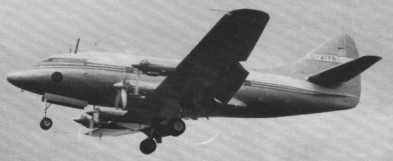
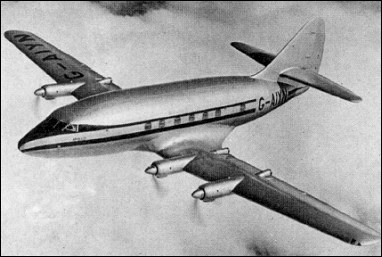
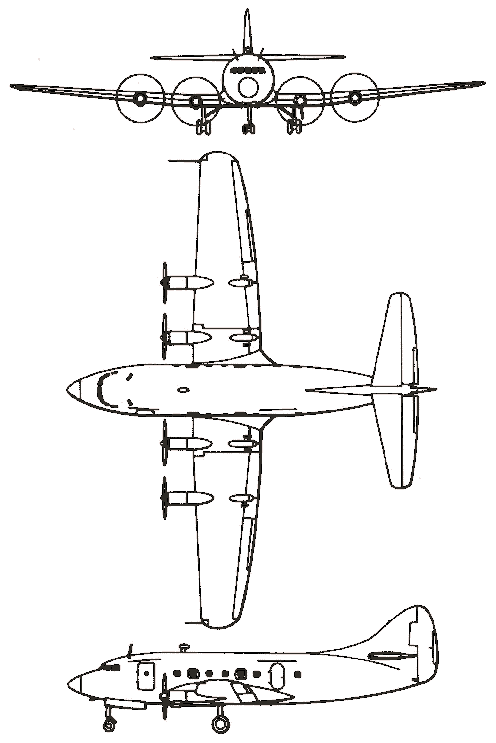
The Armstrong Whitworth AW.55 Apollo was designed as a competitor to the Vickers Viscount in response to the requirement outlined in the wartime Brabazon Committee’s Type II civil transport. It was a short- and medium-range airliner intended for operations in Europe. Specification C.16/46 to which the Apollo was designed, called for a turboprop-powered airliner to carry between 24 and 30 passengers over a range of 1609km at 483km/h.
The engine selected was the axial-flow Armstrong Siddeley Mamba centrifugal-flow turboprops but it was prone to teething problems. In the form first used on the Apollo, the engine should have developed 1010hp plus 139kg thrust, whereas it developed only 800hp.
Right from the beginning of the design, the AW.55 (first named Achilles and Avon before finally becoming Apollo) had a span of 28.04m, but length was increased from 19.66m to 20.73m and at the production stage to 21.79m, providing accommodation for between 26 and 31 passengers seated two-abreast on each side of a central aisle.
Construction began in 1948 of two flying prototypes and a fuselage for static testing. The first prototype was given the Ministry of Supply serial VX220, and made its initial flight on April 10, 1949, powered by four 1135shp A.S.Mamba A.S. Ma.1 turboprops. Control problems were remedied and the first prototype, re-registered G-AIYN, was available from October 30, 1950 for proving flights, starting with a successful flight to Paris on March 12, 1951.
In July 1951 the Mamba Mk 504 engines became available, but even these had severe limitations and problems and in June 1952 further development was halted.
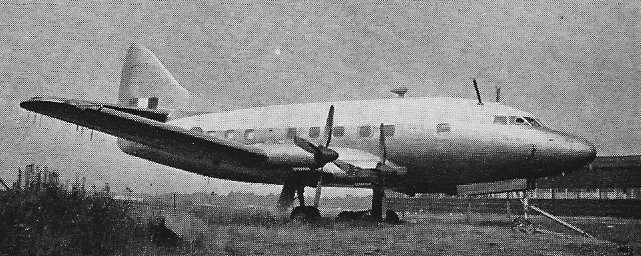
The second prototype was completed with detail modifications and flew on 12 December 1952, powered by four 1475 hp Mamba A.S. Ma.3 turboprops, and both aircraft were used for a variety of experimental work for the Ministry of Supply, which had funded them. Both aircraft became structural-test airframes in December 1954.
2nd Prototype Engines: 4 x Mamba A.S. M3.3, 1475 hp Wingspan: 92 ft Wing area: 986 sq.ft Length: 71 ft 5.5 in Height: 26 ft Loaded weight: 47,000 lb Max cruise: 310 mph at 25,000 ft Range: 1130 mi at 280 mph at 25,000 ft w/payload 7500 lb
Engines: 4 x Armstrong Siddeley Mamba Mk 504 turboprops, 750kW Take-off weight: 20412 kg / 45001 lb Empty weight: 13791 kg / 30404 lb Payload: 3402 kg / 7500 lb Wingspan: 28.04 m / 91 ft 12 in Length: 21.79 m / 71 ft 6 in Height: 7.92 m / 25 ft 12 in Wing area: 91.6 sq.m / 985.97 sq ft Cruise speed: 444 km/h / 276 mph Range: 1513 km / 940 miles Crew: 3 Passengers: 31
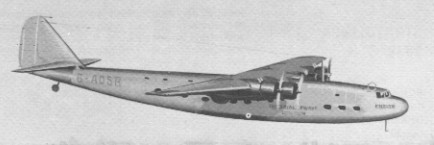
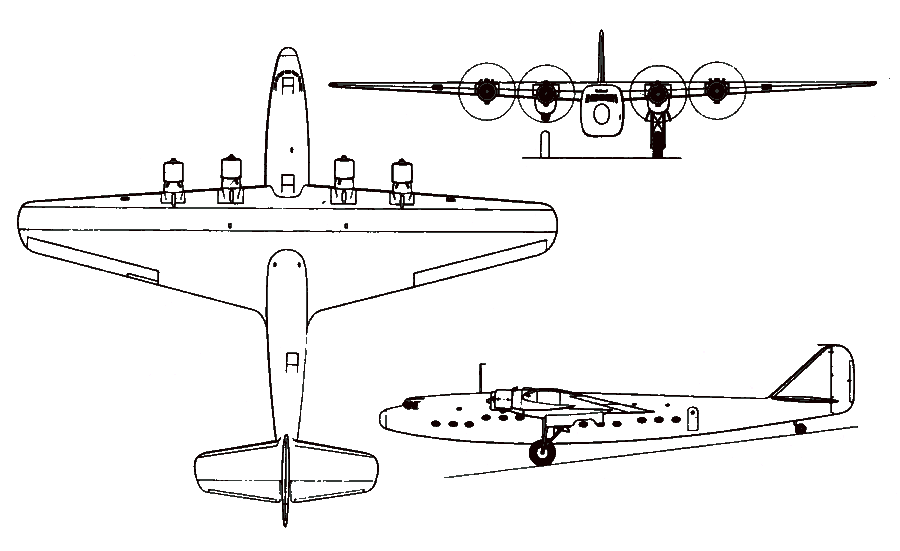
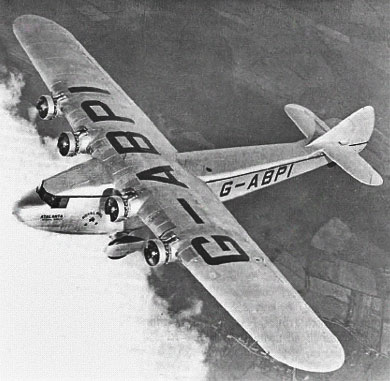
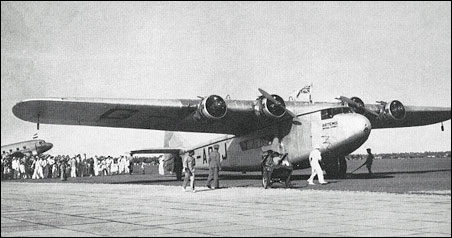
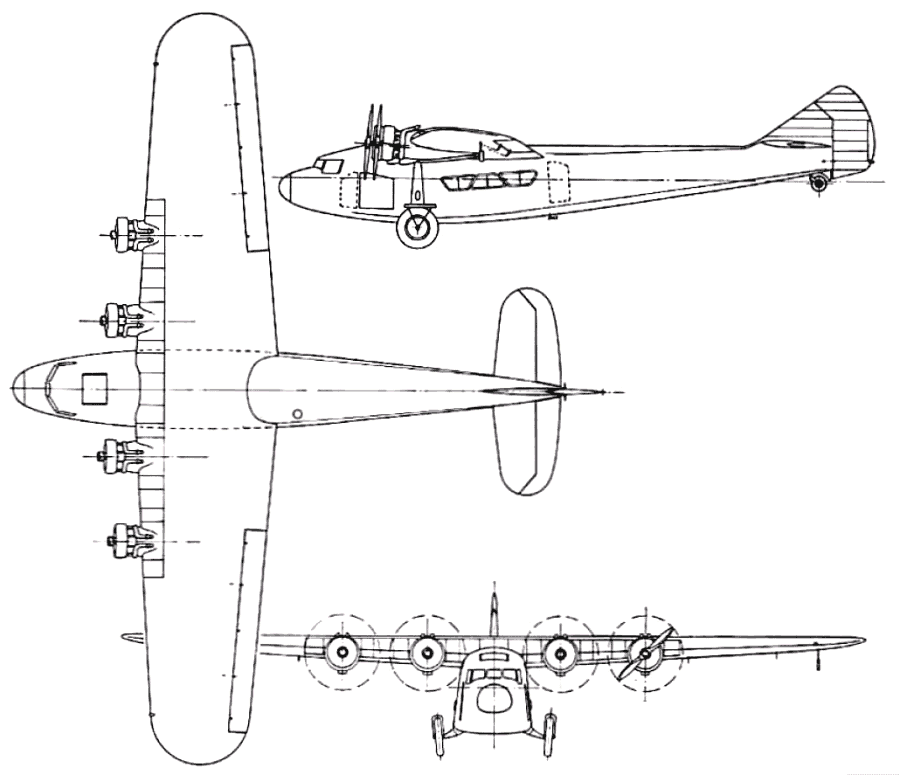
The Ensign class of airliner was designed to an Imperial Airways specification for an aircraft capable of operating Empire routes to South Africa and Australia. The aircraft was proposed in two forms: the 40-seat ‘European’ or ‘Western’ (with 12 passengers in the front cabin, 4 in the card room, 12 in the middle cabin and 12 in the rear cabin, plus 3 toilets) and the 27-seat ‘Empire’ or ‘Eastern’ (with 3 cabins and 2 toilets) which could also be configured as a 20-passenger sleeper. Both versions were externally similar, being shoulder-wing monoplanes with the four 596kW Armstrong Siddeley Tiger IX radial engines mounted in the leading edges of the wings. The fuselage had a retractable undercarriage, each main leg carrying a single large Dunlop wheel.
The design was accepted and development proceeded, albeit at a interrupted pace thanks to the changing requirements put forth by Imperial Airways, coupledd with early engine reliability issues.
Design of the Ensign was characterized by its smooth lines and high-wing mounting. The cockpit was situated at extreme forward offering up good views past the wings which were seated to the middle of the fuselage, far back from the cockpit. Oval-shaped windows dotted the fuselage sides while the fuselage bottom sagged from nose to tail tip. The main landing gear were housed in the wing roots and consisted of large donut type wheels consistent with large aircraft design of the times. Four engines were placed two to a wing in the leading wing edges and contoured nicely into the wing elements. The empennage was of a traditional layout complete with rounded fin edges. Crew accommodations amounted to five personnel that included the pilot, co-pilot, radio operator and – if needed – two cabin stewards for passenger flight. Depending on the required range, passenger seating numbers fell between 27 and 40 total personnel.
The first A.W.27 flew on 23 January 1938 and from October it flew the London-Paris service. Production was slow but three more were completed in time for mail-carrying flights to Australia in late 1938. Due to engine troubles, all broke down well short of their goal.
The sixth production A.W.27 was fitted with 637kW Tiger IXC engines driving new de Havilland three-blade constant-speed propellers, and had a modified tail unit. This arrangement became standard on all the A.W.27s.
With the outbreak of World War II the A.W.27s were used to ferry RAF personnel initially to France and then between RAF stations within the UK with No. 24 Squadron. During this period several were destroyed or damaged by German fighters. In 1941 the surviving aircraft were re-engined with 671kW Wright R-1820-G102A Cyclone radials and were known as A.W.27A Ensign Mk IIs. The AW.27 appeared in a single captured form with the Vichy French and later the Luftwaffe. With the end of the war the airliners were scrapped. Altogether 14 A.W.27s had been built.
Armstrong Whitworth AW 27 A Ensign Engine: 4 x Armstrong Siddeley Tiger IX, 779 hp Length: 114.173 ft / 34.8 m Height: 23.031 ft / 7.02 m Wingspan: 123.032 ft / 37.5 m Wing area: 2449.886 sqft / 227.6 sq.m Max take off weight: 48951.0 lb / 22200.0 kg Weight empty: 32854.5 lb / 14900.0 kg Max. payload weight: 9569.7 lb / 4340.0 kg Max. speed: 177 kts / 328 km/h Cruising speed: 147 kts / 272 km/h Service ceiling: 18012 ft / 5490 m Cruising altitude: 7005 ft / 2135 m Wing load: 20.09 lb/sq.ft / 98.0 kg/sq.m Range: 695 nm / 1288 km Crew : 3+2 Payload : 27 pax
Armstrong Whitworth AW 27 A Ensign Engines: 4 x Armstrong Siddeley Tiger IXC, 634kW Take-off weight: 22226 kg / 49000 lb Empty weight: 14392 kg / 31729 lb Wingspan: 37.49 m / 122 ft 12 in Length: 34.75 m / 114 ft 0 in Height: 7.01 m / 22 ft 12 in Wing area: 227.61 sq.m / 2449.97 sq ft Max. speed: 330 km/h / 205 mph Cruise speed: 274 km/h / 170 mph Ceiling: 5485 m / 18000 ft Range: 1384 km / 860 miles
Armstrong Whitworth AW.27 Ensign Mk I Engines: 4 x Wright GR-1820-G102A radial, 1,100hp Length: 114.17 ft (34.8m) Wing span: 123.03 ft (37.50m) Height: 23.03 ft (7.02m) Maximum Speed: 205mph (330kmh; 178kts) Maximum Range: 1,367miles (2,200km) Rate-of-Climb: 900ft/min (274m/min) Service Ceiling: 23,950ft (7,300m) Accommodation: 5 + 27 to 40 passengers Empty Weight: 35,053 lbs (15,900kg) Maximum Take-Off Weight: 55,556 lbs (25,200kg)
A.W.27A Ensign Mk II Engines: 4 x 671kW Wright R-1820-G Wingspan: 37.49 m / 122 ft 12 in Length: 34.75 m / 114 ft 0 in Height: 7.01 m / 22 ft 12 in Wing area: 227.61 sq.m / 2449.97 sq ft
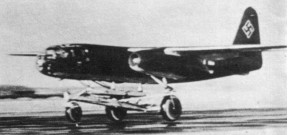
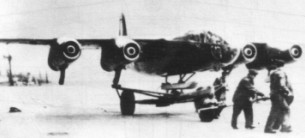
Development of the Ar 234 began in 1940 at Arado’s Brandenburg plant. The German Aviation Ministry issued an order to Dr. Walter Blume, technical director of the state-owned Arado concern, to design and build a reconnaissance aircraft propelled by the turbojet engines then under development by BMW and Junkers. Rüdiger Kosin led the design team. Initially designated the E 370, Kosin created a high-wing monoplane with two turbojet engines mounted in nacelles under the wings. The rear fuselage contained two downward-looking reconnaissance cameras. The Luftwaffe specification called for the new aircraft to have a range of 1,340 miles. To house sufficient fuel in the fuselage to meet this difficult requirement, Blume had to dispense with a conventional undercarriage. The aircraft would take off from a wheeled trolley, which would be released as soon as it got airborne. The landing would be made on three retractable skids, one under the fuselage and one under each engine.
The calculated performance figures for the E 370 were a maximum speed of 485 mph at 20,000ft, a maximum operating altitude of more than 35,750ft, and a maximum range, excluding reserves, of 1,250 miles. The range was down on the stated requirement, but the Luftwaffe Technical Office approved the design and ordered the construction of two prototypes. At that point the aircraft received its official designation: Arado Ar 234. By the end of 1941 the two Ar 234 prototypes were almost complete, except for their engines. The fuselage of the Ar 234 was a circular section, semi monocoque structure with flush riveted stressed skin with a single seat cockpit in the extreme nose. The centre section, in the region of the wing and landing gear attachments, was of reinforced box girder construction. The radio equipment and tail braking parachute were stowed in the rear fuselage.
Ar234V6
This all metal cantilever monoplane’s wings were made in one piece, each a two spar structure with a flush ¬riveted stressed skin covering. The Frise ailerons had mass balanced geared tabs on their inner ends and hydraulically operated flaps were mounted inboard and outboard of the jet engines. Outboard of the jet engines were three inset lugs for the attachment of Walter 109-500 liquid fuelled rocket booster pods to assist take off. Each pod developed 1,100 lb thrust for 30sec. When the fuel was exhausted the pods parachuted to earth for reuse. The metal fin had a detachable wooden leading edge, behind which was a radio aerial. The all metal rudder had tabs along its entire trailing edge, the upper tab being geared and the lower controlled from the cockpit. The cantilever tailplane was an all metal stressed skin structure, pivoted on self aligning bearings at the leading edge. Incidence of the entire surface could be varied by a screwjack controlled by a lever in the cockpit. The narrow chord metal elevators had no trim tabs, and a single mass balance weight in the fuselage served for both the elevators and rudder. The fuel capacity was 836 Imp.gal, contained in the two fuselage tanks, one aft of the cockpit and one aft of the wing attachment fittings. There was provision to carry one 66 Imp.gal drop tank under each engine. Some aircraft were fitted with two 20mm MG 151/20 cannon in a fixed rearward firing mounting. Sighting was by means of a PV1 B periscopic gunsight, when turned to look rearwards. The gunsight graticule was reversed and inverted, so the pilot saw the target aircraft back to-front and upside down, and would then fly the Arado to place the sight on the target as if the aircraft he was engaging was in front of him. There is little evidence that the system was used successfully in action. A standard load for operations would be 1,100 lb, comprising either a high ¬explosive bomb or a cluster bomb unit carried beneath the fuselage. Although Arado completed the Ar 234 V1 airframe in late 1942, the Junkers company encountered severe problems in trying to get its new turbojet engine to run controllably and with a reasonable running life. Not until February 1943 did Arado receive its first pair of 004 engines, and these were not flight ¬cleared. They were installed in the Arado 234V1 first prototype, which then underwent static ground running and taxying trials. In the late spring of 1943 two flight cleared Jumo 004s finally become available. Even before it made its maiden flight, the aircraft was being considered for the bomber role. The subject arose at a conference at the Air Ministry in Berlin on July 1943.
Ar 234B
The Ar 234 V1 did not fly until July 30, 1943, from Rheine Airfield near Munster, with Flugkapitan Selle at the controls. There was a problem with the take off trolley. As briefed, Selle released the trolley when the aircraft reached 200ft. It fell away cleanly, but the retarding parachutes failed to deploy fully and the trolley was wrecked on hitting the ground. The company rushed a replacement trolley to Rheine for the second flight, but that was also destroyed after the parachutes again failed to open properly. After these mishaps it was decided to release the trolley when the aircraft reached flying speed, and thereafter it seldom left the ground. Further prototypes followed including the Ar 234 V6 and Ar 234 V8 which were powered by four 800 kg (1,764 1b) thrust BMW 003A-1 turbojets. The test programme gradually gained momentum, although there was a setback on October 2 when Selle was killed when the second prototype crashed during a test flight. By the end of September 1943 three further Ar 234 prototypes had flown, and a bomber version was under active consideration. The Air Ministry directed Arado to redesign the landing gear and give the jet a bombing capability and ordered two prototypes of a new version, the Ar 234B, fitted with a conventional tricycle undercarriage retracting into the fuselage. Kosin and his team enlarged the fuselage slightly to accommodate a conventional tricycle landing gear and added a semi-recessed bomb bay under the fuselage. To allow the pilot to act as a bombardier, Kosin mounted a Lotfe 7K bombsight in the fuselage floor ahead of the control column, which the pilot swung out of his way to use the sight. A Patin PDS autopilot guided the aircraft during the bombing run. The pilot-bombardier used another periscope sight during shallow-angle, glide bombing. The first prototype for the revised design, designated Ar 234 V9, flew on March 12, 1944.
The Ar 234 B had two fuel tanks mounted in the fuselage. The forward tank held 1800 lt / 396 Imp.Gal and the rear tank held 2000 lt / 440 Imp.Gal.
Refuelling Ar 234B at Rheine autumn 1944.
Four further trolley mounted aircraft flew during December 1943 and the early months of 1944: the 5th and 7th prototypes, similar to the earlier machines; the 6th prototype, with four 1,760 lb thrust BMW 003 turbojets in separate pods under the wing; and the 8th prototype with four BMW 003s paired in wing pods. To enable the aircraft to take off fully loaded from short runways when there was little or no wind, the third prototype and subsequent twin-engined aircraft had provision for the installation of a Walter 109 500 liquid fuelled rocket booster pod under each outer wing section. Weighing 616 lb apiece, the booster pods developed 1,100 lb of thrust and carried sufficient hydrogen peroxide and sodium permanganate for about 30sec running. A system of inter-connected electrical pressure switches ensured that if one pod failed to deliver thrust, that on the fuselage or on racks mounted beneath the engine nacelles.
Ar234C
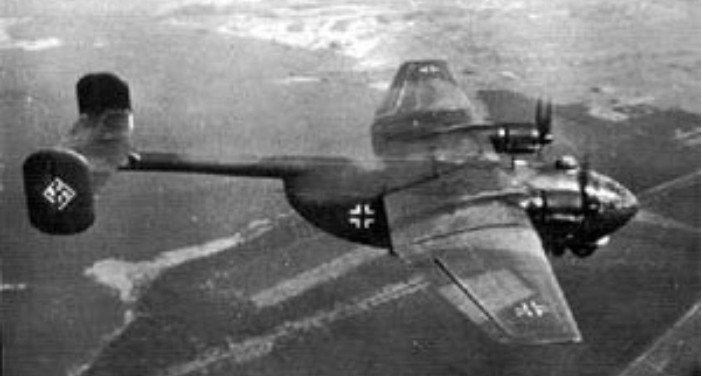
The Ar 234B 1 was an unarmed reconnaiss¬ance aircraft which first served with 1 Versuchsverband OberbefehIshaber der Luftwaffe late in 1944, and soon after with Sonderkorrimando Hecht and Sperling. These units were re¬placed in 1945 by 1 (F) 33, 1 (F) 100 and 1 (F) 123, and many reconnaissance sorties were flown over the UK. The bomber version, designated Ar 234 B-0, became the first subtype built in quantity. The Air Ministry ordered 200 Ar 234 Bs and Arado built them at a new Luftwaffe airfield factory at Alt Lönnewitz in Saxony. The factory finished and delivered all 200 airplanes by the end of December 1944 but managed to roll out another 20 by war’s end. The initial order had called for two versions of the Ar 234 B: the B-1 reconnaissance aircraft and the B-2 bomber but Arado built only the B-2 version. The company converted B-2 airframes into reconnaissance aircraft. The bomber version was the Ar 234B 2, which could carry a bombload of 2000 kg (4,409 lb), and other variants included the Ar 234B 2/b reconnaiss¬ance aircraft the Ar 234B 2/1 path¬finder and Ar 234B 2/r long range bomber. Ar 234B 2 bombers joined KG 76 in January 1945 and carried out a number of raids before the end of the war. The Ar 234B’s undercarriage was of retractable tricycle type. The nose¬wheel retracted into a compartment aft of the cockpit, and was fitted with a spring and cam centralising and anti shimmy device. The main wheels retracted forward and inwards into the fuselage, and were of unusually narrow track.
The bomber version had an effective operating radius of action, carrying a 1,100 lb bomb one way and allowing reasonable fuel reserves, of about 300 miles at high altitude, or about 120 miles if the aircraft remained at low altitude. In the reconnaissance role at high altitude with two 66gal drop tanks, the aircraft had a radius of action of about 450 miles. Three modes of bombing attack were possible with the Ar 234B. The shallow dive attack, the horizontal attack from low altitude and the horizontal attack from high altitude. The shallow dive attack was the most used method, and typically involved a nose down throttled back descent from about 16,250ft to 4,500ft, during which the pilot sighted his bombs using the periscopic sight protruding from the top of his cabin.
The low altitude horizontal attack was employed only when poor visibility or low cloud at the target precluded any other method. The pilot simply ran low over his target and released the bombs by eye.
The high altitude horizontal attack used normal map ¬reading or radio navigational methods to an initial point about 18 miles from the target. He then engaged the Patin three axis autopilot and swung his control column out of the way to his right. This done, he loosened his shoulder straps and leaned forward to the bomb aiming position, over the eyepiece of the Lotfe bombsight. The bombsight’s controls were connected to the aircraft’s automatic pilot via a simple form of computer. The pilot adjusted the bombsight controls to hold the graticule over the target; the bombsight then fed the appropriate signals via the computer to the autopilot and thus “flew” the aircraft through its bombing run. When the aircraft reached the bomb release position, the system released the bombs automatically. The pilot then straightened up in his seat, tightened his shoulder straps, retrieved the control column, switched oft the autopilot and turned the aircraft around for home.
An innovation introduced with the Ar 234B was the use of a tail brake parachute to shorten the landing run. It was the first combat aircraft to have this fitted as standard.
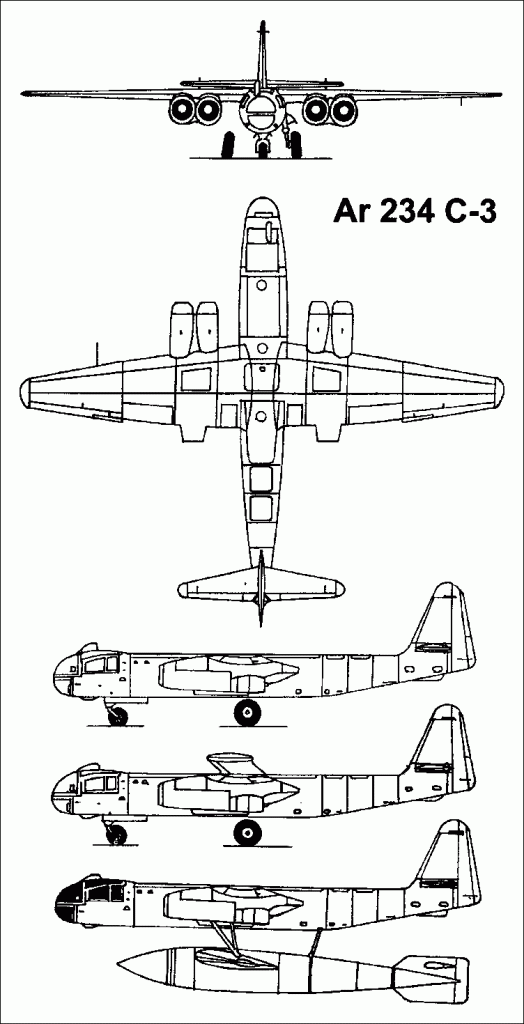
Plans called for more advanced versions of the Arado jet, including the Ar 234 C powered by four 1,760 lb thrust BMW 003 A-1 engines and fitted with a pressurized cockpit. Subvariants of the “C” model included the C-3 multi-role aircraft and the C-3N two-seat nightfighter. However, only 14 Ar 234 Cs left the Arado factory before Soviet forces overran the area. The four-engine Ar 234 was, however, the fastest jet aircraft of World War II. With the extra engine thrust this version could take off fully laden from shorter airfields without the use of booster rockets. Peter Kappus, a test pilot with BMW who flew the Ar 234C, later recalled: “The four engined Ar 234C had a very high performance in the take off and the climb. But it could not be flown at full power horizontally, because at the very high speeds reached it structural flutter problems.”
Prototypes for the more advanced Ar 234 D reconnaissance aircraft and bomber with provision for a second crewman were under construction but not completed at war’s end.
Early in 1945 a few Ar 234Bs were modified for use as night-fighters with Kornmando Bonow. These aircraft carried the FuG 218 Neptun radar, with nose-mounted aerials. The radar operator sat in an improvised position inside the rear fuselage, aft of the wing. For this role the Ar 234B was armed with two 20mm MG 151 cannon in a pack mounted under the fuselage. One idea tried out as a means of increasing the radius of action of the Ar 234 bomber was to tow a V1 flying bomb, with the warhead, engine and tailplane removed and a wheeled undercarriage fitted, to carry extra fuel. The idea was not a success and the scheme was never tried in action. During March 1945 Soviet troops advanced into eastern Germany, and the Arado plant at Alt Loennewitz came under threat. To prevent it failing into enemy hands, German Army engineers destroyed the factory with explosives. This brought production to a precipitate halt, after just 210 Ar 234Bs and 14 Ar 234Cs had been delivered to the Luftwaffe. The Arados reached their high point with their prolonged attacks on the big Remagen bridge across the Rhine, and their 1 000 kg (2,205 1b) bombs dropped from low level in shallow dive attacks finally brought the bridge down after 10 days on 17 March 1945. But by then the Allied armies were well into Germany. About 60 of the 210 Arados delivered were captured in flying condition, and most Allied countries had a whole squadron of them in mid 1945. Apart from the critical nature of some take offs, the Ar 234 was found to be a fine aircraft, with no severe Mach trouble up to 0.8 and a range in clean condition of well over 1610 km (1,000 miles).
Characteristics The take off run was long, but single engine safety speed was 140 mph (225km/h) when the aircraft would swing and bank, although not violently, and provided corrective action was taken within 2sec it could be held straight without loss of height. Flaps were raised after reaching 155 m.p.h. (250km/h) and then speed for the initial climb built up to 250 m.p.h. (400km/h). This was reduced to 235 m.p.h. (380km/h) after passing through 26,250ft (8,000m) altitude to give optimum rate of climb. The maximum initial climb rate was 2,500ft/min (12.7m/sec) but had reduced to 1,800ft/min (9.14m/sec) by 10,000ft (3,000m) and to 1,000ft/min (5.08m/sec) by 20,000ft (6,000m). These figures were certainly good for a 1945 vintage reconnaissance bomber but the top speed of 475 mph (765km/h) was what made Blitz so appropriate a name for the Ar 234B. The Blitz handled beautifully at high altitude, its stability about all axes being positive and the harmony of control being good. These characteristics, allied to the superlative view that it offered its pilot, made the Ar 234B a first class platform for photography or bombing. Quality control was suffering adversely in the chaotic conditions prevailing in the German aircraft industry as a result of the heavy Allied bombing attacks. On the Blitz the extremely sharp nosed Frise ailerons were very sensitive to rigging errors and could misbehave violently at speeds above 370 m.p.h. (600km/h), a common fault being rapid oscillation of the ailerons The Blitz suffered from directional snaking, and as often as not this undesirable characteristic was aggravated by poor manufacturing standards on the rudder which sometimes came out fatter or thinner than the fin profile. The Arado company failed to tackle this problem, merely rectifying the fault by off-setting the rudder hinge to one side, or by rigging the balance and trim tabs out in opposite directions. German test pilots did not investigate the high Mach characteristics of the Ar 234B, although normal production testing involved a dive from 10,000ft (3,000m) up to a true speed of 530 m.p.h. (850km/h) low altitude work that did not involve compressibility effects. The transonic region was, therefore, virtually fresh ground for the Royal Aircraft Establishment. In a series of dives from an altitude of 30,000ft (9,100m). The Blitz accelerated less than expected from maximum cruising speed and so a dive of some 30 degrees was needed to achieve the desired entry into the compressibility region before too much altitude was lost. This also entailed using nose down trim, as otherwise the push force to hold the dive angle became too high. At M0.76 nose heaviness set in and the elevator began to feel sloppy. These effects were accentuated until at M0.82 full backward pull on the stick was required to hold the dive angle constant and to allow the loss of altitude to have its density effect on reducing true airspeed until recovery could be effected. For its role as a reconnaissance bomber, therefore, the Ar 234B had a tactical Mach number of 0.75 while its top speed at around 30,000ft (9,145m) was about M0.72. The low speed end of the performance envelope displayed extremely docile characteristics at the stall, this being a straightforward and gentle nose drop. Stalling speed in landing condition was 112 m.p.h. (180km/h). Landing was very easy since the view from the cockpit was superb. The maximum speed for lowering the undercarriage was 250 m.p.h. (400km/h) and then flaps to 25O at 200 m.p.h. (320km/h). It was best to apply full 45O flap after turning on to the final approach at about 175 m.p.h. (280km/h), reducing speed to 130 mph (210km/h), and, when sure of making the airfield, easing back the throttles to idling at 4,000 rpm., crossing the boundary at 125 mph (200km/h). The landing run was lengthy as the rather ineffective brakes faded badly, having to be held on continuously throughout the ground run. All versions of the Blitz had a braking ‘chute fitted which halved the landing run.
Operations The 5th and 7th prototype Ar 234s each carried a pair of Rb 50/30 aerial cameras mounted nearly vertically in the rear fuselage. Fitted with 50cm long focus lenses, the cameras were splayed outwards away from each other at 120 to the vertical, perpendicular to the line of flight. From 32,500ft this split pair camera arrangement took in a swathe of ground just over 6 miles wide along the aircraft’s track. The 5th and 7th prototypes were delivered to the Versuchsverband der Oberkommando der Luftwaffe (Luftwaffe High Command Trials Detachment) based at Oranienburg, a special reconnaissance unit under the direct control of the Luftwaffe High Command. Oberieutnant Horst Goetz took command of the Arado 234 detachment, and he and another pilot, Leutnant Erich Sommer, began learning to fly the new aircraft. In mid July 1944 Goetz received orders to move the Ar 234 detachment to Juvincourt, near Reims in France, to begin reconnaissance operations over the Western Front. From the start there were problems. On July 17 the two Arados took off from Oranienburg, but soon after getting airborne Goetz suffered an engine failure and had to turn back. Sommer continued on to Juvincourt, and landed without incident. After landing, his aircraft was hoisted on to a low loading trailer and towed into a hangar. Then the world’s most advanced reconnaissance aircraft had to remain, unusable, until its tailor¬-made take off trolley arrived from Oranienburg by rail (since there were minor differences between the two hand built prototypes, their take off trolleys were not interchangeable). By that time the Allied bombing campaign had reduced the French rail system to a state of near chaos. Despite the high priority accorded the move, more than two weeks elapsed before the trucks carrying the take¬off trollev reached Juvincourt. At last, on the morning of August 2, everything was ready for Sommer to set out on the world’s first jet reconnaissance mission. It took Sommer about 20min to climb to 34,000ft, by which time the Arado was almost over the battle area. High over the Cherbourg Peninsula he turned the aircraft on to an easterly heading, eased down the nose and descended to build up his speed to about 462 mph. He levelled off and concen¬trated on flying exactly straight and level for his first photographic run. The doors protecting the camera lenses were open, and Sommer flicked the switch to activate the two cameras. The automatic mechanism on each camera took one picture every 11 sec. If any Allied fighter attempted to catch the high flying Arado, Sommer never noticed it. That first photographic run, taking in the coastal strip, lasted about 10 min. Then Sommer turned through a semi circle and levelled out, heading due west for a second run parallel to the first and about 6 miles inland. The second run completed, he turned on to an easterly heading and flew a third run 6 miles further inland and parallel to the previous two. Near the end of the third run the counters on the camera panel clicked to zero. In a flight lasting less than 90min he had photographed almost the entire Allied lodgement area in Normandy. The 380 photographs he had taken caused a considerable stir. During the three weeks that followed the two aircraft flew 13 further missions. On August 28 American tanks neared Reims, and Goetz received orders to move the two Ar 234s from Juvincourt to Chibvres in Belgium. As Goetz prepared to land at Chievres, the ground defences, long conditioned to treat any approaching aircraft as hostile, opened fire at him. An accurate shell struck the Ar 234 just beneath the cockpit, knocking out the aircraft’s electrical and hydraulic systems. Goetz broke off his approach and found that his flaps and landing skids would not extend. The aircraft was still flyable, however, so he flew it back to Oranienburg, where there were proper repair facilities. There Goetz made a skilful flapless belly landing, touching down at about 190 m.p.h. The valuable aircraft came to a halt having suffered remarkably little damage, and Goetz climbed out of the cockpit. Then the Arado received its coup de grace. A young fighter pilot taking off from the airfield, not expecting such an obstacle to be in his path, ran straight into the rear of the Arado and the propeller of his aircraft severed the complete tail unit. Goetz emerged with cuts from stones and flying glass, and was unable to see clearly for a couple of weeks. The Ar 234 was wrecked. Sommer landed his Ar 234 at Chievres without difficulty, then as Allied tanks approached the area he had to move to Volkel in Holland a few days later. Sommer was there on September 3, when over 100 RAF Lancasters carried out a heavy daylight attack on the airfield. Although the landing ground and camp areas were pockmarked with craters, Sommer’s Ar 234 sat undamaged in its hangar The airfield was judged unusable for normal operations, so on the following day, September 4, Sommer made a trolley take off from one of the taxy tracks after some of the craters had been filled in. He landed the Ar 234 at Rheine, near Osnabruck, the new base for jet reconnaissance operations. The withdrawal of the unit to Germany coincided with an end to missions using the take off trolley, for in September the Ar 234B with a normal undercarriage became available. The slightly wider fuselage necessary to accommodate the undercarriage reduced the maximum speed by about 20 mph, but still the aircraft was fast enough to avoid fighter interception. There was also a reduction in the radius of action, but there was provision to carry a 66gal drop tank under each engine for the longer missions. In return for these limitations the Ar 234B was a considerably more versatile machine able to operate from airfields without specialist ground equipment. At Rheine, Goetz’s unit, now designated Kommando Sperfing (Sparrow), gradually built up to nine Ar 234Bs and flew almost daily reconnaissance missions. Standing patrols over the airfield by Allied fighters posed a continual problem, however. The only time an airborne Ar 234 was vulnerable to fighter attack was when it was flying slowly immediately after take off, or before landing. On January 10, 1945, the Luftwaffe Quartermaster General’s list recorded only five reconnaissance Ar 234Bs in service, four with Kornmando Sperling and one with Kornmando Hecht. From September 1944 until the end of the war the reconnaissance Ar 234Bs operated regularly, photographing Allied positions with minimal interference. Early in 1945 Goetz’s Kornmando Sperling had been expanded into a Staffel, and it was redesignated as 1st Staffel of Fernaufklarungsgruppe (FAGr long range reconnaissance group) 123. Two other reconnaissance Staffeln also re equipped with the Ar 23413, one being attached to FAGr 100 and one to FAGr 33. In addition, Erich Sommer had formed his own unit, Kornmando Sommer, equipped with three Ar 234Bs and operating on the Italian front. Not until February 11, 1945, after more than six months, was a reconnaissance Ar 234 lost to an Allied fighter. On that day Scin Ldr David Fairbanks was leading an armed reconnaissance by eight Hawker Tempests of 274 Sqn RAF when he spotted a lone jet aircraft which he took to be an Me 262. After a lengthy chase he caught up with the machine as it slowed to land at Rheine, and shot it down. It was an Ar 234B of Goet’s unit, piloted by Hptm Hans Felden, returning from a photographic mission over Hull. Felden was killed. Kornmando Sommer, based at Udine in Italy, suffered its only pilot loss on April 11. Leutnant Gunther Gniesmer was near Bologna when he had the bad luck to run into a formation of bombers escorted by P 51s of the 52nd FG. Lieutenants Hall and Cooper succeeded in reaching firing positions, and shot him down. Gniesmer baled out, but as he fell clear he struck the tailplane and died in hospital a few days later. The Ar 234 was consistently successful in penetrating deep into enemy territory and bringing back vital pictures. These flights often went undetected by the enemy, and if they were detected the Arados were difficult to shoot down. During the early morning darkness of January 1, 1945, Lukesch led four Ar 234Bs for the world’s first night jet bombing mission. The aircraft took off from Munster Handorf and flew a circular route which took them over Brussels and Liege, dropping bombs on each. The bombing was intended to deceive the enemy rather than cause damage, however. The aim of the mission was to report on the weather over Belgium and Holland in preparation for Operation Boden¬platte (Baseplate), the massed Luftwaffe attack on Allied airfields scheduled to open soon after dawn. By the end of 1944 the Luftwaffe had accepted 148 Ar 234Bs. Yet on January 10, 1945, the Quartermaster General’s list recorded only 12 Ar 234B bombers in front line service, of which 11 were serviceable. All served with 9th Staffel of KG76. By then the remainder of the Geschwader was in the process of re equipping with the type, but about half of the Ar 234s built were sitting in aircraft parks. The crescendo of Allied air attacks on the German transport system greatly hindered the formation of operational units equipped with the Ar 234B, as with other new types. On April 10, 1945, the last date for which figures exist, the Quartermaster General’s report listed a mere dozen Ar 234Bs in service with operational bomber units, of which four were serviceable. The largest attack by Arados on a single day, on February 27, 1945, involved only 37 Arado sorties. The total bomb load carried, 18.25 tons, caused only minor inconvenience to the Allied troops dispersed over a large area.
On 10 April 1945, an Arado 234B-1 reconnaissance aircraft took off from Sula Airfield in Stavanger, Norway. The plane took photographs of Scotland and landed back at Sala 2 hr 30 min later. The Luftwaffe had just ended its last mission over Britain.
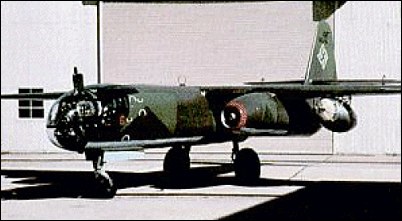
The National Air and Space Museum’s Blitz, an Arado Ar 234 B-2 bomber carrying Werk Nummer (manufacturer’s serial number) 140312, was one of nine Ar 234s surrendered to British forces at Sola airfield near Stavanger, Norway. It is the sole surviving example of an Ar 234. The aircraft had been on strength with 9./KG 76 (Ninth Squadron/ bomber Wing 76) during the final weeks of the war, having served earlier with the unit’s eighth squadron. It and three other Ar 234s were collected by the famous “Watson’s Whizzers” group of the USAAF (United States Army Air Forces) for shipment to the United States. After flying from Sola to Cherbourg, France on June 24, 1945, the four Ar 234s joined thirty-four other advanced German aircraft aboard the British aircraft carrier HMS Reaper for shipment to the United States. The Reaper departed from Cherbourg on July 20, arriving at Newark, New Jersey eight days later. U. S. Army Air Forces personnel reassembled and flew two Ar 234s, including 140312, to Freeman Field, Indiana, for testing and evaluation. The USAAF assigned the foreign equipment number FE-1010 to this Ar 234 for inventory and tracking purpose. The only surviving example was in 2004 on display at the Steven F Udvar Hazy Center at Dulles Airport in Washington DC.
Arado Ar 234 B Blitz Engine : 2 x Jumo 004 B, 8731 N Length: 41.535 ft / 12.66 m Height: 13.78 ft / 4.2 m Wingspan : 47.375 ft / 14.44 m Wing area : 298.163 sqft / 27.7 sq.m Max take off weight : 21609.0 lb / 9800.0 kg Weight empty : 11466.0 lb / 5200.0 kg Max. speed : 410 kts / 760 km/h Landing speed : 79 kts / 146 km/h Cruising speed : 378 kts / 700 km/h Service ceiling : 32808 ft / 10000 m Wing load : 72.57 lb/sq.ft / 354.00 kg/sq.m Range : 864 nm / 1600 km Crew : 1 Armament : 2x MG 151 20mm, 1000kg
Ar 234B 1 Type: unarmed reconnaiss¬ance aircraft.
Ar.234B-2 Engines: 2 x Junkers Jumo 004B turbojets, 890kg / 1,980 lbs Wingspan: 14.10 m / 46 ft 3 in Length: 12.64 m / 41 ft 6 in Height: 4.30 m / 14 ft 1 in Wing area: 26.40 sq.m / 284.17 sq ft Max take-off weight: 9850 kg / 21716 lb Empty weight: 5200 kg / 11464 lb Max. speed: 740 km/h / 460 mph / 401kt Ceiling: 10000 m / 32800 ft Range: 1630 km / 1013 miles Armament: 2 x 20mm rear-firing cannons (periscope operated) Bombload: 2000kg / 4,410 lb Crew: 1
Ar234B 2 Blitz Engines: 2 x 1,980 lb thrust Junkers Jumo 004B jet engines, plus two 1,100 lb thrust Waiter 109 500 liquid fuelled rocket booster pods. Wing span: 47ft 3.25in. Length: 41ft 5.5in. Height (on ground over fin): 14ft 1.25in. Wheel track: 6ft 8.75in. Gross wing area: 290.6sq.ft. Normal take off wt: 18,522 lb. Max permissible take off weight without rocket assistance: 19,514 lb. Maximum permissible take off weight with rocket assistance: 22,050 lb. Normally loaded wt, with two booster rockets and a 500kg bomb: 20,870 lb. Maximum speed (clean): 461 mph. at 19,500ft. Max speed with 500kg bomb: 430 mph at 19,500ft. Range at 19,500ft carrying 500kg bomb, no res: 970 miles. Climb to 19,500ft carrying 500kg bomb: 12min 48sec.
Ar 234B 2 Type: single seat tactical light bomber. Engines: two 800 kg (1,764 1b) thrust BMW 003A 1 turbojets. Wing span: 14.44 m (46 ft 3.5 in) Length: 12.64 m (41 ft 5.5 in) Height: 4.29 m (14 ft 1.5 in) Wing area: 27.3 sq.m (284.17 sq.ft). Empty weight: 5200kg (11,4641b) Max take off weight: 9800 kg (21,605 lb). Fuel cap: 3750 lt (825 Imp gal) diesel. Max speed: 742 km/h (461 mph) at 6000 m (19,685 ft) Climb to 6000 m (19,685 ft): 12.8 min. Service ceiling: 10000 m (32,810 ft). Range: 1630 km (1,013 miles). Armament: bombload of up to 2000 kg (4,409 lb); some aircraft carried two rear firing MG 151 20 mm guns.
The Arado Ar 232 was built around a monocoque fuselage, designed for cargo-carrying capacity.
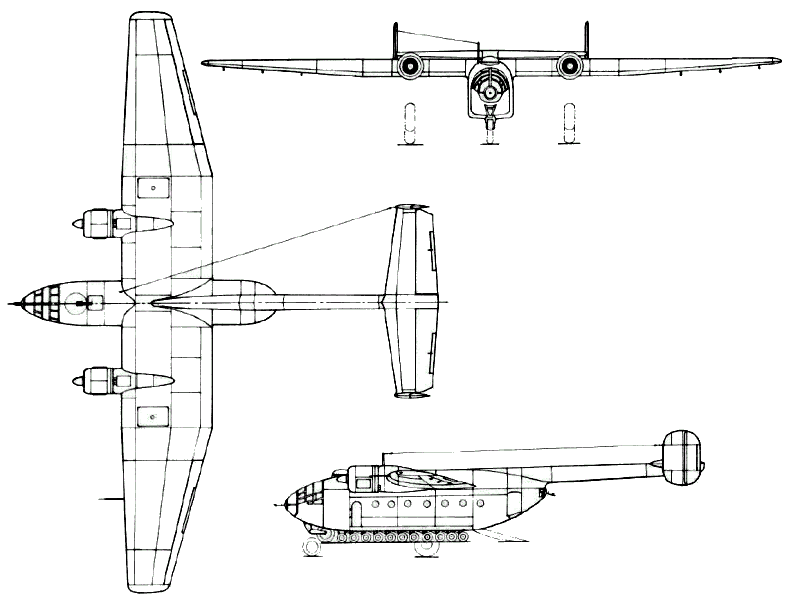
Known unofficially as the “millipede” (or “Tausendfussler”) thanks to the many sets of wheels utilized in the undercarriage arrangement, the Ar 232 system saw only a limited production run with no more than 22 total examples made. To that end, the Ar 232 served in an equally-limiting capacity for Luftwaffe special operations missions and one other transportation air group.
Powered was four Bramo piston engines, two mounted on each wing, each generating 1,200 horsepower. The wings were of a high monoplane with a twin-fin tail assembly. Armament was defensive and included a nose-mounted 13mm machine gun, a 20mm cannon in a dorsal turret mounting and one or two 13mm machine guns mounted at rear.
The landing gear featured a retractable main nosewheel type gear and a secondary gear of ten pairs of smaller wheels on shorter legs situated under the fuselage. The smaller wheels were normally off the ground but took the weight of the aircraft during loading and unloading when the main undercarriage legs were reduced in length to facilitate cargo handling.
The first prototype Ar.232 flew in 1941 powered by two 1,192kW BMW 801MA radial engines.
The Ar 232 series included “A” and “B models. The difference was in the choice and number of powerplants. Aircraft were built as Ar.232As or B-0s and Ar.232Bs, most of which were powered by four 894kW BMW Bramo 323R-2 radials and carried a crew of four and about 4,500kg of cargo (including vehicles).
Ar.232s, including the prototypes, served with the Luftwaffe from 1942 until 1944.
Engines: 4 x BMW 801MA radial, 1193kW Take-off weight: 21135 kg / 46595 lb Empty weight: 12802 kg / 28224 lb Wingspan: 33.50 m / 109 ft 11 in Length: 23.52 m / 77 ft 2 in Height: 5.69 m / 18 ft 8 in Wing area: 142.60 sq.m / 1534.93 sq ft Ceiling: 8000 m / 26250 ft Range: 1060 km / 659 miles
Engine: 4 x BMW Bramo 323 R-2 Fafnir, 986 hp Wingspan: 109.908 ft / 33.5 m Length: 77.1 ft / 23.5 m Height: 18.701 ft / 5.7 m Max take off weight: 46657.8 lb / 21160.0 kg Weight empty: 22667.4 lb / 10280.0 kg Max. speed: 183 kt / 338 km/h Service ceiling: 26247 ft / 8000 m Range: 702 nm / 1300 km Armament: 3x MG 131 13mm, 1x MG 151 20mm
Arado Ar 232 Tausendfussler (Millipede) Engines: 4 x Bramo 232-R Fafnir radial, 1,200hp each. Length: 77.17ft (23.52m) Wingspan: 109.91ft (33.50m) Height: 18.70ft (5.70m) Maximum Take-Off Weight: 46,650lbs (21,160kg) Maximum Speed: 211mph (340kmh; 184kts) Maximum Range: 830miles (1,335km) Service Ceiling: 22,638ft (6,900m) Armament: 1 x 20mm cannon (in dorsal turret) 1 x 13mm machine gun (nose-mounted) 1 or 2 x 13mm machine gun(s) (rear position mount) Crew: 4
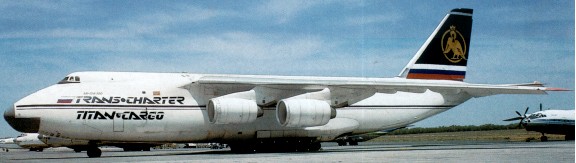
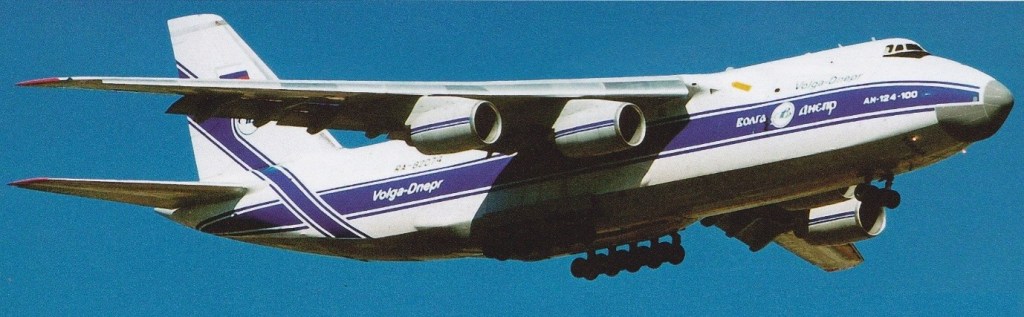
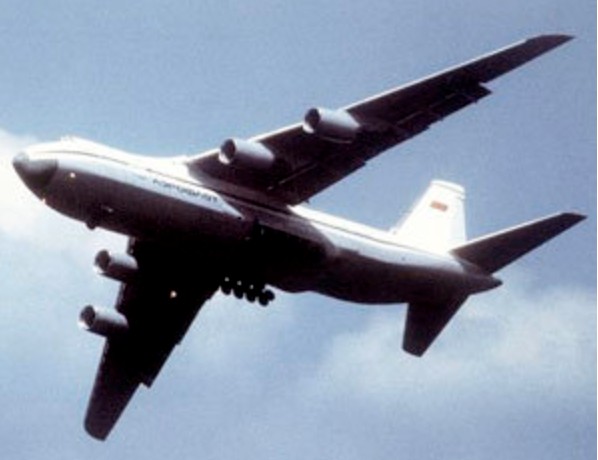
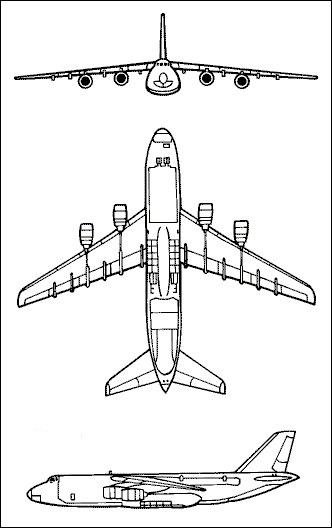
The An-124 strategic airlifter, Nato code name Condor, first flew on December 26, 1982 with Vladimir Terski at the controls, and at least nine had been built by June 1987. At the time of its first flight, the An-124 was the largest aircraft in the world. The An-124 is powered by four 230kN-thrust Lotarev D-18T high-bypass turbofans, and is claimed to carry its 150-tonne maximum payload over 4,500km. Designed for simultaneous nose and tail loading, with a visor-type lifting nose and integral forward-folding ramp, the pressurised cargo hold is 36m long, 6.4m wide, and 4.4m high. A pressurised upper deck can accommodate 88 passengers. The An-124 has a six-man crew (two pilots, two engineers, a navigator and a radio operator), dual weather and ground mapping raders, quadruplex inertial navigation, and anologue fly-by-wire controls with mechanical backup operating hydraulic control servos. Two overhead travelling cranes, which have a lifting capacity of 30 tonnes, and two winches allow heavy cargo to be self-loaded without the use of special airport loading equipment. To enable the carriage of extremely heavy cargo, HeavyLift-Volga-Dnepr have developed special loading systems allowing individual items of up to 100 tonnes to be loaded. In addition, two double-deck car-racking systems have been built allowing up to 50 cars to be carried in one flight. Approximately 5,500kg of composite materials are used in doors, fairings, and panels, including 3,000kg of carbonfibre, giving a 1,800kg overall weight saving.
The second aircraft, named Ruslan, appeared at the 1985 Paris Air Salon. The aircraft entered service with Aeroflot in early 1986, and now serves principally on the Siberian run, carrying outsize items to the oil and mineral exploitation industries. In 1987 the An-124 began service with the air force. Production is reportedly eight to ten aircraft per year, and by 1989 over 25 had been completed. The An-124 was assigned the NATO reporting name ‘Condor’. The An-124-100 is a civil varient, certified in Russia. They are built one at a time and take about three and a half years to construct. Its 24-wheel undercarriage allow it to go into semi-prepared strips and the two nose-wheel units can be retracted on the ground allowing the aircraft to ‘kneel’ to assist loading. The large undercarriage system, the full-span, leading-edge slats and flaps give the An-124 very good short field performance. Full-span leading-edge slats and large flaps give the An-124 short field capability, while its 20 main wheels allow the type to use rough fields.. Civil examples were with Antonov Air Foyle, HeavyLift Volga Dnepr and the Russian-Australian joint venture, Antonov Airlines.
An-124 Engine: 4 x Lotarev D-18T Turbofan, 229.9 kN. / 51,590 lb Installed thrust: 920 kW. Wingspan: 73.0 m / 239 ft 6 in Length: 69.1 m / 226 ft 5 in Height: 68.18ft / 20.78m Wing area: 6759.792 sq.ft. / 628.0 sq.m Wing load : 132.23 lb/sq.ft / 645.00 kg/sq.m Height: 22.0 m / 72 ft 2 in Max take off weight : 893025.0 lb / 405000.0 kg Weight empty : 429975.0 lb / 195000.0 kg Max. weight carried : 463050.0 lb / 210000.0 kg Max. speed : 466 kt / 863 km/h / 537mph Landing speed : 132 kt / 245 km/h Cruising speed : 445 kt / 825 km/h Service ceiling : 39370 ft / 12000 m Range w/max.fuel: 16500 km / 10253 miles Range w/max.payload: 4500 km / 2796 miles T/O run: 1200 m. Ldg run: 800 m. Crew: 6 Capacity: 88 pax. Air refuel: No.
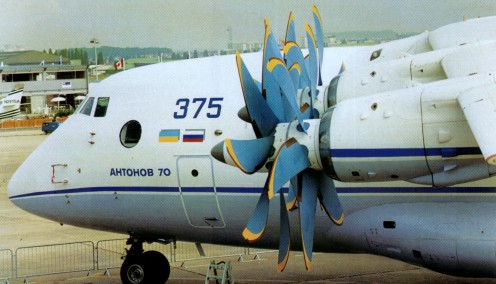
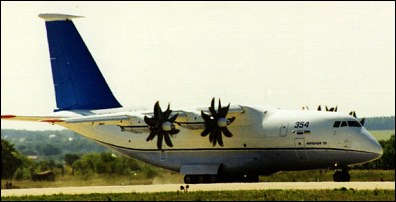
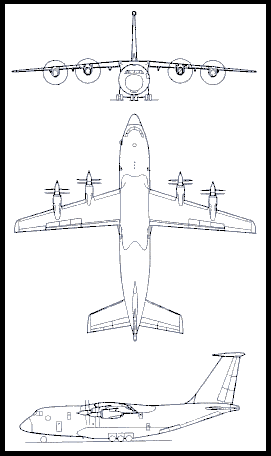
The development of the An-70 program began in 1975 but the collapse of the Soviet Union effectively stopped the funding of most major new programs. The An-70 has the high wing and tail loading ramp for a tactical freight aircraft and uses contra-rotating propfans. Each propfan has contra-rotating propellers; the front has eight composite blades, the rear just six.
A new propfan medium-size wide-body short take-off and landing transport aircraft intended to replace An-12, the first flight was achieved on December 16, 1994 but the first prototype crashed on 10 February 1995 after colliding with its An-72 chase plane. Construction of a second prototype was completed, which began flight testing at Gostomel airport in Ukraine on April 24, 1997.
Engine: 4 x D-27 propfans, 10300kW Take-off weight: 130000 kg / 286602 lb Wingspan: 44.06 m / 144 ft 7 in Length: 40.25 m / 132 ft 1 in Height: 16.1 m / 52 ft 10 in Cruise speed: 750-800 km/h / 466 – 497 mph Ceiling: 12000 m / 39350 ft Range: 7250 km / 4505 miles Range w/max.payload: 1350 km / 839 miles Maximum payload: 47 tons. Crew: 3-5
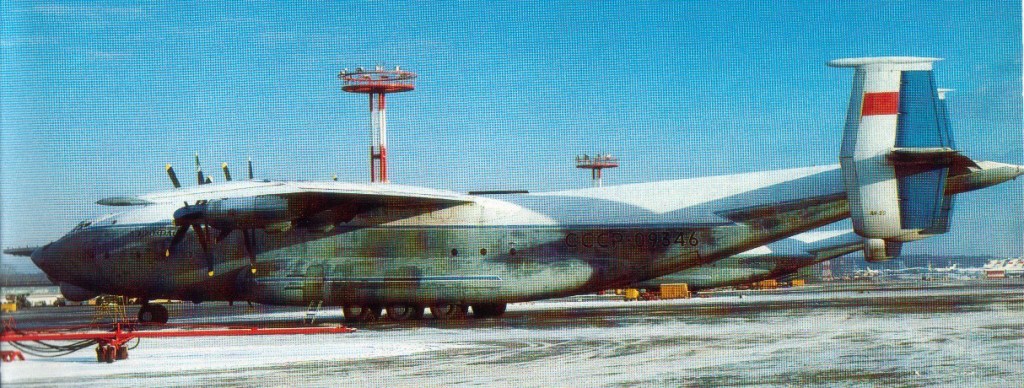
Carrying the NATO reporting name Cock, the An-22 is a very large, long-range heavy transport. The An-22 was the world’s largest aircraft when first flown on 27 February 1965, powered by four Kuznetsov turboprop engines, each driving two contrarotating coaxial propellers.
A very heavy freighter for the Soviet Air Force and Aeroflot, it was given a rear loading ramp to provide access to the 26.4m cargo hold, and can carry a payload of up to 176,350 lb (80 000 kg), including Ganef and Scud-A missiles on their tracked launchers.
Entering Soviet service in 1967 all 65 production aircraft were built at the Chakalov factory in Tashkent for the VTA/Soviet Air Force Transport Service, but were available to Aeroflot for charter and so all were painted in Aeroflot colours.
In October 1967 an An-22 established 14 payload-to-height records. With a payload of 100,000kg of metal blocks it reached a height of 7,848m, thereby qualifying also for the intermediate records from 35,000kg. Max payload lifted to a height of 2,000m was 104,444.6 kg. A take-off run of just over one kilometre was reported; the flight duration was 78 minutes.
In 1972 a further series of ten records for speed with payload were set up by Marina Popovich, wife of the Soviet cosmonaut Pavel Popovich. The aircraft averaged a speed of 593.318km/h around a 2,000km closed circuit with a 50,000kg payload, qualifying also for the intermediate records from 30,000kg. In addition the aircraft averaged a speed of 608.449km/h in a flight two days later around a 1,000km circuit with the same payload. The An-22 also holds three further records for speed with payload over a 5,000km circuit, established in 1974 and 1975.
Deliveries to both the Soviet Air Force and Aeroflot were completed during 1974.
Antonov An 22 A Antei Engines: 4 x Samara / Kusnetsov NK-12MA, 14602 shp Prop diameter: 6.2 m Length: 188.025 ft / 57.31 m Height: 41.142 ft / 12.54 m Wingspan: 211.286 ft / 64.4 m Aspect ratio: 12.02 Wing area: 3713.58 sqft / 345.0 sqm Max take off weight : 496125.0 lb / 225000.0 kg Weight empty : 261793.0 lb / 118727.0 kg Max. payload weight : 132300.0 lb / 60000.0 kg Max. speed : 324 kts / 600 km/h Landing speed : 130 kts / 240 km/h Cruising speed : 313 kts / 580 km/h Take off distance : 4790 ft / 1460 m Landing distance : 3412 ft / 1040 m Wing load : 133.66 lb/sq.ft / 652.00 kg/sq.m Maximum range : 5940 nm / 11000 km Range (max. weight) : 2700 nm / 5000 km Crew : 5 Payload : Cabin for 29 Pax, freight hold volume 640cu.m
Antonov An-22M Antei (Cock) Engines: 4 x KKBM Kuznetsov NK-12MA turboprop, 14602 shp Prop diameter: 6.2 m Length: 190.03ft (57.92m) Wingspan: 211.29ft (64.40m) Aspect ratio : 12.02 Wing area : 3713.58 sqft / 345.0 sqm Height: 41.11ft (12.53m) Maximum Speed: 460mph (740kmh; 400kts) Landing speed : 130 kts / 240 km/h Cruising speed : 313 kts / 580 km/h Maximum range : 5940 nm / 11000 km Range (max. weight) : 2700 nm / 5000 km Service Ceiling: 24,606ft (7,500m) Crew : 5 Weight empty : 261793.0 lb / 118727.0 kg Maximum Take-Off Weight: 551,156lbs (250,000kg) Max. payload weight : 132300.0 lb / 60000.0 kg Payload : Cabin for 29 Pax, freight hold volume 640cu.m Take off distance : 4790 ft / 1460 m Landing distance : 3412 ft / 1040 m
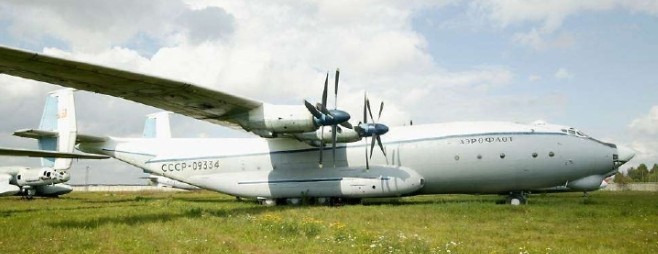
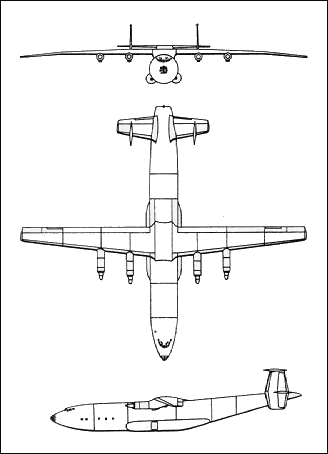
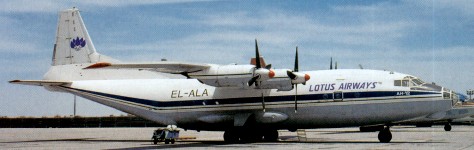
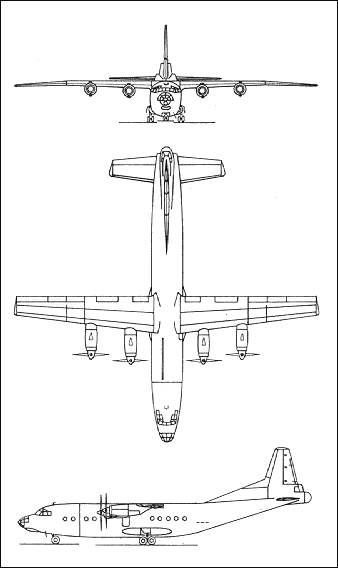
The An-12 (NATO reporting name ‘Cub’) is a military development of the An-10 airliner. The An-12 prototype (7900101) built at Irkutsk, flew first on 16 December 1957 powered by four Kuznetsov NK-4 turboprops of 4,000 horsepower and differs from the An-10 in featuring a more upswept rear fuselage and rear loading ramp, entering service in 1959.
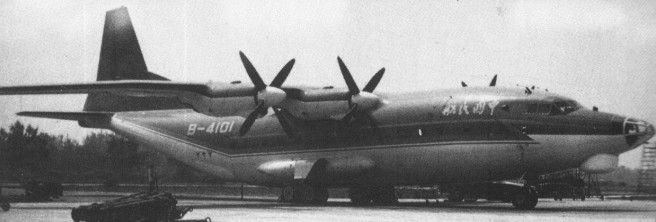
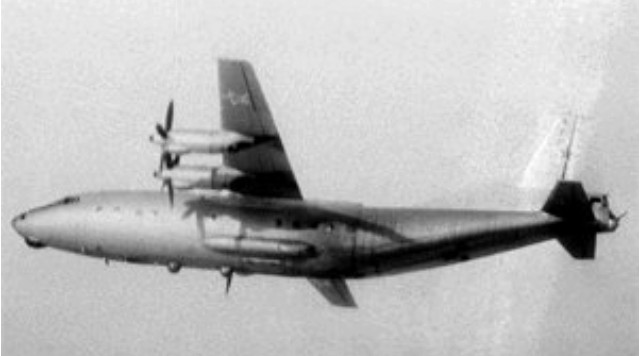
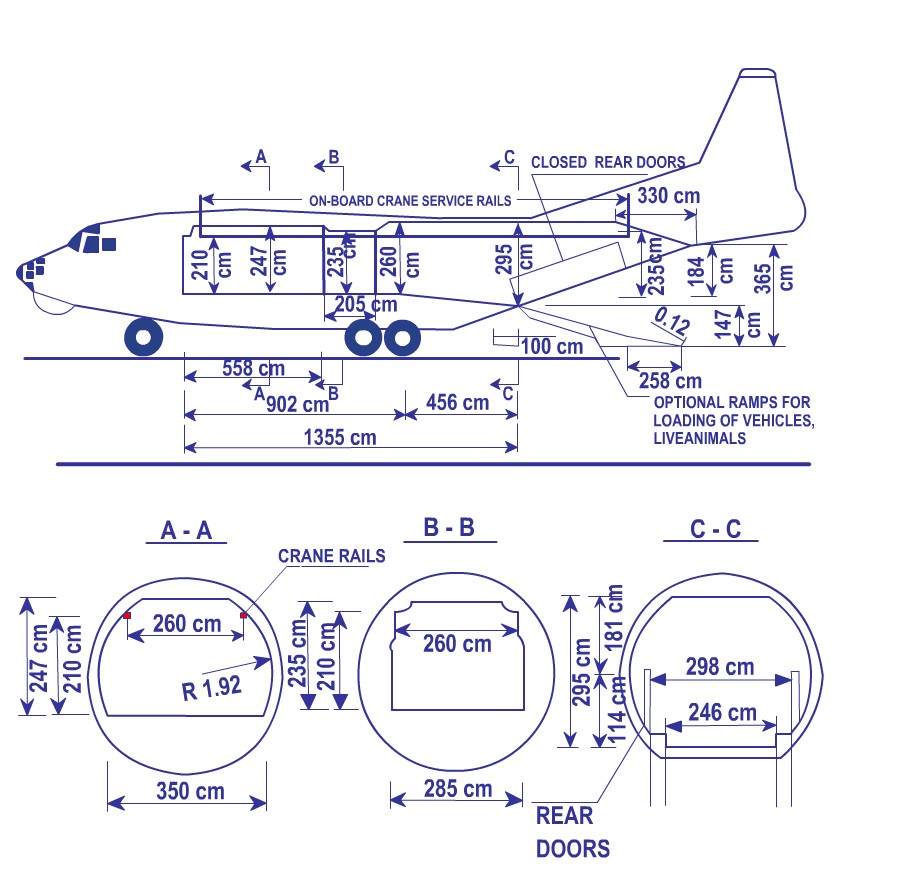
Fully pressurised, the An-12 has high performance yet can operate from unpaved surfaces. At least one was fitted with large skis with shallow V planing surfaces equipped with heating (to prevent sticking to ice or snow) and brakes. Nearly all have the tail turret, and under the transparent nose is a weather and mapping radar. The rear ramp door is made in left and right halves which can be folded upwards inside the fuselage, either for loading heavy freight with the aid of a built-in gantry or for the dispatch of 100 paratroops in less than one minute. The An 12 BP became the standard Soviet Air Force cargo and paratroop transport since 1960, also being exported for both military and commercial use to the air forces of India, Egypt, Indonesia, Poland, Iraq, Algeria and Bangladesh and to 70 other freight operators. Powered by four 4,000 ehp (2 985 kW) Al-20K turboprops, standard transport variants of the An-12 have been adapted for EW and ELINT duty with SovAir and SovNavAir. Variants include Cub-A and Cub-B for ELINT role and Cub-C and Cub-P with varying antenna and radomes, to perform passive and active ECM duty. With a max payload of 20,500 kg or up to 4 crew and 90 troops, series production of the An-12 in a number of variants continued until 1973. Around 1,400 were built with AI-20K engines and the type was also produced by Shaanxi Aircraft Company (or Harbin), China as the Yunshuji-8 (Y-8) redesigned transport version and derivatives.
Harbin Y-8
The first Shaanxi Y8, assembled from Russian components, flew in December 1974, the first Chinese-manufactured example following a year later.
About 200 remained in service in civil marks in 1992, including some working as aerial laboratories, with industry and with the WA (Air Force Transport Service) in Aeroflot colours, plus at least 25 An-12BK/PP/PPS “Cub-A/B/C/D” electronic warfare conversions in air forces and Naval Aviation. The An 12 was gradually superseded by the Il 76 with the Soviet forces from 1974.
Engines: 4 x Ivchenko Al-20K turboprop, 4,000 ehp (2 985 kW). Wing span 124 ft 8 in (38 m) Length 121 ft 4½ in (37 m) Height 32 ft 3 in (9.83 m) Empty weight: 61.730 lb (28.000 kg) Loaded weight: 121.475 lb (55.100 kg) Payload: 44,090 lb (20,000 kg) of freight or 100 troops. Maximum speed: 482 mph (777 km/h) Maximum cruise: 416 mph (670 km/h) Maxi¬mum rate of climb: 1970 ft (600 m)/min Service ceiling: 33,500 ft (10200 m) Range with full payload: 2,236 miles (3600 km). Armament: powered tail turret with two 23 mm NR-23 cannon.
Engine: 4 x turbo-prop AI-20, 3125 kW Take-off weight: 54000-61000 kg / 119050 – 134483 lb Empty weight: 30500 kg / 67241 lb Wingspan: 38.0 m / 124 ft 8 in Length: 37.0 m / 121 ft 5 in Height: 9.8 m / 32 ft 2 in Wing area: 121.7 sq.m / 1309.97 sq ft Max. speed: 640 km/h / 398 mph Cruise speed: 600 km/h / 373 mph Ceiling: 10000 m / 32800 ft Range: 5500 km / 3418 miles Crew: 6 Passengers: 130 Armament: 2 x 23mm machine-guns
An-12BK (Cub) Engines: 4 x ZMDB Progress (Ivchenko) AI-20M turboprop, 4,252eshp Length: 108.60ft (33.1m) Wingspan: 124.67ft (38.00m) Height: 34.55ft (10.53m) Maximum Take-Off Weight: 134,482lbs (61,000kg) Maximum Speed: 300mph (482kmh; 260kts) Maximum Range: 2,237miles (3,600km) Service Ceiling: 34,449ft (10,500m) Armament: Some with tail-mounted 2 x 23mm cannons Crew: 4 or 5
An-12BP Powerplants: – Four 2985kW (4000ehp) Ivchenko Al-20K turboprops Wing span 38.00m (124ft 8in) Length 33.10m (108ft 7in) Height 10.53m (34ft 7in) Wing area 121.7sq.m (131.0sq ft). Empty weight 28,000kg (61,728lb) MTOW 61,000kg (134,480lb). Max Landing Weight: 58,000kg 127,870lb Max Zero Fuel Weight: 48,000kg 105,790lb Structural Payload: 44,090kg 20,000lb Fuel Capacity: 21,000kg 46,295lb Max speed 777km/h (420kt) Max cruising speed 670km/h (360kt) Max initial rate of climb 1970ft/min Service ceiling 33,465ft Takeoff run MTOW 700m (2296ft) Range max fuel 5700km (3075nm) Range max payload 3600km (1940nm). Accommodation: Flightcrew of two pilots, flight engineer, navigator (in glazed nose) and radio operator, plus loadmasters. Main Deck Useable Volume: 97m3 285ft3 4in3 Cargo Area Width: 3.5m 11ft 5in Cargo Area Height: 2.6m 8ft 6in Main Cargo Door Width: 2.95m 9ft 8in Main Cargo Door Height: 2.6m 8ft 6in
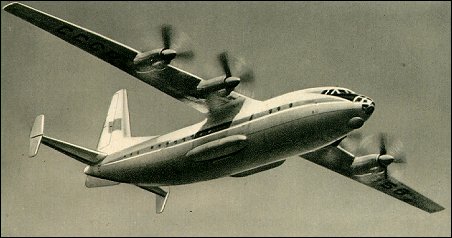
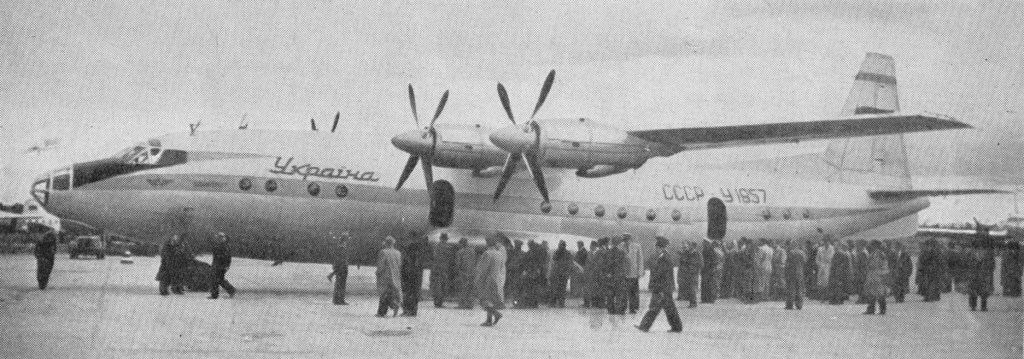
Design of the An-10 airliner began in November 1955 and the prototype (named Ukraina) first flew on 4 July 1957, The An-10 was the initial version with accommodation for 84 passengers and a room at the rear. It entered service in July 1959 on routes from Simferopol to Moscow and Kiev. The An-10A developed version had a 2m longer fuselage and accommodated 100 to 130 passengers. It entered service in February 1960. An-10A also operated on skis in the far north of the Soviet Union. No An-10/10A were exported and Aeroflot withdrew the airliners in 1973 after a series of crashes. 104 were built.
Both versions had the NATO reporting name Cat. From this was derived the An 12 military and civil freighter, with redesigned rear fuselage incorporating a cargo loading and air drop ramp. The An 10, accommodating from 84 to 130 passengers, was designed as a bulk passenger carrier for remote and under developed regions of Russia.
Engine: 4 x turbo prop AI-20K, 2940 kW Take-off weight: 55000 kg / 121255 lb Empty weight: 30500 kg / 67241 lb Wingspan: 38.0 m / 124 ft 8 in Length: 37.0 m / 121 ft 5 in Height: 9.8 m / 32 ft 2 in Wing area: 120.0 sq.m / 1291.67 sq ft Max. speed: 725 km/h / 451 mph Cruise speed: 660 km/h / 410 mph Ceiling: 10000 m / 32800 ft Range w/max.fuel: 4000 km / 2486 miles Range w/max.payload: 1200 km / 746 miles Crew: 5 Passengers: 100-132




 All Aero