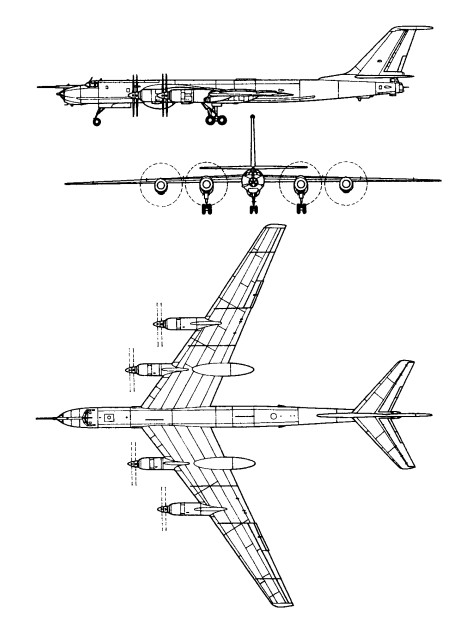
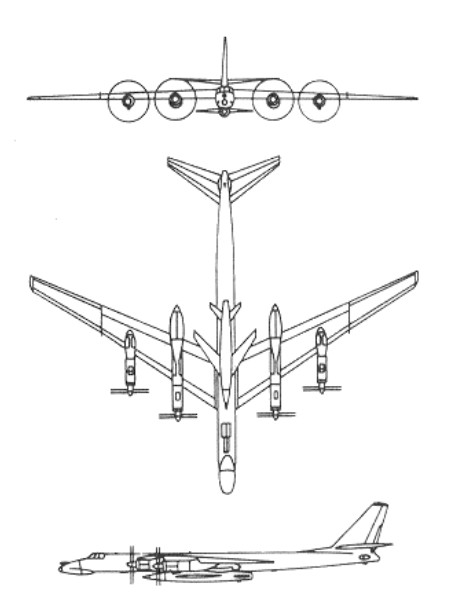
The Tupolev-Myasishchec Type 31 was believed to be an interim bomber design built only in pre-production quantities and used to test the turboprop power plants later employed by the type 40 Bear. The type 31 Barge originally employed diesel engines believed to be 4300 hp M-224, but these were later replaced by four turbines of about 4500 shp, plus 1200 lb residual thrust.
Est. Wingspan: 185 ft Length: 145 ft Height: 38 ft Loaded weight: 210,000 lb Max speed: 380 mph Cruise: 340 mph Max range: 7500 mi
On 28 November 1967 the Soviet government specified the requirements for a competition for a new strategic bomber. Technical parameters were high. The aircraft was to reach 11000 to 13000 km (5,970 to 7,020 nm) and have a cruising speed of 3200 to 3500 km/h. The maximum range at subsonic speed was to be 16000 to 18000 km (8,640 to 9,720 nm) at high altitude. Basic armament was to be nuclear missiles, including heavy Kh-45 and small Kh-2000s.
Tupolev, which was formally called Moscow Engineering Plant ‘Opyt’ (meaning Test), joined Sukhoi and Myasishchev in the quest for a supersonic strategic bomber. Unlike the others, Tupolev started designing by not aiming at the specifications given by the government. Tupolev thought a Mach 3.0 to 3.2 bomber, compared with a Mach 2.3, did not off-set the cost of construction and technology. In the early 1970s Tupolev prepared a series of flying-wing designs designated 160M, which were based on the contemporary delta-winged Tu-144 supersonic airliner.
In 1972 the air forces selected Sukhoi as the winner, however it was realised a design with these specifications was not possible. So it was decided to start a second stage of the competition. The maximum speed was lowered to Mach 2.3 enabling Tupolev’s 160M flying-wing design to enter the competition. Myasishchev came with the M-18, based on the M-20 design which had a variable-geometry wing. Sukhoi gave up the competition and decided to concentrate on fighter aircraft.
The air force selected the M-18, because of its variable-geometry wing design and the design was supported by TsAGI (large and powerful Soviet technical research institute) and the Technological-Scientific Council of the Ministry of Air Industry. Tupolev’s flying-wing design was a single-mode aircraft and the air force required bomber following a compound flight profile and be able to also land at ‘smaller’ airfield.
Myasishchev’s winning design was developed by the Tupolev bureau, because the former’s team was too small. In 1973 the first design for the Tu-160 was prepared by Tupolev based on the M-18 variable-geometry design. The design was gradually improved and Tupolev began selecting the aircraft systems, together with the scientific and government research institutes. The NK-25 engine of the Tu-22M3 were selected at first, but the high fuel consume rate required a new development. In 1980 the first Nk-32 was test flown on a Tu-142 and production began in 1983.
Aleksei Tupolev (son of Andrei Tupolev, founder of the design bureau) lead the Tu-160 design program during the initial period, in 1975 Valentin Bliznyuk was appointed as chief designer and remained in charge of the program. In 1977 the preliminary design and a full scale mock up were submitted for state committee acceptance. At this stage the aircraft would carry two Kh-45 missiles. During the Strategic Arms Limitation Treaty II (SALT II) talks in the late 1970s, the plans for a new strategic bomber and the name Tu-160 were first revealed to the west.
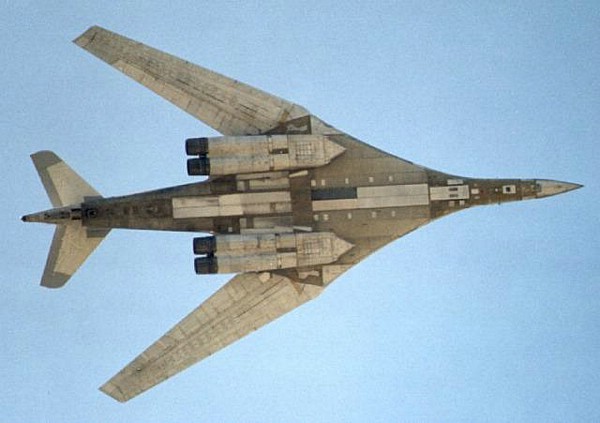
The aircraft has a slender long blended wing-body design with a variable-geometry wing. The four NK-32 afterburning turbofans are arranged in pairs under the mid-wing each with variable-area intakes. The undercarriage consists of one front double-wheel leg and two six-wheel bogies (three tandem pairs), which are located between the engine pairs. Along the aircraft’s centreline between the two gear units there are two weapon bays, which are divided by the wing carry-through structure.
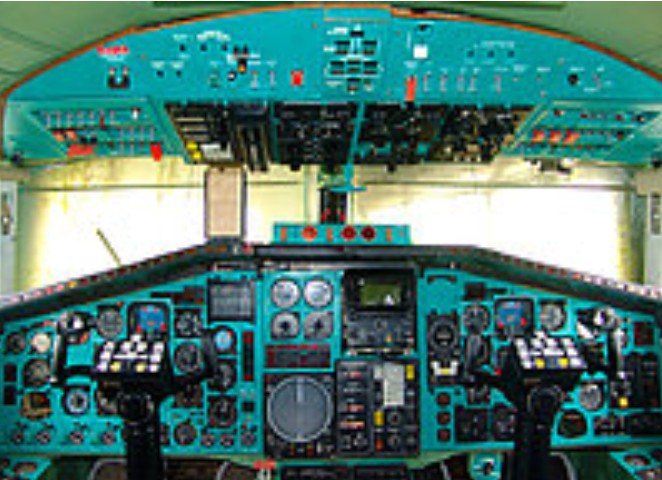
The nose of the aircraft contains the Obzor-K (Survey) radar, which is used for both ground and air observation. It also contains another radar, the Sopka (Hill), which is used for terrain following when flying at low altitude. The upper center part in front of the windscreen contains the retractable inflight refuelling probe. Under the front fuselage there is a forward looking OPB-15T optical bombing sight and video. Behind the sight, there is the nose gear. The four man crew enters the cabin through the front gear bay. The pressurized cabin has four fighterjet-like K-36LM ejection seats. There are two control sticks for commander pilot (front left) and co-pilot (front right). The Tu-160 has a conventional flight deck, which is divided by a central console with the thrust and flap selection levers for the co-pilot. Behind the pilots there is the navigator/offensive weapons operator (left) and the navigator/electronic warfare and communications operator (right). Behind the crew there is corridor leading to a galley and a toilet.
The weapons carried in the weapon bays comprises of six (or a maximum of 12) Raduga Kh-55SM (NATO AS-15B ‘Kent’) cruise missiles, which are launched from two six-round MKU6-5U revolving launchers located in the forward area of each bay. The nuclear warhead loaded Kh-55SM is a development of the subsonic Kh-55 cruise missile. For guidance of the Kh-55SM the Tu-160 is equipped with the Sprut-SM (Octopus) navigation/attack system, which automatically aligns the coordination axes of both aircraft and weapons. It also generates a digital map of the terrain which is transferred from the aircraft to the missile before launch. Alternatively the Tu-160 can be equipped with up to 24 Raduga Kh-15 (NATO AS-16 ‘Kickback’) short-range attack missiles (SRAM) or Kh-15P anti radiation missiles, which are both launched from up to four MKU6-1U revolving drums. However reportedly the Kh-15 capability has not been implemented on any production aircraft.
The variable-geometry wing has three positions. 20 degree sweep for landing, 35 degree for cruise and 65 degree sweep for high speed flight. The inner portion of the wing forms a vertical plane for directional stability when the wings are fully swept backwards. When the wing is swept forwards this portion lies flat to fill the gap between wing and fuselage and forms the most inner part of the flap.
The Tu-160 houses a Baykal self-defence systems of which most systems are located in the ‘carrot’ tail cone. These systems include a Mak (Poppy) infra-red missile launch sensor, radar warning receiver, electronic jammer and a battery of APP-50 chaff/flare dispensers. The underside of the tailcone houses the brake chutes. Directional control is provided by an all moving fin.
When the Soviets learned about the American AGM-86 ALCM-B cruise missile, the requirement of the Kh-45 as main armament for the Tu-160 was dropped and a strategic (nuclear) version of the Kh-55 cruise missile was developed. The Tu-160 armament would now consist of 12 Kh-55SM missiles, with 12 to 24 Kh-15 being the alternative. Although there was enough time to design the weapon bays after the plans for Kh-45 were dropped, the Tu-160 design held its long weapon bays. The Kh-55SM and Kh-15 are much shorter, and can be launched with only the forward longer doors openened (each weapon bay has four doors). Initially a traditional self-defence system was proposed for the Tu-160, including a tail turret with a 30mm GSg-6-30 cannon. However the designer replaced the plans later during developed with the Baykal system. Also the plans for R-77 medium-range air-to-air missiles were abondoned.
The program was accepted in 1977 and Tupolev began production of three prototypes. Although the aircraft were assembled at Tupolev’s workshop at Moscow, the sub-assemblies were built at other production plants.
The first prototype 70-01 intended for flight testing the basic flight characteristics had incomplete equipment. Prototype 70-02 was built for static tests. Prototype 70-03 was practically an equivalent of series production aircraft. 70-01 was completed at Zhukovskity in January 1981. On 14 November, the aircraft taxied the airstrip for the first time, after months of testing. On 25 November 1981 a picture was taken of the aircraft near two Tu-144 by a US reconnaissance satellite, this was the first picture of the Tu-160 revealed to the world, at that time designated ‘RamP’.
On Friday 18 December 1981 Tu-160 70-01 made its maiden flight. Three months later the first supersonic flight was achieved. And during one of the test flight the top speed of 2200 km/h was reached. The 70-01 can be distinguished from the other Tu-160 by having a long probe at the nose tip. Internally there are greater differences in equipment and structural elements. Work on new materials and engineering methods, lead to postponement of the 70-03 prototype, which did not take off until 6 October 1984.
Although there are some differences between the first prototype, the development and the production aircraft, only one variant of the Tu-160 entered production. NATO codename for this variant is ‘Blackjack-A’.
Series production was started at Ulyanovsk production plant, but was soon replaced to KAPO (Kazan Aviation Production Association) in favor of the An-124 production. The first series Tu-160 took off from Kazan on 10 October 1984. The first aircraft to enter service took off from Kazan on 15 August 1986.
On 23 April 1987 this aircraft as well as a second example were delivered to the 184th Heavy Bomber Regiment of Guards, based at Pryluky airfield in the Ukaine. The squadron had previously been operating the Tu-16 Badger, so it obtained a small number of Tu-22M3 ‘Backfire-C’ to train the crew on high supersonic bombers, with a variable-geometry wing. Later the Tu-134UBL dedicated trainer for the Tu-160 replaced the Tu-22Ms. At the end of 1991, the 184th regiment had two squadron and a total of 19 Tu-160 were delivered.
The first time the Tu-160 was shown to the public was on 20 August 1989 flying over Tushino airfield in Moscow. The first ground presentation was in August 1992 at MosAeroshow held at Zhukovskiy. It made its international debut at the Paris Airshow in June 1995, were it was presented as space carrier for the Burlak space vehicle with a mock up of the Burlak under its belly.
After the break up of the Soviet Union the Ukrainian parliament took all military units based in its country under control. At first this had no effect on the 184th bomber regiments. But in 1992 25% of the pilots and personnel swore oath to the Ukraine. At Engels airbase in Russia, the first Russian Tu-160 regiment was formed. Russia had just three Tu-160 remaining at the Kazan factory. On 16 February the first arrived at Engels AB, but because of lack of pilots it was not until 29 July 1992 when the first Tu-160 took off from Engels. The production at Kazan continued for a short while until the air force ran out of money and in June 1994 the sixth and last Tu-160 left the factory for Engels. Four unfinished airframes remained at Kazan.
The Ukrainian 19 Tu-160 from the 184th regiment were flown only a small number of sorties, before they were grounded because of lack of technical support from Tupolev and manufacturer, lack of spares and lack of fuel. Also the Ukraine did not have areas suitable for training with strategic missiles. The Ukraine could not sustain the aircraft and had no need for them, so they started negotiations with Russia in 1991. When in 1998 no agreement was reached, Ukraine decided to scrap the aircraft. The first Tu-160 was cut up in November 1998.
In April 1999, Russia proposed buying back eight Tu-160 and three Tu-95MS ‘Bears’ which were in the best technical condition, as well as 575 Kh-55 and Kh-55SM missiles, documentation and ground equipment. On 6 October 1999 an agreement was signed and a total of US$285 million was deducted from the Ukraine’s outstanding payments to Russia for the supply of natural gas. On 5 November the first two bombers, a Tu-160 and a Tu-95MS, landed at Engels AB. The last two Tu-160 ‘Blackjacks’ arrived at Engels on 21 February 2000. All the aircraft were overhauled at the Kazan factory during 2001. On 5 May 2000, another aircraft that was nearly finished aircraft was commissioned into service at Engels as ’07’.
The 182nd Heavy Bomber Regiment of Guards operated 15 Tu-160 ‘Blackjacks’ after all eight Ukrainian Tu-160 were returned into service. In September 2003 one Tu-160 bomber was lost in a fatal crash. Reportedly production restarted work on another one of the unfinished Tu-160 airframes at Kazan to replace the lost bomber. This is the second Tu-160 bomber to be lost in a crash, in 1987 the first Tu-160 (a series production test aircraft) crashed due to an engine problem.
The total number of Tu-160 Blackjacks built was 35 at the end of 2000, comprising of 3 prototypes built in Moscow and 32 series aircraft built in Kazan. Three unfinished aircraft remain at the Kazan factory today. Of the 11 Tu-160 airframes that remained in the Ukraine 1 serves as a gate monument, while the remaining 10 were cut up. The last Ukrainian Tu-160 was cut up in 2001.
The Russian Air Force was planning a limited upgrade for their Tu-160 fleet. First stage of the upgrade was to equip the aircraft with the conventional armed Kh-101 and Kh-555 cruise missiles and a new fire control system for these missiles, called Sigma. The Kh-101 uses a electro-optical terminal homing system and the Tu-160 will be able to carry up to 12 of these missiles. The Kh-555 is a reworked Kh-55SM with uses the Kh-101 homing system and replaces the nuclear warhead with a conventional one. Second stage of the upgrade was to include upgraded mission equipment and a new search-attack radar. Besides the Kh-101, this will enable the Tu-160 to be equipped with the Kh-102 strategic missile, medium range subsonic Kh-SD and a medium range supersonic weapon, presumable designated the Kh-41. Other upgraded system include navigation, communication and self-defence systems. The upgrade was to be carried out by KAPO at Kazan and would extend the service life of the Tu-160 until at least 2020-2025.
Tupolev’s son, Alexei A Tupolev, was primarily responsible for the design of the Tu 144 supersonic transport, begun in the early 1960s, the prototype being flown on 31 December 1968.
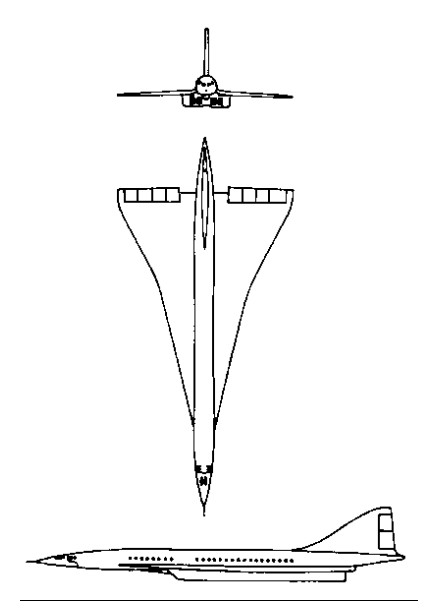
The aircraft has an ogival delta wing with the powerplants grouped at the rear of the wing and a drooping nose to improve the pilot’s view in low-speed regimes. The Russian jetliner also featured a nose that is lowered hydraulically 12 degrees to improve cockpit vision during takeoff and landing. The wings are of double-delta design with a sweep-back of 70-75 degrees on the inboard portions and about 40 degrees on the outboard sections. The main landing gear had 12 tires each (three rows of four). The tall, spindly nose gear had just two wheels. A maximum 130 passengers could be accommodated in an all-economy version, but the initial model seated 98 in mixed classes (18 in first class and 80 in tourist).
It flew at Mach 1 four months before the Concorde and at Mach 2 six months before its western rival (May 26, 1970); moreover, the entire test programme up to the autumn of 1971 had been carried out by a single prototype.
The first airliner to have exceeded Mach 2. In May 1971 it made its first appearance outside the USSR, at the Paris Air Show.
The Tu-144 was reported to be in production with design changes incorporated following the tragic crash of a prototype aircraft at the 1973 Paris Show.
The production version had a flight crew of three and 140 passengers as standard, and began 50 proving flights with cargo between Moscow and Alma Ata, the capital of Kazakhstan, on 26 December 1975. The distance of 1,864 miles (3000 km) was covered in a flight time of 1 hour 59 minutes. This variant also had retractable but non-moving canard foreplanes, lengthened fuselage, redesigned intakes, increased span and removal of pilots’ ejection seats.
Almost five years behind schedule, supersonic passenger services with the Tupolev Tu 144 were inaugurated by Aeroflot between Moscow and Alma Ata on 1 November 1977. 102 revenue services were flown before operations ended prematurely on 1 June 1978 after a fatal accident.
The air conditioning system needed to keep the airframe cool at Mach 2 was ineffective and the cabin was uncomfortably hot. It was also so noisy, along with the engines, that passengers were issued with earplugs during flight.
A modernised and modified version, the Tu-144D, with new engines, entered service in June 1979, with more economical Kolesov turbofan engines.
The last of 17 production models were the five Tu-144Ds, which had larger engines and greater range. Most had been retired by the late 80s, with only a handful retained for various research tasks at Zhukovskii.
The NATO reporting name is ‘Charger’.
In November 1996 a converted Tu-144D flew again as the Tu-144LL, used thereafter for an international High-Speed Civil Transport research program to assist in the development of a next generation supersonic transport.
Engines: 4 x Kuznetsov NK 144 afterburning turbofan, 38,580 lb (17,500 kg) Wing span: 90 ft 8.5 in (27,65 m) Length: 190 ft 3.5 in (58.00 m) Height: approx 43 ft 3 in (13.20 m) Wing area: 438 sq.m / 4714.59 sq ft Gross weight: 395,000 lb (179,150 kg) Empty weight: 85000 kg / 187394 lb Fuel capacity 209,440 lbs Operating altitude 18000 m / 59,000 ft Max cruising speed: 1,550 mph (2,500 km/h) at 65,000 ft (20,000 m) Range: 3510 nm / 4,040 miles / 6,500 km with 121 Passengers Takeoff distance (balanced) 9,845 ft Landing roll 8,530 ft Accommodation: Crew of 3 and up to 130 passengers.
In the mid-1960s, the Soviet Navy developed a requirement for a long-range anti-submarine and maritime patrol aircraft to supplement the IL-38 medium-range aircraft. With the Tu-95 and Tu-114 in operation, Tupolev was asked to prepare proposals.
Nikolai Bazenkov was appointed chief designer for the project, which was given the number 142. He took the basic Tu-95 design but omitted all the strategic equipment. The wing was redesigned with increased span, up from 50.05m to 51.10m, which allowed more fuel to be carried, and with increased camber. Much of the defensive weaponry was also removed. Then he added the electronic equipment needed for its new role.
Featuring lengthened forward fuselage and Mod II (Tu-142M) and successive Bear-F variants having redesigned nose with revised cockpit. Bear-J is SovNavAir VLF communications version. SovAir strike version (with fuselage lengthening omitted) is Bear-H. All are powered by four NK-12MV turboprops, 14,795 ehp.
The crew in all versions is accommo¬dated in nose and rear fuselage press¬urized cabins, as well as the pressu-rized but isolated rear turret, fitted to most versions. Most operational variants have an inflight refuelling probe on the nose, but even on internal fuel it is possible to fly missions lasting 26 hours.
The prototype Tu-142 made its first flight from Zhukovski in July 1968. After flight tests by the designers and the NIl VVS, the aircraft was put into production at Kuibyshev and later at Taganrog. It entered service with Naval Long Distance Aviation in 1972; it was then the world’s largest anti-submarine aircraft. It served as Bear-F alongside the smaller IL-38 but its long-range capability made it able to launch an attack on a submarine 5,000km from the aircraft’s base. With improvements in electronics, work began in 1973 on an improved version, the Tu-142M, and its first flight was made on 4 November 1975.
The -142M was fitted with electronic equipment capable of early detection of low-noise submarines, a new and more accurate INS navigation system and automated radio communications. Its surveillance system worked on a 360 degree arc, and was more capable than that of the IL-38 at detecting magnetic abnormalities. Data was transferred immediately by satellite link back to base. With a capability to patrol for seventeen hours, the aircraft was provided with bunks for crew rest. Its internal fuel load was seventy tonnes, and it was equipped for in-flight refuelling which could extend the patrol duration beyond the seventeen hours when needed.
The VMS based its Tu-142s, which were given the NATO codename ‘Bear F’, in the Northern and Pacific regions; some were also based in Cuba and Vietnam until 1990, when political developments prompted their return to Russia.
Production was running at ten a year until 1983, when output was split between Bear F and Bear H, with five of each being produced. Bear F was identified in 1973, and later aircraft have a MAD sensor at the top of the fin.
A new version of the long-range four-turboprop Bear, carrying the subsonic 3,000km range AS-is Kent cruise missile, entered service late in 1984, according to the Pentagon. The new Bear H carries at least four AS-b5s, two under each inboard wing section, and may carry more internally. According to US estimates, some 40 Bear Hs were in service by 1986.
Production continued at Taganrog until 1988 suspended by President Yeltsin as a unilateral arms limitation measure, with one aircraft per month being completed. Total production run at both factories was 225 aircraft, including eight delivered to the Indian Navy starting in the mid- 1980s and continuing until 1988.
The standard armament of the Tu-142 was two GSh-23 cannons mounted in the tail for defensive use. It could carry up to eight Kh-35 anti-shipping cruise missiles (NATO code AS-17) mounted on pylons under the wing, and internally, 450mm calibre anti-submarine torpedoes and/or 533mm calibre anti-shipping torpedoes. Depth charges could also be dropped. With a combat load of 11,340kg, its maximum range was 12,550km. Normal take-off weight was 170 tonnes, but 188 was possible with little difficulty.
Tu-142M3 Engines: 4 x NK-12MP, 15000hp Max take-off weight: 188000 kg / 414471 lb Empty weight: 80000 kg / 176371 lb Fuel capacity: 73,000 lt Wingspan: 51.10 m / 168 ft 8 in Length: 49.50 m / 162 ft 5 in Height: 12.12 m / 40 ft 9 in Wing area: 295 sq.m / 3175.35 sq ft Max. speed: 925 km/h / 575 mph Ceiling: 13500 m / 44300 ft Range: 12550 km / 7798 miles Endurance: 25 hr Crew: 10
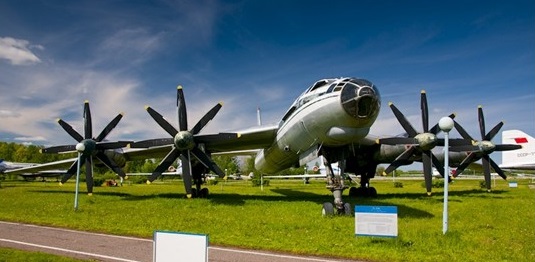
NATO code name ‘Moss’, about 10 surviving Tu-114s were retired and converted to Tu-126 ‘Moss’ configuration as airborne early warning platforms with a rotating radome pylon-mounted over the rear fuselage for the Soviet air force. The aircraft also has an inflight-refuelling probe and a number of blisters and fairings covering operational equipment. The former passenger cabin provides ample space for extensive communications, radar and signal processing equipment, and consoles for specialist operators.
First deployed in the mid-1960s, the Tu-126 carries a crew of 12. It is powered by four NK-I2MV turboprop engines and has a range of 7,700 miles at a cruise speed of 380-485 mph. The endurance at cruising speed for a 1,250-mile radius is six hours, which with flight refuelling can be extended to 17 hours.
Engines: 4 x NK-12MV, 15000hp Max take-off weight: 170000 kg / 374788 lb Wingspan: 51.20 m / 168 ft 0 in Length: 55.20 m / 181 ft 1 in Height: 16.05 m / 53 ft 8 in Wing area: 311.10 sq.m / 3348.65 sq ft Max. speed: 850 km/h / 528 mph Cruise speed: 650 km/h / 404 mph Ceiling: 13000 m / 42650 ft Range: 12550 km / 7798 miles Crew: 5 + 12 systems operators.
The Soviet government had planned for several years that the General Secretary of the Communist Party and Premier of the Soviet Union, Nikita Khrushchev, should address the United Nations General Assembly. As a matter of national prestige, he had to travel on a Soviet airliner.
When this matter first arose, in the mid-1950s, the Soviet Union had no medium- or long-range aircraft in commercial service. Although the Tu-104 was shortly to enter service, it was not considered suitable because of its relatively short range. The -114 was in the early stages of design, but whether it would be operational before the end of the decade was difficult to determine. The Soviet Union had, of course, the remarkable Tu-95, but the nation’s leader could not travel in a strategic bomber – or could he? Tupolev was called in.
Nikolai Bazenkov was diverted from other duties to prepare a passenger version of the Tu-95. Two aircraft were taken from the production line at Kuibyshev. No armaments were fitted, and all military equipment was removed. With the original airframe of the Tu-95, a passenger compartment was installed behind the wing spar; it consisted of a pressurised cabin with two sections, each of which could accommodate twenty passengers in VIP luxury. A kitchen, toilet and service room were also installed. A fitted stairs was installed so passengers could board and disembark without a need for special airport equipment.
Although the work began only in mid-1957, the Tu-116, which was sometimes called the Tu-114D, was airborne in November 1957. Usually, the ‘D’ suffix in an aircraft designation represented ‘Dalnii’ (long distance), but this time it stood for ‘Diplomaticheskii’ (diplomatic).
In April 1958, the prototype Tu-116, Air Force Number 7801, a number probably derived from its manufacturer’s block and line number, made a high-altitude, long-distance trial flight to demonstrate its ability for the task. Flying at levels between 10,000m and 12,200m, it flew non-stop from Moscow to Irkutsk and back to Moscow, covering 8,500km at an average speed of 800km/h. After landing, it was calculated still to have fuel for another 1,500 to 2,000km. The second aircraft was intended as a reserve in the event of a problem with the first, but neither were needed. Instead, Khrushchev flew to the New York headquarters of the United Nations Assembly in the prototype Tu-114.
Never intended for normal commercial service, the two Tu-116s were little used. Originally painted in military marks (7801 and 7802), one aircraft was later given the civilian registration SSSR-76462, and is now preserved in the Ulyanovsk Museum of Civil Aviation.
While the Tu-114 was derived from the military Tu-95, it was given a totally new fuselage. However, three Tu-116s were also built, and were designated Tu-114Bs by Aeroflot and retained the much narrower fuselage of its predecessor.
Engines: 4 x NK-12MV turboprops, 15000hp Max take-off weight: 121920 kg / 268789 lb Wingspan: 51.1 m / 168 ft 8 in Length: 47.5 m / 156 ft 10 in Wing area: 311.1 sq.m / 3348.65 sq ft Max. speed: 770 km/h / 478 mph Ceiling: 12000 m / 39350 ft Range: 10500 km / 6525 miles
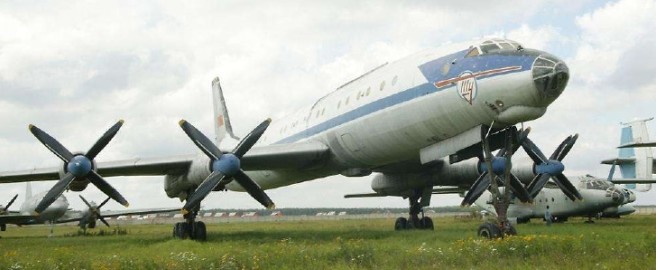
The Tu-114 flew for the first time on 3 October 1957 and remained the world’s largest and heaviest commercial aircraft until the introduction of the Boeing 747. The prototype Tu 114, named Rossiya (Russia) to celebrate the 40th anniversary of the 1917 Revolution, established a large number of speed, height and distance records with payloads of up to 66,216lb (30,035 kg). The first public appearance was at the 1959 Paris Airshow.
On April 9, 1960 Tu-114 set the world speed record with 25000kg payload on a 5000 km circuit at 877.212kph.
The production versions entered Aerofllot service since 1961. Seating 170 on internal services or 120 on intercontinental routes, the Tu-114 proved fast and reliable and operated Moscow-Havana, Moscow-Delhi, Moscow-Montreal and Moscow-Tokyo services until replaced by the four-jet Ilyushin Il-62 from 1967. Many speed-and-altitude-with-payload records set by the Tu-114 stood for many years. Its final retirement on international routes came in 1969, and the last domestic services were flown in 1973.
About 30 Tu-114s were built and about 10 surviving Tu-114s were retired and converted to Tu-126 ‘Moss’ configuration as airborne early warning platforms for the Soviet air force.
Engines: 4 x Kuznetsov NK 12MV turboprop, 14,795 eshp / 11033kW Props: 8 ft 41 in (5.60 m) diameter 8 blade contra rotating Wing span: 167 ft 8 in (51.10 m) Length: 177 ft 6 in (54.10m) Height: 15.5 m / 51 ft 10 in Wing area: 3,349 sq ft (311.1sq.m) Empty weight: 91000 kg / 200622 lb Gross weight: 376,990 lb (171,000 kg) Max cruising speed: 478 mph (770 km/h) at 29,500 ft (9,000m) Range: 3,850 miles (6,200km) with max payload of 66,140 lb (30,000 kg) Ceiling: 12000 m / 39350 ft Accommodation: Crew of 10 15 (Incl cabin staff) and 120 220 passengers
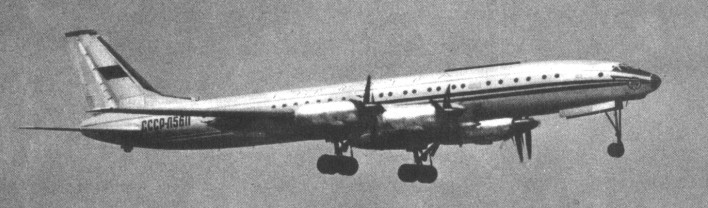
In order to meet Aeroflot’s requirement for a 100-seat jetliner, Dmitri Markov installed four 5,000shp Lyulka AL-7P engines in place of the two larger AM-3s in a slightly stretched fuselage of a Tu-104 – the stretch, of 1.2m, gave the Tu-110, as the new version was numbered, a fuselage length of 40.06m. The span was also increased by 2.96m to give space for the extra two engines to be installed. The third change was to the interior, where the cabin was divided into two sections to provide for first and economy class passengers. Take-off weight of the four-engined aircraft, at 79,300kg, was 3,300kg higher than the original Tu-104. With a maximum speed of 1,000km/h, a ceiling of 12,000m, and a range of 3,300km, there was little difference in performance.
One aircraft was built at factory N 156 from parts manufactured at factory N 22 in Kazan and brought to Moscow, and it made its first flight on 11 March 1957. Although it flew well, it offered little advance on the Tu-104, and no production orders followed, although two others were completed at Kazan. Instead, Aeroflot and Tupolev agreed that the slightly larger body should become standard on the Tu-104B, which began service in 1959.
Engines: four 5,000shp Lyulka AL-7P Length: 40.06m Span: 37.5 m Take-off weight: 79,300kg Maximum speed: 1,000km/h Ceiling: 12,000m Range: 3,300km Passengers: 100
The Tu-95 was developed for use by the Soviet Union’s DA (Long-Range Aviation) as an intercontinental strategic bomber. Design of the Tu-95 version began before 1952, powered by four Kuznetsov NK-12 turboprop engines, the bench-testing of which started in 1953.
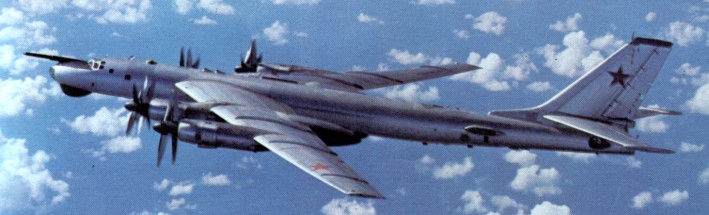
Making use of identical systems, techniques and even similar airframe structures as the Tu-16, the Tu-95 (service designation Tu-20) is much larger and has roughly double the range of its turbojet predecessor. The 35 degree swept wing, formed integral tanks, with turboprop engines and their eight blade 18 ft 4½ in (5.6 m) contraprops. Sweptback tail surfaces have an adjustable-incidence tailplane. Conventional control surfaces are supplemented by spoilers in the upper surface of the wings forward of the ailerons. Fowler-type trailing edge flaps are fitted. The tricycle undercarriage, with twin nose wheels and a four-wheel bogie on each main unit all retract rearward, plus a small two-wheel retractable tail-bumper,
The basic bomber called “Bear A” by NATO had a glazed nose, chin radar and gun-sight blisters on the rear fuselage. First seen in 1961, “Bear B” fea¬tured a solid nose with enormous radome, refuelling probe and centreline attachment for a large cruise missile (‘Kangaroo”). C appeared in 1964 with a large new blister on each side of the fuselage (on one side only on B). while D was obviously a major ECM/FSM reconnaissance type with chin radar, very large belly radar, and from 12 to 21 avionic features visible from stem to stern. F is a multi-sensor reconnaissance conversion of A. while F is a recent further conversion with an array of ventral radars and stores bays in place of the ventral guns. Older Tu-95 Bear A and B variants are being converted to carry the supersonic AS-4 Kitchen air-to-surface missile in place of the AS-3 Kangaroo. Modified aircraft are codenamed Bear G by Nato.
First flown in prototype form on 12 November 1952, the aircraft was allocated the service designation Tu-20, and began to enter service with the DA bomber force in 1955. Its turboprop powerplant gives remarkably high speed and, at the same time, long range and endurance. Additionally, the large size of the Tu-95 has permitted the carriage of extensive radar equipment and the largest Soviet air-to-surface missiles and bombs.
Built up to 1992, the total production run was fewer than 300.
In 1984 DA (Long Range Aviation) had an ultra long range backbone comprising 113 bombers called ‘Bear A’ and ‘Bear B’ by NATO.
The AV MF had 75 of various types used for ocean patrol, anti ship attack, and ECM/EW.
The crew in all versions is accommodated in nose and rear fuselage pressurized cabins, as well as the pressu-rized but isolated rear turret, fitted to most versions. Most operational variants have an inflight refuelling probe on the nose, but even on internal fuel it is possible to fly missions lasting 26 hours. Some models, such as the ‘Bear D’ maritime surveillance aircraft, are packed from nose to tail with radars, navaids, special com-munications, missile guidance links and other advanced electronics.
Engines: 4 x turbo-prop NK-12M, 11030kW Max take-off weight: 185000 kg / 407857 lb Empty weight: 94400 kg / 208117 lb Wingspan: 51.0 m / 167 ft 4 in Length: 49.0 m / 161 ft 9 in Height: 13.0 m / 43 ft 8 in Wing area: 310.0 sq.m / 3336.81 sq ft Max. speed: 860 km/h / 534 mph Cruise speed: 710 km/h / 441 mph Ceiling: 11000 m / 36100 ft Range w/max.fuel: 15000 km / 9321 miles Crew: 10 Armament: 2-6 x 23mm cannons Bombload: 20000kg
Engine: 4 x NK-12MV turboprops, 14,794 ehp Wing span: 159 ft (48.5 m) Length 155 ft 10 in (4750 in). (certain versions differ by up to 6 ft.) Height 38 ft 8 in (11.78 m) Maximum speed (typical Bear clean) 540 mph (870 km/h) Service ceiling, about 44.000 ft (13,400 m) Range with 25,000 lb (11.340 kg) bomb load. 7,800 miles (12,550 km) Armament: normally six 23 mm NS-23 in radar-directed manned tail turret and remote-aimed dorsal and ventral barbettes (defensive guns often absent from late conversions and from Moss); internal weapon bay for load of about 25,000 lb (11,340 kg).
Tu 20/Tu 95 ‘Bear A’ Type: strategic bomber Crew: 8 Powerplant: four 14,795 ehp (11033kW) Kuznetsov NK 12M turboprops Max speed: 950 km/h (590 mph) at high alt Service ceiling: 14000 m (45,930 ft) Range with bombload: 17500 km (10,875 miles) Wing span: 51.10 m (167 ft 7.75 in) Length: 49.50 m (162 ft 4.75 in) Height: 12.12 m (39 ft 9 in) Wing area: 310.50 sq.m (3,342.3 sq ft) Fuel capacity: 73,000 lt Armament: two internal bays for a total bombload of 20000 kg (44,092 lb), plus a defensive armament of four (or, with rear dorsal, five) powered turrets each with two 23 mm NR 23 cannon.
Next in the extended B-29/Tu-4 family was a military transport, basically a version of the Tu-70. Its design was very similar to its civilian counterpart. Again Dmitri Markov had gone for a low-wing, four-engined transport, with the wings, undercarriage and tailplane virtually identical to those of the B-29/Tu-4; only the wing’s centre section had any major differences in order to fit a low- rather than a mid-wing arrangement. The fuselage was also almost a direct copy of the Tu-70 in length, cockpit and cross-section, but its military purpose resulted in some differences. These included the interior: rather than a luxury passenger cabin, the Tu-75 had a pressurised cargo hold with an underbody loading ramp which swung downwards on hinges to allow ramp access for its planned military cargoes. These could include vehicles such as jeeps or small tracked armoured personnel carriers. General cargo could be loaded or unloaded using a hoist which was mounted in the aircraft beside the loading ramp. Ahead of its time, even aero engines could be carried in the hold. Alternatively, 100 fully equipped paratroops could be carried, and could exit the aircraft while in flight.
Like the Tu-70, powerplants were those of the B-29, but this time Shvetsov’s copy, the ASh-73K, was used, with each engine giving 2,300hp. It was armed with three pairs of machine-guns, one on the upper fuselage, one below and one in the tail.
Work began on the Tu-75 in 1947, and the prototype was built at factory N 156. Its first flight was made on 22 January 1950. Although the aircraft was not put into production, it was another step on the road to the VVS building up its strategic transport and bomber capability.
















 All Aero