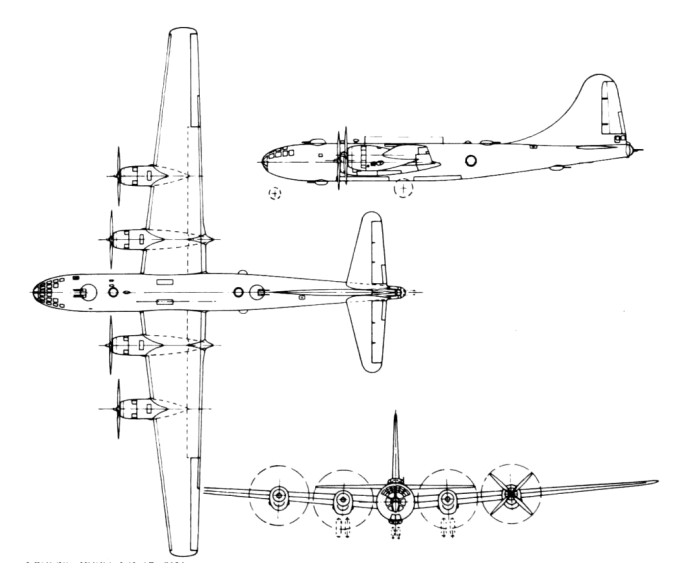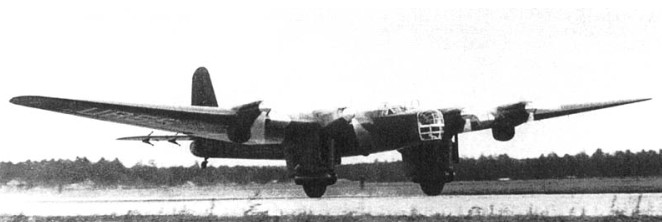
Bolkhovitinov DB-A / DBA / DB-2A

At the beginning of 1933 it became necessary to find a replacement for the aging Túpolev TB-3 bomber, which formed the basis of the long-range bomber aviation of the RKKA VVS. At the same time it became known that a group of professors and assistants from the Zhukovski Military Aeronautical Academy had been working on the conception of a new giant 12-engine bomber known as “Gigant”. By 1934 the need for an aircraft of these proportions had waned, so the financing of the project was cancelled. It was proposed to this group to develop a capital reconstruction project for TB-3.

Viktor Fedorovich Bolkhovitinov became the head of the VVIA design group at the VVA Žukovskij (VVS academy Žukovskij ) tasked with the design of a replacement for the Tupolev TB-3 heavy bomber. It was decided to study in depth the limitations of TB-3 and propose solutions to improve them. To this end, consultation work was started directly with the builders of Factory No.22 in Fili , where the Túpolev bomber was produced.

The new aircraft was designed as a Long Range Bomber or BDD (Russian: бомбардировщик дальнего действия – БДД). The technical tasks approved by the VVS for the new bomber in December 1934 included a speed of 320 km / h, a landing speed of 90-95 km / h, a flight ceiling of 6000 – 7000 m and a transport capacity of 1000 kg of bombs at a distance of 4000 km (with a total load capacity of 5000 kg). For its projection, a Joint Projection Bureau (OPB) was created, made up of technologists and builders from the factory and designers from the Zhukovski Academy.

The proposals put forward by the Academy were supported by RKKA chief of armament M. N. Tukhachevsky.

The Academy’s group of specialists conceived that, maintaining the tooling of Factory No.22, it was entirely possible to create an aircraft capable of meeting the specifications of the VVS and even in some cases exceeding them.

Soon Bolkhovitinov’s brigade was transferred to Factory No.22 in Fili, where the KB-22 was organized. Already participated in the projection of the new model. M. Kuritskies, IF Florov, BE Chertok, MM Shishmariov, among others.

The factory name for the new model was “A”. The Commission analysis of the model met on 14 January 1935, leaving some constructive recommendations for changes, the composition of the weaponry and equipment. By this time it was clear that even when the dimensions and composition were maintained constructively, it was a new aircraft. Despite this, it is remarkable that many official documents of the time refer to the new model as “the last modification of the TB-3 ” or “the TB-3 of 1935 “.

The resulting Bolkhovitinov DB-a (Russian: Болховитинов ДБ-А. Its acronym comes from the term Long Distance Bomber – Academy, Russian: Дальний Бомбардировщик – Академия) was advanced for its day with stressed skin aluminium alloy construction throughout with clean lines, neatly cowled engines and trousered main undercarriage legs, with fully retracting main-wheels and tail-wheel. The split flaps, undercarriage, nose turret and bomb-bay doors were all operated by a pneumatic system re-charged by engine driven compressors.

Upgraded bombs with 6 x 2 m hatches, mechanized and armoured Tur-8 turret and closed cockpits for the crew (with the exception of the tail gunner).

The new fuselage with a monocoque structure made it possible to significantly increase the interior volume of the aircraft. In the lower part of the center was located the bomb bay with a capacity for 3000 kg of bombs in the following configurations:
8 bombs of 250 kg;
6 bombs of 500 kg;
2 bombs of 1000 kg;
or 24 bombs of 100 kg.

The ability to install VAP-500 and VAP-1000 external supports, as well as a rotary launching system for RRAB pumps, was envisaged.

In the nose there was a Tur-8 turret with a ShKAS machine gun, which rotated with the help of a pressurized air system and in the central area of the fuselage a Tur-Aldis turret, designed in the TsAGI, with a ShVAK 20mm cannon. To defend the belly area, a ShKAS machine gun was installed firing through a hatch. In the tail area, the installation of a TUR-8 turret with another ShKAS machine gun was planned. The cannon had 250 rounds, while the total ammunition load for the machine guns reached 3,000 units.

The wing had a structure with three spars and a TsAGI – 620 profile. It was made up of the centrewing and two wing consoles. Nine fuel tanks accommodated 14,600 liters and two 460-liter oil tanks were located in the wing between the engines. In the intrados the underwing supports were located with a total capacity of 2000 kg of pumps. Both the flaps and the ailerons had a metallic structure and textile covering. The use of these flaps, capable of operating at 60º, allowed the landing speed to be reduced to 80 km / h.

The operation of the flaps, the retraction and extension of the wheels, the turning of the bow turret and the opening and closing of the hold gates were carried out by means of a pneumatic system.

The DB-A incorporated an APR-3 radio-rangefinder. The project also included the addition of an AVP-10 autopilot system. Both crew members communicated with the help of an intercom system. For night landings, the placement of headlights under the wings was foreseen.

The power plant consisted of four M-34RN engines. The project was calculated for the turboed version M-34FRN, but this model became available later.

The landing gear was designed as a conventional type with a tail wheel. The main units featured 2000x450mm wheels that partially retracted into large ‘pant’ type fairings. To allow the exploitation of the aircraft in winter operations, the use of special skis was envisaged, but these were never built, so for the factory tests the skis of a TB-3 were used. The main landers used telescopic, hydro-pneumatic shock absorbers.

The DB-A crew of nine were two pilots, a navigator, two engineers, a radio operator – gunner and three other gunners, but in different configurations it varied between 6 and 9 people.

In November 1934 the construction of the first copy of the DB-A (Dalni Bombardirovchik – Akademia or Long-range Bombardment of the Academy) was completed. Instead of the M-34FRN engines required by the project, four M-34RNs with a lower power were installed in the new prototype.

Flight trials began on 2 May 1935 at Khodinka piloted by factory pilots N.G. Kastanyev and Ya.N. Moseyev, Later, due to Moiseyev’s illness, he was replaced by AK Tumansky, brother of the aircraft engine manufacturer Sergei Konstantinovich Tumansky . The crew also included engineers Godovikov, Florov, Konkin and Osipienko.The first flight of the new “22A” factory index bomber lasted barely half an hour, but it demonstrated the value of the technical solutions applied to the “Annushka” (Anita) as the workers of Factory No.22 where it was developed called it.
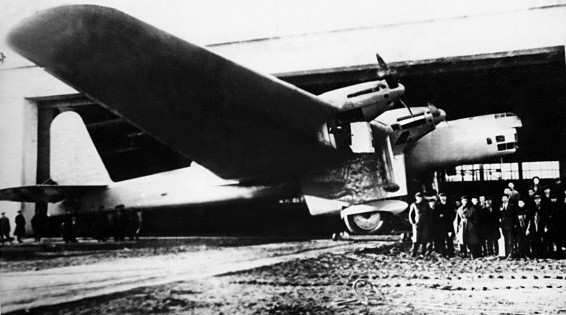
First prototype of the DB-A at Factory 22 in Fili during 1935 testing.

Initially, the DB-A engines had wooden propellers with two blades and a diameter of 4.35 m, similar to those used in the TB-3, but this brought about a noticeable decrease in performance in relation to those calculated, therefore It was decided to replace them with one of three 4.1 meter blades, similar to those used in the Túpolev ANT-25.

Factory tests were completed by April 1934 and NII testing was carried out in May and June 1935. In them it was shown that the DB-A out-performed not only the TB-3, but even the Farman-222 with a similar mission. Despite presenting an empty weight 15.4 tonnes higher than that of the TB-3, the DB-A showed an increase in speed of 40 – 50 km / h. This increase in performance was mainly due to the aerodynamic improvement of the model. With retraction of the landing gear, 18-20 km / h were gained at sea level and 25-28 km / h at 2000 meters. The performance demonstrated included, sustained flight at an altitude of 2,500m (8,202 ft) with two engines shut down, and 4,500 km range.
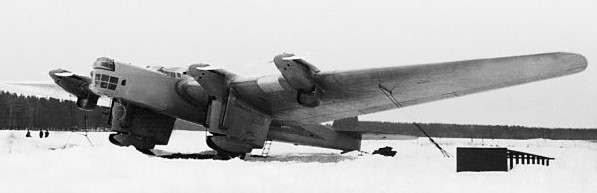
Prototype at Shelkovo airfield, Svierdlovsk in NII VVS tests.

The aircraft assessment report only included poor visibility from the cockpit as a defect. However subsequent investigations have shown that the report was not objective. There is evidence of contradictions between Kastanayev and Tumanski, as the former eliminated the defects from the reports in order to get the plane to be chosen for the long-haul flight to the United States proposed by the polar pilot SA Levanevski.

The aircraft was shown to Levanevski and government approval was soon received to prepare the first factory specimen No.22-A1 for flight, assigning it the USSR-N-209 polar aviation index.

In 1936 the DB-A was shown in the parade commemorating the first of May, causing a sensation among national and foreign guests.

A decision was made to fly non-stop from Moscow to the USA and the DB-A was modified to fly, at an overload weight of 34,700 kg (76,500 lb), carry enough fuel to fly 8,440 km (5,244 miles). While the state tests were being carried out, the first DB-A was modified and prepared for the record flight on the Moscow – North Pole – Fairbanks route. The plane was lightened. All weapons were removed; the glazing of the forward cabin in which the navigator and radio operator were located was modified; an astrological dome was installed over the pilot’s seat, the position of the tail gunner was removed. The weight saved went to a new fuel tank and commercial cargo.
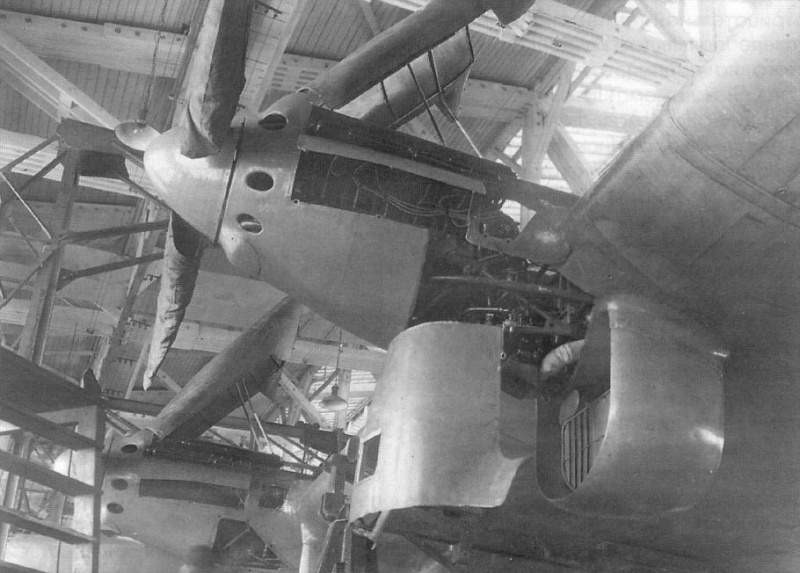
DB-A USSR-N-209 during flight preparations.

During the preparation of the flight, a test flight was carried out on the Shelkovo – Baku – Shelkovo route and a test takeoff with a weight of 32,300 kg.

The flight across the North Pole on the red painted DB-A prototype USSR-N-209 began on August 12, 1937 from Moscow Shchyelkovo airport on an attempt to fly to Fairbanks, Alaska. The crew consisted of SA Levanevski as pilot and captain, NG Kastanayev as second pilot, VI Lievchenko as navigator, mechanics GT Pobratimov and NN Godovikov and radio operator N. Ya. Galkovski.

Although the weather conditions on the route were extremely difficult, it was decided to continue the flight. On August 13 at 1:40 p.m. Moscow time, the crossing over the North Pole was reported. At 14:32 the last radio communication was received informing that an engine had stopped. Then the link was lost. The plane was never found, despite intensive searches carried out for almost a year. In more recent times, attempts have been made to continue searching using more advanced search techniques, without obtaining any results.
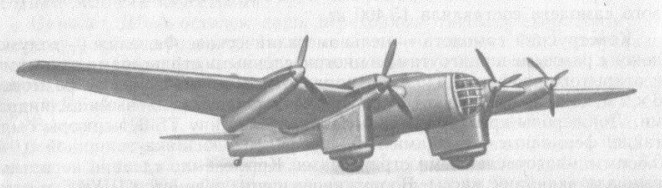
In order to verify the performance obtained during the prototype factory tests, it was decided to deliver the second prototype, known as DB-2A, to the NII VVS to carry out the state tests, which began on March 14, 1936. This model was equipped with a more powerful version of the M-34RN engine rated at 1000 hp and a new radiator.

The main pilot for the tests was MA Nyuxtikov and the principal engineer Losiukov. The flight results set in these tests were:
Maximum speed at sea level: 280 km / h
Maximum speed at 3000 meters: 323.5 km / h
Maximum speed 4200 meters: 330 km / h
Landing speed: 80 – 85 km / h
Practical ceiling with weight of 21,600 kg: 7,220 m
Take-off run: 300 – 350 m

The evaluation report of the state tests, signed by the head of the VVS Ya. I. Alksnis on June 1, 1936 concluded: “Compared to the TB-3 4M-34RN aircraft, the DB-2A prototype presents the following improvements: 1 – Considerable increase in horizontal speed. With the use of M-34FRN engines for which it was calculated, the speed should be increased until reaching 360 – 370 km / h. 2 – The large capacity of the fuel and oil tanks, at the overloads for which the aircraft was calculated, guarantee a great range. ” But there were a series of defects whose enumeration reached 38 points. Among them:
1 – Unsatisfactory stability and handling;
2 – Low effectiveness of the ailerons and great pressure on the lever during its operation;
3 – Low effectiveness of the rudder and great pressure on the lever during its operation;
4 – In flight regime between atmospheric turbulence, the effectiveness of the tail decreases significantly with rolling. A prolonged flight in these conditions is made impossible by the pilot’s fatigue.
5 – Appearance of strong vibrations in the tail unit in some flight regimes.

Despite not being included in the official report, Tumansky had highlighted other defects, including the impossibility of completing the oil capacity in flight, the inability to use the last 60 kg of oil in the tanks, due to the location of the system nozzles. Piloting the plane required great physical strength and there was no oxygen system for the crew.

Several improvements were made to the aircraft that included modifications to the aileron and rudder control systems. The appearance of strong vibrations in the tail section forced a flight weight limit of 21,800 kg to be established. Upon learning of this, Boljovitinov himself together with the test pilot MA Nyuxtikov conducted a test flight, managing to find a weak point in the aircraft’s structure, which was soon reinforced. With this it was possible to raise the takeoff weight to more than 30,000 kg.

The DB-A was flight tested with only three engines. In this case the maximum speed decreased to 292 km / h, the ceiling with 21,500 kg of weight reached 5100 meters. It is noteworthy that in the tests an engine was never really disconnected, but the power was reduced to the maximum. With two engines working, the plane was unable to exceed 2,500 meters in height.

In the flight tests there were several mishaps that luckily did not end in disasters:
On March 11, at an altitude of 2000 m, due to a power failure during the climb, the four engines stopped and only the quick action of the pilots who managed to stabilize the horizontal flight, guaranteeing the necessary flow of fuel to the engines. was able to avoid an accident.
On May 21, 1936, during landing 67 and due to a manufacturing defect, the left leg of the landing gear broke.

In June 1936, installation tests were carried out on the DB-2A of the M-34FRN engines with take-off power of 1220 – 1240 hp and new metal propellers. It was decided to develop a new test suite on the NII VVS. These tests were developed by the third rank military engineer MA Lipkin and had MA Nyuxtikov as the main pilot.

The M-34FRN engines (with factory numbers № 436, 437, 4311, 4314) were experimental and did not pass the test because they were considered unreliable. Compared to the M-34RN they had a power increase of only 50 – 70 hp. It was impossible to install them on the plane until its completion by Factory No.24.

In the report of the test results with the new powerplant signed by the head of the VVS Ya. I. Alksnis on November 2, 1936 it is found that:
“… The installation of the M-34FRN engines in the DB-A aircraft, due to its low working height and lack of completion, negatively influenced the flight data of the aircraft, excluding the speed performance (maximum speed grew at 10 km / h)”.

In the conclusions of the state tests Alksnis also wrote:
“Taking into account that the DB-A significantly surpasses the TB-3-4M-34RN in performance and that the defects indicated in the state tests can be solved during the construction of the field series, consider it essential to begin preparation for production series of these aircraft based on the results of field tests”.

In 1936 itself, the process of preparation for serial production began. At that time a contradiction was created between Bolkhovitinov and the director of Factory No.22, Tarasievich. The factory had been instructed to restore production of the TB-3 and a large production plan for SB bombers. On the other hand, Túpolev had begun to propagandize the series production of his TB-7. For this reason, Tarasievich submitted to Glavaviaprom (of which Tupolev was deputy chief engineer) the request to develop the production of DB-A in Kazan, at Factory No.124. This request soon became a decision sanctioned by the Commissariat for Heavy Industry.

This decision directly affected the group. Bolkhovitinov could not refuse to move, as this meant refusing to produce the bomber. KB members received the documents for a lengthy service commission. Several specialists were unable to transfer and others simply did not want to do so, for example Kuritskies and Shishmariov, who taught at the Academy, decided not to leave the VVA.

Only two complete copies had been built at Factory No.22: the DB-A prototype and the second DB-2A. A third uncompleted specimen was sent to Factory No.124 in Kazan for completion. As a basis for serial production it would be necessary to build 4 or 5 aircraft, which were to be produced at Factory No.22.

Although initially it was planned to have the first copy ready for December 1936, the construction of the plane was delayed. At the beginning of 1937 all the forces of Factory No.22 focused on the first copy in order to be able to deliver it for testing on February 8.

In April 1937, joint tests began with the contractor of the first specimen intended for field tests, produced at Factory No.22. This aircraft was a modified DB-2A. Among the main differences was the fully retractable landing gear. Initially 1350×300 mm wheels were selected but it was shown that they did not support the maximum flying weight of the aircraft, so other 1600×500 mm wheels were chosen. The cockpits for the pilots, navigator and mechanics had been totally modified and raised to improve visibility. This caused the deck to protrude from the fuselage, ending in a fall in which it was thought to locate a ShKAS machine gun.

On the nose was the two machine gun system used in the SB. In the central region there was a turret with a ShVAK cannon that rotated with the help of an electric motor. The initial turret, now equipped with a PMP-2 collimator, was kept in the tail.

This new specimen received the name DBA-37 or simply DB. The test brigade was made up of the test pilot MA Nyuxtikov, the second pilot and engineer Antojin, the armament engineer Stvietkov and the chief engineer of Factory No.124 Volkov.

As a result of the second stage of testing, the surface and trim area of the rudder was increased. Later, the construction of the cellar hatch opening system was changed, the engine exhaust system was modified, the trimmers and the aileron and rudder compensation system were modified, among other minor changes. For crew communication, a new intercom system SPU-1 was adopted and RSTB-1 and RSB radios were added. The crew grew to 11 people. The changes continued until the end of 1937.
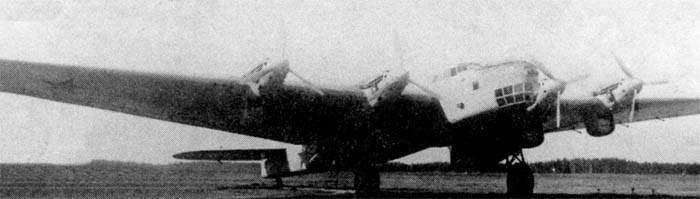
DB-A from the field test series.

The first modernized DB-A copy was completed only for the month of May. Factory tests with M-34RNV engines took place between May 11, 1937 and March 22, 1938. The test brigade in this case consisted of the test pilot MA Nyuxtikov, the second pilot and engineer Antojin, the chief engineer of Factory No.22 Frolov and the engineer of Factory No.124 Garanovich.

Bolkhovitinov DB-A pre-series bomber.

Compared to the first copy, the handling worsened. With respect to the first prototype, the take-off weight had increased by 2000 kg and the maximum speed to 3000 meters was increased by only 8 km / h, so the modifications had been insignificant.

The long duration of the tests was due to the fact that, after the disappearance of Levianevski, the works in the DB-A were stopped and only continued in early 1938.

The first stage of state testing of the modernized DB-A took place between October 21 and December 20, 1937. After several modifications to the aircraft, the tests were continued at the NII VVS between April 14 and June 24, 1938. The final result of the tests was generally positive, for which the series production of 16 copies was authorized.

Between August 26 and September 28, tests were carried out with the M-34FRN engines with turbochargers and VISH-3B propellers of 3.9 m diameter. The tests were carried out in conjunction with the NII VVS. A total of 13 flights were carried out, of which 6 were carried out at altitudes of more than 9000 meters. They aspired to reach 11,000 meters, but the poor work of the compressors did not allow this result to be achieved. With this new power plant, the empty weight of the aircraft grew by 910 kg, reaching 17,722 kg. The takeoff weight was close to 24 tons.

Only 12 copies had been built by the end of 1939, when production was halted in favour of the Túpolev TB-7. The built specimens were destined for the 5th Long Range Bomber Aviation Corps of the RKKA VVS in the Far East. In 1940 there were 6 DB-A bombers in service there. At the beginning of the war these aircraft were not transferred to the European region of the USSR, serving basically as transports until the end of their useful life.

In 1940 the problems presented with the production of the TB-7 brought to the table for discussions the issue of restoring the production of the DB-A, but from there it did not happen.

Among the possible development variants to eliminate the problems of the use of a lower performance powertrain than the projected one, the use of Charomsky AN-1 diesel engines was valued.

Records:
The 10 November of 1935 pilots MA Nyuxtikov and MA Lipkin set a new world record for the lifting 10 tons of weight to 7,032 meters high.
On 20 November 1935 these pilots set a new record holder for the lifting 13 tons to 4,535 meters.
The 14 May 1937 pilots GF Baydukov. NG Kashtanayev and LL Kerber flew in a DB-A on the Moscow – Melitopol – Moscow route covering 2002.6 km in 7 hours 2 minutes and 11 seconds with a payload of 5 tons. Two world records were set on this flight:
Speed of 280 km / h in distance of 1000 km with 5 tons of load.
Speed of 246 km / h in distance of 2000 km with 5 tons of load.

Gallery

Variants:

DB-A – The initial prototype aircraft, with M-34RN engines, lost on a non stop flight Moscow to Fairbanks, Alaska.

DB-2A – The second prototype with many detail improvements and M-34RNV engines.

DBA – Production aircraft ordered in 1937. Sixteen aircraft ordered, but only twelve completed, with M-34FRN engines plus turbo-chargers, rearwards retracting main undercarriage, gunners cockpits in the rear of the inner engine nacelles, and other modificatoions.

TK-1 TK ( – heavy cruiser) – Projected escort bomber with 11 crew, 3xShVAK + 3,000 rounds, 5xShKAS + 11,000 rounds and underwing rockets.

Specifications:
DBA
Engines: 4 × M-34FRN + turbo-chargers, 970 hp
Wingspan: 39.5 m (129 ft 7 in)
Wing area: 230 sq.m (2,476 sq.ft)
Length: 24.4 m (80 ft 0-5/8 in)
Stabilizer wingspan: 12.5 m
Height: 8.50 m
Wheelbase: 7,690 m
Empty weight: 16,150 kg (35,605 lb)
Gross weight: 22,000 kg (48,500 lb)
Power load: 5.7kg / hp
Wing loading: 95 kg / m²
Maximum speed: 316 km/h (196.4 mph)
Maximum speed at 4000 m: 330 km / h
Cruising speed: 260 km / h
Range: 4500 km (2,796 miles)
Service ceiling: 7,730 m (25,360 ft)
ROC: 135 m / min
Climb to 1000 m: 5 min
Climb to 7000 m: 56 min
Crew: 6 – 9
Armament:
2 x ShKAS 7.62mm machine-guns in each of the inner nacelle gun positions.
1 x ShKAS 7.62mm machine-guns in nose and tail positions.
1 x ShVAK 20mm cannon in the dorsal turret.
5,000 kg of bombs in internal bomb-bay.
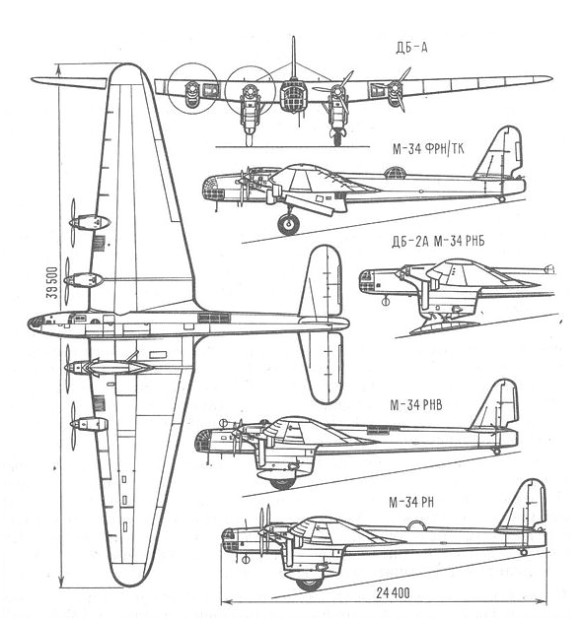
Boljovitinov DB-A

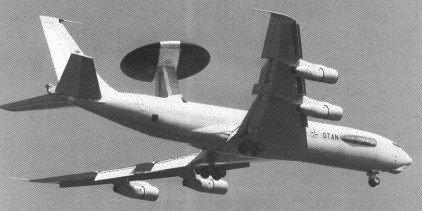
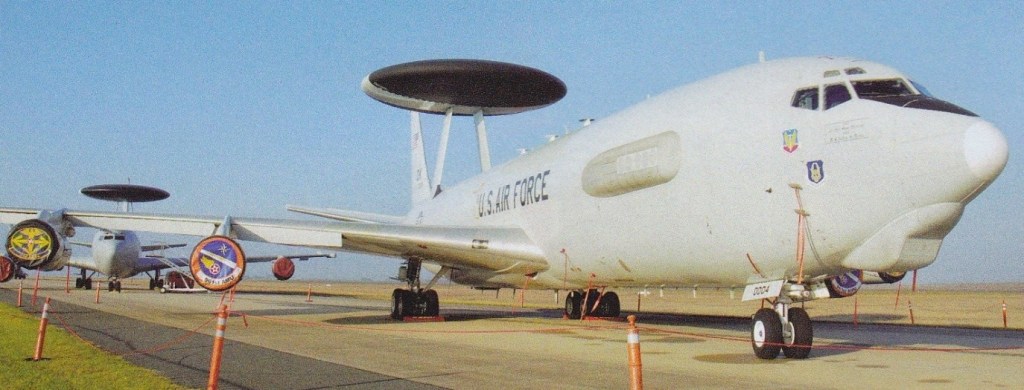
Boeing E-3 Sentry / EC-137D

Boeing E-3A Awac

The requirement for an Airborne Warning And Control System (AWACS) aircraft was outlined by the US Air Force in 1963, at which time it was envisaged that a force of up to 64 of these specially-equipped aircraft would be needed. Economic considerations have made it necessary to reduce considerably the number of aircraft to be acquired initially.
The resulting Boeing E-3A Sentry is essentially a flexible, jamming-resistant, mobile and survivable radar station, plus a command, communications and control centre, all contained within the airframe of a Boeing 707. In addition to its long-range high- or low-level surveillance capability, an AWACS aircraft can provide all-weather identification and tracking over all kinds of terrain, and the 22nd and subsequent aircraft also have a maritime surveillance capability.
Boeing was the successful one of two contenders for the supply of an AWACS aircraft, being awarded a contract on 23 July 1970 to provide two prototypes under the designation EC-137D. The company’s proposed AWACS was based on the airframe of the Boeing Model 707-320B commercial transport, and the prototypes were modified in the first place to carry out comparative trials between the prototype downward-looking surveillance radars designed by the Hughes Aircraft company and Westinghouse Electric Corporation. These tests continued into the autumn of 1972, and on 5 October the USAF announced that Westinghouse had been selected as prime contractor for the advanced radar that was to be the essential core of the AWACS. This has the task of seeking and identifying low-flying targets at ranges as great as 370km, and in the case of high-altitude attack at even greater ranges.

Very little modification of the basic 707-320B airframe was needed to make it suitable for the new role. An external, large rotodome assembly carried on two wide-chord streamlined struts are secured to the upper rear fuselage. The remainder of the essential avionics antennae are housed within the wings, fuselage, fin and tailplane. New engine pylon fairings are provided for the more powerful turbofan engines of the pre-production EC-137Ds, and of the production aircraft which were designated E-3A and given the name Sentry. Internal modifications included strengthening of the cabin floor, provision of MPC (multi-purpose console) and other equipment bays, and addition of a crew rest area. Basic operations require a flight crew of four plus 13 AWACS specialist officers, but this number can vary for defence and tactical missions, and other personnel can be carried for systems management and radar maintenance.

Liquid cooling protects the radar transmitter, housed in the aft cargo hold, and a conventional air-cycle and ram-air environmental control system provides for crew comfort and the safe operation of other avionics equipment. Electrical power is supplied by generators with a combined output of 600 kVA. The over-fuselage rotodome is 9.14m in diameter and has a maximum depth of 1.83m. This incorporates the AN/APY-1 surveillance radar and IFF/TADIL C antennae. During operational use the rotodome is driven hydraulically at 6 rpm, but in non-operational flight is rotated at one twenty-fourth of this speed to ensure that low temperatures do not cause the bearing lubricant to congeal and prevent normal operation when required.

The Westinghouse radar, installed first in the 22nd Sentry, and scheduled to be updated in earlier aircraft, can function as a pulse and/or pulse-Doppler radar, and is operable in six different modes. The data processing capability of the first 23 E-3As is provided by an IBM 4 Pi CC-1 high-speed computer. It has a processing speed of some 740,000 operations per second, main memory capacity of 114,688 words, and a mass memory of 802,816 words. The IBM CC-2 computer, introduced on the 24th production aircraft, has a main memory capacity of 665,360 words. Also introduced on this aircraft is the newly-developed Joint Tactical Information Distribution System (JTIDS). This provides a high-speed secure communications channel for up to 98,000 users, and one that is less vulnerable to jamming.

The first Boeing E 3A Sentry aircraft was delivered to USAF Tactical Air Command’s 552nd Airborne Warning and Control Wing at Tinker AFB, Oklahoma, in March 1977, while the Nato fleet was delivered between January 1982 and April 1985.
Saudi Arabian E3 Peace Sentinel AWACS and KE-3A tankers are powered by CFM-56 turbofans, and were delivered from late August 1986.
The US/Nato Standard E-3A features a radar modified to track ships, a faster central computer with expanded memory, and improved communications equipment, including JT1DS. Ten USAF Standard E-3As are being upgraded to E-3C configuration by the addition of five more consoles and extra communications systems. The conversion of 24 early production USAF Core E-3As to E-3B standard covers the upgrade of communications equipment, including the installation of JTIDS and the fitting of extra consoles and a US/Nato Standard computer. Hardpoints for chaff/flare dispensers are also being fitted. The first E-3B conversion was delivered in July 1984.
A force of 18 generally similar aircraft was acquired by NATO. Initial deliveries of NATO’s operational E-3As, which are based at Geilenkirchen, West Germany, were made during 1982. They differ from their USAF counterparts by comparatively minor changes in installed avionics to meet NATO communications requirements. They also introduced underwing hardpoints to carry self-defence weapons, but these mountings can be used optionally to carry ECM pods. The Sentry has also been sold to France and the United Kingdom, all export aircraft being powered by CFM56 high bypass ratio turbofans.

Flying for the first time on 27 June 1990 after leaving the Renton assembly line in April, was the first E-3F Sentry AWAC for the Armee de l’Air.

Gallery

E-3A Sentry
Engine : Pratt&Whitney TF33-PW-100 / 100A, 21,000 lb (9525 kgp)
Length : 152 ft 11 in / 46.61 m
Height : 42.421 ft / 12.93 m
Wingspan : 145 ft 9 in / 44.42 m
Wing area : 3050.518 sq.ft / 283.4 sq.m
Max take off weight : 325061.1 lb / 147420.0 kg
Weight empty : 170027.6 lb / 77110.0 kg
Max. speed : 545 kt / 1010 km/h
Cruising speed : 478 kt / 886 km/h
Ceiling: 8840 m / 29000 ft
Wing load : 106.6 lb/sq.ft / 520.0 kg/sq.m
Range : 5940 nm / 11000 km
Crew : 3 + 14

E-3A Sentry
Engine: 4 x CFM56-2 turbofan.
Installed thrust: 392.6 kN.
Span: 44.4 m.
Length: 46.6 m.
Wing area: 511 sq.m.
Empty wt: 78,000 kg.
MTOW: 147,400 kg.
Max speed: 855 kph.
Ceiling: 12,000 m.
T/O run: 2450 m.
Ldg run: 1130 m.
Fuel internal: 90,800 lt.
Range: 1600 km.
Endurance: 6 hr on station.
Air refuel: Yes.

Boeing C-135 Stratotanker / Stratolifter / 717 / 367-80

KC-135

At company board meeting on 22 April 1952 that meeting voted to go ahead and use company money ($20,000,000) — more than the company had – to fly a prototype jet transport. Actually called the 367-80, this air¬craft was rolled out on 15 May 1954 and first flew on 15 July 1954. Despite its size and speed it had manual flight controls, in all respects the 367-80 proved to be excellent. The Boeing 367-80, the first American turbojet airliner, was unique in having a wing sweep¬back of 35 degrees, and four engines suspended in pods below the wings.

Boeing 367-80

In October 1954 an order came through for 29 KC-135 Stratotankers, based on the 367-80. These were allocated the designation KC-135A, and the first of them made its initial flight on 31 August 1956; 10 months later, on 28 June 1957, the first was delivered to Castle AFB, California.

Boeing C-135 Stratotanker / Stratolifter Article

The KC-135 featured tanking equipment and an all-Boeing powered boom. Fuel was carried in the belly and wings and power was generated by use of four J57 powerplants. The system was generally crewed by three personnel though additions could be made when mission-specific (5 are utilized in the MEDEVAC role for instance).

KC-135R Stratotanker

This military version of the Model 367-80 is identified as the Boeing Model 717: it differs primarily from the later Model 707 by having a smaller-diameter fuselage, deletion of cabin windows, reduced size and weight, and accommodation for 80 passengers or an equivalent weight of cargo on the main deck. All equipment for the tanker role is carried on the lower deck, or normal cargo area, and includes the pivoted ‘Flying Boom’ refuelling gear. This was modified subsequently by the provision of an adaptor to allow for probe-and-drogue refuelling of Tactical Air Command and US Navy/Marine Corps aircraft. Power is provided by four 6123kg thrust Pratt & Whitney J57-P-59W turbojets.

Boeing EC-135C Looking Glass

The Model 717 Stratolifter family differs from the foregoing by being equipped specifically to serve as long-range transports. These have the refuelling boom deleted, but there is a structural similarity between these two basic tanker/lifter types, with interior changes in the latter providing accommodation for up to 126 troops, or 44 stretchers plus 54 sitting casualties. Galley and toilet facilities are provided at the rear of the cabin, and provision is made for an alternative all-freight role. The initial version was the C-135A with turbojet engines, first flown on 19 May 1961, and delivered to MATS on 8 June 1961 to become the USAF’s first strategic jet transport.

KC 135A 58-0091; courtesy Ron Bennett, Crew Chief, 1982-84, Minot AFB.

In 1964 the Strategic Air Command’s C-135A command post aircraft were being modified for inflight refuelling to etend flight duration beyond the 8 hr 30 min available. The C-135B’s were t be fitted with refuelling equipment on the production line.

KC-135 experience

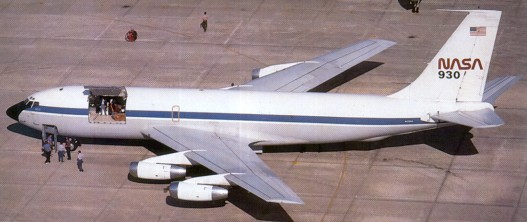
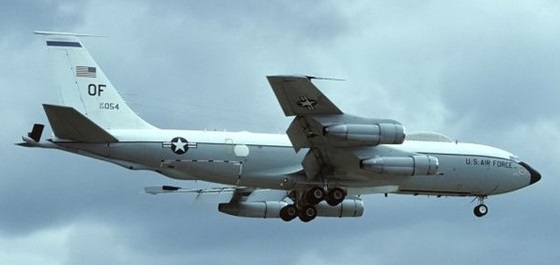
Some three dozen KC-135 Stratotankers (first flown on 31 August 1956) or C-135B transports have been modified to serve the USAF and other government agencies in specialised reconnaissance roles.

The USAF plans to re-engine some 630 KC-135A tankers with fuel-efficient CFM-56 turbofans, under the designation KC-135R. The programme began in 1983, and is due to run until 1995. The prototype conversion flew on August 4, 1982, and production deliveries started in 1984. KC-135Rs are expected to remain in service until 2020 at least, probably with further avionics updates later. Eleven French Air Force KC-135Fs are also being retrofitted with CFM-56s as KC-135FRs. The first was delivered in August 1985.
Ten KC-135As were modified to EC-135K standard as airborne relay aircraft.
Under a separate programme, 104 Air National Guard KC-135s, together with 24 Air Force Reserve and 23 special-mission aircraft, are being re-engined with JT-3D turbofans acquired from retired airline Boeing 707s, and are known as KC-135Es (in tanker configuration). The first was completed in July 1982.
Four RC-135As were camera-equipped for photo-mapping, but most of the RC variants, including RC-135C, RC-135D, RC-l35E, RC-135M, RC-135S, RC-135T, RC-135U, RC-135V, RC-135W and RC-135X, carry nose-mounted and side-looking radars and other sensors. Some RC variants have the original 13,750 lb st (6 237 kgp) Pratt & Whitney J57-P-59W turbojets; others have been converted to have 18,000 lb st (8 165 kgp) TF33-P-9 turbofans.

RC-135 Operations

In 1967 eight standard Boeing C 135s were converted by Douglas Aircraft Company to ARIA (Apollo Range Instrumented Aircraft) EC 135Ns. Each aircraft carries inside its bulbous nose a dish shaped radar antenna to track spacecraft and lock on to them for the transmission and reception of radio messages and data telemetry between the NASA Manned Space Flight Centre at Houston, Texas, and the Apollo programme.
The 707 has also been operated by the US military as the VC-135.
The Navy received congressional approval to modify two Boeing NKC-135s into electronic warfare aircraft to be used for electronic warfare training of the fleet.
Boeing KC/C-135
The RC 135W is derived from the RC 135M, and differs from the RC 135V in having turbofan engines. Equipment wise it is similar to the “V”, but it has a longer SLAR cheek, which cuts into the crew door area rather than stopping short of it. Also, a pair of viewing ports have been added to the overwing hatch on the RC-135W. The “V” features additional airconditioning intakes on the engine pylons.
The Republic of Singapore Air Force took delivery of the first of four KC-135R Stratotankers on 10 September 1999. The former USAF KC-135A was withdrawn from ARMARC and updated with CFM56 engines and a Boeing developed multi-point refuelling system. It has bith the normal KC-135 refuelling boom and hose together with hose and drogue units under each wing.

In 1963 French KC-135 crews were being trained by SAC’s 93rd Bomb Wing at Castle AFB, California, at a rate of one four-man crew each month. France had bought 12 KC-135F which, along with crew training program, was paid under US Military assistance sales project. Training was to be completed by February 1964.

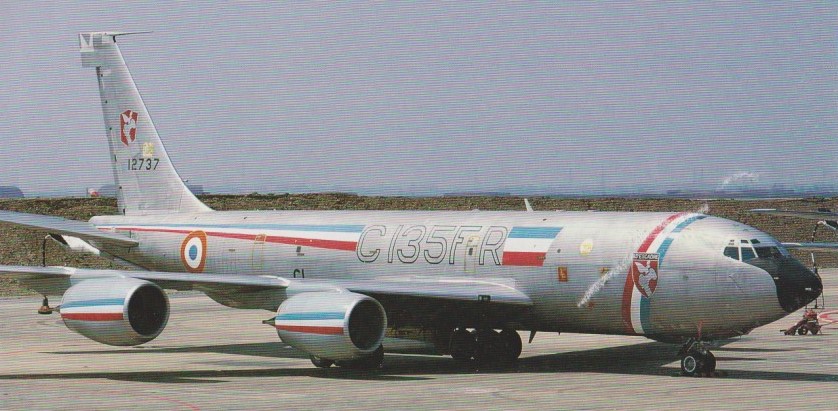
ERV-94 of the French Air Force at Istres received the last of 11 C-135FRs on 13 April 1988, serial CI (12737). Boeing converted these and equipped them with new CFM turbofans.

C-135FR serial CI (12737) on 13 April 1988  

Two modified KC-135As are used by the US Federal Aviation Administration (FAA) to check navigation aids throughout the United States.

Gallery

367-80
Engines: 4 x Pratt & Whitney J-57-P, 9500 lb
Wingspan: 130 ft
Wing area: 2400 sq.ft
Length: 127 ft 10 in
Height: 38 ft 3 in
Empty weight: 88,890 lb
Loaded weight: 190,000 lb
Max speed: 630 mph
Max cruise: 550 mph at 35,000 ft

KC-135A
Engines: 4 x Pratt & Whitney J57-P-59W turbojet, 13,750 lb.
Wing span: 130 ft 10 in (39.88m).
Length: 136 ft 3 in (41.53m).
Wing area: 2433 sq.ft (226.06sq.m).
Max wt: 297,000 lb (134,715 kg).
Typical cruise: 532 mph @ 45,000 ft.
Endurance: 5.5 hr.

C-135R
Engines: 4 x CFM56.

KC-135R Stratotanker
Engines: 4 x CFM F108 turbofan, 22,000lb
Length: 136.25ft (41.53m)
Wingspan: 130.84ft (39.88m)
Height: 41.67ft (12.70m)
Empty Weight: 106,307lbs (48,220kg)
Maximum Take-Off Weight: 322,503lbs (146,285kg)
Maximum Speed: 610mph (982kmh; 530kts)
Maximum Range: 2,880miles (4,635km)
Rate-of-Climb: 1,290ft/min (393m/min)
Service Ceiling: 41,719ft (12,716m)
Accommodation: 3

RC-135M

RC-135V

RC-135W

Engines: 4 x P+W TF-33-P-5
Take-off weight: 125000 kg / 275579 lb
Empty weight: 47000 kg / 103618 lb
Wingspan: 39.9 m / 130 ft 11 in
Length: 41.0 m / 134 ft 6 in
Height: 11.7 m / 38 ft 5 in
Wing area: 226.0 sq.m / 2432.64 sq ft
Max. speed: 970 km/h / 603 mph
Cruise speed: 650 km/h / 404 mph
Ceiling: 10700 m / 35100 ft
Range w/max.fuel: 14800 km / 9197 miles
Range w/max.payload: 4900 km / 3045 miles
Crew: 4-5
Passengers: 126

367-80

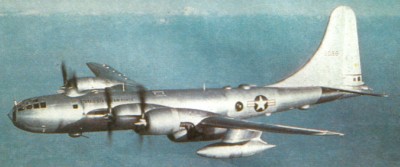
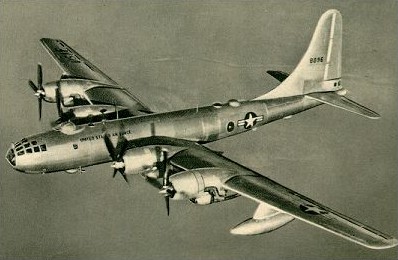
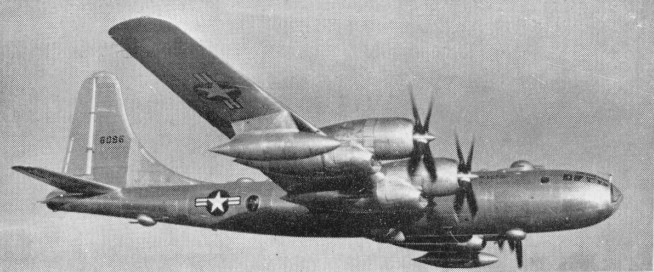
Boeing B-50

The B-50’s development was approved in 1944, when the aircraft was known as the B-29D. The Army Air Forces (AAF) wanted a significantly improved B-29 that could carry heavy loads of conventional weapons faster and farther. As World War II ended, the production of thousands of B-29s was cancelled. The B-29D survived, redesignated B-50 in December 1945, the improved bomber was now for the atomic role. The decision was pending availability of the intercontinental B-36 or of another bomber suitable for the delivery of atomic weaponry.

Boeing B-50 Article

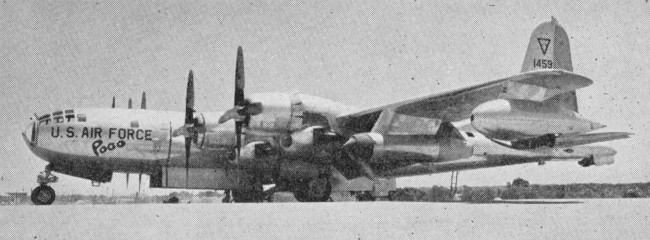
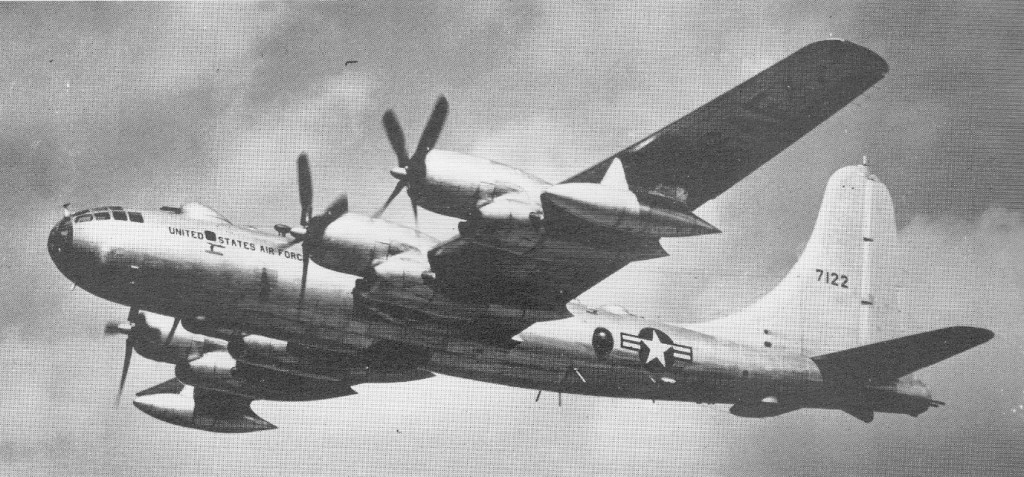
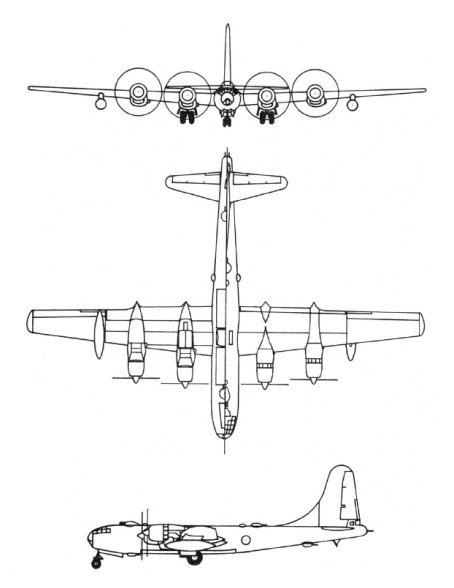
First flying on 25 June 1947 and looking identical to the B-29 Superfortress, the B-50 retained just 25 percent of the B-29’s original components. Changes distinguishing the B-50 from its predecessor included an all new aluminum wing design that made the aircraft more resilient and efficient. Vertical tail surfaces were now designed to fold down, allowing the massive bomber the capability to be housed in air force hangars.

A four-engine heavy bomber powered by the Pratt & Whitney 3,500 horsepower R-4360-35 Wasp Major radial engine produced in about 750 examples from November 1949 up until February 1953. Accommodations for crewmen included a total of ten personnel with access to 12 x .50 caliber machine guns in remotely-controlled barbettes and a 20mm cannon. Up to 20,000lbs of internal ordnance could be carried.

Initial production models were the B-50A and B-50B.

Photo-reconnaissance versions included the RB-50E, F and G, and the TB-50D and TB-50H were navigation trainers.

While the short-range B-50 was immediately recognized as a stopgap measure, the magnitude of the aircraft’s development problems proved unexpected. The B-50’s first difficulties stemmed from its bomb bay which, like that of the B-29, was too small to house the new bomb and its required components. The fast development of special weapons created more complications, since the individual components of every single type of bomb had to be relocated within the bomb bay’s narrow confines.

The B-50 soon exhibited engine malfunctions. Then, cracking of the metal skin on the trailing edge of the wings and flaps dictated extensive modifications. While these problems were being resolved, new requirements were levied on the aircraft. In 1949, as the proposed RB-36 remained a long way off, and because of the older RB-29’s deficiencies in speed, range, and altitude, some B-50s had to be fitted for the reconnaissance role. Fuel tank overflows, leaking fuel check valves, failures of the engine turbo-chargers, generator defects, and the like continued to plague every B-50 version.

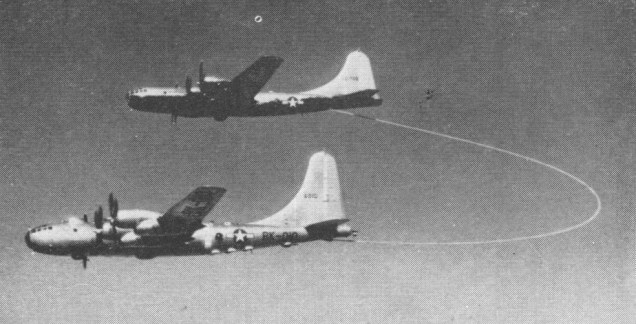
Contrary to plans, most B-50s came off the production lines without the receiver end of the new air-to-air refueling system being developed by Boeing. Additional, and successful, modifications ensued. Nevertheless, the Strategic Air Command (SAC) had no illusions. The B-50, along with the B-36 (first delivered in June 1948), would be obsolete in 1951. That the B-50 did not start leaving the SAC inventory before 1953 was due to the production problems and many modifications of its replacement: the subsonic B-47.

Boeing B-50D

B-50’s would eventually be replaced by the jet-powered B-47 Stratojet by 1954, though many would go on to be modified as TB-50H crew and pilot trainers, the KB-50 aerial refueling aircraft and the RB-50 photographic reconnaissance platform.

Boeing KB-50K

The KB-50 refuelling tankers had two J47 turbojets added in underwing pods, and were redesignated KB-50K.

B-50 ‘Luckey Lady II’ encircled the world non-stop in 1949, refuelled four times
RB-50 ELINT

Still operational in 1955, the B-50D usually carries two 700-gal. fuel tanks or 4,000 lb. bombs under outer wings. All B-50’s would be retired from service by 1965.

Gallery

B-50A
Engines: 4 x Pratt & Whitney R-4360-35 Wasp Major, 2610kW
Take-off weight: 76389 kg / 168410 lb
Empty weight: 36764 kg / 81051 lb
Wingspan: 43.05 m / 141 ft 3 in
Length: 30.18 m / 99 ft 0 in
Height: 9.96 m / 32 ft 8 in
Wing area: 161.55 sq.m / 1738.91 sq ft
Max. speed: 620 km/h / 385 mph
Cruise speed: 378 km/h / 235 mph
Ceiling: 11280 m / 37000 ft
Range: 7483 km / 4650 miles
Armament: 12 x 12.7mm machine-guns, 1 x 20mm cannon, 9000kg of bombs
Crew: 11

B-50D
Engines: 4 x Pratt & Whitney R-4360-35 Wasp Major, 3500hp
Wingspan: 141 ft. 3 in (43.10m)
Wing area: 1768 sq.ft
Length: 100.00ft (30.48m)
Height: 34.58ft (10.54m)
Empty Weight: 80,601lbs (36,560kg)
Maximum Take-Off Weight: 173,001lbs (78,472kg)
Maximum Speed: 380mph (611kmh; 330kts)
Cruise speed: 330 mph
Maximum Range: 4,896 miles (7,880km)
Service Ceiling: 36,713ft (11,190m)
Armament: 12 x 12.7mm machine guns, 1 x 20mm cannon
Internal bombload: 20,000lb
Accommodation: 10

WB 50D

Boeing 345 / B-29 Superfortress

B-29-40-MO

In March 1936, a team lead by Lysle Wood began work on an updated XB-15, the Model 316. This plane featured the all-glass nose that would make the B-29 distinctive. Designated the Y1B-20, it was 17 percent heavier than the eventual B-29. The Army was not interested. Boeing continued heavy bomber development in 1938 and 1939 with Models 330, 333, 333A, 333B, 334, and 334A. In August 1939 they began work on the Model 341, featuring a much improved wing: the Boeing Model 115 airfoil. Around 1938, General Henry H. ‘Hap’ Arnold, the head of the Army Air Corps, was growing alarmed at the possibility of war in Europe and in the Pacific. To prepare the Air Corps, Arnold created a special committee chaired by Brigadier General W. G. Kilner; one of its members was Charles Lindbergh. After a tour of Luftwaffe bases, Lindbergh became convinced that Nazi Germany was far ahead of other European nations. In a 1939 report, the committee made a number of recommendations, including development of new long-range heavy bombers. When war broke out in Europe, Arnold requested design studies from several companies on a Very Long-Range bomber capable of travelling 5,000 miles (8,000 km). Part of Arnold’s motivation for these studies was the fear that Britain might fall to the Nazis. In that event, it would be imperative that the Army Air Force have a bomber capable of flying round-trip from the U.S. East Coast to Europe to strike targets on the European mainland. Approval was granted on December 2. This request, R-40B, fitted perfectly with the research Boeing was doing at the time. On 29 January 1940, the Air Corps issued a request for proposals for a much larger bomber, which was to have the range for operation over the Pacific; this bomber would serve in the inevitable war with Japan. Four firms submitted design studies: the Boeing XB-29, Lockheed XB-30, Douglas XB-31, and Consolidated XB-32. Douglas and Lockheed soon withdrew, in part because Boeing was well ahead of them in the design process. On 6 September 1940 contracts were awarded to Boeing and Consolidated (later Convair) for the construction and development of two (later three) prototypes of their respective designs. Convair’s XB-32 Dominator was the first to fly, on 7 September 1942, but extensive development delayed its entry into service.

Boeing B-29 Superfortress Article

In early 1940, the Army Air Corps analysed the performance of bombers used in Europe against the Luftwaffe, and requested that the B-29 have self-sealing fuel tanks, more machine guns, and higher-caliber guns. Boeing incorporated these into a redesign of the Model 341, and resubmitted it to the Army Air Corps as Model 345, which would become the XB-29. Impressed by the mock-up completed in the spring 1941, the Army Air Corps had placed a massive order for 1,500 B-29s, a year before the prototype would fly for the first time on September 21, 1942. A long-range bomber was urgently needed, so service testing proceeded largely in tandem with production. The first B-29 rolled off the assembly line two months after the first service test flight. In under a year, the B-29 was in full-scale production. The USAAC’s specification had called for a speed of 644km/h, so the XB-29 had a high aspect ratio cantilever monoplane wing mid-set on the circular-section fuselage. Because such a wing would entail a high landing speed, the wide-span trailing-edge flaps were of the Fowler type which effectively increased wing area by almost 20%, thus allowing a landing to be made at lower speed. Electrically retractable tricycle landing gear was provided and, as originally proposed by Boeing, pressurised accommodation was included for the flight crew. In addition, a second pressurised compartment just aft of the wing gave accommodation to crew members who, in the third XB-29 and production aircraft, sighted defensive gun turrets from adjacent blister windows. The crew and aft compartments were connected by a crawl-tunnel which passed over the fore and aft bomb bays. The tail gunner was accommodated in a third pressurised compartment, but this was isolated from the other crew positions. Rather than the traditional bulky manned gun turrets, Boeing used small, remote-control units ‘networked’ together with an analog computer that compensated for factors such as air temperature and bullet drop. This system was very difficult to develop, but it proved effective. Each gun was served by a 1,000 round bullet belt.

The powerplant consisted of four Wright R-3350 Cyclone twin-row radial engines, each with two General Electric turbochargers mounted one in each side of the engine nacelle.

Prototype production was followed by 14 YB-29 service test aircraft, the first of these flying on 26 June 1943. Deliveries of YB-29s began almost immediately to the 58th Very Heavy Bombardment Wing (VHBW), a unit which had been established on 1 June in advance of the first flight. B-29 production was the most diverse aircraft manufacturing project undertaken in the USA during World War II, with literally thousands of sub-contractors supplying components or assemblies to the four main production plants: Boeing at Renton and Wichita; Bell at Marietta, Georgia; and Martin at Omaha, Nebraska.

Because of its highly advanced design, challenging requirements, and immense pressure for production, development was deeply troubled. The first prototype crashed during testing, killing the entire crew and several ground personnel. Changes to the production craft came so often and so fast that in early 1944, B-29s would leave the production lines and fly directly to modification depots for extensive rebuilds to incorporate the latest changes. This ‘battle of Kansas’ nearly sank the program, which was only saved by General Hap Arnold’s direct intervention. It would still be nearly a year before the aircraft was operated with any sort of reliability.

The most common cause of maintenance headaches and catastrophic failures, even more so than the advanced gunnery system, was the engine. Though the Wright R-3350 would later become a trustworthy workhorse in large piston-engined aircraft, early models were beset with dangerous reliability problems. It had an impressive power-to-weight ratio, but this came at a heavy cost to durability. Worse, the cowling Boeing designed for the engine was too close (out of a desire for improved aerodynamics), and the early cowl flaps caused problematic flutter and vibration when open in most of the flight envelope.

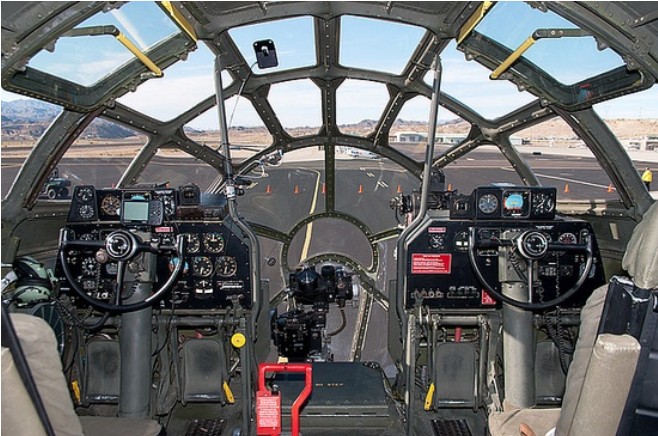
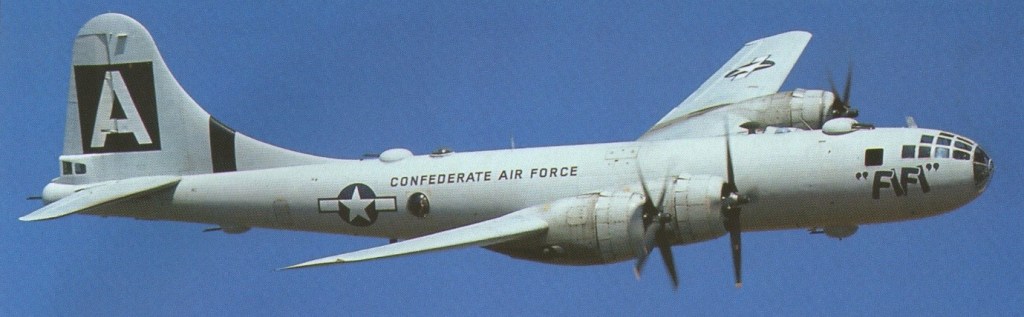
These weaknesses combined to make an engine that would overheat regularly when carrying combat loads; it frequently swallowed its own valves. The resulting engine fires were exacerbated by a crankcase designed mostly of magnesium alloy. The heat was often so intense the main spar burned through in seconds, resulting in catastrophic failure of the wing. This problem would not be fully cured until the aircraft was re-engined with the more powerful Pratt & Whitney R-4360 ‘Wasp Major’ in the B-29D/B-50 program, which arrived too late for World War II. Pilots, including the present-day pilots of the Commemorative Air Force’s Fifi, describe flight after takeoff as being an urgent struggle for airspeed. Radial engines need that airflow to keep cool, and failure to get up to speed as soon as possible could result in an engine failure and risk of fire.

The initial plan was to use B-29s to attack Japan from airfields in southern China, with the main base in India, and to attack other targets in the region from China and India as needed. This was an extremely costly scheme, as there was no overland connection available between India and China, and all the supplies had to be flown over the Himalayas. The first B-29s started to arrive in India in early April, 1944. The first B-29 flight to airfields in China (over the Himalayas, or “The Hump”) took place on 24 April 1944. The first B-29 combat mission was flown on 5 June 1944, with 77 out of 98 planes launched from India bombing the railroad shops in Bangkok (5 B-29s were lost to non-battle causes).

B-29 bomb aimer

On June 15, 1944, 47 B-29s launched from Chengtu in China bombed the Imperial Iron and Steel Works at Yawata, Japan. This was the first attack on Japanese islands since the Doolittle raid in April, 1942. The first B-29 combat loss occurred during this raid, with 1 B-29 destroyed on the ground by Japanese fighters after an emergency landing. Because of the extreme cost of operations, the raids against Japan from Chinese airfields continued at relatively low intensity. Japan was bombed on: 7 July 1944 (14 B-29s), 29 July (70+), 10 August (24), 20 August (61), 8 September (90), 26 September (83), 25 October (59), 12 November (29), 21 November (61), 19 December (36) and for the last time on 6 January 1945 (49). B-29s were withdrawn from airfields in China by the end of January, 1945. Throughout this period B-29 raids were also launched from China and India against many other targets throughout South-East Asia. However, the entire B-29 effort was gradually shifted to the new bases in the Marianas, with the last B-29 combat mission from India flown on March 29, 1945.

The need to use inconvenient bases in China for attacks against Japan ceased after the capture of the Marianas islands in 1944. On the islands of Tinian, Saipan and Guam a series of airfields were built, which became the main bases for the large B-29 raids against Japan in the final year of the war. The islands could be easily supplied by ship. The first B-29 arrived on Saipan on 12 October 1944, and the first combat mission was launched from there on 28 October 1944, with 14 B-29s attacking the Truk atoll. The first mission against Japan from bases in the Marianas was flown on 24 November 1944, with 111 B-29s sent to attack Tokyo. From that point ever more intense raids were launched regularly until the end of the war. These attacks succeeded in devastating all large Japanese cities and gravely damaged Japan’s war industries.

Perhaps the most recognized B-29 is the Enola Gay, which dropped the atomic bomb ‘Little Boy’ on Hiroshima on 1945 August 6. The Bockscar, also a B-29, dropped ‘Fat Man’ on Nagasaki three days later.

On Sunday 2 April 1944, the first B-29 Superfortress landed in Calcutta, India. It belonged to 58 Wing, 20th Bomber Command of the USAAF and had flown almost around the world, from the Boeing aircraft plant Wichita, Kansas to England, and then onto North Africa and the Orient. The plan was for B-29s to begin the strategic war against Japan.

On 16 June 1944 the US War Department announced the first wings of new US B-29 Superfortress bombers had taken off from bases in India, Burma and China, and have flown a massive raid on an “important target in Japan” from an altitude of 20,000 ft.

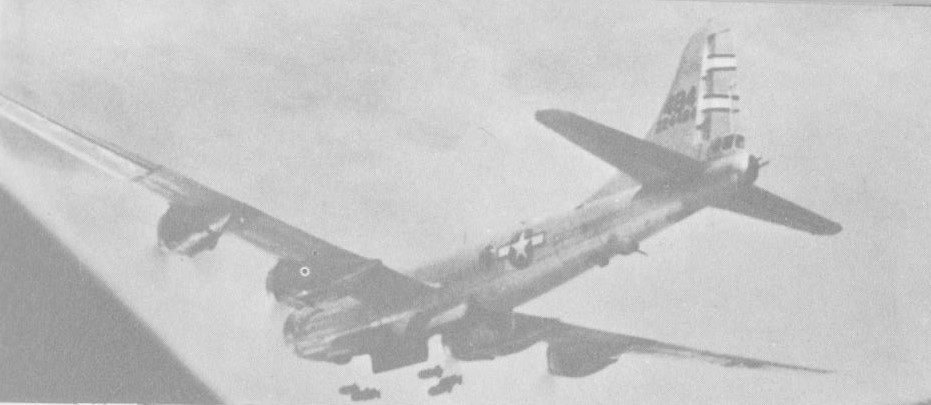
The B-29 was used in World War II only in the Pacific Theatre. It was later used in the Korean War, over the course of which they flew 20,000 sorties and dropped 200,000 tons (180,000 tonnes) of bombs. 3970 of the aircraft were built before they were retired in 1960. The B-29 was soon made obsolete by the development of the jet engine. With the arrival of the mammoth B-36, the B-29 suffered its first ignominy by being classified a medium bomber with the new Air Force. However, the later B-29D/B-50 variant was good enough to handle auxiliary roles such as air-sea rescue, electronic intelligence gathering, and even air-to-air refuelling. It was replaced in its primary role during the early 1950s by the Boeing B-47 Stratojet, which in turn was replaced by the Boeing B-52 Stratofortress. The final active duty variants were phased out in the mid 1960s.
B-29 production totalled 1,644 from Boeing’s Wichita plant, with 668 built by Bell and 536 by Martin. The Renton plant produced only the B-29A variant, with a 12in wider span, later marks of the 2,200hp Wright R 3350 engines, changes in fuel capacity, and the addition of a four gun forward dorsal turret and armament: production continued until May 1946 and totalled 1,122 aircraft.
The designation B-29B related to 311 of the aircraft built by Bell. These were reduced in weight by removal of all defensive armament except for the tail guns, which were then unmanned, being aimed and fired automatically by an AN/APG-15B radar fire-control system. The production total of 3970 B-29s of all versions saw a wide variety of employment in the post-war years, operating under several designations. A number of B-29s were used operationally during the Korean War.

B 29s were followed by several hundred of many versions of the B 50, with more powerful engines and other changes. These saw action only as tankers in the Vietnam War, but B 29s operated throughout the Korean War, the 22nd and 92nd Bomb Groups opening strategic missions as early as 13 July 1950. Though never more than 99 B 29s were on strength, the two groups flew 21,000 sorties and dropped 167,100 tons, more than the tonnage dropped by B 29s in World War II.

The US Operations Crossroads, with a budget of $1.3 billion, was to determine atomic bomb effectiveness using three tests. The first, Able, was air dropped, Baker detonated under water. Charlie, the third was later cancelled. For the first test site the Navy chose Bikini atoll. On 1 July 1946, the Able bomb was loaded into a B-29 Superfortress named ‘Dave’s Dream’. Just before 9am the bomb was released, exploding 518 ft above Bikini lagoon. The 23 kiloton test was a success, generating a 100,000 degree Fahrenheit fireball with the mushroom cloud reaching 40,000 ft.


B 29s force landed in Soviet territory were dissected in minute detail, and the Tupolev design bureau built first a simple transport, the Tu 70, followed in July 1947 by the first Tu 4 bomber. This was a B 29 except in having 23 mm cannon in its five twin turrets. About 400 were built, but they did not see action; their main importance was that they were the starting point for all today’s Tupolev strategic turboprop and jet bombers. Some of these remained in service into the 1960s in the Soviet Union. All but one of the Tu-4s were scrapped in the 1960s. The lone example of a Tu-4 known to exist today is located at the Yuri Gagarin Air Force Academy near Moscow, as a static display. This particular airplane was tasked with bombing the Budapest headquarters of the Hungarian rebel movement during the 1956 rebellion; but although the mission was rehearsed it was never put into play.
The last RB-29 was shot down by two MiG-15s above the east coast of Hokkaido, Japan, on 4 September 1954. The aircraft allegedly flew over Soviet territory on the Pacific coast, according to the Soviet. Ten or eleven of the crew survived.
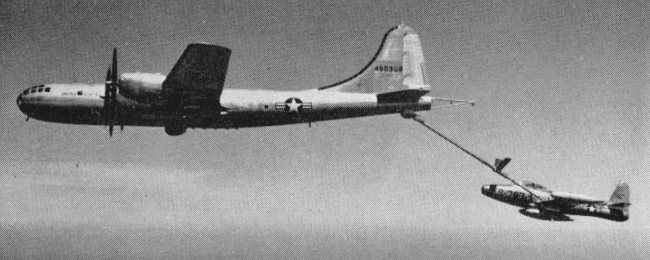
The KB-29 was the tanker version of the B-29, the SB-29 the search & rescue version, carrying a lifeboat; the DB-29 was a drone controller, the TB-29 a trainer, the RB-29 a reconnaissance aircraft. Some B-29s were also used as launch aircraft for research aircraft like the X-1 and X-2.

Boeing eventually converted about 100 to KB-29 tankers.

The KB-29P flying boom flight refuelling tanker version and the SB-29 search and rescue aircraft were still in service in 1955. The SB-29 equipped to carry an A.3 remote control lifeboat under its fuselage.

Boeing KB-29P

Eventually 4221 B-29 were built.

Events:

1 June 1943
The USAAF’s 58th Heavy Bombardment Wing was established. This wing was equipped with Boeing B-29 superfortresses for strategic attack on Japan.

15 June 1944
47 B-29s bombed the imperial iron and steel works at Yawata Japan.

20 November 1945
A new non-stop distance record of 7,916 miles was set by B-29 bomber “Pacusan Dreamboat” after flying from the island of Guam to Washington DC.

1 November 1954
The last B-29 in front-line service, based at Kadena, was retired. The B-29s were replaced by the B-47.

Gallery

B-29
Engines: Four Wright R-3350-21 or -23 “Cyclone” radials each equipped with two type B-11 turbo superchargers; later B-29 models fitted with -23A, -41 or -57 Cyclone radials
Engine gear ratio: 20:7 (.35)
Take-off power: 2,200 hp at 2,600 rpm w/ manifold pressure of 47.5 in.
Military power: 2,200 hp at 2,600 rpm w/ manifold pressure of 47.5 in at 25,000 ft.
Normal rated power: 2,000 hp at 2,400 rpm at sea level
Idling speed: 600 +/- 50 rpm (propeller at increase rpm)
Propellers:
Manufacturer: Hamilton Standard Propeller division of United Aircraft Corp.
Type: 4-blade, full feathering
Diameter: 16 ft. 7 in.
Span: 141 ft. 2.76 in.
Length: 99 ft. 0 in.
Height: 27 ft. 9 in. (at rest) 27 ft. 6.7 in. (taxi position)
Maximum fuselage diameter: 9 ft. 6 in.
Height to centerline of propeller hub (taxi position)
Inboard engines: 9 ft. 5.6 in.
Outboard engines: 10 ft. 8 in.
Ground clearance of inboard propeller tips (taxi position): 14.1 in.
Airfoil section: Boeing 117
Root: 22%
Tip: 7%
Chord root: 17 ft.
Chord tip (70 feet 10 inches from centerline of fuselage): 7 ft. 5 in.
Incidence: 4 degrees
Dihedral: 4 degrees 29 minutes 23 seconds
Sweepback: 7 degrees 1 minute 26 seconds
Stabiliser:
Span: 43 ft.
Maximum chord: 11 ft. 2.4 in.
Areas:
Wing (less ailerons): 1609.68 sq. ft.
Wing (flaps extended, plus ailerons): 2070.88 sq. ft.
Alierons (total, including tabs): 129.2 sq. ft.
Flaps (total): 332 sq. ft.
Stabilizer and elevators (including tabs): 333 sq. ft.
Elevators (total including tabs): 115 sq. ft.
Elevator trim tabs (total): 10.12 sq. ft.
Vertical fin: 131.9 sq. ft.
Dorsal fin: 40.6 sq. ft.
Rudder (including tab): 65.5 sq. ft.
Rudder trim tab: 5.79 sq. ft.
Weight: 133,500 lbs. (maximum overload) 105,000 lbs. gross
Armament: 10 or 12 .50-cal. machine guns and one 20mm cannon plus 20,000 lbs. of bombs.
Fuel Tank Capacities:
Regular wing (22 cells): 5608 US gals. (4669 Imp.)
Auxiliary center wing (four cells): 1333 US gals. (1110 Imp.)
Auxiliary bomb bay (four cells): 2560 US gals. (2133 Imp.)
Net Total capacity: 9501 US gals. (7912 Imp.)
Crew: Normal crew of 10 consists of Pilot, Co-Pilot, Flight Engineer, Bombardier, Navigator, Radio Operator, (2) Side Gunners, Top Gunner, and Tail Gunner
Maximum speed: 357 mph at 25,000 ft.
Cruising speed: 220 mph
Range: 5,600 miles maximum ferry range and 3,250 miles with 20,000 lbs. of bombs
Service ceiling: 33,600 ft.

B-29
Crew: 10
Engines: 4 x Wright R-3350-23-23A/-41 Cyclone 18, 1641kW
Take-off weight: 56245 kg / 124000 lb
Empty weight: 31815 kg / 70140 lb
Wingspan: 43.05 m / 141 ft 3 in
Length: 30.18 m / 99 ft 0 in
Height: 9.02 m / 29 ft 7 in
Wing area: 161.27 sq.m / 1735.89 sq ft
Max. speed: 576 km/h / 358 mph
Cruise speed: 370 km/h / 230 mph
Ceiling: 9710 m / 31850 ft
Range w/max.fuel: 5230 km / 3250 miles
Range w/max.payload: 2880 km / 1790 miles
Armament: 11 x 12.7mm machine-guns, 9000kg of bombs

B-29A
Engines: 4 x Wrigth R-3350-23 (supercharged radial engines), 1600kW/ 2,200 hp
Wing Span: 142.26ft (43.36m)
Length: 99.02ft (30.18m)
Height: 29.56ft (9.01m)
Wing Area: 161.27 sq.m
Empty Weight: 71,361lbs (32,369kg)
Max.Weight: 141,102lbs (64,003kg)
Maximum Speed: 358mph (576kmh; 311kts)
Service Ceiling: 31,808ft (9,695m)
Maximum Range: 4,100miles (6,598km)
Rate-of-Climb: 526ft/min (160m/min)
Wing loading: 337 kg/sq.m
Armament: 1 x 20mm, 12 x mg 12.7mm,
Bombload: 20,000lbs / 9072 kg
Crew: 10 (pilot, co-pilot, flight engineer, bombardier, navigator, radio operator, side gunners (two), top gunner, and tail gunner)

B 29A
Engines: 4 x four 2,200 hp (1641 kW) Wright R 3350 57 (or related) Duplex Cyclone 18 cylinder radials.
Wing span: 43.05 m (141 ft 3 in).
Length: 30.18 m (99 ft 0 in).
Height: 9.02 m (29 ft 7 in).
Wing area: 161.28 sq.m (1,736.0 sq ft).
Weight empty: 31816 kg (70,140 lb).
MTOW: 64002 kg (141,100 lb).
Maximum speed: 576 km/h (358 mph) at high altitudes.
Service ceiling: 9750 m (32,000 ft).
Range with maximum bombload: 5230 km (3,250 miles).
Armament: bombload of 9072 kg (20, 000 lb), plus 10 12.7 mm (0,5 in) machine guns and one 20 mm cannon in five turrets.
Crew: 10.

B 29B
Engines: 4 x four 2,200 hp (1641 kW) Wright R 3350 57 (or related) Duplex Cyclone 18 cylinder radials.
Wing span: 43.05 m (141 ft 3 in).
Length: 30.18 m (99 ft 0 in).
Height: 9.02 m (29 ft 7 in).
Wing area: 161.28 sq.m (1,736.0 sq ft).
Maximum speed: 576 km/h (358 mph) at high altitudes.
Service ceiling: 9750 m (32,000 ft).
Range with maximum bombload: 5230 km (3,250 miles).
Weight empty: 31816 kg (70,140 lb).
MTOW: 64002 kg (141,100 lb).
Armament: bombload of 9072 kg (20, 000 lb), plus 10 12.7 mm (0, 5 in) machine guns and one 20 mm cannon in five turrets.
Crew: 10.

KB-29P
Flight refuelling tanker.
Engines: 4x 2,200 h.p. Wright R3350-57 or -83
Wingspan: 141 ft. 3 in
Length: 99 ft.
Max speed: 351 m.p.h.
Ceiling: over 35,000 ft.
Range: 4,600 miles

Boeing 747 Dreamlifter

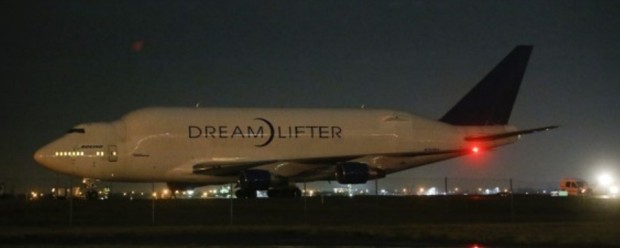
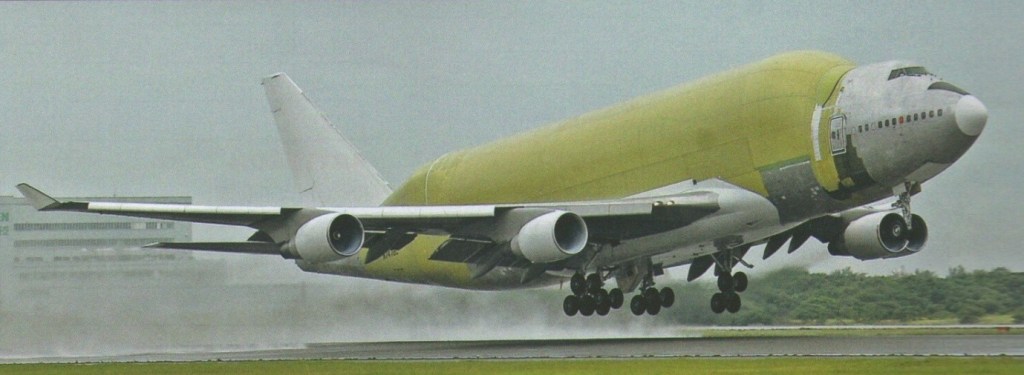
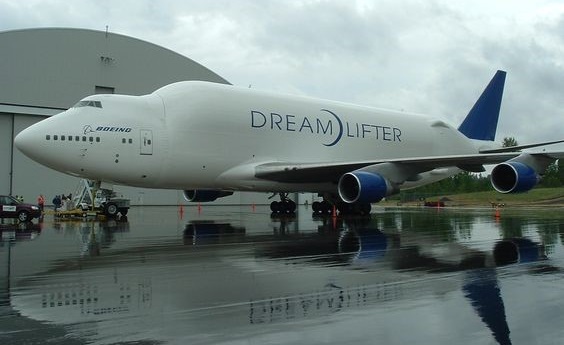
The first of an initial three Boeing 747-400 Large Cargo Freighters designed to transport major assemblies for the 787 to Everett for final assembly made its maiden flight on 9 September 2006 after conversion by Evergreen Aviation Technologies in Taiwan.

The Atlas Air 747 Dreamlifter is a modified 747-400 passenger airplane that can haul more cargo by volume than any airplane in the world. When fully loaded, the Dreamlifter needs a runway 9,199 feet long to take off.

The plane was owned by Boeing and operated by Atlas Air.

Boeing’s modified 747-400 was built to transport wings, tail, and fuselage components for Boeing 787 Dreamliners and other oversized cargo.

Only four of the modified 747-400s were ever built. The fuselage diameter of the Dreamlifter is 18 inches larger than the fuselage of the Airbus A380, the world’s largest passenger jet.

Gallery

Engines: 4 Pratt & Whitney 4062 turbofans
Wingspan: 212 feet
Length: 235 feet
Height: 71 feet
Empty weight: 398,000 lbs
Cargo capacity: 65,000 cubic feet
Cruise speed: Mach 0.82

Boeing 747 / VC-25 / E-4

Boeing 747-338

The Boeing 747 was conceived following the failure of Boeing to secure a USAF contract for a large strategic transport (the winner of this competition was Lockheed and their C-5 Galaxy). Seeing the need for a large passenger aircraft, Boeing dismissed the option of developing their 707 further and began the most famous and most ambitious project in the company’s history.

Boeing 747 Article

The Boeing Model 747-100 was announced on 13 April 1966 supported with orders from PanAm for twenty-five aircraft. It was not until further orders were received from Japan Airlines and Lufthansa that, on 25 April 1966, the decision was made to start construction. The maiden flight did not occur until 9 February 1969. Everything about it was giant sized, including the 200,000,000 cu ft (5,663,400 cu.m) single roofed factory in which to build it; some 20,000 people involved initially on the project; and the astronomic production costs. The new aircraft, RA001, emerged from the plant with 158 orders. The next four aircraft that were constructed were used in the certification programme, and collectively flew some 1400 hours. With the certification flying completed towards the end of 1969, FAA approval was granted on 30 December 1969. This was followed by Pan Am’s inauguration of the type on its first service from New York to London on 22 January 1970. Boeing went on to deliver 250 of the 747-100 series. The last built in 1982.

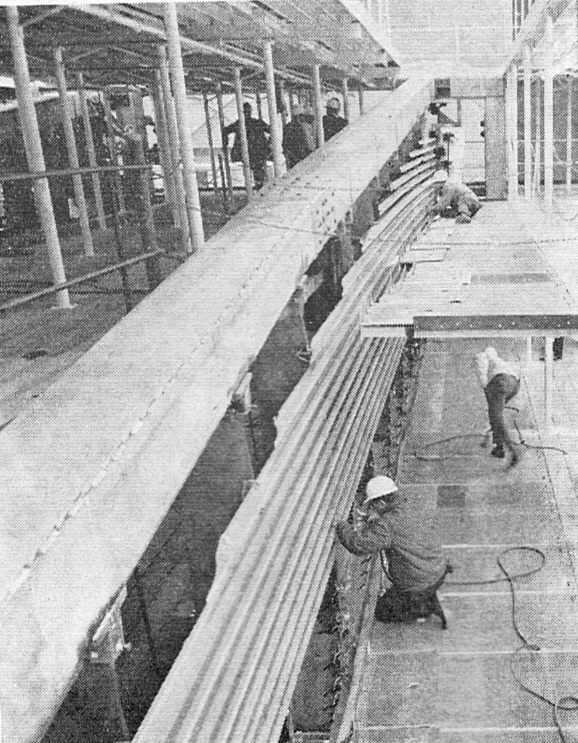
Installation of the 1st set of 95ft stringers on the first 747, at Everett plant, 1967

Lufthansa became the first European carrier, inaugurating its Frankfort-New York service with 747-100 on 26 April 1970, three months after Pan Am 747 introduction.


On 11 October 1970, when the first Boeing 747-200 model flew. Developed as a long-range model, it had greater fuel capacity, increased gross weight (from 334,751 kg to an initial 351,535 kg). The 100th 747 was delivered on 26 February 1971 and by September the following year the 747 had flown 1 million hours.

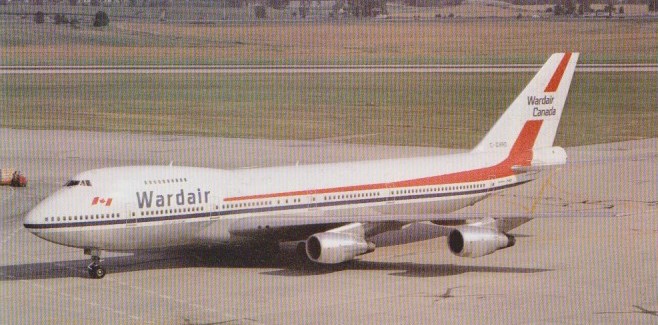
Boeing 747-211B C-GXRD, Toronto, Canada, August 1980

British Airways introduced their 747-100 into service in April 1971 between London and New York, with the first 13 (of 18) delivered in BOAC colours. These were P&W JT9D-7A powered.

The Boeing 747 212F differs in so far as it has the uprated 300 series Pratt and Whitney JTP D 7R4G2 engines, no windows and three air conditioning pacs instead of two. The additional air conditioning provides for a greater range of air temperature control. The contrast becomes more marked when the Jumbo comes to rest and opens its top hinged nose door. A large freight door port side rear completes the contrast. With the nose door open, some 53.42 metres of usable freight space stretches out awaiting the placement of the 28 pallets utilising a power driven conveyor system. The nose, restricted by the lower floor of the upper deck, can swallow loads up to 2.4 metres in height. The side cargo door can accept loads of up to 3.05 metres.
The seventh model was the 747SP (special performance), of which only forty-five were built. The B747SP, which first flew on 4 July 1975 (N530PA), was 14.35 m shorter than the standard Jumbo, and the vertical tail was increased in height to compensate for the reduced moment arm of the shorter fuselage. It did, however, share 90 percent commonality with the -200 and the -100 aircraft.


On 23 24 March 1976 a Model 747SP on delivery to South African Airways set a commercial aircraft nonstop distance record of 10,290 miles (16560 km).

Korean Air Lines Flight 007 Shoot-down

The SUD (stretched upper deck) model involved extending the upper deck (behind the flight deck) by about 7 metres. The SUD model became the Boeing 747-300, the first example of which was delivered in March 1983.

In mid-1977 Lufthansa changed the powerplants on its entire 747 fleet from Prat & Whitney JT9D to the General Electric CF6-50 to ensure commonality with its McDonnell Douglas DC-10-30s.

From July 1977 British Airways received 16 747-200Bs, powered by Rolls-Royce RB211-524D4 engines.

As launch customer for the 747-400, Northwest Orient Airlines began route-proving trials on 31 January 1989.

The initial Lufthansa order for six 747-400s, on 23 June 1986, allowed replacement of its older 747s. Since the start of 747-400 service with a flight from Frankfort to Johannesburg on 6 July 1989, follow-up orders boosted the fleet to 22, of which 7 were in combi configuration.

When British Airways signed a US$4.5 billion deal in late 1986 for 19 two-man crew 747-400s (seating up to 426 passengers), it was the biggest aircraft procurement contract ever placed by the airline. The first arrived in London on 30 June 1989. The aircraft success led British Airways to increase its orders to 67 aircraft.

Sharing the same airframe as the -300 series was, naturally, the Boeing 747-400. It first flew on 29 April 1988, and since 1990 has been the only 747 on offer. This latest model features drag reducing 1.8-m winglets, an advanced two-crew electronic flight instrument system (EFIS) “glass” flightdeck (in contrast, the -100’s flightdeck has a staggering 971 lights, gauges and switches, while the -400 has a relatively sparse 365). It also has new engines and an empty weight saving of 11 tonnes and, subsequently, further range. This aircraft is available in three maximum take-off weights up to 396.90 tonnes, and in a typical configuration of 416 passengers.

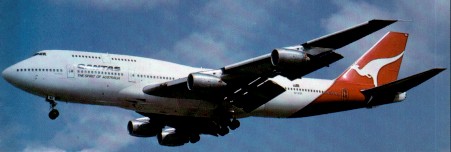
On 18 August 1989 QANTAS 747-400 Spirit of Australia completed the longest non-stop flight of any airliner. It flew 11,156 miles / 17,950 km from London Heathrow to Sydney, Australia in 20 hours 8 minutes.

In 1996 the Lufthansa fleet included 89 Boeing 737 and 26 Boeing 747s.
The 747F cargo version has a cargo area the size of two tennis courts. Wing sweepback on the 747 is 37.5 degrees.

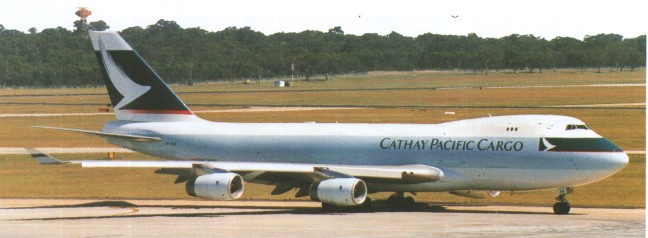
Boeing 747-400F

The 747-ER first flew on 31 July 2002, and can carry 15,000 lb more and can fly about 410 nm farther than existing 747-400s. Although identical in exterior appearance to the -400 the -400ER achieves it gains through an additional fuel tank and a strengthened fuselage, parts of the wing and undercarriage. The additional fuel is a 12,150 lt tank in the forward cargo area.


Original Boeing 747s had fuel distributed in seven tanks: two inboard (wing) mains, two outboard mains, and two inboard reserves, with a center wing tank. The latter’s capacity was first increased with the 747 200B and 200C, which also had the option of two outboard reserve tanks and a fuselage tank in the aft cargo compartment. With the 400, an option is to have fuel in the horizontal stabilizer.

In May 1990, Boeing decided to market only the -400.

Boeing 747-428

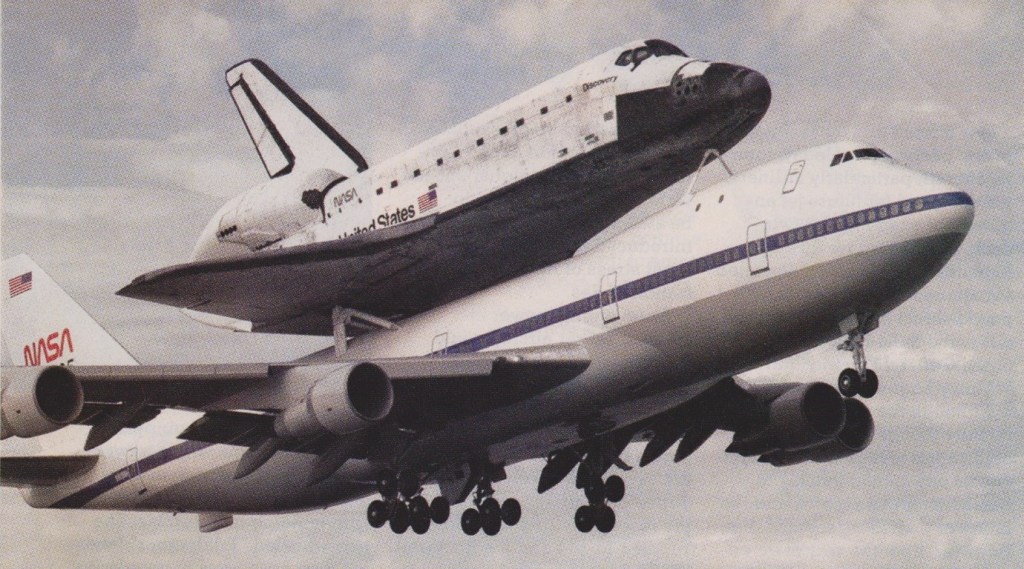
The Boeing 747 123 Shuttle Carrier Aircraft (SCA) (NASA 905), was flown for the first time on 16 December 1976. The Shuttle Carrier Aircraft (SCA), for which Boeing became the contractor to convert an ex American Airlines Boeing 747 123 to carry an SSO mounted above its fuselage, has meant structural reinforcement to withstand the weight of the 150,000 1b (68039 kg) SSO above the fuselage, supports and clamps to hold it in position, and to provide increased stability when paired with the Shuttle the 747 had endplate fins added to its tailplane.

Boeing 747‑123 Shuttle Carrier Aircraft (SCA) (NASA 905)

On 14 January 1977 the task was complete, the SCA handed over to NASA ahead of schedule.

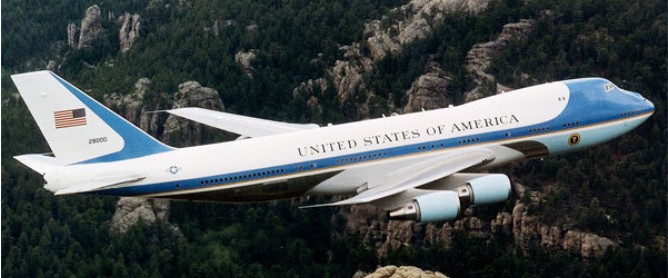
The VC-25 is essentially a highly-modified Boeing 747-200B series model featuring state-of-the-art communications and air defense measures consistent with protecting the President of the United States and his staff. Two Boeing 747-200B’s were converted to this VC-25 status and operate with tail numbers 28000 and 29000 respectively. Both aircraft are flown simultaneously for security and logistical reasons. The aircraft – or any USAF aircraft – is not officially designated as “Air Force One” until the president is onboard.

VC-25 (as VC-25A) arrived in 1990 with tail number 28000 (27000 served Nixon, Ford and Carter). Its first flight was in transporting President George Bush senior on September 6th 1990. The aircraft was officially introduced on December 8th, 1990. A second VC-25A (tail number 29000) was introduced on December 23rd, 1990. VC-25 with tail number 29000 was deployed for the first time on March 26th, 1991. These two VC-25’s were in operational service with the United States Air Force.

The VC-25 differs from existing passenger Boeing 747’s mostly in an internal way. The aircraft features a self-contained baggage loader, capability for in-flight refueling and front and rear “air-stairs”. Additionally, cutting edge technology is in the navigation, real-time communications and electronic systems. The aircraft features anti-missile functionality that is held classified. The interior furnishings are consistent with the level of government and combine the comforts of a working office and the White House in a self-contained mobile platform.

VC-25

The main galley can serve up to 100 persons at a given time while the crew has access to their own smaller galley as well as a lounge area. Passengers are also offered up six lavatories and full disabled access. 102 passengers can be carried.

The president has full access to his own in-flight office and the executive suite which contains the stateroom and comforts such as a shower, lavatory and dressing room. A conference room doubles as a dining room for family and close staff. Air Force One is also stocked with medical equipment to address minor injuries and situations.

Power for the VC-25 is four General Electric CF6-80C2B1 engines of 56,700lbs of thrust each engine. The aircraft flies higher and faster than her commercial counterparts, with a top speed of 630 mph and a ceiling of 45,100 feet. Range capability is up to 7,800 statute miles. With the in-flight refueling capability, this distance becomes essentially unlimited.

The pair of VC-25’s are held in an unmarked hanger at Andrews Air Force Base. The aircraft is inspected, cleaned and waxed before every flight and must be ready at a moment’s notice.

The E-4 designation identifies four Boeing 747 transports operated by the USAF as Advanced Airborne Command Posts. One is airborne at all times to maintain the critical communications link (in event of war) between the US National Command Authority and the strategic retaliatory forces.
Derived from the Boeing 747, the first of three E 4As flew first in mid 1973. The fourth aircraft, designated E 4B, has more advanced equipment. Power plant of the E 4B comprises four 52,500 lb thrust General Electric F103 GE 100 turbofan engines. The primary advantages of the E 4s over the EC 135s that formerly had full responsibility for this role are increased endurance and increased efficiency through the use of a larger number of crew members.
The programme to upgrade the four E-4A airborne command posts to E-4B standard was completed early in 1986. Satellite communications terminals have been added, together with radios ranging from super-high-frequency (SHF) to very-low-frequency (VLF) for more reliable contact with US strategic nuclear forces.

As of 20 October 2001, produced as 747-100 (250), 747-200 (393), 747-300 (81), 747-400 (530). Versions of 747-400 include – 400D, -400F and 400-M (Combi). As of 20 October 2001, Boeing had delivered 1,254 Boeing 747s. In addition, four 747s have been modified as E-4 command post aircraft, 19 Pan American C-19As were modified for the Civil Reserve Fleet currently operated by Evergreen International.

Launched in November 2005, the 747-8 Intercontinental received its first order in December 2006; 30, plus 20 options, from Lufthansa. All orders were for the freighter model.

The delivery of N863GT marks the final 747 to fly away from Everett after 1,574 747s came off the production line. From the first 747-100 to the shortened 747SP to the most successful variant, the 747-400, to the final 747-8, Boeing’s most iconic work has exited the building at Paine Field. The building will now be repurposed for 787 rework and a fourth final assembly line for the 737 MAX.

747-8F

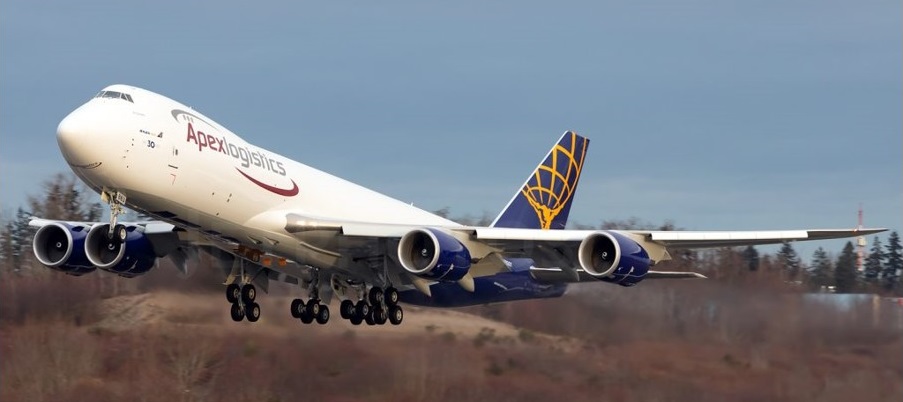
Atlas Air will put this particular 747-8F into service carrying cargo for Apexlogistics. The second to last 747 also delivered to Atlas Air is flying for Apex’s parent company Kuehne + Nagel.

Atlas was the final customer, ordering the last four examples ever built. The United States Air Force (USAF) is still working on converting some 747-8I passenger models that were repurposed, but these were not newly built planes. There is no sign that 747 production will restart.

Boeing 747-8 Article

Gallery

747-100
Engines 4 x 43,500 lb. (19,730 kg.) thrust Pratt & Whitney JT9D-3 turbofan.
Length 231.3 ft. (70.51 m.)
Wing span: 195.7 ft. (59.64 m.)
Wing area: 511.0 sq.m / 5500.35 sq ft
Height: 19.3 m / 63 ft 5 in
Max. weight: 710,000 lb. (322,000 kg.)
Empty weight: 238820 kg / 526511 lb
Max. capacity: 490 passengers
Max. speed: 990 km/h / 615 mph
Cruise speed: 965 km/h / 600 mph
Ceiling 45,000 ft. (13,000 m.) fully loaded.
Range w/max.fuel: 13000 km / 8078 miles
Range w/max.payload: 9650 km / 5996 miles
Crew: 3
Passengers: 490

747-200B
Engine : 4 x Pratt&Whittney JT9D-7W, 209149 N
Wing span: 195 ft 8 in (59.64 m)
Wing area: 5685.545 sq.ft / 528.2 sq.m
Wing load : 136.53 lb/sq.ft / 666.0 kg/sq.m
Length: 231 ft 4 in (70.51 m)
Height: 63 ft 5 in (19.33 m)
Max TO wt: 775,000 lb (351,540 kg)
Weight empty: 361276.0 lb / 163844.0 kg
Max level speed: 608 mph (978 kph)
Cruising speed: 512 kts / 948 km/h
Service ceiling: 44291 ft / 13500 m
Range : 6156 nm / 11400 km
Crew : 3
Payload : 66 Pax 1.cl., 490 Pax eco.

747-200B
Engines: 4 x General Electric CF6-50E2, 52,500 lbf
Length: 231.63ft (70.6m)
Width: 195.54ft (59.60m)
Height: 63.32ft (19.30m)
Maximum Speed: 587mph (945kmh; 510kts)
Maximum Range: 8,342miles (13,425km)
Service Ceiling: 45,000ft (13,716m)
Accommodation: 3 + 452
Empty Weight: 383,604lbs (174,000kg)
Maximum Take-Off Weight: 832,999lbs (377,842kg)

747-200B
Engines: 4 x Rolls-Royce RB211-524D4, 53,000 lbf
Length: 231.63ft (70.6m)
Width: 195.54ft (59.60m)
Height: 63.32ft (19.30m)
Maximum Speed: 587mph (945kmh; 510kts)
Maximum Range: 8,342miles (13,425km)
Service Ceiling: 45,000ft (13,716m)
Accommodation: 3 + 452
Empty Weight: 383,604lbs (174,000kg)
Maximum Take-Off Weight: 832,999lbs (377,842kg)

747-2D7B
Engines: 4 x General Electric CF6-50E2 turbofan, 233.5 kN.
Wing span: 59.64m.
Length: 70.66m.
Height: 19.33m.
Max speed: 0.84M @ 9150m.
Range (std load): 11,760 km.
Accommodation: 3 (flight-deck) three-class, 366 pax.

747 212F
Engines: 4 x Pratt and Whitney JTP D 7R4G2

747-214B
Engines: 4 x RR RB211-524D4 turbofan, 52,810 lb thrust.
Length: 70.4m.
Wing span: 59.64 m.
Height: 19.58m.
Wing area: 512 sq.m.
Range: 9500-11,000 km.
MTOW: 377.84 tonne.

747-243B
Engines: 4 x General Electric CF6-80E2 turbofan, 233.5 kN.
Length: 70.66m.
Height: 19.33m.
Wingspan: 59.64m.
Max speed: M0.84.
Max range: 11760 km.
Crew: 3.
Pax cap: 432

747-419
Engines: 4 x Rolls-Royce RB211-524G3 turbofan, 56,870 lb thrust.
Fuel cap: 175 tonne.
MTOW: 394,600 kg.
Max cruise alt: 40,000 ft.

747-400ER
Engines: 4 x General Electric CF6-80C2-B5F turbofan, 62,100 lb thrust.
MTOW: 412.769 tonne.
Fuel cap: 184.44 tonne.
Cruise: 0.85M.

747-441
Engines: 4 x General Electric CF6-80C2V1F turbofan.

747-8 Intercontinental
Engines: 4 x GEnx-2B67 turbofan
Length: 250 feet
Height: 63 feet
Wingspan: 224 feet
Passenger capacity: 467
Empty weight: 485,300 lb
Cruise speed: Mach 0.86
First flight: 2010

E-4B
Engines: 4 x Gen¬eral Electric Fl03-GE-100 turbofans, 52,500 lb st (23 814 kgp)
Length: 231.30ft (70.5m)
Width: 195.87ft (59.70m)
Height: 63.32ft (19.30m)
Maximum Speed: 603mph (970kmh; 524kts)
Maximum Range: 7,140miles (11,490km)
Service Ceiling: 45,932ft (14,000m; 8.7miles)
Accommodation: 4 + 23 + 70
Empty Weight: 418,878lbs (190,000kg)
Maximum Take-Off Weight: 826,403lbs (374,850kg)

VC-25A (Air Force One)
Engines: 4 x General Electric CF6-80C2B1, 56,700 lb
Length: 231.96ft (70.7m)
Width: 195.54ft (59.60m)
Height: 63.32ft (19.30m)
Maximum Speed: 629mph (1,013kmh; 547kts)
Maximum Range: 7,798miles (12,550km)
Service Ceiling: 45,098ft (13,746m)
Accommodation: 26 + 102
Maximum Take-Off Weight: 826,403lbs (374,850kg)

Boeing 720

Boeing 720B

The most important aerodynamic change compared with the 707-120 is a refinement to the wing leading-edge, which increases the angle of sweepback and decreases the thickness/chord ratio, with improvement in take-off performance and cruising speed. These modifications were incorporated subsequently on the Boeing 707-120B.
Major weight saving has been achieved by lightening the structure to the extent made possible by reducing the standard fuel load.

First flying on 23 November 1959, and first ordered by United Airlines, only 154 Boeing 720s were built before production ceased in September 1967, the type being replaced by the Boeing 727.

Gallery

Engines: 4 x P+W JT-3 D-1, 75.6kN
Wingspan: 39.9 m / 130 ft 11 in
Length: 41.5 m / 136 ft 2 in
Height: 11.7 m / 38 ft 5 in
Wing area: 226.0 sq.m / 2432.64 sq ft
Take-off weight: 103870 kg / 228995 lb
Empty weight: 49705 kg / 109581 lb
Cruise speed: 1000 km/h / 621 mph
Ceiling: 12800 m / 42000 ft
Range w/max.fuel: 8400 km / 5220 miles
Range w/max.payload: 6700 km / 4163 miles
Crew: 3-4
Passengers: 110-149

Boeing 707 / E-6 / E-8 / VC-137

Boeing 707

In October 1954 an order came through for 29 KC-135 tankers, based on the 367-80. When the company enlargened the cross-section of the fuselage, Boeing decided to design a new upper lobe for the commercial 707, while keeping the original one for the KC-135. The new fuselage upper lobe was of 140 in diameter making it easier to accommodate a triple seat each side of the aisle. The first 707 flew on 20 December 1957.

The 1st Boeing 707

Three airlines put Conway-engined Boeing 707s into service across the North Atlantic in the spring of 1960. The first was Lufthansa.

1st Lufthansa 707

The Boeing 707-120 was introduced in 1954. As the 707-121, the first of a whole family of passenger and cargo variants, it was launched on its career by Pan Am in 1958 with a $296 million order for 20 — on the transatlantic route for prestige reasons, although it was designed and subsequently used for medium-range domestic service.

Boeing 707 Article

The first flight of a Pratt & Whitney JT3D turbofan powered 707-120B was made on 22 June 1960.

707-120B

The first operator of the 707-120 was Pan American who started daily service between New York and Paris on 26 October 1959.

Pan American began using its 707-120s on US domestic routes on 20 March 1959. Starting in July 1965, Pan American Airways replace the human navigator with inertal navigation systems in their entire fleet of 55 Boeing 707s at a cost of $12,500,000.

A brand-new presidential Boeing VC-137A, purchased in 1959, was equipped by a CIA team with a series of large cameras under conditions of secrecy at Andrews Air Force Base. Of the three military Boeing 707 aircraft provided for the White House and the American Government, 86970 was most frequently used as ‘Air Force One’.

VC-137A Air Force One

Some photographs were taken during test flights with the Special Air Mission Boeing, proving that from a height of 9 km the number plates of cars could be read. The large cameras in the belly of SAM 970 were installed behind hidden panels. The operation was controlled from the cockpit in such a way that possible Soviet ‘escorts’ would not notice anything.

The 707-121 was followed by the intercontinental -320, the largest passenger jet of its era (which flew the first ever round-the-world service in 1959) and the short-range -720. The Boeing 707-320B was introduced in 1959.
The 707-138 was tailored exclusively to QANTAS specifications, combining the short fuselage of the -120 with P&W JT3D turbofans (replacing the JT3C-6 turbojets), and taller tail fin, and other aerodynamic improvements significantly boosting performance. Modification to 707-138B standard included fitting leading edge flaps and the installation of JT3D-1 turbofans.

The first QANTAS 707 (and Australia’s first jet) VH-EBA, a 707-138B, was retored at Southend and returned to Australia on 16 December 2006. Now registered VH-XBA (EBA was taken) it was to be delivered to the QANTAS Founders Outback Museum at Longreach QLD.

In the early months of 1960, modifications were adopted on the 707 to improve its controllability under certain critical conditions. The modifications, first applied to the Conway-engined 707-436s of BOAC, included a taller fin and a small ventral fin.

Lufthansa Boeing 707-430 jets first entered service on the non-stop Frankfort-New York route on 17 March 1960.

On 29 July 1963 BOAC’s flight 568, a Boeing 707, left Montreal for a non-stop to London. At the controls were Capts. Hilbert Alcock and Ernest E. Brow. On 15 June 1919 two British Navy pilots. Capt. John Alcock ant d Lt. Arthur Brown, made the first non-stop flight across the Atlantic in 16 hr 12 min. The jet flew 1300 miles further in 6 hrs 10 min.

BOAC 707-436

On 707s only the rudder is power operated; the other control surfaces, aerodynamically balanced, are moved by spring tabs on the trailing edges. Though criticized for being noisy and excessively smoky, and for needing longer runways than existed at most airports in the 1950s, the 707 quickly overcame all opposition by flying more passengers and cargo faster, farther and more economically than any other passenger plane. Models fitted with turbofan engines were considerably quieter than the early turbojet-powered versions and by the early 1960s, runways at major airports had been extended to accommodate the new generation of jets. During the two decades of 707 production, almost 2,000 have been built.

A modified Boeing 707-353B joined the US Presidential fleet in August 1972, designated as a VC-137C.
President John F. Kennedy’s VC-137 (tail number 26000) was based on a USAF C-137C model which in turn was based on the Boeing 707. This aircraft gained more significance in becoming the aircraft used to transport Kennedy’s body back from Dallas, Texas in 1963. The aircraft served as the official office to which Vice President Lyndon B. Johnson was sworn in as the 36th President of the United States following Kennedy’s assassination at the hands of Lee Harvey Oswald. Today, this very aircraft resides at the United States Air Force Museum in Dayton, Ohio. The aircraft exhibit details the event complete with text and pictures showing the swearing in and the area of the aft portion of the interior cabin modified to fit the coffin of John F. Kennedy for the trip back to Washington, D.C.

The same aircraft transported the body of President Lyndon B. Johnson back to Texas for final rest. President Richard M. Nixon utilized VC-137 on his historic visits to China and the Soviet Union.

John F. Kennedy’s VC-137 was the first presidential aircraft to be popularly known as “Air Force One”.

Powered by four turbojet engines the long range 707-320C can carry up to 202 passengers and has provided safe, fast and comfortable jet travel around the world. Its success can be measured by the fact that no fewer than 859 had been delivered by 1 June 1972.

In 1982 Boeing modified a commercial 707-320 airliner to demonstrate its potential as a tanker/ transport. As flown, the demonstrator has a centreline and wing-tip hose and drouge refuelling systems, but several alternatives are offered, including a centreline flying boom installation. For the tanker role an optional tank may be fitted in the lower rear cargo hold to provide an additional 19,000 lt of fuel. Spain will receive two tanker/transports with VIP interiors during 1987, while Brazil will take delivery of its fourth and last in November 1987.

Boeing completed the first 707-320 Inter-continental as no.16 off the Renton line, flying it on 11 January 1959. The Intercontinental had been ordered by nine airlines. Britain’s CAA caused a minor hiccup by insisting on extra vertical tail area. At first this was met by a big underfin, but the definitive answer was a taller fin, which Boeing made standard. The name Inter-continental was later dropped. The -320B had the JT3D engine and wings with a high-lift leading edge with full-span Kruger flaps and longer-span curved wingtips. These matched weight increases to 333,600lb, paralleled by the -320C mixed-traffic version cleared for 202 passengers or 96,126 lb of cargo.

The -320C remained in production until March 1982, the final total standing at 917. This does not include such military versions as the E-3 AWACS and KE-3A, E-6, E-8A and EC-18 series; with these the total is almost exactly 1,000.

Northrop Grumman undertakes production of E-8C Joint STARS as joint USAF and U.S. Army co-operation program for an airborne surveillance and target acquisition system (first flown August 1995 for first production E-8C).

U.S. Navy Boeing E-6B Mercury airborne command post

The last commercial 707 was 707-320C for Moroccan government delivered March 1982.

Based on the E-3 airframe and powered by four CFM International Fl08-CF-100 turbofans rated at 22,000 lb st (9 979 kgp) each, E-6As will replace EC-130Q Hercules in the TACAMO (Take Charge And Move Out) role to communicate with nuclear submarines. The E-6A is equipped with very-low-frequency (VLF) radio systems for commu¬nication with the US Navy’s Trident nuclear submarine fleet.

In 1990 the US Navy ordered eleven Boeing 707 derivatives. The particular USN variant ordered was the E-6 submarine communication aircraft which uses a five mile long trailing wire as a very low frequency antenna to produce a carrier wave to penetrate the ocean surface and reach submerged submarines worldwide.

For the US Navy, Boeing is building 15 of these survivable airborne communications systems, based on the Model 707 airliner airframe. E-6A – Powered by CFM-56 engines, the E-6A proto¬type flew on 19 February 1987 (minus avionics). Development of the survivable airborne communications system for the US Navy will continue until 1989.

Five Royal Australian Air Force Boeing 707 jets, with 29 years of service, where used for air-to-air refuelling and transport. A 707 tanker can carry up to 43 tonnes of fuel – the wingtip refuelling pods removable to reduce weight and drag and increase range on non-tanker missions.

As a transport aircraft, the 707 can seat up to 152 passengers or carry 60 tonnes of cargo. From 2009, the RAAF 707s were progressively replaced by new KC-30B Multi-Role Tanker Transports, specially-modified Airbus A-330s.

A re-engined Boeing 707 with four Pratt & Whitney JT8D-219 engines has shown up to 22% improvement in fuel usage over its original engines. This aircraft has been dubbed the B707RE. Also tested (as 707-700) was a re-engined version with CFM56.

The Boeing 707 80 prototype obtained speeds well below 100 mph during landing approach in tests conducted by NASA and Boeing at Langley Research Centre. The plane, which once set a coast-to-coast record at 612 mph, was modified by Boeing at its own expense. It has large wing flaps, a boundary layer control system, thrust modulating system and instruments to provide flight data. The Boeing 707 80 prototype was presented ultimately to the Smithsonian Air and Space Museum.

Keen to market its own AEW system for the Israeli Air Force (IAF) and for export, Israeli Aircraft Industries (IAL) developed the Phalcon Airborne Early Warning, Command and Control System and mounted it on a Boeing 707 airframe. The Phalcon system has attracted interest from a variety of countries, however, when China expressed an interest in mounting the radar system on a Russian-built Ilyushin/Beriev A-501 Mainstay in Jul 2000, the USA eventually blocked the sale.

Boeing 707 Phalcon

Gallery

B707-120
Engines: 4 x Pratt & Whitney JT3C-6 turbojet.
Length: 145 ft 1 in.
Seats: up to 180.

B707-138B
Engines: 4 x Pratt & Whitney JT3D-1 turbofan.

Engines: 4 x Pratt & Whitney JTD 3 turbofan, 18,000 lb. (8,165 kg.) thrust.
Length: 149 ft 7 in (46.61 m)
Height: 12.9 m / 42 ft 4 in
Wing span: 145 ft 8 in (44.42 m)
Wing area: 273.3 sq.m / 2941.77 sq ft
Weight empty: 138,385 lb (62,771 kg)
Take-off weight: 148780 kg / 328005 lb
Cruise speed: 960 km/h / 597 mph
Max. accommodation: 189
Ceiling: 42,000 ft (12,800 m) fully loaded
Range w/max.fuel: 8690 km / 5400 miles
Range w/max.payload: 7885 km / 4900 miles
Crew: 4

B707-220
Seats: up to 180

707-320
Engines: 4 x Pratt & Whitney JT-4A turbojet

707-320B
Engines: 4 x Pratt & Whitney JT9D 7 turbofan, 19,000 lb
Wing span: 145 ft 9 in (44.42 m)
Length: 152 ft 11 in (45.61 m)
Height: 42 ft 5 in (12.92 m)
Max TO wt: 333,600 lb (151,315 kg)
Max level speed: 627 mph (1010 kph)
Ceiling: 42,000 ft
Range 6,160 miles
Seats: up to 219

B707-320C
Engines: 4 x Pratt & Whitney JT3D-7 turbofans, 19,000lbs thrust
Length: 149.61ft (45.6m)
Width: 145.73ft (44.42m)
Maximum Speed: 551mph (886kmh; 478kts)
Maximum Range: 4,300miles (6,920km)
Service Ceiling: 38,993ft (11,885m)
Accommodation: 9 + 189
Empty Weight: 145,999lbs (66,224kg)
Maximum Take-Off Weight: 333,592lbs (151,315kg)

B707-720
Seats: up to 180

B707-420
Engines: 4 x Rolls-Royce Conway
Seats: up to 219

B707RE
Engines: 4 x Pratt & Whitney JT8D-219

B707-700
Engines: 4 x CFM56

E-6A
Engine: 4 x CFM56-2 turbofan.
Installed thrust: 392.6 kN.
Span: 45.2 m.
Length: 46.6 m.
Empty wt: 78,380 kg.
MTOW: 155,130 kg.
Max speed: 980 kph.
Ceiling: 12,200 m
T/O run: 1650 m.
Ldg run: 720 m.
Range: 11,750 km.
Endurance: 15.4 hr.
Air refuel: Yes.

Boeing 707
RAAF Role: Air-to-air refuelling, passenger and cargo transport
Crew: Two pilots, flight engineer, loadmaster, navigator (air-to-air refuelling role), up to six crew attendants
Engines: Four Pratt and Whitney JT3B turbofans (8,172kg thrust each)
Length: 46.5m
Height: 12.9m
Wingspan: 44.5m
Weight: 152,000kg
Speed: 890 km/h
Range: Over 7,400km
Ceiling: 42,000 feet
Accommodation: Up to 152 passengers

Boeing VC-137B Stratoliner
Maximum Speed: 628mph (1,010kmh; 545kts)
Maximum Range: 5,757miles (9,265km)
Rate-of-Climb: 4,000ft/min (1,219m/min)
Service Ceiling: 49,869ft (15,200m; 9.4miles)
Engines: 4 x Pratt & Whitney JT3D-3 Turbofans, 80kN (18,000 lbs)

Boeing 314 / C-98

As early as January 1935, Pan American Airways had signified to the US Bureau of Air Commerce its wish to establish a transatlantic service and, the airline wanted a new aircraft for the route.

Boeing submitted a successful tender to the Pan American specification and a contract for six Boeing Model 314 flying-boats was signed on 21 July 1936. They used features of the XB-15 heavy bomber, adapting the wing and horizontal tail surfaces for its 37421kg gross weight flying-boat, which could accommodate a crew of 8 and up to 74 passengers in four separate cabins. The engines 1119kW Wright GR-2600 Double Cyclones which gave the machine a maximum speed of 311km/h. The fuel capacity of 15898 litres giving a maximum range of 5633km. Some of the fuel was stored in the stabilising sponsons, which also served as loading platforms.
The first Boeing 314 made its maiden flight on 7 June 1939, this original version having a single fin and rudder, later replaced by twin tail surfaces to improve directional stability. These proved to be inadequate, and the original centreline fin was restored, without a movable rudder.

The aircraft was awarded Approved Type Certificate No. 704 and entered transatlantic airmail service on 20 May 1939. PAA Boeing 314 ‘Yankee Clipper’ flew by way of the Azores to Spain and then on to Southampton. On June 17 ‘Atlantic Clipper’ made first passenger crossing, carrying reporters and airline officials. Regular passenger service commenced on 28 June 1939, when ‘Dixie Clipper’ carried twenty-two paying passengers. One passenger having booked his seat in 1931. At that time the Model 314 was the largest production airliner in regular passenger service.

Known as “California Clippers” they operated over the South Pacific Ocean routes for Pan American Airlines. One such “California Clipper” flew from Los Angeles Harbor to Auckland, New Zealand, an 8,000-mile, 50-hour route with night layovers at Honolulu, Canton Island, and Noumea, New Caledonia. On two decks—an upper or control deck and a passenger deck—there were accommodations for a crew of 11 and 68 passengers or 36 sleeping passengers. The passenger deck was divided into nine sections, including a lounge, six separate passenger compartments, a specially furnished deluxe compartment, a galley and restrooms.

Clippers were in service with distinguishable names from 1939 through 1951 and were represented as the Honolulu Clipper, Cape Town Clipper, Anzac Clipper, Pacific Clipper, American Clipper, Yankee Clipper, California Clipper and the Atlantic Clipper – all operated by Pan Am.

Pan American ordered another six aircraft which were designated Model 314A, improved by the installation of 1193kW Double Cyclones with larger-diameter propellers, and additional 4542 litres of fuel capacity, and a revised interior. The first Model 314A flew on 20 March 1941 and delivery was complete by 20 January 1942. Five of the original order were retrospectively converted to Model 314A standard in 1942. Three of the repeat order were sold, before delivery, to BOAC for transatlantic service and operation on the Foynes-Lagos sector of the wartime ‘Horseshoe Route’. The three Boeing 314As, G AGBZ Bristol, G AGCA Berwick, and G AGCB Bangor, with fuel capacity of 5,448 US gallons giving a range of over 3,600 miles, were acquired by the British Government and delivered new from Boeing’s Seattle factory specifically to provide the UK West Africa ‘lifeline’. The three Boeings commenced operation UK West Africa in May 1941. It transpired that a valuable, albeit irregular, trans Atlantic service was an incidental development due to the necessity for them to return to their Baltimore base for certain overhauls after every 120 hours flying, and Atlantic flights were therefore interpolated into the schedules to permit this to happen. BOAC operated its last B.314A on January 17, 1948.

Of Pan American’s nine Model 314/ 314As, four were requisitioned by Army Transport Command and given the military designation C-98. They were little used, however, and in November 1942 one was returned to the airline. The other three were transferred to the US Navy to join two acquired direct from Pan American; the airline provided crews for the US Navy’s B-314 operations and the aircraft were partially camouflaged but operated with civil registrations.

BOAC and Pan American terminated Boeing Model 314 services in 1946 and the surviving aircraft were sold to American charter airlines

Only 12 were ever built.

Gallery

Boeing 314 Clipper
Engines: 4 x Wright R-2600 Double Cyclone, 1,500 hp

Boeing 314A Clipper (C-98)
Engines: 4 x Wright R-2600 Cyclone 14, 1193kW, 1600 hp
Props: full-feathering constant-speed
Length: 32.31 m / 106 ft 0 in
Height: 8.41 m / 27 ft 7 in
Wingspan: 46.33 m / 152 ft 0 in
Wing area: 266.34 sq.m / 2866.86 sq ft
Maximum Take-Off Weight: 83,776lbs (38,000kg)
Empty Weight: 48,281lbs (21,900kg)
Fuel capacity: 5408 USG
Max. speed: 311 km/h / 193 mph
Cruise speed: 295 km/h / 183 mph
Maximum Range: 3,664miles (5,896km)
Ceiling: 4085 m / 13400 ft
Passengers: 74