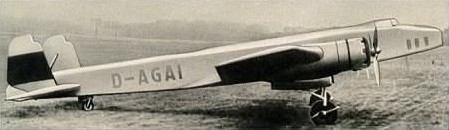
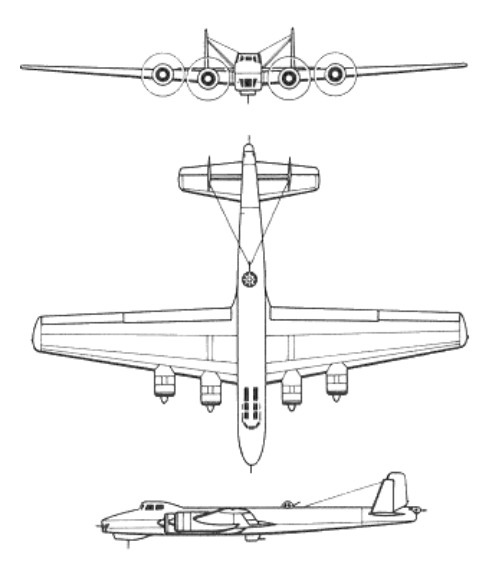
As early as 1934 the Luftwaffe began to think about a long range heavy bomber, and in 1935 a specification for the ‘Ural Bomber’ was issued to Junkers and Dornier. Both Dornier and Junkers completed preliminary studies for such an aircraft, and each received in late 1935 an order for three prototypes under the respective designations Dornier Do 19 and Ju 89. A mid-wing cantilever monoplane, largely of metal construction, the Do 19 had a rectangular-section fuselage; a tail unit with braced twin fins and rudders mounted on the upper surface of the tail-plane, at approximately mid-span on each side; tailwheel landing gear, with all three units retracting; and powerplant comprising four Bramo 322H-2 radial engines, mounted in nacelles at the wing leading edges. Accommodation was provided for a crew of nine, consisting of pilot, co-pilot/navigator, bomb-aimer, radio operator and five gunners. The intended hydraulically-operated two man dorsal and ventral turrets, combined with the overweight aircraft, would have left the bomber severely under-powered. The Do 19 V1 prototype flew for the first time on 28 October 1936, but by then an event had occurred which was to bring development of the long-range strategic bombers to an end. Using lighter turrets and Fafnir 323A-1 engines, a revised design showed an estimated range of 2000 km (1240 miles) and a top speed of 370 km/h (230 mph), but by this stage there were doubts about the usefulness of the ‘Ural Bomber’ and the ability of the aircraft industry to produce it without reduc¬ing the supply of other warplanes. On 3 June 1936 Generalleutnant Wever had lost his life in an aircraft crash and his successor, Generalleutnant Albert Kesselring, concluded that the Luftwaffe’s more urgent requirements were increased numbers of fighters and tactical bombers of greater capability. The Do 19 V2, which was almost ready to fly, and the incomplete Do 19 V3 were both scrapped; the Do 19 V1 saw limited use as a military transport following conversion for such a role during 1939.
Do 19 V1 Engines: 4 x BMW “Bramo 322”, 480kW Span: 35 m (114 ft 10 in) Length: 25.45 m (83 ft 6 in) Height: 5.8 m / 19 ft 0 in Wing area: 162.0 sq.m / 1743.75 sq ft Empty weight: 11000 kg / 24251 lb Gross weight: 18500 kg (40785 lb) Maximum speed: 315 km/h (196 mph) Cruise speed: 250 km/h / 155 mph Ceiling: 5500 m / 18050 ft Range w/max.fuel: 1600 km / 994 miles Crew: 4-5
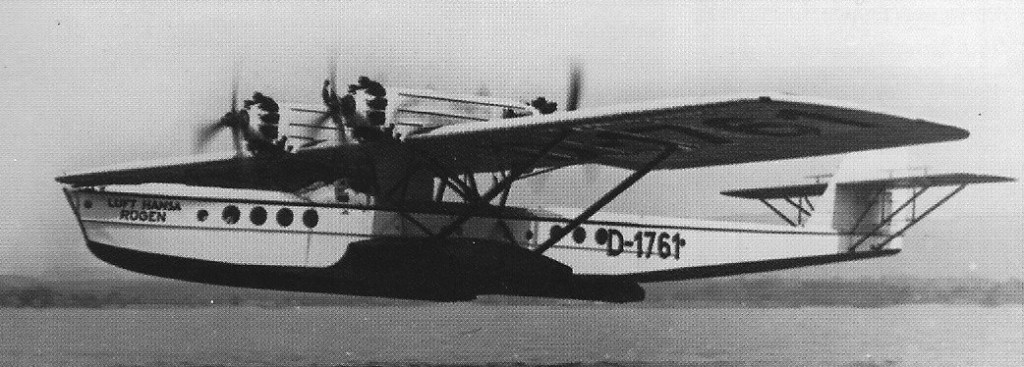
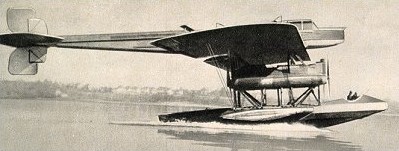
In 1926 Dornier located his main centre of activities across Lake Constance at Altenrhein, Switzerland, and began the development of the Superwal, the four engine DoR with two passenger cabins for 20 passengers, and then the gigantic 12 engine DoX, intended for transatlantic travel.
Engine: 4 x MB IVa, 190kW Take-off weight: 10500 kg / 23149 lb Empty weight: 3500 kg / 7716 lb Wingspan: 37.0 m / 121 ft 5 in Length: 22.3 m / 73 ft 2 in Height: 8.6 m / 28 ft 3 in Wing area: 226.0 sq.m / 2432.64 sq ft Max. Speed: 145 km/h / 90 mph Ceiling: 2800 m / 9200 ft Range w/max.fuel: 1300 km / 808 miles Crew: 4-5
de Havilland Canada, in response to a market survey, estimated interest in a large STOL aircraft with advanced STOL capability, so that higher standards of comfort, comparable with much larger aircraft, would be available to those airlines which operate from runways about 915m in length.
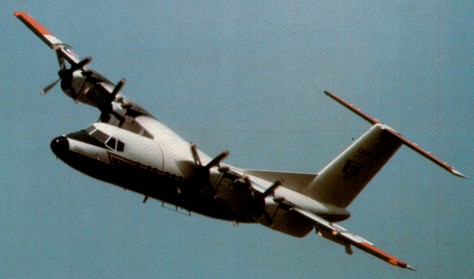
With backing from the Canadian government the, construction of two pre-production de Havilland Canada DHC-7 aircraft began in late 1972, and the first was flown on 27 March 1975 (C-GNBX X) at Downsview, Ontario. Certification was gained in 1977 and the Dash 7 proved not only to be very quiet, but could take off with full load in only 2,260 ft (689 m) and land in 1,950 ft (594 m).
Prototype DHC-7 C-GNBX c/n 001 in 1979
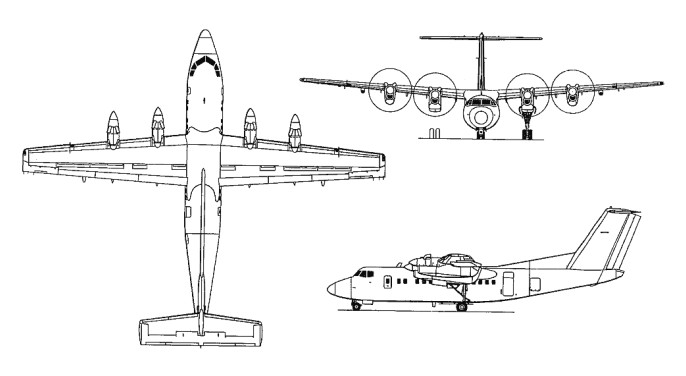
The DHC-7 has four large-diameter propellers turning slowly (and therefore quietly) in front of double-slotted trailing-edge flaps, and a T-tail keeps the tailplane well clear of the propeller wash. There are four spoilers in the upper surface of each wing. The inboard pair serve as spoilers or lift dumpers, the outboard pair as air spoilers which can also be operated differentially in conjunction with the ailerons to augment lateral control. The fuselage is of fail-safe construction to permit pressurisation, and the landing gear is of the retractable tricycle type, with twin wheels on each unit, Powered by four Pratt & Whitney Aircraft of Canada PT6A-50 turboprop engines, to reduce noise levels to a minimum, each drives a large-diameter 3.42m, Hamilton constant-speed full-feathering reversible-pitch four-blade propeller made from fiberglass. The props are slow-turning to reduce noise levels, so that the landing approach noise level on a three-degree glideslope is 92.4 EPNdB. Accommodation is provided for 50 passengers, with access to the main cabin via a single door, incorporating air-stairs, at the rear of the cabin on the port side. There are provisions for optional mixed passenger/cargo or all-cargo operations, and a large freight door can be installed at the forward end of the cabin on the port side. Up to five standard pallets can be carried by the Dash 7 in an all-cargo configuration. The flight crew of two is accommodated on a separate flight deck, and advanced avionics to enhance their efficiency include an autopilot/flight director system which incorporates flight and air data computers, and weather radar. The first operator to receive the Dash 7 was Rocky Mountain Airways, on 3 February 1978. The company offered a coastal reconnaissance model as the Dash 7R Ranger with Litton LASR-2 radar with its antenna in an underfuselage radome for 360x surveillance coverage, but in fact the only military sales have been three aircraft each to Canada and Venezuela. Two of the Canadian aircraft were designated CC-132 and used for communications from the base at Lahr in West Germany by No.412 Squadron, while the third is designated Dash 71R and used for ice reconnaissance by the Canadian Coast Guard in the Gulf of St Lawrence. The Venezuelan aircraft are transports with a secondary coastal reconnaissance.
When production finished in December 1988 113 had been delivered to 35 customers in 22 countries. Military use of the Dash 7 was restricted to two used as VIP/transports (designated CC-132) by the Canadian Armed Forces in Germany from August 1979 to April 1987, and a single aircraft delivered to the Venezuelan Navy in May 1982 used in the patrol and transport roles.
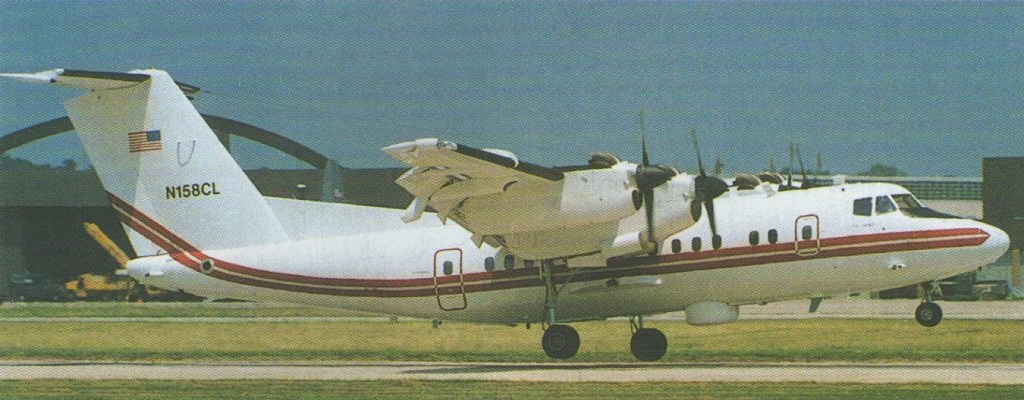
RC-7B N158CL
Variants: Dash 7 Series 100: standard passenger version seating 50 passengers. Dash 7 Series 101: all-cargo version of Series 100 able to accommodate five standard pallets. Dash 7 Series 150: developed passenger version introduced in 1978 with higher gross weight, increased fuel capacity and improved passenger amenities. Dash 7 Series 151: all-cargo version of Series 150. Dash 7 IR: single special ice reconnaissance version of the Series 150 built for the Canadian government. Equipped with SLAR and computers to track ice formations and flow patterns, the aircraft was delivered in May 1986 and is operated by Bradley Air Services for the Department of Environment.
DHC-7 Series 100 Engines: 4 x P & W Aircraft Canada PT6A-50 turboprop, 835kW Max take-off weight: 19958 kg / 44000 lb Empty weight: 12542 kg / 27651 lb Wingspan: 28.35 m / 93 ft 0 in Length: 24.58 m / 81 ft 8 in Height: 7.98 m / 26 ft 2 in Wing area: 79.89 sq.m / 859.93 sq ft Cruise speed: 436 km/h / 271 mph Ceiling: 6400 m / 21000 ft Range w/max.payload: 1279 km / 795 miles Crew: 2 Passengers: 48
DHC 7-102/103 Engines: 4 x P&W PT6A-50, 1120 shp. Props: Hamilton 4-blade, 135-in. Seats: 50. Length: 80.5 ft. Height: 26.2 ft. Wingspan: 93 ft. Wing area: 860 sq.ft. Wing aspect ratio: 10. Maximum ramp weight: 44,100 lbs. Maximum takeoff weight: 44,000 lbs. Standard empty weight: 27,044 lbs. Maximum useful load: 17,056 lbs. Zero-fuel weight: 39,000 lbs. Maximum landing weight: 42,000 lbs. Wing loading: 51.2 lbs/sq.ft. Power loading: 9.8 lbs/hp. Maximum usable fuel: 9925 lbs. Best rate of climb: 1200. Service ceiling: 22,800 ft. Max pressurisation differential: 4.7 psi. 8000 ft cabin alt @: 22,000 ft. Maximum engine out rate of climb: 700 fpm @ 124 kts. Engine out climb gradient: 338 ft/nm. Engine out ceiling: 14,800 ft. Maximum speed: 231 kts. Normal cruise @ 16,000ft: 225 kts. Fuel flow @ normal cruise: 1639 pph. Endurance at normal cruise: 5.5 hrs: Stalling speed clean: 100 kts. Stalling speed gear/flaps down: 66 kts. Turbulent-air penetration speed: 171 kts.
CC-132 Engines: four 1,120-shp (835-kW) Pratt & Whitney Canada PT6A-50 turboprops. Maximum speed 266 mph (428 km/h) at 8,000 ft (2,440 m) Service ceiling 21,000 ft (6,400 m) Range 1,347 miles (2,168 km) with a 6,500-lb (2,948-kg) payload. Empty weight: 27,650 lb (12,542 kg) Maximum take-off 44,000 lb (19,958 kg). Wing span 93 ft 0 in (29.35 m) Length 80 ft 7.75 in (24.58 m) Height 26 ft 2 in (7.98 m) Wing area 860.0 sq ft (79.89 sq.m) Payload: 50 passengers or 11,310 lb (5,130 kg) of freight.
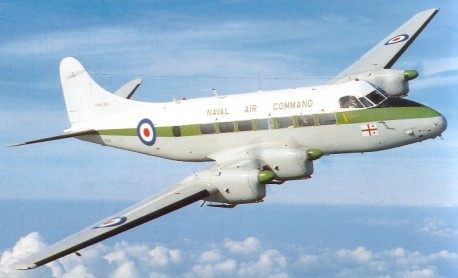
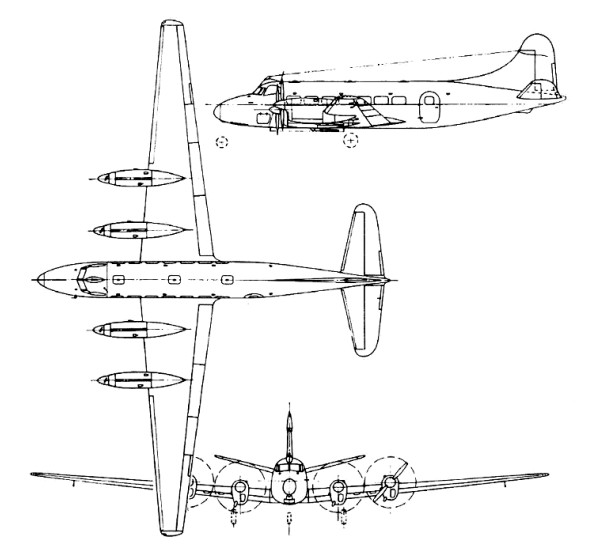
de Havilland continued the success of the Dove by designing a scaled-up version designated de Havilland D.H.114 Heron. The new aircraft provided accommodation for a crew of two and 14 passengers (17 if no toilet was installed). Fixed tricycle landing gear removed the complications of a hydraulic system, Gipsy Queen 30s and variable-pitch propellers. The prototype was flown for the first time on 10 May 1950. The Heron is equipped to seat 14 passengers in single seats on each side of the central aisle. Four 250 hp Gipsy Queen six-cylinder inline direct drive normally aspirated engines are fitted with bracket type constant-speed two-blade airscrews.
The first production Heron 1 was acquired by New Zealand National Airways, this and all subsequent aircraft having a tailplane with considerable dihedral. The seventh production example served as the prototype for the Heron 2, incorporating retractable landing gear. This proved to be the most popular version, representing almost 70 per cent of the 150 Herons built.
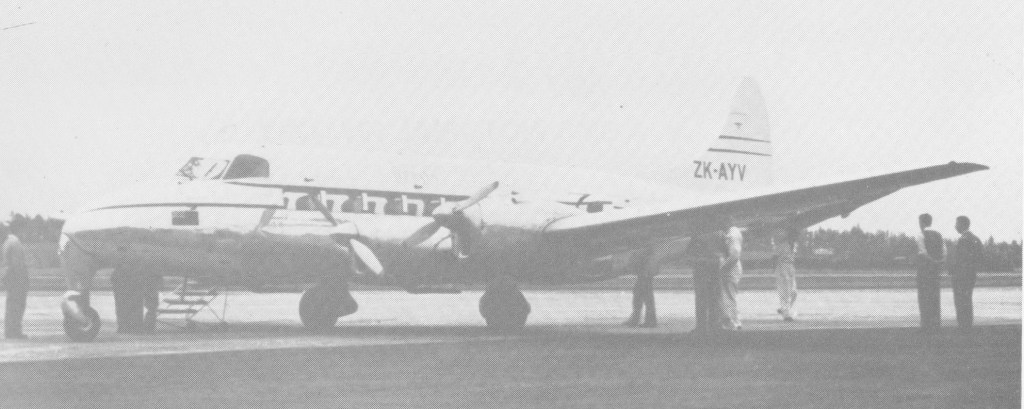
The New Zealand National Airways Corp owned four during 1952-60; ZK-AYV Matuku; ZK-BBN Motuhi; ZK-BEQ Mako; ZK-BBM Matmpouri.
ZK-AYV Matuku
The Heron saw service in 30 countries, some with major airlines, many as luxury transports (including four operated by The Queen’s Flight at RAF Benson), and about 25 of the total were used as communications aircraft by nine military services.
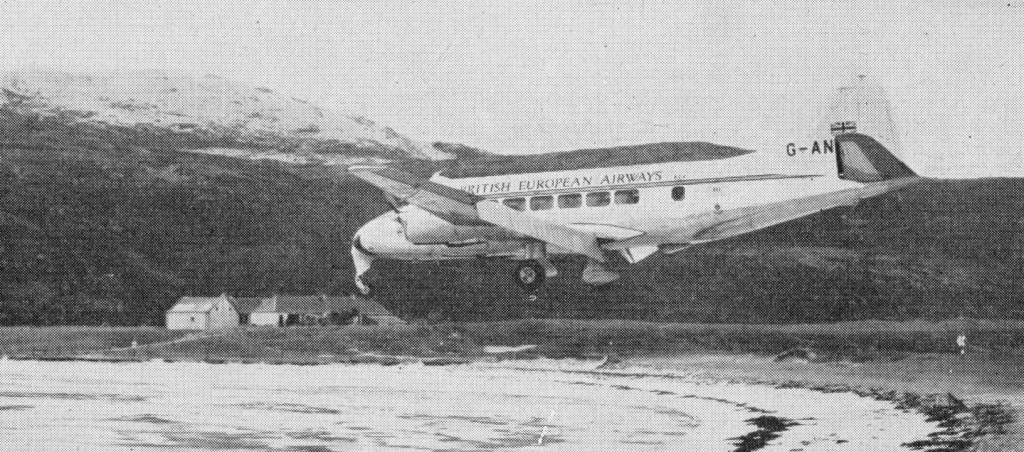
British European Airways Herons were used to maintain the BEA Ambulance Service in Scotland and the islands around the coast.
BEA Heron landing on the beach at Bora, Scotland circa 1955
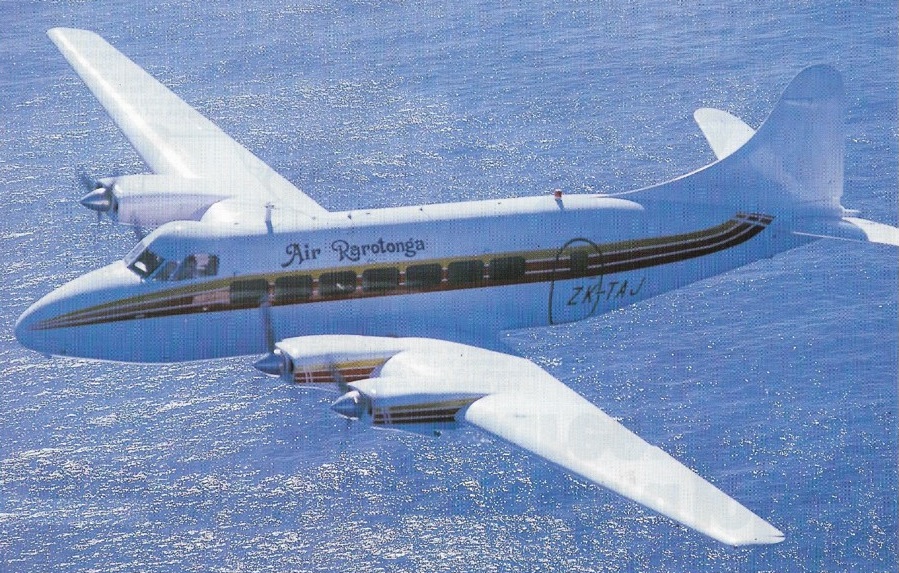
The Riley Turbostream Corporation in the USA produced the Riley Turbo Skyliner. This replaced the standard engines with 290 hp / 216kW Avco Lycoming IO-540-G1A5 engines, with or without turbochargers according to customer requirements.
Riley Heron ZK-TAJ of Air Rarotonga
Far more ambitious was the conversion carried out by Saunders Aircraft Corporation of Gimli, Manitoba. Designated Saunders ST-27, this had a fuselage lengthened by 2.59m to provide accommodation for a maximum of 23 passengers, the wing rebuilt to incorporate a redesigned main spar and the four Gipsy engines replaced by two 559kW Pratt & Whitney Aircraft of Canada PT6A-34 turboprop engines. A total of 12 ST-27 conversions was completed and the prototype of an improved ST-28 was built before Saunders went into receivership.
Franciso J. Waltz, Mexico City, produced in 1959 a high-altitude conversion of de Havilland Heron with 340 hp Lycoming engine for Mexican use under name Waltz Super Heron.
DH 114-1B Heron Engines: 4 x Gipsy Queen 39, 250 hp Wingspan: 71 ft 6 in / 21.8 m Length: 48 ft 6 in / 14.78 m Max speed: 190 mph / 306 kph Cruise Speed: 183 mph / 295 kph Range: 915 miles / 1473 km Service Ceiling: 18,500 ft / 5,600 m Crew: 2 Passenger capacity: 14
DH 114 Heron 2D Engines: 4 x de Havilland Gipsy Queen 30-2 inline, 186kW, 247 hp Max take-off weight: 6123 kg / 13499 lb Empty weight: 3697 kg / 8151 lb Wingspan: 21.79 m / 71 ft 6 in Length: 14.78 m / 48 ft 6 in Height: 4.75 m / 15 ft 7 in Wing area: 46.36 sq.m / 499.01 sq ft Max. speed: 165 kts / 306 kph Cruise speed: 295 km/h / 183 mph Ceiling: 5640 m / 18500 ft Initial climb rate 1,075 fpm Takeoff distance (50′) 2,424 ft. Landing distance (50′) 2,065 ft. Range w/max.fuel: 1813 km / 1127 miles Range w/max.payload: 645 km / 401 miles Crew: 2 Passengers: 14-17 / 1385Kg
Riley Heron Engines: 4 x Lycoming IO 540-G1A5, 290 hp. Cruise: 170 175 kt. Endurance: 7.5 hr. Pax cap: 15.
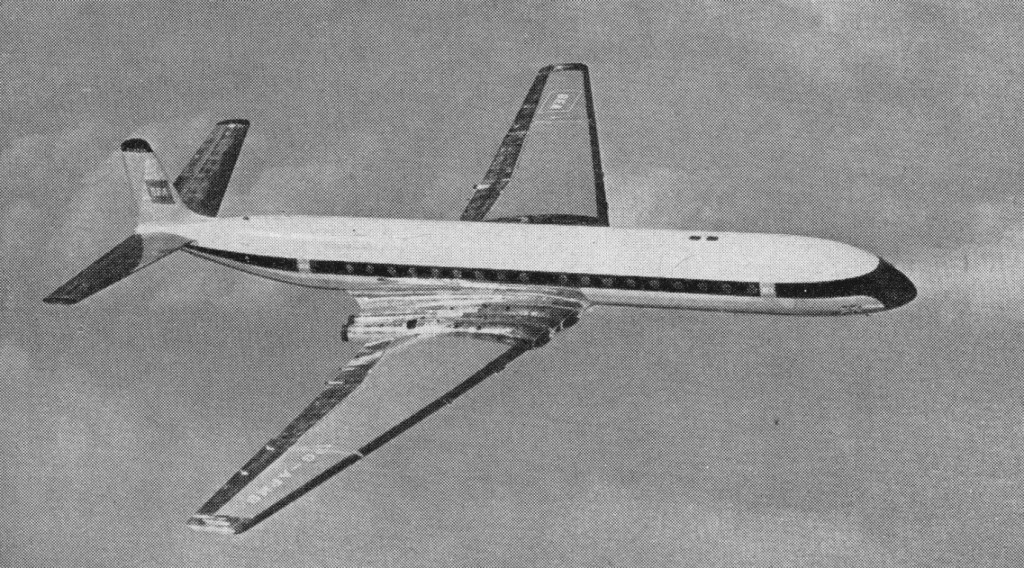
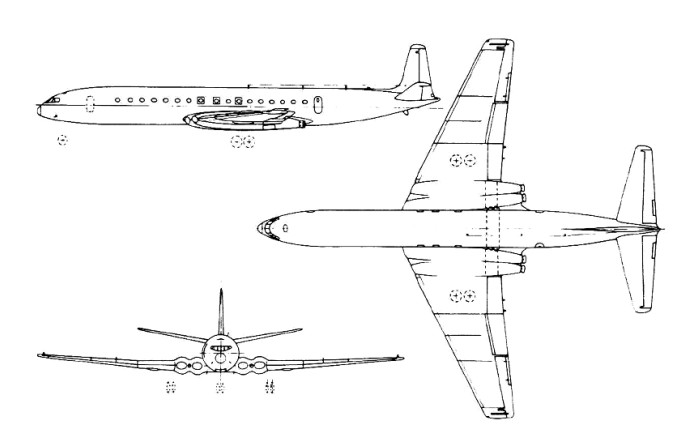
The Comet resulted from the wartime Brabazon Committee’s recommendations for the Type IV North Atlantic turbojet mail plane, which led to numerous studies including a 20-passenger aircraft with three rear-mounted Goblin engines. The final design emerged as an orthodox low-wing monoplane with 20 degree leading-edge sweep-back and four 19.8kN de Havilland Ghost centrifugal-flow turbojets buried in the wing roots. Initial accommodation was for 36 passengers in two cabins, pressurised to provide internal pressure equivalent to 2,438m when flying at 12,192m. Cruising speed was about 788km/h.
The prototype Comet made its first flight on 27 July 1949.
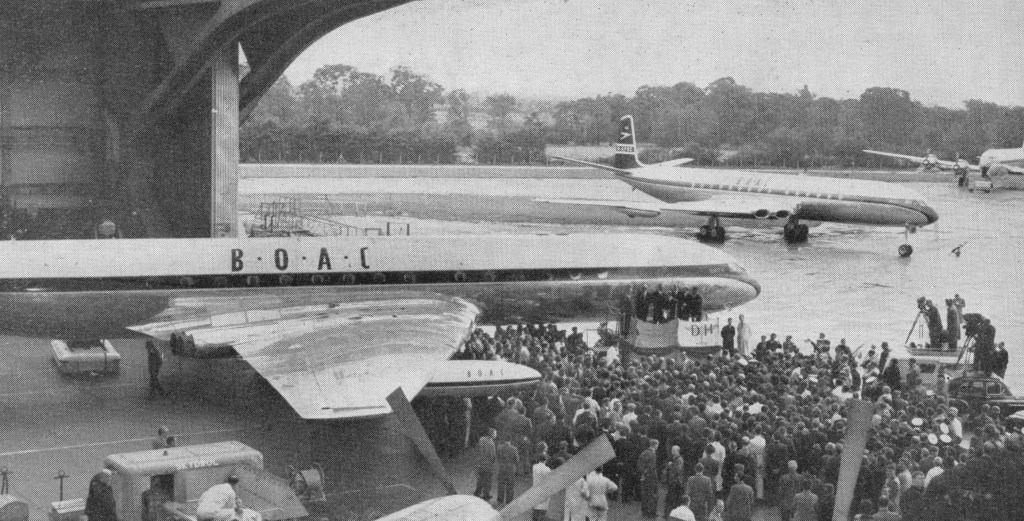
The first two BOAC Comet 4C delivered to London Airport from Hadfield, 30 September 1958
BOAC received a fleet of ten Comet Is and on 2 May 1952 inaugurated the first passenger services to be operated by turbojet aircraft – on the London-Johannesburg route, covering the 10,821km in 23 hr 34 min. Comets were subsequently introduced on a number of routes, bringing drastic cuts in journey time: such as the reduction from 86 to 33 1/4 hours between London and Tokyo. Air France and UAT soon began Comet services and there were a number of airline orders for Comet 1s when one broke up near Calcutta exactly a year after its introduction; in January and April 1954 two more suffered inflight structural failure, resulting in the type being withdrawn. In October 1952, a Comet broke up in flight near Calcutta. Modifications were made, but when, on April 8, 1954, the fifth Comet accident occurred, all Comets were withdrawn from service and production was halted.
Salvage and careful investigations showed that fatigue failure of the cabin was the cause of the crashes, and the fuselage was redesigned. Painstaking detective work by scientists and engineers had established that the Comet ls had suffered metal fatigue, causing explosive decompression of the pressurized fuselage.
A great deal of structural knowledge was gained through the accidents of four of the original nine Comet I models. This knowledge was later tested on the model 3 and applied to the model 4. The Avon-powered Comet 2s on order for BOAC were strengthened and some delivered to the RAF.
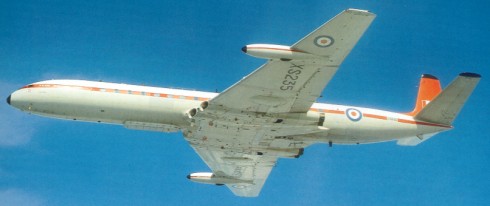
No.216 squadron of RAF Transport Command was equipped with Comet 2 from 1956 in order to operate a courier service between Britain and the Long-range Weapons Establishment at Woomera, Australia. Operated with full C of A, they were modified and powered by Rolls-Royce Avon 117/118 turbojets.
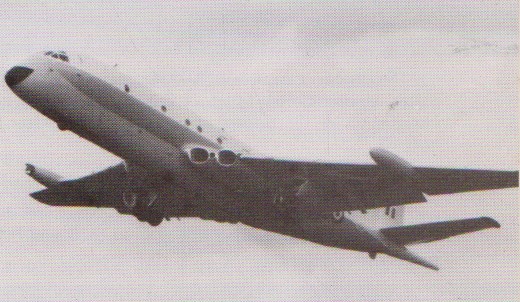
A longer-fuselage long-range Comet 3 had been developed and in the light of the inquiry into the Comet 1s disasters it was redesigned, first flying on 19 July 1954. It did not go into production but made a round-the-world flight and served as a test vehicle.
Comet 3B
Most of the flight tests for the Comet 4 were conducted on the one and only Comet 3 built by Hawker.
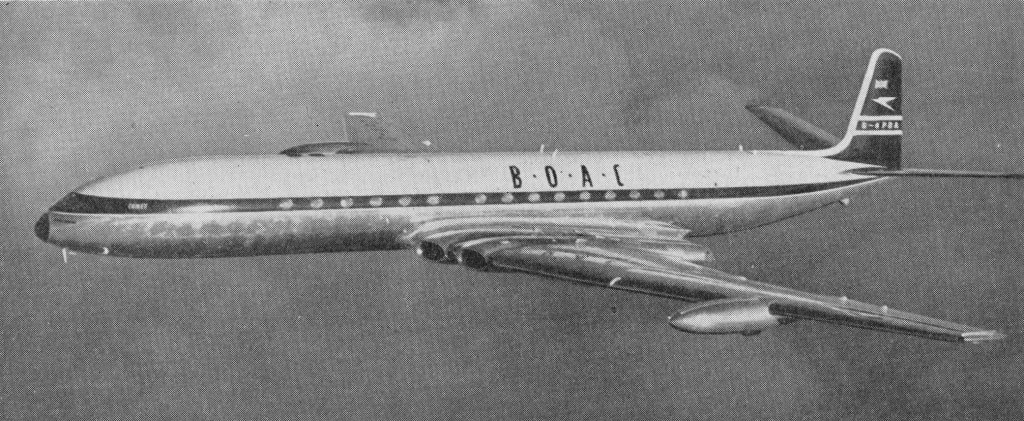
In 1957 it was decided that Comets would be reinstated and BOAC ordered 19 Comet 4s. These were powered by 46.71kN Rolls-Royce Avon 524, had longer fuselages than the Comet 1 and could carry 60-81 passengers. The first Comet 4 flew on 27 April 1958 and on 4 October BOAC Comets inaugurated North Atlantic jet services over the London-New York route when Comet 4s of BOAC (G APDB and G APDC) made simultaneous crossings in opposite directions. BOAC bought 19 larger, more powerful Comet 4s, and successfully operated the first London/New York jet service from 1958. On 1 April 1959 Comets were put back on the London-Tokyo route.
First BOAC Comet 4
It was a long range version of the basic Comet design and was recognized by the projection of the two-pod fuel tanks on the leading edge of each wing. Following the model 4, the Comet 4B was produced for intermediate-range flights carrying a high-density passenger load. The model C-2 was a military cargo airplane and was structurally far superior to the original Comet 1.
Comet C4
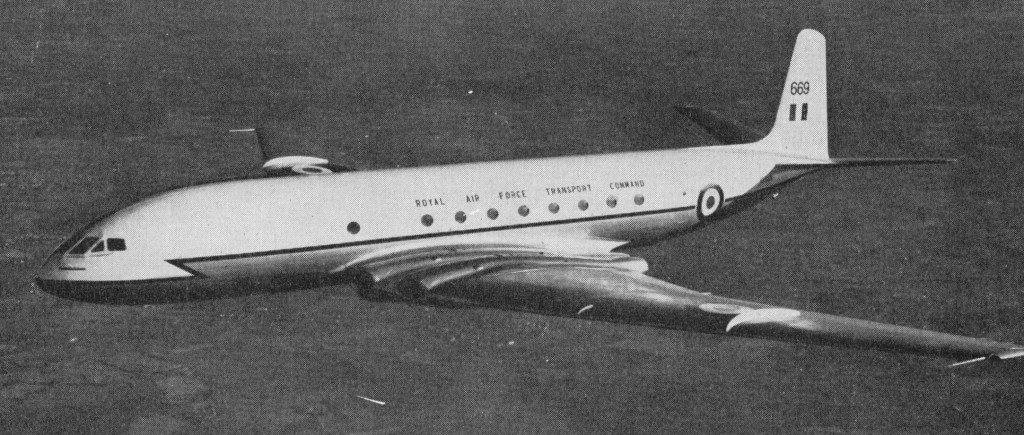
Transport Command’s Comet 4 took 76 passengers, the C2 44 and the Comet T2s, which were often pressed into service could carry 36.
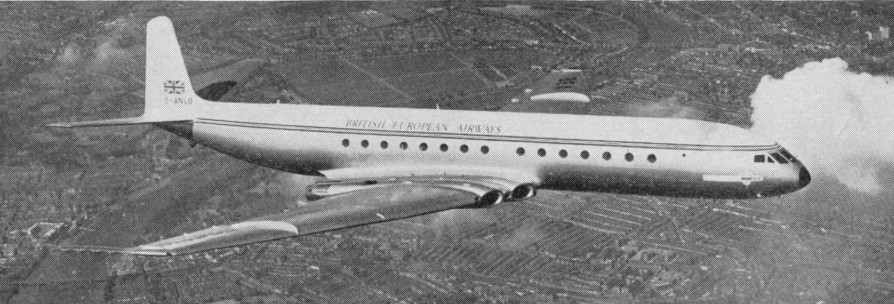
From that time Comets took over much of BOAC’s network. Other Comet 4s were used by Aerolineas Argentinas, East African Airways and the RAF. From this version were developed the Comet 4B and 4C which first flew on 27 June and 31 October 1959 respectively. The Comet 4B had a 1.98m increase in fuselage length, a 2.13m reduction in span and was intended for high-speed operation over shorter stages. It could carry up to 101 passengers and was not fitted with wing-mounted external fuel tanks. The main operators of Comet 4B were British European Airways and Olympic Airways.
Characteristics of the Comet 4B used by BEA were the longer fuselage and the shorter wing, without the external nacelle fuel tanks, when compared with the BOAC Comet 4. Olympic Airways also started operating the Comet 4B during 1960.
Comet 4B
The Comet 4C combined the long fuselage of the Comet 4B with the standard Comet 4 wing. This version was ordered by several airlines and went into service in 1960. A total of 112 Comets were built including 74 Series 4 aircraft; and the type was subsequently developed into the RAF Nimrod.
The DH Comet was designed and built all 113 of them over 15 years at Hatfield.
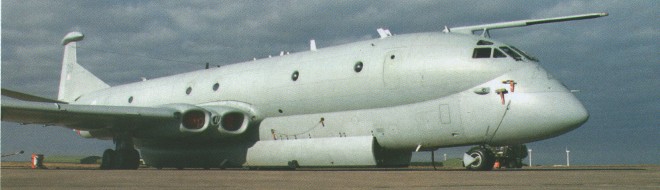
The HS.801 Nimrod was originally designed by Hawker-Siddeley, but was also a product of BAE Systems. First flying on 23 May 1967, the Nimrod serves the RAF in two variants: the R1 variant in a reconnaissance and electronic intelligence gathering capacity (ELINT), and the MR2 variant in the Maritime Reconnaissance role.
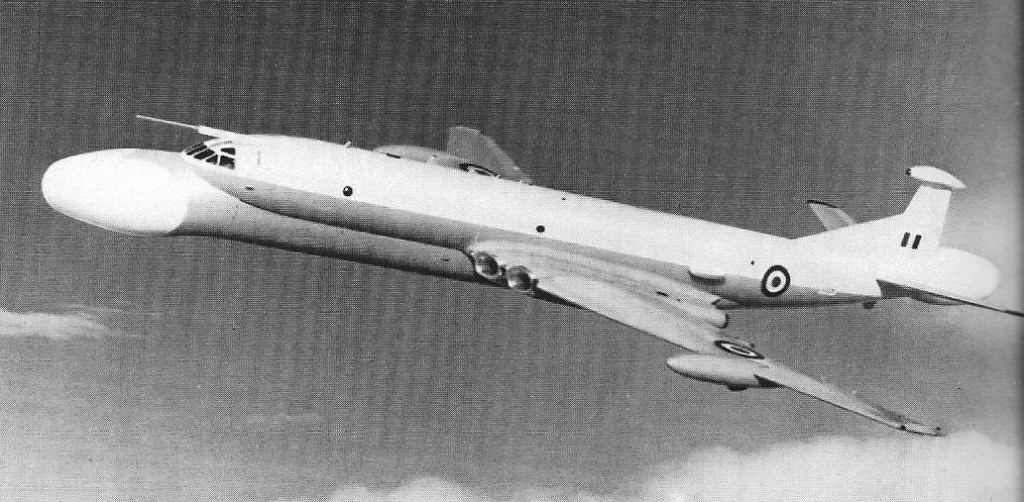
Ordered by the RAF to replace the Shackleton MR.Mk.3s, the Nimrod is said to have begun in June 1964 when Hawker Siddeley at Woodford began work on the HS.801. Its true origin is in the de Havilland Comet, two Nimrod prototypes were made from unsold Comet Mk.4C airframes, with many changes involved in producing a maritime reconnaissance version. The second prototype (XV148) was converted to HS.801 standard, four Rolls-Royce RB.168 turbofans replacing the Comet’s original four R-R Avons. Its maiden flight was on 23 May 1967, with the second, Avon-powered, aircraft flying two months later.
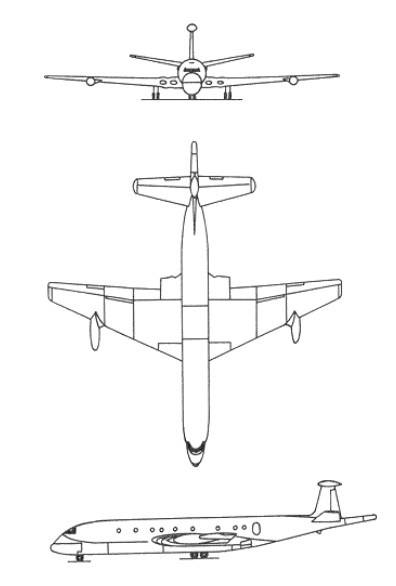
In mid-1965 a contract to build 38 Nimrod MR.Mk.Is was placed, and the first flew at Woodford on 28 June 1968. All were built as new airframes and delivered by September 1972, although a further eight were completed three years later. In service with RAF Strike Command since late 1969, the Nimrod MR.1 is based on the airframe of the Comet 4C Main difference are a power plant of four Spey turbofan. In addition of an unpressurised pannier beneath the pressurised main fuselage to house the operational equipment and weapons; and modified tail design incorporating an ECM pod and MAD stinger.
Subsequent plans were to upgrade 35 aircraft to Mk.II standard (by the installation of new communication systems and advanced tactical sensors), with 11 for the new AEW Mk.3 programme, and the last of the Mk.IIs was completed in 1985. The conversion added some 6000 lbs to the empty weight, and external signs of change were a reduction in cabin windows, new intakes and ducts around the rear fuselage. Other MR.2 modifications include the provision of in-flight refuelling probes, Harpoon anti-shipping missiles, and AIM-9 Sidewinder AAMs for self-defence. Loral early-warning support measures pods (EWSM) are mounted on the wing tips, and minor airframe changes have been made, comprising the introduction of larger finlets to the tailplanes and a new ventral fin. The Nimrod R.1 is a specialised Elint variant.
Nimrod MR.2
The AEW.3 conversion programme was scrapped in 1986 after the con¬version of eleven Nimrods at a cost of around NZ$2,700 million. The UK Ministry of Defence decided drop the Nimrod AEW.3 project in favour of Boeing E-3A Sentry purchase. The planned Nimrod AEW.3 was a conversion of an MR.1 airframe to accept an AEW mission system comprising radar, IFF, ESM, and datalink. Nimrod R Mk2 – The RAF has three of these specially-equipped versions of the MR Nimrod to fulfil its requirement for long-range electronic reconnaissance missions. The next changes came in 1982 with the Falklands War, when the Nimrods were required to operate up to 6440 km from their advance base at Ascension Island and carry the Marconi Stingray torpedo, 1000 lb bombs and the AGM-84A Harpoon anti-ship missile. Even air-to-air armament was added in the form of AIM-9G Sidewinders. Another large installation was an inflight refuelling probe to extend its endurance up to 19 hours, which saw large hoses laid over the floor inside the cabin. Placed under the floor when the conflict ended, this gave the Nimrod Mk.IIP code. At the same time GPS was installed in RAF aircraft. The AEW version was plagued with problems and never entered service, being placed in outside storage.
Models offered up four additional hardpoints externally to field even more potent air-to-surface missiles and mine dispensing munitions. Crew accommodations vary per model. The MRA.Mk 4 (or “Nimrod 2000”) can house a base flight crew of two personnel along with 7 specialists in designated roles. Additionally, up to 13 relief crew members can be carried aboard for extended flights. The Nimrod MRA.4 can operate a 15 hours of endurance time.
Comet 1 Engines: 4 x Ghost 50 turbojets, 4,450 lb. (2,020 kg.) thrust. Range loaded with res: 2,030 sm. Capacity payload: 14,000 lb. Fuel cap: 7,050 Imp.G. Max range with res: 2,610 sm. Length 93 ft. (28.35 m.) Wing span 115 ft. (35 m.) Weight 105,000 lb. (45,540 kg.) Pax cap: 36 44. Max cruise speed: 490 m.p.h. (790 km.p.h.). Cruise alt: 35,000 ft. (11,000 km.) fully loaded. Range: 1,750 miles (2,800 km.).
De Havilland DH 106 Comet 1 A Engines: 4 x DeHavilland Ghost 50 Mk 2, 22249 N / 2268 kp Length: 93.012 ft / 28.35 m Wingspan: 114.993 ft / 35.05 m Max take off weight: 115021.6 lb / 52164.0 kg Max. speed: 459 kts / 850 km/h Range: 1728 nm / 3200 km Crew: 3 Payload: 44 pax
Comet 2 Engines: 4 x Avon turbojets. Range loaded with res: 2,610 sm. Capacity payload: 14,000 lb. Fuel cap: 7,050 Imp.G. Max range with res: 3,700 sm. Block speed: 444 mph.
Comet 4 Engines: 4 x RR Avon RA.29, 10,500 lb. Wing span: 115 ft 0 in (35 m). Length: 111 ft 6 in (33.99 m). Height: 28 ft 4.5 in (8.65 m). Max TO wt: 152,500 lb (69,235 kg). Max level speed: 500 mph ( 800 kph). Cruise speed 489 mph
Engines: 4 x Rolls-Royce Avon 525B, 46.7kN Max take-off weight: 73482 kg / 162001 lb Empty weight: 36430 kg / 80315 lb Wingspan: 35.0 m / 114 ft 10 in Length: 36.0 m / 118 ft 1 in Height: 9.0 m / 29 ft 6 in Wing area: 197.0 sq.m / 2120.49 sq ft Cruise speed: 865 km/h / 538 mph Ceiling: 10000 m / 32800 ft Range w/max.fuel: 6700 km / 4163 miles Range w/max.payload: 5350 km / 3324 miles Crew: 4 Passengers: 72-102
Nimrod MR.1 Engines: Four 11,500 lb (5 217 kg) st Rolls Royce RB.168 Spey turbofan. ¬ Wingspan: 114 ft 10 in (35.0m). Length: 126 ft 9 in (38.63m). Wing area: 2121 sq.ft (197.0 sq.m). Height: 29 ft 8.5 in (9.01 m). Max TO wt: 192,000 lb (87090 kg). Max cruising speed: over 500 mph (805 kph). Max endurance: 12-14 hr. Crew: 12. Max level speed: 575 mph (926 kph).
Nimrod MR.2 Engine: 4 x R-R Spey 250 turbofan. Installed thrust: 216 kN. Span: 35 m. Length: 38.6 m. Wing area: 197 sq.m. Empty wt: 39,000 kg. MTOW: 80,500 kg. Warload: 6100 kg. Max speed: 930 kph. Ceiling: 13,000 m. T/O run: 1460 m. Ldg run: 1620 m. Fuel internal: 48,780 lt (+8590 lt). Endurance: 12+ hr. Air refuel: Yes. Armament: Stingray torpedo or AGM-84 Harpoon.
Nimrod Mk.IIP Engines: 4 x Rolls-Royce RB.168-20 Spey Mk.250 turbofans, 12,140 lb. Span: 114 ft 10 in (35 m). Length: 129 ft (39.31 m). Empty wt: 86,000 lbs (39,009 kg). MTOW: 192,000 lbs (87,090 kg). Max speed: 500 kt. Service ceiling: 42,000 ft. Max Op alt: 37,000 ft. Normal transit speed: 425 kts. Ferry range: 9254 miles. Endurance: 12 hr. Crew: 13.
BAe / Hawker Siddeley Nimrod MRA.4 Engines: 4 x Rolls-Royce BR710 Mk 101 turbofan, 15,500lbs / 66218 N / 6750 kp thrust Length: 126.74ft (38.63m) Wingspan: 127.00ft (38.71m) Wing loading: 91.23 lb/sq.ft / 445.00 kg/sq.m Height: 31.00ft (9.45m) Wing area: 2538.151 sqft / 235.8 sq.m Empty Weight: 102,515lbs (46,500kg) Max take off weight: 231271.4 lb / 104885.0 kg Fuel capacity: 2959 gal / 11200 lt Maximum Speed: 575mph (926kmh; 500kts) Maximum Range: 6,903miles (11,110km) Service Ceiling: 42,000 ft (12,802m) Endurance: 15 h Accommodation: 9 + 13 Hardpoints: 4 Payload: max 5500kg
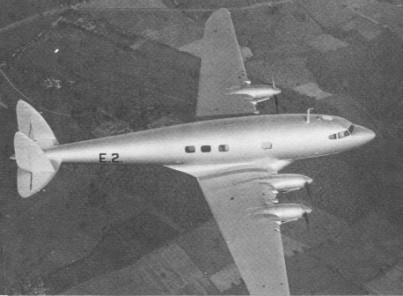
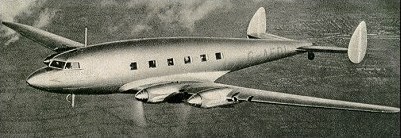
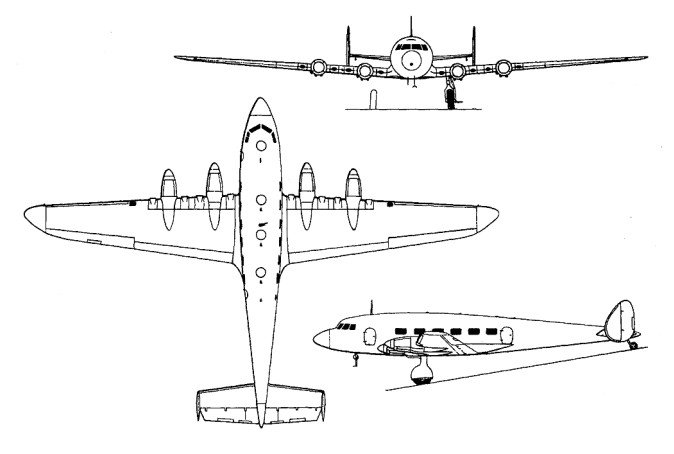
Designed by A. E. Hagg to an Air Ministry specification for a transatlantic mailplane, the de Havilland D.H.91 Albatross fuselage was made of laminations of cedar ply and balsa wood, built as a monocoque in which the skins bore the load, and had a one-piece wing.
Powered of four de Havilland Gipsy Twelve engines driving constant-speed propellers, and with the landing gear main units electrically retractable, the prototype, initially with twin fins mounted at mid-span on the tailplane, was flown for the first time at Hatfield on 20 May 1937. Directional instability saw a change to more traditional endplate fins with unbalanced rudders and trim tabs. Passenger entry was through a door just 1m tall and the rear fuselage was particularly cramped. In general the cabin was noisy and the ride was uncomfortable.
Problems with the landing gear retraction system resulted in a wheels-up landing for the first prototype on 31 March 1938, and a structural weakness in the rear fuselage was revealed when the second prototype broke into two a few months later when landing during overload trials. Effective modifications were soon evolved and the two prototypes were repaired and used experimentally by Imperial Airways.
Their range made them particularly useful for a shuttle service between the UK and Iceland, and they were impressed for RAF use with No. 271 Squadron in September 1940. Five Albatrosses, with reduced capacity, additional cabin windows and slotted flaps replacing the split trailing edge flaps, were delivered to Imperial Airways between October 1938 and June 1939. With accommodation for 22 passengers and a crew of four, they saw wartime service on the Bristol-Lisbon and Bristol-Shannon routes until, with their numbers reduced to two by enemy action or accidents, the survivors were scrapped in September 1943.
D.H.91 Engines: 4 x de Havilland Gipsy Twelve, 391kW/ 525 hp Max take-off weight: 13381 kg / 29500 lb Empty weight: 9630 kg / 21231 lb Wingspan: 32.00 m / 105 ft 0 in Length: 21.79 m / 71 ft 6 in Height: 6.78 m / 22 ft 3 in Wing area: 100.15 sq.m / 1078.00 sq ft Wing loading: 27.47 lb/sq.ft / 134.00 kg/sq.m Max. speed: 362 km/h / 225 mph Cruise speed: 338 km/h / 210 mph Ceiling: 5455 m / 17900 ft Max range: 3,300 miles (5,300 km) Range: 1674 km / 1040 miles Crew: 4 Passengers: 22
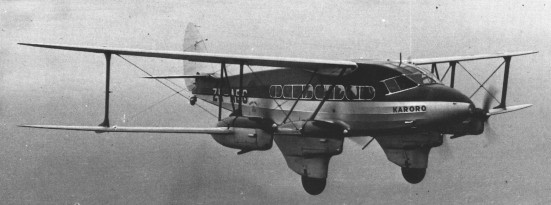
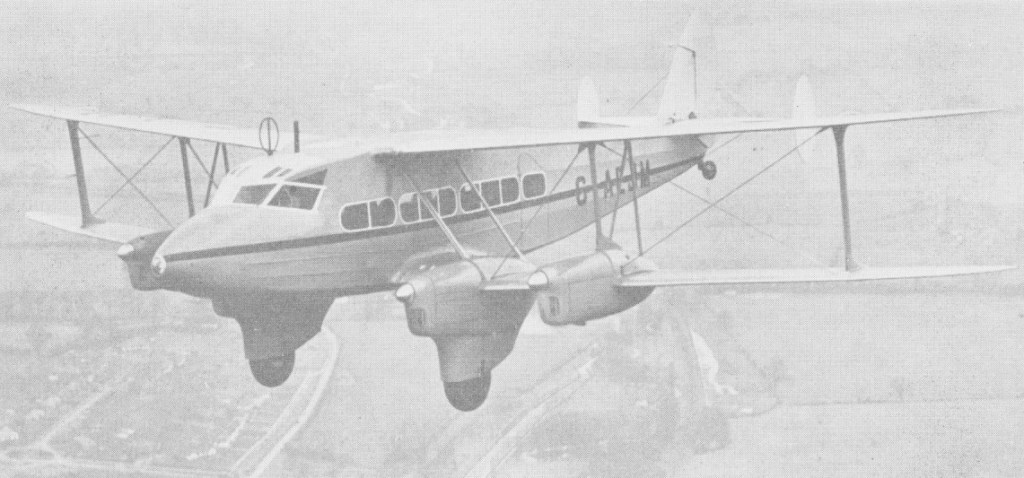
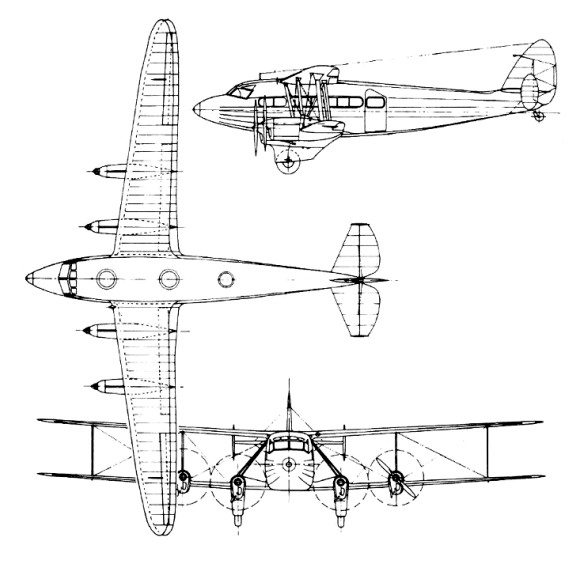
Designed and built in response to an Australian government requirement for a multi-engined aircraft to be used by QANTAS for service across the Timor Sea, between Singapore and Australia, the de Havilland D.H.86 was awarded its Certificate of Airworthiness on 30 January 1934, only four months after a start of work on the project. The aircraft was of wooden construction with fabric covering, and powered by four de Havilland Gipsy Six engines.
The first flight was made on 14 January 1934 at Stag Lane, in the hands of Hubert Broad, and certification trials were conducted at Martiesham. The prototype and two identical aircraft were equipped for single-pilot operation. The latter were used by Railway Air Services from 21 August 1934 on a new Croydon-Birmingham- Manchester-Belfast-Glasgow route. A second crew member (navigator/ wireless operator) was carried, accommodated behind the pilot.
DH86B “Zulu shield”
QANTAS and Imperial Airways required that two pilots should be seated side-by-side, and in August 1934 the prototype re-emerged from the Stag Lane factory with a longer and wider nose to provide the necessary accommodation. The first of 29 production examples was one of four flown by Holyman Airways in Australia, and other operators comprised QANTAS (six), Imperial Airways (five), Jersey Airways (six), Misr Airwork, Egypt (four), Hillman’s Airways (three) and Wrightways (one).
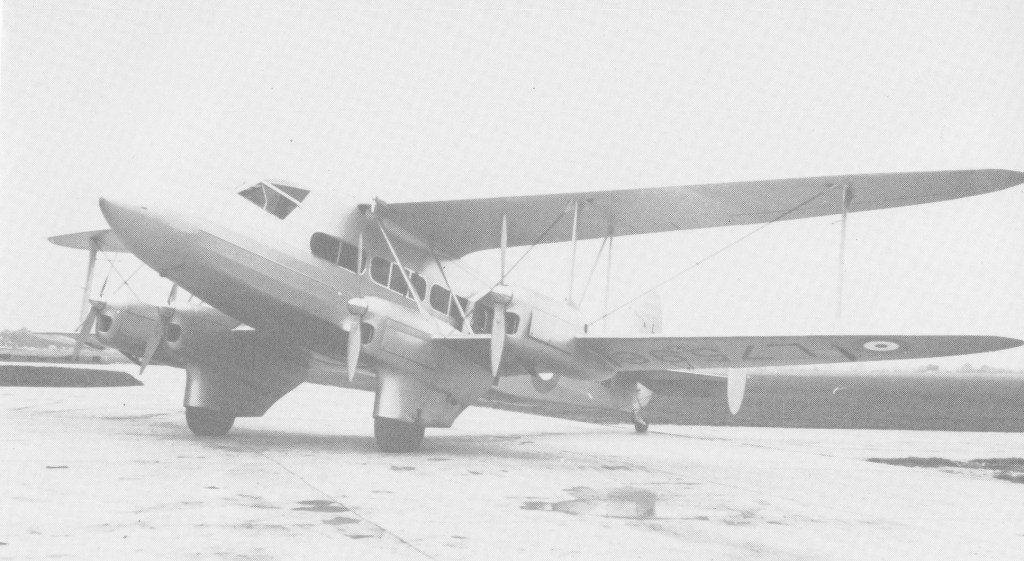
A total of 62 DH express airliners were built. Some at Stag Lane, the later ones at Hadfield. Four were single pilot and 28 were two pilot DH86s. Twenty were DH86As, improved with some strengthening following some incidents. Ten built were DH86Bs with the “Zulu shield” additional vertical tail surfaces, giving greater stability.
DH86A
Three DH86A were impressed from Union Airways by the Royal New Zealand Air Force, equipped as bombers, and operated 1939-44. One (ZK-AHW) was in service with the New Zealand National Airways Corp 1947-48.
DH 86A Engines: 4 x DH Gipsy-Six Series 1 Wingspan: 64 ft 6 in / 19.66 m Length: 46 ft 2 in / 14.07 m Max speed: 166 mph / 267 kph Crew: 2 Passengers: 12
D.H.86B Engines: 4 x de Havilland Gipsy Six inline, 149kW / 200 hp Take-off weight: 4649 kg / 10249 lb Empty weight: 2943 kg / 6488 lb Wingspan: 19.66 m / 64 ft 6 in Length: 14.05 m / 46 ft 1 in Height: 3.96 m / 12 ft 12 in Wing area: 59.55 sq.m / 640.99 sq ft Max. speed: 267 km/h / 166 mph Cruise speed: 229 km/h / 142 mph Ceiling: 5305 m / 17400 ft ROC: 925 fpm. Range: 1287 km / 800 miles Fuel consumption @ cruise: 40 gal/hr total Pax cap: 12 Crew: 2
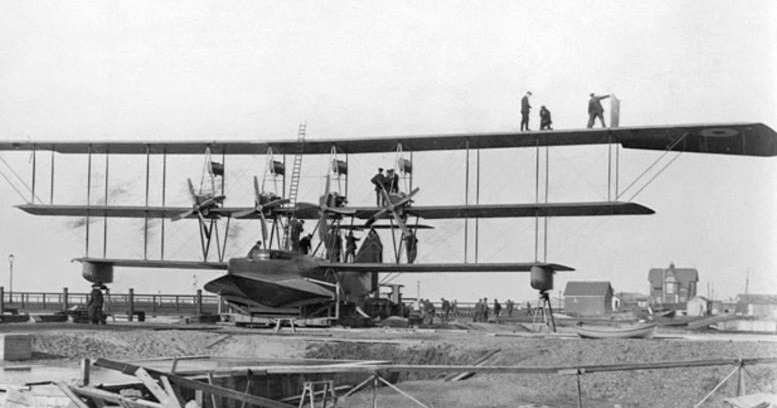
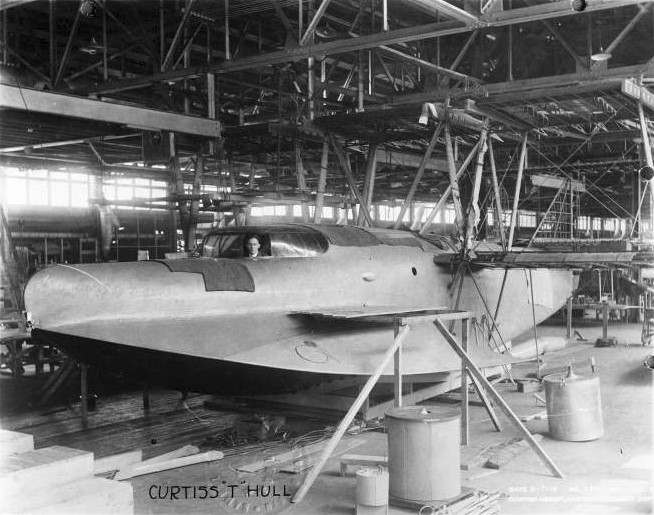
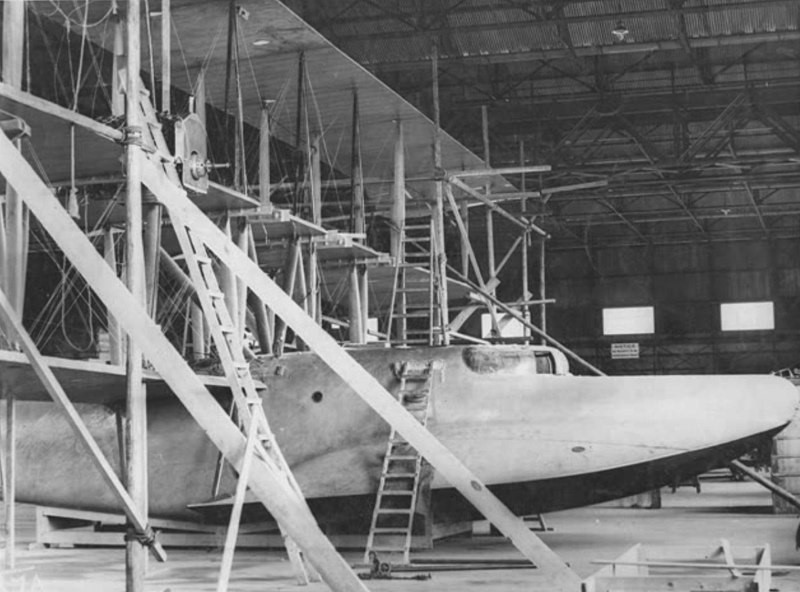
In 1915, the American businessman Rodman Wanamaker who, prior to the outbreak of the First World War commissioned the Curtiss Aeroplane and Motor Company to build a large flying boat, America to win the £10,000 prize put forward by the British newspaper Daily Mail for the first aircraft to cross the Atlantic, commissioned Curtiss to build a new, even larger flying boat for transatlantic flight that became known as the Wanamaker Triplane, or Curtiss Model T, (retroactively re-designated Model 3 when Curtiss changed its designation system).
Partially constructed, 5 July 1916.
Early press reports showed a large triplane, 68 ft (17.9 metres) and with equal-span six-bay wings of 133 foot (40.5 metre) span. The aircraft, to be capable of carrying heavy armament, was estimated to have an all-up weight of 21,450 pounds (9,750 kilogrammes) and was to be powered by six 140 hp 104 kW) engines driving three propellers, two of which were to be of tractor configuration and the third a pusher.
The British Royal Naval Air Service (RNAS) placed an order for 20 Triplanes. The first one was completed at the Curtiss factory, Buffalo, New York in July 1916. This was the first four-engined aircraft to be built in the United States and one of the largest aircraft in the world.
Fitted with a Rolls-Royce engine at RNAS Felixstowe.
The finished Model T differed from the aircraft discussed in the press in various points. Size and weight were similar, with the upper wing having a span of 134 feet, but the other wings had different spans. It was planned to be powered by four tractor 250 hp (187 kW) Curtiss V-4 engines installed individually on the middle wing, which was unusual for the time. The crew of two pilots and a flight engineer were provided with an enclosed cabin, similar to the Curtiss Model H. To reduce the forces a pilot would need to use on the controls, small windmills could be connected to the aileron cables by electrically operated clutches to act as a form of power assisted controls.
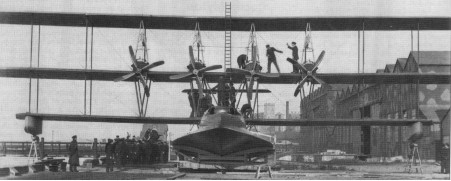
As the planned Curtiss V-4 engines were not available when the prototype, 3073, was completed, it was decided not to fly the aircraft in the United States, but to take it to England by ship where it was reassembled at the naval air station Felixstowe. Initially it was fitted with four 240 hp (180 kW) Renault engines, but these were soon exchanged for four 250 hp Rolls-Royce Eagles.
As the aircraft was damaged beyond repair on the maiden flight it was considered unsuccessful, and the order for the remaining nineteen cancelled. The Wanamaker Triplane did however, provide the inspiration for John Porte of the Seaplane Experimental Station to build a massive five-engined flying boat of similar layout, the Felixstowe Fury.
Model T with four Rolls-Royce engines, RNAS Felixstowe, 1916
Although 20 Curtiss-Wanamaker triplanes were ordered by Britain, only one, 3073, reached the RNAS.
Engines: 4 × Renault 12F, 240 hp (180 kW) each Upper wingspan: 134 ft (41 m) Mid wingspan: 100 ft (30 m) Lower wingspan: 78 ft 3 in (23.85 m) Length: 58 ft 10 in (17.93 m) Height: 31 ft 4 in (9.55 m) Wing area: 2,815 sq ft (261.5 sq.m) Empty weight: 15,645 lb (7,096 kg) Gross weight: 22,000 lb (9,979 kg) Maximum speed: 100 mph (161 km/h; 87 kn) Range: 675 mi (587 nmi; 1,086 km) at cruise speed of 75 mph Endurance: 7 hr Time to altitude: 10 minutes to 4,000 ft (1,220 m) Crew: 6
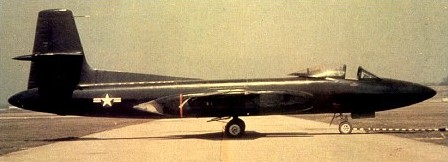
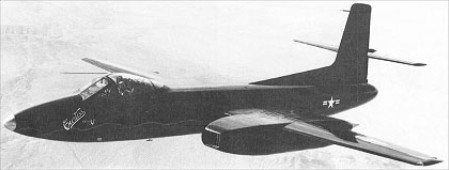
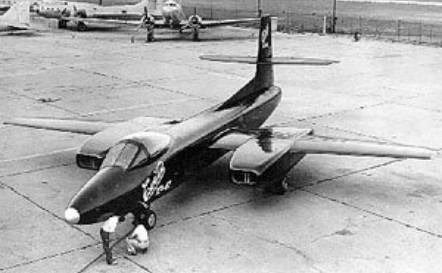
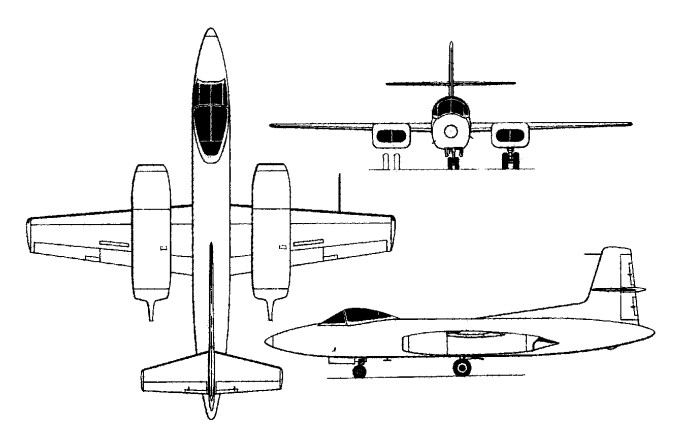
Curtiss had obtained tentative approval to build a twin-jet ground-attack aircraft, the XA-43. On 21 November 1945, this project was redirected towards completion of the Blackhawk fighter, mid-wing, four-engine craft with a two-man crew in side-by-side seating and with large fuel capacity. Powered by four 1360kg thrust Westinghouse XJ34-WE-7 turbojets, the sole XF-87 was flown at Muroc Dry Lake, California, on 1 March 1948 following long delays in its development and shipment from the company’s plant (later sold to North American) in Columbus, Ohio. The two prototypes were S/N identifiers as the 45-59600 and the 46-522. The 46-522 was modified to become the single XF-87A production aircraft.
The XF-87 proved to be underpowered. In the expectation that a different powerplant arrangement would make the Blackhawk more competitive, the twin-engine scheme was resurrected. On 10 June 1948, the USAF awarded a contract to Curtiss for 57 production F-87As to be powered by two 2722kg thrust each General Electric J47-GE-7 engines located in pairs on each wing. A further order was placed for 30 RF-87A reconnaissance aircraft.
The design featured four 20-mm cannon in a fixed nose installation and would have been fitted with a nose turret developed by the Glenn L. Martin Company which revolved in a 60-degree arc enabling four 20mm guns to be fired at any angle from zero to 90 degrees from the centre-line. Though the Blackhawk was able to overcome teething troubles in flight tests and seemed to offer promise as an all-weather interceptor, Curtiss was suffering from management difficulties and Northrop was developing an interceptor with solid potential, the F-89 Scorpion. On 18 October 1948, the USAF cancelled the F-87 Blackhawk programme in favour of the F-89. A second prototype which would have evaluated the twin J47 installation was never completed. It was to be the last Curtiss fighter.
The first aeroplane was known as the Nighthawk and powered by four Westinghouse J34-WE-7 engines, while the second was known as the Blackhawk and powered by four General Electric J47-GE-15 engines, the XP-87 Nighthawk flew. The Nighthawk and its Blackhawk counterpart were later be scrapped.
Curtiss-Wright XP-87 / XF-87 Nighthawk Engines: 4 x Westinghouse XJ34-WE-7 turbojet, 3,000lbs thrust Wingspan: 18.29 m / 60 ft 0 in Length: 19.15 m / 62 ft 10 in Height: 6.1 m / 20 ft 0 in Wing area: 55.74 sq.m / 599.98 sq ft Maximum Speed: 585mph (941kmh; 508kts) Maximum Range: 1,000miles (1,609km) Service Ceiling: 40,000ft (12,200m) Proposed armament: 4 x 20mm cannons in remote-controlled nose turret. 2 x 12.7mm machine guns Crew: 2 Empty weight: 11760 kg / 25926 lb Maximum Take-Off Weight: 49,833lbs (22,604kg)



 All Aero