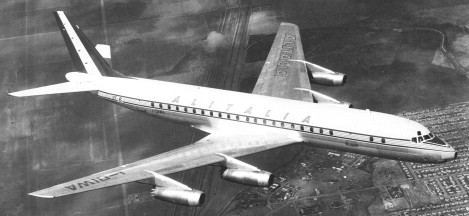
Douglas DC-8

DC-8-40

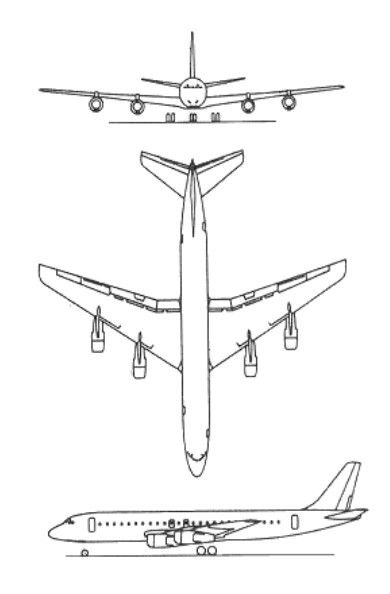
The Douglas Aircraft Company announced its intention, on 7 June 1955, to enter the pure jet stakes with the DC-8. Originally powered by the same Pratt & Whitney JT3 turbofans as the 707, it had a fractionally more slender body, less wing sweep, and fully powered flight controls. To reduce drag and avoid stress between wing and fuselage, the aerofoil changes shape toward the root, becoming flatter on top and more curved beneath. Douglas began assembling the first DC-8 in February 1957 and, there being no prototype as such, was rolled out and first flew on 30 May 1958.
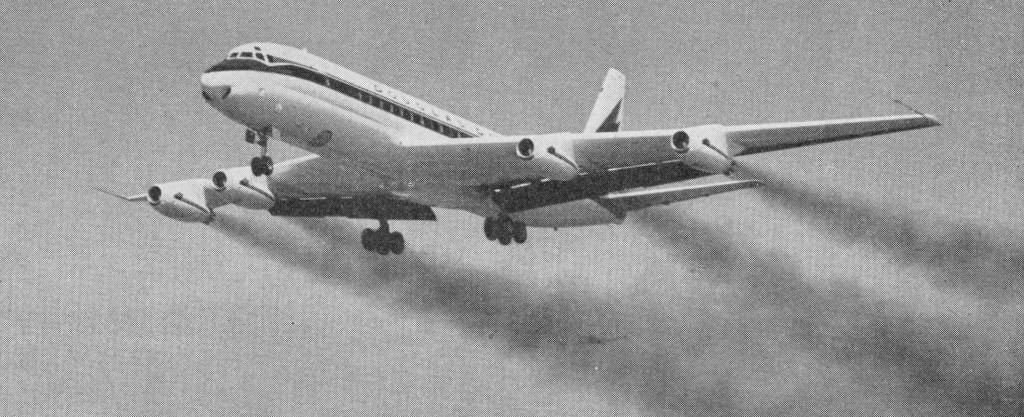
DC-8 first take-off 30 May 1958

There are four main families of DC-8s: Douglas made the first five versions the same size differing only in power and fuel capacity. Douglas had announced that all projected versions would have the same overall dimensions. It adhered to this policy until 1965, and the first five versions of the DC-8 have an identical airframe, with uniform electrical, hydraulic, control and air conditioning systems. The intercontinental versions differ from the domestic models only in having extra fuel capacity and the structural modifications needed to carry the additional fuel. The modifications are limited to the use of thicker skin and stronger material within the wing structure, the aft portion of the fuselage and the tailplane. The landing gear is also more robust in the case of the heavier intercontinental versions.

Douglas DC-8 Article


It was offered in several models, the series 10 for domestic services, the series 30 for longer ranges and the Series 40 powered by the Rolls Royce Conway bypass engine for Trans Canadian Airlines, Air Canada.

On 23 July 1959 the first DC-8 with Rolls-Royce Conway engines made its first flight from Long Beach, California. It was the ninth DC-8 to fly in 14 months.
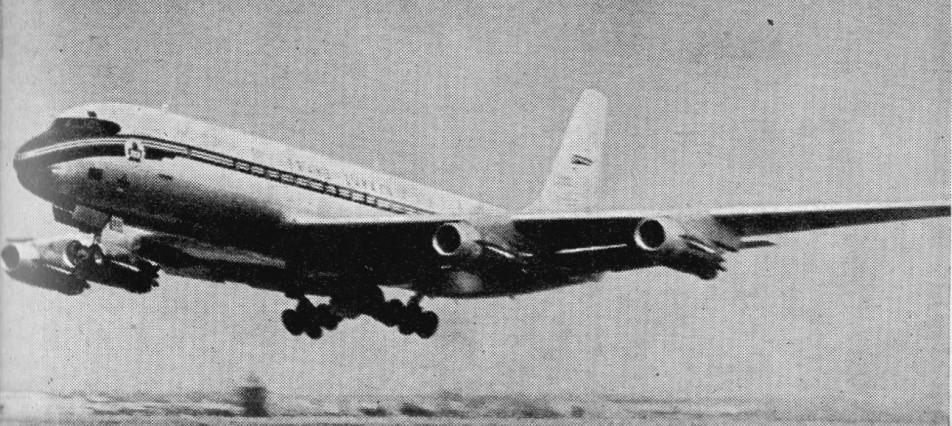
DC-8 no.9

A DC-8-40 became the first jet airliner to exceed the speed of sound when, in 1961, it reached Mach 1.012 (667 mph) in a shallow dive. In 1959 Douglas introduced an extended wing leading edge and slightly extended tips, allowing weight to reach 310,000 lb.

The DC-8 with JT-3C engines received its FAA Type Approval on 31 August 1959 and went into service with United Airlines and Delta Airlines on 18 September 1959.
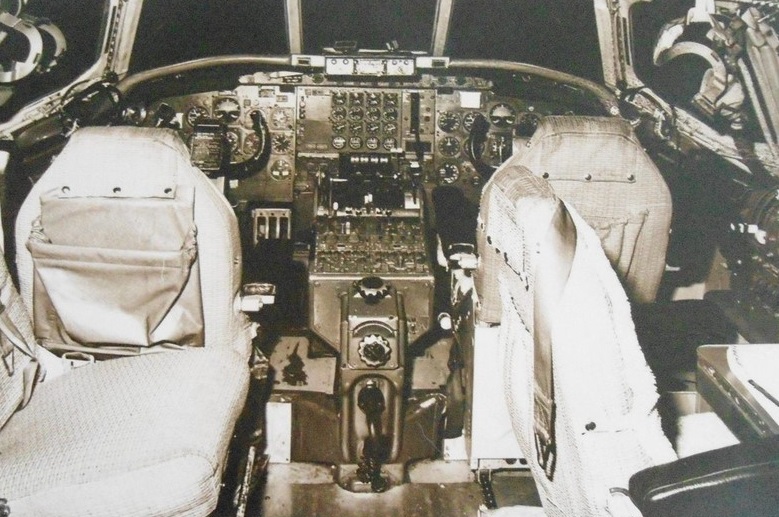
DC – 8 ZK-NZF

In 1960 the Series 50 introduced the JT3D turbofan engine, with weights up to 325,000lb. The Series 50 evolved after Pratt and Whitney developed the new JT3D turbofan housed in new nacelles with distinct exhaust louvres on either side. The 50 range was developed into the 51 for domestic operations, the 52, 53 and 55 for long range versions differing in the model of engine fitted. A subsequent version, the 54, was developed as a freighter.

The Series 50 DC 8 had a still air range of around 6900 miles with a maximum cruise of 580 miles an hour at 220,000 lb. The series 52 had a total fuel capacity of 150,055 lb. The forward freight compartment had a capacity of 690 cu ft and the rear a usable capacity of 700 cu ft.
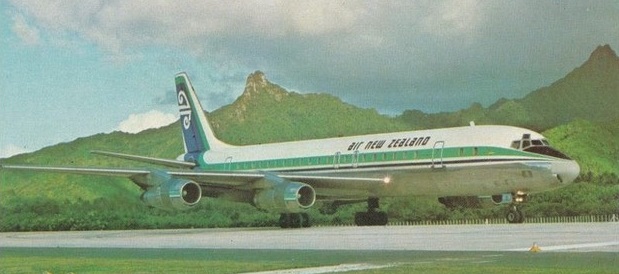
DC-8-52 ZK-NZD

In April 1965 Douglas announced the Super Sixty series. This comprised the DC-8-61, stretched by 36ft 8in to seat up to 259 pas¬sengers; the -62 with only a small stretch, to seat 189, but with extra fuel for very long range, enhanced by an improved wing and engine pods; the -63, fuselage lengthened by 36.7 ft. (11.18 m.), an extended wing span. Powered by JT3Ds of up to 19,000-lb thrust, these extended the DC-8 line from 293 to 556, production continuing until 1972. The Super Sixties proved such good aircraft that in the early 1980s 110 were retrofitted with the CFM56-2 engine as the DC-8-71.

A total of 556 DC-8s were produced before the production line closed in early 1972.

The French Air Force operated an electronic reconnaissance version of the DC-8. They were equipped with large antenna pods on both wingtips and under the fuselage. Reconnaissance squadron Escadron Electronique 51 ‘Aubrac’ operated at least two converted DC-8, 45570 and 46043, from 1977 from Evreux airfield. The first ELINT DC-8 was ordered as early as 1973.
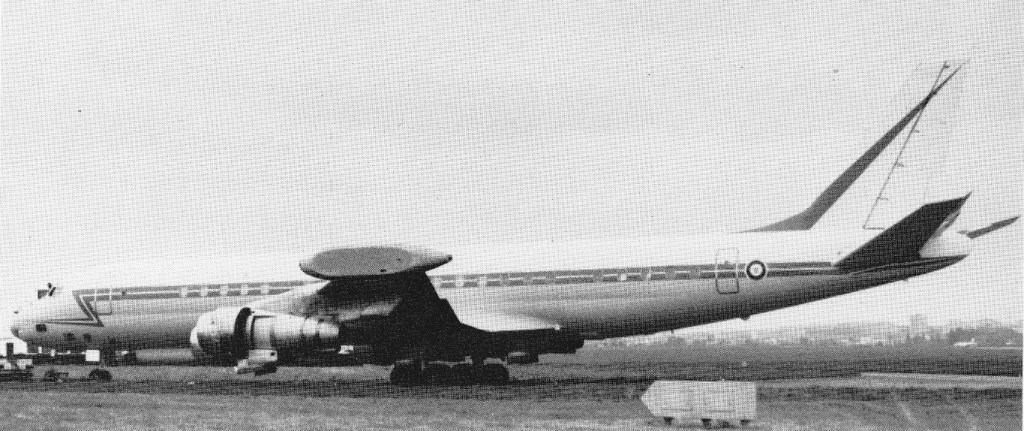
French Air Force ELINT DC-8

Gallery

DC-8-10
MTOW: 211,00 lbs.

DC-8-40
Engine: 4 x Conway.

DC-8-50
Engines: 4 x P&WJT-3 D-1 turbofan, 75.7kN
Wingspan: 43.4 m / 142 ft 5 in
Length: 45.9 m / 150 ft 7 in
Height: 12.9 m / 42 ft 4 in
Wing area: 257.6 sq.m / 2772.78 sq ft
Empty weight: 57000 kg / 125664 lb
Max take-off weight: 142880 kg / 314998 lb
Cruise speed: 932 km/h / 579 mph
Range w/max.fuel: 11100 km / 6897 miles
Range w/max.payload: 9200 km / 5717 miles
Crew: 3-5
Passengers: 105-189

DC-8-54
Engine: 4 x JT3D3B turbofan.

DC 8 Super 61
Engines: 4 x Pratt & Whitney JT3D 3B turbofans, 18,000 lbs thrust.
Length: 187 ft 5 in.
Wingspan: 142 ft 5 in.
Ceiling: 30,000 ft.
Range: 3,750 miles.
Pax cap: 259.

DC-8-62
MGTOW: 350,0001b (157,500kg).
Fuel cap: 163,0001b (73,350kg).

DC-8 Super 63
Engines: 4 x 19,000 lb. (8,618 kg.) Pratt & Whitney JT3D.
Length: 187.4 ft. (57.12 m.)
Wing span 148.4 ft. (45.23 m.)
Height: 42 ft 5 in (12.92 m).
Weight empty 153,749 lb. (69,739 kg.)
Max TO wt: 350,000 lb (158,760 kg).
Max. capacity: 251 passengers
Max cruise 600 m.p.h. (965 kph)
Range 4,600 miles (7,400 km.) with max. payload.
Max range: 7,700 miles (12,400 km).
Max level speed: 600 mph (965 kph).

DC-8-71
Engines: 4 x CFM56-2.
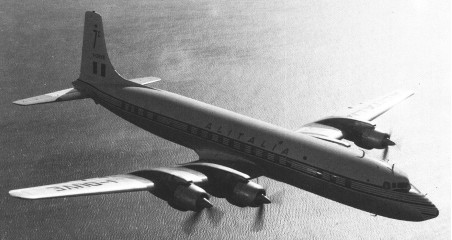
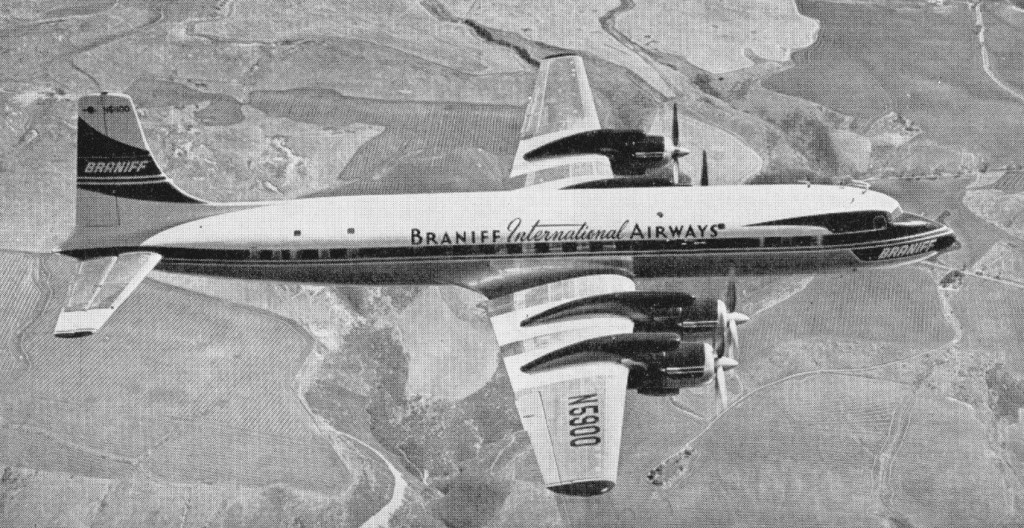
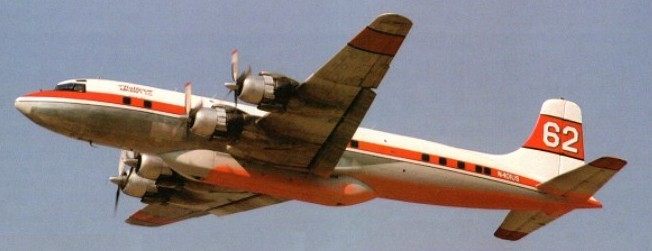
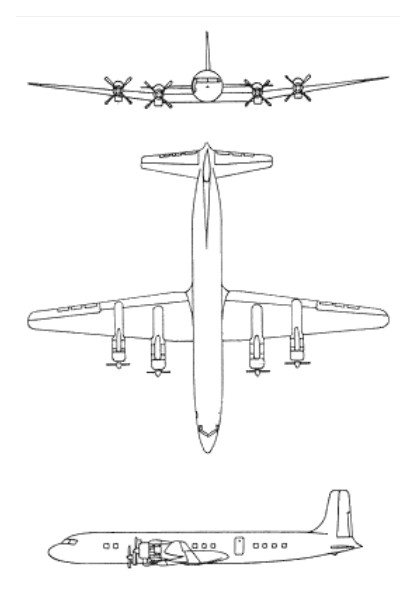
Douglas DC-7

DC-7C

Design and development of the Douglas DC-7 were prompted by American Airlines, which was seeking an aircraft superior in performance to the Lockheed Super Constellation being used by TWA. To meet the requirement of American Airlines it was decided to develop an improved version of the DC-6B using Wright Turbo-Compound engines, each of which had three exhaust-driven turbochargers giving some 20 per cent more output than the standard unit powerplant.
Originally assigned to the civilian version of the C-74 Globemaster (which did not proceed) ‘DC-7’ was later used for Wright R-3350-powered derivatives of the DC-6, but those were completely different airplanes.
American Airlines produced up-front funding for 25 new airliners, enabling Douglas to invest in its own Wright R-3350 Turbo Compound-powered airliner, the DC-7. The initial DC-7 was a direct development of the DC-6B, with the fuselage lengthened by 3 ft 4in to permit the inclusion of one additional row of seats. With the 2424kW R-3350 Turbo Compounds, gross weight went up to 15,200lb / 6895kg and required some strengthening of the landing gear structure. There were also some minor changes in detail, but externally the DC-7 appeared little different from the DC-6B.
One hundred and five DC-7s were built, followed by 112 DC-7Bs, the latter having only minor improvements. In the DC-7B, the engine nacelles were extended further aft to permit the installation of saddle tanks within the rear of the nacelles, made of the new metal titanium. The additional fuel capacity enabled Pan American Airlines to initiate non-stop London-New York service with the DC-7B on 13 June 1955.
The fuel capacity was marginal for North Atlantic services. With a full load and normal headwinds, DC-7Bs which were used to operate the east-to-west service, frequently had to divert for a refuelling stop. Douglas set about the task of developing a version of the DC-7B with greater range.
The third version was designated DC-7C and had, therefore, increased span to provide for greater fuel capacity. This was achieved by inserting a new parallel-chord wing section between the fuselage and the inboard engine nacelles, which had the added advantage of improving the cabin environment by reducing engine noise. During the development of the DC-7C, Curtiss-Wright was able to offer a further increase in engine power up to 3,700 hp and, as a result, the fuselage was lengthened by the insertion of a 1.02m plug to provide accommodation for up to 105 passengers.

DC-7C

Production of DC-7Cs totalled 120. Not only were they used on North Atlantic and Pacific Ocean services, but they also made possible non-stop scheduled operations across the continental USA, and were used also by SAS to inaugurate a Europe-to-Far East route over the North Pole. An improved DC-7D was planned, to be powered by four 4273kW Rolls-Royce Tyne turboprop engines, but the emergence of the Boeing 707 and the Douglas Company’s purpose-built DC-8 jetliner meant that this remained only as an unfulfilled project.

Gallery

DC-7
Engines: 4 x Wright R-3350 Turbo-Compound, 3250 hp.
Max wt: 152,000 lb.
Maximum speed: 406 mph at 21,700ft.
Normal cruising speed: 355mph.
Range max payload: 4,605 miles.
Service ceiling: 21,700 ft.
Wing span: 127ft 6in.
Length 112ft 3in.
Height: 3lft l0in.
Wing area: 1,637 sq.ft.

DC-7C
Engines: 4 x Wright R-3350 Turbo-Compound, 2500kW.
Maximum speed: 406 mph / 650 km/h at 21,700ft.
Normal cruising speed: 355mph.
Range max payload: 7400 km / 4,605 miles.
Service ceiling: 21,700 ft.
Wing span: 38.8 m / 127ft 6in.
Length: 34.2 m / 112ft 3in.
Height: 9.7 m / 3lft l0in.
Wing area: 152.0 sq.m / 1,637 sq.ft.
Empty weight: 35785 kg / 78893 lb
Max take-off: 143,000 lb / 64865 kg.
Crew: 3-5
Passengers: 48-105

Douglas DC-6 / C-118

DC-6B

The US Army Air Forces financed the building of a pressurised prototype aircraft based on the DC-4 but with the square, rather than round, windows which were to be an identifying feature of the future DC-6. The prototype, designated XC-112A, also had 2,100-hp / 1,565kW Pratt & Whitney R-2800-34 Double Wasp engines and an 81-inch extension of its fuselage. The XC-112A flew at Santa Monica on 15 February 1946.

Douglas DC-6 / C-118 Article

American Airlines placed the first order for 50 examples of the new four-engined Douglas, now called DC-6 and first flown on 29 June 1946. The DC-6 was configured to transport between 52 and 86 passengers, depending upon the class of accommodation used. A total of 175 DC-6 were built.
The windowless DC-6A freighter followed in 1949, powered by 1,788.5kW Double Wasps, with reinforced floor and double cargo doors.
The DC-6A, a strengthened, some¬what elongated version powered by water-injection versions of the Double Wasp engine, flew on 29 September 1949. Most DC-6As were built initially as cargo-haulers but were later converted into passenger carriers by their airline users. They had a reinforced floor and cargo-loading doors. The DC-6A was 1.52m longer than the DC-6 (101 going to the USAF as C-118A transports). The term DC-6C was used to refer to aircraft in this series built from the beginning with passenger accommodation. Seventy-four aircraft of the DC-6A/DC-6C type were built, the last being delivered in 1959.
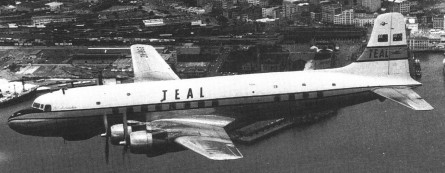
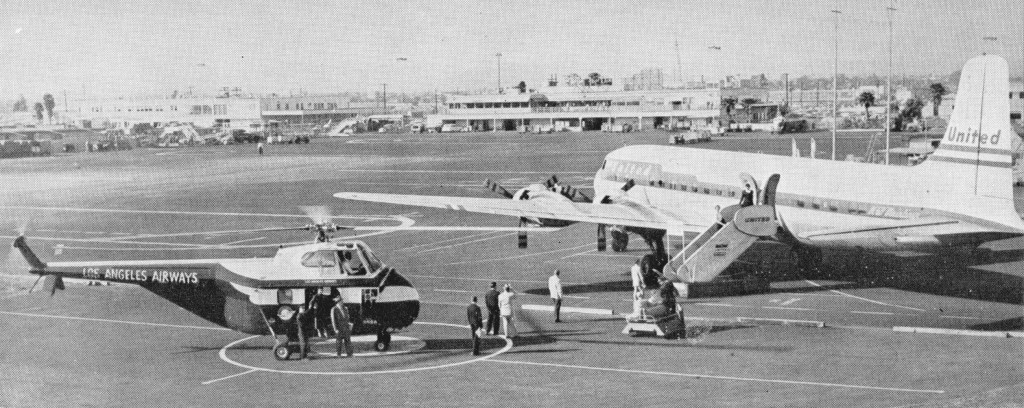
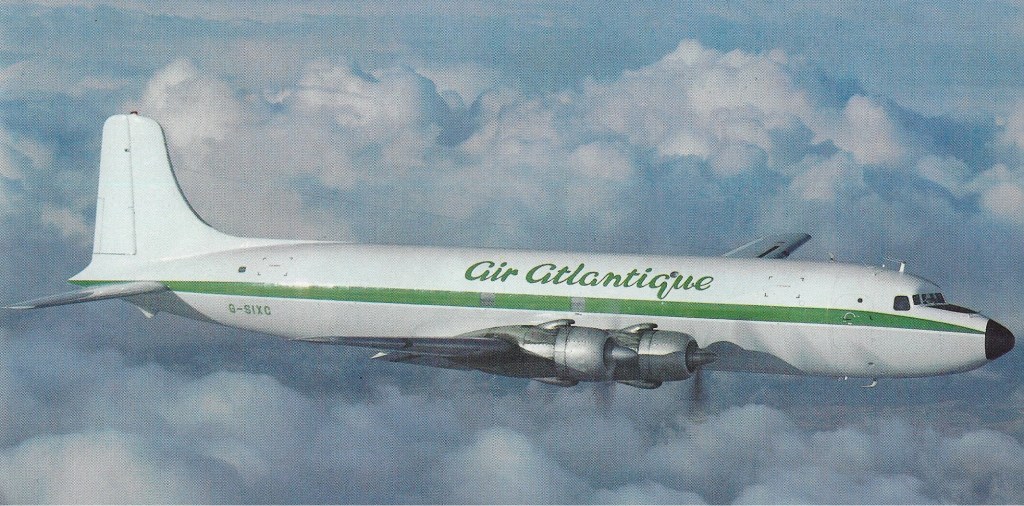
The DC-6B flew on 2 February 1951, a passenger ship lacking the floor and cargo door of its immediate predecessor. Improved 2,500-hp Double Wasp engines with paddle-blade propellers powered the DC-6B. With 288 examples delivered between 1951 and 1958, the DC-6B was the most numerous of variants in the DC-6 series, 704 of which were delivered in all and was put into service on 29 April 1951, by American, Panagra and Braniff, among others.

The DC-6B, with accommodation for 54-102 passengers, first flew on 2 February 1951 and also had the longer fuselage. American Airlines introduced DC-6B on its US transcontinental services on 29 April 1951.
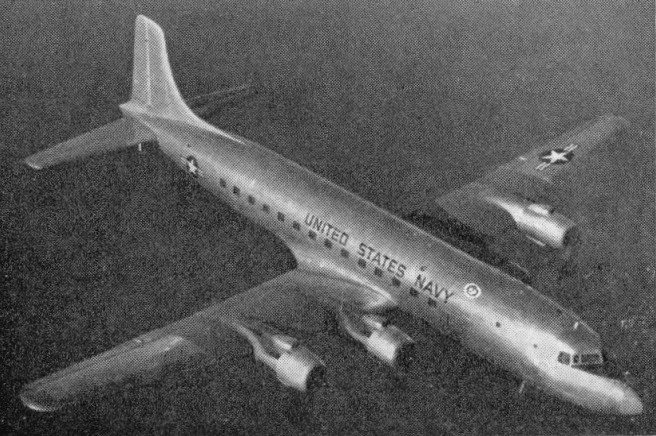
The US Navy was the first military customer to order a DC-6 variant in some numbers, acquiring 65 DC-6As in the late 1940s and early 1950s. These were designated R6D-1 and VIP/staff transport examples were called R6D-1Z. The single C-118 (length 100ft 7 in) is V.I.P. transport.

R6D-1

After the Navy, the US Air Force acquired 101 DC-6A aeroplanes, designated C-118A, and employed them on MATS’ worldwide routes. These aircraft could carry up to 27,000 lb of cargo or 81 fully-armed troops. In 1962, the two Naval variants were redesignated C-118B and VC-118B and 40 of them were transferred to the USAF.

Regularly scheduled operations of the commercial passenger DC-6 continued until 1967 and many of the DC-6 series were later converted to freighters.

Gallery

XC-112A
Engines: 4 x Pratt & Whitney R-2800-34 Double Wasp, 2,100-hp.
Wing span: 117 ft 6in.
Wing area: 1,463 sq.ft.
Length: 100 ft 7in.
Height: 29ft 1 in.
Empty weight: 53,623 lb.
Max take-off weight: 97,2001b.
ROC: 900 fpm.
Cruise: 328mph.
Service ceiling: 29,000ft.

DC-6
Engines: 4 x Pratt & Whitney R-2800-34 Double Wasp, 2,100-hp.
Wing span: 117 ft 6in.
Wing area: 1,463 sq.ft.
Length: 100 ft 7in.
Height: 29ft 1 in.
Empty weight: 53,623 lb.
Max take-off weight: 97,2001b.
ROC: 900 fpm.
Cruise: 328mph.
Service ceiling: 29,000ft.

DC-6A
Engines: 4 x Pratt & Whitney R-2800 Double Wasp.

DC-6B
Power: 4 x Pratt & Whitney R-2800 Double Wasp radials, 2400 hp.
Max speed: 356 mph @ 20,000 ft.
Span: 117 ft 6 in.
Length: 100 ft 7 in.
MAUW: 97,200 lbs.
Range: 3860 mile.
Cruise: 328mph.
Pax cap: 107.

DC-6BF
Engines: 4 x Pratt & Whitney R-2800-CB Double Wasp, 2400 hp.
Wing span: 117 ft 6 in.
Length: 103 ft 6 in.
Height: 28 ft 6 in.
MTOW: 103,800 lb.
Empty wt: 56,000 lb.
Cruise: 225 kt.

C-118
Length: 100 ft 7 in

C-118A
Payload: 27,000 lb or 81 fully-armed troops.

C 118B Liftmaster

Douglas DC-4 / C-54 / R5D

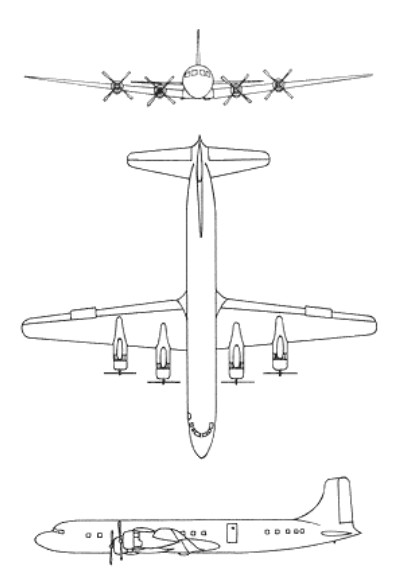
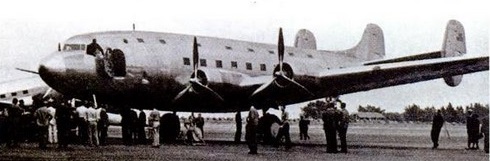
In response to the requirements of five major US airlines, Douglas designed and built the large 52-passenger DC-4, which made its first flight on 7 June 1938. This type was not put into production; instead 61 smaller unpressurised development were ordered by American, Eastern and United Air Lines. This, too, bore the designation DC-4 and the original aeroplane became the DC-4E.

DC-4 prototype

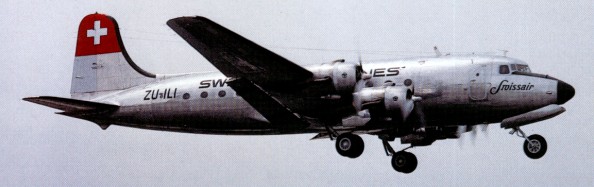
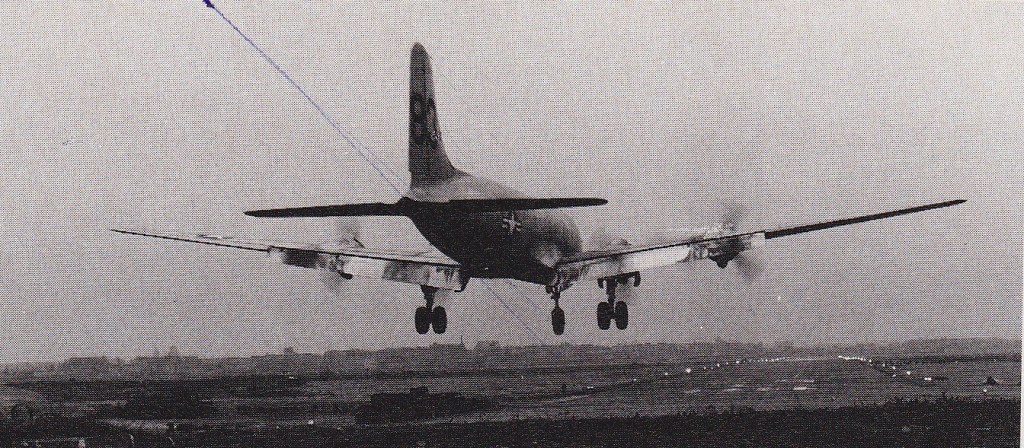
The DC 4 actually saw its first service as the wartime C 54 Skyrnaster (first flight 14 February 1942) when all 24 DC-4A built were taken by the armed forces (designated R5D Skymaster by the Navy).

Douglas DC-4 / C-54 Article

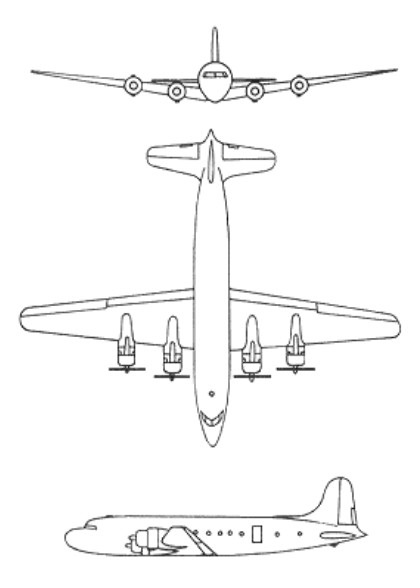
The DC-4 had a retractable nosewheel undercarriage and was powered by four 820-1,080kW Pratt & Whitney Twin Wasps. It was a long-range heavy logistic transport with a payload of up to 9,980kg.
A total of 207 C-54A were built, followed by increased-capacity C-54B, similar C-54D with Pratt & Whitney R-2000-11 radials, C-54E with convertible cargo/passenger interiors, and C-54G with new engines. Nine hundred and fifty-two Skymasters were completed for the USAAF and 211 for the US Navy.
The C 54D-15DC (USAAF variant of the DC 4, with the DC suffix indicating Douglas Chicago) with four 1,200 hp Pratt and Whitney R2000 7 radials, was operational for the last year of WW2.
USAAF C¬54s were allocated to the USN in July 1945; 92 so transferred.
The C 54Q had R2000 11 engines.
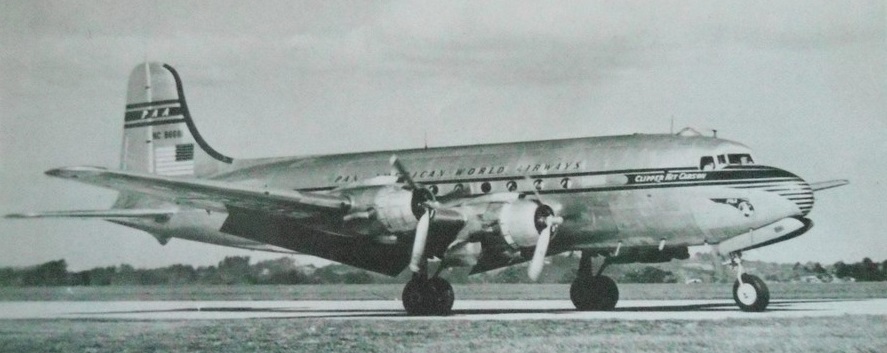
After the war Douglas built 79 civil DC-4-1009 and many of the military aircraft became available for airline operation – mostly with 44 seats but later with as many as 86. On 7 March 1946 American Airlines was first to introduce DC-4 on US domestic services, between New York and Los Angeles. However in October 1945 American Overseas Airlines had introduced DC-4 on North Atlantic services.

From it were developed the larger DC 6 and DC 7 series the Merlin engined Canadair C 4 and the Aviation Traders Carvair nose loading vehicle transport.

One, the VC-54C-DO Sacred Cow, served as President Roosevelt’s special aircraft and a C-54B-1-DO was used by Prime Minister Winston Churchill.

During the first years of the Berlin Airlift corridors, the pilots had to be wary about mock attacks by Soviet MiG fighters or near misses. The mutual mistrust inevitably caused a number of incidents. In April 1952 an Air France DC-4 was shot-up in one of the Airlift corridors by two Russian MiG-15a. A stewardess and two passengers were seriously injured.

A C-54 made the Berlin Airlift’s last flight on 30 September 1949.

C-54 Skymaster

The 1956 R5D2-2 radar and radio research aircraft in the US Navy featured a retractable mast with instruments.

R5D2-2

When production ceased in 1947, 1,242 had been built, of which hundreds served to re-equip civil airlines during the first postwar years.

In 1963 the Peruvian Air Force bought three DC-4B’s from US dealer Aircraft Corp of Charlotte, NC. Two for passenger transport and the third for use by Peru’s president.

Gallery

Variation:
Canadair C-54 / C-4 / C-5

DC 4
Engines: 4 x Pratt & Whitney R 2000 SD13G Twin Wasp, 1,450 hp.
Wing span: 117 ft 6 in (35.80 m).
Length: 93 ft 11 in (28,63 m).
Gross weight: 73,000 lb (33,112 kg).
Typical cruising speed: 204 mph (328 kph) at 10,000 ft (3,050 m).
Accommodation: Crew of 5 plus 44 86 passengers.
Typical range: 2,140 miles (3,444 km) with max payload at 201 mph (323 kph).

DC 4
Engines: 4 x P&W R-2000-25, 1065kW
Max take-off weight: 33140 kg / 73062 lb
Empty weight: 20000 kg / 44093 lb
Wingspan: 35.8 m / 117 ft 5 in
Length: 28.6 m / 93 ft 10 in
Height: 8.4 m / 27 ft 7 in
Wing area: 136.0 sq.m / 1463.89 sq ft
Max. speed: 450 km/h / 280 mph
Cruise speed: 365 km/h / 227 mph
Ceiling: 6900 m / 22650 ft
Range w/max.fuel: 6000 km / 3728 miles
Range w/max.payload: 2200 km / 1367 miles
Crew: 4
Passengers: 40-44

Douglas C 54 B Skymaster
Engine : 4 x Pratt&Whitney R-2000-7, 1332 hp
Length : 93.93 ft / 28.63 m
Height : 27.526 ft / 8.39 m
Wingspan : 117.487 ft / 35.81 m
Wing area : 1462.935 sq.ft / 135.91 sq.m
Max take off weight : 73012.0 lb / 33112.0 kg
Weight empty : 38206.0 lb / 17327.0 kg
Max. speed : 238 kt / 441 km/h
Cruising speed : 208 kt / 385 km/h
Service ceiling : 21998 ft / 6705 m
Cruising altitude : 15207 ft / 4635 m
Wing load : 50.02 lb/sq.ft / 244.0 kg/sq.m
Range : 3389 nm / 6276 km

C-54M Skymaster
Engines: 4x Pratt & Whitney R2000-11, 1,350 h.p.
Wingspan: 117 ft. 6 in.
Length: 93 ft. 10 in.
Loaded weight: 73,000 lb
Max. speed: 274 m.p.h.
Ceiling: 22,500 ft.
Typical range: 1,500 miles at 220 mph at 10,000 ft.
Crew: 6
Capacity: 50 passengers, 30 stretchers or cargo.

C 54D-15DC
Engines: 4 x Pratt and Whitney R2000 7, 1,200 hp.

C 54Q
Engines: 4 x Pratt and Whitney R2000 11.

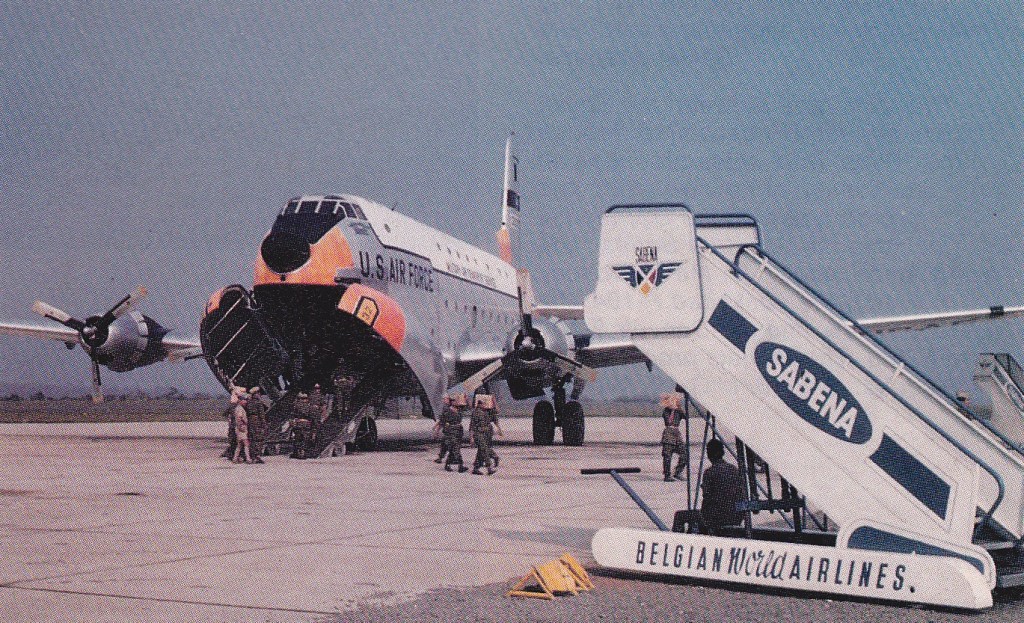
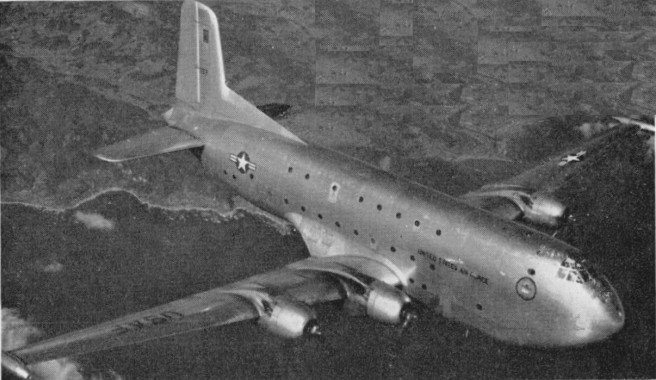
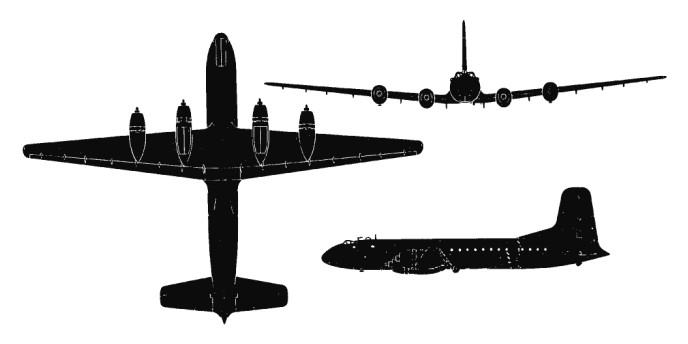
Douglas C-133 Cargomaster

C-133A-5-DL

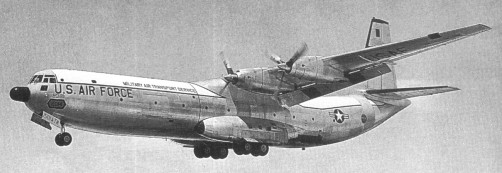
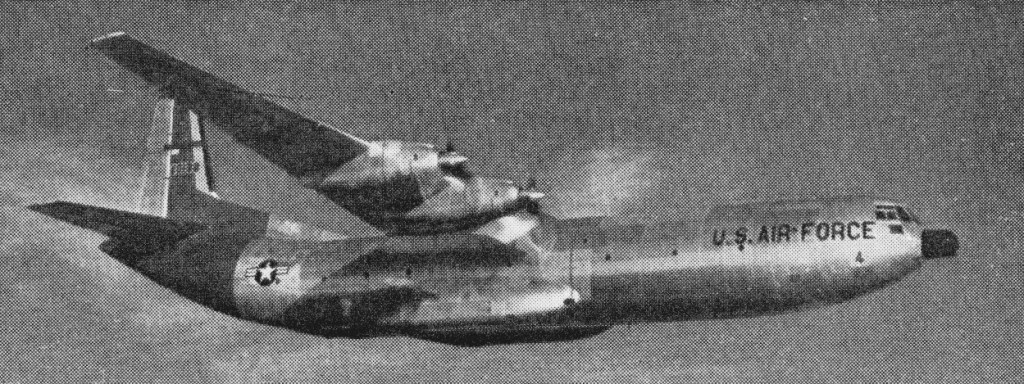
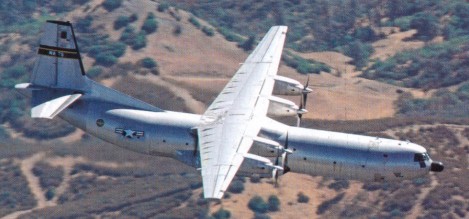
Resulting from studies aimed towards a successor to the Globemaster II, the C-133 Cargomaster was worked up by Douglas’ designers beginning in February 1953, and the first aircraft was rolled out on 27 March 1956.

Douglas C-133 Cargomaster Article

C-133A

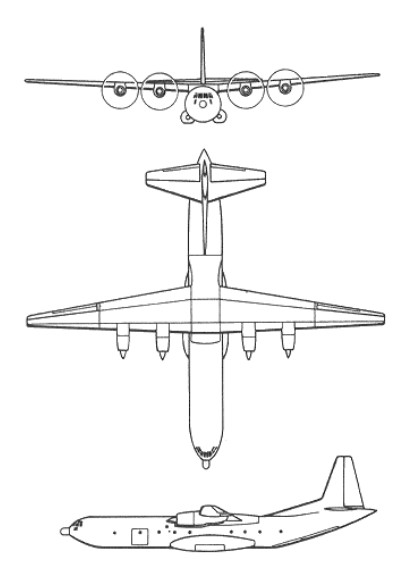
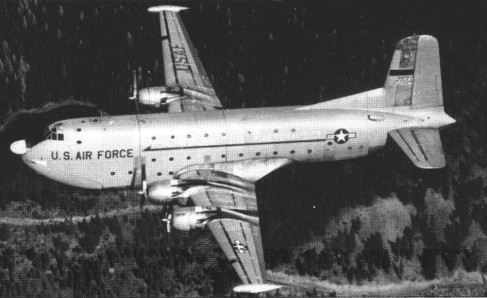
A huge airlifter with high-mounted wings powered by four 5,700-shp Pratt & Whitney T34-P-3 turboprop engines, the C-133 had its cargo-loading door in the rear fuselage. It was designed to carry heavier and bigger loads than the Lockheed C-130 Hercules, although its internal capacity did not represent a significant increase over the C-124 Globemaster II. First flown on 23 April 1956 and delivered to MATS on 1 August 1957, 35 C-l33As were followed by 15 C-l33Bs powered by 7,500 hp / 5,589kW T34-P-9W turboprops, the latter with an improved cargo door and increased payload. Some Cargomasters were used to transport the first generation of intercontinental ballistic missiles (ICBMs) and intermediate-range missiles such as Atlas, Thor and Redstone. Production ended in April 1961.

The Cargomaster fleet served for a decade and the aircraft were seen everywhere, including in Vietnam in the early days. They were stressed for a limited airframe life and could not be kept in service longer. In service until 1971.

Gallery

C-133A
Engines: 4 x Pratt & Whitney T34-P-3 (later -7WA), 6500 shp.
Wing span: 179 ft 7.75 in.
Length: 157ft 6.5 in.
Height 48ft 3in.
Wing area: 2,673sqft.
Empty weight: 120,263 lb.
Loaded weight: 275,000lb.
Max speed: 359 mph.
Ser¬vice ceiling: 29,950ft.

C-133B
Engines: 4 x Pratt & Whitney T34-P-9W, 7500 shp / 4410kW
Max take-off weight: 129700-136000 kg / 285941 – 299830 lb
Empty weight: 54600 kg / 120373 lb
Wingspan: 54.8 m / 179 ft 9 in
Length: 48.0 m / 157 ft 6 in
Height: 14.7 m / 48 ft 3 in
Wing area: 248.3 sq.m / 2672.68 sq ft
Max. speed: 558 km/h / 347 mph
Cruise speed: 500 km/h / 311 mph
Ceiling: 6125 m / 20100 ft
Range w/max.fuel: 7000 km / 4350 miles
Range w/max.payload: 3600 km / 2237 miles
Crew: 4
Passengers: 200

Douglas XB-42 Mixmaster

XB-42A

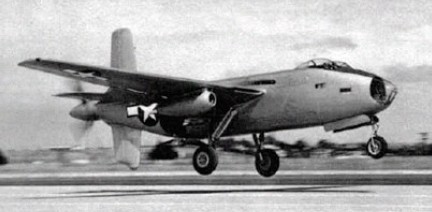
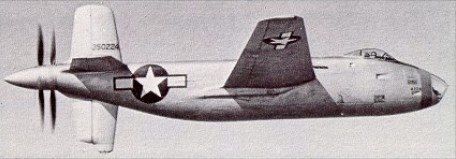
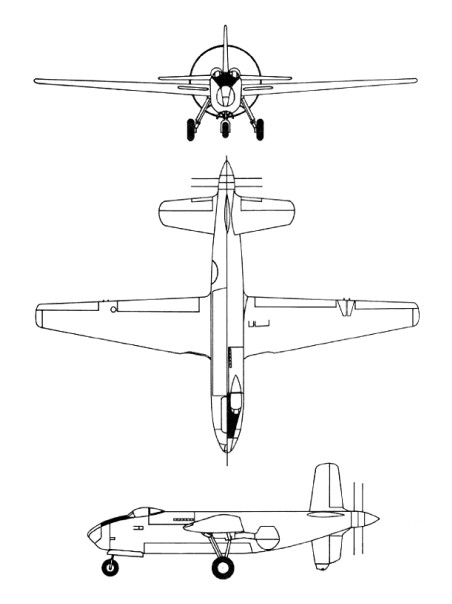
Douglas designed and built two bomber prototypes and one static test airframe under a contract received from the US Army Air Force on 25 June 1943. This was based on two 1800-hp (1342-kw) Allison V-1710-25 inline engines located in tandem in the fuselage to drive a pair of contra-rotating propellers behind the cruciform tail unit. Named Mixmaster by the company, this aircraft had a mid-set cantilever monoplane wing, cruciform tail surfaces and tricycle landing gear, whose main units retracted aft to be housed in the sides of the fuselage.
The fuselage provided accommodation for a crew of three. A bomb-aimer/navigator in the nose, and the pilot and co-pilot in a side-by-side cockpit well forward on the fuselage, each beneath an individual canopy. The fuselage also incorporated an internal bomb bay, as well as housing the twin-engine powerplant in a compartment immediately to the rear of the pilot’s cockpit. The two Allison V-1710 engines were used to drive, via shafting and a reduction gearbox in the tailcone, two three-bladed contra-rotating pusher propellers to the rear of the tail unit. Opening the bomb doors in flight interrupted the airflow to the propeller and caused excessive vibrations. The bomber version had six machine guns. The four on the wing trailing edge were aimed by the copilot, whose seat could turn to face aft. An attack version armed with 16 machine guns or a 75mm cannon and two machine guns, or two 37mm cannon was proposed.

Designated XB-42, the Mixmaster was first flown on 6 May 1944.

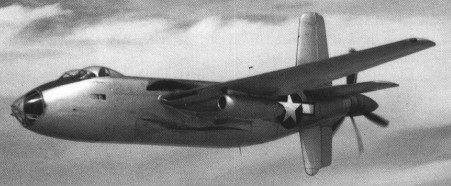
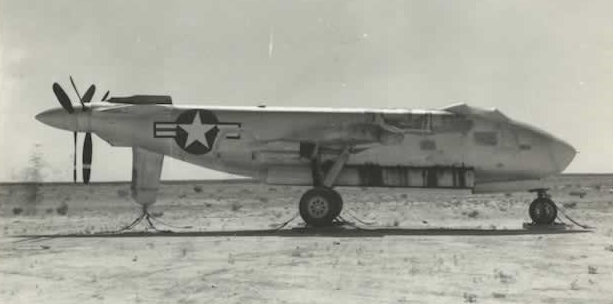
A second prototype was flown for the first time on 1 August 1944, soon afterwards being modified by the addition of a single canopy over the pilot/copilot cockpit. This prototype was destroyed in a crash during December of that year, but by that time the USAAF had decided not to proceed with production of this design, awaiting instead the development of higher-performance turbojet-powered bombers. As an interim step to allow evaluation of turbine power, the first prototype was given a mixed powerplant comprising two 1025kW Allison V-1710-133 piston engines to drive the propellers, plus two 726kg thrust Westinghouse 19XB-2A turbojets mounted in underwing nacelles.

Redesignated XB-42A, this aircraft was used for performance testing over several months before being retired at the end of June 1949. The XB-42A is now in storage for the National Air and Space Museum. Somewhere along the way its wings were removed for transport and haven’t been seen since.

Douglas XB-42 Mixmaster in storage at Pyote AFB

XB-42
Engines: 2 x Allison V-1710-125, 1800-hp (1342-kw)
Max take-off weight: 16193 kg / 35700 lb
Empty weight: 9475 kg / 20889 lb
Wingspan: 21.49 m / 70 ft 6 in
Length: 16.36 m / 53 ft 8 in
Height: 5.74 m / 18 ft 10 in
Wing area: 51.56 sq.m / 554.99 sq ft
Max. speed: 660 km/h / 410 mph
Cruise speed: 502 km/h / 312 mph
Ceiling: 8960 m / 29400 ft
Range: 2897 km / 1800 miles
Armament: 4 x 12.7mm machine-guns, 3629kg of bombs

XB-42A
Engines: 2 x Allison V-1710-25, 1800-hp (1342-kw) & 2 x turbojets.

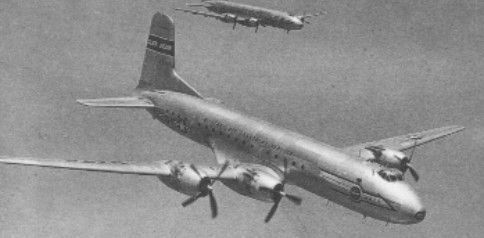
Douglas C-124 Globemaster II

C-124C

Although the production run of the C-74 Globemaster had been held to 14 airframes, the success of this oversized transport led the US Air Force and Douglas to agree upon construction of an improved long-range transport. The fifth C-74 airframe was used to create the service-test YC-124 Globemaster II which retained the earlier aeroplane’s wings, tail surfaces, and 2610kW R-4360-49 engines. The YC-124 flew on 27 November 1949. The new fuselage was double-decked and the aircraft had enormous clamshell loading doors at the nose with an associated built-in loading ramp, an electric hoist amidships, and two overhead cranes (each with a capacity of 7257kg which could traverse the entire length of the 23.47m-long cargo hold. When used in a transport role (with two decks installed), the Globemaster II could carry a maximum of 200 fully-equipped troops, or 123 stretcher cases plus 45 ambulatory patients and 15 medical attendants.

Douglas C-124 Globemaster II Article

A pre-production aircraft and 28 C-124A models were retrofitted with the ‘thimble’ nose fairing containing ASP-42 radar. Douglas then manufactured no fewer than 243 C-124C models, with the radome as standard, increased fuel, wingtip fairings housing combustion heaters to de-ice the wing and tailplane leading edges and to heat the cabin, and other improvements. The first service Globemaster began duty in May 1950, the month before the outset of the Korean War. Although production was finished by May 1955, the Globemaster II remained a standard in USAF service for years thereafter.

C-124C Globemaster II of 39th Air Transport Squadron flying supplies to Leopoldville in 1963

The Globemaster IIs remained in service until replaced by the Lockheed C-5A Galaxy during 1970.
The YKC-124B Globemaster II was Douglas’ bid for a major order for air refuelling tankers. In 1951, engineers began working on a C-124 airframe to be powered by 5,500-shp Pratt & Whitney YT34-P-1 turboprop engines. Gas turbine power produced a kind of ‘Super Globemaster II’ with greater speed, altitude and range capability than the ‘recip’ aeroplane but for reasons not now clear, the USAF decided instead to order the Boeing KC-97 Stratofreighter as its standard tanker even though the latter aircraft did not perform so well. By the time the turboprop Globemaster II flew on 2 February 1954, it had been redesignated YC-124B and was used for proof-of-concept evaluations. Though no orders resulted from its 32-month test programme, the YC-124B contributed substantially to knowledge needed when the C-133 Cargomaster came along.

Gallery

YC-124 Globemaster II
Engines: 4 x R-4360-49.

C-124A
Engines: Pratt & Whitney R-4360-20W, 3500 hp

YC-124B
Engines: 4 x 5,500 h.p. Pratt & Whitney T34-P-1 turboprops

C-124C Globemaster II
Engines: 4 x Pratt & Whitney R-4360-63A Wasp Major, 3800 hp / 2795kW
Wing span 173 ft 3 in / 53.1 m
Length 130 ft 5in / 39.8 m
Height 48ft 3.5in / 14.7 m
Wing area: 2,506sq.ft. / 233.0 sq.m
Empty weight: 101,165 lb.
Max weight: 194,5001b.
Max speed: 298 mph at 20,800 ft
Cruise speed: 520 km/h / 323 mph
ROC: 800 fpm
Service ceiling: 21,800 ft.
Range w/max.fuel: 6500 km / 4039 miles
Range w/max.payload: 1970 km / 1224 miles
Crew: 5
Passenger capacity: 200

Douglas 415 / C-74 Globemaster

In 1942 Douglas began to design a larger, would-be successor to the Douglas C-54. The new model, identified in project form as the Model 415, had the same four-engine, low-wing layout as its predecessor, but it was about half again as large dimensionally and twice as heavy. With 3,250hp (2,420kW) Pratt & Whitney R-4360-27 Wasp Major engines, it would cruise at 296mph (476km/h), considerably faster than the C-54. The pilot and co-pilot were separately enclosed in side-by-side bubble canopies, an arrangement later found far from satisfactory from a crew communication standpoint. It was a cantilever low-wing monoplane of all-metal construction, with a conventional tail unit, and retractable tricycle landing gear with twin wheels on each unit.
The C-74’s fuselage provided accommodation for the crew and 125 troops, or 115 stretchers with medical attendants, or up to 21840kg of cargo.
Orders were received for 50 examples of a military version known as the C-74 Globemaster.
In 1945, Pan American Airways also recognized the new model’s potential and ordered 26 with seats for 108 passengers. As ‘DC-6’ was already assigned, the civilian version was called the DC-7. Unlike the C-54, the DC-7 was to have a pressurized cabin.
By the time of the first flight on September 5, 1945, the military order had been reduced to 14 units. One, with 103 passengers and crew, flown from the USA to the UK on 18 November 1949, was the first aircraft to fly across the North Atlantic with more than 100 persons on board.
With development costs shared by fewer military airplanes, the cost of the DC-7s rose accordingly. Pan American reassessed its needs, as well as the increased cost of the DC-7s, and elected to cancel its order altogether. Although the DC-7 failed as a civil airliner, Douglas did redesign the fuselage of the C-74 to create the C-124 Globemaster II.

Douglas XBLR-2 / XB-19

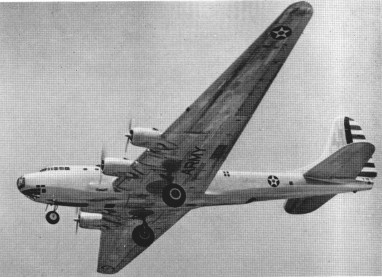
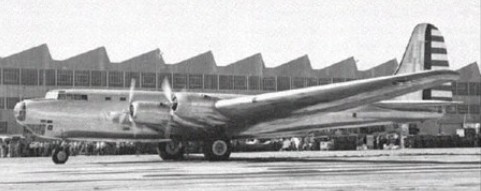
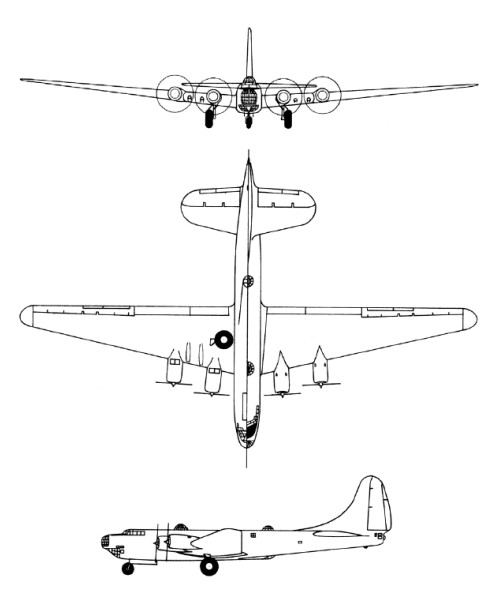
Originally designated XBLR-2 (eXperimental Bomber Long-Range 2), the XB-19 was essentially used as a test bed for very large bomber construction techniques and flight characteristics. The Douglas Aircraft Company had wanted to cancel the project because of the expense and extended construction time which made the aircraft obsolete before it ever flew. However, the Army Air Corps insisted the aircraft be completed for test use.
The XB-19’s first flight was 27 June 1941, more than 3 years after the construction contract was awarded. In 1943, the original radial engines were replaced by Allison V-3420 in-line engines and the aircraft was redesignated XB-19A. After testing was completed, the XB-19A was used as a cargo/transport aircraft until 1949 when it was scrapped.

Engines: 4 x 2000hp
Max take-off weight: 73467 kg/ 161968 lb
Wingspan: 64.62 m / 212 ft 0 in
Length: 40.23 m / 131 ft 12 in
Height: 13.03 m / 42 ft 9 in
Max. speed: 360 km/h / 224 mph
Ceiling: 7015 m / 23000 ft
Range: 8372 km / 5202 miles
Crew: 11
Armament: 2 x 37mm cannon, 5 x 12.7mm + 6 x 7.62mm machine-guns , 16330kg of bombs

Dornier Do-26

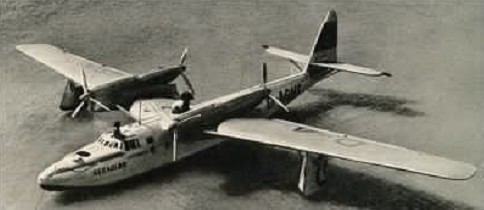
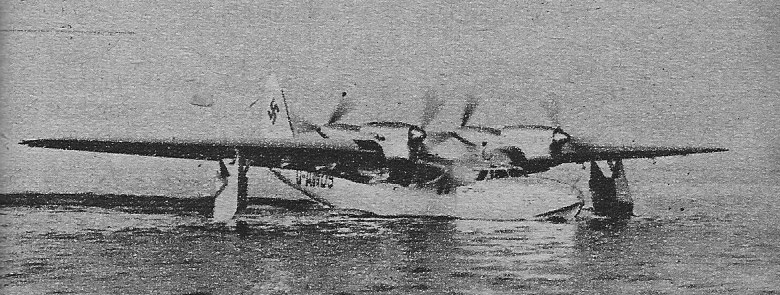
Do 26 V6

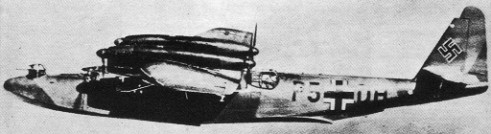
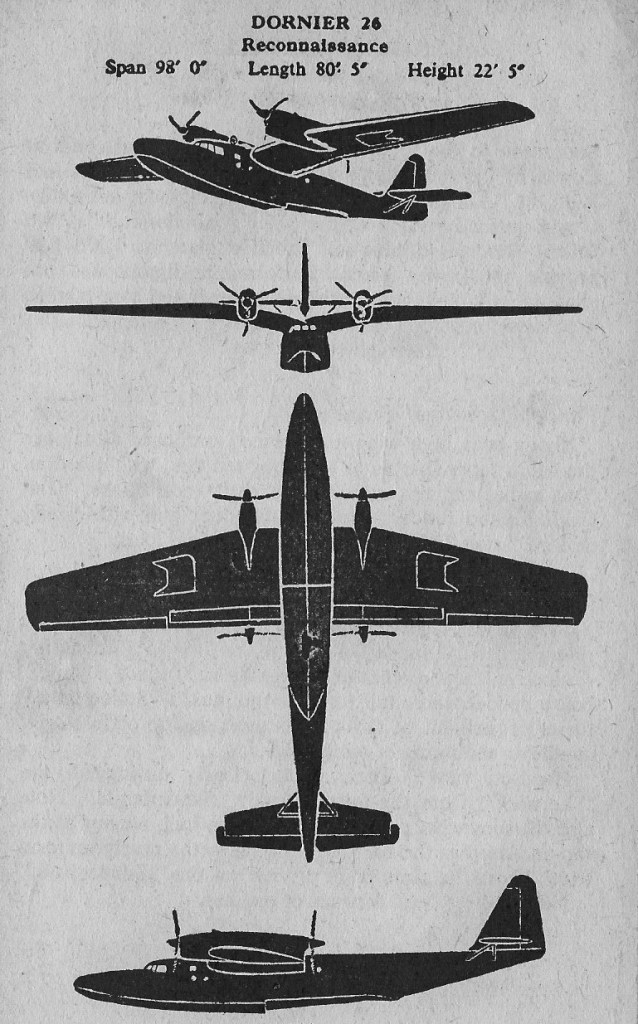
The Do 26 was originally produced for Lufthansa as a mailplane capable of flying non stop between Lisbon and New York. A complete break with previous Dornier flying boat designs, the Do 26 VI, which flew for the first time on May 21, 1938, used a cantilever wing housing retractable stabilizing floats and four 600 hp Jumo 205C diesel engines in tandem pairs. The forward engines drove normal tractor propellers, but the rear pair drove pushers by means of extension shafts which could be raised through 10 degrees to keep the three-blade metal propellers clear of spray during takeoff. The V2, with 800 hp 205D engines, was completed by early 1939, and together with the V1 underwent extensive trials with Lufthansa. Three Do 26s, stressed for catapult launching from support ships, had been ordered by Deutsche Lufthansa in 1937, and the first of these was flown on 21 May 1938. Two of the three were completed before the outbreak of World War II and delivered to the airline under the designation Do 26A. They were never used as intended, across the North Atlantic, and made just 18 crossings of the South Atlantic.

The four passenger B series prototype, the V3, was still under construction at the start of the Second World War in September 1939 and was taken over by the Luftwaffe along with three eight-passenger C series prototypes, the V4, V5 and V6.

The Luftwaffe ordered the last four to be adapted as Do 26D dual role long range maritime reconnaissance aircraft, with a 20mm (0.79 in) MG 151 cannon in a powered bow turret, two glazed blisters amidships each mounting a single MG 15 machine gun, and a third MG 15 below the rear hull. Along with the V2 prototype, the four converted machines were used during the invasion of Norway on supply and communications operations in and out of the narrow fjords. On May 28, 1940, two Do 26s were shot down by Hurricanes of 46 Squadron, RAF, in Rombaksfjord while attempting to land. No further Do 26s were built. After the operations in Norway the remaining Do 26s were withdrawn from front line service. They continued to operate on communications tasks until the lack of spares and servicing problems necessitated their withdrawal from service.

The V1 and “A” model had 205E engines. The sole “B” model, which was destroyed by RAF Hurricanes early in the war, had 205Ea engines and the “C” model had 205D engines.

Do 26 V6
Engines: 4 x Jumo 205C, 440kW / 600 hp
Wingspan: 30.0 m / 98 ft 5 in
Length: 24.5 m / 80 ft 5 in
Height: 6.9 m / 22 ft 8 in
Wing area: 120.0 sq.m / 1291.67 sq ft
Gross weight: 22 500 kg (49 604 lb)
Empty weight: 10200 kg / 22487 lb
Maximum speed: 324 km/h (201 mph)
Cruise speed: 310 km/h / 193 mph
Ceiling: 4600 m / 15100 ft
Range w/max.fuel: 9000 km / 5592 miles
Crew: 4