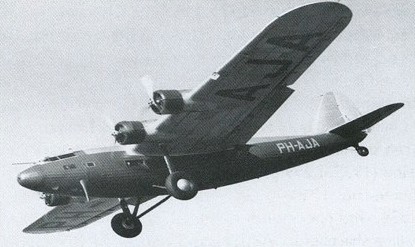
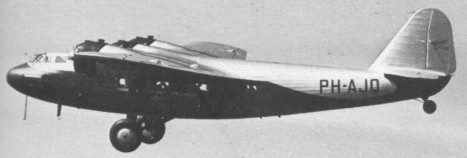
The sole Fokker F.XXXVI made its first flight on 22 June 1934, flown by Fokker’s test pilot Emil Meinecke. Largest of the Fokker transports, it was a high-wing cantilever monoplane with fixed landing gear and powered by four 559kW Wright Cyclone radial engines mounted forward of the leading edge. Of typical Fokker construction, the F.XXXVI provided accommodation for a crew of four, and 32 passengers in four eight-seat cabins. As an alternative 16 passengers could be carried in sleeping accommodation. Operated on European routes by KLM from March 1935, it was sold in 1939 to Scottish Aviation of Prestwick and was flown from there as a crew and navigational trainer until scrapped in 1940.
The prototype (PH-AJR) flew in early 1935 and was followed by two production machines, accommodating 22 passengers. All three were delivered to KLM, the prototype in March and the other two in May 1935. One aircraft crashed on 14 July 1935, but the other two operated European routes until they were sold in the UK, PH-AJR becoming G-AFXR in August 1939 on joining British American Air Services, and PH-AJP being re-registered G-AFZP in the following month when it was acquired by Scottish Aviation. Impressed for RAF service as HM159 and HM160 in October 1941, the two aircraft were used for transport and crew training. HM159 caught fire in the air and was lost in the Highlands, but HM160 was returned to Scottish Aviation post-war under its previous civil registration. It flew between Prestwick and Belfast for a time before being grounded finally at the end of 1947. A fourth F.XXII was built for Swedish AB Aerotransport and delivered in March 1935. Named Lappland, it flew a regular schedule between Malmo and Amsterdam until destroyed in an accident at Malmo in June 1936.
Engines: 4 x Pratt & Whitney Wasp T1D1 radial, 373kW Max take-off weight: 13000 kg / 28660 lb Empty weight: 8100 kg / 17858 lb Wingspan: 30.00 m / 98 ft 5 in Length: 21.52 m / 70 ft 7 in Height: 4.60 m / 15 ft 1 in Wing area: 30.00 sq.m / 322.92 sq ft Max. speed: 285 km/h / 177 mph Cruise speed: 215 km/h / 134 mph Ceiling: 4900 m / 16100 ft Range: 1350 km / 839 miles Passengers: 22
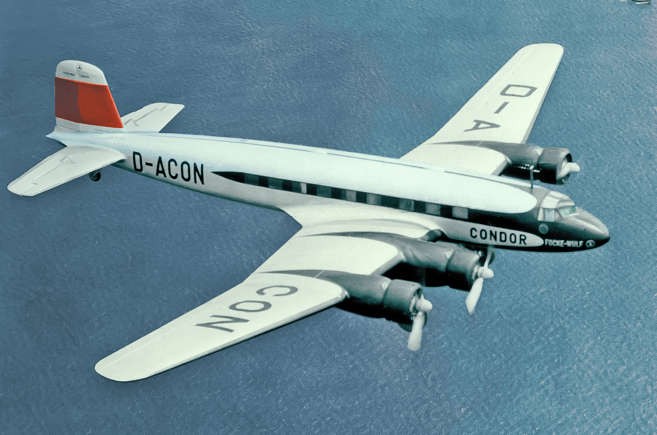
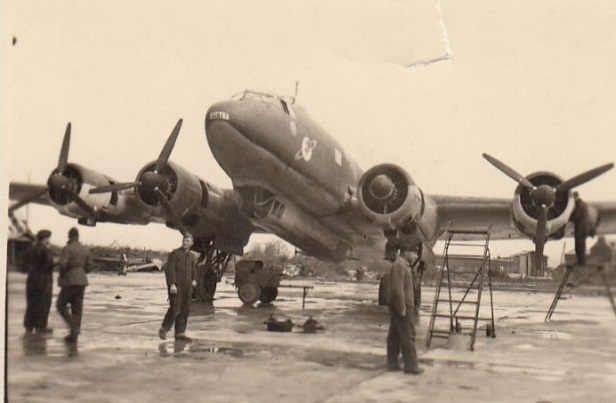
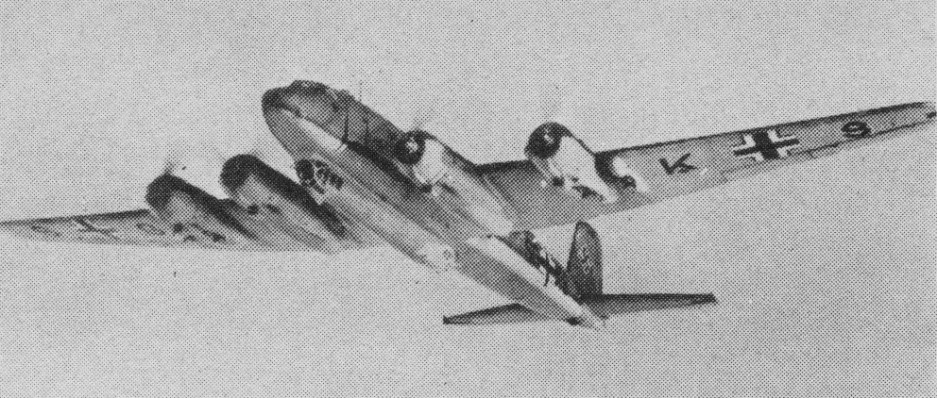
The Fw 200 Condor flew on 3 July 1937 in the form of the first prototype for a 26-passenger long-range airliner.
In 1938 the Fw200 first flew across the north Atlantic to New York, and to Tokyo later that year, but World War II prevented the establishment of proper schedules.
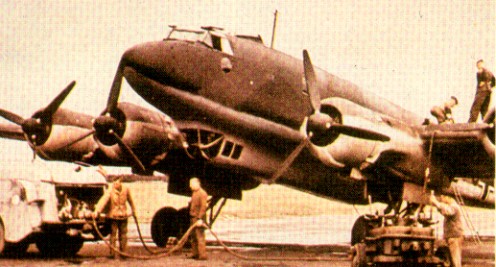
In 1938 the type confirmed its potential by capturing several world records, and about 10 airlin¬ers had been delivered to Brazilian, Det Danske Luftfartselskab Danish and German airlines before the outbreak of the Second World War. A few VIP transports had also been delivered. The B version powered by four 648kW BMW 132H engines. With the outbreak of World War II, Luft-Hansa’s Condors were impressed into the Luftwaffe as transports, while a small number being built for the Japanese Army (including a maritime reconnaissance conversion) were also taken over.
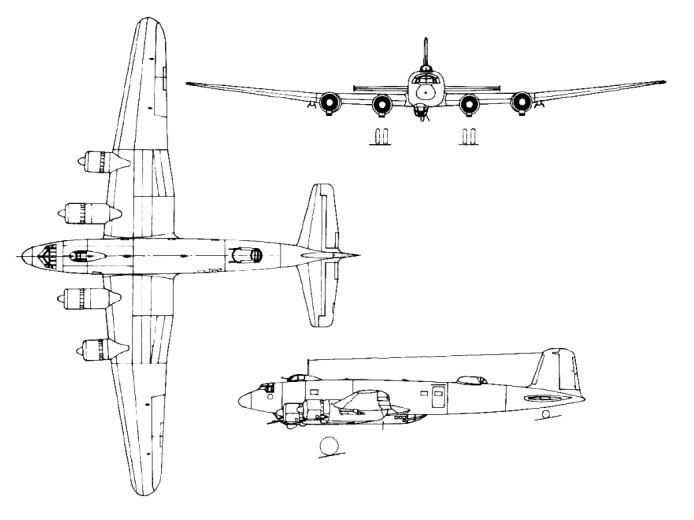
Thereafter, development was concentrated on the Fw 200C maritime version, starting with a small number of pre-production aircraft of basically commercial type. In this role the Condor’s long range was decisive, but there were constant problems with the integrity of the military version’s fuselage, which had a tendency to break in heavy landings. The Fw 200C-1 introduced the long bomb-bay gondola beneath the fuselage, slightly offset to starboard. This contained a bomb aimer’s position at the forward end and gun positions at both the forward and aft ends. The guns were placed on hemispherical mountings with restricted movement. Total defensive armament comprised, according to sub-variant, one 7.9mm machine-gun, 15mm or 20mm cannon in a power-operated turret above the pilot’s cabin, one 13mm machine-gun in an aft dorsal position, two-four 7.92mm machine-guns for lateral fire, one 20mm cannon in the nose of the gondola and one 7.92mm or 13mm machine-gun or 20mm cannon in the tail of the gondola. Power was provided by four BMW 132H-1 engines in the Fw 200C-1 and C-2 versions and 700kW Bramo Fafnir 323R-2s in the C-3 and later aircraft. Operated in small numbers against allied shipping during 1940, as well as for maritime reconnaissance and mine-laying duties, and from 1941 until the summer of 1944 it was used extensively against convoys and for U-boat cooperation. However, as early as 1943 purpose-designed maritime reconnaissance aircraft began replacing the Condor, whose activities had been curtailed by the introduction of Allied CAM merchant ships carrying expendable Hurricane fighters, long-range Beaufighters and Liberators.
On Saturday 26 October 1940, a Focke-Wulf Fw-200 Condor took off under the command of 1st Lt. Burkhardt, second pilot, NCO Dörschel, flight mechanic; NCO Iwang; 1st radio operator; Airman 2nd Class Mix, 2nd radio operator; Dr Habich, meteorologist, on an armed reconnaissance and weather scouting mission over northwest Ireland. During this flight a large vessel with 3 smokestacks was sighted west of Ireland. Despite powerful anti-aircraft activity which inflicted serious hits on the attacking aircraft after its first assault, the German plane inflicted 2 severe hits on the ship in a total of 4 daring low-level attacks. As the plane was flying away, the ship showed a slight list and was burning along the whole length. Mission ‘weather reconnaissance’ was carried out at the conclusion of this success. The assaulted ship burned for 24 hours and the following day its wreck was sunk by a U-boat. The vessel was the passenger steamer ‘Empress of Britain’, which at 42,000 tons was the tenth largest ship in the international merchant fleet and did service as a troop transport vessel.
Some Condors were equipped to carry the Hs 293 anti-shipping missile under the outer engines. Otherwise they carried up to 2100kg of bombs.
Total production was 276 aircraft. Principal versions – Fw 200A (pre-production airliner), Fw 200B (production airliner with 850- hp/634-kW BMW 132 radials), Fw 200C-0 (pre-production military model), Fw 200C-1 (production type with 3,757-lb/1,750-kg bombload), Fw 200C-2 (improved C-1 with revised nacelles and underwing bomb racks), Fw 200C-3 (first major version with BMW Bramo 323 Fafnir radials and different armament in several subvariants), Fw 200C-4 (definitive production model with search radar), Fw 200C-6 (model with two Henschel Hs 293 anti-ship missiles), and Fw 200C-8 (revised missile-carrier).
Interest by the Japanese Army in the bomber version of the Fw-200 followed a visit to Japan in 1938. The Fw-200K Kurier version was originally intended for Japan and the allied code ‘Trudy’ was allocated. No deliveries were made.
Focke Wulf FW 200 A Condor Engines: 4 x BMW 132 G, 710 hp Length: 78.248 ft / 23.85 m Height: 19.685 ft / 6.0 m Wingspan: 107.743 ft /32.84 m Wing area: 1270.152 sqft / 118.0 sq.m Max take off weight: 37485.0 lb / 17000.0 kg Weight empty: 24089.6 lb / 10925.0 kg Max. speed: 202 kts / 375 km/h Landing speed: 58 kts / 107 km/h Cruising speed: 181 kts / 335 km/h Initial climb rate: 1377.95 ft/min / 7.00 m/s Service ceiling: 24606 ft / 7500 m Wing load: 29.52 lb/sq.ft / 144.00 kg/sq.m Range: 956 nm / 1770 km Crew: 4 + 26
Fw 200C-3/U4 Engines: 4 x Bramo 323R, 895kw Max take-off weight: 24520 kg / 54058 lb Empty weight: 17005 kg / 37490 lb Wingspan: 32.85 m / 107 ft 9 in Length: 23.45 m / 76 ft 11 in Height: 3.3 m / 10 ft 10 in Wing area: 119.85 sq.m / 1290.05 sq ft Max. speed: 360 km/h / 224 mph Cruise speed: 335 km/h / 208 mph Ceiling: 6000 m / 19700 ft Range: 3560 km / 2212 miles Armament: 4 x 13mm machine-guns, 1 x 20mm cannon, 4 x 250kg bombs
Fw 200C-8 Condor Engines: 4 x 1,200-hp (895-kW) BMW Bramo 323R-2 Fafnir Maximum speed 224 mph (360 kph) at 15,750 ft (4,800 m) Service ceiling 19,030 ft (5,800 m) Range 2,175 miles (3,500 km) Emptyweight 29,367 lb (12,950 kg) Maximum take-off wieght 50,044 lb (22,700 kg) Wing span 109 ft 1 in (33.25 m) Length 78 ft 3 in (23.85 m) Height 20 ft 4 in (6.20 m) Wing area 1,270.2 sq ft (118.00 sq.m). Armament: one 20-mm cannon, four 13.1-mm (0.52-in) machine guns, and one 7.92-mm (0.312-in) machine gun in nose, dorsal, beam and ventral positions, and two HS 293A missiles.
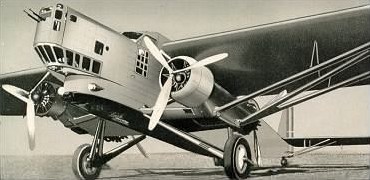
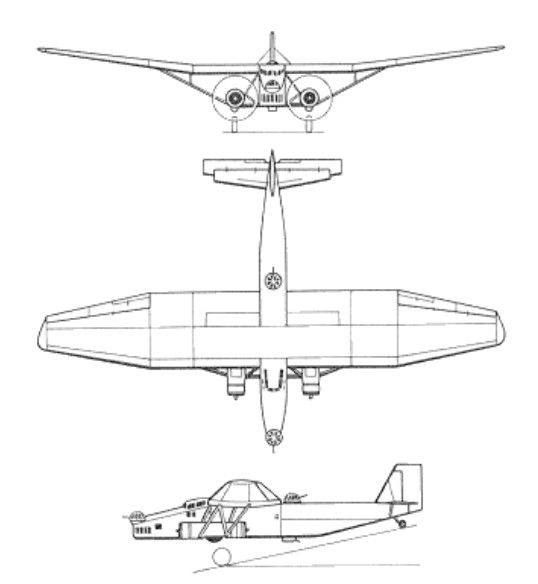
In May 1929, the Service Technique Aeronautique issued a requirement for a BN5 aircraft (Bombarde-ment de Nuit, 5 seat) to replace the ageing LeO 20 series then in service with the Avia¬tion Militaire. The result was the prototype Farman 220 01, which flew for the first time on May 26, 1932. It was powered by four Hispano Suiza 12 Lbr, V type engines, mounted in tandem pairs in nacelles beneath the wings, each driving one tractor and one pusher three blade propeller. This prototype later flew for many years as F ANLG Centaure with Air France on air mail services to South America.
In the sum¬mer of 1933, a second bomber prototype, the F221 01, was flown with 800 hp / 596kW Gnome-Rhone 14Kbrs radial engines, armed with three manually operated gun turrets in nose, dorsal and ventral positions, and a more extensively glazed nose permitting a better field of view for the pilots. The number of crew members in the F221 was increased to seven. Ten examples of the F221 Bn5-series bombers (some later converted into F.222) were built at Billancourt from 1934. On June 16 of that year, the prototype set up a new international payload to height record by lifting 5000 kg (11025 lb) to an altitude of 7000 m (22 970 ft). The first five production F221s were delivered to the 15e Escadre de Bombardement of the Armee de l’Air (as the Aviation Militaire had by then been retitled) in April 1936.
F.222
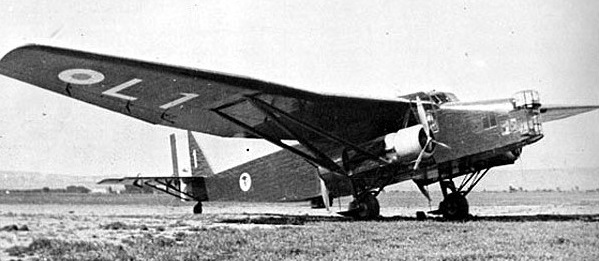
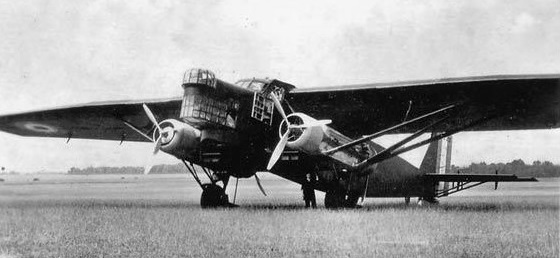
The F.221 were followed by 11 F.222 with retractable undercarriage, designated F222/1; seven were delivered in April 1937 to GB I/15, and the other four to the 4e Eseadre at Tong, French Indo China. The final bomber version was the F.222/2, 24 of which were built during 1937-38 with a lengthened and redesigned front fuselage sections and dihedral on the outer wing sections, and the step beneath the bomb-¬aimer’s position removed. The last 16 machines had 685.6kW engines. The first eight (with Gnome Rhone 14 Kirs engines) were manufactured by Farman factories and the other 16 by the SNCA du Centre. These latter aircraft had 860 hp Gnome Rhone 14N 11/15 powerplants, and the first official trials began in November 1937. The aircraft were of all metal construction, with a rectangular¬ section fuselage. A manually operated turret, fitted with a single 7.5 mm (0.29 in) MAC 1934 machine gun, was positioned in the extreme nose, and single guns of the same calibre were installed in the manually operated dorsal turret and in a ventral housing. The bomb bay, in the undersides of the wings, comprised four compartments for up to 4200 kg (9260 lb) of bombs of varying sizes.
F222 Bomber
Escadre GB 11/15 operated F.221 from November 1936, then F.222 from April 1937. These were the largest bombers to serve in France between the world wars. After the outbreak of World War II the bombers flew leaflet raids over Germany, but night bombing raids during May and June 1940 led to three losses. About two dozen Farman 221s and 222s remained in service in September 1939. Dur¬ing the early stages of the Second World War, they flew on antisubmarine and ship¬ping patrols along the West African coast. Night sorties were made to Germany and Czechoslovakia in late 1939, but mainly on reconnaissance or leaflet dropping missions. Two were allocated to the Aeronavale for maritime reconnaissance in November 1939, and were subsequently transferred with their unit to Casablanca in January 1940. Fitted with two 1000 litre (220 Imperial gallons) auxiliary fuel tanks occupying half of the bomb bay, they were used for Atlantic patrol duties. On May 14, 1940, Groupement 15 utilized F 222s on night bombing raids over the Rhine, Wurtternburg and Bavaria; this unit moved to North Africa a month later.
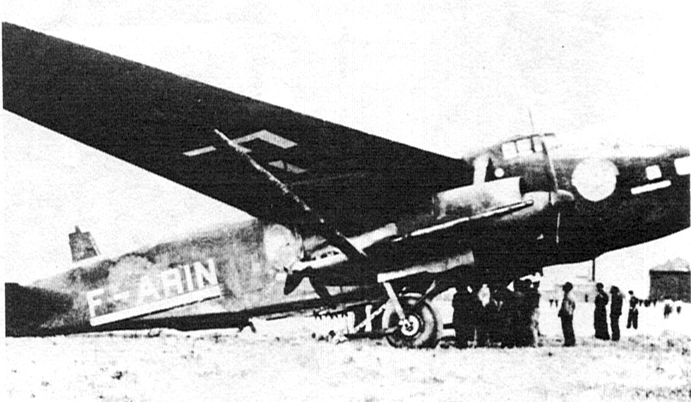
The French navy came up with the idea to attack Berlin during the French campaign. At 3.00pm on 7 June 1940, one of France’s three Farman F.223.4 long-range naval reconnaissance aircraft, F-ARIN, the ‘Jules Verne’, was cleared for take-off at Bordeaux-Merignac airfield. The four-engined high-wing monoplane, painted dull black, had already logged several missions. At 3.30pm the Jules Verne rolled u for take-off carrying a bombload of 2000 kg. this was the first bomb assault of the war made on the German capital. The crew commander was Captain de Corvette Dailliere, a former professor of aerial navigation at the Ecole de Guerre. With him flew Paul Comet, an ex-chief navigator of the Air France airline. “t once we set a northern heading for the English Channel. I flew the plane visually; the weather was clear and I was completely familiar with the first route via Pas de Calais and Holland. We did not meet with a single aircraft; we came under heavy anti-aircraft fire only over Sylt. By sunset we were flying over Denmark, some time later the Baltic Sea lay beneath us. When Stettin appeared on our right, we took a southern heading, flew at high altitude over the Meckleburg lake district, and reached the northern outskirts of Berlin at exactly the appointed time. I got ready to release the bombs and realised that someone had failed to install our bombsight, so I pressed my nose to the glass of the cockpit. Visibility was good, but I could not identify any of the numerous lakes around Berlin and the city lay in complete darkness. Suddenly, as if on command, countless searchlights lit up the night and all calibre of flak opened fire. We circled over he city centre for a while, throttled the engines, let them run again full blast, then repeated the process. We wanted to create the impression that a whole formation was over Berlin. Then we turned off toward a northern suburb and dropped our payload there on one of the numerous factories. The attack certainly did not cause any great destruction, but after all we were more concerned with the psychological effect.”
Farman F.223.4 Jules Verne
The Jules Verne then set course for Leipzig, crossed all of Germany unmolested by either fighters or flak, and landed at Paris-Orly at around 5.00am, after a 13.5 hr flight of almost 3000 miles. Next day the French Admiralty announced “On the night of June 7-8, a formation of French long-range bombers bombed an industrial quarter in north Berlin as retaliation for the German air attack on Paris. All our aircraft came back”.
F222 Bomber
The Vichy authorities disbanded most Groupes de Bornbardement after the French armistice in 1940, but F221s and 222s formed part of a transport and communications unit which was based in Morocco in late 1942. Although Allied attacks destroyed many aircraft, operations continued in the Mediterra¬nean and North Africa and the type was still in use as late as January 1944, but by September of that year the few survivors had been withdrawn from service and scrapped.
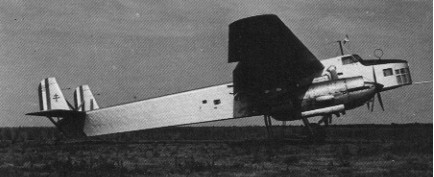
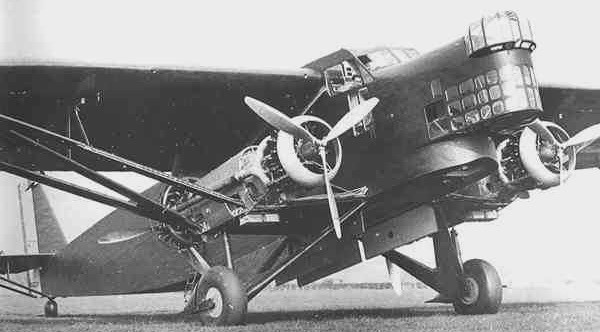
The improved F.223 had a more streamlined fuselage, slimmer wings, simplified strutting and twin fins and rudders. Originally fitted with radial engines, eight were re-engined during 1939-40 with 820kW Hispano-Suiza water-cooled 12Y50/51. After June 1940 a number of F.222 and F.223 bombers were used as military transports.
F.223
Civil passenger/mailplane versions of the F.220 family included Le Centaure, the converted F.220.01, four F.2200 and a single F.2220 – all with in-line engines and intended for the South Atlantic service. Six radial-engined F.224, with new deep fuselages for 40 passengers, were rejected by Air France and subsequently went to the Armee de l’Air. The F.2231 and F.2232 were civil equivalents of the F.223 bomber; the F.2231 made a spectacular flight to South America in November 1937 piloted by Paul Codos.
Three F.2234 built during 1938-39 had the thin tapering wings of the F.223 and F.2231/2, but featured a new streamlined fuselage with a pointed nose section. All were requisitioned by the French Navy in September 1939. One (“Jules Verne”) made the first Allied air raid on Berlin in June 1940. After the French collapse in June 1940 these three machines were returned to Air France. “Le Verrier” was shot down in the Mediterranean on 27 November 1940.
F.221 Engine: 4 x G+R 14 Kbrs, 715kW Max take-Off Weight: 15200-18700 kg / 33510 – 41227 lb Empty Weight: 10488 kg / 23122 lb Wingspan: 36.2 m / 118 ft 9 in Length: 21.5 m / 70 ft 6 in Height: 5.2 m / 17 ft 1 in Wing Area: 188.0 sq.m / 2023.61 sq ft Max. Speed: 320 km/h / 199 mph Cruise Speed: 280 km/h / 174 mph Ceiling: 8000 m / 26250 ft Range W/Max.Fuel: 1995 km / 1240 miles Armament: 3 x 7.5mm machine-guns, 4200kg of bombs Crew: 5-6
F 222/2 Span: 36 m (118 ft 1.25 in) Length: 21.45 m (70 ft 4.5 in) Gross weight. 18 700 kg (41230 lb) Maximum speed. 325 km/h (202 mph)
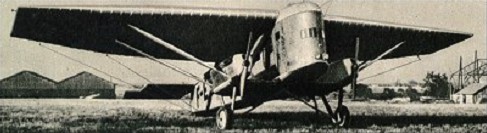
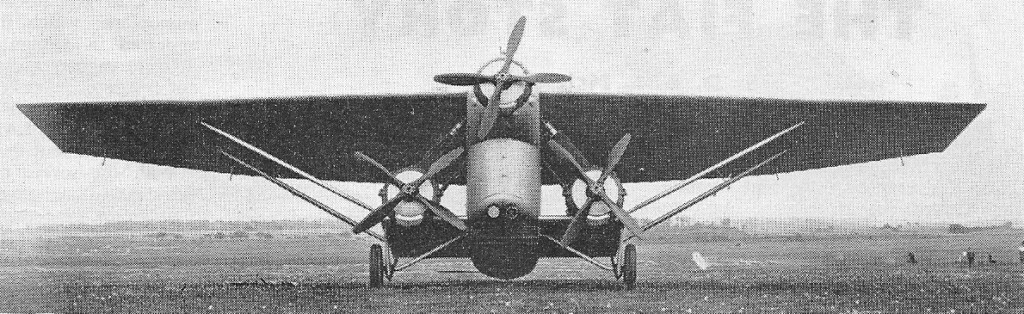
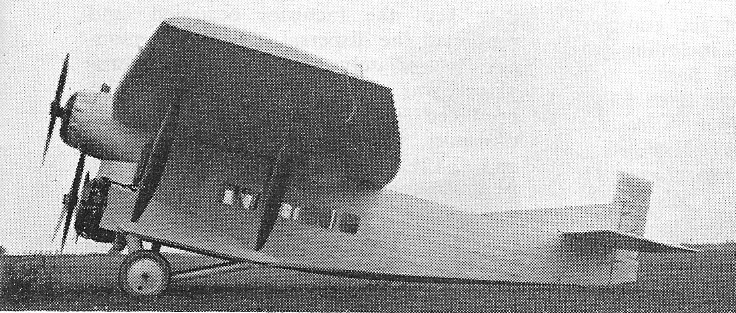
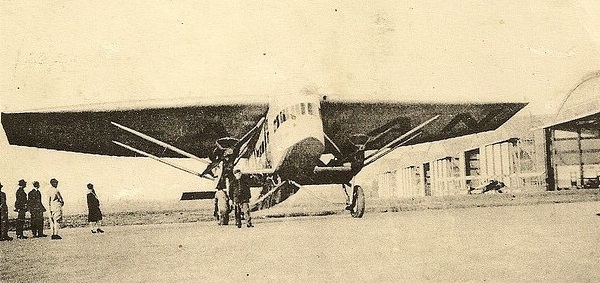
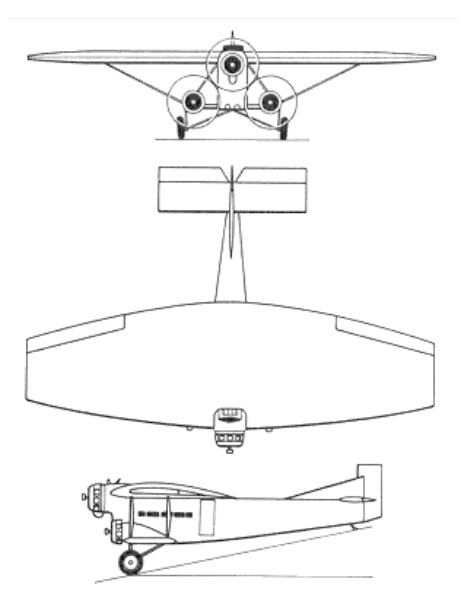
The nine-passenger F.121 was originally known as the F.3X and was a high-mounted wing, deep slab-sided fuselage aircraft powered by four 134kW Hispano-Suiza 8Ac engines in tandem pairs. The F.121 won the 1923 French Grand Prix des Avions Transports and 500,000 francs. At least three different radiator arrangements were tried in attempts to cure the Jabiru’s chronic cooling problems.
Four flew on the Farman airline’s Paris-Brussels-Amsterdam route from 1926 and Danish Air Lines used a few between Amsterdam and Copenhagen. Four even uglier F.4X six-passenger aircraft followed, each with three uncowled 223.5kW Salmson Az.9 engines, two engines mounted above the landing gear on the lower stub wings and one in the upper fuselage nose. These served with Compagnie Internationale de Navigation Aerienne (formerly CFRNA) along with the more attractive Caudron 81 and Potez 32.
Farman F.3X Jabiru
Farman F.3X Jabiru
Passengers sat in wicker chairs angled towards the centre, and had a view from the continuous row of windows around the cabin.
Military Jabirus also appeared as prototype heavy bombers and escort fighters with stepped noses, each carrying twin Lewis guns on a Scarff ring in a nose cockpit and light bombs in a fuselage bay. Heavier bombs or, a torpedo could be carried under the fuselage.
Farman Jabiru 3X
Engine: 4 x HS 8AC, 132kW Max take-off weight: 5000 kg / 11023 lb Empty weight: 3000 kg / 6614 lb Wingspan: 19.0 m / 62 ft 4 in Length: 13.7 m / 44 ft 11 in Wing area: 80.0 sq.m / 861.11 sq ft Max. speed: 180 km/h / 112 mph Ceiling: 4000 m / 13100 ft Range w/max.fuel: 600 km / 373 miles Crew: 1-2 Passengers: 9
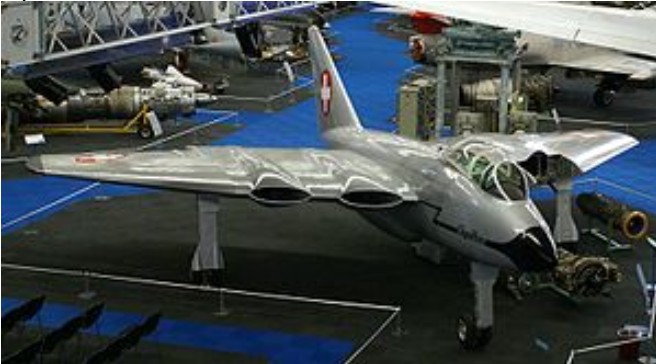
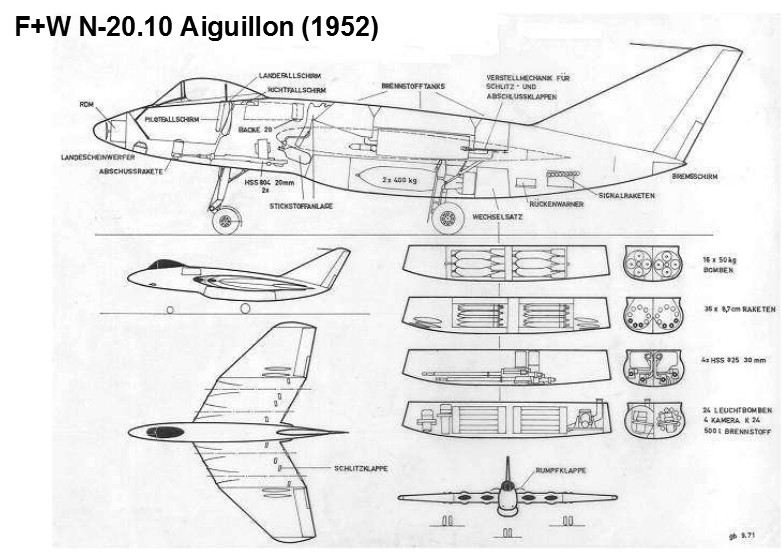
The EFW N-20 “Aiguillon” (English: Stinger) was Switzerland’s first jet fighter aircraft. The Swiss Federal Aircraft Factory developed a design for a four-engined swept winged fighter following the end of the Second World War. The aircraft was to be powered by four turbofan engines buried in the wings, with the bypass air feeding cold-air pipes each side of the engine, being routed through a combustion chamber where additional fuel could be burned as a form of reheat, or deflected though large slots on the upper and lower wings to act as aerodynamic flaps or thrust reversers. Two engines could be shut down in flight to increase range. It was planned that the N-20 would carry its armament in a detachable weapons bay, capable of carrying large loads of cannons, rockets or bombs.
It was initially planned that the aircraft’s engines would be designed and built by the Swiss company Sulzer, but they abandoned this project in 1947, so the British Armstrong Siddeley Mamba turboprop was chosen as the basis for the N-20’s engines, with the propeller reduction gear replaced by a low pressure compressor.
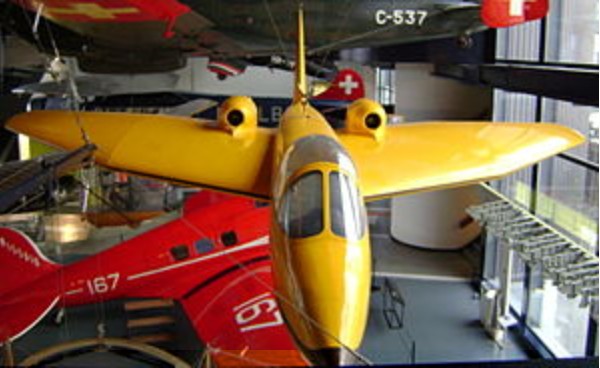
A 3/5 scale wooden glider, the EFW N-20.01 was built to allow testing of novel wing shape, this flying on 17 April 1948. Although the glider was destroyed in a landing accident, it had successfully proven the design, and was followed by a similar sized powered test aircraft, the EFW N-20.02 Arbalète (Crossbow), powered by four 0.98 kN (220 lbf) Turboméca Piméné, mounted above and below the wings, this flying on 16 November 1951. It proved to have good manoeuvrability and reached a maximum speed of 750 km/h (466 mph).
The full scaled aircraft was estimated to have a maximum speed of 1,095 km (680 mph), but the initial converted Mamba, the SM-1, which was test-flown under a de Havilland Mosquito in 1948 and was the first turbofan to fly, did not generate adequate thrust. Considerable further work was required for the definitive two-shaft SM-5 engine, which was meant to generate 14.7 kN (3,300 lbf) thrust. The prototype was completed in 1952 and, fitted with four SM-1 engines, flew briefly during a taxi test on 8 April 1952, but the development of the engine and the N-20 aircraft was cancelled soon afterwards.
N-20 Powerplant: 4 × Armstrong Siddeley Mamba turbofan, 6.2 kN (1,400 lbf) thrust each Length: 12 m (41 ft) Wingspan: 12.60 m (41 ft 4 in) Height: 4 m (12 ft) Wing area: 53 m2 (570 sq ft) Gross weight: 8,709 kg (19,200 lb) Crew: 1
F+W N-20-2 Arbalète Engines: 4 x Turbomèca Piméné jet, 100 kp thrust Length: 7.53 m Span: 7.56 m Height: 2.30 m Wing area: 12.63 m² Empty weight: 1540 Kg MAUW: 1800 Kg Useful load: 190 Kg Max. speed: 720 km/h ROC: 5m / s Ceiling: 8000 m Range: 250 Km
F+W N-20.10 Aiguillon Engines: 4 x Swiss Mamba SM-01 turbofan with plenum chamber burners and thrust reversers, Thrust: 620 kp Length: 12.5 m / 41 ft 0 in Wingspan: 12.6 m / 41 ft 4 in Height: 3.13 m / 10 ft 3 in Wing area: 54.0 sq.m / 581.25 sq ft Max. speed: 1000 km/h / 621 mph T/O weight: 9000 kg Max. speed: 1000 km/h Ceiling: 14000 m
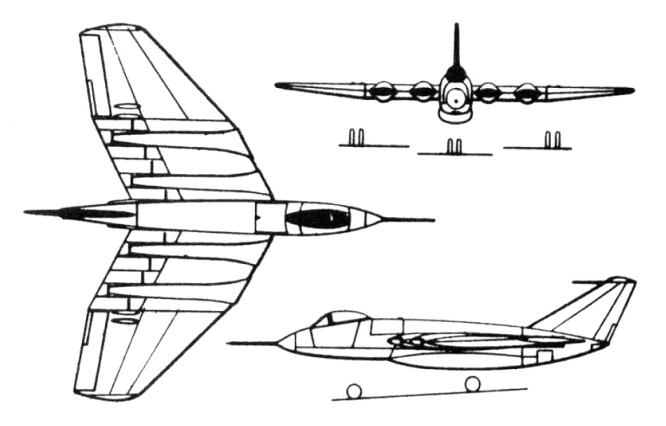
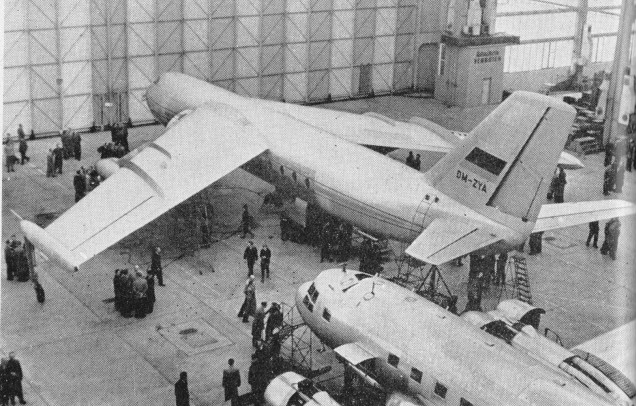
The political ambition of the East German politburo and the cancellation of the Alekseyev 150 Soviet bomber project led to the return to East Germany in 1953 of a group of German engineers and scientists deported to Russia in 1945. They were sponsored to proceed with one of the many commercial designs that they had formulated while in Russia.
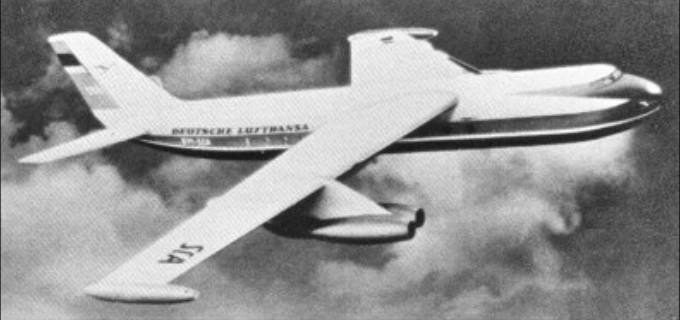
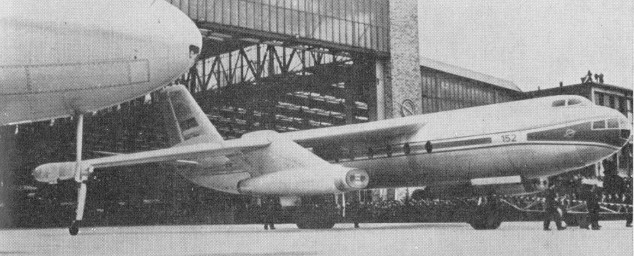
One of these was the 72 seat 152 airliner, which was based on their experience with the Alekseyev 150 and would be powered by a development of the Junkers Jumo turbojet engine named Pirna 014. The design team was led by Brunolf Baade, a former Junkers designer, and the 152 descended from a bomber design started by Junkers during WW2.
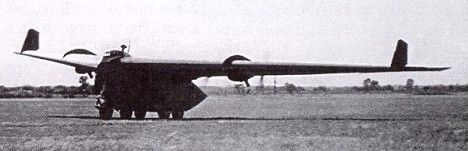
The prototype had a glazed nose and an unusual undercarriage arrangement featuring a single central gear assisted by wingtip pod-mounted outriggers, and was completed in May 1958. Late availability of the Pirna engines meant the prototype first flew with Tumansky Rd-9b engines. On its second flight, while rehearsing for the Leipzig trade fair, the prototype 152 crashed due to pressure equalization problems between the multifarious tanks and the inadequate engines. The second heavily modified (152A) model (with modified tanks, conventional undercarriage and a glazed nose) flew twice more before the project was cancelled in 1961 due to national economic crises which were exacerbated by the defection of key design team members.
VEB 152 Engines: 4 x 3165kg VDL Pirna 014A-1 turbojets Max take-off weight: 46500 kg / 102515 lb Wingspan: 25.40 m / 83 ft 4 in Length: 31.30 m / 103 ft 8 in Height: 9.70 m / 32 ft 10 in Max. speed: 920 km/h / 572 mph Range: 2500 km / 1553 miles Crew: 4-5 Passengers: 58
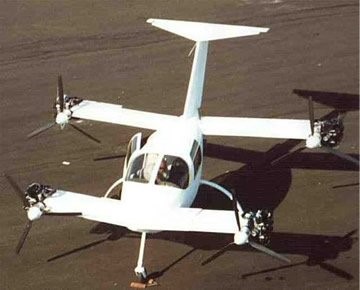
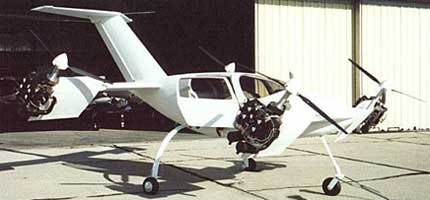
In the late 1990s Duncan Aviation of Michigan developed its Xantus V/STOL design N44CX, named after a species of hummingbird and designed by Terry Duncan, a lead engineer for Williams International.
It featured four 80 hp Hirth F30 engines placed at wingtips fore and aft of the fuselage, and was unveiled to the public for the first time at AirVenture ’99.
The company predicted that the four-passenger tilt-prop aircraft would take off and land vertically, and cruise at 290 mph with a range of up to 800 nm.
After receiving an airworthiness certificate from the FAA on July 7, 1999, the aircraft made its first tentative hovering flight on July 11. Its current disposition is unknown.

 All Aero