Vought-Sikorsky VS-44A / JRS-1

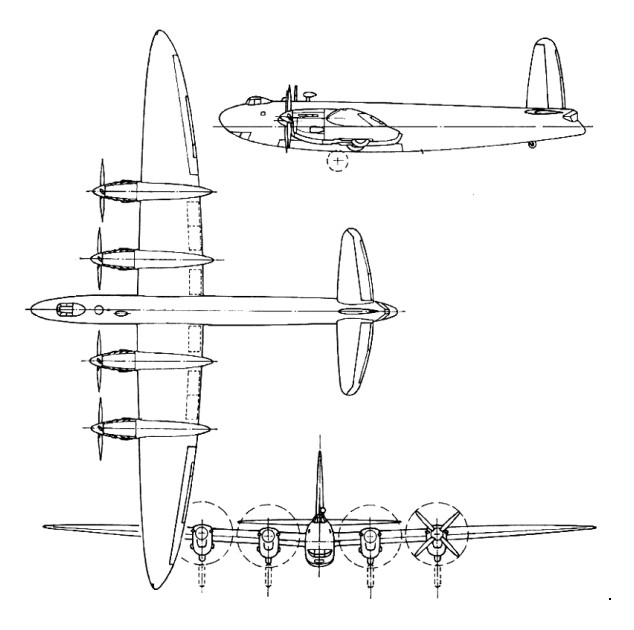
After a two year construction period the XPBS-1 prototype first flew on 13 August 1937. Initial testing with 1050 hp engines revealed a top speed of 227 mph. Stability problems traced to turbulence generated by the wings resulted in the addition of dihedral to the horizontal stabilisers. After being delivered to the Navy in October 1937, the XPBS-1 began competitive trials with the Consolidated XPBY2-1 in mid-1938. Consolidated won a construction order and the XPBS-1 was assigned to Patrol Wing 5 at NAS Norfolk, Virginia, to evaluate long-range patrol-bomber operations until shortly after the US entered World War II. In the spring of 1942 the aircraft was reassigned to VR-2 out of California for transport duties between the West Coast and Hawaiian Islands. On 30 June 1942, while returning from Pearl Harbor, the XPBS-1 struck a log in San Francisco Bay and sank. All on board escaped safely, the passengers including Admiral Chester W. Nimitz, Commander of the Pacific Fleet.

In December 1939, American Export Airlines approached Sikorsky (then operating as Vought-Sikorsky Divistion) with the proposition of creating a commercial variant of the S-44, with the option of acquiring three aircraft as VS-44As.

The VS-44A was a commercial version of the experimental XPBS-1 patrol-bomber flying-boat, which had been built for the US Navy and flown in 1937. Accommodating 40 passengers over short ranges or 16 with sleeping bunks, it was developed by Michael Gluhareff for American Export Airlines. Power was provided by four 894kW Pratt & Whitney Twin Wasp engines.

With war clouds gathering, on July 15, 1940, the new Civil Aeronautics Board granted AEA a certificate to operate between New York and Lisbon, despite protest of Pan American. AEA promptly exercised its December 1939 option on three all metal VS 44A flying boats, powered by four 1,200hp (895kW) Pratt & Whitney Twin Wasp engines, at a total cost of US$2,100,000.

The aircraft were designed to carry 26 passengers on shorter trips, but only 16 over the North Atlantic in sleeper berths. Passengers would enjoy comfortable seats convertible for sleeping, modern lighting and heating systems, and even a galley where stewardesses could prepare freshly cooked meals. It possessed a 3100 mile range, fully loaded, that would allow it to fly the Atlantic non-stop.

The three VS-44 Excalibur passenger flying boats for American Export Airlines were completed as XJR2S-1 for the Navy, but flown by AEA under contract. Civil registrations NC41880-41882 (ATC 752) were allocated, as well as USN s/ns 12390-12392. 04396-04398 were cancelled and possibly refer to the same aircraft. The designation JR2S-2 was used as an alternative.
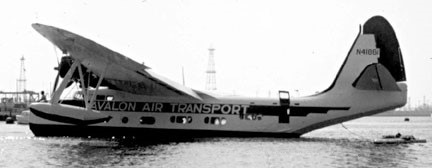
Vought-Sikorsky VS-44A NC41881

Vought Sikorsky completed the first of the ‘Flying Aces’, named Excalibur, in January 1942. A day later, AEAs chief pilot, Charles Blair, eased the flying boat down the ramp and into the icy Housatonic River. Only taxiing tests were planned but, Blair insisted later, the huge airplane “accelerated like a startled greyhound” and lifted off without his permission. Blair brought the willful ship back down, took off again and made a low pass over the Sikorsky plant.

The Excalibur was soon joined by the Excambian and the Exeter, all named for American Export Lines steamships. As the Naval Air Transport Service had taken over the order by then (and contracted with AEA to carry military and government personnel and equipment), the VS 44As were decked out in blue camouflage, with American flags emblazoned on the port and starboard bows to fend off aggressive Allied pilots and anti aircraft gunners. To maintain them, AEA hurriedly erected a tent city at Port Washington on Long Island to house a temporary base until a hangar could be completed at New York LaGuardia. Even that would prove inadequate as the Navy’s requirements necessitated a larger fleet one that would consist mostly of Consolidated P12Y 3R Coronado flying boats, which beat out Sikorsky for a Navy contract.
Charlie Blair commanded the Excambian’s initial crossing of the Atlantic on May 27/28, 1942, on the first of two survey flights. Those flights were designed to assure safe operations between Port Washington and Foynes, a flying boat port on the River Shannon, with a fueling stop in Botwood, Newfoundland.

When the Excalibur inaugurated passenger service on June 20, 1942, with Blair again in command, the eastbound flight was uneventful. Travellers relaxed as purser Bill Scouler and Dorothy Bohanna, enjoying her role as the world’s first trans Atlantic stewardess, dished up drinks and hot entrees.

On the return flight to the new LaGuardia base two days later, the crew faced strong headwinds and fog that had socked in Newfoundland, the refueling point. Assessing their grim fuel outlook, co pilot Bob Hixson remarked at one point, “Glad this is a boat.” To stretch mileage, Blair brought the VS 44A down to skim just above the waves. When the flying boat touched down on Flushing Bay 25 hours and 40 minutes later, AEA publicists could claim the first Foynes New York nonstop flight. But only 45 minutes worth of fuel remained.

Eastbound flights were almost always easier, with nonstops of 3,000mls (4,800km) possible in 20 hours or less. On one flight, with the help of hurricane driven tailwinds, Blair crossed from New York to Foynes in a record 14hr 17min. To avoid winter headwinds on westbound crossings, crews had to detour far south of the favored Great Circle route. After mid October, the Sikorskys sometimes flew a circuitous South Atlantic track, via Bathurst, a West African port near the equator much farther from New York than Foynes, their departure point.
When they crossed the Atlantic westbound, crews often flew as low as 500ft (150m) to avoid higher altitude headwinds. “There were times when we flew so low that the windshields were spattered with salt spray,” Blair recounted in his book, Red Ball in the Sky. While low flights made for slow trips, they sometimes afforded spectacular views. Pan American Captain Mike Craig, whose father Jim succeeded Blair as chief pilot of AEA, once noted that passengers and crew members “often had memorable flights viewing such sights as seals bathing in freshwater pools atop icebergs a scant few hundred feet beneath their windows.”

AEA’s flightdeck crewmembers, all Naval reservists, dressed in civilian uniforms to avoid problems in neutral countries. Like Blair, the other eight original captains had abandoned secure jobs with domestic carriers such as Eastern and United for the challenge of flying the Atlantic in some of the world’s most exciting aircraft. They were joined by a number of co pilots who had flown Curtiss P 40 fighters in China with the American Volunteer Group.

The second VS-44A, Excambian, was delivered in May 1942, and the third, Exeter, in June. Shortly after all three became operational, they were formally impressed into the Naval service designated JR2S-1.

Excalibur was lost soon after it entered service in a setback to the new airline. A relatively inexperienced pilot, trying to take off from Newfoundland’s Bay of Exploits, forced the reluctant flying machine into the air, causing it to stall and plunge back into the bay. Eleven of the 37 on board were lost, along with AEA’s beloved flagship.

AEA’s two surviving VS 44As would make more than 400 trans Atlantic crossings before the war ended.
As early as 1942, when the first VS 44As were being delivered, the CAB had agreed with Pan Am that the Civil Aeronautics Act of 1938 prohibited shipping lines from starting or acquiring airlines. American Export’s airline division would have to be sold, although the ship line could retain a minority interest.

Determined not to let his airline be swallowed up by its arrogant competitor, John Slater, executive vice president, sounded out American Airlines executive Ralph Damon about acquiring AEA. Damon advanced the idea with AA’s wartime president, Alexander ‘Ned’ Kemp, who announced in March 1944 that AA had contracted to acquire control of AEA through a stock purchase. The deal was contingent on government approval, and would be argued along with a case to sort out which US airlines could fly trans Atlantic routes after peace was restored.
In the debate that followed, both the Board and Congress rejected Juan Trippe’s efforts to establish Pan Am as the sole US flag carrier for all international service.
On July 5, 1945, the CAB gave American permission to purchase 51.4% of AEA’s capital stock from the steamship line for $3 million.
AEA’s last flying boat service departed from Foynes on October 22, 1945, with Blair again in command. Both flying boats were sold in 1946 and flown to South America. In mid-1947 Exeter was destroyed during a night landing on the Rio de la Plata River in Uraguay operated by Skyways International, loaded with guns and ammunition intended for Paraguayan rebels, leaving only Excambian.

Blair, still restless, leased that survivor for charter work with his Associated Air Transport, while he flew for American Overseas Airlines. AAT used the VS 44A in summer 1947 to support the construction of the US base at Keflavik, Iceland, flying on one occasion to Stockholm.
After retiring from Pan Am, which ultimately acquired AOA from American in 1950, Blair created Antilles Air Boats, a Caribbean commuter service in the Virgin Islands. With business booming for his ‘Streetcar Line of the Virgin Islands’, Blair purchased Excambian in January 1968 from Catalina Air Lines (formerly Avalon Air Transport) of Long Beach, California, for $100,000 to handle the traffic between St Thomas and St Croix.
The aircraft was so severely damaged in a landing just a year later that it could not be economically repaired. It remained beached for years at St Thomas until Blair reluctantly turned it over to the National Museum of Naval Aviation at Pensacola, Florida, in 1976. However, as the Excambian was never technically a Navy aircraft, officials waffled about restoring it. It was still vegetating outdoors at the base when Blair died in September 1978 in an aircraft accident.
Maureen O’Hara, who stepped in to take command of Antilles Air Boats after Blair’s death, knew something had to be done to save the aircraft. She finally asked the Navy to turn Excambian over to the Bradley Air Museum (now the New England Air Museum) on a permanent loan basis. Sikorsky veteran Harry Hleva mobilized some 130 volunteers to restore the derelict to like new condition at the Stratford plant where it was born.
With the restoration accomplished over an estimated 200,000 man hours, Sikorsky trucked the aircraft in parts to the museum’s civil aviation hangar. Even in that cavernous building, the giant nearly touches the ceiling.

Vought-Sikorsky VS-44A NC41881 Wartime paint

JR2S
Wingspan: 124’0″
Length: 76’2″
Top speed: 227 mph

VS-44A
Engines: four 1050hp R-1830 Twin Wasp
Wingspan: 124’0″
Length: 79’3″
Useful load: 27,300 lb
Max speed: 210 mph
Cruise: 175 mph
Stall: 67 mph
Range: 4900 mi
Ceiling: 16,600′
Passenger capacity: 35

XPBS-1

Voisin Triplane / E.28

1915 version

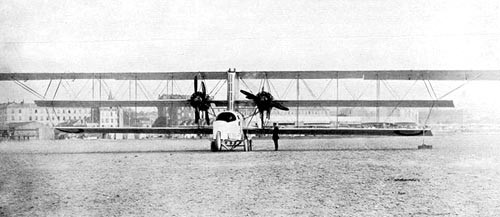
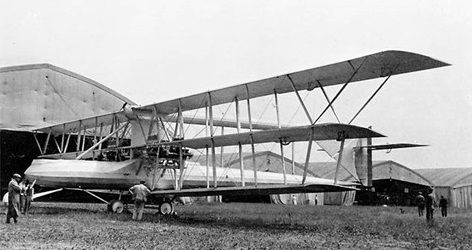
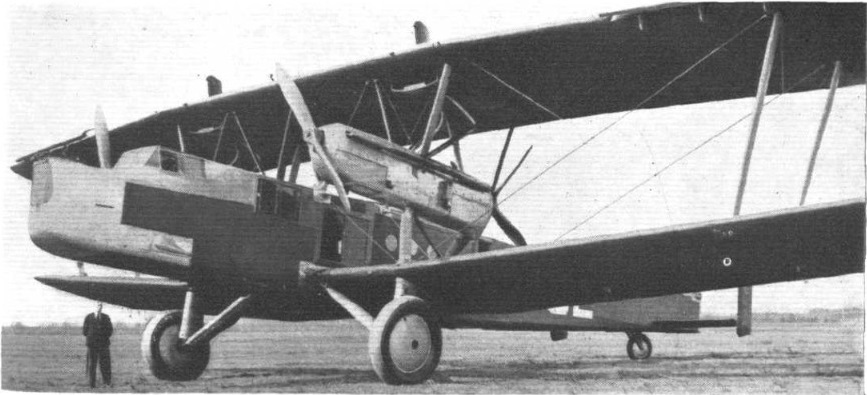
The Voisin Triplane was a large experimental bomber built by Voisin. The first model was designing and produced in 39 days, presentation in August 1915 before the French high military, and was fitted with four Salmson radial engines of 150 hp / 110 kW each. The four engines were mounted in tandem pairs in two nacelles on the centre wing. Not only did it have three wings, but also two fuselages, the upper one affording an air gunner a near 360-degree field of fire. Two gun positions were provided, one the nose and second behind the trailing edge of the wings, firing downwards through an aperture in the fuselage. The tail surfaces being supported between the fuselage and an upper boom attached to the centre section of the upper wing.

1915

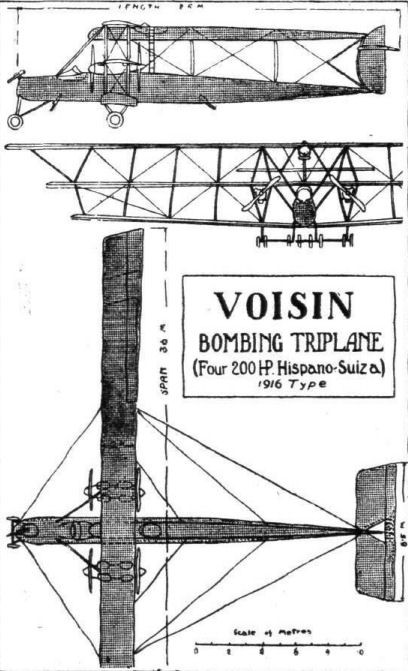
As this first machine did not come up to expectations on its trials, another machine was constructed in 1916, similar in general design, but embodying many modifications. This Triplane No.2 got the design study identification E.28. The 1916 version switched to four 200 hp (150 kW) Hispano Suiza engines, and a redesigned circular section fuselage. In both models the lower fuselage forms the main body, the upper fuselage being of much lighter construction and serving as an outrigger for the tail. The four Hispano-Suiza engines (220 h.p. each) are mounted in pairs in tandem, just below the middle plane in the 1916 model, on tubular V frames, extending from top to bottom planes. The engine mounting is additionally braced by diagonal struts from both upper and lower fuselages.

1916 version

This time construction proceeded far slower as the machine was finished in 1919 and first flown in 1920. The design obviously came too late for the war and was not ordered in production.

1916 version – E.28

1916 version
Engines: 4 × Hispano-Suiza V-8, 150 kW (200 hp)
Upper wingspan: 36 m (118 ft)
Wing area: 200 m2 (2,150 sq ft)
Chord: 6 ft. 6 in
Empty weight: 4,990 kg (11,000 lb)
Gross weight: 6,985 kg (15,400 lb)
Maximum speed: 127 km/h; 69 kn (79 mph) at 1981 metres (6500 ft)
Service ceiling: 3,505 m (11,500 ft)
Time to altitude: 27 minutes to 1981 m (6,500 ft)
Wing loading: 35 kg/m2 (7.1 lb/sq ft)
Crew: 3

Vickers R80

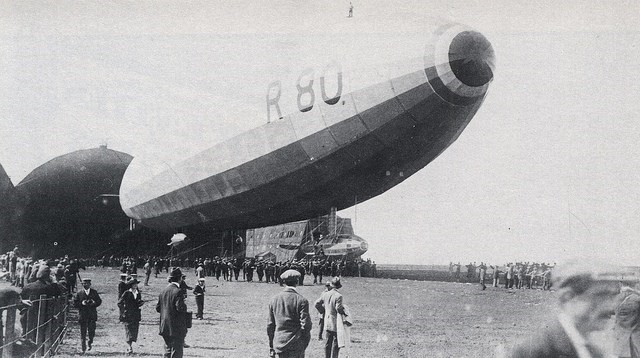
The R80 airship at Barrow in Februrary 1920

Circa 1921 was the R80; the only example of the Small R33 Class. She was the last rigid to be planned before World War One ended. Measuring 534 ft in length, 70 ft in diameter, with a volume capacity of 1,250,000 cu ft she was fitted with four 250hp Wolsey Maybachs giving a maximum speed of 65mph. R80 was designed by Barnes Wallis and built by Vickers. When at Pulham decisions were reached that she was too small to be a lot of commercial use, and was laid up there after only 73 hours flying time. She was finally broken up in 1924.

R80
Length: 534 ft
Diameter: 70 ft.
Volume capacity: 1,250,000 cu ft.
Engines: four 250hp Wolsey Maybachs.
Maximum speed: 65mph.

Vickers VC-10

VC-10

Vickers had honed the VC10 since the cancellation of the VC7/V1000 in 1955. As it became clear that BOAC would buy Boeing 707s for trans-oceanic routes, George Edwards aimed his design at their Medium-Range Empire routes to countries with undeveloped hot and high airports. Alongside this, he also had in mind the RAF’s need for a personnel/freight transport, again to ‘up-country’ destinations. Though in time the Super VC10 did come to fly the North Atlantic, its progenitor was never intended as a true long-ranger, nor was it ever a pure civilian machine. The VC10/Super VC10 needs 17 hydraulic actuators in their tailplanes. Much of its structure was famously milled from solid billets of metal.

Vickers VC-10 Article

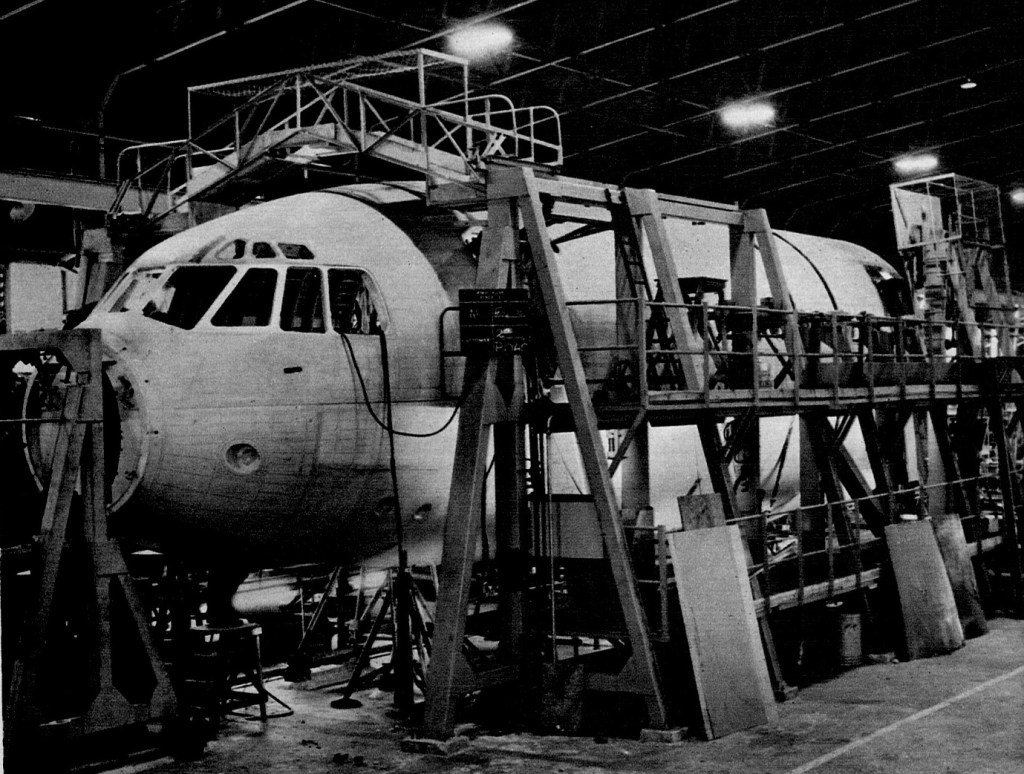
A long range civil transport featuring rear mounted engines emerged when introduced, the VC10 tailored closely to the requirements of BOAC. The prototype (G ARTA) flew for the first time on 29 June 1962, powered by four Rolls-Royce Conway turbofan engines.

Vickers VC10 Srs1100

The VC10 entered service on BOAC’s route to West Africa on 29 April 1964. Four production variants and a modification of the prototype were produced: the Model 1101, of which 12 went to BOAC accommodated 16 first-class and 93 economy passengers; the Model 1102, of which two went to Ghana Airways, one with a large hydraulically operated cargo door between the standard passenger doors and both with 4% chord leading-edge extension from wing root to fence; the Model 1103, of which three went to British United Airways with cargo door and extended leading edge; Model 1106, of which 14 went to RAF Air Support Command with cargo door, folding hatracks, machined cargo floor, extended leading edge, 97kN Conway RCo.43 Mk 301 turbofans and fin fuel tank; and the Model 1109, the prototype brought up to airline standard for Laker Airways, with the Model 1106 wing. Standard engines for the VC10 were four 90.6kN Rolls-Royce Conway RCo. 42 turbofans in lateral pairs on each side of the rear fuselage. RAF basic transport version designated VC10 C.1. C.2 is the unconfirmed designation of flight refuelling tanker conversions of five VC10 and four Super VC10.

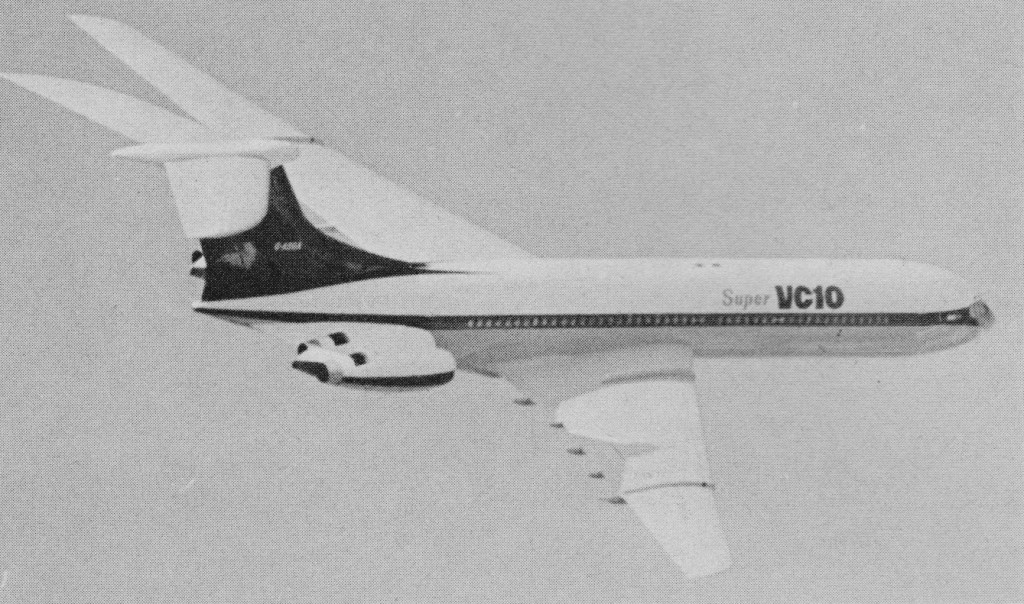
A developed version, the Super VC 10, with a longer fuselage, an improved wing leading edge and more powerful engines was able to accommodate up to 174 economy class passengers and had a maximum range of 4,720 miles (7,600 km).

Super VC-10

The stretched fuselage Super VC-10 overflew the 1964 Farnborough Air Show. Landings are made using two section flaps and deflecting leading edge slats.

Only 54 sold. Only nine of those built were for customers outside of Britain.

VC-10

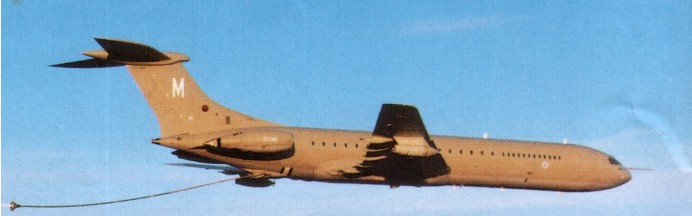
Eleven Super VC 10s, once operated by BOAC and British Airways, were pur¬chased by the RAF/Ministry of Defence in 1981 and flown into long term storage at Abingdom. In 1990 the decision to convert six of the stored airframes to three point refuelling tankers at British Aerospace’s Filton facility was announced.

Gallery

Engines: 4 x RR Conway RCo-42 turbo-jet, 93.4kN
Max take-off weight: 141521 kg / 312002 lb
Empty weight: 67094 kg / 147918 lb
Wingspan: 44.6 m / 146 ft 4 in
Length: 48.4 m / 158 ft 10 in
Height: 12.0 m / 39 ft 4 in
Wing area: 264.3 sq.m / 2844.90 sq ft
Cruise speed: 915 km/h / 569 mph
Range w/max.fuel: 8328 km / 5175 miles
Range w/max.payload: 6680 km / 4151 miles
Crew: 4-6
Passengers: 108-151

Engines: 4 x Rolls-Royce Conway RCo.42 turbofan, 20370 lb (9240 kg)
Wing span: 146 ft 2 in (44.55m)
Length: 158 ft 8 in (48.36m)
Wing area: 2,851 sq ft (264.9sq.m)
Gross weight: 314,000 lb (142,430 kg)
Max cruising speed: 568 mph (914 kph)
Typical range: 5,040 miles (8,115 km) with max payload
Crew: 3-4
Pax cap: 109

VC-10 Srs 1100
Engines: 4 x RR Conway, 21,000 lb
Wing span: 146 ft 2 in (44.55 m)
Length: 158 ft 8 in (48.36m)
Height: 39 ft 6 in (12.04 m)
Max TO wt: 312,000 lb (141,520 kg)
Max level speed: M0.86

Super VC 10
Engines 4 x 22,500 lb. (10,205 kg.) Rolls Royce Conway RCo.43 turbofan
Length 171.7 ft. (52.32 m.)
Wing span 146 ft 2 in (44.55 m.)
Height, 39 ft 6 in
Gross wing area, 2 932 sq.ft
Basic operational weight, 154 552 lb
Max. take-off, 335 000 lb
Max. landing, 267 000 lb
Max. payload (volume limited), 47,150 lb
Max. zero fuel, 215,000 lb
Total fuel, 154,700 lb
Power loading (max. take-off weight), 3.72 1b/1b
Wing loading (max. take-off weight), 114.2 lb/sq.ft
Wing loading (max. landing weight), 80.9 lb/sq.ft
Accommodation: 24 first-class at 46 in pitch and 103 coach class at 33 in pitch
Max. high density seating: 169 at 33 in pitch.
High-speed cruise, 500 kt. at 33 000 ft
Long-range cruise, 459 kt at 40 000 ft
Approach speed, 134 kt
Take-off field length, ISA at sea level, 8660 ft
Landing field length, ISA at sea level, 6830 ft
Range with allowances, max. fuel, 25,750 lb payload, 5 450 nm
Max. usable floor area, 1130 sq.ft
Max. usable cabin volume , 7600 cu.ft
Max. cabin length, 103 ft
Max. width, 137.8 in
Aisle height, 91 in.
Freight and baggage holds: 1930 cu.ft

Super VC-10

Vickers 660 Valiant

To meet the need for long range high altitude heavy bomber aircraft, capable of carrying nuclear weapons, the Avro Vulcan, along with the Handley Page Victor and Vickers Valiant, was developed in accordance with an Air Ministry specification that originated in 1947.

Vickers Valiant Article

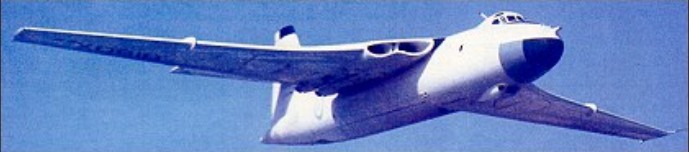
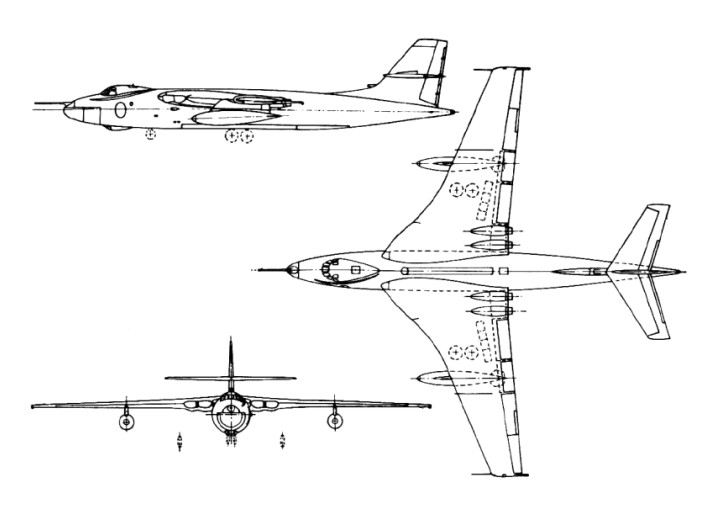
The Vickers Valiant was designed to Air Ministry specification B.9/48. It was a cantilever shoulder-wing monoplane of all-metal stressed-skin construction. The wing had compound sweepback on the leading edge, somewhat similar to that of the Handley Page Victor, air-brakes, double-slotted flaps and powered ailerons. The fuselage was a circular-section semi-monocoque structure, incorporating a pressurised cell to contain the crew of five, and a large bomb bay which later proved capable of accommodating a Blue Steel stand-off weapon. The tail unit was conventional, but the tailplane was mounted almost half-way up the fin to keep it clear of the efflux from the four turbojet engines, buried in the inner wing adjacent to the fuselage. Landing gear was of tricycle type electrically retracting tan¬dem main gears folding outwards. The Valiant was largely conventional in construction, with a giant radar in its underside, an inflight refuelling probe (added after delivery) above and a ventral blister for a visual bombing station. The main weapon bay could house all the UK’s nuclear bombs (or the Blue BoarTV guided bombs) or up to 21 HE bombs of 454 kg (1,000 lb) each. One unusual feature was the extensive use of electrical power for the actuation of practically all movable units, even powered controls. The only exception was a minor hydraulic system for brakes and powered steering, but even this had its pumps driven by electric motors.

Two prototypes were ordered initially, one to be powered by four Rolls-Royce RA.3 Avon 204 turbojets and the other by four Armstrong Siddeley Sapphires. The first prototype made its maiden flight on 18 May 1951, but was lost in an accident on 12 January 1952. The second prototype flew first on 11 April 1952, but was powered by RA.7 turbojets instead of the Sapphires as planned originally.

Vickers Valiant 2nd prototype

In spite of the fact that two types of so-called V bomber were already on order it was put into production as well, allegedly as an insurance against ‘failure’ of the others.

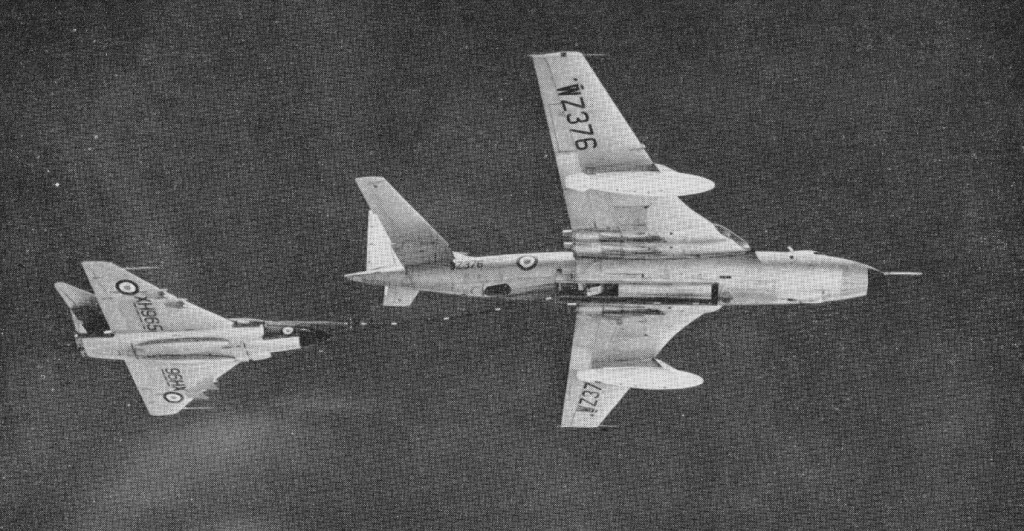
Named Valiant, B.1 began to enter service in January 1955, the first of the V-bombers to serve with the RAF. They were followed by B(PR).1 long-range strategic reconnaissance; B(PR)K.1 multi-purpose bomber, photo-reconnaissance, tanker; and BK.1 bomber/tanker aircraft. Production totalled 111 examples, including one B.2 pathfinder prototype. Used extensively in service, Valiants dropped the first British hydrogen and atomic bombs and during operations in the Suez campaign operated with high-explosive bombs.

Javelin FAW.8 refuelling from a Vickers Valiant

Vickers built 108 including prototypes, and from January 1955 these served with 10 RAF squadrons. At first painted all in anti flash white, with very pale roundels and serials, they set a high standard in navigation and bombing, though most crews wished to forget their one taste of actual warfare when in late 1956 four squadrons bombed Egyptian targets during the ill starred Suez campaign. Valiants carried out all of the UK’s live air tests of nuclear weapons. There were reconnaissance, tanker and multi role versions, and from 1963 Valiants were given regular grey and green camouflage and assigned to low level missions using conventional bombs in support of SACEUR (Supreme Allied Commander, Europe) as a NATO force, though still based in the UK. By this time they were the RAF’s only inflight refuelling tanker force.

In the Autumn of 1957 these four Valiants, with two Vulcans, flew to the US to compete with USAF teams in anannual bombinng compteition. One Valiant came 11th of the 100 aircraft competing.

Intended for fast high-altitude strategic bombing, the Valiant – in company with other V-bombers – was switched to low-level operations. There seems little doubt that the stresses imposed by such a role accelerated the wingspan metal fatigue first reported in late 1964, and which led to the scrapping of all Valiants in January 1965.

The RAF did not buy the Valiant Mk 2, first flown in 1953, which was specially designed for low level operations. With just over 100 built at Brooklands aerodrome, production ended in the autumn of 1957.

Gallery

Vickers Valiant B.Mk.1
Engines: 4 x Rolls-Royce RA.28 Avon 204/205, 10,050 lb / 44.7kN
Wingspan: 34.85 m / 114 ft 4 in
Length: 32.99 m / 108 ft 3 in
Height: 9.8 m / 32 ft 2 in
Wing area: 219.43 sq.m / 2361.92 sq ft
Max take-off weight: 63503 kg / 140001 lb
Empty weight: 34419 kg / 75881 lb
Max fuel w/underwing tanks: 9972 gal
Max speed: 492 kts / 912 km/h / 567 mph at 30,000 ft
Max cruise: 553 mph at 30,000 ft
Service Ceiling: 16460 m / 54000 ft
Range w/max.fuel: 7242 km / 4500 miles
Bombload: 9525kg / 21,000 lb or 2 x 1615 flight refuelling tanks
Crew: 5

Valiant B(K)Mk.1
Type: five seat bomber and inflight refuelling tanker
Engines: 4 x 4763 kg (10,500 lb) thrust Rolls Royce Avon 201 turbojets
Max speed 912 km/h (567 mph) at 9145 m (30,000 ft)
Service ceiling: 16460 m (54,000 ft)
Range with reduced bombload 7242 km (4,500 miles)
Wing span: 34.85 m (114 ft 4 in)
Length (normal long ECM tailcone): 33.00m(108ft 3in)
Height: 9.81 m (32 ft 2 in)
Wing area: 219.44 sq.m (2,362.0 sq ft)
Bombload: 9526 kg (21,000 lb)

Vickers Valiant

Vickers Viscount

Viscount 806

The origin of the Viscount can be traced back to the war-time Brabazon Committee, which was charged with the task of steering Britain’s aircraft industry in the right direction in the immediate post-war years. One of its recommendations was the development of a turboprop-powered short/medium-range airliner (identified originally as the Brabazon IIB), and in April 1945 Vickers were instructed to proceed with its design and development, then identified by the company as the VC2 project.

Vickers Viscount Article

Discussions between the committee, liased with B.E.A., and Vickers designers resulted in the developing of the Type 609. Construction of two prototypes began in December 1946, modified to a 32-seat capacity at the request of British European Airways, renumbered Type 630 and named Viceroy. The name was changed to Viscount in 1947. This was the first of the company’s designs to be brought to fruition under the leadership of George (later Sir George) Edwards, following the death of Rex Pierson.

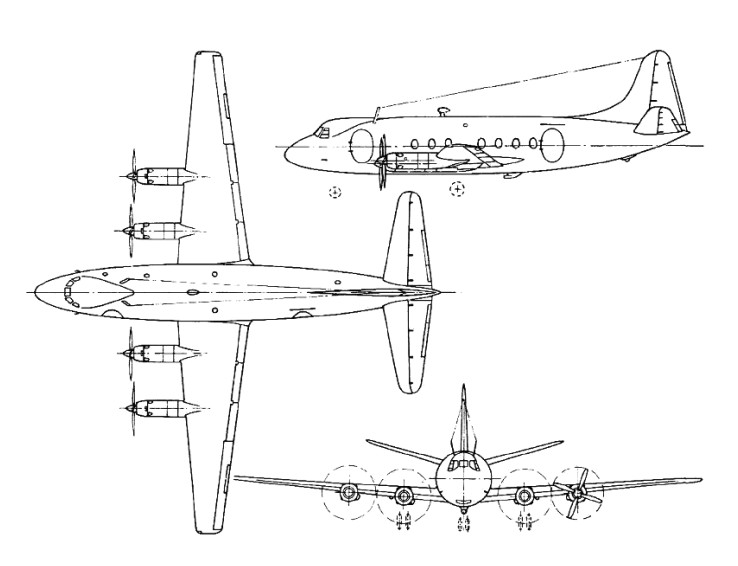
As finalised, a circular-section pressurised fuselage was chosen with low-set monoplane wings, a Vickers-style tail unit, retractable tricycle-type landing gear and four of Rolls-Royce’s new Dart turboprops.
Despite the efforts of Edwards, his design team and Vickers’ engineers, interest in the project waned when BEA had doubts about the aircraft’s economics in the autumn of 1947.

Prototype Model 630 Viscount (G-AHRF) powered by Rolls-Royce Darts engines was flown first on 16 July 1948. The second prototype (G-AHRG; VX217), completed with Rolls-Royce Tay turbojets was used as an engine test-bed. The design was considered as to small and slow, went back to the drawing board and re-emerged as the larger Type 700 with a 53-seat capacity. The new prototype (G-AMAV) flew for the first time on August 28, 1950. By this time, BEA had already bolstered Vickers’ enthusiasm by ordering 20 (later 26) Viscount 701s on 3 August.

Flying the Vickers Viscount

The Viscount prototype was loaded to British European Airways and operated the world’s first turboprop service on 29 July 1950. An order for 30 Viscounts was signed by BEA in August 1950 with BEA operating the first commercial flights on 18 April 1953.

A C.A.A. team arrived on May 16th 1954 to evaluate the Viscount. Their visit, the first step towards American certification of the Viscount, resulted from negotiations between Vickers-Armstrongs and TransCaribbean Airways, an American independent airline.

The Italian journal Alata reported in May 1954: “The Viscounts destined for the R.A.F., probably three in number – two to replace the present Royal Vikings – will be 700Ds, and will be powered by the new Dart RDa.6.”

The Viscount 700 had a fuselage 80 inches longer, albeit bringing a 7,500 lb weight increase. The proto-type had a fuel load of 1,620 gallons whereas pro¬duction Type 701s would carry 1,920 gallons. A total of 287 of the Viscount 700 Srs. were built.

The 800 series had more powerful engines and a longer fuselage seating up to 75 pas¬sengers and flew on 27 July 1956, sixty-seven being produced, followed by 84 Viscount 810 Srs. aircraft.

The prototype Viscount 802, G-AOJA, was the first production aircraft and destined for service with BEA. BEA had 24 Viscount on order.
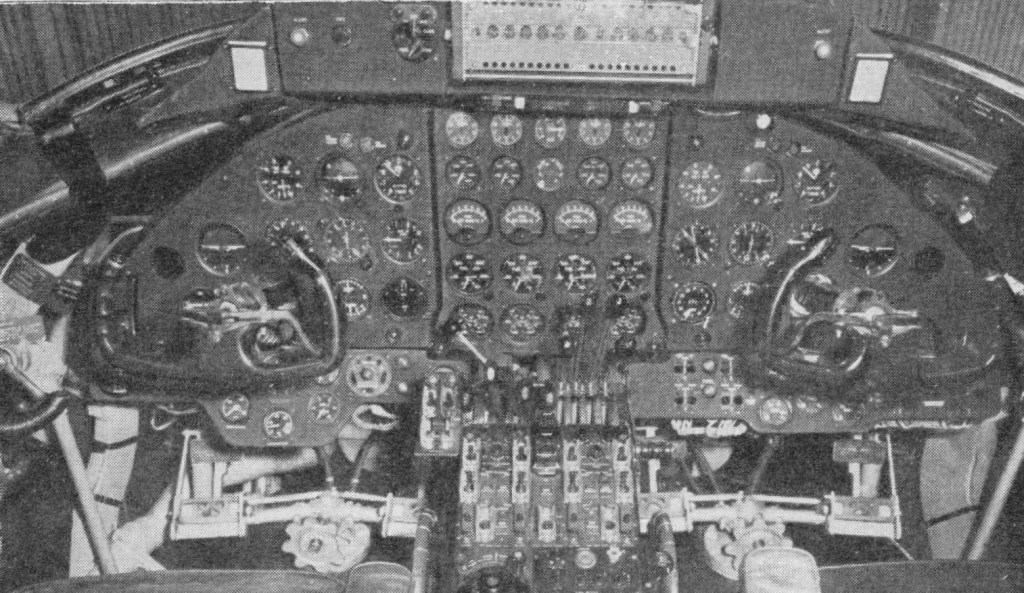
The BEA Viscount 802 featured an altered instrument panel to fit a Smiths Flight System direction indicator and beam compass and Decca Flight Log.

KLM began receiving the first of nine Viscount 803s at the end of 1957. By the middle of 1958 40 airlines had ordered the Viscount 400 had been sold so far at over £150 million.

Viscount 803

One development, flown but not continued, was a RR Tay powered version.
Between 1953 and 1959 438 were sold and orders from Capital Airlines of Washington totalled 60 aircraft.

Gallery

700
Engines: 4 x 1,530 h.p. Rolls Royce Dart 506 turboprop
Length 81.2 ft. (24.75 m)
Wing span 94 ft. (28.65 m)
Weight, loaded 56,000 lb. (2,540 kg)
Seats: 3 to 4 crew; 40 to 48 passengers
Max cruise speed: 300 mph (480 kph)
Ceiling 28,500 ft. (8,700 km) fully loaded
Range: 750 miles (1,200 km) 13,000 lb payload

Viscount 700D
Engines: 4 x RR Dart 510
Span 93 ft 8.5 in
Length 81 ft 2 in
MAUW 60,000 lb
Cruise speed 320 mph

Vickers V 800 Viscount
Engines: 4 x Rolls Royce Dart 510, 1989 shp
Length : 85 ft 7 in / 26.11 m
Height : 26.739 ft / 8.15 m
Wingspan : 93 ft 8.5 in / 28.65 m
Max. speed : 297 kts / 550 km/h
Cruise speed: 315 mph
Service ceiling : 25098 ft / 7650 m
Crew : 3+60
MAUW: 62,000 lb

807
Engines: 4 x Rolls-Royce Dart

810 Viscount
Crew: 2
Passengers: 75
Engines: 4 x Rolls-Royce Dart RDa. 7/1 Mk 525 turbo-prop, 1566kW
Max take-off weight: 32885 kg / 72499 lb
Empty weight: 18854 kg / 41566 lb
Wingspan: 28.56 m / 94 ft 8 in
Length: 26.11 m / 86 ft 8 in
Height: 8.15 m / 27 ft 9 in
Cruise speed: 563 km/h / 350 mph
Ceiling: 7620 m / 25000 ft
Range w/max.payload: 2776 km / 1725 miles

Vickers Viscount

Vickers 952 / 953 Vanguard / Merchantman

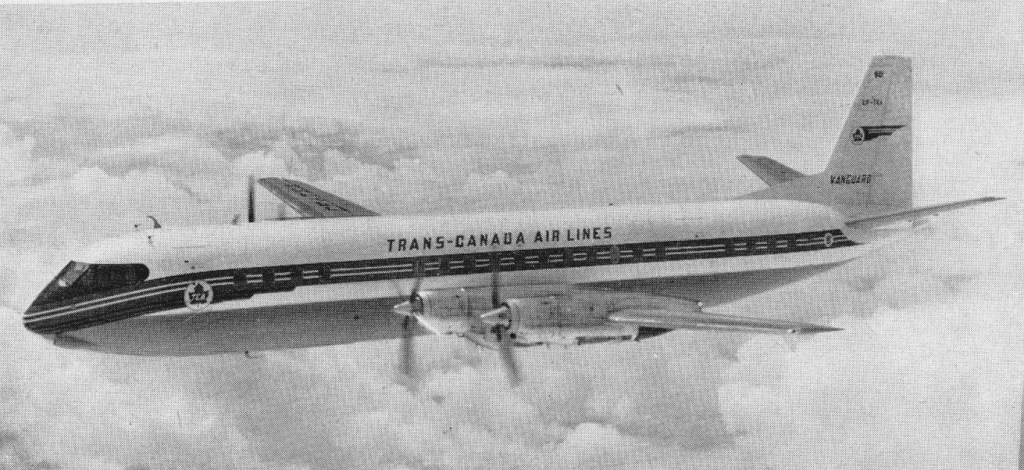
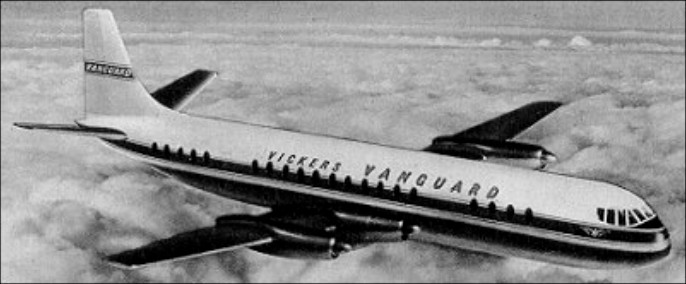
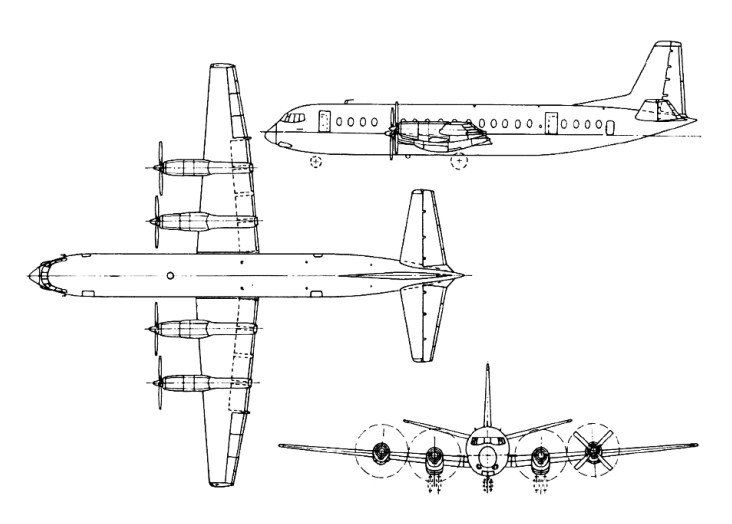
In early 1953, not long after the Viscount entered service with British European Airways (BEA), discussions began to initiate the design of a successor. Both BEA and Trans-Canada Airlines were interested in a generally similar aircraft; compromise in design to satisfy the views of these two operators resulted in the low-wing configuration and ‘double-bubble’ fuselage to provide a large underfloor cargo hold beneath the main cabin.
The power plant considered originally for inclusion in the design was the Rolls-Royce Dart. But Rolls-Royce intimated that development of a new engine, the RB.109, was then well under way and it (later known as the Tyne) was chosen to power this new transport. Construction was entirely conventional except for the wing, which introduced integrally machined skins of light alloy to provide spanwise stiffening at low cost, and three shear webs instead of the single spar in the Viscount wing. When tied together by closely spaced ribs it produced a rigid box structure and outboard of the centre-section it was sealed to form integral fuel tanks.

First flight of the prototype Vanguard, as the new aircraft had been named, was made on 20 January 1959. But because of the normal development programme of a new civil airliner – coupled with delays caused by problems with the new power plant – it was not until 1 February 1961 and 1 March 1961 that these aircraft began regular service with Trans-Canada Airlines and BEA respectively. The Vanguard made its first public appearance flying London-Hamburg-London (940 sm) in 2 hr 33 min. The flight was made by the second prototype G-APEA. By then this and other second-generation turboprop-powered airliners had been deposed by the development and introduction into service of economical turbojet-powered airliners such as the Boeing Model 707. Consequently production ended after the original orders had been completed: 20 for BEA and 23 for Trans-Canada Airlines.

Trans-Canada Airlines increased its order for Vickers Vanguards to 23 during 1960.

On 10 October 1969 the first of nine freighter conversions of the Vanguard by Aviation Traders (Engineering) Ltd, called Merchantman, was flown for BEA.

Gallery

Type 952 Vanguard
Engines: 4 x Rolls-Royce Tyne RTy.11 Mk 512 turbo-prop, 4135kW / 5545 shp
Props: 4 blade, 14.5ft dia
MTOW: 146,500 lb (66451 kg)
Empty weight: 37421 kg / 82500 lb
Wingspan: 36.14 m / 118 ft 7 in
Length: 37.45 m / 122 ft 10 in
Height: 10.64 m / 35 ft 11 in
Wing area: 141.86 sq.m / 1526.97 sq ft
Cruise speed: 684 km/h / 425 mph at 20,000ft
Ceiling: 9145 m / 30000 ft
Range w/max.payload: 2945 km / 1830 miles with max payload (37000lb/16,783kg) at 420 mph
Typical range: 1830 miles (2945 km)
Crew: 2-3
Passengers: 97-139

Type 953C Merchantman

Vickers Vanguard

Vickers 447 / 457 / 480 Winsor

The Barnes Wallis geodetic construction, introduced on the Vickers Wellesley and used later on the Vickers Wellington and Vickers Warwick, was highly successful. To exploit its physical characteristics fully, however, a very big aeroplane was desirable.
Vickers’ designer, Rex Pierson, used geodetics in evolving a four-engined bomber to meet Specification B.13/36, but the Short Stirling was awarded the contract. Another opportunity came with Specification B.1/39, but this was again unsuccessful, and it was not until the submission to Specification B.5/41 that the Vickers tender was accepted.
The requirement was for a high-altitude heavy bomber with pressurized crew compartment, and an ability to fly at 555km/h at 9450m. Two prototypes of the new bomber were ordered, but changes resulted in a new specification, B.3/42, being drawn up. Vickers designated their design the Type 447, and the name Windsor was given to the aircraft. Various armament trials were carried out on a Warwick prototype, and the first Windsor flew from Farnborough, where it had been assembled, on 23 October 1943. It attained a speed of 486km/h at 7620m, and had completed almost 34 hours of flight testing before being written off in a forced landing, caused by problems with a propeller constant-speed unit. The second prototype, Type 457, contained armour plating and other modifications, and flew from Wisley on 15 February 1944, demonstrating similar performance to the first aircraft. This aircraft was grounded in June 1946, and broken up.
A third Windsor, Type 480, was flown on 11 July 1944, with some further changes incorporated. This aircraft was fitted later with defensive barbettes in the outboard engine nacelles, each barbette having two remotely-controlled rear-firing 20mm cannon.
Trials for these were carried out by a Lancaster, but although further tests continued for some 10 months, the Windsor programme was cancelled on 15 March 1946, with the third aircraft finishing its days as an instructional airframe. A fourth Windsor, originally Type 471 but later changed to Type 483, was almost complete when the programme finished.

Engines: 4 x Rolls Royce Merlin 65, 1613 hp
Max take-off weight: 24500 kg / 54014 lb
Empty weight: 17500 kg / 38581 lb
Wingspan: 35.71 m / 117 ft 2 in
Length: 23.42 m / 76 ft 10 in
Height: 7.01 m / 23 ft 0 in
Wing area: 115.94 sq.m / 1247.97 sq ft
Max. speed: 275 kts / 510 km/h / 317 mph
Ceiling: 8305 m / 27250 ft
Range: 2511 nm / 4650 km / 2889 miles
Armament: 2 x 7.7mm machine-guns, 2 x 20mm cannon
Bombload: 5500kg

Vickers Windsor

Vickers 163

The Vickers Type 163 prototype biplane bomber design of the 1930s. It was based on the Vickers 150 Vanox scaled up to take four Rolls-Royce FXIVS 480 hp engines in paired mountings. The engines are mounted in tandem pairs on Y struts between the wings, two engines driving tractor props and two driving pusher props.

It was submitted both as a bomber and as a troop carrier to Air Ministry specifications B.19/27 and C.16/28 respectively first flying on 12 January 1931. As a bomber, the load weighed up to 1361 kilograms, housed in the inner compartment (a maximum of 8 bombs weighing 114 kg) and external hardpoints (up to 4 bombs weighing 114 kg or two 226 kg). Defensive armament consisted of two 7.7-mm machine guns Lewis, mounted on a mobile turret Scraff fore and aft fuselage. The 163 is all metal. Wheel brakes are fitted, and under the tail is a castoring tail wheel.

The aircraft was rejected by the military. In order to fully exploit the potential of the aircraft, it was decided to convert the Type 163 military transport aircraft that meets the specifications C.16 / 28. In this configuration, the aircraft could carry up to 21 soldiers. The machine can be operated as a bomber with a crew of 5, or as a troop carrier, with a crew of 4.

Vickers Type 163 (C.16 / 28)

Only one was produced.

Gallery

Engines: 4 × Rolls Royce FXIVS, 480 hp / 358 kW
Length: 66 ft 9 in / 20.34 m
Wingspan: 90 ft 0 in / 27.4 m
Height: 22 ft 4 in / 6.80 m
Wing area: 1,948 m² / 178 sq.m
Gross vehicle weight: 25,700 lb / 11,700 kg
Maximum speed: 139 kn / 258 kph / 160 mph at 6,500 ft / 1,980 m
Cruising speed: 220 kph
Range: 1,000 NMI / 1850 km / 1,150 mi
Service ceiling: 25,200 ft / 7680 m
Time to 10,000 ft (3,050 m): 18 min 15 sec
Armament: 2 × 0.303 in Lewis Guns
Capacity: up to 12 x 250 lb / 1361 kg bombs / 10 troops
Crew: 4 / 5

Vickers 163

Udet U-11 Kondor

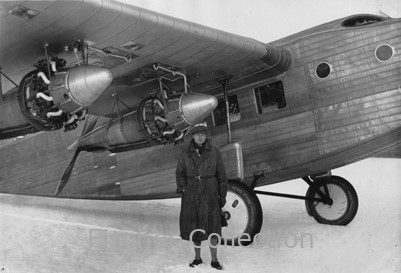
The U 11 (Werk.N. 243) was completed in December 1925, and was the largest aircraft produced by Udet Flugzeugbau, München-Ramersdorf, following an order by Deutscher Aero Loyd. It was an open-cockpit design with side-by-side seating for the two pilots. The navigator’s station was located in the very front of the aircraft, ahead of the pilots. The fuselage was constructed from Duralumin profiles and covered by Duralumin sheets. It could seat eight passengers and also contained a toilet and a luggage compartment.

The wings, featuring two main spars, were manufactured from wood, with fabric covering and a plywood-reinforced leading edge. The empennage consisted of Duralumin tubing and profiles, also covered with fabric. The landing gear was fitted with a then rather common rubber suspension system and 1100 by 220mm main wheels.

January 1926 at Oberschleissheim airfield north of Munich, with test pilot Harry Rother

First flown by Harry Rother on January 19, 1926, the U 11 was powered by four Siemens & Halske Sh 12 air-cooled radial engines with aerodynamic fairings, extended driveshafts (necessitated due to the pusher configuration), and two-blade propellers. The U 11 Kondor had a dangerously close clearance between the pusher propellers and rear passenger door, which caused one fatality.

The sole Udet U 11 Kondor [Condor] Grossverkehrsflugzeug [large airliner], Werknummer 243, was devoid of any markings; it would later be assigned D-828.

Rother’s test flights revealed significant design shortcomings. Tested by the DVL, the registration was approved on 8th of April 1926.

Bought by the Deutsche Aero-Lloyd AG and delivered to Deutsche Lufthansa (successor to Deutscher Aero Loyd) in 1926, but because of bad flying characteristics, DLH would not accept it. After negotiations the U.11 was sold to Deutsche Verkehrsfliegerschule [German air transport school] for 500 thousand RM.

The U 11 subsequently crashed during the delivery flight to Deutsche Verkehrsfliegerschule [German air transport school], for a total loss for DLH of 1 million RM.

The failure of the U 11 was among the reasons for the financial failure of Udet Flugzeugbau and its eventual acquisition by Bayerische Flugzeugwerke AG (BFW).

Gallery

Engines: 4 × Siemens-Halske Sh 12, 75 kW (100 hp)
Length: 16 m (52 ft 6 in)
Upper wingspan: 22 m (72 ft 2 in)
Wing area: 70 m2 (750 sq ft)
Aspect ratio: 7
Height: 4 m (13 ft 1 in)
Empty weight: 3,370 kg (7,430 lb)
Gross weight: 4,572 kg (10,080 lb)
Fuel capacity: 300 kg
Maximum speed SL: 152 km/h (94 mph; 82 kn)
Cruising speed SL: 135 km/h (84 mph; 73 kn)
Service ceiling: 3,190 m (10,466 ft)
Climb rate: 1.5 m/sec
Time to 1000m: 11.33 min
Time to 2000m: 28.25 m
Time to 3000m: 68.79 min
Practical range: 500 km
Endurance 3.60 h
Crew: 2
Capacity: 8