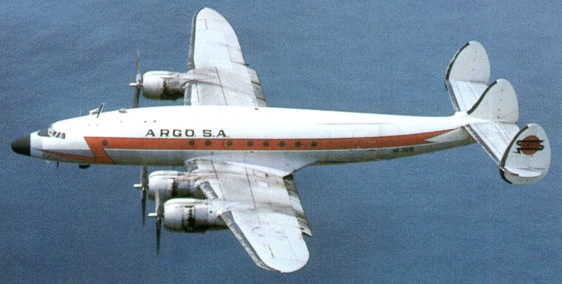
Lockheed built 286 Super “Connies,” then followed with production of the L.1619 Starliner. This development of the Model 649 standard Constellation actually started in when Lockheed were attempting to meet the requirements of TWA. Modified into a military transport during the Second World War, the design was reconverted into an airliner which came at the right time to equip airlines starved of new aircraft by the war.
The Super Constellation was first introduced on transatlantic services by KLM in 1953.
With a range of 7,200 miles, the Starliner became popular on long international routes for TWA and Air France. Only 43 Starliner Constellations were built, and most of those were short lived, bowing out gracefully for the introduction of the jet age. A historical note about the Connie’s heritage: the tri-tailed airliner was the first Air Force One.
US Navy designation – Lockheed R7V-1 Super Constellation.
In 1963 Flying Tiger VP Fred Benninger required a Super H Connie for less than the going price of $500,000. Finding two Navy surplus Elations, Connies with Electra engines, the fuselages were right but not the wings. Two cheap South American 1049G’s and four months of fitting parts produced two cargo planes for less than the price of one.
Lockheed Super Constellation Engines: 4 x Wright, 3250 hp. Wing span: 123 ft 0 in (37.49 m). Length: 113 ft 7 in (34.65 m). Height: 24 ft 9 in (7.56 m). Max TO wt: 133,000 lb (60,380 kg). Max level speed: 352 mph (563 kph).
EC 121K Warning Star Engines 4 x 3,400 h.p. Wright R 3350 turbo compound piston engines. Length 113.6 ft. (34.62 m.) Wing span 123 ft. (37.47 m.) Weight, max 137,500 lb. (62,370 kg.) Crew 6. Pax cap: 65 89 Max cruise 310 m.p.h. (500 km.p.h.) Range 4,800 miles (7,700 km.) with 18,000 lb payload
A stretched version of the L.749, the L.1049 Super Constellation, was introduced in 1950. Gross weight was increased substantially when the fuselage was expanded by 18.4 feet and 3,250-hp Wright engines were fitted. The stretched “Connie” held up to 91 passengers; with tip tanks, range was increased to 5,840 miles.
The first prototype Super Constellation (a conversion of the original C-69 prototype) flew for the first time on 13 October 1950. First in commercial service (on 15 December 1951) was one owned by Eastern Air Lines. This version could accommodate 71 first-class or 95 coach-class passengers (14 delivered to Eastern and ten to TWA during 1951-52).
The L.1049C model had structural modifications to allow a gross weight of 150,000 pounds, provided that more powerful engines were available. Lockheed built 286 Super Connies.
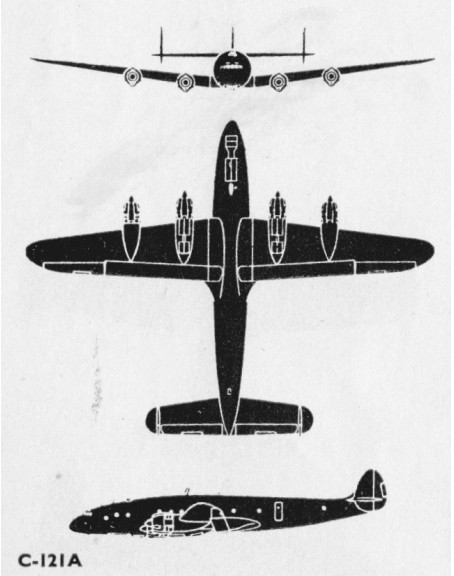
L-1049 Super Constellation were in use by both the USAF and US Navy under a variety of C-121C and R7V-1 designations respectively.
Lockheed C 121G Super Constellation Engine: 4 x Wright R 3350-91, 3501 hp Length: 116.175 ft / 35.41 m Wingspan: 122.999 ft / 37.49 m Max take off weight: 144917.0 lb / 65722.0 kg Max. speed: 320 kt / 592 km/h Range: 1825 nm / 3380 km Crew: 5 Payload: 72 Pax
L-1049G Engines: 4 x 3400hp Wright R-3350-972T-C18DA-3 Max take-off weight: 130,000 lb Empty weight: 33119 kg / 73015 lb Wingspan: 37.62 m / 123 ft 5 in Length: 35.41 m / 116 ft 2 in Height: 7.55 m / 24 ft 9 in Wing area: 154.40 sq.m / 1661.95 sq ft Cruise speed: 589 km/h / 366 mph Ceiling: 6950 m / 22800 ft Range: 6700 km / 4163 miles Crew: 4 Passengers: 62-109
The Lockheed Constellation L.749 variation was a long-range version of the earlier L.049. The first Constellation placed in airline service was the L.749 series. This aircraft differed from earlier versions in its increased fuel capacity and takeoff weight. The L.749 provided for 44 to 64 passengers and was powered by four 2,500-hp Wright Cyclone 18-cylinder air-cooled engines.
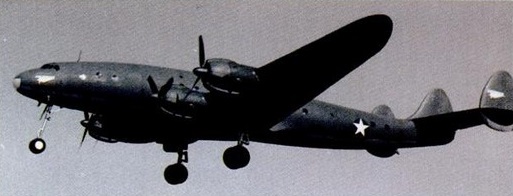
The 749 Constellation was operated by the military as the C-121A and C-121B.
EC-121
In service with both the U.S. Navy (WV-2) and U.S.A.F. (RC-121C) in 1955 as high-altitude early-warning radar picket. The WV-2 has very large dorsal and ventral radomes, which are not found on R7V transport versions. Basically-similar transport versions are the R7VA (U.S.N.) and C-121C. Experimental turboprop powered R7V-2 also flying. Earlier C-121A and VC-121B with shorter (95 ft. 1 in) fuselages were also in service in 1955.
WV-2 Reconnaissance and early-warning aircraft Engines: 4 x Wright R3350-34W Turbo-Cyclone, 2,250 h.p. Wingspan: 123 ft Length: 113 ft. 7 in Loaded weight: 130,000 lb Max. speed: 350 mph Max. range: over 4,000 miles at 330 mph Crew: Up to 31
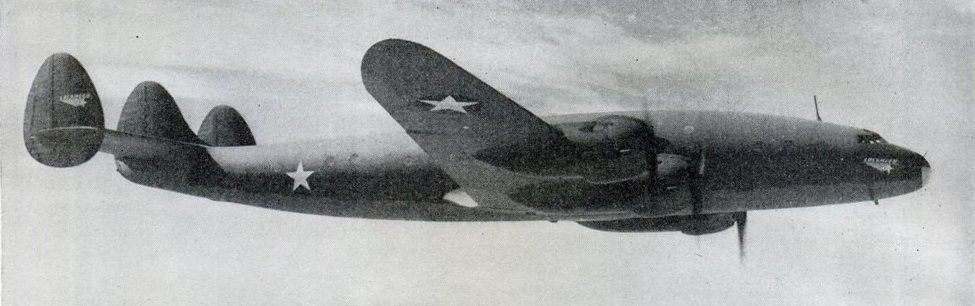
In 1939 TWA formulated a requirement for a long-range transport and C. L. Johnson designed the 558km/h Constellation. The earliest Constellation was initially flown in January 1943. Designed for commercial transport, the first Constellations were produced for the U.S. Air Force as C-29s.
Engines: 4 x Wright R-3350-35 Cyclone 18, 2170 hp Length: 95.177 ft / 29.01 m Height: 23.655 ft / 7.21 m Wingspan: 122.999 ft / 37.49 m Wing area: 1650.014 sqft / 153.29 sq.m Max take off weight: 72013.1 lb / 32659.0 kg Weight empty: 50507.7 lb / 22906.0 kg Max. speed: 287 kts / 531 km/h Cruising speed: 261 kts / 483 km/h Service ceiling: 25000 ft / 7620 m Wing loading: 43.67 lb/sq.ft / 213.00 kg/sq.m Range: 2085 nm / 3862 km
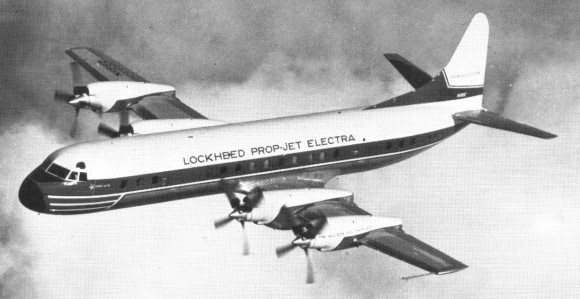
The design of the Lockheed L-188 Electra began in 1954, and in the following year the company received a launching order from American Airlines.
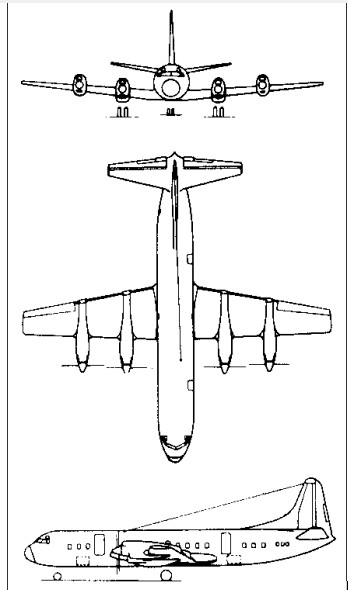
By the first flight, 144 were already on order. The prototype, first flown on 6 December 1957, was a low-wing monoplane of conventional configuration with retractable tricycle landing gear and powered by four Allison 501D-13, 501D-13A or 501D-15 turboprop engines. Standard accommodation was for 66 to 80 passengers, but a high-density arrangement was available optionally to seat 98.
Several crashes occurred in 1959 that caused Lockheed Corp. to make a few improvements including a stronger wing structure and engine nacelles plus thicker wing skins.
Built initially as the L-188A, the Electra became available also as the longer-range L-188C with increased fuel capacity and operating at a higher gross weight. A total of 170 had been built when production ended unexpectedly early as a result of passenger loss of confidence in the type after two had disintegrated in flight, and by the time remedial modifications had been, incorporated customer airlines were interested in turbojet- rather than turboprop-powered aircraft. About half of the total built remained in service in 1992, many of them converted by Lockheed Aircraft Service for convertible passenger/cargo or all-cargo use.
L-188A Electra Engines: 4 x Allison 501D-13, 2796kW / 4600 hp Propellers: Hamilton Standard Max take-off weight: 51256 kg / 113001 lb Empty weight: 26036 kg / 57400 lb Wingspan: 30.18 m / 99 ft 0 in Length: 31.85 m / 104 ft 6 in Height: 10.01 m / 32 ft 10 in Wing area: 120.77 sq.m / 1299.96 sq ft Cruise speed: 652 km/h / 405 mph Ceiling: 8655 m / 28400 ft Range: 3541 km / 2200 miles Crew: 5 Passengers: 44-98
Engines: 4 x 4,050 h.p. Allison 501 D15 turboprop. Length 104.5 ft. (31.81 m.) Wing span 99 ft. (30.18 m.) Weight empty 57,300 lb. (25,990 kg.) MTOW: 113,000 lbs (51,227 kg). Pax cap: 99. Max cruise 405 m.p.h. (650 km.p.h.) Ceiling 28,400 ft. (8,655 m.) Range 2,770 miles (4,458 km.) with 18,000 lb. (8,165 kg.) payload Cabin width: 10 ft 8 in. Takeoff run 4,720 ft Landing roll 4,300 ft
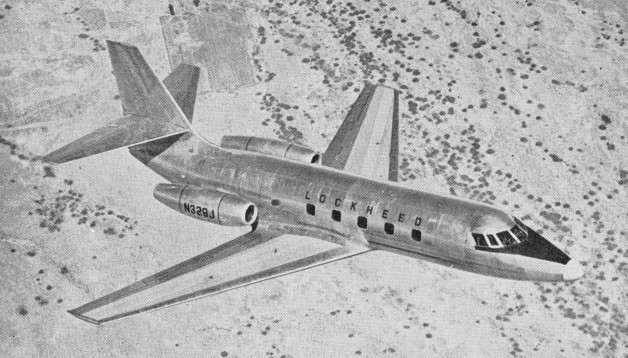
To meet a US Air Force requirement for an ‘off-the-shelf’ high-performance light transport, Lockheed developed the Lockheed 1329 JetStar. A low-wing monoplane with swept wings and swept tail surfaces, the JetStar was powered in prototype form by two 2200kg thrust Bristol Orpheus 1/5 turbojet engines. The JetStar flew 241 days after design began, in 1957. The first of two prototypes was flown on 4 September 1957, with flight testing proving satisfactory, but when planned licence-production of the Orpheus engine could not be finalised.
Lockheed chose to power the initial production version by four 1361kg thrust Pratt & Whitney JT12A-6 engines, mounted in pairs on each side of the rear fuselage. The anticipated military demand failed to materialise in any significant numbers, with the result that the majority of the 204 JetStars that were built, before production ended in 1980, were sold as business/executive aircraft.
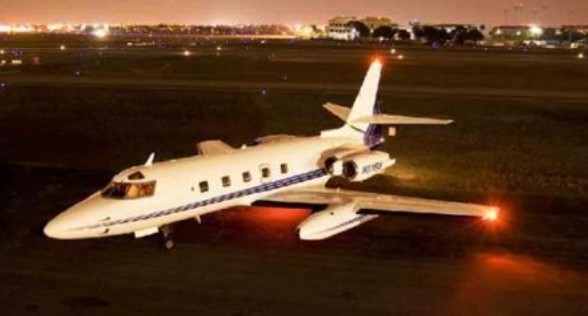
As advertised – Dec 2011
1977 LOCKHEAD JETSTAR II; A truly one-of-a-kind 12 passenger aircraft (including crew of 2 pilots and 1 flight attendant), powered by four 3,700 lbf (16.5 kN) thrust Garrett TFE731-3 turbofan engines and fitted with revised external fuel tanks. This is one of only 40 produced between 1976-1979, hand built in Marietta, Georgia USA; 30 still flying!
AiResearch Aviation Company’s 731 JetStar made its first flight on July 10 1976 from San Antonio, Texas. The TFE 731 is 10 inches larger in diameter than the JT12A, so the drag produced from the larger nacelles needed to house it would lessen the benefits of its lower fuel consumption. Also, the modified aircraft weighs 1,750 pounds more than its predecessor, so the gross weight would have to be increased in order to retain the same payload, but a high¬er gross weight means more drag. The TFE731 3 turbofan produces only 400 pounds more takeoff thrust than does the JT12A 8 turbojet, so there was not a significant amount of extra power to overcome drag.
Ed Swearin¬gen designed a TFE 731 installation for the JetStar. He also warped both ailerons so that the outer portions are biased slightly upward in neutral position to act as “reverse” flaps, thus forcing the inboard section of the wing to carry a greater share of the lifting loads. By designing a new fuel tank below the wing instead of wrapping it around the airfoil, Swearingen was able to reduce the size of the pod without sacrificing any fuel capacity and eliminate all nacelle flow disturbances caused by the tanks.
Wind tunnel studies showed that despite its larger nacelles, the overall drag of the 731 JetStar would be slightly less than that of the original JT12A powered version.
A supplemental type certificate for retro¬fitting Garrett TFE 731 3s to JetStars was granted to AiResearch on June 10, 1976, nearly two years after the aircraft’s first flight. Flight tests had demonstrated that the turbofan 731 JetStar exceeded the performance of its turbojet predecessor in take¬off, rate of climb, initial cruise altitude and cruise speed at altitude. The 731 JetStar will go 2104 nm with full IFR reserves.
Pro¬duction JetStar IIs differs only slightly as, because the aircraft is newly manufactured, the aft fuselage bulk¬heads can be relocated, rather than modified (as they must be on the 731 JetStar), to ac¬commodate the Garrett engines; thus the na¬celle installation is about 175 pounds lighter than the AiResearch arrangement. The first production example (N5527L) of the Lockheed 1329 25 JetStar II 12 seat executive transport made its first flight at Marietta, Georgia on 18 August 1976.
American Aviation Industries, founded 1985 and offered Lockheed JetStar business jet re-engining program as the FanStar.
JetStar I Original production version, differing from the first prototype by having increased fuel capacity provided by a permanently attached streamlined JuelI tank at mid-span of each wing, de-icing of wing and tail unit leading edges and Pratt & Whitney JT12A-6 engines; a slightly lengthened fuselage provided executive standard accommodation for a crew of two and 10 passengers; late production aircraft had 1497kg thrust JT12A-8 turbojet engines
JetStar 731 Conversion developed by AirResearch, replacing the Pratt & Whitney powerplants of Jet Star I aircraft with more fuel-efficient Garret TFE731-1 turbofan engines; about 60 JetStar Is were converted to this standard
JetStar II New production version incorporating Garrett TFE731-3 engines as standard and a number of refinements
C-140A Five aircraft for USAF, similar to early production JetStar Is and equipped for calibration of navigation beacons
C-140B Convertible cargo/passenger version for USAF, five built; generally similar to C-140A
VC-140B Designation of six additional production aircraft, generally similar to C-140A, except equipped as VIP transports; the five C-140Bs were also converted to this configuration
Specifications:
Lockheed JetStar II Engines: 4 x Garrett TFE731-3 turbofans, 1678kg Max take-off weight: 20185 kg / 44501 lb Loaded weight: 11294 kg / 24899 lb Wingspan: 16.59 m / 54 ft 5 in Length: 18.41 m / 60 ft 5 in Height: 6.22 m / 20 ft 5 in Wing area: 50.4 sq.m / 542.50 sq ft Max. speed: 880 km/h / 547 mph Ceiling: 13105 m / 43000 ft Range: 4820 km / 2995 miles
Lockheed 731 Jetstar-6, -8 Jetstar II (Airesearch conversion) Engines: 4 x Garrett TFE 731 3, 3,700 lbs Length: 60 ft. 5 in Height: 20 ft. 5 in Wingspan: 54 ft. 5 in Wing area: 542.5 sq. ft Airfoil: NACA 63A1 12 at root, NACA 63A309 modified at tip Aspect ratio: 5.27 Passenger seats: 10 Takeoff weight: 43,750 lbs Operating weight: 24,178 lbs Useful load: 19,572 lbs Payload with full fuel: 1,750 lbs Zero fuel weight: 27,000 lbs Fuel capacity: 2,640 USG/17,822 lbs Wing loading: 80.6 lb/sq.ft Power loading: 2.96 lbs/ft.sq Baggage area: 104.9 cu.ft Cabin pressure differential: 8.9 psi Cabin altitude @ 43,000 ft: 7,500 ft Balanced field length: 6,250 ft Takeoff safety speed: 145 knots Initial rate of climb: 4,200 fpm Gross takeoff climb rate, one engine out: 2,400 fpm @ 220 kt Engine out service ceiling: 37,000 ft Maximum operating altitude: 43,000 ft Maximum operating Mach: 0.82 M Maximum cruise: 475 kt / 0.82 M Normal cruise: 0.76 M Long range cruise: 438 kt / 0.72 M Maximum range, 45 minute reserve 2,770 nm Range max fuel/cruise: 2331 nm/4.9 hr Range max fuel / range: 2956 nm/ 6.8 hr Maneuvering speed (@ 20,000 ft. and 35,000 lb): 220 knots Stall speed, landing configuration: 108 knots Stall clean: 138 kt. 1.3 Vso: 140 kt Vmc: 103 kt
The Lockheed C-141 Starlifter was designed to a 1960 requirement as a military strategic airlifter.
First flown on 17 December 1963, production deliveries of an eventual 248 entering USAF service began in 1965 as the C 141A. By August 1964 the USAF had ordered 132 Starlifters.
The original Starlifter model, the C-141A, could carry 138 passengers, 80 litters for wounded, or ten standard 463L pallets with a total of 62,700 pounds (28,900 kg) of cargo.
A number were modified to allow the carriage of a containerized Minuteman ballistic missile.
The C-141 volume capacity was relatively low in comparison to its lifting capacity; it generally ran out of physical space long before it hit its weight limit.
It was reported in August 1964 that a $64,000,00 order was placed by Flying Tiger Line for eight Super Starlifters, a 168 ft long commercial growth version of the C-141. Deliveries planned for 1967 did not happen.
C-141A 66-0192
Lockheed produced the prototype C 141B version in 1977, a conversion of a standard C 141A with a 23 ft 4 in (7.11 m) longer fuselage, other airframe changes and flight refuelling equipment producing the C-141B, flown for the first time on 24 March 1977. The conversion program took place between 1977 and 1982. It was estimated that this stretching program was the equivalent of buying 90 new aircraft, in terms of increased capacity.
Additional ‘plug’ sections were added before and after the wings, lengthening the fuselage by 23 ft 4 in (7.11 m) The modifications raised the StarLifter’s carrying capacity from ten standard freight pallets to 13, or a similar rise in the 154 troops, from 123 paratroops. All C 141As were being brought up to the new C 141B standard.
Sixty-three aircraft have been upgraded to C-141C status, with improved avionics and navigation systems.
In 1994, thirteen C-141Bs were given SOLL II (Special Operations Low-Level II) modifications, which gave the aircraft a low-level night flying capability, enhanced navigation equipment, and improved defensive countermeasures. The USAF operates these aircraft for the Air Force Special Operations Command.
On 16 September 2004 the C-141 left service with active duty USAF units, being confined to reserve units for the remainder of its service life. As of September 25th, 2005, there were only 8 C-141 aircraft still flying (All from Wright-Patterson AFB) near Dayton, Ohio. One of them is the same aircraft that was used at the end of the Vietnam War to repatriate American POWs from North Vietnam, and was to be moved to the National Museum of the United States Air Force, also at WPAFB.
C 141A Engines: 4 x Pratt & Whitney TF33 P 7 turbofan, 21000 lb (9,525 kg) st. Wing span: 159 ft 11 in (48.74 m). Length: 145 ft 0 in (44,20 m). Height: 12.0 m / 39 ft 4 in Wing area: 299.8 sq.m / 3227.02 sq ft Gross weight: 316,600 lb (143,600 kg). Max speed: 571 mph (919 km/h) at 25,000 ft (7,620 m). Cruise speed: 885 km/h / 550 mph Ceiling: 12500 m / 41000 ft Capacity: 154 troops, 123 paratroops, 80 stretchers, 5,283 cu.ft (169.6cu.m) cargo Range w/max.fuel: 11400 km / 7084 miles Range w/max.payload: 6440 km / 4002 miles Typical range: 4080 miles (6,565 km) with 70,847 lb (32,136 kg) payload. Crew: 4
C 141B Engines: 4 x Pratt & Whitney TF33 P 7 turbofan, 21000 lb (9,525 kg) st. Length: 168 ft 4 in / 51.31 m Height: 12.0 m / 39 ft 4 in
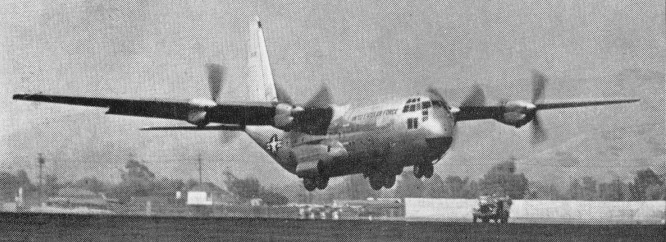
Lockheed’s C 130 Hercules was designed to meet a specification issued by the USAF Tactical Air Command in 1951.
C-130A
The prototype C-130 flew on August 23, 1954. Production models were delivered from 1956 and remained in production in 1999 in latest C-130J form with fully integrated digital avionics, advanced engines and propellers, and other improvements.
Older espionage-variants of the Hercules, the C-130A-II and the C-130B-II, had been noted at Rhein-Main around 1955. The metal-coloured aircraft, which externally were no different from the freighters operating regularly from Rhein-Main, belonged to the 7406th Combat Support Squadron.
C-130A-II at Rhein-Main in 1970
The RC-130 carried out COMmunications INTelligence (COMINT) for the USAF in Europe under the auspices of the National Security Agency. The RC-130s flew not only to West Berlin (Operation Misty Creek), but also on eavesdropping missions along the Iron Curtain and the borders of other countries, including the Middle East.
One of the C-130A-IIs from Rhein-Main lost its bearings in the early hours of 2 September 1958 during a COMINT mission for NSA along the Turkish-Soviet border, and was shot down near the town of Jerevan in Armenia by a group of five MiGs. Of the 17 crew and NSA eavesdropping specialists six lost their lives. What happened to the remaining eleven is still unknown in Washington. The Soviet Union has never admitted that the RC-130, which took off from the Turkish airfield at Incirlik, was shot down. In turn, the US Government has never admitted that the Hercules in Armenia was on a reconnaissance flight. The purpose of the flight was stated to be ‘a study of the propagation of radio waves’. Washington released for publication the radio transmissions, received by an American listening post in Turkey, between the MiG pilots and a Soviet Ground Control Interception station, relaying speech from shortly before to shortly after the attack. There was no admission from the Soviets.
The 1958 Ground Proximity System uses a cargo hook dangling from the open tail door which snares a ground cable, which pulls cargo out. Up to 13,000 lb can be pulled out.
In December 1963 Lockheed was building 15 Hercules a month, with almost 600 delivered already.
In June 1965 it was reported that Malaysia protested to the US that C-130s operated by the Indonesia AF dropped para-troopers on Malaysian soil. The US had sold ten C-130s to Indonesia in 1960 for non-military use, but cut-off supplies of spare parts in 1964 when Indonesia had violated the agreement.
In 1967 Lockheed rebuilt the company’s C-130 demonstrator to the stretched L-100-20 civil freight version. The main change was the addition of a 100in fuselage insert.
USAF 109th AW LC-130H Hercules 83-0491 – Christchurch, NZ, May 2000
It was reported in 1964 that the RCAF had bought 16 C-130E, with deliveries to be spread over a year, at $55 million including spares. The RCAF were then operating four C-130B.
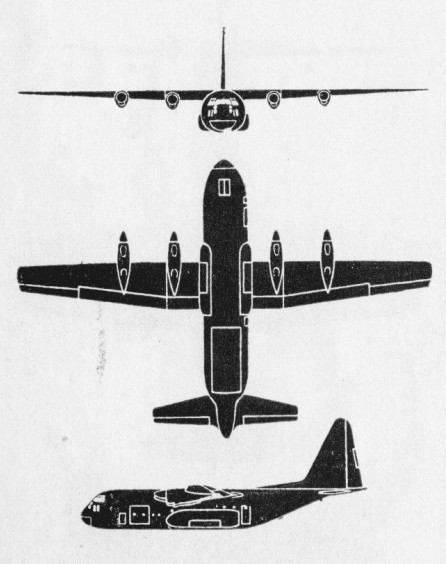
The four-turboprop Hercules tactical transport is available in advanced C-130H and stretched C-130H-30 versions. The latter is 4.5m (l5ft) longer than the C-130H, and has a 16.8m (56ft)-long cargo compartment, which can accommodate seven cargo pallets. The C-130H-30 can carry 128 troops or 92 paratroops, compared with 92 and 64 respectively in the standard C-130H. Similarly, the H-30 can lift 97 stretchers in the medevac role instead of the 74 of the C-130H. The RAF’s ‘stretched’ C.Mk 3 carries up to 128 troops, 92 paratroops, or freight. The C-130J C.4 being longer than the C.5.
Electronic warfare versions of the Hercules include the EC-130H Compass Call of the USAF and the EC-130Q TACAMO of the USN.
On 21 March 1973, Mirage aircraft of the Libyan Air Force attacked an RC-130 from the 7406th CSS at Rhein-Main which was eavesdropping along the coast of Egypt and Libya, The NSA operators on board the Hercules heard via their headsets that the Mirages were ordered to shoot down the four-engined American aircraft. The pilot, who was warned, managed to evade the stream of bullets from the Libyan jet fighters by flying into cloud. According to the Pentagon the attack took place about 80 miles / 130 km from the Libyan coast. As late as 1973 Washington was unable to confirm that the RC-130 was on an electronic reconnaissance flight. It did become known that the Americans were using Hellinik airfield near Athens as the start and finish for their spying flights.
The RAF operated the C 130K Hercules C Mk.1 and Hercules C Mk.1(P) (for probe).
Lockheed Martin delivered fully configured KC-130J tanker aircraft to the United States Marine Corps. Using wing and external tanks, the KC-130J has a 57,500-lb (8,455 US gallon) fuel off-load capability while performing a 500-nm radius mission, compared with 38,000 lbs (5,588 US gallons) for the KC-130Fs. The aircraft is also configured to accept a fuselage tank if desired, adding another 24,392 lbs (3,600 US gallons) of fuel to a mission. The aircraft use the probe-and-drogue configuration.
The ‘air snatch’ HC 130H, was used by the USAFs Aerospace Rescue and Recovary Service. It has scissor like folding probes on the nose designed to make pick ups from the ground or in mid air, by using the probes to engage parachute lines or balloon cables attached to the man or equipment to be recovered. First flown on 8 December 1964.
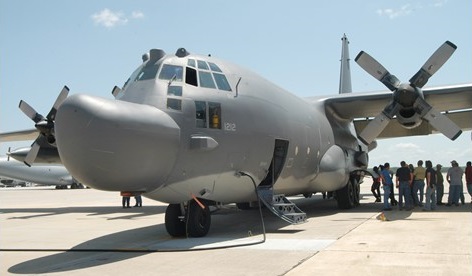
The MC-130E Combat Talon I and MC-130H Combat Talon II provide infiltration, exfiltration, and resupply of special operations forces and equipment in hostile or denied territory. Secondary missions include psychological operations and helicopter and vertical lift air refuelling.
MC-130E/H Combat Talon I/II
Both aircraft feature terrain-following and terrain-avoidance radars capable of operations as low as 250 feet in adverse weather conditions. Structural changes to a basic C-130 include the addition of an in-flight refuelling receptacle and strengthening of the tail to allow high speed/low-signature airdrop. Their navigation suites include dual ring-laser gyros, mission computers, and integrated global positioning system. An extensive electronic warfare suite enables the aircrew to detect and avoid potential threats. If engaged, the system will protect the aircraft from both radar and infrared-guided threats.
Both the MC-130E and MC-130H are equipped with aerial refuelling pods to provide in-flight refuelling of special operations forces and combat search and rescue helicopters and vertical lift assets.
The primary difference between the MC-130E and MC-130H involves the degree of integration of the mission computers and avionics suite. The Combat Talon I was conceived originally and developed during the 1960s, and although extensively upgraded in the 1980-90s it still features analog instrumentation and does not fully integrate the sensors and communications suites. The Combat Talon II, designed in the 1980s, features an integrated glass flight deck which improves crew coordination and reduces the crew complement by two.
The MC-130E Combat Talon first flew in 1966 and saw extensive service in Southeast Asia, including the attempted rescue of Americans held at the Son Tay prisoner-of-war camp in 1970. Also, the MC-130E landed in the Iranian desert in April 1980 in support of Operation Eagle Claw, the attempt to rescue American hostages held by Iran.
The MC-130E saw combat in Grenada in 1983, delivering U.S. Army Rangers to Point Salinas Airfield in the opening moments of Operation Urgent Fury, and subsequently performing psychological operations leaflet drops. In 1989 they led the joint task force for Operation Just Cause in Panama, helping to seize the airfield at Rio Hato.
In 1990, MC-130Es were employed in Operation Desert Storm, where they dropped 11 BLU-82 15,000-pound bombs and more than 23 million leaflets in a highly effective effort to encourage Iraqi soldiers to surrender. They also conducted numerous aerial refuelling of special operations helicopters with combat search and rescue operations.
The MC-130H Combat Talon II first arrived at Hurlburt Field, Fla., June 29, 1992, and after acceptance testing, began official flying operations Oct. 17, 1992. Since then, the MC-130H has played a role in AFSOC operations including the evacuations of non-combatant Americans and other civilians from conflicts in Liberia in 1996. Also, in 1998, a Combat Talon II aircrew was awarded the Mackay Trophy for the involvement in the evacuation of civilians from the Republic of the Congo (1997); and they participated in combat operations in the Balkans during Operation Allied Force.
In 2001, MC-130Hs were employed to seize an airfield in southern Afghanistan delivering U.S. Army Rangers to commence ground operations in Operation Enduring Freedom and later in 2003, the MC-130H was the first US aircraft to land at Bagdad International to initiate missions supporting Operation Iraqi Freedom. Since Oct 2001, both aircraft have been used extensively in Operations Enduring, Operation Enduring Freedom-Philippines, and Iraqi Freedom in a variety of roles.
In 2001 10 MC-130E were operational with the Reserves, and 20 MC-130H with the Active force.
One of the measures considered for a second hostage rescue attempt in Iran was a project to develop a “Super STOL” aircraft, to be flown by Combat Talon crews that would use a soccer stadium near the US Embassy as an improvised landing field. Called Credible Sport, the project acquired three C-130H transports from an airlift unit in late August 1980, one as a test bed and two for the mission, and modified them on an accelerated basis.
Designated as the XFC-130H, the aircraft were modified by the installation of 30 rockets in five sets: eight firing forward to stop the aircraft, eight downward to brake its descent rate, eight rearward for takeoff assist, four mounted on the wings to stabilize them during takeoff transition, and two at the rear of the tail to prevent it from striking the ground because of over-rotation. Other STOL features included a dorsal and two ventral fins on the rear fuselage, double-slotted flaps and extended ailerons, a new radome, a tailhook for landing aboard an aircraft carrier, and Combat Talon avionics, including a TF/TA radar, a defensive countermeasures suite, and a Doppler radar/GPS tie-in to the aircrafts inertial navigation system.
Of the three aircraft, only one received full modification. The program abruptly ended when it crashed during testing on October 29, 1980, and international events soon after rendered another rescue attempt moot.
The C-130J-30 is a stretched variant and is 15 ft longer and can carry two extra cargo pallets compared to C-130H (30% more). A key to the C-130J-30’s increased performance is a mission computer linked to the four new, electronically controlled (by Lucas Aerospace’s FADEC (full authority digital electronic control) system) Allison AE-2100D3 turboprops. Flat rated to 4,691 shp (down from 6,148 shp), the engines still generate 29 percent more thrust and they are 15 percent more fuel-efficient than the E model’s. An all-composite six-blade Dowty Aerospace R391 propeller is lighter and has fewer moving parts than previous Hercules C-130 propellers. Lockheed-Martin were to develop and produce six WC-130J weather reconnaissance aircraft.
The AC-130 is the gunship variant of the C-130 Hercules. The first flight of the AC-130A was in 1967. The missions of the AC-130 are: close air support, air interdiction and armed reconnaissance, perimeter and point defense, escort, drop and extraction zone support, forward air control, limited command and control (c2), and combat search and rescue (CSAR).
The AC-130A Spectre is similar to the C-130 in terms of external dimensions. It is 97 feet, 9 inches long, 38 feet, 3 inches tall, and has a wingspan of 132 feet, 7 inches. Originally, the AC-130A did not have the capability to refuel in flight. With a full load, these AC-130As had a range of 2450 miles. However, once modified with aerial refueling capabilities, the range was limited only by crew endurance. The AC-130A was sent to Vietnam on September 20, 1967, and flew its first mission one week later. The AC-130A destroyed over 10,000 enemy vehicles during the course of the Vietnam War. The last AC-130A was retired on September 10, 1995.
Between November 1968 and November 1989, only four, and later six, AC130 gunships were operating over the Trail, pending delivery of more advanced ‘Spectres’.
The first AC-130 gunship had arrived in Vietnam for field trials in September 1967, and its success led to the decision to modify more of the type. However, the Air Force could not spare any of its C-130 fleet, they were all needed for airlift duties throughout South-East Asia. Seven early-model C-130s were available though, and the first of these was converted to gunship configuration by June 1968; combat operations began with four aircraft in October 1968.
The AC-130 was armed with four 7.62mm minigun modules and four 20mm gatting cannon. Two of each were mounted forward of the main landing gear on the port (left) side of the aircraft and two each aft of the gear. In addition, a Night Observation Device (NOD) or Starlite Scope was carried – a sophisticated piece of equipment which enables the user to see targets on the ground by utilizing the available star or moonlight. The NOD and a primitive infra-red sensor were fitted to the port side of the aircraft and a bread-board computer was also carried to co-ordinate all the variables involved in a side-firing weapons system. These early AC-130s were operated by the newly formed 16th Special Operations Squadron at Ubon Royal Thai Air Force Base, and the Commander of Spectre Crew Number One was Lieutenant Colonel William Schwehm.
The AC-130H (also Spectre), which initially worked with the AC-130A, replaced it in 1995. The H-model has computers which can tell whether a target is friendly or not, thus, reducing the amount of casualties due to friendly fire. In the Persian Gulf War, one AC-130H was lost, along with all 14 crew.
The AC-130U Spooky is an advanced gunship. It can support special operations forces, in addition to its primary mission (gunship). It has a fire control system, which is capable of attacking two targets at once. With advanced computers, all guns can be slaved to computers if the need should arise.
The first RAAF C-130J-30 Hercules II, A97-464, was officially handed over at RAAF Richmond on 7 September, 1999. The first of 12 to replace the 37 Sqn C-130Es.
During 1964 a C-130E Hercules flew 25 hr 1 min 8 sec without landing as a prelude to FAA certification for civilian cargo use. The red, white, and blue aircraft was built as a cooperative venture by Lockheed and 57 suppliers of engines, parts, and systems for C-130’s. Once airborne it flew the endurance run at 140 kt on two engines.
Hercules commercial transports have an L 100 series designation. Largest of these, the L.100 30 entered service in 1970, can lift a maximum payload of more than 23 tons.
1,814 aircraft of all versions had been deliv¬ered by June 1987. Total Hercules sales had reached 1,845 by June 1987.
In July 1997, the company set-up then included Lockheed Martin Aeronautical Systems tasked with production and support of the C-130.
In 2005 an RAAF C-130J operating in Iraq was fired on by a surface-to-air missile over Baghdad and forced to deploy counter-measures and take evasive action. The Hercules was not damaged.
By 1999 well over 2,200 Hercules, still in production, had been built.
Hawkins & Powers enveloped civil conversions of of C-130 and P2V-7 under TC A19NM, A30NM, and A34NM in the Restricted category as borate bombers for forest fire control.
C 130 Hercules Length : 97.736 ft / 29.79 m Height : 38.255 ft / 11.66 m Wing span : 132.612 ft / 40.42 m Max take off weight : 175032.9 lb / 79380.0 kg Max. speed : 330 kts / 611 kph Service ceiling : 22638 ft / 6900 m Range : 4083 nm / 7562 km Engine : 4 x Allison T56-A7A, 3995 shp Crew : 4+92 Armament : 8862kg Freight
C-130A Engines: 4 x Allison YT56-A-11 turboprop, 3,750 e.h.p. Wingspan: 132 ft 7 in Length: 97 ft 9 in Basic weight: 67,000 lb Loaded weight: approx. 124,200 lb. Max fuel: 40,000 lb Cruise: 320 mph Max. speed: approx. 400 m.p.h. Typical range: 2,900 miles at 350 m.p.h. at altitude, with 40,0001b. payload Armament: None Crew: 5
C-130E Wing span: 132 ft 7 in (40.41 m) Length: 97 ft 9 in (29.78 m) Height: 38 ft 3 in (11.66 m) Engines: 4 x Allison, 4050shp Max TO wt: 175,000 lb (79,380 kg) Max level speed: 384 mph ( 618 kph).
C-130H Hercules Engine: 4 x Allison T56-A-15, 4,190 shp Installed thrust: 13,440 kW Propellers: 4-blade Span: 40.4 m Length: 29.8 m Wing area: 162 sq.m Height: 11.7m Empty wt: 34,686 kg Max AUW: 70,450kg Maximum Alternate AUW: 79,380 kg Payload: 19,365 kg Cruise speed: 595 kph Initial ROC: 415 m / min Ceiling: 10,060 m / 40,000 ft T/O run: 1091 m Ldg run: 518 m Fuel internal: 36,636 lt Range 14,000kg payload: 5,100km Range with 19,765 kg: 3790 km Ferry range: 7400km Capacity: 92 pax or 64 paratroopers Medivac config: 74 stretchers Freight config: 6 cargo pallets Air refuel: Yes Crew: 2 pilots, 1 navigator, 1 flight engineer, 1 loadmaster.
Lockheed Martin C-130J Hercules Engine: 4 x Allison AE2100D3 turboprops, 4,590 shp Propellers: 6-blade variable-pitch Length: 34.37m Height: 10.1m Wingspan: 132.579 ft / 40.4m Wing area: 1745.06 sq.ft / 162.12 sq.m Maximum weight: 79,380kg Maximum payload: 19,500kg Max. speed: 348 kts / 645 kph Normal operations cruise: 625km/h Initial climb rate: 2106.30 ft/min / 10.70 m/s Range 18,155kg payload: 5,100km Ceiling: 35,000 ft Crew: Two pilots, loadmaster Accommodation: 128 troops / 74 paratroops / 74 stretcher, two attendants
C-130J-30 Engines: 4 x Rolls-Royce Allison AE 2100D3, 4591 shp. Props: Dowty R391 6 blade composite. Cruise: 348 kts. Range: 3262 sm (with 40,000 lb payload). Max payload: 41,790 lbs. MTOW: 155,000 lbs. Ceiling: 29,000 ft.
HC 130H Engines: 4 x Allison T56 A 15 turboprop, 4,500 esh. Prop: 13 ft 6 in (4.11 m) dia 4 blade. Wing span: 132 ft 7 in (40.41 m). Length: 98 ft 9 in (30.10 m). Wing area: 1,745 sq ft (162,12 sq.m). Gross weight: 155,000 lb (70,310 kg). Max speed: 384 mph (618 km/h). Typical range: 2,450 miles (3,945 km). Crew: 10.
MC-130E Primary Function: Infiltration, exfiltration, and resupply of special operations forces Engines: Four Allison T56-A-15 turboprop, 4,910 shaft horsepower Wingspan: 132 feet, 7 inches (40.4 meters) Length: 100 feet, 10 inches (30.7 meters) Height: 38 feet, 6 inches (11.7 meters) Speed: 300 mph Load: 53 troops, 26 paratroopers Ceiling: 33,000 feet (10,000 meters) Maximum Takeoff Weight: 155,000 pounds (69,750 kilograms) Range: 2,700 nautical miles (4,344 kilometers) Crew: Two pilots, two navigators and an electronic warfare officer (officers); flight engineer, radio operator and two loadmasters (enlisted) Date Deployed: 1966 Unit Cost: US $75 million
MC-130H Primary Function: Infiltration, exfiltration, and resupply of special operations forces Contractor: Lockheed Engines: Four Allison T56-A-15 turboprop, 4,910 shaft horsepower Wingspan: 132 feet, 7 inches (40.4 meters) Length: 99 feet, 9 inches (30.4 meters) Height: 38 feet, 6 inches (11.7 meters) Speed: 300 mph Load: 77 troops, 52 paratroopers or 57 litter patients Ceiling: 33,000 feet (10,000 meters) Maximum Takeoff Weight:155,000 pounds (69,750 kilograms) Range: 2,700 nautical miles (4,344 kilometers) Crew: Two pilots, a navigator and electronic warfare officer (officers); flight engineer and two loadmasters (enlisted) Date Deployed: June 1991 Unit Cost: US$155 million
L-100-30 Engines: 4 x Allison, 4050shp Wing span: 132 ft 7 in (40.41 m) Length: 112 ft 8.5 in (34.35 m) Height: 38 ft 3 in (11.66 m) Max TO wt: 155,000 lb (70,308 kg) Max level speed: 377 mph ( 607 kph).
Hercules C.Mk.1 Wing span: 132 ft 7 in (40.41m) Max cruise: 386 mph (621 kph).
AC-130H Engines: 4 x Allison T56-A-15 turboprop, 4,910 shp Length: 97 ft, 9 in / 29.8 m Height: 38 ft, 6 in / 11.7 m Wing span: 132 ft 7 in / 40.4 m Max Take-Off Weight 155,000 lb / 69,750 kg Max level speed SL: Mach 0.4 / 300 mph (482 km/h) Service ceiling: 25,000 ft / 7,576 m Armament: two 20mm guns, one 40mm cannon and one 105mm cannon; Crew: Five officers (pilot, co-pilot, navigator, fire control officer, electronic warfare officer) and eight enlisted (flight engineer, TV operator, infrared detection set operator, loadmaster, four aerial gunners)
AC-130U Engines: 4 x Allison T56-A-15 turboprop, 4,910 shp Length: 97 ft, 9 in / 29.8 m Height: 38 ft, 6 in / 11.7 m Wing span: 132 ft 7 in / 40.4 m Max Take-Off Weight 155,000 lb / 69,750 kg Max level speed SL: Mach 0.4 / 300 mph (482 km/h) Service ceiling: 25,000 ft / 7,576 m Armament: one 25mm gun, one 40mm cannon and one 105mm cannon; Crew: Five officers (pilot, co-pilot, navigator, fire control officer, electronic warfare officer) and eight enlisted (flight engineer, TV operator, infrared detection set operator, loadmaster, four aerial gunners)
In 1963 the USAF’s Military Air Transport Service issued a require¬ment for a very large logistics transport aircraft. Finally, this and other requirements evolved into specification CX HLS (Cargo. Experimental Heavy Logistics System) which demanded an aircraft capable of carry¬ing a payload of 56 700 kg (125 000 lb) over a range of 12 875 km (8000 miles) and twice that weight over shorter distances. It also had to be able to take off from the same runways as the smaller C 141 StarLifter and have the capacity to land on roughly prepared strips in combat areas. In May 1964 the Boeing, Douglas and Lockheed companies were asked to develop their submitted designs further. The gross weight requirement had by then been increased to 317 500 kg (700 000 lb), and General Electric and Pratt & Whitney were invited to design a suitable powerplant. Towards the end of the following year the choice was made in favour of a Lockheed/General Electric partnership, and the aircraft was officially designated C-5A Galaxy.
Eight test and evaluation machines were built, beginning in August 1966, the first C-5A Galaxy (#66-8303) was “rolled out” on 2 March 1968.
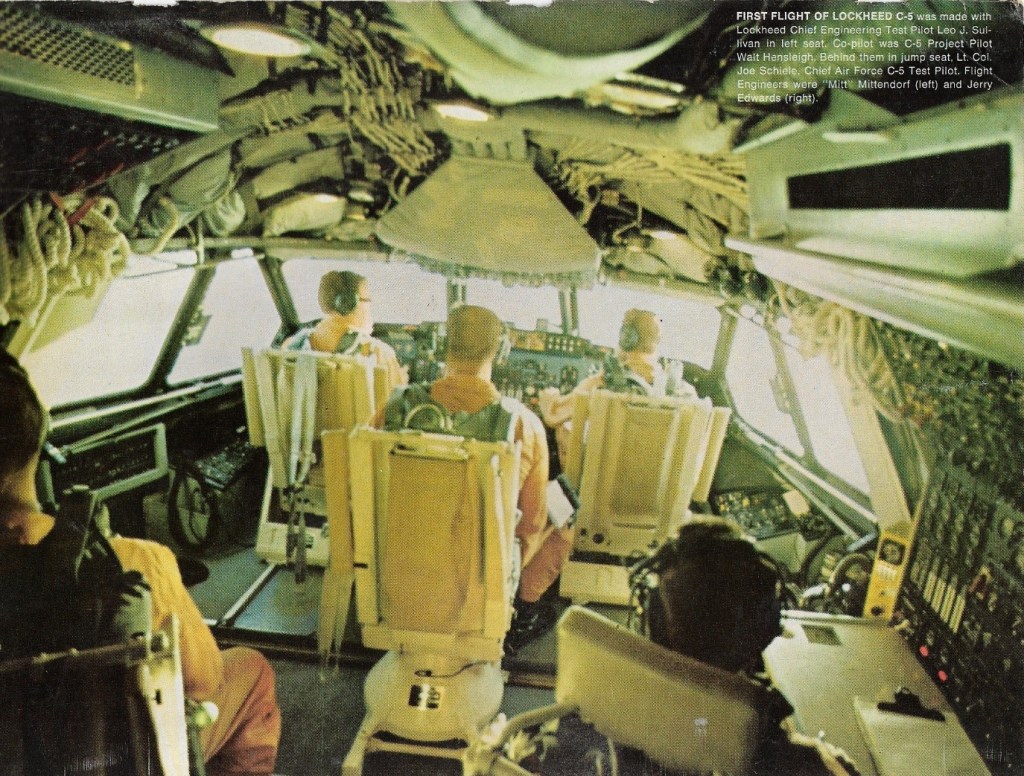
On June 30th 1968 Lockheed-Georgia Co. began flight testing with the aircraft’s first flight taking to the air under the call-sign “Allen-zero-three-heavy”, upon completion of testing the first C-5A was transferred to the Transitional Training Unit at Altus Air Force Base, OK, in December 1969.
The first flight crew were Lockheed Chief Engineering Test Pilot Leo J. Sullivan in left seat. Co-pilot was C-5 Project Pilot Walt Hensleigh. Behind them in jump seat, Lt. Col. Joe Schiele, Chief Air Force C-5 Test Pilot. Flight Engineers were “Mitt” Mittendorf (left) and Jerry Edwards (right).
C-5 first flight
It is a high wing cantilever monoplane, with a semi monocoque two deck fuselage of aluminium and titanium alloy construction and a cantilever all metal ‘T’ tail. The nosewheel unit retracts rearward hydraulic¬ally, as do the four main undercarriage bogies, each consisting of two sets of wheels in tandem on each side of the fuselage. Powered by four General Electric TF39 GE 1 turbofan engines, each rated at 18600 kg (41005 lb) thrust at sea level, the Galaxy carries a maximum usable fuel load of 185 480 litres (40 800 Imp gal) and can be refuelled in flight from a KC 135 tanker via an inlet in a fairing on top of the forward fuselage, just aft of the flight deck. For takeoff, a fully loaded Galaxy needs 2135 m (7004 ft) of runway, but can land in 680 m (2230 ft).
A crew of five is normally carried, includ¬ing a loadmaster, and there is a forward rest area on the upper deck for 15 persons (relief crew, etc). Although intended primarily as a freighter, the basic version can carry 75 troops at the rear of the upper deck and 270 on the lower deck. Loads lifted have included a 35380 kg (78000 1b) Minuteman ICBM and its 3175 kg (7000 1b) launching cradle; two 44 905 kg (99 000 1b) M 48 tanks; or three Boeing Vertol Chinook heavy lift helicopters. Loading can be done from front or rear, or from both ends simultaneously. There is an upward hinged nose door and loading ramp at the front; the rear straight in loading ramp, when closed, forms part of the undersurface of the rear fuselage.
Flight testing of the Galaxy continued until the summer of 1971. Deliveries of production aircraft to Military Airlift Command began on December 17, 1971, (to the 437th Airlift Wing, Charleston Air Force Base, SC) and were completed in May 1973. The C 5A became operational in 1970, and from July of that year was flying regular trips to Southeast Asia and Europe; it was utilized extensively during the Vietnam war for rapid transport of heavy equipment. In 1978, a total of 77 still remained in the MAC inventory of the 81 aircraft built. These were in service with the 60th, 436th, 437th, and 443rd Military Airlift Wings, based at Travis Air Force Base, California; Dover, Delaware; Charles¬ton, South Carolina; and Altus, Oklahoma.
Throughout the 1970s, the Galaxy remained the world’s largest military transport aircraft, being almost as large and heavy as the later model Boeing 747 Jumbo jets. Lockheed has calculated that, if required by the USAF, it is capable of being optimized for payloads even greater than the present 100227 kg (220964 1b) maximum, without increasing the maximum takeoff weight.
These aircraft have been put to invaluable use on non military mercy missions to disaster stricken areas such as the floods in Chile in 1974 and those in Pakistan. Much needed equipment and supplies were taken to earthquake ravaged Nicaragua by Galaxy aircraft, and in early 1977 and 1978 they were used to ferry snow¬clearing equipment to several areas within the United States.
In the mid-1970s, wing cracks were found throughout the fleet. Consequently, all C-5A aircraft were restricted to a maximum of 50,000 pounds (22,680kg) of cargo each. To increase their lifting capability and service life, 77 C-5As underwent a re-winging program from 1981 to 1987. (In the redesigned wing, a new aluminum alloy was used that didn’t exist ten years prior.) The final re-winged C-5A was delivered in July 1986.
In January 1981 a C-5A at snow covered Griffiss Air Force Base a C-5A performed more exhaustive ground maneuvers on unprepared ‘off-runway’ surfaces, including taxiing, towing and cargo off-loading at gross weights from 425,000 to 665,000 lb. The tests were conducted by the Air Force Test and Evaluation Center, Kirkland AFB, New Mexico.
Some C-5s were transferred to the Air Reserve components starting with Kelly AFB, Texas, in 1985; followed by Stewart Air National Guard Base, NY; and Westover Air Reserve Base, MA.
In December 1985 Lockheed was awarded a contract to design a new wing for the Galaxy, increasing maximum take-off weight from 348,810kg to 379,660kg. By the end of 1986, 68 rewinged C-5As had been returned to service, and the 77-strong fleet was scheduled for completion by mid-1987. C-5Bs have the same wing, improved General Electric TF39 turbofans, updated avionics, and better fatigue and corrosion resistance.
C-5B
Two C-5As modified to carry outsized space cargoes as C-5Cs.
On 17 April 1989 Lockheed delivered its final C-5B to the USAF.
C-5 engines were upgraded as C-5M, from four General Electric TF-39 engines to General Electric CF6-80C2-L1F (F-138) commercial engines, which have 22 percent more thrust, a 30 percent shorter takeoff roll, and a 58 percent faster climb rate. June 2006 saw the first flight of the C-5M ‘Super Galaxy’ with a digital glass cockpit.
C-5A Galaxy Engines: 4 x GE TF-39-GE-1, 182.9kN / 41,000 lb Wing span: 222 ft 8.5 in (67.88 m) Wing area: 576.0 sq.m / 6200.01 sq ft Length: 247 ft 10 in (75.54 m) Height: 65 ft 1.5 in (19.85 m) Max TO wt: 764,500 lb (346,770 kg) Payload: 73pax, max 130950kg Max level speed: 571 mph (919 kph) Cruise speed: 871 km/h / 541 mph Service ceiling: 33802 ft / 10303 m Range w/max.fuel: 13472 km / 8371 miles Range w/max.payload: 5600 km / 3480 miles Take off distance : 12129 ft / 3697 m Landing distance : 4872 ft / 1485 m Crew: 6
C-5B Galaxy Engine: 4 x GE TF39 turbofan Installed thrust: 765 kN Wingspan: 67.9 m / 222 ft 9 in Height: 19.8 m / 65 ft 0 in Length: 75.5 m Wing area: 576.0 sq.m / 6200.01 sq ft Empty wt: 169,645 kg MTOW: 379,660 kg MLW: 288,630 kg Payload: 118,390 kg Max. speed: 920 km/h / 572 mph Cruise speed: 835 kph Initial ROC: 440 m / min Ceiling: 10,895 m T/O run: 2125 m Ldg run: 720 m Fuel internal: 193,640 lt Range with 118,390 kg payload: 5470 km Capacity: 75 pax Air refuel: Yes.
C-5M Super Galaxy Engines: 4 x GE CF6-80C2 turbofan Wingspan: 222.8 feet Length: 247.8 feet Height: 65.1 feet Empty weight: 400,000 lb Cargo capacity: 281,001 lb Cruise speed: Mach 0.77 Un-refuelled range: 5,524 sm (4,800 nm) with 120,000 lb of cargo Un-refuelled range: 7,000 nm no cargo
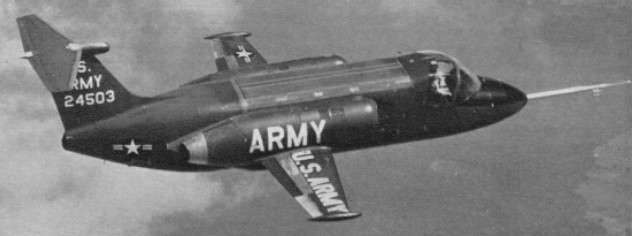
A contract for two prototypes of a new type VTOL aircraft was placed with the Lockheed company’s Georgia factory by the U.S. Army in June 1961. This followed more than two years of privately financed development of the jet ejector augmentation principle by Lockheed, including wind tunnel and test rig work.
The Army contract was for the Lockheed Model 330 Humming Bird, a research vehicle which was to be capable of development for use in the battlefield surveillance and Army support role.
Basis of the Lockheed concept is to augment the thrust of a jet engine by ducting its exhaust through a large diameter tube so that a large volume of cold air is drawn through it by friction and vacuum effect. This can augment the basic thrust of the engine by as much as 40 per cent.
In the VZ 10 which was re designated XV4A in July 1962 two 3,000 lb.s.t. Pratt & Whitney JT12A 3s are located each side of the fuselage above the wing root. For vertical operations, their exhaust jet is turned through 180 degrees and ejected downwards through a series of nozzles into a duct or mixing area in the centre fuselage. Doors covering this duct, top and bottom, are opened. To convert from vertical to horizontal flight, the VZ 10 is first tilted slightly nose down to obtain a small thrust component from the jet exhaust from the fuselage duct. As speed builds up the wings begin to contribute lift and the thrust of one engine is then deflected from vertical to horizontal. This increases the speed still more and the second engine can then be deflected, too, and the duct doors are closed.
The first VZ 10 (62 4503) made its first flight at Marietta on July 7th, 1962, taking off conventionally. Hovering trials began in 1963. On 20 November 1963 the first successful flight involving transitions from vertical to horizontal flight, and vice versa, was completed.
The second VZ 10 was tested in the 40 ft by 80 ft low speed tunnel at Ames Research Center before joining the flight test programme.
By then, redesignated XV-4A, the two prototypes were handed over to the US Army. In late 1966 Lockheed modified one of the XV-4As to a new XV-4B configuration, the major change being replacement of the XV-4A’s two 1361kg thrust engines by four each of 1368kg thrust. Testing began in August 1968, but when the aircraft was destroyed in an accident in early 1969 further development was abandoned.













 All Aero