Three flight test models were built, and the aircraft became operational in 1994.
By October 2002 C-17s were being delivered at a rate of 15 per year, with a planned run of 180 aircraft. The C-17 Globemaster is a four-engine transport aircraft fitted with the reversible-thrust F117-PW-100 by Pratt & Whitney, with each of 40,000 pounds of thrust. This powerplant represents the military version of the commercial Pratt & Whitney PW2040 as found on the 757 airliner. The aircraft is designed for operations utilizing shortened runaways.
The C-17 Globemaster III is crewed by a pilot, copilot and a loadmaster. At rear of the aircraft, the C-17 features a large access ramp. The aft-loading ramp allows for transportation and delivery of varying types of cargo including over 100 fully-armed troops and paratroopers, 36 medical litters and nearly 171,000 pounds of cargo. The cargo hold is able to carry most all of the military’s air-portable weapon and vehicle systems. With in-flight refueling, the C-17 has a global reach.
Unit Cost: $237 million (2007)
The Boeing-produced C-17 Globemaster III represents one of the latest additions to the United States Air Force mobile airlift fleet. By 1998, over 140 Globemaster III’s were in active or reserve service with the USAF, Air National Guard and the Air Force Reserve.
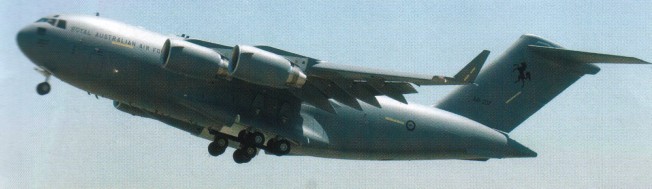
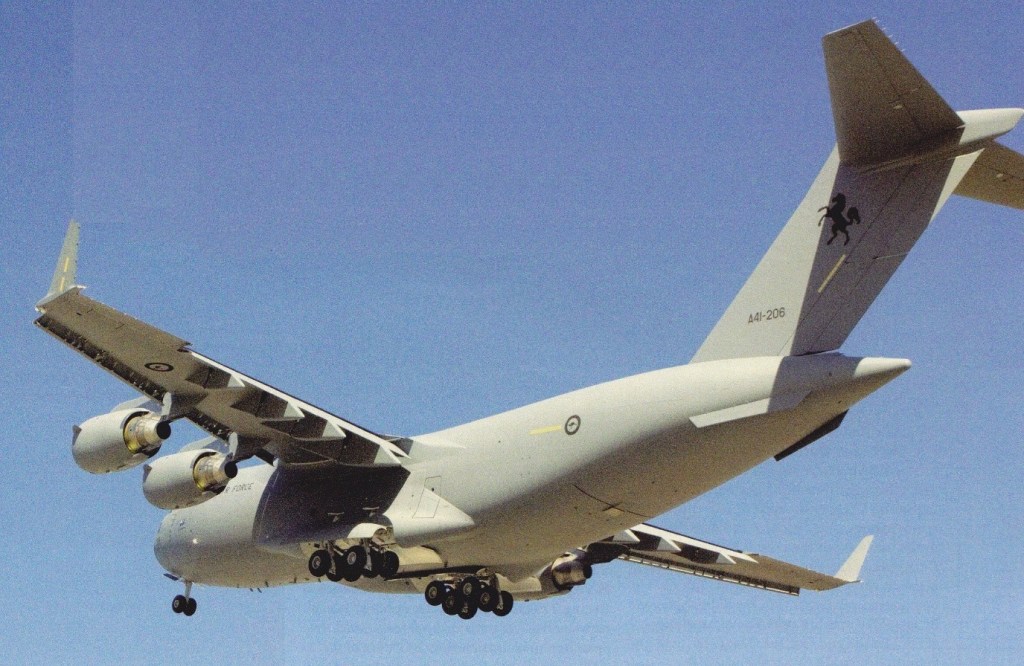
The first Boeing C-17 Globemaster III for the RAAF, A41-206, first flew at Long Beach on 8 November 2006. The Royal Australian Air Force had four C-17 Globemaster heavy transport aircraft.
RAAF A41-206
The first, A41-206, arrived in Australia on 2 December 2006. The RAAF’s second C-17 was handed over at Long Beach on 11 May 2007 and flown to Australia a few days later.
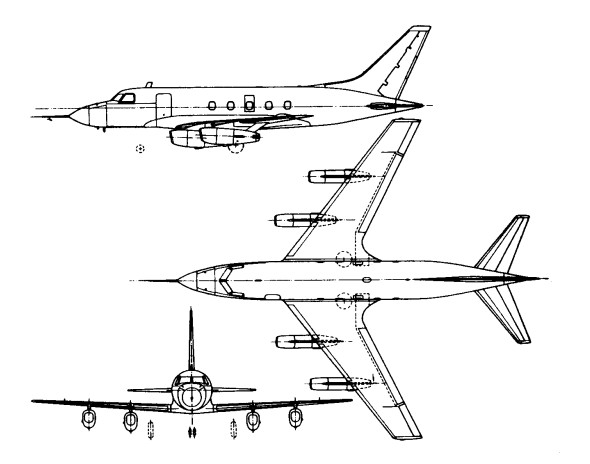
In the early 1960s Lockheed, McDonnell and North American were each vying for a military utility aircraft con¬tract and built commercial derivatives of their Air Force offerings to enter into the bizjet market.
First flown on 11 February 1959, the prototype was powered by 3250 lb Westinghouse J34 turbojets. They were to be replaced by newer 2900 lb Pratt & Whitney J60s.
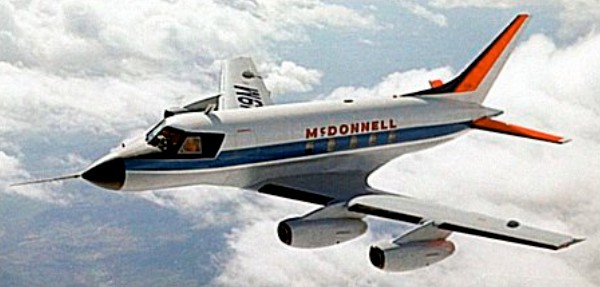
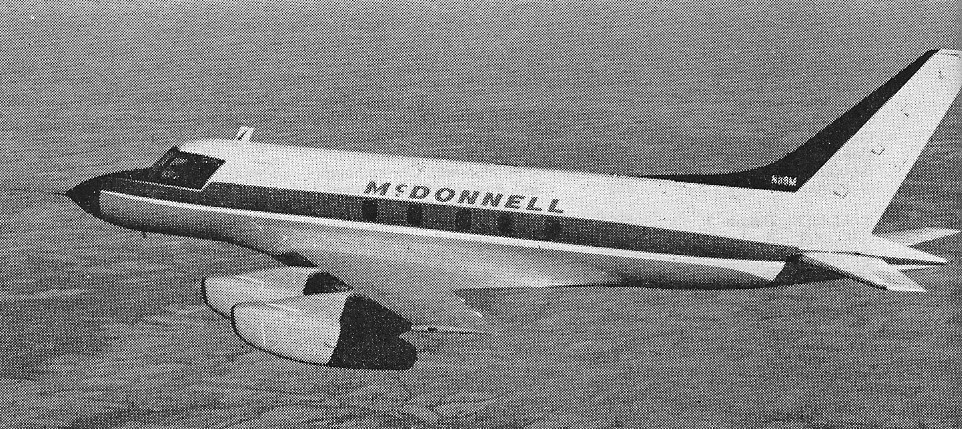
The four engine McDonnell Model 220 only saw service as a one of a kind corporate barge for McDonnell executives.
The Model 119/220 was the first business, non-airline-type jet aircraft to receive an FAA Class I provisional type certificate as airworthy in the transport category.
Max take-off weight: 20560 kg / 45327 lb Empty weight: 10529 kg / 23213 lb Wingspan: 17.55 m / 57 ft 7 in Length: 20.27 m / 66 ft 6 in Height: 7.21 m / 23 ft 8 in Wing area: 51.10 sq.m / 550.04 sq ft Max. speed: 901 km/h / 560 mph Cruise speed: 837 km/h / 520 mph Ceiling: 13685 m / 44900 ft Range: 3765 km / 2340 miles
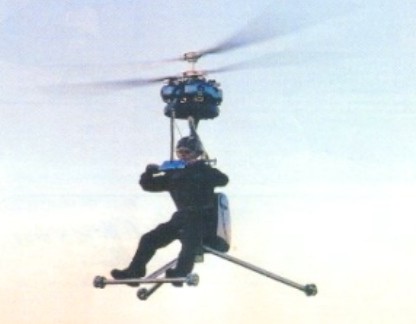
A single-seat strap-on helicopter. Complete helicopter fitted with one five-USG fuel tank and flown in the ultralight category. Gen H-4 should take 30-40 hours to assemble. Kit: $36,000 in 2009.
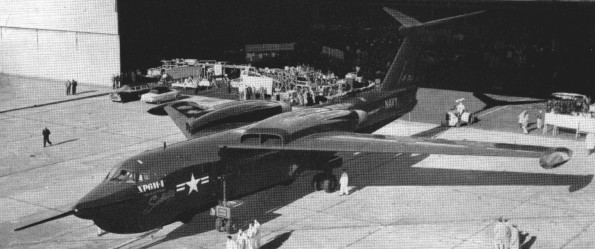
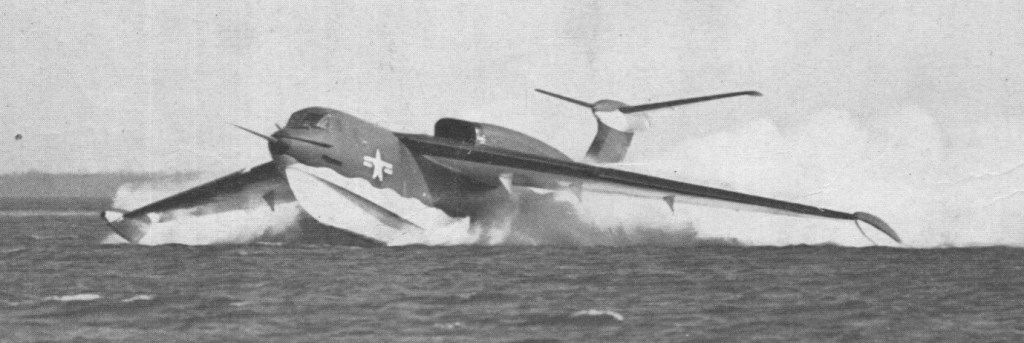
To meet a US Navy requirement for a high-performance multi-role flying-boat, Martin offered its Model 275 design. This had an all-metal hull of high length/beam ratio, mounting a cantilever high-set sharply-swept wing incorporating so much anhedral that the stabilising floats at the wing-tips could be attached permanently; the tail unit was of T-tail configuration with all-swept surfaces. Above the wing, to minimise spray ingestion, were mounted four Allison turbojet engines, and pressurised accommodation was provided for a crew of five. A beaching cradle allowed the SeaMaster to taxi in and out of the water under its own power. The P6M used a rotary bomb bay (as used on Martin’s licence-built Canberras and the XB-51). This permitted weapons release at high speeds without the drag of conventional bomb doors.
The first XP6M-1 prototype was flown on 14 July 1955, the second following on 18 May 1956. Ejection seats were fitted to the second and subsequent aircraft. These proved useful when the second SeaMaster pitched up, went into a loop and disintegrated. The original position of the engine exhausts caused stress on the rear fuselage which resulted in structural damage. The angle of the exhausts was adjusted after testing.
Martin received orders for six pre-production YP6M-1 boats powered by Allison J71 turbojets each developing a maximum 5897kg afterburning thrust. Successful flight testing led to an order for 24 production P6M-2 aircraft named SeaMaster, which differed primarily by having 7711kg thrust non-afterburning Pratt & Whitney J75-P-2 turbojet engines. The cockpit glazing was modified on later models to give a much better overhead and side view. However, the contract was cancelled on 21 August 1959 after only three had been built and these, together with the YP6M-1s, were scrapped at a later date. They were the fastest flying-boats ever built.
YP6M-1 Engines: 4 x J71 turbojet. Speed: 600 mph.
P6M Engines: 4 x Pratt & Whitney J75-P-2 turbojets, 7938kg Wingspan: 30.48 m / 100 ft 0 in Length: 40.84 m / 133 ft 12 in Height: 9.45 m / 31 ft 0 in Max take-off weight: 72575 kg / 160001 lb Payload: 13600kg / 29983 lb Max. speed: 965 km/h / 600 mph Ceiling: 12200 m / 40050 ft Range: 4830 km / 3001 miles Armament: 6 x 12.7mm machine-guns, 1800kg of weapons Crew: 4
On 23 August 1938 the US Navy ordered from Martin a single prototype of the Martin 170 design for a patrol bomber of flying-boat configuration.
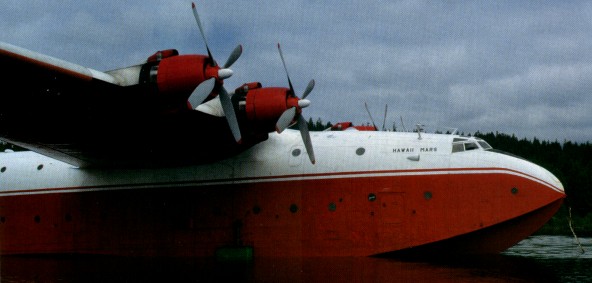
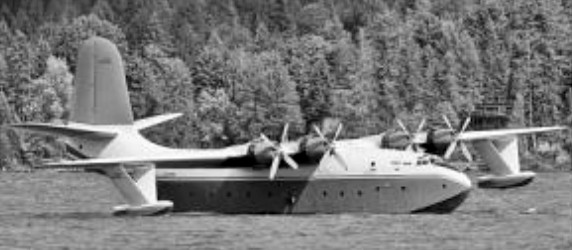
The tip of the tail is almost 50 feet above water level while the wing span is 200 feet, greater than a Boeing 747, and the two level interior is as big as a 15 room house with a long circular staircase connecting the two decks. The control surfaces are all fabric covered.
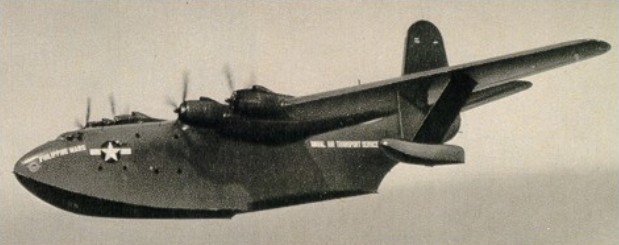
Designated XPB2M-1, it was the world’s largest flying-boat when flown for the first time on 3 July 1942, but by then the United States had become involved in World War II and it was decided not to proceed with procurement of the type as a patrol bomber. Instead, the boat was modified for use in a transport role, becoming re-designated XPB2M-1R and entering service in December 1943. It remains the largest flying-boat to have been operated by the US Navy and an early demonstration of its capability came in 1944, when a 9299kg cargo was delivered to Hawaii in a 7564km round trip completed in only 27 hours 36 minutes, resulting in a US Navy order for a production version under the designation JRM-1 Mars. This covered 20 aircraft to be completed specially for the transport role, but the end of World War II brought contract cancellations and only five were built, plus a single JRM-2 for operation at a higher gross weight. When the five JRM-1s were later modified to this latter standard they became redesignated JRM-3. These 60.96m span aircraft were powered by four 1715kW Wright R-3350-8 engines, and an appreciation of their capacity can be gained from the fact that on 19 May one of them, Marshall Mars, carried a total of 301 passengers, plus its crew of seven.
In 1948, carrying a load of 25 passengers, 17 crew, and 22,000 lb of freight, JRM ‘Carolina Mars’ flew from Hawaii to Chicago non-stop. This 4000-mile flight was the longest made by a flying boat.
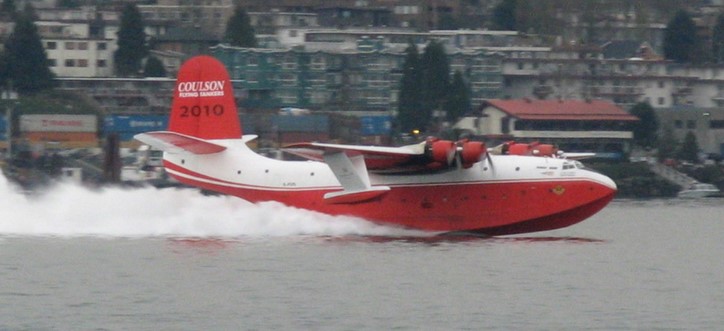
In ten years of military service between 1946 and 1956 and the five logged some 87,000 accident free hours. They established the world flying boat lift record of 30,992 kg (68,327 pounds) and carried a record 350 troops. The propeller driven Mars were declared obsolete in 1956 and Forest Industries Flying Tankers Ltd, Canada, purchased four, the other having been lost in a fire.
With a fibre glassed Douglas Fir plywood 6.000 gallon tank installed in the cargo area it could scoop up the 32 tons of water within 22 seconds while the flying boat skimmed the surface at about 70 knots.
Martin 170 / JRM Mars Engines: 4 x Wright R-3350-18 Cyclone, 1620kW / 2170 hp Max take-off weight: 67130 kg / 147997 lb Empty weight: 34300 kg / 75619 lb Wingspan: 61.0 m / 200 ft 2 in Length: 36.6 m / 120 ft 1 in Height: 13.6 m / 44 ft 7 in Wing area: 242.0 sq.m / 2604.86 sq ft Max. speed: 380 km/h / 236 mph Cruise speed: 300 km/h / 186 mph Ceiling: 5200 m / 17050 ft Range w/max.fuel: 9300 km / 5779 miles Crew: 7 Passengers: 40
The Martin Model 156 was intended to be a successor aircraft to the M130 for Pan American Airways.
Lateral buoyancy was provided by seawings rather than conventional sponsons or outboard floats. Interior furnishings provided for either a maximum of 46 passengers or a more luxurious arrangement allowing for night sleeping for a reduced number of passengers. Four 1,000-hp nine-cylinder radial engines were mounted in nacelles on the leading edge of the center section.
Only one was built and it was sold to the Russians in 1937. The sale included a complete set of production drawings as the Russians intended to mass produce the aircraft. WWII and invading Germans ruined their plans. The single type was used by the Russians for troop movements during the war. It is distinguishable from the M130 by the twin tails structure.
Engines four 1,000-hp Wright Cyclones Gross wt. 63,000 lb Empty wt. 30,414 lb Top speed 190 mph Cruise 156 mph Takeoff 70 mph Range 2,410 miles Ceiling 15,500 ft Seats 46.
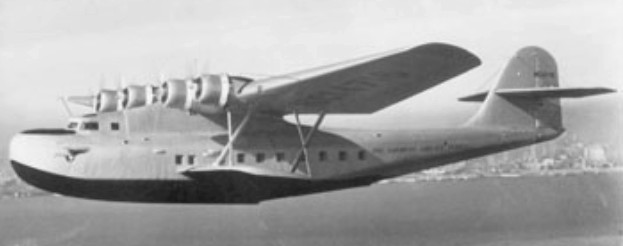
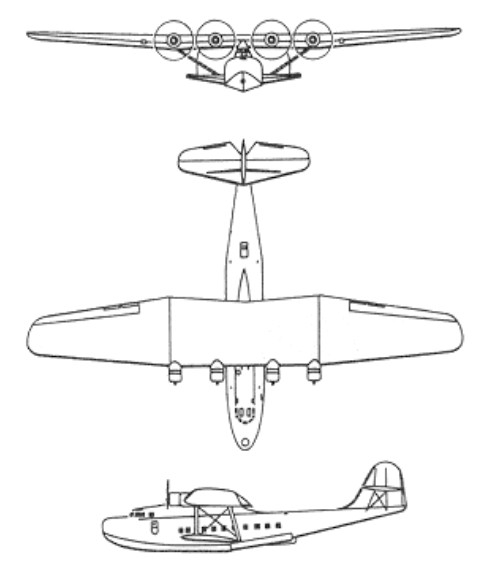
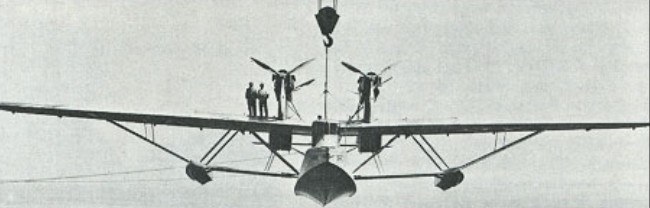
The Martin 130 was a large four-engined monoplane flying-boat designed for transoceanic services. Three were built for Pan American Airways in 1934-1935 and on 21 October 1936 began operating over the Pacific from San Francisco to Manilla, Philippine Islands.
The first designated flight engineer was required on the Martin M-130 ‘China Clipper’, flying boat. On the M-130, a separate cabin was constructed for the flight engineer, communication with the pilots being carried out via interphone. His principal responsibilities were supervision of aircraft maintenance on the ground, advising the flight crew of the aircraft maintenance status, and in-flight operation of the engines and aircraft systems. In the absence of flight time limitations, these engineers performed some prodigious feats of repair in addition to their normal functions.
Lateral buoyancy of the hull was provided by stub wings or ‘seawings’ instead of the conventional sponsons or outboard stabilising floats. Accommodation was provided for a crew of four and 36-48 daytime passengers or 18 sleeping bunks for night flying.
First flying in 1934, the four engine Martin Model 130 flying boat entered service on 21 October 1936 with Pan American Airways on the San Francisco Manila air route in 1935. The Martin Clipper carried 10 passengers on overseas flights with a range of 3,200 miles. The M-130 had a cruising speed of 163 mph, weighed 53,000 pounds when fully loaded, and a wingspan of 130 feet.
Engines: 4 x Pratt & Whitney R-1830-S1A4G Twin Wasp, 830 hp / 610kW Prop: three blade. Wing span: 130 ft 0 in (39.62 m). Length: 90 ft 71 in (27.62 m). Height: 7.3 m / 23 ft 11 in Wing area (incl. sponsons): 2,315 sq.ft (215.07 sq.m). Empty weight: 13160 kg / 29013 lb Gross weight: 52.000 lb (23,587 kg). Max. speed: 290 km/h / 180 mph Max cruising speed: 163 mph (262 kph) at 7000 ft (2,135m). Range: 3,200 miles (5,150 km). Crew: 4. Pax cap: 36 43 (18 in sleeper configuration). Ceiling: 5200 m / 17,000 ft.
Designed for the South Atlantic mail route between West Africa and Brazil, the Loire 101 Bretagne (Brittany) flew for the first time on 12 May 1936. A large superstructure, on the lines of the naval vessels for which the firm was famous, was set-on top of the two-step hull and contained the control cabin and various crew compartments. Forward in the hull was a comfortable cabin for four passengers, to the rear of which were holds for mail, baggage and freight. Set on top of the high braced wing were four 537kW Hispano-Suiza 12Kbrs-1 liquid-cooled engines in tandem pairs. Vibration problems of the Loire 102 were never resolved and the flying-boat was finally scrapped in 1938.
Max take off weight: 19100 kg / 42109 lb Wingspan: 34.0 m / 111 ft 7 in
Around this time, the late 1930s Lockheed Aircraft Corporation was studying different airliner projects. The first was the Model 27, which had a canard configuration. The other two were the L-104 and L-105. The L-105 was smaller, with 1200 hp engines, and was more conventional than the L-104. These studies led Lockheed’s Burbank facility to settle on a design dubbed Model 44, a four-engined airliner that was announced to the public in April 1939. Soon afterwards, the new airliner was dubbed Excalibur. The Excalibur resembled an enlarged Model 10 Electra. It would be powered by four Wright GR-1820 Cyclone 9 radial engines, rated at 1000 hp (746 kW), or four Pratt & Whitney R-1830 Twin Wasp radials. Its wingspan was 95 ft 9 in (29.18 m), its length was 82 ft 6 in (25.15 m), and its projected maximum speed was in the 250-280 mph range (402–451 km/h). Several variants were proposed, to accommodate different passenger loads.
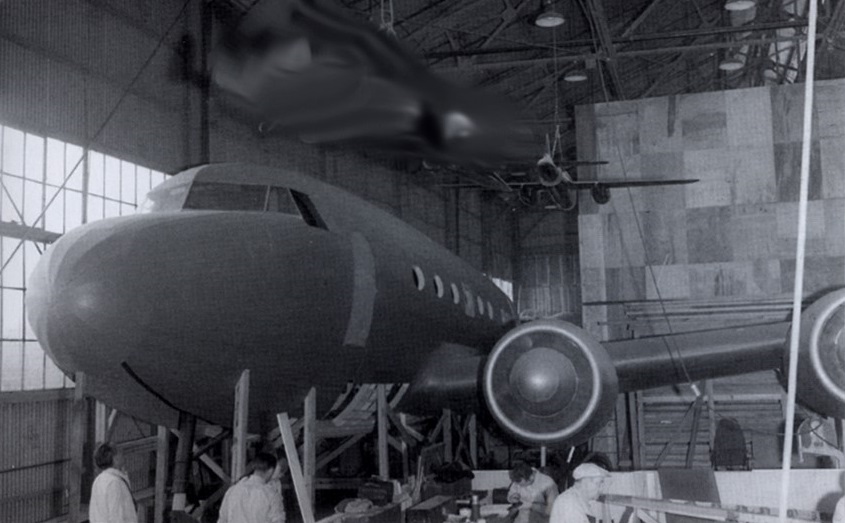
The original Excalibur design envisioned a 21-passenger payload, with a 240 mph (386 km/h) cruising speed. This was revised to 36 passengers at 268 mph (431 km/h) cruise at 12,000 feet (3,660m) altitude. This change included increasing the fuselage diameter, making it comparable to the Model 18 Lodestar, and increasing the wingspan to 95 ft 9 in (25.19 m) with an area of 1,000 ft² (92.9 m²). A tricycle landing gear with steerable nosewheel was envisioned. With the revised specifications, the Excalibur could now effectively compete with the near monopoly Douglas had on the airliner market. Its projected performance was better (except in range) than the Boeing 307. The revision of specifications was partially due to a request from Pan American Airlines; their influence also caused the addition of the third tailfin. A variant designated the L-144, able to carry 40 passengers was planned, but was ultimately cancelled even though South African Airways had placed a potential order for two examples. Lockheed proceeded with a full-scale mockup of the proposed Excalibur, including most of the airliner except the right wing.
The billionaire Howard Hughes, who had recently gained ownership of Transcontinental & Western Air (TWA), decided to provide funding for the new Excalibur. He had a plan in mind to vastly improve the characteristics of the Excalibur by increasing comfort, speed and profit of the aircraft. It was thus that Hughes invited three workers from Lockheed and Jack Frye (president of TWA) to a meeting at his Hancock Park residence. The Lockheed employees included Clarence “Kelly” Johnson and Robert E. Gross. Hughes expressed his requirements for the “airliner of the future”: a payload of 36 passengers (or 20 sleeping berths), a six-person crew, a 3,600 mile (5,800 km) range, a 300 mph (483 km/h) cruise speed, and a weight of 23.5-25 metric tonnes. This meant that the Excalibur would have to get a 100 mph (161 km/h) increase in speed and be able to fly 1,000 ft (305 m) higher. It would need to cross the United States nonstop. The first decision was to re-engine the Excalibur with Wright R-2600 radials, which had not been tested yet. The next decision was to start from scratch while saving the overall shape and triple tail configuration of the original Excalibur.
The new design differed so much from the original Excalibur, that a different model designation was needed. It was first given the temporary designation L-104, then it was later officially designated the Model 49 or “Excalibur A”. In time, the Model 49 would become a completely different aircraft from the original Model 44. Lockheed later dropped the name “Excalibur” as the new airliner had little to do with its predecessor. The end result was the Lockheed L-049 Constellation.
Powerplant: 4 × Pratt & Whitney Twin Wasp S4C-4-G, 1200 hp (895 kW) each Wingspan: 95 ft 0 in (28.96 m) Wing area: 1000 sq.ft (92.90 sq.m) Aspect ratio: 9.025 Length: 74 ft 11½ in (22.85 m) Empty weight: 26,424 lb (11,986 kg) Gross weight: 40,000 lb (18,144 kg) Crew: two Capacity: 32 passengers
When in August 1957 the US Navy needed an advanced ASW/maritime patrol aircraft, it was suggested that a variant of a type then in production would be most suitable for this requirement. Lockheed proposed a developed version of the L-188 Electra, gaining an initial research and development contract on 8 May 1958.
Lockheed’s Model 186, which retained the wings, tall unit, power plant and other components of the commercial Electra, as well as much of the fuselage structure which was, however, shortened and provided with a 6.9m3 weapons bay, and there are 10 under-wing pylons for a variety of stores. The first Lockheed P 3 Orion, NP 3A BuNo 148276, was converted from the third L.188 Electra airliner by removing 7ft (2.1m) from the fuselage, flying from Burbank in August 1958. The air¬craft saw extensive use as an aero-dynamics test bed. It was eventually transferred to NASA.
Pressurised for the higher altitudes, the aircraft can operate from sea level, (usually 200ft minimum) up to 30,000 ft with a speed range from 140 to 405 knots. The engines are four x 4600 hp Allison turbo props with Hamilton Standard propellers. Maximum all up weight at take off is 14,500 lbs (6577 kg) higher than the original airliner at 127,500 lbs (57,800 kg) including a maximum of 60,000 lbs (34,000 lites) of fuel.
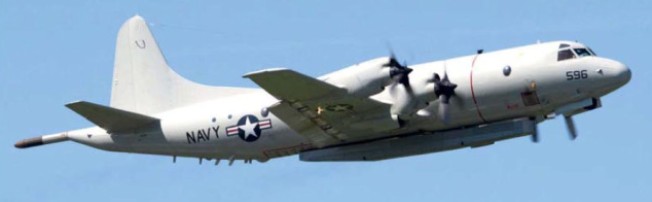
This was followed by the Lockheed YP3V-1 operational prototype, later named Orion, which first flew on 25 November 1959. The first production P3V-1 was flown on 15 April 1961, with initial deliveries being made to US Navy Patrol Squadrons VP-8 and VP-44 on 13 August 1962, by which time the type had been redesignated the P-3.
In August 1963 a US Navy crew flew a P-3A nonstop from California to Japan, 5280 miles, in 14 hr 30 min. After several demonstration flights it returned nonstop in 14 hr 5 min.
One hundred and fifty seven P-3As and 144 P-3Bs followed and production switched to the origi¬nal P-3C in 1968. P-3C is powered by 4,910 ehp (3 661 kW) Allison T56-A-14 turboprops. Progressive development of the P-3C’s systems through Update I and II has led to the production P-3C Update III model. The first P-3C Update III, with IBM Proteus acoustic processors, was delivered in May 1984. Update IV will improve the P-3’s ASW capability by the use of new acoustic processing systems and Litton AN/ALR-77 tactical ESM equipment. The P-3G would also feature Allison 501 turboprops in place of the T56-A-14s of the preceding model.
By 1994, production in Georgia was with wings built by Daewoo Aerospace in Korea and tail surfaces by Jetstream Aviation at Prestwick in Scotland, and remaining in production in the U.S.A. until 1995.
The first Kawasaki-assembled P-3C Orion was accepted by the Maritime Self-Defence Force at Gifu, Japan, on 27 May 1982. Flown for the first time on 17 March 1982, this aircraft was built from knocked-down components, and Kawwasaki was scheduled to deliver four more by March 1983. All were to be assigned to the 4th Air Group at Atsugi AB, near Tokyo.
Following the assembly in Japan of four P-3C aircraft from Lockheed-built components, Kawasaki produced the Lockheed Martin P-3C Orion for the JMSDF; 101st and final aircraft delivered in 1997, when four EP-3/UP-3D electronic intelligence/training variants remained to be delivered up to the year 2000.
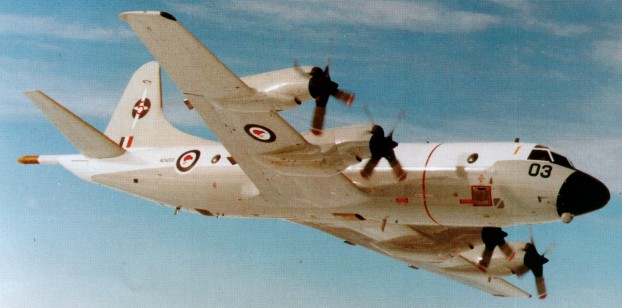
Other export P-3s feature various equipment changes: Australian P-3Cs used Marconi Avionics AQS-901 acoustic processing; the 21 Canadian CP-140 / CP-140A Auroras have S-3 Viking avionics; and New Zealand’s P-3Bs are fitted with Boeing’s UDACS display and control consoles. The US Customs Service became the first customer for Lockheed’s P-3 (AEW&C) airborne early warning aircraft in May 1987. These aircraft will have a reduced mission system suitable for their task, while the full AEW&C aircraft would have a General Electric AN/APS-138 radar and APA-171 rotodome above the fuselage, together with a M1L1553A communications and data handling system. During 1984 Lockheed converted an ex-RAAF P-3B to serve as the AEW&C prototype, featuring the dorsal “rotodome”. Designated EP-3Es and converted from P-3As, twelve versions serve with the US Navy to provide electronic surveillance. The EP-3s are equipped with APS-120 radar plus extensive jamming, detection and analysis equipment.
The significantly upgraded Australian Orions, designated AP-3C, were introduced into service in 2002 and are fitted with a variety of sensors, including digital multi-mode radar, electronic support measures, electro-optics detectors (infra-red and visual), magnetic anomaly detectors, identification friend or foe systems, and acoustic detectors.
The major changes since the Orion entered service have been in avionics equipment and capability, and more than 640 have been built to 1989, with the type then continuing in production (at Marietta, Georgia) until 1995/56 for South Korea, who ordered eight P-3C Update Ills in December 1990. Other Orions were in service in Iran, the Netherlands, New Zealand, Norway, Pakistan, Portugal, Spain and NASA and NOAA.
P-3 LSRS
The last of 18 upgraded AP-3C Orions was formally handed over to the RAAF in 2005. The first upgrade was performed by L-3 Communications in the USA and the remainder by L-3 and then Tenix in Australia. The programme was completed four years behind schedule.
L-3 Communications re-delivered the first of six P-3Ks to the RNZAF with sensor, communications and navigation systems upgrades in July 2005.
P3V-1 Orion Engines: 4 x Allison T56-A-10W, 4500 hp Wing span: 99 ft 8 in Length: 116 ft 8 in Height: 33 ft 8 in Wing area: 1300 sq.ft MTOW: 125,500 lb Max speed: 460 mph at 20,000 ft Service ceiling: 27,000 ft Endurnce -2 engines: 8 hr at 220 mph at 1000 ft
P-3B Orion Engines: 4 x Allison, 4910 shp. Wing span: 99 ft 8 in (30.37 m). Length: 116 ft 10 in (35.61 m). Height: 33 ft 8.5 in (10.29 m). Max TO wt: 134,000 lb (60,780 kg). Max level speed: 476 mph ( 765 kph).
P-3C Orion Engine: 2 x Allison T56-A-14 turboprop, 4910 shp / 3661kW. Installed thrust: 14,640 kW. Wingspan: 30.38 m / 99 ft 8 in Length: 35.61 m / 116 ft 10 in Height: 10.27 m / 33 ft 8 in Wing area: 120.77 sq.m / 1299.96 sq ft Empty wt: 27,890 kg / 61492 lb MTOW: 127,500 lb (57834 kg) Heavywt model MTOW: 135,000 lb (61,236 kg). Warload: 9070 kg. Max speed: 476 mph @ 15,000 ft. Cruise: 340 kt. Initial ROC: 880 m / min. Ceiling: 8600 m. T/O run: 1290 m. Ldg run: 845 m. Fuel internal: 34,830 lt. Max range: 4500nm. Endurance: 3 hr on station. Crew: 10 Air refuel: No. Armament: 9000kg
P 3K Engines: 4x Allison T56. Length: 36m. Wingspan: 30m. Height: 10m. Weight: 57,800kgs. Max range: 7100kms (3850 NM). Cruise speed: 260 750 km/hr. Endurance: 15hrs with 2 engines shut down to conserve fuel. Cruise speed: 195 205 km/hr. Equipment: Rescue winch 270kg max load, nightsun search light, nightvision goggles. Armament: 2 x M60D 7.62 machine guns. Crew: 2 pilots, 2 flight engineers, 2 navigators, 1 air electronics officer, 3 air electronics ops, 1 air ordnanceman Seating: up to 20.
Lockheed Martin AP-3C Orion Engine: Four Allison T56-A-14 (4600 shaft horsepower) Length: 35.6m Height: 10.44m Wingspan: 30.8m Maximum weight: 61,200Kg Maximum speed: 750 km/h (405 knots), Cruise speed: 650 km/h (350 kts) at 26,000 feet Loiter speed:370 km/h (200 kts) Endurance: 15 hours Crew: 13, two pilots (captain and co-pilot), two flight engineers, tactical co-ordinator, navigator/communication officer, sensor employment manager, six airborne electronic analysts.
Lockheed P 3 Sentinel Engine: 4 x T 56 A14, 3314 shp Length: 116.798 ft / 35.6 m Height: 33.793 ft / 10.3 m Wingspan: 99.738 ft / 30.4 m Wing area: 1300.291 sq.ft / 120.8 sq.m Max take off weight: 142024.1 lb / 64410.0 kg Weight empty: 61497.5 lb / 27890.0 kg Max. payload weight: 80526.6 lb / 36520.0 kg Max. speed: 410 kt / 760 km/h Landing speed: 112 kt / 208 km/h Cruising speed: 328 kt / 608 km/h Initial climb rate: 1968.5 ft/min / 10.0 m/s Service ceiling: 28297 ft / 8625 m Wing loading: 109.27 lb/sq.ft / 533.0 kg/sq.m Range: 2071 nm / 3835 km Crew: 10







 All Aero