Trials in the direct-lift approach started with the MiG-21DPD to validate the basic concept, but were then taken a stage further with the Ye-230 prototype. This was built in parallel with the Ye-231 variable-geometry prototype to ensure maximum commonality for any production type resulting from the twin programmes. The Ye-230 was of tailed delta configuration, was powered by a Lyulka AL-1F-1 afterburning turbojet, and had the same type of lift engine arrangement as the MiG-21DPD, namely two turbojets (probably Koliesov units) located vertically on the centre of gravity with air drawn from above past a rear-hinged louvred dorsal door and exhausted downward through a grid of ventral transverse louvres which could be angled by the pilot to provide a forward thrust component during transition to forward flight.
The Ye-231 variable-geometry prototype was almost identical to the Ye-230 apart from its lack of lift jets and the use of variable-geometry swept wings similar to those of the General Dynamics F-111, the first operational variable-geometry warplane. Comparative trials revealed the superiority of the variable-geometry arrangement. and the Ye-231 thus became the precursor of the MiG-23 fighter, later adapted with a modified nose and simpler engine arrangements as the MiG-27 attack aeroplane.
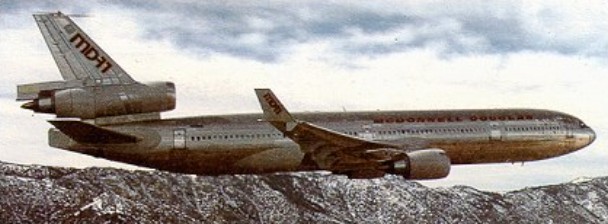
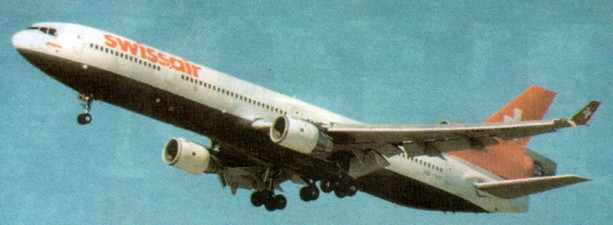
The MD-11 is a direct descendent from the DC-10, revealed at Paris Air Show 1985. British Caledonian ordered nine on 3 December 1986 and the official programme launch was on 30 December 1986.
The McDonnell Douglas MD-11 is an advanced-technology tri-jet designed to fulfil many airlines needs into the ‘90’s and beyond. After obtaining commitments for 92 aircraft from customers, the McDonnell Douglas board of directors gave the go-ahead for the MD-11 and the program was launched on the 30th of December 1986. On the 4th of March 1987 McDonnell Douglas saw the fabrication of the first parts for the MD-11 and the assembly of the first MD-11 began with the riveting of a portion of the nose on the 9th of March 1988 at Long Beach, California.
The MD-11 was very much an international aircraft with components being manufactured in many parts of the world. These included the vertical stabiliser, rudder and winglets from ‘Aeritalia’ in Italy, the wing and fuselage fillets from ‘Korean Air’ in Korea, the overwing fuel tanks, horizontal stabilizer and elevators from ‘Casa’, in Spain, and the outboard flaps from ‘Embraer’, in Brazil. One of the most noticeable differences between the DC-10 and the MD-11, has been the addition of winglets. These are seven feet high and have a lower segment of 2 feet 6 inches with an overall area of 40 square feet each side.
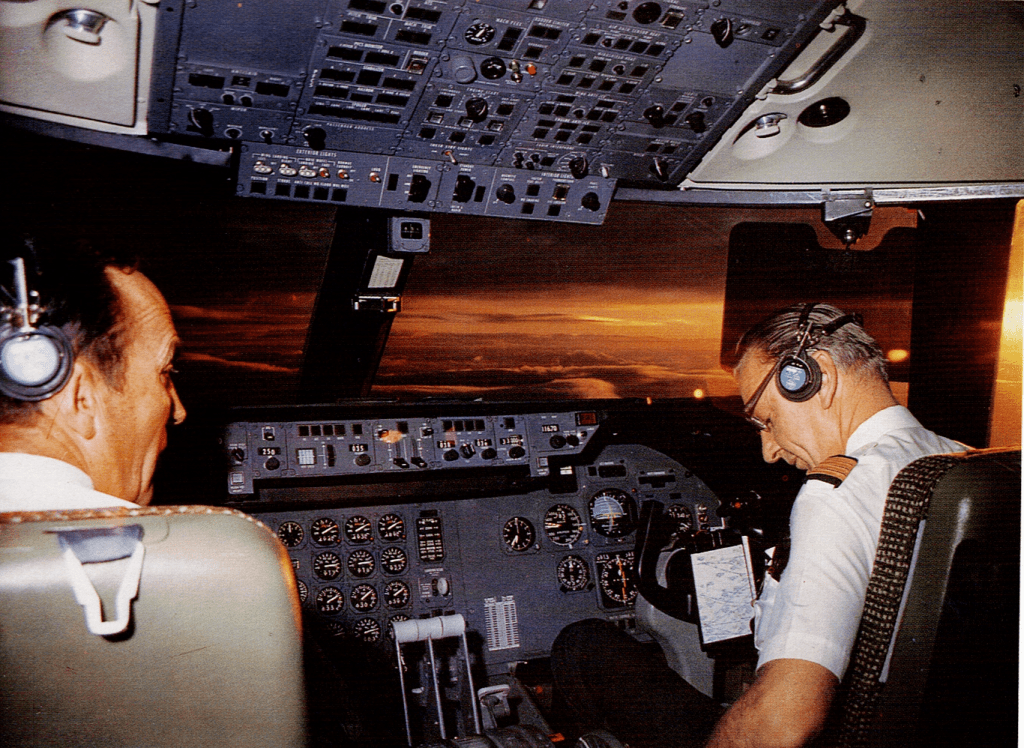
The advanced flight deck is designed for a two man flight deck crew using the latest digital technology to automate systems management via six, eight inch Cathode Ray Tube (CRT) displays.
The MD-11 flight deck concept was developed by a combined team of pilots, flight engineers and human factor experts, and operates on the ‘dark cockpit’ philosophy, that is. 99 percent of the time all light switches, warnings, and other devices are off. A light only goes on to alert, this assuring prompt pilot attention.
All alert information is displayed on the engine ‘CRT’ and action is taken by activating the switches on the overhead panels. The six ‘CRTs’ are used to display primary flight deck informa¬tion – two are to provide primary flight data; two are for naviga¬tion; one is for engine/alert displays, and the remaining one for systems. The ‘Honeywell/McDonnell Douglas’ designed flight deck also has a dual advanced flight management system, a dual advanced digital flight control system, wind shear detection and guidance devices.
The MD-11 had normal, abnormal and emergency checklist functions performed automatically rather than simply being displayed to the crew. No other new generation aircraft had the same level of automated systems management as the MD-11, however actions such as dumping fuel, or shutting down engines, were still left to the crew.
The MD-11 had been ordered by 29 customers and 312 commitments in all. The McDonnell Douglas MD-11 took off for its first flight from Long Beach ‘ California on 10 January 1990 (N111MD).
During the flight, the aircraft, which was powered by General Electric CF6-80C2 high bypass turbofan engines, reached altitudes of 25,000 ft and speeds of up to 300 knots. It is designed for a maximum level flight speed of 588 mph at altitudes of up to 43,000 ft. Other powerplants offered were the Pratt & Whitney PW4460 and Rolls-Royce Trent 650.
Of the five aircraft in the flight test programme (four with GE engines, one with P&W), the first flight of third prototype powered by P&W PW4460s, was on 26 April 1990
A fifth MD-11 brought the total test programme hours to 2,000.
Certification came on 8 November 1990 and deliveries began the same year. The first-three MD-11 off the production line were delivered to Federal Express, while American Airlines were the first passenger airline to receive the MD-11 (at the end of 1990). The 100th MD-11 was delivered on 30 June 1993. As of November 1996, McDonnell Douglas had made 146 sales of the MD-11 aircraft.
Several variants included long range MD-11ER, the MD11CF freighter and two combination freighter/passenger aircraft. Certification with the R-R Trent 650 was discontinued, and the fuselage production line was moved from San Diego to Long Beach during early 1996.
MD-11F N624FE Sydney, Australia January 2007
Boeing elected to cease production of the MD-11 in February 2000, after the delivery of the 200th aircraft (D-ALCN) which was delivered to Lufthansa Cargo on 22 February 2000.
MD-11 Engines: 3 x General Electric CF6-80C2D1F turbofans, 61,500 lb MTOW: 273.28 tonne MLW: 195.04 tonne Wing span: 169 ft 6 in (51.7m) Wing area: 3,648 sq.ft (339 sq.m) Length: 200 ft 10 in (61.2m) Fuel cap: 117.468 tonnes Range: 12,741 km Pax cap: 293.
MD-11 Seats 315-400 Gross wt. 602,500 lb Empty wt. 277,000 lb Fuel capacity 32,185 USG Engines 3 x 58,000-lb. s.t. Pratt & Whitney PW4358 turbofans Top speed 644 mph Cruise 588 mph Ceiling 45,000+ ft Range 5,010 miles Takeoff distance 10,100 ft Landing distance 6,470 ft
MD-11P Engines: 3 x General Electric CF6-80C2D1F turbofans, 273kN Max take-off weight: 273300 kg / 602527 lb Empty weight: 125870 kg / 277497 lb Wingspan: 51.6 m / 169 ft 3 in Length: 61.2 m / 200 ft 9 in Height: 17.6 m / 57 ft 9 in Wing area: 338.9 sq.m / 3647.89 sq ft Max. speed: 962 km/h / 598 mph Cruise speed: 876 km/h / 544 mph Ceiling: 11000 m / 36100 ft Range w/max.fuel: 11000 km / 6835 miles Range w/max.payload: 9270 km / 5760 miles Crew: 2 Passengers: 293-405
Since 1949 the McDonnell Helicopter Engineering Division had attempted to develop a rotor system capable of high-speed operation. Such a system driven by tip-mounted pressure jets had been successfully tested on the XV-1 convertiplane and its use as a pure helicopter rotor was thought to offer many significant advantages, including (1) inherent angle of attack stability; (2) increased inherent pitch and roll damping; (3) greatly improved dynamic helicopter stability; (4) ability to start and stop in high winds; (5) no need for tracking and no dampers required; (6) no possibility of mechanical instability or ground resonance; (7) very low vibration; (8) low maintenance due to absence of highly loaded bearings, reduction gears, shafting, and anti-torque rotor; and (9) automatic rotor speed control. Accordingly, McDonnell decided in December 1956 to undertake as a private venture the design, development, and testing of a small single-seat crane helicopter using the XV-1 rotor.
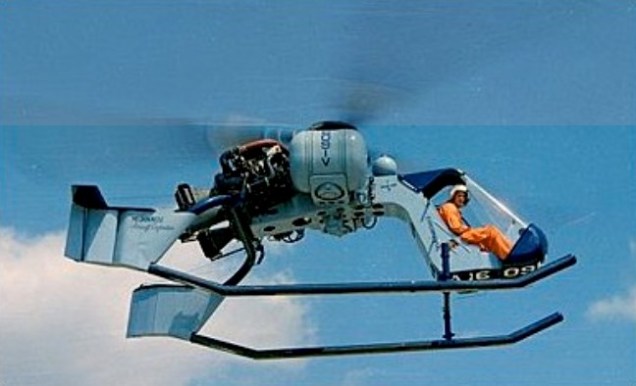
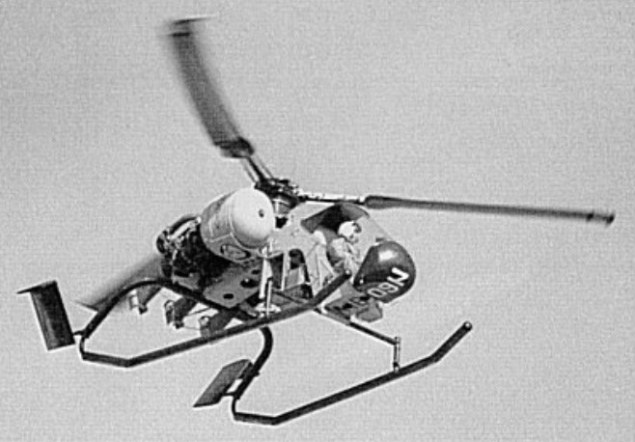
The mock-up of the Model 120, which was designed by a team led by Project Engineer Lloyd R. Novak, was completed in January 1957, and the first (N6081V) of two prototypes was flown on 13 November of that year by John R. Noll. This helicopter was of simple design, with the pilot seated centrally and the fuel tanks mounted on each side of the upper fuselage beneath the rotor head. Three AiResearch GTC-85-135 gas-turbine compressors, which fed pressure jets at the tips of the three-blade rotor, were located below and behind the rotor head. A wide-spaced skid undercarriage enabled large loads to be slung beneath the centre of gravity, or specialized pods to be fitted to carry up to 12 troops, firefighting equipment, or cargo containers.
In spite of some powerplant teething problems, the Model 120 demonstrated a maximum load-to-weight ratio of 1.5:1. Unfortunately, in spite of having been judged ‘one of the most outstanding helicopters evaluated to-date in its weight class’ when flown at the Naval Air Test Center, NAS Patuxent River, in September 1959, the Model 120 remained experimental as McDonnell failed to win either military or civil orders for this competent design. The termination of this programme in February 1960 marked the end of McDonnell’s independent efforts in this field as 13 months earlier the US Marine Corps had terminated the development of the XHCH-1 crane helicopter. McDonnell Douglas, however, came back to the helicopter field in 1984 with its acquisition of Hughes Helicopters, Inc.
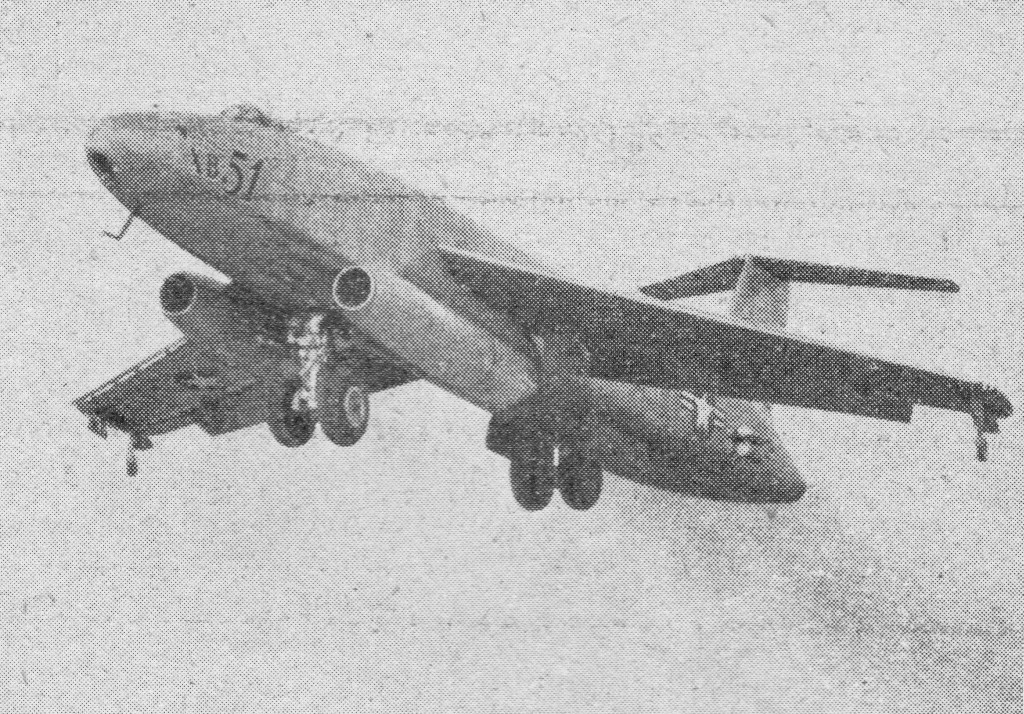
In World War lithe USAAF made widespread and effective use of the attack bomber for battlefield tasks. For post¬war service the USAAF wanted a higher-speed successor, and the specification produced two types in the Douglas XB-43 and Martin Model 234 XB-51.
The Martin was designed originally to meet a US Army Air Force requirement for a close-support bomber, being allocated the designation XA-45. However, it was developed instead as a medium bomber with turbojet power-plant and two prototypes were ordered under the designation XB-51.
The XB-51 featured a tandem-unit landing gear arrangement, a thin variable ¬incidence wing whose leading edges were swept at 35 degrees, a swept T-tail. It was powered by three 2640kg thrust General Electric J47-GE-7 or -13 turbo-jets, one pylon-mounted low on each side of the forward fuselage and the third within the rear fuselage.
Other features included pressurised accommodation for the two-man crew, provisisions for JATO (jet-assisted take-off) units, and a braking parachute.
The first of two aircraft flew in October 1949, Martin’s Director of Flight O.E. (Pat) Tibbs making the first flight, taking off from Baltimore and lading at Naval Air Test Centre at Patuxent, in a flight of 35 minutes.
XB-51 first take off
Although flight trials confirmed that the XB-51 had very good performance, they revealed that the type had poor handling qualities in the air. The XB-51 did not proceed past the prototype stage and the USAF opted instead for licence-production of the English Electric Canberra as the Martin B-57.
Engines: 3 x 2360kg General Electric J47-GE-13 Max take-off weight: 25393 kg / 55982 lb Empty weight: 13431 kg / 29610 lb Wingspan: 16.18 m / 53 ft 1 in Length: 25.93 m / 85 ft 1 in Height: 5.28 m / 17 ft 4 in Wing area: 50.91 sq.m / 547.99 sq ft Max. speed: 1038 km/h / 645 mph Cruise speed: 857 km/h / 533 mph Ceiling: 12344 m / 40500 ft Range: 2576 km / 1601 miles
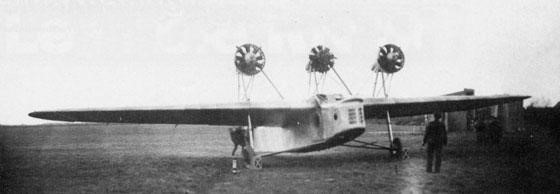
In 1919 built ultralight Butterfly and a three-engined triplane, Model H Owl, based on Caproni design. This was offered to the Army but was not accepted.
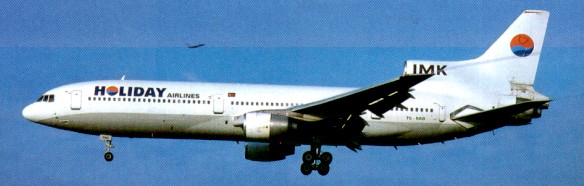
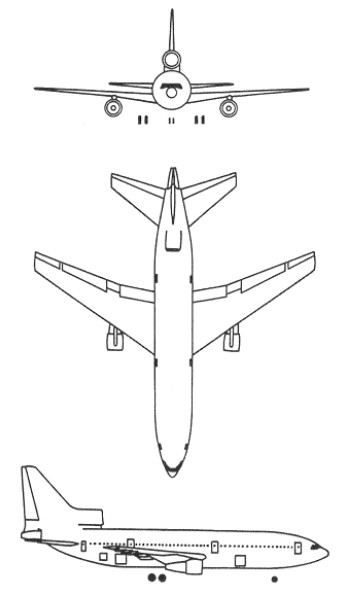
In the 1960s, American Airlines approached Lockheed and competitor Douglas with a need for an aircraft smaller than the existing 747, but still capable of flying to distant locales such as London, the Caribbean, and Latin America from company hubs in Dallas/Ft Worth and New York. The Model L-1011 was designed to enter this category with optimum payload-range performance and short-field characteristics. The Model L-1011 is powered by three 42,000-lb. s.t. turbofan engines, two of which are mounted in pods underneath each wing, and the third is located in the rear of the fuselage at the base of the tail unit. The TriStar’s engine is integrated into the tail through an S-duct for improved quietness and stability. Fuel is carried in two integral wing tanks and an inboard tank. With a full load, the TriStar can travel a maximum of 4,467 miles. Accommodations provide for 256 passengers in a mixed coach and first-class arrangement or a maximum of 400 passengers in a high density all-economy configuration.
First flown on November 16, 1970, the twin-aisle TriStar’s design schedule closely followed that of its competitor, the DC-10, Douglas beat Lockheed to market by a year due to delays in powerplant development. Rolls-Royce, the maker of the TriStar’s RB211 turbofan engines, had filed for bankruptcy, halting L-1011 final assembly. The first flight was powered by Rolls Royce RB.211 high by pass ratio turbofan engines, from Palmdale, California.
The British government did not approve the large state subsidy used to restart Rolls-Royce operations until after the U.S. government had guaranteed the Lockheed loans previously provided to Rolls for the extensive engine contract. (The UK Goverment also took the contentious step (for a Conservative administration) of taking the aero-engine side of RR into public ownership, to maintain national defence capability). Its first revenue flight, for Eastern Air Lines, was made on 26 April 1972.
A longer-range variant of the standard-length L-1011 was developed in the late 1970s. Designated the L-1011-500, the fuselage length was shortened by 14 feet (4.3 m) to accommodate higher fuel loads.
Ironically, American Airlines never flew the “Ten Eleven,” purchasing many DC-10s instead.
Lockheed manufactured a total of 250 TriStars, ceasing production in 1984. Lockheed needed to sell 500 planes to break even. Failing to achieve profitability in the civilian airliner sector, the TriStar was to be Lockheed’s last commercial aircraft.
Flying all of its life on test and development work, the prototype was acquired by Aviation Sales of Ardmore in August 1986.
L-1011 Tristar Engines: 3 x Rolls Royce RB.211 22B turbofan, 42,000 lb / 180.5kN Wing span: 155 ft 4 in (47.34 m). Length: 178 ft 8 in (54.35 m). Height: 55 ft 4 in (16.87 m). Wing area: 312.1 sq.m / 3359.41 sq ft Empty wt. 102000 kg / 222,941 lb Max TO wt: 430,000 lb (195,045 kg). Fuel capacity 23,814 USG Max level speed: M0.9. Cruise 474 mph. Stall 144 mph. Initial climb rate 2,800 fpm Ceiling: 42,000 ft. Range w/max.payload: 5000 km / 3107 miles Pax cap: 345. Takeoff run 7,590 ft Landing roll 5,660 ft Crew: 2-3
A five-passenger high-wing monoplane tri-motor airliner of 1931. Power was by a 3 x 140 hp 14-cyl Walter Mars. Four were built. The Š.328/528 series were reconnaissance/light bomber biplane developments of the Š.32.
Two more examples of the Leduc 0.10 were built, the first an identical 0.10, the other differing only by having two wingtip-mounted turbojet engines to accelerate the aircraft to the ignition speed of the ramjets. This last aircraft, designated 0.16, was first flown on 8 February 1951, but the turbojet engines were later removed.
The Leduc 016 was developed with wingtip mounted Marbore I.







 All Aero