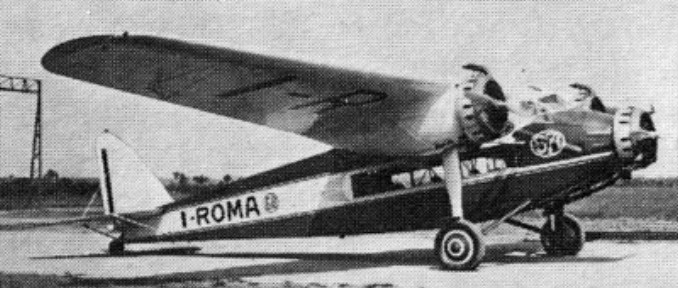
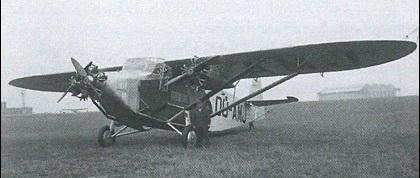
Eight-passenger commercial monoplane of 1930 powered by three 179kW Walter Castor, 253kW Walter Pollux II, or 276kW Piaggio Stella VII engines. Several were produced.
Max take-off weight: 4600 kg / 10141 lb Loaded weight: 2900 kg / 6393 lb Wingspan: 21.2 m / 70 ft 7 in Length: 14 m / 46 ft 11 in Height: 4.1 m / 13 ft 5 in Wing area: 60 sq.m / 645.83 sq ft Max. speed: 235 km/h / 146 mph Ceiling: 6000 m / 19700 ft Range: 1600 km / 994 miles
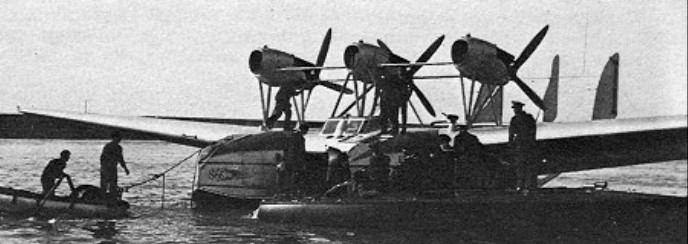
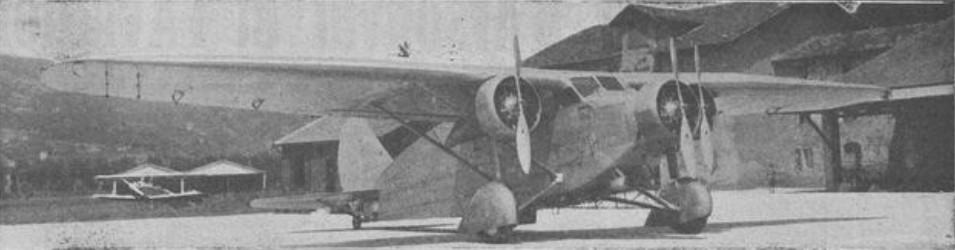
First appearing in 1931, the S.66 prototype was a larger development of the S.55 accommodating 14 passengers and powered by three A.22R engines. The Savoia-Marchetti S.66 was powered by three 750 h.p. FiatA 24R engines. Each of its twin hulls could seat up to nine passengers, while the cockpit was in the wing centre section.
Production aircraft were fitted with 522kW Fiat A.24R engines, raising accommodation to 18. S.66s entered commercial service and at least one was taken on charge by the Regia Aeronautica.
Around 25 were built.
Max take-off weight: 10950 kg / 24141 lb Loaded weight: 7450 kg / 16425 lb Wingspan: 33 m / 108 ft 3 in Length: 16.65 m / 55 ft 8 in Height: 4.9 m / 16 ft 1 in Wing area: 126.7 sq.m / 1363.79 sq ft Max. speed: 238 km/h / 148 mph Ceiling: 5350 m / 17550 ft Range: 1200 km / 746 miles
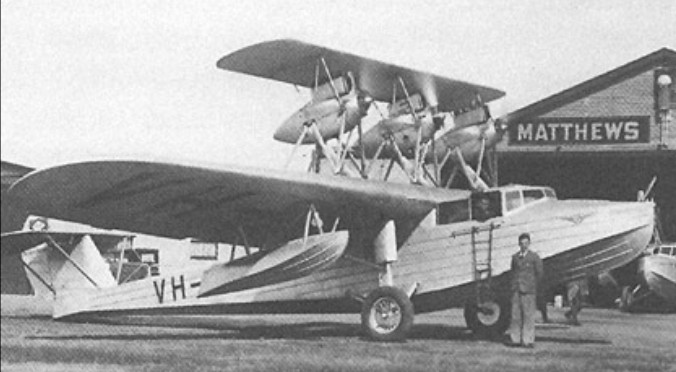
The Windhover was a six-seat three-engined flying-boat with an auxiliary upper wing first flown in 1931. One built. It crashed in 1936 during attempted night landing in Currie Harbour, King Island in Bass Strait, Australia. A total loss
Engines: 3 x de Havilland Gipsy II, 89kW Passengers: 6 Crew: 2
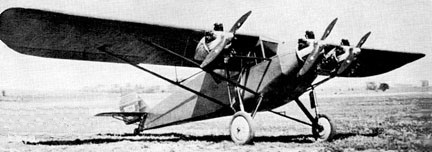
The sole Triad 1000 (ATC 2-229) of 1930 was registered NX/NC808M c/n 1001.
It was reportedly scrapped in 1936 after its motors were traded for a new Porterfield. Assets of the corporation were liquidated in 1939 after the death of Irving Saul in 1933, but several accounts indicate that the aircraft was still operational long after that time.
The SABCA S.11 was a prototype Belgian 20 passenger airliner of 1928, developed from the S.3. It was a three-engined 420 hp Jupiter powered high-winged monoplane intended for service in the Belgian Congo, but only a single example was built.
In 1930 the Direection Générale Technique issued a programme for an aircraft to operate in the French Colonies. It was to have three Lorraine 9N Algol engines and an all-metal structure, capable of reconnaissance, observation, policing and bombing as well as medical evacuations or general transport. The Romano R.16 was one of nine prototypes built to this programme.
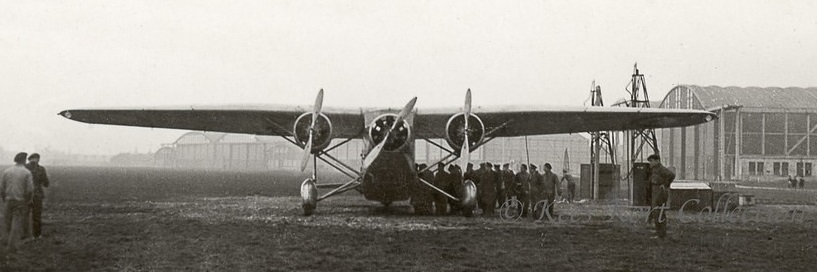
Despite the all-metal requirement, the Romano R16 initially flew with a wing of mixed construction which was originally built for the rather similar Romano R.6 civil passenger aircraft. It is not known if the intended wing, all-metal and expected to be lighter, ever replaced it. On each side the high wing was in two parts, with a rectangular inner section attached to the top of the fuselage. The outer panels were straight tapered to rounded tips. The wing had two wooden box spars and spruce ribs and was entirely plywood covered. The centre section, over 40% of the span, was braced at its outer ends with a pair of parallel steel wing struts between the wing spars and the lower fuselage longerons, so that the R.16’s wing was a semi-cantilever one. High aspect ratio ailerons occupied the whole outer panel trailing edge and camber changing flaps filled those of the centre section.
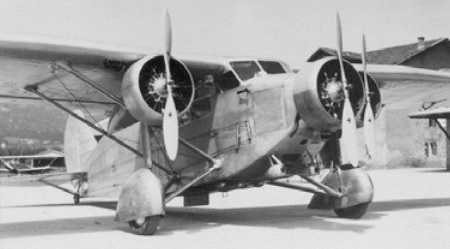
The R.16 was powered by three 220 kW (300 hp) Lorraine 9N Algol nine cylinder radial engines enclosed by long chord NACA-type cowlings. One was in the nose of the fuselage and the other were mounted under the wing centre section from the forward wing struts, aided by bracing struts rising inwards to the wing root and short vertical struts to the forward spar. Long nacelles behind the outer engines tapered to the rear wing strut.
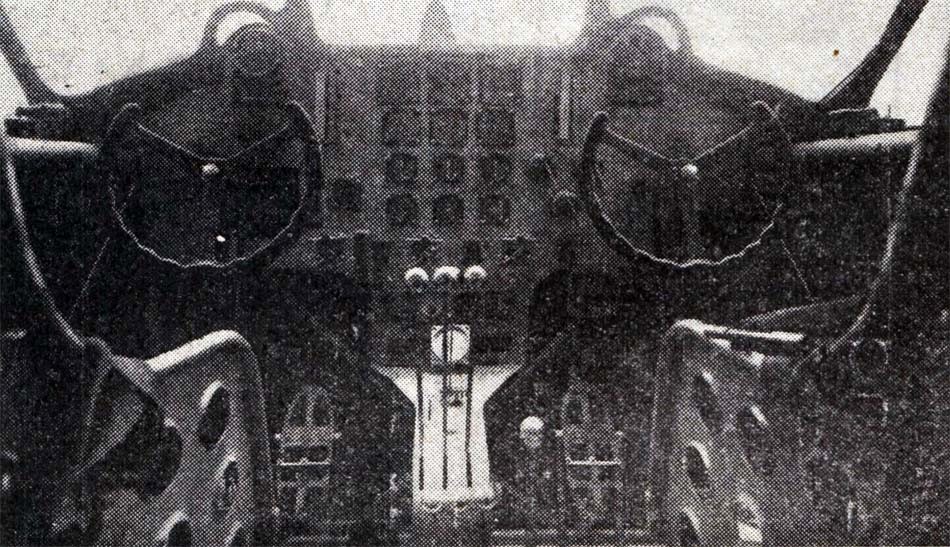
Structurally the R.16’s fuselage was built around steel tube longerons, giving it a simple rectangular cross-section. The pilots’ enclosed cabin was below and just ahead of the wing leading edge, fitted with side-by-side seating and dual controls. Behind them there was a generous cabin, accessed via a large port side door. Aft of the cabin, just behind the trailing edge was a dorsal gunner’s position. At the rear the fixed surfaces were approximately triangular and carried a balanced rudder and elevators, also balanced. Each tailplane was braced on the vertex of a V-strut from the lower fuselage. The tail surfaces were steel tube structures with fabric covering.
The colonial aircraft were expected to have to use basic or unprepared strips, so needed a robust undercarriage. The R.16 had large 1,150 mm (45 in) diameter wheels, independently mounted and fitted with brakes that could be use for steering, enclosed under large fairings. Each wheel was on a cranked steel half axle from the lower fuselage with a trailing recoil strut and a vertical oleo leg to the engine mounting.
The R.16 flew for the first time in February 1933. By May the initial development tests at Romano’s Cannes factory were complete. It then went to Villacoublay for its official tests, which were completed by early September.
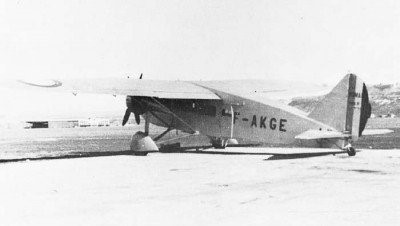
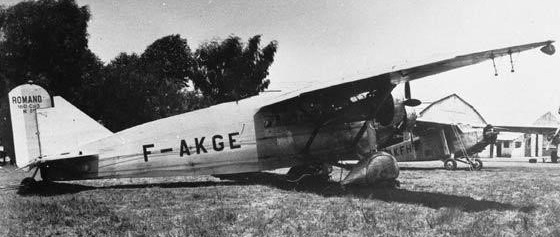
The Colonial trimotor contract was awarded to the Bloch MB.120, so no more R.16s were built. The sole example appeared in the prototypes section of the French civil aircraft register as F-AKGE, with the type name Romano 160 and was used by the Commander of the 5th Aerial Region of French North Africa as his personal transport. A photograph taken at Cannes in 1937 shows that by then it had been adapted to carry passengers, the cabin now lit by long, continuous windows on each side. It also had a revised vertical tail with an unbalanced rudder.
Romano R.16 Powerplant: 3 × Lorraine 9Na Algol, 220 kW (300 hp) each Propellers: 2-bladed Ratier Wingspan: 21.60 m (70 ft 10 in) Wing area: 70 m2 (750 sq ft) Length: 13.90 m (45 ft 7 in) Height: 4.05 m (13 ft 3 in) Empty weight: 3,138 kg (6,918 lb) Gross weight: 5,200 kg (11,464 lb) Fuel capacity: 415 l (91 imp gal; 110 US gal) Maximum speed: 230 km/h (140 mph, 120 kn) at ground level Cruising speed: 195 km / h Landing speed: 81 km/h (50 mph; 44 kn) Range: 1,200 km (750 mi, 650 nmi) Service ceiling: 2,400 m (7,880 ft) theoretical Time to altitude: 13 min 5 sec to 3,000 m (9,800 ft) Take-off distance: 150 m (490 ft) Crew: Three
The Romano R.6 was a transport aircraft built by Romano in France in the early 1930s. It was a three engine, high wing monoplane transport of all-metal construction.
First flying on 20 December 1932, only the one was built.
A longer wing-span colonial police transport was also built as the Romano R.16.
Engines: 3 × Gnome & Rhône 7Kb, 220 kW (300 hp) each Propellers: 2-bladed Ratier Wingspan: 19.64 m (64 ft 5 in) Wing area: 63.00 m2 (678.1 sq ft) Length: 13.90 m (45 ft 7 in) Height: 3.27 m (10 ft 9 in) Empty weight: 3,047 kg (6,717 lb) Gross weight: 4,473 kg (9,861 lb) Maximum speed: 216 km/h (134 mph, 117 kn) at ground level Range: 1,000 km (620 mi, 540 nmi) Service ceiling: 6,850 m (22,470 ft) theoretical Crew: Three Capacity: 8 passengers


 All Aero