Yakolev Yak-40

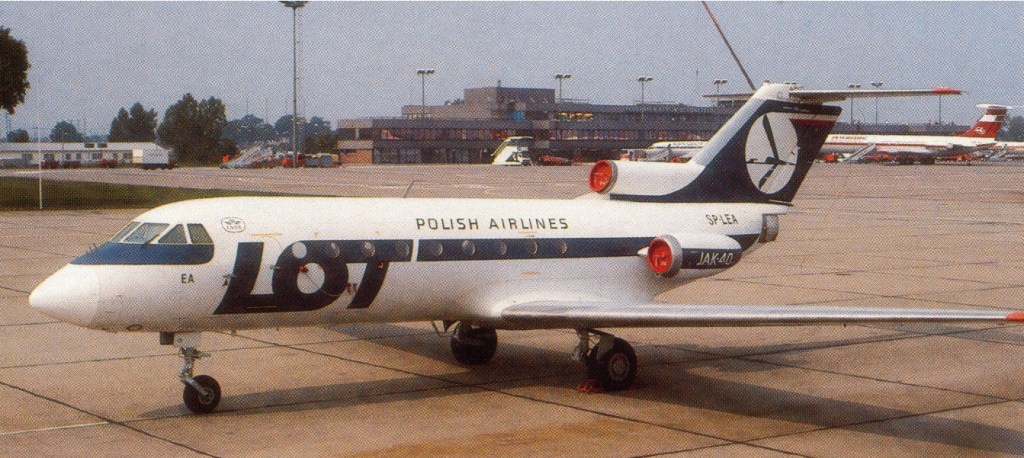
Development the Yak-40 as a replacement of the ageing LI-2, Il-12 and Il-14’s, started in 1965 by the Yakolev Design Bureau. The Yak-40 was required to operate from Class 5 grass airfields or semi-prepared strips. The resulting aircraft has high-lift lightly-loaded wings and, for added safety, three Ivchenko AI-25 turbojets. All three engines are operated on take-off, but the central engine may be throttled back to idle for fuel economy during cruise. In configuration, the Yak-40 is a cantilever low-wing monoplane with retractable tricycle landing gear, rear-mounted engines and with accommodation for a flight crew of two or three and up to 32 passengers. The provision of a ventral rear door with airstair makes it possible to operate the Yak-40 from airfields with minimum facilities, and an onboard auxiliary power unit makes the type independent of ground equipment for engine starting and the maintenance of cabin heating and air-conditioning.

The first prototype tri-jet was flown on 21 October 1966, the Yak bureau eventually building five pre-production test airframes. The type entering revenue service with Aeroflot on 30 September 1968 with 2 crew and 27-31 passengers (NATO reporting name ‘Codling’).

The Yak-40 is cleared for Class Five grass airfield operations, and to improve its short landing performance a single clamshell thrust reverser has been fitted to the centre engine on later production models. The rear mounted turbofan engines enable it to take off and land within 1500 ft (500 m), and it can operate from grass fields.

The Yak-40K cargo version is configured purely for the carriage of freight, the aircraft being cleared to carry a load of up to 5070 lbs in weight.

When production ended in 1980, 1011 Yak-40 airliners were built in Saratov in the former USSR. The majority of these are still in service in 1993, with both military and civilian operators.

Gallery

Yak40
Engines, Ivehenko Al-25 (3 x 3300 lb thrust)
Max take-off weight, 27,500 lb
Payload. 5500 1h
Cruising speed, 405 kt
Range. 620-1240 st. miles
Take-off distance to 50 ft, 1950 ft
No. of passengers, 24

Engines: 3 x 3,306 lb (1,500 kg) st Ivehenko AI 25 turbofans
Wing span: 82 ft 0.25 in (25.00 m)
Length: 66 ft 9.5 in (20.36 m)
Wing area: 735 sq ft (70.0sq.m)
Gross weight: 30,200 lb (13,700 kg)
Max cruising speed: 342 mph (550 kph)
Typical range: 620 miles (1,000 km) with normal payload of 5,070 lb (2,300 kg)
Crew: 2
Passengers: 24 40
T/O run: 700m
Ldg run: 360m
Cargo: 5070 lbs

Engines: 3 x turbo-jet AI-25, 14.7kN
Max take-off weight: 12400 kg / 27337 lb
Empty weight: 8500 kg / 18739 lb
Wingspan: 25.0 m / 82 ft 0 in
Length: 20.2 m / 66 ft 3 in
Height: 6.5 m / 21 ft 4 in
Wing area: 70.0 sq.m / 753.47 sq ft
Cruise speed: 550 km/h / 342 mph
Range w/max.fuel: 1600 km / 994 miles
Range w/max.payload: 600 km / 373 miles
Crew: 2
Passengers: 24-33

Yakolev Yak-40

Yakolev Yak-38

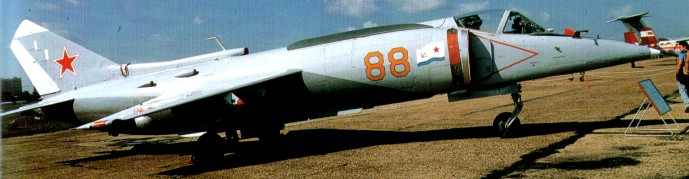
Flown in prototype form in 1971, the Yak-38 was developed under the design leadership of S Mordovin for the primary tasks of fleet air defence against shadowing maritime surveillance aircraft, reconnaissance and anti-ship strike. Power plant combined a Yu Gusev-developed Tumansky R-27V thrust-vectoring turbojet with two Rybinsk (Koliesov) RD-36-35 vertical-lift turbojets designed by a team led by A Dynkin. Hydraulic drives synchronised by a transverse shaft rotated the thrust-vectoring nozzles aft of the wing, their output in vertical take-off and landing operations being balanced during hover and transition by the paired lift engines mounted in tandem immediately aft of the cockpit and inclined forward 13 degrees from the vertical.

Yakolev Yak-38 Article

Yak-38A


Shipboard trials with the Yak-38 began aboard the Moskva half-deck anti-submarine cruiser in 1972, and, in the following year, the decision was taken to build a pre-series of Yak-38 fighters for service evaluation, the first two of these landing aboard the carrier-cruiser Kiev in 1975. An evaluation squadron comprising 12 single-seat Yak-38s and two two-seat Yak-36Us embarked aboard the Kiev in the summer of 1976, the aircraft being confined to vertical take-off with conversion following at 5-6m above the deck. During 1976, production was initiated of a much improved version of the basic design as the Yak-38.

Yak-38 aboard Kiev

Externally similar to the Yak-36M, apart from substantial strakes either side of the intake for the lift engines, the Yak-38 possessed a full weapons system and an automatic control system permitting a short roll leading into vertical take-off as distinct from an orthodox short take-off benefiting from wing-induced lift. Although intended only for vertical take-offs and landings, the ‘Forger’ had double-slotted flaps and a braking parachute.
The Yak-38 entered service with the Soviet Navy in 1978, and, during 1980, was evaluated under operational conditions in Afghanistan. Progressive development resulted in the Yak-38M, which, with 1000kg more engine thrust, a steerable nosewheel and provision for paired 600-litre underwing auxiliary tanks, entered production in succession to the Yak-38. The Yak-38M had a 6940kg R-27V-300 thrust-vectoring turbojet and two vertical-lift RD-38 turbojets each rated at 3250kg. Two wing stations immediately inboard of vertically-folding panels provided for two gun pods each containing a twin-barrel 23mm GSh-23 cannon, rocket packs or bombs weighing up to 500kg each, two R-60 IR-homing AAMs or short-range ASMs. The tuitional version, the Yak-38UM, had vertically-staggered tandem seats, a plug being inserted in the aft fuselage to compensate for a lengthened nose. Each of the four Soviet Navy Kiev-class carrier cruisers received a 14-aircraft squadron of Yak-38s or -38Ms (each including two two-seaters), and production was completed by 1987 with a total of 231 Yak-38s (all versions) built.
The ‘Forger’ had a system to automaticaliy eject the pilot if the engine stopped while the thrust was angled below the horizontal. On one occasion this occurred in full view of a British carrier, who rescued the pilot.
Production of the Yak-38 Forger subsonic V/Stol shipborne fighter continued in 1987, to equip four Kiev-Class aircraft carriers. Each vessel carries 12 Forger As and two two-seat Forger Bs, which lack the ranging radar of the single-seat aircraft. Some 70 Yak-38s had been built by mid-1986.
Photographs of Forger As executing rolling take-offs from the deck of a carrier appeared in 1984, ending all speculation that the aircraft was only capable of Vtol operations. Short take-off techniques will improve the Forger’s payload/range performance. The Yak-38 has no internal armament, but carries gun and rocket pods on four underwing hardpoints to a maximum load of approximately 3,600kg.

Yak-38 aboard Minsk

Yak-38 Forger A
Engine: 1 x Lyuika AL-21F, 8160 kg / 17,989 lb thrust
Lift engines: 2 x Koliesov ZM, 3750 kg / 7870 lb thrust
Installed thrust (dry): 80 kN
Span: 7.32 m / 24 ft 8.25 in
Length: 15.50 m / 50 ft 10.5 in
Height: 4.37 m / 14 ft 4 in
Wing area: 18.50 sq.m / 199.14 sq ft
Empty wt: 7385 kg / 16,281 lb
MTOW VTOL: 11,700 kg / 25,794 lb
MTOL STOL: 13,000 kg / 28,660 lb
Warload: 1350 kg
Max speed: Mach 0.95 / 1110 kph / 627 mph
Initial ROC: 4500 m / min
Ceiling: 12,000 m / 39,370 ft
T/O run: VTOL
Ldg run: VTOL
Range: 740 km / 460 mi
Combat radius: 370 km
Fuel internal: 2900 lt
Air refuel: No
Hard points: 4
Bombload: 3600 kg / 7937 lb
Seats: 1

Yak-38M
Max take-off weight: 11700 kg / 25794 lb
Wingspan: 7.32 m / 24 ft 0 in
Length: 15.5 m / 51 ft 10 in
Height: 4.37 m / 14 ft 4 in
Wing area: 18.50 sq.m / 199.13 sq ft
Max. speed: 1010 km/h / 628 mph

Yakolev Yak-38

Wibault 280 T / 281 T / 282 T / 283 T

283 T.12

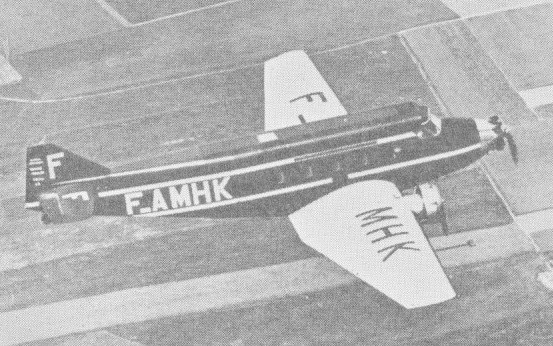
The Wibault 280-T was a French 12-passenger civil airliner produced by Wibault backed by money from the Penhoët shipyards and also known as ‘Penhoët Wibault’.

280 T

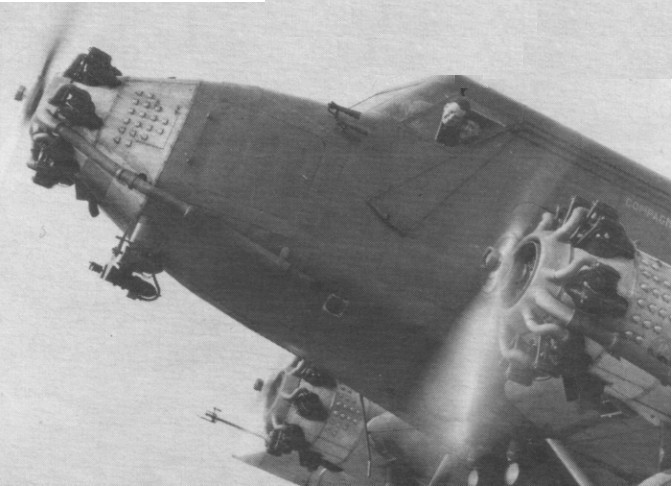
The prototype Penhoët Wibault 280-T first flew at Villacoublay in November 1930 with the development backed by funds from the Penhoët shipyards of St Nazaire. It was an all-metal low-wing cantilever monoplane powered by three 300 hp (224 kW) Hispano-Wright 9Qa radial engines although these were soon replaced by three Gnome-Rhône 7Kb and the aircraft was redesignated the Wibault 281-T.

A second aircraft was built to the 281 standard but then it was converted to a Wibault 282-T with three 350 hp (261 kW) Gnome-Rhône 7Kd engines and room for 12 passengers, seven further aircraft were built as 282s. Some of the 282s were operated by Air Union on the Paris-London Voile d’Or (“Golden Clipper”) service in 1933.

282.T12

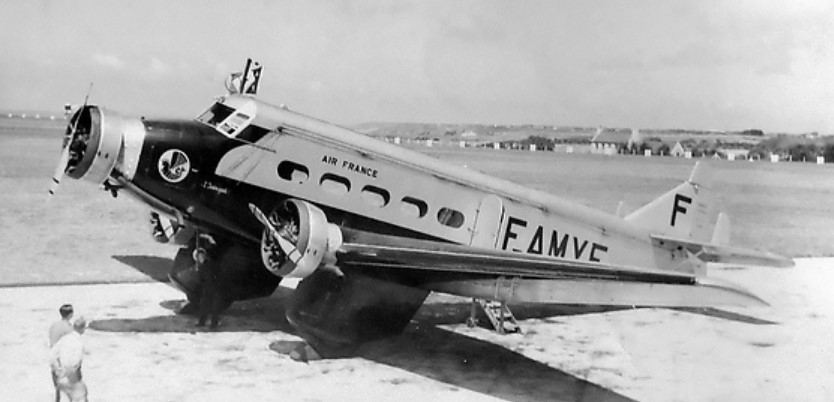
Air France replaced its LeO 21 biplanes with a fleet of Wibault 282s, which in turn gave way to Bloch 220s.

In 1934 Air France took delivery of the first of ten Wibault 283-Ts which had an increased fuel capacity and modified tail. Some of the 282s were converted to 283 standard. Some of the commercial aircraft were later taken over as military transports.

Wilbault 283 T Article

Accidents and incidents

On 9 May 1934, Wibault 282-T F-AMHP of Air France crashed into the English Channel off Dungeness, Kent, United Kingdom, killing all six people on board.

On 19 May 1934, a Golden Clipper of Air France crash-landed on a cricket pitch adjacent to Croydon Airport, Surrey, United Kingdom, due to fuel exhaustion. Only one of the ten people on board was injured.

On 24 December 1937, Wibault-Penhoët 283.T12 (c/n 11) F-AMYD of Air France crashed near Zhůří (currently part of Rejštejn), Czechoslovakia, due to a navigational error. The aircraft was supposed to land at Prague, but was directed by controllers to fly south and crashed in foggy, snowy and dark conditions after 120 km (75 mi). Two pilots and a single passenger were killed.

Gallery

Variants

Penhoët Wibault 280-T
Prototype
one built converted to a 281 and then to a 282.
Engines: three 300 hp (220 kW) Hispano-Wright 9Qa

Wibault 281-T
Prototype
One built as such and one converted from 280-T.
Both converted to 282-Ts.
Engines: three 350 hp (260 kW) Gnome-Rhône 7Kd

Wibault 282-T
10-passenger production variant
cowlings around the wing-mounted engines
Six built from new plus two converted prototypes.
Engines: 3 x Gnome-Rhône 7Kd

Wibault 283-T
Production variant for Air France
NACA cowlings, increased fuel capacity, higher weights and a modified tail
ten built.
Engines: three Gnome-Rhône 7Kd

283-T-12
Powerplant: 3 × Gnome-Rhône Titan Major 7Kd, 260 kW (350 hp) each
Wingspan: 22.61 m (74 ft 2 in)
Wing area: 64.4 m2 (693 sq ft)
Length: 17.0 m (55 ft 9 in)
Height: 5.75 m (18 ft 10 in)
Empty weight: 4,266 kg (9,405 lb)
Gross weight: 6,350 kg (13,999 lb)
Maximum speed: 251 km/h (156 mph, 136 kn)
Cruise speed: 230 km/h (140 mph, 120 kn)
Range: 1,000 km (620 mi, 540 nmi)
Service ceiling: 5,200 m (17,100 ft)
Crew: 2
Capacity: 10 passengers

Wibault 282 T12

Vortech G-1

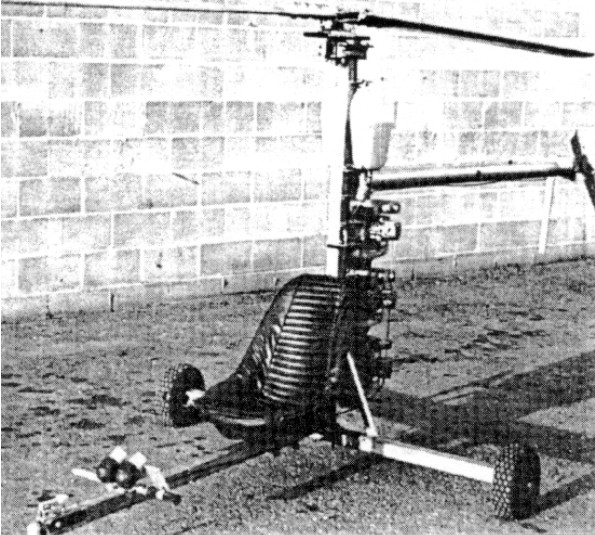
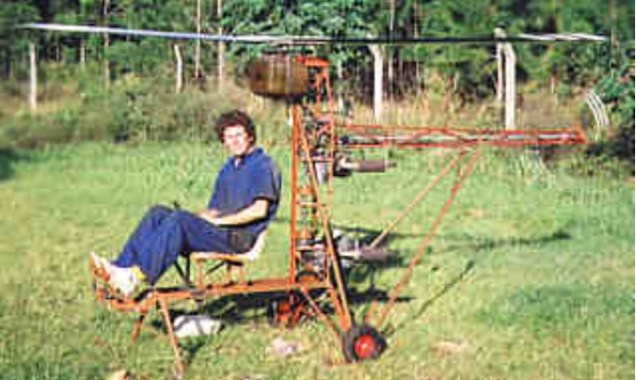
The G-1 Ultrtalight Helicopter, created in the early 1970s by Art Weilage, was tested and sold as low-cost kits by Compcop, Inc. Vortech offers the original construction prints to hobbyists curious about this design, or who want to study the concept as inspiration for a design of their own.

Developed, tested and sold in the 1970’s by Compcop, the G-1 was designed to fill the need for an affordable, easy-to-build ultralight helicopter. The entire helicopter can be built at home with ordinary tools at a low cost. No license is required to fly the G-1 because it is in the license-free “Ultralight Aircraft” category (see FAR Part 103). The construction manual provides all the details needed to build the G-1 with an engine of 40 h.p. or higher. The three McCulloch go-cart engines can be replaced with a single engine such as the Rotax 447. Aluminium construction.

Carries one person. Takes off and lands vertically. Flies forward, backward, sideward, & hovers.

Engines: 3 x McCulloch MC101 42 hp
Empty wt: 150 lb
Max wt: 420 lb
Rotor span: 12ft
Height: 5.5ft
Length: 12ft
Max speed: 80 mph
Cruise: 55 mph
Climb rate: 1,000 fpm
Range: 120 sm
Service ceiling: 10,000 ft
Seats: 1

Engine (typical) Kawasaki or Rotax, 40+ hp
Length 12 ft
Width 5.7 ft
Height 5 ft 6 in
Main rotor diameter 12 ft
Tail rotor diameter 2 ft
Empty weight 150 lbs
Gross weight 420 lbs
Useful payload 270 lbs
Fuel capacity 5 USgals
Fuel consumption 4 USgals/hour
Speed (max.) 80 mph
Altitude (max.) 10,000 ft asl

Engine: 3 x McCulloch, 9.5 hp
Rotor span: 3.66 m
MAUW: 190 kg
Empty weight: 66 kg
Fuel capacity: 19 lt
Max speed: 128 kph
Cruise speed: 80 kph
Fuel consumption: 12 lt/hr
Seats: 1
Plan price (1998): $34.95

VFW Fokker VAK-191B

The VAK concept of NATO and the German Armed Forces required an aircraft that was able to take off from unprepared airfields without runways. Its mission was close air support. In addition it had to be able to fly long distances in extreme-low-altitude in order to prevent attacks of antiaircraft weapons and radar detection. Because of this the VAK was designed with short wings and a minor extension so it would provide its pilots a tolerable flight and bear aerodynamically difficult extreme low altitude flights.

VFW Fokker VAK-191B Article

The first prototype flew on September 10, 1971, powered by one 10,150-lb (4604-kg) thrust Rolls-Royce/MTU RB.193 vectored-thrust turbojet and two 5577-lb (2530-kg) thrust RB.162 lift turbojets. It had small, vertically mounted jets in the front and rear of the fuselage for direct lift, plus a third engine of the vectored ¬thrust type for forward propulsion and transitions between horizontal and vertical flight. It uses “puffer jets” at the nose, tail and wingtips to stabilise it during low speed and hovering man¬oeuvres. In terms of design, it is intended for experimental work only.
The first transition – the transfer of vertical flight in horizontal and vice versa as well as turning off and on the lift-engines – was achieved on October 26, 1972 in Manching, Bavaria, at a speed of 400 km/h.
All three VAK 191B experimental aircraft completed a total of 91 flights that lasted all together 12 hours.

Despite successful flight trials it was not ordered into production as the Harriers of RAF Germany were already fulfilling the need for which the VAK-191B had been conceived.

VAK 191B
Engines: 1 x Rolls-Royce/MTU RB 193-12, 45.2kN + 2 x Rolls-Royce RB 162-81 F 08, 26.5kN
Max take-off weight: 8507 kg / 18755 lb
Empty weight: 5562 kg / 12262 lb
Wingspan: 6.16 m / 20 ft 3 in
Length: 14.72 m / 48 ft 4 in
Height: 4.30 m / 14 ft 1 in
Wing area: 12.5 sq.m / 134.55 sq ft
Max. speed: 1100 km/h / 684 mph
Cruise speed: 740 km/h / 460 mph
Range: 400 km / 249 miles
Payload: 2945kg
Crew: 1

Union Aircraft Co Rotorplane

Union Rotorplane NX772N

The 1931 Union Aircraft Co Rotorplane was designed by Isaac C Popper with four conical rotors in an open frame replaced the wings and were driven by two additional 28hp Indian (motorcycle) engines. An experiment based on the Magnus Effect to create lift.

Power was by a 90hp ACE (Cirrus).

The two-place aircraft was registered NX772N c/n M-1 and although the designer claimed it had double the lifting power of conventional wings and could land a half the speed, there is no record of actual flight.