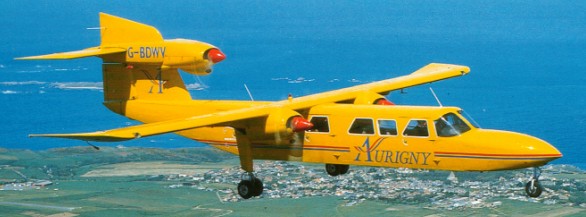
Britten-Norman BN2 Mk.III Trilander

BN-2A-2 Mk.III

The Trislander was born out of the Islander concept during 1970. The creation of a Trislander involved a larger and strengthened tail fin, a stronger rear fuselage structure, new main landing gear units and the insertion of a 2.29 fuselage “plug” to create space for 17 passengers and a pilot. Designated BN2A Mk.III, the prototype first flew in September 1970.
Full UK CAA certification came in May 1971 and the first delivery came on 29 June, less than 300 days after the prototype first flew. Some 73 Trislanders were manufactured but the downturn in general aviation in the late 70s and upheavals at Britten Norman led to the production line at Gosselies being closed down and subsequently new owner, Pilatus, decided to withdraw the jigs and tooling from Belgium. The aircraft was still selling albeit slowly and did not promise to provide a significant return on invest-ment. The Trislander was placed on hold.
In August 1982 production rights were sold to the International Aviation Corporation based in Miami, Florida. Included in the deal were eight complete aircraft and components for a further twelve aircraft. IAC renamed the aircraft the Tri Commutair and announced their intention to deliver 35 aircraft by July 1984 as well as a turbine variant. It is thought that production was never initiated.
BN2A-2 Mk.III Trislander has a long nose, droop flap and wing tip tanks. The commuters are powered by three 260 hp Lycoming O 540-E4C5 engines, have a wingspan of 53 feet and a MAUW of 10,000 lbs. With an airframe that is 75% common with the twin engined BN2. The Mk.III-2 versions incorporated a longer nose and forward baggage compartment.

Gallery

BN2A Mk.III
First built: 1971.
Engine: 3 x Lycoming O-540-E4C5, 260 hp.
TBO: 2000 hrs.
Prop: Hartzell 2 blade, constant speed 80 in.
Seats: 18.
Length: 44.8 ft.
Height: 14.2 ft.
Wingspan: 53 ft.
Wing area: 337 sq.ft.
Wing aspect ratio: 8.
Max ramp wt: 10,000 lbs.
Max take off wt: 10,000 lbs.
Standard empty wt: 5750 lbs.
Max useful load: 4250 lbs.
Max landing wt: 10,000 lbs.
Wing loading: 29.7 lbs/sq.ft.
Power loading: 12.8 lbs/hp.
Max useable fuel: 1170 lbs.
Climb rate: 1000 fpm @ 80 kts.
Climb gradient: 750 ft/nm.
Rate of climb @ 8000 ft: 600 fpm.
Service ceiling; 13,600 ft.
SE rate of climb: 290 fpm @ 80 kts.
SE climb gradient: 218 f/nm.
SE ceiling: 4500 ft.
Max speed: 159 kts.
75% cruise: 144 kt.
55% cruise: 130 kt.
Cruise @ 65% power @ 8,000ft: 137 kts.
Fuel flow @ 65% power @ 8,000ft: 225 pph.
Endurance @ 65% power @ 8,000ft: 5 hr.
Payload max fuel: 2775 lb.
Range max fuel/75% pwr: 550nm/3.8hr.
Range max fuel /55% pwr: 643nm/5.0hr.
Stalling speed clean: 61 kts.
Stall speed flaps down: 50 kts.
Turbulent air penetration speed: 133 kts.
Fixed undercarriage.
1.3 Vso: 100 kt.
Min field length: 1950 ft.

BN2A Mk.III-1
Engines: 3 x Lycoming O-540-E4, 260 hp.
Seats 18.
Gross wt.10,000 lb
Empty wt. 5,843 lb
Fuel capacity 197 USG
Top speech 180 mph.
Cruise speed 166 mph.
Initial climb rate 980 fpm.
Ceiling 13,150ft
Takeoff distance (50ft): 1,950 ft
Landing distance (50ft): 1,445ft.

Britten-Norman BN-2A Mk. III – 2 Trislander
Length: 43.734 ft / 13.33 m
Height : 14.173 ft / 4.32 m
Wingspan : 52.986 ft / 16.15 m
Wing area: 336.913 sq.ft / 31.3 sq.m
Max take off weight: 10010.7 lb / 4540.0 kg
Weight empty: 5699.9 lb / 2585.0 kg
Max. speed: 159 kt / 294 km/h
Cruising speed: 152 kt / 282 km/h
Wing load: 29.73 lb/sq.ft / 145.0 kg/sq.m
Range: 609 nm / 1127 km
Engine: 3 x Avco Lycoming O-540-E4C5, 256 hp
Crew: 2
Payload: 17 Pax
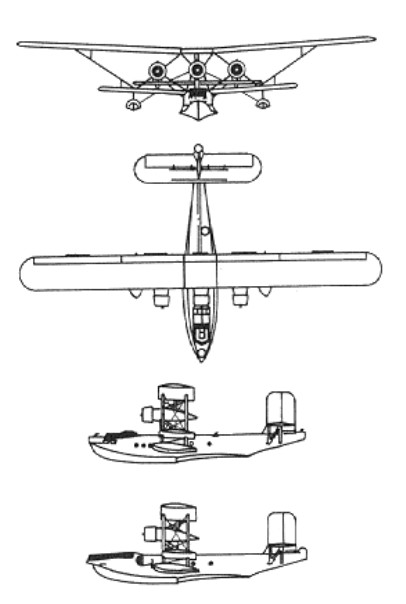
Breguet Bre.521 Bizerte / Bre.522 Bizerte / Bre.530 Saigon

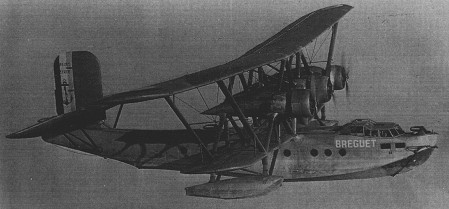
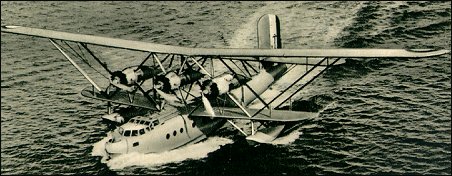
In 1931 Breguet secured a licence to build the Short Calcutta, and this was used as the basis for the company’s Bre.521 submission to meet a 1932 French Navy requirement for a long-range reconnaissance flying-boat.
The Bre.521 was of all-metal construction with stabilising floats strut-mounted under the lower wings, a strut-braced empennage and three tractor engines located between the biplane wings.
The Bre.521.01 prototype flew on 11 September 1933 with 630-kW (845-hp) Gnome-Rhóne l4Kdrs radials, and was followed by three pre¬production boats. The second of these introduced refinements intended for the production variant, includng an improved cockpit enclosure and more potent defensive armament. Armament comprised five 7.5mm Darne machine-guns: one in the cupolas each side at the rear of the cabin, one under each of two sliding hatches (with retractable windscreens) staggered to port and starboard amidships, and one in the extreme tail cockpit aft of the tail unit.
Thirty were built up to 1940, powered by three 671kW Gnome-Rhone 14 Kirs radial engines. These served with “Exploration” escadrilles of the French Aeronavale from 1935 until the end of World War II, latterly being used as maritime reconnaissance and anti-submarine aircraft. Of these, nine were captured by the Germans and were used during 1943-45 for air-sea rescue.

One ‘boat became the sole Bre.522 when re-engined with 746-kW (1,000-hp Hispano-Suiza l4Aa radial engines.

In 1935 a civilian version – the Breguet Br.530 Saigon – was produced.

Breguet Bre.530 Saigon Article

Bre.521 Bizerte
Engines: 3 x Gnome-Rhône l4Kirs or 14N-11, 671 kW (900 hp).
Wingspan: 35.1-18.9 m / 115 ft 2 in-62 ft 0 in
Wing area: 169.8 sq.m / 1827.71 sq ft
Length: 20.5m (67 ft 3in).
Height: 7.5 m / 24 ft 7 in
Max T/O weight: 16600 kg (36,597 lb).
Empty weight: 8855 kg / 19522 lb
Max speed: 243 km/h / 152 mph at 3,280ft.
Cruise speed: 200 km/h / 124 mph
Ceiling: 6600 m / 21650 ft
Range w/max.fuel: 3000 km / 1864 miles
Range w/max.payload: 2000 km / 1243 miles
Seats: 8
Crew: 5
Armament: 5 x 7.5-mm (0.295-in) Darne mg plus up to 300 kg (661 lb) of bombs.

Bre.522
Engines: 3 x Hispano-Suiza 14Aa, 1000 hp, (746 kW).
Span: 35.15m / 115ft 4in.
Length: 20.5m / 67 ft 3in.
Armament: 5 x 7.5-mm (0.295-in) Darne mg.

Breguet Bre.390T / Bre.392T / Bre.393T

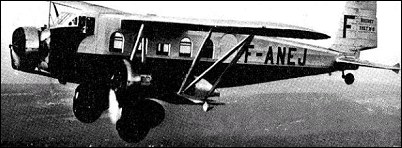
Development of the Breguet 393T three-engined passenger transport began with the Breguet 390T prototype, an all-metal sesquiplane which made its first flight in February 1931. During a test flight on 3 July 1931 a propeller broke away, the pilot losing his life when his parachute failed to open after he abandoned the aircraft. The Breguet 390T was completely destroyed in the ensuing crash.
A single Breguet 392T followed, replacing the Bre.390T’s 179kW Gnome-Rhone 5Kd radials with 224kW Hispano-Suiza 9Qc engines, and completed as a freight carrier. Only one example appeared and it was followed later in 1933 by the prototype Breguet 393T. It differed by changes in interplane struts, by having fabric instead of metal fuselage covering, and by introducing a tailwheel and spat fairings for the mainwheel units. This aircraft was delivered to Air France in July 1934, being followed by two more examples later that year. The remaining three aircraft ordered by Air France were delivered in 1935.
The Breguet 393T had accommodation for a crew of two and 10 passengers, each passenger having a comfortable armchair beside a large window. The type flew regular routes between Toulouse and Casablanca, the Mediterranean leg of the route to South America, and later on the Natal-Buenos Aires stage in Brazil. Their final employment was on several European routes radiating from Paris.

Bre.390T
Engines: 3 x 179kW Gnome-Rhone 5Kd radials

Bre.392T
Engines: 3 x 224kW Hispano-Suiza 9Qc

Bre.393T
Engines: 3 x Gnome-Rhone 7Kd Titan Major radial, 261kW
Take-off weight: 6000 kg / 13228 lb
Loaded weight: 3966 kg / 8744 lb
Wingspan: 20.71 m / 67 ft 11 in
Length: 14.76 m / 48 ft 5 in
Wing area: 66.46 sq.m / 715.37 sq ft
Max. speed: 249 km/h / 155 mph
Cruise speed: 235 km/h / 146 mph
Ceiling: 5850 m / 19200 ft
Range: 975 km / 606 miles

Breguet 11 Corsair

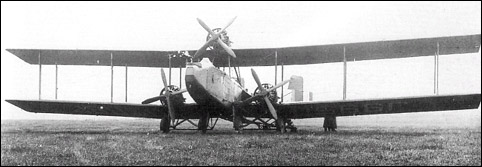
The Breguet 11 Corsair was a three engined aircraft with two pushers and one tractor. The two pusher engines were mounted on the lower wing, either side of the main fuselage, in nacelles, each with its own tricycle undercarriage. The three-bay, unequal span wings had ailerons mounted in the upper wings, but despite a favourable test report, the aircraft was declined in favour of smaller models. The 90-ft (27.6m) wingspan was one of the reasons it was declined, but it was felt that the relatively slow speed of the aircraft, 91 mph (149 kph), coupled with its enormous size made it an easy target for anti-aircraft guns.

Breda CC.20 / CC.2000 / CC.3000

Designed by Ing Generale Gaetano Arturo Crocco and Ing Giulio Cesare Costanzi who worked for the Italian military the 1929 Breda CC.20 trimotor monoplane bomber had a 42m span and IF Asso A.500 power. One prototype was built.

CC.2000 was an alternative designation for the CC.20 (based on total installed horsepower).

Built in the 1930s, the Breda CC.3000 trimotor monoplane was a more powerful derivative of the CC.20.

Breda Ba.46

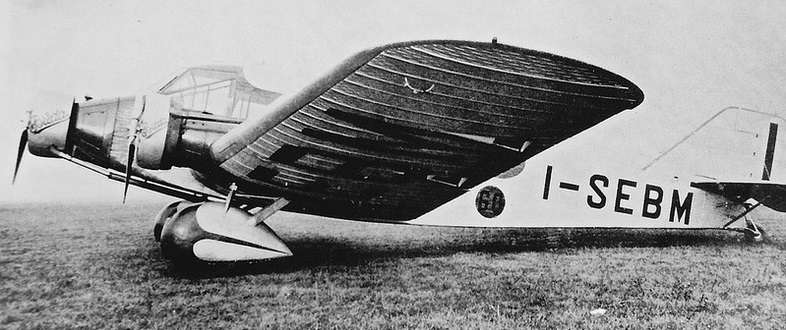
The sole 1934 Ba.46 three engined low-wing monoplane bomber/transport I-SEBM was designed to carry 12 troops or a 2200 lb bombload. It was created based on the transport aircraft Breda Ba.32.

With fixed spatted main undercarriage, the Ba.46 was first flown with 3 x 320 hp P&W Wasp Junior air-cooled radials and NACA cowls in 1932.

It was modified to 3 x 500 hp IF Asso 500 liquid-cooled V-12s, and some sources say 3 x 650 hp AR Pegasus (possibly a third re-engining)

The aircraft successfully underwent testing; however, its flight characteristics were not militarily satisfactory and it was soon dismantled.

Engines: 3x Isotta-Fraschini Asso 500, 500 hp
Span: 28.80 m
Length: 10.60 m
Wing area: 108.20 sq.m
Empty weight: 5600 kg
Normal takeoff weight: 8200 kg
Maximum speed: 272 km/h
Cruising speed: 226 km/h
Service range: 840 km
Service ceiling: 6000 m
Crew: 5
Armament: 3x 7.7 mm machine guns

Breda Ba.32

I-SEBM c/n: 3232001 Ministero Aeronautica /Centocelle 17 June 1932

A 1931 trimotor low-wing monoplane light airliner

The Breda Ba.32 was an Italian three-engine medium civil/transport aircraft, which had room for 8/10 passengers or freight. The maiden flight was in 1931. Only one aircraft was built known to have gone in June 1932 to the Ministero Aeronautica and it was powered by 3 x 320 hp P&W Wasp Junior and demolished in March 1940.

Other sources record I-ADDB as registered on 3-12-34 to SAI, Torino, and it had gone to Militar Aviation August 1935, it should have Fiat engines.

Wingspan: 26.67m

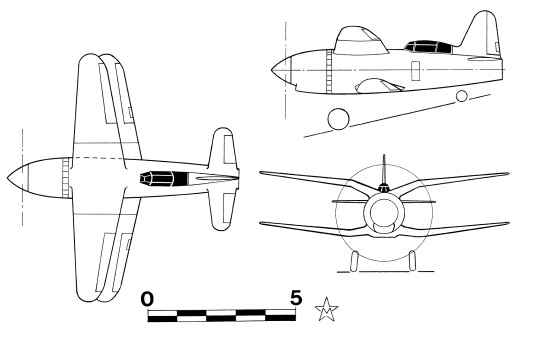
Borovkov-Florov I-207/6 / Object 11

After the “Object 10” project, the Borovkov and Florov working group got to work on a new version known as “Object 11” or simply No.11. In some literature it has also been called I-207/6. This new project owed its origin to the intention to comply with the requirements issued by BN Yuriev during the review of the “Object 10” project as a way to achieve its serial production.

This new project returns to the conception of pure fighter with high manoeuvrability and to the conventional type landing gear. The armament included two 12.7 mm machine guns and two 7.62 mm ShKAS, but the possibility of carrying two FAB-250 250 kg bombs or instead two detachable containers with PTB-23 23 mm cannons remained.

It was smaller and lighter derivative of the “10”. Maintaining the same wing configuration of gull and inverted gull, the new model included two Merkulov DM ramjets in its metallic tail section, located side by side and with side gates for the air intakes. Instead of one large DM ramjet, it has two smaller ones placed side-by-side. This arrangement made it possible to install the tail wheel between them.

The project kept the Shvietsov M-71 engine, but in this case a variant with an elongated shaft was used, which made it possible to improve the aerodynamics of the forward section of the fuselage.

All efforts in the design of this new version were directed to obtain the lowest possible weight. The calculated speed of the project in fighter configuration at 5830 meters and without the auxiliary engines gave 654 km / h. With the bomb load the speed decreased to 611 km / h. The ascent time to 5000 meters was 3.7 and 4.5 minutes respectively.

The conceptual project for “Object 11” was presented in the fall of 1940. The evaluation commission considered that the calculated speed was a bit high and recalculated it to 630 km / h, leaving the speed with bombs at 585 km / h. The commission proposed to include the model in the plan of experimental works for the next year, obtaining the approval of AS Yakovlev.

In October 1940 the project was presented at the NII VVS and the conclusions of its evaluation were signed by PV Rychagov on December 9 1940. In general, the evaluation was positive and it was again recommended to include the fighter in the experimental construction plan for 1941 with the condition of increasing its range to 1000 km in normal version and 1400 km with auxiliary fuel (taking into account that “Object 11” it was not foreseen as an escort fighter, such range value was exaggerated and forced to considerably increase the weight of the aircraft in fuel).

The position of the GUAP, together with the negative perception of the industry and the air forces towards the biplane wing structure, resulted in the work on the project being closed. The deputy commissioner for experimental aviation AS Yakovlev, in a meeting informed the constructors of the decision not to include new proposals for two-plane configurations in the future work plans of the Narkomat.

Borovkov-Florov Object 11
Powerplant: One Shvietsov M-71 (1700/2000 hp) and two Merkulov DM ramjet
Wingspan: 8.5 m
Wing area: 22.0 m²
Length: 7.85 m
Flying weight: 3250 kg
Wing loading: 148 kg / m²
Maximum speed: 790 – 800 km / h
Ascent time at 8000 m: 6 – 7 min
Range: 800 km
Accommodation: 1