As early as 1915, a group of naval pilots had asked the Fleet for a long-range aircraft capable of carrying out long patrols, covering the entire Baltic Sea area. The start of the war increased the requests and increased when the conflicts with Turkey began.
On August 12, 1915, a meeting of the Aviation Committee of the Baltic Sea Liaison Service took place, in which once again the issue of the need for the provision of large seaplanes with a 6-hour patrol capacity was discussed. Based on these requirements, the builder DP Grigorovich proposed to build such a device.
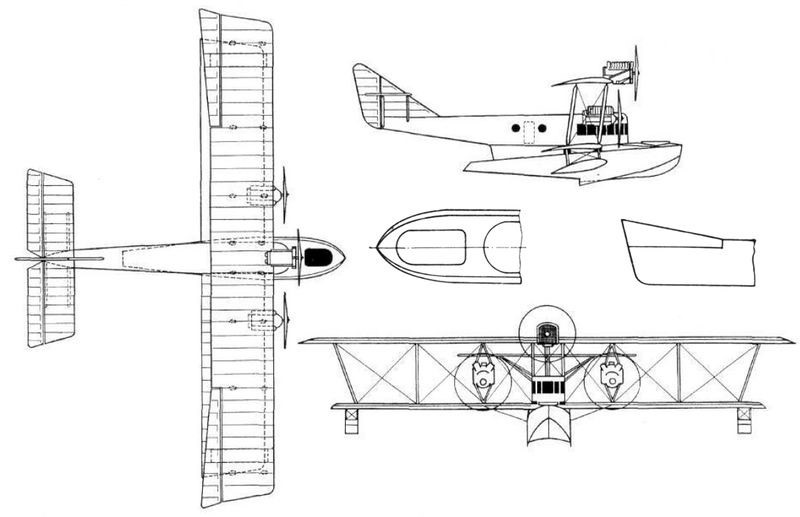
The Marine Cruiser (Mosrkoi Kreiser or MK (Russian: Григорович МК-1 “Морской крейсер”)) was designed in 1916 to meet the requirements of the Naval General Staff (MGSh) and was conceived to serve with the Baltic and Black Sea fleets in long-range reconnaissance and bomber functions.
The MK-1 was the largest Russian seaplane ever designed and it only yielded to the Ilya Muromets bomber with floats.
The MK-1 featured a center float, biplane configuration, three engines, and a four-crew capacity. From the technological and constructive point of view, the model maintained the characteristics of the designs developed in the Schetinin Factory.
A feature was that the float and fuselage were merged into a single structure, resulting in a general outline of combined features. This float had such dimensions that it could generally be considered a hull. In its lower region it presented a redentient with concave and lateral sides similar to those used in Grigorovich’s M flying boats. The construction of the internal structure of the float was made of ash with plywood covering.
In the forward region of the fuselage the closed cockpit was located, built with plywood and with good frontal glazing. At the rear, the fuselage appeared as a wooden frame braced by cables and covered with fabric.
The wing box was of the conventional type with three pairs of struts in each half plane and a certain offset. The upper plane was slightly larger than the lower plane and had trapezoidal-shaped ailerons. The wing structure was conventional, with two wooden spars and a rather slim profile. It should be noted that this wing box was fixed to the upper part of the float body by means of rubber shock absorbers with a travel of 180 mm.
In the tail section there was a wide triangular keel on which the horizontal planes were fixed, braced by uprights and the large-area rudder.
Originally it was thought to equip the MK-1 with only two 220 hp Renault engines located between the planes. Later, when construction began, the designers realized that the weight of the model exceeded that calculated and the center of gravity was located a little behind, so it was decided to locate on the upper plane and on the line of the longitudinal axis a third engine. A 150 hp Sunbeam motor was first tested, but was later replaced by a 140 hp Hispano-Suiza V-cylinder motor, which was found at the factory. In this way the MK-1 became the world’s first three-engined seaplane.
The cockpit of the pilots in the MK-1 was characterized by being very spacious and located high above the hull. In the bow section a gunner was located operating a 76 mm gun.
The MK-1 was completed in the middle of 1917 and only late in the fall was it ready for testing. In November the pilot Ya. I. Siedov-Sierov attempted to make the first flight in Petrograd Bay, taking several people on board. The weather was not the most propitious, the cold wind had created waves. At the beginning of the take-off and giving full throttle to the upper engine, the nose sank and the water swept over the bow, filling a large part of the first watertight compartment of the hull. The “Cruise” was stuck on its nose and ended up sinking. All the crew members were able to be evacuated.
The flying boat was pulled out of the water with significant damage. The cause of the problem was considered to lie in design problems of the bow section of the float, which needed to be lengthened. The need was also seen to eliminate the upper engine and increase the power of the two located between the wing planes. This meant a major job that was decided not to undertake, especially considering that the GASN torpedo bomber was already being built, which seemed much more perspective. Thus ended the development.
Grigorovich/Schetinin MK-1 Sea Cruiser Power plant: 2 x 220-hp Renault & 1 x 140-hp Hispano-Suiza Upper plane span: 30 m Length: 16.50 m Height: 4.50 m Accommodation: 4
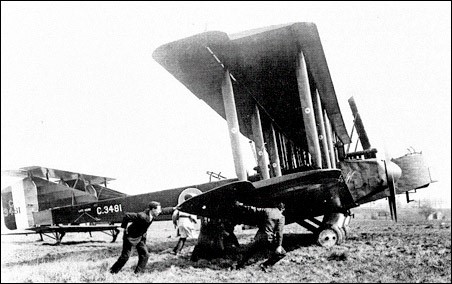
In 1918, the Grahame-White Aviation Company of Hendon, London developed a large, long-range heavy bomber intended to equip the Royal Air Force. The resulting design, the E.IV Ganymede, was a three-engined, twin-boom biplane with four-bay wings. Two of the engines were located at the front of the booms, driving tractor propellers, while the third engine was installed at the rear of the central nacelle, driving a pusher propeller.
A biplane tail unit with three fins and rudders spanned the gap between the two main fuselage booms. The two pilots and a bomb-aimer/gunner were accommodated in the central nacelle, while additional gunners cockpits were provided in each of the fuselage booms, with Scarff ring mountings for a machine gun together with a tunnel opening under the fuselages to allow the gunners to repel attacks from below.
It was intended that the Ganymede be powered by three 400 hp (298 kW) Liberty engine, but concerns about the availability of the American-built Liberty resulted in considerably less powerful Sunbeam Maori engines being specified when an order was placed for three prototypes. The first of these prototypes, serial number C3481 was completed late in 1918. While it was tested by the Air Ministry during 1919, the RAF had little interest in purchasing a new heavy bomber, and the remaining two prototypes were cancelled.
It is the first known type to carry the “E” letter used on all of Grahame-White’s latter models.
After being damaged in a landing accident in 1919, Grahame-White rebuilt the Ganymede into a civil airliner, becoming the E.9 Ganymede. The central engine was removed completely, while the two remaining engines were replaced by 450 hp (336 kW) Napier Lions. The nacelle was rebuilt with two pilots in an open cockpit ahead of a glazed cabin housing 12 passengers. The modified aircraft was granted a Certificate of Airworthiness on 12 September 1919, with the Aircraft registration G-EAMW, but was destroyed in a fire in September 1920.
E.4 Ganymede Engines: 3 × Sunbeam Maori, 270 hp (201 kW) each Wingspan: 89 ft 3 in (27.21 m) Wing area: 1,660 ft² (154.3 m²) Length: 49 ft 9 in (15.17 m) Height: 16 ft 0 in (4.88 m) Empty weight: 11,500 lb (5,227 kg) Loaded weight: 16,000 lb (7,273 kg) Wing loading: 9.64 lb/ft² (51.8 kg/m²) Maximum speed: 105 mph (91 knots, 169 km/h) at sea level Power/mass: 0.051 hp/lb (0.083 kW/kg) Endurance: 9 hours Guns: 3x .303 in (7.7 mm) Lewis guns, One in nose of central nacelle and one in each outer fuselage Crew: Five
The 8AT variant (ATC 2-485) of 1931 was a single Model 5-AT-C converted as a freighter without the wing-mounted engines, seating 13. First flown on 30 July 1929 power was a 575hp P&W Hornet A and also tried were the Hornet B, 575hp Wright Cyclone, 715hp inline Hispano-Suiza, and 535hp Bristol Jupiter.
The one built was operated as a two place cargo Express with the Hispano-Suiza engine as N8499. It was refitted with a 700hp Wright Cyclone GR (2-485) in 1934 for Pacific Alaska Airways with the new registration NX/NC8499, moving to Colombia in 1938.
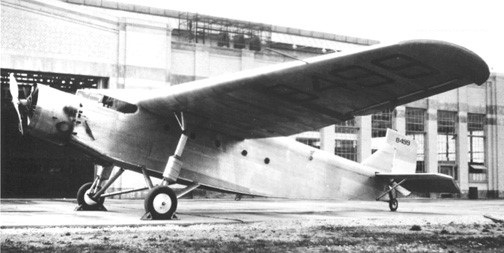
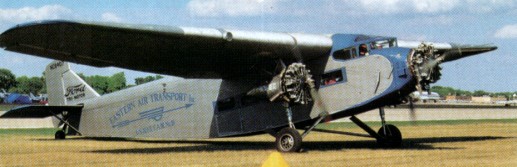
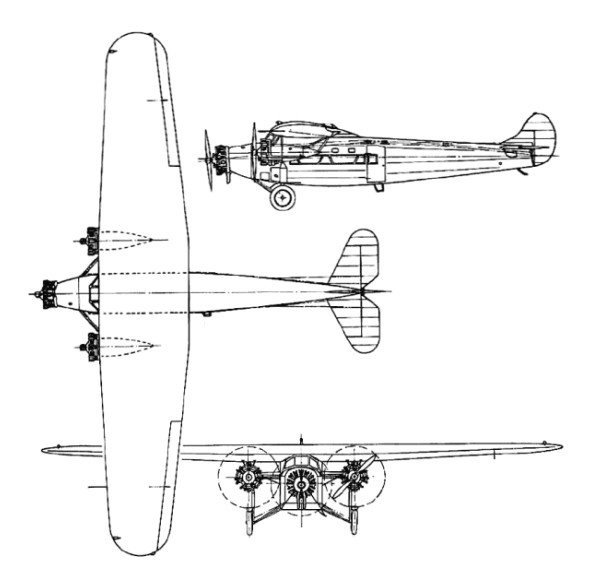
The original Stout Metal Airplane Company was purchased in 1925 by Henry Ford and the new division of the Ford Motor Company produced three versions of the Tri-Motor monoplane. The Tri-Motor’s fuselage was constructed from a series of transverse duralumin bulkheads covered with corrugated metal skin. One engine was mounted in the nose, while the other two were suspended underneath the wings.
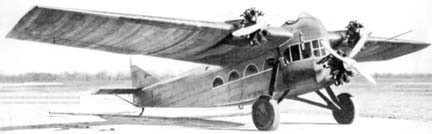
In 1926 Ford told Stout to build him a tri-motor. Stout rushed through his Model 3-AT and the resulting Model 3-AT was a crude and unimpressive lash-up. It may have flown only once before it was destroyed in a fire on the ground, which also destroyed the factory at Ford Airport, on 17 January 1926. Ford and Stout had a violent argument which ended in Stout being fired. In February 1926 Ford decided to proceed with an improved air¬craft, the Model 4-AT, whose design was based on that of the Model 3-AT but differed in almost all details and especially in the engine installations, cockpit, landing gear and fuselage. The small engineering team was headed by Harold Hicks and Tom Towle. The first of the successful Ford tri-motors, NC1492, was flown for the first time on 11 June 1926.
Ford 4-AT-A
The wing was recessed so that the three spars significantly reduced headroom in the cabin. Each spar was a Warren-braced truss assembled mainly by riveting, and the ribs were likewise built up from rolled strip and sections. The wing suffered a certain amount of cracking after flying over 5,000 hours. The wing was made in three parts, the rectangular centre section being integral with the fuselage. The latter was a capacious box. The three engines, which in the Model 4-AT were 149-kW (200-hp) Wright J-4 Whirl-winds driving two-blade metal propellers, were uncowled and in most Fords not even provided with cooling airflow baffles or fairings. In the Model 3-AT the nose engine had been mounted low to balance the thrust lines of the two wing-mounted engines, but in the Model 4-AT the centre engine was mounted exactly on the nose and the other pair brought down so that all thrust lines were at the same level, the wing engines now being carried on the front of separate strut-mounted nacelles well below the wing. The wing engines had short stub exhausts or, from 1927, an exhaust manifold leading to a short pipe on the outboard side of the nacelle. The nose engine, however, sent its gas through a pipe running (in most versions) half way back to the tail, surrounded by a muff open at the front so that, in cold weather, heated fresh air could be admitted to the cabin. The movable control surfaces, as well as the fixed tail, were metal-skinned. The extreme nose and the top and bottom of the fuselage were often skinned with smooth metal sheet.
From the first Model 4-AT, the skin material used was Alclad, duralumin coated with non-corrosive pure aluminium, spray coated in varnish. All the Fords had an oval entrance door on the right side, used for passengers, cargo and also by the two pilots. In the Model 4-AT the latter had the usual open cockpit, a feature of which was a sharply angled Vee windshield with glass panes that were not vertical but sloped outwards from bottom to top, to give a better view for landing. Panels in the windshield could be slid open in really bad weather. The Model 4-AT had four passenger seats on each side of a central aisle, and was available with a lavatory at the rear. Light personal baggage could be placed in a typical suspended-mesh rack along each side of the cabin above the windows, level with the bottoms of the wing spars. In a few Model 4-ATs further baggage and mail was stowed in drop-down lockers between the spars at the inner end of each outer wing panel, though this was really a feature of later models. Other features were wheel brakes, which enabled a tailwheel to be used instead of a skid, and an electrical system with the battery charged by a generator on the nose engine. This system served navigation lights and, in most air¬craft, leading-edge landing lamps and two-way radio. On the other hand, the Fords adhered to the old practice of running the tail control cables along the outside of the fuselage from large rocker arms on the sides of the nose.
One of the first customers was Stout Air Services to fly schedules from Detroit to Chicago and other cities in the Great Lakes region.
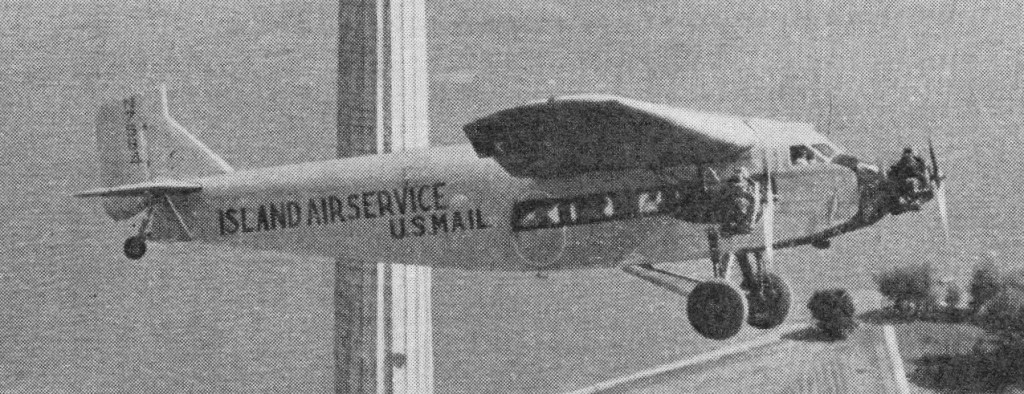
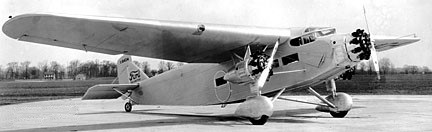
Ford 4-AT-B Tri-Motor N7584
Thirty-seven of the 1928 4-AT-B were built, powered by three 220hp Wright J-5, under certificate 2-10 (later replaced by 87). One went to the AAC as C-3 (NC3444 / 28-348), 7 as C-3A/-9 (29-220-226), 1 as -4, and 4 as C-4A. All C-3A were later converted to C-9 repowered with 300hp Wright R-975s. Several civil models were converted to 4-AT-E in 1930-31.
One 4-AT-C was built, NC7862, in 1928 (ATC 2-11). Sold to Sunbeam Air Transport, it crashed on 1 December 1928.
The 1928 4-AT-D (ATC 2-322) was a special long-wing model with three 220hp Wright J-5. Sold for $48,000, the one built went to Grand Canyon scenic flights as NC5578, then to Ecuador in 1945 as HC-SBC. There was also one conversion from a 4-AT-B, NC7583, and reportedly one other, NC7586.
Four (A8457, A8598-8599) from civil 5-AT-C went to the USN/USMC as JR-3/RR-3. (ATC 2-240) and (ATC 2-242) for 15 passengers with 420hp Wasp as 5-AT-C Special (A8840).
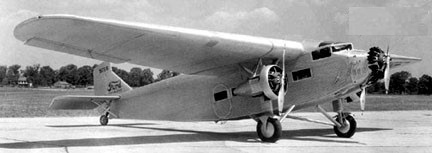
Twenty-five of the 1929 4-AT-E (ATC 132) were built, selling for $42,000. Some were 4-AT-B conversions. Seven went to the AAC as C-3A, and two to USN as JR. One as the XJR-1 (A7526) and five production model as the JR-2 (A8273-8274), re-designated as RR-2 later.
Ford 4-AT-E 7861
The single 4-AT-F (ATC 441) built, 9656, in 1931, went to Spain with three eventual registrations: EC-BAB, EC-RRA, and EC-WIO.
Ford 4-AT-F 9656
Subsequent Fords had an enclosed cockpit with sliding side windows, and various other refinements, and almost all were more powerful. As listed in the separate variants section, there were almost as many sub-types as there were aircraft built, partly because there were numerous rebuilds and conversions. The initial Model 4-AT-A eight-seater entered service with Ford’s own air service on 2 August 1926. Ford Airport at Dearborn had by this time become the first in the world with paved runways and full electric lighting, and later Ford not only made other improvements to the buildings but also set up one of the world’s first training schools for commercial flight crews.
Though the Model 4-AT had been the biggest all-metal aircraft then built in the USA, and possibly in the world, it was rightly judged too small and the Model 4-AT-B of 1927 had a span increased from 20.97m (68ft l0in) to 22.53m (73ft 11in), matching the greater power of 164-kW (220-hp) J-6 Whirlwind engines. Though the fuselage was almost the same as before, the seating limit went up to 12. There followed various sub-types of Model 4-AT, differing chiefly in engine arrangement. Almost all the Fords were originally built with spatted main wheels, and their modern image did much to promote sales.
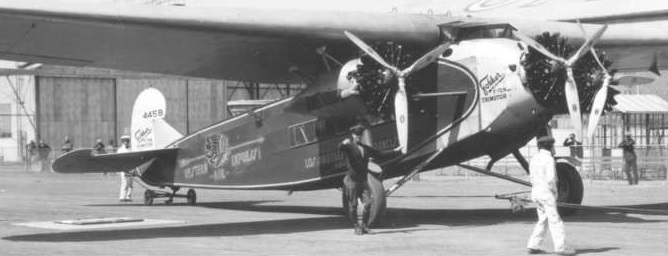
Ford 4-AT-B “Ship Of Flame” used for night aerial advertising NC5093
When the Ford was a new and very modern aircraft, most had Wright engines in the 149/164-kW (200/220-hp) bracket, but production of this Model 4-AT family came to an end (except for the single Model 4-AT-F) in 1929. By this time the much more powerful, and further enlarged, Model 5-AT family was selling even better than its predecessors, and output of Model 5-ATs reached a remarkable four per week in 1929, before the Wall Street crash.
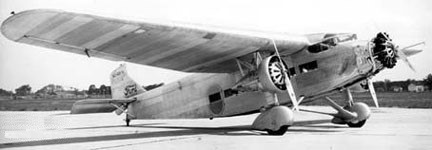
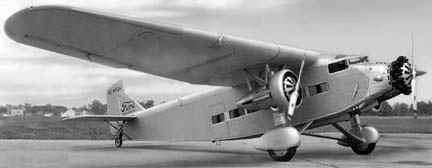
Thanks to the use of the Pratt & Whitney Wasp engine, the Model 5-AT was a much more capable aircraft. First flown in mid-1928, the Model 5-AT had a further enlarged wing, the fuselage deepened to give more headroom under the wing, Townend-ring cowled wing engines (often a cowled nose engine also), and a structure strengthened for operation at greater weights.
The 1929 5-AT-A (ATC 2-32, 2-282) sold for $65,000. Three were built, one to P&W Co [NX/NC6926], and two to Northwest Airlines [NX/NC7416, NC7739].
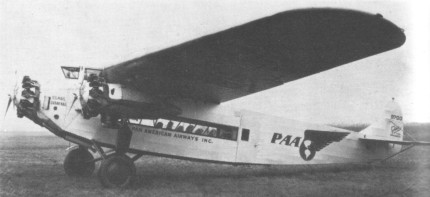
The 1929 5-AT-B (ATC 156) had 17-19 passengers and sold for $55,000. Forty-two were built, of which one went to the AAC as C-4. C/n 11, started with PAA in 1929, and ended up at the San Diego Air Museum in 1982. It had 13 US and Central American registrations: NC9637 / NM22 / XA-BCC / AN-AJJ / HI3 / NX1629M / N1629M / XB-KUI / XA-HIL / N1629M / N9637 / N76GC / N9637.
ATC 2-12 was for modification to 14passengers with 420hp P&W Wasp C.
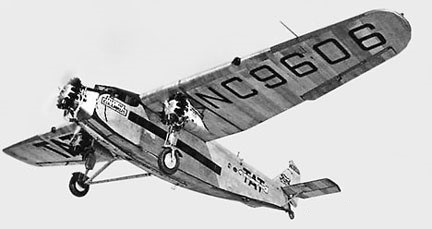
Ford 5-AT-B City of Columbus [NC9606 used by Lindbergh while surveying 1929 national air-rail route
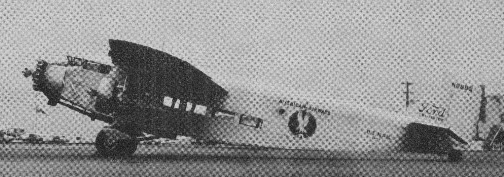
The 1930 5-AT-C (ATC 165) was an improved 5-AT-B as “De-Luxe Club Model” with increased performance, cowlings and wheel pants options. Selling for $55,000-68,000, fifty-one were built. One, NX9652, was heavily modified in April 1931 as XB-906-01 for AAC five place bomber evaluation, built at the firm’s expense and using what was mainly a Model 5-A T-D airframe (but with a redesigned vertical tail). First flown on 27 June 1931, it crashed during dive testing at the factory on 19 September 1931. There were guns above and below at the rear and a bombardier’s station under the cockpit.
Ford X-B-906 NX9652
Four went to the USN/USMC as JR-3/RR-4. (ATC 2-240) and (ATC 2-242) for 15 passengers with 420hp Wasp as 5-AT-C Special.
Ford 5-AT-C [NC421H]
Tri-motors nos 69, 74 and 75 (NC410H, NC414H, NC415H) were all of the 1930 Model 5-AT-CS (ATC 296, 2-518) type with twin floats for water-based operation, sold for $68,000.
Ford 5-AT-CS NC410H
In 1930 one 5-AT-C, NX/NC420H, was modified with one 450hp P&W + two 220hp Wright J-5 mounted on the leading edge of the wings as a 5-AT-E. It was restored as a 5-AT-C in 1930.
Twenty 1931 5-AT-D (ATC 409) were sold for $50,000. Four went to the AAC as C-4A, and two to the USN/USMC as RR-5.
Ford 5-AT-D NC440H
The single 1935 5-AT-DS built, (ATC 2-504) NC/NR9657, was powered by three 450hp P&W Wasp.
The 1929 6-AT-A (ATC 173, 2-97) was as a 5-AT-C with 16 passenger seats and three 300hp Wright J-6. Selling for $50,000, or $92,650 on floats, 2 were built. One, NC8485, was converted first to a 7-AT, then 5-AT-C. One went to Colonial Air Transport as NC8486. Both went to China in 1936.
No fewer than 117 Model 5-AT were built in 1929-31, many were built with the wing baggage/mail lockers, and others were thus equipped as a modification. The cabin could be equipped to seat up to 17, with eight seats on the right and nine on the left, even with a rear lavatory. Northwest Airlines took delivery of the 5-AT in September 1927, costing $55,000 each.
Ford 5AT Tri-motor
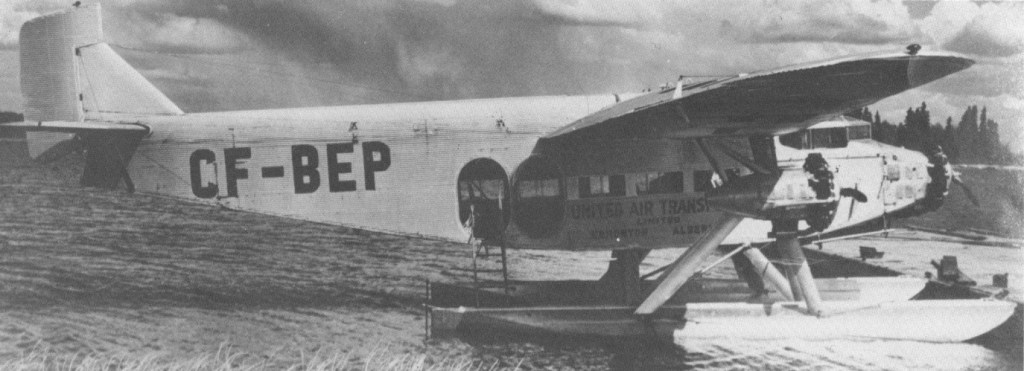
The sole 6-AT-S (ATC 2-80), built in 1929 with 12 passenger seats and on Brewster floats, went to Canada as a forest sprayer (G-CYWZ / CF-BEP). Converted to a landplane, Ford 6-ATS-Special Trimotor CF-BEP was acquired by Grant McConachie from the RCAF in March 1937 and on 5 July 1937 pioneered airmail service from Edmonton to Whitehorse. In March 1939, when part of the Yukon Southern Air Transport fleet, CF-BEP was hit by a RCAF Hurricane at Vancouver airport. The collision severely damaged the Trimotor but subsequently Yukon Southern won damages of $52,000 from the Crown and obtained a further $5200 from the insurance.
Ford 6-ATS-Special Trimotor CF-BEP
One 7-AT (ATC 246) was built, in 1929 as NC8485, as a 16 passenger 6-AT-A with one 420hp P&W Wasp + two 300hp Wright J-6. It was modified with three 300hp Wright J-6 for entry in the 1929-30 National Air Tours (p: Myron Zeller). Final conversion was to 5-AT-C with three 450hp Wasp and delivered to American Airlines in 1931. Exported to China in 1936.
In 1930 one 4-AT-B (X/NC7585/NC423H) was converted to the 9-AT-A (ATC 307) powered by three 300hp P&W Wasp Jr. Sold for $40,000 it went to Honduras in 1934.
In 1931 temporarily designated 4-AT-G, the 14 place 11-AT (ATC 441) was powered by three 225hp Packard DR-980 diesel engines. The one built (NC/NX/NR8404) was modified in 1934 to -AT-B with 220hp Wright J-5 engines. It crashed in March 1937 and was sent to Parks Air College for rebuilding, which proved infeasible due to the extent of damage.
Ford 11-AT NX8404
In 1931 one 5-AT-D was modified as the eight place 13-A (ATC 431) powered by one 575hp / 429-kW Wright Cyclone and two 300hp Wright J-6. It was converted for the 1931 National Air Tour, then converted back to a 16-place 5-AT-D in 1932 (under ATC 209), and sold to Panagra (NX/NC433H).
Total population of all Ford tri-motors from 1926-33 was 198, plus a few special-purpose modifications and experiments.
Variants: 7-AT-A – rebuild of Model 6-AT-A with a nose-mounted 313-kW (420-hp) Wasp radial. 9-AT – conversion of Model 4-AT-B with 224-kW (300-hp) Wasp J union radials; 1 converted. 11-AT – one Model 4-AT-E rebuilt with 168-kW (225-hp) Packard DR-980 diesels. 13-A – powered by one 575hp / 429-kW Wright Cyclone and two 300hp Wright J-6 C-3 – US Army no, 28-348, based on Model 4-AT-B. C-3A – US Army nos 29-220/226, seven aircraft with 175-kW (235-hp) R-790-3 Whirlwind radials. C-4 – US Army no, 29-219, basically a Model 4-AT-B for military service. C-4A – US Army nos 31-401/404, four aircraft based on the Model 5-AT-D with 336-kW (450-hp) R-1340-11 radials. C-9 – redesignation of all seven C-3As after the installation of 224-kW (300-hp) R-975-1 radials. XJR-1 – US Navy no, A7526, based on Model 4-AT. JR-2 – US Navy nos A8273/8274, two aircraft based on the Model 4-AT-E for the US Marine Corps. JR-3 – US Navy nos A8457 and A8598/8599, three aircraft based on the Model 5-AT-C. RR-2 – redesignation of JR-2. RR-3 – redesignation of JR-3. RR-4 – additional Model 5-AT-C with US Navy no, A8840. RR-5 – US Navy nos 9205/9206, two aircraft based on the Model 5-AT-D, one of them delivered to the US Marine Corps XB-906-1 single prototype 1NX96521 for a bomber version with internal racks and two gunners positions; crashed on 19 September 1931 killing Ford’s chief test pilot, Leroy Manning.
Engines: 3 x 313kW Pratt & Whitney R-1340-C1 or SC1 Wasp radial Max take-off weight: 6123 kg / 13499 lb Wingspan: 23.72 m / 77 ft 10 in Length: 15.32 m / 50 ft 3 in Height: 3.86 m / 12 ft 8 in Wing area: 77.57 sq.m / 834.96 sq ft Max. speed: 241 km/h / 150 mph Ceiling: 5640 m / 18500 ft Range: 885 km / 550 miles Crew: 1-2 Passengers: 17
3-AT 1 built 1924 Engines: 3 x Wright J-4, 200hp
4-AT Engines: 3 x 149-kW (200-hp) Wright J-4 Whirl¬winds Propellers: two-blade metal Wingspan: 20.97m (68ft l0in) Length: 49 ft 10 in (15.2 m) Height: 12 ft 8 in (3.86 m) Max TO wt: 10,130 lb (4590 kg) Max level speed: 134 mph (214 kph). Pax cap: 8.
4-AT-A 1926 (ATC 2-9 issued in 1927) 6 / 14 built Engines: 3 x Wright J-4, 220hp Wingspan: 74’0″ Length: 49’10” Useful load: 3961 lb Max speed: 114 mph Cruise speed: 95 mph Stall: 55 mph Range: 520 mi Passengers: 12-15
4-AT-A / XC-3 1926 (ATC 2-9 issued in 1927) 7 conversions / 1 as AAC XC-3 Engines: 3 x Wright J-5, 220hp Wingspan: 74’0″ Length: 49’10” Passengers: 12-15
C-4 / 5-AT-B ATC 2-12 Engines: 3 x P&W Wasp C, 420hp Wingspan: 77’10” Length: 49’10” Speed: 145 mph Seats: 14 No built: 1 (29-219)
C-4 Engines: 3 x 220hp Wright J-5 No built: 1
C-4A Engines: 336-kW (450-hp) R-1340-11 radials. No built: 4 (31-401-404)
C-4B 1932 Engines: 475hp R-1340-7. No built: 1 conversion.
4-AT-C Engines: 1 x 298-kW (400-hp) Wasp, 2 x 220hp Wright J-5 Seats: 15 1 built, NC7862
4-AT-D Engines: 3 x J-4 Whirlwind Engines: 2 x J-5 Whirlwind and 1 x 298-kW (300-hp) J-6-9 Whirlwind Engines: 3 x J-6-9 Whirlwind Wingspan: 78′ 0″ 3 built
4-AT-F Engine: 3 x Wright J-6, 300hp Wingspan: 74’0″ Length: 49’10” Useful load: 4071 lb Max speed: 138 mph Cruise speed: 113 mph Stall: 59 mph Range: 540 mi 1 built Seats: 14
5-AT Engines: 3 x Pratt & Whitney Wasp, 420 hp Passengers 17 Cruise: 110 mph. Range: 500 miles Cost September 1927: US$55,000
5-AT-A Engines: 3 x P&W Wasp A/C, 313-kW (420-hp) Wingspan: 77’10” Length: 49’10” Seats: 14 3 built
5-AT-B Engines: 3 x 425 hp Whirlwinds Gross weight: 13,250 lbs Empty weight: 7,800 lbs Top speed: 140 mph Cruise speed: 115 mph Landing speed: 60 mph Range: 500 nm Service ceiling: 20,000 ft. Passengers 13
5-AT-B Engines: three 313-kW (420-hp) Pratt & Whitney Wasp C-1 or SC-1 radial Max speed: 259 km/h (161 mph) Cruising speed 198 km/h (123 mph) Normal range 708 km (440 miles). Empty weight (typical, as built) 3447 kg (7,600 lb) Max takeoff weight 5738kg (12,650 lb). Wingspan 23.72m (77ft l0in) Length 15.3m (50ft 3 in) Height (tail down) 3.66m (l2ft) Wing area 77.57sq.m (835sqft). Crew two side-by-side Passengers, 15 (later) 13 plus steward, or 1520 kg (3,350 lb) cargo. 42 built.
The F.X and its variants were developed and built in the Factory at Hasbrouck Heights under the guidance of the chief designer, Mr Alfred Gassner. In April 1927 the first F.X made its debut. Western Air was first to buy, with an order for three of these 12 seat airliners.
Fokker F-10 Western Air Express 1928.
The Fokker F.XA was a bigger version of the 12 seater F.X airliner. It had seats for 14 passengers and was used on American routes. Pan American Airways flew F.XAs between Key West and Havana, Cuba, a route which included 100 miles over the sea.
Fokker F-10 monoplane operated by Western Air Express.
The US Army used obtained one as the C 5 in 1927 and one flew with the USMC as the RA 4, also in 1927.
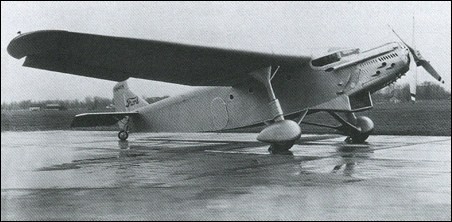
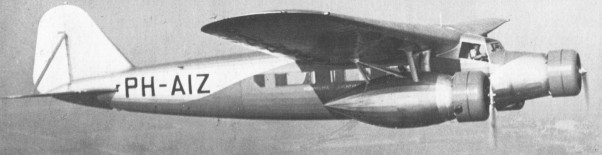
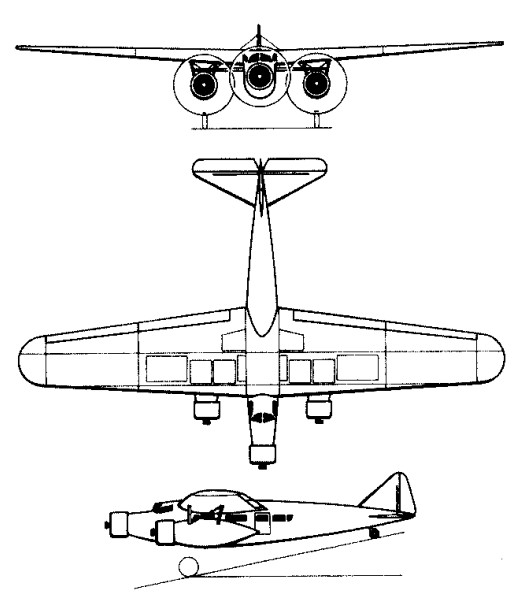
The unique F.XX tri-motor PH AIZ Zilvermeeuw was the first and only Fokker commercial aircraft with a retractable undercarriage. The 12-passenger transport had an elliptical-section fuselage instead of the rectangular form of previous Fokker transports. The cantilever high wing was of wooden construction and the fuselage a steel-tube structure. Power was provided by three Wright Cyclone R-1820-F radial engines, one mounted in the nose and the other two carried on strut assemblies under the wings, for a cruising speed of 270 kph. The main landing gear units retracted rearwards into the engine nacelles. Named Zilvermeeuw (Silver Gull), it was flown for the first time in 1933 and handed over to KLM for operation on services from Amsterdam to London and Berlin. It was later sold via Air Tropic to the Spanish Republican government and was used to maintain liaison between Madrid and Paris during 1937. Its ultimate fate is unknown.
Engines: 3 x Wright Cyclone R-1820-F radial, 477kW Max take-off weight: 9400 kg / 20724 lb Empty weight: 6455 kg / 14231 lb Wingspan: 25.70 m / 84 ft 4 in Length: 16.70 m / 54 ft 9 in Height: 4.80 m / 15 ft 9 in Wing area: 96.00 sq.m / 1033.33 sq ft Max. speed: 305 km/h / 190 mph Cruise speed: 250 km/h / 155 mph Ceiling: 6200 m / 20350 ft Range: 1410 km / 876 miles Passengers: 12
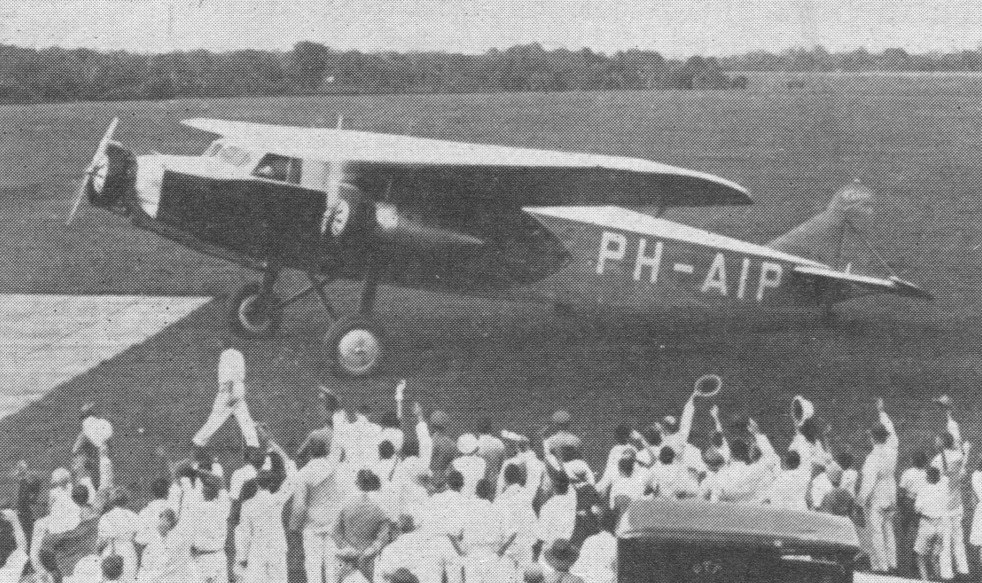
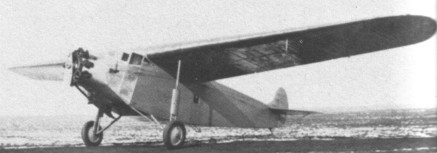
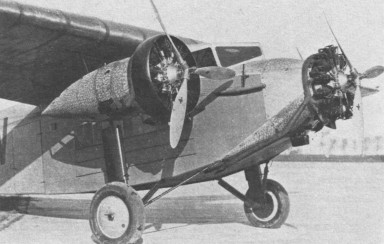
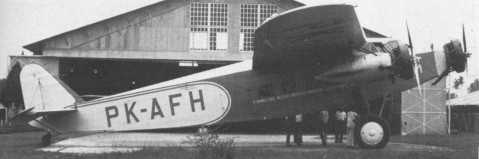
The Fokker F.XVIII retained the same basic design with metal fuselage structure and a high-set cantilever wooden wing but had a number of detail design improvements compared with earlier Fokker tri-motors. Five F.XVIIIs were built in 1932 and all were put into service on the route from Amsterdam to Batavia in the Dutch East Indies. On this route to the East four passengers were accommodated in the main cabin in seats which converted for sleeping; the cabin also provided accommodation for the wireless operator and the navigator. Several notable flights were made by F.XVIIIs. Between 15 and 22 December 1934 PH-AIS Snip (Snipe), re-engined with Pratt & Whitney Wasp T1D1 radials, covered 10300km from Amsterdam to Curasao in a flight time of 55 hours 58 minutes carrying 100kg of mail.
The F-XVIII Pelikaan PH-AIP left Amsterdam on 18 December 1933 and reached Jakarta four days later.
PH-AIP on arrival at Jarkata
The F.XVIIIs were withdrawn from the long-distance routes in 1935. PH-AIS was joined in the West Indies by PH-AIO Oriol and both remained in service until 1946. The Oriol was converted for military use during the war period and carried a defensive machine-gun. Two F.XVIIIs were sold to the Czech national line CSA and operated the route from Prague to Berlin and Vienna, normally carrying 13 passengers. Another of the type was sold to a Palestine freight operator and the famous Pelikaan was bought in October 1936 by Air Tropic, a French company acting for the Spanish government, and it is believed that the Pelikaan ended its days on military liaison and transport duties during the Spanish Civil War.
Engine: 3 x Pratt & Whitney Wasp C radial, 313kW Max take-off weight: 7850 kg / 17306 lb Empty weight: 4623 kg / 10192 lb Wingspan: 24.50 m / 80 ft 5 in Length: 18.50 m / 60 ft 8 in Wing area: 84.00 sq.m / 904.17 sq ft Max. speed: 240 km/h / 149 mph Cruise speed: 210 km/h / 130 mph Ceiling: 4800 m / 15750 ft Range: 1820 km / 1131 miles
In 1933 Fokker produced the F.XII, an airliner with three 420hp Wasp engines and accommodation for 16 passengers. The prototype made its maiden flight at the beginning of 1930 and entered service on the KLM route to Batavia in March 1931. Ten more were built by Fokker, all for operation by KLM and its Far Eastern subsidiary KNILM, except for the final machine which was sold to Sweden and operated by AB Aerotransport as the Varmland. The Dutch-operated F.XIIs maintained the routes to the Far East for two years, and were then switched to the European services connecting Amsterdam with London, Paris, Berlin and other principal cities. On the European runs the F.XIIs carried a crew of two and 16 passengers, but on the Far East route only four passengers were carried in a fair degree of comfort on fully reclining seats. The Danish Orlogsvaerftet built two F.XIIs under licence for the national airline DDL to operate on the Copenhagen-Berlin route. The second, delivered in May 1935, was designated F.XIIM and had some aerodynamic refinements resulting in improved performance. Six Dutch F.XIIs were later sold to British operators, and in turn four of the British machines were re-sold to the Spanish government, which had already bought the last KLM-operated aircraft. All were flown in the Spanish Civil War and were lost during the course of the conflict. Last survivors were the Swedish aircraft and the Danish F.XIIM, the first scrapped in 1946 and the second a year later.
Engines: 3 x Pratt & Whitney Wasp C radial, 317kW Max take-off weight: 7250 kg / 15984 lb Empty weight: 4350 kg / 9590 lb Wingspan: 23.02 m / 75 ft 6 in Length: 17.80 m / 58 ft 5 in Height: 4.72 m / 15 ft 6 in Wing area: 83.00 sq.m / 893.40 sq ft Max. speed: 230 km/h / 143 mph Cruise speed: 205 km/h / 127 mph Ceiling: 3400 m / 11150 ft Range: 1300 km / 808 miles Passengers: 16
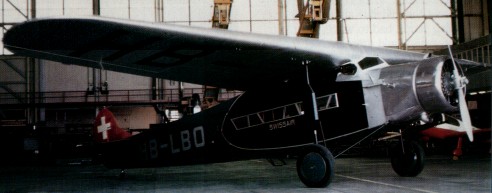
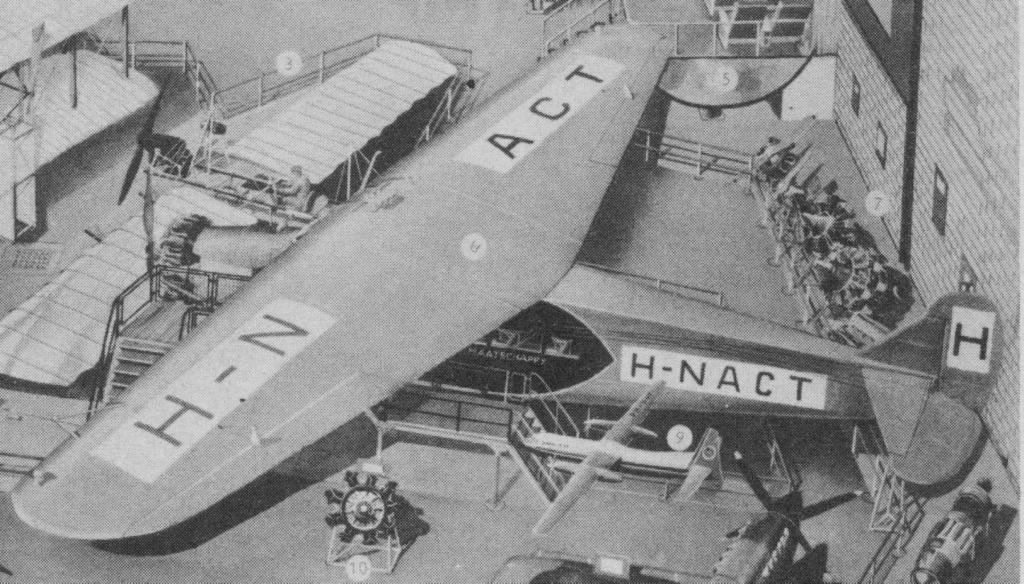
In April 1924 the F.VII made its maiden flight. The F.VII and its derivatives were to revolutionise air transport. Slowly, but steadily, the F.III’s capacity had become inadequate for the rapidly expanding air traffic, and KLM in particular was pushing for a larger successor. On December 10th, 1923, KLM signed a temporary contract for three F.VIIs, with an option on another three later on. The order would be confirmed if the prototype proved satisfactory during practical use. In 1924 the first F.VII went into service with KLM, the first, H-NACC, made the first flight from Amsterdam to Batavia, Java. Five in total were built in 1924-25.
Ever since the end of World War One plans had existed for a flight to the Dutch East Indies, and during the design of the F.VII the requirements for such a flight had been taken into account. In particular, the undercarriage was strongly constructed to allow for the bad landing fields expected along the route. The F.VII had a Rolls-Royce Eagle engine, and its cabin could accommodate eight passengers. A separate luggage compartment was provided, and also a toilet.
The improved version, with rounded wingtips, ailerons moved inboard from the wing tips, and a simplified undercarriage, was designated F.VIIA, and was 22 km/hr faster than the F.VII and more manoeuvrable. The Fokker F.VIIA flew on 12 March 1925 with a 298kW Packard Liberty engine. Following a demonstration tour of the United States, a number of orders were secured and further orders came from European operators. Almost 50 single-engined F.VIIAs were built, some of which were converted later to F.VIIA-3m standard with three engines.
1925 Fokker F.VIIa
Early in July 1925 Fokker cabled Platz in Amsterdam to say that a three engined F.VII was to be built. Platz executed this order in eight weeks. To avoid extra testing and design, he suspended the additional engines be¬neath the wing of an F.VIIA. After a demonstration for KLM, the F.VIIA/3m, as it was later called, was shipped to the USA, where Fokker flew the aircraft from New York to Detroit on September 26th.
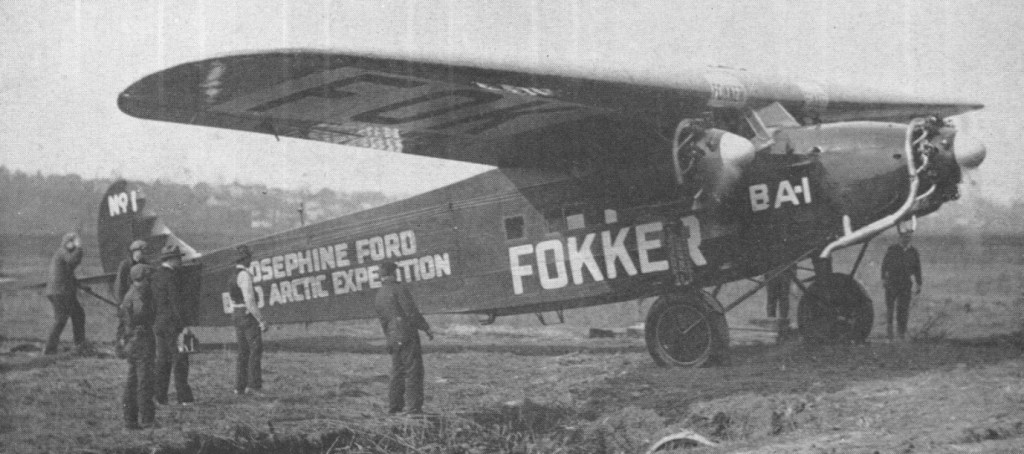
After the Ford Reliability Tour Fokker made the F.VIIA/3m prototype available to the Army Air Corps for testing from Wright Field. After this military goodwill tour, the aircraft was flown to Detroit to be inspected by Edsel Ford, who purchased it. He then made the aircraft available to Lt Commander Richard Byrd, who used it to become the first to fly an aircraft over the North Pole on the 9th May 1926, naming the Fokker F.VIIa/3M Josephine Ford.
Fokker F.VIIa/3M Josephine Ford.
Josephine Ford
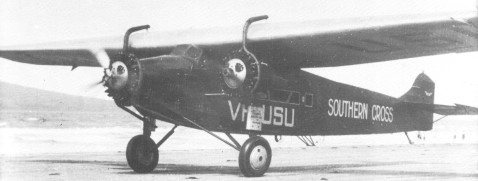
The first trans-Pacific crossing was in 1928 by the Fokker tri-motor “Southern Cross”. Unable to find afequate funding in theit own country, WW-1 Australian RAF pilots Charles E. Kingsford-Smith and C.T.P. Ulm, backed by Californian Capt. G. Allen Hancock, purchased a battered Fokker Detroiter without engines or instruments from Arctic explorer Sir George Hubert Wilkins. After modifications to strengthen fuselage and landing gear for extra fuel, and after obtaining Wright Whirlwind J-5C 200hp engine with US Navy help, now named “Southern Cross” they attemped to break the world endurance record in January 1928. “Smithy” and Lt. G.R. Pond flew for 50 hours, missing the record by two hours.
The Southern Cross left Oakland, California, on 31May 1928 headed for Australia. Crew were pilots Smithy and Ulm, navigator Harry W. Lyons, and radio operator James W. Warner. Oakland to Honolulu – 2408 miles, 27 hr 25 min; Hawaii to Suva, Fiji – 3144 miles, 34 hr 30 min; Fiji to Brisbane – 1795 miles, 21 hr 35 min. Total distance 7400 miles averaging 88.1 mph for 83 hr 15 min flying time, arriving at Brisbane on 9 June. In 1929 Smithy and Ulm made a record flight from Australia to England. After overhaul at the Fokker factory in Amsterdam, the Southern Cross made an east to west Atlantic crossing in 31 hr 30 min in June 1930. The flight continued to Oakland, California becoming the first globe circling aircraft. It then pioneered air mail routes and barnstormed until retirement in 1935. It was refitted and flown in the late 1940s for filming the movie “Southern Cross”. It is now on display at Canberra National Museum, Australia.
F.VIIb-3m
Seven were built by Curtiss as RA-3. American military designation for the F.VIIB/3m was C-2.
The Royal Dutch East Indies Army took over two F.VIIB/3ms, equipped with Titan engines, from the Royal Dutch East Indies Airlines Company. They also used five F.VIIB/3ms with Lynx engines. Sabena relied on a fleet of Fokker F.VIIb/3ms until they were replaced by Savoia-Marchetti S.73s.
One was supplied to the RAF, the only example known to have been used by the military in World War II was the 12th production F.VIIA which, after a chequered career in the Netherlands and Denmark, was presented to the Finnish Red Cross and operated in military markings in the Continuation War which began in 1941. Those operated by the Netherlands and Polish air forces were destroyed at an early stage of the German invasion of these two nations.
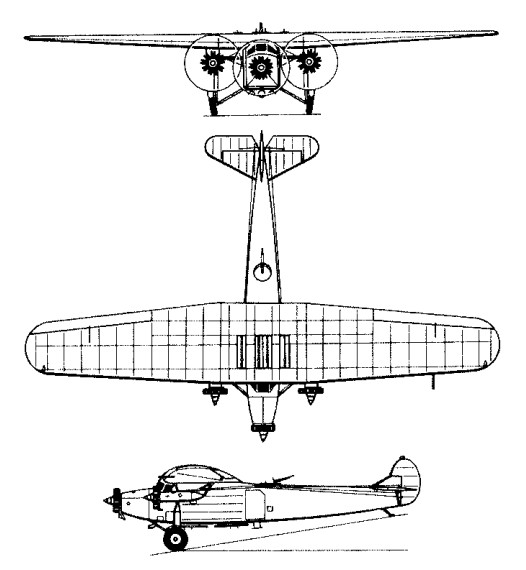
The Fokker F.VIIb-3m one of two aircraft, both of which had crashed, and its wing had been united to the other aircraft, a single-engined F.VIIA. This hybrid had also crashed, and eventually the wing of the tri-motor, and the fuselages of both machines, had been shipped back to the Seattle Boeing factory, where the Tri-motor wing and fuselage were reunited, and the rear fuselage, fin and rudder redesigned to give greater stability. The reconditioned aircraft was re-designated Fokker F.VIIb-3m, and was sold, with Wright J4 engines and no instruments, to Kingsford-Smith, who eventually had it fitted with the later Wright Whirlwind J5 engines, and crossed the Pacific in it in June 1928, with Charles Ulm as co-pilot. The high cantilever thick-section wing consisted of two wooden box spars and plywood ribs, the whole being skinned with plywood. The fuselage and tail unit were welded steel-tube structures, covered mainly with fabric. Narrow chord ailerons were fitted to the main wing. The prototype Trimotor was used by Admiral Byrd on the first flight over the North Pole in May 1927.
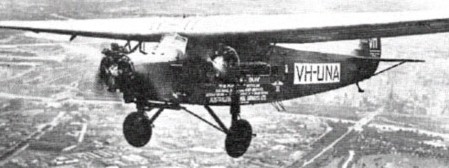
Licence-production was also undertaken in Belgium, Italy, Poland and the UK (as the Avro Ten). Approximately 184 were built. The F.VIIb-3m was also licence built as the Avro 618 Ten circa 1929.
Avro 618 Ten
The Avia F-VIIb /Fokker VII.B/3M/ monoplane was built under licence as the first transport plane from 1931. It was tested in the Scientific Aeronautical Institute as a bomber as the S-19, and as a transport by the Czechoslovak Air Liners Comp.
F.VIIA Passengers: 10 Engine: 1 x Gnome Rhone Jupiter, 298kW Wingspan: 19.3 m / 63 ft 4 in Wing area: 58.5 sq.m / 629.69 sq ft Length: 14.35 m / 47 ft 10 in Height: 3.9 m / 12 ft 10 in Empty weight: 1950 kg / 4299 lb Max take-off weight: 3650 kg / 8047 lb Max. speed: 185 km/h / 115 mph Cruise speed: 155 km/h / 96 mph Ceiling; 2600 m / 8550 ft Range: 1160 km / 721 miles
VIIa/3m Engines: 3 x 215 h.p. Armstrong Siddeley Lynx. Length 47.9 ft. (14.6 m.) Wingspan 63.25 ft. (19.3 m.) Weight empty 4,730 lb. (2,145 kg.) Crew: 2. Pax cap: 8. Max cruise: 106 mph (170 kph). Ceiling: 15,500 ft (4,700 m) fully loaded. Range: 500 miles (800 km).
F.VIIb-3m Engines: 3 x Wright Whirlwind J5. Span 63 ft. 4 in. Length 49 ft. 2 in Height 12 ft. 9 in Wing area 630 sq. ft Weight empty 5,380 lb Loaded 9,000 lb Max. speed 122 m.p.h Ceiling 12,500 ft.
Avro 618 Ten Engine: 3 x 240hp Armstrong Siddeley Lynx IVB or IVC Take-off weight: 4812 kg / 10609 lb Empty weight: 2733 kg / 6025 lb Wingspan: 21.72 m / 71 ft 3 in Length: 14.48 m / 48 ft 6 in Height: 3.89 m / 13 ft 9 in Wing area: 71.72 sq.m / 771.99 sq ft Max. speed: 185 km/h / 115 mph Cruise speed: 161 km/h / 100 mph Ceiling: 4877 m / 16000 ft Range: 644 km / 400 miles
Avia F-VIIb / S-19 Engines: 3 x Walter Castor, 240 hp Props: three-blade composite Wingspan: 21.7 m Length: 14.5 m Empty weight: 2750 kg Top speed: 208 kph Service ceiling: 5000 m Range: 800 km Bombload: up to 800 kg Armament: three machine guns Undercarriage: Fixed






 All Aero