The Laté 4 was unstable and on 14 October 1922 the aircraft was caught by a gust and crashed. At this point the civil aircraft was abandoned. In early 1921 a decision had already been made to submit the second Latécoère 4 as a four-man bomber (to BPR 3 spec); it became the Latécoère 5 powered by three 375 hp / 280kW Lorraine 12Da W12 engines.
The Late 5 was unsuccessful.
Engine: 3 x 370hp / 280kW Lorraine 12Da Max take-off weight: 8400 kg / 18519 lb Empty weight: 5230 kg / 11530 lb Wingspan: 26.80 m / 87 ft 11 in Length: 18.10 m / 59 ft 5 in Height: 4.12 m / 13 ft 6 in Wing area: 195.00 sq.m / 2098.96 sq ft Max. speed: 160 km/h / 99 mph Cruise speed: 122 km/h / 76 mph Ceiling: 4000 m / 13100 ft Range: 700 km / 435 miles Crew: 2 Passengers: 24
In 1928 Kreutzer made the Air Coach six-seat high-wing monoplane with 90 hp nose engine and two 65 hp units outboard. The six seater cruised at 97 mph and had a range of 600 miles.
Experimental conversion of a standard Kellett KD-IB Autgiro into a convertiplane, for the U.S. Navy. Chief external changes are addition of wings and two wing-mounied engines. Was due to fly in 1955.
Engine: 1 x 275 hp Jacobs and 2 x 140 hp Lycoming Rotor diameter: 40 ft Rotors: 3-blade main; 3 propellers Length (blades folded): 25 ft 11 in Loaded weight: 3,400 lb Seats: 1.
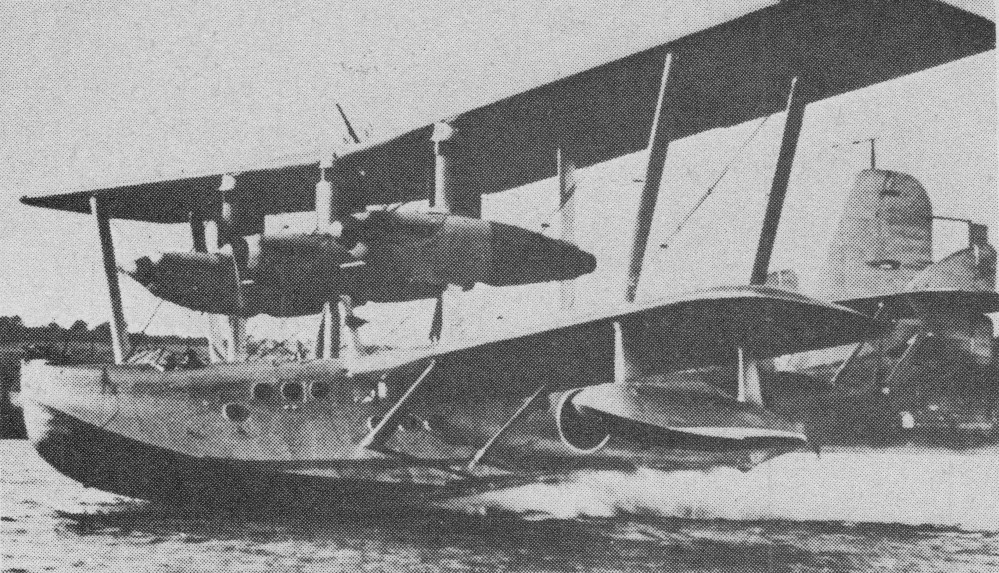
Designed by Short as the KF.1, the prototype was built by Short and delivered to the Japanese Naval Air Force.
Five were built in Japan and at least one saw service in World War II as the Kawanishi H3K1 Type 90-2, a troop and supply transport assigned the code name Belle.
Later models produced by Kawanishi versions had enclosed cockpits and remained active until replaced by H6K2 Type 97 flying boats in 1938-39.
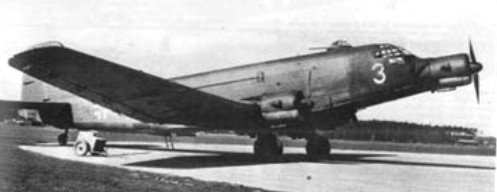
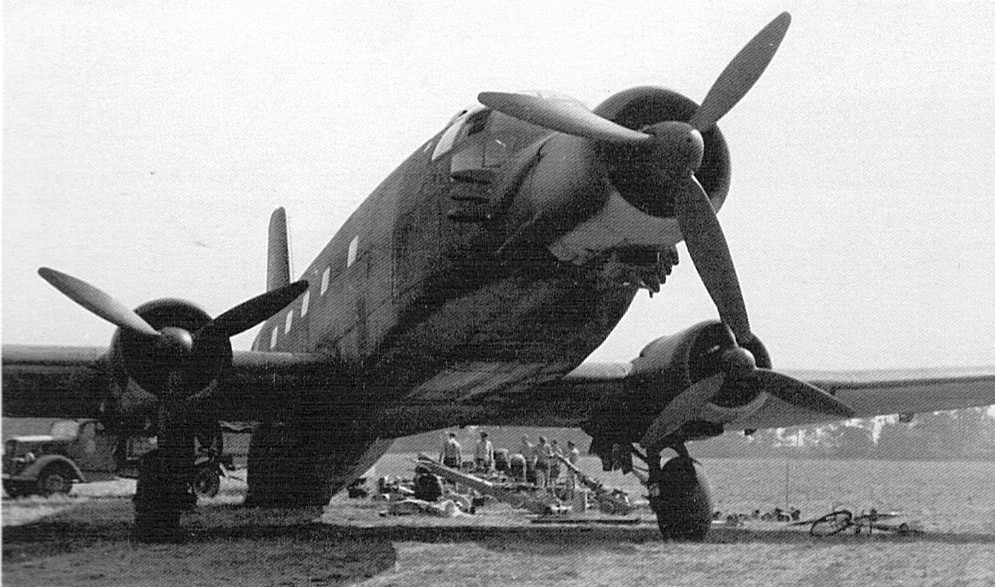
The Ju 352 development was based on wood in order not to use strategic materials. Power was provided by three 894kW Bramo 323R-2 engines. Production of this version totalled 43 or 44.
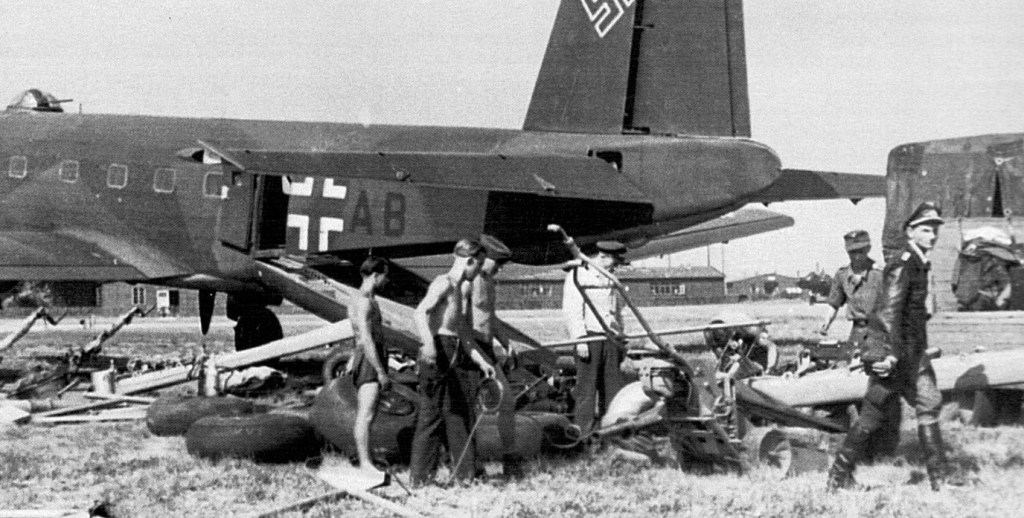
Ju 352 T9+AB at Juvincourt unloading AR234 equipment – Erich Sommer at right
One of the features of the Ju 352 was its Trapoklappe hydraulically-operated loading ramp. Incorporating its own central stairway, this ramp, when lowered, raised the aircraft to a near horizontal position which facilitated easy loading and unloading. Another feature were its reversible pitch propellers.
T9+AB
A total of ten pre-production Ju 352 A-0s and 33 A-1 production aircraft were completed before construction was halted in September 1944.
A number of Ju 352 were delivered to Versuchsverband including T9+AB, T9+MB and T9+AL.
The Ju 252 was a transport aircraft powered by three 1,051kW Junkers Jumo 211 engines. It had been designed to replace the Ju 52/3m but only 15 were produced.
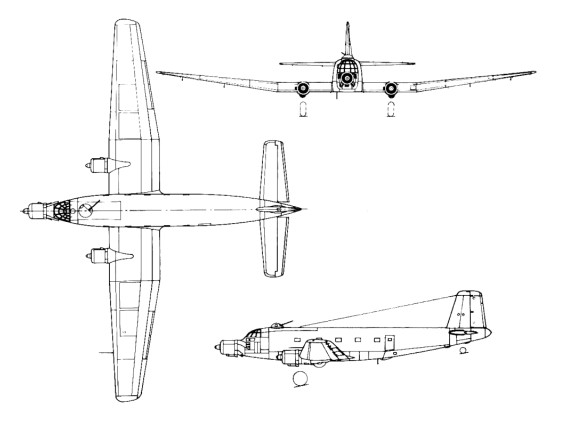
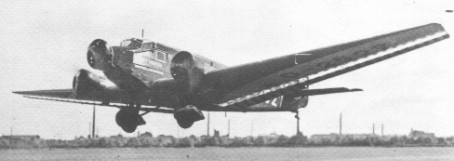
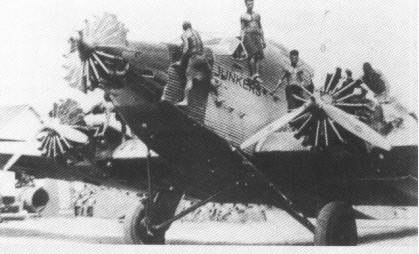
The original prototype (flown in May 1932) was a Ju 52 redesigned to be powered by three engines. Most early civil examples had the 447kW BMW Hornet engine, made under Pratt & Whitney licence; but the vast bulk of later sub-types had the derived engine known as the BMW 132, rated at 507-618kW.
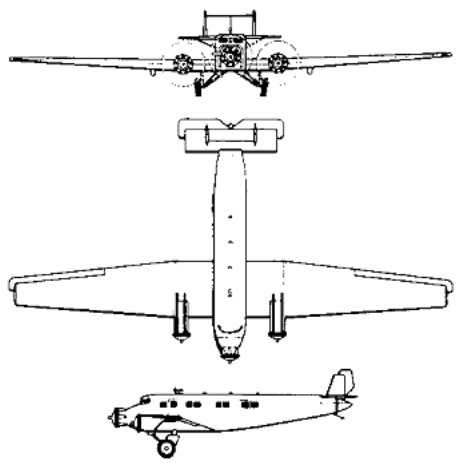
Like the original single-engined Ju 52, the tri-motor transport had a structure wholly of light alloy with corrugated skin and a very large cantilever wing-with patented ‘double wing’ flaps and ailerons giving great lift at low airspeeds. The fixed landing gear was almost unbreakable and on a few examples had spats; float-seaplane and ski versions were not uncommon.
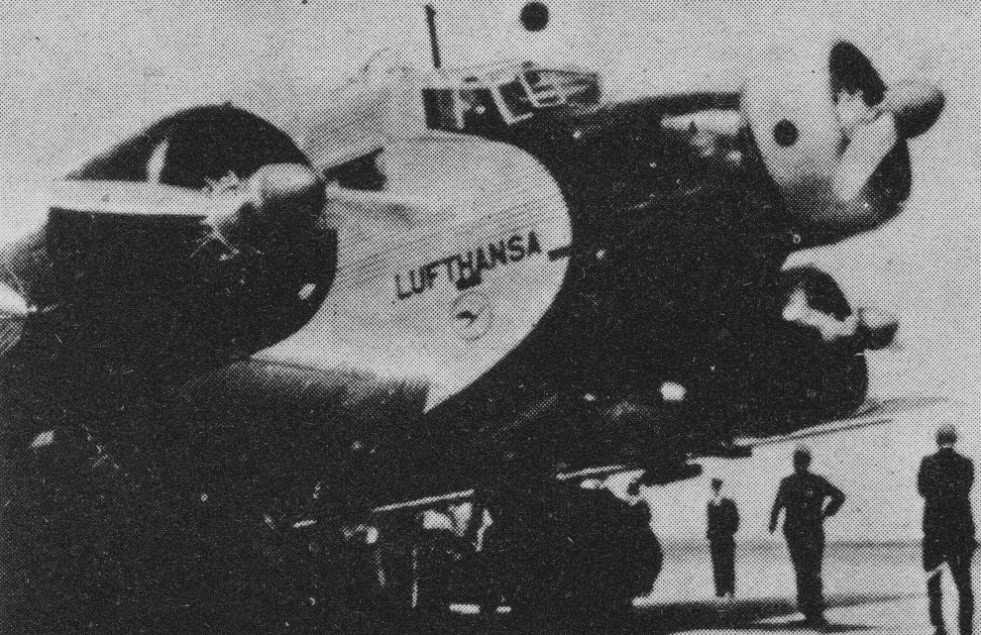
The Ju 52/3m was by far the leading European civil airliner of the 1930s, seating 15 to 17 in single seats each side of the central aisle. It carried more than 75% of Luft-Hansa’s Europe-wide traffic in the 1930s, the airline using at least 120. Exported civil models had Wasp, Hornet and Pegasus engines, and a small number in Germany had Jumo diesels.
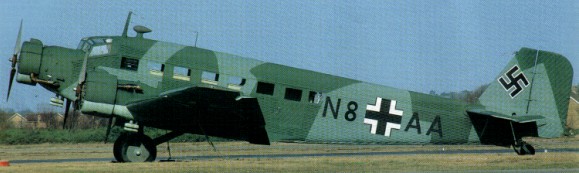
Thirty airlines in 25 countries made it their standard medium range airliner and it equipped the new Luftwaffe’s transport squadrons. Yet the Luftwaffe also adopted the Ju 52 as an auxiliary bomber (Behelfskampfflugzeug) in Octo¬ber 1933, and because of problems in the development of the Do 11 bomber, the Ju52 equipped many of the Luftwaffe’s bombing units as well as its transport squadrons in the mid 1930s. Within a week of the Spanish Civil War’s start, 20 such aircraft were placed at the Nationalists’ disposal, being employed initially to ferry men and supplies from Morocco to mainland Spain. Nine aircraft were then diverted to form a bomber unit. From November 1936 the Legion Condor arrived in Spain, and its Kampfgruppe 88 bomber component had three Staffein each fielding 12 improved Ju 52/3m g4e aircraft. From February 1937 KG/88 received more modern bombers, and 55 Ju 52/3m g4e aircraft were passed to the Spanish, who used them as bombers up to the end of the war, when 23 remained on strength with 1- and 2-0-22.
In the Spanish civil war, Soviet planes went into action for the first time on 4 November 1936, repulsing Junkers 52 bombers attacking Madrid.
Based on reports that the Japanese Army used Ju.52 transports the allied code name ‘Trixie’ was assigned. Lufthansa Ju.52 3/M D-ANJH visited Japan in May 1939 to generate sales in Japan but the type was never selected for military service.
The Ju 52/3m first entered service with the Luftwaffe as the Ju 52/3m g3e bomber transport, a hybrid type providing the fledgling German bomber arm with a limited offensive capability and, more importantly, operating experience with modern multi-engined monoplanes. In 1935 the first 3mg3e bombers reached the Luftwaffe, with 1,500kg of bombs and MG 15 machine-guns in a dorsal cockpit and ventral ‘dustbin’. In 1936 about half the total production (450) of this model were serving as transports or bombers with the Condor Legion in Spain.
Total production of all models was about 4,845 on German account, 575 of which were completed before 1940. German plants then made a further 2,659, the rest comprising output by Amiot for the Luftwaffe. The latter was continued post-war by the AAC which delivered 400 by 1947 with the designation AAC.1. A further 170 were built by CASA in Spain as the C-352.
CASA C-352
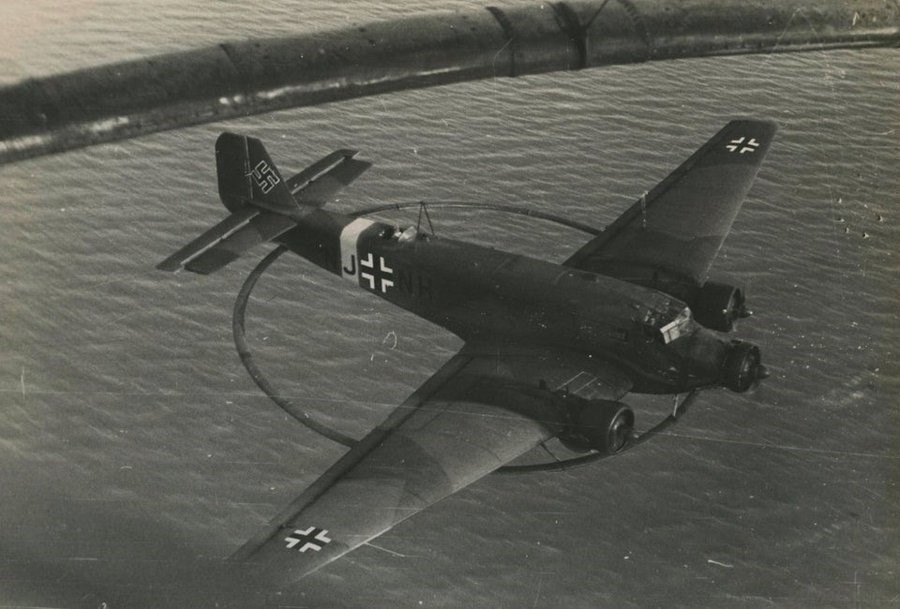
More than 3,500 served with the Luftwaffe, nearly all in the transport role with the popular names ‘Tante Ju’ (Auntie Ju) and ‘Iron Annie’. The most-produced wartime types were the 3mg5e, 7e, 8e and 14e, though differences were confined to such features as armament, loading arrangements, autopilot, glider couplings and crew armour. There were several non-transport versions, such as the g6eMS with a degaussing ring for exploding mines.
The Ju 52 ‘Minensuch’ variant had a 14m diameter current-carrying ferrous ring under the airframe, to create a magnetic field that triggered submerged naval mines.
After 1945 BEA used a fleet on internal services and the Spanish T.2B version was not withdrawn until 1975. One of the last, with the Swiss Air Force, was still active in 1979.
Ju 52/3 Engines 3 x 770 hp BMW 132H Length 62 ft. (18.9 m.) Wing span 95.9 ft (29.2 m) Weight empty 14,325 lb. (6,500 kg.) Armament up to 4 machine guns (Troop transport) Max cruise 160 m.p.h. (260 kph) Ceiling 19,000 ft. (5,800 m.) fully loaded Range 550 miles (885 km) Crew: 2. Pax cap: 17 troops
Junkers Ju 52/3M Tante Ju Engines: 3 x BMW 132 A/3, 819 hp Length: 62.008 ft / 18.9 m Height: 20.013 ft / 6.1 m Wingspan: 95.965 ft / 29.25 m Wing area: 1189.422 sq.ft / 110.5 sq.m Max take off weight: 23152.5 lb / 10500.0 kg Weight empty: 14531.0 lb / 6590.0 kg Max. weight carried: 8621.6 lb / 3910.0 kg Max. speed: 143 kt / 264 km/h Initial climb rate: 787.4 ft/min / 4.0 m/s Service ceiling: 16732 ft / 5100 m Wing loading: 19.48 lb/sq.ft / 95.0 kg/sq.m Range: 648 nm / 1200 km Endurance: 7 h Crew: 3 Payload: 17 Pax
Ju 52/3m g3e Engines: 3 x BMW 132A-3, 541 kW (725 hp). Span: 29.24m (95ft11.5in). Length: 18.9m (62ft). Height: 5.55 m / 18 ft 3 in Wing area: 110.50 sq.m / 1189.41 sq ft Max T/O weight: 10500 kg (23,146 lb). Empty weight: 5720 kg / 12611 lb Max speed: 165 mph at sea level. Ceiling: 5900 m / 19350 ft Range w/max.fuel: 1300 km / 808 miles Operational range: 620 miles. Crew: 3 Armament: up to 5×7.92-mm (0.312-in) mg plus 1500 kg (3,307 lb) bombs.
Ju 52 Engines: 3 x BMW 132D, 850 hp Wingspan: 95 ft 11 in Length: 62 ft 0 in Height: 14 ft 10 in Top speed: 165 mph Range: 850 mi at 138 mph
G.31 Engines: 3 x Bristol Jupiter 420 hp Passenger seats: 12
Engines: 3 x BMW Hornet-A, 385kW Max take-off weight: 8500 kg / 18739 lb Empty weight: 5250 kg / 11574 lb Wingspan: 30.3 m / 99 ft 5 in Length: 17.3 m / 56 ft 9 in Height: 6.0 m / 19 ft 8 in Wing area: 100.0 sq.m / 1076.39 sq ft Max. speed: 211 km/h / 131 mph Cruise speed: 180 km/h / 112 mph Range w/max.fuel: 1050 km / 652 miles Crew: 2 Passengers: 16







 All Aero