In order to train pilots and other personnel, Goodyear decided to build and operate a fleet of small non rigid airships. These would not only prove useful as training craft, but also as experimental ships to test new materials and techniques required for the rigid airship programme.
Between July 1928 and August 1940, twelve commercial airships were built by Goodyear, eleven of the Type TZ, which was an enlarged and improved version of “Pilgrim”, and one larger Type PA. The one off Type PA named “Defender”, largest of the fleet, began life in 1929 with an envelope of 178,000 cut ft. In September 1935, this was replaced with one of 183,000 cu ft when the ship was sold to the U.S. Navy as the first of the G Class.
The “Defender”, the Flag Ship of the fleet, was powered by two 165 h.p. Wright Whirlwind engines and could take eight passengers plus pilot.
Operations were based on five airships during the summer months, With “Defender” based at Akron until retirement in 1934.
Goodyear had supplied the Navy with J 1 in 1922 and G 1 in 1935. G 1 was ex-¬Goodyear DEFENDER,1935, Vol 183,000 cu ft. G 2 to G 8 were ordered June, 1942.
2 Engines
Goodyear Type TZ / ‘L’ Class

In order to train pilots and other personnel, Goodyear decided to build and operate a fleet of small non rigid airships. These would not only prove useful as training craft, but also as experimental ships to test new materials and techniques required for the rigid airship programme.
Between July 1928 and August 1940, twelve commercial airships were built by Goodyear, eleven of the Type TZ, which was an enlarged and improved version of “Pilgrim”, and one larger Type PA. Various sizes of envelope were used, but finally a standard size of 123,000 cu ft was employed on all of the TZ type in service after 1932.
First of the fleet was “Puritan” of 86,000 cu ft, which flew on July 2, 1928. For the next ten years, “Puritan” was in more or less continuous service until completely wrecked in a hurricane on September 21, 1938, at Springfield, Mass. Next to fly was “Volunteer” in April, 1929, to be followed by “Mayflower”, “Vigilant” and “Defender”, all named after winners of the America’s Cup yacht races.
These TZ ships could accommodate four to six passengers and the pilot in their totally enclosed cars, and were powered in their final form by two 145 h.p. Warner Scarab engines.
Operations were based on five airships during the summer months, With “Defender” based at Akron until retirement in 1934, “Volunteer” at Los Angeles, and the remainder either touring or operating at one or other of the two main bases. As ships were lost or retired they were replaced by new or rebuilt ships. When “Vigilant” was wrecked at Piedmont in November 1930, the car and fins were fitted with a new envelope to become “Columbia” re entering service in July, 1931. The new “Reliance” first flew in November, 1931, and she was followed by “Resolute” in 1932, “Enterprise” in 1934, “Rainbow” in 1939, and “Ranger” in 1940.
The outbreak of war curtailed the commercial fleet’s operations until the summer of 1946, when a new fleet was established to continue the tradition. The fleet, however, did not go into retirement. All the ships then in commission, plus a replacement car for “Ranger”, saw service with the U.S. Navy as training L Class ships throughout the war period.
Goodyear had supplied the Navy with J 1 in 1922 and G 1 in 1935, but it was not until 1937 that an order was placed for the first of the L Class (L 1) which was based on the TZ type commercial ship of 123,000 cu.ft. In 1940, L 2 (ex RANGER) and L 3 were ordered and these were followed by the five former Goodyear fleet ships (L 4 to L 8) and 14 production models of which Goodyear built ten (L 13 to L 22). Over twenty of the type were used for wartime training.
The L 1 was followed by the prototype of a new class of naval airship which was destined to be built in larger numbers than any other single airship type, either rigid or non rigid; the K Class.
The second “Ranger” was a replacement for the first. Completed after outbreak of war and delivered direct to U.S.N. as L 8 at Moffett Field, 26 2 42. The car returned to Goodyear in 1946 and was stored. Rebuilt as GZ 20 type for AMERICA, 1968 69.
Immediately after the war, Goodyear bought back from the Navy four complete L ships and one K ship to form the basis of a new commercial fleet. Goodyear were not the only company to be interested in the airship, however.
The Douglas Leigh advertising company purchased no less than 29 surplus L and K ships in February, 1946, and began operating some of them in various parts of the United States with advertising for Ford, M.G.M., Mobilgas, and many other sponsors. However, the coming of television advertising and the high cost of replacing the war surplus ships soon began to tell, and by the early 1950s Goodyear were alone as commercial airship operators in America.
Total production: 18.
The only other Goodyear built airship to be used commercially, other than those of the Goodyear fleet, was the ex Navy L 19, N65N. Originally built in 1944, the airship was delivered to a German company and made its first flight at Stuttgart on March 16, 1956. It became D LAVO, later D LISA, and was used for aerial advertising in Germany until sold to Japan in 1968.
The post war Goodyear fleet, which began operations in May, 1946, were given names used before by the pre war ships, although there was no connection between them and the previous ships of the same name. Navy L-14 became “Mayflower”, L-16 became “Enterprise”, L 17 “Volunteer”, and L 18 “Ranger”, all in service by May, 1947. The single K ship (K 28) became “Puritan” and was the largest commercial airship ever operated by Goodyear, with an envelope of 425,000 cu.ft. She entered service in March, 1947, but due to the high operating cost was withdrawn just over a year later in April, 1948.
Cars from three of the pre war fleet (L-4, L 5, and L 8) were also acquired in 1946 and placed in storage as spares. The car of L 8 has since been used in a modified and improved form for the “America” in 1968. As with the pre war fleet, several rebuilds took place during the 1950s and 1960s to keep one or two ships always in commission up to 1968 when a major expansion programme got under way.
In 1964 Goodyear blimp Mayflower cruised over New York City with two chemists and 250 lb of air sniffing equipment to detect sulpherdioxide gases expelled from industry.
Type TZ (NAVY L CLASS) 1938
Engines: 2 x 145 hp Warner Scarab.
Length: 149ft.
Maximum diameter: 39ft 6in.
Volume: 123,000 cu ft.
Maximum speed: 60 m.p.h.
Cruising speed: 45 m.p.h.
Range: 335 miles.
Endurance: 61 hours.
Useful load: 2,150 lb.
GZ 7
Engines: 2 x145 h.p. Warner R 500 2/6.
Volume: 123,000 cu ft.
Length: 149ft.
Max Dia: 39ft.
Goodyear Type FD
The lack of military contracts caused Goodyear to look at the possibility of building commercial airships, and this led to a series of designs which were to become world famous. The first of these was the Type FD “Wingfoot Express”, of 95,000 cu ft, which first flew in June, 1919. Just over 160 feet long and capable of carrying five people, it was powered by two Gnome Le Rhone rotary engines which were suspended from the envelope above and behind the car. Although short lived, it was soon to be followed by three much smaller craft of 35,500 cu ft which were known as “Pony Blimps”.
Goodyear ‘D’ Class
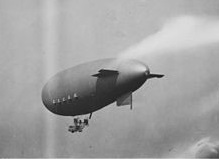
The BA contract was followed by others for C and D Class ships, each slightly larger and more improved than the preceding type. The D class blimp was a patrol airship used by the US Navy in the early 1920s. The D-type blimps were slightly larger than the C-type and had many detail improvements. The Navy continued the practice of dividing the envelope production between Goodyear and Goodrich. The control cars were manufactured by the Naval Aircraft Factory. The major improvements over the C-type blimps were a better control car design and easier, more reliable controls and instrumentation. The engines were moved to the rear to reduce noise and allow better communications between crew members. The fuel tanks were suspended from the sides of the envelope. The envelope was identical to the C-type, except an additional six-foot panel was inserted for a total length of 198 feet (60 m) and a volume of 190,000 cubic feet (5,400 m3). The last of the D-Class, D-6, had a different control car designed by Leroy Grumman who later founded the Grumman Aircraft Engineering Corporation.
The D-1 burned the day of its first flight, 13 July 1920, in the Goodyear hangar at Wingfoot Lake, Ohio. The D-2, D-3, D-4 and D-5 were transferred to the United States Army which the Air Ship Board had given the primary role of operating non-rigid airships after World War I. D-3 participated as an observation and photography aircraft at the famed “Mitchell” bombing test of 1921. D-3 also participated in the Mitchell bombing trials and tested experimental mooring masts. D-3 also participated in early “hook-on” experiments to see if it was possible for an airplane to fly up to and hook onto a trapeze hanging from an airship. No actual hook-ons were achieved, but approaches were practiced. D-4 also participated in the Mitchell trials, for observation and photography. The D-5 was never operated by the Army with that designation. After the loss of D-2, the D-5 was erected with more powerful 180 hp Wright V engines and flown as the D-2 (no. 2) D-2 (no 2 is a designation created by historian James Shock, never used by the Army). There is no evidence the airship flew for the Army with the designation “D-5”. D-5 is believed to have been renumbered “D-2” after the loss of that airship.
The Navy retained one additional D-type, the D-6. The D-6 was built by the Naval Aircraft Factory, Philadelphia, Pennsylvania, but her design was sufficiently different that she was distinct from the other five D-class airships. It featured a further improved control car (the “D-1 Enclosed Cabin Car” which had a water tight bottom for landings on water and internal fuel tanks. The D-6 was burned in the Naval Air Station Rockaway hangar fire of 31 August 1921 along with two small dirigibles, the C-10 and the H-1 and the kite balloon A-P.
The last operational D-type, the D-3 was decommissioned by the Army sometime in 1924.
Typical Specifications
Length: 198 ft 0 in (60.37 m)
Diameter: 42 ft 0 in (12.80 m)
Height: 58 ft 0 in (17.68 m)
Volume: 190,000 cu.ft (5,380 cu.m)
Useful lift: 4,340 lb (1,969 kg)
Powerplant: 2 × Union, 125 hp (93 kW) each
Maximum speed: 58 mph (93 km/h)
Cruise speed: 40 mph (64 km/h)
Range: 1,480 miles (2,380 km)
Endurance: 37 hours
Crew: Four
Armament: 1 × .303 Lewis gun
Bombload: 4 × 270 lb (122 kg) bombs
Goodyear ‘C’ Class
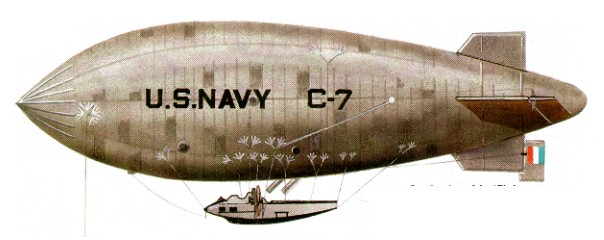
The BA contract was followed by others for C and D Class ships, each slightly larger and more improved than the preceding type.
The Goodyear ‘C’ class airship was a type which must be counted the most successful design ever produced for the type of work envisaged: the C-7 became part of technical history and the type as a whole, although of non-rigid pattern, influenced the next generation of rigid vessels.
The first flight of a ‘C’ class airship took place on 30 September 1918, this and the subsequent five airships being produced by the Goodyear Tire & Rubber Company of Akron, Ohio, where a training establishment and a hydrogen plant had already been set up under contract with the US Navy on 29 May 1917; the 20 trainees in each intake had the advantages of permanent barracks.
The six vessels produced were numbered C-1 to C-8, the omitted designations C-2 and C-6 being used for some reason with C-9 and C- 10 for the quartet of airships of the type ordered from the Goodrich company.
Although the work performed by the ‘C’ class units proved it an outstanding airship design, the type came into use at a time when World War I was nearing its end, so it is to the design features of the class that one must look for interest. Most obvious of these was the four-crew streamlined car with an engine and pusher propeller mounted at each side. The C-7’s claim to history rests on a single incident when, on 1 December 1921, it became the first airship in the world to fly with helium substituted for the normal hydrogen lifting gas. The test was so successful that it was decided that henceforth all US airships would use this inert gas as a fire precaution despite the small loss of lift in comparison with that provided by lighter but inflammable hydrogen.
Other records held by the ‘C’ class include its use for the first successful release of an aeroplane from a non¬rigid airship, and by becoming the first airship to make a coast-to-coast US crossing, this being achieved by one of the pair that were given over to US Army control in 1921. On the other hand the C-5, earmarked for a projected transatlantic crossing attempt, was lost in a storm when it was ripped from its moorings.
With the end of the war, large contracts for naval airships were cancelled but work continued on various military designs.
Goodyear C-7
Type: coastal patrol and convoy escort airship.
Powerplant: two 149. 1-kW (200-hp) Hall-Scott L-6 eight-cylinder water-cooled piston engines; reports also mention the 11 1.9-kW (150 hp) Wright Hispano
Maximum speed 97 kph (60 mph)
Service ceiling 2438 m (8,000 ft)
Range about 4828 km (3,000 miles).
Useful lift about 2,404 kg (5,300 lb).
Diameter 12.80 m (42 ft 0 in)
Length 58.52 m (192 ft 0 in)
Volume 5125.3 cu.m (181,000 cu ft)
Armament: one 7.62-mm (0.30-in) Lewis machine-gun.
Gluhareff EMG-300
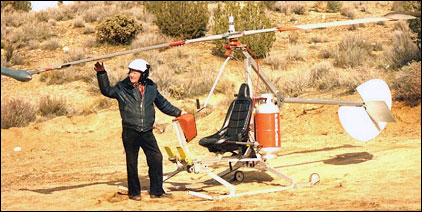
Mr. Gluhareff pioneered the use of liquid propane as a fuel for jet engines and a series of ultra-light portable one-man-helicopters, MEG-1X, MEG-2X and MEG-3X which were designed and built by his own company, Gluhareff Helicopters Corporation. All of which were powered by the G8-2 Pressure Jet Engine on the blade tip and test flown by Eugene M. Gluhareff.
In 1972 Mr. Gluhareff returned to research and design under his own company name of EMG Engineering in Gardena, California. There he continued his work on the G8-2 Pressure Jet Engines which ranged from five pounds of thrust to 700 pounds of thrust.
Mr. Gluhareff designed, built and tested his own one-man tip jet helicopter, the EMG-300 in the early 90’s. Its successful test flight marked the realization of Mr. Gluhareff’s lifelong dream to design what he called a “Flying Motorcycle”.
The EMG-300 was his last design before his death in 1994, it had completed an initial series of test flights, but was not completely tested at the time of his death.
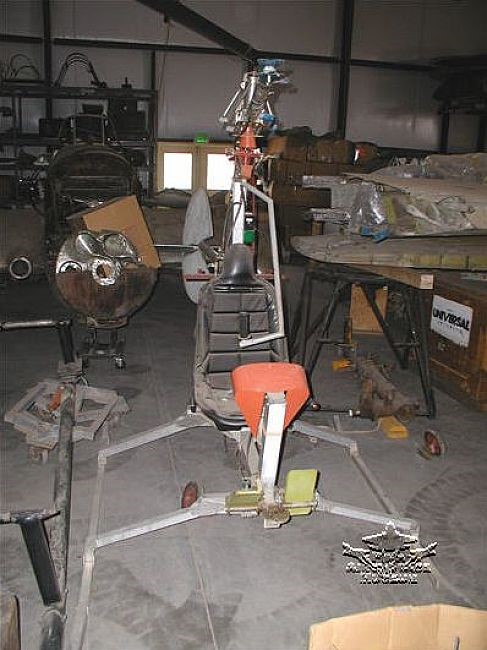
EMG-300
Engine: 2 x G8-2-20H jet engines 10kg of thrust each
Fuel: liquid propane
Fuel capacity: 70 litres
Rotor diameter: 7.3m
Fuselage length: 4.57m
Height: 2.1m
Empty weight: 109kg
Take-off weight: 208kg
Maximum speed without canopy (est.): 112km/h
Maximum speed with canopy (est.): 193km/h
Range: 280km
Endurance: 2.5hr
Gluhareff MEG-2X
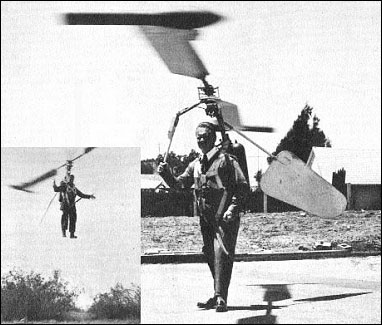
Mr. Gluhareff pioneered the use of liquid propane as a fuel for jet engines and a series of ultra-light portable one-man-helicopters, MEG-1X, MEG-2X and MEG-3X which were designed and built by his own company, Gluhareff Helicopters Corporation. All of which were powered by the G8-2 Pressure Jet Engine on the blade tip and test flown by Eugene M. Gluhareff.
The MEG-1X personal strap-on helicopter rig with a tip-mounted G8-2 engine was followed by the MEG-2X which had a two-blade rotor. No commercial development was undertaken.
Gluhareff MEG-1X
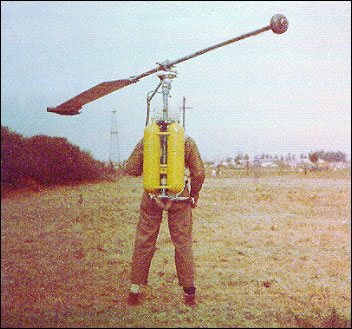
Eugene Gluhareff established a development company in 1952 to carry out research into pressure-jet powered light helicopters. Mr. Gluhareff pioneered the use of liquid propane as a fuel for jet engines and a series of ultra-light portable one-man-helicopters, MEG-1X, MEG-2X and MEG-3X which were designed and built by his own company, Gluhareff Helicopters Corporation. All of which were powered by the G8-2 Pressure Jet Engine on the blade tip and test flown by Eugene M. Gluhareff.
He built the MEG-1X personal strap-on helicopter rig which used a single-blade rotor with a tip-mounted G8-2 engine and followed this with the MEG-2X which had a two-blade rotor. No commercial development was undertaken.
MEG-1x
Take-off weight: 104kg
Max speed: 88.5km/h
Hovering ceiling: 1500m
Endurance: 14-18min
Gloster GA.5 Javelin
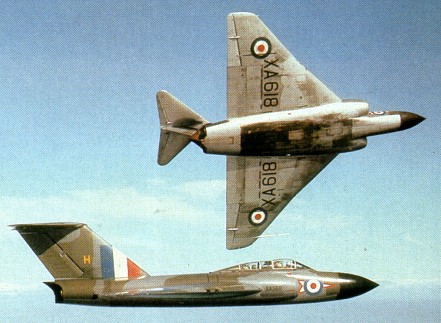
Designed to meet the requirements of Specification F.4/48 for a two-seat twin-engined all-weather interceptor fighter, the Javelin was of tailed-delta configuration and the first of seven prototypes was flown on 26 November 1951. The Javelin suffered a protracted development period, being subjected to delays arising from poor handling qualities and difficulties with integration of the radar.
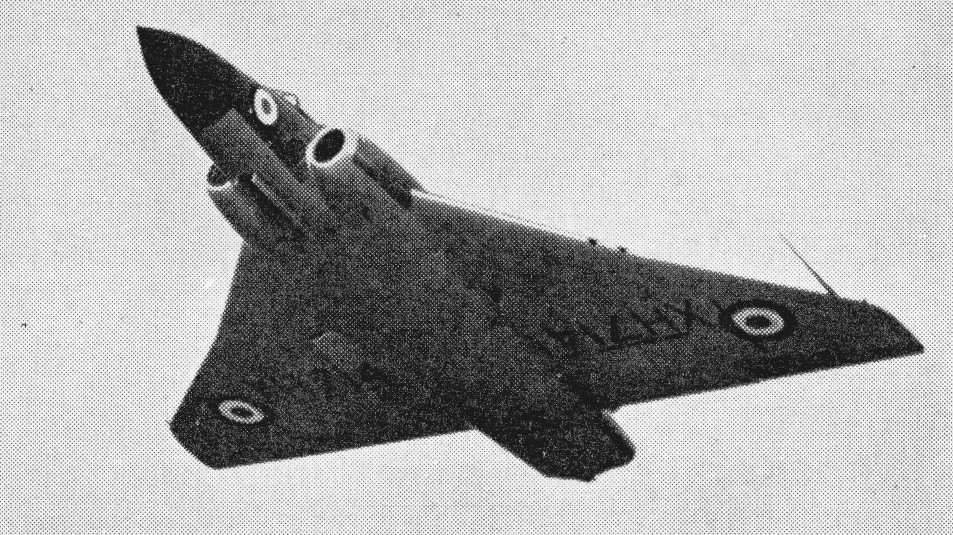
The third prototype, WT827, had a straight wing and early cockpit canopy. WT830, the fourth prototype, had a revised “cranked” leading edge giving a better fineness ratio over the ailerons, and also the old cockpit and no guns; and WT 836, the fifth prototype, which is to full production standard. This has a more extensive transparency over the rear cockpit with a streamlined fairing behind instead of the former rather abrupt cut off to the canopy. The fifth prototype also had the standard “cranked” wing and the full armament of four 30 mm cannon mounted just outboard of the angle in the leading edge.
It was not until late 22 July 1954 that the first production specimen made its maiden flight. This was the Javelin FAW.Mk 1, powered by two 3629kg Armstrong Siddeley Sapphire ASSa 6 turbojets and carrying an armament of four 30mm Aden cannon, which began to enter service with No. 46 Squadron in February 1956.
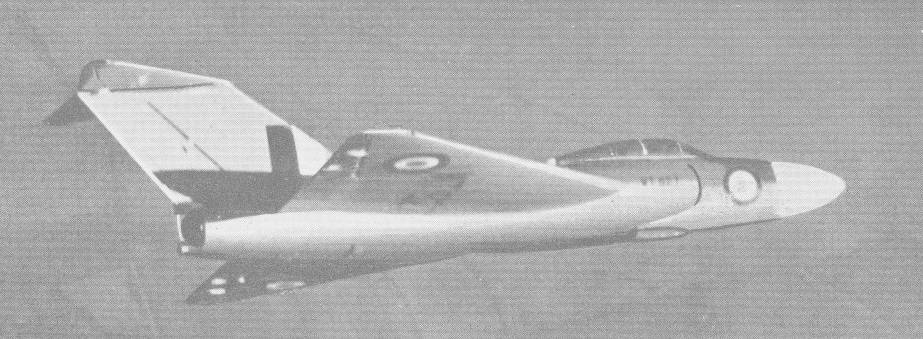
Forty F(AW) Mk Is for the RAF were followed by 30 F(AW) Mk 2s, the first example of this version flying on 31 October 1955.
The FAW.1 was su¬perseded in production by the Javelin FAW.Mk 2 which featured American (APQ 43) interception radar in place of the Brit¬ish (AI17) equipment originally fitted. Both of these models were armed with four 30-mm Aden cannon, as was the Javelin FAW.Mk 4 which intro¬duced an all-moving tailplane in an attempt to eliminate excessive stick force requirements when flying at high indicated speeds. First flown on 19 September 1955, differed in having a fully-powered all-moving tailplane, 50 being built.
The F(AW) Mk 4 paralleled production of 21 T Mk 3 dual-control trainers.
Additional fuel capacity in the wings and having provision for four de Havilland Firestreak AAMs was introduced in the Javelin FAW.Mk 5, which was otherwise virtually identical to the Javelin FAW.Mk 4, and both of these variants duly entered service during 1957. Sixty-four F(AW) Mk 5 were built.
The final ‘first-generation’ model was the Javelin FAW.Mk 6, which was basically a Javelin FAW.Mk 5 fitted with American radar. 33 F(AW) Mk 6s were built.
Whilst production of these was progressing, a major redesign effort had been initiated with the objective of installing the rather more powerful 4990kg Sapphire ASSa 7 200 series engine, and the first model to appear with this power-plant was the Javelin FAW.Mk 7, which also incorporated increased fuel capacity, Firestreak infra-red homing missiles modified flying controls, an extended rear fuselage with raised topline, and later interception equipment, though this entailed the loss of two Aden cannon. Armament comprised two 30mm Aden cannon and four Firestreak AAMs, and 142 were built. The Javelin FAW.Mk 7 took to the air for the first time in November 1956, deliveries get¬ting under way in August 1958.
The FAW.7 model was succeeded by the Javelin FAW.Mk 8 with US radar, drooped wing leading edges and a Sapphire ASSa 7R engines with limited afterburning boosting output to 5579kg above 6100m. Entering service with No. 41 Squadron during early 1960, the Javelin FAW.Mk 8 was the last new-build Javelin variant to appear. Forty-seven were built during 1957-60.
Production of the type terminating on 16 August 1960 when the 381st example made its initial flight.
Subsequently 76 Javelin FAW.Mk 7s were updated to the definitive Javelin FAW.Mk 8 configuration, though retaining British radar, as Javelin FAW.Mk 9 aircraft standard during 1960-61, with Armstrong Siddeley Sapphire Sa.7R after-burning engines. It had a maximum speed of 702 mph and a service ceiling of 52000 feet. Armament was four Firestreak air-to-air missiles and two 30 mm Aden guns.
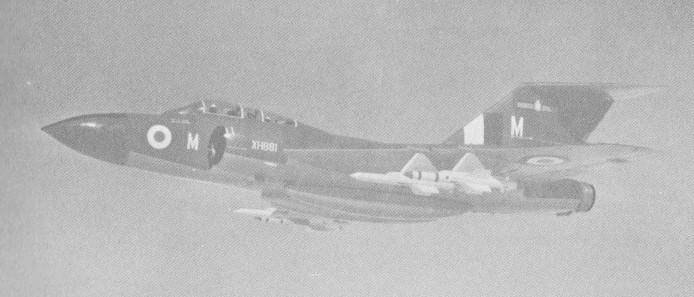
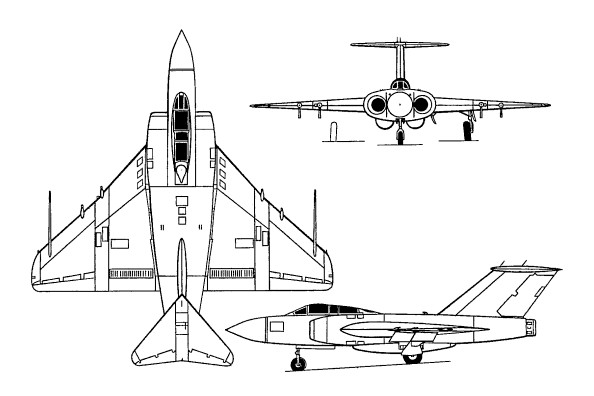
The Mk.9 having 28.5 degrees sweepback on the inner wings and 33.8 degrees on the outer section. Split flaps are under the wings and slotted-plate airbrakes above and below the wings, near the trailing edge, aft of the flaps.
The tricycle undercarriage has a single wheel on each unit. The mains retract inward into the wings and the nose wheel retracts rearward. They can have a flight-refuelling boom from the right side of the cockpit area.
Fuel tanks are in the wings and fuselage and can be supplemented by two 259 Imp.Gal tanks flush under the fuselage and up to four underwing tanks.
Late marks of Javelin were modified circa 1960 to accommodate aerial-refuelling equipment.
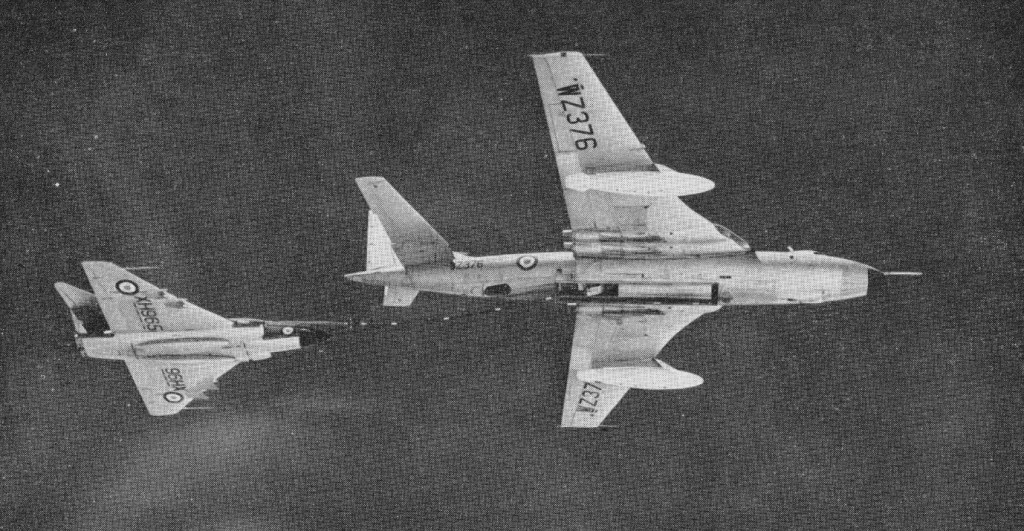
The Javelin was finally withdrawn from RAF service in 1967.
Javelin F(AW). Mk 1
Engnes: 2 x Armstrong Siddeley Saphire ASSa.6 turbojets, 35.6kN
Max take-off weight: 14324 kg / 31579 lb
Wingspan: 15.85 m / 52 ft 0 in
Length: 17.15 m / 56 ft 3 in
Height: 4.88 m / 16 ft 0 in
Wing area: 86.12 sq.m / 926.99 sq ft
Max. speed: 1141 km/h / 709 mph
Ceiling: 16000 m / 52500 ft
Crew: 2
FAW Mk.8
Engines: two 5548-kg (12,230-lb) afterburning thrust Bristol Siddeley Sapphire Mk 203/204 turbojets.
Maximum speed 1101 km/h (684 mph) at sea level
Iinitial climb rate 3734 m (12,250 ft) per minute
Service ceiling 15645 m (51,330 ft)
Rnge with two 1137-litre (250-Imp gal) drop tanks 1497 km. (930 miles).
Mximum take-off weight (40,000 lb).
Wing span 15.85 m (52 ft 0 in)
Legth 17.16 m (56 ft 3.5n)
Hight 4.88 m (16 ft 0 in)
Wing area 86.12 s (927 sq ft).
Armament: two 30-mm Aden cannon, plus four Firestreak air-to-air missiles
Javelin F.(A/W.) Mk.9
Engines: 2 x Bristol Siddeley Sapphire 203/204, 12,300 lb with reheat
Wingspan: 52 ft
Wingarea: 928 sq.ft
Length: 56 ft 4 in
Height: 16 ft
Wheel track: 23 ft 4 in
Armament: 2 x 30 mm Aden cannon
Gloster Trent Meteor
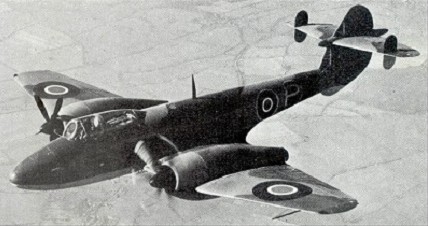
The Gloster Meteor was an important development platform for many jet related technologies including early engine design, this is highlighted by the fact that the eight Meteor F9/40’s were powered by no less than four entirely different engine designs with only two powered by the same engine (The W2/B 23’s of DG205 & DG208).
In many ways the Meteor contributed more at the end of their service life which is seen for the first time with F Mk I Meteor EE227.
Rolls-Royce began to develop the experimental Trent in May 1944, using as the basis of the engine the centrifugal-flow Derwent turbojet which was to power the F.3 and later marks of the Meteor.
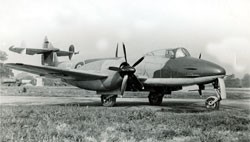
EE227 was originally issued to 616 squadron but after just 80 hours was retired from service in favour of the improved Meteor F. Mk III. Initially sent to RAE Farnborough it soon moved to Rolls Royce at Hucknell in March 1945 where its Derwent Turbojets were exchanged for a pair of Rolls Royce RB50 turboprops.
Fitted with 7ft 11 inch Rotol propellors and reduction gear the combination produced 750 shp and 1,000 lbs of jet pipe thrust. Other modifications included a six inch undercarriage extension for better propellor clearance and ballast in place of its cannons. It first flew from Church Broughton on the 20th September 1945 with Eric Greenwood at the controls.
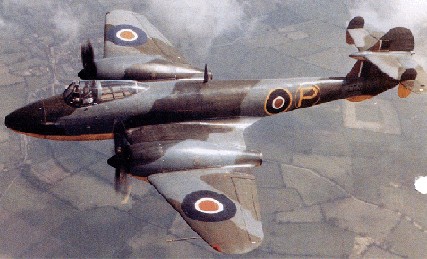
Initial trials showed that the aircraft was directionally unstable which was improved by the addition of small fins on the horizontal stabilizer fitted in May 1946. Later the propellors were reduced in size to 4ft 10.5 inches which had the effect of reducing shaft horsepower to 350 although jet thrust increased to 1,400 lbs. In April 1948 the aircraft spent time at Boscombe Down in simulated deck-landing trials. In total it accumulated 47 hours of flight time in a successful program which would lead to the Rolls Royce Dart turboprop. After having its engines removed in October 1948 it ended its days as a standard F Mk I in fire destruction tests at Farnborough.
Engines: 2 x Rolls-Royce R.B.50 Trent turboprops, 1305kW
Wingspan: 13.12 m / 43 ft 1 in
Length: 12.57 m / 41 ft 3 in
Height: 3.96 m / 12 ft 12 in
Wing area: 34.75 sq.m / 374.05 sq ft
Crew: 1
 All Aero