Grigorovich M-8 / Shchetinin M-8

According to Shavrov the Grigorovich M-8 (Russian: Григорович М-8) was a new prototype on the way to the M-9, in which the contours of the hull were once again modified with a higher recess (about 150 mm). In this case the prototype did not even manage to take off from the water.

AO Alexandrov handles another theory since the following statement appears in a Navy document dated October 26, 1915:
“Currently at the Schetinin factory two large experimental flying boats with increased range are being built. At this time one of them (the minor) is ready and is in the testing stage…”

According to Alexandrov this document refers to the M-7 and M-8 models.

The idea of creating the M-8 as a large flying boat with a long range could respond to a request from the pilots of the Baltic Fleet. In the Naval General Staff, many plans related to naval aviation were related to the giant models of Igor Sikorski and their possible modification to navalized versions. Unfortunately, the only example of the Ilya Múromets bomber in floatplane configuration with floats was destroyed by an accident caused by its pilot’s error during landing in the first days of the war.

At the end of July or beginning of August 1915 D. P. Grigorovich presented to the Aviation Committee of the Baltic Fleet the project of a biplane and twin-engine flying boat with an empty weight of 3.1 tons and a payload capacity of 2 tons. The large fuel capacity (970 kg) allowed it a range of 8 hours of flight at cruise power from its 600 total hp engines. The calculated speed was about 105 km/h.

On August 12, the military pilots supported the idea and proposed giving the aeronautical manufacturer an advance of 50% of the value requested to start the construction of the experimental prototype. The other 50% would be delivered once the specimen was finished and successfully tested, considering that the data presented could only reach a deviation of 10% with respect to the calculated ones.

On August 22, Captain 2nd Rank BP Dudorov, Head of the Aviation Department of the Baltic Sea Liaison Service , approved the idea, but expressed his disagreement with the proposed form of payment. Instead he proposed that the firm apply for a loan and deliver the engines of the requested power.

Everything indicates that SS Shchetinin put great hopes in the project, for which he ordered to start its construction at risk. It was also oriented to expand the factory with new workshops capable of accommodating large flying boats under its roof.

According to a report from the Naval General Staff (MGSh), issued on September 24, the model was built with two 220 hp engines, which would allow a horizontal speed of 95 km/h with a climb of 2,000 meters in 30 minutes. Cargo capacity was also reduced to only 1.7 tons, including crew, weapons and fuel capacity for 7 hours of patrolling. Neither the Navy nor the company were able to obtain the long-awaited 300-hp engines, but hope remained that they could be delivered before construction of the prototype was completed.

From then on, all the evidence that could link the fate of the M-8 disappears. Probably the requested power plant could not be obtained and the performance with the 220 hp engines ceased to be of interest to the Navy, but these are only guesses.

In a paper presented to a meeting of the Imperial Flying Club on November 25, 1915 , AO Alexandrov found some technical data on an airplane that he associated with the M-8. These data are the following:
Number of motors: 2
Total power: 600 hp
Take-off weight: 5100kg
Payload Capacity: 2000kg
Endurance: 8 hours
Fuel weight for 10 hours of flight: 970 kg
Armament weight in 5-hour flight: 650 kg
Armament weight in 10-hour flight: 135 kg
Crew: 5 people
Speed with maximum load: 105 km/h
Wingspan of upper plane: 33 m
Wingspan of the lower plane: 24 m
Height: 3.8m
Length: 14.6m
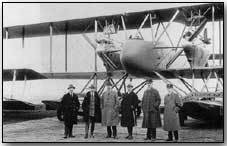
Grahame-White E.7 Aero-Limousine

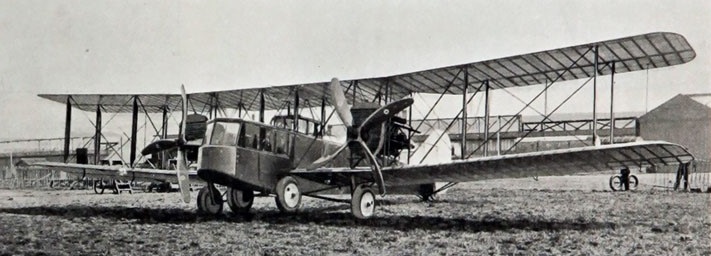
The Grahame-White G.W.E.7 was a twin-engined transport biplane, designed by M Boudot and built by Grahame-White Aviation Company at Hendon.

With folding wings, it seated four passengers in a glazed compartment between the centre section struts in the nose with the pilot behind. Powered by two 320 hp (239 kW) Rolls-Royce Eagle V piston engines.

Finally completed post-war, the only G.W.E.7, registered G-EALR was first flown in 1919.

It was damaged beyond repair in a forced landing at Hendon in the same year. The damaged remains were burned in 1920.

Engines: 2 × Rolls-Royce Eagle V, 320 hp (239 kW) each
Wingspan: 60 ft 0 in (18.29 m)
Length: 39 ft 0 in (11.89 m)
Empty weight: 5785 lb (2624 kg)
Gross weight: 7947 lb (3605 kg)
Maximum speed: 116 mph (186 km/h)
Crew: 2
Capacity: 4

Government Aircraft Factories / GAF N24 Nomad

N24A

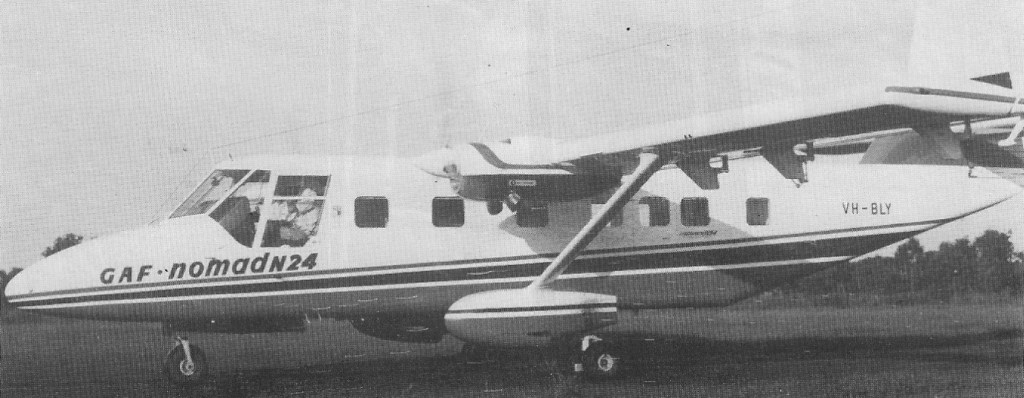
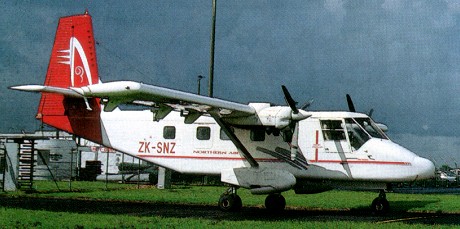
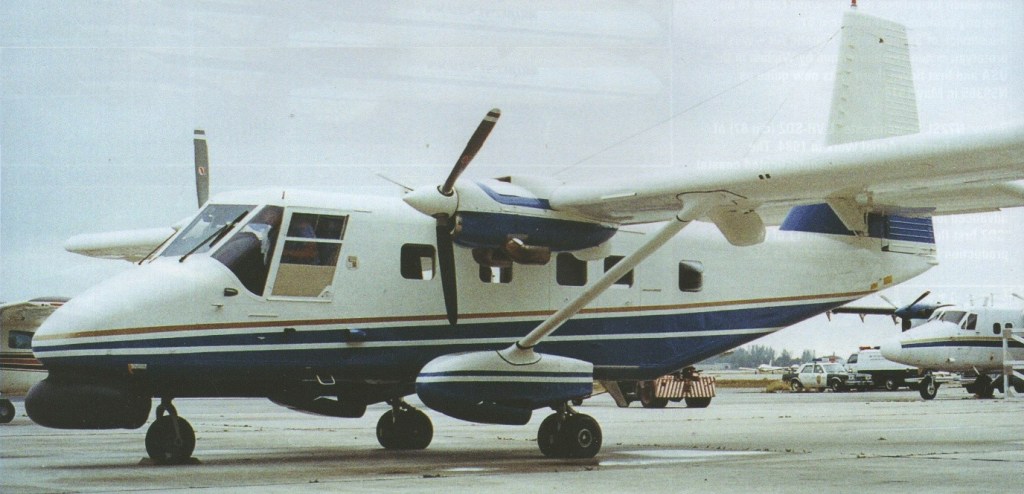
Originally designed in the 1960s as a STOL utility aircraft for both civil and military use. The first prototype flew in 1971.
One hundred and seventy were sold by GAF / ASTA.
Certification in accordance with the Australian Department of Transport air regulation 27 approves the use of N24A as an 18-place airliner in regular public transport as well as in normal operation. N24A is an improved version of the previous ‘stretched’ Nomad N24. It has increased passenger and load carrying capacity with an all-up-weight of 9400 pounds from the original 8500 pounds.

Production ceased in 1984 after safety concerns following a number of accidents and the loss of 54 lives.
Boeing obtained the type certificate via its 1999 acquisition of Rockwell, which had previously acquired ASTA.
Gippsland Aeronautics purchased the GAF N24 Nomad type certificate from Boeing Australia and planned to restart production.

Gallery

N-24
Engine: 2 x Allison 250-B17B, 400 hp.
Seats: 18.
Wing loading: 27 lb/sq.ft.
Pwr loading: 10.5 lb/hp.
Gross wt: 8750 lb.
Empty wt: 4844 lb.
Equipped useful load: 3811 lb.
Payload max fuel: 1451 lb.
Range max fuel/75%: 964nm/5.7hr.
Range max fuel /55%: 1071nm/7.7hr.
Ceiling: 22,500 ft.
Max cruise: 167 kt.
Max range cruise: 140 kt.
Vmc: 62 kt.
Stall: 52-70 kt.
1.3 Vso: 68 kt.
ROC: 1430 fpm.
SE ROC: 280 fpm @ 87 kt.
SE ceiling: 9000 ft.
Min field length: 1100 ft.
Fuel cap: 1770/2360 lb.

N24A
Engines: 2 x Allison 250-B17C, 400 shp.
Props: Hartzell 3-blade, 90-in.
Seats: 17.
Length: 47 ft.
Height: 18.2 ft.
Wingspan: 54.2 ft.
Wing area: 320 sq.ft.
Wing aspect ratio: 9.1.
Maximum ramp weight: 9450 lbs.
Maximum takeoff weight: 9400 lbs.
Standard empty weight: 5480 lbs.
Maximum useful load: 3970 lbs.
Maximum landing weight: 9200 lbs.
Wing loading: 20.9 lbs/sq.ft.
Power loading: 12.2 lbs/hp.
Maximum usable fuel: 1770 lbs.
Best rate of climb: 1313 fpm.
Service ceiling: 23,300 ft.
Maximum single-engine rate of climb: 240 fpm @ 96 kts.
Single-engine climb gradient: 113 ft/nm.
Single-engine ceiling: 11,390 ft.
Maximum speed: 173 kts.
Normal cruise @ 8,000 ft: 169 kts.
Fuel flow @ normal cruise: 335 pph.
Endurance at normal cruise: 5.3 hrs:
Stalling speed clean: 72 kts.
Stalling speed gear/flaps down: 57 kts.
Turbulent-air penetration speed: 134 kts.
Takeoff distance (50ft) 1,710 ft
Landing distance (50 ft) 1,380 ft

Government Aircraft Factories / GAF N22 Nomad

In 1965 design studies were started by GAF to find a follow-on production commitment. Interest expressed from commercial operators lead to a twin engined utility transport. Production commenced on the prototypes in January 1970 with flight testing beginning in 1971.


GAF Nomad N22 Article

Conversion to N.22A allowed an increase in AUW.

The final version, launched in May 1985, was the N22C, aimed at the commuter airline market and offering an increased all-up weight of 4,060kg. The N22C was a post-production variant with increased weights, strengthened undercarriage, improved tail structural design and other modifications. Most Nomads delivered from storage after production ended were to this standard and some earlier aircraft were modified.


Three military variants of the N22/N24 Nomad, the utility Missionmaster, the coastal surveillance Searchmaster B with 1200 scan Bendix radar, and the Searchmaster L with 3600 scan Litton radar, were built for five customers.

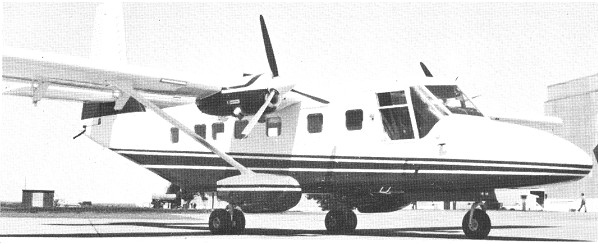
The Nomad is designed and built by the Government Aircraft Factories in Australia in two models. These are the short-takeoff-and-landing (STOL) Nomad N22B and the Nomad N24A commuter aircraft. Variations on the basic aircraft include the Mission Master, the Search Master for maritime surveillance work, and a photographic and mapping model. The aircraft have proven successful in many countries, often flying over rugged terrain in climates ranging from tropical to subarctic. Its STOL capability, originally developed for Australian military use, has made it ideal for operations in rugged areas such as the highlands of Papua, New Guinea. The N22B, capable of carrying up to 12 passengers, can take off in only 800 feet. The larger N24A is a later development of the basic aircraft capable of carrying more passengers and cargo.

The Nomad is characterized by simplicity of construction and systems, which contribute to its economy of operation. Its two Allison 250-B17C turboprops are rated at 420 shp, producing more than two horsepower per pound of engine weight. The B17C offers an improved single-engine high-altitude performance capability and a more rugged gearbox.

The Royal Thai Air Force received 20 N22B Missionmasters.

US Customs Service received 7 Searchmaster Ls from storage including VH-HTG cn160 becoming N6305U in December 1989

Gallery

N22B
Engines: 2 x Allison 250-B17, 416 shp.
Props: Hartzell 3 blade reversible 7 ft 6 in.
Fuel cap: 1030 lt.
Wing span: 54.0 ft (16.46 m).
Length: 41.2 ft (12.57 m).
Height (tail section): 18.12 ft (5.52m).
Main wheel track: 10.6 ft (3.23m).
Wheel base: 12 ft (3.66 m).
Propeller ground clearance: 4 ft (1.22m).
Wing area: 324 sq.ft (30.2 sq.m).
Wing loading at max. gross weight: 26.2 lbsft) 127.9 kg/ sq.m).
Power loading at max. gross weight: 10.2 lbs eshp (4.64 kg eshp).
(Excluding flight deck) – Cabin length: 17.5ft (5.34m).
Cabin height: 5.13ft (1.57m).
Cabin volume: 360 cu.ft (10.2 cu.m).
Cabin door size: 4.06 ft x 4.33 ft (1.24 m x 1.32m).
Baggage compartment volume (nose): 28 cu.ft ( 0.79 cu.m).
Baggage compartment volume (rear): 30 cu.ft (0.85 cu.m).
Take of pwr: 416 eshp (400shp).
Maximum continuous: 400 eshp (385 shp).
Maximum cruise: 380 eshp (366 shp).
Normal internal fuel tanks (usable): 227 Imp gals (1030 lt, 268 U S gals).
Maximum take-off: 8500 lbs (3856 kg).
Maximum landing: 8500 lbs (3856 kg).
Typical operating empty (including commercial interior and avionics): 4730 lbs (2146 kg).
Max fuel capacity (usable): 1793 lbs (813.5 kg).
Tyre size – Nosewheel: 35 p.s i. (241.1 KPa).
Mainwheels (dual): 29 p s i. (199.8 KPa).
All performance quoted at 8500 lbs (3856 kg) TO weight – STOL
Ground roll: 600 ft (183 m).
Distance over 50 ft: 1050 ft (320 m).
FAR 23 Ground roll: 800 ft (244 m).
Distance over 50 ft: 1360 ft (415 m).
STOL Ground roll: 250 ft (76 m).
Distance over 50 ft: 635 ft (194 m).
FAR 23 (no reverse thrust) Ground roll: 655 ft (200 m).
Distance over 50 ft: 1150 ft (351 m).
Stalling Flaps retracted: 68 knots EAS.
Flaps extended: 49 knots EAS.
ROC take-off rating: 1440 fpm (439 m/min).
ROC max. cruise rating: 1260 fpm (384 m/min).
ROC Single engine wax. continuous: 220 fpm (67 m/min).
Service ceiling: 22,500 ft (6858m).
Single engine max continuous rating service ceiling: 10,000 ft (3050 m).
Max. cruise speed — ISA, 5000 ft (1 525 m): 169 kt.
Cruise speed 90% power ISA 5000 ft: 165 kt.
Long range cruise speed 145 kts
TAS: 50 NM wth 3300 lbs (1496kg) payload; 860nm wth 1617lb (733kg).
Max cruise speed (168 knots TAS) range: 50nm wth 3280 lbs (1470 kg) payload; 730nm wth 1617 lbs (733 kg) payload.

N22C Nomad
Engine: 2 x Allison 250.
Installed pwr: 630 kW.
Span: 16.5 m.
Length: 12.6 m.
Wing area: 30 sq.m.
Empty wt: 2092 kg.
MTOW: 4060 kg.
Payload: 1630 kg.
Vne: 200 kts.
Cruise speed: 304 kph.
Initial ROC: 445 m / min.
Ceiling: 7620 m.
T/O run (to 15m): 400 m.
Ldg run (from 15m): 385 m.
Fuel internal: 1018 (+335) lt.
Range (std fuel): 1460 km.
Capacity: 13 pax.

Gourdou G-120

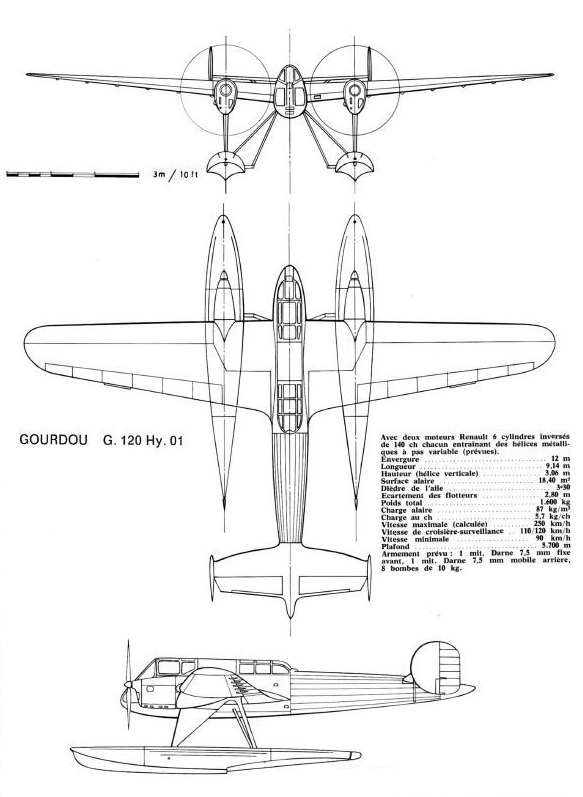
In 1937, the French Navy launched a program for a twin-engine, catapultable twin-engine seaplane for anti-submarine warfare. The aircraft should not exceed a weight of 1,600 kg, and carry 10 bombs of 10 kg. It needed a top speed of 250 km / h, a minimum speed of 90 km / h, and a cruising speed of 110 to 120 km / h. Gourdou proposed a plane equipped with high-lift devices.

In early 1938, the Technical Service of Aeronautics commissioned a life-size, rectangular wing with a constant profile, which passed the tests in the large Chalais-Meudon wind tunnel in June. This wing of 12 m wingspan and 18 sq.m wing surface, resulted in the order of a prototype.

The structure of the wing was two longitudinal members braced by oblique ribs lattice. The wing was fabric covered. The aircraft had a Fowler-type double-flap system, fitting one into the other. In the “out” position, the ensemble retreated by increasing its initial surface area by 50% and opening two slots. The slits obtained by this system were “convergent-divergent”. They differed from the converging slits of Handley-Page beaks and flaps of Bernard aircraft. Once the shutters returned, there were only small dents on the underside.

The fuselage was of welded steel-molybdenum tube structure. It had an advanced cockpit, and a firing point for the gunner behind a common fairing. This defensive post was equipped with a 7.5 mm Darne machine gun. A second machine gun of the same type, fixed, was installed in the nose. The cockpit roofs were glazed, and the front part of the fuselage was Plexiglas.

Both floats each had a volume of 1500 litres. Each float was located under the engine nacelles. They were held in the vertical plane by a triangular panel and a rear strut. Two slashes connected him to the fuselage. The floats were built in three elements, like those of the seaplanes Bernard H.52 C1 and H.110 C1.

The empennages were also made of welded steel tubes. To clear the shot in the rear weapon, the tail was twin fin.

The aircraft was subjected to static tests on a specially designed bench in the Parc Saint-Maur plant. At the beginning of the winter of 1939-1940, the seaplane was transferred to Chalais-Meudon where a special three-column support had been built on the balance plate of the large wind tunnel. In December 1939, the glider tests were carried out, flaps out. The results were disappointing. The lift was 30% lower than expected, the drag higher, the stability at depth mediocre. The director of the wind tunnel tests, Mr. Rebuffel, decided to visualize the flow on the wing with a thin stream of hot oil. The defect was a small oil cooler placed in the leading edge of the wing between the fuselage and the engine. The air intake was on the underside and the exit located on the rear. The smoke clearly indicated that this exit was prominent and caused air separation throughout the area between the fuselage and the engine. Once this radiator output changed, everything returned to normal. The exit and the return of the shutters, in 11 seconds, created a normal flow.

The powered tests began in February 1940, with test pilot Jean-Marie Le Borgne. The metal propellers that were not delivered on time were replaced by wooden pitch propellers. The results confirmed the calculations: the stability was good.

The G.120 was transported to Athis-Mons, in a rented shed on the banks of the Seine. It was launched on June 1, 1940. The test pilot Le Borgne made several hydroplanings, shutters closed, with a test engineer in the rear seat. Passing on his own wake, the pilot noticed a certain lack of rigidity in the behaviour of the floats. During another test, the flaps released, and at 70 km / h the G.120 took off by surprise, after 100 m and rose to 20 m of altitude. After a small flight of 200 m, the pilot landed without difficulty. The next day, the aircraft flew again in front of the STAé officials and flew 50 m above the water for more than 3 km. After this flight, the pilot pointed out the lack of effectiveness of the ailerons. He had been obliged to counter the lateral wind with the rudder. The flotation behaviour of the floats was remedied. This work could not be completed because of the German invasion. To prevent the prototype from falling into the hands of the enemy, Le Borgne destroyed it and sank the wreck in the Seine.

Gourdou G.120 Hy
Engines: 2 x Renault, 140 hp
Wingspan: 12 m
Length: 9.14 m
Height: 3.06 m
Wing area: 18,40 sq.m
Cruising speed: 110-120 km / h
Maximum speed: 250 km / h
Ceiling: 5,700 m
Wing load: 87 kg / sq.m
Load factor 5.7
Armament: 2 x Darne 7.5 mm machine guns
Bombload: 8 x 10 kg bombs

Gotha WD.27

The Gotha WD.27 (for Wasser Doppeldecker – “Water Biplane”) was a patrol seaplanes developed in Germany during World War I. It was a conventional four-engine seaplane with engines grouped in tractor-pusher pairs on the lower wings. Contemporary records show three German Navy serial numbers allocated to the type, but firm evidence of only one of these being built.

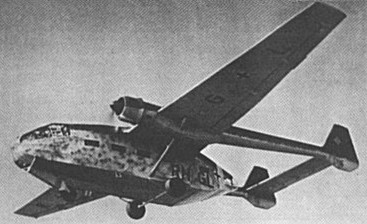
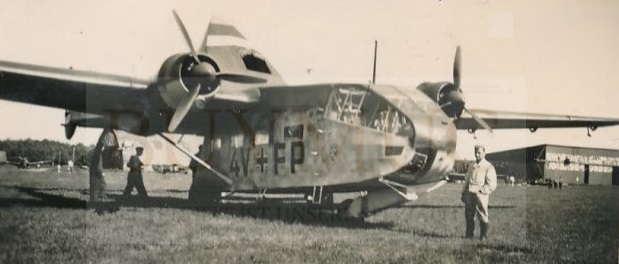
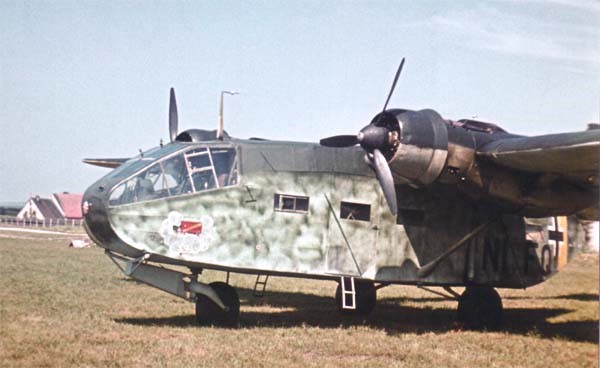
Gotha Go 244

After the fall of France the French Gnome-Rhone 14M radial engine became available to the Germans in large numbers, and the Go 242 was modified to serve as the Go 244 twin-engined transport, each of the twin booms being extended forward of the leading edge of the wing to mount one of these engines. At the same time fixed tricycle landing gear was installed.

A total of 133 conversions was made from the five Go 242B variants and these were designated correspondingly Go 244B-1 to B-5. First deliveries were made in March 1942 to the Greek-based KGrzbV 104 and to KGrzbV 106 in Crete, but they proved to be relatively easy targets for Allied fighter aircraft and had been withdrawn by November 1942. Some Go 244s had 492kW BMW 132Z or captured Russian Shvetsov M-25As each of 559kW.

Go-244B-2
Engine: 2 x Gnome-Rhone 14M, 522kW
Max take-off weight: 7800 kg / 17196 lb
Empty weight: 5100 kg / 11244 lb
Wingspan: 24.5 m / 80 ft 5 in
Length: 15.80 m / 51 ft 10 in
Height: 4.70 m / 15 ft 5 in
Wing area: 64.4 sq.m / 693.20 sq ft
Max. speed: 290 km/h / 180 mph
Ceiling: 7500 m / 24600 ft
Range: 600 km / 373 miles
Armament: 4 x 7.9mm machine-guns

Gotha Go 150

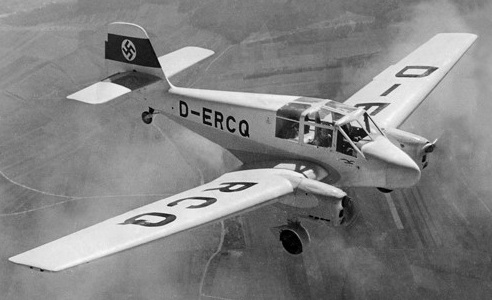
In January 1937 Major Werner Junck, chief of the LC II, the technical wing of the Reichsluftfahrtministerium responsible for the development of new aircraft, informed various minor aircraft manufacturers such as Gothaer Waggonfabrik, Bücker, Fieseler, Flugzeugwerke Halle and Klemm that they would not get any contracts for the development of military aircraft. He therefore advised them to concentrate in the development of a Volksflugzeug or a small twin-engined plane. As a result, Gothaer Waggonfabrik developed the Go 150.

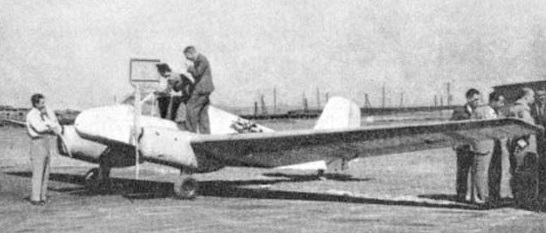
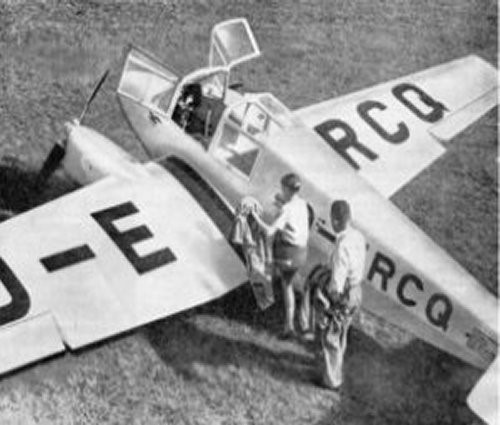
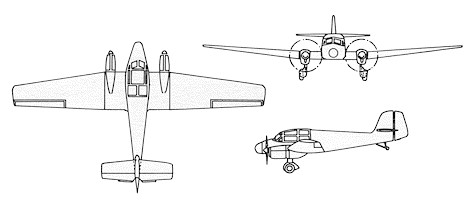
The aircraft was a twin-engined monoplane with an enclosed cockpit, designed by Albert Kalkert.

The first, D-ERCQ, first flew in 1937. The results of this flight were good, and production began. The aircraft was used to train both civilian and Luftwaffe pilots. The Go 150 was later also used in tests, where it was towed by a Heinkel He 46.

Two prototypes were built, followed by a series of 10. All of them received civil registration. Another series with 10 aircraft was planned but not fulfilled.

The Go.150 established flight altitude records in its class. Firstly, three test attempts in which the aircraft reached heights of 7100 m, 7500 and 7800 m were made. Only when there was full confidence in achieving the record, the Go.150 made the attempt.

On July 5, 1938, piloted by Fritz Platz, after 45 minutes he had reached 7,000 meters, but fell sharply in this rate of climb. At an altitude of 7100 meters, it was only 1m\sec, and in another 700 meters, it decreased to 0.5 m\sec. After 1.5 hours he reached an estimated height of 8,000 meters. After ascertaining the correct indication of the instrument pilot, and after 30 minutes, made a successful landing at its airport. This record was officially recorded FAI.

Gallery

Engines: 2 × Zündapp Z 9-092, 37 kW (50 hp) each
Wingspan: 11.80 m (38 ft 9 in)
Wing area: 17.50 m2 (188 sq ft)
Aspect ratio: 8.1
Length: 7.15 m (23 ft 5 in)
Height: 2.03 m (6 ft 8 in)
Empty weight: 535 kg (1,179 lb)
Gross weight: 850 kg (1,874 lb)
Max takeoff weight: 1,036 kg (2,284 lb)
Fuel capacity: 80 kg
Oil capacity: 6 kg
Load: 315 kg
Fuel consumption: 12.7 l/100 km
Flying weight 48.5 kg/sq.m
Maximum speed: 200 km/h (124 mph; 108 kn)
Cruising speed: 185 km/h (115 mph; 100 kn)
Landing speed: 85 km/h
Range: 900 km (559 mi; 486 nmi)
Service ceiling: 4,200 m (13,780 ft)
Rate of climb: 2.74 m/s (539 ft/min)
Time to 1000m: 6min. 5sec.
TO dist to 20m: 400 m
Landing dist from 20m: 500 m
Crew: 1

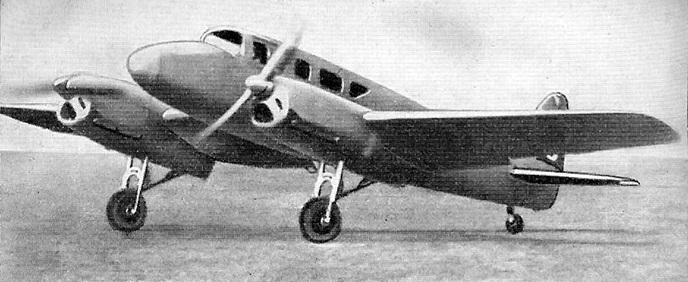
Gotha Go 146

The Gotha Go 146 was a twin-engine utility aircraft developed in Germany in the mid-1930s. It was a conventional low-wing cantilever monoplane with tailwheel undercarriage, the main units of which retracted into the engine nacelles on the wings. It was offered to the Luftwaffe as a high-speed courier aircraft, but the Siebel Fh 104 was selected instead. With Gotha unable to attract other customers, no serious production was undertaken and a small number of prototypes were the only examples built.