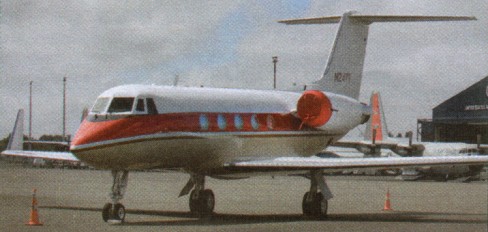
The Gulfstream I, the first of its kind designed specifically for business travel, was a success in the business world, prompting Grumman to develop a jet-powered corporate aircraft called the Gulfstream II or GII.
Announced on 17 May 1965, the G.II was to have a maximum range of 3670 mi / 5907 km.
The Grumman Gulfstream II was originally designed as a business jet, but an enlarged version would eventually serve in feeder airline use. Production of the swept-wing Model II version with turbofan engines started in 1965, and the first delivery was in 1967. It is one of the larger business jets, with a gross weight of 58,000 pounds. It is also one of the fastest, with a top speed of 589 mph, and it has a long-range capability of up to 3,600 miles.
The 200th Gulfstream II was delivered in 1977. In 1981, Gulfstream introduced the Gulfstream GIIB. The GIIB had a modified GII fuselage and the GIII wings, complete with winglets. The variant offered weight and performance characteristics similar to the GIII, but with the shorter GII fuselage. Gulfstream completed and delivered approximately 40 GIIBs. The 256th and final GII delivery took place in 1977.
Gulfstream II 1959 Engines: 2 x RR Spey Mk.511-8 turbofan, 11,400 lb. Seats: 12/19. Wing loading: 80.9 lb/sq.ft. Pwr loading: 2.87 lb/hp. Empty wt. 29,000 lb Max TO wt: 65,500 lb. Operating wt: 36,900 lb. Equipped useful load: 28,207 lb. Payload max fuel: 907 lb. Zero fuel wt: 42,000 lb. Range max fuel/cruise: 1701 nm/3.2 hr. Range max fuel / range: 4009 nm/ 10.2 hr. Service ceiling: 43,000 ft. Top speed 588 mph Max cruise: 512 kt. Max range cruise: 395 kt. Vmc: 89 kt. Stall: 108-130 kt. 1.3 Vso: 140 kt. ROC: 4350 fpm. SE ROC: 1525 fpm @ 214 kt. SE Service ceiling: 24,500 ft. BFL: 5700 ft. Cabin press: 9.45 psi. Fuel cap: 23,300/27,300 lb. Takeoff run 5,000 ft. Landing roll 3,190 ft.
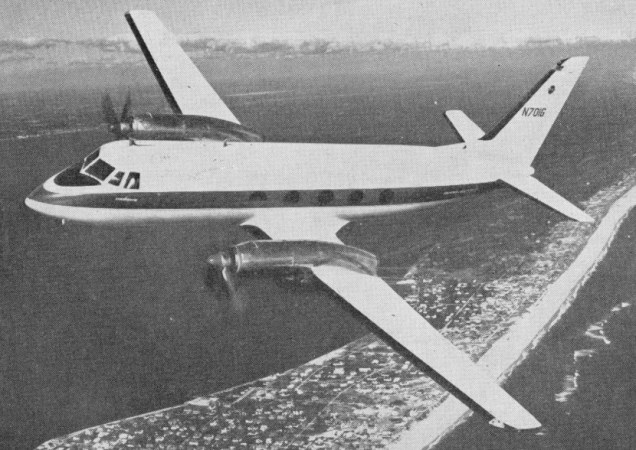
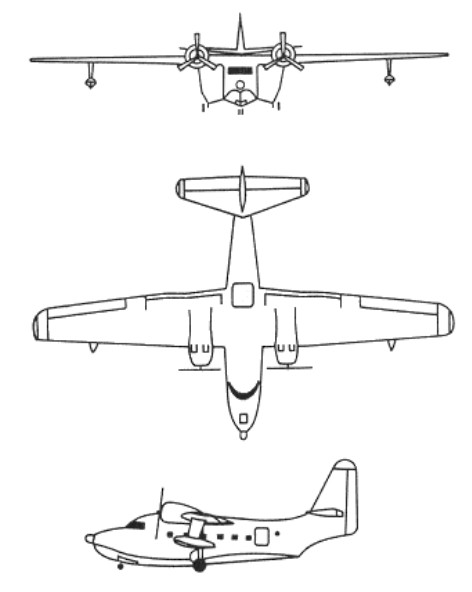
Dubbed the Gulfstream I (GI), the turbo-prop aircraft was named after the Gulf Stream, the current that flows along the coast of Florida, which was a favored vacationing spot for Grumman executives. The Gulfstream I is a business transport designed to carry a crew of two with 10 to 14 passengers, which was introduced in 1958. Power is provided by twin Rolls-Royce Dart turboprop engines turning four-blade Rotol constant-speed propellers.
The Gulfstream I first flew on 14 August 1958 and was the first United States twin-engine business aircraft to be certificated to cruise at 30,000 feet, and had a maximum speed of 350 mph at 25,000 feet and a range of 2,200 miles.
The Gulfstream continued in production in 1960, with about 40 ordered.
A later version received certification as a 24-passenger variation for feeder-line use. Two Gulfstream offspring were enlisted for military use: the VC-4A was a U.S. Coast Guard transport and the TC-4C was an “avionics classroom” for the U.S. Navy.
The aircraft, specifically for business travel, was a success in the business world, prompting Grumman to develop a jet-powered corporate aircraft called the Gulfstream II or GII.
Seats 10-24. Gross wt. 35,100 lb. Empty wt. 21,900 lb. Fuel capacity 1,550 USG. Engines two 2,210 shp Rolls-Royce Darts. Top speed 348 mph. Cruise speed 288 mph. Initial climb rate 1,900 fpm. Approach speed 128 mph. Range 2,540 miles. Ceiling 33,600 ft. Takeoff run 2,550 ft. Landing roll 1,525 ft.
Gulfstream American Commander Divi¬sion announced it will build a lower-¬powered version of its large cabin 1000 model. The new airplane will be called the Commander 900. By moving the floor and the pressure bulkhead and by chang¬ing the windows, Gulfstream has been able to come up with a great deal more cabin space inside the old Commander fu¬selage. First built in 1982.
AE-900 Engines: 2 x Garrett TPE-331-5-254K, 748 shp. Props: Dowty Rotol 3-blade, 106-in. Seats: 7/9. Length: 42.9 ft. Height: 14.9 ft. Wingspan: 52.1 ft. Wing area: 279 sq.ft. Wing aspect ratio: 9.8. Maximum ramp weight: 10,775 lbs. Maximum takeoff weight: 10,700 lbs. Standard empty weight: 7000 lbs. Maximum useful load: 3775 lbs. Zero-fuel weight: 9000 lbs. Maximum landing weight: 10,550 lbs. Wing loading: 38.3 lbs/sq.ft. Power loading: 7.2 lbs/hp. Maximum usable fuel: 2848 lbs. Best rate of climb: 2779 fpm. Service ceiling: 32,325 ft. Max pressurisation differential: 6.7 psi. 8000 ft cabin alt @: 31,000 ft. Maximum single-engine rate of climb: 924 fpm @ 112 kts. Single-engine climb gradient: 480 ft/nm. Single-engine ceiling: 18,140 ft. Maximum speed: 289 kts. Normal cruise @ 18,000ft: 286 kts. Fuel flow @ normal cruise: 648 pph. Endurance at normal cruise: 3.9 hrs: Stalling speed clean: 79 kts. Stalling speed gear/flaps down: 77 kts. Turbulent-air penetration speed: 188 kts.
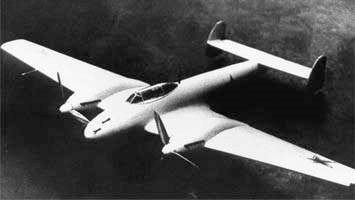
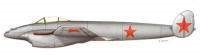
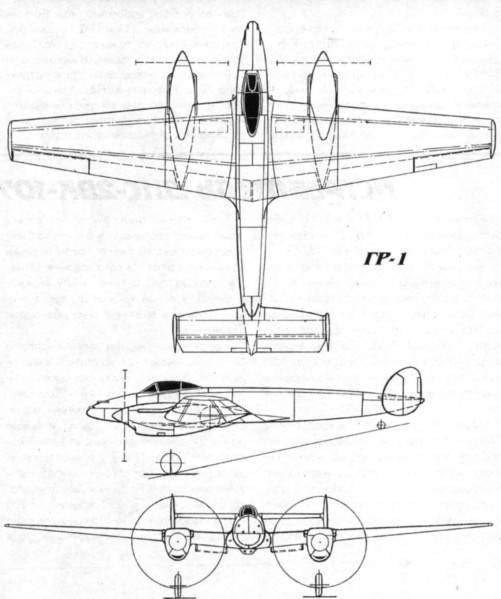
In 1940 PD Grushin was given the task of creating a long-range escort fighter within the experimental aviation development program. Developed by Grushin during his period as the OKB ‘s chief builder at Kharkiv Aviation Plant No.135, the IDS heavy escort fighter name corresponds to the initials Long-Range Fighter (in Russian: Истребитель Дальнего Сопровождения), but it was also known as Gr-1 (Grushin No.1).
The Gr-1 was designed as a twin-engine monoplane of conventional structure with a twin-empennage tail and was powered by two water-cooled Mikulin AM-37s rated at 1,200 hp. The structure of the Gr-1 was metal. The wings featured spars of square section and the rib of shaped and welded pieces of steel forming a closed contour.
The Gr-1 cockpit featured armor plating using a steel slatted trunk and this was the primary cause for the single-seat configuration selection. During development Grushin asked his specialists to assess between a two-seater configuration with pilot and gunner and an armored single-seater configuration capable of fully defending the pilot. The results showed that the second configuration was 18 kg lighter than the first and from this analysis the Gr-1 emerged as a single-seater.
AM-37 engines featured exhaust manifolds located above the wing and the radiators were located in the lower part of the wing center and had a retractable configuration to reduce the probability of impacts during dogfights.
The IDS had in the nose two 7.62 mm ShKAS machine guns and two 20 mm ShBAK cannons. Two other ShKAS machine guns were located in the wings. All the machine guns had 1,250 rounds, while the cannons had 300 rounds per unit. It was also planned to install a station with a pair of 37 mm guns in the lower part of the fuselage with 200 rounds each.
In the wing, 4 supports capable of carrying eight 100 kg aviation bombs or four RS-82 or RS-132 unguided rockets could be located. Instead of installing guns, up to 500 kg of bombs could be hung under the fuselage.
The Gr-1 was designed and built in just 9 months. The static resistance tests took several days and in the spring of 1941 the plane was ready to fly. After a period of fine-tuning and fixing details, someone objected that the plane had not been tested in the TsAGI wind tunnel. Without this proof, flying was too risky, so the plane was disassembled and sent to Moscow.
After the tests, the plane was again disassembled and sent to Factory No.135 to correct the indications, but the war began.
The Factory was evacuated to the west and the plane was repacked. During the transfer the convoy was bombed. The Gr-1 suffered extensive damage and all the documentation was burned. Work on the fighter was never continued. Grushin was sent to Factory No.21, where he held the post of chief engineer and later replacement for builder Semyon Lavochkin.
Gr-1 Powerplant: 2 x 1,250 hp Mikulin АМ-37 Wingspan: 16.80 m Wing area: 42.00 m² Length: 11.60m Height: 3.88m Empty weight: 5420 kg Normal takeoff weight: 7650 kg Fuel capacity: 1860/2550 kg Wing loading: 182kg/m² Power load: 2.73 kg/hp Calculated Maximum speed at sea level: 448 km/h Maximum speed at 7200 m: 595 km/h Landing speed: 120 km/h Ascent time to 5000 m: 9.8 min. Range: 1890 km Practical range: 1380 km Practical ceiling: 11700 m Accommodation: 1 Armament: Four 7.62 mm ShKAS machine guns and two 20 mm ShKAS cannon Bombload: 500 kg or eight RS-82 and RS-132 rockets
Right on schedule, in December 1974, Grum¬man American got its new light twin, the Cougar, into the air on its first test flight.
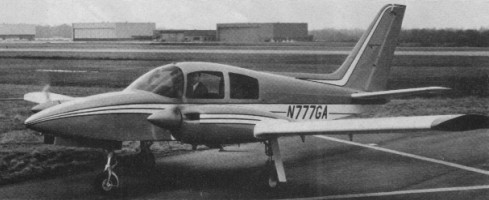
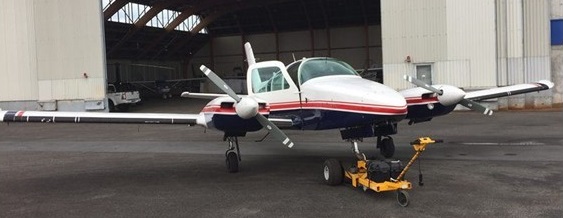
The Cougar had a lengthy development period – nearly three years – between the prototype’s first flight on December 20 1974 and certification in September 1877. During that time the aircraft was modified considerably in detail. First flown with a sliding canopy and two cabin windows per side. A third window had been added by the time the aircraft entered production and the sliding canopy replaced by a conventional solid cabin roof and starboard side entry door.
The cabin itself was made a little larger while a two spar wing helped form the structure for an integral wet wing fuel tank. On the prototype the main undercarriage units retracted inwards but on the production models they retracted outwards. The first production standard Cougar flew in January 1977.
Two models were offered for the 1978 model year, the basic GA-7 and the better equipped Cougar with improved fittings, a basic avionics pack and gyro system as standard.
In service, the Cougar’s single engine performance on only 160 hp / 119 kW a side proved to be not as great as early published figures indicated and the numbers were subsequently revised downwards by nearly 30%. Gulfstream responded by proposing two new variants, one with turbocharged 160 hp / 119 kW engines and another with 180 hp / 134 kW normally aspirated engines.
Neither proposal eventuated as Gulfstream ended production of all light aircraft in 1979.
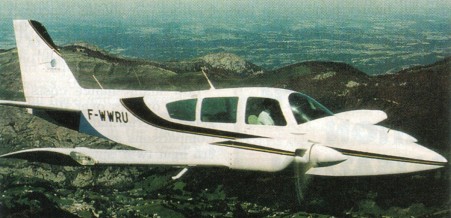
In 1995 plans were made for SOCATA to licence build the Grumman GA-7 Cougar as the TB320 Tangara.
SOCATA TB 360 Tangara
Socata acquired the design and manufacturing rights to the Cougar in 1995. Socata announced plans to produce the aircraft as the TB 320 Tangara and then as the TB 360 with 180 hp / 134 kW Lycoming O-360 engines. Three modified Cougars were built as prototypes, the first (as a TB 320) in mid 1996 and the second (as a TB 360) in February 1997. Planned production was then delayed.
Grumman GA-7 Cougar Engines: Lycoming 0 320 D1D, 160 hp / 119 kW TBO: 2,000 hrs. Props: two blade, constant speed, 73 inch dia. Length: 29 ft. 10 in. Height: 10 ft. 4 in. Wingspan: 36 ft. 10 in. Wing area: 184 sq.ft. Wing loading: 20.67 lb/sq.ft. Power loading: 11.88 lb/hp. Seats: 4. Empty weight: 2,569 lb (1,165 kg) Useful load: 1,155 lbs. Payload with full fuel: 459 lbs. Gross weight: 3,800 lb (1,724 kg) Usable fuel capacity: 116 USG/696 lbs. Service ceiling: 17,400 ft (5,300 m) Rate of climb: 1,150 ft/min (5.8 m/s)Single engine rate of climb: 280 fpm. Single engine climb gradient at 85 knots (Vyse): 197 ft. per nm. Single engine service ceiling: 4,500 ft. Maximum speed: 117 kts. Max cruise, 75% power (2,700 rpm) at 8,500 ft: 165 kts. Range: 1,170 nmi (max econ no res) Duration at maximum cruise: 6.7 hrs. Duration at economy cruise: 9.2 hrs. Stalling speed, clean: 68 kts. Stalling speed, full flaps: 61 kts.
Socata TB 360 Tangara Engines: 2 x Lycoming O-360-A1G6, 180 hp / 134 kW Wing span: 36 ft 11 in / 11.24 m Length: 29 ft 10 in / 9.09 m Height; 10 ft 4 in / 3.15 m Wing area: 184 sq.ft / 17.1 sq.m MTOW: 3800 lb / 1724 kg Max speed: 174 kt / 322 kph Max cruise; 165 kt / 306 kph Long range cruise: 120 kt / 222 kph Initial ROC: 1400 fpm / 427 m/min Service ceiling; 20,000 ft / 6096 m Range at max cruise (45 min res): 800 nm / 1480 kg Max range w/res: 1140 nm / 2110 km
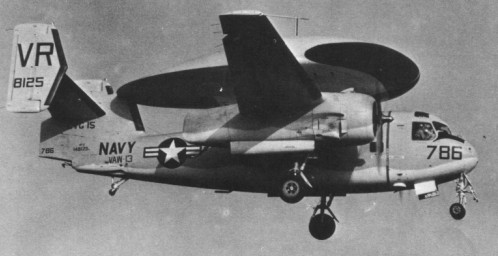
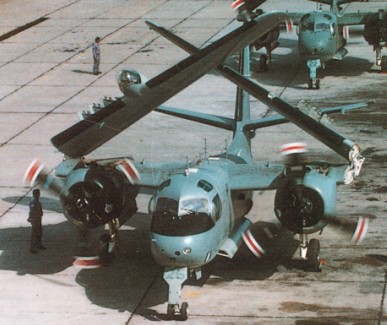
An AEW development of the S-2 Tracker the E-1 Tracer was designated WF under the old US Navy system. The Tracer was fitted with the Hazeltine AN/APS-82 search radar in its radome. The radar featured an Airborne Moving Target Indicator (AMTI), which analyzes the Doppler shift in reflected radar energy to distinguish a flying aircraft against the clutter produced by wave action at the ocean’s surface. Separating a moving object from stationary background is accomplished by suitable hardware. The E-1 featured folding wings for compact storage aboard aircraft carriers. Unlike the S-2 and C-1 in which the wings folded upwards, the radome atop the fuselage necessitated the E-1 to fold its wings along the sides of the fuselage.
Variants:
XTF-1W/XWF-1 Aerodynamic prototype (BuNo 136792) without electronics, later rebuilt as a standard C-1A, retaining the twin tail.
WF-2 Airborne Early Warning version of the TF-1 Trader, redesignated E-1B in 1962, 88 built.
E-1B WF-2 redesignated in 1962.
Specifications:
E-1B Engines: 2 × Wright R-1820-82A Cyclone 9-cylinder radial, 1,525 hp (1,137 kW) Length: 45 ft 4 in (13.82 m) Wingspan: 72 ft 4 in (22.05 m) Height: 16 ft 10 in (5.13 m) Wing area: 506 sq ft (47.0 sq.m) Empty weight: 20,638 lb (9,381 kg) Loaded weight: 24,800 lb (11,273 kg) Max takeoff weight: 26,600 lb (12,091 kg) Maximum speed: 207 knots (238 mph, 383 km/h) at 4,000 ft (1,220 ft) Cruise speed: 142 knots (163 mph, 263 km/h) Service ceiling: 15,800 ft (4,800 m) Rate of climb: 1,120 ft/min (5.7 m/s) at sea level Range: 900 nmi (1,035 mi, 1,666 km) Endurance: 6.83 hrs (4.63 hrs on station at 150 nm (278 km) at 5,000 ft (1,500 m) Armament: None Crew: 4, two pilots, two RADAR/Intercept Controllers
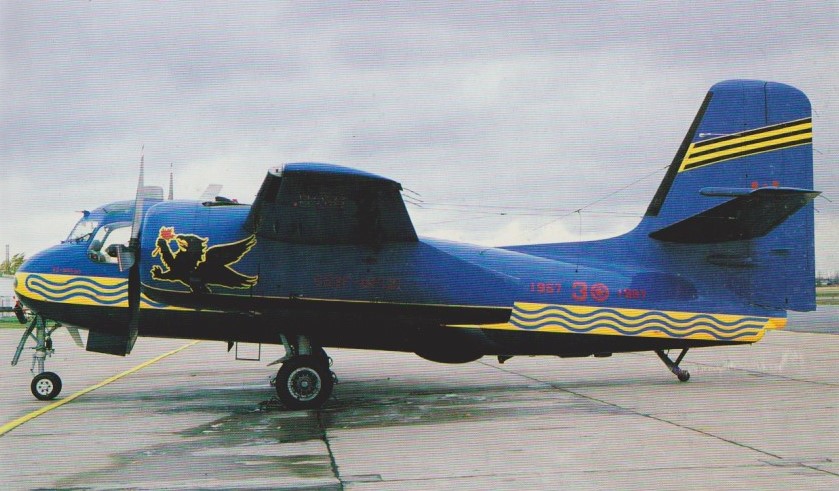
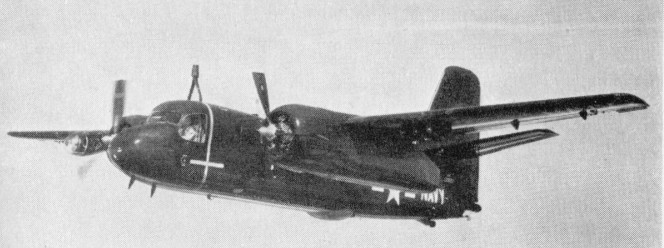
Grumman’s S 2 Tracker was the first of the US Navy’s post Second World War aircraft to combine the ASW roles of ‘hunter’ and ‘killer’. Prior to its entry into operational service, no one aircraft with adequate perform¬ance and the capability to carry the necessary equipment to seek the sub¬marine, as well as the weapons to destroy it. The prototype was first flown on 4 December 1952 and S 2A Trackers entered service with the US Navy in 1954. The initial production version was designated S-2A (CP-121, formerly CS2F-1 for the Canadian version).
The mainplanes and tail surfaces are un-swept, with dihedral on the tailplane. Small ailerons are supplemented by long-span spoilers on the top surfaces of the wings. There are fixed leading edge slots on the outer wings and long span slotted trailing edge flaps. The rudder is divided vertically into two parts, the forward part being used only during take-off, landing and single-engine flight. The tricycle undercarriage has twin nose-wheels and single wheel on each main unit. All wheels retract rearward. A partially retractable bumper-wheel is under the rear fuselage, and an arrester hook is under the tail.
CP-121 Tracker 12195 of 880 Sqn RCAF, 1987
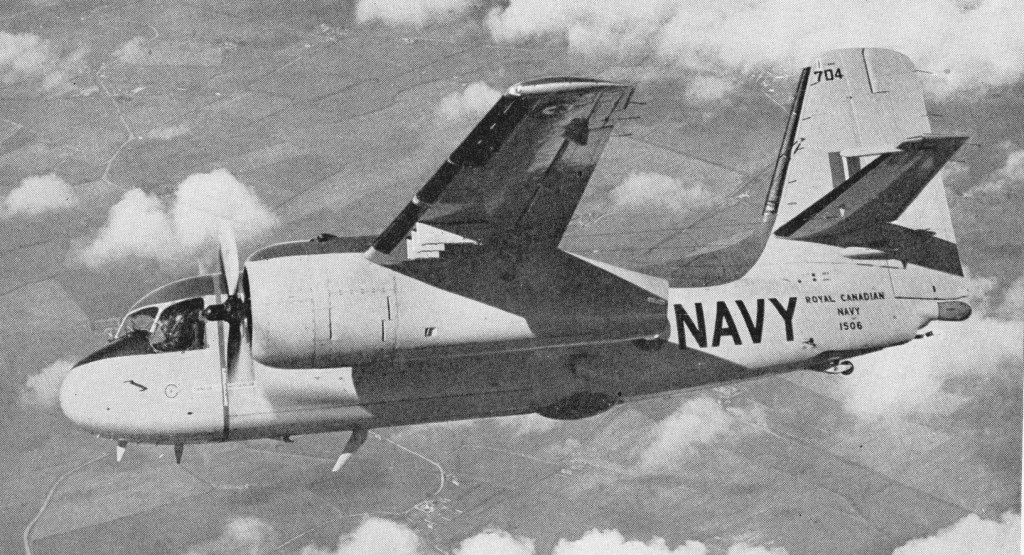
In production for the U.S. Navy and in Canada for the Royal Canadian Navy in 1955 as the S2F-1 Sentinel. The S2F-2 is similar, but has a large radar scanner, similar to that carried by AD4W “guppy” Skyraiders, built into the bottom of its fuselage under the cockpit. Both versions combine search and strike duties in a single aircraft. TF-1 trainer is similar. So is transport version, able to carry 8 passengers or over 1,600 lb. cargo for shore-to-ship supply.
Canadian de Havilland built Tracker
The S-2B had new anti-submarine detection equipment, and the TS-2B was a trainer.
The S 2E was powered by two 1,136.4kW / 1,525 hp Wright R 1820 82WA piston engines, and stores which can be deployed include sonobuoys, depth charges, a nuclear depth bomb, bombs, torpedoes, and rockets. The US Navy also operates an AEW version of this aircraft known as the E 1B Tracer. Other variants include: S-2G with enlarged bomb bays to house two homing torpedoes (most converted to US-2C or RS-2C) S-2D with improved anti-submarine equipment, wider cockpit and longer range S-2F with uprated submarine detection equipment S-2G, early version uprated with a Martin Marietta kit US-2A/C, S-2A/C converted for target towing US-2B utility/transport conversion of the S-2B RS-2C, S-2C converted for photo-reconnaissance/ survey work AS-2D, S-2D modified for night attack E-1B Tracer, AEW version with a radome on its back.
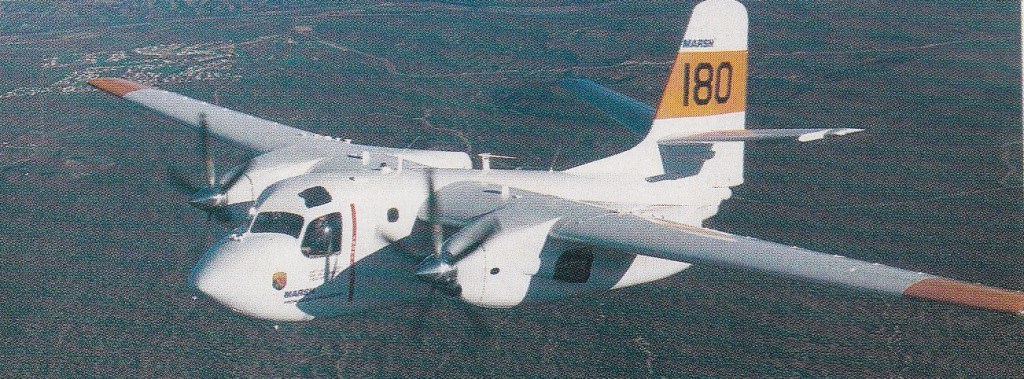
A number of Argentinian S-2E Trackers were up-graded by IAI, including replacing the engines with Garrett TPE331-15 turboprops and 5 blade Hartzell props, to be re-designated S-2UP. Starting in 1952, Grumman built nearly 1,200 S-2 Trackers, for US Navy and a dozen or so other users, including Argentina, Brazil, Peru, S Korea, Taiwan, Thailand, Turkey, Uruguay and Venezuela. The RAAF purchased 32 S-2E/G Trackers, the first was delivered on 9 Nov 1966 and last delivered on 16 Mar 1977.
Grumman, with Tracor, developed the S-2T with 1,650 shp (1 230 kW) Garrett TPE331-1-AW turboprops primarily to meet Taiwan¬ese interest.
The Canadian Government decided on the Grumman Tracker, and 100 examples were built by de Havilland Canada under license in Downsview, Ontario, with Wright R-1820 engines of 1530 hp. Originally designated CS2F, the Canadian Trackers flew their sub-hunting missions from land bases and the HMCS Bonaventure.
S2F-1 Sentinel
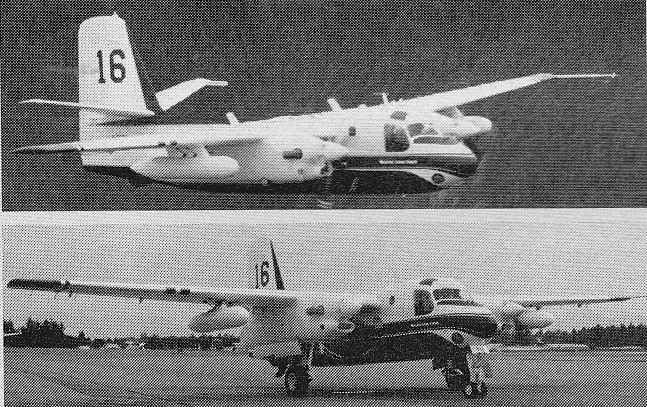
Conair Aviation’s Turbo Firecat conversion of a Grumman S-2 Tracker made its first flight at Abbotsford, BC, on 7 August 1988 and was delivered to the Securité Civile in France later in the month. A second prototype, using a French Agency aircraft during September, was to be used to obtain Canadian certification.
The Turbo Firecat is powered by 1424 shp / 1063 kW Pratt & Whitney Canada PT6A-67AF turboprops and has a revised fuel system with single-point underwing refuelling and 100 USG / 379 lt underwing tanks. An 870 USG / 3295 lt retardant delivery tank and 46 USG / 173 lf foam injection system are fitted.
Canada has a programme to fit 1,100 shp (820 kW) Pratt & Whitney PT6A-67Rs in its locally-produced CP-121 Trackers (28 in service). The Tracker continued active operation until April 1991, when the last Tracker was retired.
In 1990 both Marsh Aviation and Grumman produced turboprop conversion, with Garrett TPE331s.
S2F-1 Sentinel Carrier-based anti-submarine aircraft Crew: 4 Engines: 2 x Wright R1820-76, 1,425 h.p. Wingspan: about 69 ft. Loaded weight: approx. 20,000 lb. Armament: 20 mm. guns in nose Bombload: 6,000 lb
S2F-3 Engines: 2 x Wright R-1820-82, 1525 hp Props: 3 blade Wingspan: 72 ft 7 in Length: 43 ft 6 in Height: 16 ft 7.5 in Wing area: 499 sq. ft Empty weight: 18,315 lb MTOW: 26,147 lb Max speed: 280 mph Service ceiling; 22,000 ft Endurance: 9 hr at 150 mph at 1500 ft Hardpoints: 6
S-2E Engines: 2 x Wright R-1820-82WA Cyclone, 1,530 hp (1141 kW) Max take-off weight: 13222 kg / 29150 lb Empty weight: 8505 kg / 18750 lb Wingspan: 22.12 m / 72 ft 7 in Length: 13.26 m / 43 ft 6 in Height: 5.05 m / 16 ft 7 in Wing area: 46.08 sq.m / 496.00 sq ft Max. speed: 426 km/h / 265 mph Cruise speed: 241 km/h / 150 mph Range w/max.fuel: 2092 km / 1300 miles Crew: 4
S-2E/G Engines: 2 x Wright Cyclone, 1,520 hp Wing Span: 72 ft 7 in Length: 43 ft 6 in Height: 16 ft 7 in Empty weight: 18,750 lb Loaded weight: 29,150 lb Ceiling: 21,000 ft Speed: 265 mph (sea level) Endurance: 9 hr Armament: 2 x torpedoes / 4 depth charges (bomb bay) Hardpoints: 6 x / 250 lb Crew: 4
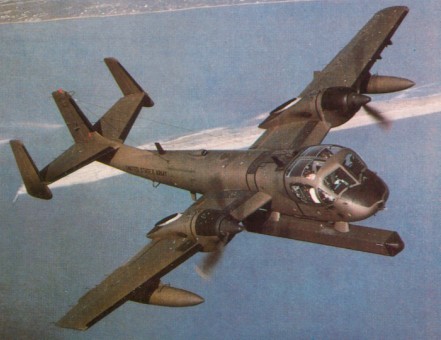
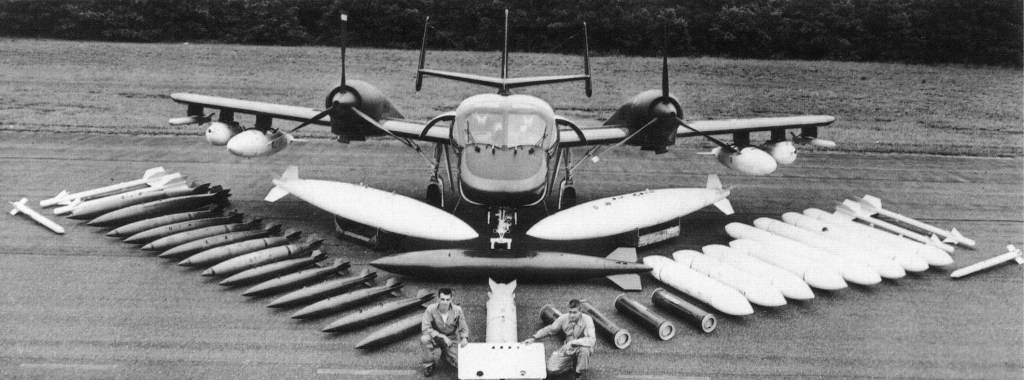
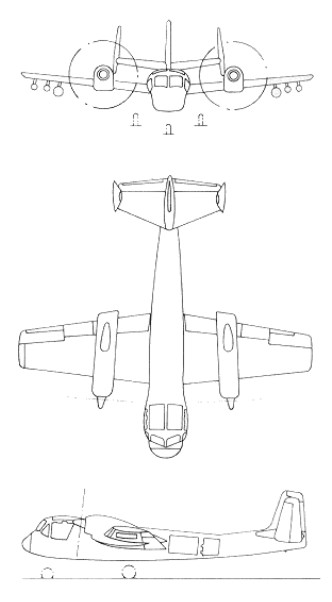
Initial variants were reasonably unsophisticated but progressive modification efforts over the years have brought about a significant improvement in its sensor systems. The first production model to see service was the OV-1A, essentially intended to fulfil photographic reconnaissance duties by day or night, being fitted with cameras, flares and advanced navigation equipment.
The type entered service with the US Army in February 1961 and became a stalwart of the Vietnam conflict. Six JOV-1As with additional under-wing weapon stations to take an incredible arsenal, including Sidewinder heat-seeking missiles, were evaluated in South East Asia.
It was succeeded by he OV-1B which was the first model to incorporate SLAR (Side-Looking Airborne Radar), this AN/APS-94 equipment being housed in a prominent pod carried externally under the lower starboard forward fuselage.
The next derivative was the OV-1C, which utilised the AN/AAS-24 infra-red sensor in place of the SLAR gear, while the final new-build member of the family was the OV-1D, basically a quick-change aircraft capable of operating with either infra-red or SLAR sensors. The standard OV-1D is equipped with infrared or radar sensors in addition to two panoramic cameras (horizontal and vertical) and one vertical/oblique camera, plus inertial navigation systems and full communication navigation packages. Deliveries of the OV-1D terminated in 1970, bringing total production to 375. Additional OV-1Ds were made available by the relatively simple conversion of most of the 100-plus OV-1Bs and OV-1Cs which remained.
A number of other derivatives appeared, including the RV-1D and the EV-1E, The former version is a conversion of the OV-1B specifically intended for Elint (electronic intelligence) duty, the dozen or so aircraft known to exist being fitted with a multiplicity of passive receivers, analysers and recorders to gather unknown or ‘hostile’ signals. The EV-1E, again a rebuilt OV-1B, is fitted with AN/ALQ-133 ‘Quick Look II’ surveillance radar, additional Elint equipment and electronic warfare pods. At least 16 conversions have been produced.
The latter type was also converted into the dedicated electronic intelligence gathering RV-1D. Israel received two OV-1Ds for use in the mid-1970s, with the designation EV-IE attributed to them. The only other export customer was Argentina, which still operates a small number of OV-IDs. Production ended in late 1970 after 265 were built and the US Army retired its Mohawks in 1996.
JOV-1A
Israel’s air force has received two OV-1Ds, and continued updating effort should result in updated or converted OV-1Ds for various customers, including Pakistan and the US Army.
The JOV-1B was an armed version used in Vietnam. Israel operated two EV-1Es equipped for ELINT surveillance.
The Army maintained a Mohawk fleet at 110 OV-lDs and 28 RV-1D electronic-intelligence-gathering aircraft.
Engine: 2 x Lycoming T-53-L-7, 810kW Max take-off weight: 5546-7365 kg / 12227 – 16237 lb Empty weight: 4339 kg / 9566 lb Wingspan: 12.8 m / 41 ft 12 in Length: 12.5 m / 41 ft 0 in Height: 3.9 m / 12 ft 10 in Wing area: 30.7 sq.m / 330.45 sq ft Max. speed: 558 km/h / 347 mph Cruise speed: 345 km/h / 214 mph Ceiling: 10700 m / 35100 ft Range w/max.fuel: 2770 km / 1721 miles Crew: 2
OV-1D Engines: two Avco Lycoming T53L-701 turboprops, 1,400 hp (1044 kW) Maximum speed 465 km/h (289 mph) Range 1520 km (944 miles) Empty weight 5467 kg (12,053 lb) Maximum take-off 8214 kg (18,109 lb) Wing span 14.63 m (48 ft 0 in) Height 3.86 m (12 ft 8 in) Wing area: 30.66 sq.m (330 sq ft) Length (with SLAR) 13.69 m (44 ft 11 in).
The Mallard was Grumman’s entry into the civilian/commercial use amphibian category. Based on the smaller Goose and Widgeon designs, the larger G73 featured tricycle landing gear. Only 59 Mallards were ever built, but some saw a new life as a turboprop with Pratt & Whitney PT6A out front. A supplemental type certificate was issued for the kerosene burning versions in 1960, but even the performance boost delivered by the more powerful engines was not enough to keep the Mallards in service. Only 59 were built.
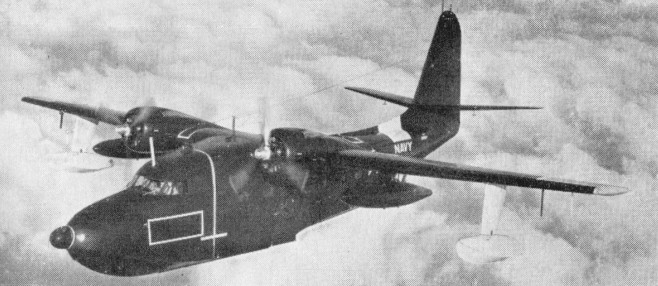
In 1944 Grumman initiated design of its Grumman G-64 aircraft, which was to be named Albatross, and which saw service with the US Air Force, US Coast Guard and US Navy. The Albatross was first ordered as the XJR2F 1 utility transport for the US Navy and the prototype was flown first on 24 October 1947, and was of generally similar configuration to its predecessor. Fixed underwing floats were retained, but these and the entire structure had been considerably refined to reduce drag. Other changes included the provision of a cantilever, instead of strut-braced, tailplane; tricycle type retractable landing gear; and pylons beneath the wing, outboard of the engines, which could carry weapons, or drop-tanks to increase range. The wings and tailplane are unswept, the tailplane with dihedral. The controls are conventional and flaps are split trailing edge type. Additional fuel could also be carried in the underwing, non-retractable, floats. Accommodation was provided for a crew of four and the cabin could accommodate 10 passengers, stretchers, or cargo, according to requirements.
Initial production was of the UF-1 model, and a modified version introduced in 1955 was the UF-2. This latter aircraft had a 16 ft 6 in increased span, a cambered wing leading edge, ailerons and tail surfaces of increased area, and more effective de-icing boots for all aerofoil leading edges.
Many SA-16A were modified to SA-16B standard.
In the tri-service rationalisation of designations in 1962, these aircraft became HU-16C and HU-16D respectively.
Winterised aircraft for Antarctic service were designated UF-1L (later LU-16C), and five UF-1T dual-control trainers were re-designated TU-16C.
The US Navy’s UF-2 general duties amphibian and Coast Guard’s UF-2G were similar to the SA-16B. In 1965 the Coast Guard operated 71 UF-2Gs.
Also operated by the US Navy as the UF-1F and UF-1L. The UF-2S was a modification of the UF-2 for anti-submarine hunter-killer duties. It utilizes much of the equipment developed for the S2F Tracker. Norway ordered 16 examples of the UF-2S. More than 450 Albatross were built.
The USAF found the G-64 attractive for rescue operations, the majority of the 305 ordered serving with the MATS Air Rescue Service under the designation SA-16A. Most of which were converted to SA 16B form with extended wings and tail for operation at greater weight. An improved version, equivalent to the US Navy’s UF-2, entered service in 1957 as the SA-16B; in 1962 these became HU-16A and HU-16B respectively. HU-16E was the designation (originally UF-1F) of Albatross aircraft operated by the US Coast Guard, and 10 supplied to Canada were designated CSR-110.
In service in 1955 with air-sea rescue units of the U.S.A.F. (SA-16A) and with the U.S.N. (UF-1) and U.S.C.G. (UF-1G) for general utility duties. One version has a sprung ski under the hull and small skis under the wing-tip floats, to permit operation from land, water or ice without modification.
An anti-submarine version with nose radome, retractable MAD gear, ECM radome and searchlight was introduced in 1961, and was equipped to carry a small number of depth charges. The versatile Albatross continues in service with a few air forces and navies, but its powerful and fuel-hungry engines have meant that surplus aircraft which became available for use were not a particularly attractive proposition to airline operators, and in consequence few were adapted for such a role.
Several nations used the Albatross, including Argentina, Brazil, Canada, Chile, Greece, Indonesia, Italy, Japan, Norway, Philippines, Portugal and Spain. Many still in service are of the anti-submarine type first flown in 1961, with nose radome, tail MAD boom, underwing searchlight, ECM installations and provision for carrying antisubmarine depth charges, torpedoes or other stores. Full all weather electronics and anti icing equipment are standard.
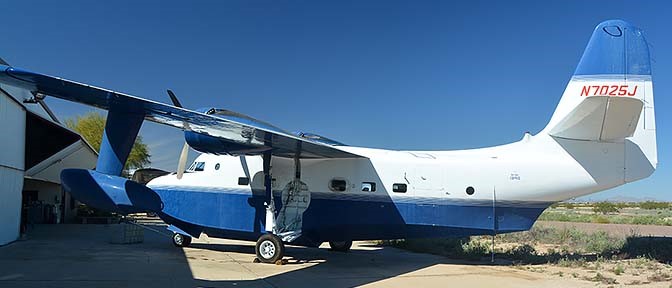
Grumman HU-16C N7025J
The unique capabilities of the big amphib have caused numerous attempts to modernize the basic hull. In the 1970s, Grumman reconfigured the military design to make room for 28 passengers, and added a galley for food and room for a fight attendant. The new airplane was designated the G111 and awarded FAA certification in 1980. Other Albatrosses have been converted to turbine power.
The Grumman G-111, civilianised version of the HU-16 Albatross, entered service on 1 July 1981 with Chalks International Airline to operate scheduled service between Fort Lauderdale and Paradise Island, Nassau. Chalks is a subsidiary of Resorts International, which has arranged the programme to convert U-16 to G-111 standard. Sub-contracted to Grumman, Chalks took two of the initial batch of five G-111. Up to 50 more were available for conversion.
Transland Aircraft modified HU-16B for civilian use with ATC A2GL.
Principal versions – UH-16A (short-span navy model), UH-16B (long-span navy model), UH-16C (short- span air force model), UH-16D (long-span air force model), and UH-16F (coast guard model).
UF-1 Air-sea rescue amphibian. Engines: 2x 1,425 h.p. Wright R1820-76B Wingspan: 80 ft Length: 62 ft. 2 in. Loaded weight: 27,025 lb. Max. speed: 247 mph Typical range: 2,700 miles at 225 mph with 2×300 USG external tanks. Armament: None. Crew: 4-6 Capacity: 10 passengers or 12 stretchers.
UF-2S Engines: 2 x Wright R-1820-76A, 1425 hp Props: 3 blade Wing span: 96 ft 8 in Length: 62 ft 10 in Height: 25 ft 10 in Wing area: 1035 sq.ft MTOW: 37,500 lb Fuel capacity centre section: 562 Gal Float fuel capacity: 2 x 166 Gal Underwing fuel capacity: 2 x 250 Gal Service ceiling: 21,500 ft Range: 2850 mi at 124 mph Wing Hardpoints: 4
HU-16C Albatross Engines: 2 x 1,425-hp (l,063-kW) Wright R-l820-76A Cyclone Max range: 2200 nm. Crew: 4-6
HU-16D Albatross Engines: 2 x 1,425-hp (l,063-kW) Wright R-l820-76 Cyclone Maximum speed 236 mph (205 kts / 380 km/h) Cruise speed: 360 km/h / 224 mph Service ceiling 21,500 ft (6,555 m) Range 2,850 nm (4,587 km) Empty wt.: 22,883 lb (10,380 kg) MTOW: 35,700 lb (16,193 kg) Wing span: 96 ft 8 in (29.46 m) Length 61 ft 3 in (18.67 m) Height 25 ft 10 in (7.87 m) Wing area 1,035.0 sq ft (96.15 sq.m). Crew: 4-6





 All Aero