Following its initial services into Europe with modified O/400 bombers shortly after the first World War, Handley Page Transport operated a series of two and three-engined developments of the bomber, designated W8, W9 and W10.
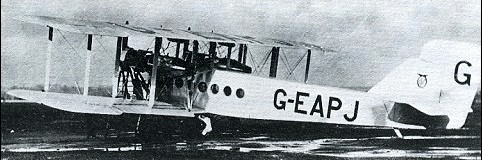
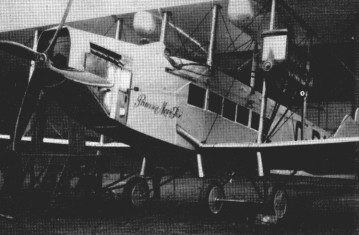
First flown on 2 December 1919 the W.8 had twelve passenger seats in two rows in a glazed cabin, while the pilot and co-pilot sat in an open cockpit in the nose of the fuselage. Powered was 335kW Napier Lion IB engines. The Handley Page W.8B (three of which were originally operated by Handley Page Transport and then from 1924 by Imperial Airways on its London-Paris service) was a refinement of the original W.8. The W.8Bs each had two 268kW Rolls-Royce Eagle VIII engines. The last W.8B was retired in 1932. A trio of W8bs named Princes Mary, Prince George and Prince Henry, started a London Paris service in May 1922.
In addition to the British-operated W.8Bs, one was built and exported to Belgium, where SABCA licence-built three more for Sabena. Handley Page also delivered a single example of the W.8E, with two 171kW Siddeley Puma and one nose-mounted 268kW Rolls-Royce Eagle IX engines. Eight were subsequently licence-built in Belgium. The final new W.8 version, the W.8F Hamilton, was similar to the W.8E and had been designed to be used in the Belgian Congo. Practically a standard W.8B, the nose of the fuselage ahead of the cabin was considerably modified. One of these machines in 1925 completed a flight from Brussels to the Belgian Congo, a distance of 11,000km, piloted by Lt Thieffry, of the Belgian Army, accompanied by Mecanicien De Bruycker. Imperial Airways received only one W.8F
W.8f Hamilton
The HP.24 Hyderabad was a military derivative.
Following its initial services into Europe with modified O/400 bombers shortly after the first World War, Handley Page Transport operated a series of two and three-engined developments of the bomber, designated W8, W9 and W10.
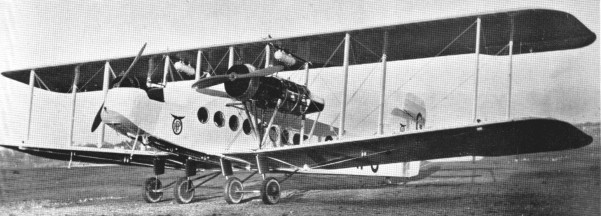
Imperial Airways received one W.9A Hampstead and four W.10s (the last retired in 1933). The Hampstead was powered by three 287kW Siddeley Jaguar and then 335kW Bristol Jupiter VI engines and had a 5.31m long, 1.35m wide and 1.78m high passenger cabin for 14 persons.
The W.10s each had two 335 kW Napier Lion IIB engines and featured a new type of rudder, fitted with a balance of the inset-hinge type, instead of the earlier horn-balance arrangement. The W.10 featured an entirely metallic structure for the engine mountings, replacing the usual wooden bearers.
Imperial Airways received W.10s (the last retired in 1933).
W8b Engines: 2 x Rolls Royce Eagle VIII, 360 hp Props: 10 ft 6 in (3.20 m) 4 blade. Wing span: 75 ft. (22.86 m). Length: 60 ft.1 in (18.31 m). Wing area: 1456 sq ft (135.26sq.m). Gross wt: 12500 lb (5,670 kg). Max speed: 104 mph (167 km/h). Range: approx 500 miles (800 km). Crew: 2. Pax cap: 12.
W.9a Hampstead Engine: 3 x Siddeley Jaguar, 287kW Max take-off weight: 6577 kg / 14500 lb Empty weight: 3794 kg / 8364 lb Wingspan: 24.08 m / 79 ft 0 in Length: 18.39 m / 60 ft 4 in Wing area: 145.30 sq.m / 1563.99 sq ft Max. speed: 183 km/h / 114 mph Ceiling: 4115 m / 13500 ft Range: 644 km / 400 miles
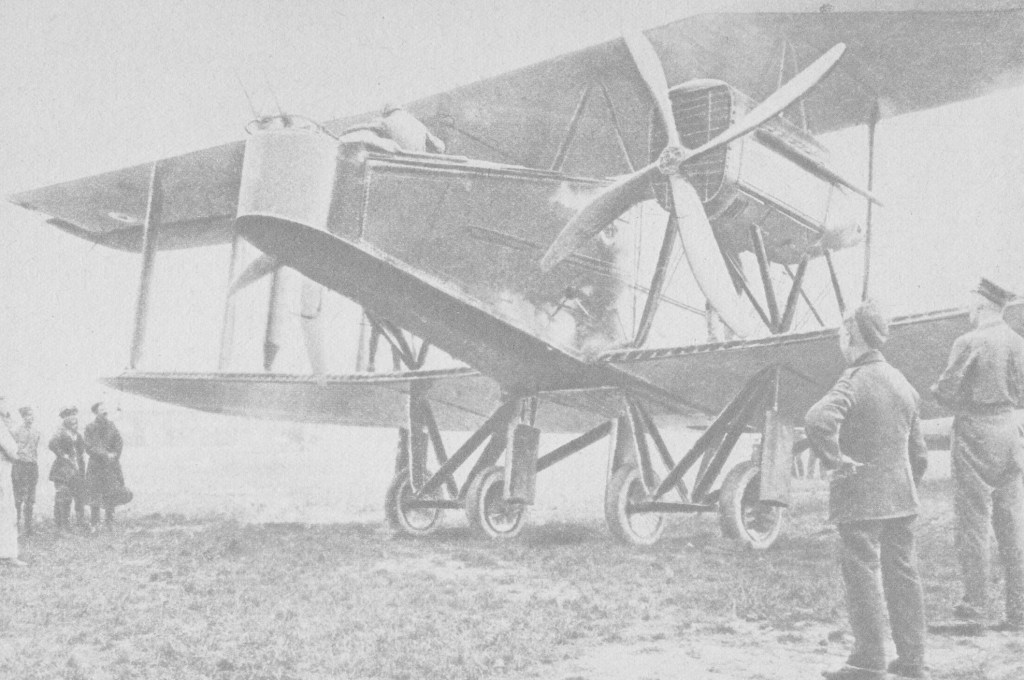
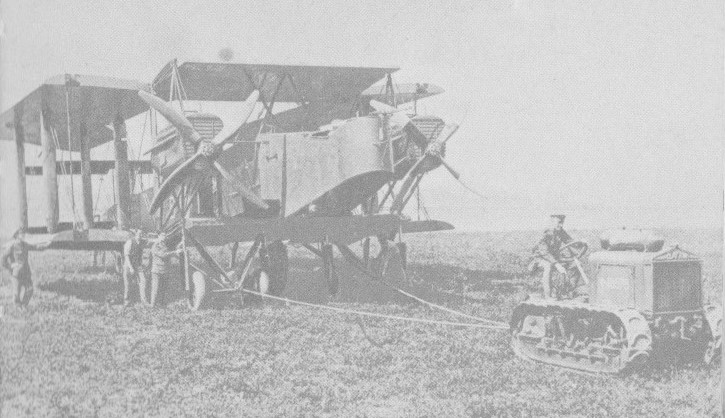
In December, 1914, Capt. Murray Sueter had asked Handley Page to produce for the RNAS an aircraft which, with naval forthrightness, he described as “a bloody paralyzer”, a development of the O/100.
Operational experience with the O/100 showed that certain changes were desirable, especially to the fuel system. In the original layout each engine had its own armoured fuel tank contained within the armoured nacelle which housed the engine, restricting the amount of fuel which could be carried. The modified fuel system consisted of two fuselage tanks and two gravity-fed tanks installed in the leading edge of the upper wing’s centre-section. Wind-driven pumps supplied fuel direct to the engines, as well as to the gravity-fed tanks. Removal of the fuel tanks from the nacelles allowed them to be shortened and a new inter-plane strut to be fitted immediately aft of each nacelle.
Other improvements included the provision of a compressed-air engine-starting system, with a crank handle for manual start in the event of pressure loss, and changes to the rear gun position and central fin. In this new configuration this variant of the O/100 was redesignated O/400. An initial contract for 100 of these aircraft was awarded to Handley Page in August 1917.
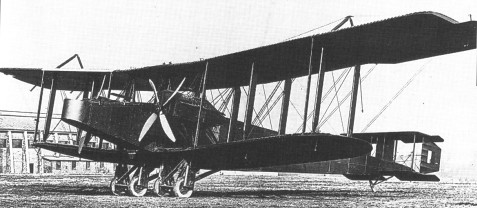
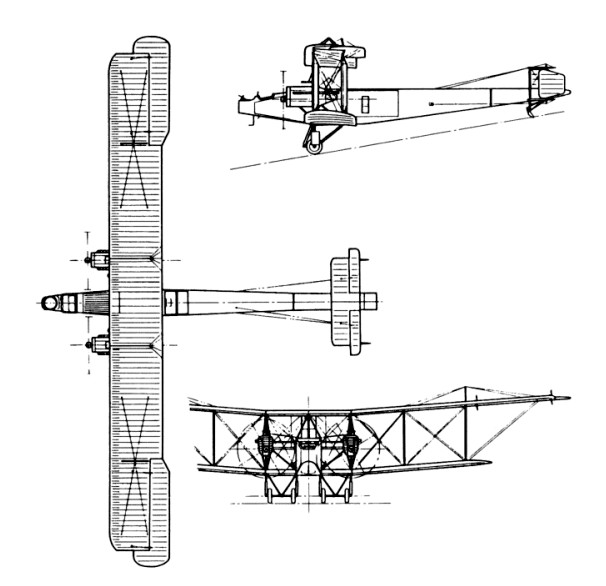
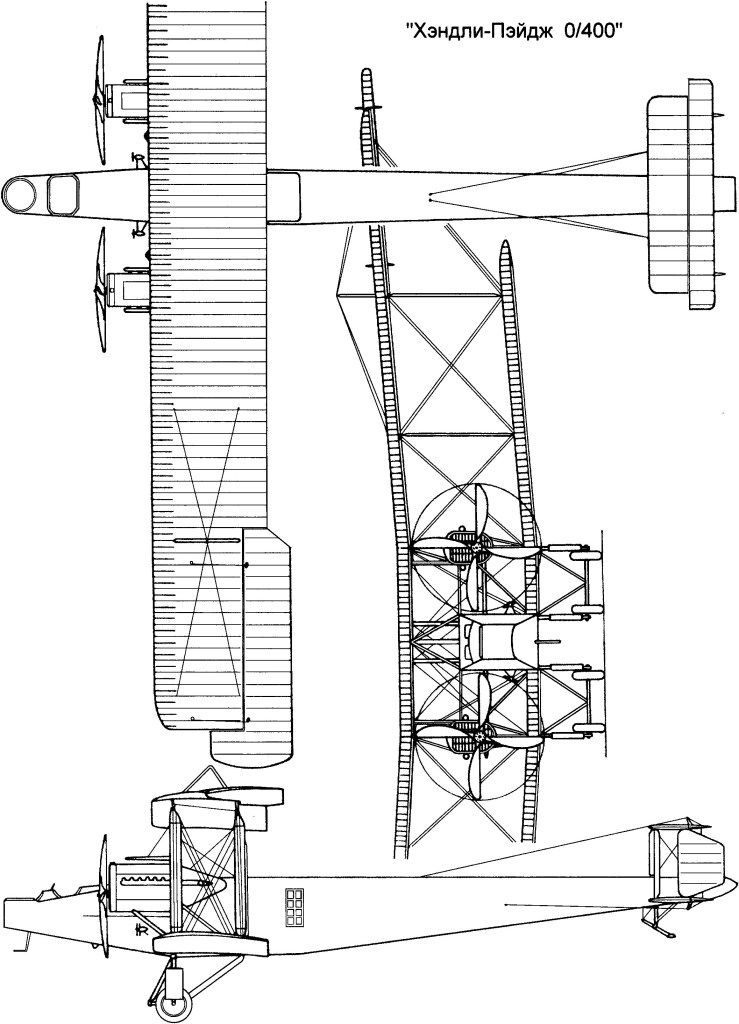
The O/400 was a two-place biplane with two-spar wooden wings, with fabric covering. The wings could be folded for storage. The fabric covered fuselage has a biplane tail-unit, with elevators on the top and bottom tailplanes, a central fixed fin and two outboard rudders. Ailerons were on the top wings only. Twin wheels were on each undercarriage unit.
A total of 284 Imp.Gal of fuel was in two tanks in the fuselage and two in the upper centre-section. Defensive armament consisted of one or two Lewis machine guns in the nose cockpit, one or two in the cockpit aft of the wings, and one firing rearward and downward through a trapdoor in the fuselage. An internal bomb-bay for one 1650-lb bomb or equivalent weight of smaller bombs. A typical load was sixteen 112-lb bombs.
First flying in September 1917, production deliveries of O/400 began in the spring of 1918, but it was not until 9 August 1918 that No 97 Squadron, which was equipped with these aircraft, joined the Independent Force and began operations. As numbers built up it became possible to launch heavier and more frequent raids: on the night of 14-15 September 1918 an attack by 40 Handley Pages was launched against enemy targets. It was also during September that O/400 began to use newly developed 750kg bombs for the first time.
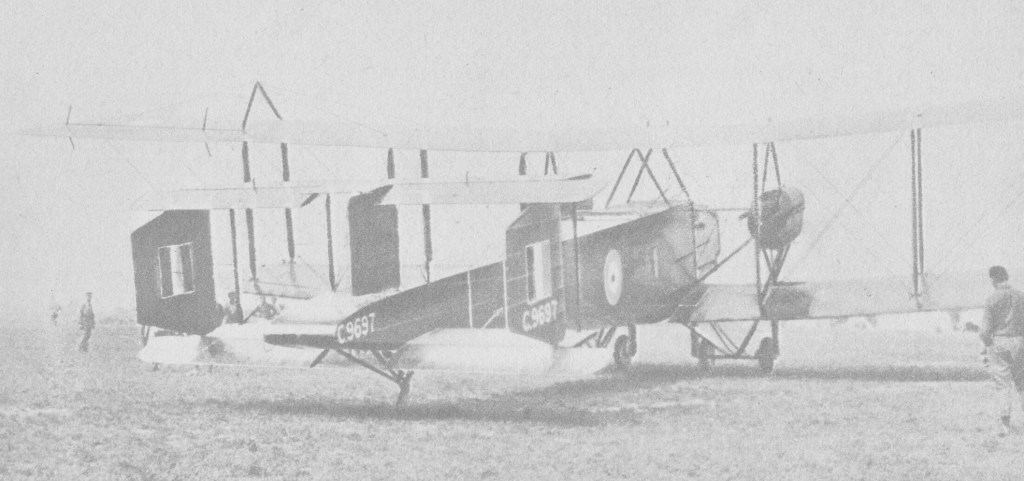
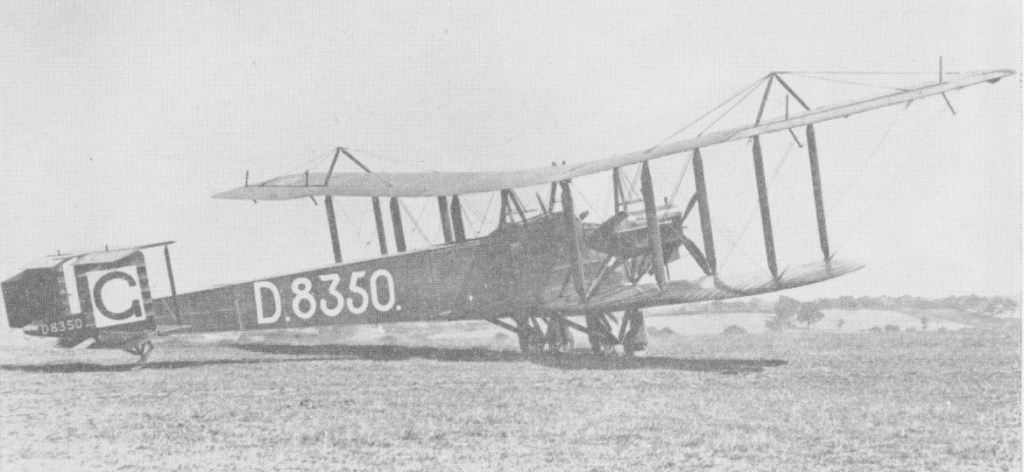
This weapon came into service in 1917 in the form of the O/400 twin engined, heavy bomber. Carrying a bombload of 1800 lbs, and powered by two Rolls Royce Eagle engines, it was the world’s first really effective night bomber.
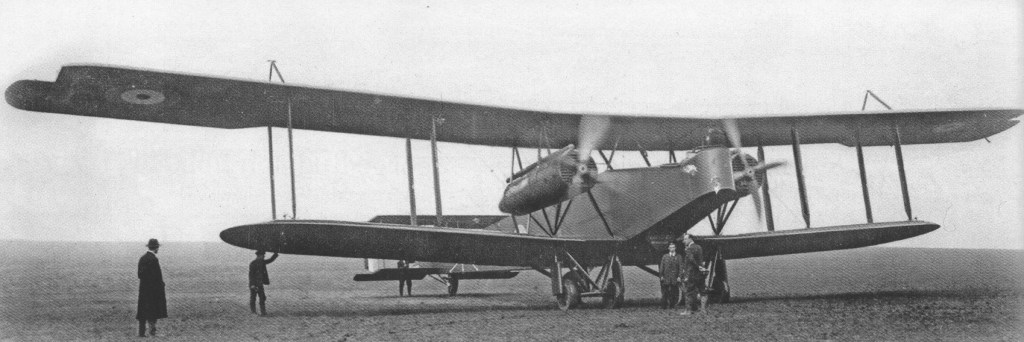
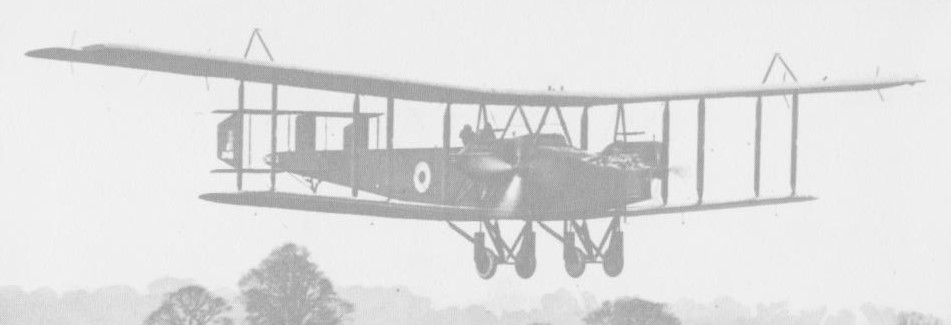
The Handley Page O/400 of 1918 was Britain’s standard heavy bomber of the first World War. A large biplane, with a span of 100 ft (30.5 m) on the upper wing, it was powered by two Rolls Royce Eagles or alternative engines of 250 350 hp each. A crew of three was usually carried, there being an open cockpit seating two side by-side and open gunners’ cockpits in the extreme nose and in the fuselage behind the wings. The guns were mounted on Scarff rings which allowed them to be swivelled through a 360 degree arc, and another gun was mounted in the underside of the fuselage to fire downwards and aft.
The O/400 could carry sixteen 112 1b bombs inside the fuselage, the bomb bay being covered by spring loaded doors which opened under the weight of the bombs as they were released. Other combinations of larger bombs could be carried, up to a single example of the 1,650 1b (750kg) bomb which was the largest used by the RAF in that war. Two more bombs could be carried on external racks under the fuselage. With a gross weight of about 13,500 lb (6,125 kg), the O/400 could reach a speed, flat out, of nearly 100 mph (160 km/h) and had a range of about 600 miles (965 km). Construction was of wood, with fabric covering.
On the Western Front an O/400 was the only aircraft to bomb Essen.
By comparison with the 0/100 the type had more power, detail improvements and the fuel relocated from the two engine nacelles to the fuselage, from where it was pumped to an upper-wing centre section tank for gravity feed to the two inline engines. The type was in service with seven Independent Air Force squadrons (Nos 58, 97, 15, 207, 214, 215 and 216) just before the end of the war, and remained in limited service in the period immediately after the war, until replaced by the de Havilland (Airco) DH10 Amiens and the Vickers Vimy. The O/400 had a slightly longer post-war career in Egypt, where it served with Nos 70 and 216 Squadrons up to 1920.
A total of 700 O/400 were ordered, and about 400 were delivered before the Armistice. In the US 1,500 of these aircraft were ordered from Standard Aircraft Corporation, with power plant comprising two 50hp / 261kW Liberty 12-N engines. Built as components from 1917, of this total only 107 were delivered to Great Britain in 1918 mainly for use as spare parts. Eight were assembled for the the US Army Air Service (AS62445 to 62451, and one other) before signature of the Armistice brought contract cancellation.
A number of British-built O/400 were delivered post-war to China.
Soon after the armistice with Turkey, Major-General Geoffrey Salmond, with Brig.-General A.E. Borton as chief pilot, flew from Palestine to India in an O/400, the first aircraft to make the journey.
On September 2, 1919, Handley Page Transport Ltd, operating from Cricklewood, began flights between London and Paris, and to Brussels and Amsterdam.
Handley Page used converted O/400 bombers on the London-Paris, London-Brussels routes, and converted de Havilland 9s on the London-Amsterdam. The converted DH9s were designated DH.16s. The fuselage of the aircraft was rebuilt as a cabin with room for four passengers. Converted in the same way, the O/400 has room for 12 passengers.
O/400 Engines: 2 x Rolls-Royce Eagle VII, 268kW (360hp). Span: 30.48m (l00ft). Length: 19.16m (62 ft 10.25 in). MTOW: 6360 kg (14,022 lb). Max speed: 97.5 mph at sea level. Height: 22 ft. Operational endurance: 8 hrs. Wing chord: 10 ft. Wing area: 1,648 sq. ft. Weight empty: 8,502 lb Loaded weight: 13,360 lb. Ceiling: 8,500 ft. Armament: 3 to 5 x 7.7-mm (0.303-mg plus up to 907kg (2,000lb) of bombs internally.
Engines: 2 x Rolls-Royce Eagle VIII, 265kW Wingspan: 30.5 m / 100 ft 1 in Wing area: 153.0 sq.m / 1646.88 sq ft Length: 19.6 m / 64 ft 4 in Height: 6.7 m / 21 ft 12 in Max take-off weight: 5466 kg / 12051 lb Empty weight: 3776 kg / 8325 lb Fuel capacity: 284 Imp.Gal Max. Speed: 157 km/h / 98 mph Ceiling: 2600 m / 8550 ft Range w/max.fuel: 1000 km / 621 miles Crew: 2 Passengers: 10-14
Standard Aircraft Corp-Handley-Page O/400 Engines: two 350hp Liberty 12-N Wingspan: 100’0″ Length: 62’10” Useful load: 3704 lb Speed: 96 mph
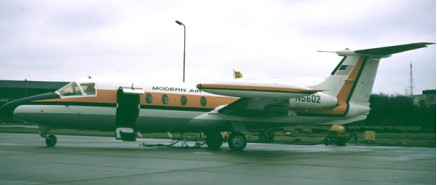
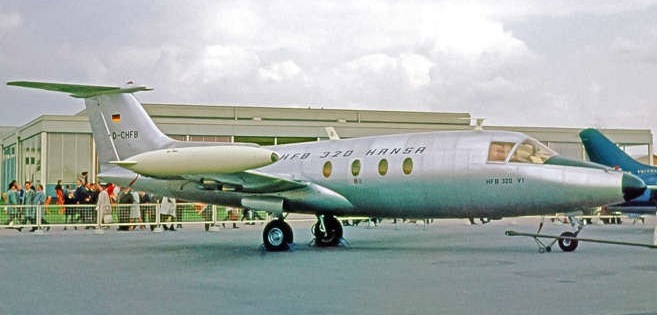
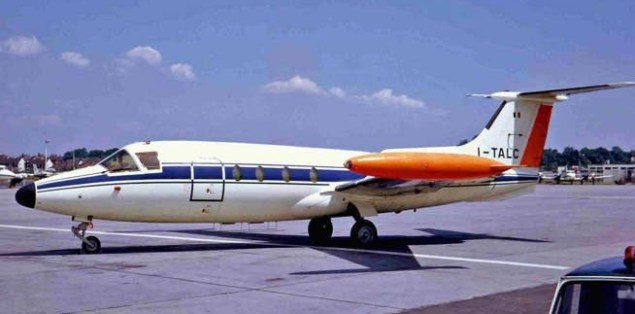
In¬terest in forward swept wing was revived in the early 1960s when the German Hamburger Flug¬zeugbau (HFB) company made market studies on the prospects for business jet aircraft. These studies indicated a potential demand for a seven seater and that a forward swept wing offered advantages for this particular size of aircraft. The HFB chief designer was Hans Wocke. Designer of the war-time Junkers Ju 287, and the commercial sales manager of HFB was Sieffiried Holzbaur, the Ju 287 test pilot.
In the development of the Hansa Hamburger Flugzeugbau GmbH co-operated with several other companies, the Dutch Fokker concern being responsible for the typical forward-swept wing and the Spanish CASA concern for the rear fuselage and tail.
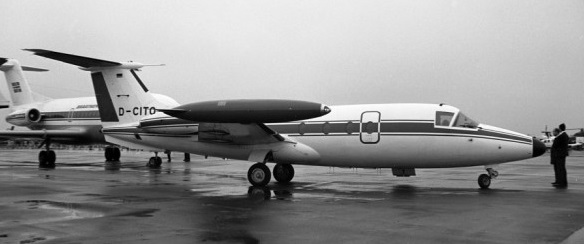
The Hansa 320 is identified by the 15-degree forward sweep of the wings. In addition to providing the low-speed flying characteristics desired, the adoption of forward sweep enabled the wing to be mid mounted, this position permitting the use of a fuselage of optimum diameter (81 in). A mid wing layout is impractical with conventional aft swept wings, as it involves the main spar passing through the cabin. On the HFB 320 Hansa Jet, the cabin is forward of the main spar.
The Hansa Jet prototype D-CHFB first flew on 21st April 1964, for 73 minutes. The wing provided the flying characteristics hoped for. Control during the approach to, and in, the stall was excellent. During trials the aircraft was held in a full stall with an indicated angle of attack of 19 deg., and banked with the normal application of aileron. Warning of stall is consistent and readily evident.
Production of the Hansa was initiated by Hamburger Flugzeugbau and carried the name of Messerschmitt- Bolkow-Blohm (MBB) when the two German aircraft companies merged in 1969. The first production Hansa Jet flew on February 2, 1966, and received FAA certification on April 7, 1967. However, the problem of providing the exceptional wing torsional stiffness required, without excessive weight penalty, was not entirely over¬come. To prevent the main landing gear bay breaking into the vital lower wing skin, the legs are stowed in fuselage fairings, ahead of the forward wing root. This results in a narrow track. To keep the air flowing over the heavily loaded inboard end of the wing, short span slats are fitted to the inner section of the wing. Without such a device, a forward swept wing will generate less lift than one swept aft.
A US test pilot, Loren W. Davis, was engaged for the initial flight programme.
In the second part of 1968, after three HFB-320 were ordered for the RLS, the Hansajet became well known at Groningen-Eelde. HFB directed a number of brand-new HFB-320 Hansa jets to Groningen Airport Eelde in the Netherlands for test flying and training. In spite of the good low speed qualities, the Hansa Jet did not initiate a business jet fashion. The theoretical aerodynamic advantages were in practice too deeply eroded by the increased wing weight, its complexity and cost. A parachute brake in the tail is used for short or icy runways. About 50 were built in executive, cargo and quick-change versions.
HFB-320 Hansa D-CITO (1025)
Hamburger Flugzeugbau HFB 320 Hansa Jet Engine : 2 x General Electric CJ610-1, 12704 N / 1295 kp Length : 54.462 ft / 16.6 m Height : 15.748 ft / 4.8 m Wing span : 47.572 ft / 14.5 m Max take off weight : 18742.5 lb / 8500.0 kg Max. speed : 486 kts / 900 kph Service ceiling : 38058 ft / 11600 m Range : 1253 nm / 2320 km Crew : 2+12
Engines two 3,108-lb. s.t. General Electric turbojets. Gross wt. 20,280 lb. Empty wt. 11,960 lb. Fuel capacity 1,099 USG. Top speed 513 mph. Cruise 420 mph. Stall 111 mph. Initial climb rate 4,250 fpm. Range 1,472 miles. Ceiling 40,000 ft. Takeoff distance (50′) 2,740 ft. Landing distance (50′) 4,429 ft. Seats 15.
The twin-engined Hall PH-1 was superseded by PH-2 and PH-3 variants which served in small numbers with the U.S. Coast Guard during the Second World War.
Mr. Hisao Hagiwara of Tokyo formed the Jiyu Koku Kenkyusho (Liberty Aeronautical Research Institute) in 1952 in order to develop a helicopter with a jet-driven main rotor.
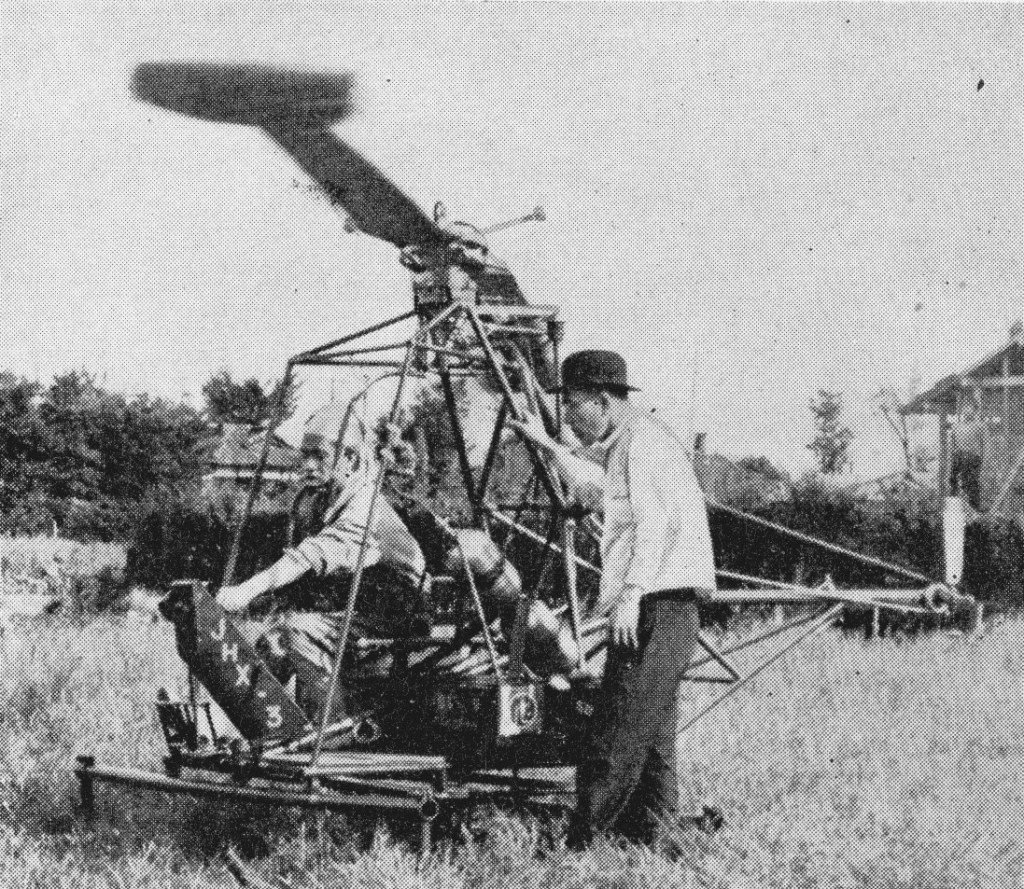
The JKK completed the design and construction of its first prototype in August, 1952. It was a light single-seat aircraft with a two-blade rotor of 7.3m diameter. Troubles with the transmission system and jet-nozzles led to its abandonment before the end of the year. No greater success was achieved with the original 100mm pulse-jet engine, designed by Mr. Takeo Kimura to power the helicopter, because it proved difficult to ignite and its noise level was unacceptable. Subsequent prototypes have had ramjet engines. Two of these prototypes, designated the JHX-2 and JHX-3, were completed in March and September, 1955 respectively. Two years later the JKK was disbanded, but Mr. Hagiwara has continued his work with technical assistance from the Civil Aeronautics Agency and the Tokyo Metropolitan Aeronautical Engineering School. The first result of this collaboration is the JHX-4 helicopter.
JHX-3
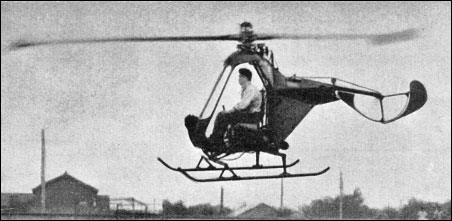
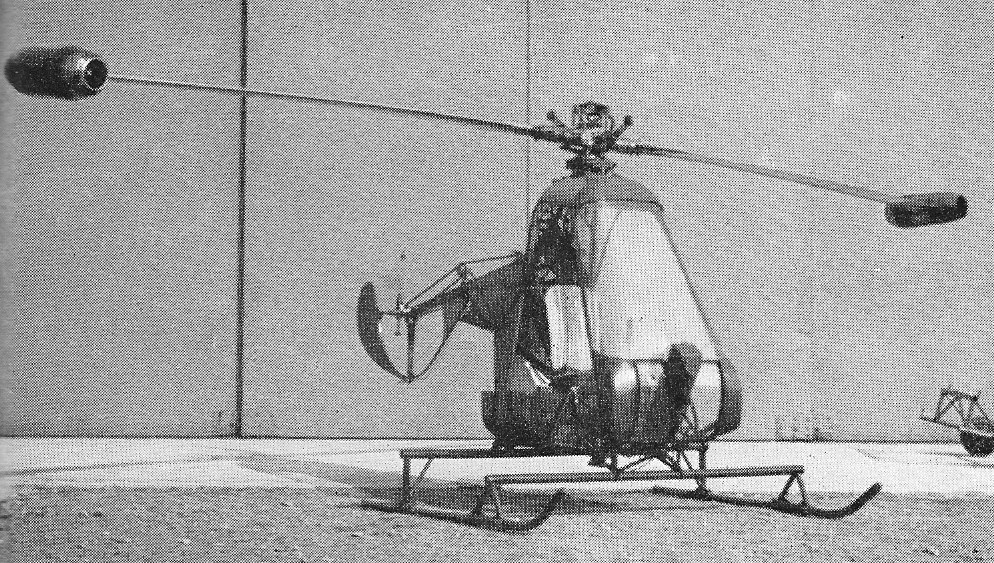
First flown in late September, 1958, the JHX-4 is a single-seat light helicopter with a two-blade main rotor which is driven by tip-mounted ramjet engines.
JHX-4
The rotor turns at 600 rpm. The JHX-4 has an endurance of 30 minutes.
Hagiwara JHX-4 Power: 2 x Hagiwara ramjet, 44 lb thrust Rotor diameter: 7.3m / 23 ft 9 in Height: 2.2m / 7 ft 2 in Length: 3.8m / 12 ft 5 in Empty weight: 396 lb Crew: 1
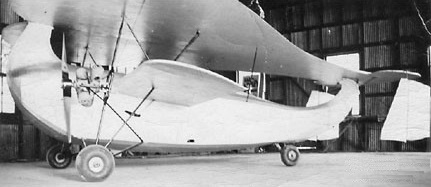
The Hackenberger 1A is an evolution of the model H. Similar in its design, but larger and more streamlined.
Built in 1935, the single place 1A extremites of the elevator had twin stabilizer/rudders.
Those rudders were actually braced onto the rear of the fuselage and only a single strut balanced the elevator above the stabilizers. The fuselage curved upwards at both ends, connecting to the leading and trailing edges of the parasol. Somehow the angle of the elevator was varied at its joining with the parasol/fuselage.
Registered N13974 c/n 2, power was two 20hp Irwin Meteormotors, changed to 40hp Continentals in 1938.
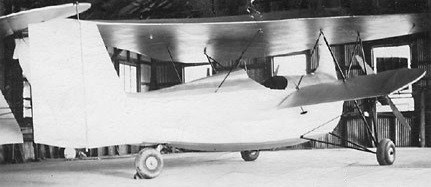
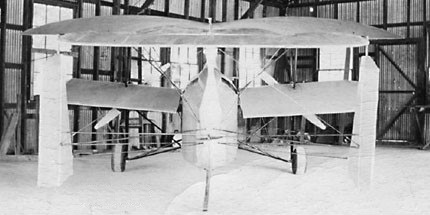
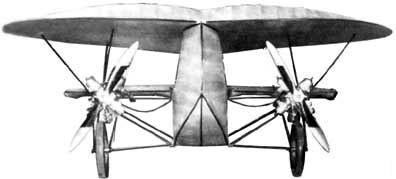
A 1930 twin-engine flying pancake-type with heart-shaped parasol wing built by A L. Hackenberger. The Hackenberger H, or Helioplane, was powered by two 4-cyl “Scroggies”.
The aircraft was registered NX18966 c/n 5H-1 (as H) as a single seater.
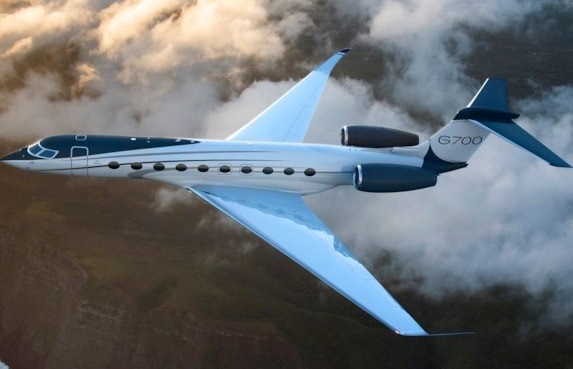
Gulfstream unveiled its new G700 business jet at the 2019 National Business Aviation Association Convention & Exhibition in Las Vegas, Nevada.
On its way toward certification, Gulfstream reported that it had put in almost 14,000 hours of lab testing on the aircraft.
The Gulfstream G700 has also completed “successful ground vibration testing, engine runs, loads calibration and all structural testing required for first flight.” Sporting a Rolls Royce engine, the G700 was the tallest, widest and has the longest cabin in the industry. It can accommodate up to 19 passengers and sleeps 13.
The Gulfstream G700 price tag was $76 million in 2020 and was to be available in 2022.
Gulfstream G700 Engines: 2 x Rolls Royce Pearl 700 Wing Span: 103 ft Length: 109 ft 10 in Exterior Height: 25 ft 5 in Max T/O Weight: 107600 Lb Max Landing Weight: 83500 Lb Operating Weight: 56365 Lb Fuel Capacity: 49900 lbs Lb Payload W/Full Fuel: 2235 Lb Max Payload: 6385 Lb Max Speed: 709 kts Normal Cruise: 690. kts Economy Cruise: 652 kts Max Range: 7500 nm Service Ceiling: 51000 ft Take-off Distance: 6250 ft Cabin Height: 6 ft 3 In Cabin Width: 8 ft 2 In Cabin Length: 56 ft 11 In Cabin Volume: 2603 cu ft Internal Baggage: 195 cu ft Crew: 2 Passengers: 19
On March 13, 2008, Gulfstream unveiled the Gulfstream G650. The ultra-large-cabin, ultra-long-range Gulfstream G650, powered by two of the new Rolls-Royce BR725 engines, offers the longest range, fastest speed, largest cabin and the most-advanced cockpit in the Gulfstream fleet. It is capable of traveling 7,000 nautical miles at 0.85 Mach or 5,000 nautical miles at 0.90 Mach. The G650 has a maximum operating speed of 0.925 Mach and can climb to a maximum altitude of 51,000 feet. The G650 features the PlaneView II cockpit with a number of enhancements including: four 14-inch, adaptive, liquid-crystal displays; three standard PlaneBook computer tablets; a smaller pedestal; a standby multifunction controller that combines current display controller functionality with standby flight instruments; and a fully automatic, three-dimensional scanning weather radar with an integral terrain database for efficient ground-clutter elimination. In addition, the G650 uses the Gulfstream Enhanced Vision System (EVS II), the Synthetic Vision-Primary Flight Display (SV-PFD) system and Head-Up Display (HUD II). The aircraft offers a full three-axis fly-by-wire system that delivers flight-envelope protection, increased redundancy and reduced maintenance. The Gulfstream G650 first flew on 25 November 2009.
Long Range Cruise Mach 0.85 Mmo Mach 0.925 Range at LRC 7,000 nm / 12,964 km
The large-cabin, ultra-long-range Gulfstream G550 can fly up to 51,000 feet at speeds up to Mach 0.885. Powered by two Rolls-Royce BR710 engines, the G550 can fly eight passengers and four crewmembers 6,750 nautical miles. The G550 also features the PlaneView cockpit. The G550’s standard equipment includes the Gulfstream Enhanced Vision System and the Gulfstream Signature Cursor Control Devices. The fully equipped G550 offers a choice of cabin layouts and option packages. Customization packages are also available. Dependent upon the configuration, the G550 can accommodate 14 to 18 passengers. The aircraft received FAA certification in August 2003 and validation from the European Aviation Safety Agency (EASA) in March 2004. The G550 entered service in September 2003. In early 2004, the G550 team was awarded the 2003 Collier Trophy, the most prestigious award in aviation in North America. Less than two weeks after it entered service, a G550 flew nonstop from Seoul, South Korea, to Orlando, Fla., covering the 7,301 nautical-mile distance in 14.5 hours and setting a city pair record. It would go on to establish 40 city-pair records in its first five years of service. Powered by enhanced Rolls-Royce BR710 turbofan engines, the G550 has a range of 6,750 nm at Mach 0.80 and a high-speed cruise capability of Mach 0.87.
Gulfstream G550 P4-TPS
The G550 is equipped with the Gulfstream PlaneView cockpit, based on the Honeywell Primus Epic architecture and display system, the PlaneView cockpit presents critical flight information on 14-inch liquid crystal displays arranged for easy interpretation. The cabin aboard the G550 features up to four distinct living areas, three temperature zones, with seating for up to 18 passengers. Standard communication features: a fax machine, a printer, a wireless local area network and satellite communications. An option is a Broad Band Multi Link. In 2004, Gulfstream was awarded the 2003 Collier Trophy for the development of the G550. The G550 is the first civil aircraft to receive a Type Certificate issued by the FAA that includes an Enhanced Vision System (EVS) as standard equipment on an aircraft.
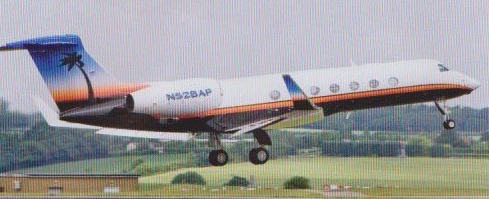
Gulfstream G550 N528AP
Engines; 2 x Long Range Cruise Mach 0.80 Mmo Mach 0.885 Range at LRC 6,750 nm / 12,501 km



 All Aero