This is the one and only Vreeburg A-2M bomber was designed by HA Vreeburg as the chief of the Technical Service of the Dutch Air Force (The LVA = Luchtvaart Afdeling). The machine was built by the government works on the airfield of Soesterberg. Development started in 1918, and the machine was finished in 1919, making its first flight on February 10th in 1919.
The machine received no orders from the LVA and was scrapped in 1920.
Engines: 2 x Le Rhone, 110-120 hp Max speed: 140 kph
An anti-sub aircraft design as XS2U-1W in competition with the Grumman S2F and was later re-designated as XWU-1 (c.1955). Work began on 25 January 1950 and a contract was awarded for two prototypes with s/ns [133780/133781]. A mock-up was built but, during construction, difficulties were encountered with the folding wings. The contract was cancelled before the aircraft could be completed and USN selected the S2F instead.
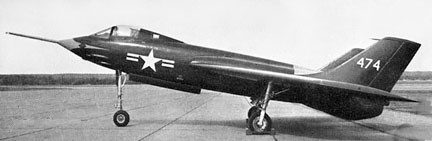
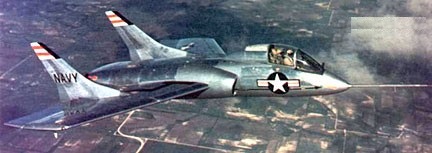
The Vought F7U Cutlass swept flying wing design had a large central nacelle and two substantial vertical tail surfaces. The first U.S. fighter designed from the start to use afterburners. Three prototype XF7U-1 (122472-122474) were built. The first flying on 29 September 1948.
1950 production was 20 F7U-1 (124415-124434) as trainers.
Vought F7U-1 122474
S/ns 125322-125409 were assigned for F7U-2s, but production was cancelled.
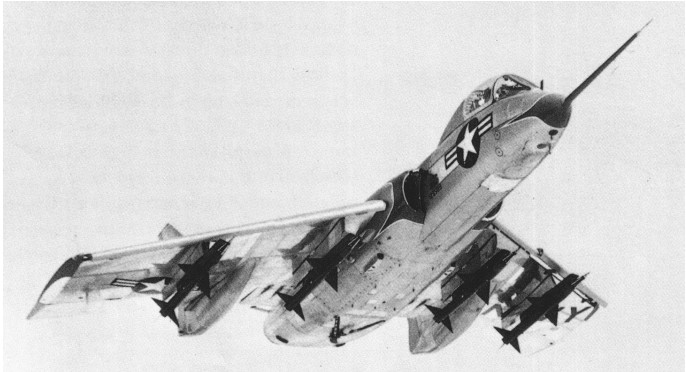
After 14 F7U-1’s, the Cutlass was in production for the U.S. Navy in 1951 as the F7U-3 interceptor and F7U-3P photo-reconnaissance aircraft with lengthened nose containing cameras. 288 F7U-3 (128451-128478 and 139868-139917 et al) were built, with a redesign, radar gunsight, four 20mm cannon; and two 4600 lb J46-WE-8A engines.
Vought F7U-3
Built in 1954 were the F7U-3M missile platform and F7U-3P photo-recon version.
F7U-1 Cutlass Engines: 2 x Westinghouse J34-WE-32, 3000 lb Wingspan: 38’8″ Length: 39’7″ Speed: 672 mph Range: 1170 mi Ceiling: 41,400 ft Armament: 6×20 mm. cannon Seats: 1
F7U-3 Engines: 2 x J46-WE-8A, 4600 lb / 6100 lb afterburn Wingspan: 38 ft 8 in Length: 40 ft 10.5 in Height: 11 ft 6.5 in Empty weight: 13,100 lb Normal loaded weight: 20,000 lb Max weight: 23,000 lb Max speed: 670 mph / 705 mph afterburn at SL Max ROC: 13,000 fpm Range: 660 mi Ceiling: 40,000 ft Armament: four 20m cannon Bombload: 5400 lb
F7U-3P Naval photo- reconnaissance aircraft Engines: 2 x Westinghouse J46-WE-8A turbojets, 4,800 lb. thrust Wingspan: 38 ft. 8 in. Loaded weight: 20,000 lb Max speed: 670 m.p.h. Ceiling: Over 45,000 ft. Crew: 1 Armament: None
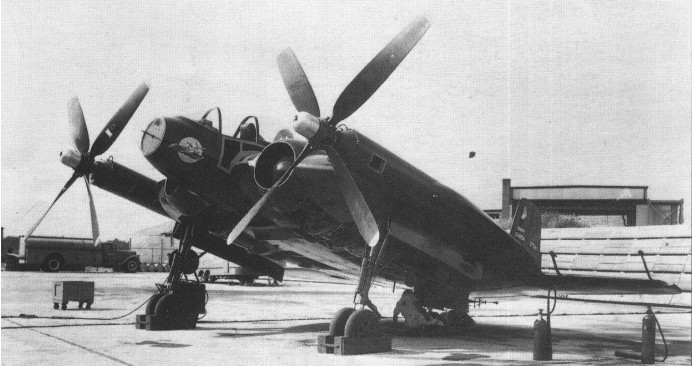
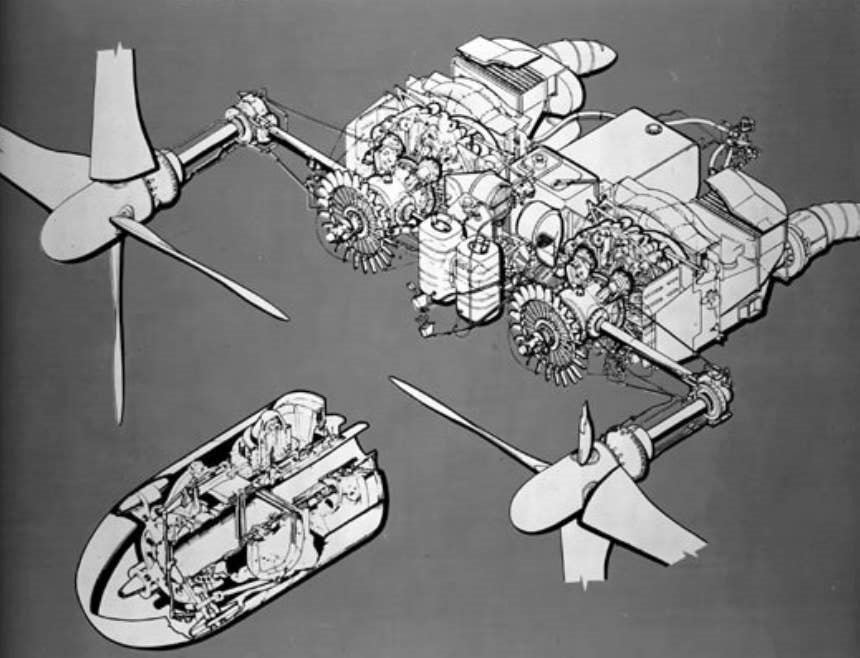
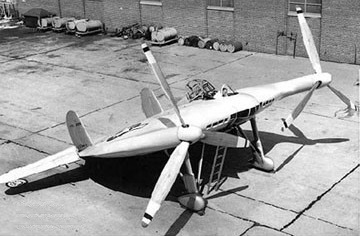
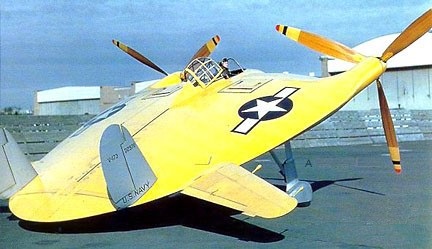
The Vought XF5U based on the V-173 aerodynamic research aeroplane. The XF5U had a basically circular wing with twin vertical surfaces at its rear ‘corners’ outside two stability flaps and inside two projecting ‘ailavators’ for pitch and roll control. The primary structure was of Metalite, a material of bonded aluminium and balsa that offered exceptional strength with great lightness. The powerplant comprised two 1600-hp (1193-kW) Pratt & Whitney R-2000-7 radials buried in the thick inner portions of the wings and driving, via a complex double right angle transmission system of shafts and gearboxes, two 4.88 m (16 ft) four-blade propellers located on the forward ‘corners’ of the wing. The propeller blades were articulated and could be moved fore and aft on their shafts in the manner of a helicopter’s rotors, permitting the craft to ‘hang’ on its propellers in a semi hover at low airspeed.
Vought’s specification for the Flapjack called for a maximum speed of 811 kph (504 mph) at 6100m (20,000 ft), while the landing speed was to be as low as 32 kph (20 mph). A proposed turbine engined variant would have been even faster. The aircraft was to have been armed with six 12.7 mm (03 in) machine guns or four 20 mm cannon, or two 454 kg (1000 lb) bombs.
The prototype XF5U 1 33958 first began engine tests in August 1945, but it was not until 1947 that the articulating propellers became available and the Flying Flapjack began taxying trials at Vought’s Stratford, Connecticut plant.
On 17 March 1947 the US Navy had cancelled the programme in favour of jet powered fighters, and the prototype, the sole XF5U was ordered scrapped, but a crane’s wrecking ball merely bounced off the tough little prototype, and it finally took workers with blowtorches to reduce it to salvageable scrap.
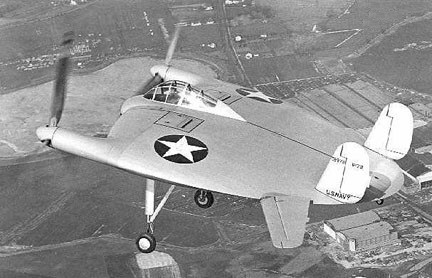
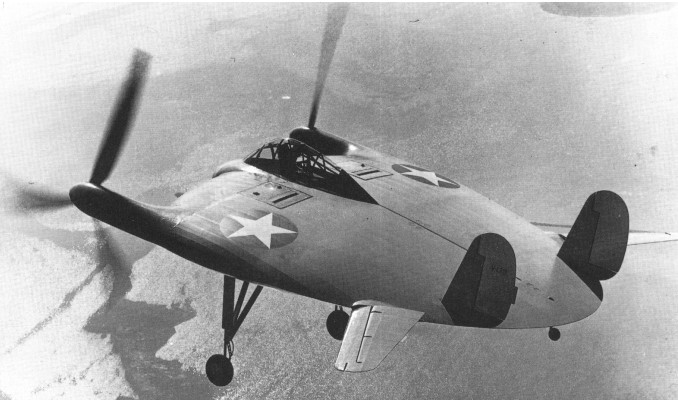
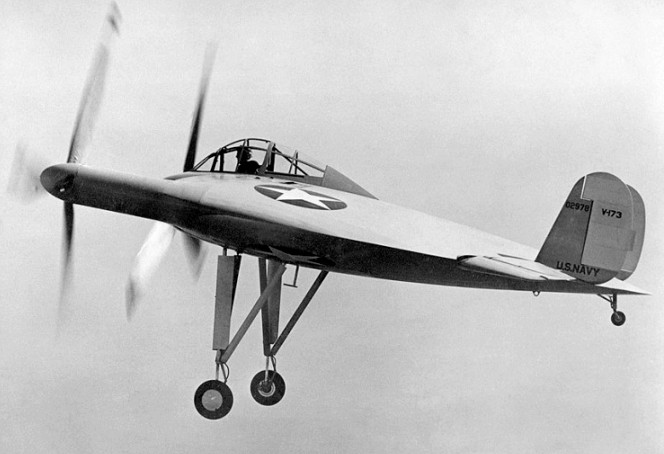
Navy chiefs ordered a full-size flying model to be built to evaluate the flying characteristics of the proposed fighter, and this aircraft, the Vought V 173 designed by Charles H Zimmerman, made its first flight on 23 November 1942 piloted by Boone T Guyton. The V 173 (unofficially dubbed Flying Pancake or Flying Flapjack) was constructed of wood with fabric covering, and had two wingtip-mounted 80 hp Continental engines driving a pair of 5.03 m (16 ft) three-blade, laminated-wood propellers.
Compared to a typical taildragger’s resting deck angle of around 5 degrees, the V-173 sat at an extreme 22 degrees. This would eliminate all forward vision if not for the addition of windows on the underside of the nose by the pilot’s feet. When on the ground, the pilot simply looked downward, past his feet, and could see the path ahead.
To further reduce takeoff and landing distances, two enormous propellers bathed the entire airframe in propwash, generating lift even at a standstill. The result was a landing speed of only 22 mph and the capability of taking off nearly vertically with typical wind over a ship’s deck.
The V-173 prototype would ultimately weigh just over 3,000 pounds fully loaded, with a massive 427 square feet of wing area. The V-173’s wing loading was just over 5 pounds per square foot.
With such ample lift, only modest power would be required. Zimmerman chose two small and light 4-cylinder Continental A80 piston engines. Their small size enabled them to be buried within the saucer-like fuselage.
Zimmerman had US patent #2,431,293 of 18 November 1947.
The engines of the V 173 were barely adequate, but the Flying Pancake took off in 15 m (50 ft), or much less with a steady wind, and could cruise at 222 kph (138 mph) despite its low power. Guyton and other pilots who flew the aircraft (including Charles Lindbergh) found it impossible to stall or spin, and full control could be maintained even at a 45 degree angle of attack.
The V-173 confirmed that the type offered viceless handling characteristics as well as an exceptional speed range between 20 mph (32 km/h) and 460 mph (740 km/h). The Vought XF5U was based on the V-173.
The Vought V-173 on its maiden flight in 1942
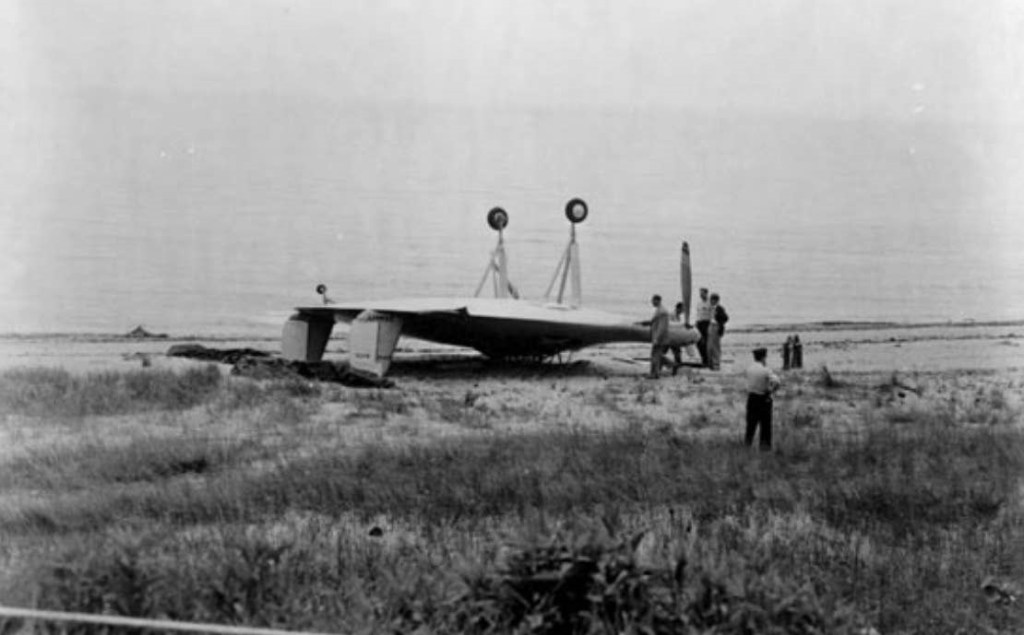
At one point, a vapor lock resulted in a forced landing on a beach. While the airplane flipped over onto its back, neither the airplane nor test pilot were significantly harmed.
The one V-173 built, 02978 in 1942, completed 171 flights for 131.8 hours flight time.
The V-173 placed into long-term storage. Charles Zimmerman went on to become a division chief for Project Mercury at NASA.
In 2003, the Vought Aircraft Heritage Foundation began a nearly 10-year-long restoration of the aircraft, stripping it down to its wooden airframe and replacing the fabric entirely. Today, the resplendent V-173 stands proudly on display at the Frontiers of Flight Museum in Dallas.
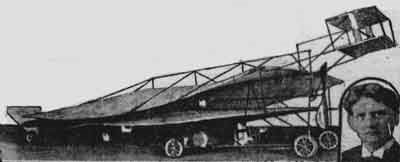
Built by German immigrant Alexander von Hagan in Seattle, Washington, the machine had two sets of silk wings, an aluminium framework, two motors and three propellers. It weighed 600 pounds without the operator. One propeller was in the front, the second three-quarters back, and the third at the rear. One 40 hp motor ran the two front propellers and a smaller one of 35 hp powered the rear. Von Hagan was born in 1859 and served in the German army for 14 years.
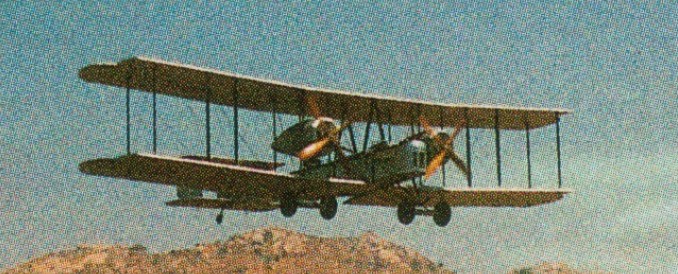
In 1992 Peter H.McMillan and Lang Kirby considered reproducing the Vickers Vimy. A set of almost complete drawings were found in 1993 and Bill Whitney, an Australian aeronautical engineer and designer was hired to do a stress analysis. Whitney also reproduced the great number of missing drawings and designed the numerous new parts that would be required.
The job of building the project was given to a Hollywood set builder, John LaNoue (who had never built an aircraft before). The wingspan was more than 70 ft. There were 112 flying wires, 150 sheets of aircraft plywood, 500 yards of Grade A cotton fabric, over a mile of hand frayed finishing tape, two 11 foot four blade wood propellers, 300 gallons of dope, 10,000 rib stiches, more than 700 feet of control cable, more than 1000 feet of 4130 aircraft tubing and 240 feet of 5/8 in bungee cord. There were 300 nose ribs to be fabricated, 330 feet of box spars to be built, 126 main wing ribs and hundreds of metal fittings.
The finished weight would exceed 12,000 lb. And all this had to be done by the 75th anniversary of the great air race of 1919 – 18 months later. LaNoue put together a team of dedicated experts who were committed to seeing the project through. The project was broken down to the smallest denominator, and a schedule developed. The team started working 12 hour days five days a week but soon were working 12 hr seven days a week. The parts were built in two locations: Australia, and at the closed Hamilton AFB north of San Francisco.
Due to no Rolls Royce Eagles being available it was decided to go with automotive 454 Chevys. The GM motors would fit inside the cowling with their 4:1 reduction gears. The 454s flew the aircraft to Australia with only one mishap, but when BMW became a sponsor, the engines were changed to 5.4 litre BMW V-12 M-73s with 5:1 planetary reduction gears.
The project was completed in 15 months and 22,000 hours of labour, and flight testing was carried out at Hamilton on the old, closed runways.
The adverse yaw was so great due to the massive size, nothing happened quickly. The original Vimy had only one set of controls on the right side and no brakes or tailwheel. The reproduction is fitted with dual controls along with all the other modern conveniences, but it is still tough to fly.
After the obligatory 25 hours of flight testing, the aircraft was disassembled, loaded into a C-5 Galaxy and delivered to Farnborough for the 1994 airshow.
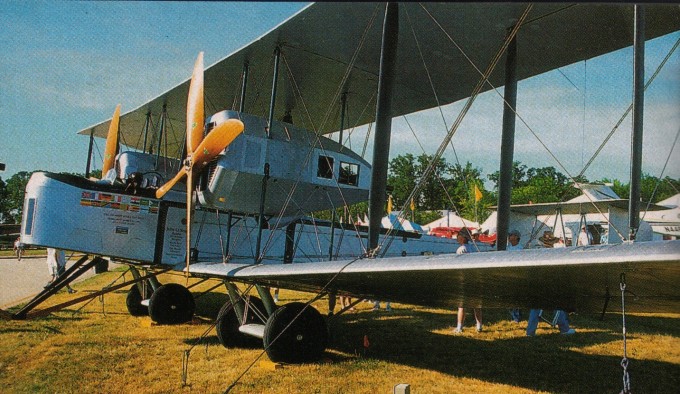
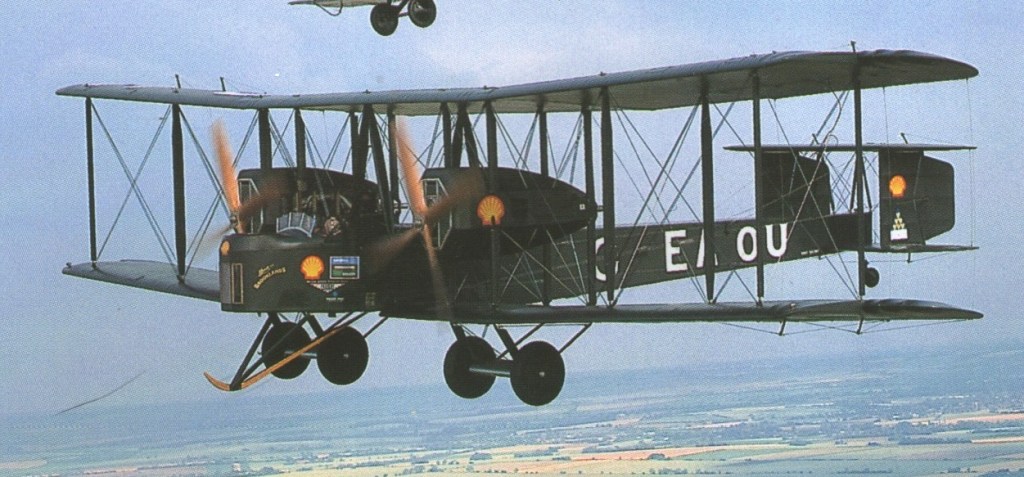
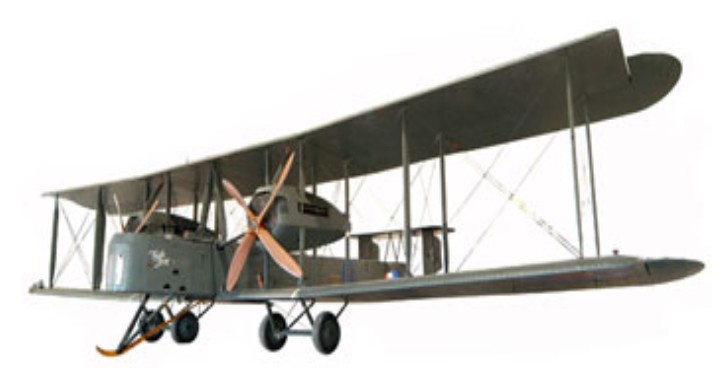
In May 1967 the Vintage Aircraft and Flying Association decided to build a Vimy replica to commemorate the 50th anniversary of the Alcock and Brown’s trans-Atlantic flight. When told of the project Rolls-Royce began a world wide search for engines. Eventually they were successful and recovered three Eagle engines from Dutch canal barges two of which they stripped down and rebuilt; putting the first on bench test in August 1968. The aircraft was completed on Friday 30 May 1969. The following days were filled with final inspections and checks and on Tuesday 3 June at 6.40pm the aircraft took off on its first flight.
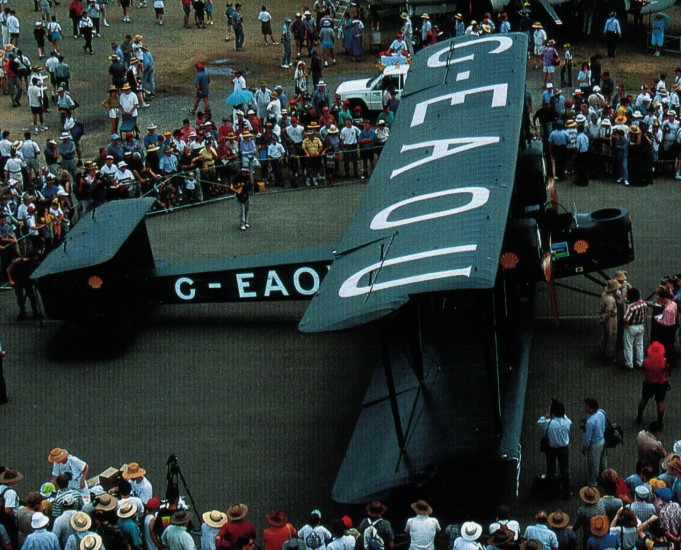
The aircraft was completed on Friday 30 May 1969 at Weybridge with the original Rolls-Royce Eagle VIIIs. The following days were filled with final inspections and checks and on Tuesday 3 June at 6.40pm the aircraft took off on its first flight. It first flew at Wisley, un-marked, registered G-AWAU c/n VAFA.02 and pained as H651.
The aircraft went through an intensive flight test programme before receiving a Special Category Certificate of Airworthiness on 5 June. The next day the aircraft crossed the Channel to appear at the Paris Air Show. On 9 June it returned to the United Kingdom and two days later, after being repainted in service markings, flew to Ringway Airport, Manchester to become the centre of an Alcock and Brown exhibition.
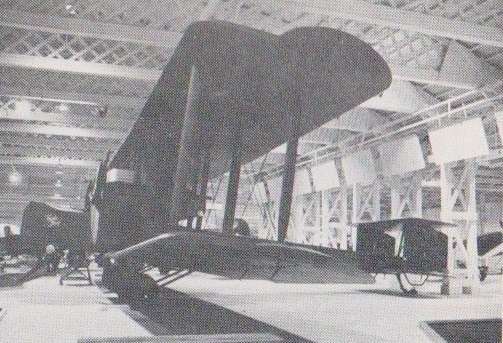
It was badly damaged by fire at Ringway on 18 July 1969 while on display. It was repaired and donated to the RAF Museum where it went on display at Hendon as F8614.
The Vickers Vanncock was designed to meet the Air Ministry Specification B.19/27 calling for a long-range night bomber.
Only one prototype was built, J9131, but it was twice modified and given new type numbers.
The Vanncock Mk.I, Type 150, was powered by two Rolls-Royce Kestrels and fitted with single-bay outer wings.
The Vanncock Mk.II, Type 195, was re-engined with two Bristol Pegasus I,M.3s and had a three-bay wing. The four-seat Mk.II had an AUW of 16,000 lb, span of 76 ft 6 in, and length of 60 ft 4 in.
The final Type 255 reverted to two-bay wings of increased area, retaining the Pegasus engines.







 All Aero