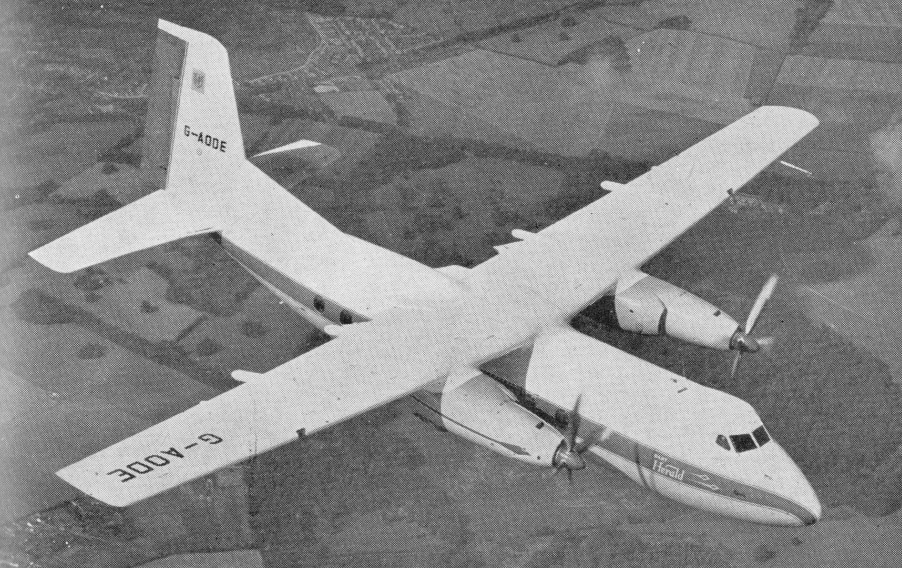
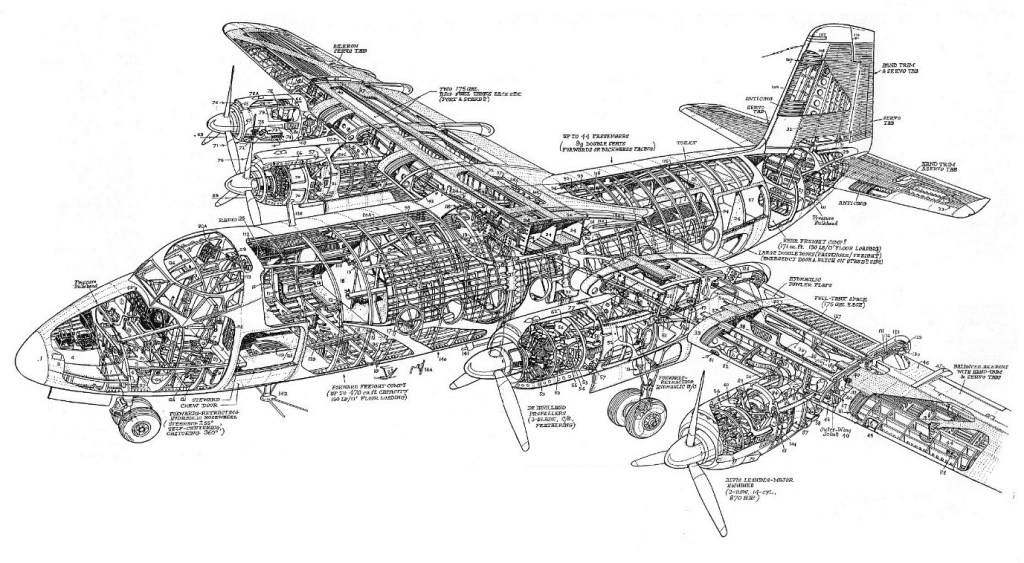
A medium sized transport designed to take the place of the DC 3, the Handley Page HPR 3 Herald design shows an essentially straight forward approach ¬with four piston engines, a high wing layout and a fuselage designed to carry 44 passengers, freight, or mixed loads. It is to be pressurized to a relatively low differential, and will carry a full payload of 10,705 lb. for a no reserve range of 350 st. miles, or 4,650 lb. for a full tank range of 2,050 miles.
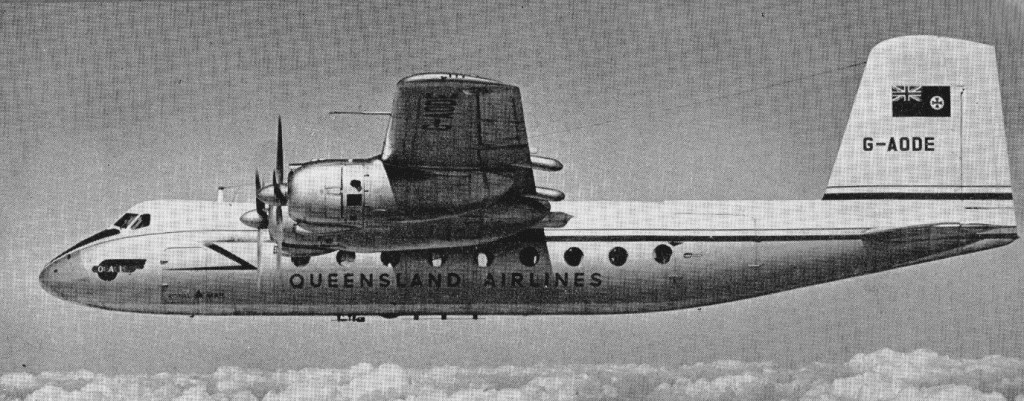
The first Herald, G-AODE, flew on 25 August 1955 from Radlett, powered by four Alvis Leonides piston engines. Airborne for 30 minutes, the pilot was H.G.Hazelden. It appeared at that years SBAC Display.
Handley Page HPR.3 Herald
The first Handley Page Herald completed 125 hours flying in a year and received a Special Category of C of A in 1956.
By 1956 the Herald had been ordered by Queensland Airlines, Australian National Airways, Lloyd Aereo Colombiano and Air Kruise.
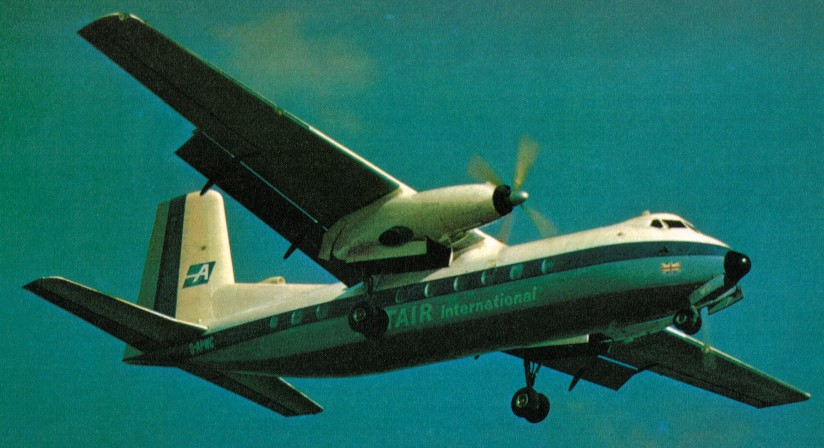
The prototype Dart-engined Herald made its first flight on 11 March 1958 and the first production Herald Series 100 flew on 30 October 1959. The Series 100 accommodated between 38 and 47 passengers. The Series 200 was the main production version with a forward fuselage 1.07m longer than that of the Series 100. Accommodation was provided for 50-56 passengers. Powered by two Rolls-Royce Dart 527 turboprops of 2,150 shaft hp, its maximum cruise speed is 274 mph.
In 1960 Handley Page were offering both the Leonides Major and Dart powered versions.
The Series 300 (a modified Series 200 developed to meet US airworthiness requirements) was followed by the Series 400 military transport with a side loading door and accommodation for 50 troops, paratroops, 24 stretchers or freight, eight of which went to the Royal Malaysian Air Force. The projected Series 500 was followed by the Dart 532/9 turboprop-engined Series 600.
The final two versions were the Series 700 long-range version of the Series 600, accommodating up to 60 passengers or 52 passengers and baggage over 1,980km stages, and the Series 800 military version of the 700. By 1958, when they offered an alternative version powered by Rolls-Royce Dart turboprops, the Fokker F 27 had cornered the market. Only 48 aircraft were produced.
HP(R) HP.3 Herald Engines: 4 x Alvis Leonides Major, 850 bhp Wingspan: 95 ft Length: 70 ft 3 in Mauw: 34,000 lb Max speed: 263 mph
HP Herald Srs 200 Powerplant: two Rolls-Royce Dart RDa.7 M1k. 527 turboprops, 1570kW / 2105 ehp Propellers: Rotol four-blade, fully feathering 12 ft 6 in diameter Wingspan, 94 ft 9 in / 28.88 m Length, 75 ft 6 in / 23.01 m Height, 24 ft 1 in / 7.34 m Gross wing area, 82.31 sq.m / 886 sq.ft Max. usable floor area, 283 sq.ft Max. usable volume, 1802 cu.ft Max. cabin length, 54 ft 0 in Max. width, 8 ft 8.25 in Max. height, 6 ft 3.75 in Accommodation: 50 passengers at 30.5 in pitch; 56 at 30 in pitch. Basic operational 25,758 lb Total fuel, 8640 1b Max. take-off with 5 deg flap, 41000 lb Max. landing, 39,500 lb Max. payload, 11,242 lb Max. zero fuel, 37,500 lb Power loading (max. take-off weight), 10.2 lb/ehp Wing loading (max. take-off weight), 48.5 lb/sq.ft Wing loading (max. landing weight), 44.5 lb/sq.ft Max level speed: 275 mph / 443 kph High-speed cruise, 237 kt. at 15,000 ft Long-range cruise, 230 kt. at 23,000 ft Approach speed, 89 kt Ceiling: 8500 m / 27900 ft Take-off field length, ISA at sea level, 5000 ft Landing field length, ISA at sea level, 3575 ft Range, no reserves, ISA with max fuel, 8602 lb payload, 1 500 nm Range w/max.payload: 1786 km / 1110 miles Crew: 2 Passengers: 50-56
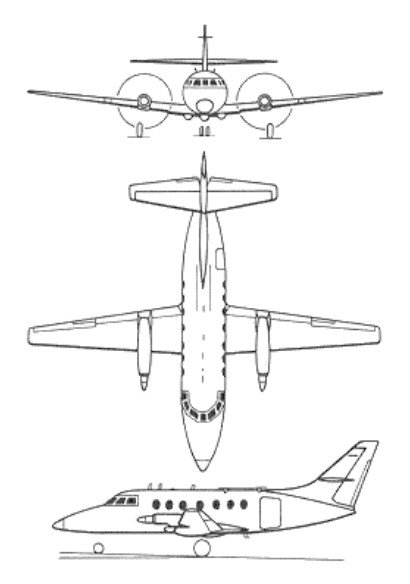
In 1966 feasibility and market studies revealed a definite market for a medium-sized turboprop mini-airliner for commuter and executive use. The H.P.137 Jetstrearn was launched, attracting nearly 200 orders and options in the first year. It even won the United States Air Force contest for the C- 10A transport. But it was a difficult aircraft for a firm used to large and expensive military designs, and development was prolonged. Its airworthiness category imposed a nominal limit in all-up weight which severely affected range/load performance. This was improved with the advent of higher-power engines and a change in category, which allowed take-off weight to rise to the level for which the Jetstream was designed.
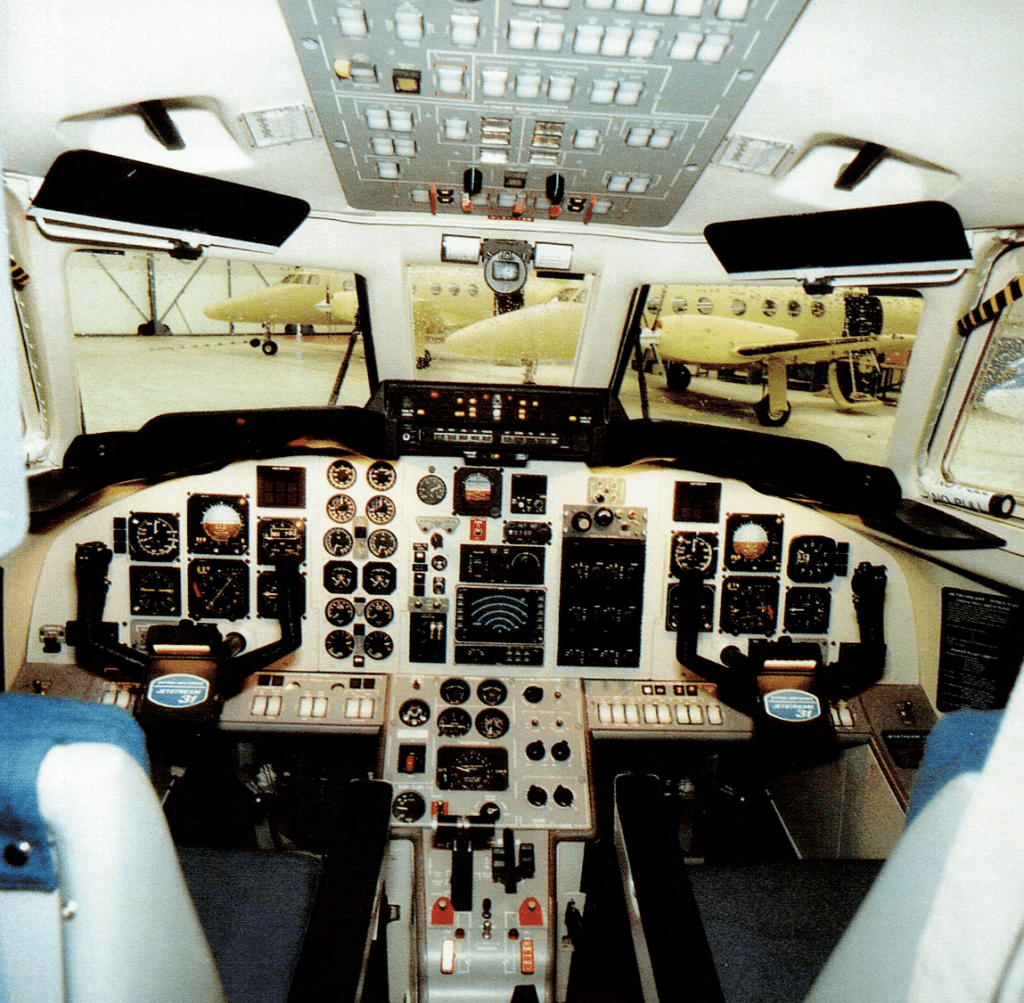
The Jetstream had accommodations for a crew of two plus flight attendant and 4-18 passengers. With a diameter of 6 feet, a length of 24 feet, and 613 cu. ft. of usable cabin space, the Jetstream has the largest interior in its class. There is stand-up headroom, ample walkaround space, and 14 windows.
The HP.137 Jetstream was a pressurized 12/18 seat low-wing monoplane with a retractable undercarriage, powered by a pair of 840 hp Turbomeca Astazou XIV turboprops. Before the drawings were complete, Riley placed an order for 20 for the United States feeder liner market.
The prototype H.P.137 (G-ATXH c/n 198) flew first on 18 August 1967 powered by the Astazou XII. The first four aircraft were powered by the French Astazou, the fifth aircraft was fitted with the US-built Garrett AiResearch TPE-331 instead to improve sales prospects in the US. This re-engining lead to an order by the US Air Force for 11 Jetstream 3M or C-10A as a mission support transport aircraft. Early 1969 however this order was cancelled on the grounds of late delivery.
The Jetstream 1 had entered production by this time; with the first production model Jetstream 1 flying on 6 December 1968. Over the next year 36 would be delivered. The Astazou XIV engines however proved to be generally underpowered for the design. Due to these engine problems the Jetstream 1 was re-designed as the Jetstream 2 with more powerful 1073 hp Astazou XIVCs, starting deliveries in late 1969. By this point the late delivery and engine problems had driven costs to £13 million and Handley Page ran into serious financial difficulties. Only three Jetstream 2’s would be completed before Handley Page went bankrupt, and the production line eventually shut down in 1970. Only 39 aircraft had been completed by the time of Handley Page’s collapse in 1970. Although Handley Page was wound up as a company, the Jetstream lived on. Ten further aircraft were completed, five by Jetstream Aircraft and five by Scottish Aviation. In 1971 Scottish Jetstream Ltd was the name of a new company formed by Scottish Aviation and Jetstream Aircraft for the manufacture of the Jetstream twin turboprop transport. Scottish Aviation continued production of the Jetstream 2 although they referred to it as the Jetstream 200.
The Royal Air Force ordered twenty-six Jetstream 200’s as navigation and multi-engine trainers known as the Jetstream T.1. The Royal Navy later subsequently took over some of these as T.2’s. In 1977, Scottish Aviation was nationalized along with the British Aircraft Corp. and Hawker Siddeley Aviation to form British Aerospace.
Jetstream 31
BAe decided the design was worth further development, and started work on a “Mark 3” Jetstream. The new version was re-engined with two 1020 hp Garrett TPE331-12UAR turboprops that offered significant advantages over the Turbomeca units. This allowed the aircraft the ability to operate at maximum load from a much greater range of airfields. The prototype of the BAe Jetstream 31, converted from an original HP137 airframe to suit revised FAR requirements for 19-seat commuter aircraft, made its maiden flight on 28 March 1980 (G JSSD) from Prestwick Airport, Scotland and was airborne for 1hr 22min. Aboard on the flight were BAe test pilots Angus McVittie and J. L. S. ‘Len’ Houston, J. R. ‘Bob’ Baker from Garrett-AiResearch and BAe flight test engineer Andrew Eldred.
The new British Aerospace Jetstream 31 entered production 28 March 1980 and is powered by two Garrett AiResearch TPE331 IOU engines and also features advanced technology propellers and new electrical, air conditioning and cockpit systems. By 1994 some 380 had been delivered, 320 of those to the USA. The Royal Navy received four Jetstream 31 twin turboprops, designated T.3, which are used for observer training. These aircraft join 16 Astazou-powered T.2s which are used in similar roles. The T.3s differ not only in having Garrett TPE331 engines, but also in having an underfuselage Racal ASR360 search radar in place of the nose-mounted MEL E90 unit of the T.2. The RAF also used 11 Astazou powered Jetstream T.ls for multi-engine pilot training. Saudi Arabia has bought two Jetstream 31s for tornado crew training.
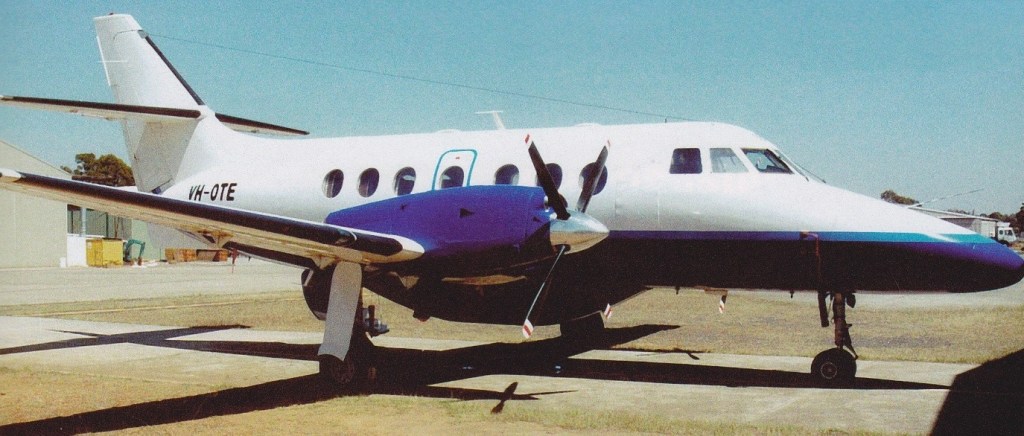
In 1985, development of a further upgrade started resulting in the Jetstream Super 31, also known as the Jetstream 32, with more powerful engines that flew in 1988. The Jetstream 32EP (also known as Jetstream Super 31) was designed to increase the payload and range of the Jetstream 32 in extreme climatic conditions. It provides significant improvements in performance, derived from the use of two upgraded Garrett TPE331-12 turboprop engines flat-rated at 1,020 shp (760 k)XD and driving four-bladed advanced technology propellers.
Jetstream 32EP VH-OTE December 2007, Bankstown, Australia
More than 310 Jetstream 31s and Super 31s had been ordered by 1987. In 1991, the 29-seat Jetstream 41 was introduced. Production of the Jetstream 31/32 ended in 1993, while the production of the Jetstream 41 ended in 1997.
The Handley Page Jetstream came back for another round, as the newly certi¬ficated Century Jetstream III, with 904 shp Garrett AiResearch TPE 331 turboprops in place of the French Astazous. Century Aircraft Corp. of Amarillo, Texas, Jetstream III is air-conditioned and pressurized at 6.5 psi. The conversion to Garrett engines allows a range of 1,920 miles out of a 426-gallon fuel capacity. The engine conversions were performed by Volpar, Inc. in Van Nuys, California.
Jetstreams built since the early start in 1965 until the production ended in 1997 are: 38 H.P.137 Jetstream by Handley Page Ltd; 5 H.P.137 Jetstream by Jetstream Aircraft Ltd; 5 H.P.137 Jetstream by Scottish Aviation Ltd; 26 Jetstream T.1 by Scottish Aviation; 220 Jetstream 31 by British Aerospace; 161 Jetstream Super 31 by British Aerospace; 100 Jetstream 41 by British Aerospace.
HP 137 Jetstream Powerplant: two Turbomeca Astazou XIV, 850 shp / 625kW Propellers: Hamilton Standard three-bladed 8 ft 3 in diameter Wingspan: 15.9 m / 52 ft 2 in Length: 14.7 m / 48 ft 3 in Height: 5.1 m / 16 ft 9 in Wing area: 25.1 sq.m / 270.17 sq ft Max. usable floor area, 85.5 sq.ft Max. usable cabin volume, 564 cu.ft Max. cabin length, 24 ft 3 in Max. width, 6 ft 1 in Max. height, 5 ft 11 in Accommodation: max. high density 18 passengers at 30 in pitch. Basic operational (gross less usable fuel and payload), 8200 lb or 8530 lb / 3869 kg Total fuel, 3120 lb / 456 USG Max take-off weight: 5657 kg / 12472 lb Max. landing, 12,250 lb Max. payload (volume limited), 4000 lb Power loading, 7.76 lb/shp Wing loading (max. take-off weight), 45.4 lb/sq.ft Wing loading (max. landing weight), 45.4 lb/sq.ft Top speed 345 mph. High-speed cruise, 265 kt at 15,000 ft Long-range cruise, 217 kt. at 30,000 ft Stall 84 mph. Take-off field length to 50 ft, ISA at sea level, 2550 ft Landing field length, ISA at sea level, 2130 ft Range with allowances, max. fuel, 1000 lb payload at 217 kt. at 30,000 ft, 1910 nm Range with allowances, max. payload 18 passengers, at 265 kt. at 15,000 ft, 220 nm Initial climb rate 2,100 fpm. Ceiling 30,000 ft.
Jetstream III Engines two 902 shp Garrett AiResearch turboprops Gross wt. 12,500 lb Empty wt. 8,200 lb Fuel capacity 426 USG Cruise mph 300+ Range 1,920 miles Takeoff distance (50′) 2,500 ft Landing distance (50′) 1,000 ft Seats 4-18.
British Aerospace Jetstream 31 Engine : 2 x Garrett TPE 331-10UG, 691 shp Length : 47.146 ft / 14.37 m Height: 17.388 ft / 5.3 m Wingspan : 52.001 ft / 15.85 m Wing area : 271.253 sq.ft / 25.2 sq.m Max take off weight : 15324.8 lb / 6950.0 kg Weight empty : 9613.8 lb / 4360.0 kg Max. weight carried : 5711.0 lb / 2590.0 kg Max. speed : 264 kts / 488 km/h Landing speed : 86 kts / 159 km/h Cruising speed : 230 kts / 426 km/h Initial climb rate : 2066.93 ft/min / 10.50 m/s Service ceiling : 25000 ft / 7620 m Wing load : 56.58 lb/sq.ft / 276.0 kg/sq.m Range : 675 nm / 1250 km Crew : 2 Payload : 19PAX / 1805kg
BAe Jetstream 3100 First built: 1982. Engines: 2 x Garrett TPE 331-10V-501H, 940 shp. Props: Dowty-Rotol 4-blade, 106-in. Seats: 9/18. Length: 47.1 ft. Height: 17.5 ft. Wingspan: 52 ft. Wing area: 271.3 sq.ft. Wing aspect ratio: 10. Maximum ramp weight: 14,660 lbs. Maximum takeoff weight: 14,550 lbs. Standard empty weight: 9046 lbs. Maximum useful load: 5614 lbs. Maximum landing weight: 14,550 lbs. Wing loading: 53.6 lbs/sq.ft. Power loading: 8.1 lbs/hp. Maximum usable fuel: 3079 lbs. Best rate of climb: 2200 fpm. Service ceiling: 25,000 ft. Max pressurisation differential: 5.5 psi. 8000 ft cabin alt @: 25,000 ft. Maximum single-engine rate of climb: 520 fpm @ 109 kts. Single-engine climb gradient: 286 ft/nm. Single-engine ceiling: 15300 ft. Maximum speed: 267 kts. Normal cruise @ 25,000ft: 230 kts. Fuel flow @ normal cruise: 460 pph. Endurance at normal cruise: 6.1 hrs: Stalling speed clean: 98 kts. Stalling speed gear/flaps down: 86 kts. Turbulent-air penetration speed: 180 kts.
HP Jetstream Mk.1 / Century Jetstream III Engines: 2 x Garrett TPE 331-3U-303, 904 hp. Seats: 10/20. Wing loading: 47 lb/sq.ft. Pwr loading: 6.9 lb/shp. Max TO wt: 12,500 lb. Empty wt: 8,600 lb. Equipped useful load: 3600 lb. Payload max fuel: 528 lb. Max cruise: 489 kt. ROC: 2000 fpm. Min field length: 2310 ft. Cabin press: 6.5 psi. Fuel cap: 3072 lb.
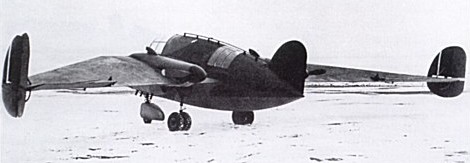
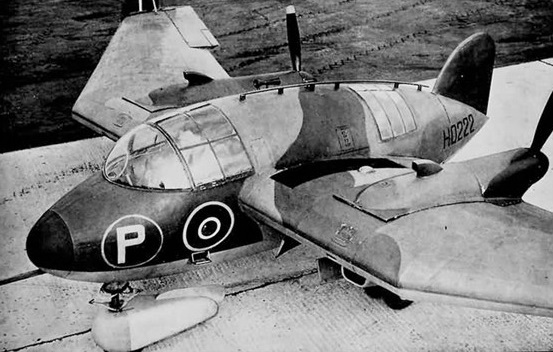
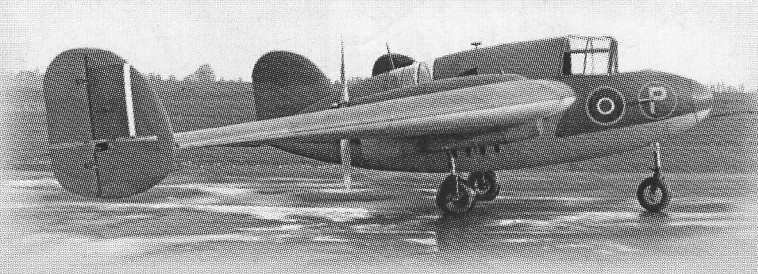
From 1936 Dr. Gustav Victor Lachmann concentrated on research with tailless aircraft, starting with the development of the H.P.75 Manx. This was completed in 1939, but Lachmann was interned for the duration of the war, and its development was completed by Godfrey Lee.
The airframe was built by Dart Aircraft of Dunstable, England; the aircraft was finished at Radlett, England. During taxi trials on 12 September 1942, the aircraft flew unintentionally at a height of 12 ft (3.66 m) and was subsequently damaged while landing.
Marked with the ‘Class B’ markings H-0222, the aircraft flew for the first time on 25 June 1943. Handley Page chief test pilot Fit Lt James Talbot flew the small H.P.75 for the first time at the company’s airfield at Radlett in Hertfordshire. Talbot reported that the H.P.75 flew well but had high drag owing to its fixed undercarriage. In 1945 it was designated H.P.75 for the first time.
After modification it flew again, but interest waned and it last flew on April 3, 1946. A total of 31 flights were made till 3 April 1946 (total flight time 17 hr 43 min) when the aircraft was stored and subsequently scrapped in 1952.
Engines: 2 x Gipsy Major Max take-off weight: 1800 kg / 3968 lb Wingspan: 12.2 m / 40 ft 0 in Length: 5.6 m / 18 ft 4 in Wing area: 23 sq.m / 247.57 sq ft Max. speed: 235 km/h / 146 mph
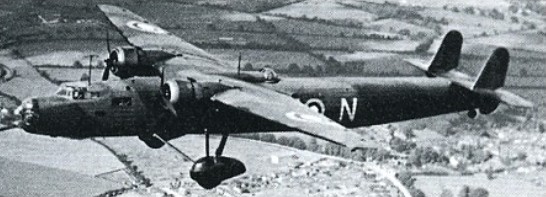
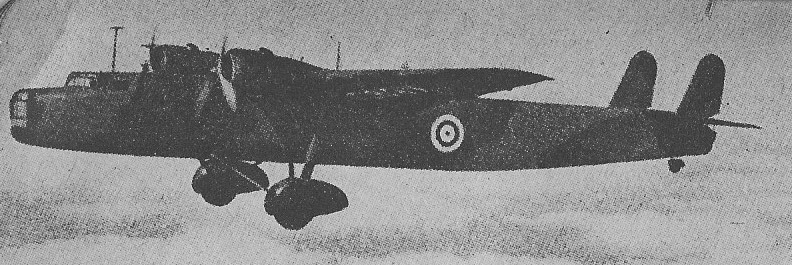
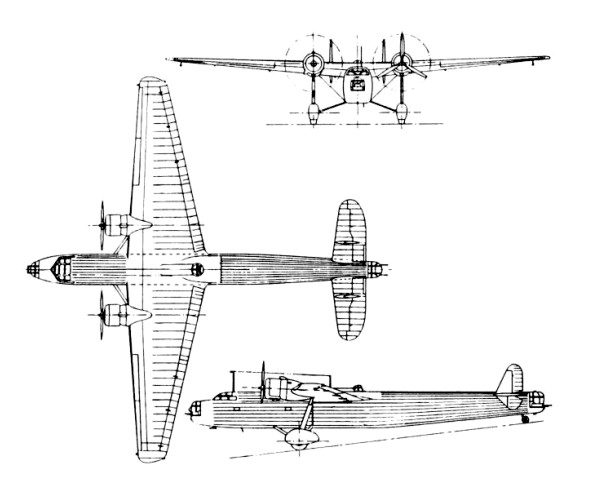
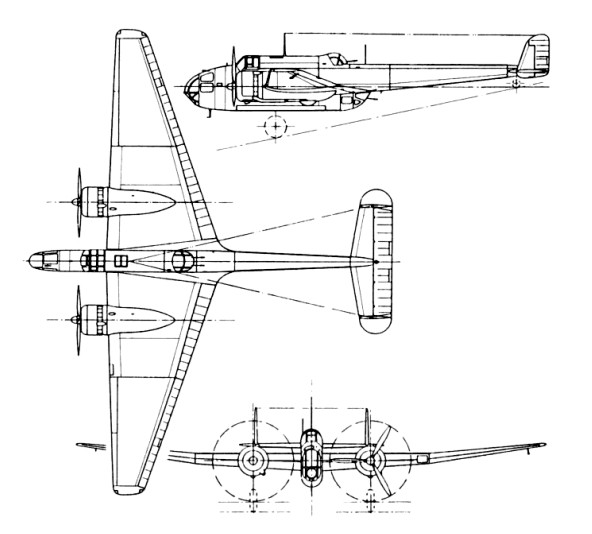
The Harrow was one of the RAF’s first monoplane bombers, and though never used in combat by Bomber Command it played a significant part in the training of bomber crews. The Harrow was based on the H.P.51 troop transport, and first flew on 10 October 1936 14 months after 100 had been ordered ‘off the drawing board’.
The Harrow bomber was a cantilever high-wing monoplane with a fixed divided-type landing gear and a twin fin and rudder-type tail unit. Enclosed accommodation was provided for a normal flight crew of four, who were also expected to man the nose turret, tail turret and mid-upper gun position.
The 38 Harrow Mk I bombers had the 619-kW (830-hp) Pegasus X radial, and were followed by the 62 Harrow Mk IIs with 689kW Pegasus XX engines and improved defensive armament. Production ended in December 1937, 11 months after the type had begun to enter service with No. 214 Squadron. By the time production ceased another four squadrons (Nos 37, 75, 115 and 215) had equipped with the type, and with some Whitley squadrons these formed Bomber Command’s main strength until well into 1939. At the outbreak of war the type was retired to the transport role and tested as an in-flight refuelling tanker circa 1939.
Engines: 2 x Bristol Pegasus XX, 690kW / 925 hp Wingspan: 26.95 m / 88 ft 5 in Length: 25.04 m / 82 ft 2 in Height: 5.92 m / 19 ft 5 in Wing area: 101.26 sq.m / 1089.95 sq ft Max take-off weight: 10433 kg / 23001 lb Empty weight: 6169 kg / 13600 lb Max. speed: 174 kts / 322 km/h / 200 mph at 10,000ft Cruise speed: 141 kts / 262 km/h / 163 mph Service Ceiling: 6950 m / 22800 ft Range: 1086 nm / 2010 km / 1249 miles Armament: 4 x 7.7mm / 0.303 machine-guns, 1360kg (3,000 lb) bombs Crew: 6
Gustav Lachmann took on the technical development of modern methods of aerodynamics and metal construction. His ideas were also incorporated into the H.P.52 Hampden.
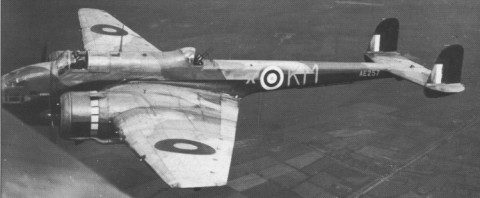
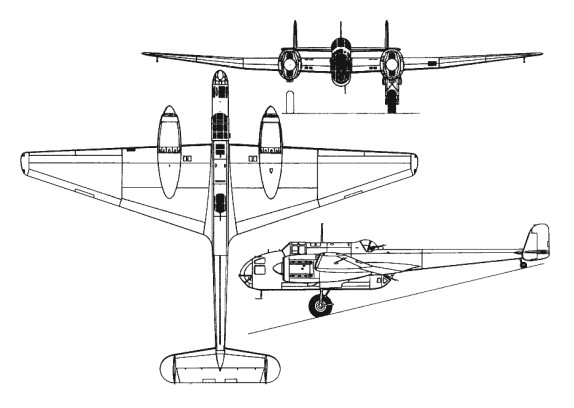
Built initially to Air Ministry Specification B.9/32, the Handley Page HP52 prototype, K4240, made its first flight on June 21, 1936.
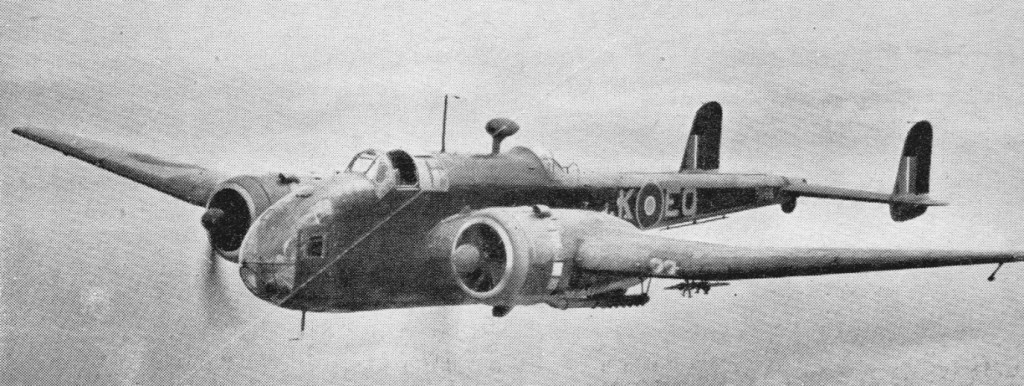
Of conventional all-metal stressed-skin construction, the Hampden’s thick-section mid-set monoplane wings tapered both in chord and thickness. Handley Page slots on the leading edge of the wing outer panels, plus trailing-edge flaps, made possible a low landing speed. Accommodation was provided for a crew of four. Accommodation was provided for a crew of four. The fuselage was on 36in wide at its widest point.
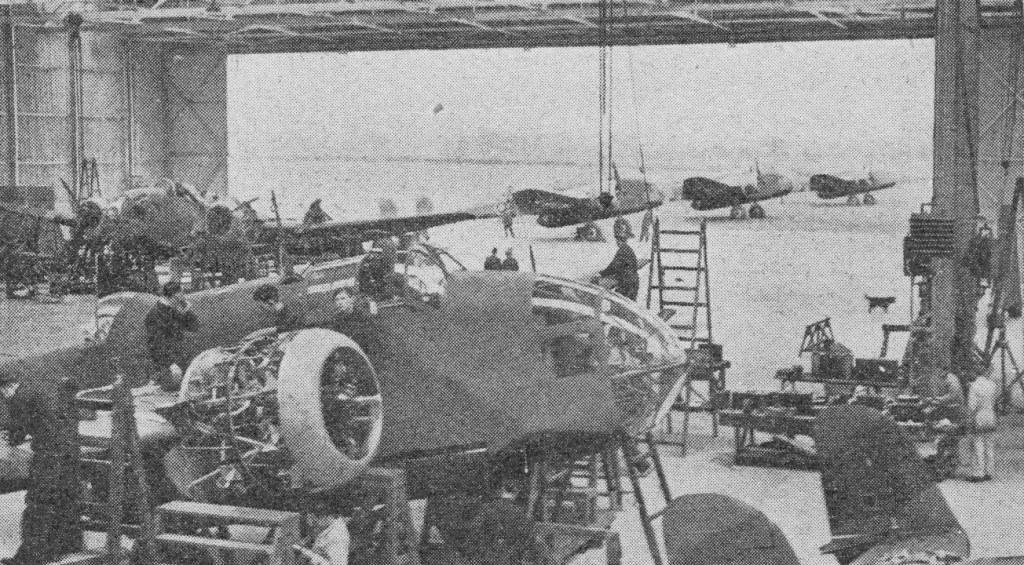
Seven weeks after the first flight, the design was put into production, and the first examples entered RAF service in the autumn of 1938, 49 Squadron being the first unit to fully reequip with the type. By September 3, 1939, the RAF possessed a total of 212 Hampdens (ten squadrons, including reserves) which represented almost 25% of Bomber Command’s offensive first-line bomber strength. Hampdens flew on operational sorties from the first day of the war, and during the first few months suffered high casualties in unescorted daylight bombing attacks against naval targets along the German coastline.
During operations, the Hampden proved to have serious deficiencies, particularly in its defensive armament, which consisted of five 0.303 inch machine guns. The fixed forward firing gun proved almost useless and the single guns in the nose, dorsal and ventral positions had limited transverse, leaving a number of blind spots. In addition, the cramped conditions led to crew fatigue on long flights, and it was almost impossible for crew members to gain access to each others cockpit in an emergency. Losses during early daylight raids were very heavy.
To improve the defensive armament, the dorsal and ventral positions were each fitted with twin Vickers K machine-guns. In addition, armor plate was installed and flame-damping exhaust pipes were fitted for night flying. Thus modified, the Hampden did useful work in Bomber Command’s night offensive from 1940 to 1942, taking part in the RAF’s first raid on Berlin and in the 1,000-bomber raid on Cologne.
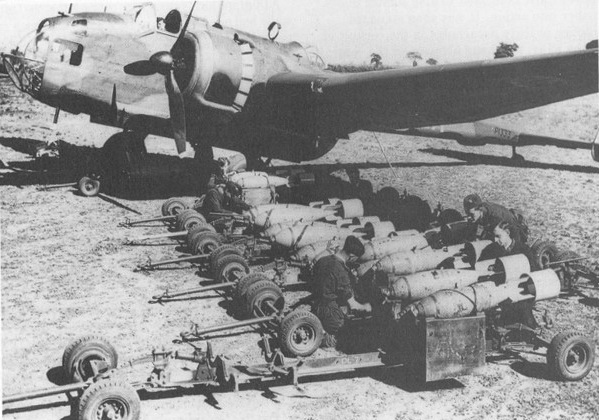
Switching mainly to night bombing by early 1940, Hampdens became the chief exponent of ‘gardening’ sorties-sowing sea mines in enemy waters but continued to participate in Bomber Command’s nightly assault on Germany. In 1940 two Hampden crew members, Flight Lieutenant R A B Learoyd of 49 Squadron, and Sergeant John Harmah of 83 Squadron, were each awarded a Victoria Cross for valour during bombing operations.
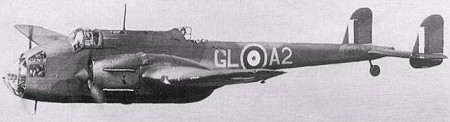
No.49 Sqn Hampden
Though obsolescent for its intended role as a medium day bomber, and poorly armed for self defence against more modern enemy fighters, the Hampden continued in first line operational service with RAF Bomber Command until September 1942. In three years of operations as a pure bomber, Hampdens flew a grand total of 16541 individual sorties, dropping almost 10000 tons of bombs on German targets. In the same period, however, 413 Hampdens and their crews were lost in action. On February 1, 1942, a total of eight Hampden squadrons, all in No 5 Group, Bomber Command, were operational, though by the end of the year they had all converted to Avro Manchesters or Avro Lancasters. Retired as a bomber, the Hampden saw a further year’s first line service as a torpedo bomber with Coastal Command, equipping at least four squadrons before finally being withdrawn from operational roles in December 1943.
A total of 1584 Hampdens and its stablemate, the Hereford, was built and delivered to the RAF, equipping a total of 21 squadrons at some period of the war. A further 160 were built in Canada.
Hampdens were produced by The English Electric Co.
Nicknamed variously as ‘Hambone’, ‘Flying Suitcase’ and ‘Ferocious Frying Pan’, the Hampden was nevertheless popular with its pilots, due to its near fighter manoeuvrability and excellent all round vision field from the high forward cockpit. Internally, its very restricted space created no little discomfort for other crew members, while its poor defensive armament, comprising a single hand held machine gun in the nose and single or twin machine guns in ventral and dorsal positions, belied the original description of the design in 1936 as a ‘fighting bomber’. Nevertheless, the Hampden and its contemporaries, the Bristol Blenheim, Vickers Wellington and Armstrong Whitworth Whitley, all outdated for modern warfare by 1940, had to soldier on as Bomber Command’s only weapons during the first three years of the 1939 45 war, until heavier, four engined replacements became available in ample quantities in late 1943.
HP.53 Hereford
The Hereford bomber was a Napier Dagger-engined version of the Hampden, ordered as a back-up at the same time as the first Hampden production contracts. The noisy new inline engines overheated on the ground and cooled too quickly and seized in the air. Even routine maintenance was more complicated than that required for the Hampden’s Pegasus radials. There were no performance advantages from the new engines. Only a very small number of Herefords saw action (in Hampden squadrons). The rest were relegated to training units, soon followed by the marginally better Hampen.
The Hereford was distinguishable from the Hampden by its longer engine cowlings and greater dihedral on the outer wings.
The Hereford and Hampden had a single-pilot cockpit with a sliding canopy, which was sometimes left open in flight for the ‘wind-in-the-hair’ feel.
A total of 1,432 Hampdens were built, 502 of them by Handley Page, 770 by English Electric and 160 in Canada by the Victory Aircraft consortium. Of the 160 built, 84 were shipped by sea to Britain, while the remainder came to Patricia Bay (Victoria Airport) B.C., to set up No.32 OTU (RAF). Due to heavy attrition from accidents, a number of “war weary” Hampdens were later flown from the U.K. to Pat Bay as replacements.
Victory Aircraft Hampden Engines: Two 1000 hp Bristol Pegasus XVIII engines Maximum speed: 254 mph (409 km/h) Empty weight: 11,780 lb (5,345 kg) Loaded weight: 18,756 lb (8,505 kg) Span: 69 ft 2 in (21.1 m) Length: 53 ft 7 in (16.3 m) Height: 14 ft 11 in (4.5 m) Wing area: 668 sq ft (62.1 sq m)
HP 52 Hampden Engines: 2 x Bristol Pegasus XVII, 746kW / 1000 hp Wingspan: 21.1 m / 69 ft 3 in Length: 17.0 m / 55 ft 9 in Height: 4.6 m / 15 ft 1 in Wing area: 62.0 sq.m / 667.36 sq ft Max take-off weight: 8510 kg / 18761 lb Empty weight: 5340 kg / 11773 lb Max. speed: 408 km/h / 254 mph Cruise speed: 350 km/h / 217 mph Ceiling: 6900 m / 22650 ft Range w/max.fuel: 3200 km / 1988 miles Range w/max.payload: 1400 km / 870 miles Armament: 4 x 7.7mm / 0.303 in machine-guns, 1800kg of bombs Crew: 4
Hampden B.Mk I Span: 21.08 m (69 ft 2 in) Length: 16.33 m (53 ft 7 in) Gross weight: 8508 kg (18760 lb) Maximum speed: 426 km/h (265 mph)
Hampden TB.1
Handley Page HP 53 Hereford Engines: 2 x Napier Dagger VIII, 986 hp / 746kW Length: 53 ft 7 in / 16.33 m Height: 14 ft 11 in / 4.55 m Wing span: 69 ft 2 in / 21.08 m Wing area: 668.014 sq.ft / 62.06 sq.m Max take off weight: 17803.2 lb / 8074.0 kg Weight empty: 11701.9 lb / 5307.0 kg Max. speed : 230 kts / 426 kph / 265 mph Cruising speed: 150 kts / 277 kph / 172 mph Service ceiling : 19,000 ft / 5790 m Wing load : 26.65 lb/sq.ft / 130.0 kg/sq.m Range w/max.payload: 1043 nm / 1931 km Crew : 4 Armament : 6x cal.303 MG (7,7mm), 1814kg Bomb.
Gustav Lachmann took on the technical development of modern methods of aerodynamics and metal construction, and went on to convert the H.P.43 biplane into the H.P.51, with a modern monoplane wing and aircooled engine nacelles. This led to the order for 100 of a production version, the H.P.54 Harrow.
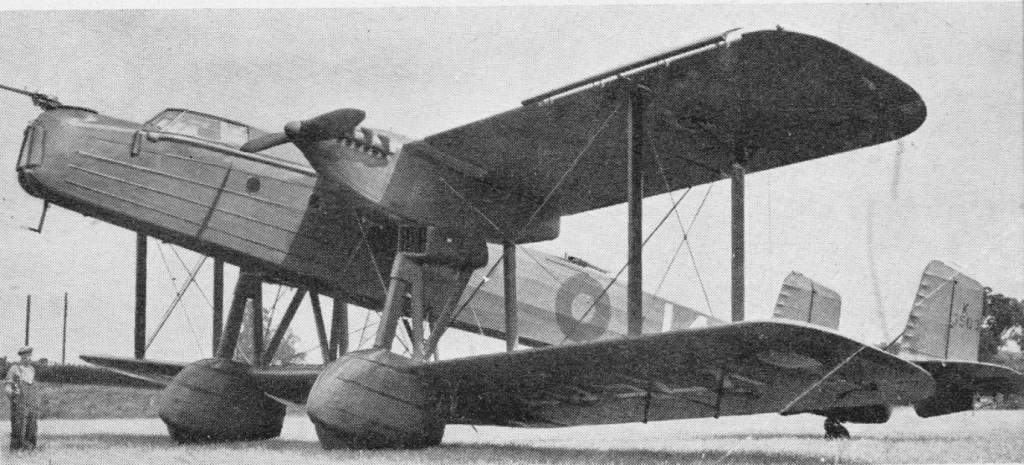
The Heyford was the RAFs last biplane heavy bomber, an unusual type with the fuselage attached to the undersurface of the upper wing and the centre section of the lower wing thickened for internal carriage of the bombload. The long main landing gear units were attached at their upper ends to the engine nacelles, while the wheel spats were attached at their rear to the lower-wing centre section. The Heyford prototype flew in June 1930, and production of 124 aircraft up to July 1936 comprised 38 Mk Is and Mk lAs, 16 Mk Is with de¬rated 391.2kW Rolls-Royce Kestrel VI engines, and Mk IIs and 70 Mk IIIs with fully rated 428.5kW Kestrel VI engines and four-blade propellers.
The Heyford was an equal-span biplane with staggered wings: the upper wing centre-section rested on top of the fuselage, while the lower was positioned well below the fuselage, connected to the under-fuselage by N-type struts. The inner interplane struts supported the engine mountings. Bombs of various sizes were carried inside the thickened centre-section of the lower wing, each bomb being carried in a separate cell closed by spring doors. The fixed landing gear comprised two large wheels faired into the lower wing. The nose and dorsal gun positions of the Heyford were equipped with Scarff mountings for their 0.303 in (7,7 mm) Lewis or Vickers guns. Of the three versions of the Heyford, the Mks I, II and III, the visible differences are primarily in detail, including such items as alternative wheel pants, three and four bladed propellers, and varying radiator intake designs. The main bomb load was housed in the thickened centre section of the lower wing. Additional bombs were carried on external racks. A total of 124 Heyfords were built, made up of 38 Mk I and IA, 1 intermediate Mk IA/II, 16 Mk II and 71 Mk III – including changes made from the original production orders.
The type entered service in November 1933 with No 99 Sqn at Upper Heyford, and equipped a total of 11 squadrons before being phased out from 1937, removed from first-line service in 1939 and finally declared obsolete in July 1941.
Heyford Mk IA Engines: 2 x Rolls-Royce Kestrel IIIS, 429kW/ 575 hp Span: 22.86m / 75 ft Length: 17.68m / 58 ft Height: 5.3 m / 17 ft 5 in Wing area: 136.6 sq.m / 1470.35 sq ft Empty weight: 4580 kg / 10097 lb Max T/O weight: 7666 kg / 16,900 lb Max. speed: 229 km/h / 142 mph at 13,000 ft Ceiling: 6400 m / 21000 ft Range: 1480 km / 920 miles with 726-kg (1,600-lb) bombload Armament: 3 x 7.7-mm (0.303-in) mg, 1588 kg (3,500 lb) bombs
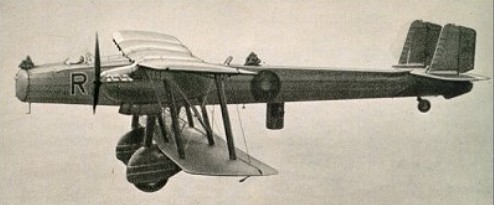
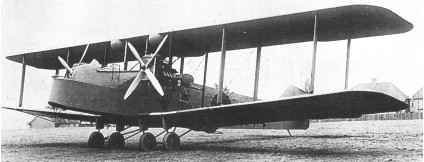
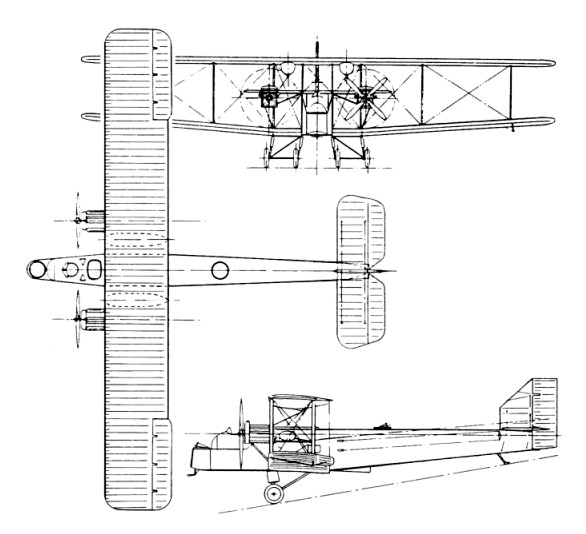
The Hinaidi was a structural rather than aerodynamic development of the Hyderabad (with a primary structure of metal rather than wood in the main production variant) and with Jupiter radials in place of the Lion inlines for slightly better performance with a usefully increased warload. The two Hinaidi prototypes were Hyderabad conversions and thus retained a wooden structure, and first flew in March 1927.
HP.33 Hinaidi
The 12 new-build Hinaidi Mk Is retained the Hyderabad’s wooden construction, and were complemented by seven Hyderabad conversions before the advent of the metal-structured Hinaidi Mk II (first flown 8 Feb 1929), of which 33 were built up to 1932.
The first Hinaidi unit was No. 99 Squadron, which received its aircraft from October 1929. There followed No. 10 Squadron, together with Nos 502 and 503 Squadrons of the Auxiliary Air Force. Hinaidis were replaced by Heyfords from 1933, and declared obsolete during 1937.
The RAF also received three examples of the troop-transport version known as the Clive (formerly Chitral). Each could accommodate 17 fully armed troops, or equivalent freight; folding seats being provided on both sides of the cabin and racks for the rifles. Two gun positions were retained (nose and dorsal). The first Clive was later civil registered G-ABYX and named Youth of Australia (subsequently Astra).
HP.35 Clive
Hinaidi Mk II Engines: 2 x Bristol Jupiter VIII, 328kW (440 hp) Span: 22.86m (75ft). Length: 18.03m (59ft2in). Height: 5.18 m / 16 ft 12 in Wing area: 136.66 sq.m / 1470.99 sq ft Max T/O weight: 6577 kg (14,500 lb). Empty weight: 3647 kg / 8040 lb Max speed: 106 kts / 196 km/h / 122 mph at sea level. Cruise speed: 121 km/h / 75 mph Ceiling: 4420 m / 14500 ft Range: 1368 km / 850 miles Armament: 3 x 7.7-mm (0.303-in) machine-guns, 657 kg (1,4481b) bombs Operational range: 850 miles. Crew: 4
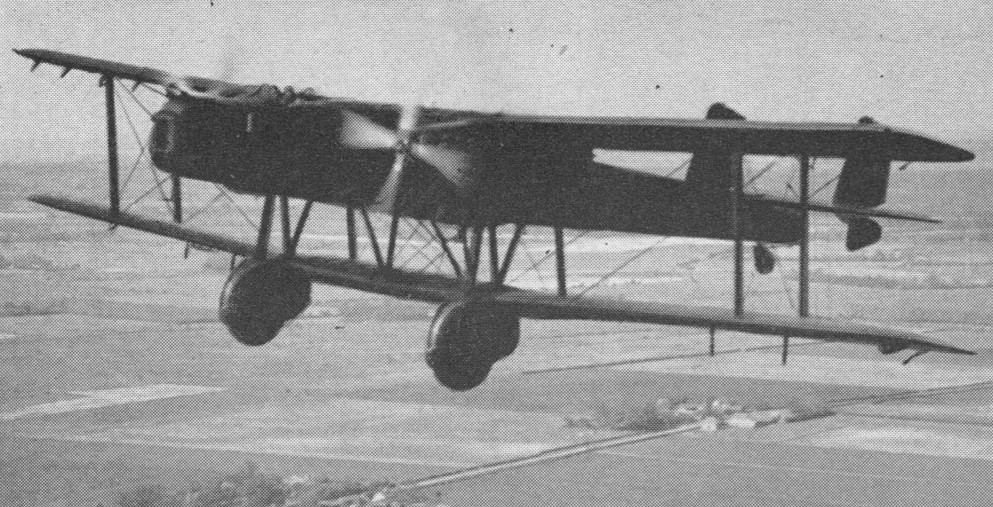
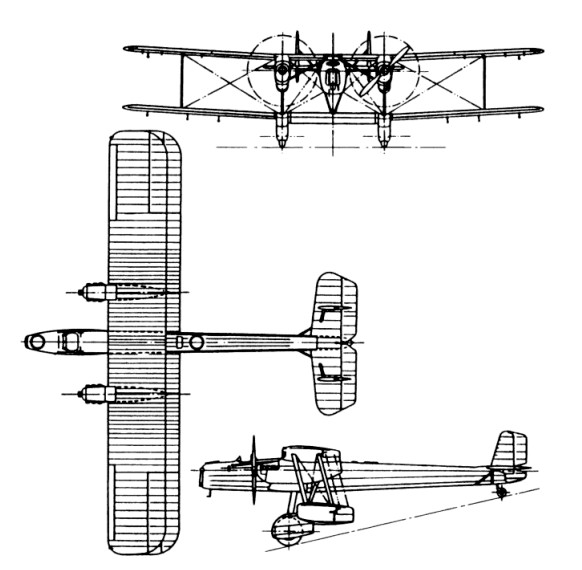
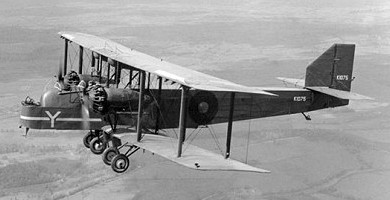
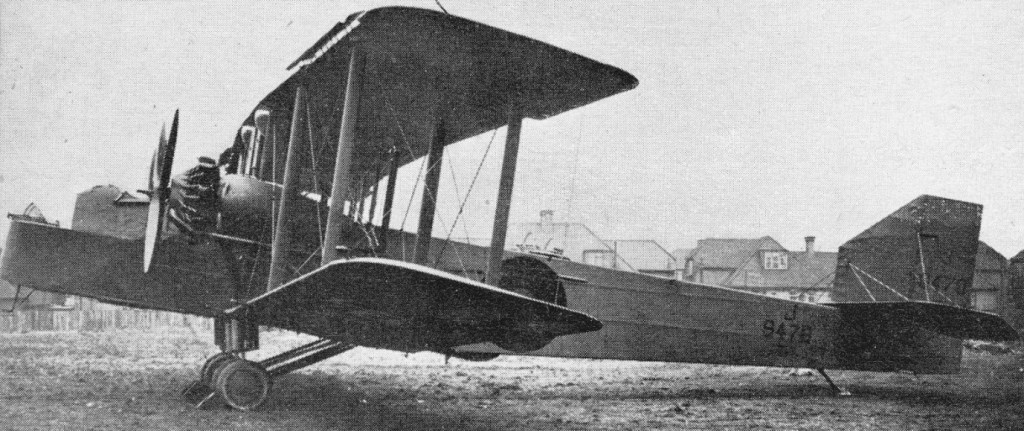
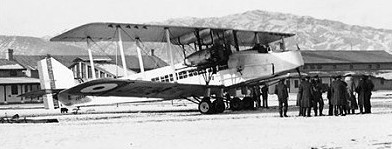
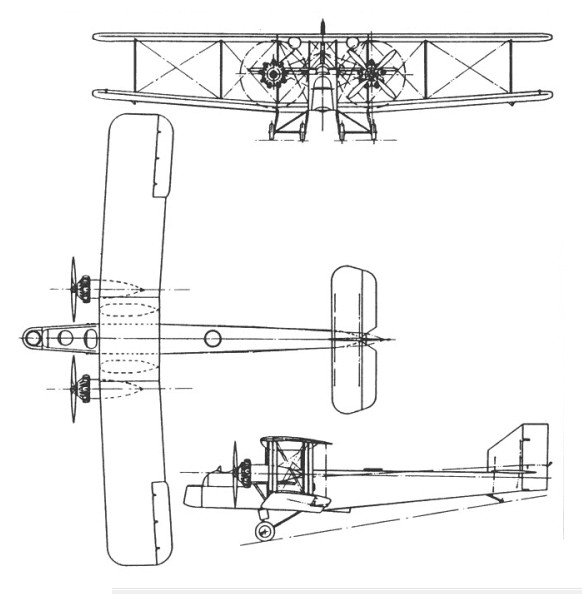
The Hyderabad was a military derivative of the W.8 which first flew in December 1919 as one of the first purpose-designed airliners. The Hyderabad was the company’s response to a 1922 bomber specification, and when it took to the air in October 1923 it was the world’s first large aeroplane with automatic leading-edge slats. Such slats were not incorporated into the Hyderabad Mk I production type, which was also the RAF’s last all-wooden heavy bomber. Delivery of the 38 aircraft was slow, No. 99 Squadron receiving its Hyderabads from December 1925 but No. 10 Squadron re-equipping only from January 1928. Hyderabads were also flown by two Auxiliary Air Force units, Nos 502 and 503 Squadrons. The bomber was withdrawn from first-line service in 1930 and from AAF service in 1933, and the type was declared obsolete in 1934. Three were later converted into Hinaidis.
Handley Page Hyderabad Mk I Engines: 2 x 450hp / 338.5kW Napier Lion IIB or V Wingspan: 22.86 m / 75 ft 0 in Length: 18.03 m / 59 ft 2 in Height: 5.11 m / 16 ft 9 in Wing area: 136.66 sq.m / 1470.99 sq ft Max take-off weight: 6164 kg / 13,590 lb Empty weight: 4045 kg / 8918 lb Max. speed: 94 kts / 175 km/h / 109 mph at sea level Ceiling: 4267 m / 14000 ft Operational Range: 432 nm / 805 km / 500 miles Armament: 3 x 7.7mm (0.303-in) machine-guns, 500kg (1,100 lb) bombs Bomb load: 500kg Crew: 4










 All Aero