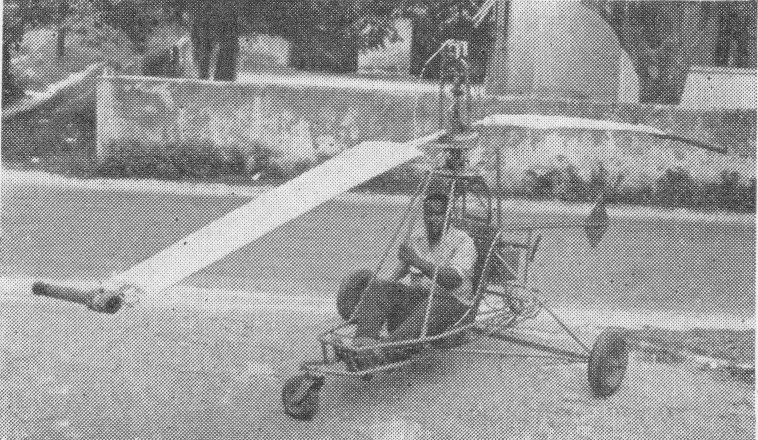
Built as a flying test bed for the Jervis tip-powered rotor system, the Baby J was flown in Nassau, Bahamas, in 1952.
Power: 2 x Jervis pulse-jets
Rotors: 2-blade, tip-powered main rotor
Seats: 1
Built as a flying test bed for the Jervis tip-powered rotor system, the Baby J was flown in Nassau, Bahamas, in 1952.
Power: 2 x Jervis pulse-jets
Rotors: 2-blade, tip-powered main rotor
Seats: 1
The JAI-39 (Russian: ХАИ-39) was designed at SKB JAI in 1978 as a single-seat experimental light aircraft of twin-engine configuration.
Only one example was built.
JAI-39
Engines: two 4 hp Druzhba
Wingspan: 10.65 m
Wing area: 17.63 m²
Length: 3.62 m
Empty weight: 42.65 kg
Maximum takeoff weight: 140 kg
Maximum speed at sea level: 45 km / h
Landing speed: 22 km / h
Take-off run: 10 m
Accommodation: 1
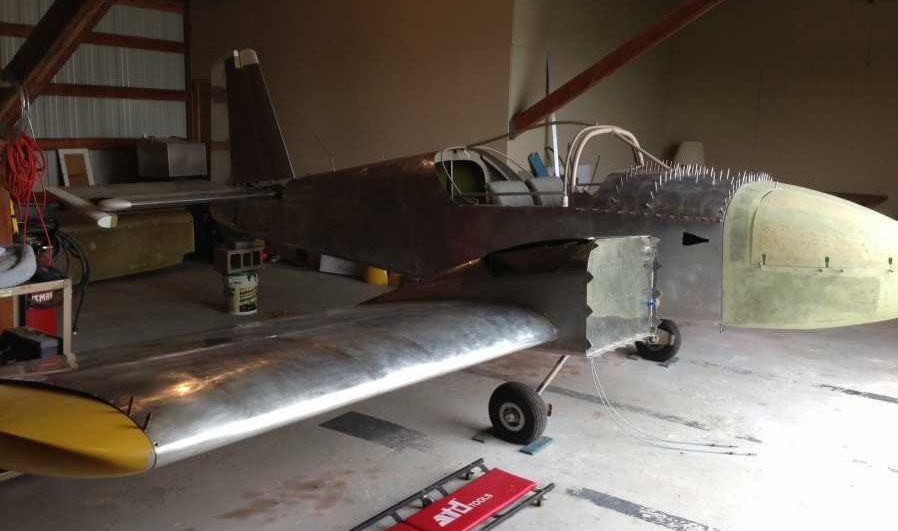
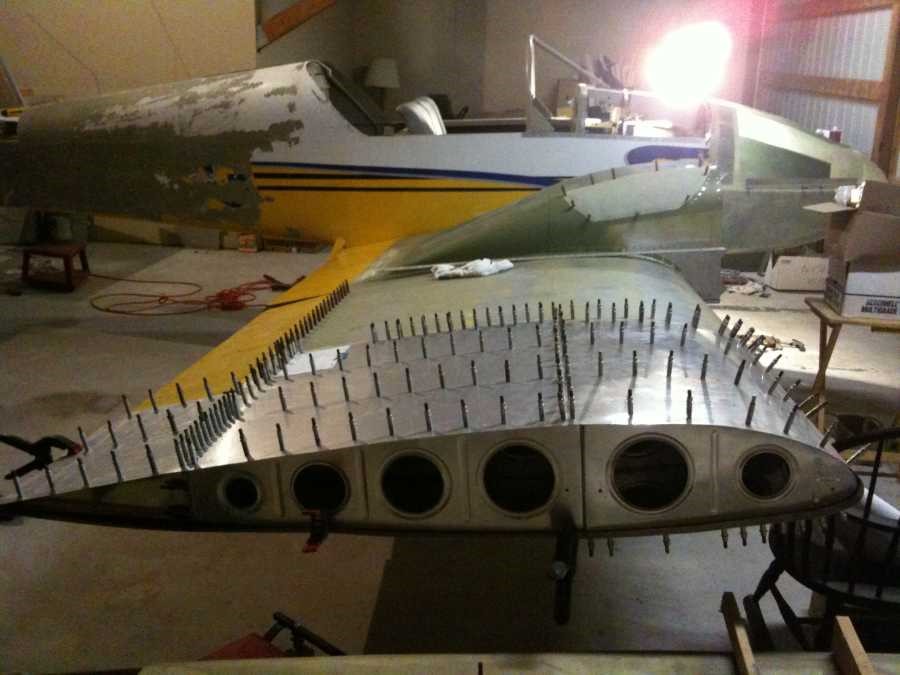
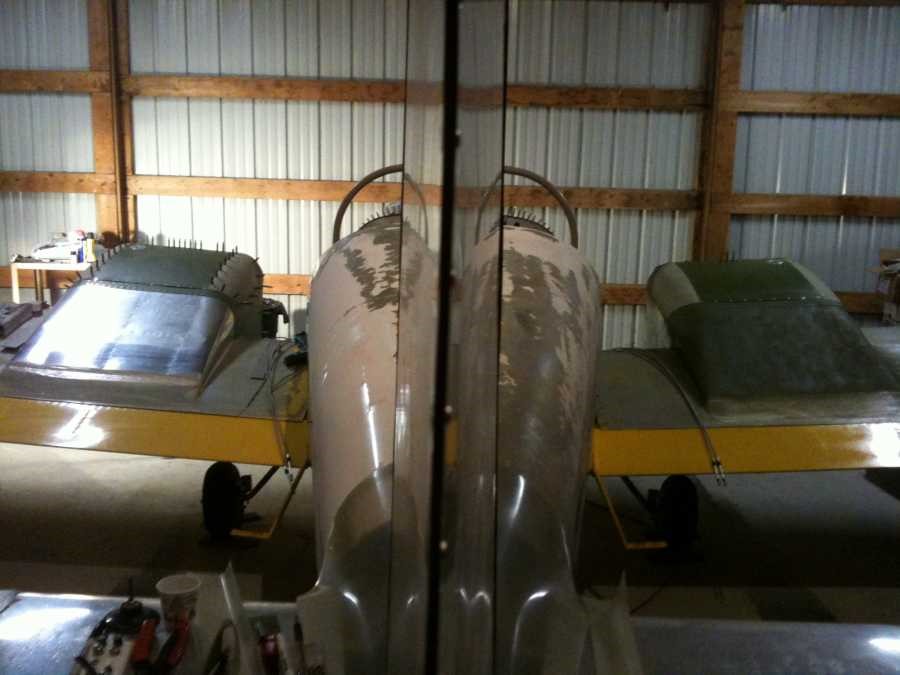
The Twin Jag project started life as a completed RV-6A, which was built and flew for 250 hours.
Some modifications include, but not limited to:
The Twin Jag is a side-by-side 2 seat twin-engine cross country aircraft. It will be IFR capable with dual Dynon Skyview EFIS.
By January 2013, both nacelles complete. Custom motor mounts being fabricated. Riveting right wing extension now, left wing extension riveting to follow. Center console 75% complete. Fabricating nose gear/baggage shelf in next few weeks. All fibreglass work still in rough stages of completion…lots of filling & sanding ahead.
Engines: 2 Corvair 3000cc 120hp

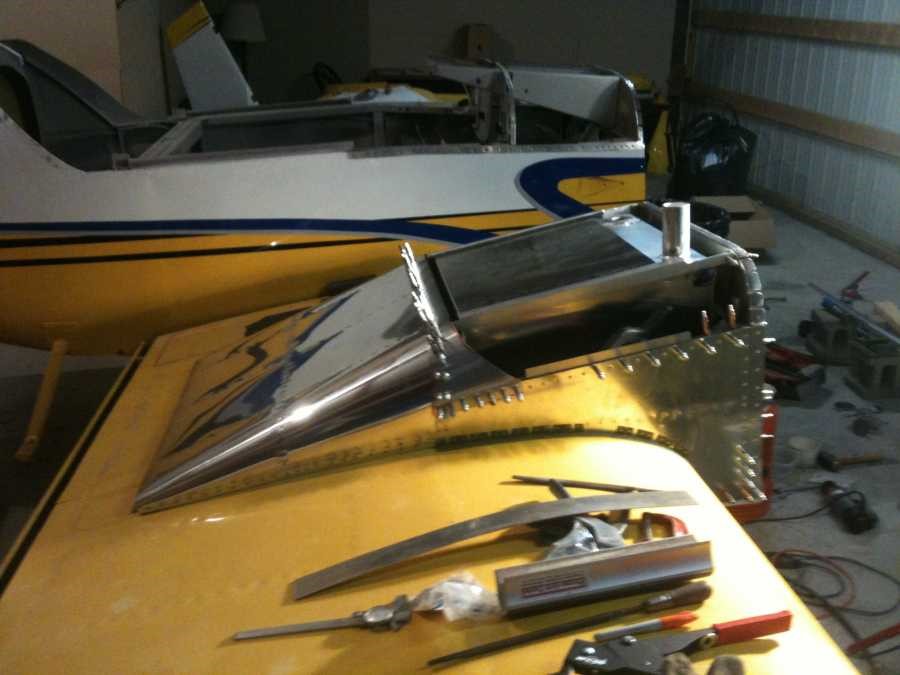
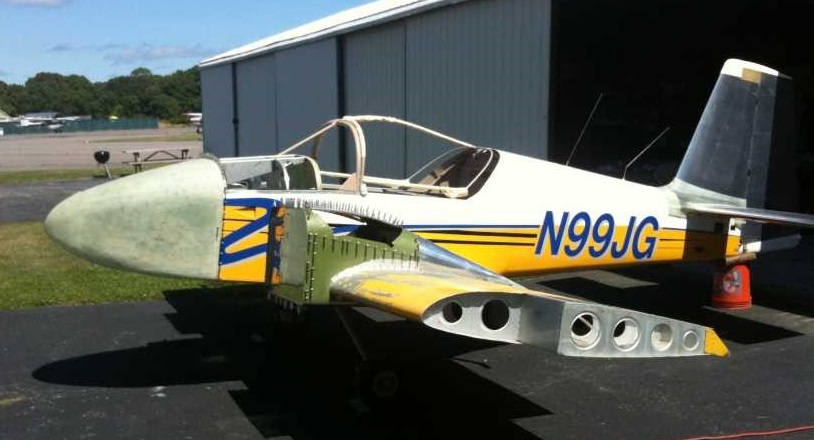
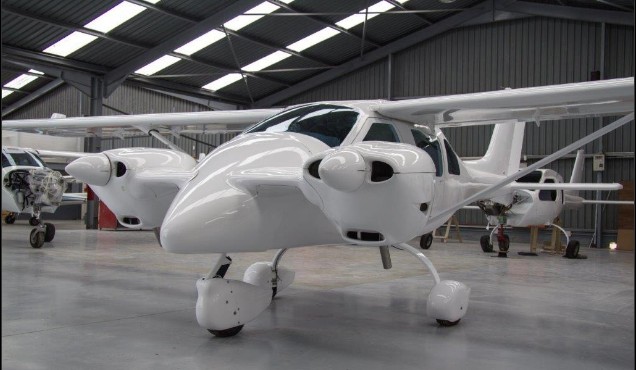
Len and Les Alford of Jabiru Aircraft Southern Africa suggested there was a market for a twin engine Jabiru in Africa. Parts of Africa are best flown over at a great height as the prevalence of wild animals and AK47’s tends to make you nervous about outfield landings and the comfort of two engines is hard to replace.
Len and Les completely build the Jabiru Aircraft under licence and service the whole of Southern Africa. The project was always intended to be a joint development and aimed at the South African market.
The complexity generated by hanging the engines off the wings. This would have meant going back to basics on wing structure and all the difficulties of fire proofing the wings etc. Another physical difficulty was the engine pods completely obstructed the entry and exit points to the cabin. The idea came of mounting the engines on a short canard mounted on the firewall. The propellers were quite close together to reduce the amount of asymmetric thrust on one engine.
At Jabiru Aircraft Australia, John Farmer made a streamlined nose for a J430 and the two engine pods. Engineer Tom Ferguson was given the task of testing the supporting structure for the engines. This took quite a while to get a structure light enough and strong enough to meet the FAR Part 23 standards. As usual most of the structure was built in composite with aluminium connections to the engines.
The firewall structure of the J430 is unchanged and the nose wheel stays where it is. This is a relatively simple bolt on modification.
When the structure was finished and the moulds were complete the project was shipped to South Africa where Len had to fit all this to a new aircraft and finish all the details to make it into a flying aircraft.
Len had the task to bring this raw prototype to a production item and to negotiate with the South African CAA on its terms of release to the public.
The conversion could be offered as a kit to be fitted to an existing experimental J430.
Dott Ing Stelio Frati designed the F.20 Pegaso light twin; two prototypes built (first flown 1971) and an agreement was reached for production aircraft to be manufactured by Italair.
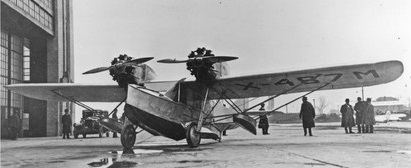
The Issoudun H-23 was built in 1930, powered by two 125 hp Warner Scarab 7 cylinder radial engines.

Originally designed by Ted Smith in 1960 and called the Aero Commander Jet Commander, the design first flew in 1963. When the company was taken over by North American Rockwell in 1967, the Justice Department in¬sisted that the new firm divest itself of Rock¬well’s rights to the Jet Commander. The Gov-ernment apparently felt that common owner¬ship of two bizjet designs the Commander and North American’s existing Sabreliner¬ – would give North American Rockwell a lock on the market. For a variety of public and pri¬vate reasons (the Sabreliner’s origin as a mili¬tary project was mentioned most frequently), the Government decreed that the Command¬er must go.
The project was bought lock, stock and tooling by Israeli Aircraft Industries. The machine the Israelis developed from the basic Commander design was the IAI Westwind 1124 and its successor, the Westwind 1.
The Jet Commander was so easy to control that flight controls are not boosted hydraulically and there is no artificial stall-warning device. In a deliberate stall, the Jet Commander will not fall off either wing. When Israel Aircraft industries began production of the Commander Jet, several improvements were added:
increased takeoff weight, strengthened landing gear, greater fuel capacity, and improved performance. The 1123 Westwind features a longer cabin, auxiliary wingtip fuel tanks, more powerful engines, two additional cabin windows, and modified wing leading edges. The 1124 Westwind is the long-range version utilizing two 3,700-lb. s.t. Garrett turbofans with an 8,620-gallon fuel capacity. The 1123 converted to the 1124 when Garrett TFE731 turbofans were added. That model changed to the 1124A Westwind 2 with improved hot and high performance, better fuel economy and longer range. The Westwind 2 also had a modified wing, winglets, and upgrades to the interior.
Characterised by a mid-fuselage wing, set aft, behind even the rearmost windows, the Westwind is a high versatility, multi-role performer. Israel and Venezuela both have them in use for naval and air-force tracking, while the German air force have three engaged in target towing. As well, Westwinds are to be found perform¬ing fisheries surveillance, anti-submarine reconnisance, air am¬bulance work, VIP carriage, calibration flying, all freight, charter and even, in the case of the Israelis, in the attack role, with missiles attached to fuselage hardpoints. Certified for up to ten passengers and two crew, with seven passengers still air range with mandatory reserves is 2400 nautical miles. An auxilliary fuel tank can be fitted to the rear baggage compartment to give a further 300 nm range. Maximum ramp weight is 23,000 pounds, while a typical Basic Operating Weight runs to 13,200 pounds. Maximum zero fuel weight is 16,500 pounds giving a near 3,500 pound useful load – in the freight configuration this is upped to a 4,000 pound disposable load. Two baggage holds are standard, an 800 pound capacity forward one and a 250 pound rear locker. Both are un¬pressurised though the forward hold is heated. Powered by two Garrett AiResearch TFE 731 engines, each rated at 3,700 pounds static thrust, with clam-shell thrust reversers as standard to minimise brake and tyre wear. Certified under Part 25 of the FAR’s (airline category certification), the Westwind 1 has an excellent balanced-field/range combination. Take-off distance at gross is 5,500 feet, and the aircraft can operate a 2,500 nm sector, with 45 minute reserve, out of a 4,600 foot field carrying four passengers. At the other end of the scale, the same four passengers can be flown a 500 nm trip out of only a 2,550 foot strip. Standard are thrust reversers, antiskid braking, lift dump system, therapeutic oxygen, and single point refuelling.
Israel Aircraft Industries flew the IAI 1124 Westwind development aircraft (4X CJA) on 21 July 1975. An improved ver¬sion of the 1123 Westwind introduc¬ing Garrett TFE731 3 turbofans. The new engines have allowed IAI to increase the Westwind’s ramp weight by one ton and other useful changes have been made as well: the wing leading edge cuff has been blunted and drooped slightly in order to maintain reasonable approach speeds de¬spite the weight increases; the two baggage compartments in the tailcone have been enlarged; and the airplane is being delivered from the factory with a completely new avion¬ics package featuring the Collins NCS 31 mul¬tipurpose digital computer a compact RNAV processor and avionics management system.
Cabin ac¬commodations, standard, includes four swivelling/tracking/reclining club seats, three fixed seats, a fully enclosed lavatory and a hot¬-and cold refreshment center.
A version of the 1124 for the Israeli navy was de¬veloped as the 1124 Sea Scan. A maritime version of the IAI-1124 Westwind corporate jet, the Sea Scan is equipped with a Litton AN/APS 504(V) 360 degree scan search radar, a VLF/Omega naviga¬tion system, and stores pylons on the fuselage sides. Three standard Westwinds, delivered to the Israeli Navy in 1977, have been converted to Sea Scans for maritime patrol and tactical support duties.
Westwind
Seats 10.
Gross wt. 20,700 lb
Empty wt. 9,370 lb
Fuel capacity 1,330 USG.
Engines two 3,109-lb. s.t. General Electric turbojets.
Top speed 428 mph.
Cruise 420 mph.
Stall 112 mph.
Initial climb rate 4,040 fpm.
Range 1,600 sm.
Ceiling 45,000.
Takeoff distance (to 35 ft) 4,100 ft.
Landing distance (to 50 ft) 3,400 ft.
IA-1124 Westwind I
First built: 1976.
Engines: 2 x Garrett TFE 731-3-1G, 3700 lbs thrust.
Seats: 7/10.
Length: 52.3 ft.
Height: 15.8 ft.
Wingspan: 44.8 ft.
Wing area: 308 sq.ft.
Wing aspect ratio: 6.5.
Maximum ramp weight: 23,000 lbs.
Maximum takeoff weight: 22,850 lbs.
Standard empty weight: 12,390 lbs.
Maximum useful load: 10,610 lbs.
Zero-fuel weight: 16,000 lbs.
Maximum landing weight: 19,000 lbs.
Wing loading: 74.1 lbs/sq.ft.
Power loading: 3.1 lbs/lb.
Maximum usable fuel: 8710 lbs.
Best rate of climb: 3200.
Certificated ceiling: 45,000 ft.
Max pressurisation differential: 9 psi.
8000 ft cabin alt @: 45,000 ft.
Maximum single-engine rate of climb: 860 fpm @ 150 kts.
Single-engine climb gradient: 392 ft/nm.
Single-engine ceiling: 25,000 ft.
Max speed: 360 kts./.765 Mach.
High speed cruise @ 39,000ft: 424 kts/.75 Mach.
Fuel flow @ normal cruise: 1048 pph.
Long range cruise at 39,000 ft: 393 kts./.7 Mach.
Stalling speed, clean, at 19,000 lbs: 113 kts.
Stalling speed, flaps 40, at 16,000 lbs: 91 kts.
Turbulent-air penetration speed: 230 kts.
Duration at high speed cruise: 5.9 hrs. (2,466 nm).
Duration at long range cruise: 6.7 hrs (2,640 nm).
IA-1124A Westwind II
First built: 1980.
Engines: 2 x Garrett TFE 731-3-1G, 3700 lbs thrust.
Seats: 9/12.
Length: 52.3 ft.
Height: 14.8 ft.
Wingspan: 44.8 ft.
Wing area: 308 sq.ft.
Wing aspect ratio: 6.5.
Maximum ramp weight: 23,650 lbs.
Maximum takeoff weight: 23,650 lbs.
Standard empty weight: 12,717lbs.
Maximum useful load: 10,933 lbs.
Zero-fuel weight: 16,500 lbs.
Maximum landing weight: 19,000 lbs.
Wing loading: 76.2 lbs/sq.ft.
Power loading: 3.2 lbs/lb.
Maximum usable fuel: 9555 lbs.
Best rate of climb: 3500.
Certificated ceiling: 45,000 ft.
Max pressurisation differential: 9 psi. 8000 ft cabin alt @: 45,000 ft.
Maximum single-engine rate of climb: 900 fpm @ 209 kts.
Single-engine climb gradient: 258 ft/nm.
Single-engine ceiling: 29,000 ft.
Maximum speed: 470 kts.
Normal cruise @ 45,000ft: 425 kts.
Fuel flow @ normal cruise: 992 pph.
Stalling speed clean: 113 kts.
Stalling speed gear/flaps down: 99 kts.
Turbulent-air penetration speed: 230 kts.
Seascan
Engine: 2 x Garrett TFE731 turbofan.
Installed thrust: 33 kN.
Span: 13.65 m.
Length: 15.93 m.
Wing area: 28.6 sq.m.
Empty wt: 6273 kg.
MTOW: 10,952 kg.
Warload: 2182 kg.
Max speed: 872 kph.
Initial ROC: 1524 m / min.
Ceiling: 13,715 m.
T/O run: 1180 m.
Ldg run: 534 m.
Fuel internal: 5390 lt.
Range: 4275 km.
Air refuel: No.
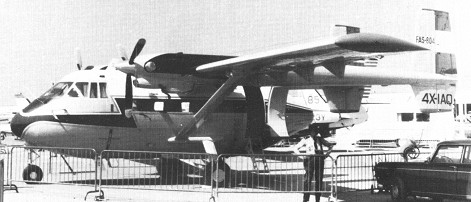
The Arava first flew on 27 November 1969, and entered production for military and civilian customers in 1972. More than 90 had been delivered by mid-1985.
The standard military version of the twin-turboprop utility transport is the IAI-201. In the transport role up to 24 troops or 16 para¬troops may be carried, and machine-gun packs can be fitted to the fuselage sides. Rocket pods may be fitted on two additional fuselage pylons.
The improved IAI-202 has a lengthened fuse¬lage with accommodation for 30 troops, 20 paratroops, 2,500kg of cargo, or 12 stretcher and five attendants, plus a fully wet wing with winglets for increased range. The winglet modification is available as a retrofit on earlier Aravas.
IAI 202 Arava
Engine: 2 x P&WAC PT6A.
Installed pwr: 1167 kW.
Span: 21.6 m.
Length: 13.5 m.
Wing area: 43.7 sq.m.
Empty wt: 4110 kg.
MTOW: 7710 kg.
Payload: 2500 kg.
Cruise speed: 319 kph.
Initial ROC: 390 m / min.
Ceiling: 7620 m.
T/O run: 400 m.
Ldg run: 250 m.
Fuel internal: 1663 lt.
Range/payload: 630 km with 2500 kg.
Capacity: 30 pax.
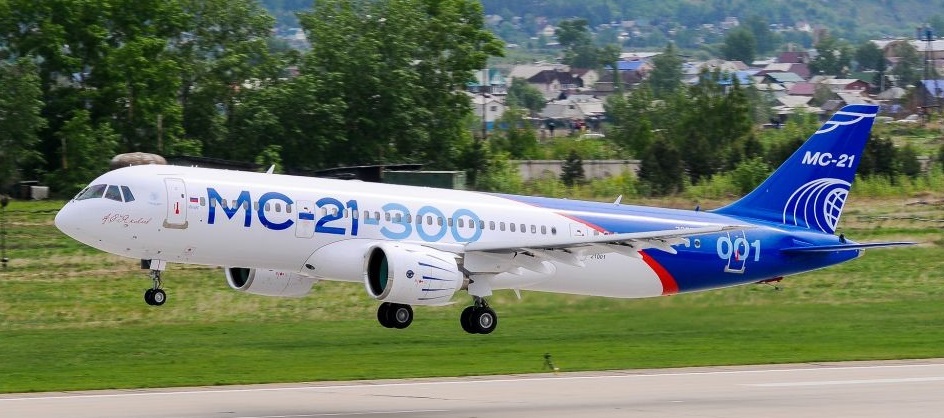
A project of Russian civil aviation was the new-generation narrow-body mid-range airliner MC-21-300. United Aircraft Corporation continued to work on the new civilian aircraft from the very beginning of the COVID-19 pandemic.
IT solutions have made it possible to transfer employees of engineering and corporate centres to remote workstations. The factories also did not stop, shift work was organised to support continuous production processes, on which the implementation of the SDO and MTC programs depended. Strict control over the health status of employees has been introduced, disinfection of territories and premises of UAC enterprises was carried out.
Due to the COVID-19 pandemic, there was a short break, but work resumed. As part of the certification program according to Russian and European standards MC-21-300, a large complex of ground, flight, bench tests was underway.
The MC-21-300 airliner is being created in a wide cooperation of Rostec enterprises. More than half of avionics was developed by the holdings of the State Corporation, and titanium and composite parts are supplied. The first MC-21-300 aircraft is under construction at the Irkutsk Aviation Plant, which will undergo flight tests with PD-14 engines developed by the United Engine Corporation.
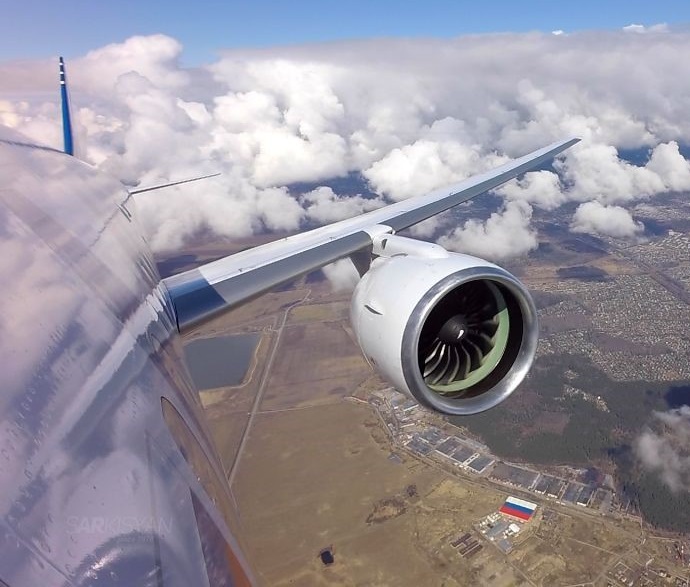
Test flights of the MC-21-300 continued. The program involves four experimental aircraft. Two of them are equipped with passenger cabins. In the case, modifications are being checked with a two-class layout for 163 seats and an ultra-dense layout for 211 seats. Flights are performed by crews of the Irkut Corporation and joint crews: pilots of the corporation and representatives of certification centres. The pace of flight tests is increasing. Often, two aircraft are simultaneously in flight.
During flights, the testing equipment allows recording of about 40 thousand parameters. By 2021 the MC-21-300 was tested for resistance to flutter and at extreme angles of attack. The main engines and auxiliary power unit were tested, including during take-off and landing with a failed engine. The minimum separation speed of the aircraft is determined. The operability of the instrumental landing system and equipment for flying in the dark was confirmed.
The production of MC-21-300 aircraft for delivery to customers had begun by 2021. The start of mass production was allowed by the positive results of flight and ground tests, which proved the correctness of the basic design and technological solutions.
IPTN developed the N-250 50/68-passenger twin-turboprop -regional airliner (first flown August 1995).
 All Aero