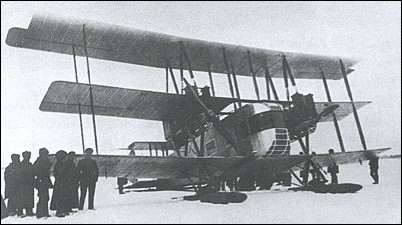
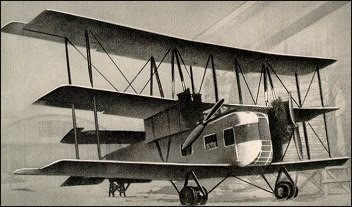
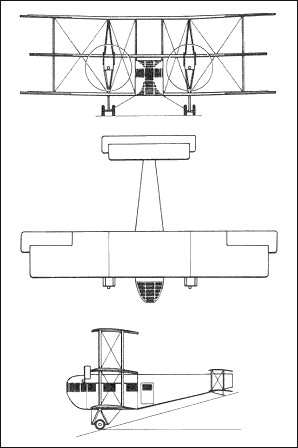
The Komta was not only the name of the aeroplane but also the name of the organisation set up to build it in the first place, under the chairmanship of Zhukovskii he of the ANT, Central Aero and Hydronamic Institute. The name comes from the “KOMissia po Tiazholot Aviatsii or the Commission for a Heavy Aircraft. The plane did not take to the air until late 1923 and by 1924 it had just about had it with the engines worn out. By this time Zhukovskii’s protogee, A.N.Tupolev, had taken over the design of large aircraft at the institute and so the Komta was no more.
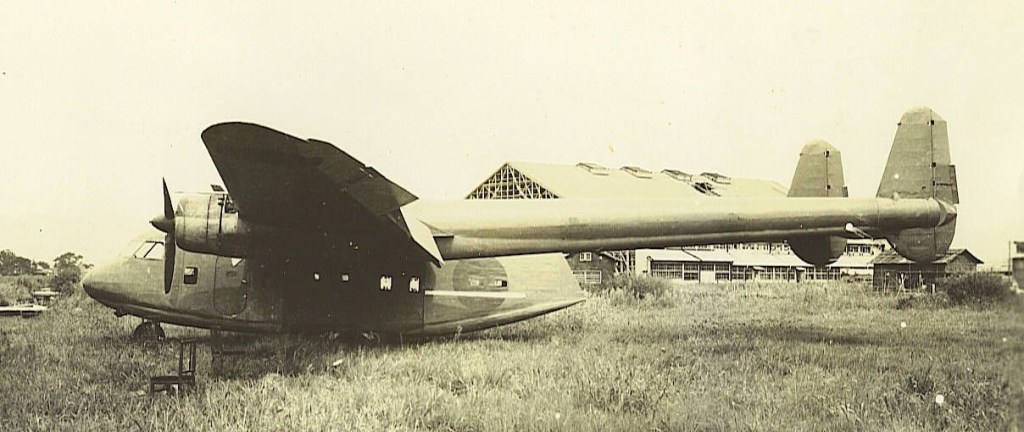
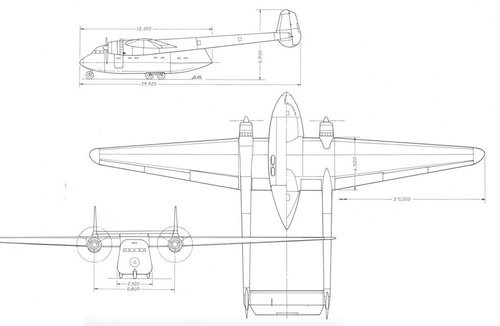
The Ki-105 Ohtori, (‘Phoenix’, allied codename Crane) was a project in the last months of the Pacific War. With Allied attacks on ports and shipping, Japan’s sources of oil to fuel its defensive fighters were drying up. To meet the demand for aviation fuel, the experimental Kokusai Ku-7 transport glider was developed into a powered version for use in transporting fuel from the oilfields still held in Sumatra to Japan.
This required a range of 2500km, and to achieve this the Ki-105’s engines drew on the transported fuel, and used 80% of it to reach Japan (plus what it used to reach Sumatra unloaded). Japan developed a process to make gasoline from pine tree oil, which saw whole forests destroyed to fill the tanks of a few fighter aircraft.
The Ku-7 Manazuru were modified by fitting them with engines, which were designated the Ki-105 Otori (鳳 “Phoenix”). Ku-7-II was the original designation for the Ki-105. Intended for use as fuel transports, only nine, of 300 ordered, were produced before development priorities were shifted elsewhere.
Engines: 2 x Mitsubishi Ha-26-Il, 940 hp (700 kW) Wingspan: 35.00 m / 115 ft 10 in Length: 19.92 m / 65 ft 4 in Height: 5.56 m / 18 ft 3 in Max take-off weight: 12,500 kg / 27,558 lb Normal payload: 3,300 kg / 7,300 lb Cruising speed: 220 km/h / 137 mph / 120 kn Maximum range: 2,500 km / 1,600 mi / 1,300 nmi Crew: 3
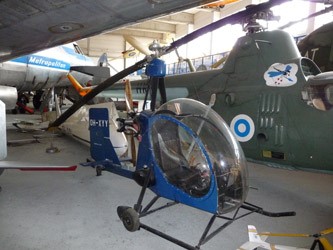
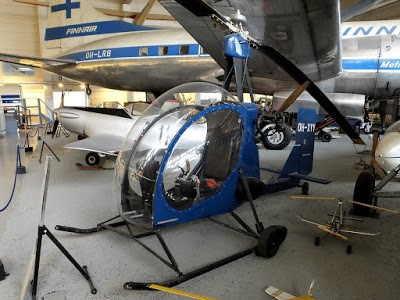
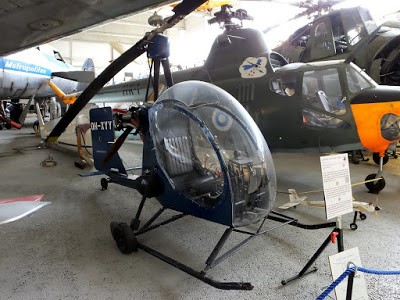
In 1968 the Kokkola Brothers, Kalevi and Seppo, designed the KO-04 Super Upstart autogiro or gyrocopter with rotor-tip thrusters for increased take-off performance. The plane was registered OH-XYY (Serial number 1) during 1969 – 1976, and after that it came in airworthy condition to the Finnish Aviation Museum. The plane was donated to the museum’s collection in the end of the 1990’s.
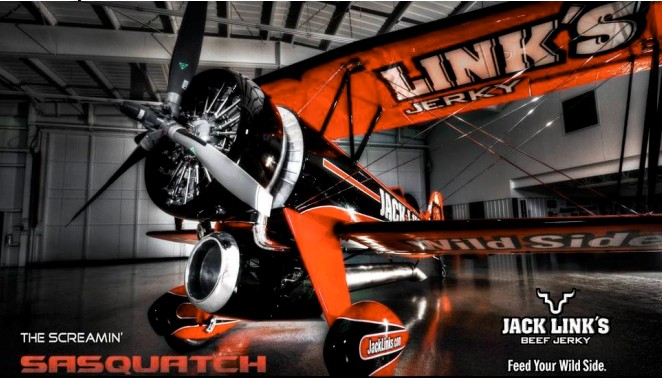
During the opening session of the 2013 ICAS Convention, John Klatt Airshows unveiled “The Screamin’ Sasquatch” Jack Link’s Jet Waco – a highly modified 1929 Taperwing Waco, powered by a Pratt & Whitney 985 Radial Engine and a CJ610 Jet Engine. These dual power-plants provide over 4,500 lb of thrust. Enough to rocket the Screamin’ Sasquatch straight up, into max speed vertical climbs.
Building this airplane over 2013 in collaboration of many others as the worlds second Jet Waco, the Screamin’ Sasquatch is sponsored by Jack Link’s Beef Jerky company.
During 1937 company still offered six types of engine and was working on twin-engined Invader, but in 1938 was in receiver’s hands, though continuing operations under control of a trustee.
The last two LB designations covered seven LB 13s with 525 hp Hornets (redesignated in 1930 as five Y1B 4s and two Y1B 6s) and three LB 14s with 575 hp Hornets (redesignated as Y1B 5s).
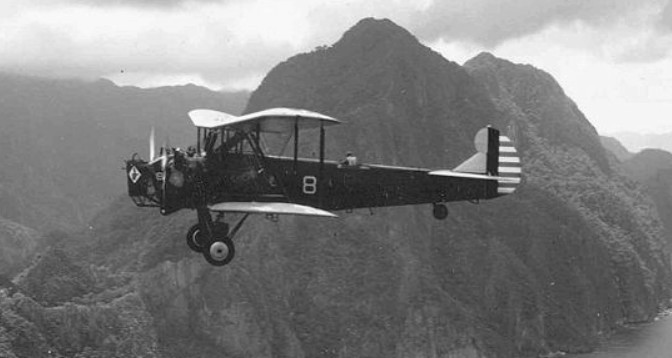
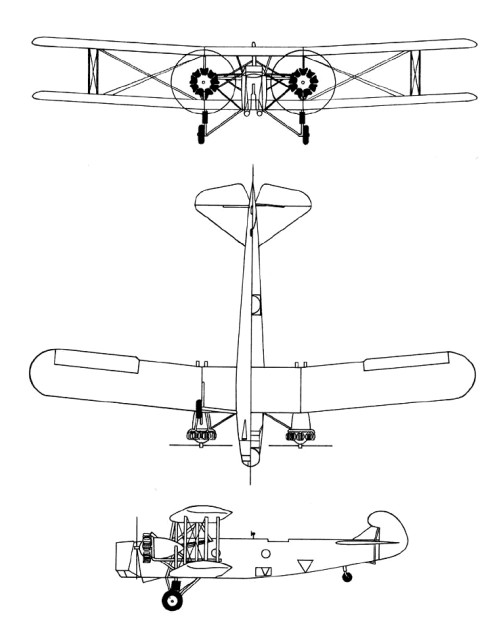
Developed from the Keystone B-3, the Keystone B-4 was a biplane bomber produced for the United States Army Air Corps in 1930. Originally seven were ordered by the United States Army Air Corps as the LB-13 light bomber. They were to be equipped with single vertical tails and were to be powered by a pair of 525 hp Pratt & Whitney GR-1690 radials. Serials were 30-344/353. When the LB- designation was dropped in 1930, the first five planes were redesignated Y1B-4. (The Y1B- designation indicates that funds for the design did not come from the normal annual funds.) Of seven LB-13s ordered, five were completed as Y1B-4s with 575 hp R-1860-7 engines (30-344/348). The Y1B-4 had a slightly better performance than the B-3A because of the more powerful engines, but was otherwise almost exactly the same.
The first B-3A (S/N 30-281) was converted to Y1B-4 configuration with the addition of R-1860-7 radial engines and low pressure tires. Because of more powerful engines, the performance of the Y1B-4 was a slight improvement on the B-3, but the only difference between the two planes was their engines.
On April 28, 1931, the army ordered 25 improved Y1B-4s as the Keystone B-4A. Serials were 32-117/141. This production version was part of the last biplane bomber order made by the Army Air Corps (along with 39 B-6As, identical in all respects except their make of engine), and the B-4As, delivered between January and April 1932, were the last biplane bombers delivered to the Air Corps.
Like the B-3A, the B-4A carried five crew members; two pilots, a bombardier, and a front and rear gunner. The B-4A was externally almost identical to the B-3A which preceded it (as well as to the B-5 and B-6 which followed it).
B-4 was the last of the Keystone biplane bombers ordered by the U.S. Army in late 1931. These aircraft were used primarily as observation and reconnaissance aircraft as early as 1934 when the Martin B-10B went into operational service. Some remained in service into the early 1940s.
In 1932, Keystone produced 25 B 4As (575 hp R 1860 7 Hornets) and 39 B 6As (575 hp R 1820 1 Cyclones). Like the B 3A, these also had single tails; their armament was reduced to three 0.30 in (7.62 mm) guns, and bombload increased to 1130 kg (2500 lb).
A number of the Keystone aircraft became one off flying testbeds for various newly developed geared or direct drive versions of the Hornet and Cyclone engines. This pro¬gramme gave rise to the new designations LB 8, LB 9, LB 10, LB 11, LB 11A and LB¬-12. Most of these were conversions from existing LB 6 or LB 7 bombers. The major production model which follow¬ed was the single tailed LB 10A, powered originally by 525 hp R 1690 3 Hornets, of which 63 were built. These were delivered under the new designation B 3A, the USAAC having adopted a single ‘B’ category for all types of bomber in 1930. Later, 27 of them were refitted with R 1750 3 Cyclones in place of the Hornets and were redesignated B 5A.
LB 10A Engine: 525 hp R 1690 3 Hornet Span: 22.78 m (74 ft 9 in) Length: 14.88 m (48 ft 10 in) Gross weight: 5875 kg (12 952 1 b) Maximum speed: 183 km/h (114 mph).
The Keystone LB series had been characterized by tapered wings, but the XLB 6 of 1927 (converted from the tenth LB 5) introduced constant chord wings with new powerplant (two 525 hp Wright R 1750 1 Cyclone radials) mounted between the wings, and a lengthened fuselage. Thus modified, this became the standard configuration for the remaining Keystone LB types, beginning with 17 production LB 6s and continuing with 18 LB 7s, which were identical except for their 525 hp Pratt & Whitney R 1690 3 Hornet engines.
Prior to the com¬pany reorganization, Huff Daland had com¬pleted a prototype XLB 5, with triple rudders and two 420 hp Liberty engines mounted on the lower wings, and this was adopted as the initial production configuration. Ten similar LB 5s were delivered in 1927 28, followed by 25 twin tailed Keystone LB 5As delivered in 1928. Standard armament consisted of five 0.30 in (7.62 mm) machine guns and the maximum bombload was 910 kg (2000 lb).
LB 5A Span: 20.42 m (67 ft) Length: 13.61 m (44 ft 8 in) Gross weight: 5526 kg (12184 1b) Maximum speed: 172 km/h (107 mph).



 All Aero