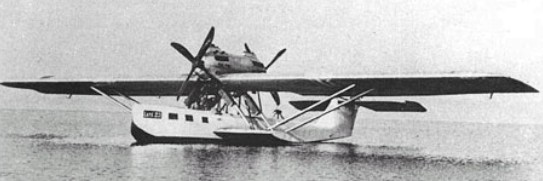
Latécoère Late 23

The Late 23 was an enlarged version of the Late 21 (conv. from Laté 21bis F-AIHP 73/2) for 4-6 pax, powered by Farman engines and spanning 28.00m. With accommodation for eight passengers, it had a maximum take-off weight of 7503kg, but the sole prototype broke up on take-off on 31 December 1927, killing its crew of four.

Engines: 2 x 500hp Farman 12We
Max take-off weight: 7503 kg / 16541 lb
Empty weight: 4627 kg / 10201 lb
Wingspan: 28.00 m / 91 ft 10 in
Length: 16.60 m / 54 ft 6 in
Height: 4.80 m / 15 ft 9 in
Wing area: 123.00 sq.m / 1323.96 sq ft
Max. speed: 178 km/h / 111 mph
Cruise speed: 152 km/h / 94 mph
Ceiling: 3800 m / 12450 ft
Range: 1200 km / 746 miles

Latécoère Late 21

The first flying-boat produced by Latecoere was the Late 21, built for Aéropostale for its Marseille-Algiers postal and passenger routes. The prototype, first flown in 1926, had a parasol wing with lower stub wings which acted as stabilising sponsons. Two 313kW Gnome-Rhone Jupiter 9Ab radials were mounted in tandem on the wing, and the single-step hull terminated in a large single fin and rudder. Open side-by-side pilots’ cockpits were located in line with the wing leading edge and there was cabin accommodation for seven passengers. Successful tests with the Late 21 led to the construction in 1927 of five slightly modified Late 21bis and a single Late 21ter, with Farman 12We engines. The Late 21 bis spanned 22.00m, had a maximum take-off weight of 5730kg and possessed a maximum speed of 172km/h.
The Late 23 was an enlarged version of the Late 21, powered by Farman engines and spanning 28.00m.

Variants:
Laté 21 – 1926 parasol monoplane flying boat, 2 x push-pull 420 hp GR Jupiter 9Ab, 21 m span

Laté 21: prototype N°1/72 F-ESDH, conv. into Laté 21bis F-AIHN

Laté 21bis: production model, different hull length, fins shortened
1 x Laté 21 conv., plus F-AIIE, ‘FH, ‘HN, ‘HP (conv. to Laté 23), ‘HQ

Laté 21ter: 2 x 500 hp Farman 12We W12 engines
F-AIKL N°1/76 ,1927 to Aéropostale, discarded Oct 1931

Engine: 2 x Gnome-Rhone Jupiter 9Ab , 420hp
Max take-off weight: 5730 kg / 12633 lb
Empty weight: 3530 kg / 7782 lb
Wingspan: 22.00 m / 72 ft 2 in
Length: 17.95 m / 58 ft 11 in
Height: 4.85 m / 15 ft 11 in
Wing area: 88.00 sq.m / 947.22 sq ft
Max. speed: 172 km/h / 107 mph
Cruise speed: 144 km/h / 89 mph
Ceiling: 3600 m / 11800 ft
Range:
800 km / 497 miles
Crew: 3
Passengers: 5-7

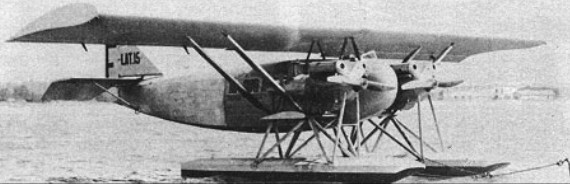
Latécoère Late 15

The first successful Latecoere design was the 1924 Late 15, the prototype being flown in 1924 and being followed by nine series aircraft. The Late 15 had a parasol wing spanning 18.00m and a lower stub wing, landing gear with twin-wheel main units, and power provided by two 230 hp / 194kW Lorraine 8-Bd engines. Accommodation comprised an open cockpit for the pilot, just forward of the wing leading edge, with a cabin for six passengers to the rear.

The Late 15s were operated on the Casablanca-Oran stage of the air routes flown by the Latecoere airline subsidiary. The Laté 15M were 5 a/c equipped with twin floats for the Alicante-Oran run. One Late 15 was temporarily redesignated Late 15H after float landing gear had been installed, but was soon restored to its original landplane configuration. The initial success of the Late 15 was shortlived as the aircraft was soon found to be underpowered.

Engines: 2 x 194kW Lorraine 8-B1
Max take-off weight: 3530 kg / 7782 lb
Empty weight: 1900 kg / 4189 lb
Wingspan: 18.00 m / 59 ft 1 in
Length: 11.85 m / 38 ft 11 in
Height: 3.82 m / 12 ft 6 in
Wing area: 56.48 sq.m / 607.95 sq ft
Max. speed: 180 km/h / 112 mph
Cruise speed: 151 km/h / 94 mph
Ceiling: 4500 m / 14750 ft
Range: 600 km / 373 miles

Lascurain Aura

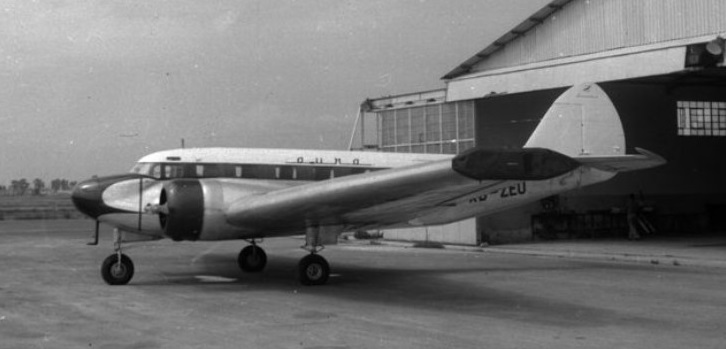
Ángel Lascurain y Osio wanted to manufacture an aircraft designed for the regional airlines of some parts of Mexico that required short airstrips in rugged terrain.

Lascurain determined that regional airlines required a twin-engine plane with fixed landing gear that was affordable, capable of landing at low speed on short runways. The aircraft had to have a high rate of climb to overcome the mountainous areas.

In 1955 Ángel Lascurain went with the architect Juan Cortina Portilla, beginning the design of the aircraft based on the Turkey Buzzard, a bird for which Lascurain had fascination.

The aircraft was a twin-engine monoplane with a mid-wing monocoque fuselage built in duralumin that was capable of holding 12 people in 2 rows of 6 seats plus a bathroom lobby, with the option of 14 seats without the bathroom, plus two pilots. The fuselage was part of the wings through beams. Each wing had between the engine and the fuselage two compartments for luggage of 0.65 cubic meters each, the aircraft had two tanks of fuel of 200 liters each that fed to the Jacobs R-755 engines by gravity and pumps besides two auxiliary tanks located at the outer wing of 50 liters each.

It was the largest aircraft designed and built in Mexico.

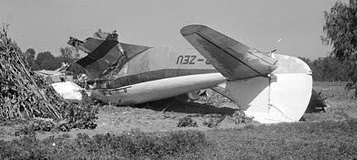
On December 24, 1957, during a routine flight of the Lascurain Aura XB-ZEU at the Mexico City Airport for no apparent reason, both engines of the aircraft were stopped and the pilot attempted to land at the airport. planning for runway 13, they crashed a few meters before the runway, killing the pilot Carlos Castillo Segura and Angel Lascurain.

Powerplants: 2 × Jacobs R-755-A1, 245 hp (183 kW)
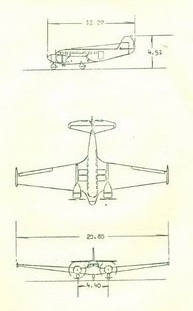
Wingspan: 68 ft 3 in (20.8 m)
Length: 40 ft 1 in (12.22 m)
Height: 14 ft 10 in (4.51 m)
Gross weight: 4,409 lb (2,000 kg)
Fuel capacity: 132 USgal. (500 L) (with reserves)
Maximum speed: 120 kn (140 mph, 220 km/h)
Cruise speed: 107 kn (123 mph, 198 km/h) at 75% thrust
Minimum control speed: 30 kn (35 mph, 56 km/h)
Range: 430 nmi (500 mi, 800 km)
Service ceiling: 26,900 ft (8,200 m)
Rate of climb: 1,033 ft/min (5.25 m/s)
Crew: two
Capacity: 12 or 14 passengers

Lascurain XB-1

The Lascurair XB-1 was a four-seat cabin monoplane built in 1939 as a small charter aircraft but only one prototype was completed.

Of all-wood construction with fabric and plywood covering, power was provided by two 65 hp Continental C65.

This was employed by a small airline in South-East Mexico for several years before becoming privately owned.

Engines: 2 x Continental C65, 65 hp
Max speed: 130 mph
Cruise: 112 mph
Service ceiling: 19,685 ft

Langley Twin / 2-4 / Monoplane / XNL-1

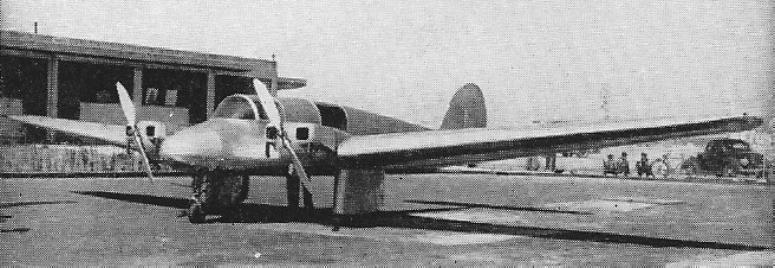
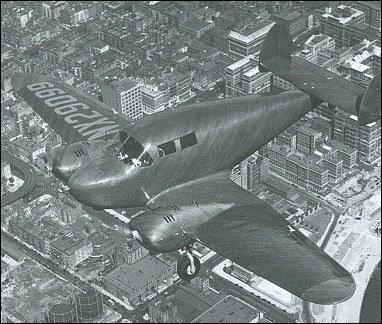
The Langley 2-4, variously described as the Langley Monoplane or Langley Twin was a twin-engine utility aircraft built in the United States and first flown in 1940. Named in honour of Samuel Pierpont Langley, the aircraft was designed by Arthur Draper and Martin Jensen to make use of non-strategic materials in its construction and thereby avoid any shortages brought about by war. Its design was conventional – a low-wing cantilever monoplane with twin tails and tailwheel undercarriage.

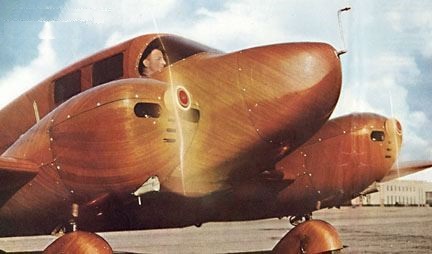
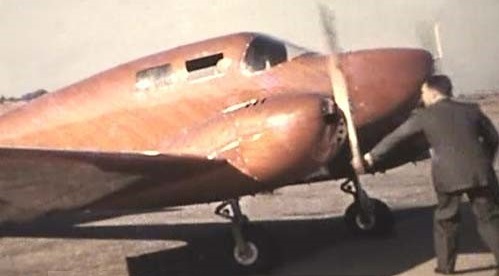
The manufacturing process, however, was unorthodox, and the aircraft’s structures were built up from mahogany veneers bent over moulds and impregnated with vinyl and phenol resins to make them hold their shape. The Vidal plastic-bonded mahogany plywood construction. The use of metal for structural elements – even in fasteners – was thereby almost completely avoided.

Two prototypes were constructed, one with 65 hp (49 kW) engines NX29099, and another (29-90 NC/N51706) with 90 hp (67 kW) engines. The second machine was purchased by the United States Navy and evaluated as the XNL-1 39056, but the navy did not order the type. The Langley was a Type Certificated airplane, achieving ATC number 755.

Once the United States entered the war, it transpired that the resins needed for construction were in far shorter supply than the metal that would have been needed to produce an aircraft by conventional means, and the project was abandoned.

The XNL-1 was sold as war surplus. The Langley was landing in Oklahoma in 1965 and after touch down the brakes locked flipping the airplane over and damaging the fuselage beyond economical repair.

John Pierce and Hurley Boehler had a Stinson 108 fuselage in their hangar without wings, so they decided to purchase the Langley and, following the accident, its wings, engine nacelles, and main undercarriage were mated to a Stinson 108 fuselage to create a one-of-a-kind homebuilt aircraft named the Pierce Arrow N6622A.

Gallery

Specifications:

2-4-65
Engines: 2 × Franklin 4AC, 65 hp (49 kW)
Length: 20 ft 8 in (6.30 m)
Wingspan: 35 ft 2 in (10.72 m)
Maximum take-off weight: 1155 lb
Maximum speed: 135 mph (216 km/h)
Cruising speed: 185 kph
Stall: 50 mph
Range: 400 miles (640 km)
Service ceiling: 13,300 ft (4,100 m)
Take-off distance: 200 ft
Crew: one pilot
Capacity: three passengers
2-4-90 / NL-1
Engines: 2 × Franklin, 90 hp
Wingspan: 35 ft 2 in (10.72 m)
Length: 20 ft 8 in (6.30 m)
Empty weight: 1738 lb
Loaded weight: 2850 lb
Maximum speed: 138 mph
Cruising speed: 117 kph
Stall: 55 mph
Range: 350 miles at 100 mph
ROC: 695 fpm
Crew: one pilot
Capacity: three passengers