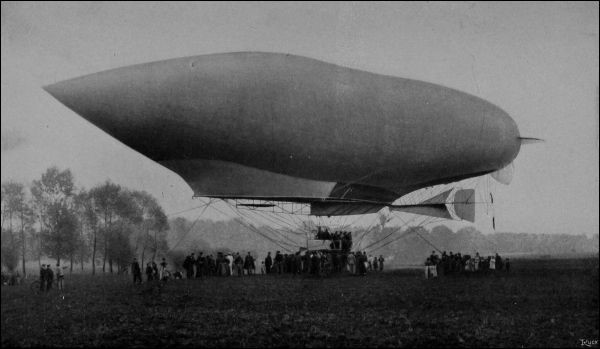
In February 1907, with the Chief Military Engineering Directorate, was created a commission under the chairmanship of N.L. Kirpicheva, which received the task to run the necessary experiments and to build a large dirigible. To the works were drawn the researchers: N.E. Zhukovsky, A.N. Krylov, V.V. Kuznetsov, E.S. Fedorov, K.A. Antonov, D.M. Smirnov, and others. The project they developed was under the direct management of N.I. Utesheva. Construction was somewhat drawn out, and only on July 30, 1910, the airship “Krechet” performed its first flight. It was the largest airship at the time.
The Patrie employed a non-combustible shield over the motor, for the protection of the envelope: its steering wheel was in front and the motor about in the middle of the car. The gasoline tank was under the car, compressed air being used to force the fuel up to the motor, which discharged its exhaust downward at the rear through a spark arrester.
The semi-rigid Lebaudy Patrie was used for training by the Russian Empire as the Krechet (Gerfalcon).
The Patrie was destroyed by a storm.
Engines: 2 x 84 h.p Volume: 6000 cu.m Length: 70 m Diameter: 11,4 m
LearAvia decided to increase the gross weight of its yet to be built Lear Fan 2100 turboprop from 6,000 to 7,200 pounds. This change will add only 24 extra pounds of structural material. The extra load carry¬ing capacity will cut range, speed and single engine ceiling slightly.
A successful first flight was made on 1 January 1981 by the first prototype. Powered by two pusher Pratt & Whitney PT6B-35F, two more prototypes were under construction at Reno, plus a static test example. The Lear Fan spent all of 1981 in flight tests after a New Year’s Day first flight. The Lear Fan cabin has been stretched and much design effort has been concentrated on the single pusher propeller; however, Learavia still hoped to have the non-metal airplane certificated by the end of 1982. Ownership passed 1982 to Fan Holdings Inc. of U.S.A., but with production in Northern Ireland. Production moved to U.S.A. 1983 but program halted 1985.
Engines: 2 x 850 hp P&W Seats: 7. Empty Wt: 4100 lbs. Gross wt: 7400 lbs. Useful load: 3300 lb Max Cruise: 400 mph Max range: 1800 sm
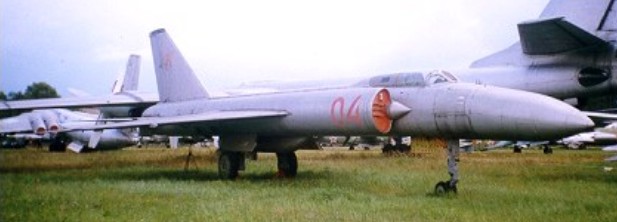
Planned in response to a January 1954 requirement for a super-interceptor able to cruise long distances at high altitudes with missiles able to provide a ‘snap-down’ attack capability against targets at lower altitudes, the La-250 was known unofficially as the Anaconda.
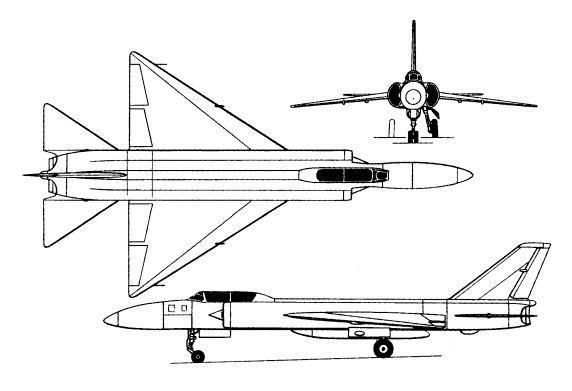
Featuring a 57 degree delta wing, slab delta tailplane, and a fuselage of near-constant cross section, the La-250 was powered by two Lyulka AL-7F turbojets each rated at 6500kg which were later to be fitted with afterburners boosting thrust to 9000kg. All control surfaces were fully powered with duplex systems and without manual reversion.
Intended armament was a pair of K-15 missiles that rode the beam of the Uragan (Hurricane) radar, which had a range of 30km. The missiles were cancelled and the radar never made it into an aircraft before the development was cut short.
Although the La-250 was intended as a single-seater in operational form, prototypes were completed as two-seaters to provide accommodation for a test observer, and the first of three flying examples was completed in July 1956.
The first flight was attempted on 16 July, but the test pilot, A G Kochetkov, encountered an unexpectedly rapid roll moment and lost control. Extensive testing of a systems rig followed before acceptable characteristics were attained and flight testing could be resumed. Investigation revealed a severe roll-coupling problem derived from the combination of a long heavy fuselage and small wings. Enormous effort went into the creation of a new electronic flight-control system, and a successful first flight was recorded in spring 1957.
The third La-250 had its nose lowered by six degrees to give better visibility on landing, the poor view forward having been determined as a factor in the second crash.
The second aircraft was lost in a landing accident on 28 November 1957, and the third aircraft also suffered a landing accident on 8 September 1958.
The flight test programme suffered continual delays as a result of poor engine reliability and the full testing had not been completed when the programme was cancelled just before Semyon Lavochkin’s death in 1960.
Max take-off weight: 30000 kg / 66139 lb Empty weight: 15000 kg / 33070 lb Wingspan: 13.90 m / 45 ft 7 in Length: 25.60 m / 83 ft 12 in Wing area: 80.0 sq.m / 861.11 sq ft Max. speed: 2000 km/h / 1243 mph Ceiling: 18000 m / 59050 ft Range: 2000 km / 1243 miles
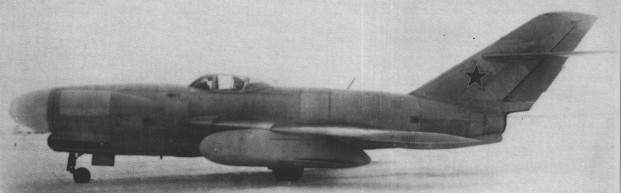
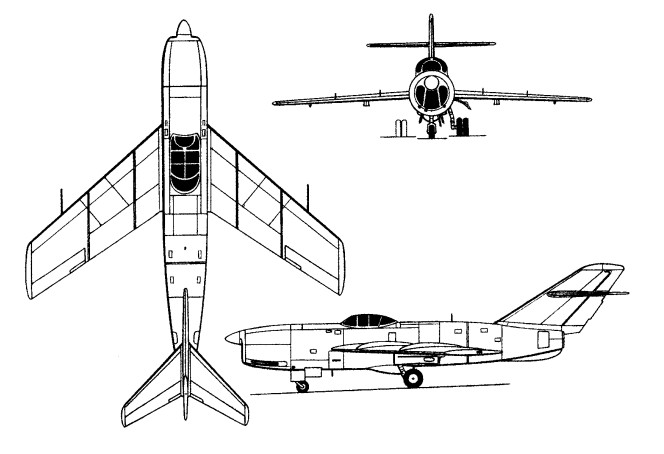
In January 1948 a requirement was formulated for a two-seat twin-engined all-weather interceptor.
The La-200 was powered by two examples of an engine derived from the RD-45, the 5004-lb (2270-kg) thrust Klimov VK-1. These were located in a tandem arrangement, with the forward engine exhausting from the bottom of the central fuselage via an S-shaped jetpipe and the aft engine trough a nozzle at the tail, and were aspirated via an annular nose inlet round the centre body that accommodated the antenna of the search radar. The flying surfaces were swept at 40 degrees, and the crew of two was accommodated side-by-side under a large canopy.
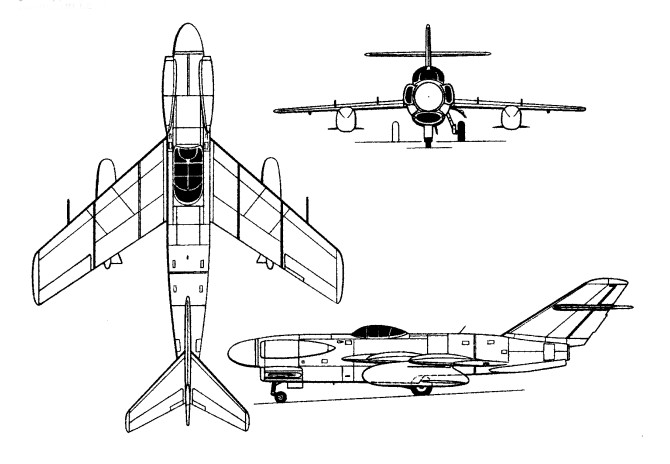
Two were built, each powered by two 2700kg Klimov VK-1 turbojets mounted in tandem with the exhaust of the foremost engine ducted beneath the fuselage. The side-by-side seating for the two crew members was retained, and the centre and aft fuselage were comparatively unchanged, but the forward fuselage was entirely redesigned. The prototypes differed one from the other primarily in the location of the Torii (Thorium) AI radar, the first prototype having a conical intake centrebody and the second prototype having a radome underslung on the upper intake lip. Armament consisted of three 37mm N-37 cannon, one to port and two to starboard. The wing, sweptback 40 degrees at the leading edge, was largely occupied by integral tankage and two large underwing slipper-type auxiliary tanks could boost maximum range from 1165 to 2000km.
The first of two prototypes was flown on 9 September 1949, and the first and second flight test phases were completed by February and October 1950 respectively, Mach 0.946 being attained in level flight and Mach1.01 in a dive.
The range was 1243 miles (2000 km), but in November 1950 a range of 2175 miles (3500 km) was demanded, together with longer-range radar. The design was recast as the La¬200B with greater fuel capacity and a larger antenna for the more powerful radar. This led to a redesign of the nose. The extreme nose was formed by a large dielectric radome of more than 1.0m diameter. The early single-antenna Torii-A radar was replaced by a large RP-6 Sokol (Falcon) radar with three different scan modes, and twin ventral strakes supplanted the single strake of the second La-200. The additional fuel required to achieve the specified endurance was provided by increasing the capacity of each underwing tank from 1120 l to 2650 l. Two 3100kg Klimov VK-1 turbojets were installed, the forward engine’s air being supplied through a chin intake and that for the aft engine being provided by “elephant ear” type intakes on the sides of the extended nose. Armament remained three 37mm cannon.
The La-200B first flew on 3 July 1952, and while range was improved considerably, overall performance was reduced. A mock-up of the Sokol radar initially being fitted, tests with the radar installed commencing on 10 September. The second prototype joined the flight programme early 1951, the repositioned radar being of the improved Torii-A type, ammunition capacity being increased, a ventral keel being introduced and normal loaded weight rising to 10580kg. With the final NII VVS test phase completed in April 1952, a recommendation was made that series production of the La-200 should be initiated.
An extensive test programme was conducted, but, in the event, the competitive Yak-120 was selected to fulfil the requirement. The La-200B was beaten to a production order by the Yak-25.
La-200 (1st prototype) Max take-off weight: 10375 kg / 22873 lb Empty weight: 7090 kg / 15631 lb Wingspan: 12.92 m / 42 ft 5 in Length: 16.59 m / 54 ft 5 in Wing area: 40.18 sq.m / 432.49 sq ft Max. speed: 1090 km/h / 677 mph Range: 1165 km / 724 miles
La-200B Max take-off weight: 12700 kg / 27999 lb Empty weight: 8810 kg / 19423 lb Wing area: 40.00 sq.m / 430.56 sq ft Max. speed: 1030 km/h / 640 mph Range: 2800 km / 1740 miles
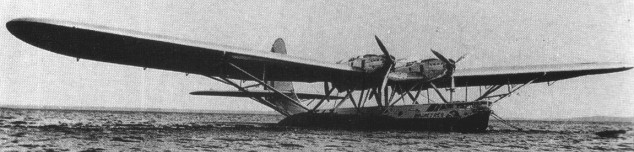
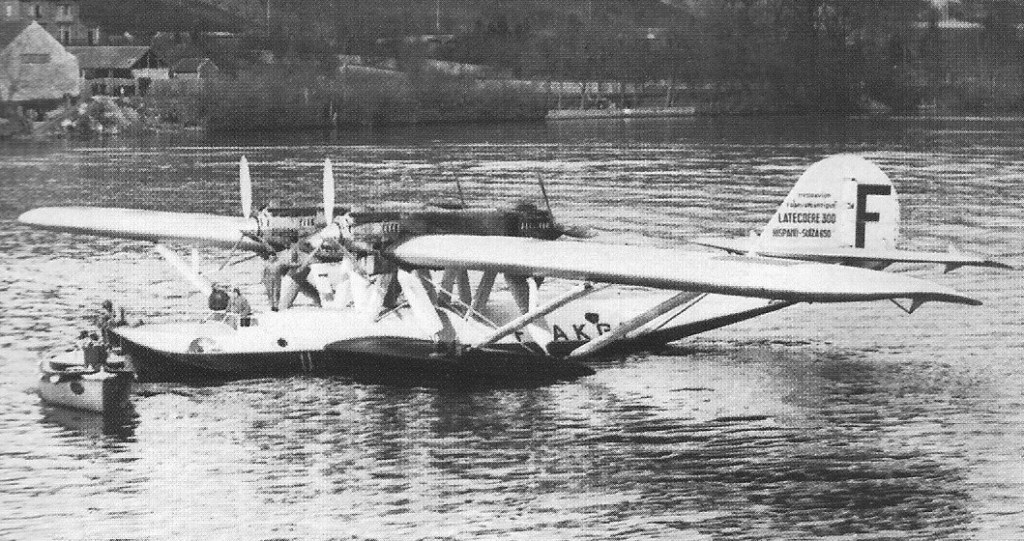
The Latécoère 300.01 was the company’s first four-engined flying-boat and flew originally in 1931, but sank in the Etang de Berre, near Marseilles, later that year. When salvaged it was re¬built and named Croix du Sud (First flight 7 October 1932) with four 650 hp / 484.4kW Hispano-Suiza 12NBr water-cooled engines in tandem pairs. On 31 December 1933 Croix du Sud set up a new international class record by flying the 2,285 miles (3,679 km) from Berre to St Louis (Senegal) in just under 24 hours.
It operated the Air France South Atlantic mail service between Dakar, Senegal and Natal, Brazil. It completed 23 missions before being lost at sea on December 7, 1936. The pilot was the famous French aviator Jean Mermoz.
Jean Mermoz’s Croix du Sud. Latécoère 300 in 1936
Three improved Latécoère 301 aircraft with 485-kW (650-hp) Hispano-Suiza l2Nbr engines were built during 1935-6, incorporating changes made to the Late 300 in 1935, including increased wing dihedral and enlarged tail surfaces. The all-metal two-step hull accommodated a four-man crew with sleeping accommodation, mail load and most of the fuel.
The first of the 301s was lost, the remaining two were used in South Atlantic service until 1939. In 1939 the last remaining 301 was converted to military service, joining the 302s in patrol duties in West Africa.
The basic type’s long-range performance attracted the attention of the French Navy, and in 1936 the French naval air service received three examples of the Latecoere 302, a fully navalised version of the Latécoère 301, with 930-hp / 693kW Hispano-Suiza 12Ydrs engines, between 1935 and 1936. They had machine-gun posts in bow and two beam positions, as well as two in the engine nacelles. Bomb load was 300kg. The aircraft supported a crew of four and included sleeping accommodations. Fuel and payload were stored inside the hull.
Late 302 equipped Escadrille E4 at Berre, joined by the last civil but militarised Late 301 in August 1939. These were operated in the patrol role, operating from West Africa together with a single navalised Latécoère 301 until scrapped in 1941.
Laté 300 – 1931 flying boat for Aéropostale (Dakar-Natal), 4 x 650 hp HS.12Ner Laté 300-01: aground Berre Dec 1931, rebuilt 1932 as Croix-du-Sud Laté 301: 1934-35 version for Air France, 3 built (2 later to military) Laté 301 to Aéronavale: 2/1017 for spares, 3/1018 to part Laté 302 std. Laté 302: 1936 version for Aéronavale, 4 x HS.12Ydrs, 3 built Laté 302 crew of 8 (inst. of 4), 3 x Darne MGs, 4 x 75 kg bombs
Variants:
Laté 300 Mailplane with Hispano-Suiza 12Nbr engines, one built.
Laté 301 Mailplane with Hispano-Suiza 12Nbr engines, three built.
Laté 302 Maritime reconnaissance aircraft with Hispano-Suiza 12Ydrs engines, three built.
Latécoère 300.1 Engines: 4 x Hispano-¬Suiza 12 Nbr, 750 hp, Propeller: three blade. Wing span: 145 ft 0.25in (44,20 m). Length: 84 ft 9in (25.83 m). Wing area: 2.798.6 sq.ft (260 sq.m). Gross weight: 50,706 lb (23,000 kg). Max speed: 130 mph (210 kph) at S/L. Typical range: 2,985 miles (4,800 km). Crew: 4. Pas¬senger/mail payload: 2,910 lb (1,320kg).
Latécoère 301
Latécoère 302 Engines: 4 × Hispano-Suiza 12Ydrs2, 694 kW (930 hp) each Length: 26.16 m (85 ft 9.5 in) Wingspan: 44.01 m (144 ft 4.25 in) Height: 7.98 m (26 ft 2⅛ in) Wing area: 258 sq.m (2,755.6 sq.ft) Empty weight: 14,340 kg (31,548 lb) Loaded weight: 24,050 kg (52,911 lb) Maximum speed: 240 km/h, 130 knots, 149 mph at 2,000 m (6,560 ft) Cruise speed: 185 km/h (xx100 knots (190 km/h), 115 mph (185 km/h)) Range: 3,300 km (1,783 nm, 2,050 mi (3,300 km)) Range w/max.fuel: 4800 km / 2983 miles Service ceiling: 5,000 m (xx16,400 ft (5,000 m)) Wing loading: 93.2 kg/sq.m (19.2 lb/sq.ft) Power/mass: 0.11 kW/kg (0.070 hp/lb) Endurance: 20 hours at 150 km/h (93 mph) Climb to 2,000 m (6,560 ft): 12.5 min Armament Guns: 1 7.5 mm (0.3 in) Darne machine gun in bow, 2 firing through beam windows Bombs: 4 x 75 kg (165 lb) bombs Crew: 8 Armament: 5 or 7×7.5-mm (0.295-in) Darne machine-guns plus provision for up to 300 kg (661 lb) of bombs under wing. Crew: 4
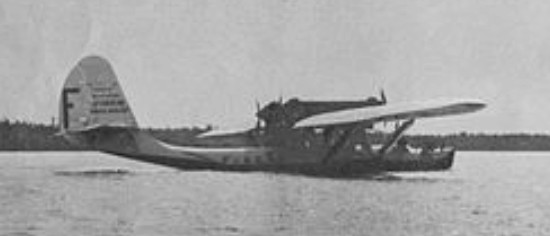
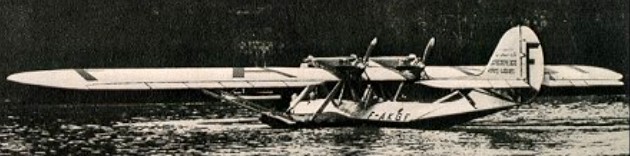
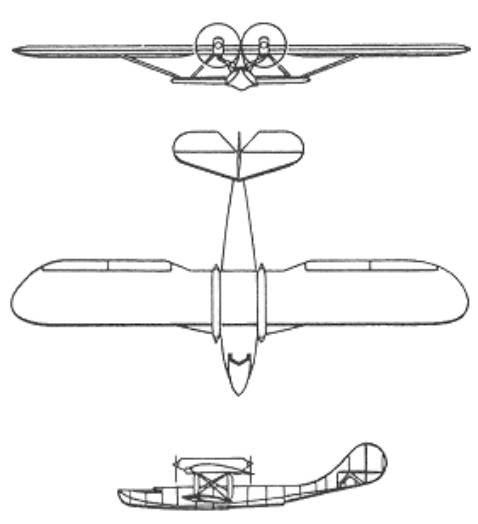
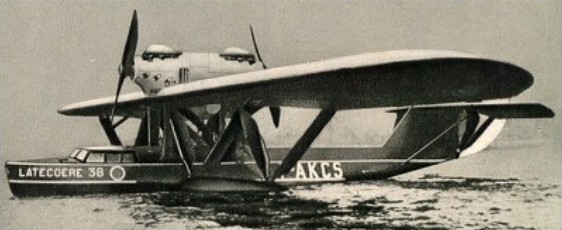
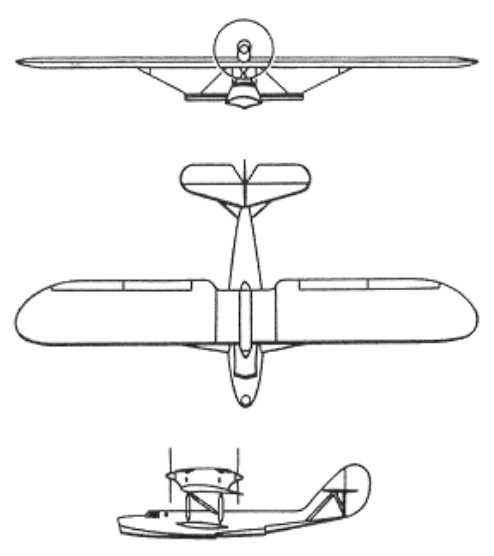
The Laté 38 Series were 1929 postal parasol flying boat, 2 x push/pull engines.
Laté 38-01: 1930 prototype, trialled at St Raphaël (Nov 1930) F-AKCS aka Laté 38-0-01 or Laté 380-01, first flight 14 Sept 1930 Laté 380bis: Laté 38-01 mod. for Aéronavale, crashed 16 Mar 1933 Laté 380bis modifications incl. lengthened hull and larger tailplane Laté 38-02: 1931 prototype, F-ALRP to Aéropostale, 1934 to Air France Laté 38-1: 1934 recce flying boat, 2 x 650 hp HS.12Nbr, 3 built aka Laté 381, as Laté 380bis but hull widened and further lengthened
Engine: 2 x HS 12 Ydrs 2, 685kW Max take-off weight: 9475 kg / 20889 lb Empty weight: 5475 kg / 12070 lb Wingspan: 31.4 m / 103 ft 0 in Length: 17.2 m / 56 ft 5 in Wing area: 130.0 sq.m / 1399.31 sq ft Max. speed: 209 km/h / 130 mph Ceiling: 4700 m / 15400 ft Range w/max.fuel: 4000 km / 2486 miles Crew: 3

 All Aero