A three-seat monoplane bomber prototype of 1938, powered by 2 x 430 hp 7-cyl Avia Rk-17 radials (optional 2 x Gnome-Rhône 14M).
2 Engines
Letov Š.11
A twin-engined commercial monoplane possibly not completed.
Letord Let. 1 / Let.2 / Let.3 / Let.4 / Let.5 / Let.6 / Let.7
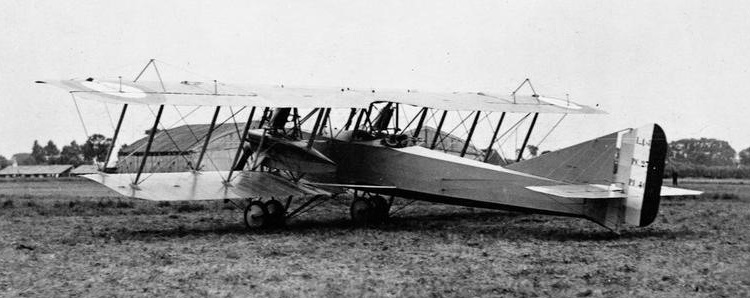
In early 1916 the contemporary reconnaissance aircraft of the Aéronautique Militaire, such as the Caudron G.6, Morane-Saulnier T and Salmson-Moineau SM.1 were proving to be less than sparkling in operations and testing. To provide a suitable replacement The STAé, its Director Colonel Dorand and Établissements Letord, formulated the A3 specification and co-operated in the design of the only respondent, the Letord Let.1.
In 1916, the Letord “Let”, in prototype form, recorded its first flight and this three-man, twin-engined platform was developed along the lines extended-range reconnaissance. To cover the distances required of the type, a multi-engine arrangement was used and this fitted to a relatively large airframe.
The aircraft relied on a traditional biplane wing arrangement for lift and control and the crew required to man its various systems numbered three. “Negative wing stagger” was present in the over-under wing arrangement where the lower planes were set well-forward of the upper sections, making the parallel struts angle rearwards.
Power was from 2 x engines of various makes and models throughout the service life of the aircraft and each was charged with driving two-bladed propellers. The engines were held outboard of the fuselage and atop the lower wing assembly. Each of the three crewmen sat in separate open-air cockpits so communication between them was limited. The undercarriage showcased double-wheeled main legs and a tail skid though a nose leg was usually added to prevent “nose-over” accidents when ground-running (common to larger aircraft of the war). The tail unit was marked by a single vertical fin and low-mounted horizontal planes.
Design of this aircraft was attributed to Emile Dorand.
The Letord A3 reconnaissance bomber family, the Let.1 to Let.7, were essentially similar biplanes with, variously unequal span or equal span wings, with prominent and characteristic negative stagger on their wings, powered by two tractor engines in nacelles mounted short struts or directly on the lower wings and had a fixed tailskid undercarriage. Some aircraft were equipped with a strut-mounted nosewheel to protect the aircraft and its crew from “nosing-over” accidents while landing. The pilot sat in an open cockpit under the upper wing trailing edge, with a gunner in an open position immediately aft, and a third crew-member in an open position in the nose where he could act as gunner, observer, and bomb-aimer.
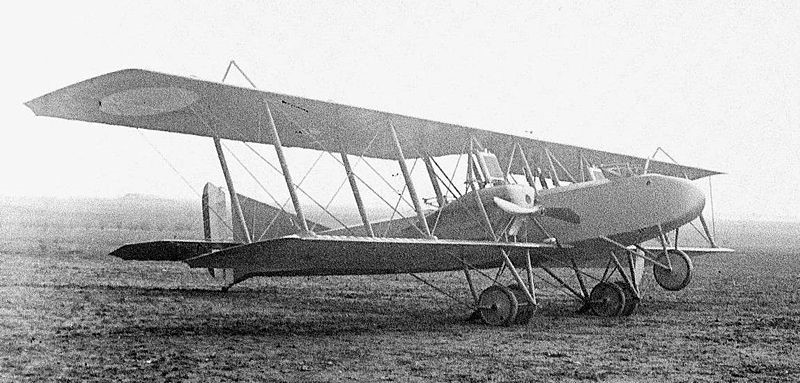
Aircraft were completed, variously, with equal span 4-bay wings or unequal span 3-bay wings with longer span upper wings braced by an A-frame king-post and wires. All the Letord reconnaissance bombers shared similar plywood covered wooden structure fuselages and wooden structure wings and conventional tail-unit.
Of the 250-300 built, the Letord Let.5 was probably the most numerous of a family of 3-seat reconnaissance bombers, designed and built in France from 1916, originally to an A3 (reconnaissance aircraft 3-seat) specification from the STAé (Service Technique d’Aéronautique).
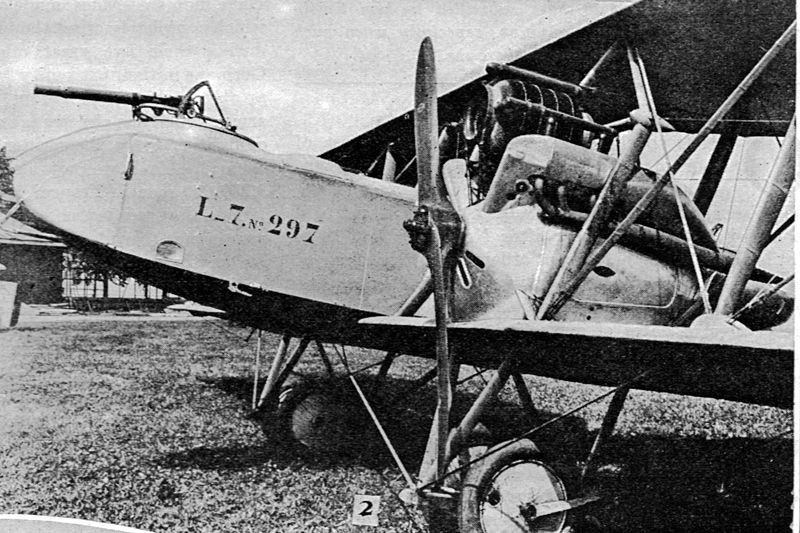
The Letord reconnaissance bombers saw widespread service throughout the Aéronautique Militaire, from mid-1917, with 121 operational on the Western Front by November 1917. Most were no longer in front-line use by the Armistice in November 1918.
Variants:
A Letord Let.1
Let.1 A.3
initial reconnaissance version
three bay wing.
Engines: two 150 hp (110 kW) Hispano-Suiza 8A
Let.2 A.3
reconnaissance aircraft similar to Let.1
three bay wing.
Engines: two 200 hp (150 kW) Hispano-Suiza 8Ba
Let.3 Bn.3
night bomber
four bay wing.
Engines: two 200 hp (150 kW) Hispano-Suiza 8Ba
Let.4 A.3
reconnaissance aircraft also used as a bomber
three bay wing.
Engines: two 160 hp (120 kW) Lorraine-Dietrich 8A
Let.5 A.3
reconnaissance aircraft
three bay wing and missing the nosewheel.
Engines: two 240 hp (180 kW) Lorraine-Dietrich 8B
Propeller: 2-bladed wooden fixed-pitch
Wingspan: 18.06 m (59 ft 3 in)
Wing area: 62.3 sq.m (671 sq ft)
Length: 11.17 m (36 ft 8 in)
Height: 3.66 m (12 ft 0 in)
Empty weight: 1,660 kg (3,660 lb)
Gross weight: 2,445 kg (5,390 lb)
Maximum speed: 170 km/h (110 mph, 92 kn) at 2,000 m (6,600 ft)
Maximum speed: 152 km/h (94 mph; 82 kn) at 3,000 m (9,800 ft)
Range: 455 km (283 mi, 246 nmi)
Endurance: 3 hours
Service ceiling: 4,900 m (16,100 ft)
Time to altitude: 2,000 m (6,600 ft) in 10 minutes
Time to altitude: 4,000 m (13,000 ft) in 20 minutes
Armament: Up to 4 7.70 mm (0.303 in) Lewis machine-guns on single or double T.O.3 flexible mounts.
Bombload: 130–150 kg (290–330 lb)
Crew: 3
Let.6 Ca.3
fighter based on the Let.3
four bay wing.
Engines: two 220 hp (160 kW) Hispano-Suiza 8Be
Armament: 37 mm (1.5 in) cannon
Let.7 Bn.3
night bomber
four bay wing of increased span.
Engines: two 275 hp (205 kW) Lorraine-Dietrich 8B engines
Let L.610
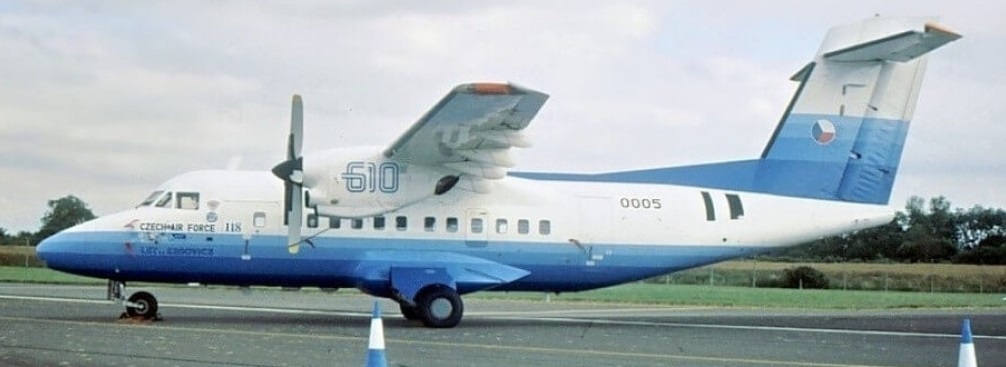
The development of the 40-seater L-610 started in 1985 at Let Kunovice Aircraft Industries in former Czechoslovakia. The Czech plane maker wanted to develop a bigger successor to its popular L-410.
After the collapse of the Soviet Union, Let tried to adapt its new airplane to the global market by westernizing its avionics. Eight prototypes were made and the forty-passenger L 610 regional airliner first flew December 1988 and L 610G version followed in December 1992.
But due to a lack of funding, the program was eventually abandoned in 2006 and Let went on to focus on the L-410 and on gliders.
In 2008, 51% of Let’s shares were acquired by the Ural Mining and Metallurgical Company (UGMK), with the prospect of developing the market of Russian regional aircraft. In 2018, Deputy Minister of Industry and Trade of the Russian Federation Oleg Bocharov announced the decision of acquiring the documentation for the L-610 in order to continue its development.
While the development of the new L-610 is carried out on the basis of the existing scientific and technical work, it should differ from the original prototype. “The maximum take-off mass, cargo capacity, flight range and speed of the aircraft will increase, moreover, even the fuselage of the aircraft will be presented in a more modern design,” claimed the director-general of UZGA Vadim Badeha. The type certificate is expected for 2023, with mass production commencing the same year.
Thirteen years after it was abandoned, Polar Airlines and the Ural Civil Aviation Plant (UZGA) brought back the L-610 to life with an order for 10 of the regional aircraft, to be delivered between 2023 and 2025.
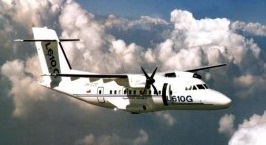
With 10 aircraft ordered at the MAKS 2019 air show, the L-610 should replace the An-24 and An-26 within Russian Polar Airlines’ fleet. The partially state-owned regional carrier, subsidiary of Yakutia Airlines, already operates three L-410s.
Let L.410 Turbolet / L.420

The PT-6A-powered prototype for the L.410 series first flew on April 16, 1969. Production versions include the L.410A, AF, M and UVP, which have Walter M601 turboprops.
Let L.410 Turbolet / L.420 Article
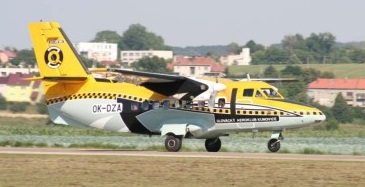
The L-410UVP-E production version succeeded earlier variants and entered service in 1986. Its main changes included a modified interior to take accommodation to 19 passengers, a reinforced wing for optional streamlined tip tanks (boosting range by 40 per cent) and modifications to the 750 shp (559 kW) Motorlet Walter M601 E turboprops with five-blade propellers.
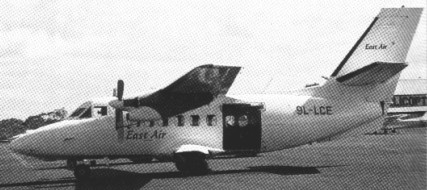
The L.410UVP-E version features a strengthened wing, and seating for four more passengers, taking total accommodation to 19. Military utility versions exploiting the L.410’s rough-field capability are available for a range of duties, including transport, medevac, para-dropping, and training.
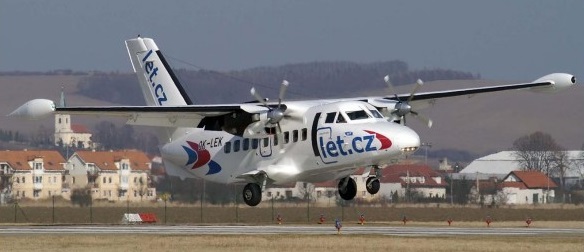
More than 860 L-410s were in civil and military use by 1990.
A higher-powered L 420 variant first flew November 1993.
1978 Let 410 Turbolet
Engine : 2 x Walter M 601 A, 537 shp
Length: 44.652 ft / 13.61 m
Wingspan : 57.349 ft / 17.48 m
Wing area : 353.059 sq.ft / 32.8 sq.m
Max take off weight : 12568.5 lb / 5700.0 kg
Weight empty : 8202.6 lb / 3720.0 kg
Max. speed : 205 kt / 380 km/h
Cruising speed : 194 kt / 360 km/h
Initial climb rate : 1476.38 ft/min / 7.5 m/s
Service ceiling : 19685 ft / 6000 m
Wing load : 35.67 lb/sq.ft / 174.0 kg/sq.m
Range : 626 nm / 1160 km
Crew : 2
Payload : 17 Pax
L-410 UVP-E Turbolet
Engine: 2 x Walter M601D.
Installed pwr: 1120 kW.
Span: 20 m.
Length: 14.5 m.
Wing area: 35.2 sq.m.
Empty wt: 3970 kg.
MTOW: 6400 kg.
Payload: 1615 kg.
Cruise speed: 375 kph.
Initial ROC: 430 m / min.
Ceiling: 4200 m.
T/O run: 425 m.
Ldg run: 320 m.
Fuel internal: 1290 lt.
Range/payload: 1380 km with 900 kg.
Capacity: 19 pax.
Let L-200 Morava / L-201 / L-200 / Ceskoslovenske Zavody A Letecke, Narodni Podnik L-200 Morava
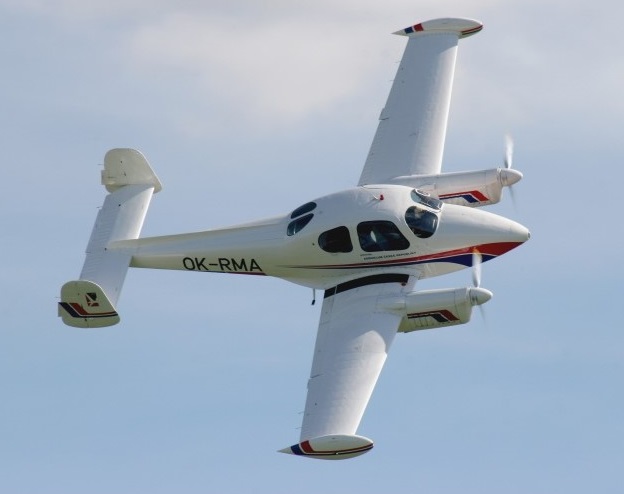
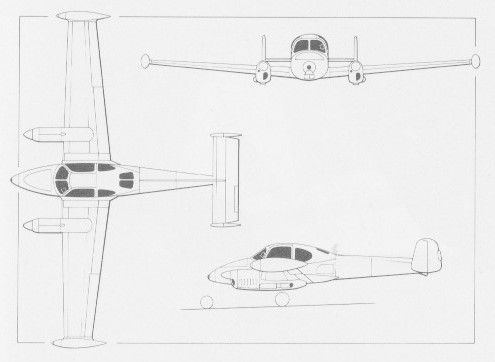
The Let L-200 Morava light twin-engine transport was preceded in production at the Let factory by the license-built Aero Ae 45. In 1955 the newly created design team led by Ladislav Smrcek of the Czechoslovak State Aircraft Factory decided to proceed with a proprietary design for a more modern twin with seating capacity of five and powered by a pair of then new 210 hp Avia M 337 engines, but as they were not yet available, the prototype made do with the less powerful Walter Minor 6-III engines of 160 hp each. While maintaining similar characteristics of western twin engine aircraft of the time, updated features of the Morava included twin tails, standard thermal wing de-icing equipment and inverted inline engines.
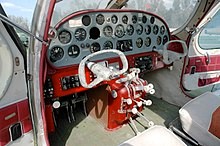
Three prototypes were built. The first, designated XL-200 (OK-LNA) made its maiden flight on 9 April 1957. It was followed in flight testing by the second prototype (OK-LNB) while the third was used for static testing. The aircraft sported clean, elegant lines. During the same year the factory built a run of 10 pre-production L-200s, one of these aircraft undergoing government flight testing in 1958. The program was successful, and the airplane was ordered into full-scale production. One L-200 was converted into a prototype of the M-337-powered production model L-200A. This aircraft incorporated minor changes, consisting mostly of new two-blade V-410 propellers, a cockpit lowered by 43mm, a modified tailfin design as well as longer engine nacelles. It was completed in 1959 and shown at the Paris Air Show in July of that year. The aircraft underwent government trials in the fall of 1959, having been fitted with M-337 engines. The trials once again proved successful and were completed the following July. The first production L-200A took to the skies in February 1960.
L-200B and C models were not produced. The second production variant was the L-200D, modified according to Soviet Aeroflot demands. It was fitted with new three-blade propellers V-506 of a smaller diameter and some minor improvements, such as dust filters. It also received more comprehensive navigation equipment. The prototype (OK-NIA) was converted from the L-200A prototype in 1960 and tested in 1961-1963.
In all, 367 L-200s were built by 1964, including 3 prototypes and 197 L-200D (eight L-200A and the L-200A prototype were converted to L-200D as well). 5 aircraft were manufactured from parts by Libis in Yugoslavia.
A further development was 6-place L-210 (also known as L-201; registration OK-PHB), converted from one L-200D in 1966, powered with 245 hp M-338 engines, but it was not ordered by the airlines and was not produced.
The pre-series aircraft L-200 were distributed for testing: 5 to the Czechoslovak airline Agrolet (OK-MEA – MEE), 2 to the Czechoslovak Air Force and 2 to Aeroflot in the USSR.
Aeroflot, who used them as air taxis, was the largest single user of Moravas – 68 L-200A and 113 L-200D, final deliveries taking place in 1966. In the 1970s however, the Soviet Union sold or withdrew its aircraft from use, in favour of indigenous designs.
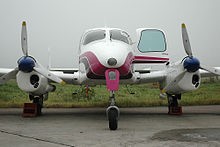
About 100 Moravas were used for civilian purposes in Czechoslovakia by aeroclubs Svazarm (about 50), the airlines Agrolet (from 1969 Slov-Air) and Czechoslovak Airlines (45) and by businesses, such as Škoda. 20 were used by the Czechoslovak Air Force (16 of which L-200A), among others, for training. About 50 were sold to Poland, where they were used mostly as air ambulances and in aeroclubs. Some other countries had smaller fleets of Moravas.
During the Cold War Era, not many light aircraft were exported from behind the Iron Curtain. 144 L-200A were exported to 15 countries. They were used in Australia, Argentina, Cuba, Hungary, West Germany, Great Britain, Egypt, India, Italy, Poland, South Africa, USSR and Yugoslavia. L-200D were exported to Bulgaria, Cuba, Egypt, France, Hungary, GDR, Great Britain, India, Indonesia, Italy, Poland, Switzerland, Sweden, USSR and Yugoslavia.
Small number of Moravas are still used (as of 2008), mainly in Czech Republic, Slovakia Poland and Ukraine.
L-200
Engines: 2 x Walter Minor 6-III, 160 hp
L 200A
Number built: 160
L 200D
Engines: 2 × Walter M337, 160 kW (210 hp) each
Propellers: 3-bladed Type V506 constant-speed, 1.75 m (5 ft 9 in) diameter
Wingspan: 12.31 m (40 ft 5 in)
Wing area: 17.28 m2 (186.0 sq ft)
Length: 8.61 m (28 ft 3 in)
Height: 2.25 m (7 ft 5 in)
Empty weight: 1,330 kg (2,932 lb)
Max takeoff weight: 1,950 kg (4,299 lb)
Fuel capacity: 420 L (110 US gal; 92 imp gal)
Maximum speed: 290 km/h (180 mph, 160 kn) at sea level
Cruise speed: 256 km/h (159 mph, 138 kn) at 2,500 m (8,200 ft) (econ cruise)
Range: 1,710 km (1,060 mi, 920 nmi)
Service ceiling: 5,700 m (18,700 ft)
Rate of climb: 6.4 m/s (1,260 ft/min)
Takeoff distance to 15 m (50 ft): 390 m (1,280 ft)
Landing distance from 15 m (50 ft): 480 m (1,570 ft)
Baggage capacity: 297 lb / 135 kg
Crew: 1
Capacity: 4 passengers
Legrand and Guillaume 1913 tractor/pusher
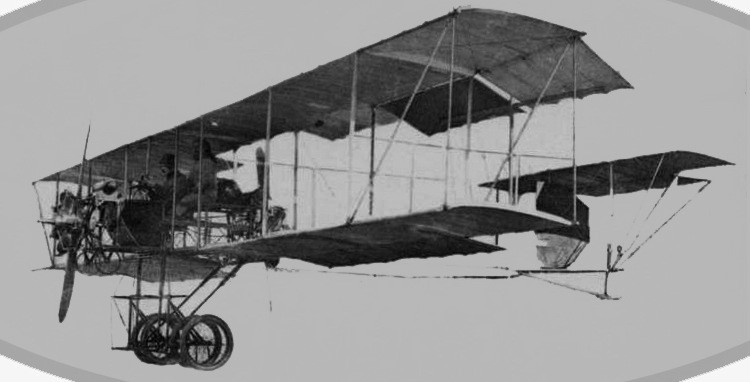
Built 1912-13, the tractor/pusher was a three-seater twin-Gnome-engined 100 hp plane built by Jean Legrand and flying by Camille Guillaume. A modification of a standard 1912 Voisin Type Course biplane to a push-pull machine.
Léger 1907 Hélicoptère
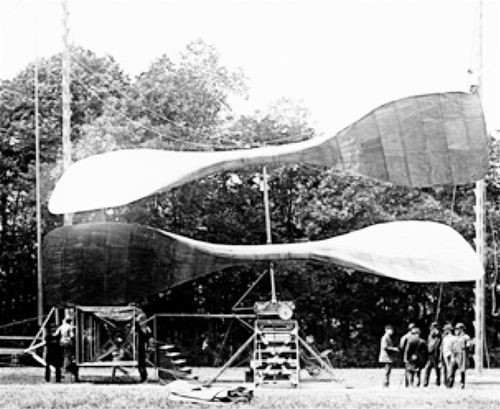
In 1905 Maurice Léger had Ouviere from Marseille build a huge ill-fated helicopter at Monaco. A half-scale model was built first, with a 5.6 kW electric motor on the ground, and a connecting cable. The spoon-bladed aluminum propellers were 6.5 m in diameter, and the empty weight of the model was 110 kg. The full-scale machine appeared shortly after, an enormous construction for the period, with two coupled Antoinette engines, driving two contra-rotating propellers made of fabric-covered frames. The pilot and his passenger sat on the base with twin steering wheels. A biplane tail unit was fixed within the diameter of the rotors. It was destroyed on its first test.
Lefervre & Peauger Mobiplane
In the summer of 1977 in France, Camille Lefervre and Philippe Peauger powered a Rogallo flex wing hang glider and called it the Mobiplane. Without a trike unit, this single seat device needed foot launching and landing and had one Solo 130 cc 5.5 hp engine as a tractor at the front above the wing and a second similar engine used as a pusher below the wing, at the trailing edge. It was described in Pilote Prive in September 1977, but never went on sale.
Engines: 2 x Solo 130 cc, 5.5 hp.
Lebaudy 190 / 1910 Morning Post
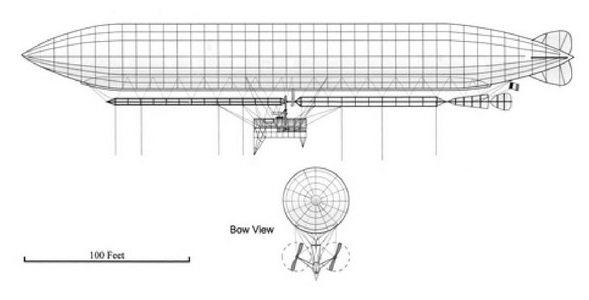
Two large dirigibles were ordered by Great Britan from France. The second airship, the Lebaudy, was purchased by the Morning Post newspaper as a gift to the nation, despite the fact there was at that time no shed large enough to house the 337 foot long craft. After protracted negotiations with the War Office agreement was reached to provide a new shen at Farnborough.
The Lebaudy had a gas capacity of 353,000 cu.ft giving a gross lift of 10.4 tons, powered by two 135hp Panhards. Colonel Capper had flown aboard her during trials earlier in the year in France and had reported favourably on her capabilities.
The airship was flown to England on 26 October 1910, maned by a French crew of seven and two representatives of the War Office including Major Bannerman who had succeeded Templer as superintendent at Farnborough. They crossed the coast at Cao Gris Nez, the airship easily overhauling the escorting destroyers at a speed of 35 mph.
After an uneventful flight of 5 hours 15 minutes the airship landed at Farnborough. On being taken to the shed the major in charge of docking became concerned that the top of the airship was too high to pass under the shed entrance, but was overruled by a senior officier who insisted the ship be walked in at once.
As the Lebaudy entered the shed the upper portion of the envelope was torn by the roof girder work, causing the ship to collapse and become a total wreck. It would appear that the dimensions of the ship supplied before the erection of the shed were different from the craft as completed, with the diameter being some 10 feet wider.
The wreckage was dragged into the shed and followed by an inquiry, during which the War Office refused to pay the purchase price to the Lebaudy Company, declared them negligent in not advising them of the increased diameter of the envelope. It was eventually agreed the Lebaudy Freres would foot the bill to repair and make the ship airworthy.
During the winter months the shed roof was raised by 15 ft, and a complete reconstruction was started. A test flight of the refurbished airship took place in May 1911 in the hands of the manufacturers with an all French crew. Soon after takeoff and following a short flight, problems with directional control were experienced, most likely due to the craft being badly rigged following certain modificatins to the suspension system.
The crew limped back to Farnborough where while attempting to land the airship lost control and dived into the round, crashing on to a house and becoming a complete wreck. There was no fire and the crew suffered only minor injuries.
Lebuady 190
Envelope volume: 353,000 cu.ft
Length: 337 ft
Width: 39 ft
Height: 64 ft
Gross lift: 10.4 ton
Disposable lift: 2.6 ton
Engines: 2 x 135 hp Panhard
Speed: 38 mph
Range: 600 mi
Crew: 7
 All Aero