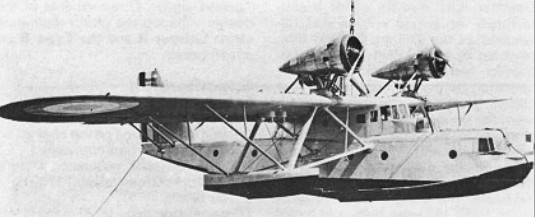
An eight-man long-range maritime reconnaissance and bombing flying-boat designed to a 1932 French navy requirement, the prototype Loire 70 made its first flight on 28 December 1933.
During tests the original three 373kW Gnome-Rhone 9Kbr radials were replaced by more powerful 9Kfr engines, and other changes included supplementing the large single fin and rudder with a pair of small auxiliary fins, elimination of the bow gun position, and relocation of the bomb-aimer/ navigator in the extreme nose.
Seven production aircraft were delivered to Escadrille E.7 at Karouba to join the prototype within a 12-month period from June 1937. From the beginning of hostilities, in September 1939, the Loire 70s patrolled the Mediterranean until three of four surviving machines were destroyed in an Italian air raid on their base on 12 June 1940. Nothing was heard subsequently of the surviving flying-boat.
Engine: 3 x Gnome-Rhone 9Kfr radial, 552kW Max take off weight: 11500 kg / 25353 lb Loaded weight: 6500 kg / 14330 lb Wingspan: 30.00 m / 98 ft 5 in Length: 19.50 m / 63 ft 12 in Height: 6.75 m / 22 ft 2 in Wing area: 136.00 sq.m / 1463.89 sq ft Max. speed: 235 km/h / 146 mph Ceiling: 4000 m / 13100 ft Range: 3000 km / 1864 miles Armament: 6 x 7.5mm machine-guns, 600kg of bombs
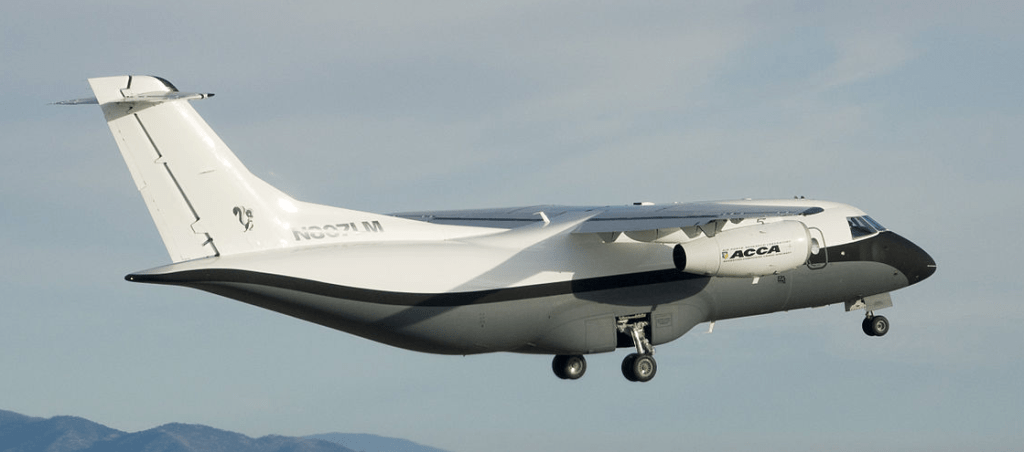
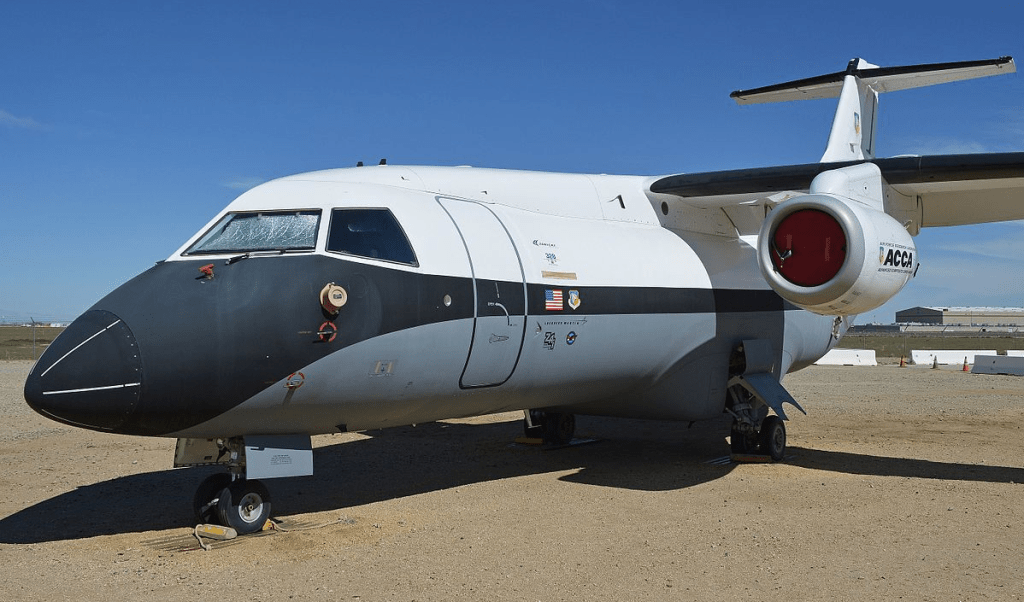
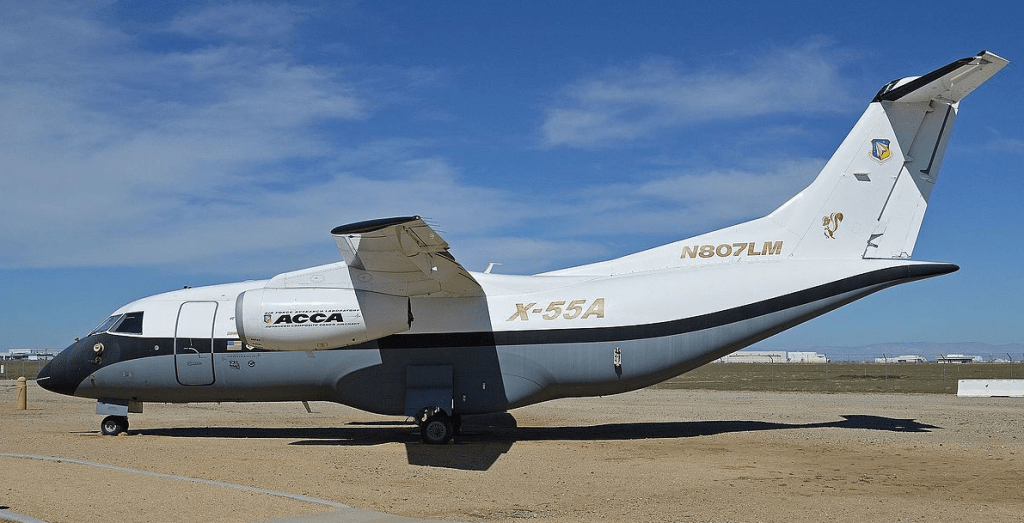
The Lockheed Martin X-55 Advanced Composite Cargo Aircraft (ACCA) is an experimental twinjet transport aircraft. It is intended to demonstrate new air cargo-carrier capabilities using advanced composite materials. A project of the United States Air Force’s Air Force Research Laboratory, it was built by the international aerospace company Lockheed Martin, at its Advanced Development Programs (Skunk Works) facility in Palmdale, California. The X-55 is a one-off aircraft intended to demonstrate the use of advanced composite materials in the fuselage of an otherwise conventional high-wing transport aircraft.
The aircraft is powered by two Pratt & Whitney Canada PW306B turbofans. The X-55 design is based on the existing Fairchild Dornier 328JET. The fuselage of that aircraft, which is constructed of aluminium alloys, was replaced aft of the entrance door with a newly designed fuselage. The new design makes extensive use of advanced composite materials, selected to allow out of autoclave curing at lower temperatures and pressures than previous materials. The new widened fuselage allows the loading of cargo through a rear ramp.
The new fuselage section is constructed as a single large component, including the vertical stabilizer. When attached to the existing nose section, the fuselage is 55 feet (16.8 m) long and 9 feet (2.74 m) diameter. The fuselage has upper and lower halves, each with a roughly-oval shape similar to a canoe. The halves are bonded to circular frames. The fuselage section ahead of the entrance door consists of the existing (metal) 328J component, with fasteners used to bring the forward and new aft sections together.
As of April 2008, the fuselage was being fabricated. The first flight of the modified aircraft was expected during the winter of 2008/2009. However, due to a “glitch” during fabricating the composite fuselage, that schedule slipped. The delay was caused by an unsatisfactory bond of the skin on the lower fuselage, which required a second fuselage to be fabricated.
The first flight was completed at Lockheed Martin’s Advanced Development Programs facility (Air Force Plant 42) in Palmdale, California on June 2, 2009 by the Air Force Research Laboratory in conjunction with Lockheed Martin. In October 2009, the ACCA demonstrator was designated X-55A by the USAF. Over the course of the program, 15 to 20 flights were expected.
As of September 12, 2014, the X-55 aircraft is on display at the Joe Davies Heritage Airpark in Palmdale, California.
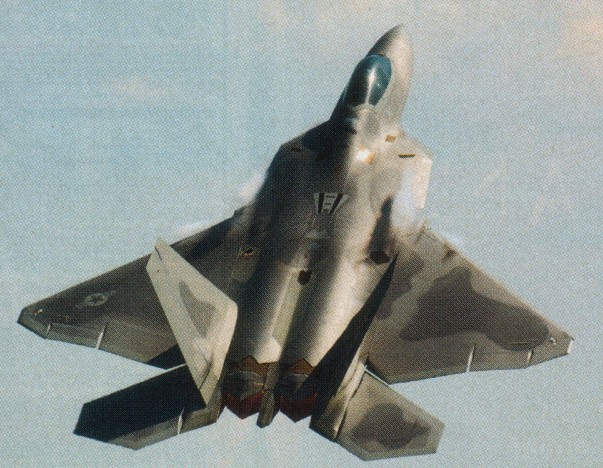
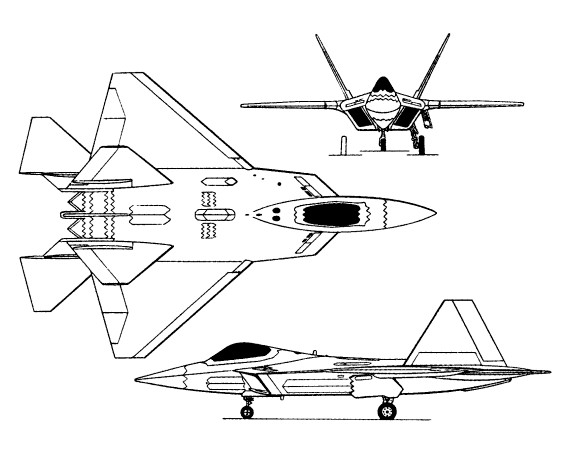
In the late 1970s, the US Air Force identified a requirement for 750 examples of an Advanced Tactical Fighter (ATF) to replace the F-15 Eagle. Flown by a single pilot, it must be able to survive in an environment filled with people, both in the air and on the ground, whose sole purpose is to destroy it. To test the concepts that would eventually be combined in the ATF, the US AF initiated a series of parallel research programmes. The first was the YF-16 control-configured vehicle (CCV) which flew in 1976-77 and demonstrated the decoupled control of aircraft flight path and attitude; in other words, the machine could skid sideways, turn without banking, climb or descend without changing its attitude, and point its nose left or right, or up or down, without changing its flight path. Other test vehicles involved in the ATF programme included the Grumman X-29, which flew for the first time in December 1984 and which was designed to investigate forward-sweep technology, and an F-111 fitted with a mission adaptive wing (MAW) – in other words, a wing capable of reconfiguring itself automatically to mission requirements.
Flight testing of all these experimental aircraft came under the umbrella of the USAF’s Advanced Fighter Technology Integration (AFTI) programme. In September 1983, while the AFTI programme was well under way, the USAF awarded ATF concept definition study contracts to six American aerospace companies and, of these, two – Lockheed and Northrop – were selected to build demonstrator prototypes of their respective proposals. Each company produced two prototypes, the Lockheed YF-22 and the Northrop YF-23, and all four aircraft flew in 1990. Two different powerplants, the Pratt & Whitney YF119 and the General Electric YF120, were evaluated, and in April 1991 it was announced that the F-22 and F119 were the winning combination. The F119 advanced technology engine, two of which power the F-22, develops 155kN and is fitted with two-dimensional convergent/ divergent exhaust nozzles with thrust vectoring for enhanced performance and manoeuvrability.
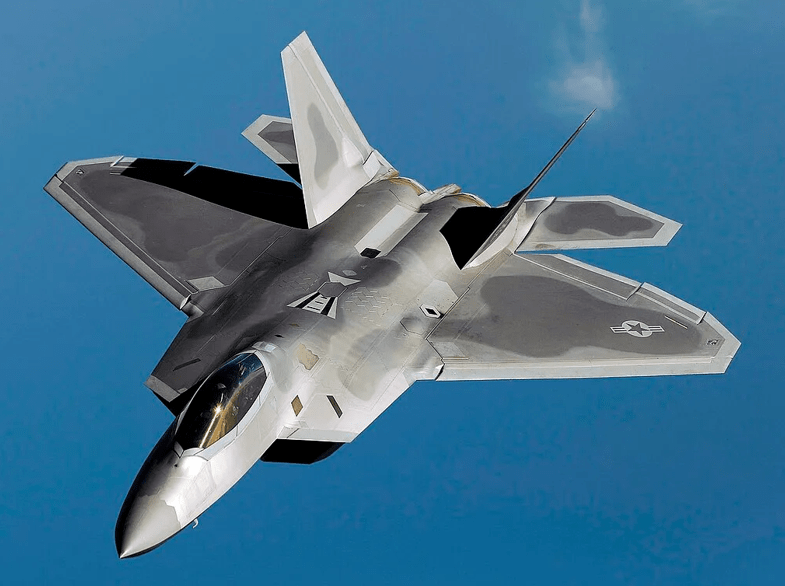
The Raptor is designed and built by Boeing, Lockheed Martin and Pratt & Whitney. Boeing supplies the F-22s 2,000-lb titanium and composite wings and aft fuselage, integrates and tests the advanced avionics and is responsible for the training and life-support systems.
Previously the designation for the Raptor was changed to F/A-22 to indicate the possible air-to-ground role of the aircraft. JDAM bombs can be carried in the internal weapon bay, while the optional external pylons offer a more flexible station for air-to-ground armament. However the U.S. Air Force changed the designation back to F-22 in December 2005, although it will still posses the secondary air-to-ground role.
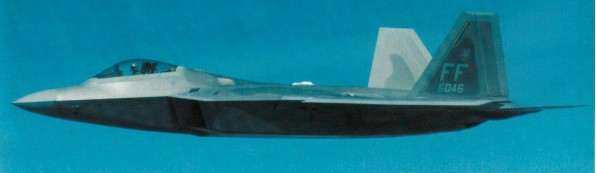
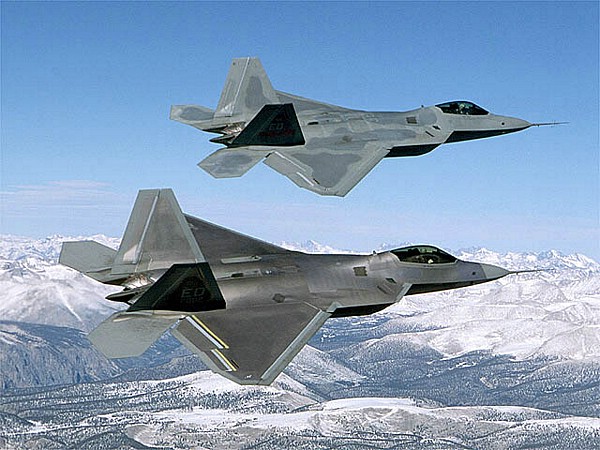
The F-22 combines many stealth features. Its air-to-air weapons, for example, are stored internally; three internal bays house advanced short-range, medium-range and beyond-visual-range air-to-air missiles. Following an assessment of the aircraft’s combat role in 1993, it was decided to add a ground-attack capability, and the internal weapons bay is also capable of accommodating 454kg GBU-32 precision-guided missiles. The F-22 is the first production aircraft with the ability to super cruise – flying at supersonic speeds without the use of afterburners. The F-22 is designed for a high sortie rate, with a turnaround time of less than 20 minutes, and its avionics are highly integrated to provide rapid reaction in air combat, much of its survivability depending on the pilot’s ability to locate a target very early and take it out with a first shot. The F-22 was designed to meet a specific threat, which at that time was presented by large numbers of highly agile Soviet combat aircraft, its task being to engage them in their own airspace with beyond-visual-range weaponry. It will be a key component in the Global Strike Task Force, formed in 2001 to counter any threat worldwide. The USAF requirement is for 438 aircraft.
The first definitive F-22 prototype was rolled out at the Lockheed Martin plant at Marietta, Georgia, on 9 April 1997.
The planned first flight of the F-22A, scheduled for 29 May 1997, was delayed by a small fuel leak in the F-1A tank just aft of the cockpit, together with an oil problem in the APU/auxiliary generator system area and software troubles.
The first flight was delayed to 7 September 1997. The second prototype first flew on 29 June 1998. The first two Raptor fighters, Nos. 4001 and 4002, have only 80% of the required strength, partly the result of an aggressive weight-cutting program, and the No. 4003 airframe has been strengthened to make it 100% capable. The third F-22 was delivered to Edwards AFB in March 2000. The aircraft was about eight months behind schedule. The empty weight is still low enough to beat the operational requirements. Raptor 4001 has been doing high speed tests such as loads and flutter but could not fully clear the envelope because of the lower strength, although it and ship No. 4002 have both exceeded 7g loads. The Air Force will only say that the required F-22 limit exceeds 7g. Raptor 4003 will provide full high speed clearance for subsequent aircraft, but will first spend several months on the ground at Edwards AFB because the reworked structure requires new ground vibration tests and other evaluations. The nonstop delivery from Marietta, Ga., was the fourth flight of 4003 and lasted 4 hr. 50 min., including four aerial refuelings. By late 2001, there were eight F-22s flying.
A YF-22 being tested at Edwards reacted unexpectedly when a go round initiated a changed in its fly-by-wire control laws. After a few cycles of PIO, the aircraft belly-flopped onto the runway.
In January 2003, the Air Warfare Center at Nellis Air Force Base near Las Vegas, Nevada, received its first Raptor. It was the twelfth F-22 produced. The 422nd Test & Evaluation Squadron took on seven more F-22s for testing and training of the initial cadre of instructor pilots. The 43rd Fighter Squadron became the first F-22 squadron when it received its first F-22 (then designated F/A-22) in the end of September in 2003. The unit of the 325th Fighter Wing carries out the training at Tyndall Air Force Base, Florida. In January 2004, the first pilot qualified at Tyndall AFB.
The 27th Fighter Squadron of the 1st Fighter Wing at Langley AFB became the first operational F-22 squadron when it received its first Raptor in January 2005. The squadron was declared operational (initial operational capability) in December 2005 with 12 F-22A Raptors. Also based at Langley AFB, the 94th Fighter Squadron received its first two Raptors in March 2006. On January 19, 2007, the last of 40 F-22A Raptor for the 1st Fighter Wing was delivered to the 94th FS, equipping both fighter squadrons with 20 Raptors each.
First prototype: N22YF (GE YF120 engines) rolled out at Palmdale 29 August 1990; first flight/ferry to Edwards AFB 29 September 1990; first air refuelling (11th sortie) 26 October 1990; Mach 1.58 supercruise’ (later exceeded) on 3 November 1990; first thrust-vectoring 15 November 1990; anti-spin parachute fitted for high AoA tests with thrust-vectoring; last flight 28 December 1990 — total 43 sorties/52.8hr.
Second prototype: N22YX (P&W F119 engine) first flight Palmdale-Edwards 30 October 1990; launched first AIM-9M Sidewinder on 28 November 1990 and AIM-120 AMRAAM on 20 December 1990; achieved Mach 1.8 26 December 1990; last flight 28 December 1990 — total 31 sorties/38.8 hrs. Summary demonstrated thrust vectoring, including 100deg/sec roll rate at 120kt (222km/h; 138mph); Mach 2 speed with afterburning. Aircraft in storage at Edwards AFB from January 1991.
Despite its $150 million unit cost and production run of only 195 aircraft, terminated early due to post-Cold Its capabilities were partially demonstrated during deployments to Syria, where Raptors operated with impunity even in airspace covered by advanced Russian air defence systems.
The F-22’s main limitation is its age—designed before modern networked warfare concepts were fully developed, it lacks some of the connectivity features of newer aircraft.
Lockheed Martin F-22 Raptor
However, ongoing modernisation programs including upgraded processors, new datalinks, and integration with the latest AIM-260 long-range missiles will keep the Raptor at the forefront of air combat capability until its planned replacement by the sixth-generation NGAD (Next Generation Air Dominance) fighter.
F-22A Engines: two Pratt & Whitney F119-P-100 turbofan, 155.69 kN (35,000 lb st) with afterburning Length 18.92m (62 ft 1 in) Height 5.00m (16 ft 5 in) Wing span 13.56m (44ft 6 in) Empty weight: 13.608+ kg (30,000+ lb) Max Take-Off Weight: 26.308 kg (58,000 lb) Max level speed at optimum altitude: Mach 1.58 in supercruise Max level speed at 30,000 ft (9145m) Mach 1.7 in afterburning mode Service ceiling: 15,240+m (50,000+ ft) G limit: +7.9 Armament: one 20mm M61A2 Vulcan six-barrel gun with 480 rounds; 2 AIM-9X Sidewinder IR-guided missiles in internal side bays. Up to 6 AIM-120C or 4 AIM-120A AMRAAM missiles in internal fuselage weapon bays or 2 AIM-120C AMRAAMs and 2 GBU-32 JDAM bombs or 2 GBU-30 JDAM bombs. Up to four fuel tanks and up to 8 missiles on optional external hardpoints.
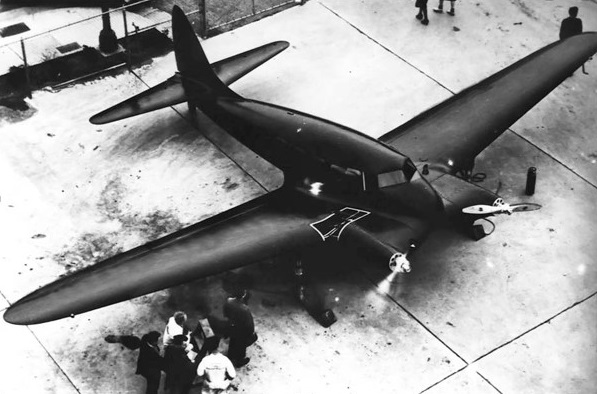
The Lockheed Brothers left the Company after the Detroit merger and set up the Airover Company, later called Alcor, to build the Uni-twin. With two Menasco engines side-by-side in the nose, driving two propellers. The name of the company was changed to Lockheed Vega when it became a subsidiary of the revived parent organization.
With Allan H. Lockheed as president, built a new version of his Duo twin-engined monoplane. Type was called Alcor Duo-6 and was distinctive in having two Menasco engines placed horizontally.
A demonstration flight was made in May 1934 at Mines Field with one propeller removed—it took off in 1200′, attained 130mph, and reportedly handled much like a single-engine plane.
Alcor Duo-6 NX962Y
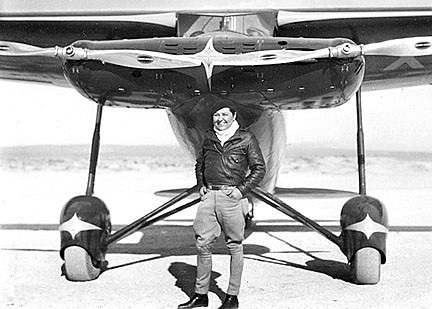
The Alcor Olympic Duo-4 of 1930 designed by Allan Loughead, featured two engines mounted side-by-side in a nose nacelle. Powered by two 160hp Menasco B-6 (reportedly first with 125hp C-5s), it was originally planned for one Wright J-6-7c in the nose. The unbraced cantilever wing had two full-length box spars.
Alcor Duo-4 with Pancho Barnes
The one five-place Alcor Duo-4 built, NX962Y, nosed over in a wind gust during a landing on Mar 18, 1931; although damage was slight, nervous financial backers withdrew their support.
Though Alcor conformed with Lockheed “star names” system and development was pursued in 1930s, no production resulted. Alcor was not a Lockheed Aircraft Corporation product.
Olympic Duo-6 Engines: two 230hp Menasco B-6S Wingspan: 42’0″ Length: 28’6″ Useful load: 2045 lb Max speed: 183 mph Cruise: 157 mph Stall: 57 mph Range: 700 mi
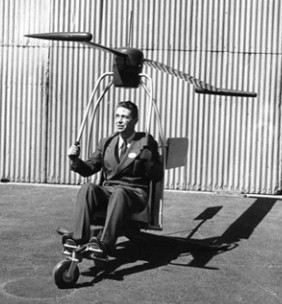
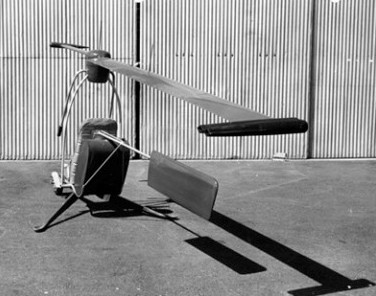
Rotor diameter: 20 ft 0 in Height: 6 ft 0 in Gross weight: 450 lb Fuel capacity: 15 USG Vert ROC: 800 fpm Max speed; 80 mph Pwr off sink: 16 ft/sec @ 25 mph
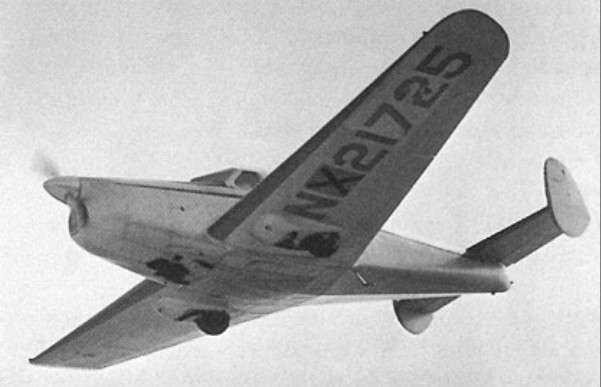
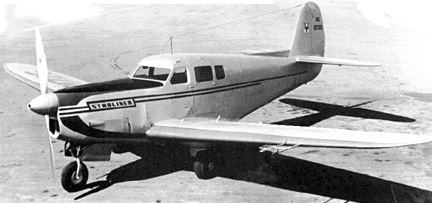
The Vega Starliner NX21725 was a five/six-seat low-wing cabin monoplane with retractable landing gear and an unusual powerplant. The model 22 was a modification with 640hp Menasco Unitwin 2-544 and a single tail. This comprised two 194kW Menasco C6S-4 inline engines, mounted side-by-side, and coupled to drive together, or independently in emergency, a single propeller.
First flown on 22 April 1939 (piloted by B A Martin), the Starliner was abandoned after some 85 flight test hours as there was no demand for an aircraft in this category.
Vega Starliner NX21725
The aircraft was sold to a film studio and its track faded.
Engines: two 194kW Menasco C6S-4 Unitwin Wingspan: 12.50 m / 41 ft 0 in Length: 31’6″ Max take-off weight: 2722 kg / 6001 lb Useful load: 1660 lb Max. speed: 338 km/h / 210 mph Cruise speed: 180 mph Stall: 60 mph Range: 600 mi Seats: 6
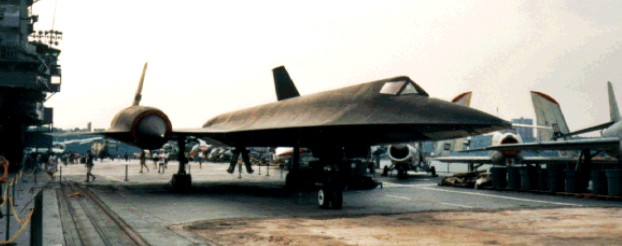
A-11 / A-12 In response to a programme for the construction of a high-speed, high-altitude, long-range reconnaissance conventional aircraft, funded by and earmarked for service with the Central Intelligence Agency (CIA), a number of US companies submitted proposals for consideration, Lockheed’s ‘Ox-cart’ from the design team led by C. L. ‘Kelly’ Johnson eventually being adjudged most suitable, and this duly received the go-ahead in the autumn of 1959.
Construction of the prototype (60-5932) single-seat A-12, as the machine was officially known, forged ahead at the ‘Skunk Works’, the virtually complete prototype being taken by road to the remote Groom Lake flight test facility during January 1962 for final assembly and flight testing. The A-12 got airborne for its first official flight on 26 April 1962, this event being preceded by a totally unexpected ‘hop’ during the course of high-speed taxi trials two days earlier.
Construction was largely of titanium to maintain structural integrity, as localised skin temperatures of up to about 427°C could be reached through air friction.
Lockheed A-12
In the early days of the flight test the first A-12 relied upon two Pratt & Whitney J75 turbojet engines for power, the same company’s J58 turbo-ramjet engine not being installed until much later in the year. Almost inevitably, with such a sophisticated machine, the project suffered from many problems during the early stages of flight testing, these being experienced in virtually every area, but despite this the CIA apparently began to take formal delivery of its initial fleet of 10 aircraft (serial numbers 60-6924/6933) shortly before the end of 1962 and these were later joined by a second batch of five A-12s (60-6937/6941). Of these 15 machines, one (60-6927) was completed as a two-seater for training duties, this differing from its counterparts by virtue of having a second, raised, cockpit and featuring conventional J75 engines which bestowed a maximum speed of about Mach 1.2, well below that of the standard A-12 which was apparently capable of approximately 3860 km/h 2,400 mph) or Mach 3.6 at altitudes in the order of 28040 m (92,000 ft), figures which significant exceeded those records established by the YF-12A at the beginning of May 1965.
A-12
In addition, the last two production examples of the A-12 were configured to carry the GTD-21B drone and these also featured a second crew station aft of the pilot’s cockpit, his housing the Launch Control Officer. As far is is known the GTD-2 1 B/A- 12 pairing was not employed operationally but the drone may have undertaken reconnaissance missions after launch from a specially configured Boeing B-52H Stratofortress.
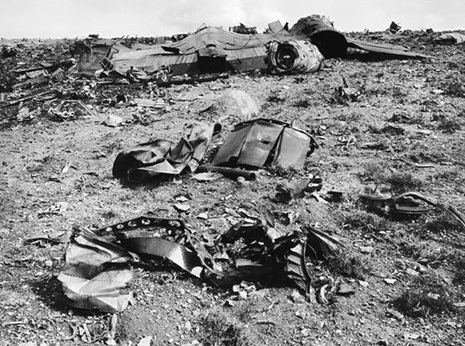
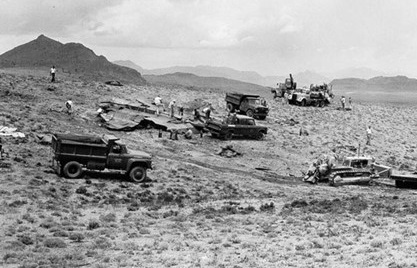
This A-12 crashed near Wendover, Utah in 1963 after entering an unrecoverable flat spin. Pilot Ken Collins managed to eject safely. He then successfully deterred several locals, who had come to his aid with the canopy of the shadowy A-12 on the back of their pickup, from the crash site by telling them the wreck was that of an F-105 Thunderchief with a nuclear weapon onboard. That same day, the CIA administered sodium pentothal to ensure Collins had divulged every last detail of the incident. When the men in black later carried him home, still heavily under the drug’s influence, Collins’ wife angrily assumed he’d been out drinking all day with his friends. Several decades later, the retired A-12 pilot was finally able to reveal the truth. X-Plane hunters continue to find components of the top secret aircraft wreck at the remote site.
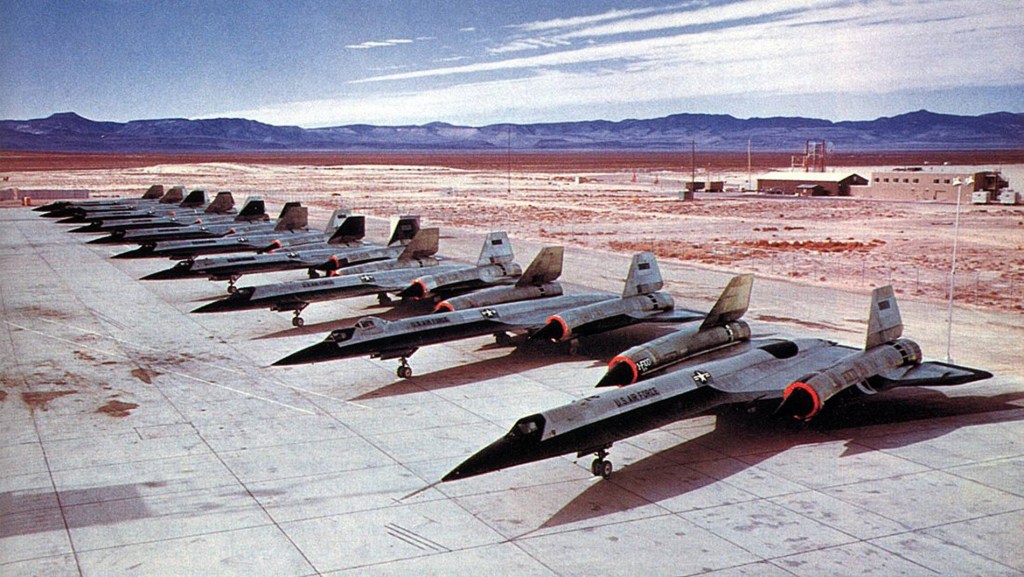
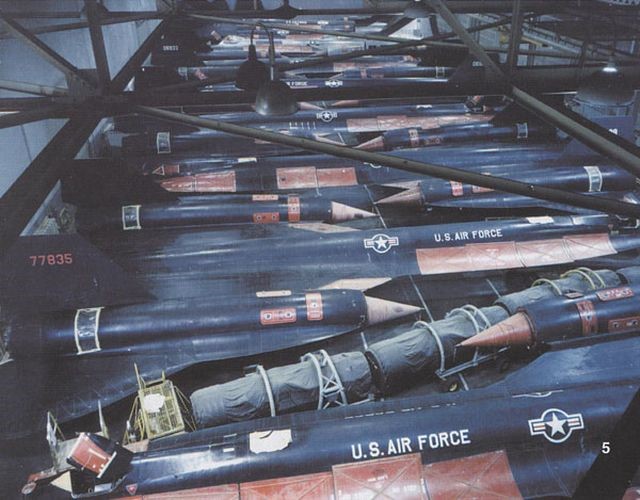
As far as operational employment is concerned, the CIA continues to maintain a tight-lipped silence about the A-12 but the type’s great speed coupled with its capacity for inflight-refuelling made range considerations virtually irrelevant, the major factor in mission scheduling almost certainly being one of crew fatigue. In view of this and the nonstop 24140km. (15,000-mile) missions accomplished by the later SR-71A it would seem reasonable to assume that intelligence-gathering was accomplished from Groom Lake until at least the summer of 1968, which most sources state as marking the cessation of A-12 activity. In addition, Kadena Air Base on the Pacific island of Okinawa has also been linked with A-12 operations as well as those of the SR-71A, and could well have served for some considerable time as a forward operating location for CIA intelligence gathering activities directed against the People’s Republic of China and North Korea. Reliable reports attest that such activity ceased abruptly on 5 June 1968 following the loss of A-12 60-6932, apparently after take-off from Kadena. By then the SR-71A had attained full operational status and the latter type is believed to have assumed responsibility for A-12 missions at about this time. Eight of the 15 A-12s eventually appeared in open storage at Palmdale during October 1977 though where they had spent the intervening nine years remains a mystery.
Lockheed A-12s while in secret storage at Palmdale, CA
In a Presidential announcement of February 1964, Lyndon Johnson formally revealed the existence of the ‘A-11 aircraft’.
YF-12
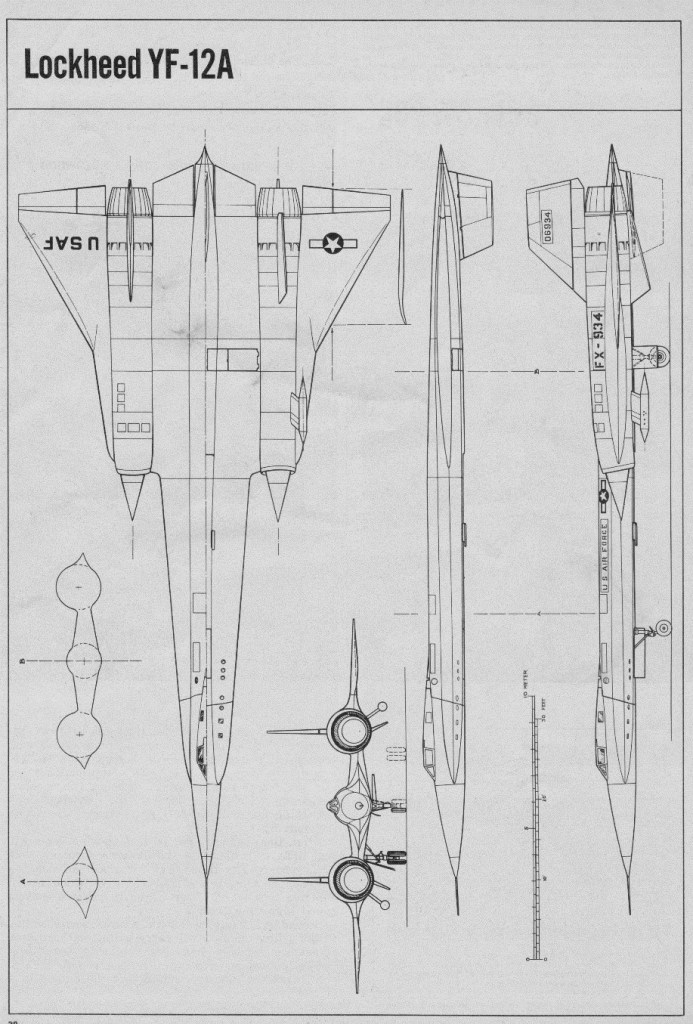
YF-12A
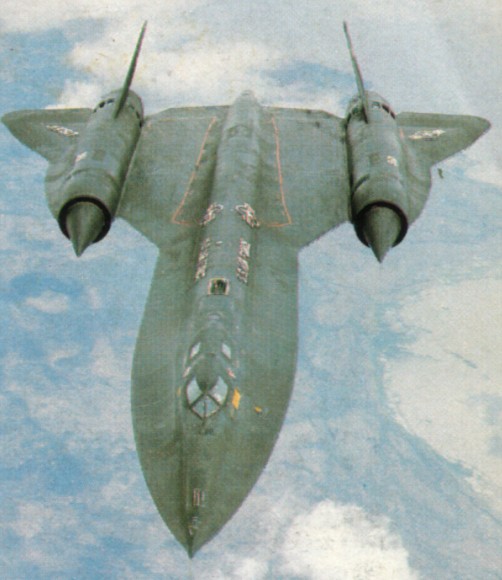
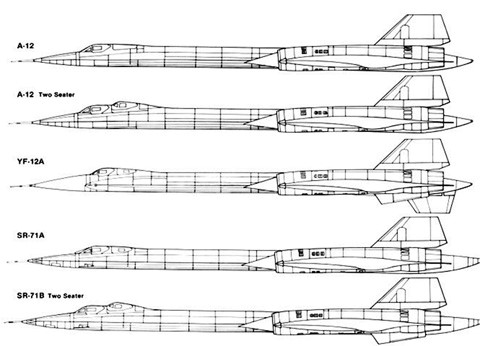
The second major ‘Blackbird’ variant to appear was the YF-12A, and it was this model which formed the basis of the Presidential announcement of February 1964 when Lyndon Johnson formally revealed the existence of the ‘A-11 aircraft’, adding that it was then under test as a long-range interceptor’. Three aircraft (606934/6936) of this type were built, the first example making its maiden flight from Groom Lake on 7 August 1963. Eventually to become the most publicly visible of all the ‘Blackbirds’, the three aircraft all featured significantly different nose contours, the forward fuselage chine having had to be redesigned to permit the installation of the Hughes AN/ASG- 18 long range radar required in the interceptor role. Armament was intended to be the Hughes AIM-47A air-to-air missile, four of which would have been housed internally, occupying space which was presumably given over to reconnaissance sensors and systems on the A-12. The type is based on advanced aerodynamics using a blended fuselage/wing design built largely of titanium alloys and covered in a special heat-radiating paint that led to the type’s nickname. The powerplant comprised a pair of 32,500-lb (14740-kg) afterburning thrust Pratt &Whitney J58 (JT11D-20B) bypass turbojets (or turbo-ramjets) which at high speeds produced their power not only as direct thrust from the exhaust nozzle but also as suction at the inlet. The fighter derivative of the basic model was the experimental YF-l2A, of which at least four were produced with the A-11’s original short fuselage, a Hughes pulse-Doppler fire-control system and, in the fuselage chine bays originally used for the carriage of reconnaissance equipment, four AJM-47A air-to-air missiles. The YF-12A never served operationally, but was important in several evaluation programmes.
The YF-12A programme, seen as important in its own right, distracted attention from the more sinister A-12, the model which mounted an assault on several world records at the beginning of May 1965, capturing the headlines and setting new marks for sustained altitudes and speed with what appeared to be consummate ease. That the A- 12 was able to exceed these figures handsomely was not brought to anyone’s attention.
Subsequently, the YF-12As and a single YF-12C (itself simply the demilitarized second production SR-71A with the bogus serial number (06937) spent most of their flying careers at Edwards AFB, California, eventually being used until 1999 by NASA in a major research effort into high-speed flight. This came to an end during 1979, the sole surviving YF-12A (60-6935) being turned over to the USAF Museum at Wright-Patterson AFB, Ohio, in November while the YF-12C was apparently placed in storage at Palmdale. Of the other two YF-12As, 60-6934 fell victim to a landing accident at Edwards at a fairly early stage, most of the rear fuselage later being used as a basis for the sole SR-71C, while 60-6936 was destroyed Arhen it crashed on approach to Edwards during June 1971.
Crewed by a pilot and flight test engineer, these aircraft flew under NASA for 10 years.
On 1 May 1965, a YF-12A established records including 2062 mph and 80,000 ft sustained horizontal flight. The YF-12As were capable of speeds in excess of Mach 3 and of sustained supersonic flight at heights of up to 24,385m.
The YF-12A paved the way for the SR-71A ‘Blackbird’ strategic reconnaissance platform that was retired from first-line USAF service in 1989, but even so the whole programme is still shrouded in secrecy and uncertainties.
SR-71
SR-71A
On Dec. 28, 1962, Lockheed got the contract to build the first group of SR-71s, which were to become the largest and best known branch of the Blackbird family. Bob Gilliland made the first flight on Dec. 23, 1964. One year after the YF-12, the first SR-71 arrived at Beale Air Force Base, California, operational home of the Black¬bird. First flown on 22 December 1964, the SR-71 is an unarmed strategic reconnaissance aircraft. The SR-71B and SR-71C are training variants.
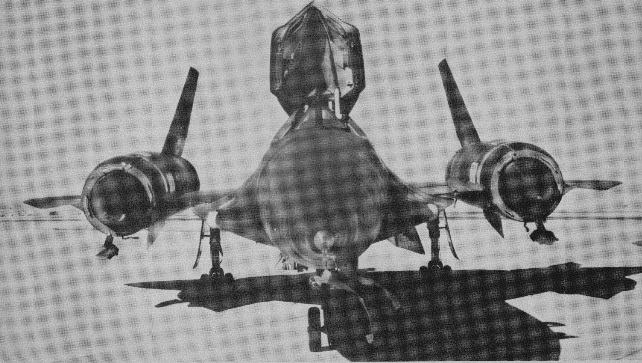
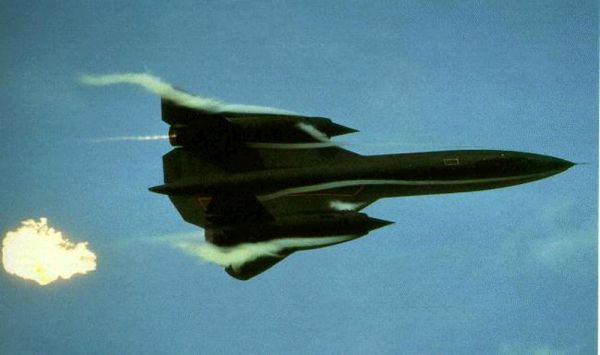
Developed from the A-12 and flown for the first time during December 1964, the Lockheed SR-71A was the world’s fastest operational aircraft, approximately 12 examples being active with the 9th Strategic Reconnaissance Wing at any given time. Possessing the ability to survey 260000 sq.km (100,000 sq miles) of the Earth’s surface in just one hour, the SR-71A routinely cruises at Mach 3 at altitudes in excess of 24385 m (80, 000 ft) during the course of its duties, and is able to gather a variety of data by virtue of highly classified but interchangeable photographic and electronic sensors which are installed to meet specific mission objectives. Deliveries to Strategic Air Command began in January 1966, and it is believed that a total of 32 aircraft was built, this figure including two examples of the two-seat SR-71B plus a single SR-71C, the latter model also being a two-seater for pilot training, built of components taken from crashed aircraft and a structural test specimen.
Unlike the A-12, the SR-71 is a two-seat aircraft with additional accommodation for a Reconnaissance Systems Officer (RSO). Externally, this model also differed from its predecessors in that it has a fully extended chine which is much broader around the nose while the rear fuselage boat-tail was extended by some 1.83 m (6 ft) aft of the trailing edge to improve overall fineness ratio and provide additional fuel capacity. JP-7, the fuel used by the SR-71, is so special due to its properties for operations at the high temperatures caused by Mach 3 cruise that the aircraft has its own fleet of tankers, designated KC-135Q.
The configuration of this aircraft results from extensive wind-tunnel testing to evolve a minimum-drag fuselage providing maximum speed while keeping kinetic heating to the minimum; and to maintain the best possible handling characteristics at supersonic, take-off (about 370km/h) and landing (about 278km/h) speeds. Power plant comprises two 144.6kN Pratt & Whitney turbojets. The 36,287kg of special fuel for these engines – which is contained within upper-fuselage and inner-wing tanks – acts as a heat sink for the entire aircraft, fuel temperature being raised to 320°C before being injected into the engines. Highly complex air intakes with computer-controlled fail-safe systems are essential to ensure that smooth airflow to the engines is maintained over the enormous forward speed range of 0-3,200km/h, at the upper limit of which the engines are virtually operating as turbo-ramjets.
An initial batch of six aircraft formed the subject of the first contract which was placed in December 1962, and the first example took to the air for its maiden flight from Palmdale on 22 December 1964.
Deliveries to the designated operating agency (Strategic Air Command) began on 7 January 1966, the first example assigned actually being the second SR-71B to be produced. SR-71As began to follow during June of the same year to the 9th Strategic Reconnaissance Wing.
Attaining operational status in mid-1967, over 16 years later virtually everything about the SR-71’s usage and mission-related sensor equipment was still the subject of a stringent security blanket, although the USAF has revealed that it can survey 100,000 square miles of the Earth’s surface in one hour’. It seems certain that the intelligence-gathering effort entails unauthorized overflights of potentially hostile territory every now and then. However, since much valuable data can be obtained without recourse to actual overflight, it seems probable that many missions are of a peripheral nature, the SR-71A operating in international air space at extreme altitude whilst going about its duties.
Operations were routinely conducted from two forward operating locations by aircraft detached from the wing’s headquarters at Beale AFB, California. Kadena in Okinawa, normally had three aircraft attached at any time, while Mildenhall in the United Kingdom was the location of the second SR-71 detachment which usually controled the activities of two aircraft. In addition, 9th SRW’s headquarters at Beale served as the centre for crew training. The two-crew members, comprising a pilot and a reconnaissance systems operator, both wear full pressure suits similar to those of astronauts.
Regardless of the equipment fitted, it is apparent that the ‘Blackbird’ was highly regarded as an intelligence-gathering tool, clear evidence of this being provided by the massive expense incurred in supporting just a handful of aircraft. There is the large fleet of Boeing KC- 135Q Stratotankers (specially modified to carry the SR-71A’s unique JP-7 fuel. In addition, the unique aspects of high-altitude flight require the services of a large physiological support division, further 9th SRW infrastructure including a reconnaissance technical squadron with the task of processing data, and an extensive training element which uses several Northrop T-38A Talons as well as a surviving SR-71B.
A total of 31 new-build SR-71 Blackbird aircraft were constructed in addition to the SR-71C. Of the total production, 29 examples (64-17950/17955 and 64-7958/17980) are SR-71As, the two remaining (64-17956/17957) being completed SR-71Bs with a second, raised, cockpit for pilot training duties. 64-17956, was originally built as an SR-71A, but was later converted to an SR-71B trainer by the addition of a second cockpit. Two aircraft were converted.
They have the capability to survey an area of 155,400sq.km within an hour and in 1976 established a closed-circuit speed record of 3,367.221km/h; a world absolute speed record of 3,529.56km/h; and a sustained-altitude record of 25,929.031m.
Including all three members of the ‘Blackbird’ family, production of new airframes totalled just 49, a fiftieth hybrid machine being completed with parts from a wrecked YF-12A and an engineering mockup.
The SR-71 left US Air Force service in January 1990. On a flight from the West Coast to the East Coast, where the aircraft was to retire to permanent static display at the Smithsonian, the Blackbird set a new transcontinental speed record, flying from Los Angeles to Washington D.C. in 1 hour, 4 minutes, and 20 seconds, averaging a speed of 2,124 mph.
SR-71
SR-71
Records Absolute speed: 2193.17 mph / 3529.56 kph – 28 July 1976 1000km / 621.1mi closed circuit speed: 2092.294 mph / 3367.221 kph – 27 July 1976 Sustained flight in horizontal flight: 85,059 ft / 25,939 m – 28 July 1976
Lockheed SR-71A Blackbird Engines: 2 x P&W JT11D, 32,500 lb / 14,742 kg thrust Wingspan: 55 ft 11 in / 16.94 m Length: 107 ft 5 in / 32.74 m Height: 18 ft 6 in / 5.64 m Wing area: app 1000 sq.ft / 92.9 sq.m Empty weight: 60,000 lb / 27,216 kg MTOW: 170,000 lb / 77,111 kg Speed: 2250 mph / 3620 kph Ceiling: 100,000 ft/ 34,800 m Range: 2980 mi / 4850 km Seats: 2
SR-71A Engines: two Pratt & Whitney J58 turbo-ramjet engines, 14742-kg (32,500-1b) afterburning thrust. Wing span 16.94 m (55 ft 7 in) Wing area: 167.2 sq.m / 1799.72 sq ft Length 32.74 m (107 ft 5 in) Height 5.64 m (18 ft 6 in) Wing area 166.76sq.m (1,795 sq ft). Empty weights: 27216 kg (60,000 lb) Maximum take-off 78019 kg (172,000 lb) Fuel capacity 13,000+ USG Maximum speed at 24385 m (80,000 ft) 3661 km/h (2,275 mph) or Mach 3.35 Operational ceiling 26060 m (85,500 ft) Maximum unrefuelled range at Mach 3: 5230 km (3,250 miles). Crew: 2
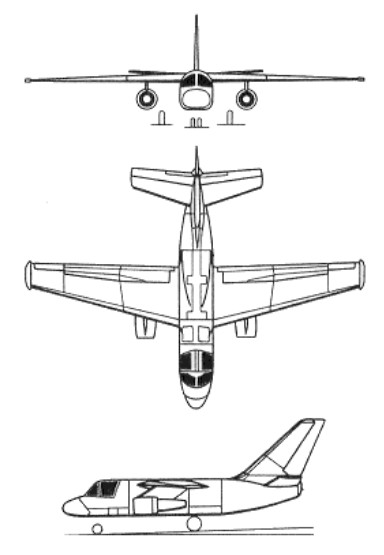
The S-3 is a carrier-based, subsonic, all-weather, long-range, multi-mission aircraft. It operates primarily with carrier battle groups in anti-submarine warfare roles. It carries automated weapon systems and is capable of extended missions with in-flight refueling.
The Viking’s primary flight controls are fully powered and are integrated with the automatic flight control system to relieve the pilot of routine anti submarine warfare manoeuvring. Primary flight controls are servo operated by dual hydraulic systems the loss of either hydraulic system results in the loss of half the available hinge moment. Reversion to manual control is automatic if both hydraulics are lost. In normal powered operation series inputs to the elevator and rudder servos compensate for pitching moments and provide turn co ordination and yaw damping. During autopilot operation parallel inputs to the power servos permit the pilot to, anticipate automatic manoeuvres. The roll axis is controlled by short-span ailerons aug¬mented by differential spoilers mounted on the upper and lower surfaces of each wing. The servo actuators have artificial feel built in to minimise variations in manoeuvring forces throughout the flight envelope. Ailerons and spoilers act together for rolling, with the spoilers acting alone as airbrakes when required. During emergency manual opera¬tion when there is no hydraulic power the spoilers are inhibited and the control column operates only the ailerons. The pitch axis is controlled by a hydraulically powered elevator servo; trim is via an electrically powered actuator. The elevator servo can be operated in normal powered, series or parallel modes. In the emergency manual mode, and in the normal powered mode, the servo is controlled by the pilot. In the series mode during manual approach with the approach power compensator on the servo is under the joint control of the pilot and the automatic flight control system. Rudder control allows an engine failure to be coped with at low speed or following asymmetric stores release. The rudder servo, like that for the elevator, can operate: in normal power, series, parallel or emergency manual modes. During the fin folding sequence rudder pedal input to the rudder servo is disconnected to enable the pilot to continue steering the aircraft on the ground using the rudder pedals.
The first S 3A Viking was rolled out at Lockheed’s Burbank, California factory on November 8 1971 and was first flown on 21 January 1972. The S-3A Viking replaced the piston-engined Grumman S-2 Tracker and entered fleet service in 1974. The last production S-3A was delivered in August 1978.
Used exclusively by the US Navy (firstly VS-41 in February 1974), a total of 187 were built before production ended in 1978, these being powered by two 9,275 lb thrust General Electric TF34 GE 2 turbofan engines.
Lockheed received an initial contract in April 1986 to supply 22 production conversion kits to modify S-3As to upgraded S-3B standard. Two S-3As were modified by Lockheed in 1984/85 to serve as S-3B prototypes, the first flying on 13 September 1984. The S-3B incorporates increased acoustic processing, expanded ESM coverage, improved radar processing, a new sonobuoy reference system, and Harpoon ASM capability. The S-3B version can be fitted with buddy stores, external fuel tanks that refuel other aircraft, to act as an airborne tanker.
Sixteen S-3As were converted to ES-3A Shadows for carrier-based electronic reconnaissance (ELINT) duties.
The Lockheed US 3A Viking car¬rier on board delivery development aircraft, a version of the S 3A Viking, was flown for the first time on 2 July1976. Four US-3As are used for COD. A few units were also converted for utility and limited cargo duty, known as the US-3B, all of which were retired by 1998.
Since the submarine threat has been perceived as reduced Vikings have had their antisubmarine warfare equipment removed and are now used primarily for sea and ground attack, sea surface search, over the horizon targeting, and aircraft refueling. As a result, crews are now usually limited to two people, but three people crews are not unusual with certain missions. Navy plans called for the retirement of all Vikings by 2009.
S-3B Viking
On May 1, 2003, US President George W. Bush rode in the co-pilot seat of a Viking that landed on the aircraft carrier USS Abraham Lincoln, where he delivered his “Mission Accomplished” speech announcing the end of major combat in the 2003 invasion of Iraq. That Navy flight is the only one to use the callsign “Navy One”.
S-3A Engines: 2 x General Electric TF34-GE-2 turbofan, 9275 lb (4207 kgp) thrust. Wing span: 68 ft 8 in (20.93 m). Length: 53 ft 4 in (16.26 m). Height: 22 ft 9 in (6.93 m). Wing area: 55.6 sq.m / 598.47 sq ft Max take-off weight: 19280 kg / 42505 lb Empty weight: 12070 kg / 26610 lb Max. speed: 815 km/h / 506 mph Cruise speed: 650 km/h / 404 mph Ceiling: 11000 m / 36100 ft Range w/max.fuel: 5700 km / 3542 miles Crew: 4
S-3 Viking Engines: 2 x General Electric TF-34-GE-400B turbofan engines rated at 9,275 lb thrust each Length: 53 feet, 4 in Wingspan: 68 ft, 8 in Height: 22 feet, 9 in Weights Empty weight: 26,650 lb Maximum takeoff weight: 52,539 lb Speed: 518 mph Ceiling: 40,000 ft Range: 2,645 mi Armament: Up to 3,958 lb Crew: Four Unit Cost: US$27 million
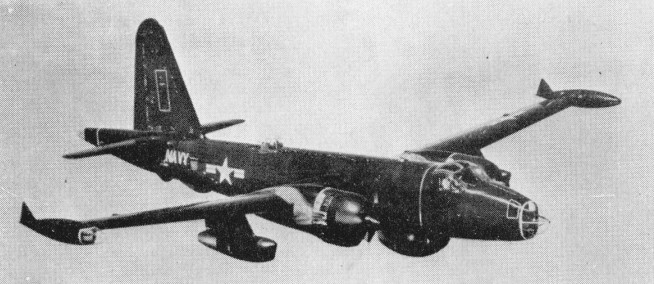
The first US Navy contract for two XP2V-1 Neptune maritime-reconnaissance bombers was placed in April 1944.
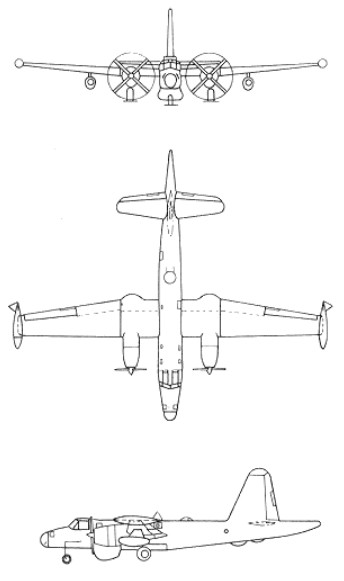
The P2V / P-2 has mid-set unswept wing, unswept tail surfaces, and conventional control surfaces. The ailerons drop 10 degrees when the Lockheed-Fowler flaps are fully extended. The tricycle undercarriage has a single wheel on each unit with the nosewheel retracting rearward and mains forward into the engine nacelles.
The first prototype flew on 17 May 1945. From then Lockheed received contracts for the P2V-1 to P2V-7 versions which were subsequently redesignated in the P-2 category.
Last versions in operational service were the P-2E (formerly P2V-5) which introduced the glazed nose, MAD tailboom, Julie/Jezebel ASW systems, etc, and later fitted with auxiliary underwing turbojets; SP-2E, as for the P-2E but with modernised equipment; P-2H, the first version to introduce auxiliary underwing turbojets and incorporating equipment and detail changes; and the SP-2H, as for the P-2H but with modernised equipment. These served with the Argentinian Navy (P-2H), Australian Air Force (SP-2H), Brazilian Air Force (P-2E), French Navy (P-2H), JMSDF (P-2H, and Kawasaki P-2J), Netherlands Navy (SP-2H), Portuguese Air Force (SP-2E) and the US Navy (SP-2H).
The USA supplied Britain with P-2 Neptune under the Mutual Defence Aid Pact. British Neptunes served in four squadrons from 1952 to 1957.
Truculent Turtle
In 1946 US Navy Neptune ‘Truculent Turtle’ flew non-stop 11,229 miles from Perth, Australia, to Columbus, Ohio.
The P 2H Neptune was a variant used by the Maritime Patrol Command of the Canadian Armed Forces.
On 6 November 1951 a Lockheed P2V Neptune from VP-6 Squadron of the US Navy was shot down over the Sea of Japan near the Soviet naval base at Vladivostok. The Neptune, with a crew of 10 on board, was to have reconnoitred the weather near the Siberian coast. On 18 January 1953 an American P2V-5 Neptune maritime reconnaissance aircraft was shot down by Chinese MiG fighters near (over?) the coastal town of Swatou, opposite Taiwan. All thirteen crew were killed. The number of occupants appears to be a little on the high side for a normal patrol flight. In those days it was not unusual for American aircraft to drop secret agents over the People’s Republic of China. Such ‘cover-flights’ were usually flown from Nationalist Chinese Taiwan. On 4 September 1954 the third Neptune went down. A P2V-5 of the American Naval Squadron VF-19 was shot down by two Soviet MiG-15 over the Sea of Japan, about 40 miles from the Siberian coast. The Neptune, originating from Atsugi airbase in Japan, forced-landed in the sea after the attack. Nine of the ten crew escaped and were rescued later. On 22 June 1955 Soviet jets attached an American P2V-5 Neptune from Patrol Squadron VP-9 over the Bering Strait. With the starboard engine on fire the Neptune had difficulty in fore-landing near Gambell on St. Lawrence Island, barely 60 miles / 100 km from the Soviet coast but United Stated territory. Three crew members were injured during the Soviet attack. Washington demanded compensation of $724,947 but later accepted a Soviet offer of half that.
A small number of P2V 2 and P2V 7 Neptunes were in service with ski landing gear for operations in the Antarctic.
P2V-7 Neptune
Kawasaki developed from the Lockheed P 2H Neptune a new ASW and maritime patrol bomber which has the designation P 2J. First flown in July 1966, the P-2J ¬differed from the P-2H in having a lengthened fuselage, and 2,850 ehp General Electric T64-1HI-10 turboprops replacing original piston engines, plus underwing 3,085 lb st (1400 kgp) J3-1H1-7C turbojets.
Entering service with the JMSDF in 1969, the last of`82 production aircraft was delivered in 1979. Sixteen P2V-7 were supplied from the USA before Japanese production began. Armament of the P 2J comprises up to 8,000 lb (3,628 kg) of bombs, depth charges, or tor¬pedoes carried internally, and 16 5 inch rockets underwing.
An approach in Vietnam was the monitoring of electronic sensors on the ground, the signals being received by the AP 2E Neptune.
Between 1945 and 1962, 1195 were manufactured.
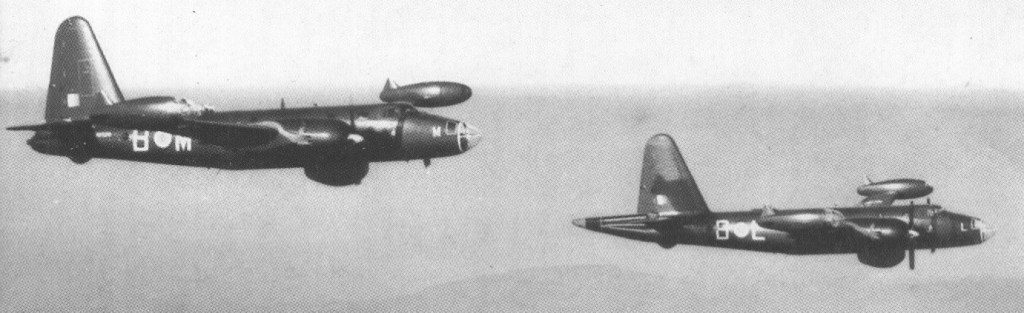
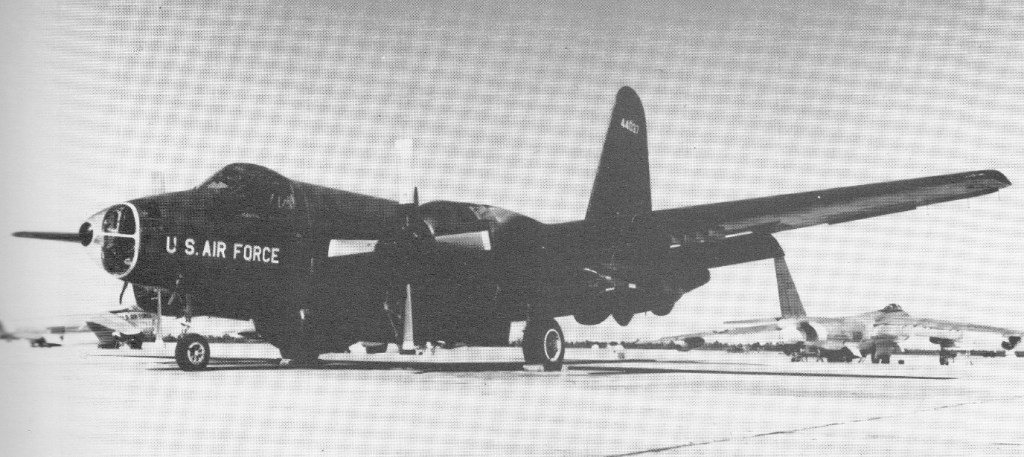
The CIA purchased seven Lockheed P2V-7U Neptunes for the USAF for clandestine missions along the Iron Curtain and beyond. The US Navy had not wished to be involved but the Navy bought the aircraft and the USAF operated them, with USAF markings. The USAF stated at the time they were purchased as RB-69 radio trainers.
RB-69
The RB-69 were converted by Lockheed into multi-purpose spying aircraft. They were able to perform low-level photographic reconnaissance, and with advanced ELINT equipment, electronic surveillance flights. Agents could be dropped through a panel in the belly, and tens of thousands of pamphlets could be dropped. Flights were planned from Eglin Air Base in Florida. The USAF Neptunes were observed from 1957 in Taiwan, in Japan, and on Wiesbaden airbase in West Germany. From Wiesbaden the blue-black RB-69 flew with a number of additional bulges and with two pencil-shaped antennas alongside the fuselage. The aircraft carried the first sideways-looking radar system and operated until modified to ordinary SP-2H Neptunes for anti-submarine warfare.
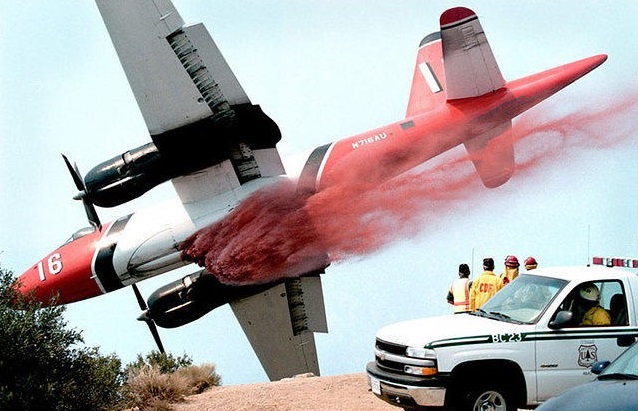
Hawkins & Powers enveloped civil conversions of C-130 and P2V-7 under TC A19NM, A30NM, and A34NM in the Restricted category as borate bombers for forest fire control.
P-2 Neptune Engines: 2 x Wright R-3350-32W, 2575kW Max take-off weight: 36191 kg / 79788 lb Empty weight: 22592 kg / 49807 lb Wingspan: 31.7 m / 104 ft 0 in Length: 27.9 m / 91 ft 6 in Height: 8.9 m / 29 ft 2 in Wing area: 92.9 sq.m / 999.97 sq ft Max. speed: 648 km/h / 403 mph Ceiling: 6800 m / 22300 ft Range w/max.fuel: 5930 km / 3685 miles Armament: 2 x 12.7mm machine-guns, bombs, missiles, torpedos Crew: 7
P2V-5 Neptune Engines: 2 x Wright, 3250 hp. Wing span: 102 ft 0 in (31.08 m). Length: 81 ft 7 in (24.87m). Height: 28 ft 1 in (8.56 m). Max TO wt: 76,152 lb (34,542 kg). Max level speed: 341 mph ( 549 kph).
P2V Neptune Length: 91.667 ft / 27.94 m Height: 29.331 ft / 8.94 m Wingspan: 103.904 ft / 31.67 m Max take off weight: 80085.6 lb / 36320.0 kg Max. speed: 309 kts / 573 km/h Service ceiling: 22014 ft / 6710 m Range: 3202 nm / 5930 km Engine: 2 x Wright R-3350-32W, 3452 hp Crew: 7 Armament: 3630kg
P2V-7 Neptune Engines: 2 x Wright R3350-30W Turbo-Cyclone 3,250 hp, 2 x Westinghouse J34 turbojets, 3600 lb Wingspan: 103 ft. 10 in Length: 91 ft. 8 in. Height: 29 ft 4 in Wing area: 1000 sq.ft Empty weight: 49,808 lb Loaded weight: 72,000 lb Fuel capacity: 1832 gal Opt bomb bay fuel: 583 gal Crew: 7 Max speed: 421 m.p.h. Ceiling: 31,000ft Service ceiling: 22,000 ft Range: 3,700 miles at 175 mph at 1000 ft Armament: 2x.50 in. machine-guns later 4 x 20mm canon Bombload: 2×294 mm. rockets or 8,000 lb; plus 16 x 5-in. rockets under wings.
AP 2E
Kawasaki P 2J Wing span is 97 ft 8.5 in (29.78 m). Max cruise: 250 mph (402 km/h).
Lockheed’s Advanced Development Projects organisation at Burbank (ADP), more commonly known as ‘The Skunk Works’, had stealth projects accelerated in 1977, and the Lockheed design was airborne from Groom Lake airfield, on the Nevada test range, by early 1978, flown by ADP chief test pilot Bill Park. Although only half the size of the F-117A, this aircraft’s configuration was broadly similar, and by the end of 1978, Lockheed had received a USAF contract to develop a full-scale production version. It contained warranties covering the aircraft’s range, weapons delivery accuracy and radar cross section.
Promising XST test results led to the development of two scaled-up YF-117A-LO prototypes which were followed by 57 production F-117As ordered in batches during the fiscal years 1980 to 1986 plus 1988. The first pre-production aircraft flew for the first time on 18 June 1981, and the first F-117A was handed over to the USAF in August 1982.
The programme was directed from AFSC’s Aeronautical Systems Division (ASD) by General Richard Scofield, who later moved on to become the B-2 programme director. According to Ben Rich, head of Lockheed’s ADP, the F-117A was developed in significantly less time and for less cost than comparable fighter aircraft. Using the streamlined management methods for which the Skunk Works is famous, ADP and ASD personnel “guided the programme through every step in a non-adversarial, problem-solving atmosphere”. At some stage of the process, the codename Senior Trend was adopted.
Although the F-117 is a radical design, every opportunity to minimise risk was taken. A number of components and systems were adopted from existing aircraft rather than designed from scratch, and this inspired programme managers to approve low rate production concurrent to full scale development. Most importantly, the quad-redundant digital fly-by-wire flight control system from the GD F-16 was incorporated. This allowed artificial stability and, therefore, much greater freedom to maximise the aircraft’s shape for stealth. The ejection seat also came from the F-16, while the environmental control system was from Lockheed’s own C-130 Hercules. Brake hydraulics were from the Gulfstream III business jet, while many avionics black boxes were purchased “off the shelf”. Finally, General Electric produced a non-afterburning version of the F404 designated the F1D2. This produces about 12,000 lb st (53,43 kN).
All the F-117s were manufactured at the Skunk Works’ Burbank headquarters before being trucked or flown in sections to Groom Lake for final assembly and test flights. On 15 June 1981, Skunk Works’ test pilot Hal Farley flew the first F-117A. This was a pre-production machine which was to crash a year later (21 June 1982) near Groom Lake while Ken Dyson was at the controls: he survived. The first aircraft destined for the customer was flying in early 1982, and deliveries to Tonopah began later that year. Lockheed received a second contract which increased the number of F-117s on order to 59, and these were completed at a rate of up to eight aircraft per year throughout the ‘eighties. The last aircraft was delivered on 12 July this year, two months ahead of the original schedule. The stealth fighter has been worth $6.265 billion to Lockheed and other contractors, of which $2 billion was spent on development. These are the actual dollar amounts that have been spent over the life of the programme to date, ie, the “then-year” dollar cost. The flyaway cost per aircraft is $42.6m.
The US Air Force formed the 4450th Tactical Group at Nellis AFB in 1980, and began recruiting pilots and groundcrew for the new aircraft. The pilots were nearly all drawn from the tactical fighter community (the 4450th reported direct to Tactical Air Command headquarters at Langley AFB until 1985). A minimum of 1,000 hours of mainly fighter time was required. The unit’s first aircraft were 20 LTV A-7D Corsair II attack aircraft which could be flown during daylight hours, unlike the “Black Jet”. They were to play an important role in maintaining pilot proficiency. In the first few years of operations, F-117 pilots were getting less than 10 hours per month in the aircraft. Despite this, an initial operational capability on the stealth fighter was achieved at Tonopah in October 1983 by the 4450th Test Squadron.
But on the night of 11 July 1986, an aircraft crashed outside the Nevada range, near Bakersfield, California, killing the pilot. In the first case, Major Ross Mulhare flew article number 792 into a hillside. Such was the extent of the security cordon thrown around the wreckage that most observers soon concluded that a stealth aircraft had crashed. Within a month, reports surfaced that about 50 “F-19 Stealth Fighters” were already fully operational at Tonopah. In fact, it was to be another three years before this number of the classified aircraft was to be in service, and the nature of the F-19 – if it exists – remains a mystery. The Pentagon has not explained the out-of sequence F-117 designation, six numerals beyond the last known previous allocation, F-111.
The second fatal crash in October 1987, may have been caused by pilot fatigue. In the second, Major Michael Stewart crashed 815 into gently sloping desert terrain near Tonopah on the night of 14 October 1987. No distress calls were made and accident investigators could find no mechanical cause. Both men were considered excellent fighter pilots. But there was little or no moonlight on either occasion and spatial disorientation may have been another factor. Despite the difficulties, the build-up continued. Tactics were constantly refined, although portions of the flying envelope were still being explored as late as 1989. A second unit, the 4451st Test Squadron, achieved operational status in January 1987, while a third unit, the 4452nd Test Squadron, was devoted to training.
After being operational for nearly six years, the US Air Force lifted, in April 1989, the veil of secrecy over the F-117 programme. The US Air Force had rotated its personnel in and out of the F117 operating unit on three-year tours throughout that time. Based at the remote Tonopah Airfield, at the edge of the Nevada Test Range, the stealth fighter was flown only at night to preserve secrecy. The USAF had spent over $295m developing the run-down Tonopah airstrip into a modern fighter base, complete with 12,000-ft (3 660-m) runway, 54 individual hangars for single aircraft and some of the most sophisticated security systems ever seen outside Fort Knox.
Officially, nothing had been said since the Pentagon’s brief admission, in 1980, that stealth aircraft were being test-flown.
Once the aircraft’s existence had been officially acknowledged – and a single, deliberately misleading photograph released – daytime flights began and new pilots no longer had to face the prospect of soloing on the aircraft at night. There are no two-seat conversion trainers, but a ground simulator has been in use at Tonopah for the last few years, built and operated by CAE Link. Now that daytime flying was possible, the unit was able to dispense with the A-7D Corsairs, trading them for eight Northrop T-38 Talons. These are used by instructor pilots in the training squadron who can now fly ‘chase’ as newcomers make their first flights in the F-117. The T-38s are also used for proficiency flying, but only a quarter of the unit’s pilots are dual qualified on both types. Once posted to one of the two operational squadrons, pilots begin night-flying in earnest. A combat-ready F-117 pilot still flies two-thirds of his sorties at night. He gets from 15 to 20 hours flying per month, with three to four sorties each week.
In October 1989, the F-117A unit received a regular TAC “number plate” when the 4450th Tactical Group was redesignated the 37th Tactical Fighter Wing. The three squadrons became the 415th TFS Nightstalkers (ex-4450th TS); 416th TFS Ghostriders (ex-4451 st TS) and 417th TFTS Bandits. (ex-4452nd TS). Having reported to the Tactical Fighter Weapons Center at Nellis AFB since 1985, the F-117A wing commander now takes his orders from TAC’s 16th Air Force at Bergstrom AFB, Texas. In December 1989, those orders included the wing’s first operational mission – against Panama during Operation Just Cause. Apart from this confirmed excursion, the unit is rumoured to have made training deployments to the UK and elsewhere.
The radar cross section (RCS) of an airframe varies greatly with the angle of observation. The wavelength of the radar is also a significant factor. The RCS of the F-117 when illuminated from certain key frontal and rear aspects may be as little as 0.1 sq ft equivalent to a medium-sized bird. Some of the energy from an air defence radar striking an F-117 is absorbed by its coating or structure, but most is reflected as ‘spikes’ in carefully-controlled directions. Most of these directions lead away from the transmitter/receiver in question, whether it be ground-based (eg, a SAM system) or airborne in a fighter. Those spikes of energy that are returned are very narrow.
The F-117, therefore, owes most of its extraordinary shape to the need to control these spikes. The entire fuselage surface consists of flat planes or ‘facets’ set in a limited number of alignments. These limitations also define the degree of sweep for both wing and V-tail, and the wingtip and trailing edge configuration. The wing and V-tail are also faceted, to a less obvious degree. No detail has been overlooked in the effort to produce an aircraft which is fully faceted. Undercarriage and bomb-bay doors, together with canopy and sensor port surrounds, all have serrated edges conforming to the required alignments. The faceting even extends to the edges where control surfaces meet the main structure. There are six control surfaces. The wing trailing edge consists of an elevon/flaperon arrangement for roll and pitch, while the all-moving tails are rudders with no influence on the pitch axis, unlike other V-tail designs.
On the F-117, the two powerplants are buried deep in the airframe and their intakes are ‘guarded’ against radar penetration by grilles. These grilles are made of composite material, and the grid size is an appropriate fraction of the main threat radar wavelengths. They cover a much larger intake area than those on other F404-powered aircraft. The larger area presumably compensates for the restriction in airflow to the compressor face caused by the grilles. Another compensation is evident when the aircraft is manoeuvering on the ground: auxiliary blow-in doors open in the intake area immediately aft of the grilles.
In a stealth aircraft, the cockpit transparency must also prevent radar energy from penetrating to the interior. It does so by shape (divided into five flat sections) and content (a conductive coating is laminated to the plexiglass to provide an effective barrier). To protect the ports in the nose and under the forward fuselage through which the aircraft’s two primary sensors view, a different solution was required. Here, unwanted electromagnetic energy is kept at bay by a screen mesh, which evidently does not interfere with the transmission of laser and infrared energy.
Apart from faceting, the F-117 also gains stealthiness from the almost complete absence of surface discontinuity. Apart from the faceted pitot heads projecting from the pointed nose, all the other protuberances usually associated with a combat aircraft are either eliminated by removal or retraction. There are no external weapons pylons or fuel tanks. Anti-collision lights are displayed on training missions, but removed and the gaps faired over before combat. Some other lights which remain have special lenses which reduce their radar return. Aerials for radio and IFF transmissions are retractable – strict radio silence is observed during combat missions. This super-smooth finish, therefore, eliminates the possibility of a discontinuity returning radar energy to the receiver, either directly from a corner type of reflection, or indirectly through the phenomenon known as ‘creep’. This consists of a certain amount of radar energy flowing around any surface that it strikes until reaching a discontinuity from which it is reflected.
Large fairings aft of the national insignia in the mid-fuselage area, and foot-long cylinders extending beneath the fuselage immediately aft of the undercarriage are radar reflectors which are carried when the aircraft is operating in controlled airspace so that air traffic control radars can actually track the “Black Jet”.
Contrary to some of the early speculation, the F-117 is not a “plastic” aircraft. During the Have Blue era the all composite Windeck Eagle light aircraft was modified and tested by Lockheed for stealth potential as the YE-5A. But the problem of shielding the remaining metal parts (engine, hydraulics, undercarriage) remained, although the YE-5A did contain internal radar absorbent material (RAM) for this purpose. In the mid ‘seventies, composite manufacturing technology had not matured sufficiently for it to be a viable option for the construction of a combat aircraft. The Skunk Works decided that the primary structure of their stealth fighter could be aluminium, although extensive use would be made of RAM inserts and coatings. Significant progress has been made in the manufacture and deployment of RAM since Lockheed’s first, failed attempt to use it successfully on the U-2 in 1956. The heavy weight and limited durability of RAM coatings made them unsuitable for application to airborne vehicles in those days. Also, the range of frequencies at which they were effective was limited.
“Stealth technology does not involve a single technical approach, but rather a complex synthesis of many. Even if 1 were willing to describe it to you, 1 could not do it in a sentence or even a paragraph”. Thus spoke the US Under Secretary of Defense for Research and Engineering, Bill Perry, when the stealth programme was first unveiled in 1980. In addition to radar signature reduction, therefore, the F-117 is also designed to present minimal infrared, acoustic, electromagnetic and visual signatures.
The engine exhaust slots are about six feet (1,83 m) wide and divided by vanes into 12 separate ports. They are shielded from the ground by an upturned lip – the rearward extension of the fuselage. This lip has a somewhat jagged edge and is believed to consist of ceramic tiles for greater dispersion of heat. Even before reaching the slots, exhaust from the non-afterburning F404s is already cooled by mixing with a proportion of cool air, which enters the intake, but by-passes the compressor face, before these unusual outlets promote further rapid mixing with ambient air. The exhaust plume therefore presents only a negligible infrared target for heat-seeking missiles. The buried engine and its inlet/exhaust configuration also serve to reduce jet noise the F-117 is noticeably quieter in an overhead pass than other combat aircraft.
It carries no radar or active jamming system. Navigation is by inertial platform targeting and attack is performed by passive means alone: FLIR and laser. As for visual signature, the F- 117 employs no exotic technology to defeat the power of observation. It goes to war under cover of darkness.
The pilot has no rearward visibility whatsoever from the cockpit: “it feels like you are flying at the tip of a spear,” said one F-117A pilot. The thrust to weight ratio is no better than 0.5, and wing loading is 55 lbs/ sq ft. It is capable of high subsonic speed only. Stealth fighter pilots say that it handles like an F-15 or F-16.
There are no curved surfaces and the underside is completely flat. The prismatic forward fuselage is actually taller at 12 ft 5 in (3,78 m) than the highly swept V-tail, which extends the aircraft’s length to 65 ft 11 in (20,09 m). An uncompromised and highly swept-back wing leading edge allows a 43 ft 4 in (13,21 m) span. Maximum gross weight is officially stated to be 52,500 lb (23814 kg) – slightly more than the F/A-18, which has similar dimensions.
The F117 is a one-mission airplane: the night attack of critical, high leverage targets with pinpoint accuracy. The aircraft carries “a sophisticated INS” which appears to be the prime means of navigation. Satellite navigation using GPS is a possibility, if a small, conformal antenna has been fitted. The two large turrets housed in recesses in the nose and under the cockpit contain combined infrared and laser targeting sensors. They are known as the FLIR and DLIR (Downward-Looking Infra Red) respectively, and are wide field of view sensors. The digital avionics suite is said to be “state-of-the-art”, and based upon those in the F/A-18 which has three CRTs surrounding an information control panel and a HUD.
The weapons payload is not very great – perhaps 5,000 lb/2 270 kg – since all ordnance is carried internally in a bomb bay measuring some 16 ft (4,9 m) in length and 6 ft (1,83 m) in width. “Smart” bombs appear to be preferred: two laser-guided Mk 84 Paveway II 2,000-pounders. The imaging infrared guidance version of the GBU-15 (also based on the Mk 84) may also be an option. A submunitions dispenser designated BLU-109 is also mentioned as F-117 ordnance.
The F-117 apparently does straight and level attacks at 5,000 ft. The F-117 would conduct an attack mission cruising at an economical 20,000 ft (6 100 m) or more, it descends when approaching the target area, but only as low as necessary for the FLIR to perform satisfactorily. The DLIR’s function is to continue the imaging and designation of the target as the aircraft passes overhead. Compared with conventional low-level attacks, the F- 117 method allows targets to be detected at greater range, allows the pilot to retain broader situational awareness, and gives a more vertical bomb impact (enhancing accuracy and penetration).
The aircraft’s first combat mission to Panama was an inconclusive demonstration of its capability. The decision to employ F-117s in Operation Just Cause was a strange one. Unlike the Libyan raid, for which the F-117 was also available, there were no air defence fighters, radars or SAMs to contend with. USAF commanders said that the F-117 was chosen simply because it was considered more capable than any other available aircraft for the precision nightime delivery of 2,000-1b (907-kg) bombs. Six aircraft made a 5,200-naut mile (9 650-km) round trip from Tonopah, with multiple aerial refuellings. There were two sets of targets, each to be attacked by a pair of aircraft (the other two aircraft were backups). In the event, the ground commander called for only one target to be attacked: two F-117s were each to drop a 2,000-lb bomb in fields some 150 ft (46 m) from two army barrack blocks at Rio Hato. These were intended to disorient the occupants and distract their attention from a parachute landing of US forces which would closely follow the bomb drop.
The lead pilot was to deliver his bomb near the barracks to the left of the flight path. Number two was to use the first bomb hit as a reference point to drop his bomb near to the right barracks. But during the approach to Rio Hato, the lead pilot determined that the prevailing left-to-right wind over target might cause debris and smoke from his bomb to obscure the right barracks. He therefore announced that he was switching his attack to the right barracks, and that number two should adjust accordingly and attack the left barracks. Since the barracks were obscured by low cloud, the pilots were not able to acquire them through the FLIR or DLIR until they descended into the clear with a short distance to run. At this stage, the lead pilot apparently mistook the left barracks for the right barracks. His bomb actually achieved the required accuracy, against the target that he had originally nominated for himself. But his number two was still working to Plan B, and he therefore offset his bomb to the left of the first explosion, and missed the target area by almost 1,000 ft (305 m).
Production of 59 F-117As ended with final delivery on 12 July 1990. By July 1997 the Lockheed company set-up then included Lockheed Martin Skunk Works which undertook advanced, secret and innovative design/development, work including support and improvement of the F-117.
In January 1991 with the Gulf conflict and a major proportion of the USAF fleet (42 out of the surviving 54) were eventually based in Saudi Arabia with 415th Tactical Fighter Squadron ‘Nightstalkers’, the 416th TFS ‘Ghostriders’ and the 417th Tactical Fighter Training Squadron ‘Bandits’, all comprising the 37th Tactical Fighter Wing, one of whose aircraft dropped the very first bomb of Operation Desert Storm on 17 January 1991.
After repeated sightings by civilians, in July 2025 the US Air Force has finally acknowledged that it still operates the F-117 Nighthawk for training purposes.
Despite officially being retired from active service in 2008, the F-117 Nighthawk stealth bomber has been continuously sighted by civilians flying in the Nevada desert. After a long period of silence, the US Air Force recently acknowledged that the service continues to fly the stealth bomber, in limited numbers, largely in a testing and training role.
Stationed at the Tonopah Test Range Airport in Nevada and Groom Lake, more famously known as Area 51, multiple F-117s remain in flyable condition. The flights, originally classified and rarely acknowledged, have become more public over the last decade or so, thanks to sleuthing civilians who have sighted the aircraft multiple times—forcing the Air Force to acknowledge the truth.
The Air Force continues to operate the F-117 for several reasons. The aircraft offers a low-observable capability, making it ideal for developing and evaluating new radar systems, infrared tracking technologies, and stealth countermeasures. The F-117 can allow the United States to fine-tune its defensive abilities against adversary stealth aircraft. The F-117’s radar-evading abilities are outdated, but can still serve as an asset during exercises, simulating enemy stealth aircraft. The F-117’s stealthy adversary role is especially important as hostile states, such as Russia and China, develop their own fifth-generation fighters.
Moreover, the F-117 is most likely being used as a testbed for new stealth systems, such as radar-absorbent coatings, sensors, and possibly autonomous systems—all without risking damage or expensive modifications to more relevant and expensive aircraft like the F-22 Raptor or the forthcoming B-21 Raider. The F-117 experiments are expected to continue into the late 2020s, before gradually being drawn down.
However, despite its groundbreaking design, the F-117 had limitations. Most notably, the aircraft could not be exposed to moisture or rain, which would degrade its radar-absorbent materials (RAM). That limited the situations in which the F-117 was deployable. The aircraft also lacked defensive countermeasures, relying instead on precise mission planning and support from other aircraft. And when an F-117 was shot down by a surface-to-air missile over Serbia in 1999, the world saw that the invisible aircraft was not invincible.
F-117A Nighthawk Engines: 2 x General Electric F404-GE-F102 non-afterburning turbofan, 5400kg / 24 kN Length: 65 ft 11 in (20.3 m) Height: 12 ft 5 in (3.78 m) Wingspan: 43 ft 4 in (13.2 m) Wing area: 105.9 sq.m / 1139.90 sq ft Empty weight est: 13.381 kg (29,500 lb) Max take-off weight: 23814 kg / 52500 lb Max level speed Mach 0.98 / 1.040 km/h (656 mph) Service ceiling: 15,240m (50,000 ft) Range: 1663 nm / 3080 km Cruise speed: 0.9M Air refuelling: yes Armament: Internal 2268 kg (5,000 lb) Unit Cost: US$45 million. Crew: One.








 All Aero