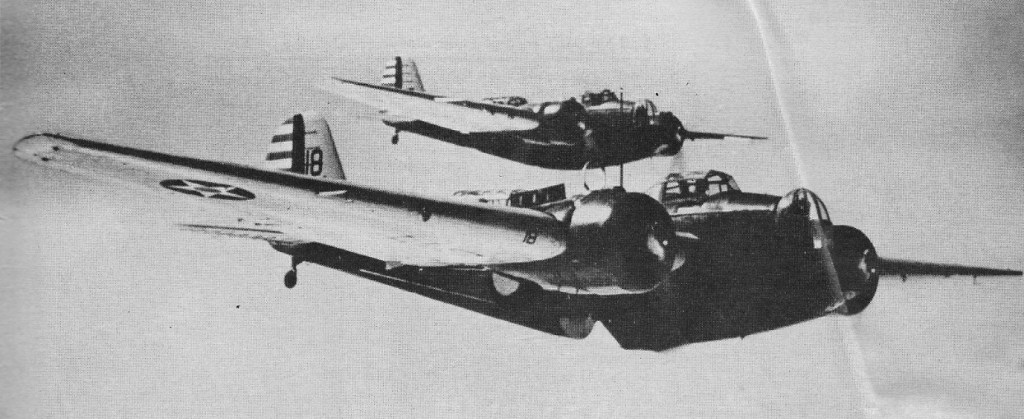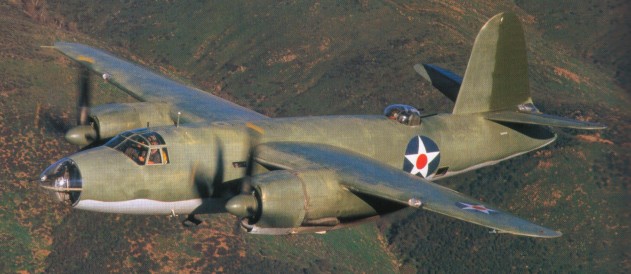
Martin 179 / B-26 Marauder / AT-23 / HM-1P

The projected design data for the Model 179 Medium Bomber were accepted by the USAAC on 5 July 1939 and the first Marauder flew on 25 November 1940. The flow of production Marauders began on 25 February 1941 and by the end of 1944 more than 5,150 had been delivered. The Marauder first went into action in the Australian theatre in April 1942.

Martin B-26 Article

The B-26 initial production version was powered by two 1,378.6kW Pratt & Whitney R-2800-5 radial engines and carried a defensive armament of five 12.7mm machine-guns in the nose, dorsal turret and tail. Normal bomb load was 907kg but up to 2,631kg could be carried in the tandem bomb bays. The B-26A was similar to the earlier version except for having R-2800-39 engines and minor changes. Similar Marauder I were delivered to the RAF and SAAF in 1942 under Lend-Lease.
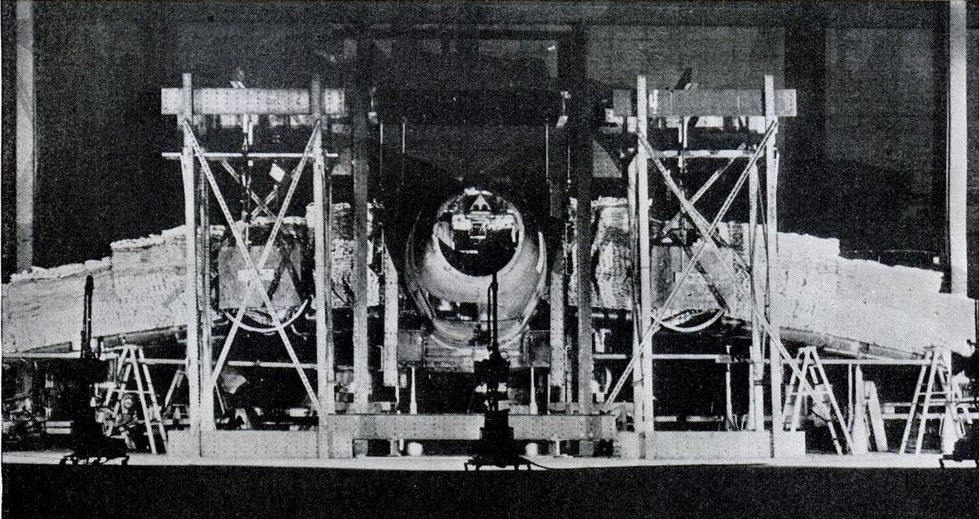
B-26 testing at 25% overload at Wright Field. A 60-ton load was reached.

The B-26B corresponded to the Lend-Lease Marauder IA and II and was produced in more than one form. Power was provided by R-2800-5 or 1,490.4kW R-2800-41/-43 engines and tail armament was increased to two guns. From B-26B-10 (Marauder II) the wing span was increased from 19.81m to 21.64m; the area of the vertical tail surfaces was also increased; and armament raised to include one fixed and one flexible gun in the nose, four ‘package’ guns on the sides of the forward fuselage, two guns in the Martin dorsal turret, two flexible waist guns, one ventral-tunnel gun and two tail guns. The front bay could carry two 900kg bombs on special carriers and use of the rear bomb bay was discontinued. The crew was increased from five to seven. The B-26B variants were the most produced of the series.
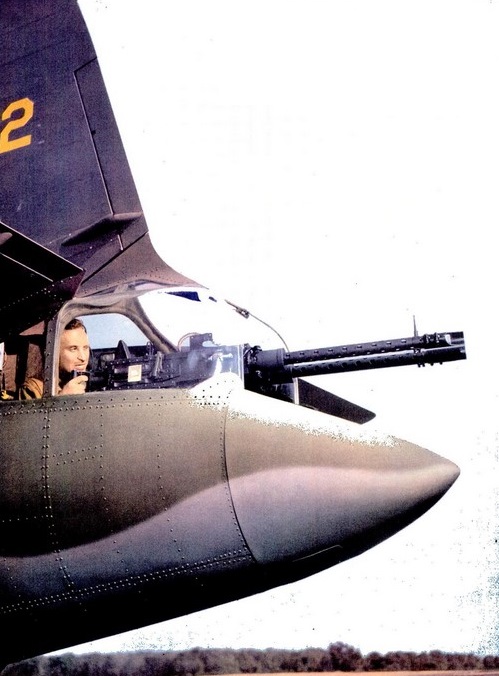
The B-26C (Marauder II) was the same as the B-26B-10 types but built at the Martin Omaha plant. The single experimental B-26D with exhaust-heated surface de-icing equipment and the single B-26E special stripped model were followed by the B-26F and G (Marauder III). These were similar to the B-26C except for having the incidence of the wings increased by 3.5 degrees, no provision for carrying a torpedo, and 11 guns fitted.
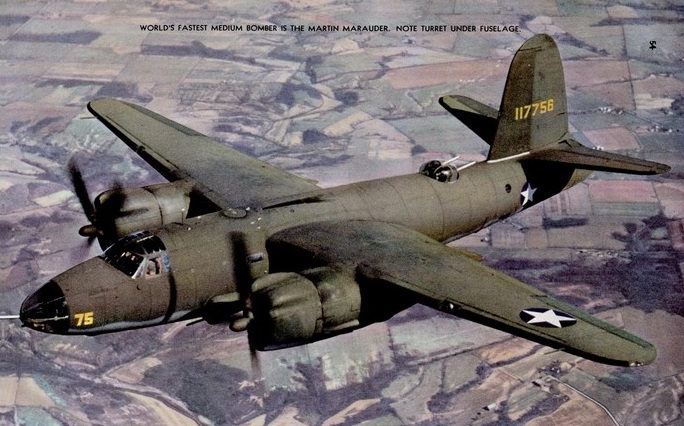
Certain examples of earlier B-26 were stripped of armament and adapted for training and general utility duties, particularly high-speed target-towing. These were originally known as AT-23 but were subsequently redesignated TB-26. A number of TB-26G were also built. The designations JM-1 and JM-2 applied to stripped versions of the B-26C and B-26G respectively, used by the US Navy for target-towing and other general utility duties. The JM-1P was equipped for photographic reconnaissance.

Gallery

Model 179
Engines: two 1,378.6kW Pratt & Whitney R-2800-5 radial
Wing span: 19.81m
Armament: 5 x 12.7mm machine-guns
Normal bomb load: 907kg
Max bomb load: 2,631kg

B-26A / Marauder I
Engines: two R-2800-39
Wing span: 19.81m

B-26B / Marauder IA
Engines: two R-2800-5 or 1,490.4kW R-2800-41
Wing span: 19.81m
Armament: 6 x 12.7mm machine-guns

B-26B-10 / Marauder II
Engines: two 1,490.4kW R-2800-43
Wingspan: 21.64 m / 70 ft 10 in
Length: 27.1 m / 88 ft 11 in
Height: 6.1 m / 20 ft 0 in
Wing area: 61.1 sq.m / 657.67 sq ft
Max take-off weight: 17300 kg / 38140 lb
Empty weight: 11340 kg / 25001 lb
Max. speed: 465 km/h / 289 mph
Cruise speed: 345 km/h / 214 mph
Ceiling: 6000 m / 19700 ft
Range w/max.fuel: 1770 km / 1100 miles
Armament: 13 x 12.7mm machine-guns
Bombload: two 900kg bombs
Crew: seven.

B-26C / Marauder II
Engines: 2 x P&W R-2800-43, 1410kW
Max take-off weight: 17300 kg / 38140 lb
Empty weight: 11340 kg / 25001 lb
Wingspan: 21.64 m / 70 ft 10 in
Length: 27.1 m / 88 ft 11 in
Height: 6.1 m / 20 ft 0 in
Wing area: 61.1 sq.m / 657.67 sq ft
Max. speed: 465 km/h / 289 mph
Cruise speed: 345 km/h / 214 mph
Ceiling: 6000 m / 19700 ft
Range w/max.fuel: 1770 km / 1100 miles
Crew: 7
Armament: 13 x 12.7mm machine-guns, 1800kg of bombs

B-26D

B-26E
Armament: 11 x 12.7mm machine-guns 11 guns

B-26F
Armament: 11 x 12.7mm machine-guns 11 guns

B-26G / Marauder III
Engines: 2 x Pratt&Whitney R-2800-43 Double Wasp, 1894 hp
Length: 56.07 ft / 17.09 m
Height: 20.341 ft / 6.2 m
Wingspan: 70.997 ft / 21.64 m
Wing area: 658.003 sq.ft / 61.13 sq.m
Max take off weight: 38206.0 lb / 17327.0 kg
Weight empty: 25304.6 lb / 11476.0 kg
Max. weight carried: 13141.8 lb / 5960.0 kg
Max. speed: 246 kts / 455 km/h
Cruising speed: 188 kts / 348 km/h
Initial climb rate: 1003.94 ft/min / 5.10 m/s
Wing load: 58.02 lb/sq.ft / 283.00 kg/sq.m
Range: 956 nm / 1770 km
Crew: 7
Armament: 11x cal0.50 MG (12,7mm), 1814kg Bomb.

AT-23 / TB-26
.
TB-26B

TB-26G

JM-1
Engines: 2 x P&W R-2800-43, 1410kW
Max take-off weight: 17300 kg / 38140 lb
Empty weight: 11340 kg / 25001 lb
Wingspan: 21.64 m / 70 ft 10 in
Length: 27.1 m / 88 ft 11 in
Height: 6.1 m / 20 ft 0 in
Wing area: 61.1 sq.m / 657.67 sq ft

JM-2

JM-1P
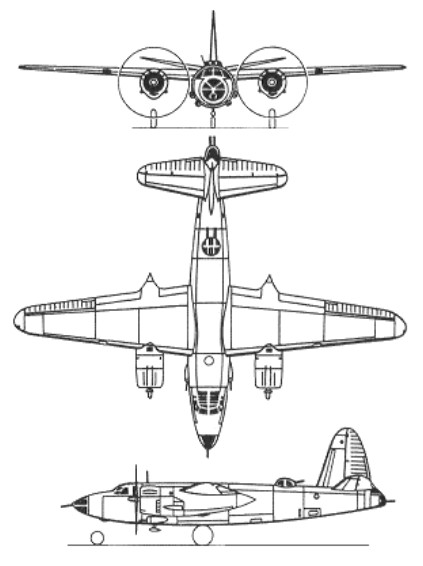
Martin B-26 Marauder

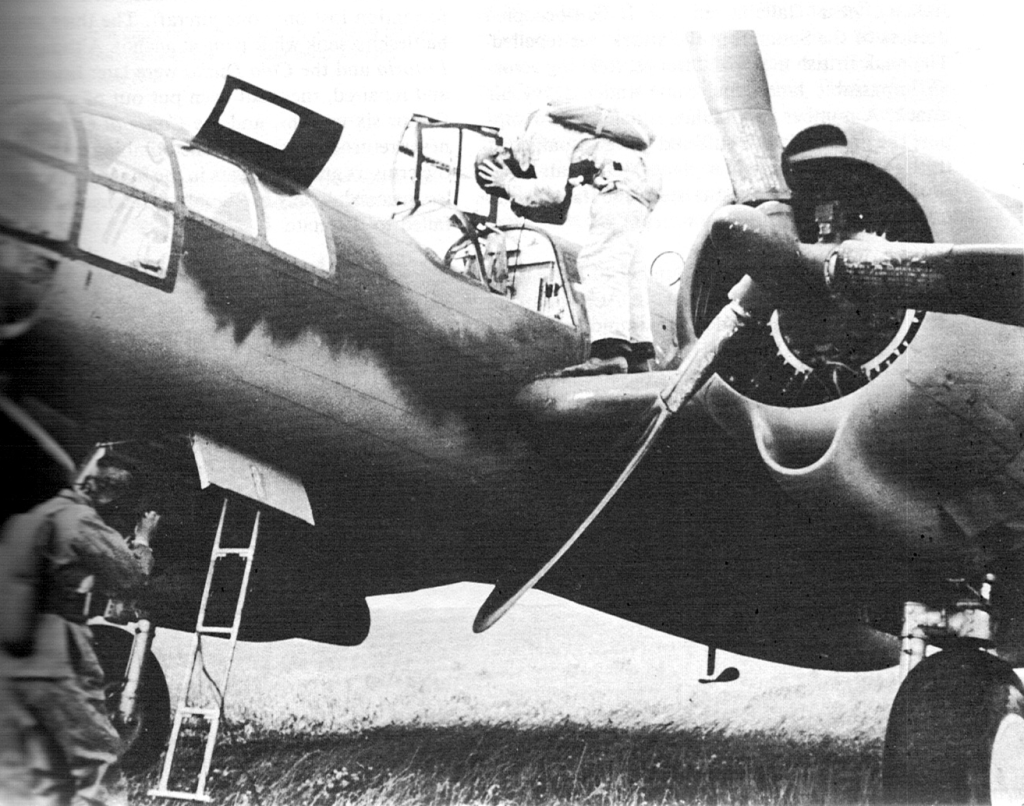
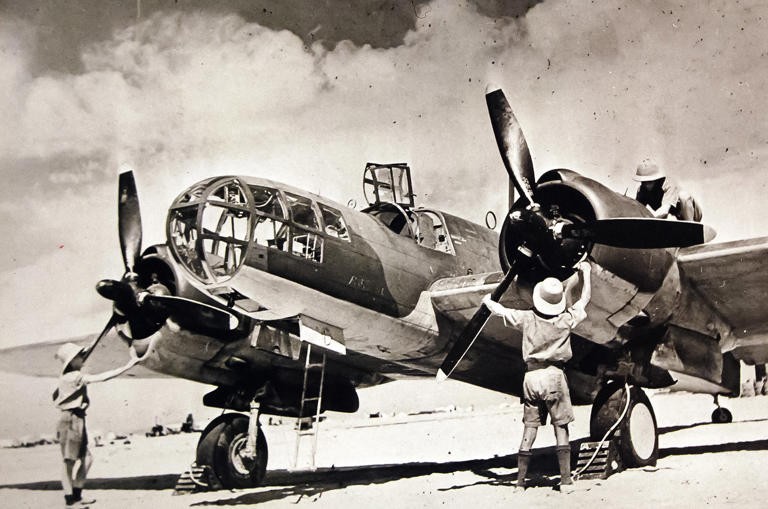
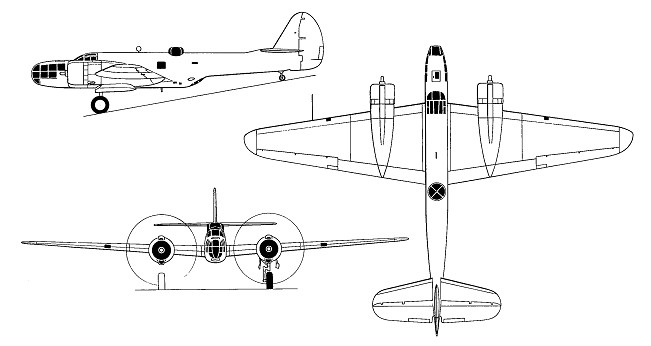
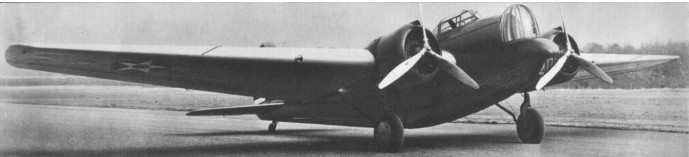
Martin 167 Maryland / XA-22

Designed to meet a US Army Air Corps specification for an attack bomber, the Martin XA-22 prototype was a twin-engine cantilever low/mid-wing monoplane with retractable tailwheel landing gear and accommodation for a crew of three. It was flown for the first time on 14 March 1939, but following official tests was rejected by the USAAC. However, the company had received a first production order for 115 aircraft from France even before the prototype had flown, but the start of delivery was delayed until the US arms embargo was lifted in October 1939; by that time France had contracted for an additional 100 aircraft. Only 140 of these Model 167F aircraft were delivered before the French armistice in June 1940, having the French designation Martin 167A-3 and seeing action against Axis forces until June 1940 and subsequently, with Vichy forces in West Africa and the Middle East, against the Allies.

With the collapse of French resistance in Europe, the outstanding 75 aircraft on order were diverted to the UK for service with the RAF and these, together with an additional 75 ordered by the RAF, were designated as Maryland Mk 1. All were powered by 783kW R-1830-SC3G Twin Wasp radial engines with single-stage superchargers. Further British orders followed for an improved Maryland Mk II with more powerful engines and two-stage superchargers, a total of 150 of this version being delivered to the RAF. Marylands were deployed initially for target towing and long-range reconnaissance, proving to be particularly valuable in this latter role, and were also used as light bombers. The first operational unit to receive the Maryland, in September 1940, was No. 431 Flight (later No. 69 Squadron) formed at Malta, and the type saw service in the Western Desert with Nos 39 and 223 Squadrons. Some 72 of the RAF’s Marylands were re-allocated to serve with Nos 12, 20, 21 and 24 Squadrons of the South African Air Force. Marylands also saw service with the Fleet Air Arm. Among the notable operations of the type were the reconnaissance sorties that preceded the successful Fleet Air Arm attack in November 1940 on the Italian fleet in harbour at Taranto. Another FAA Maryland reported that the Bismarck and Prinz Eugen were at sea in May 1941.

In 1942, South African Maryland’s performed long-range missions over Vichy-held Madagascar. One SAAF Maryland was downed but used its defensive guns to capture Vichy soldiers as prisoners on the ground.

Model 167F / Martin 167A-3 / Maryland Mk 1
Engines: 2 x Pratt&Whitney R-1830-SC3G Twin Wasp radial, 1036 hp / 783kW
Length: 46.654 ft / 14.22 m
Height: 14.993 ft / 4.57 m
Wingspan: 61.319 ft / 18.69 m
Wing area: 538.523 sq.ft / 50.03 sq.m
Max take off weight: 16810.9 lb / 7624.0 kg
Weight empty: 11214.6 lb / 5086.0 kg
Max. speed: 264 kts / 489 km/h
Cruising speed: 215 kts / 399 km/h
Service ceiling: 29495 ft / 8990 m
Wing load: 31.16 lb/sq.ft / 152.0 kg/sq.m
Range: 1130 nm / 2092 km
Crew: 3
Armament: 4x MG cal.30 (7,62mm), 2x cal.303 (7,7mm), 907kg Bomb.

Maryland Mk II
Engines: 2 x Pratt & Whitney R-1830-S3C4G Twin Wasp radial, 895kW
Max take-off weight: 7624 kg / 16808 lb
Empty weight: 5086 kg / 11213 lb
Wingspan: 18.69 m / 61 ft 4 in
Length: 14.22 m / 46 ft 8 in
Height: 4.57 m / 14 ft 12 in
Wing area: 50.03 sq.m / 538.52 sq ft
Max. speed: 447 km/h / 278 mph
Ceiling: 7925 m / 26000 ft
Range: 1738 km / 1080 miles

Martin 167 Maryland

Martin 139 / B-10 / 146 / B-12 / 166 / B-14

B-10B

The Martin Model 139 was a twin-engined mid-wing monoplane bomber developed from the experimental Model 123 of 1932. Introduced in 1934, Glenn Martin‘s B 10, the first American bomber with 200 plus mph speeds, revolutionized bomber development with retractable landing gear, cowled engines, all metal cantilever monoplane configuration, enclosed cockpit, internal bomb-bay and movable gun turrets.

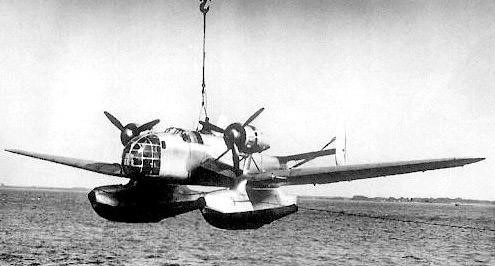
During 1934 48 Model 139 were delivered to the USAAC. Fifteen were fitted with 503kW Wright R-1820 Cyclone engines as YB-10 and 33 with 577.5kW Pratt & Whitney R-1690 Hornet engines as YB-12 and B-12A, a number of which were later converted into twin-float seaplanes for coastal patrol duties.

Martin B-10 Article

Development of the Model 139 led to numerous improvements being made, including the installation of 551.4kW SGR- 1820-G3 Cyclone engines, a Sperry automatic pilot and the addition of wing flaps, constant-speed propellers, de-icers and numerous structural and maintenance refinements. During 1935 and 1936 103 of the improved aircraft (B-10B) were delivered to the USAAC.

The 1935 Martin 146 was an enlarged B-10 with two Wright R-1820 engines. With a widened fuselage, it was the first large airplane to use Fowler flaps. One was built for Wright Field testing, NX15550, plus exports as the B-10B. Licensed production in 1936 to Fokker Netherlands was never implemented and was replaced by an order for Model 139WH to use in the East Indies.

On 1 July 1936 the bomber was released for export and was subsequently ordered by six foreign governments, the Netherlands East Indies alone receiving 120 Model 139W and Model 166 with 670.7kW Cyclone engines. The Model 166 aircraft introduced improved aerodynamics and performance characteristics and featured a continuous cockpit enclosure instead of the previous separate enclosures.

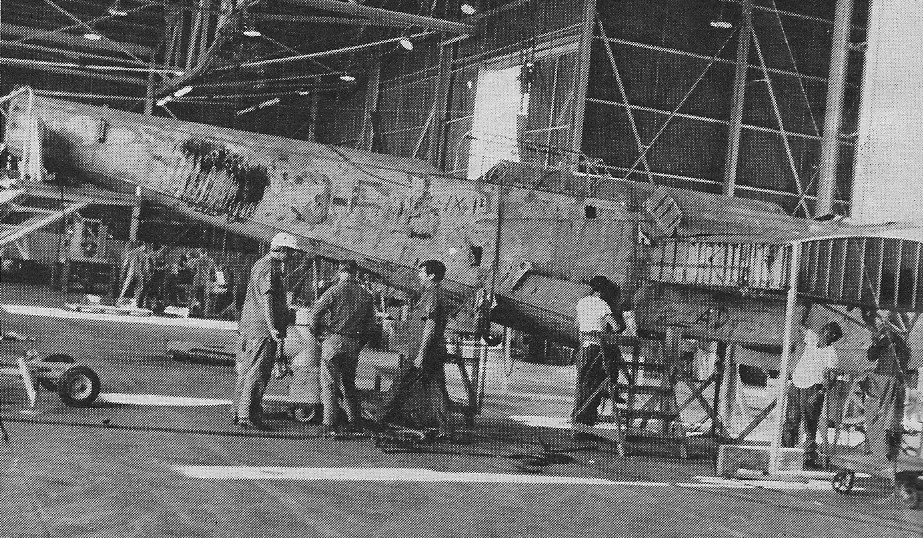
In 1973 a B-10 was located in Argentina and obtained by the USAF. At Kelly Air Force Base, Texas, members of the 96th Maintenance Squadron were rebuilding it for display in the Air Force Museum.

Kelly Air Force Base 1974

Gallery

Model 139 / YB-10
Engines: 2 x 503kW Wright R-1820 Cyclone

Model 139 / YB-12 / B-12A
Engines: 2 x 577.5kW Pratt & Whitney R-1690 Hornet

Model 139 / B-10B
Engines: 2 x 551.4kW Wright SGR-1820-33 Cyclone
Propellers: constant-speed
Top speed: 343 km/h / 212 mph
Take-off weight: 7439 kg / 16400 lb
Empty weight: 4391 kg / 9681 lb
Wingspan: 21.49 m / 70 ft 6 in
Length: 13.64 m / 44 ft 9 in
Height: 4.70 m / 15 ft 5 in
Wing area: 62.99 sq.m / 678.02 sq ft
Ceiling: 7375 m / 24200 ft
Range w/max.fuel: 2000 km / 1243 miles
Armament: 3 x 7.62mm machine-guns, 1000kg of bombs
Crew: 3

Model 139W
Engines: 2 x 670.7kW Cyclone

Model 146
Engines: 2 x Wright R-1820
Wingspan: 75’0″
Length: 50’0″
Useful load: 5057 lb
Max speed: 234 mph
Cruise speed: 170 mph
Range: 1237 mi

Model 166
Engines: 2 x 670.7kW Cyclone

Martin WF / MB-1 / MB-2 / T-1 / MT-1 / NBS-1 / MP / MTP / Aeromarine MB-2 / NBS-1 / Curtiss NBS

Martin MB

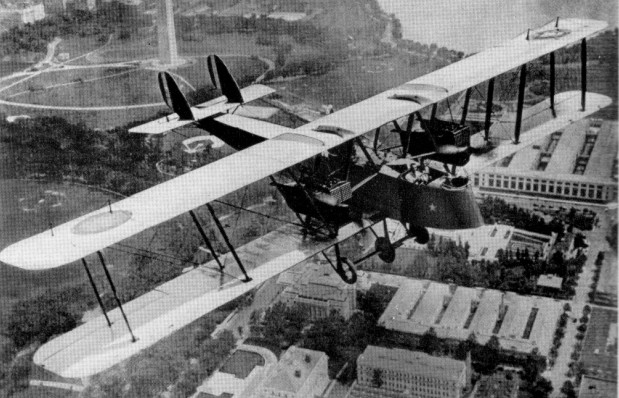
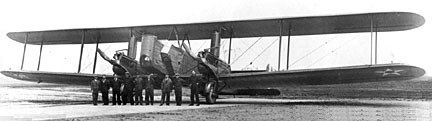
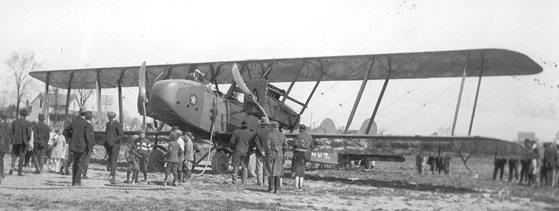
The Glenn L. Martin Company produced the first successful twin-engined aeroplane of American design, as the W. F. Night Bomber or “Seven Ton” bomber (first flown on 15 April 1918). As it is generally accepted that the first bomber built for the USAAS was the MB-1, the view can be taken that the W.F. and MB-1 are one and the same.

The MB-1 bomber first flown 17 August 1918. Contemporary reports state that the W.F. was converted into the passenger and cargo-carrying Commercial type. Again it is known that one of the ten MB-1 was so converted, although a drawing of the Commercial made in 1921 shows a rounded-nose aircraft with folding outer-wing sections, single-wheel landing-gear units and open cockpit for the pilots, while the MB-1-type Commercial was actually produced with an enclosed cockpit. Nevertheless as features of the Commercial were subsequently to be found on the improved MB-2 bombers, including the revised single- instead of double-wheel landing gear units, it can be taken that the W.F. Commercial and MB-1-type Commercial or T-1 were the same aircraft. All but one of the remaining MB-1 were produced as bombers or observation aircraft, followed by four more military MB-1 for US Government air mail services. A further two were produced as torpedo bombers for the US Navy, which designated them MTB-1.

In 1921, Martin produced its KG.1 variant of the MB-1, designed as an antiship torpedo bomber under the designation MBT. As an interim stage between the MB-1 and the later MB-2, Martin produced the MT-1 extended-wing torpedo bomber, eight of which were operated by the US Marine Corps. The MB-2 itself was powered by 313kW instead of 298kW Liberty engines and had the wing span of the MT-1 and the landing gear of the Commercial. The NBS-1 was a wood-and-canvas biplane without staggered wings, employing twin rudders on a twin vertical tail.

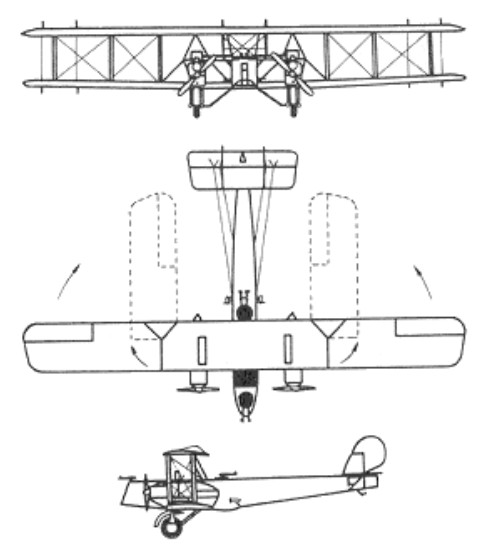
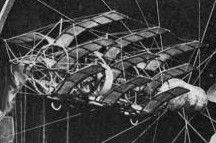
The first 20 (five MB-2 and 15 NBS-1) were ordered from the Martin Company by the USAAS in June of 1920. In the MB-1, the Liberty engines were suspended between the wings by a system of struts, but on the MB-2, the twin Liberty engines were lowered to sit inside nacelles attached to the lower wing. As compared to the MB-1, the landing gear was simplified to only two wheels. The non-staggered wings were hinged at the rear spars just outboard of the engines, and could be folded aft for storage. The armament consisted of five Lewis 0.50-in machine guns, two in the front cockpit, two in the rear, and one aimed downwards and to the rear. Bombs were carried in racks in a compartment in the fuselage, or, in the case of large bombs, on special racks or chocks directly under the fuselage. A crew of four could be carried. The NBS-1 also had a unique folding-wings system, hinged outside the engine nacelles to fold backwards for storage in small hangars.

The first flight of the MB-2 (serial number AS 64195) took place on September 3, 1920. The MB-2 was designed specifically as a night bomber, and sacrificed the high speed and maneuverability of the MB-1 for a greater bombload. Ten MB-2s were built by the Glenn L. Martin company in Cleveland, and were redesignated NBS-1 when the new Army designation scheme was introduced. Their serials were 64195/64214. These planes are best remembered today as being the aircraft which participated in the famous Billy Mitchell demonstration of aerial bombardment.

The NBS-1 was the primary bomber used by Brigadier General Billy Mitchell during Project B, the demonstration bombing of naval ships in July 1921. Six NBS-1 bombers, led by Captain Walter Lawson of the 96th Squadron operating out of Langley Field, bombed and sank the captured German battleship SMS Ostfriesland on 21 July 1921, using specially-developed 2,000 lb (907 kg) demolition bombs externally mounted beneath the fuselage. Other MB bombers and flying-boats destroyed a submarine, cruiser and destroyer.

Martin proposed to the Army that 50 more NBS-1 bombers be built. However, under the prevailing policy of the time, the rights to the NBS-1 design were owned by the Army rather than by Martin. Consequently, the Army had the right to ask for competitive bids on the project from other manufacturers. In 1921, Curtiss underbid the Glenn L. Martin Co. for the production of 50 examples of the NBS-1. One XNBS-1 was built in 1921 with two 400hp Liberty 12 engines.

In order to spread scarce military procurements among as many manufacturers as possible, contracts for 35 other NBS-1s were granted to the L.W.F. (Lowe, Willard, and Fowler) Engineering Company of College Point, New York and a contract for 25 more was granted to the Aeromarine Plane and Motor Co. of Keyport, New Jersey, in 1921.

Aeromarine contract-built twenty-five Martin MB-2 in 1921 as NBS-1; 22-201 to 22-225.

The 50 NBS-1 built by Curtiss (AS68478 to 68527) were powered by two 400hp Liberty 12 engines. The last 20 Curtiss-built NBS-1 bombers were equipped with General Electric turbosuperchargers. These were the first airplanes to use turbosuperchargers in production quantities. With these turbosuperchargers, the NBS-1 could reach a service ceiling of 25,341 feet. However, the use of turbosuperchargers in bombers proved to be premature, the early superchargers being notoriously unreliable.

Curtiss built two XNBS-4 (Model 36: AS68571/68572) in 1924, powered by two 435hp Liberty 12A. These evolved into the B-2.

Curtiss XNBS-4

One MB-2, fitted with super-chargers, attained an altitude of about 8,077m while carrying a pilot and three observers. A contemporary report states that, had it not been for the extreme cold and lack of fuel, a still greater altitude could have been reached.

The NBS-1 were built with a unit cost of US$23,485 (1920).

The first two Martin MB-2s, Air Service s/n AS64195 and AS64196, were retained at McCook Field in Dayton, Ohio, for R&D flight testing, marked with project numbers P162 and P227 respectively, as was the second NBS-1 (AS64201), marked as P222. Four Curtiss NBS-1s were also assigned to McCook.

Eight Army bombing squadrons used the NBS-1, the 11th, 20th, 49th and 96th Squadrons with the 2nd Bomb Group based at Langley Field in Virginia, the 23rd and 72nd Squadrons with the 5th Composite Group in Hawaii, and the 28th Squadron with the 4th Composite Group in the Philippines. They remained in service until replaced by Keystone bombers in 1928-29.

The Martin MP was a 1919-20 version of the bomber built for the Post Office Dept. Only six were built.

Martin MP

Gallery

Serials of NB-2/NBS-1:

10 Martin MB-2: 64195/64214
35 L.W.F. NBS-1: 68437/68471
1 Curtiss XNBS-1:
50 Curtiss NBS-1: AS68478/68527
2 Curtiss XNBS-4: AS68571 & 68572
25 Aeromarine NBS-1: 22-201/225

Operators:

United States Army Air Corps
1st Day Bombardment Group, Kelly Field, Texas (2nd Bombardment Group, Langley Field, Virginia)
11th Bomb Squadron – operated MB-2 1920-1927
20th Bomb Squadron – operated NBS-1 1920-1929
49th Bomb Squadron – operated NBS-1 1920-1929
96th Bomb Squadron – operated NBS-1 1920-1928
4th Composite Group, Nichols Field, Luzon, Philippines
28th Bomb Squadron – operated NBS-1 1924-1929
5th Composite Group, Luke Field, Territory of Hawaii
23d Bomb Squadron – operated NBS-1 1922-1929
72d Bomb Squadron – operated NBS-1 1923-1929
6th Composite Group, Albrook Field, Panama Canal Zone
25th Bomb Squadron – operated NBS-1 1922-1929

Martin MB
Engines: 2 x Liberty, 295kW
Max take-off weight: 5477 kg / 12075 lb
Empty weight: 3322 kg / 7324 lb
Wingspan: 21.8 m / 71 ft 6 in
Length: 14.1 m / 46 ft 3 in
Height: 4.3 m / 14 ft 1 in
Wing area: 99.4 sq.m / 1069.93 sq ft
Max. speed: 172 km/h / 107 mph
Range w/max.fuel: 2400 km / 1491 miles
Range w/max.payload: 772 km / 480 miles
Armament: 4-5 machine-guns, 750kg of bombs or torpedos
Crew: 2
Passengers: 12

NBS-1
Engines: 2 x Liberty 12-A, 420 hp (325 kW) each
Length: 42 ft 8 in (13.0 m)
Wingspan: 74 ft 2 in (22.7 m)
Height: 14 ft 8 in (4.8 m)
Wing area: 1,121 sq.ft (104.2 sq.m)
Empty weight: 7,232 lb (3,280 kg)
Loaded weight: 12,027 lb (5,460 kg)
Maximum speed: 99 mph (85 kn, 160 km/h) at sea level
Cruise speed: 92 mph (80 kn, 150 km/h)
Landing speed 59 mph
Range: 400 mi (345 nmi, 650 km) with 2000 lb bomb
Maximum range: 558 miles
Service ceiling: 7,700 ft (2,350 m)
Maximum ceiling: 9900 ft
Rate of climb: 391 ft/min (2.0 m/s)
Armament: 5 x .30 in (7.62 mm) Lewis machine guns
Bombload: 1,800 lb (820 kg) internal; 2,000 lb (907 kg) external
Crew: 4

Curtiss XNBS-1
Engine: 2 x 400hp Liberty 12

Curtiss NBS-1
Engines: 420hp Liberty 12
Wingspan: 74’2″
Length: 42’8″
Useful load: 4795 lb
Max speed: 99 mph
Cruise speed: 91 mph
Stall: 62 mph
Range: 430 mi
Ceiling: 8,500′

Curtiss XNBS-4 / Model 36
Engines: 2 x 435hp Liberty 12A
Wingspan: 90’2″
Length: 46’6″
Useful load: 5951 lb
Max speed: 100 mph
Cruise speed: 95 mph
Stall: 53 mph
Range: 620 mi
Ceiling: 13,000′

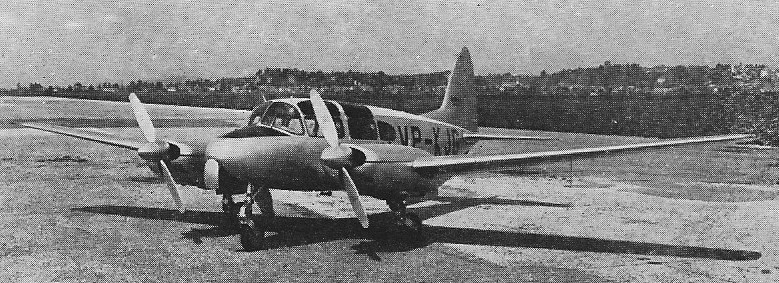
Macchi M.B.320

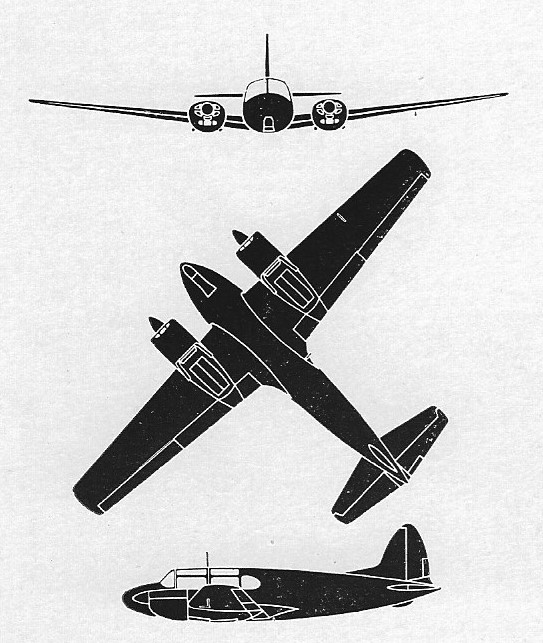
The MB.320 is a development of the post-war MB.314. Powered by two Continental E.185 engines of 185 hp driving Piaggio mechanical variable pitch or Aeromatic automatic constant speed propellers.
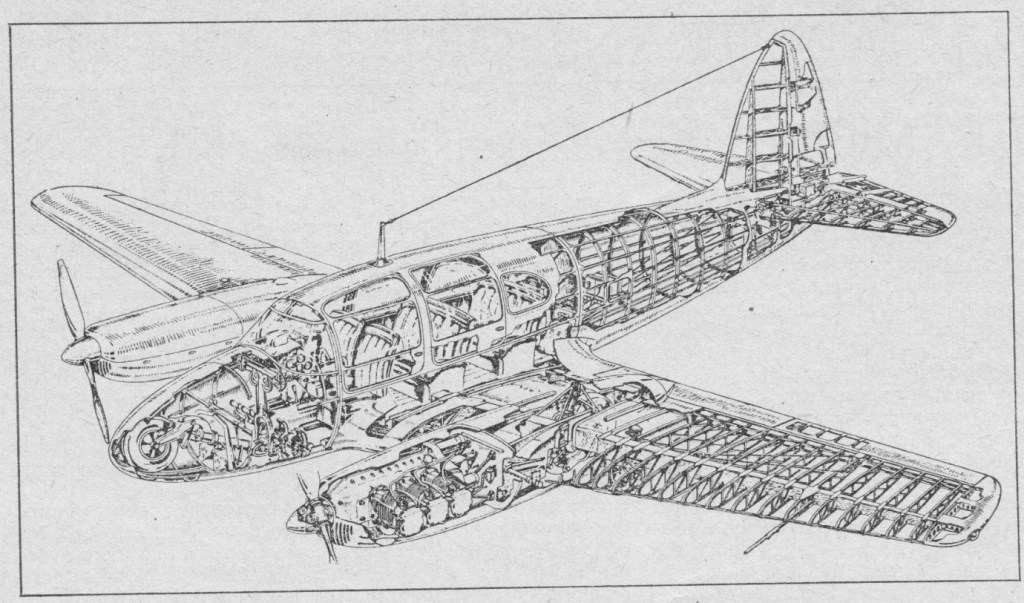
The cantilever low-wing has a NACA 2300 section and wooden single-spar covered by plywood, fitted with differential slotted ailerons and flaps. The fuselage is built in three sections with a detachable metal e cone and woo centre and rear with plywood skins. The centre section contains the cabin and baggage compartments. The wood tail section has trim tabs in the starboard elevator and rudder. The undercarriage is retractable with the fully swivelling nose wheel retracting backwards into the nacelles.
Sound proofed and air conditioned, the cabin seats six, two pilots side-by-side, and four passengers. A baggage compartment is aft of the rear seats.

Introduced in 1949, the MB.320 was produced in limited numbers.

A manufacturing licence was acquired by Societe Francaise de Constructions Aeronautiques Lignel, which planned manufacture as the VEMA-51. This licence was not taken up.

In addition to various Italian commercial concerns, three were sold to East African Airways.

One of three supplied to East African Airways.

Engines: 2 x Continental E-185, 185 hp
Wingspan: 42 ft 7 in
Wing area: 226 sq.ft
Length: 28 ft 4 in
Height: 10 ft 6 in
Empty weight: 3670 lb
Loaded weight: 5511 lb
Max speed: 186 mph at SL
Cruise: 156.6 mph
Min speed: 65 mph
ROC: 925 mph
Climb to 6500 ft: 5 min 5 sec
Service ceiling: 24,930 ft
Range: 665 mph
Seats: 6

MB.320