Mitsubishi MU-2

Solitaire

In 1959, MHI started on a utility/ executive aircraft aimed at the emerging business aviation market. It was announced in April 1962 that Mitsubishi were to build one flying prototype and a structure test airframe of a shoulder-wing twin-turboprop utility aircraft under the XMU-2 designation. A mock-up had been built and the aircraft is described as being similar in appearance to the Aero Commander, but smaller, with a circular-section fuselage. The engines were to be French or Canadian turboprops of 500 hp each.

Mitsubishi MU-2 Article

1st prototype

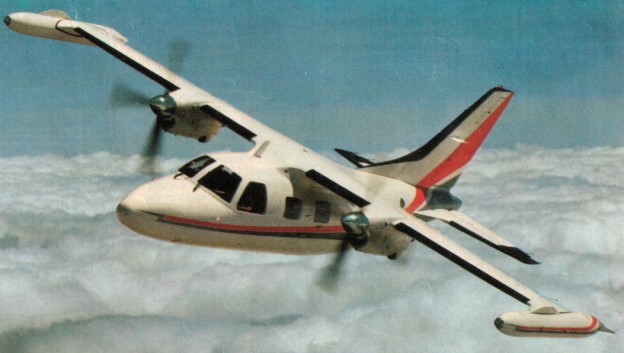
On 14 September 1963 the first of four prototypes was flown, a cantilever high-wing monoplane with a pressurised fuselage, retractable tricycle landing gear and two wing-mounted turboprop engines. The first MU 2 prototype flew pow¬ered by French Turbomeca Astazou en¬gines. The fourth airplane to be tested was fitted with an early version of the Garrett AiResearch TPE 331, and all subsequent MU 2s have been powered by TPE 331 turboprops. By 1965, the short body MU 2B was certified by the FAA for use in the U.S. and sales to American firms began. To achieve roll control when the wing required full span flaps, Mitsubishi developed a small spoiler that resides at about the two thirds chord position and extends along most of the wing’s span.

Since 1965, MHI has improved the MU 2 as the technology of general avia¬tion aircraft advanced, but with the ex¬ception of powerplants and systems, very few changes in the airframe were neces¬sary. As more power was added, a speed increase of 15 percent and a gross weight increase of 30 percent was achieved. The first significant changes to the MU 2 ap¬peared in 1968 when the aircraft was fitted with larger tip tanks and powered by 705 eshp TPE 331s.

Initial production versions were the MU-2A with Turbomeca Astazou turboprops, MU-2B with Garrett TPE331 turboprops and a similar MU-2D, an unpressurised multi-role MU-2C for the Japanese Ground Self-Defence Force, a search-and-rescue MU-2E, and the MU-2F with uprated TPE331 engines.

Models B and D were powered by 605 shp and seated 7-9 passengers. The Model F represented a boost in power to 705 shp.

Certification of the MU-2B-26A is FAA A10SW, and the MU-2B-30 JCAB 25.

The first stretched (by 1.88 m) MU 2 was the G model, which was based on the MU 2F and introduced in 1969. The Model G featured increased seating capacity for up to 11 people, and the powerplant of the MU-2F.

In 1971, the eshp of the AiResearch turbines was increased to 724 for use on the long bodied MU 2J and the short bodied MU 2K, which were introduced in mid 1972. Both utilizing 724-shp turboprops and offering seating arrangements that corresponded to Models F and G, respectively.

Subsequent versions have included the MU-2J with more powerful engines, and MU-2K combining MU-2F fuselage and MU-2J powerplant.
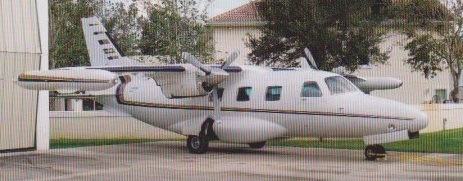
Mitsubishi MU-2J N113SD

The MU 2L and M models (variants of the MU-2J and MU-2K respectively), with their increased gross weights and added soundproofing, were an¬nounced at NBAA in September, 1974. Fitted with full span, high lift flaps and two Garrett AiRe¬search TPE 331 6 251M engines, rated at 776 equivalent shaft horsepower on the L model and at 724 eshp on the M model. Thus, both Mitsubishis have power loadings of 8.1 pounds of aircraft per horsepower for the MU 2L ¬and 7.9 lbs/hp for the MU 2M. The L and M model use AiResearch cabin pressurization systems with Hamil¬ton Standard air conditioning utilizing bleed air from the engines. The MU 2L, nine feet longer inside than the MU-2M, providing ac-commodations for a pilot and from seven to ten passengers. The MU 2L uses 178 square feet of wing area and a NACA 64A415 airfoil to produce a high speed wing that carries a load of 65 pounds per square foot.

The MU-2L and MU-2M were discontinued in 1976 and replaced by the MU-2N and MU-2P with Garrett TPE331-5-252M engines. The 90 inch, three blade propellers that were standard on MU 2Ls and Ms are replaced on the latest models by 98 inch, four¬blade props that turn at 1,591 rpm on take off, only 80 percent of the revolu¬tions previously used. Because of the slower turning propellers, the propeller tip speeds are reduced about 100 feet per second in spite of the increased prop diameter needed to produce the same thrust horsepower available on older MU 2s. The result is a dramatic 25 per¬cent reduction in perceived noise levels within the cabin and no loss in per¬formance.

The new aircraft are designated the MU 2N and the MU 2P (the latter model has the shorter fuselage). In addition to larger, slower turning propellers, both models are equipped with the Woodward fuel control units; a move which will mark a return to the fuel con¬trol units utilized by Mitsubishi in their early MU 2 models. Purchasers of L or M model Mitsubishis have the option to upgrade their new aircraft to the stan-dards of the MU 2N or MU 2P, respective¬ly, should they wish to have the slow turning engines with the Woodward fuel controllers.

The MU 21P 98 inch four blade propellers have been slowed 20 percent, to 1,591 rpm for takeoff and 1,561 during cruise. According to the factory, that reduces the interior noise level by 25 percent. A vertical fin now sprouts from the top of each tip tank, to help improve low-¬speed roll stability, and there’s a new taxi light in the nose of each tank. A new windshield can be seen in the cockpit; the new glass creates less distortion.
Spoilers replace the ailerons to good advantage; they remain equally effective at all airspeeds, eliminate adverse aileron yaw and, most significantly, permit space for almost full span double slotted Fowler flaps. When fully ex¬tended, the flaps increase wing area by 24 percent and reduce stalling speed by 24 knots. Taking off at Vmc (93 knots) allows the airplane to clear a 50 foot obstacle in 1,800 feet at gross on a standard day. In fact, the airplane’s single engine rate of climb is 760¬ fpm, at a typical weight of 9,250 pounds. The MU 2P is a short coupled machine, and this shows up during takeoff and landing. Bluntly stated, the MU 2P is lacking in pitch¬ control power, and some piloting effort is re¬quired to compensate for that shortcoming. The problem is apparently limited to the short fuselage version; the longer body MU¬2s, including the new four blade MU 2N, do not display any pitch difficulties. When leav¬ing or entering ground effect during takeoff or landing, the low mounted tailplane is af¬fected more than the high wings because of the particular relationship between them, and this produces a forward pitching force. The MU 2P, with its short fuselage and narrow center of gravity, demonstrates the effects of this nose down load more vividly than do most airplanes.

An ar¬rangement was struck with Mooney Aircraft for assembly and marketing of the MU 2, and that lasted until it was dissolved in 1970 after Mooney had been purchased by Butler Aviation. But as early as 1967, Mitsubishi Aircraft International, Inc. had been formed, and by 1970, MAI was in a position to take over both the assembly of MU 2s in San Angelo and marketing of the product. Mitsubishi Aircraft Interna-tional, Inc., a U.S. corporation based in San Angelo, Texas was responsible for assembling MU 2s and marketing them in the US and throughout the world.

The MU-2S is the Japan Air Self-Defence Force patrol aircraft, which resembles the civilian aircraft but has a shorter fuselage and bulbous radar nose.

The MU-2N and MU-2P evolved into the Solitaire (standard fuselage) and Marquise (stretched fuselage), respectively. Both airplanes have 1,000 ¬horsepower engines, wet wing fuel tanks that hold an additional 40 gallons and are certificated to 31,000 feet. The MU 2 designation will be dropped. The Solitaire succeeded the MU 2P, and the Marquise the larger, slower MU 2N.

The Solitaire is powered by two Garrett TPE331-10-501M turboprops producing 727 shp at maximum continuous power or 689 shp at recommended cruise power of 96% RPM. Each engine turns a Hartzell 98-inch four-blade prop and provides a 475-fpm single-engine rate of climb when loaded to full gross. With a cabin pressurization differential of 6.0 psi, a sea-level cabin can be maintained up to 14,000. The Marquise, which is 6 feet 2 inches longer, is powered by two turboprops, each producing 778- shp for takeoff or maximum continuous operation and 738 shp at recommended cruise power. Single-engine rate-of-climb is 410 fpm at full gross, and cabin pressurization differential is the same as the Solitaire. The long-fuselage Marquise accommodates a crew of two plus seven to nine passengers; and the Solitaire, seating a crew of two plus six or seven passengers.

Sales of the Mitsubishi MU 2 passed the 700 mark in July 1981 when the total reached 702. Since the twin turboprop business transport was introduced in 1966, 518 were sold in the USA, 20 in Canada, 58 in Latin America, 36 in Europe, nine in Africa, eight in Australia, one each in the Middle East and Asia and 51 in Japan. The last 100 aircraft were sold since September 1979.

Napier NZ Jan 84

When production ended at the end of 1983, 831 MU-2s of all versions had been built, including 73 military versions.

MU 2 prototype
Engines: 2 x Astazou II turbo-prop, 415kW
Wingspan: 10.3 m / 33 ft 10 in
Length: 10.1 m / 33 ft 2 in
Height: 4.0 m / 13 ft 1 in
Wing area: 16.6 sq.m / 178.68 sq ft
Max take-off weight: 3600 kg / 7937 lb
Empty weight: 2072 kg / 4568 lb
Max. speed: 525 km/h / 326 mph
Cruise speed: 523 km/h / 325 mph
Ceiling: 11000 m / 36100 ft
Range w/max.fuel: 2830 km / 1759 miles
Crew: 1-2
Passengers: 5-13

MU-2B-26A
Engines: 2 x Garrett TPE-331-252M, 605 shp.
Seats: 7/9.

MU-2B-60 Marquise
Engines: 2 x Garrett TPE-331-10-501M, 715 shp.
Props: Hartzell 4-blade, 98-in.
Seats: 9/11.
Length: 39.4 ft.
Height: 13.7 ft.
Wingspan: 39.2 ft.
Wing area: 178 sq.ft.
Wing aspect ratio: 7.7.
Maximum ramp weight: 11,625 lbs.
Maximum takeoff weight: 11,575 lbs.
Standard empty weight: 7650 lbs.
Maximum useful load: 3975 lbs.
Zero-fuel weight: 9950 lbs.
Maximum landing weight: 11,025 lbs.
Wing loading: 65 lbs/sq.ft.
Power loading: 8.1 lbs/hp.
Maximum usable fuel: 2700 lbs.
Best rate of climb: 2100 fpm
Service ceiling: 29,400 ft.
Max pressurisation differential: 6 psi.
8000 ft cabin alt @: 27,300 ft.
Maximum single-engine rate of climb: 410 fpm @ 152 kts.
Single-engine climb gradient: 158 ft/nm.
Single-engine ceiling: 14,800 ft.
Maximum speed: 309 kts.
Normal cruise @ 20,000ft: 295 kts.
Fuel flow @ normal cruise: 592 pph.
Endurance at normal cruise: 4.1 hrs:
Stalling speed clean: 100 kts.
Stalling speed gear/flaps down: 81 kts.
Turbulent-air penetration speed: 191 kts.
Takeoff distance (50′) 2,170 ft
Landing distance (50′) 2,200 ft

MU-2B-400 Solitaire
Engines: 2 x Garrett TPE-331-10-501M, 665 shp
Props: Hartzell 4-blade, 98-in
Seats: 7/9
Length: 33.3 ft
Height: 12.9 ft
Wingspan: 39.2 ft
Wing area: 178 sq.ft
Wing aspect ratio: 7.7
Maximum ramp weight: 10,520 lbs
Maximum takeoff weight: 10,470 lbs
Standard empty weight: 7010 lbs
Maximum useful load: 3510 lbs
Zero-fuel weight: 9700 lbs
Maximum landing weight: 9950 lbs
Wing loading: 59 lbs/sq.ft
Power loading: 7.8 lbs/hp
Maximum usable fuel: 2700 lbs
Best rate of climb: 2250 fpm
Service ceiling: 31,000 ft
Max pressurisation differential: 6 psi.
8000 ft cabin alt @: 27,300 ft
Maximum single-engine rate of climb: 475 fpm @ 150 kts
Single-engine climb gradient: 190 ft/nm
Single-engine ceiling: 16,900 ft
Maximum speed: 321 kts
Normal cruise @ 25,000ft: 309 kts
Fuel flow @ normal cruise: 526 pph
Endurance at normal cruise: 4.6 hrs
Stalling speed clean: 104 kts
Stalling speed gear/flaps down: 78 kts
Turbulent-air penetration speed: 182 kts

MU-2J

MU 2L
Engines: 2 x AiResearch TPE 331¬6 251M, 776 eshp
Max cruise pwr: 767 eshp
Prop: Hartzell 90in Constant speed, full feather with reverse pitch
Span: 39 ft. 2 in
Overall length: 39 ft. 5 in
Overall height: 13 ft. 8 in
Wing area: 178 sq. ft
Cabin length: 19 ft. 8 in
Cabin width: 4 ft. 11 in
Cabin height: 4 ft. 3.2 in
Baggage compartment: 44 cu. Ft
Seats: 8 11
Empty weight: 6,380 lbs
Standard equipped weight: 7,570 lbs
Max takeoff weight: 11,575 lbs
Max ramp weight: 11,625 lbs
Useful load (with std equip): 4,055 lbs
Payload with full fuel: 1,603 lbs
Usable fuel capacity: 366 US gal
Max cruise: 340 mph
Rate of climb at sea (10,350 lbs): 2,630 fpm
ROC SE: 675 fpm
Service ceiling (10,350 lbs): 29,600 ft
Service ceiling (10,350 lbs) SE: 15,450 ft
Stall speed: 88-115 mph
Max range 30 min res: 1450 miles
Takeoff distance over 50 ft. at 11,575 lbs: 2170 ft
Ldg dist from 50 ft. at 9,473 lbs: 1880 ft
Pressurization: 6.0 psi
Cabin alt @ 24,000 ft: 6200 ft

MU 2M
Engines: 2 x AiResearch TPE 331¬6 251M, 724 eshp
Max cruise pwr: 715 eshp
Prop: Hartzell 90in Constant speed, full feather with reverse pitch
Span: 39 ft. 2 in
Overall length: 33 ft. 3 in
Overall height: 12 ft. 11 in
Wing area: 178 sq. ft
Cabin length: 11 ft
Cabin width: 4 ft. 11 in
Cabin height: 4 ft. 3.2 in
Baggage compartment: 43 cu. Ft
Seats: 7 9
Empty weight: 5,920 lbs
Standard equipped weight: 6,864 lbs
Max takeoff weight: 10,470 lbs
Max ramp weight: 10,520 lbs
Useful load (with std equip): 3,656 lbs
Payload with full fuel: 1,204 lbs
Usable fuel capacity: 366 US gal
Max cruise: 365 mph
Rate of climb at sea (9,250 lbs): 2,840 fpm
ROC SE: 760 fpm
Service ceiling (9,250 lbs): 32,200 ft
Service ceiling (9,250 lbs) SE: 18,000 ft
Stall speed: 84-112 mph
Max range 30 min res: 1680 miles
Takeoff distance over 50 ft. at 10,470 lbs: 1800 ft
Ldg dist from 50 ft. at 8338 lbs: 1600 ft
Pressurization: 6.0 psi. Cabin alt @ 24,000 ft: 6200 ft
Wing loading: 58.8 lb/sq.ft

MU-2N
Engines: 2 x Garrett TPE 331-6-251M, 715 hp
Seats: 11
Wing loading: 65 lb/sq.ft
Pwr loading: 8.1 lb/hp
Gross wt: 11,625 lb
Empty wt: 7570 lb
Equipped useful load: 4040 lb
Payload max fuel: 1601 lb
Range max fuel/cruise: 772 nm/2.6 hr
Range max fuel / range: 1112 nm/ 4.5 hr
Service ceiling: 25,000 ft
Max cruise: 291 kt
Max range cruise: 250 kt
Vmc: 99 kt
Stall: 79-105 kt
1.3 Vso: 103 kt
ROC: 2200 fpm
SE ROC: 420 fpm @ 152 kt
SE Service ceiling: 12,000 ft
Min field length: 2200 ft
Cabin press: 6 psi.
Fuel cap: 2439 lb

MU 2P
Engines: 2 x AiResearch TPE 331 5 252M, 665 shp
Props: Hartzell four blade, full feathering, reversible
Length: 33 ft 3 in
Height: 12 ft 11 in
Wingspan: 39 ft. 2 in
Wing area: 178 sq. ft
Wing loading: 58.8 lb/sq.ft
Power loading: 7.9 lb/hp
Seats: 7
Empty wt: 7,050 lbs
Useful load: 3,420 lb
Payload with full fuel: 1,236 lbs
MTOW: 10,470 lb
Usable fuel cap: 364 USG/2,184 lbs
Max landing wt: 9,955 lb
Max ROC: 2,450 fpm
SE ROC: 475 fpm
SE climb gradient (150 kt Vyse): 190 ft/nm
Service ceiling: 32,200 ft
Certificated ceiling: 28,000 ft
SE service ceiling: 16,800 ft
Max cruise at 16,000 ft: 306 kts
Econ cruise at 24,000 ft: 272 kt
Duration at max cruise: 3.9 hrs
Duration at econ cruise: 5.9 hrs
Stalling speed, clean: 103 kts
Stalling speed, full flaps: 78 kts
Pressurization differential: 6 psi
10.000 ft. cabin at: 31,200 ft.
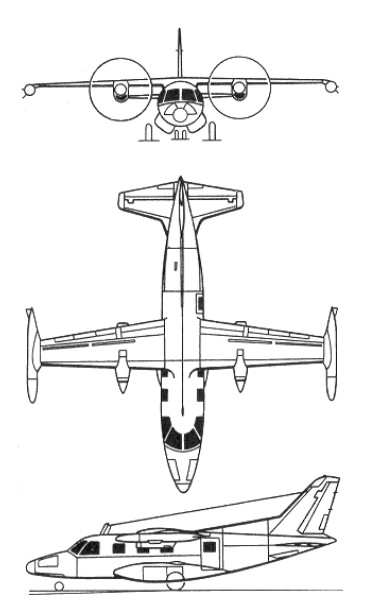
Mitsubishi MU-2

Mitsubishi F-1

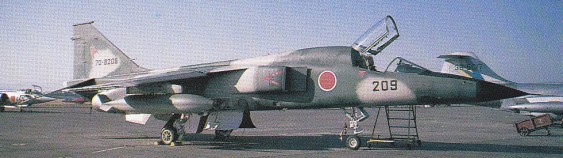
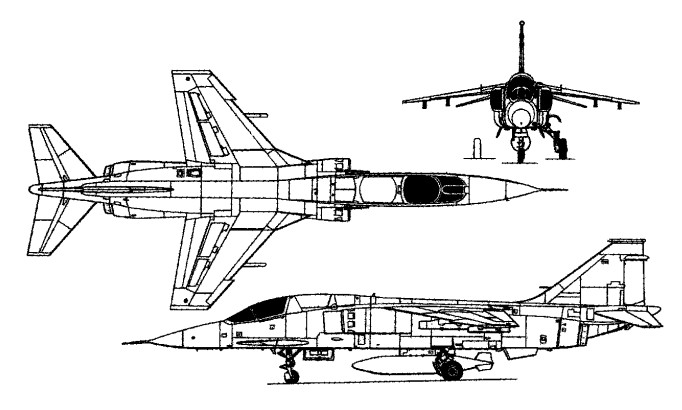
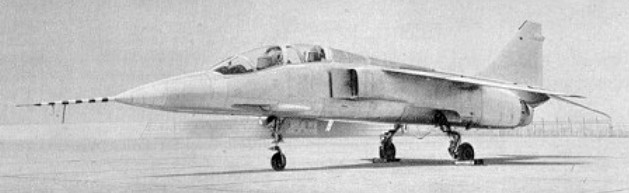
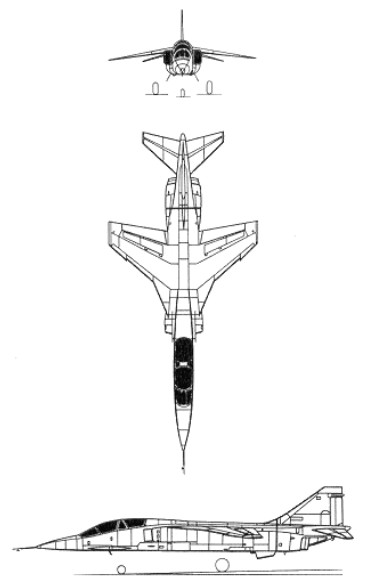
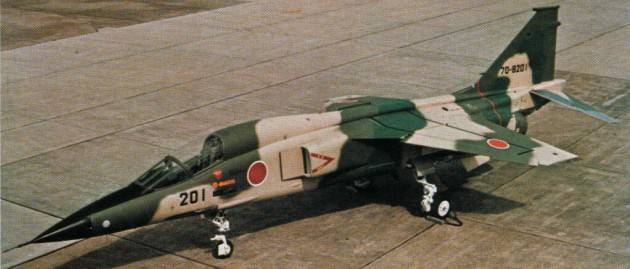
Japan’s first indigenous combat aircraft produced since the end of World War II, the F-1 originated from a 1972 decision to develop a single-seat close air support fighter from the Mitsubishi T-2 supersonic trainer. The overall performance of the latter was such that virtually no aerodynamic modifica¬tions had to be made, the principal change from the T-2 to the F-1 being the fairing over the rear cockpit for a bombing computer, inertial navigation and radar warning systems, without changing the contours. Two T-2s were converted to a single-seat fighter variant and redesignated FST-2 Kai. The first flight of this prototype (59 5107) took place on 3 June 1975, a conversion of the third production T 2 trainer.

Mitsubishi F-1 Article

The two prototypes were modified T-2s with weapons systems equipment and test instrumentation in the rear cockpits. Powered by two 7,070 lb st / 3207kg with afterburning Ishikawajima-Harima TF40-IHI-801A (licence-built Rolls-Royce/Turbomeca Adour) turbofans, the F-1 was armed with a single 20mm JM61 multi-barrel cannon in the lower front fuselage and had provision for up to 2721kg of bombs or rockets on the fuselage centreline and four wing hardpoints. Normal armament comprised two ASM-1 air-to-surface missiles and two or four AIM-9 Sidewinder AAMs.

Its primary task in the Japanese Self Defense Force was anti-shipping with the 50km range ASM-1 anti-ship missile as its primary weapon. It is equipped with the J/AWG-12 radar which has two operating modes, air-to-air and air-to-surface, and is compatible with the ASM-1 missile. It has an air-to-air capability using the AIM-9 IR seeking missile, but because of its short range this capability is only limited.

The Air Self-Defence Force purchased 77 F-1s, and the first production example (70¬8201) of the Mitsubishi F 1 was flown on 16 June 1977. First deliveries of the initial 59 aircraft ordered began in 1977 to the 3rd Squadron of the JASDF’s 81st Air Wing were made on 26 September 1977, and in April 1978 the first F-1 entered JASDF (Japanese Self Defense Force) service. All were delivered by 1987.

70 were retrofitted during 1991-93 to enable them to remain in Air Self-Defence Force service until 1999-2000. The retrofit included installation of an advanced fire control system, provision of a stronger cockpit canopy and compatibility with the ASM-2 anti-shipping missile and XGCS homing bomb.

The F-1 was scheduled to be replaced by the F-2.

Mitsubishi F-1
Engines: two 32.49 kN (7,305 lb st) Ishikawajima-Harisma TF40-IHI-801 (license built Rolls-Royce/Turbomeca Adour Mk 801A) afterburning turbofans
Wing span 7.88m (25 ft 10¼ in)
Length 17.86m (58 ft 7 in)
Height 4.39m (14 ft 5 in)
Wing area, 228 sq ft (21,18 sq.m)
Empty weight, 14,017 lb (6 358 kg)
Max loaded weight, 30,146 lb (13 674 kg)
Max speed, 1,056mph (Mach 1.6 / 1700 km/h) at 40,000 ft (12 190 m)
Service ceiling 15240m (50,000 ft)
Initial climb, 35,000 ft/ min (177,8 m/sec)
Combat radius, 346 mls (556 km)
Max range: 1100 km / 684 miles
Armament: one JM61 Vulcan 20mm multi-barrel cannon with 750 rounds
Hardpoints: 5
Bombload: 2721 kg (6,000 lb)

Mitsubishi F-1

Mitsubishi T-2 / FS-T-2

The T-2 was the first supersonic aircraft developed by the Japanese aircraft industry. It is a twin-engined two-seat jet trainer designed to meet the requirements of the JASDF. The first XT-2 prototype took to the air on 20 July 1971 and flew supersonically for the first time in level flight (Mach 1.03) during its 30th flight on 19 November 1971.

Mitsubishi T-2 Article

Armed with the 20mm Vulcan rotary cannon, production orders were placed for 92 T-2s: 28 T-2 advanced trainers, 62 T-2A combat trainers, and two as prototypes for the F-1 close-support fighter version. All of them retired from service by 1988.

Two T-2s were converted to a single-seat fighter variant and redesignated FS-T-2 Kai. The Mitsubishi FS-T2 Kai single seat close support fighter prototype (59 5107) was the first to fly on 3 June 1975, a conversion of the third production T 2 trainer. Designated F 1 in production form.

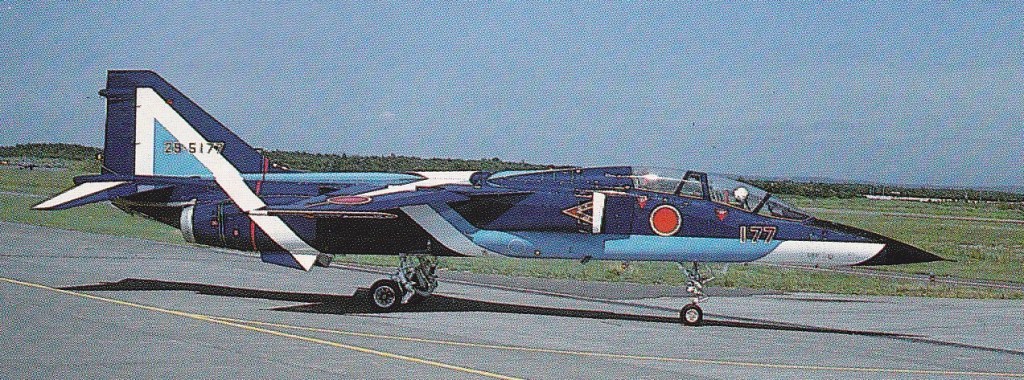
Mitsubishi T-2 29-5177 of JASDF ‘Blue Impulse’ team, Chitose, August 1982

A T-2 supersonic twin-turbofan advanced trainer modified to serve as a Control Configured Vehicle (CCV) testbed and distinguished by new horizontal canard and vertical control surfaces flew in August 1983. An extensive test programme undertaken by the JASDF/TRDI had achieved a total of 138 flights by March 1986, exploring all flight regimes including relaxed-stability and direct side force control.

Engines: 2 x Rolls Royce Turbomecca Adour turbofan, 22.8kN / 70 lb
Wingspan: 7.9 m / 25 ft 11 in
Length: 17.9 m / 58 ft 9 in
Height: 4.5 m / 14 ft 9 in
Wing area: 21.2 sq.m / 228.19 sq ft
Max take-off weight: 9650 kg / 21275 lb
Empty weight: 6200 kg / 13669 lb
Max. speed: M1.6
Ceiling: 15250 m / 50050 ft
Range w/max.fuel: 2870 km / 1783 miles
Armament: 1 x 20mm cannon, 8-12 bombs, 2-4 missiles
Crew: 2

Mitsubishi T-2

Mitsubishi Ki-109

Derived from the Ki-67 Hiryu bomber as a heavy interceptor, the Ki-109 was originally conceived in two versions, the Ki-l09Ko mounting two obliquely-firing 37-mm cannon and the Ki-l09 Otsu equipped with radar and a 15.75-in (40-cm) searchlight, the intention being that the two aircraft would work as a team. Soon thereafter the Ki-109 project was redefined as a bomber interceptor mounting a 75-mm Type 88 cannon with which it could attack its quarry while remaining beyond the range of opposing defensive armament. Converted from a Ki-67 airframe and retaining the dorsal, lateral and tail gun positions of the bomber, and the Mitsubishi Ha-104 engines each rated at 1,900 hp for take-off, the first Ki-109 prototype was completed in August 1944. The second prototype was powered by Ha-104Ru engines with Ru-3 turbosuperchargers, and it was intended that these would be installed in the final 22 aircraft of an initial batch of 42 Ki¬109s. The first series Ki-109 dispensed with the dorsal and lateral gun positions, retaining only the tail position which mounted a single 12,7-mm machine gun, primary armament being the single 75-mm cannon with 15 shells individually loaded by the co-pilot. In the event, production difficulties with the Ru-3 turbosupercharger prevented its application to any series Ki-109s, and only 20 production aircraft were completed, these having standard Ha-104 engines.

Engines: 2 x Mitsubishi Ha-104, 1,900 hp / 1425kW
Span, 73 ft 9 7/8 in (22,50 m)
Length, 58 ft 10¾ in (17,95 m)
Height, 19 ft 1 in (5,80 m)
Wing area, 708.8 sq ft (65,85 sq.m)
Empty weight, 16,367 lb (7 424 kg)
Loaded weight, 23,810 lb (10800 kg)
Max speed, 342 mph (550 km/h) at 19,980 ft (6 090 m)
Range, 1,367 mls (2 200 km)
Crew: 4
Armament: 1 x 75mm cannon, 1 x 12.7mm machine-guns

Mitsubishi Ki-109

Mitsubishi Ki-83

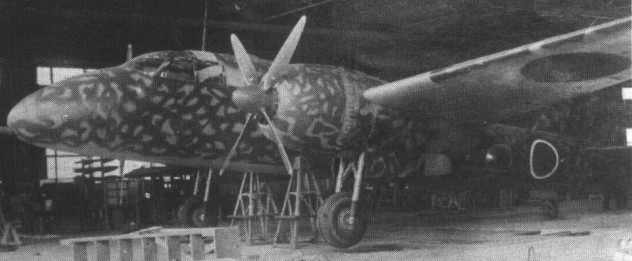
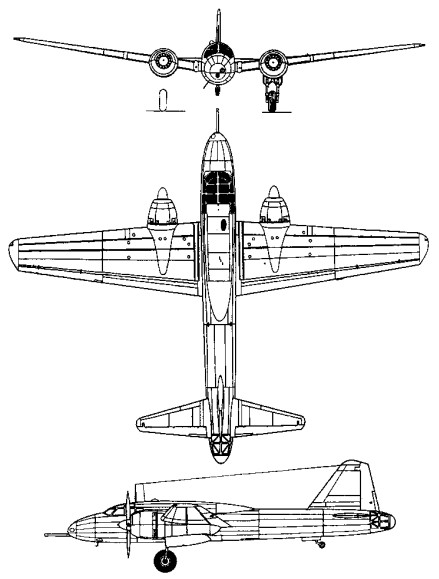
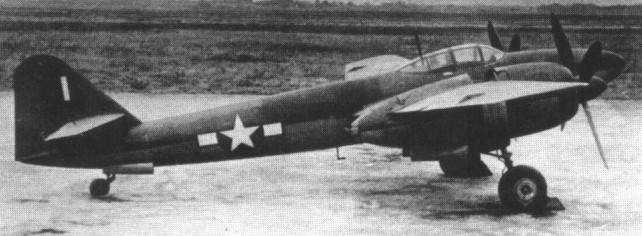
Intended to meet a requirement formulated in 1943 for an advanced two-seat long-range escort fighter. the Ki-83 was designed by a team headed by Totnio Kubo, who had previously been responsible for the Ki-46.

Aerodynamically exceptionally clean and powered by two turbo-supercharged Mitsubishi Ha-211ru 18-cylinder radials, the Ki-83 possessed an armament of two 20-mm and two 30-mm cannon.

The first of four prototypes was flown on 18 November 1944, demon¬strating spectacular performance and remarkable maneuverability for its size – a 2,200-ft (670-rn) diameter loop being executed at 403 mph (648 km/h) at 9,500 ft (2900 m) within 31 sec. However, definitive plans for the series manufac¬ture of the Ki-83 were still being finalised when hostilities terminated.

Engines: 2 x 2200hp / 1650kW Mitsubishi Ha-211-Ru
Span, 50 ft l0¼ in (l5,50m)
Length.41 ft /8 in (l2.50m)
Height, 15 ft 1¼ in (4,60 m)
Wing area, 360.8 sq ft (33.52 sq.m)
Empty weight. 13,184 lb (5 980 kg)
Normal loaded weight, 19,390 lb (8 795 kg)
Max speed. 438 mph (704 km/h) at 32,810 ft (10 000 m)
Cruise speed: 450kph / 280 mph
Normal range w/max.payload. 1,213 mls (1953 km)
Range w/max.fuel: 2175km / 1352 miles
Ceiling: 12660m / 41,550 ft
Time to 32,810 ft (10 000 m), 105 min
Crew: 1-2
Armament: 2 x 30mm cannon, 2 x 20mm cannon, 2 x 50-kg bombs

Mitsubishi Ki-83

Mitsubishi Ki-67 Hiryu

To take the place of the Mitsubishi Ki-21 ‘Sally’ and the Nakajima Ki-49 ‘Helen’, the Air Office (Koku Hombu) issued specifications for a new bomber to the Mitsubishi concern in November 1940. The work was led by Chief Engineer Ozawa on an aircraft based on the beautiful Japanese lines and powered by the new generation of Ha-100 double-row 18- cylinder radial engines.

Three prototypes of the Ki-67-I were completed between December 1942 and March 1943, the first making its initial flight on 27 December 1942. The Ki-67-I proved to be fast (though not as fast as originally specified), and extremely manoeuvrable with loops and barrel-rolls being carried out with ease in an unloaded configuration.

Although adopted for service as the Army Type 4 Heavy Bomber, such was the promise of the Ki-67-I that even the Imperial Japanese Navy was impressed, and made early representations to Mitsubishi. On 5 January 1943 Mitsubishi received an order to convert 100 Ki-49s as torpedo-bombers, with internal racks capable of handling the standard 450mm Navy Type 91 Model II aerial torpedo. These saw service with the 762nd Kokutai (air group) from the autumn of 1944 onwards. The Ki-67- I was issued in small numbers to the 7th, 14th, 16th, 61st, 62nd, 74th, 98th and 110th Hikosentais (air regiments) and saw limited action over China, Biak and Sansapor in north western New Guinea, and Sumatra in the summer of 1944.

Comparitively few Ki.67-1a were completed before being superceded by the Ki.677-1b, which continued in production to the end of the war.

Ki.67-1a

Three other manufacturers, Kawasaki, Nippon and Rikugun, were in the production team, but only completed just over 100 aircraft between them.

The type was recognized as such for the first time by the Allies in October 1944, code named ‘Peggy”, during the US 3rd Fleet’s attacks on Formosa and the Ryukyus where the Hiryu served in the 8th Hikoshidan (air division) based on Formosa under navy control. Thereafter Ki-67-Is were encountered over the Philippines, off Iwo Jima, in the strikes on the US 20th Air Force’s bases on Saipan and Tinian, and in the Okinawa campaign where it was used as a suicide aircraft.

For suicide missions the JAAF used modified Peggys known as the Ki-61-I KAI with armament removed and a solid nose packed with explosive. Only two of the more powerful Ki-67-II variant were made, production of army and navy Ki-67-Is amounting to 696.

Gallery

Ki-67
Engines: 2 x Mitsubishi HA-104 18-cyl radial, 1425kW
Max take-off weight: 13765 kg / 30347 lb
Empty weight: 8649 kg / 19068 lb
Wingspan: 22.5 m / 73 ft 10 in
Length: 18.7 m / 61 ft 4 in
Height: 7.7 m / 25 ft 3 in
Wing area: 65.85 sq.m / 708.80 sq ft
Max. speed: 537 km/h / 334 mph
Cruise speed: 400 km/h / 249 mph
Ceiling: 9470 m / 31050 ft
Range w/max.fuel: 3800 km / 2361 miles
Range w/max.payload: 2800 km / 1740 miles
Armament: 1 x 20mm cannon, 4 x 12.7mm machine-guns, 500-800kg of bombs

Ki-67-Ib
Engines: 2 x Mitsubishi Ha-104, 1900 hp
Wing Span: 22.50m / 73 ft 9.75 in
Length: 18.70m / 61 ft 4.25 in
Height: 7.70m / 15 ft 9 in
Wing Area: 65.85sq.m
Empty Weight: 8650kg / 19,069 lb
Max.Weight: 13765kg / 30,346 lb
Max speed: 537 km/h / 334 mph at 19,980 ft
Service ceiling: 9470m / 31,070 ft
Range: 2800km / 2360 mi
Armament: 1 x 20mm, 4 x mg12.7mm
Bombload: 800kg / 1760 lb
Crew: 6-8

Mitsubishi Ki-67 Hiryu

Mitsubishi MC-20 / Ki-57 / L4M1

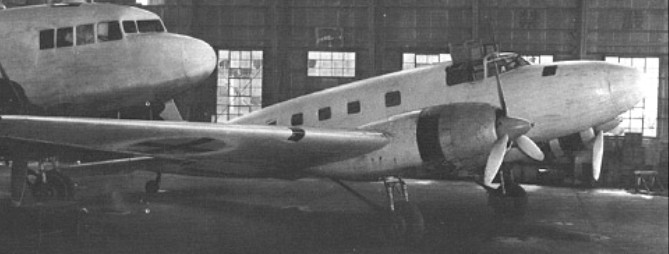
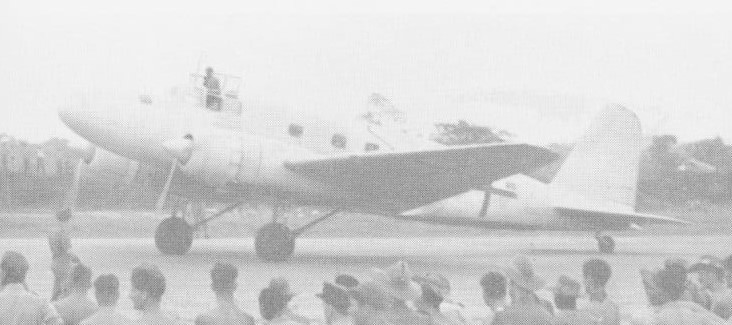
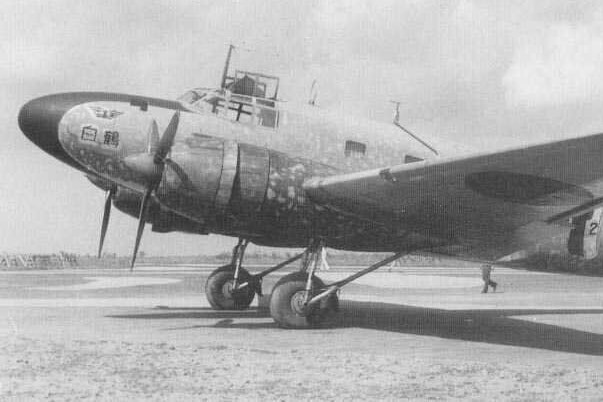
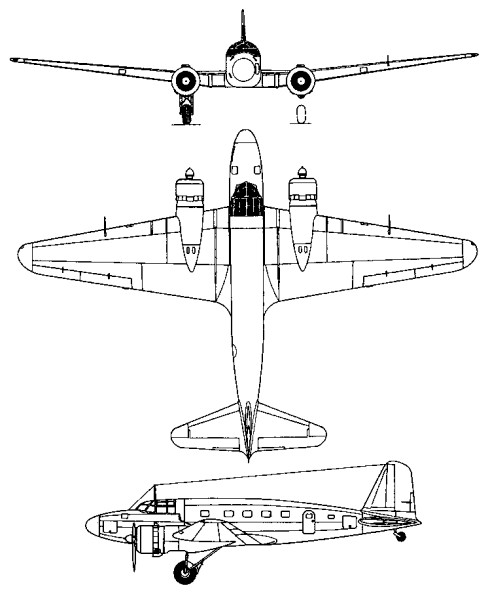
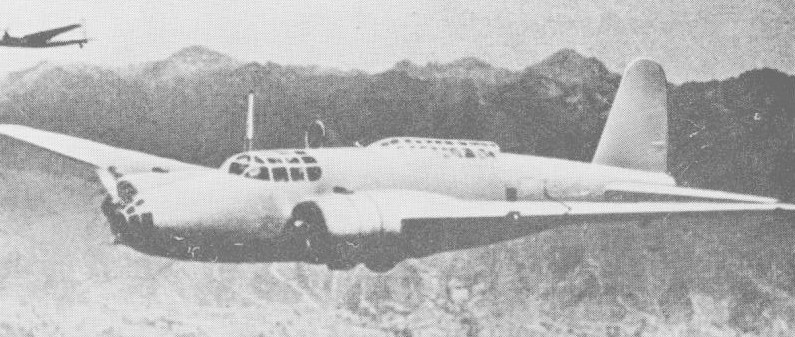
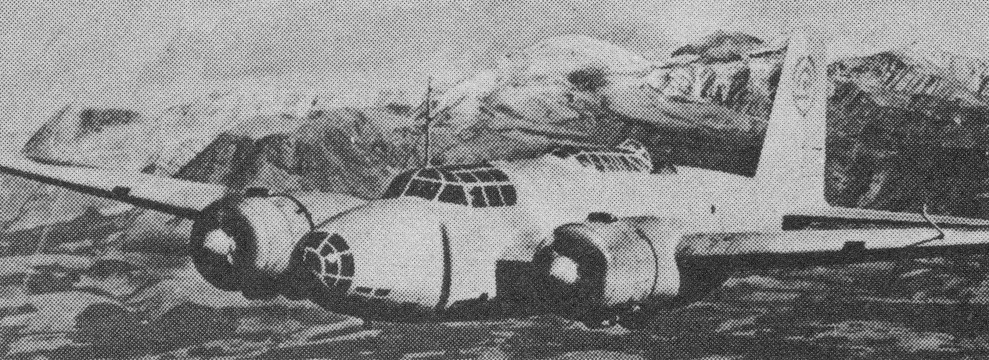
With interest shown by Japan Air Lines for a civil version of the Mitsubishi Ki-21 bomber, the company built a Mitsubishi Ki-57 prototype with the civil designation MC 20, which was flown in August 1940.

Essentially, the Ki 57 (Topsy to the Allies) was a low wing version of the Ki 21 I bomber, except for a redesigned fuselage which accommodated a crew of two and up to 11 passengers. The powerplant consisted of two 950 hp Nakajima Ha 5 Kai 14 cylinder radials. The main wheels retracted into the engines nacelles.

Following satisfactory testing the type was ordered into production in 1940 for civil and military use under the designations MC-20-1 and Army Type 100 Transport Model 1 respectively (Mitsubishi Ki-57-I), 100 series aircraft being built.

Ki.57

After 101 of these had been built, Mitsubishi in 1942 replaced this version on the production line with the Ki 57 II Army Type 100 Transport Model 2 /MC 20 II, generally similar but with 1080 hp Mitsubishi Ha 102 radials. They continued in production until January 1945, by which time 406 of this improved model had been completed.

A small number of Ki-57-IIs transferred for use by the Japanese navy were redesignated L4M1 or Navy Type 0 Transport Model 11, and all of these versions had the Allied codename ‘Topsy’.

The Ki 57 featured most notably in the paratroop attack on the airfield at Palembang and neighbouring oil refineries in February 1942.

Ki-57-II
Engine: 2 x 1080 hp Mitsubishi Ha 102, 810kW
Wingspan: 22.6 m / 74 ft 2 in
Length: 16.1 m / 52 ft 10 in
Height: 4.77 m / 15 ft 8 in
Wing area: 70.08 sq.m / 754.33 sq ft
Max take-off weight: 8173-9120 kg / 18018 – 20106 lb
Empty weight: 5585 kg / 12313 lb
Max. speed: 470 km/h / 292 mph
Ceiling: 8000 m / 26250 ft
Range w/max.fuel: 3000 km / 1864 miles
Range w/max.payload: 1500 km / 932 miles
Crew: 2
Passengers: 15

Mitsubishi Ki-57 / MC-20 / L4M TOPSY

Mitsubishi Ki-46

Ki-46-III KAI

The Mitsubishi Ki-46 was designed to meet an Imperial Japanese Army requirement of 1937 for a higher performance reconnaissance aircraft to supersede the Ki-15. The specification called for an endurance of six hours at 250mph (400 km/h), between 13,500 and 20,000 ft (4,000 and 6,000m) and a maximum speed of 375mph (604km/h) at 13,500 ft (4,000m). The man responsible for the design was Tomio Kubo, who was assisted by the Aeronautical Research Institute of the University of Tokyo.

Mitsubishi Ki-46 Article

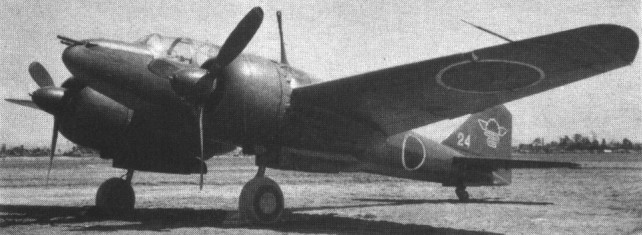
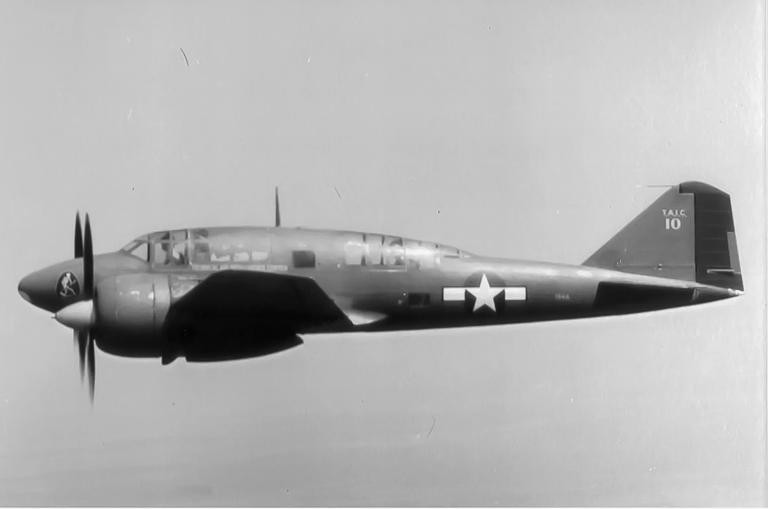
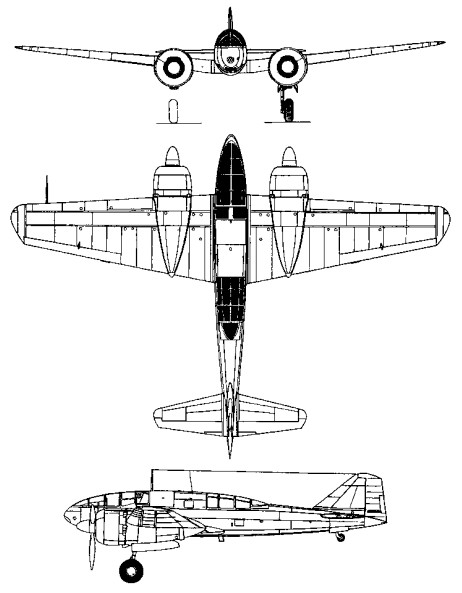
Work on the design started in December 1937, as a cantilever low-wing monoplane with retractable tailwheel landing gear, powered by two 900 hp / 671kW Mitsubishi Ha-26 radial engines. Kubo selected a small diameter fuselage with the main fuel tank located between pilot and observer, and thin section wings.

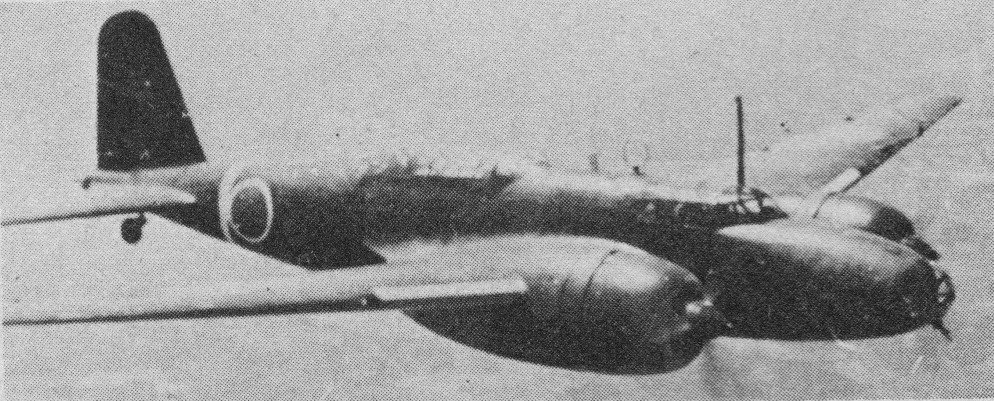
The two-seat Ki-46 prototype was flown (by Major Fujita) for the first time in late November 1939 from Kagamigahara in Gifu Prefecture, north of Nagoya. Early testing showed that maximum speed of the Ki-46 was some 10% below specification (540 km/h / 335 mph) at 4000 m / 13,000 ft), but as its speed and overall performance was better than in-service army and navy aircraft the type was ordered into production as the Army Type 100 Command Reconnaissance Plane Model 1 (Ki-46-l), later allocated the Allied codename ‘Dinah’.

The entire Model 1 production (34 were built between 1939 40) plus the prototype were delivered to the Shimshizu flying school and to a special experimental reconnaissance unit. The aircraft was known as the Shintei in Japanese service, but was soon better known to the allies under its simplified identification name, the Dinah.

The Ki-46-1 series was soon replaced by the Ki-46II, which utilised the more powerful Ha102 engines, fitted with two-speed supercharger and rated at 1,080 hp each. The increase in available horsepower meant that the performance of the II improved, maximum speed rose to 375 mph (604 kph) at 19,030 ft (5,800 m). The transition to the new series was not without its problems, vapour locks were experienced and it was only after extensive research that the cause was found. Relocation of the fuel lines around the engines and a change from 87 to 92-octane fuel seemed to cure it. Poor aileron and rudder response, overheating of the oil and an unreliable oxygen system that to crew anoxia, were all problems which had to be overcome. Another problem involved the undercarriage, due to the aircraft’s high rate of sink it was quite a common occurrence for the undercarriage to collapse on landing. Although stronger auxiliary rear struts were fitted this problem was to persist throughout the Ki-46’s operational life.

The first Model 2 appeared in March 1941, the airframe was identical with the Model 1 and production soon gathered momentum. The Type 100 was delivered from July 1941 onwards to the 18th, 50th, 51st, 70th, 74th, 76th and 81st Independent Chutais (squadrons) based in China and Manchuria. Chinese air opposition was poor and the escape capability of Ki 46 such that the sole defensive armament, a single 7.7 mrn (0.303 in) Type 89 machine gun on a flexible mounting operated by the observer, was seldom used in action.

During October 1941 Ki 46s based in French Indo China reconnoitred the Japanese army’s planned landing zones for the December invasion of Malaya. From December 1941 onwards, Ki 46s were deployed in small detachments in every army zone of operations, enjoying considerable success and remaining virtually unmolested for the first year of fighting. Such was the esteem in which the type was held that the Luftwaffe attempted to arrange licence production, and the army’s greatest rival, the navy, managed to acquire a few for its own use.

As the losses suffered by the Ki-46II units increased the Koku Hombu, in May 1942, they instructed Mitsubishi to upgrade the Ki-46-II. This was achieved with the installation of two Mitsubishi Ha 112-II engines, rated at 1,500hp each, this boosted the top speed to 404 mph (650 km/h) and increased the range to 2,485 miles and endurance by an hour. The new design was designated the Ki-46-III and with it came a whole new shape. Gone was the stepped canopy of the II series and in came a completely aerodynamic nose, with the canopy glazing extending right to the front of the aircraft in a smooth slope. The reason for the re-designed front was a simple, not just one born of aerodynamic necessity. The new engines required more fuel and the thin wing adopted in the original design allowed no room for fuel cells, it was therefore decided to fit an additional tank in front of the pilot. This tank held 52 Imp Gal (220 litres), provision was also made for the fitment of a ventral drop tank, holding 101.2 Imp Gal (460 litres). The undercarriage was beefed up and the provision for a single flexible machine gun in the rear cockpit was dispensed with.

As supply of the III series increased, some II’s were converted into three seat radio navigation trainers, designated the Ki46-II Kai, they operated with the Shimoshizu Rikugun Hikogakuko (Shimoshizu Army Flying School).

609 Ki-46-III were built, a small number being converted later as Ki-46-III KAI fighter interceptors and Ki-46IIIb ground-attack aircraft.

The Ki-46-II and the Ki46-IIKai (Kai=KAIZO “Modified”) trainer were the main production version of the Ki-46 design, with 1,093 being built.

In June 1943, the Rikugun Kokugijutsu Kenkyujo, or Army Aerotechnical Research Institute, began to study the adaptation of the Ki-46-III reconnaissance aircraft for the high-altitude interceptor fighter role. Development was actively pursued from May 1944 as the Ki-46-III KAI, or Army Type 100 Air Defence Fighter, and the Army Air Arsenal at Tachikawa instituted a conversion programme.

The nose was redesigned a new stepped cockpit canopy, and to accommodate two 20-mm Ho-5 cannon and the top centre fuselage fuel tank was removed to provide space for a Ho-203 37-mm cannon firing forward and upward at an angle of 30 deg. The two Mitsubishi Ha-112-lI engines rated at 1,500 hp for take-off were retained, and the first Ki-46-IIl KAI two-seat interceptor was completed by Tachikawa Dai-lchi Rikugun Kokushok and flown in October 1944, deliveries to operational units commencing during November. Operational results were disappointing owing to the poor climb rate of this type, but the conversion programme was continued at Tachikawa until March 1945, a substantial number being delivered. One unit was the 16th Dokuritsu, Hikotai, which operated in the latter months of the war.

With more powerful 1500-hp Mitsubishi Ha 112 11 engines and increased range, thanks to enlarged internal tankage and the introduction of a 460 litre (101 Imp gal) ventral drop tank, Model 3 showed a 26 km/h (16 mph) improvement in top speed over Model 2 and achieved a maximum range of 4000 km (2500 miles). External appearance was greatly changed by the new canopy over the pilot’s cockpit, without the conventional step between the nose and top of fuselage which had characterized the earlier versions. Performance was so good that defensive armament was dispensed with. Production at Mitsubishi’s Nagoya factory was hindered by earthquake damage in December 1944, and a further 100 of the type were built at Toyama.

Late production Ki-46-III’s coming from both plants were fitted with individual exhaust stacks providing some thrust augmentation, which increased their speed and range slightly.

Operational trainer modifications of the Model 2 serving with the specialist Shimshizu flying school had a third, stepped up cockpit fitted immediately behind the pilot’s seat.

Ki.46-IIIA

A few Ki 46 IIIb assault aircraft, devel¬oped from the intercepter, were built, and four Ki 46 IV high altitude prototypes during 1943 & 44, pow¬ered by 1,100 hp / 1119kW (at 33,465 ft / 10,200 m) Mitsubishi Ha 112 Ru supercharged engines, were tested from February 1944 onwards. Difficulties with the superchargers prevented production of the proposed reconnaissance and fighter versions. Total production of the Ki 46 in all variants was 1742 of which 902 were the III series, all built by Mitsubishi. All were initially manufactured by Mitsubishi at their Nagoya plant, but when this was damaged by an earthquake in December 1944, as well as being pounded by the B-29’s of the US Air Force, production was transferred to their new plant at Toyama. Only about one hundred aircraft came out of this plant by wars end.

Gallery

Production:
34 Ki-46 prototypes and Ki-46-I production aircraft (1939-40)
1,093 Ki-46-II production aircraft (1940-44)
2 Ki-46-III prototypes (1942)
609 Ki-46-III production aircraft, inc fighter conversions (1942-45)
4 Ki-46-IV prototypes (1943-44)

Ki 46 I
Engines: 2 x 900 hp Army Type 99 Model 1 Mitsubishi Ha-26-1 radials
Wingspan: 48 ft 2.75 in (14.7m)
Height: 12 ft 8.75 in (3.88m)
Length: 36ft 1 1/16 in (11.0m)
Empty weight: 7,449 lb (3,379 kg)
Loaded weight: 10,631 lb (4,822 kg)
Max speed: 335.5 mph at 13,350 ft
Range: 1,305 Miles (2,100 km)
Armament: One 7.7 mm Type 89 rear-firing machine-gun

Ki 46 II
Engines: 2 x 1,050 hp Army Type 1 Mitsubishi Ha102
Wingspan: 48 ft 2.75 in (14.7m)
Length: 36ft 1 1/16 in (11.0m)
Height: 12 ft 8.75 in (3.88m)
Empty weight: 7,194 lb (3263 kg)
Loaded weight: 11,133 lb (5,050 kg)
Maximum speed: 604 km/h (375 mph) at 19,000 ft
Max speed: 375 mph at 19,030 ft
Service ceiling: 35,170 ft
Range: 1,537 Miles (2,474 km)
Crew: 2
Armament: One 7.7 mm Type 89 rear-firing machine-gun

Ki 46 II Kai
Engines: 2 x 1,050 hp Army Type 1 Mitsubishi Ha102 radials
Wingspan: 48 ft 2.75 in (14.7m)
Height: 12 ft 8.75 in (3.88m)
Length: 36ft 1 1/16 in (11.0m)
Armament: One 7.7 mm Type 89 rear-firing machine-gun

Ki-46-III
Engines: 2 x Army Type 4 Mitsubishi Ha-112-II radials, 1125kW / 1,500 hp
Max take-off weight: 5722-6500 kg / 12615 – 14330 lb
Empty weight: 8,446 lb (3,831 kg)
Loaded weight: 12,619 lb (5,722 kg)
Wingspan: 48 ft 2.75 in (14.7m)
Height: 12 ft 8.75 in (3.88m)
Length: 36ft 1 1/16 in (11.0m)
Wing area: 32.0 sq.m / 344.44 sq ft
Max. speed: 630 km/h / 391 mph at 19,685 ft
Ceiling: 10500 m / 34450 ft
Range w/max.fuel: 4000 km / 2486 miles
Crew: 2

Ki-46IIIa
Engines: 2 x Army Type 4 Mitsubishi Ha-112-II radials, 1125kW / 1,500 hp
Wingspan: 48 ft 2.75 in (14.7m)
Height: 12 ft 8.75 in (3.88m)
Length: 36ft 1 1/16 in (11.0m)
Empty weight: 8,446 lb (3,831 kg)
Loaded weight: 12,619 lb (5,722 kg)
Max speed: 391 mph at 19,685 ft
Range: 2,485 Miles (4,000 km)

Ki-46IIIb
Engines: 2 x Army Type 4 Mitsubishi Ha-112-II radials, 1125kW / 1,500 hp
Wingspan: 48 ft 2.75 in (14.7m)
Height: 12 ft 8.75 in (3.88m)
Length: 36ft 1 1/16 in (11.0m)
Empty weight: 8,446 lb (3,831 kg)
Loaded weight: 12,619 lb (5,722 kg)
Max speed: 391 mph at 19,685 ft
Range: 2,485 Miles (4,000 km)

Ki-46IIIc
Engines: 2 x Army Type 4 Mitsubishi Ha-112-II radials, 1125kW / 1,500 hp
Wingspan: 48 ft 2.75 in (14.7m)
Height: 12 ft 8.75 in (3.88m)
Length: 36ft 1 1/16 in (11.0m)
Empty weight: 8,446 lb (3,831 kg)
Loaded weight: 12,619 lb (5,722 kg)
Max speed: 391 mph at 19,685 ft
Range: 2,485 Miles (4,000 km)

Ki-46-III KAI
Engines: 2 x Army Type 4 Mitsubishi Ha-112-II radials, 1125kW / 1,500 hp
Wingspan: 48 ft 2.75 in (14.7m)
Height: 12 ft 8.75 in (3.88m)
Length, 37 ft 8¼ in (11,48 m)
Wing area, 344.44 sq ft (32,00 sq.m)
Max speed, 391 mph (630 km/h) at 19,685 ft (6 000 m)
Range, 1,243 mls (2 000 km) plus one hour combat
Time to 26,250 ft (8 000 m), 19 min.
Empty weight, 8,446 lb (3 831 kg)
Loaded weight. 13,730 lb (6 228 kg)
Armament: One 37 mm Ho-203 cannon, two 20 mm Ho-5 cannons

Ki-46-IV
Engines: 2 x 1,500 hp Mitsubishi Ha-112-II Ru radials
Wingspan: 48 ft 2.75 in (14.7m)
Height: 12 ft 8.75 in (3.88m)
Length: 36ft 1 1/16 in (11.0m)

Ki-46-IVa
Engines: 2 x 1,500 hp Mitsubishi Ha-112-II Ru radials
Wingspan: 48 ft 2.75 in (14.7m)
Height: 12 ft 8.75 in (3.88m)
Length: 36ft 1 1/16 in (11.0m)
Empty weight: 8,840 lb (4,010 kg)
Loaded weight: 13,007 lb (5,900 kg)
Max speed: 391 mph at 19,685 ft
Range: 2,485 Miles (4,000 km)

Ki-46-IVb
Wingspan: 48 ft 2.75 in (14.7m)
Height: 12 ft 8.75 in (3.88m)
Length: 36ft 1 1/16 in (11.0m)

Mitsubishi Ki-46

Mitsubishi Ki-21 / Type 97

Ki-21

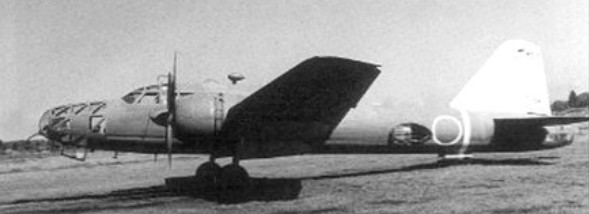
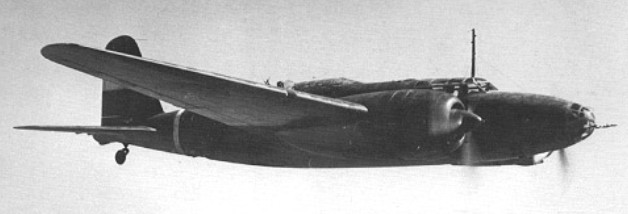
The Mitsubishi Ki-21 (Army Type 97 Heavy Bomber) was produced by engineers Nakata and Ozawa in response to an operational specification issued by the Air Headquarters (Daihonei) of the JAAF on 15 February 1936. The original specification, issued in February 1936, had required an aircraft with an endurance of over five hours at an average cruising speed of 300 km/h (186 mph), able to climb to 3000 m (9840 ft) in eight minutes and reach a maximum 400 km/h (248 mph) at that height. Normal crew was to be four, with provision for two more gunners on missions where extensive air opposition was anticipated. Maximum bombload for short range missions was to be 1000 kg (2200 lb). Early production aircraft in fact met or exceeded all these criteria.

Mitsubishi Ki-21 Article

In its definitive form the Ki 21 was a midwing monoplane of all metal semi-monocoque construction, and the smoothly contoured fuselage was oval in section. It had a single fin and rudder, and the main under-carriage legs retracted forward into the two engine nacelles.

The first of eight prototypes and service trial aircraft flew on December 18, 1936. It had a square glassed in nose, dorsal gun turret and a ventral step for a lower defensive gun. Later prototypes adopted a long dorsal greenhouse accommodating the gunner’s position, a well contoured hemispherical glassed in nose and a smooth lower fuselage line which eliminated the ventral step. To improve directional stability the fin and rud¬der were redesigned and increased in area. The first prototype had two Mitsubishi Ha 6 825 hp radial engines, while the remaining prototypes and early production machines had 850 hp Nakajima Ha 5 Kais.

Before going into production the Ki 21 had survived a competition with its rival the Nakajima Ki 19. As a consolation a contract was awarded by the Koku Hombu (the army air headquarters) not only to Mitsubishi (432 Model Is built) but also to Nakajima (351 Model Is).

A year late in entering service, some of its technology, compared with that of contemporary foreign aircraft, was not as advanced as the designers Nakata and Ozawa had hoped. The gap left by the delay in delivery of Ki 21s had to be filled by importing Fiat B.R.20 bombers. The first production model being the Mitsubishi Ki-21-Ia (Army Type 97 Model 1A). Because of production bottlenecks it was not until the end of 1939 that Ki-21-la bombers equipped the first JAAF unit, the 60th Hikosentai (air regiment) based in China, the next unit to be equipped was the 61st Sentai.

Early lessons learned over China demonstrated lack of firepower and protection, and the Ki-21-Ib and Ki-21-Ic subvariants had extra armour, additional 7.7mm Type 89 machine-guns, more fuel and larger bomb-bays. The engines were 634kW Nakajima Ha-5 KAI radials.

By the time of the outbreak of war in December 1941, the majority of the Mitsubishi Ki-21-Ia, Ki-21-Ib and Ki-21-Ic bombers had been relegated to second-line duties, or to service as operational bomber trainers. Most army front line bomber units were equipped with the Model 2 version of Ki 21, powered by two 1450 hp / 1119kW Mitsubishi Ha 101 14 cylinder radials driving constant speed three bladed metal propellers, unlike the Ha 5 Kai radials of the earlier version which had variable pitch propellers. The larger and more powerful Ha 101s required larger nacelles, and these completely enclosed the retracted landing wheels in the earlier machines, the wheels were left partly exposed.

Production models in service in 1941 were the Ki-21-IIa (Army Type 97 Heavy Bomber Model 2A), and the Ki-21-IIb which had a pedal-operated dorsal turret with one 12.7mm Type 1 heavy machine gun. Three sentais remained in Japan, Korea and in Manchuria when the Japanese high command went to war in South East Asia. For operations over the Philippines the JAAF’s 5th Air Group, based in Formosa, mustered the 14th and 62nd Hikosentais; these went into action early on the morning of 8 December 1941 striking at Aparri, Tuguegarao, Vigan and other targets in Luzon. Mitsubishi Ki-21s of the 3rd Air Group, based in French Indo-China, were earmarked for bombing strikes against Siam (Thailand) and Malaya: units were the 12th, 60th and 98th Hikosentais. These smashed RAF and RAAF facilities at Alor Star, Sungei Patani and Butterworth, being escorted by Nakajima Ki-27 and Ki-43 fighters. Only over Rangoon over December 1941 and January 1942 did the Ki-21s, codenamed ‘Sally’, suffer heavy casualties.

At its peak the Ki 21 was supplied to 11 first line Sentais and played a considerable part in the Pacific air war. Towards the end of its career lack of Ki 49 and Ki 67 replacements forced the retention of the Ki¬-21 in the first line when it was obsolete and suffering heavy losses. It took part in a number of outstanding actions, perhaps the most notable of which was the suicide mission by nine Model 2s of the 3rd Dokuritsu Hikotai (independent air wing). These were to land on the US occupied airfield at Yontan on Okinawa in the summer of 1945 to launch commando style attacks on airfield installations and aircraft. Only one aircraft survived to deliver its troops, but considerable damage was inflicted before they were wiped out.

The original Ki 21 defensive armament of single flexibly mounted 7.7 mm (0.303 in) Type 89 machine guns mounted in nose, dorsal and ventral positions proved barely adequate even for operations against the poorly equipped Chinese air force, and the Ki 21 Ib had an additional gun in a remotely operated tail stinger position plus another which could be fired from lateral positions on either side of the fuselage. The Ki 21 Ic and IIa had two beam guns while the Ki 21 IIb (688 of which were built between 1942 1944) had a remotely controlled tail stinger position for a 7.7 mm (0.303 in) machine gun, and the dorsal greenhouse replaced by a large conical turret mounting a single 12.7 mm (0.54in) Type 1 machine gun. This latter change greatly altered the appearance of the Ki 21 IIb and for a period it was thought by the Allies to be a new bomber type and given a different codename, Gwen, which was soon dropped when the new version was properly identified.

The bombload of all Ki 21 versions remained the same: a normal load of 750 kg (1653 lb) and a maximum of 1000 kg (2205 lb). The maximum range was 2700 km (1680 miles).

Some Ki 21 Ia bombers were modified during 1940 and put into service as MC 21 freight transports. Formally they passed into civil use as they were operated by the Dai Nihon Koku KK (Greater Japan Airlines) on routes between Japan, China and Manchuria, but all these flights were in fact military contract work, carrying army supplies (or personnel). Although all armament and other equipment appropriate to the bombing role had been removed, the aircraft were externally identical to the bombers, until a number were modified by the fitting of a ‘solid’ nose.

The Ki.21 was coded ‘Jane’ after Gen. MacArthur’s wife but when this came to his attention at the General’s request the code was changed to ‘Sally’,

Code named Sally, a modified model with a smooth dorsal line and a gun turret in place of the ‘greenhouse’ led spotters to believe a new type was entering service. The name ‘Gwen’ was assigned, but soon dropped in favour of ‘Sally 3’ when it was identified as a model variation.

Production of the Ki 21 ceased in September 1944, with the 2064th aircraft.

Ki-21 (Army Type 97 Heavy Bomber) prototype
Engines: 2 x Mitsubishi Ha 6 825 hp radial or 850 hp Nakajima Ha 5 Kais.
Propellers: variable ¬pitch
Span: 22.5m (73ft l0in)
Length: 16m (52ft 6in)
Height: 4.35 m / 14 ft 3 in
Wing area: 69.6 sq.m / 749.17 sq ft

Ki-21-Ia (Army Type 97 Model 1A)
Engines: 2 x 850 hp Nakajima Ha 5 Kais.
Propellers: variable ¬pitch
Span: 22.5m (73ft l0in)
Length: 16m (52ft 6in)
Height: 4.35 m / 14 ft 3 in
Wing area: 69.6 sq.m / 749.17 sq ft
Gross weight: 7916 kg (17452 lb)
Empty weight: 4691 kg / 10342 lb
Maximum speed: 432 km/h (268 mph) at 4000 m (13,125 ft)
Ceiling: 8600 m / 28200 ft
Range w/max.fuel: 2700 km / 1678 miles
Range w/max.payload: 1500 km / 932 miles
Crew: 5
Armament: 3 x 7.7mm (0.303 in) Type 89 machine-guns
Bombload: 750 kg (1653 lb) – 1000 kg (2205 lb)

Ki-21-Ib
Engines: 2 x 634kW Nakajima Ha-5 KAI radials.
Propellers: variable ¬pitch
Span: 22.5m (73ft l0in)
Length: 16m (52ft 6in)
Height: 4.35 m / 14 ft 3 in
Wing area: 69.6 sq.m / 749.17 sq ft
Maximum range: 2700 km (1680 miles)
Armament: 4 x 7.7mm (0.303 in) Type 89 machine-guns
Bombload: 750 kg (1653 lb) – 1000 kg (2205 lb)

Ki-21-Ic
Engines: 2 x 634kW Nakajima Ha-5 KAI radials.
Propellers: variable ¬pitch
Span: 22.5m (73ft l0in)
Length: 16m (52ft 6in)
Height: 4.35 m / 14 ft 3 in
Wing area: 69.6 sq.m / 749.17 sq ft
Maximum range: 2700 km (1680 miles)
Armament: 4 x 7.7mm (0.303 in) Type 89 machine-guns
Bombload: 750 kg (1653 lb) – 1000 kg (2205 lb)

Ki 21-II
Engines: 2 x 1450 hp / 1119kW Mitsubishi Ha 101 14 cylinder radials
Props: constant speed three bladed metal
Span: 22.5m (73ft l0in)
Length: 16m (52ft 6in)
Height: 4.35 m / 14 ft 3 in
Wing area: 69.6 sq.m / 749.17 sq ft
Maximum range: 2700 km (1680 miles)
Armament: 4 x 7.7mm (0.303 in) Type 89 machine-guns
Bombload: 750 kg (1653 lb) – 1000 kg (2205 lb)

Ki-21-IIa (Army Type 97 Heavy Bomber Model 2A),
Engines: 2 x 1450 hp / 1119kW Mitsubishi Ha 101 14 cylinder radials
Props: constant speed three bladed metal
Span: 22.5m (73ft l0in)
Length: 16m (52ft 6in)
Height: 4.35 m / 14 ft 3 in
Wing area: 69.6 sq.m / 749.17 sq ft
Maximum range: 2700 km (1680 miles)
Armament: 4 x 7.7mm (0.303 in) Type 89 machine-guns
Bombload: 750 kg (1653 lb) – 1000 kg (2205 lb)

Ki-21-IIb
Engines: 2 x 1450 hp / 1119kW Mitsubishi Ha 101 14 cylinder radials
Props: constant speed three bladed metal
Span: 22.5m (73ft l0in)
Length: 16m (52ft 6in)
Height: 4.35 m / 14 ft 3 in
Wing area: 69.6 sq.m / 749.17 sq ft
Empty weight: 13,382 lb
Gross weight: 9710 kg (21407 lb)
Maximum speed: 486 km/h (302 mph) at 4720 m (15,485 ft).
Maximum range: 2700 km (1680 miles)
Armament: 4 x 7.7mm (0.303 in) Type 89 machine-guns, 1 x 12.7mm Type 1 heavy machine gun.
Bombload: 750 kg (1653 lb) – 1000 kg (2205 lb)
Crew: 7

MC 21

Mitsubishi Ki-21