Work began in 1940 on the DVB-102 long-range, high-altitude bomber. Only two prototypes were built, because it was decided to copy the B-29 as the Tu-4.
Engines: 2 x Ash-71, 1620kW Max take-off weight: 15500-17750 kg / 34172 – 39132 lb Wingspan: 25.3 m / 83 ft 0 in Length: 19.5 m / 63 ft 12 in Wing area: 78.8 sq.m / 848.20 sq ft Max. speed: 565 km/h / 351 mph Cruise speed: 445 km/h / 277 mph Ceiling: 11500 m / 37750 ft Range w/max.fuel: 2230 km / 1386 miles Crew: 5 Armament: 3 x 20mm machine-guns, 4 x 12.7mm machine-guns, 1 x 7.62mm machine-guns, 2000-3000 lb bombs
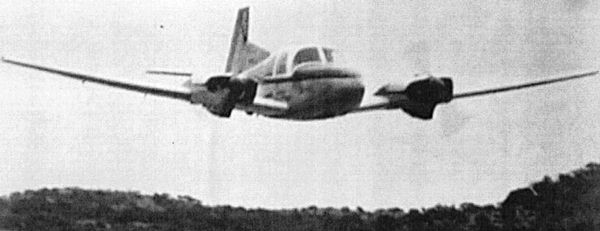
The Jupiter was an executive transport designed by André Moynet, a member of the National Assembly of France and a former government minister and built by S.S. Engins Matra (so it is sometimes referred to as the Matra Moynet Jupiter).
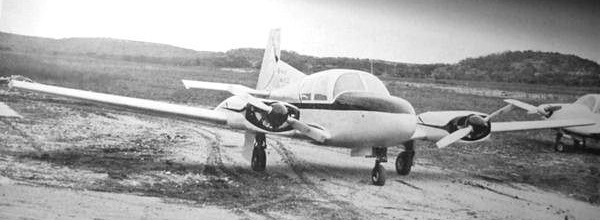
The Jupiter design began life in 1957 as a single-engine airplane, but evolved into its unusual “push-pull” arrangement during the design process. Moynet adopted the configuration to provide the power and safety of a twin, but without asymmetric handling characteristics.
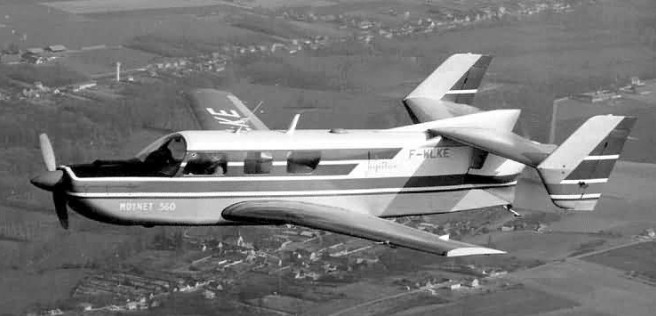
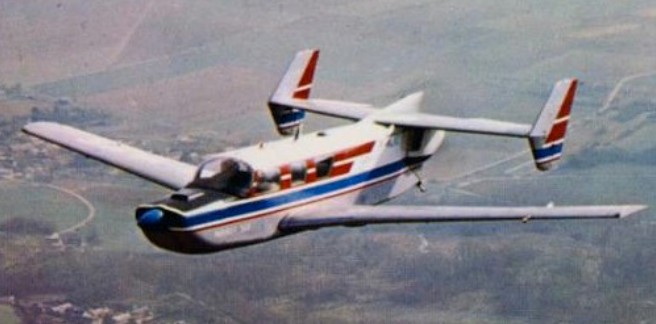
The Moynet 360 Jupiter was an example of a push-pull aircraft with a single conventional fuselage and an engine at either end. Its wing had a straight trailing edge, but the centre section had strong taper on the leading edge which continued more weakly outboard. It was of two spar, stressed skin construction, carrying mass balanced ailerons and slotted flaps. The main undercarriage legs, placed at the end of the centre section each carried a single wheel and retracted inwards electrically. A retractable nosewheel completed the landing gear.
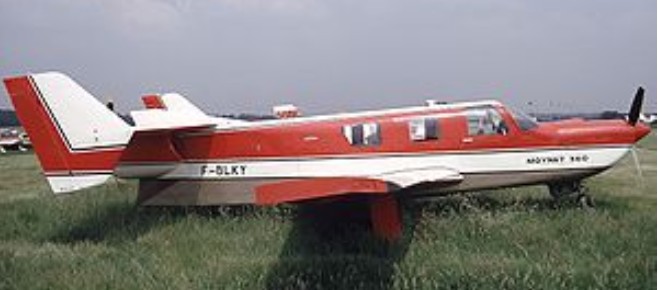
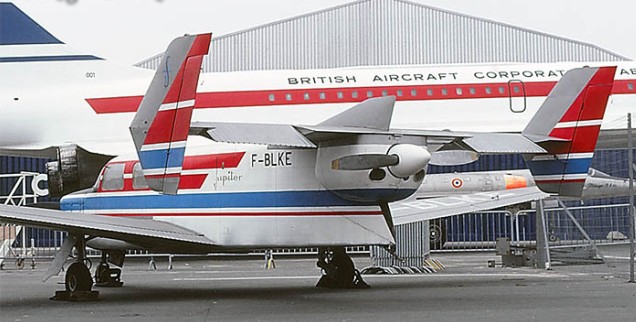
One horizontally opposed Lycoming engine was conventionally placed in the nose. Behind it was a standard cabin, though the front seats were further ahead of the leading edge than usual because of the rearward shift of the centre of gravity caused by the rear engine. There were three large windows on each side. For the same reason the rear fuselage was quite short, and it lacked the normal taper, giving it a boxy look, so that the second, pusher Lycoming could be mounted in the extreme tail. This was cooled by air from rectangular intakes on the upper sides of the rear fuselage. The straight edged, tapered tailplane was mounted on the fuselage top above the engine, with small endplate fins carrying balanced rudders. These fins extended above and below the tailplane, with arrow shaped leading edges and straight, swept trailing edges. There was also a long, shallow strake over the rear fuselage. Seen from below, the long span of the tailplane was striking, about 44% of that of the wings; the elevators filled most of the outer part of its trailing edge, avoiding the propeller airstream.
Moynet had the support of Marcel Chassigny, then the head of the Matra company, and between them they hoped that the Jupiter 360 could provide real competition to U.S.-designed light aircraft. Matra’s Lucien Tieles partnered with Moynet on the final design. The first prototype flying on 17 December 1963 at Villacoublay with the designer and Lucien Tieles at the controls.
Only two Jupiters were built (plus a single static test airframe). The first, constructed by Matra, designated 360-4 and initially registered as F-WLKE had two 200 hp (150 kW) Lycoming IO-360-A1A engines driving two-bladed propellers and was configured as a 4-5 seater.
The second prototype, second constructed by Sud-Aviation, was of a more powerful and slightly larger variant designated the model 360-6; it first flew on 25 May 1965. This model had a choice of engines, either 290 hp (216 kW) Lycoming IO-540 six cylinder engines driving constant speed, three-bladed propellers, or 310 hp (231 kW) Lycoming TIO-541 engines. The span was increased by 0.37 m (15 in) and length by 0.64 m (25 in). The increased length allowed seats for 6-7, with two rows of two single seats and a bench seat at the rear that could accommodate 2 or 3. The cabin was sound-proofed and air conditioned and could be pressurised. Access was via a forward starboard side door. There was baggage space behind the cabin with its own external door. The sole 360-6 was registered as F-WLKY.
The intention was for Sud-Aviation to produce the 360-6 Jupiter as the Sud-Aviation M 360-6 Jupiter, but no sales resulted. An order was obtained from the French government for some 360-6 pre-production aircraft, but this seems to have been cancelled. Despite sales campaigns in Europe and the U.S.A. no further orders resulted.
The first prototype is now in the reserve collection of the Musée de l’Air et de l’Espace, Le Bourget Airport, Paris museum. Parts of its fuselage were to be used as the gondola of an abortive airship project, before it was recovered by Ailes Anciennes Le Bourget and presented to the museum. At le Bourget, the 360-4 bears the normal French registration F-BLKE rather than the French prototype style F-WLKE.
Moynet 360-4 “Jupiter” n°01
Moynet himself retained the second aircraft, the six-seater 360-6 F-BLKY. It passed into the hands of the Musée Régional de l’Air Angers – Loire Airport, France, after Moynet’s death in 1993. Limited restoration work was carried out in 1994 and from 1998, before the major current restore-to-flight effort began in 2009, undertaken by six volunteers. In March 2012 the museum signed a partnership agreement with the Association Aérospatiale Matra to aid with the restoration.
M 360-4 Jupiter First prototype, 4–5 seats, two 149 kW (200 hp) Lycoming IO-360 engines.
M 360-6 Second prototype, with stretched fuselage with seven seats and two 216 kW (290 hp) Lycoming IO-540 engines.
M 360-6P Proposed pressurised seven-seat version, with Lycoming O-480 engines. Unbuilt.
Sud-Aviation Présidence Further enlarged, pressurised version planned by Sud-Aviation.
Specifications:
M 360-4 Jupiter Engines: two 149 kW (200 hp) Lycoming IO-360 Wingspan: 35.42 ft Length: 25.81 ft Seats: 4–5
360-6 Engines: 2 x Lycoming IO-540, 216 kW (290 hp) Propellers: 3-bladed Hartzell constant speed Length: 8.77 m (28 ft 9 in) Wingspan: 11.49 m (37 ft 8 in) Height: 2.46 m (8 ft 1 in) Wing area: 16.81 sq.m (180.9 sq ft) Empty weight: 1,338 kg (2,950 lb) Gross weight: 2,390 kg (5,269 lb) Fuel capacity: 566 lt Maximum speed: 363 km/h (226 mph; 196 kn) at sea level Cruising speed: 338 km/h (210 mph; 183 kn) at 1,830 m (6,000 ft) on 75% power Range: 2,060 km (1,280 mi; 1,112 nmi) at 4,500 m(15,000 ft) and 45% power. Rate of climb: 7.3 m/s (1,440 ft/min) at sea level Capacity: 6 or 7
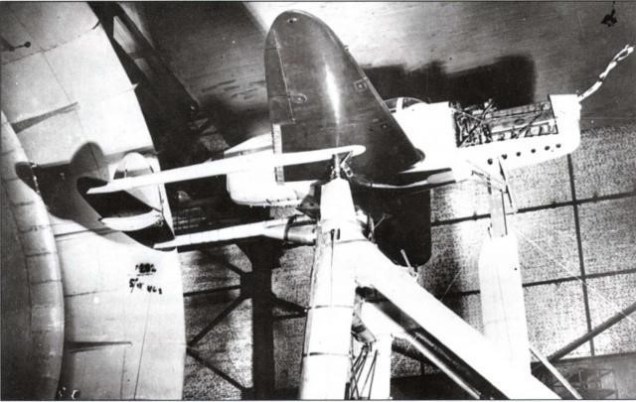
Moscaliev SAM-13 in the tunnel room T-101 at the TsAGI
This design was conceived with the OKB from the beginning as a military aircraft and, despite the low engine power, the project augured a good future due to the good performance obtained from the calculations and the low production cost.
The Moscaliev SAM-13 (Russian: Москалёв САМ-13) was designed around two 220 hp Renault MV-6 engines fore and aft and armed with four Ultra-ShKAS machine guns.
After submitting the conceptual designs, the NKAP department 7 decided to approve its inclusion in the group of experimental developments, since the MV-6 engine was not intended for military use. The evaluating commission decided that the design was novel and presented interesting solutions that could later be used in real fighters with high-powered engines.
The configuration selected for the SAM-13 comprised a low wing-set fuselage entirely in wood with a plywood covering.
The wing had a trapezoidal shape in plan, with rounded ends. The wing mechanization included offset ailerons. From the forward wing spar two bars extended backwards which joined behind the propeller cone in an oval stabilizer in which the elevators were located and from whose center the empennage rose.
The SAM-l3 was fitted with a retractable tricycle undercarriage, the forward unit was stowed aft, while the main units, attached to the forward spar of the wing at the tail cone area, were retracted into the fuselage.
The cockpit was located between both engines. Behind the engine were also located the fuel tank and the flight equipment. The rear propeller featured a mechanism that allowed it to be stopped in a horizontal position in emergencies, to allow the pilot to leave the plane.
In general, the Moscaliov SAM-13 was characterized by its small size and its clean lines.
By the end of 1939, the evaluation commission led by Colonel Kvitko met and the main topic of discussion revolved around the high value of the speed obtained as a result of the calculations. This speed of 700 km/h was considered not very objective for an airplane powered by 220 hp engines. Actually the calculations were made based not on the MV-6 engines, but on the French Renault Bengali 6 with Ratier metallic variable pitch propellers. Finally, after not a few discussions, the model of the SAM-13 was approved and the construction of the prototype began at Factory No.18.
Different tail configurations of the SAM-13 during the development of the project.
The armament comprised two synchronised 7,62-mm guns in the forward fuselage and a similar weapon in the forward end of each tailboom.
By the end of 1939 the prototype was finished, which was delivered in the spring of 1940 to carry out factory flight tests. ND Fikson was selected as test pilot, V. Galitski was singled out for the TsAGI, and engineer Pushkin for the leadership of the NKAP.
Factory tests went smoothly. After the period of runs and jumps the flights began. The pilot Fikson was satisfied with the results, assessing the stability and control very positively. The speed at sea level was established with the gear extended and reached 560 km/h. Problems with the retraction of the forward landing gear prevented it from obtaining the expected speed, reaching only 607 km/h. These results made it possible to think that with the gear collected and at the optimal working height of the engine, the goal of the calculated 700 km/h could be achieved.
These flights also evidenced the need for long takeoff and landing runs due to the small wing area and low payload capacity.
The tests were not completed. After the seventh flight, the instruction was received from Moscow to suspend them until the wings and tail were tested in the TsAGI , with the aim of verifying the possible appearance of Flutter. It was also decided that the rest of the plane’s tests would be carried out at the TsAGI, so the plane had to be sent to that institution, together with a group of OKB-31 specialists.
In the TsAGI a new commission for the evaluation of flights was created. As test pilot ML Galai was selected. The OKB-31 group of workers was led by LB Polukarov and included NA Morietski, SA Zabyalov and Dovgi.
The results of the tests of the Flutter in the TsAGI T-101 tunnel showed that the design was capable of withstanding speeds of up to 800 km/h and were followed by a new period of taxiing and runway tests, carried out by Galai.
Moscaliev SAM-13 tested in TsAGI tunnel T-104.
By that time, the TsAGI had finished installing a new high-speed wind tunnel model T-104. It was proposed to test there in a plane with a pilot and the engines working, with the aim of establishing the effectiveness of the model. These tests were completed in the spring of 1941 and the results were considered so secret that they were not even communicated to their designers.
A short time later Moscaliov was called to the office of AS Yakovlev, where he was informed that by government decision the tests of the model would be cancelled. The weak armament and the little capacity of the plane to increase it were argued. Then the war started.
All materials and documentation linked to this model were destroyed.
SAM-13 Powerplant: 2 × 220 hp Renault Bengali 6 Span. 23 ft 11 1/3 in (7,30 m) Wing area, 96.88 sq ft (9.00m sq.m) Length, 25 ft 4 in (7,68 m) Empty weight: 745 kg Maximum takeoff weight: 1183 kg Wing loading: 131 kg/m² Power load: 7 kg/hp Max speed reported: 323 mph (520 km/h) at 11,485 ft (3 500 m) Maximum speed at 5000 m est: 680 km/h Maximum speed at sea level est: 463 km/h Landing speed: 125 km/h Practical range: 850 km Service ceiling: 10000 m Accommodation: 1 Armament: Four 7.62 mm Ultra-ShKAS machine guns.
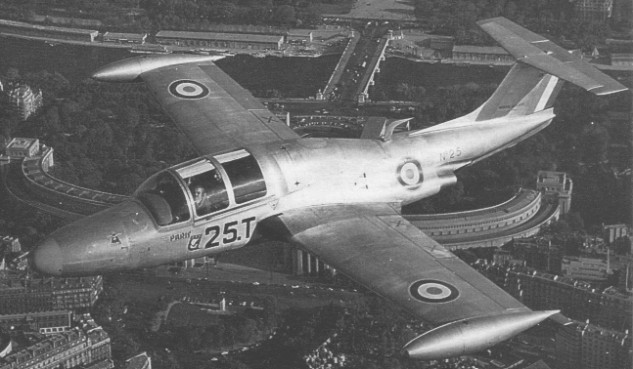
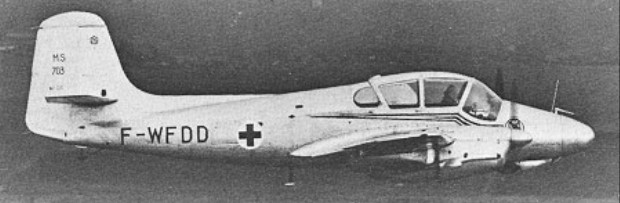
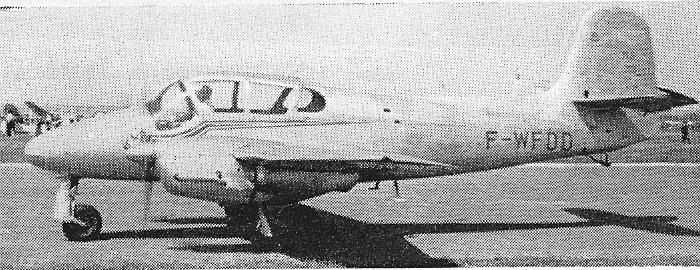
In January 1953 Morane-Saulnier flew the prototype M.S.755 Fleuret, a two-seat jet trainer which competed with the Fouga Magister for an air force order. The Fleuret lost the competition, but its design formed the basis of the Morane-Saulnier M.S.760 Paris which, designed primarily as a high-speed liaison aircraft, can be considered as a forerunner of the executive jet. Morane-Saulnier developed the Fleuret into a four seat light communications aircraft by enlarging the cabin, increasing the internal fuel capacity and strengthening the airframe.
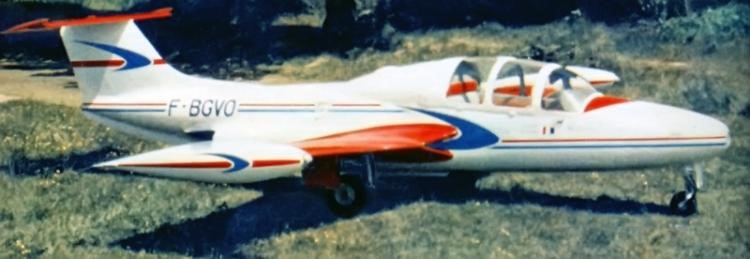
The Turboméca Mabore II powered first prototype, MS.760-01 F WGVO (then F-BGVO), was flown on 29 July 1954, and interest shown by the French military authorities resulted in orders for 50 for the air force and navy on 18 July 1956, the initial production example designated M.S.760A, flying on 27 February 1958. Fitted with tip tanks, this type was delivered as the Paris IR to the Armée de l’Air and the Aeronavale.
Two basic models will be manufactured in series. The MS 760A Paris I (one hundred and fifty built), and MS 760B Paris II (sixty-three built). The dates of the first flight respectively, February 27, 1958 and December 12, 1960.
Orders were received for 109 civil and military use, 12 MS.760A sets of components were supplied to Argentina for assembly at the Fabrica Militar de Aviones (FMA) factory in Cordoba, followed by production of 36 more. The 760 MS was purchased by Argentina in May 1957. Forty-eight Paris were operated by the Fabrica Militar de Aviones Cordoba. The first shipped to Argentina was Paris I No. 3, on 1 May 1958. By February 1959, twenty-six complete aircraft had crossed the Atlantic in separate shipments.
MS 760 of Argentina
Brazil acquired 30 for liaison, photographic survey and training. A first order of eight Paris II for Brazil was signed February 19, 1960 with twenty other options. In total, Brazil assembled forty-eight Paris II, mainly for the Air Force.
The first Paris was delivered to the Air Force as a training and liaison aircraft on 27 February 1958. The Naval Aviation were to receive a small number for the same missions as the Air Force. On a training mission, it can be armed with two 7.5mm machine guns plus four rockets or two bombs of 50 kg fixed under the wing.
At the end of 1958 the College of Aeronautics, Cranfield, received an MS.760 (No. 8) for practical demonstrations. Two were sold in the U.S., and one in Iran (delivered on 15 July.1958).
The initial production version was superseded in 1961 by the M.S.760B Paris II with 10581bst / 480kg thrust Marbore VI turbojets and various systems improvements and integral fuel tanks in wing leading edges.
When production ended in 1964 a total of 156 aircraft of the two series had been built, including 48 assembled in Argentina.
In 1969, four MS 760A were registered in France and many 760B, one registered in Italy and seven in Holland. Seven Paris II were purchased to train airline pilots at the Eelde school in Holland, the first being delivered September 14, 1962.
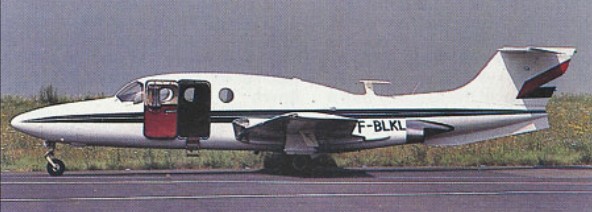
The final version was the 1963 Marbore VI-powered M.S.760C Paris III, with an enlarged wing but without tip tanks, plus increased fuel in a redesigned fully integral cabin fuselage accommodating five or six passengers, and a car-type door on port side instead of a sliding canopy. It was also fitted with an air system for cabin and pressurisation bled from the turbojet (SEMCA automatic air-conditionning system). The sole prototype, F WLKL, flew for the first time on 28 February 1964 but the variant did not find favour as a business jet and proceeded no further. Only one aircraft built, F-BLKL.
Paris III F-BLKL / 366 (cn 01)
A total of 109 MS.760A Paris I, 10 MS.760B Paris II and 1 MS.760C Paris III were built. For replacement, Argentina selected the FMA Pampa jet trainer, while France chose the TBM700 turboprop.
Two French companies, Fouga and Morane Saulnier, saw a market for such a basic jet trainer and realised the potential of the Turbomeca engines for this application. Fouga presented a proposal for a tandem two seat trainer to the French Air Ministry, the CM.130R, which was powered by two 353 lbst (160kgst) Palas engines. The design was refined and a contract for three of the resulting twin Marbore II powered CM.170R aircraft was placed with Fouga in December 1950. The Morane Saulnier company were working along similar lines at this time, and their drawing boards brought the MS.755 Fleuret. It was designed under the direction of engineer Paul-René Gauthier, who was then director of Morane-Saulnier engineering department.
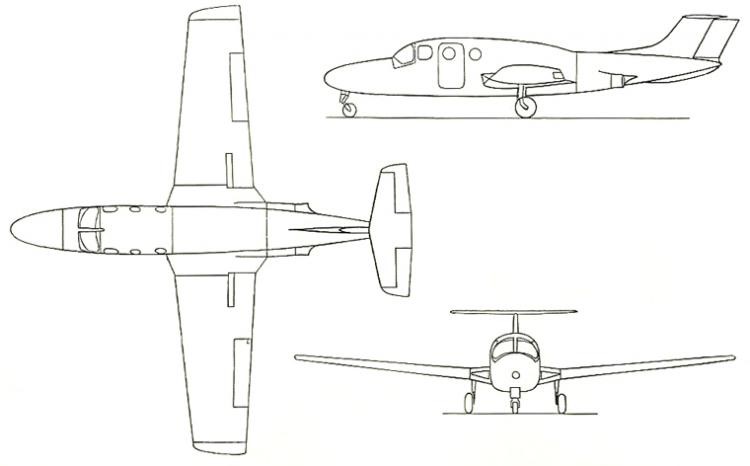
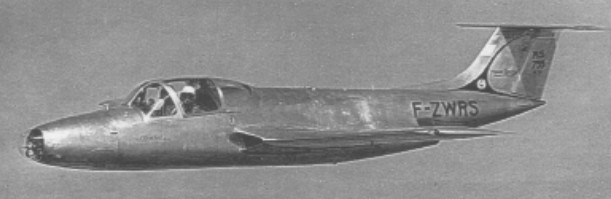
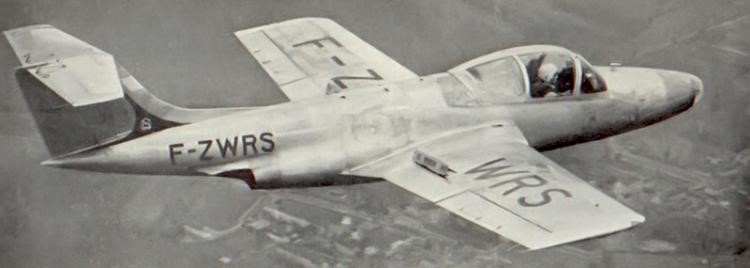
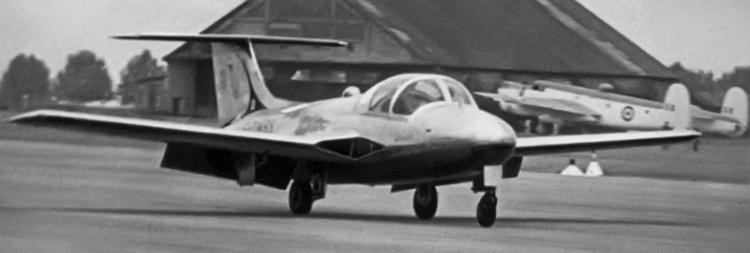
It was an all-metal mid-wing cantilever monoplane with a T-type tail. The MS.755 Fleuret featured side by side seating, the wing was set slightly lower on the fuselage and had a lower aspect ratio, the tail surfaces were conventional and the two Turbomeca Marbore II turbojet engines were faired more into the fuselage than the semi podded arrangement evident on the Magister. Air intakes were located in the wing roots. The two pilots seats were attached to an aerodynamically balanced trap in the fuselage, which operated following jettison of a hatch in the underbelly in an emergency and ejected the two occupants through the floor of the cockpit.
The construction of two prototypes was launched at the same time. Cn 01 (F-ZWRS) began its taxi tests in January 1953 (while its competitor, the Fouga Magister, made its first flight on July 23, 1952). The MS-755 made its maiden flight on 26 January 1953, with Morane-Saulnier chief test pilot Jean Cliquet at the controls, accompanied by flight engineer Ferdinand Naudy. Jean Cliquet took off from Melun-Villaroche for a 15 minute flight. The aircraft did not exceed the altitude of 800-900 m considered a limited ceiling. Two other flights were made the next day. On January 31, a flight was performed with the commander Grigaut (Head of Bretigny AB. *Flight Test Center (CEAM)). February 12 was the official flight presentation of the aircraft to President Robert Morane and the executive committee.
On 30 April 1953, the aircraft is delivred to Bretigny Flight Test Center for official qualifying tests. At that time 57 flights and almost 35 hours of flights have been made.
After stopping the program, Cn 02 was converted into four-seater as the MS-760 01.
After evaluating the merits of both aircraft, the French Air Force expressed a preference for tandem seating, and in 1953 placed an initial order for ten pre production and 95 production CM.170R Magister aircraft.
The initial success of the Magister was not lost on Morane¬Saulnier, who decided not to compete head on and thus developed the Fleuret into a four seat light communications aircraft by enlarging the cabin, increasing the internal fuel capacity and strengthening the airframe. This became the MS.760 Paris.
First twin-engine design by this company since World War I, the Morane-Saulnier M.S.700 of 1948 was a cantilever low-wing monoplane with retractable tricycle landing gear, the cabin accommodating five in either an executive transport or air taxi role.
Powered by two Potez 4D-33 inline engines, each of 119kW, the M.S.700 had a maximum speed of 290km/h. It was followed by the M.S.701 with two 134kW Mathis 8G-20s, the larger, six-seat M.S.703 with two 179kW Argus As 10Cs, and the M.S.704, similar to the M.S.703 but with two 164kW Potez 4D-31s. The M.S.703 had a maximum speed of 300km/h, being flown for the first time in 1951. None of the variants was built in quantity, only four being entered on the French civil register.
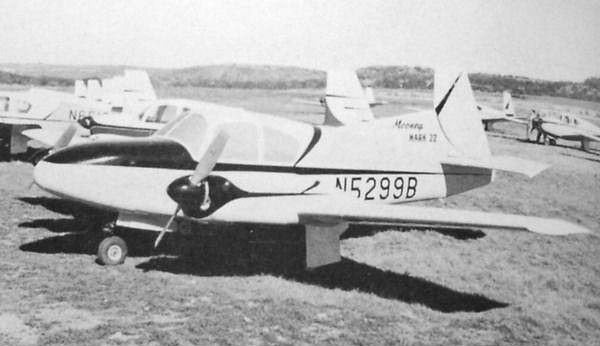
The long hoped for Mooney light twin was permanently laid to rest by the appearance of the prototype Mark 22 Mooney Mustang, a five seat pressurized airplane powered by a single 310 hp turbocharged Lycoming. The concept of a sophisticated high altitude airplane that could outperform most twins on the market at a fraction of the price was radical, and the Mustang project seemed destined to drain a disproportionate share of the company’s time and resources.
The prototype, which used the fuselage of a Mooney Mk.20 with a new wing and dorsal fin, first flew in September 1964, and Mooney hoped to be building saleable airplanes by mid 1965. Instead, the type certificate wasn’t issued until September 1966, and the first production airplane wasn’t delivered until March of the following year.
In the meantime, Mooney had been taking firm orders at the unrealistically low price of $29,900, while the actual production costs rose until the last of the 30 or so Mustangs built rolled off the assembly line with a price tag of over $46,000. High costs combined with less than advertised performance not to mention the less tangible but equally important factor of momentum put a loser’s stigma on the airplane that it would never completely shake.
When Ralph Harmon arrived to take over as chief engineer at the old Mooney Company, he scrapped the twin and used the Mark 22 designation for the Mustang, a pressurised single.
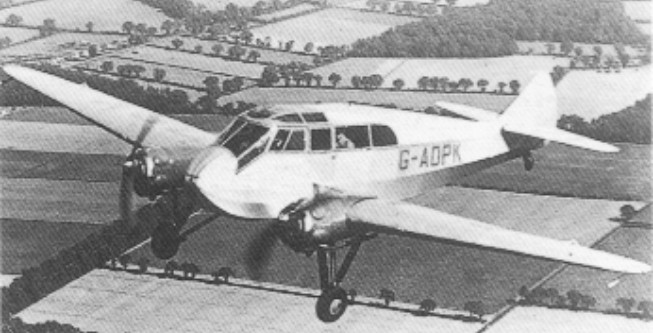
Under the guidance of F F Crocombe, the ST 10 was improved and in 1935 was relaunched as the ST 25 Jubilee. The year witnessed King George V’s Silver Jubilee and the mark numbers were ‘shunted’ on accordingly.
The two designers. Messrs J.H. Steiger and F.F. Crocombe, were responsible for the wing design that gave this aircraft its name — Monospar, or single spar. In the wing, a single transverse spar carries a number of main ribs spaced apart. The spar is braced to resist torsion, or twisting effect, by means of rigid struts on wire arranged in pyramid fashion. “Former” ribs are provided between the main ribs in order to strengthen the fabric when the wing is covered. The use of a fabric covering makes it easy and economical to maintain the wing in good condition, and provides a quick access to the framework for overhaul and repairs. As only one spar is used there is a considerable weight saving in the wing structure, which allows a greater payload. The same principle can be applied to the fuselage.
An improved Jubilee, the ST 25 de Luxe, appeared in 1936 with Niagara III engines. The 90hp Niagara III cruised at 3,000rpm with Rotax rotating armature ignition, turning wooden two blade 6.67 ft diameter fixed pitch mahogony Aircrew propellers through offset 2:1 reduction gears. Initial climb rate was 710ft/min and potential maximum ceiling some 16,000 feet. Sustained climb was nonetheless relatively slow, and it took up to an hour to reach 12,000 feet. Rudder and elevators were fitted with controllable trim tabs, and directional stability was improved with increased fin area. This could not cope with the asymmetric loads of single engine operation and a new twin tail unit was fitted to correct this problem. The resulting design was called the ST 25 Universal. Twenty nine Universals were built. Slightly heavier at 1,818 lb tare than the Jubilee, they were also slightly slower with a maximum speed of 131 mph. Overall dimensions and all up weight remained the same.
Two engine choices were offered. The 88 hp Pobjoy had a better power-to weight ratio than the low revving 90hp Cirrus alternative, giving a much shorter take off run. With an effective 88hp per motor and an all up aircraft weight of 2,750 lb, single engine performance was marginal.
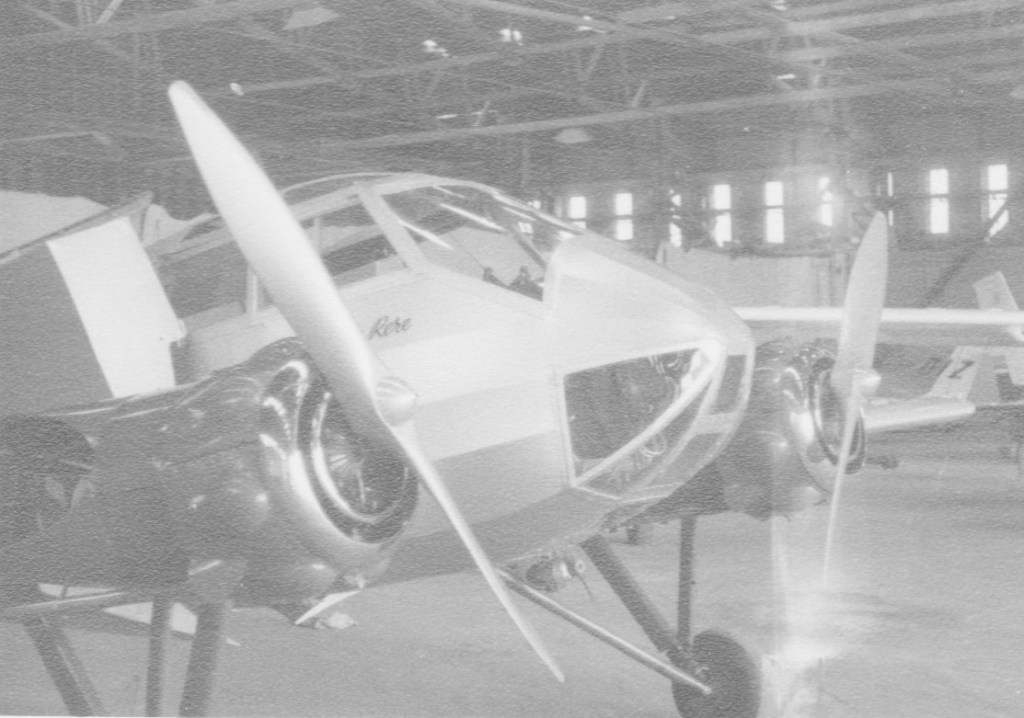
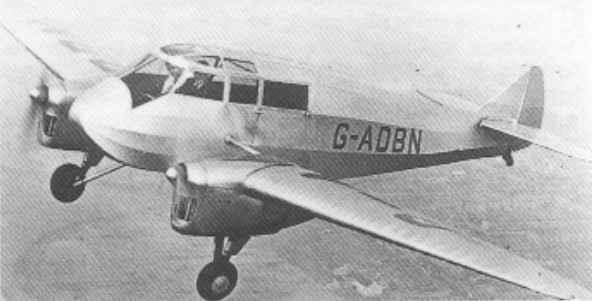
With 9 degrees of dihedral the wings are fabric-cover¬ed, and fold back flat along the fuselage. The seven cylinder radial engines have aluminium cowlings held in place by a single clip at the bottom of the cowl. A 2:1 reduction gear off-sets the propeller drive by about six inches from the centre. The twin exhaust pipes are chromium plated, which greatly enhance the general appearance of the aircraft. The fuel tank filling point is in the starboard side; the 44 gallon tank is situated below the two pilot’s seats. Provision is also made for an additional 12 gallon internal tank. The fixed undercarriage has three tubular legs extending from the nacelle to the axle. There are two rudders with the elevator extending the full width between them. The tailwheel has a large heavy duty spring to reduce landing shocks. Entry to the aircraft is by a door on the port side, and access to the two front seats is made easier by a hatch in the roof.
A total of 59 were produced circa 1936.
The STL.25 T42 was fitted with an experimental tricycle undercarriage.
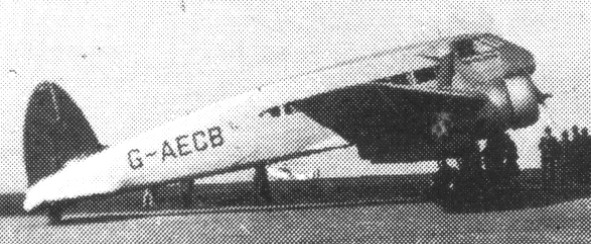
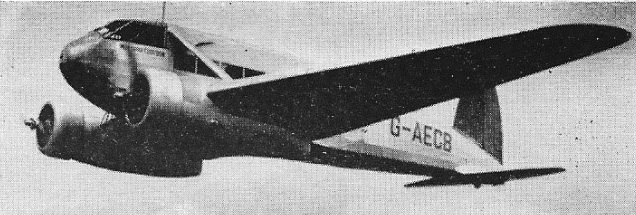
G-AECB was a General Aircraft Monospar ST-18 Croydon built at Hanworth in the UK in 1935 and flown out to Australia in July 1936. The 10 passenger seat aircraft, the only one of the type built, was abandoned on the Seringapatam Reef 175 miles north of Australia when it failed to make landfall across the Timor sea due to compass error on its return flight in October 1936.
The design of the ST-12 dates back to the mid-1920s with the development of a single-spar wing. In 1931 GAL was formed to develop the patented Monospar Co wing design. The ST-12 was a fixed undercarriage variant of the ST-10, re-engined with two 120 hp Gipsy Majors.









 All Aero