A powered version of the Waco CG-4 Glider with two Franklin 6AC-298-N3 engines.
2 Engines
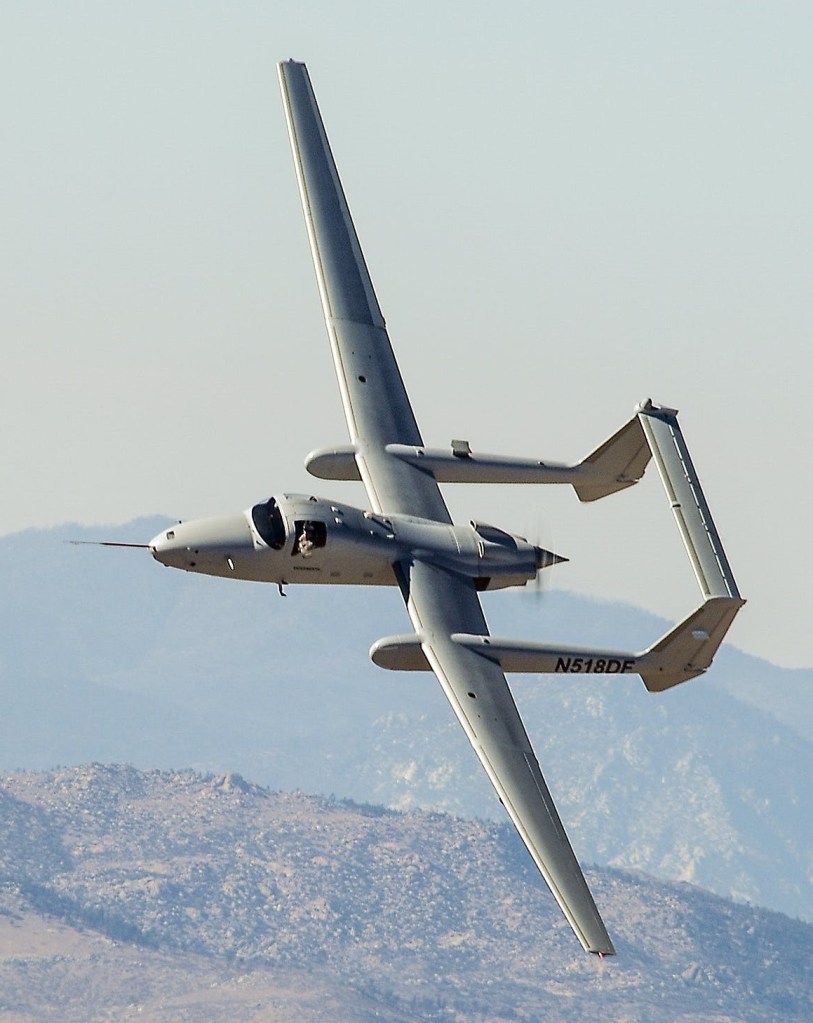
Northrop-Grumman Firebird / Scaled Composites Firebird Model 355
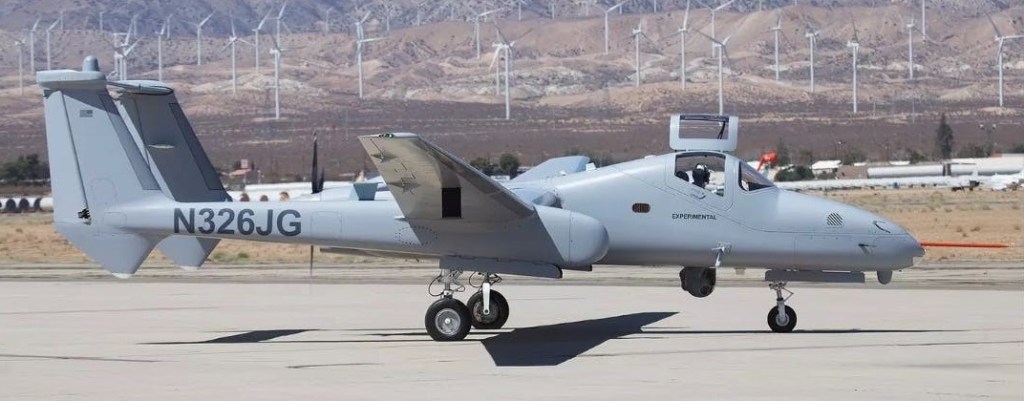
The Firebird concept actually dates the back to the latter half of the 2000s, with Scaled Composites, Northrop Grumman’s storied subsidiary, eventually building a technology demonstrator. That highly experimental aircraft was a forerunner to the current Northrop Grumman designed Firebird, which is a clean-sheet, production-ready aircraft. Scaled Composites’ Firebird demonstrator first flew in 2010 and proved that an optionally manned, highly flexible surveillance aircraft could not only work, but it could compete for missions with both unmanned and manned platforms at the same time.
Firebird in manned configuration. It can be flown by one or two pilots and uses open architecture Garmin 3000 avionics.
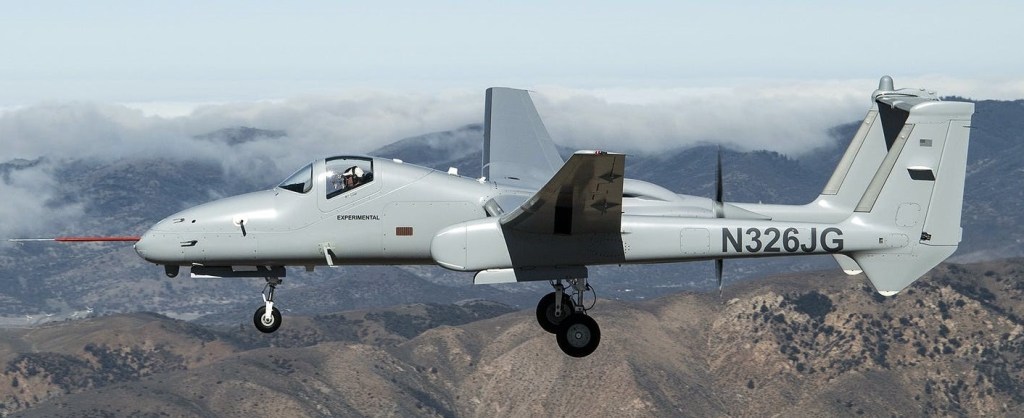
Firebird is that it can self-deploy anywhere in the world with a pilot at its controls and even work out of small, rough airfields. Once forward deployed, it can then be converted into unmanned configuration and fly missions lasting over 30 hours. It single six-cylinder Lycoming TEO-540 engine runs on avgas.
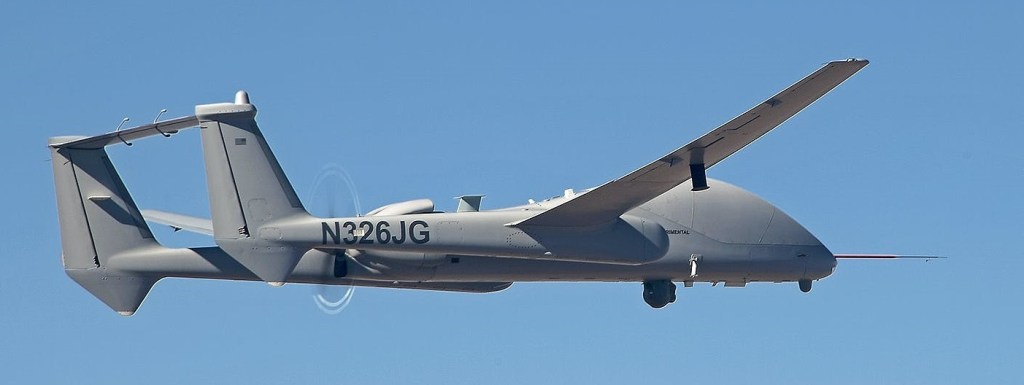
Being able to tailor payloads to the operating environment and mission, some operations and operating areas benefit from or even necessitate a human in the cockpit, while others largely benefit from long-duration missions run from a ground station. Being able to provide both in one airframe is revolutionary, at least in terms of a purpose-built aircraft being sold and sustained by an American aerospace-defense prime contractor.
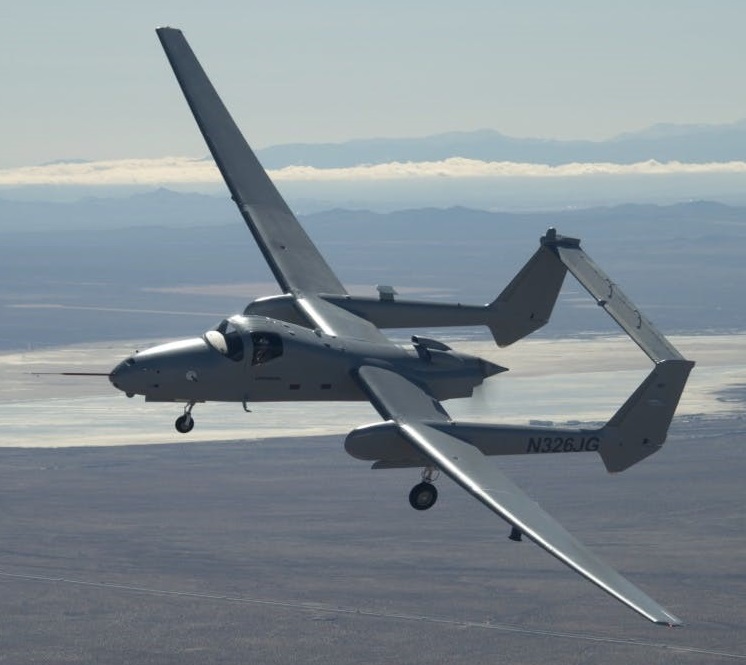
The Firebird can be easily broken down and flown on a transport. Its modular carbon fiber design made this nearly a default capability.
Firebird was into the back half of its flight test program circa 2019.
Northrop XS-2 Skylancer / X-4 Bantam
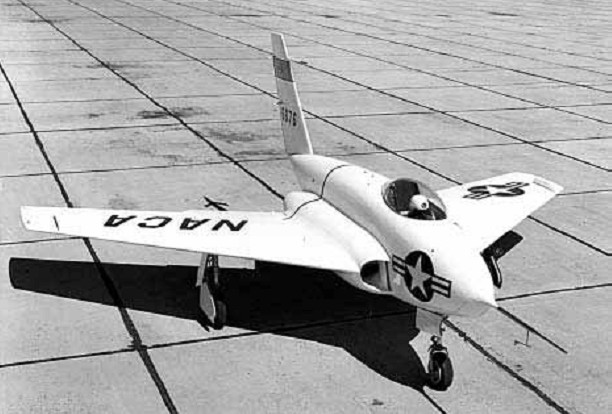
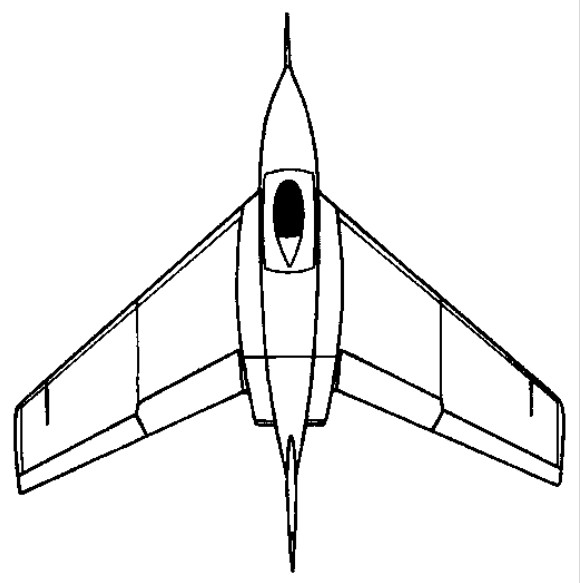
The Northrop X-4 was the first example of an X-vehicle intended to research something besides supersonic flight. The jet-powered X-4 was designed to evaluate the characteristics of a tailless aircraft at high subsonic speeds, a configuration believed to hold a great deal of promise for future aircraft.
The final Northrop flying wing design, although it could more accurately be described as a tailless aircraft, was the XS-4 Skylancer, a transonic research vehicle with two 726kg thrust Westinghouse turbojets. Later redesignated X-4, the first of two aircraft flew at Muroc on 16 December 1948, followed by the second on 7 June 1949.
Although not designed for supersonic speeds, the X-4 nevertheless proved that tailless swept-wing aircraft were not well suited for high transonic or supersonic performance. Pitch, roll, and yaw instabilities were very pronounced at speeds in excess of Mach 0.88, and there was no solution to the problem using the technology available at the time. The last flight was made on 29 September 1953. After a total of 102 flights, the highest achieved was 42,300 feet (approx) and fastest Mach 0.90 (630 mph) (approx).
Both aircraft survived the flight test program, and there were no serious accidents during the 102 flights. The first X-4 was on display at Edwards AFB. The second aircraft, after long being displayed at Maxwell AFB, Alabama, moved to the Air Force Museum in Dayton, Ohio.
X-4 Bantam
Engines: 2 x Westinghouse turbojets, 726kg each
Max take-off weight: 3175 kg / 7000 lb
Wingspan: 8.18 m / 26 ft 10 in
Length: 7.1 m / 23 ft 4 in
Wing area: 19 sq.m / 204.51 sq ft
Max. speed: 1000 km/h / 621 mph
Crew: 1
Northrop Tacit Blue
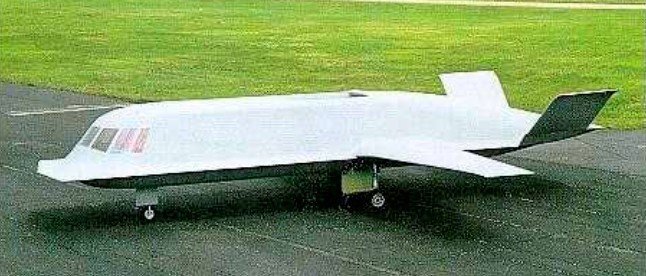
The “Tacit Blue” was built to test the advances in stealth technology. The aircraft made its first flight in February 1982 and by the conclusion of the program in 1985 had flown 135 times.
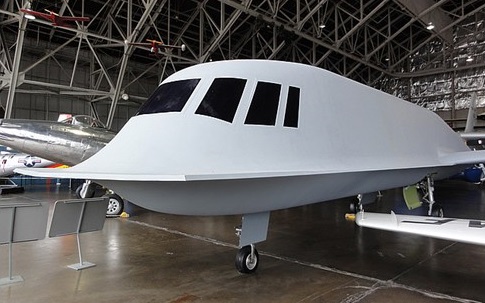
The entire program cost $165 million and Northrop, as the main contractor, received $136 million. The data collected from the Tacit Blue project was later used on the B-2 Spirit, also made by Northrop.
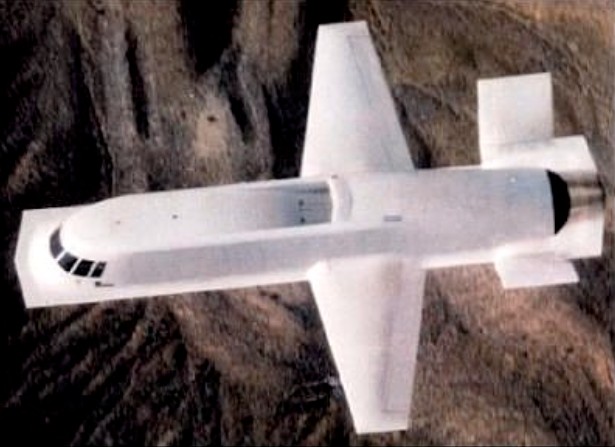
Tacit Blue
Engines: 2 x Garrett ATF3-6
Max take-off weight: 13500 kg / 29763 lb
Wingspan: 14.69 m / 48 ft 2 in
Length: 17.0 m / 55 ft 9 in
Height: 3.23 m / 10 ft 7 in
Cruise speed: 460 km/h / 286 mph
Ceiling: 9000 m / 29550 ft
Northrop X-21A
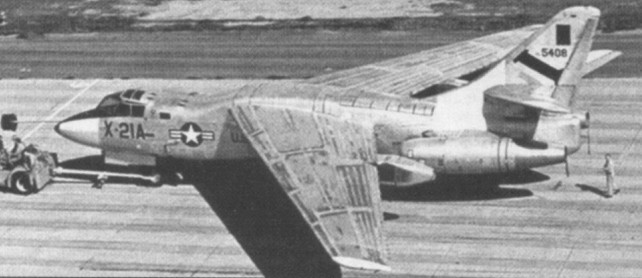
Sponsored by the USAF, the X-21A was designed to explore the feasibility of utilizing full-scale boundary layer control on a large aircraft. Paper and wind tunnel studies conducted by Northrop had indicated boundary layer control would offer numerous performance benefits. After successfully demonstrating the ability to achieve laminar flow over approximately 75 percent of the wing surface, the X-21As were used to explore the impact of rain, sleet, snow, and other weather anomalies on the system.
The two X-21As were modified from Douglas WB-66D Destroyer light bombers that had been retired from active service, and were equipped with a completely new wing and engine nacelles that were hung on either side of the aft fuselage.
First flown on 18 April 1963, the X-21As demonstrated that the boundary layer control technique, called laminar flow control, was both effective and viable. However, they also showed that these benefits came at a significant maintenance penalty as the numerous small slots required for the airflow constantly plugged up.
Last flown in 1964, the highest speed achieved was 560 mph (approx) and an altitude of 42,500 feet (approx).
Both X-21As survived the flight test program and were left in a bad state of repair on the photo range at Edwards AFB.
Northrop F-89 Scorpion
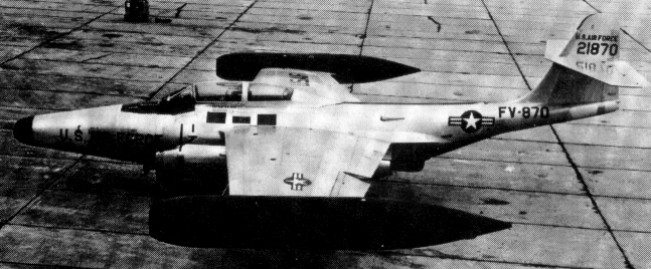
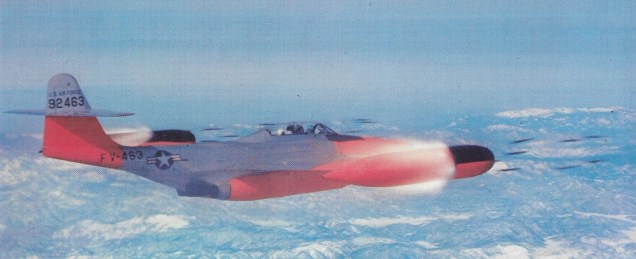
Basic development of the Northrop F-89 Scorpion began during 1945 in response to a general requirement issued by the then US Army Air Force calling for an aircraft capable of a speed of 845 km/h (525 mph) at 10670 m (35,000 if) with a 965-km (600-mile) combat radius and the ability to operate with air-to-air rockets. Although the jet era had already begun, the original requirement called for a propeller-driven aircraft, but most of the six companies which responded submitted proposals based upon the use of jet power. In March of the following year, one of the four Northrop candidates was selected for further development and rewarded with a contract for two XP-89 prototypes on 13 June 1946, flown for the first time on 16 August 1948.
Northrop F-89 Scorpion Article
Initial trials revealed few problems, and the type was ordered into production as the F-89A in 1949. Soon afterwards, the Scorpion began to run into difficulties, most of which centred around inadequate performance; but there was also serious concern about structural integrity and it was decided to suspend production until Northrop had eradicated these failings. In the event, only 11 examples of the F-89A were completed, most of these being emplayed on operational trials, and it was the F-89B which became the first operational model, entering service at Hamilton AFB, California, in June 1951.
A total of 37 F-89Bs was built before production switched to the essentially-similar F-89C. It was at about this time that the Scorpion gained a reputation as ‘the world’s largest vacuum cleaner’, the low-slung engines being prone to damage by objects ingested on takeoff and during taxiing; inlet screens helped to overcome this difficulty.

The most numerous sub-type was the F-89D with revised engines and improved fire-control and armament systems, no less than 682 being built by March 1956. The standard fighter equipment with U.S.A.F. in 1955, early F-89A, B and C had six 20 mm. cannon in nose. F-89C could also carry 16×5 in. rockets under wings. They were followed by the rather more heavily-armed F-89H, almost all of the 156 aircraft of this version being accepted in 1956. Subsequently, 350 of the earlier F-89Ds were fitted with a new fire-control system and revised armament in the form of the Douglas MB-i Genie missile, these henceforth being known under the designation F-89Js. The first nuclear-armed interceptor to make its debut, the F-89J began to enter service at Hamilton in January 1957 but enjoyed only a short front-line career, giving way to more sophisticated interceptors like the McDonnell F-101B, Convair F-102A and Convair F-106A in 1960. Many Scorpions did, however, continue to fly with the Air National Guard until 1968.
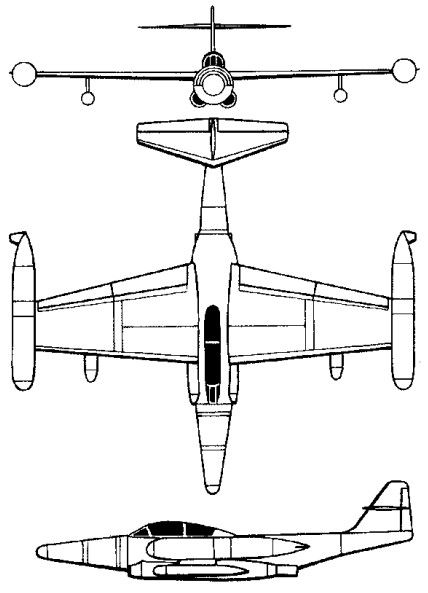
A total of 1232 were built.
F-89D
Engines: 2 x Allison J35-A-35, -33A, -41, -47 afterburning turbo-jet, 3266kg / 5,600 lb
Max take-off weight: 19160 kg / 42241 lb
Empty weight: 11428 kg / 25195 lb
Wingspan: 18.19 m / 59 ft 8 in
Length: 16.41 m / 53 ft 10 in
Height: 5.36 m / 17 ft 7 in
Wing area: 52.21 sq.m / 561.98 sq ft
Max. speed: 1024 km/h / 636 mph
Ceiling: 14995 m / 49200 ft
Range: 4184 km / 2600 miles
Armament: 3 x “Falcon” guided missiles, 104 x 70mm missiles
Crew: 2
F-89J Scorpion
Powerplant: two 3266-kg (7,200-lb) afterburning thrust Allison J35-A-35 turbojets
Maximum speed 958 km/h (595 mph) at 10970 m (36,000 ft)
Initial climb rate 1573 m (5,160 ft) per minute
Service ceiling 15600 m (51,180 ft)
Maximum range 1720 km (1,690 miles)
Maximum take-off weight 19319 kg (42,590 lb)
Wing span 18.19 m (59 ft 8 in)
Length 16.33 m (53 ft 7 in)
Height 5.36 m (17 ft 7 in)
Wing area 52.2 sq.m (562 sq ft)
Armament: two MB-i (AIR-2A) Genie nuclear-tipped rockets and 104 FFAR rockets.
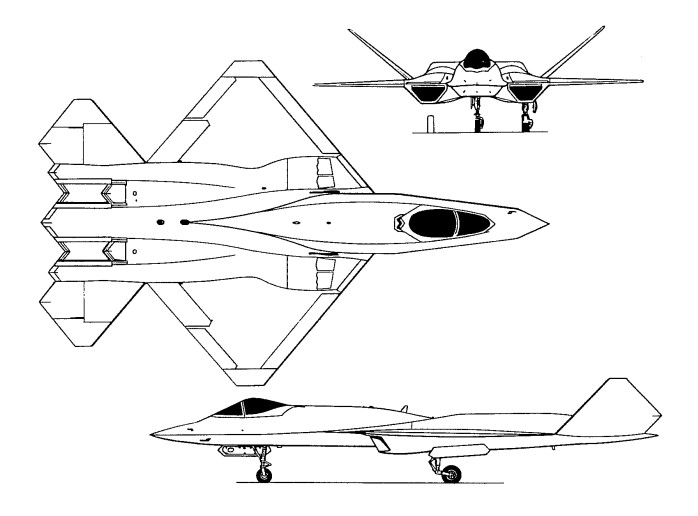
Northrop F-23 Black Widow II / Northrop/McDonnell Douglas YF-23 Black Widow II

The first prototype, 87-800 (N23IYF reserved, but not used) was rolled out at Edwards AFB on 22 June 1990. The first flight was achieved on 27 August 1990 powered by P&W YF119s. The first air refuelling was achieved on the fourth sortie, on 14 September 1990. Mach 1.43 ‘supercruise’ was achieved on 18 September 1990 (the fifth sortie). The first use of afterburner was on the sixth sortie, on 21 September 1990. An altitude of almost 50,000ft was reached on 25 September 1990 (seventh sortie), and the final flight was on 30 November 1990. A total of 34 sorties/43hr.
Northrop F-23 Black Widow II Article
The second prototype, 87-801 (N232YF reserved, but not used) had GE F120 powerplants, and had a first flight at Edwards 26 October 1990. ‘Supercruise’ in excess of Mach 1.6 was achieved on 29 November 1990. The final flight was made on 18 December 1990 after a total of 16 sorties/22 hrs.

The YF-23 had achieved Mach 1.8 at 50,000ft (15,240m) in afterburner. No missile launches were made, and no thrust vectoring was used. The aircraft were in storage at Edwards AFB from December 1990.

YF-23
Engines: 2 x Pratt & Whitney YF119-PW-100, 155.7kN with afterburner
Max take-off weight: 29030 kg / 64001 lb
Empty weight: 16783 kg / 37000 lb
Wing span 43ft 7.25in / 13.29m
Length overall 67ft 4.75in / 20.54m
Height overall 13ft 10.75in / 4.24m
Wing area: 87.8 sq.m / 945.07 sq ft
Max. speed: 2080 km/h / 1292 mph
Ceiling: 19800 m / 64950 ft
Range: 1200 km / 746 miles
Crew: 1
Northrop P600 / YF-17
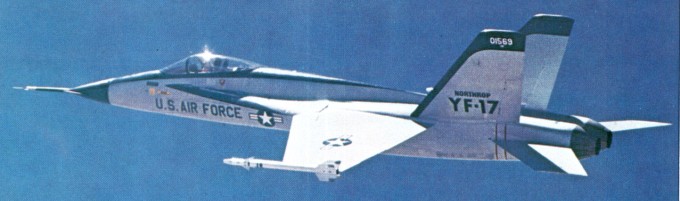
Based on the company-funded P530 Cobra project, the YF-17 was developed to meet a USAF Request for Proposals for a lightweight day air superiority fighter. Of the companies making submissions for the RFP, Northrop and General Dynamics were each awarded contracts on 13 April 1972 for their contenders as the YF-17 and YF-16 respectively.
The YF-17 Cobra prototype (72-01569), the first of two for competitive evaluation against the General Dynamics YF-16, made its maiden flight on 9 June 1974. The second prototype made its first flight on August 21 1974 from Edwards AFB, California. These were powered by two General Electric YJ101-GE-100 engines rated at 6532kg with afterburning. Proposed armament comprised one 20mm rotary cannon and two AIM-9 Sidewinder AAMs, provision being made for one centreline and four wing stores stations to give the YF-17 multi-mission capability.
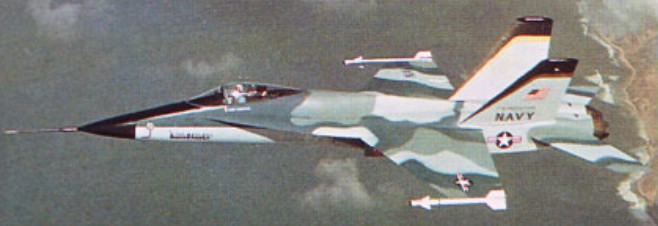
Northrop’s YF-17A prototypes failed to win a production contract for the USAFs LWF (lightweight fighter) requirement, losing out to the General Dynamics YF-16A in 1974. Developed later by Northrop and McDonnell Douglas, it is in production for the US Navy as the F/A-18 Hornet single-seat naval strike fighter.
North¬rop’s YF 17 #1 prototype was flying a number of research missions for NASA at Edwards AFB in California. One of two ob¬jectives for the twin engine fighter was collection of in flight pressure data around the afterbody of the air¬craft and engine nozzles. The data was to be compared with wind tunnel information in an effort to improve wind tunnel prediction techniques which will help de¬signers of future fighter aircraft.
YF 17
Engines: two General Electric YJ101-GE-100, 6532kg with afterburning
Span: 10.67 m (35 ft 0 in)
Length: 16.92 m / 55 ft 6 in
Height: 4.42 m / 14 ft 6 in
Wing area: 32.51 sq.m / 349.93 sq ft
Max take-off weight: 13894 kg / 30631 lb
Loaded weight: 9526 kg / 21001 lb
Maximum speed: Mach 2+ / 2071 km/h / 1287 mph
Range w/max.fuel: 4506 km / 2800 miles

Northrop F-5 Freedom Fighter / N-156F

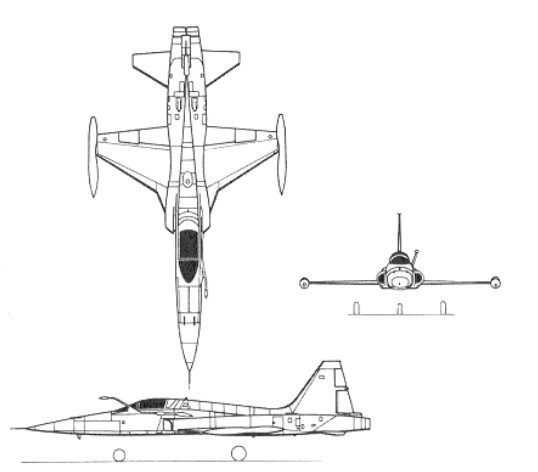
A team under Welko Gasich designed the N 156F in the mid 1950s as an economical, light fighter, cheaper to buy and operate than the large Mach 2 designs then being constructed. The Department of Defense showed little interest, but a two seat trainer version (at first for the Navy, later the USAF) bore fruit and was produced in quantity as the T 38 Talon. This provided an underpinning for the N 156F, which after various changes was released to manufacturing in late 1957, Northrop deciding to build three. The first, by this time called the Freedom Fighter, flew on July 30, 1959. The prototype had a Department of Defense (Air Force) serial number but no national markings. On April 25, 1962, the US government announced that it was ordering the aircraft into quantity production as the standard fighter to be supplied through the Military Assistance Program to Allied and friendly nations. Since then further contracts have followed, paid for by the recipient governments.
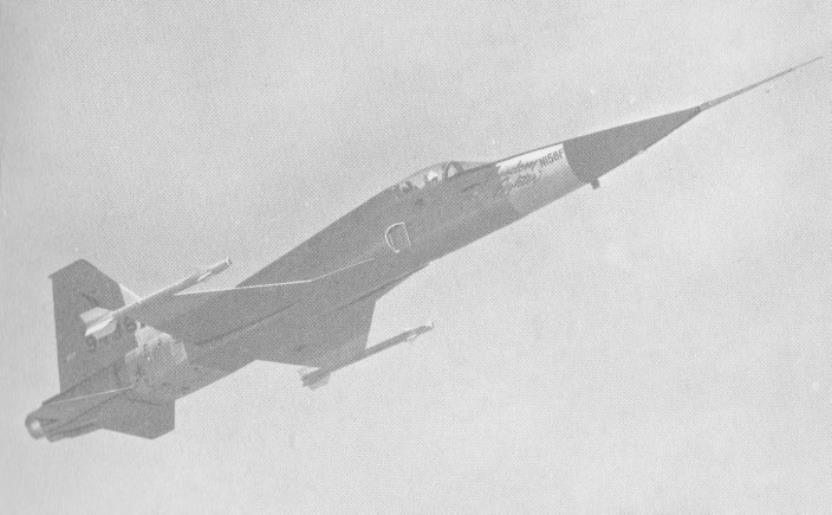
The low wing is swept back 25 degrees, with ailerons at mid-span, and trailing-edge flaps inboard. Full span leading-edge flaps and a conventional rudder is fitted, and all-moving tailplane. Two air-brakes are under the centre of the area-ruled fuselage. The tricycle undercarriage has a single wheel on each unit. The mains retract inward into the fuselage and the nose wheel retracts forward.
Redesignated F 5A (single seat) and F 5B (tandem dual control version), the Freedom Fighter began to come off the production line in 1963. Powered initially by two General Electric J85 13 engines each rated at 1383 kg (3050 lb) static thrust with full afterburner, the F 5A was a simple machine with no radar other than a ranging set for the two 20 mm (0.79 in) Pontiac M 39 cannon mounted above the nose.
Total internal tankage was 2200 litres (484 Imperial gal), and two Sidewinder air to air missiles could be carried on the wing tips in place of area ruled (Coke bottle shape) drop tanks. Early in development five further hard points were added for a total external load of 2000 kg (4410 lb), the total load of ordnance of all kinds, including guns and ammunition, being 2812 kg (6200 lb).
More than 1000 of this first generation F 5 series were produced, including more than 300 built under licence in Canada, Spain and Taiwan. Canadian aircraft, assembled by Canadair incorporated parts built in the Netherlands in a two nation production programme, with J85 CAN 15 engines built by Orenda. In all except the first production version, the 13 engines were rated at 1850 kg (4078 lb) thrust, except for the CF 5 (Cana¬dian) and NF 5 (Netherlands) versions in which the rating was 1950 kg (4299 lb).
Recipients of these F/CF/NF 5A, B, D and G aircraft included Brazil, Canada, Ethiopia, Greece, Iran, Jordan, South Korea, Libya, Malaysia, Morocco, the Netherlands, Norway, Pakistan, the Philippines, Saudi Arabia, Spain, Taiwan, Thailand, and South Vietnam. The USAF also bought a small number to equip a foreign customer training squadron at Williams Air Force Base, and in 1965 also bought one squadron of single seat F 5A aircraft for evaluation in South Vietnam. The equipment fitted was varied for richer customers, and eventually included inertial navigation for Saudi Arabia and various changes to improve short field performance including increased wing incidence, two-position nose gear, arrester hook, provision for ATO rockets and uprated engines. These customers options were specified by Canada, the Netherlands and, except for uprated engines, Norway.
In April 1964 it was reported Norway had confirmed it will purchase 64 F-5A, with option to buy 20 more. The initial order came to $75 million, including spares and training cost. Deliveries were to be made in 1966-67.

In 1969 the US government held a competition for a successor to the F 5 called IFA (International Fighter Aircraft). Northrop had already fitted an F 5 with two of the more powerful J85 GE 21 engines, each rated at 2227 kg (4910 lb) thrust, and fully investigated the improved performance envelope thus obtainable. It proposed an improved F 5, called F 5E Tiger II, as the IFA, and this won the competition in November 1970. The F 5E has a broader fuselage increasing fuel capacity and wing span a redesigned wing with leading edge manoeuvre flaps, based on an earlier flap fitted to the NF 5A and B, positioned by a switch on the pilot’s throttle working in conjunction with the landing flaps on the trailing edge. It also has large wing root leading edge extensions, Emerson APQ159 X band radar, hard points for a total external load of 3175 kg (7000 lb) and considerably altered and enhanced avionics. Provision is made for a detachable probe for inflight refuelling, and a further list of customer options includes ATO rockets, antiskid brakes (the arrester hook is standard), the ‘FR’ nose, chaff/ECM pods, improved ejection seats and a wide range of special target sensing or designations, weapon guidance and countermeasure kits. The first F-5E was flown in August 1972
By 1978 more than 1000 F 5Es and tandem seat F 5F Tiger IIs had been delivered, and orders had been placed for some 1500 from Brazil, Chile, Ethiopia (supplied by Iran after a US embargo), Iran, Jordan, Kenya, Malaysia, Morocco, Peru, Philippines, Saudi Arabia, Singapore, South Korea, Switzerland, Taiwan, Thailand, Tunisia and South Vietnam. In February 1978, the US government agreed to sell 50 (probably a mix of Es and Fs) to Egypt ‘as a reward for President Sadat’s peacemaking efforts’. Further aircraft had been supplied to the USAF and US Navy for use in DACT (Dissimilar Aircraft Combat Training), the F 5E taking the part of aggressor’ MiG 21 fighters which it resembles in size and to some degree in characteristics. The tandem seat F 5F, of which some 100 have been delivered, has a longer fuselage, a single gun and reduced gross weight.

Derived from the earlier F-5A/B Freedom Fighter, the F-5E/F, powered by two 22.24kN General Electric J85 turbojets, first flew on August 11, 1972. Its armament comprises twin 20mm cannon, two AIM-9 Sidewinder, plus up to 3,l75kg of stores on one under-wing and one under-fuselage hard-points. Development of a two-seater conversion trainer counterpart of the F-5E Tiger II was approved early in 1974, and the F-5F Tiger II (73-0889) first flew on 25 September of the same year. The airframe is basically that of the F-5E lengthened by 3 ft 6.5 in (1.08 m) to allow the insertion of a second ejector seat, displays, and controls under a lengthened canopy. Though one of the F-5E’s two 20-mm cannon is removed, the F-5F still has the F-5E’s fire-control system with APQ-157 multi-role radar, and retains all five hardpoints for full combat capability. Some aircraft have an inertial navigation system and provision for a laser designator pod. About 200 F-5Fs were produced, and such aircraft serve with most F-5E operators. Many aircraft are being updated in a series of programs concerned mostly with the F-5E.
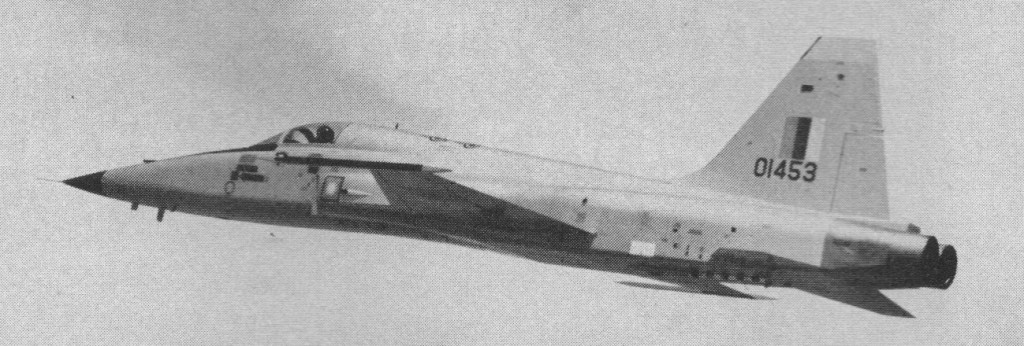
The F-5E/F has also been produced under licence in South Korea, Switzerland, and Taiwan.
The Northrop F-5 Freedom Fighter/Tiger family has also been developed to perform photographic reconnaissance duties; approximately 100 examples of the RF-5A and RF-5E Tigereye have been built to 1984. The first and thus far most numerous reconnaissance model to appear was the RF-5A, 89 examples of which were constructed by the parent company between 1967-72. Featuring a nose-mounted battery of four KS-92A cameras, the RF-5A entered development in October 1963 in response to a US Air Force directive calling for a daylight tactical reconnaissance model of the Freedom Fighter for supply to friendly nations as part of military assistance and foreign military sales programmes. The RF-5A flew for the first time during May 1968, deliveries beginning during the following month with the initial aircraft going to Iran, which received 13 production examples as part of the military aid programme then in being, Subsequent customers comprised Turkey (20 aircraft), South Vietnam (10), Thailand (4), Greece (16), South Korea (8), Morocco (2) and Norway (16) before production of this model ceased in June 1972.
In addition to those aircraft produced by the parent company, the Freedom Fighter was also built under licence in Spain, 17 examples of the reconnaissance model known locally as the SRF-5A being completed by CASA. Many of the 89 CF-5As, 75 NF-5As and 2 seat CF-5Ds completed by Canadair for service with the armed forces of Canada, the Netherlands and Venezuela also featured latent reconnaissance capability, being fitted with camera noses. A total of 204 CF-5s were produced.

More recently, Northrop developed the RF-5E Tigereye for reconnaissance duties and this is a rather more sophisticated machine based on the F-5E Tiger II and using up to six cameras or infra-red scanners on quick-change pallets which can be inserted into the extended nose. Making its maiden flight on 29 January 1979, the RF-5E has thus far failed to find a ready market, the only customers being Malaysia, which took delivery of two during 1983, and Saudi Arabia, which has ordered 10. Malaysia operates two Northrop RF-5E Tigereyes on reconnaissance duties, equipped with Sidewinder air-to-air missiles on the winglips for protection. The type features an arrester hook in common with most US fighters.
Production of the F-5E/F light tactical fighter ended in 1986, and the last two aircraft were handed over to Bahrain on January 16, 1987. A total of 2,610 F-5s of all models were built over a 24-year period, includ-ing more than 1,400 F-5E/F Tiger IIs and RF-5E Tigereyes.
NASA employed a single F-5E airframe with a revised, deeper fuselage for experimentation in DARPA’s “Shaped Sonic Boom Demonstration” program. The airframe survived its testing and became a permanent fixture at the Valiant Air Command Museum in Florida.
A further development, the F-5G, became the Northrop F-20.
N-156F
Engines: 2 x General Electric J85-GE-5, 3850 lb
Wingspan: 26 ft 5 in
Wing area: 171 sq.ft
Length: 43 ft 1 in
Height: 13 ft 1 in
Wheel track: 10 ft 10 in
MTOW: 16,110 lb
Internal fuel: 500 Imp.Gal
Max speed: 990 mph at 36,000 ft / M1.5
Cruise: 560 mph at 36,000 ft
Max ROC: 28,000 fpm
Max range: 2100 miles
Hardpoints: 5 + 2 wingtip
F-5A
Engines: 2 x GE J85 turbojet
Span: 7.70 m (25 ft 3 in)
Length: 14.38 m (47 ft 2 in)
Gross weight: 9379 kg (20 680 lb)
Maximum speed: 1489 km/h (925 mph)
External load: 2812 kg (6200 lb)
Seats: 1
Armament: 2 x 20mm cannon
RF-5A
Type: single-seat tactical reconnaissance aircraft
Powerplant: two General Electric J85-GE-13 turbojets, 1851 kg (4,080-1b) afterburning thrust
Maximum speed at 10975 m (36,000 ft) 1489 km/h (925 mph) or Mach 1.4
Combat ceiling 15240 m (50,000 ft)
Range w/max.payload: 592 km / 368 miles
Max range 2595 km (1,612 miles)
Empty weight 3667 kg (8,085 lb)
Maximum take-off weight 8952 kg (19,736 lb).
Span 7,70 m (25 ft 3 in)
Length 14.38 m (47 ft 2 in)
Height 4.01 m (13 ft 2 in)
Wing area 15.79 sq.m (170 sq ft)
F-5B
Span: 7.70 m (25 ft 3 in)
Length: 14.12 m (46 ft 4 in)
Gross weight: 9300 kg (20 500 lb)
Maximum speed: 1424 km/h (885 mph)
Seats: 2
F-5D
Span: 7.70 m (25 ft 3 in)
Length: 14.12 m (46 ft 4 in)
Gross weight: 9300 kg (20 500 lb)
Maximum speed: 1424 km/h (885 mph)
F-5E
Span: 8.13 m (26 ft 8 in)
Length: 14.73 m (48 ft 31 in)
Gross weight: 11192 kg (24675 lb)
Maximum speed: 1704 km/h (1060 mph)
F-5E Tiger II
Engines: 2 x J85 GE 21 reheat 44.5 kN
External load: 3175 kg (7000 lb)
Span: 8.1 m
Length: 14 m
Wing area: 17.3 sq.m
Empty wt: 4410 kg
MTOW: 11,215 kg
Warload: 3175 kg
Max speed: 1.64 Mach
Initial ROC: 10,515 m / min
Ceiling: 15,790 m
TO run: 610 m
Ldg run: 762 m
Combat radius lo-lo-lo: 220 km
Fuel internal: 2563 lt
Air refuel: Yes
Armament: 2 x AAM, 2 x 20 mm
Hard points: 5 + 2 wing tips
F-5F Tiger II
Engines: two 5,000-lb (2,268-kg) reheated thrust General Electric J85-GE-21 B turbojets
Maximum speed 1030 mph (1,658 km/h) or Mach 1.56 at 36090 ft (11000 m)
Initial climb rate 32900 ft (10030 m) per minute
Service ceiling 50800 ft (15485 m)
Radius 599 miles (964 km)
Empty weight 10,576 lb (4,797 kg)
Maximum take-off 25,152 lb (11,409 kg)
Wing span 26 ft 8 in (8.13 m)
Length 51 ft 4 in (15.65 m)
Height 13 ft 1.75 in (4.01 m)
Wing area 186.0 sq ft (17.29 sq.m)
Armament: one 20-mm cannon, and up to 7,000 lb (3,175 kg) of disposable stores
Canadair CF-5 Mk.2
Engine: 2 x General Electric/Orenda J-85-15, 4000 lb
Wing Span: 25ft 10in
Length: 47ft 2in
Height: 13ft 2in (4m)
Speed: 1,150 miles/hr – mach 1.3
Armament: two 20mm Cannons 6,200lbs bombs, rockets & missiles
Northrop T-38 Talon / N-156T
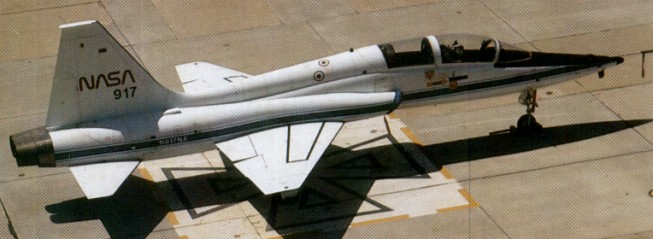
To meet a US government requirement for a high-performance lightweight fighter that would be suitable for supply to and operation by friendly nations via the Military Assistance Program, Northrop began the private-venture design of such an aircraft in the mid-1950s, identifying it as the Northrop N-156.
This initial design concept was to form the basis of a family of aircraft, including a supersonic trainer which had the company designation N-156T. Three YT-38 prototypes were ordered in December 1956, this number being increased to six in June 1958, and the first of them was flown on 10 April 1959.
Cantilever low wing monoplanes with slender area ruled fuselages, the first two prototypes were each powered by two 953kg thrust non-afterburning General Electric YJ85-GE-1 turbojets, but the remainder of this first batch had YJ85-GE-5 engines with an afterburning thrust of 1633kg. The first to receive the T 38, in 1962, was the 3560th UPT Wing at Webb AFB, Texas. Testing with these latter engines resulted in an initial contract for the T-38A Talon, the first of them entering service with the USAF’s 3510th Flying Training Wing, at Randolph AFB, on 17 March 1961, powered by two 3,850 lb thrust General Electric J85 GE 5 turbojet engines. The aircraft boasts a 720° per second roll rate.
The Talon, which seats instructor and pupil in tandem on ejection seats and has a fully powered control system, has gained one of the best safety records of any supersonic aircraft in USAF service. As a result, when production ended in early 1972 a total of 1,187 T-38s had been built for the USAF. The US Navy acquired five from the USAF, and three of these remained in service with the Test Pilots School at Patuxent River.
Also supplied through the USAF and operated by the German Luftwaffe were 46 used for pilot training in the US. Only export customer was Portugal who received two batches of six Sidewinder-equipped ex-USAF aircraft in 1977 and 1981 to replace F-86 Sabres used in the dedicated air defence role but doubling as advanced pilot trainers.
NASA also acquired a number from Northrop, using them as flight-readiness trainers for astronauts. Reported in 1965, fifteen were acquired, replacing Convair F-102 Delta Daggers.
The designations AT-38A and NT-38A were allocated to two T-38As following their conversion for evaluation as an attack trainer and research/ development aircraft respectively. Four of the US Navy’s T-38s converted to serve as drone directors were redesignated DT-38A.
The AT 38B is a lightly armed version serving in the Lead-in Fighter Training role at Holloman AFB, New Mexico. The T-38B has a gunsight and a centerline pylon which can be fitted with a gun pod or bombs. Some 700 of these aircraft remained in service in 1992.
The T-38 Talon were modernised to T-38C standard for redelivery from 1999 by Northrop Grumman. The T-38C employed new, electronic instrumentation.
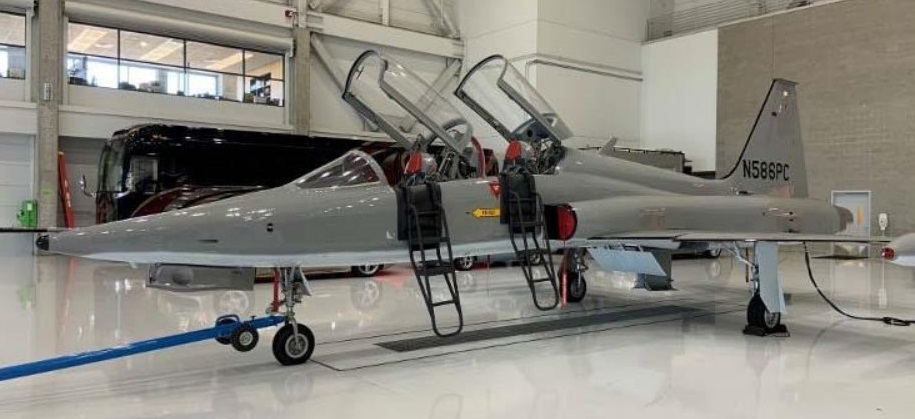
Several T-38s have made their way back into the U.S. in private hands.
T-38A Talon
Engines: 2 x General Electric J85 GE 5 turbojets, 2,500 lbs.t. (1134 kgp) and 3,850 lb (1746 kg) with afterburn
Span, 25 ft 3 in (7.7 m)
Length, 44 ft 2 in (13.46 m)
Height: 3.92 m / 12 ft 10 in
Wing area, 170 sq.ft (15.8 sq.m)
Empty weight, 7,340 lb (3329 kg)
Loaded weight, 11,700 lb (5307 kg)
Max speed, 838 mph (710 kt / 1348 kph) at 36,000 ft (10 973 m)
Cruise, 590 mph (949 kph)
Initial climb, 30,000 fpm (152.4 m/sec)
Service ceiling, 56,800 ft (17 312 m)
Range, 1,267 mls (2039 m)
Seats: 2
U/C & flap limit: 240 kt
Loading: +6.4 / -2.6G
 All Aero