A twin engined push pull CP 500, for homebuilders.
2 Engines
Piasecki 59 Sky-Car / Airgeep / Seageep / VZ-8
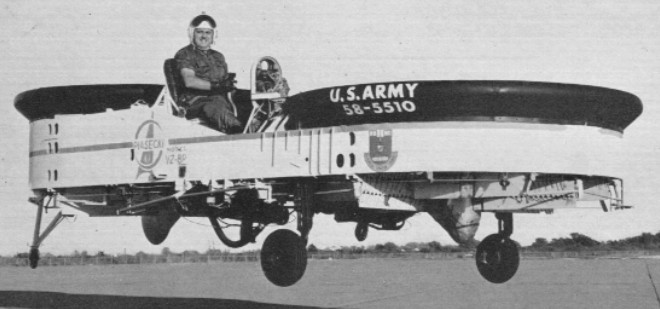
While the Army was pursuing the flying platforms, they were also investigating larger rotorcraft along similar lines, called the “flying jeeps”. Some sources imply that they were intended mostly for hovercraft operation, with an ability to fly over obstacles or impassable terrain when necessary, while other sources indicate they were regarded as helicopter-like utility vehicles that operated normally as flying machines. Whatever the case, the US Army Transportation Research Command began an investigation into the flying jeeps in 1956, leading to award of contracts for prototypes to Chrysler, Curtiss-Wright, and Piasecki in 1957.
The first of the Piasecki flying jeep was the Piasecki “Model 59H AirGeep”, which was given the Army designation “VZ-8P”. The craft was built around two tandem 2.4 meter (8 foot) diameter, three-bladed, ducted rotors driven by two 135kW / 180 hp Lycoming piston engines. Both powerplants were connected to a single central gearbox so that both rotors would continue to turn even if one engine failed. The “Sky Car” had fairly conventional helicopter-type controls which provided directional stability through a series of hinged vanes mounted under each rotor duct. Forward motion was achieved by pitching the aircraft nose-down. The craft had fixed tricycle wheeled landing gear, and accommodated its single pilot and one passenger in seats sited between the two rotor ducts.
The AirGeep was 7.9 meters long and 2.7 meters wide (26 feet by 9 feet), with three-bladed rotors in ducts in the front and the back. The pilot and passenger sat between the ducts. The rotors spun in opposite directions to reduce torque effects.
The first of two Model 59 AirGeep (58 5510) examples ordered by the Army was first flown on 12 October 1958. Apparently it proved grossly underpowered, barely able to fly over a fence, and it was sent back to the shop, where the piston engines were replaced by a single 317 kW (425 HP) Turbomeca Artouste IIB turbine engine. The upgraded AirGeep flew on 28 June 1959. It weighed 1.1 tonnes (2,500 pounds) and could carry a payload of 550 kilograms (1,200 pounds), including the pilot.
Turned over to the Army shortly, the machine was subsequently given the designation VZ-8P (the “P” indicating Piasecki). Shortly after being accepted by the Army the VZ-8P was fitted with a single 315kW Turbomeca Artouste IIB turbine engine in place of its twin Lycoming pistons, and its first turbine-powered flight took place in June 1959.
The AirGeep was put through trials for both the Army and the Navy over the next few years. The engine was upgraded again to a Garrett / Airesearch 331-6 engine, which had a higher power-to-weight ratio. For Navy trials, which began in June 1961, the rotorcraft was fitted with floats, and redesignated the “PA-59 SeaGeep”.
The second VZ-8P incorporated several significant design changes and was designated the Model 59H “Airgeep II” by Piasecki and the VZ-8P (B) by the Army. The Army Transportation Research Command issuing a contract for the “Model 59K”, which made its first non-tethered flight in the summer of 1962.

The AirGeep II was similar to the AirGeep, except that the aircraft was “bent” in the middle so that the rotors were tilted fore and aft, to improve forward flight characteristics. The AirGeep II used twin 298 kW (400 SHP) Turbomeca Artouste IIC turboshaft engines, once again linked so that if one failed the other would drive both rotors. One engine could also be coupled to the landing wheels to drive the machine on the ground.
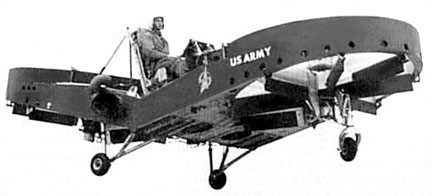
The increased power allowed a maximum take-off weight of 2.2 tonnes (4,800 pounds). The pilot and observer had “zero-zero” ejection seats, allowing safe escape if the machine was on the ground and standing still, and there were seats for up to passengers.

During 1961 it was used for a series of trials by the U.S. Navy, operating from water and from the deck of a destroyer. For these, pontoons replaced the wheeled undercarriage and the VZ 8 became known as the PA-59N Seageep. Following completion of these trials, it was re engined with an AiResearch Model 331 6 turboshaft.
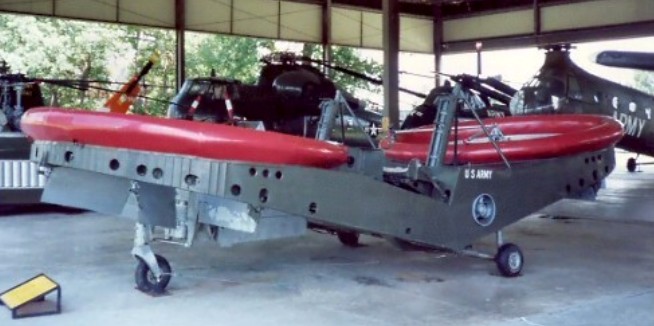
Neither version of the VZ-8P was dependent upon surface effect lift for flight and, though intended to operate within a few feet of the ground in order to make the best use of natural cover, both were quite capable of flying at altitudes of several thousand feet. Both versions were found to be stable and relatively capable craft.
The Airgeep was ultimately judged by the Army to be mechanically ill-suited to the rigors of field operations. The “flying jeep” concept was eventually abandoned in favor of the further development of conventional battlefield helicopters, and both VZ-8P examples were dropped from the Army’s inventory in the mid-1960s.
Piasecki VZ-8P Airjeep
Engines: 2 x Lycoming O-360-A2A, 180 hp / 135kW
Rotor diameter: 2.26m
Length: 7.95m
Height: 2.03m
Width: 2.87m
Max take-off weight: 1060kg
Empty weight: 835kg
Max speed: 105km/h
Cruising speed: 80km/h
Service ceiling: 900m
Range: 40km
Crew + passengers: 1+1
Piasecki VZ-8P Airgeep II
Engines: 2 x Turbomeca Artouste IIC turboshaft, 400 shp / 300kW
Rotor diameter: 2.49m
Length: 7.44m
Height: 1.78m
Width: 2.82m
Max take-off weight: 1655kg
Empty weight: 1178kg
Max speed: 137km/h
Cruising speed: 113km/h
Service ceiling: 900m
Range: 55km
Crew + passengers: 2+3
Piasecki PV-15 / H-16 / H-27 / Vertol H-16
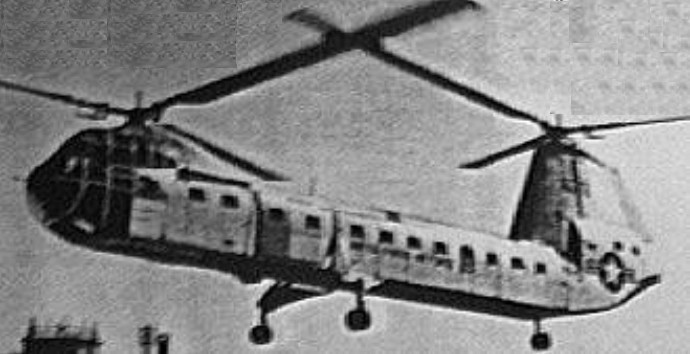
A USAF requirement for a wide-ranging helicopter capable of rescuing downed strategic bomber crews had given rise to the new helicopter. The hefty fuel capacity required to meet its specified 2250km range in part dictated its size. Without the extra fuel, the capacious aircraft also had possible military application as a large troop and cargo transport. In 1946 the Army Air Forces awarded Piasecki Aircraft a contract for the development of a tandem rotor helicopter intended for use in the long-range search and rescue (SAR) role. The resultant Piasecki Model PV-15 was originally given the military designation XR-16 (R denoting rotorcraft under the World War II system), though this was changed to XH-16 in June 1948. The Air Force placed an order for two service test and evaluation aircraft in June 1949, and subsequently allocated the serial numbers 50-1269 and -1270 for these machines.
Piasecki PV-15 Transporter Article
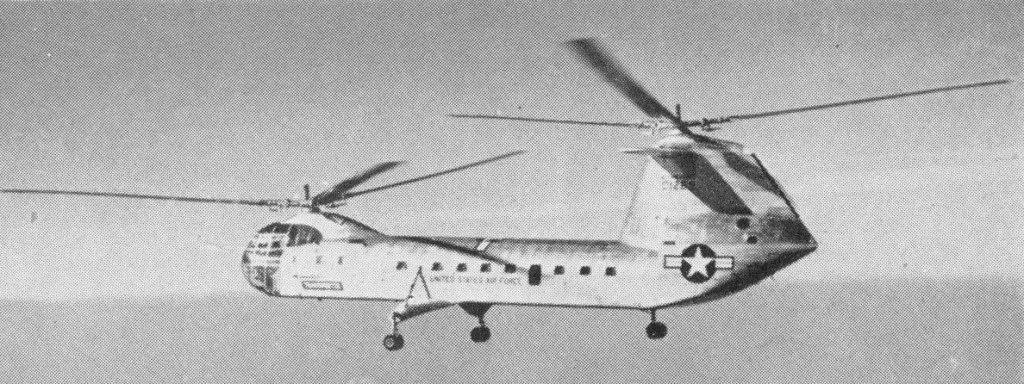
At the time of its inception the H-16 was the largest helicopter in the world. Though originally intended for the SAR role the Transporter, as the H-16 was ultimately named, evolved during the design process into a heavy-lift craft equipped with a tail loading ramp and optimized for troop and cargo transport. In this role the aircraft could carry up to forty troops or three light trucks within its fuselage, the interior of which was kept clear of obstructions by mounting the engines and all dynamic components in the upper fuselage. The H-16 was also capable of transporting large exterior cargo pods, and was equipped with variable-height landing gear legs in order to accommodate pods of varying sizes.

It had tandem three-blade rotors, and two engines, one at the front and the other in the rear of the fuselage. The rear engine drove the rotor at the top of a tail pylon nearly 4m high. The helicopter had a horizontal stabilizer, to which vertical control surfaces were later added in order to overcome problems of directional stability during fast flight. It weighed 14 tonnes on take-off with two pilots and 40 equipped infantry on board.
It was 23.8m long and topped by two overlapping rotors each 25m in diameter. In-flight vibration was low and of a loping nature. Bonded and tapered all-metal rotor blades (built using a new company process) combined milled-aluminum skins, aluminum honeycomb filler, and a leading-edge balance weight that also served as a mechanical fastener for the skins.
These capabilities appealed to the U.S. Army, which saw in the H-16 an answer to several helicopter mission requirements of its own. It therefore joined the USAF in sponsoring further development of the YH-16.
The first Transporter (serial 50-1269) was powered by two 1650hp Pratt & Whitney piston engines and made its first flight on 23 October 1953 at Philadelphia International Airport, designated YH-16. Company personnel and military officials watched the helicopter take off, hover, and fly forward and sideways during a successful twelve-minute maiden hop flown by Harold Peterson and Phil Camerano.
The Air Force ultimately decided against procuring the H-16 for operational use, and in 1955 the YH-16 was turned over to the Army for evaluation. The Army found the piston-driven Transporter to be underpowered and therefore awarded the reorganized Vertol company a contract for the machine’s conversion to turbine power.
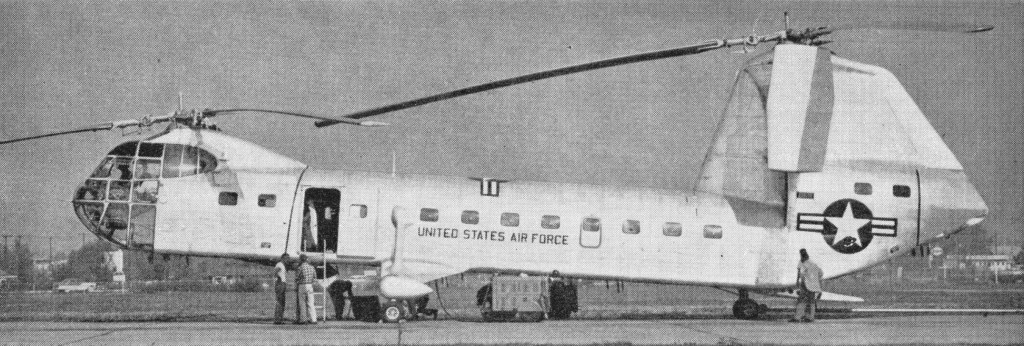
During construction the second prototype (50-1270) was modified to Model PV-45 (first designated H-27 and then H-16A) standard through the replacement of its piston engines with two 1800shp Allison T38-A-6 turboshafts, and modified to carry up to fifty troops, and redesignated YH-16B. The change in powerplants and inclusion of various structural modifications prompted a redesignation to XH-27 in October 1952, though this was changed to YH-16A prior to the aircraft’s first flight in July 1955 with Harold Peterson and George Callaghan at the controls. This aircraft set an unofficial world record of 270km/h in 1956. Both H-16 variants were at times fitted with varying types of experimental horizontal tail surfaces, one of which incorporated large end-plate rudders, but none of these designs were adopted for permanent use.
Despite improvements the type was ultimately judged to be unsuited to sustained operations under field conditions, and the Army terminated the H-16 test programme in mid-1956.

In December, the YH-16A broke apart in the air and crashed near the Delaware River, killing Peterson and Callaghan as they returned from a test flight in New Jersey. Investigators determined that the rear rotor shaft had failed, allowing the blades to desynchronize and wobble into the plane of those of the forward rotor. In fact, a frozen bearing in the test instrumentation had precipitated this failure by allowing a steel-tube standpipe, placed within the aluminum rotor shaft to guide wires from the instrumented blades, to undetectably inscribe a deepening groove within the shaft.
This accident caused the H-16 program to be scrapped, preempting the sixty-nine-passenger YH-16B Turbotransporter (a conversion of the YH-16 then in progress), which would have flown with two 3700shp Allison T56 engines. It also preempted Frank Piasecki’s vision of interchangeable under-body pods for the rapid transport of differing loads such as field operating rooms, communications centers, and mobile repair centers. A tall stilt landing gear had already been designed to let the YH-16B accommodate such pods.

XR-16 / YH-16
Engines: two 1,650 h.p. Pratt & Whitney R2180-11
Rotors: 2 x 3-blade main rotors in tandem.
Rotor diameter: 25m / 85 ft
Fuselage length: 23.8m / 78 ft
Loaded weight: Over 30,000 lb
Useful load: 15,615 lb
Max speed: Over 130 mph
Range: 210 mi
Ceiling: 18,000′
Capacity: 32 stretchers, 3 jeeps or 40 troops.
No built: 1, 50-1269
YH-16A
Engine: 2 x Allison YT-38A-10 turboshaft, 1800 / 1340kW
Rotor diameter: 24.99m
Length: 23.65m
Height: 7.62m
Max take-off weight: 15244kg
Empty weight: 10218kg
Max speed: 235km/h
Hovering ceiling, IGE: 4800m
Service ceiling: 6980m
Range: 2300km
XH-27
Engines: 2 x 1800hp Allison YT38-A-10 turboshafts
Useful load: 20,250 lb
Range: 216 mi
Ceiling: 15,600 ft
Capacity: 49
No built: 1, 50-1270
YH-16B
Engines: 2 x 2100hp Allison T56-A-5
No converted: 1, 50-1270

Piaggio PD-808
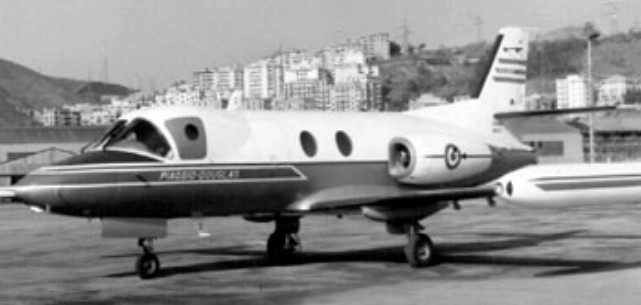
Under an agreement signed in 1961, Piaggio and Douglas Aircraft developed the PD-808 for military and commercial use. Originally designed by the Douglas Aircraft Company of Long Beach, California, as a business jet. No orders were received, and the complete project was bought by Piaggio, which flew the first prototype in 29 August 1965.
The PD-808 was powered by Bristol Siddeley Viper turbojets mounted on the sides of the rear fuselage. Piaggio also failed to secure any worthwhile commercial interest, but a few examples were taken by the Italian air force.
After appearing at the Paris Air Show it was modified.
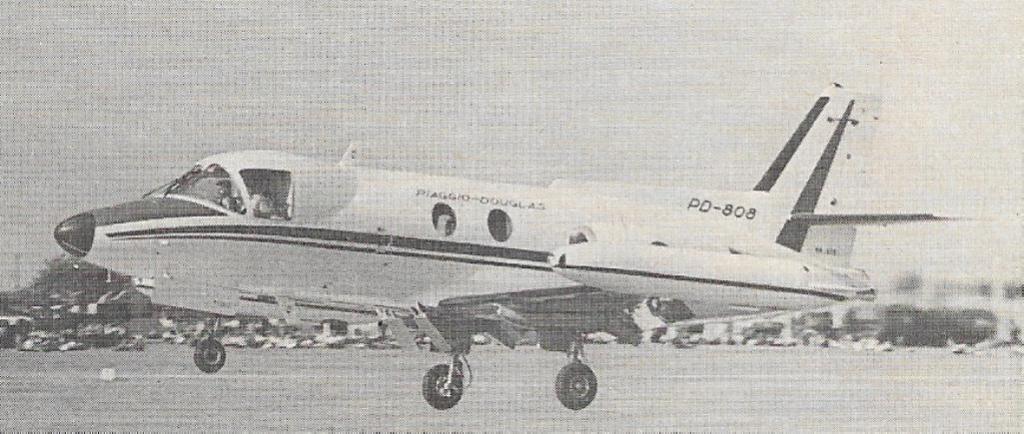
Only 27 examples of this type, with low-set wings and aft-mounted turbojet engines, were produced, and 25 of these went to the Italian air force. The first aircraft were configured for the utility role (navaid calibration, navigation training for three pupils, and light transport of up to eight passengers or an equivalent freight load), but the last six aircraft were completed as electronic warfare platforms with cabin accommodation for specialist Elint (electronic intelligence) equipment and its three operators.
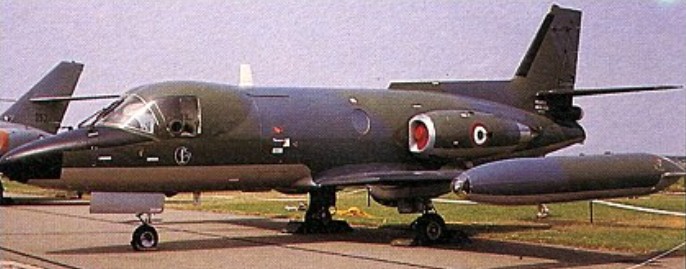
Power increased in 1966 to 3,300 lbs. s.t. The PD-808 differed from the original model by having larger tip tanks, a longer dorsal fin, and a forward-sliding nose fairing. By 1972, the aircraft was available in several versions: a five-seat executive version, a seven-seat executive transport, a six-seat version for the Italian Air Force, and one powered by 3,500-lb. s.t. AiResearch turbofans. Other PD-808s are powered by twin 3,360-lb. s.t. turbojets drawing from two integrated tanks of 511 gallons total capacity and wingtip tanks with 473 gallons total capacity.
Four versions were produced for the Italian Air Force as the PD-808 VIP six-seater for government and military VIP transport duties; PD-808 TA nine-seat transport and navigation trainer; PD-808 ECM electronic-countermeasures version; and the PD-808 RM radio-calibration version that is equipped for medium- and high-altitude calibration of navigation aids.
Engines: two Rolls-Royce Bristol Viper Mk 526 turbojets, 3,368-lb. s.t / 1524kg
Wingspan: 13.2 m / 43 ft 4 in
Length: 12.85 m / 42 ft 2 in
Height: 4.8 m / 16 ft 9 in
Wing area: 20.9 sq.m / 224.97 sq ft
Max take-off weight: 8165 kg / 18001 lb
Empty weight: 4830 kg / 10648 lb
Max. speed: 850 km/h / 528 mph
Cruise 497 mph
Stall 104 mph
Service ceiling: 13700 m / 44950 ft
Range w/max.fuel: 2100 km / 1305 miles
Initial climb rate: 5,400 fpm
Takeoff distance (35′): 3,180 ft
Landing distance (50′): 2,990 ft
Seats: 5-9
PD-808ECM
Five-seat electronic warfare plane
Engines: two 3,360-lb (1,524-kg) thrust Piaggio built Rolls-Royce (Bristol Siddeley) Viper Mk 526 turbojets
Maximum speed 529 mph (851 kph) at 19,685 ft (6,000 m)
Initial climb rate 5,415 ft (1,650 m) per minute
Service ceiling 44,950 ft (13,700 m)
Range 1,322 miles (2,128 km)
Empty weight 10,648 lb (4,830 kg)
Maximum take-off weight 18,001 lb (8,165 kg)
Wing span 43 ft 3.75 in (13.20 m)
Length 42 ft 2in (12.85 m)
Height l5ft 9in (4.80m)
Wing area 224.97 sq ft (20.90 sq.m)
Armament: none
Piaggio P.180 Avanti
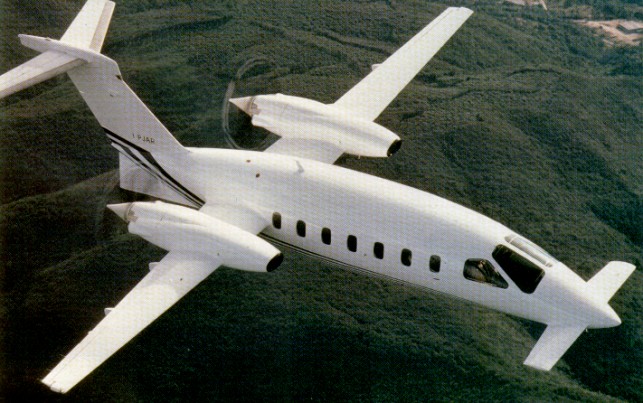
At the 1983 NBAA convention in Dallas, Texas, Piaggio announced a new twin turbo-powered business aircraft. Design work on the P.180 Avanti had begun at Piaggio’s Genoa headquarters in 1979. Seating six to 10 passengers it was a radical departure from anything the company had previously produced. The major design feature of the aircraft is its use of three lifting surfaces. The main wing is fitted above the mid-set position in the fuselage, with the main spar running behind the passenger cabin. Its straight leading edge is broken only by the engine nacelle inlets and the wing has a slight dihedral of 2 degrees. The T-tail and elevator act as the second lifting surface, in addition to being orthodox control surfaces. The foreplane is not a simple canard, but provides a positive lift component in addition to that produced by the wing. This in turn allows the wing to be reduced in size, thus decreasing overall weight and drag.

The engines were originally specified as Pratt & Whitney Canada PT6A-66A turboprops, but these were later changed in favour of more powerful PT6A-61s. Each drives a five-bladed Hartzell fully-feathering reversible-pitch propeller with spinner. The engines are mounted in composite-material nacelles. The Avanti makes considerable use of composites. Carbonfibre and a Graphite/ Epoxy mix represent about 10% of the aircraft’s weight, and all of these components are built by Sikorsky arid Edo. Wings and tail sections are produced by Piaggio at Genoa, while the forward fuselage is the responsibility of Piaggio Aviation in Wichita. Final assembly is completed in Italy. Aircraft intended for the American market are flown ‘green’ to the US to a specialist outfitters and there are plans to eventually assemble all aircraft in the United States.
The cockpit is fitted with a Collins EFIS system, comprising three CRTs and Col-lins navigation and weather radar systems are standard. The aircraft is certified for single pilot operations. The main cabin is pressurised and air conditioned, is fitted with a galley and folda-way tables. An emergency exit is situated at the front on the starboard side with the airstairs on the port side.
In 1983 Gates Learjet became a partner in the project, but withdrew for economic reasons in January 1986. All the tooling and the forward fuselages of the three pre-production Avantis which were on the line at Wichita, were then transferred to Italy.
Assembly of the first P.180 began on Piaggio’s Finale Ligne plant in 1986 and the first flight was made on 23 September 1986 (I-PJAV). This was followed by the second aircraft (I-PJAR) on 14 May 1987. The Avanti was certified by the Italian authorities in March 1990, and in May of that year the first production aircraft was rolled out. The final hurdle of US certification was passed in October 1990 and the first customer delivery took place the following September.
By early 1993 only 20 Avantis had been delivered.
Engines: two Pratt & Whitney PT6A-66, 850-shp / 1107kW
TBO: 3000 hrs
Props: 5 blade 85in counter-rotating Hartzell
Wingspan: 14.03 m / 46 ft 0 in
Wing area: 172.2 sq.ft / 16.0 sqm
Length: 14.41 m / 47 ft 3 in
Height: 3.94 m / 13 ft 11 in
Max ramp weight: 5262 kg
Max take-off weight: 5080 kg / 11200 lb
Empty weight: 3384 kg / 7460 lb
Max ldg wt: 4965 kg
Max zero fuel: 4310 kg
Max fuel: 1170 kg
Max wing loading: 67.1 lbs/sq.ft
Max pwr loading: 6.79 lbs/hp
Service ceiling: 12500 m / 41000 ft
Vmo: 260 kt
Mmo: .67 Mach
Max speed: 395 kts
Stall (MLW): 93 kt
ROC: 2950 fpm
SE ROC: 2950 fpm
TO dist (50 ft): 2850 ft
Ldg dist (50 ft): 2860 ft
Max range with res: 1400 nm
Seats: 7-11
Cabin ht: 5 ft 9 in
Cabin width: 6 ft 1 in
Cabin length: 14 ft 7 in
Piaggio Aero P.180 Avanti II
Price: $6.8 million 2009
Engine: 2 Pratt & Whitney PT6A-66B: 850 shp (derated from 1630)
Max Takeoff Weight: 12,050 lb
Useful Load: 4300 lb
Max Payload: 2000 lb
Empty Weight, Std: 7800 lb
Wing Span: 46.03 ft
Cabin Height: 5.74 ft
Cabin Width: 6.07 ft
Cabin Length: 14.93 ft
Rate Of Climb: 2950 fpm
Max Certified Altitude: 41,000 ft
Max IFR Range: 1507 nm
Max Cruise Speed: 402 KTAS
Takeoff Distance: 2850 ft
Landing Distance: 2860 ft
Piaggio P.166 / Kearney and Trecker Royal Gull
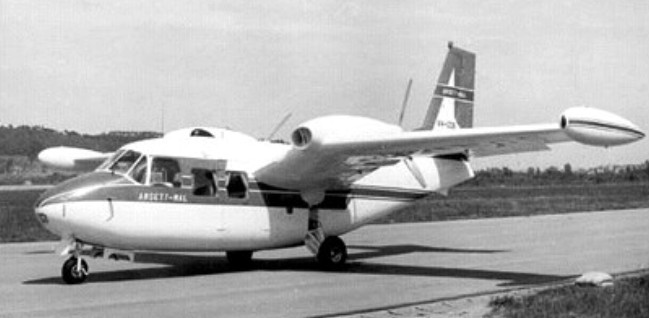
The P.166 first flew on 28 November 1957. Introduced in 1959 for executive use, the P.166 had a rear baggage compart with a capacity of 300 lb.
Thirty-two examples of the P.166 twin-engined light transport were produced together with 51 P.166M general-purpose military counterparts (for the Italian Air Force); five P.166B Portofinos; two P.166Cs; 20 P.166S radar-equipped search, surveillance and coastal-patrol aircraft (for the South African Air Force as the Albatross).

Production of the Piaggio P.166 in its several piston-engined variants ended in 1973.
The last version was the ten-seat P.166-DL3. A first flight was recorded by the Piaggio P.166 DL3 prototype (I-PJAG) on 3 July 1976. It differed from earlier versions by introducing 438kW Avco Lycoming LTP 101-600 turboprop engines, but these were still mounted in pusher configuration, and was produced for service in the transport role with the Somali Air Force. Four P.166DL-3SFMs were delivered to the Italian Ministry of Merchant Marine to serve as maritime and ecological research aircraft, carrying radar in a 360-deg scan installation under the nose, plus other sensors. The 1987 production version of the P.166, the DL3 can be configured for light tactical transport, medevac, multi engine training, armed counterinsurgency with four underwing pylons, SAR, and maritime reconnaissance with an integrated search/detection / identification / plotting / reporting system.

The Royal Gull, a twin engine pusher amphib (nee Piaggio P.166) was assembled and distributed by Kearney and Trecker during the late 1950s and early 1960s. Two models offered a choice of a 270 hp or a supercharged 340 hp Lycoming.
Brian Heath
28 Jul 13
Kearney & Trecker Milling Machine Company was — probably still is — located in Milwaukee, Wisconsin. In the 1950’s and 60’s they leased 2 hangers on the west side of General Billy Mitchell Field in Milwaukee next to the Air National Guard with it’s F-86’s. The north hanger housed the business aviation division of the milling machine company. They had a DC-3, a Cessna 182, a Piaggio Royal Gull, and an aero-coupe. Hope I got the names right.
I was 10 years old in 1958 and my dad was the mechanic for the operation, co-pilot on the DC-3, and pilot on the others. They flew milling machine sales people and maintenance people around the eastern U.S. And they often flew the company owners and brass on vacations and fishing trips.
The south hanger housed Kearney & Trecker’s other business investment — a contract with Piaggio in Italy to assemble and sell Royal Gulls. Later the P-166 executive plane was added. My recollection is that the first P-166 at Mitchell Field was a prototype. It was the only one I ever saw, but I did ride in it several times. While the two businesses were legally separate, the mechanics/pilots often consulted with each other.
I recall being there one day when a lively discussion was held between 4 or 5 people about the length of the main forward hull that floats. Mid ship there was a step, and the rear part of the fuselage was not in the water. Some of them, including dad, thought the plane would take off and land better if the floating part of the hull extended back a foot or so. Not everyone agreed, but there was a consensus to try the idea by building a block (out of wood, I think) that would extend the floating hull back. They did that and tried it out. It worked and I think that Piaggio accepted the idea and modified the design.
I went to the airport with dad when there was a vague hope of getting a plane ride. Perhaps he was going to do a short test flight after doing some work. Or perhaps he was flying a low level company person that he knew would not mind a kid on the trip. Sometimes he had to deliver a milling machine part to a customer in, say, New York. On some of those trips I got the right hand seat — several times on the Gull.
I believe it was in the early 60’s that Kearney & Trecker sold a dozen or so of the Royal Gulls to Peru’s air force. They were looking for pilots to deliver the planes and for someone to teach Peru’s pilots and mechanics how to fly and maintain them. Dad volunteered and was selected to fly one plane from Milwaukee to Peru, and then spend a month or so teaching before returning. No, I was not invited. But I thought that what he did was cool. They bought the supercharged engines for going over mountain passes and landing on mountain lakes at over 12,000 feet. Neat planes. Sounds like Kearney & Trecker got out of the airplane business shortly after dad left.
P.166-DL3
Engines: 2 x Lycoming LTP 101-600, 600 shp / 447kW.
Props: Hartzell 3-blade, 95-in.
Seats: 6/12
Length: 39 ft 4 in
Height: 16 ft 5 in / 5 m
Wingspan: 48 ft 2 in / 14.69 m
Wing area: 285.9 sq.ft / 26.56 sq.m
Wing aspect ratio: 7.3
Maximum ramp weight: 9480 lb
Maximum takeoff weight: 9480 lb
Standard empty weight: 4960 lb
Maximum useful load: 4520 lb
Zero-fuel weight: 8377 lb
Maximum landing weight: 8377 lb
Wing loading: 33.2 lbs/sq.ft
Power loading: 7.9 lbs/hp
Maximum usable fuel: 1698 lb
Best rate of climb: 2100 fpm
Certificated ceiling: 20,000 ft
Maximum single-engine rate of climb: 650 fpm @ 95 kt
Single-engine climb gradient: 411 ft/nm
Single-engine ceiling: 12,500 ft
Maximum speed: 225 kt
Normal cruise @ 10,000ft: 212 kt
Fuel flow @ normal cruise: 530 pph
Endurance at normal cruise: 2.7 hr
Stalling speed clean: 79 kt
Stalling speed gear/flaps down: 66 kt
Turbulent-air penetration speed: 157 kt
Piaggio P.136 / Trecker Gull / Super Gull
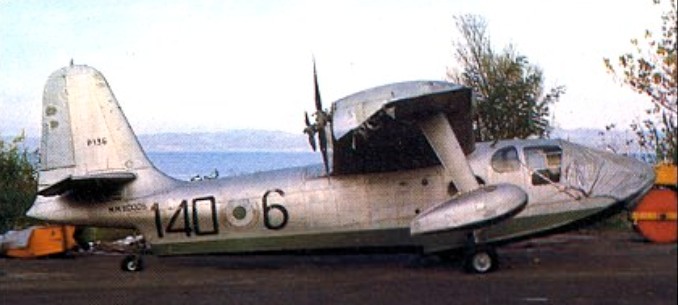
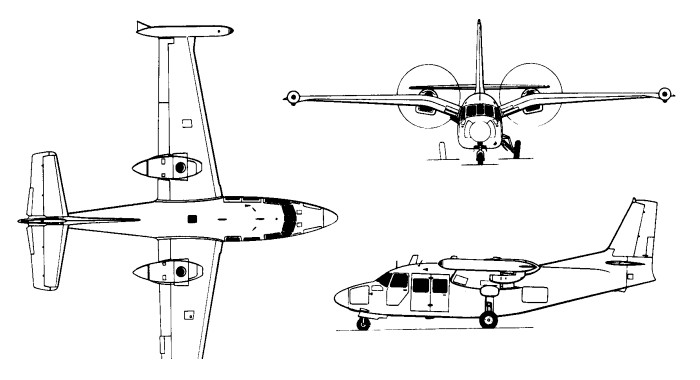
The P.136 was flown for the first time on 29 August 1948 and he first production aircraft were powered by 215 hp Franklin 6A8-215-B9F engines. Eighteen of these were acquired by the Italian Air Force followed by a further fifteen of the P.136-L powered by Lycoming engines.
More than 80 P.136 five-seat light amphibians were built as one of the company’s first post-war products, 33 of which were supplied to the Italian Air Force for use as flying-boat trainers and for air-sea rescue duties.
A second production series, the P.136-L, differed in having higher-power Lycoming engines and redesigned, enlarged squared-off tail surfaces.
A total of 32 were delivered to non-military customers, including twenty to the USA where they were marketed as the Trecker Gull. Most of these were P.136-L-1 or P.136-L-2.
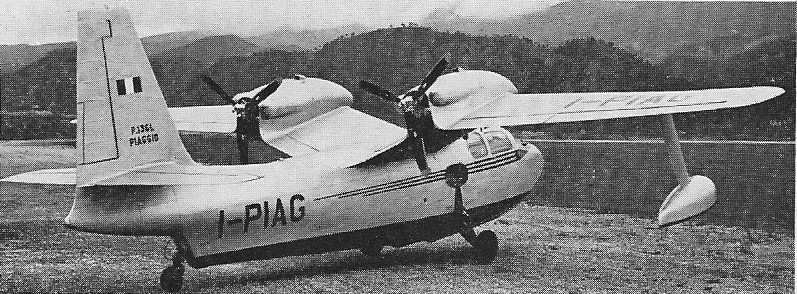
Trecker Aircraft Corp, a division of Kearney & Trecker Corporation, in early/mid-1960s assembled at Milwaukee, Wisconsin, Piaggio P.136L-1 s and L-2s under names Trecker Gull and Super Gull.
P.136
Engine: 215 hp Franklin 6A8-215-B9F
P.136-L
Engine: 2 x Lycoming GO-435-C2
Wingspan: 44 ft 4.75 in
Wing area: 268 sq.ft
Length: 35 ft 5 in
Height: 11 ft 6 in
Empty weight: 3211 lb
Loaded weight: 5842 lb
Max speed: 181 mph
Cruise: 160 mph at 6890 ft
Time to 3280ft: 3 min 40 sec
Service ceiling: 17,716 ft
Normal range: 373 mi
Max range: 621 mi
P.136-L-1
Engines: 2 x 270 hp Lycoming GO-480-B
Wingspan: 44 ft 4.5 in / 13.53 m
Length: 35 ft 4 in / 10.8 m
Height: 12 ft 7 in / 3.83 m
Wing area: 270.2 sq.ft / 25.1 sq.m
Empty weight: 4400 lb
Loaded weight: 5996 lb
Max speed: 183 mph at SL
Cruise 70%: 167 mph
Service ceiling: 19,685 ft
Max range: 1056 mi
P.136-L-2
Engines: 2 x 340 hp / 254kW Lycoming GSO-480
Wingspan: 44 ft 4.5 in / 13.53 m
Length: 35 ft 4 in / 10.8 m
Height: 12 ft 7 in / 3.83 m
Wing area: 270.2 sq.ft / 25.1 sq.m
Empty weight: 4652 lb / 2110 kg
Loaded weight: 6600 lb / 2995 kg
Max speed: 208 mph / 335 km/h at SL
Cruise 70%: 190 mph
Service ceiling: 25,500 ft / 7800 m
Max range: 900 mi / 1450 km
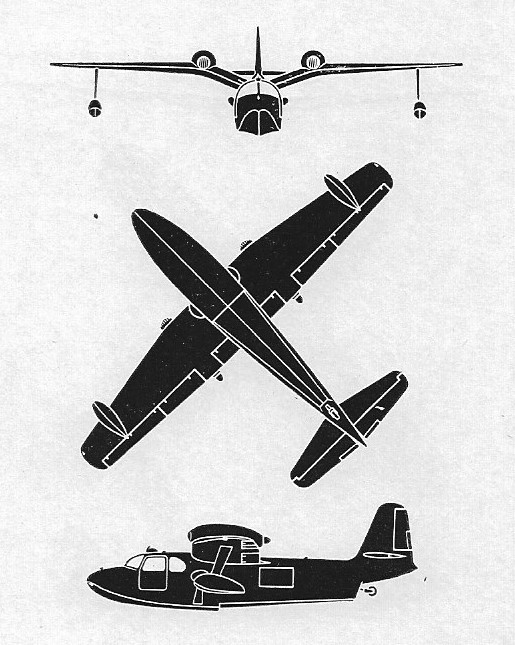
Piaggio P.32
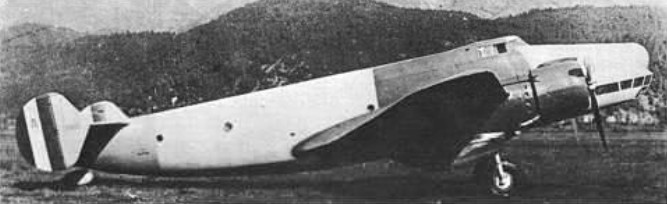
The prototype of the Piaggio P.32 twin-engine bomber flew in early 1936 powered by two Isotta Fraschini Asso XI V-12 engines. Of mixed construction, the P.32 had a stubby fuselage with a low/ mid-set wing incorporating Handley-Page leading-edge slats and double trailing-edge flaps, and a tail unit with twin fins and rudders. The V-12 engines were later replaced by 746kW Piaggio P.XI RC.40 radials. Armament comprised a single 7.7mm Breda machine-gun in a nose turret, and twin guns of the same type and calibre in retractable dorsal and ventral turrets.
A production series of 16 P.32s with Isotta Fraschini engines went into service with the 47a and 48a Squadriglie B.T. of the Regia Aeronautica during 1937, only to be withdrawn and scrapped the following year after a crash which indicated irremediable control problems. Twelve radial-engined aircraft under construction were never completed.
Used in the disasterous attempt by the Italians to bomb London on 11 November 1940.
Piaggio P.23
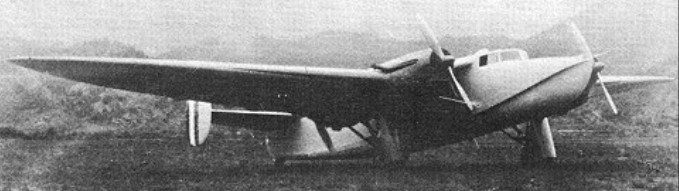
Built to fly the North Atlantic, with potential for development as a commercial transport, the Piaggio P.23 had inverted-gull shoulder-mounted wings and was powered by four 671kW Isotta Fraschini Asso XI R V-12 engines mounted in tandem pairs and driving two tractor and two pusher propellers. It had retractable main landing gear units and twin fins and rudders. A distinctive feature was the ‘avion marin’ boat-type hull underside to the fuselage, intended to assist in an emergency if the aircraft had to alight on the sea.
Maximum take-off weight was 18,400kg and maximum speed a claimed 400km/h; at a cruising speed of 300km/h its range was estimated to be 5100km. However, no transatlantic flight was made and the aircraft was dismantled soon after its appearance in 1935.
Engine: 4 x Isotta-Fraschini Asso XI R, 671kW
Max take-off weight: 18400 kg / 40565 lb
Max. speed: 400 km/h / 249 mph
Range: 5100 km / 3169 miles
Phönix-Aviatechnica LKhS
A twin-engined light utility biplane of 1991
 All Aero