SAAB 2000

Saab’s experience with the S340 commuter airliner turned its attention to the future needs of regional and ‘feeder’ carriers. Having forged a market with its smaller aircraft, Saab used the S340 as a baseline from which to develop a new, high-speed turboprop airliner which was to be called the Saab 2000, with a max payload of 5900 kg or up to 2 crew and 58 passengers. The go-ahead came with a launch order from Moritz Suter’s Crossair, already a firm Saab customer, which signed for 25 aircraft with a further 25 on option, on 15 December 1988.

SAAB 2000 Article

By late 1989 project definition for the Saab 2000 had been completed, with the contracting out of major portions of the aircraft’s construction. CASA of Spain was responsible for the wing design and production, though Saab defined the basic airfoil structure. Valmet of Finland was to build the entire tail unit and elevators, while in England, Westland is responsible for the rear fuselage. For the cockpit, a Collins Proline 4 avionics suite was selected, while a radical reduction in cabin noise levels over existing aircraft was also promised. The concept of ‘hub bypass’ was central to Saab’s sales efforts for the aircraft. To achieve this, Saab planned to build an aircraft capable of 665km/h over a 1850km sector, a speed comparable with the BAe 146 (Avro RJ). A jet-like climb performance was also essential, with figures of 0-6096m in less than 11 minutes assured. The original choice of engine fell between General Electric’s GE38, then under development for the US Navy’s projected LRAACA maritime patrol aircraft, and the Pratt & Whitney PW300 turbofan. In the event, and in conjunction with Crossair, Saab opted for the Allison GMA 2100 turboprop, driving six-bladed, low-noise Dowty propellers. As part of the deal Allison was contracted to build the engine nacelles.

Production of the first prototype began at Linkoping in February 1990. Several European aerospace firms participated in the Saab 2000 manufacturing program including CASA, Westland and Valmet of Finland.

The prototype’s (SE-001) maiden flight occurred on 26 March 1992. A four-aircraft test programme was established with aircraft No. 2 (SE-002) involved in stability and control certification. Much of the high-temperature and adverse weather flying was undertaken by the No. 2 Saab 2000, which completed two visits to Spain. The first full production-standard aircraft was SE-003, with which all the systems certification was achieved, only the autopilot certification being outstanding in mid-1993. Certification in Europe was granted in March 1994 and by the FAA in April 1994. Functional reliability flights were undertaken by aircraft No.4 (SE-004), as part of the ongoing test programme which exceeded 1,200 hours across the fleet.

All Saab’s performance guarantees have been met or exceeded. Take-off and landing distances were bettered by 100-200m. Time from brake release to 6096m is less than eight minutes, and in proving this the Saab 2000 easily broke the existing time-to-climb record for an aircraft in its class (previously held by a Grumman E-2 at 10 minutes). Range and weights have all been better than expected on the production standard aircraft, and the promised cruise speed of 665km/h at 8534m is, on average, 15km/h better. In a dive the Saab 2000 has reached 794km/h with no ill effects. International noise requirements have been bettered by 9.1 decibels.

The fuselage diameter is 91 inches, allowing for a single row of passenger seats on the left side and double row on the right. The gear up limiting speed is 175 kt, with extension being 220 kts and a cruise speed of over 665km/h.

Reducing cabin noise was a cornerstone of the Saab 2000 design philosophy and Saab has developed a so-far unique anti-noise system that has been test flown on a Saab 340, ready for inclusion on its larger sibling. This involves a series of microphones, located around the interior, which monitor cabin noise and then re-broadcast an equal opposite; wave, thus effectively ‘switching off’ background noise and vibration.

August 1994 saw the first delivery to Crossair and September 1994 the first revenue service.
Saab originally foresaw a market for 1,400 new 40- to 50-seat regional airliners by the end of the century, and sales of 400 Saab 2000s were anticipated. While the manufacturer held well over 100 paid options, only 36 firm orders had been received by July 1993. The seventh aircraft and the first for Deutsche BA (formerly Delta Air) flew on 24 June 1993.

Lack of sales and profitability forced Saab to cease the 2000 production with just 63 aircraft built. The last SAAB 2000 was delivered to Crossair in April 1999.

Gallery

Engines: 2 x Allison AE2100A turboprop, 4152 shp / 3096kW
Props: Dowty 6 blade
Wingspan: 24.76 m / 81 ft 3 in
Length: 27.03 m / 89 ft 8 in
Height: 7.73 m / 25 ft 4 in
Max take-off weight: 22000 kg / 48502 lb
Loaded weight: 13500 kg / 29763 lb
Max. speed: 680 km/h / 423 mph
Cruise: 360 kt
Ceiling: 9450 m / 31000 ft
Range w/max.payload: 2557 km / 1589 miles
Pax cap: 50-58
SAAB SF 340

SF340A

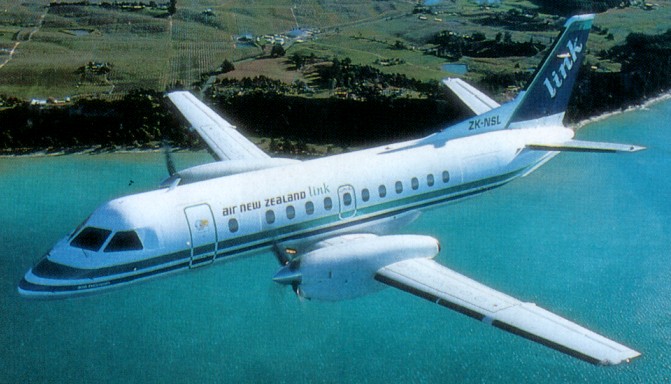
For several years, Saab-Scania had been working on a project known as Aircraft 108 (later renamed the Transporter), calculation and design work on the later versions of which (1083 and 1084) had advanced to the stage at which production was feasible. The scope of the project was such that the initial costs and the risks involved were substantial, added to which Saab-Scania had no recent experience in marketing an airliner. As a result SAAB sought a partner in the venture. Negotiations were initiated in 1979 with Fairchild Industries.

SAAB SF 340 Article

This resulted in a 65/35 co-operation agreement being signed on January 25 1980. In this agreement, Fairchild would manufacture the wing and tailplane surfaces and the engine housings at its Republic factory on Long Island, and Saab would manufacture the fuselage and be responsible for final assembly at its new plant in Linkoping, Sweden. SAAB was also responsible for the systems integration, and flight-testing.

Initial project name was ‘3000’ but in July 1980, it was officially named Saab-Fairchild SF-340. In June 1980 General Electric was selected as the engine supplier with its new CT-7 engine derived from the T-700 helicopter unit. Meanwhile Saab had placed a group of engineers with Fairchild to design the aircraft following 15 September 1980. Most of 1980 went to define the aircraft and build a wooden mock-up in Linkoping.

A cantilever low-wing monoplane of basic all-metal structure with the selective use of composite materials, the aircraft is of conventional configuration; it has a fail-safe pressurised fuselage structure, retractable tricycle landing gear with twin wheels on each unit, and is powered by two turboprop engines in wing-mounted nacelles.

The aircraft comprises a round-section fuselage seating up to 35 passengers with a flight attendant and two-person crew. The wing uses NASA-developed low-drag airfoil technology, and two General Electric CT7 turboprops were chosen as powerplants.

Marketing of the aircraft began immediately and early customers were Crossair in Switzerland, Swedair in Sweden and Comair and Air Midwest in USA. In late 1981 production began in the brand new facilities in Linkoping adjacent to the military factory, By early 1982 major sub-assemblies were finished and the first wing was lifted out of the jig in April. The fuselage and wing were mated in August. The rolling out the prototype came on 27 October 1982 in the presence of the Swedish King.

The first Saab-Fairchild 340 prototype (SE-ISF) flew on 25 January 1983, three years to the day after the agreement had been signed with Fairchild. This, plus a second prototype (SE-ISA) and the first production aircraft (SE-ISB flown on 25 August 1983) participated in the certification programme. After a flight test period lasting 16 months involving four aircraft, the SF-340 received its JAR type-certificate on May 30 1984 and FAA approval granted by 29 June 1984. The 340 was the first aircraft to be certified under the new JAR rules in which Belgiurn, Finland, France, Germany, Holland, Norway, Sweden, Switzerland and the UK participated. Australia followed on October 30. The prototype was subsequently mounted on a pole outside Linkoping when the city celebrated its 700 anniversary.

The second prototype has been retained for the subsequent flight-testing including the 340B certification. It was being used in preparation for the Saab 2000 flight test programme.

The third 340, was a pre-production aircraft. It was subsequently modified by Fairchild to incorporate an APU. It was later cut up, and various pieces used for the Saab 2000 programme. The last aircraft was the first production standard, and was later delivered to Comair.

The first production aircraft, s/n 003 SE-ISB, was flown on 25 August 1983.

SAAB SF340A s/n 005 was the first delivered, and it went to Crossair on 6 June 1984. This was placed into service on June 15 flying from Basle to Paris.

Initially two versions were on offer: the basic air transport configuration and an executive version. The first of these ‘biz-props’ was sold to Pittsburgh’s Mellon Bank. The type suffered a setback in 1984 when it was temporarily grounded, after Crossair suffered inflight engine shut downs, but these teething troubles were soon rectified and Saab pressed on with the next stage in the aircraft’s development. In 1985, at the Paris air show, Saab launched a 340 with uprated CT7 engines driving larger Dowty propellers. Maximum take-off weight was increased from the original 11,793kg to 12,872kg. Existing SF-340s were offered the improvement as a modification programme.

Saab attempted to sell the 340 as a corporate aircraft, but only sold four 340As. For this marketing campaign the Saab office in USA actually operated a corporate demonstrator (N340SF) during 1985 and 1986. As the sales-result could not warrant an exclusive demonstrator, it was sold and later converted to airliner standard for Comair.

Fairchild entered economic problems partly due to the increased costs of starting up the 340 programme and partly because of the cancelled T-46 programme. Fairchild withdrew from the aircraft business altogether. Swearingen in Texas was sold and an agreement was reached with Saab to withdraw from the 340 programme. As of 1 November 1985, Saab took over the responsibility for the 340 and renamed it the ‘Saab SF-340’. In 1987 it became simply the ‘Saab 340’ and the factory in Linkoping was expanded to take over the wing- and tail-production, completed in June 1986. SAAB initially retained the SF340 designation but later changed it to 340A.

Next version to be offered was the freighter S340QC which was a quick-change cargo aircraft, the first of which was delivered to Finnaviation in 1987. In that same year, as Saab severed its final links with Fairchild, the family was renamed the S340.

The 100th 340 was delivered in September 1987.

1987 saw the launch of the Saab 340B, first flying on April 21 1989, which features higher power output CT7-9B engines, a larger span tailplane, and a further increased maximum takeoff weight of 12,928kg. Crossair was again the launch customer for this version. From aircraft number 160, all 340s were ‘B’ models. The last SF340A, of 159, was delivered in August 1989. The SF340B has two 1750 shp (1 305 kW) GE CT7-9B turboprops for hot and high use.

Announced improvements to the Saab 340 will enhance the aircraft’s hot-and-high performance and short field capability, through a 0.6m wingtip extension. This increases the Saab 340’s takeoff weight by 544kg, equivalent to six/seven passengers. A third-generation cabin interior, common to the Saab 2000, was also being introduced, along with modifications to the APU and optional low-pressure tyres.

In 1987 and 1988 44 340s were sold each year. In 1989 Saab sold 123 aircraft, the 300 mark was reached in 1990. By mid-1993 Saab 340 orders had exceeded 400, with over 340 delivered, to 28 airlines and four corporate clients.

SF340AEW

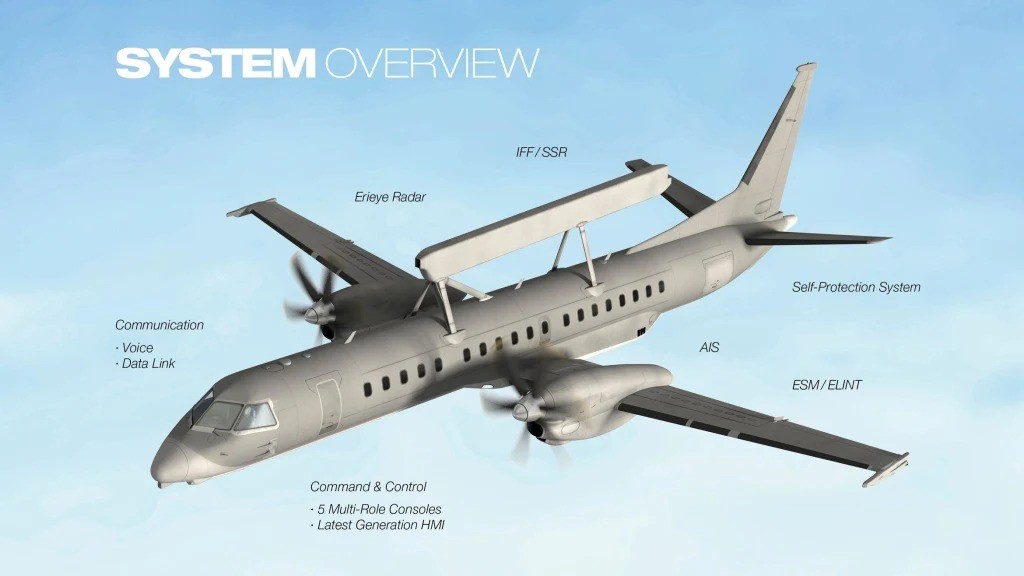
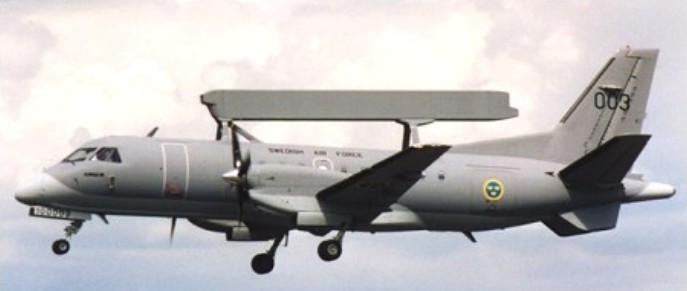
For the Swedish military the SAAB-340AEW Erieye airborne early warning version was developed, the contract for which was signed by the Swedish air force on 3 February 1993.

This version features an Ericsson phased array surveillance radar above the fuselage, with three operators in the cabin and a mission endurance of up to seven hours. Six aircraft were anticipated lor Swedish service with an initial in-service date of 1995.

Saab 2000 Erieye AEW&C

The last development of the 340 was the 340B Plus, that introduced changes developed for the larger SAAB 2000. The first 340B Plus was delivered in March 1994. Production of the 340 ended in 1999 with a total of 459 airframes built.

Air Lingus SF340s were disposed of in 1997.

Gallery

340A
Engines: 2 x General Electric CT7-5A2, 1735 hp
Accommodation: 30-37
Wing span: 21,44 m (70 ft 4 in)
Wing area: 41.81 sq.m (450 sq.ft)
Length: 19.72m (64ft 8in)
Height: 6.87 m (22 ft 6 in)
Max. t/o weight: 12400 kg / 27337 lb
Max. land, weight: 27,200 lb
Max. payload: 8,085 lb
OEW: 17,6151b
Typical cruis. speed: 275 kt
Maximum/cruising speed: 507 kph / 315 mph
Landing speed: 154 kph / 96 mph
Range: 805 nm / 1500 km / 930 miles
T/o field length: 3,900 ft
Max, ceiling: 8500 m / 27890 ft
Max, ceiling Exec. version: 25,000ft
Max. SL cabin altitude: 3650 m / 11975 ft

340B
Engines: 2 x General Electric CT7-9B, 1750 shp (1305 kW)
Wing span: 21.44 m (70 ft 4 in)
Wing area: 41.81 sq. m (450 sq. ft)
Length: 19.73 m (64 ft 9 in)
Height: 6.87 m (22 ft 6 in)
Max. t/o weight: 13000 kg / 28660 lb
Max. land. weight: 28, 000 lb
Max. payload: 8,285 lb
OEW: 8035 kg / 17714 lb
Typical cruise speed: 285 kt / 522 km/h / 324 mph
Range (35 pax): 980 nrn / 1807 km / 1123 miles
T/o field length: 4,050ft
Max ceiling: 25,000 ft / 7620 m
Accommodation: 30-37

Saab 340

SAAB 105

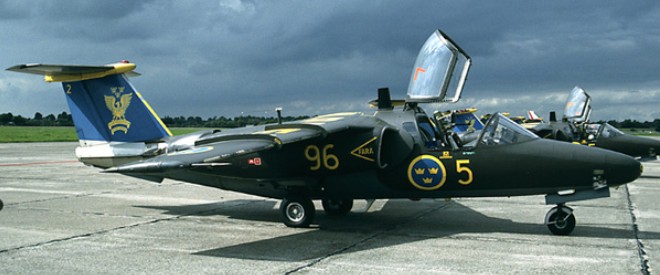
Developed by Saab as a private venture, to add to its product line a lightweight turbojet-powered aircraft able to fulfil a number of civil and military roles, the Saab-105 entered the design stage in 1959. SAAB launched the Saab-105-project in April 1960. This shoulder-wing aircraft was originally engined by two French Turbomeca Aubisque turbofans. The project was company-funded and conducted by a design team under Ragnar Haerdmark.

On 16 December 1961, the Swedish government awarded SAAB a contract for a prototype of the SAAB 105 side-by-side two-seater and signed a letter of intent for at least a hundred production machines. In 1962, the Flygvapnet ordered 150 SAAB 105, designated Sk 60 (was to be Sk 55, but SAAB asked for number 60).

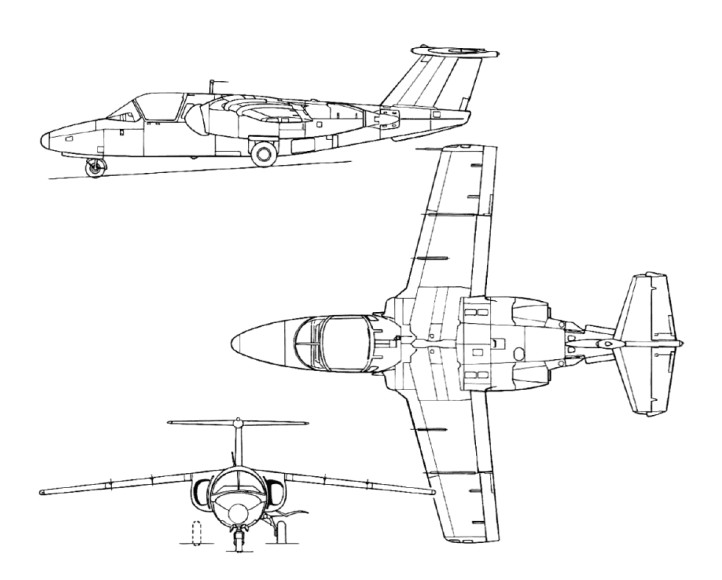
A cantilever-shoulder-wing monoplane with marked wing anhedral and high T-tail, it has retractable tricycle landing gear, is powered by two turbofans nacelle-mounted one on each side of the fuselage, and has an enclosed cockpit that accommodates two side-by-side on ejection seats. Alternative seating for four can be provided on fixed seats.

SAAB 105 Article

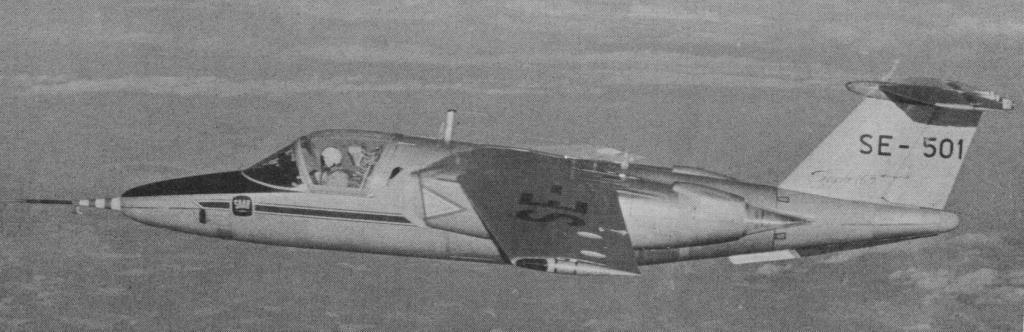
The initial test flight was delayed to find an appropriate engine, eventually found in the 745kg thrust Turbomeca Aubisque. The first SAAB 105 prototype, registered SE-501, was flown on 29 June 1963. A second prototype, SE-502, flew on 17 June 1964.

Following extensive testing of the prototypes the Flygvapen placed an initial order in early 1964 for 130 production aircraft, a figure that was amended later to 150. The first of them was the Sk 60A trainer/liaison aircraft, flown initially on 27 August 1965 with deliveries for optional deployment in an attack role. The first Sk 60A, Swedish Air Force 60001, was delivered to the F 5 at Ljungbyhed in 1966. By 1969, 149 Saab Sk 60A, were delivered to the Swedish Air Force and placed in service.

Next to the SAAB 105 for the Swedish Air Force, SAAB worked on a military export model, the SAAB 105XT, with “XT” standing for “Export Tropic”. This variant had more powerful General Electric J85-GE-17B turbojets and an improved wing structure. The second SAAB 105 prototype was modified and was flown first as Saab 105XT on 29 April 1967. It was registered SE-XBZ for use as a flying demonstrator. Austria ordered 40 SAAB 105XT machines with the designation of SAAB 105OE (“OE” for “Oesterreich”). Deliveries started in 1970 and the order was completed in 1972. The Saab 105OE is used in Austrian service for reconnaissance, support and air defence tasks.

The Saab 105 delivered to the Swedish Air Force as Sk 60A was an unarmed trainer. Starting in 1970, 46 Sk 60As were converted into Sk 60B standard, with three hardpoints beneath each wing enabling them to operate as a light ground attack aircraft.

Another 28 Sk 60A aircraft were modified to Sk 60C. The Sk 60C has a reconnaissance camera in the nose. The nose is longer and angular compared with the other versions of the aircraft. The Sk 60C prototype was the only new-build Sk 60C, when delivered to the Flygvapnet, making it the 150th and last new-build Sk 60 for the Swedish Air Force service.

In the mid-1970s, ten Sk 60A planes were configured as transports and given the designation of Sk 60D. A further development is the Sk 60E, which is equipped commercial-type instruments, including an instrument landing system. This variant has four seats, and consequently no rocket chairs. The Sk 60D and Sk 60E variants were also used for training of civil pilots. The Sk 60 has now gone trough a modernisation programme. The most important alteration was replacement of the Turbomeccas by the stronger William Rolls FJ 44 turbofans. The first Williams-powered Sk 60(W) was flown in August 1995. A total of about 115 conversions of Sk 60A, Sk 60B, and Sk 60C machines were performed in the late 1990s. In addition to its primary duty as a trainer, the Sk 60 is used as target aircraft, weather flying and liaison aircraft. A new variant, the Sk 60M, was developed to replace the Mitsubishi MU-2 target aircraft / target tug of Nyge Aero.

Surviving Swedish air force Sk 60s, of which there are four squadrons, have undergone a life extension programme at Saab.

Gallery

Versions:
Sk60A
A60B
Sk60C
Sk60D
Sk60E
105 G/OE

Sk60A
Engine: RM9 Turbomeca Aubisque 2x 1638 lbs
Span: 9.5 m (31’2.25’)
Length: 10.5 m (34’5.5”)
Take-off weight: 4050 kg (8929 lb)
Maximum speed: 770 kph (478 mph)
Cruising speed: 640 kph (398 mph)
Landing speed: 165 kph (103 mph)
Range: 1940 km (1210 miles)
Max. altitude: 13500 m (44290 ft)

Sk60 B
Engine: RM9 Turbomeca Aubisque 2x 1638 lbs
Span: 9.5 ft (31’2.25”)
Length: 10.5 ft (34’5.5”)
Take-off weight: 4500 kg (9921 lb)
Maximum speed: 765 kph (475 mph)
Cruising speed: 640 kph (398 mph)
Landing speed: 165 kph (103 mph)
Range: 1780 km (1110 miles)
Max. altitude: 12000 m (39370 ft)

Sk60C
Engine: RM9 Turbomeca Aubisque 2x 1638 lbs
Span: 9.5 ft (31’2.25”)
Length: 11.0 m (36’1”)
Take-off weight: 4500 kg (9921 lb)
Maximum speed: 765 kph (475 mph)
Cruising speed: 640 kph (398 mph)
Landing speed: 165 kph (103 mph)
Range: 1780 km (1110 miles)
Max. altitude: 12000 m (39370 ft)

Sk60D
Engine: RM9 Turbomeca Aubisque 2x 1638 lbs
Span: 9.5 m (31’2.25’)
Length: 10.5 m (34’5.5”)
Take-off weight: 4050 kg (8929 lb)
Maximum speed: 770 kph (478 mph)
Cruising speed: 640 kph (398 mph)
Landing speed: 165 kph (103 mph)
Range: 1940 km (1210 miles)
Max. altitude: 13500 m (44290 ft)

Sk60E
Engine: RM9 Turbomeca Aubisque 2x 1638 lbs
Span: 9.5 m (31’2.25’)
Length: 10.5 m (34’5.5”)
Take-off weight: 4050 kg (8929 lb)
Maximum speed: 770 kph (478 mph)
Cruising speed: 640 kph (398 mph)
Landing speed: 165 kph (103 mph)
Range: 1940 km (1210 miles)
Max. altitude: 13500 m (44290 ft)

105G/OE
Engine: General Electric J85-17B 2x 2851 lbs
Span: 9.5 m (31’2.25”)
Length: 10.5 m (34’5.5”)
Height: 2.7 m (8ft 10in)
Wing area: 16.3 sq.m (175.46 sq.ft)
Empty weight: 2550 kg (5534 lb)
Disposable wt: 2000 kg (4409 lb)
Take-off weight: 6500 kg (14330 lb)
Maximum speed: 970 kph (603 mph)
Cruising speed: 800 kph (497 mph)
Climb to 10,000m (32810ft): 4.5 min
Landing speed: 165 kph (103 mph)
Range: 2750 km (1710 miles)
Range with 1361kg (3000 lb) load: 825 km (513 sm)
Max. altitude: 13700 m (44950 ft)

SAAB 105

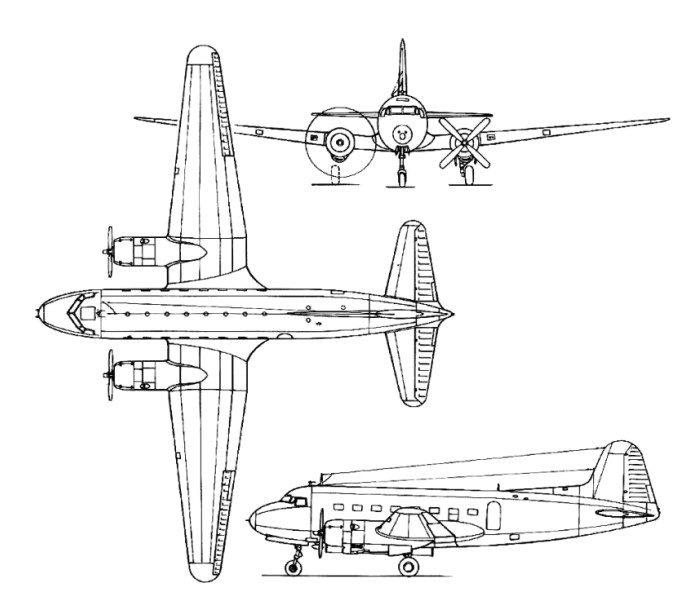
SAAB 90 Scandia

In 1944 Saab em¬barked on two civil aircraft projects — the Saab 90 Scandia, a twin-engined airliner, and the Saab 91 Safir, a single-engined trainer and private plane. The Saab-90 Scandia represented the company’s attempt to join the post-World War II hunt for a Douglas DC-3 replacement.

A cantilever low-wing monoplane of all-metal construction, with retractable tricycle landing gear and powered by two wing-mounted 1081kW Pratt & Whitney Twin Wasp radial engines, and accommodation was provided for a flight crew of four or five and 24 to 36 passengers, according to cabin layout. The 14-cylinder R-2180 radial drove a four-bladed variable-pitch propeller. The Scandia was the only civil use for the R-2180 (also known as the Twin Wasp E1) engine, although a military version was used in rhe prototype Piasecki H-16 helicopter. The elevators and ailerons were fabric-covered and interchangeable port and starboard. After landing a support strut could be deployed from the cockpit to keep the aircraft from tipping backwards during passenger and baggage loading and unloading.

The results of the SAAB 90 first test flight, on 16 November 1946 were sufficient to encourage the Swedish airline, AB Aero¬transport, to sign a contract for 10 aircraft at a value of SKr 15 million. The first plane was delivered in October 1950. When Swedish airline AB Aerotransport this was absorbed into SAS (Scandinavian Airlines System) the order was reduced to six. The remaining four aircraft were then sold to Aerovias Brasil (later VASP). Both airlines found them efficient aircraft to operate, resulting in production of two more for SAS and five for VASP, but that was all.

When Saab was told by the Swedish Air Force to focus on Saab 29 “Tunnan” deliveries, Scandia production was transferred to Fokker in 1951, who in turn used Aviolanda and de Schelde to finish the aircraft. Saab received compensation from the Swedish Air Force for the abandonment of the project.

At this point, the Company had delivered 8 aircraft to ABA and exported 10 to Brazil. In time, the ABA planes were also sold to Brazil, where they remained in service until 1969. Only those 18 were ever built, between 1948 and 1954, including the prototype.

A Saab-90B with a pressurised cabin was planned, but with no demand for the type it was not built.

Saab 90A Scandia
Engines: 2 x Pratt & Whitney R-2180-E1 radial, 1342kW
Wingspan: 28 m / 92 ft 10 in
Length: 21.3 m / 70 ft 11 in
Height: 7.1 m / 23 ft 4 in
Wing area: 85.65 sq.m / 921.93 sq ft
Max take-off weight: 16000 kg / 35274 lb
Empty weight: 9960 kg / 21958 lb
Cruise speed: 390 km/h / 242 mph
Ceiling: 7500 m / 24600 ft
Range: 1480 km / 920 miles

Saab 90A-2 Scandia
Crew: 4-5
Engine: 2 x Pratt & Whitney Twin Wasp R-2180-E1, 1825 hp
Span: 28.0 m (91’10.5”)
Length: 21.3 m (69’10.5”)
Take-off weight: 15900 kg (35053 lb)
Range: 2650 km (1650 miles)
Maximum speed, km/h (mph) 455(283)
Cruising speed: 400 kph (249 mph)
Landing speed: 120 kph (75 mph)
Max. altitude: 8700 m (28540 ft)

Saab 90 Scandia

SAAB 18

Design work on Aircraft 18 was commenced at the beginning of 1939 to meet an official Swedish requirement for a reconnaissance aircraft. The Air Force chiefs had announced a competition for the design of a twin-engined aircraft to replace the old B3. The competition was won by Saab.

A cantilever mid-wing monoplane, primarily of metal construction, the Saab-18 had retractable tailwheel landing gear, a twin-fin-and-rudder tail unit, and was powered as first flown by two 794kW Swedish-built Pratt & Whitney R-1830 Twin Wasp radial engines in wing-mounted nacelles. The crew comprised a pilot, navigator/gunner and bomb-aimer, the last having a position in the glazed nose of the fuselage.

The first prototype took to the air on 19 June 1942. As a result of changing requirements, the two Saab-18A prototypes were redesigned and equipped for the light bomber or dive-bomber role. Early testing of the prototypes revealed that the Saab-18A was underpowered, but with no immediate remedy available.

The type was ordered into production in B18A bomber and S18A photo-reconnaissance versions, built to a combined total of 60 aircraft; late production examples of the S18A also carried radar equipment. Delivered to Bomber Wing Fl in June 1944, the aircraft was designated the B18. Several B18s were con-verted for reconnaissance duties with the installation of radar and camera equipment. This version became known as the B18A.

The availability in 1944 of a Swedish licence-built version of the much more powerful Daimler-Benz DB 605B powerplant led to the single Saab-18B prototype, first flown on 10 June 1944 and followed by 120 B18B dive-bomber production aircraft. With new engines, this version was one of the fastest piston-engined aircraft in the world, reaching a top speed of 570 km/h (354 mph).

Final production version was the T18B (62 built) which had been developed to serve as a torpedo-bomber but was, instead, completed as an attack aircraft. With a crew of two, this could either be fitted with torpedoes for anti-shipping duties or armed with a single 157-mm and two 20-mm automatic Bofors cannons. Production of the last T18B ended in 1948.

242 production aircraft serviced until the last of them was retired in 1956.

B/S18A
Span: 17.04 m (55 ft 10.75 in)
Length: 13.23 m (43 ft 4,75 in)
Take-off weight: 8700 kg (1918 lb)
Maximum speed: 465 kph (289 mph)
Cruising speed: 415 kph (258 mph)
Landing speed: 135 kph (84 mph)
Range: 2200 km (1367 miles)
Max. altitude: 8000 m (26250 ft)

B18B
Engines: 2 x Daimler-Benz DB 605B, 1100kW
Span: 17.04 m (55 ft 10.75 in)
Length: 13.23 m (43 ft 4,75 in)
Height: 4.35 m / 14 ft 3 in
Wing area: 43.75 sq.m / 470.92 sq ft
Take-off weight: 8793 kg (1938 lb)
Maximum speed: 570 kph (354mph)
Cruising speed: 480 kph (298 mph)
Landing speed: 125 kph (78 mph)
Ceiling: 9800 m / 32150 ft
Range: 2600 km (1616 mph)
Max. altitude: 9800 m (32150 ft)
Armament: 1 x 7.9mm and 2 x 13.2mm machine-guns
Bombload: 1500kg

T18B
Span: 17.04 m (55 ft 10.75 in)
Length: 13.23 m (43 ft 4,75 in)
Take-off weight, kg (lb) 9272 kg (2044 lb)
Maximum speed: 595 kph (370 mph)
Cruising speed: 480 kph (298 mph)
Landing speed: 130 kph (81 mph)
Range: 2600 km (1616 miles)
Max. altitude: 9300 m (30150 ft)

Saab 18

Ryan VZ-11 / XV-5 Vertifan

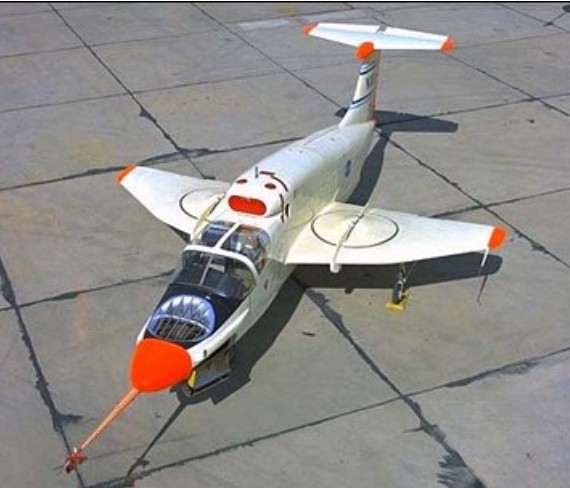
Developed with possible Army operational applications in view, the Ryan VZ 11 uses a totally different concept to obtain VTOL performance. The outcome of several years’ work on lift fans by General Electric Corporation, the VZ 11 derives its vertical lift from two ducted fans, one in each wing.

Unlike other ducted fans, above the General Electric version is powered by the jet exhaust from a turbojet engine which is directed on to turbine blades at the tips of the fan blades.

The VZ 11 layout has two 2,658 lb.s.t. General Electric J85 GE 5 turbojets in the fuselage, fed by a dorsal intake over the two seat cabin. For vertical operations, the fans are powered, together with a third fan in the nose which provides a small lift increment but is primarily for pitch control. For roll control, the thrust developed by the wing fans can be varied differentially by means of ‘butterfly’ doors over the inlets. Louvres under the outlets provide yaw control.

Once the VZ 11 is airborne, the louvres are moved to deflect the fan flow rearwards. This gives the aircraft a forward thrust component. As speed builds up the undercarriage is retracted. At about 120 knots, the wings provide sufficient lift to sustain flight and the exhaust flow from the two engines is then switched from the fans to direct propulsion nozzles. The butterfly doors and louvres close over the fan ducts and the aircraft continues as a conventional jet propelled type.

Two prototypes of the VZ 11 were ordered from Ryan in November 1961 as part of a U.S. Army research contract to investigate lift fans which was placed with General Electric. The designation was changed to VZ-5A in July 1962 and flight trials began in 1963. The XV-5 first flew in May 1964.

Ryan XV-5A Article

Republic Aviation joined GE and Ryan in XV-5A development and was directing flight tests at Edwards AFB in 1964. Republic would share in building additional prototypes if the craft met Army and DoD expectations.

XV-5A
Engines: 2 x 1200kg General Electric J85-GE-5
Max take-off weight: 7690 kg / 16954 lb
Empty weight: 5450 kg / 12015 lb
Wingspan: 9.25 m / 30 ft 4 in
Length: 13.75 m / 45 ft 1 in
Height: 4.5 m / 15 ft 9 in
Max. speed: 880 km/h / 547 mph
Ceiling: 12200 m / 40050 ft
Range: 1600 km / 994 miles

Ryan XF2R

XF2R-1

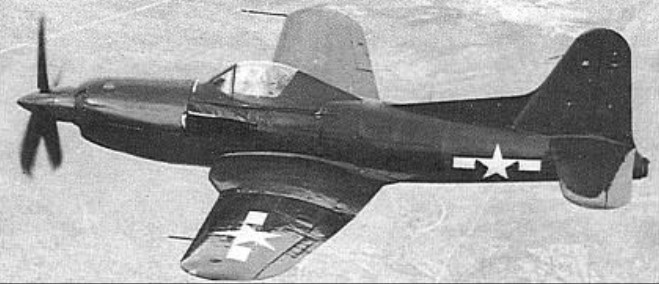
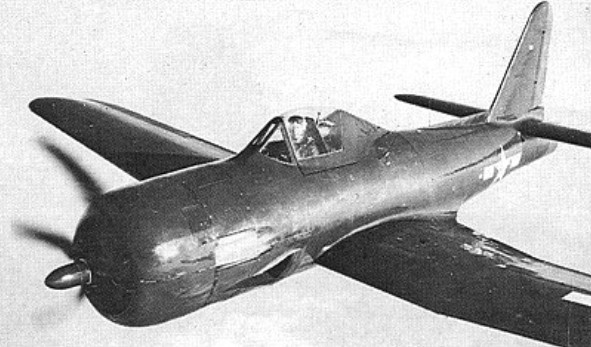
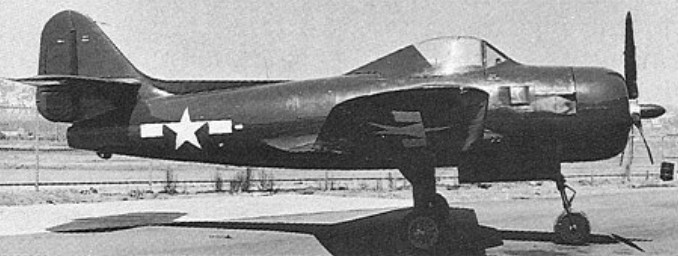
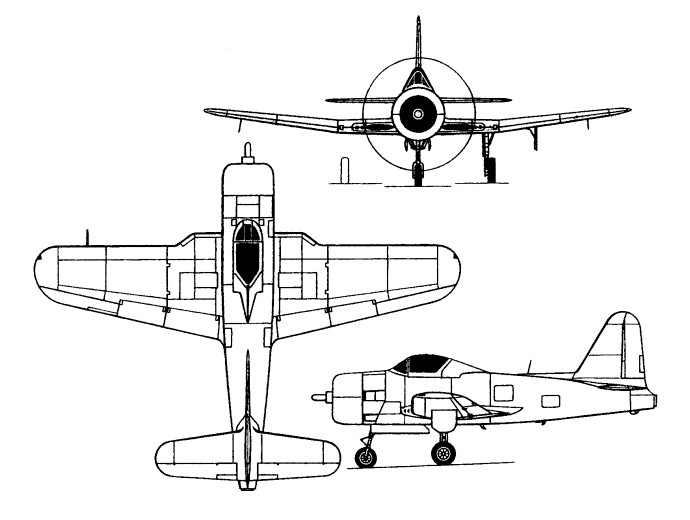
A major modification of the FR-1 Fireball, the Model 29 resulted from a Bureau of Aeronautics requirement for a single-seat fighter combining a turboprop with a turbojet. Assigned the designation XF2R-1 and later to become known unofficially as the “Dark Shark”, the single prototype utilised the fifteenth FR-1 production airframe and retained that fighter’s J31-GE-3 turbojet, mated with a General Electric XT31-GE-2 turboprop developing 1,700hp plus 227kg of residual thrust.

Although lacking the wing folding and the catapult and arrester gear standard on the FR-1, the XF2R-1 weighed 473kg more than its predecessor when it flew for the first time in November 1946. The XT31 drove a propeller with four square-tipped hollow-steel blades which could be fully feathered or reversed to zero blade angle extremely rapidly, the drag of the flatter blade angle serving as an effective air brake for landing. By comparison with the FR-1, the vertical tail surfaces of the XF2R-1 were enlarged to compensate for the lengthening forward to accommodate the turboprop, but the airframe of the later fighter was similar in most other respects. The XF2R-1 underwent extensive testing at Muroc Dry Lake, but no further development was undertaken.

Max take-off weight: 4990 kg / 11001 lb
Wingspan: 12.80 m / 42 ft 0 in
Length: 10.97 m / 36 ft 0 in
Height: 4.27 m / 14 ft 0 in
Wing area: 28.33 sq.m / 304.94 sq ft
Max. speed: 800 km/h / 497 mph
Ceiling: 11920 m / 39100 ft

Ryan FR-1 Fireball / Model 29

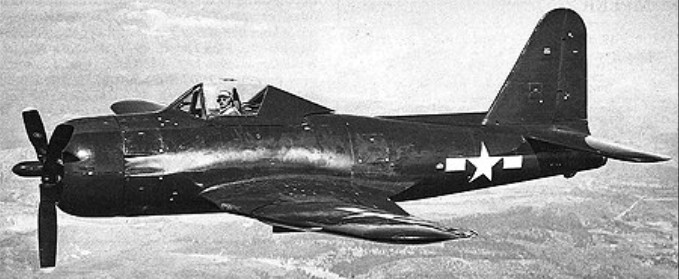
In December 1942, nine US aircraft manufacturers received a Request for Proposals from the Bureau of Aeronautics for a single-seat shipboard fighter combining piston engine and turbojet, the former to be the main power source and the latter to provide boost in climb and combat. The Ryan Model 28, designed by Benjamin T Salmon and William T Immenschuh, was selected as winning contender by the Bureau and three prototypes were ordered on 11 February 1943 as XFR-1s.

A low-wing, cantilever monoplane of classic design, the XFR-1 was the first carrier aircraft designed from the outset to use a laminar-flow aerofoil and the first US Navy aircraft to have an entirely flush-riveted exterior and metal-skinned movable control surfaces. Power was provided by a 1,350hp Wright R-1820-72W Cyclone nine-cylinder air-cooled radial and, in the rear fuselage, a 726kg General Electric I-16 (later redesignated J31) turbojet. Proposed armament consisted of four 12.7mm machine guns with provision for a 454kg bomb under port inboard wing panel. Other features were hydraulically-folding outer wings and a tricycle undercarriage.

A contract for 100 production FR-1s was placed on 2 December 1943, the first XFR-1 flying seven months later, on 25 June 1944, with only the piston engine installed. The turbojet was added a few days later. Initial flight tests led to the major redesign and enlargement of the vertical tail and lowering of the horizontal tail. On 31 January 1945, by which time a number of series FR-1s had been completed and were under test, a contract was placed for 600 FR-2s which were to differ in having the R-1820- 74W engine of 1,500hp with water injection. In the event, neither the FR-2 nor the XFR-3 was to be built, the latter being intended to mate the 907kg General Electric I-20 turbojet with the -74W piston engine.

XFR-4

The XFR-4 entered flight test in November 1944. Utilising the 19th FR-1 production airframe, this replaced the J31-GE-3 turbojet with a 1542kg Westinghouse J34-WE-22, discarded the wing root intakes of the FR-1 in favour of flush inlets in the sides of the forward fuselage, and had the aft fuselage extended by 20cm. It was found, however, that the thrust of the J34 was too great to permit efficient use of both engines and the XFR-4 programme was discontinued accordingly.

Due to its (relatively) high-speed dash capability, the Fireball was considered for use in defence against kamikaze attacks. The war ended just as the first squadron was becoming operational. .Deliveries of the FR-1 to the US Navy began in March 1945, the Fireballs equipping one squadron (VF-66) and completing carrier qualification in May (aboard the USS Ranger). After VJ-Day, the 34 FR-1s remaining to be delivered were cancelled, together with all 600 FR-2s. On 18 October 1945, VF-66 was de-commissioned and its FR-1s transferred to VF-41 (redesignated VF-1E on 15 November 1946) which continued to fly them until mid- July 1947. Only 17 of the 66 FR-1s built saw squadron usage, the remainder being assigned for various test programmes.

FR-1
Engines: 1 x GE J31-GE-3 turbojet, 1600 lbs (726 kg) thrust & 1 x Wright Cyclone R1820-72W, 1425 hp piston.
Wingspan: 12.19 m / 40 ft 0 in
Length: 9.85 m / 32 ft 4 in
Height: 4.24 m / 14 ft 11 in
Wing area: 25.54 sq.m / 274.91 sq ft
Max take-off weight: 5285 kg / 11651 lb
Empty weight: 3488 kg / 7690 lb
Max speed: 370 kts, (piston power only: 255 kts).
Range: 1658 km / 1030 miles

Ryan FR-1 Fireball