A twin engined Project version of Type-C, powered by two 100 hp Gnome engines, mounted in propellant directly above the trailing edge of the wing
2 Engines
Scholz Schwingenflieger
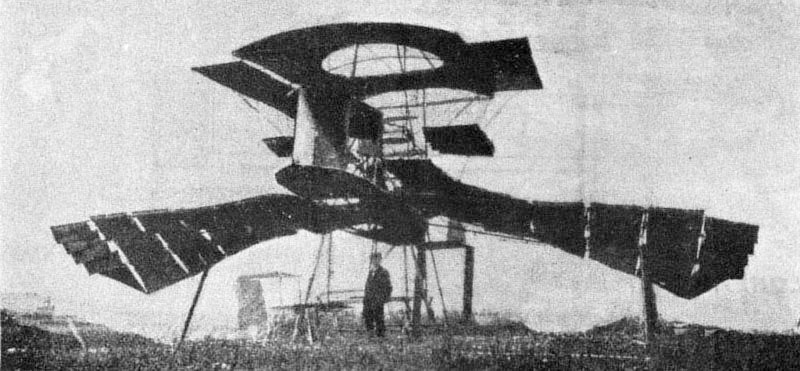
This big, strange ornithopter was designed by architect Bruno Scholz of Schulzendorf near Berlin after 12 years of studies of birds. It was “modelled after real birds” and the frame was made of bamboo sticks with multiple-slatted wings covered canvas. The apparatus measured from head to tail 17 meters, the wing span was 14 meters and the height 6 meters. The bird’s body held a cockpit for two passengers, two engines, each of 8 hp, and a centrifuge (fan?) which would help to lift it. It was built at great expense in 1909/10, but after it had been found to be complete failure it was reportedly smashed by hand by its builder.
Schmidt Paracopter Model 2
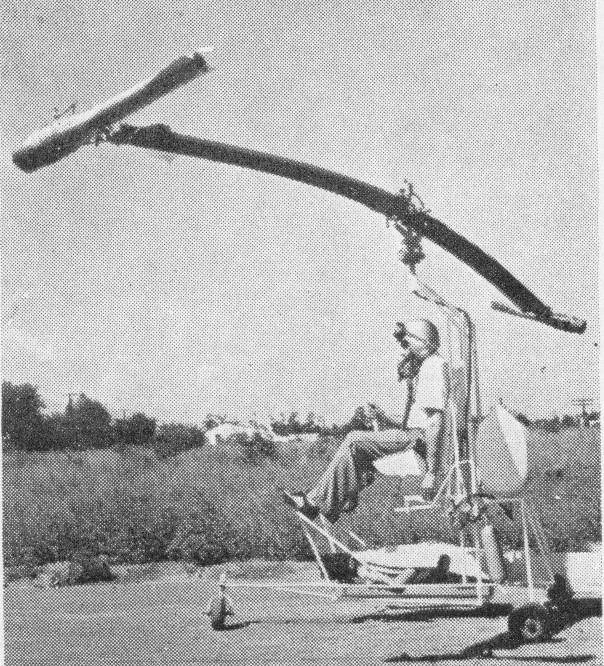
A prototype built circa 1958 by George Schmidt, an engineer who was formerly with Focke-Achgelis in Germany. Designed primarily to rescue wounded from front-line areas: one stretcher can be carried beneath the pilot’s seat.
Power: 2 x 10⁵ lb Schmidt pulse-jets
Rotors: 2-blade tip-powered main
Rotor diameter: 17 ft 5 in
Loaded weight: 775 lb
Max. speed: 132 mph
Ceiling: 12,300 ft
Seats: 2
Scaled Composites V-Jet II / Williams International V-Jet II

On June 23, 1997, Williams International announced that its all-composite, turbofan- powered “V-JET II” light aircraft is on schedule for its July 31 fly-in and follow-on demonstration flights and exhibition at the Experimental Aircraft Association (EAA) convention at Oshkosh, July 30 to August 5, 1997. Williams also announced that, although the aircraft is early in its program of gradually expanding its flight envelope, the twin-engine “V-JET II” has already demonstrated docile stall characteristics for beginning pilots, and it has flown at 30,000 feet and at 295 knots true air speed. The Oshkosh show will be the first unveiling of the aircraft to the media and public.
Last fall under a competitive procurement program among jet engine companies, NASA selected Williams International to join NASA in a $100 million cooperative effort to revitalize the once-flourishing light aircraft industry in the United States through small turbofan engine technology. Under the program, Williams and its industry team members, which include Williams suppliers and future aircraft company customers, provide 60 percent of the resources and NASA provides 40 percent for the initial engine demonstration phase.
In 2010, Williams was in the component design phase of the engine technology program, is emphasizing low cost manufacturing processes suitable for high quantity production, and is active with key suppliers to minimize material and purchase parts costs. The new Williams engine has been named the “FJX-2.”
Dr. Sam Williams, Chairman of Williams International, said, “Our objective is to replace aging, piston-powered light aircraft with all new, four-place single and six-place twin, turbofan-powered modern aircraft. This means we must develop a turbofan in the 700 lb thrust category that is very low in cost at a high production rate, is extremely quiet, is light in weight, and is very reliable.”
Not intended for production, the “V-JET II” was designed by Dr. Sam Williams to demonstrate the new Williams FJX-2 high bypass ratio engine characteristics in flight over the anticipated speed and altitude range for the future “turbofan-powered, light aircraft era.”
Several Williams “V-JETs” have been designed in past years by Dr. Williams with three full-scale mockups and at least a dozen small models studied to arrive at the present “V-JET II” configuration. The name, “V-JET”, started with the forward-swept or V-shaped wing that continues from the early Williams designs.
The “V-JET” has the appearance of an advanced fighter with forward-swept wings. The sleek appearance is not only for marketing appeal but is for sound aerodynamic and structural reasons. The Williams design emphasized, and has now achieved for beginning pilots, very docile stall characteristics (because of the forward-swept wing) and minimum pilot action required in the event of a single engine-out condition (because of the close spacing of the engines in the unique Williams V-tail design).
Williams also revealed it contracted with Burt Rutan’s Scaled Composites organization to start with the Williams preliminary design, to conduct the V-JET II” detailed design and analysis, and to manufacture the prototype “V-JET II” (that will fly in to the Oshkosh show). According to Dr. Williams, “Burt Rutan and his team have made major improvements to this design and have introduced into this prototype many new, exciting manufacturing processes.” Flight testing is being done by Scaled Composites’; Doug Shane, acting as Chief Pilot of the program; Matt Gionta, Project Engineer; and Burt Rutan.
The aircraft at Oshkosh this year will be powered by two existing low bypass ratio, 550 lb thrust, FJX-1 turbofan engines developed previously by Williams, These interim engines are being used to check out the aircraft’s performance and systems prior to installation of the new high bypass ratio, FJX-2 engines being developed in cooperation with NASA. The new engines are to be installed during the fourth year of the NASA/Williams program and demonstrated at Oshkosh during the year 2000.
According to Williams, the “V-JET II” will be used primarily to demonstrate the new turbofan engines over a range of flight speeds and altitudes that are expected to be required in future turbofan-powered light aircraft. Installation characteristics, engine performance data, noise levels, exhaust emissions, and flight parameters will be reviewed with the aircraft companies that are participating in the program as members of the NASA/Williams General Aviation Propulsion (GAP) team.
Another purpose of the “V-JET II” flight demonstrations will be to stimulate interest on the part of aircraft companies in designing and developing production aircraft utilizing this new propulsion technology. Williams said, “When the public views the 3800 lb “V-JET II” powered with the existing small turbofan engines, the interest will begin to build. However, later in the program when they view this sleek aircraft powered with extremely quiet, very low cost, light weight, high bypass ration turbofans, the potential for a revival of the light aircraft industry through turbofan power should certainly be underway. I believe every light aircraft pilot dreams of being a jet pilot. This low cost turbofan technology can make this a reality.”
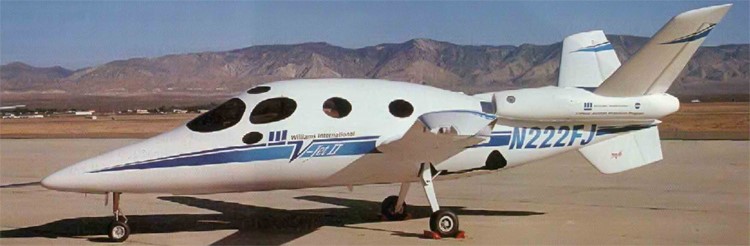
NASA partnered with the general aviation industry in introducing the V-JET II, a turbofan-powered jet. NASA awarded Williams International a 37 million dollar developmental grant to design and build such a small jet engine.
Burt Rutan and his Scaled Composites were contracted to build the V-JET II. While the overall configuration had been created by Sam Williams, it was up to Burt and his staff to do the detail design work and then execute it in the new, composite construction method Scaled Composites had developed.
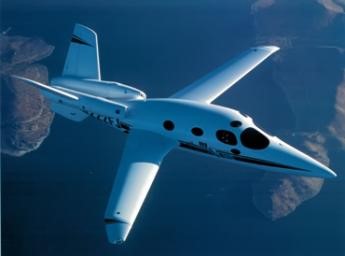
A the time of its first flight on April 13,1997, as a five seat jet, the VJET II was powered by two Williams International FJX-1 turbofan engines.
Engines: two Williams International FJX-1 turbofan
Span: 35.3 ft
Length 31.1 ft
Height: 9.8 ft
Max TO Weight: 3,800 lb
Empty Weight: 2,200 lb
Take off Distance 5000 ft / IS A (25°C): 3,000 ft
Take off Distance SL / std day: 2,300 ft
Climb rate (SL): 3,200 ft/min
Time to climb: 8 min to 18,000 ft
High speed cruise: 370 knts
Range – max fuel: 2600 miles
Range loaded: 1800 miles
Seating: 6
Scaled Composites 311 Global Flyer
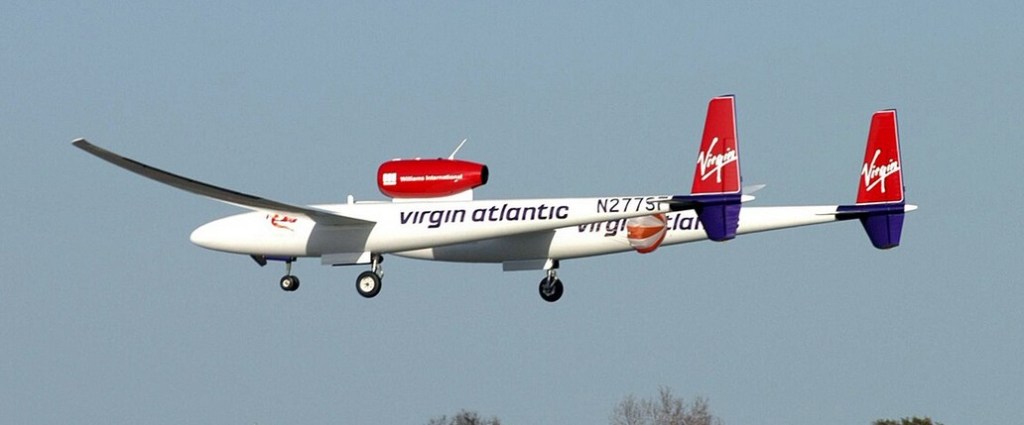
Test flying began in 2004 in the US on an aircraft designed to fly around the world by a single pilot and without refuelling. Known as the Global Flyer, or Scaled Composites Model 311, it made the first of several flights which tested its controls and systems, including its “drag chutes” used during descent and landing.
The GlobalFlyer is a single seat, turbofan powered airplane designed to fly around the world nonstop, unrefueled. It achieved this milestone for the first time on March 03, 2005 after 67 hours and one minute of flying time. With that, Pilot Steve Fossett set the record for fastest time around the world unrefueled. The GlobalFlyer took off and landed in Salina, Kansas.
The second world-record flight was completed on February 11, 2006 when Pilot Steve Fossett made an emergency landing at Bournemouth Airport in England. Kennedy Space Center was chosen for the takeoff, which took place on February 8. The flight had many stressful moments. Despite this, Steve was able to accomplish the goal of the “Ultimate Flight” by breaking the previous world distance record for an airplane, which was set by the Voyager in 1986 (24,987 miles), as well as the aviation long-distance record set by the Breitling Orbiter Balloon in 1999 (25,361 miles).
Aerodynamics are key to this aircraft, and its configuration is optimized for range and fuel efficiency. The aircraft’s shape has been designed using computational fluid dynamics to predict how the aircraft’s surfaces will behave in flight. The aircraft is so aerodynamically efficient that the only practical way to descend is using drag parachutes. As the aircraft is only required to land once, these aren’t detachable and take time to reset.
The aircraft is a trimaran-like construction with two huge external ‘booms’ which hold the landing gear, and 5,454 pounds of fuel on either side of the pilot’s cockpit in the center on top of which is the single Williams turbofan jet engine. The construction materials used for the structure of this aircraft are all graphite/epoxy. The stiffest carbon fibers are used in the construction of the wings, and the skin is a sandwich of graphite/epoxy and Aramid honeycomb.
The aircraft doesn’t have what is known as ‘deicing’ or ‘anti-ice’ measures. This means that it is not able to fly in ‘icing’ conditions. In addition, it does not cope with turbulence very well in the early part of the flight when the aircraft is heavy and structural margins low; so weather will be an important factor in choosing when and where to take off from.
The pilot sits in the main fuselage, the center pod, just behind the nose landing gear and below the engine. He also sits in front of the main fuel header tank which feeds the engine. Early on in the project, there were huge obstacles to overcome caused by engine noise levels, but those were quickly overcome with the addition of insulation. The cabin is pressurized because of the altitude which gives a ‘cabin altitude’ of 10,000 feet at the 45,000 feet the plane actually flys at.
There are thirteen fuel tanks all in all, and on take-off, it is expected that this aircraft will be 83% fuel by weight. Getting fuel to where it’s needed whilst maintaining the balance and stability of the aircraft is a feat that will require constant supervision and monitoring. The fuel itself is a special fuel that has a much lower freezing point than regular aviation fuel.
Wing Span: 114ft
Wing Area: 400 sq.ft
Length: 44.1ft
Height: 13.3ft
Gross Weight: 22,000 lbs
Empty Weight: 3,350 lbs
Scaled Composites 133 ATTT
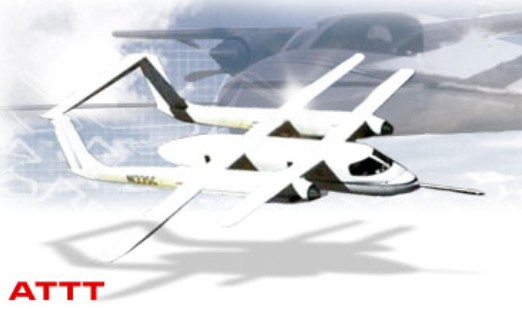
The Model 133-4.62 Advanced Technology Tactical Transport (ATTT) proof-of-concept demonstrator is a 62% scaled version of an airplane designed to challenging STOL and long range requirements. The ATTT was developed and test flown by Scaled Composites, Inc. under contract to DARPA. The initial flight test program consisted of 51 flights with the original cruciform tail configuration, measuring and refining performance, stability and control, and handling qualities. The results of the fabrication and test program were presented in a comprehensive report to DARPA .
In an effort to improve the aft loading capability of the aircraft and to correct aerodynamic deficiencies discovered during the test program, the ATTT aircraft was modified with a twin-boom tail whose general configuration was similar to that of the Rockwell OV-10 Bronco. This modified configuration is shown in the accompanying photograph. Pratt and Whitney of Canada PT6A-135A turboprop engines were attached to the twin booms in a tractor configuration. A simple fully mechanical flight control system was installed, with full control available from both seats. The Scaled-designed landing gear is actuated using electric motors.
The M-133 demonstrator used a unique flap system to enable its STOL performance. The high lift configuration consists of eight Fowler-type flaps, each of 43% chord. The flap system was designed to allow the initial takeoff roll to be performed with the flaps extended, but at low deflections to minimize takeoff drag. As rotation speed was neared, the flaps were quickly rotated to the maximum lift position via a separate pilot action. The ATTT was a key program for Scaled. It demonstrated our ability to perform a challenging aerodynamic and structural design, and to build, test, and deliver what amounted to two different manned research airplanes, including all design and flight test data, to DARPA for less than 3 million dollars, including all recurring and nonrecurring costs.
The Scaled ATTT (also seen as AT3) was flown in two different configurations. First as Model 133-3-62 with a conventional tail section with cruciform tailplanes. First flight 29 December 1987. Later in the test programme small endplates were added to the horizontal tail. During 1989 it few again as Model 133-4-62 with the twin tail booms. Engines were two 850hp P&WC PT6AS-135A end registration was N133SC.
In original form wingspan was 53.208ft, length 44.854ft and height 14.075ft. Internally the project was referred to as SMUT (Special Mission Utility Transport). It was an approx. 62% scale technology demonstrator for a planned ATTT -Advanced Technology Tactical Transport and some money may have come from DARPA – Defence Advanced Research Projects Agency.
The ATTT is in storage at the Air Force Flight Test Center Museum, at Edwards Air Force Base.
Savoia-Marchetti SM.85 / SM.86
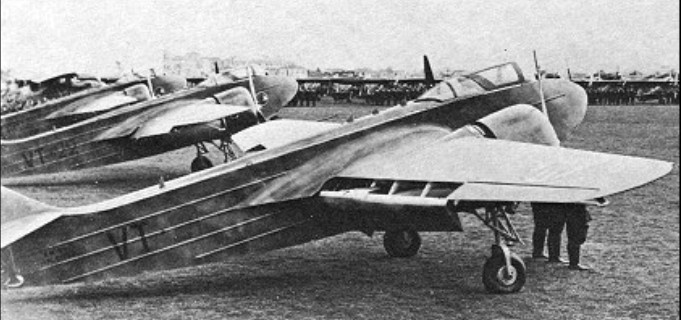
Single-seat twin-engined dive bomber and ground-attack monoplane. Power was provided by two 373kW Piaggio P.VII RC.35 engines. A small number served with the Regia Aeronautica.
S.M.85
Loaded weight: 2950 kg / 6504 lb
Empty weight: 4190 kg / 9237 lb
Wingspan: 14 m / 46 ft 11 in
Length: 10.4 m / 34 ft 1 in
Height: 3.3 m / 11 ft 10 in
Wing area: 25.8 sq.m / 277.71 sq ft
Max. speed: 368 km/h / 229 mph
Ceiling: 6500 m / 21350 ft
Range: 827 km / 514 miles
Armament: 1 x 12.7mm or 1 x 7.7mm machine-gun, 1 x 800kg bomb
Savoia-Marchetti S.55
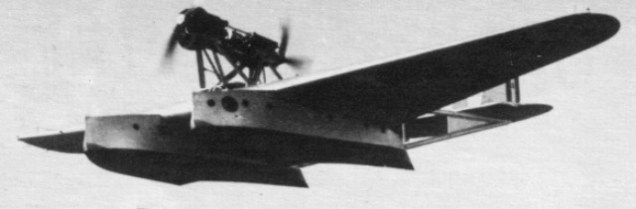
The S.55 prototype flew in 1925, in an era still committed to the biplane flying-boat, it had a cantilever shoulder-wing monoplane with twin hulls and delicate booms supporting a twin-fin triple-rudder tail assembly. Side-by-side pilots’ cockpits were located in the leading edge of the wing centre-section. Twin tandem engines were carried on struts over the wing.
Savoia-Marchetti SM.55 Article
The S 55 was basically a torpedo bomber, pow¬ered by two 700 hp Fiat A 24R engines in tandem, but the 1933 version, designated S 55X was specially cleaned up and fitted with 559kW / 800 hp Isotta¬Fraschini Asso 750 engines. The two pilots sat side¬by side in the centre section, under the engines. The S 55 had open gun positions in the front and rear of each hull, but these were faired over in the S 55X.
Total production exceeded 200. The type formed the main equipment of Italy’s maritime-bombing squadriglie for many years, 13 remaining on charge (but in reserve) in 1939. The S.55C and S.55P civil passenger versions operated Mediterranean routes for a decade.
The S.55 achieved great fame through spectacular long-distance flights: Lieut-Col the Marchese de Pinedo flew the Santa Maria from Sardinia to Buenos Aires and then through South America and the USA in 1927.
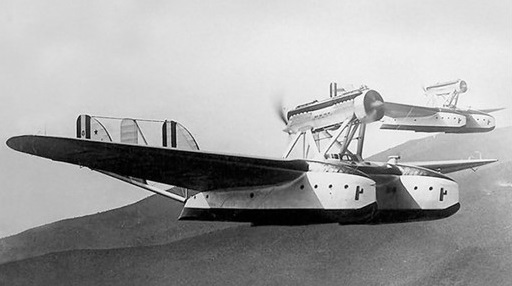
General Italo Balbo conceived in 1930 the idea of making a mass flight in formation over the Atlantic, at a time when transatlantic flying was still a hazardous adventure. A fleet of twin hull flying boats was ordered from the Savoia-Marchetti company for the attempt, and the first began in December 1930 when specially modified S.55As covered 10,400km between Italy and Brazil.
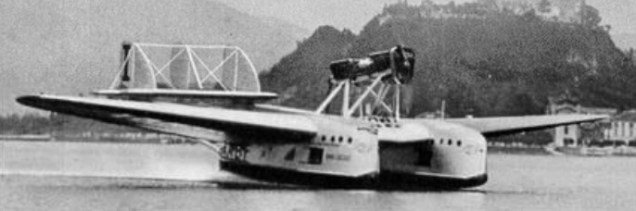
Balbo led twelve of these in person across the South Atlantic from Rome to Rio de Janeiro. In 1933, he led an even greater armada of 24 similar machines across the North Atlantic, from Rome to Chicago by way of Iceland, Greenland and Labrador, and back again to Rome via New York, the Azores and Lisbon. The 24 S.55X machines overflew the Alps and continued in stages via Iceland, Greenland and Labrador to Chicago for the 1933 Century of Progress Exposition. The international press coined the phrase ‘Aerial Armada’ to describe the flights. Neither flight was achieved without loss of life, but from that moment the idea of an airline service across the Atlantic no longer seemed such a remote possibility.
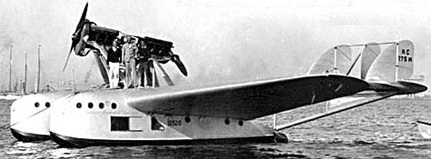
American Aeronautical Corp built the S-55 in 1927. Poweerd by two 515hp Isotta-Fraschini Asso (ATC 2-27 in 1930), optional engines were 500hp Wright Cyclone or Curtiss Conqueror 525hp (ATC 2-206). The price was $57,000. Three were built (NC20K, NC105H, NC175M). Savoia planes were more often called American Marchetti to disguise their Italian origin of design although they were built in the US under license.
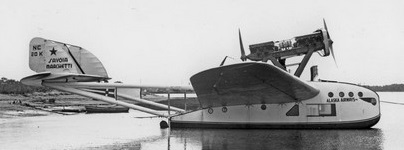
Alaska Airways operated NC290K until 1932.
Engines: 2 x 700 hp Fiat A 24R
Span 79 ft. 11 in
Length 54 ft. 2 in
Height 16 ft. 5 in
Wing area 990 sq. ft
Weight empty 11,440 lb
Loaded weight 16,940 lb
Max. speed 147 mph
Ceiling 13,776 ft
Max. range 2,174 miles
S.55X
Engine: 2 x Isotta-Fraschini Asso 750R, 656kW
Max take-off weight: 8260 kg / 18210 lb
Loaded weight: 5750 kg / 12677 lb
Wingspan: 24.0 m / 79 ft 9 in
Length: 16.75 m / 55 ft 11 in
Height: 5.0 m / 16 ft 5 in
Wing area: 93.0 sq.m / 1001.04 sq ft
Max. speed: 279 km/h / 173 mph
Cruise speed: 233 km/h / 145 mph
Ceiling: 5000 m / 16400 ft
Range w/max.fuel: 4500 km / 2796 miles
Range w/max.payload: 2000 km / 1243 miles
Armament: 4 x 7.7mm machine-guns, 1 torpedo or 2000kg of bombs
Crew: 5-6
American Aeronautical Corp S-55
Engines: 2 x Isotta-Fraschina Asso, 515 hp
Props: 2 blade wooden fixed pitch
Wingspan: 79’11”
Wing area: 1001 sq.ft
Length: 54’2″
Useful load: 5250 lb
Max speed: 128 mph
Cruise speed: 110 mph
Stall: 68 mph
Ceiling: 16,400 ft
Range: 650 mi
Passenger capacity: 17
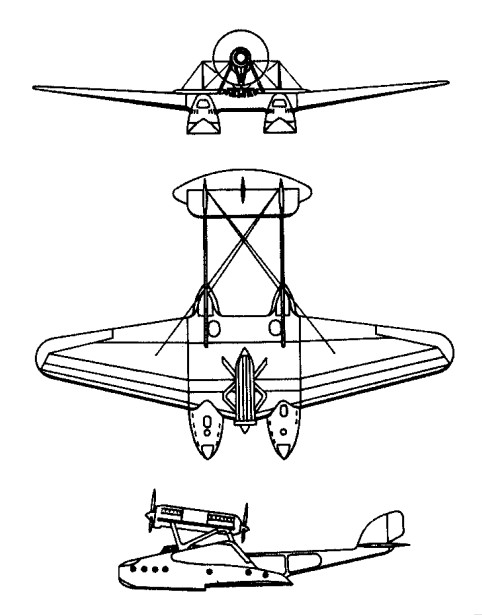
Sau Scientific-Production R-50 Robert
A twin piston-engined six seat light amphibian (first six were to be built by Dubna)
Saunders-Roe SR.53

By 1952 Saunders-Roe produced the SR.53 design for a single-seat target defence interceptor combining a liquid-fuel rocket motor with an auxiliary turbojet. Submitted to the Ministry of Supply (MoS) the design based on the pairing of the de Havilland Engines DGJ.1OR Gyron junior turbojet and Spectre rocket motor, to meet the requirements of Specification F.124T. This was accepted with high regard, and Specification F.177D was written around it to meet Operational Requirement (OR) 337. Furthermore, naval requirement NR/AA7 was combined in the specification, the designation SR.177R being applied to the RAF aircraft and SR. 177N to those for the Fleet Air Arm (FAA). The SR.53 was recipient of a three-prototype contract in October 1952. Armament proposed was a Red Top missile on each wingtip.
On September 4, 1956, Saro received an initial order for nine aircraft, and West Germany expressed enough interest for the eventual figure of 600 production aircraft to be mooted. Production was to be shared among Saro and other companies, and German companies were to manufacture that nation’s variant, so the whole programme would benefit a large European workforce.
With one 8,0001b-thrust de Havilland Spectre rocket engine and one 1,6401b-thrust Armstrong Siddeley Viper turbojet. Of clipped delta wing configuration with a specified armament of two wingtip-mounted Blue Jay (de Havilland Firestreak) AAMs, the SR.53 was powered by an 3629kg de Havilland Spectre HTP rocket and a 744kg Armstrong Siddeley Viper turbojet superimposed one above the other in the rear fuselage.
In the event, only two of the SR.53s were to be completed (XD145 and XD151), these making their initial flights on 16 May and 8 December 1957, prior to which, in April 1957, all rocket-powered fighter development in the UK had been cancelled.
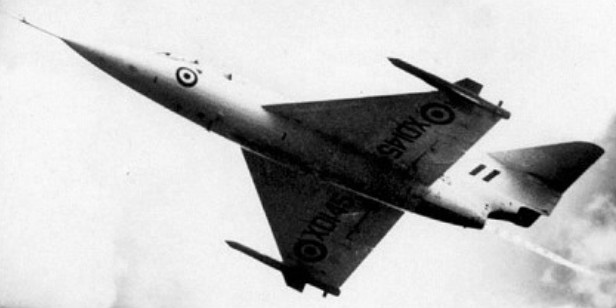
Duncan Sandys’ Defence the White Paper of 1957 resulted in the cancellation of the whole project. When a British request to the USA for funding under the Mutual Weapons Development Program (MWDP) was turned down, West Germany dropped out and turned to the Lockheed F-104 Starfighter.
Nonetheless, the two SR.53s performed 42 test flights before, on 15 June 1958, the second aircraft crashed, the surviving aircraft then being permanently grounded.
SR.53
Max take-off weight: 8618 kg / 19000 lb
Empty weight: 3357 kg / 7401 lb
Wingspan: 7.65 m / 25 ft 1 in
Length: 13.72 m / 45 ft 0 in
Height: 3.29 m / 11 ft 10 in
Wing area: 25.45 sq.m / 273.94 sq ft
Max. speed: 2135 km/h / 1327 mph

 All Aero