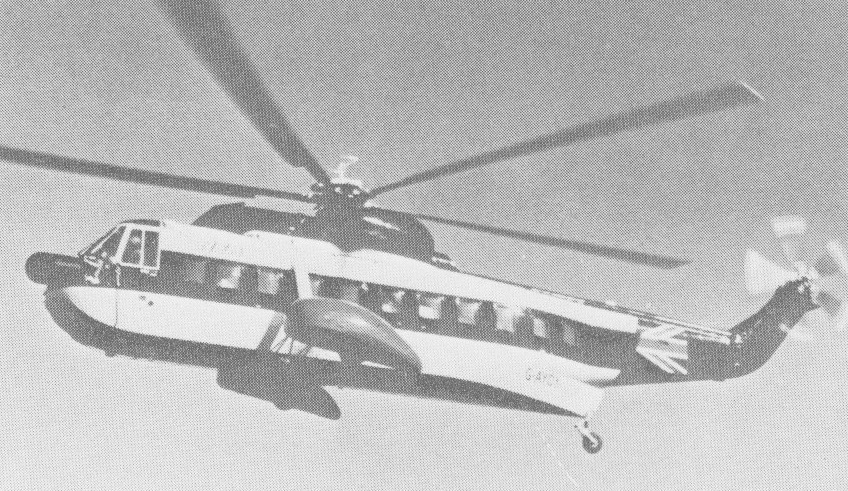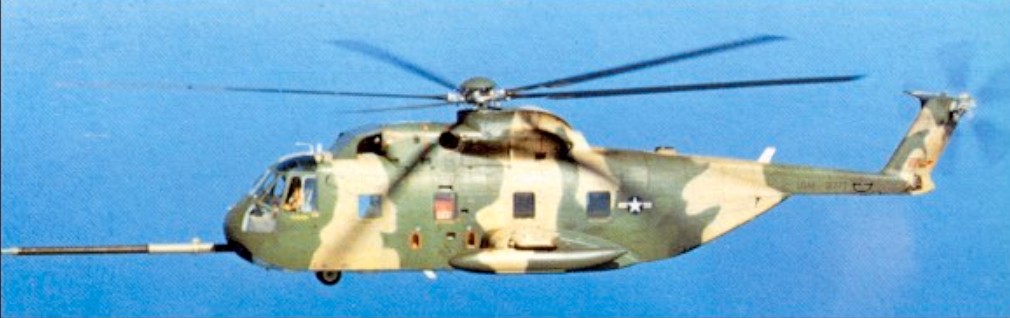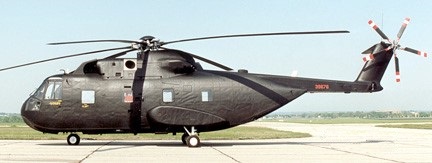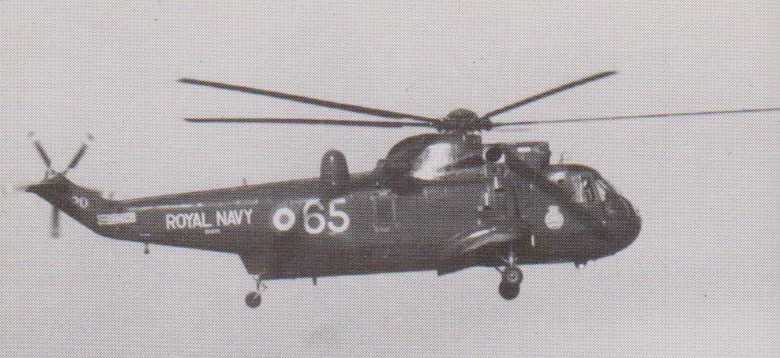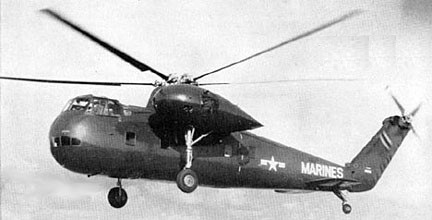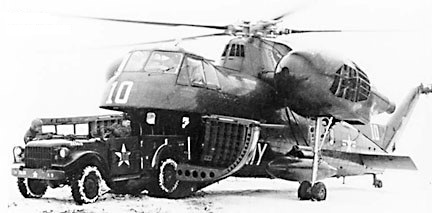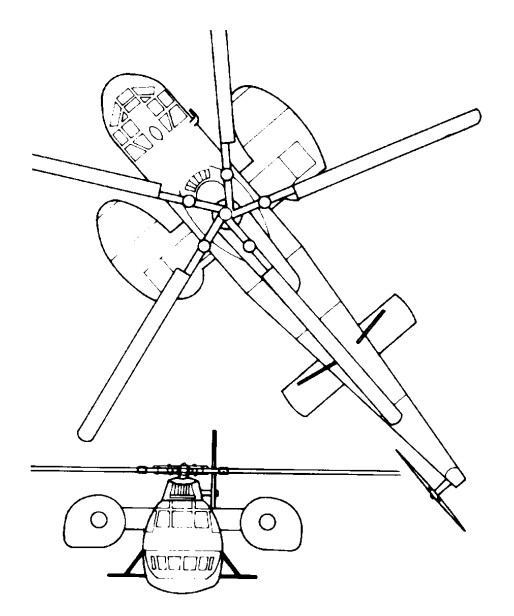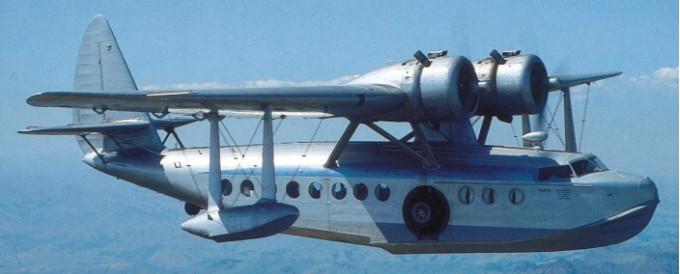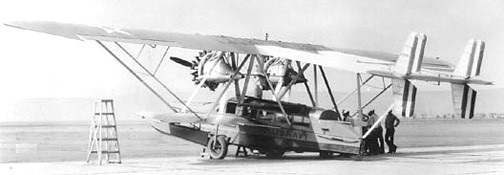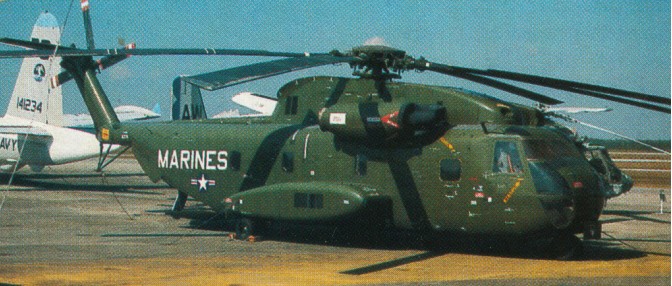
Sikorsky S-65 / CH-53 Sea Stallion / S-80

CH-53A

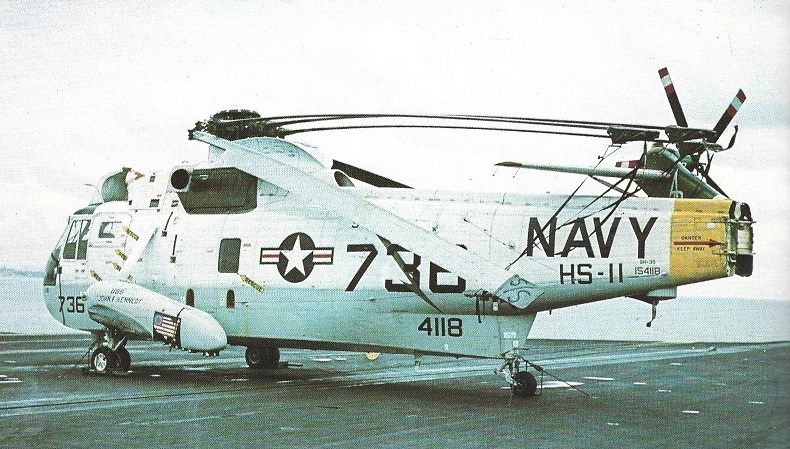
On the basis of the S-61R project for the Marines, the American company proposed the S-65A with a completely redesigned, large-capacity fuselage, capable of transporting 37 equipped troops or 24 stretchers with 4 medical attendants.

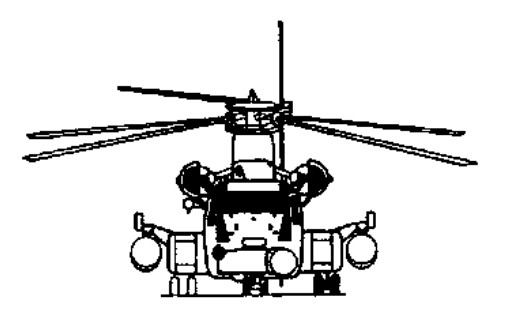
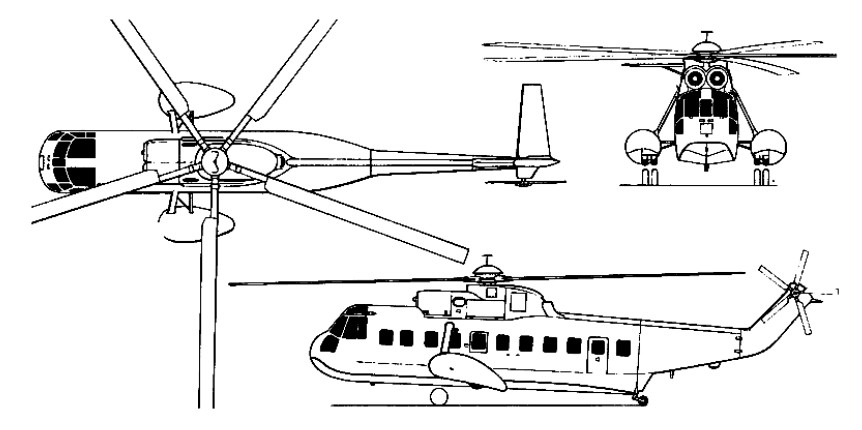
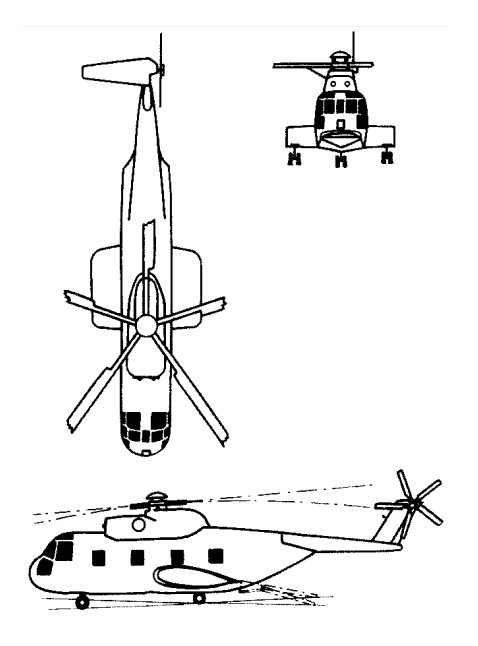
The S-65A fuselage is a scaled-up version of that used on the S-61R. The fuselage is a conventional semi-monocoque structure of aluminium, steel and titanium, a folding tail pylon, and with a horizontal stabiliser on the starboard side of the tail rotor pylon. The rotor system and transmission are generally similar the S-64A Skycrane, but the main rotor head is of titanium and steel, and has folding blades. The flat-bottomed body is watertight and has similar sponsons amidships in which are housed fuel tanks and the main undercarriage members when retracted. The fully castoring nosewheel is also fully retractable. The retractable tricycle type landing gear, has twin wheels on each unit. Main units retract into rear of sponsons on each side of fuselage. Mainwheels and nosewheels have tyres size 25.65 x 8.50-10, pressure 6.55 bars. Basic empty weight is reduced by the use of titanium in the rotor head. The S-65A carries a crew of 3 and can airlift 38 troops and their equipment, 24 casualty litters and 4 medical attendants, or some 3630kg of cargo within the fuselage. The interior of the CH-53 is fitted with rollers for easy movement of cargo. A let-down rear ramp provides access for such military loads as 2 jeeps, a Hawk missiles, or a 105mm howitzer and its carriage. A slung load of some 5900kg can be lifted on an under-fuselage hook.

Power is normally two 2,850 shp / 2,125kW General Electric T64-GE-6 turboshaft engines, mounted in pod on each side of main rotor pylon. The CH-53A can also utilise, without airframe modification, the T64-GE-1 engine of 2,297kW or the later T64-GE-16 (mod) engine of 2,561.5kW. Two self-sealing bladder fuel tanks, each with capacity of 1,192 litres, housed in forward part of sponsons. Total fuel capacity 2,384 litres.

With a crew of three, the main cabin accommodates 37 combat-equipped troops on inward-facing seats. Provision for carrying 24 stretchers and four attendants. Roller-skid track combination in floor for handling heavy freight. Door on starboard side of cabin at front. Rear-loading ramp.
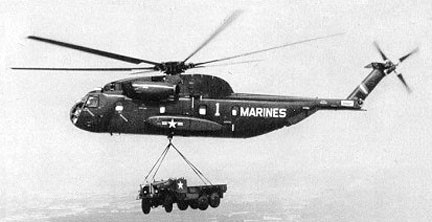
Sikorsky S-65A

The first flying on 14 October 1964, the YCH-53A Sea Stallion demonstrated ruggedness of design by flying with three of six main rotor blades removed, and also performed a barrel-roll. Two YCH-53A were built, 151613 and 151614. One commercial demonstrator was later sold to NASA.

Sikorsky S-65 Article

The US Navy, which is responsible for acquisitions for the Marines, in August 1962, announced that the S-65A had been selected as a new ship-borne heavy assault transport for the U.S. Marine Corps, with the military title CH-53A Sea Stallion.

The first Sea Stallion flew on 14 October 1965 powered by two 2125kW General Electric T64-GE6 engines, and delivery of the first 106 helicopters began in September 1966. The aircraft were assigned to Marine Squadron HMH-463 in Vietnam in January 1967. At that period, it was the largest helicopter in the Western world.

On 17 February 1968, a CH-53A with modified T64 engines took off with a gross weight of 23540kg and a 9925kg payload, establishing an unofficial record. On 23 October of the following year a Sea Stallion demonstrated surprising manoeuvrability when it performed a series of loops and rolls with Lt.-Col. Robert Guay of the Marines and Sikorsky test pilot Byron Graham at the controls, carrying a gross weight of 12250kg. During these manoeuvres, the helicopter supported from -0.2 to 2.8g.

Delivery of the first of one hundred and six production CH-53A’s began in September 1966. Since January 1967 the Sea Stallion has been serving with Marine Squadron HMH-463 in Vietnam, and by that summer some thirty Sea Stallions had been delivered. Standard powerplant is the T64-GE-6 shaft turbine, though the 3080shp T64-GE-1, 3435shp T64-GE-16 or GE T64-GE-3/-6/-12 may be fitted. One CH-53A with standard engines has been flown at a gross weight of 20865kg, of which 9072kg was payload. One hundred ad thirty-nine were built; 151686 to 151701, 152392 to 152415, 153274 to 153313, 153705 to 153739, 154863 to 154888, and 63-13693 to 13694, of which 15 transferred to USN as RH-53A and 9 to USAF, 66-30047, -30049, -30050, 67-30043 to 30046, -30048, and -30051. 152399 went to the FAA as NCH-53A and wore a civil license.

In September 1966, the USAF also ordered this big helicopter for its rescue service to assist space programmes and recover pilots from war zones. The eight HH-53B, 66-14428 to 14435, ordered for the USAF were known as “Super Jolly Green Giants” and fitted with in-flight refuelling probes, jettisonable auxiliary fuel tanks, rescue hoists and all-weather avionics. Flown for the first time on 15 March 1967. This version has 3080shp T64-GE-3 engines. It also has defensive machine gun positions fore and aft.

A batch of eleven ex-USMC, 66-14468 to 14478, went to the USAF in 1988 as TH-53A.

The HH-53B is employed by the Aerospace Rescue and Recovery Service of the U.S. Air Force, and delivery of an initial batch began in June 1967. Two of these aircraft were stationed at Cape Kennedy in connection with the Apollo manned spacecraft programme.

Parallel with the military variants, Sikorsky had under development a commercial model of the S-65A. This was currently envisaged with 3435shp T64 engines and an enlarged pressurised fuselage to seat 67 passengers.

Fifty-eight of the subsequent HH-53C variant with uprated turbines (3435shp each) were built from 1967. Used for space capsule recovery and combat SAR, they were similar to HH-53B, but with 3925hp T64-GE-7 engines and jettisonable fuel tanks.

The CH-53C Super Jolly was as the HH-53C, but in transport roles. Twenty were built, 68-10922 to 10933, and 70-1625 to 1632.

After having used the early production aircraft, the US Marine Corps also asked for more powerful engines to be installed, and the result was the CH-53D, introduced in March 1969, with 3925shp / 2927kW T64-GE-413 engines. In this version, the tail and rotor could be folded back automatically, and a high density cabin layout was available to accommodate 64 troops, equivalent to the S-65C export version. All but the first 34 had fittings to operate as minesweepers. A total of 265 CH-53As and Ds were built for the Marines; the last left the factory on 31 January 1972.

Of the early versions, all are transports (139 CH 53As and 126 of the more powerful CH 53D, all for the US Marines) except for 15 CH-53A, including 152392-152398, transferred to the US Navy as RH 53A Sea Stallion minesweeping machines with T64-GE-413 engines in 1971.

Last CH-53D (the 26th built) was delivered on 31 January 1972. All but the first 34 CH-53s were provided with hardpoints for supporting towing equipment and transferring tow loads to the airframe, so that the US Marine Corps could utilise the aircraft as airborne minesweepers, giving an assault commander the capability of clearing enemy mines from harbours and off beaches without having to wait for surface minesweepers.

Tow kits installed in the 15 CH-53Ds operated by the US Navy Squadron HM-12 included automatic flight control system interconnections to provide automatic cable yaw angle retention and aircraft attitude and heading hold. Rearview mirrors are fitted for pilot and co-pilot; tow cable tension and yaw angle indicator; automatic emergency cable release; towboom and hook system with 6,803kg load capacity when cable was locked to internal towboom. A dam to prevent cabin flooding in emergency water landing with lower ramp open; dual hydraulically powered cable winches; racks and cradles for stowage of minesweeping equipment; auxiliary fuel tanks in cabin to increase endurance.

HH-53B and HH-53C SAR variants were built for the US Air Force, the former equipped to a standard similar to that of the HH-3E and powered by 2297kW T64-GE-3 engines. It was first flown on 15 March 1967. Sponson bracing struts allowed the HH-53B to carry 2460-I drop-tanks. More powerful 3,925kW T64-GE-7 engines powered the improved HH-53C, the same powerplant being installed in the CH-53G produced for the German army. Two S-65Oe rescue helicopters were delivered to the Austrian air force in 1970.

S-65C-3 were sold to the Israel Defense Force/Air Force.

A specialised minesweeping version, the RH-53D, was first flown on 27 October 1972 with drop-tanks and in-flight refuelling probes. To complete its experiments with the RH-3A, the US Navy borrowed nine CH-53Ds from the Marines, fitted with devices for the detection, sweeping and neutralization of all types of mines. This variant was designated RH-53D, and 30 were produced for the US Navy and six for the Iranian Navy in 1978. The RH-53 has 1900 liter supplementary fuel tanks, a 270kg hoist and 11340kg cargo hook. Minesweeping equipment is towed behind the helicopter on a trapeze. Towing equipment was installed from the 34th production aircraft onwards. Once brought to the surface, mines are detonated using two door-mounted machine-guns. Though a dedicated minesweeper, the RH-53D also has a transport role. At the beginning of 1973, these helicopters were used by US Navy Task Force 78 for Operation Endsweep, to free the North Vietnamese ports of mines. Some ships used for tests were designated as NRH-53D.

Eight RH-53Ds were used to fly into Iran during Operation Eagle Claw to rescue the hostages held by Iran in 1980; seven were destroyed. RH-53Ds were deployed to the Persian Gulf for minesweeping operations in 1987, and in 1991 for Desert Storm.

Two VH-53D Sea Stallion were USMC staff transport.

The Sea Stallion also aroused some interest in other countries where there was a requirement for a helicopter for troop transport. Thus the S-65A was also ordered by Germany. Two pattern aircraft were built in the US and 110 were built under license by VFW-Fokker as the CH-53G with T64-GE-7 engines. Another eight aircraft, modified for use in hot/high conditions, were exported to Israel.

Work began in 1971 on an enlarged version with a lengthened fuselage, a new rotor system and three 3266kW T64-GE-416 engines. The US Navy contract covering two prototypes and subsequent flight test was awarded in 1973, and the S-80 / YCH-53E prototype (71-59121) flew for the first time on 1 March 1974. During tests it was hovered at 50′ at a gross weight of 71,700 lb on 10 August 1974, carrying an external load of 17.8 tons, the heaviest gross weight ever flown and heaviest payload ever lifted by a helicopter in the western world. With the three engines each of 4,380 shp (3266 kW) it was the most powerful helicopter ever built outside the Soviet Union. First flight of first production prototype was on 8 December 1975, and the second production prototype in March 1976. Fitted with in-flight refueling, two YCH-53E Super Stallion prototypes were built.
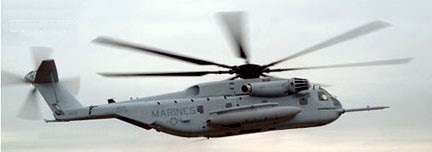
Sikorsky CH-53E USMC

This is a much modified version with three 4380shp General Electric T64-GE-416 engines and strengthened transmission to withstand the increase in power. The fuselage is about 2m longer than that of the CH-53D and the tail pylon is canted to port. The main rotor has also been improved and has seven composite blades (its predecessor had six light alloy ones) of increased diameter. Thirty-three CH-53Es were initially ordered by the Marines and 16 by the US Navy.

The first production CH 53E flew on 13 December 1980, and the first delivery of a CH-53E took place on 16 June 1981 at Stratford, Con. This CH-53E (the sixth of the initial production lot, the preceding five serving as acceptance test procedures, avionics testing, maintenance and pilot training programs) entered service with HMH-464 Marine Aircraft Group 26. It was the first of 20 contracted.

By mid 1983 more than 40 had been delivered out of 72 ordered. Specifically designed for USN/USMC, they carried 55 troops and two 650-gallon fuel tanks on sponsons, A total of 103 CH-53 were built.

JCH-53E and NMH-53E were designations for test aircraft.
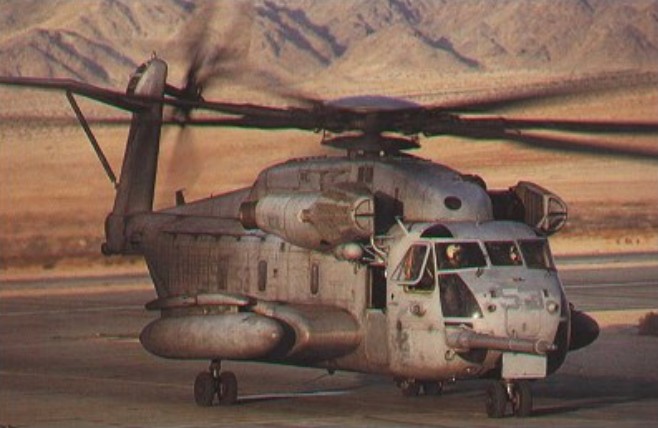
S-80/CH-53E

Full-scale development of Helicopter Night Vision System (HNVS) for CH-53E began June 1986, in co-operation with Northrop Electro-Mechanical Division; HNVS includes Lockheed Martin Pilot Night Vision System (PNVS) and Honeywell Integrated Helmet and Display Sighting System (IHADSS) from Bell AH-1S surrogate trainer; HNVS will allow low-level operations in night and adverse weather; HNVS ground testing began 1988; operational evaluation began August 1989. Smaller-scale capability authorised 1993, with contract to EER Systems for installation of Hughes AN/AAQ-16B FLIR, Teledyne Ryan Electronics AN/APN-217 Doppler and Rockwell Collins GPS 3A; total 24 upgrades initially authorised; subsequent contracts for 99 HNVS with work scheduled for completion in May 1999. USMC has also evaluated engine-suppression system as means of reducing IR signature, and new multiple cargo hook concept.

The CH-53E can accommodate 55 fully equipped combat troops, wheeled vehicles, and palletised cargo, and has a 16-ton heavy-lift capability. In-flight refuelling plus a folding rotor and tail boom for shipboard stowage are also provided.

The first CH-53E Super Stallion delivery to the US Marine Corps took place on 16 June 1981. Since 1982 Sikorsky has been developing the MH-53E mine countermeasures variant. It incorporates major equipment changes and has much enlarged sponsons to carry an additional 3785 litres of fuel. Six were delivered in 1986. June 1987 marked six years in service for the CH-53E Super Stallion.

In addition Sikorsky is de¬veloping the derived MH 53E as a de¬finitive MCM (mine countermeasures) helicopter, with very comprehensive minesweeping gear using all existing or planned MCM devices. Enormously enlarged side sponsons accommodate an extra 3785 litres (833 Imp gal) of fuel, for extended sweeping missions with the engines at sustained high power, The MH 53E will also be used in the vertrep (vertical replenishment of ships) role, and has been made com¬patible with the cargo hold of the Lock¬heed C 5 Galaxy in order that it can be deployed rapidly anywhere in the world. Bureau number 162497 was the first true production MH53E. The first delivery (of 35 built) of an MH-53E Sea Dragon airborne mine counter¬measures (AMCM) helicopter to a US Navy fleet squadron took place in April 1987. Based on the triple-turbine CH-53E airframe, the MH-53E has extra-large sponsons made of composite material, each holding 1,600gal of fuel allowing a 4hr minesweeping mission. To accomplish its task the Sea Dragon tows mechanical, acoustic, and magnetic hydrofoil sweeping gear through the water. A dual digital automatic flight control system allows automatic approach to, and departure from, a coupled hover, with tow cable tension and skew-angle hold functions. In-flight refueling capability aids rapid long-range deployment, while rotor-blade and tail-boom folding ensures compatibility with all US Navy AMCM ships.
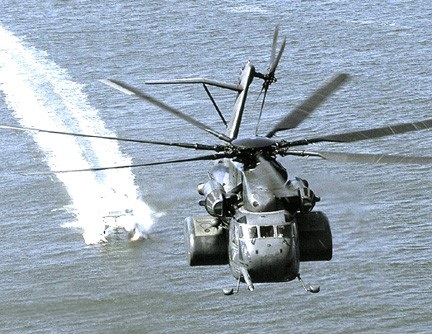
Sikorsky MH-53E Towing minesweeper sled

Delivery effected 1994 of MH-53E retrofitted with upgraded avionics package by EER Systems, comprising two 15.2 cm (6 in) horizontal situation display colour screens, Fairchild mission data loader and Rockwell Collins GPS 3A; upgrade of entire MH-53E fleet planned but may be reduced to around 30 as result of defence budget trimming. One MH-53E to West Palm Beach, Florida, for installation of T64-GE-419 engines, late 1993. Trials during 1994 verified performance gains, including recovery and flyaway capability in event of engine failure during hover; retrofit of entire MH-53E fleet underway.

First flight of preproduction MH-53E, 1 September 1983; first delivery to US Navy 26 June 1986; in operational service with HM-14 at Norfolk, Virginia, 1 April 1987; first carrier deployment by HM-15 on board USS Tripoli, 9 December 1989.

Delivery effected 1994 of MH-53E retrofitted with upgraded avionics package by EER Systems, comprising two 15.2 cm (6 in) horizontal situation display colour screens, Fairchild mission data loader and Rockwell Collins GPS 3A; upgrade of entire MH-53E fleet planned but may be reduced to around 30 as result of defence budget trimming. One MH-53E to West Palm Beach, Florida, for installation of T64-GE-419 engines, late 1993. Trials during 1994 verified performance gains, including recovery and flyaway capability in event of engine failure during hover; retrofit of entire MH-53E fleet underway.

Export versions of the CH-53E and MH-53E were available as the S-80E and S-80M respectively.

Some CH-53C and HH-53B helicopters remained unmodified until the late 1980s, when they became MH-53Js.
MH-53H and MH-53J Pave Low IIs were involved in the US invasion of Panama. Air Force special operations HH-53Hs and MH-53Js are rebuilds of HH-53B/Cs.

The 1975 HH-53H Super Jolly was a USAF 24-hour, all-weather SAR in the PAVE LOW program. One prototype was completed and eight conversions of HH-53C in 1979.

The 1981 MH-53J PAVE LOW IIIE were for heavy-lift, all-weather, long-range, undetected penetration. They were the largest and most powerful helicopter in USAF at the time, featuring PAVE low-level terrain-avoidance radar and forward-looking infrared sensors (FLIR), along with a projected map display, enabled pilot to follow land contours and avoid obstacles.
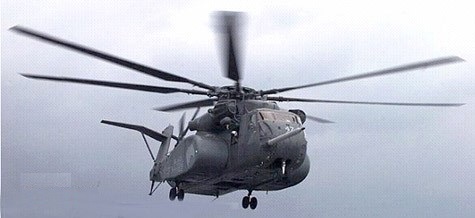
Sikorsky MH-53

Six Sikorsky VH-53F Super Stallion were ordered for the USAF but with US Navy bureau numbers (159123 / 159128) for VIP transport by the 89th Military Airlift Wing. These were cancelled before deliveries could take place.

Gallery

Production:
151613-151614 (2) YCH53A
151686-154884 (128) CH53A
156654-157931 (126) CH53D
158682-158761 (30) RH53D
161179-165651 (177) CH53E
161395-164864 (48) MH53E
168778-168782 (5) YCH53K (1 GTV, 5 EDM)
Bureau number 161395 was later converted from a CH53E to MH53E

Variants:

YCH-53A
Winner of the HH(X) competition, two prototype CH-53As were completed for US Navy evaluation, by March 1966; first flight made by second aircraft (BuNo. 151614) on 14 October 1964, powered by two T64-GE-6 turboshafts

CH-53A
Initial version powered by two General Electric T64 turboshaft engines and has a watertight hull for US Marine Corps, deliveries commencing in September 1965. A full-size rear opening, with built-in ramp, permits easy loading and unloading, with the aid of a special hydraulically operated internal cargo loading system and floor rollers. Accelerated deployment to South East Asia made after improvements to engine intake filters, defensive armament, crew armour and external lifting capability; selected T64-GE-1 engines retrofitted for extended running at maximum power output when necessary; fitted with hardpoints for towing mine-sweeping gear from 34th aircraft onwards; used by USAF for crew training and later for covert operations in Vietnam and Laos (seven aircraft borrowed from and returned to Navy); 139 built

RH-53A
15 dedicated mine-counter-measures versions delivered to the Navy via the Marine Corps; re-engined with T64-GE-413 turboshafts; rectangular frame mounted on rear ramp to tow mine clearing sled and rear view mirrors fitted on either side of the nose; used to clear North Vietnamese mines during Operation Endsweep in 1973; RH-53As replaced by RH-53Ds in Navy service and aircraft returned to Marines

TH-53A
Former USMC CH-53As used by USAF from 1989 onwards to train MH-53 crews at Kirtland AFB, NM; at least three aircraft in use, stripped of most equipment and camouflaged

HH-53B
Eight aircraft similar to CH-53A but delivered to USAF Aerospace Rescue and Recovery Service to supplement HH-3s in South East Asia. The first of these flew 15 March 1967, powered by 2,297kW T64-GE-3 turboshaft engines. Refuelling probe relocated to starboard side of nose, pylons fitted to allow carriage of external fuel tanks; armed with three pintle-mounted GAU-2A/B 7.62mm Miniguns and powered by T64-GE-3s, later replaced by T64-GE-7s; quickly supplemented by HH-53Cs and re-assigned to CONUS, the last four HH-53Bs were modified to MH-53J standard in the late 1980s

CH-53C
22 aircraft built for heavy-lift duties with the USAF; fitted with sponsons and external tanks as developed for HH-53C, it was similar in most respects to this version but lacked a refuelling probe; replaced CH-53As on loan from USMC for covert operations in Laos; later operated by TAC and USAFE; seven surviving CH-53Cs brought up to MH-53J standard in late 1980s

HH-53C
Refined version of HH-53B, with 2,927kW T64-GE-7 engines. 44 were built for USAF ARRS for combat rescue; dubbed ‘Super Jolly Green Giant’; dispensed with bracing struts fore the external pylons, and included additional crew armour, and better radio fit to facilitate operations with HC-130 tankers. Auxiliary jettisonable fuel tanks each of 1,703 litres capacity on new cantilever mounts. Flight refuelling probe, and rescue hoist with 76m of cable. External cargo hook of 9,070kg capacity. RHAW and IR jamming systems introduced as a result of experience in North Vietnam during 1972; HH-53Cs used in support of Apollo space missions for emergency capsule rescue; HH-53Cs remained in USAF service until late 1980s when all were converted to MH-53J standard
First HH-53C was delivered to the USAF 30 August 1968. A total of 72 HH-53B/Cs was built.

S-65C
Commercial intercity helicopter proposal based on military CH-53.

S-65C-2 / S-65O
Export version of CH-53C, two of which were ordered in 1969 and delivered to the Austrian air force in 1970; later retired from use due to operating costs and passed on to Israel in 1981. Used for rescue duties in the Alps, they have the same rescue hoist as the HH-53B/C, fittings for auxiliary fuel tanks and accommodation for 38 passengers.

S-65-C3
Only other export version of H-53, delivered to Israel from 1969; corresponding to HH-53C, 33 aircraft supplemented by two additional S-65s from Austria in 1981; surviving aircraft upgraded by IAI subsidiary MATA Helicopters

CH-53D
Improved CH-53A for US Marine Corps, the first of which was delivered on 3 March 1969. Two T64-GE-413 engines, each with a maximum rating of 2,927kW. A total of 55 troops can be carried in a high-density arrangement. An integral cargo handling system makes it possible for one man to load or unload 1 ton of palletised cargo a minute. Main rotor and tail pylon fold automatically for carrier stowage, first flown on 27 January 1969; 124 built.

RH-53D
First flown 27 October 1972; 30 aircraft (named Sea Stallion) specifically developed for anti-mine warfare in the light of positive experience with RH-53A; fitted with an initial powerplant of two T64-GE-415s, RH-53D also differs from RH-53A by inclusion of refuelling probe, automatic flight control system, more powerful cargo hook, and rescue winch; armed with two’swivel-mounted 12.7mm machine-guns; six delivered to Imperial Iranian navy before the fall of the Shah

VH-53D
Two CH-53Ds delivered to USMC for VIP transport

YCH-53E
Three-engined development of the CH-53D.\

CH-53E Super Stallion
Heavy transport and amphibious assault helicopter (first flown March 1974)

MH-53E Sea Dragon / S-80
Airborne mine countermeasures helicopter able to tow through water hydrofoil sledge carrying mechanical, acoustic and magnetic sensors; nearly 3,785 litres (1,000 US gallons; 833 Imp gallons) extra fuel carried in enlarged sponsons made of composites; improved hydraulic and electrical systems; minefield, navigation and automatic flight control system with automatic towing and approach and departure from hover modes.

CH-53K
Cargo, USN & USMC

CH-53G
Version of the CH-53 for the German armed forces order for 135 examples, later reduced to 110, with T64-GE-7 engines. A total of 112 were produced, the first of two built by Sikorsky being delivered 31 March 1969. The next 20 were assembled in Germany by VFW-Fokker from US-built components, then progressively increasing indigenous sources. Prime contractor in Germany was VFW-Fokker, whose first CH-53G flew 11 October 1971, entered service in-1973. Deliveries completed in 1975.

YHH-53H
First aircraft to be fitted with ‘Pave Low I’, in trials for a projected night/ all-weather combat rescue/infiltration mission; fitted with early low-light TV system which proved inadequate, though the first successful night rescue was made with an improved system in December 1972, in Laos; aircraft later modified to ‘Pave Low II’ standard, with external sponsons and tanks

HH-53H
Eight HH-53Cs and YHH-53H modified to definitive ‘Pave Low III’ standard; delivered between 1979 and 1980 and fitted with FLIR, TF radar, INS, computer generated moving map display, RHAW and chaff/flare dispensers. Eight converted to MH-53J Pave Low III.

MH-53H
Redesignation and modification of HH-53H under the Constant Green programme; all ‘Pave Low III’ aircraft were modified to MH-53J standard

MH-53J Pave Low III Enhanced
US Air Force upgrade of Special Operations Forces combat rescue and recovery fleet; 31 HH-53Bs, HH-53Cs and CH-53Cs converted at NAS Pensacola, Florida, beginning 1986, to MH-53J Pave Low III Enhanced; similar to 11 HH-53H Pave Low III produced earlier, eight survivors of which also converted to MH-53Js; programme completed in 1990. Modifications include Texas Instruments AN/AAQ-10 nose-mounted FLIR, inertial navigation, Doppler radar, computer-projected map display, Navstar GPS, Texas Instruments AN/APQ-158 terrain-following/avoidance radar in offset nose radome, chaff/flare dispensers, Loral AN/ALQ-157 IR jammer on each outrigger pylon, 454kg of extra titanium armour plating and Collins AN/AIC-3 intercom; armament includes three 7.62mm or 12.7mm machine guns firing through windows on each side and from open rear ramp. Power plant is two 3,266kW General Electric T64-GE-415 turboshafts; maximum T-O weight increased from 19050 to 22,680kg. Further upgrades planned to improve combat effectiveness and service life. Those modified from HH-53Bs retain braced external tank pylons of first Super Jollys.

MH-53M Pave Low IV
Internal upgrade featuring new avionics and defence aids, including an integrated AP-102A weapon systems computer to speed up target acquisition. All 39 existing MH-53J Pave Low III’s are expected to be converted.

S-80E
Export version of CH-53E.

S-80M
Export version of MH-53E; total of 11 delivered to Japan for Japanese Maritime Self-Defence Force (JMSDF).

Yasur 2000
Upgrade of 30 Israeli Air Force CH-53Ds by IAI. Improved avionics and structural changes to extend service life. Other modifications include internal auxiliary fuel tanks, flight refuelling boom, rescue hoist, crashworthy seats and cockpit armour.

Detailed description refers to CH-53E, but applicable also to MH-53E and S-80 export versions, except where indicated.

COSTS: US$24.36 million (1992) projected average unit cost.

DESIGN FEATURES: Fully articulated seven-blade main rotor; blade twist 14°; hydraulic powered blade folding for main rotor; tail pylon folds hydraulically to starboard; four composite-blades tail rotor on pylon canted 20° to port to derive some lift from tail rotor and extend CG range; cranked, strut braced tailplane; rotor brake standard; fuselage stressed for 20 g vertical and 10 g lateral crash loads.

FLYING CONTROLS: Fully powered, with autostabilisation and autopilot. See also Current Versions and Avionics.

STRUCTURE: Fuselage has watertight primary structure of light alloy, steel and titanium; glass fibre/epoxy cockpit section; extensive use of Kevlar in transmission fairing and engine cowlings; main rotor blades have titanium spar, Nomex honeycomb core and glass fibre/epoxy composites skin; titanium and steel rotor head; Sikorsky Inflight Blade Inspection Method (IBIM) sensors detect blade spar cracks occurring in service; tail rotor of aluminium; pylon and tailplane of Kevlar composites.

LANDING GEAR: Retractable tricycle type, with twin wheels on each unit. Main units retract into rear of sponsons on each side of fuselage. Fully castoring nosewheels.

POWER PLANT: Three General Electric T64-GE-416 turboshafts, each with a maximum rating of 3,266kW for 10 minutes, intermediate rating of 3,091kW for 30 minutes and maximum continuous power rating of 2,756kW. Transmission rated at 10,067kW for take-off. Retrofit underway with 3,539kW T64-GE-419 turboshafts.

Self-sealing bladder fuel cell in forward part of each sponson, each with capacity of 1,192 litres. Additional two-cell unit, with capacity of 1,465 litres, brings total standard internal capacity to 3,849 litres. (Total internal capacity of MH-53E is 12,113 litres)

Optional drop tank outboard of each sponson of CH-53E, total capacity 4,921 litres. (MH-53E can carry seven internal range extension tanks, total capacity 7,949 litres) Forward extendable probe for in-flight refuelling. Alternatively, aircraft can refuel by hoisting hose from surface vessel while hovering.

ACCOMMODATION: Crew of three. Main cabin of CH-53E will accommodate up to 55 troops on folding canvas seats along walls and in centre of cabin or 24 litters. Door on forward starboard side of main cabin. Hydraulically operated rear-loading ramp. Typical freight loads include seven standard 1.02 x 1.22m pallets. Dual and single-point central hooks for slung cargo, capacity 16,330kg.

SYSTEMS: Hydraulic system, with four pumps, for collective, cyclic pitch/roll, yaw and feel augmentation flight control servo mechanisms; engine starters; Engine Air Particle Separators (EAPS); engine and hydraulic oil replenishment in flight; landing gear actuation; cargo winches; loading ramp; and blade and tail pylon folding. System pressure 207 bars, except for engine starter system which is rated at 276 bars. (Separate hydraulic system in MH-53E to power AMCM equipment.) Electrical system includes three 115V 400Hz 40 to 60kVA AC alternators, and two 28V 200A transformer-rectifiers for DC power. Solar APU.

AVIONICS: Flight: Hamilton Standard automatic flight control system, using two digital onboard computers and a four-axis autopilot. Retrofit test flown late 1993, comprising four Canadian Marconi CM A-2082 15.2cm square colour displays, tied with GPS, Doppler and AHRS; installation by Teledyne Ryan.

EQUIPMENT: MH-53E equipment includes Westinghouse AN/AQS-14 towed sonar, AN/AQS-17 mine neutralisation device, AN/ALQ-141 electronic sweep and Edo AN/ALQ-166 towed hydrofoil sled for detonating magnetic mines.

ARMAMENT: Window mount provisions for 7.62mm and 12.7mm weapons.

Specifications:

YCH-53A Sea Stallion
Engines: two T64-GE-6
Max speed: 200+ mph
No built: 2

S-65A
Engines: two 3925hp T64-GE-413 turboshafts
Rotor: 72’3″
Length: 67’2″
Max speed: 196 mph
Range: 257 mi
Crew: 3
Passenger capacity: 41

CH-53A Sea Stallion

CH-53D
Engine: 2 x General Electric T64-GE-412 turboshaft, 2926kW / 3,925 shp
Main rotor diameter: 22.02m
Disc Area: 280.5 sq.m
Fuselage length: 20.5m
Height: 7.6m
Max take-off weight: 19050kg
Empty weight: 10650kg
Max speed: 315km/h
Cruising speed: 278km/h
Range with payload: 2075km
Rate of climb: 11m/s
Service ceiling: 6220 m / 21,00 ft
Internal (external) payload: 3710kg (9070kg)
Accommodation: 37 troops or 24 stretchers

RH-53D / NRH-53D Sea Stallion
Engines: two T64-GE-415

YCH-53E Super Stallion
Engines: 3 x GE T64-GE-415, 4380hp turboshafts
Main rotors: 7
Rotor dia: 24.08 m (79 ft 0 in)
Length 73’9″
Max speed: 195 mph
Cruise: 172 mph
Range: 306 mi
Ceiling: 18,500′

CH-53E Super Stallion
Engine: 3 x General Electric T64 416 tur¬boshafts, 4380 shp (3266 kW)
Rotor dia: 24.08 m (79 ft 0 in)
Fuselage length: 22.3 m
Length overall 30.19 m (99 ft 0.5 in)
Height: 8,66 m (28 ft 5 in)
No blades: 7
Main rotor disc area 455.38 sq.m (4,902.0 sq ft)
Empty wt: 15071 kg (33,226 lb)
MTOW: 33339 kg (73,500 lb)
Payload: 14,515 kg
Max speed: 170 kt
Cruising speed at sea level 278 km/h (173mph)
ROC: 840 m/min
Fuel cap (aux): 4920 lt (4545 lt)
Max range (unrefuelled): 2075 km
Range: 56 mi with 16 tons external cargo
Range: 575 mi with 10 tons external cargo
HIGE: 11,550 ft
HOGE: 9500 ft
Ceiling: 5640 m / 18,500′
Crew: 3
Pax: 55

CH-53G
Engines: 2 x T64-GE-7
Fuselage length: 67 ft 3 in (20.5m)
Pax cap: 38 troops

HH-53 Jolly Green Giant
Engines: 2
Fuselage length: 67 ft 3 in (20.5m)
Pax cap: 38 troops

HH-53B Super Jolly
Engines: 3080hp T64-GE-3
Seats: 6
No built: 8

MH-53E Sea Dragon
Engine: 2 x GE T64-416, 4380hp
Instant pwr: 3263 kW
MTOW: 33,340 kg
Payload: 16,587 kg
Max speed: 170 kt
Max range: 2035 km
Ceiling: 27,900′
HIGE: 3520 ft
HOGE: 2895 ft
Crew: 3
Pax: 55

MH-53J PAVE LOW IIIE
Engines: two 4330hp GE T64
Main rotor: 72’0″
Length: 92’0″
Max take-off weight: 46,000 lb
Max speed: 165 mph
Range: 630 mi
Ceiling: 16,000′
Accommodation: 8

RH-53D
Engines: 2
Fuselage length: 67 ft 3 in (20.5m)
Pax cap: 38 troops

CH-53D

Sikorsky S-64 Skycrane / CH-54 Tarhe

Skycrane

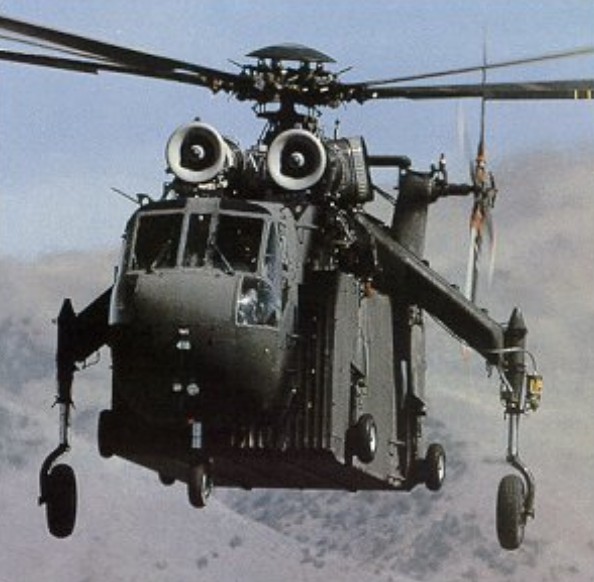
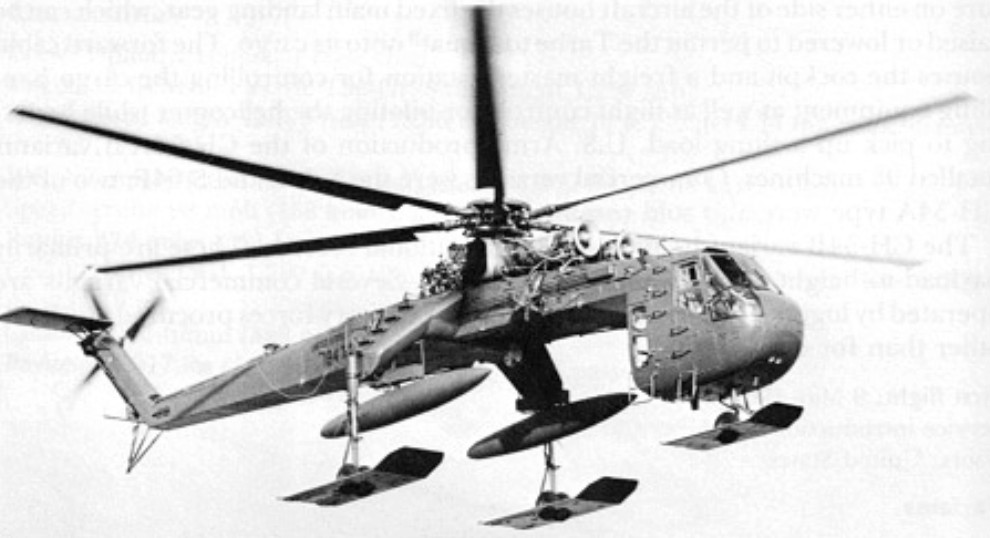
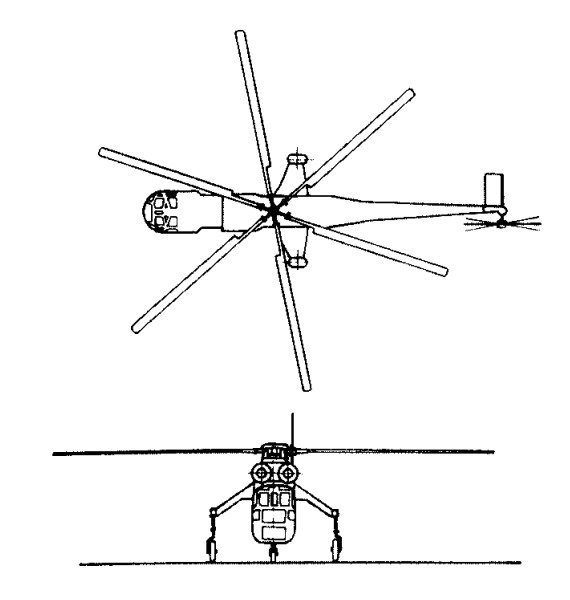
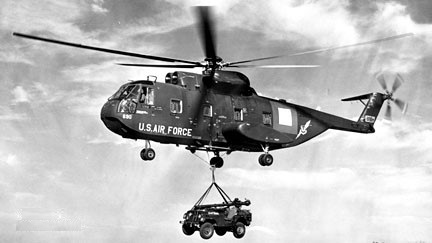
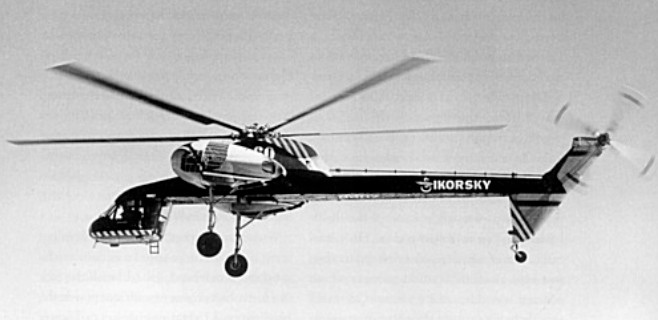
Before the S-60 was destroyed in April 1961, Sikorsky had already begun the S-64 Skycrane project. Sikorsky Aircraft produced the prototype (N325Y) of its S 64 Skycrane and this flew for the first time on 9 May 1962. The S 64 is a flying crane helicopter consisting of a basic skeletal to which can be attached large freight containers or people pods for short haul transportation. The S-64 retained the same basic rotor system as the S-60, and had a pair of 4050shp JFTD-12A shaft turbines mounted side-by-side on top of the fuselage boom, and had no fin area below the boom, and a 42,000-lb gross-weight. Ground clearance beneath this boom is 2.84m and the main wheel track is 6.02m, hence loads of considerable size can be fitted underneath the S-64. The six-blade, fully articulated main rotor and four-blade tail rotor. Steel driveshafts. Main gearbox below main rotor, intermediate gearbox at base of tail pylon. Tail gearbox at top of pylon. Main gearbox rated at 4,922kW on CH-54A. Two fuel tanks in fuselage, forward and aft of transmission, each with capacity of 1,664 litres. Total standard fuel capacity 3,328 litres. Provision for auxiliary fuel tank of 1,664 litres capacity, raising total fuel capacity to 4,992 litres.

Undercarriage is non-retractable tricycle type, with single wheel on each unit of CH-54A/S-64E, twin wheels on main units of S-64F. CH-54A/S-64E mainwheel tyres size 38.45 x 12.50-16, pressure 6.55 bars. S-64F mainwheel tyres size 25.65 x 8.50-10, pressure 6.90 bars. Nosewheels and tyres of all versions size 25.65 x 8.50-10, pressure 6.90 bars.

The pilot and co-pilot sit side by side at front of cabin. Aft-facing seat for third pilot at rear of cabin, with flying controls. The occupant of this third seat is able to take over control of the aircraft during loading and unloading. Two additional jump seats available in cabin.

A feature of this aircraft is that the landing gear can be lengthened and shortened hydraulically, so that the helicopter can ‘crouch’ on to its load, raise it off the ground and then, if desired, taxi with it to a more suitable take-off point. Two additional prototypes, N305Y and N306Y, were completed for evaluation by the Federal German forces. Re-registered D-9510 (early 1963) and D-9511, they were operated under the aegis of the former Weser Flugzeugbau.

Sikorsky S-64 Article

After evaluation of the original prototype at Fort Benning, Georgia, the U.S. Army placed a pre-series order in June 1963 for six S-64A’s with the military designation YCH-54A and allotted the serial numbers 64-14202 through -14207. 64-4256 probably is a cancelled order. These aircraft were delivered to the Fort Benning-based 478th Aviation Company beginning in June 1964. Five of these were operated with the 478th Aviation Company supporting the U.S. Army’s 1st Cavalry Division in Vietnam.

Sikorsky CH-54 (US Army / KYNG)

This unit took four of the machines to Vietnam for a thorough field evaluation, upon the successful conclusion of which the Army placed orders for fifty-four CH-54A production aircraft, 66-18408-18413, 67-18414-18431, and 68-18432-18459. In 1965, a CH-54 at Ft. Bragg, N.C. established a world record lift of 90 passengers. Eighteen more CH-54A’s were ordered in 1966, and total orders stood at about sixty in 1968, later aircraft having uprated -4A engines of 4620shp each.

A military version, designated CH 54A, gained three international height records in 1965; those involving a 2,000 kg payload to a height of 28,743 ft (8,761 m) and a 1,000 kg payload to a height of 29,340 ft (8,943 m), were unbeaten in mid 1972.

Loads which can be lifted by the S-64A/CH-54A include trucks or palletised containers holding a field hospital unit, 48 casualty litters, 67 troops or 10382kg of cargo; one CH-54A in Vietnam has successfully lifted 87 troops.

Meanwhile a Sikorsky-owned S-64A and the sixth aircraft of the U.S. Army’s original order have been used to further the acceptance of the type for the civil market. During 1967, N325Y carried out tests on behalf of the Los Angeles Airport Department with the 23-seat Budd XB-1 Skylounge pod, designed to speed connection between the city’s airports and the city centre. The S-64’s cargo pod is a box 8.36 x 2.69 x 1.98m.

The larger CH-54B version with twin 4800shp T73-P-700 turbines and 2300kg more lifting power, went into service with the US Army in 1969; eventual thirty-seven CH-54Bs (serials 69-18462 through -18498). The -B model Tarhe differed from the earlier -A primarily in having more powerful engines, high-lift rotor blades, a modified main rotor gearbox and rotor head, a payload capacity increased by some 5000 pounds, and dual-wheeled main landing gear.

Sikorsky CH-54B 69-18464

Thirty-seven CH-54B were built; 69-18460-18484, 70-18485-18490, and 71-18491/18498. Twenty-two universal carrier pods, 27’5″ long and 8’10” wide, used by these aircraft were serialled separately (68-18578-18599).

Also under development was the S-64B/CH-54B, an enlarged three-turbine version designed to lift a 16329kg payload.

In addition to its use by civil operators on a variety of duties, 80 were ordered as CH 54A/B Tarhes by the US Army. The US Army bought 97 with deliveries between June, 1964 and 1972, and in Vietnam was used to retrieve 380 downed aircraft, saving $210 million. The Tarhe served in a heavy-lift role in Vietnam, with the 478th and the 291st Aviation Companies. The Tarhe can carry sling loads, vehicles or other items on a special platform, or a detachable military pod for 45 troops, 24 stretchers, or 20,000 lb (9,072 kg) of freight. The last one was retired in 1993.

On several occasions, CH-54s even served as makeshift bombers; they were among the few American aircraft in Southeast Asia that were capable of carrying, and dropping, the 10000 pound ‘daisy-cutter’ bombs used to create instant helicopter landing zones by flattening all vegetation (and most structures) within an area several hundred yards in diameter.

On 18 April 1969, two commercial Skycranes were delivered to Rowan Drilling Company Inc of Houston, Texas, for operation in support of oil exploration and drilling operations in Alaska.

During the late 1960s and early 1970s the Tarhe was gradually superseded in front-line service by the CH-47B and -C Chinook, and all surviving CH-54s were subsequently transferred to the Army Reserve and National Guard. Withdrawal from frontline units did not signal the Tarhe’s immediate demise, however, for as of early 1986 seventy-one -A model machines are shared among Georgia, Kansas, Mississippi, Nevada and Pennsylvania, while the twenty-six surviving -Bs serve in Alaska, Alabama and Connecticut.

When repairs were needed to the 11000kg statue atop Washington’s Capitol dome, it was lifted away and then returned by a SkyCrane.

Only 97 Tarhes were built for the United States Army between 1964 and 1972. Seven Army National Guard units were still equipped with it by the beginning of the 1990s. Progressively replaced by the CH-47D, the last unit to give up its CH-54s was D Company, 113th Aviation, of the Nevada Army National Guard, based in Reno, in 1993.

Sikorsky also offered the Skycrane to commercial operators. The models S-64E (civil version of the CH-54A) and S-64F (derived from the CH-54B) were produced, while plans for a triple turbine version were not realized.

In January 1972 Erickson Air-Crane Company of Marysville, California, purchased the first S-64E, for logging and other heavylift tasks. Erickson Air-Crane Co LLC purchased the Type Certificate and production rights for S-64 from Sikorsky on 1 February 1992, and can construct new examples to improved Erickson S-64 Aircrane standard. Erickson also developed modifications for ex-U.S. Army CH-54s to bring them up to Aircrane standard.

Versions:

S-64A
Under this designation the first of three prototypes flew for the first time 9 May 1962 and was used by the US Army at Fort Benning, Georgia, for testing and demonstration. The second and third prototypes were evaluated by the German armed forces.

CH-54A
Six ordered by US Army in 1963 to investigate the heavylift concept, with emphasis on increasing mobility in the battlefield. Delivery of five CH-54As (originally YCH-54As) to the US Army took place in late 1964 and early 1965. A sixth CH-54A remained at Stratford, with a company-owned S-64, for a programme leading toward a restricted FAA certification, which was awarded 30 July 1965. Further US Army orders followed.

CH-54B
On 4 November 1968 Sikorsky announced that it had received a US Army contract to increase the payload capacity of the CH-54 from 10 to 12.5 tons. The contract called for a number of design improvements to the engine, gearbox, rotor head and structure; altitude performance and hot weather operating capability were also to be improved. Two of the improved flying cranes, designated CH-54B, were accepted by the US Army during 1969.
The original JFTD12-4A engines were replaced by two Pratt & Whitney JFTD12-5As, each rated at 3,579kW, and a gearbox capable of receiving 5,891kW from the two engines was introduced. Single-engine performance was increased, since the new gearbox receives 3,579kW from one engine, compared with 3,020kW on the CH-54A.
A new rotor system was also introduced, utilising a high-lift rotor blade with a chord some 0.064m greater than that of the blades used formerly.
Other changes included the provision of twin wheels on the main landing gear, an improved automatic flight control system and some general structural strengthening throughout the aircraft. Gross weight was increased from 19,050kg to 21,318kg.

S-64E
FAA certification of the improved S-64E for civil use was announced in 1969, for the transportation of external cargo weighing up to 9,072kg.

S-64F
Designation of a commercial version of the S-64.

Specifications:

S-64A / CH-54A Tarhe
Engines: 2 x Pratt & Whitney JFTD12-4A (military T73-P-1), 3356kW / 4500 shp
Rotor dia: 72 ft (21.95m)
Length: 70 ft 3 in (21.4m)
Height: 18 ft 7 in (5.67 m)
Empty weight: 8724 kg
Max wt: 42,000 lb (19,050 kg)
External load: 9400 kg
Max. speed: 127 mph (204 km/h) at sea level
Crew: 2
Payload: 90 pax or 17,500 lb (7937kg) in detachable pod
Payload: 22,400 lb (10,160kg) under-slung
Max speed: 204 kph
Cruise: 169 km/h
Service Ceiling: 2475 m
Max. range: 253 miles (407 km)

S-64E / CH-54A
Engines: 2 x Pratt & Whitney JFTD12-4A (military T73-P-1) turboshaft, 3,356kW / 4,500 hp for take-off / max continuous 2,983kW.
Rotor diameter 72 ft
Main rotor 6 blades
Length: 70 ft 3 in
Gross weight 42,000lbs
Fuel capacity standard: 3,328 litres
Auxiliary fuel capacity: 1,664 litres
Max cruise speed 110kts
Ceiling: 13,000 ft
Range: 253 miles

S-64F / CH-54B
Engines: 2 x Pratt & Whitney JFTD12-5A (military T73-700) turboshaft, 3579kW / 4800 hp for take-off / max continuous 3,303.5kW.
Main rotor diameter: 21.95m
Fuselage length: 21.41m
Height: 5.67m
Max take-off weight: 21318kg / 47,000 lb
Empty weight: 8981kg / 19607 lb
Equipped useful load: 27,371 lb
Payload max fuel: 18,225 lb
Max sling load: 25,000 lb
Fuel capacity standard: 3,328 litres
Auxiliary fuel capacity: 1,664 litres
Disc loading: 11.5 lb/sq.ft
Pwr loading: 6 lb/hp
Service ceiling: 10,000 ft
Max cruise: 100 kt
Max range cruise: 100 kt
Cruising speed: 169km/h
Range with max fuel: 370km / 1.9 hr
ROC: 1300 fpm
HIGE: 7200 ft
HOGE: 2100 ft
Payload: 9000kg in a standard container
Seats: 4

Sikorsky S-61 / HSS-2 / H-3 Sea King / Westland Sea King / Commando

Westland Sea King AEW

In December 1957, the US Navy gave the go-ahead to a new programme for a very high performance helicopter with advanced technology, to replace the S-58 / HSS-1 and to combine the hunter/killer functions in one airframe. Sikorsky was approached again and submitted a project for a big twin turbine aircraft with a boat-type hull and retractable landing gear for amphibious operations. The aircraft had all-weather capability, a good choice of weapons loads and four hours’ endurance. The project was designated S-61.

Sikorsky S-61 / Westland Sea King / Commando Article

The main rotor of the medium-tonnage S-61 was of the articulated type, with five interchangeable blades which could be folded automatically by hydraulic actuators. The tail boom could also be folded for stowage on board ship. The all-metal, semi-monocoque single-step boat-type hull was amphibious, the twin mainwheels retracting into two sponsons.

The Sikorsky HSS-2 was the subject of a US Navy contract awarded on 23 September 1957. This called for an all-weather anti-submarine helicopter with ‘dunking sonar’ equipment and able to carry up to 381kg of offensive weapons. The S-61 design had watertight, hull-retractable landing gear in the stabilising floats, and was powered by two General Electric T58 turboshaft engines driving a five-bladed main rotor.

Design Features: Five-blade main and tail rotors. All-metal fully articulated oil-lubricated main rotor. Flanged cuffs on blades bolted to matching flanges on all-steel rotor head. Main rotor blades are interchangeable and are provided with an automatic powered folding system. Rotor brake standard. All-metal tail rotor. Non-folding blades on S-61L and S-61N. Fixed stabiliser on starboard side of tail section. A rotor brake is standard.

The amphibious landing gear consists of two twin-wheel main units, which are retracted rearward hydraulically into stabilising floats, and non-retractable tailwheel. Oleo-pneumatic shock-absorbers. Goodyear mainwheels and tubeless tyres size 6.50 x 10 type III, pressure 4.92kg/csq.m. Goodyear tailwheel and tyre size 6.00 x 6. Goodyear hydraulic disc brakes. Boat hull and pop-out flotation bags in stabilising floats permit emergency operation from water. Non-retractable landing gear on S-61L.

Pilot and co-pilot on flight deck, two sonar operators in main cabin. Dual controls. Crew entry door at rear of flight deck on port side. Large loading door at rear of cabin on starboard side. Crew of three: pilot, co-pilot and flight attendant on S-61L. Main cabin accommodates up to 30 passengers. Standard arrangement has eight single seats and one double seat on port side of cabin, seven double seats on starboard side and one double seat at rear. Rear seat may be replaced by a toilet.

Primary and auxiliary hydraulic systems, pressure 105kg/sq.cm, for flying controls. Utility hydraulic system, pressure 210kg/sq.cm, for landing gear, winches and blade folding. Pneumatic system, pressure 210kg/sq.cm, for blow-down emergency landing gear extension. Electrical system includes one 300A DC generator, two 20kVA 115A AC generators and 24V 22A battery. APU optional.

AlliedSignal AQS-13 sonar with 180 degree search beam width. Hamilton Standard autostabilisation equipment. Automatic transition into hover. Sonar coupler holds altitude automatically in conjunction with Ryan APN-130 Doppler radar and radar altimeter. Provision for 272kg capacity rescue hoist and 3,630kg capacity automatic touchdown-release low-response cargo sling for external loads.

Provision for 381kg of weapons, including homing torpedoes.

The prototype HSS-2 flew on 11 March 1959 and ten pre-production YHSS-2 trials aircraft (147137 to 147146) followed completing service trials in 1960. During flight testing, it proved its ability to hover over one point for more than three hours continuously, and to complete patrols of up to four hours with large fuel reserves. Redesignated as YSH-34A in 1962.

The US Navy ordered the first ten S-61B/HSS-2 for delivery starting in September 1961 and the Sea King began to reach fleet squadrons in September 1961. The helicopters were later redesignated SH-3A Sea King. One of the first production models set up a world speed record of 339 km/h on 5 February 1962. The HSS-2 held all four of the other major international helicopter speed records for distances up to 620 miles.

HSS-2

In the SH-3A version 255 were produced, while eight more (150610 to 150617), ordered as HSS-2Z and subsequently re-designated VH-3A and -3C, were assigned to the special American Presidential Department for personnel transport and evacuation services in case of emergency. First flying on 18 September 1962 eight modifications were produced (147141, and 150610-150617) and 11 new production (159350-159360).

The YSH-3A Sea King and SH-3A were USN anti-sub warfare helicopters. About 250 were built, including 148038, 152104/152139, and 153532/153537, of which one was converted with a modified fuselage to S-61F, three as CH-3B, and three to the USAF as NSH-3A (62-12571/12573).

One set a world helicopter speed record of 192.9mph on 17 May 1961, piloted by P L Sullivan and B W Witherspoon. A highly modified SH-3A set a world helicopter speed record of 210.64mph on 5 February 1962 piloted by R Grafton.

Nine of the SH-3As were transformed into RH-3As with minesweeping equipment, first flying on 2 February 1965, and three were used by the USAF for missile site support and drone recovery. They were the only H-3 to have cargo doors on both sides. A small number of RH-3A minesweeper variants entered service in 1964. Some were to became UH-3A drone targets. Repowered RH-3A were designated RH-3D.

Another 12 SH-3As were converted into the HH-3A for battlefield rescue work, and were fitted with two Emerson TAT-102 turrets mounted at the rear of the two spontoons, and an in-flight refuelling probe.

The H-3 designation was applied to various versions of the S-61 basic design, including S-61B, -61D, -61F, and -61R.

The HH 3E of the USAF Aerospace Rescue and Recovery Service has an inflight refuelling probe, hoist and much special role gear, and has also been developed into the radar equipped HH 3F Pelican advanced search and-rescue helicopter for the US Coast Guard.

In April 1962, the USAF leased HSS-2 / CH-3B (62-12574 to 62-12576), transformed into 27-seat transport aircraft for services linking the Texas Towers radar installations. Another three S-61As upgraded to CH-3B were purchased for this purpose (62-12571 to 62-12573). One later transferred to the USN. Until 1990, the Library of the USAF Museum erroneously filed details of these aircraft under the H-38 designation.

Sixteen S-61A-4s with 31 seats were acquired by the Royal Malaysian Air Force (S-61A-4 Nuri) and nine by the Danish Air Force for rescue work. Danish deliveries were made from December 1964 to May 1965. One went to a civil operator. A total of 38 S-61A were built.

A 1965 S-61F experimental version of the S-61 to test high speeds reached 390 km/h.

From 1966, the anti-sub SH-3A was superseded by the SH-3D, which had a 1044kW / 1419shp T58-GE-10 turbine replacing the original 932kW T58-GE-8Bs, and new electronics. Seventy-two were built; prototype 152139, 152690/152713, 154100/154123, 156483/156506, 158724/158725, 158874/158875, 159026/159029, 159053/159056, and 161207/161212. In addition, several SH-3As were converted to this standard (148998, 151544, 152139, and 153532/153537). VH-3D referred to a conversion.

The first SH-3D delivered in June 1966 was one of six ordered by the Spanish Navy. This was followed by another four for the Brazilian Navy and 73 for the US Navy, and ordered by Argentina.

SH-3D

The 105 SH-3G were USN SH-3A and -3B converted to utility configuration. They were further modified as SH-3H with new anti-sub warfare equipment fitted and UH-3H.

Two SH-3Gs were converted to YSH-3J as prototypes for the LAMPS III program.

The essentially similar CH-124, assembled by United Aircraft of Canada, was supplied to the Canadian navy. The Royal Canadian Navy was the first export customer, ordering 41 of the type. The Royal Norwegian air force acquired S-61A helicopters without ASW equipment for rescue duties, and the Royal Malaysian air force acquired S-61A-4 Nuri helicopters equipped to carry 31 troops or operate in the SAR role.

One hundred and sixty-seven HSS-2, HSS-2A, SH-3D. HSS-2Bs (SH-3H) and a further 18 SAR-configured S-61As were built under licence by Mitsubishi, in a programme which was completed in 1990.

The SH-3H was the standard version in service with the US Navy, with approximately 150 earlier aircraft modified to this standard. Supplemented by small numbers of the surviving SH-3G utility version, which has had all the SH-3H’s anti-submarine equipment removed, SH-3Hs serve regularly on board the Navy’s carriers and at shore bases, but were replaced by the SH-60 Seahawk and Ocean Hawk. Eight of the SH-3s supplied to Spain were modified to SH-3H standard, and three of these were equipped with a Thorn-EMI Searchwater radar in an external inflatable radome (similar to that fitted to Royal Navy Sea King AEW.Mk 3s) for shipboard airborne early warning duties.

Acquired originally for re-supply of its radar stations, the US Air Force CH-3B was essentially a de-navalised SH-3, but the CH-3C that was ordered in November 1962 introduced a number of major changes, including a rear loading ramp.

CH-3C

Originally conceived as XHR3S-1 and allocated the company designation S-61R, the prototype flew on 17 June 1963 and the first CH-3C delivery was made on 30 December 1963. The small flotation sponsons were replaced by larger sponsons and the tail wheel was replaced by a retractable nose wheel. Only one S-61R was built for civilian use and seventy-five CH-3C models were built for the USAF (62-12561/12570, -12577/12582, 63-9676/9691, 64-14221/14237, 65-5690/5700, -12511, and -12777/1280). The R model has an 80 hp auxiliary power unit. An engine change from 969kW T58-GE-1s to 1119kW T58-GE-5S produced the CH-3E in February 1966. Most were later converted to CH-3E or HH-3E standards.

Sikorsky CH-3C 1493

One CH-3C (62-12581) was temporarily used to test de-icing equipment as CH-3C.

Some were later converted to HH-3E standard for the USAF Aerospace Rescue and Recovery Service, being provided with armour, self-sealing fuel tanks, retractable inflight-refuelling probe, rescue hoist and 12.7mm machine-guns for defensive purposes; this was the ‘Jolly Green Giant’ as used in Vietnam. These aircraft have all been replaced by the HH-60. The US Coast Guard operated the HH-3F Pelican, which had advanced electronic equipment for SAR duties, but lacked the self-sealing tanks, armour and armament of the HH-3E. Ordered in August 1965, the US Coast Guard a special version gave all-weather capability, which could safely land on water. The Pelican was virtually identical to the HH-3E, apart from the lack of protection, armament and other military equipment. It had an AN/APN-195 search radar on the port side of the nose. Forty were operated; 1430/1438, 1467/1497 plus 12 USN (158847/158858). These gave way to the HH-60J Jayhawk.

Sikorsky HH-3F 1493

A heavylift version of this helicopter, nicknamed the ‘Payloader’, carried cargoes as heavy as 4990kg.
The SH-3 has been replaced by aboard USN carriers by the SH-60F Sea Hawk.

A total of 210 HSS-2 were built (148033 to 148052, 148964 to 149012, 149679 to 149738, 149893 to 149934, 150618 to 150620, and 151522 to 151557) powered by two T58-GE-8 engines. Production continued as SH-3A and ultimately 245 were built.

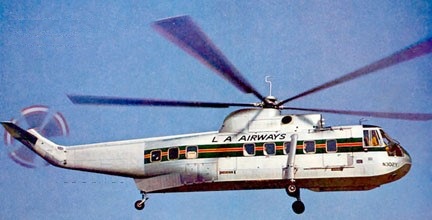
Civil versions for passenger operations were developed initially as the non-amphibious S-61L which, with a lengthened fuselage to seat up to 30 passengers, was first flown on 6 December 1960 and was FAA-approved on 2 November 1961. S-61Ls entered service with Los Angeles Airways on 1 March 1962. The S-61L is a landplane model, although its hull is sealed against the possibility of making an emergency landing on water, and all undercarriage units are non-retracting. It seats 28 passengers in the standard airline seating layout and carries a flight crew of 3.

Sikorsky S-61L N302Y

Three S 61Ls operated by Los Angeles Airways had each exceeded 10,000 flight hours by February 1968.

Three S 61L was followed by the essentially similar S-61N that was, however, an amphibious version with a sealed hull and stabilising floats that housed retractable landing gear; it was first flown on 7 August 1962 and is still in widespread civil use. The type received FAA certification – the first for a twin-turbine commercial helicopter – in November 1961 and since October 1964 has been cleared for all-weather operation. Production examples have 1500shp CT58-140 shaft turbines.

S-61N

Customers up to January 1968 for the S-61N have been British European Airways (four); Greenlandair (four); Pakistan International and San Francisco & Oakland (three each); Helibuss of Norway (two); and Ansett/A.N.A., Brunei Shell Petroleum, the Canadian Dept. of Transport, Elivie of Italy, Japan Air Lines, KLM, Nitto Airways and Petroleum Helicopters Inc. (one each).

BEA used a sole S-61N on the 35 mile route between Land’s End and the Scilly Isles.

BEA S-61N

The S-61N is the civil version of the military S-61C, and is some four foot longer. The sole example was used by Grumman Corp for many years in support of flight operations from Long Island.

The S-61R differs from the original S-61 in that it has a more boat-type hull, modified to take a rear loading ramp, while the two sponsons have been replaced by two stub wings set farther back, into which the rear members of the tricycle landing gear retract.

The prototype was built by the company as a private venture and flown with a civil registration on 17 June 1963, almost one month ahead of schedule. However, the USAF had already placed an order with Sikorsky in February of that year for 22 aircraft, designated CH-3C, and they began to receive the first helicopters at the end of 1963. Subsequent orders brought the total number for the USAF to 133.

S-61R

The CH-3C was used in the Vietnam War for rescuing pilots who had been shot down and came to be nicknamed the “Jolly Green Giant”. It was given more powerful T58-GE-5 turbines from February 1965 and redesignated CH-3E. The uprated “Green Giant” could carry 26 troops or 15 wounded, or vehicles of equivalent weight, and could also be armed with two Emerson turrets on the leading edges of the two stub wings.

Forty-two CH-3Es were built (66-13291/13296, 67-14702/14725, and 69-5798/5812), in addition to which 41 CH-3Cs were modified to this standard.

Sikorsky CH-3E ex-CH-3C 63-9676

The USAF also asked for specific modifications to be made to this helicopter to meet the demands of the Vietnam War: application of armour; use of supplementary fuel tanks for extended flights; self-sealing internal fuel tanks and a telescopic in-flight refuelling probe. Two of the first aircraft of the 50 to be built in the HH-3E rescue version became famous in 1967 by flying non-stop from New York to Paris (for the Air Show), covering the 6870km journey with nine refuellings by airtankers. Eleven were converted from CH-3E (66-13284/13290, and 68-8282), plus several CH-3Cs.

The CH-3E could seat up to 30 troops or carry 2270kg of cargo.

In 1975 CH/HH-3Es became the first helicopters in the US Air National Guard. Variants of Sikorsky’s S-70 have replaced S-61Rs in US service.

S-61 production by Sikorsky came to an end after two decades on 19 June 1980 and military S-61s served in 30 countries, plus with the US Air Force, Navy, Marine Corps and Coast Guard. Sikorsky built 794 S-61s between 1959 and 1980.

Orlando Helicopters provided extensive spares support for the S-61 and is investigating ways to re-engine existing aircraft to run on alternative petrol, propane and alcohol fuels.

Carson Helicopters have been modifying various versions of the H-3 and HH-3, as S-61A models. This involves the fitting of composite blades.

In response to a Japanese naval specification, Mitsubishi obtained a license to produce the S-61; three were purchased directly from Sikorsky and by February 1972, 43 locally-produced aircraft had been delivered. The first models were assembled from US-built fuselages, rotors, and other components with Mistubishi subsequrntly producing more parts. Procurement in the FY1987 budget amounting to 17 of the HSS-2B variant. HSS-2 deliveries from the Japanese production line began in 1964, and 138 had been completed by mid-1985, some with Marte anti-ship missile armament.

Since 1967 Agusta has been building SH-3Ds under licence in Italy as the Agusta-Sikorsky ASH-3D Silver, following an Italian naval order for an ASW helicopter to replace the old Sikorsky SH-34. An initial batch of 24 was built for the Italian Navy and 20 for the Iranian Navy (three in the VIP version). The Italian SH-3D is identical to the American model, apart from the installation of a Teledyne Doppler radar and a search radar on the left side of the nose. Some 105 ASH-3As with ASW equipment removed were redesignated SH-3G for utility duties, while further conversions which have been made since 1971 are of the SH-3H version, with updated ASW and electronic surveillance equipment.

The only foreign license-holder for the S-61R / CH-3 / HH-3 was Agusta, who began producing it in 1974. The 22 aircraft built by Agusta were all delivered to the Italian Air Force as replacements for the amphibious Grumman Albatross used for search and rescue missions at sea.

Agusta 1974 production was the HH-3F (S-61R). Production of the HH-3F Combat SAR version lasted into mid-1990s.

When production of the AS-61 and ASH-3D, ASH-3TS (Transporto Special, a VIP version) and ASH-3H ceased, Agusta claimed it could re-open the line in 36 months. The Italian firm did recommence building AS-61R (HH-3F) search and rescue helicopters to meet an order for two from the national civil protection service and 13 for the air force. These have upgraded radar, LORAN, FLIR and navigation systems, modifications that were to be retrofitted to the air force’s existing 19 AS-61Rs. Agusta is also the exclusive overhaul and repair agent for Europe and the Mediterranean.

Agusta continued limited production of SH-3 helicopters under licence from Sikorsky in 1987. The ASH-3D/TS is a VIP transport variant, while the naval model is the ASH-3H, which may be used in the ASW/ASV, electronic warfare, SAR, and tactical transport roles. An ASH-3H was to be used to test the British Aerospace/Bendix Helras sonar equipment for the forthcoming EH.101.

Argentina is unique in that it operates both Sikorsky and Agusta built examples.

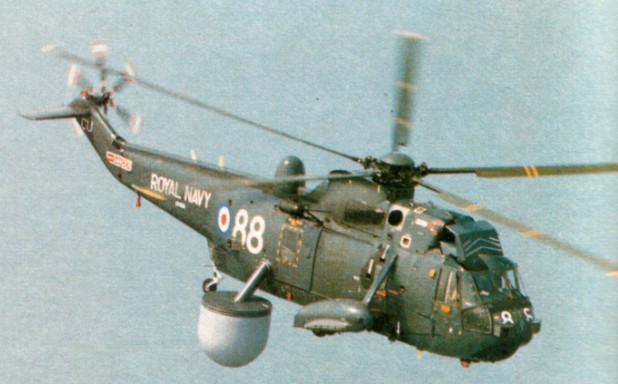
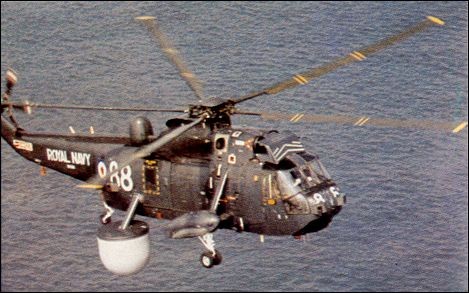
In Britian, the Royal Navy also chose the S-61 to replace its Wessex. In 1959 Westland acquired the license to build the Sikorsky S-61B, to replace the Wessex in the antisubmarine role. The licence agreement allowed Westland to use the airframe and rotor system of the Sikorsky SH-3 Sea King as the basis for a new ASW helicopter for the Royal Navy. The Royal Navy specification called for a British powerplant with different characteristics from the original one, different electronics and a wide range of mission capabilities. Westland adopted a pair of Rolls-Royce Bristol Gnome turbines for their version of the Sea King, with fully computerized controls and largely British-made ASW equipment. The resultant helicopter is readily identifiable by the dorsal radome of the all-weather search radar. Other avionics systems include Plessey dipping sonar, Marconi Doppler navigation radar and Sperry & New-mark instrumentation.

Following test and evaluation of prototype and pre-production aircraft assembled from Sikorsky-built components, the first British-built HAS Mk.1 production Sea King flew on 7 May 1969 and the first squadrons were formed the following August. At that time, the Sea King HAS.Mk 1 was similar to the Sikorsky SH 3D Sea King, but powerplant comprised two Rolls-Royce Gnome H.1400 turboshaft engines. More significantly, Westland had adapted the large cabin as a tactical compartment for ASW operations, this meaning that the British Sea King was able to operate as an independent unit in an ASW role.

Royal Navy HAS.1 Sea King

The Sea King is not a truly amphibious vehicle, in that any length of time spent in water would irrevocably damage some items of equipment on the hull. It is therefore only designed to land on water in an emergency, the boat-type hull being guaranteed watertight for 15 minutes. The two lateral sponsons contain flotation bags to improve buoyancy.

Westland delivered 56 in 1969 72. The HAS.Mk 1 machines were later modified to Sea King HAS.Mk 2 standard with more powerful Rolls Royce Gnome engines improved equipment, 21 Sea King HAS.Mk 2 helicopters also being built new.

Westland Sea King HAS Mk.2 of 826 Sqn, HMS Tiger

The Sea King HAS.Mk 3 is the RAF search and rescue model with very complete equipment and versatility (SAR models carry up to 22 rescues including stretcher casualties).

The Sea King HC.Mk.4 is the ver¬sion of the Command for the Royal Navy (used for Royal Marine assault transport) with the shipboard features (such as folding blades and tail) but simple fixed landing gear and fitted for 27 troops or 6, 000 lb (2722 kg) of cargo. The Sea King HAS.Mk.5 was a RN ASW model with dramatically up rated avionics, all Sea King HAS.Mk.2s being converted to this standard; 17 were built new and after the Falklands nine more were ordered, The Royal Navy received a small number of Sea King AEW helicopters in response to a need appreciated in the Falklands war of 1982. This model had Thorn EMI Searchwater radar with its antenna in an inflated and swivelling radome pro¬jecting from the right side of the fusel¬age. Key items in the Sea King HAS.Mk.5’s avionics suite are the MEL Sea Searcher surveillance radar with a radome of considerably different shape and size, provision for the launch of passive sonobuoys, LAPADS (Lightweight Acoustic Processing and Display System) by Marconi for the quicker and more precise handling of acoustic data, and a better display sys¬tem. To permit the installation of the extra equipment, the cabin was extended aft by 1.83 m (6 ft), Westland have exported ASW and SAR Sea Kings (including the upgraded Sea King Mk.50 with Bendix sonar for Au¬stralia) to eight countries.

The first of two Westland Sea King Mk.50A for the Australian Navy was shipped to Australia in February 1983 and officially delivered to the RAN on 26 January.

First Australian Navy Sea King Mk.50A

The Royal Navy has ordered seven examples of an advanced version of the Sea King, the HAS.6, for service from 1989 in the ASW/ASV role. The HAS.6 is powered by uprated 1092kW Gnome H.1400-1T engines, and has advanced-design composite main and tail rotors, an uprated gearbox, improved radar, and Sea Eagle ASM armament. The HAS.6 will join the current fleet of HAS.5s, which have MEL Sea Searcher radar in an enlarged dorsal radome, Tans G coupled to Decca 71 Doppler, and GEC Avionics Lapads acoustic processing equipment for both sonar and dunking sonar. Earlier Sea King HAS.2s have been upgraded to HAS.5 standard.

Essentially the same as the HAS.6 are the 20 Sea King Mk.42Bs ordered for the Indian Navy, which will also be equipped with Sea Eagles and a GEC Avionics AQS-902 acoustic processing system. The Indian Navy has received the first of six Mk.42C utility variants of the advanced Sea King, with nose mounted Bendix RDR-1400C radar.

An AEW Sea King, equipped with a Thorn-EMI Searchwater maritime surveillance radar in a retractable radome, has been operational since November 1984. The Searchwater radar gives a 360 degree scan with a multiple target track-while-scan capability. Ten Sea King AEW.2s were being acquired, all converted HAS.2 airframes. Fitted with Thorn-EMI Searchwater surveillance radars during the Falklands war, some have been designated AEW.2As. The AEW7 being based around the Searchwater 2000 radar.

Sea King HAEW Mk.2

Westland has built over 200 Sea Kings, including the Sea King Mk.1, 2 and 5 for the Royal Navy, 22 for the German Navy (Mk.41), 11 for the Norwegian Air Force (Mk.43) and 12 for the Australian Navy (Mk.50).

Westland also produces a tactical transport version of the Sea King, known as the Commando, which first flew on 12 September 1973. It has the same power plant as the Sea King, a fixed landing gear, can carry up to 28 troops or 2,720kg of cargo, and may be armed for assault duties. The Commando Mk 1 is also known as the Sea King Mk 70 and is basically a stripped-out Sea King HAS.Mk 1.
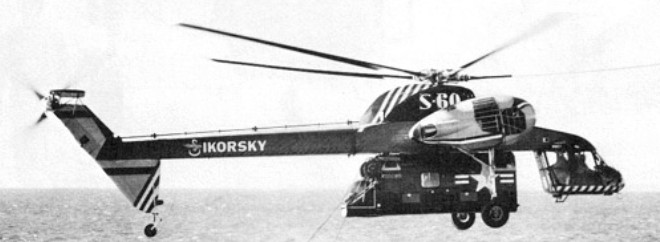
Westland flew the first commando Mk 2 on 16 January 1975. No customer has ever specified the Mk 2’s optional underwing hardpoints. Commando Mk 2Bs have extra seats for two flight attendants.

Commando Mk 1 and Mk 2 versions have been supplied to Egypt and Qatar. Qatar’s Mk 3s have Sea King-like undercarriage sponsons. 17 were initially delivered to the Royal Navy and at least another 30 to Egypt and Qatar.

Deliveries for the Sea King and Commando totalled 326 by the end of 1993.

Gallery

Versions:

S-61A
Amphibious transport, generally similar to the US Navy’s SH-3A. Accommodation for 26 troops, 15 litters, cargo, or 12 passengers in VIP configuration. General Electric T58 turboshaft engines standard, but Rolls-Royce Gnome H.1200 offered as alternative.

ASH-3 Sea King

S-61A-4
Export version for Malaysia; first ordered on 26 October 1970, known locally as Nuri.

S-61B
Initial production version with amphibious capability.

S-61D
Export version of SH-3D.

S-61D-4
For Argentine Navy; ordered in 1971.

S-61F
Experimental high-speed version with stub wings and auxiliary turbojets.

S-61L
Non-amphibious commercial version with modified landing gear, rotor head and stabiliser. First flight of prototype 6 December 1960; FAA certification 2 November 1961.

S-61L Mk II
Improved version with more powerful 1,118 kW (1,500 shp) CT58-140-2 turboshaft engines; individual cargo bins; enhanced vibration damping. Accommodation increased to 30 passengers.

S-61N
Similar to S-61L, but with sealed hull and stabilising floats (as on SH-3A) for amphibious operations. First flight 7 August 1962.

S-61N Mk II
Improved version with more powerful CT58-140-2 engines; individual cargo bins; enhanced vibration damping. Accommodation increased to 26 passengers.

S-61R
Development of S-61B; introduced many design changes, including rear loading ramp and new landing gear.

AS-61N1 Silver
Licence-built version of S-61N, with slightly shorter fuselage and greater range, by Agusta in Italy.

AS-61R Pelican
Licence-built multipurpose SAR version by Agusta in Italy.

ASH-3D/TS
Licence-built VIP transport version by Agusta in Italy.

ASH-3D
Licence-built multirole naval version built by Agusta in Italy.

CH-3B
Version of S-61A operated by USAF for missile site support and drone recovery duties.

CH-3C/E
Transport version of S-61R for USAF.

CH-124 / CHSS-2
Anti-submarine helicopter similar to SH-3A, delivered to the Canadian forces in May 1963.

HH-3A
Modified version of SH-3A for Search and Rescue duties, with T58-GE-8F turboshaft engines, two electrically powered minigun turrets, high-speed refuelling and dumping system, rescue hoist, upgraded avionics, external auxiliary fuel tanks and armour installation.

HH-3E
Version of S-61R for US Aerospace rescue and recovery service.

HH-3F
Version of S-61R for US Coast Guard.

RH-3A
Conversion of nine SH-3As for mine countermeasures duty with US Navy.

SH-3A / HSS-2 Sea King
Initial amphibious ASW version for US Navy; powered by 932kW General Electric T58-GE-8B turboshaft engines.

SH-3D Sea King
More powerful ASW development of SH-3A for US Navy, with 1,043kW T58-GE-10 engines and an additional 530 litres of fuel. First delivered in 1966.

SH-3G
US Navy conversion of 105 SH-3As into utility helicopters. Six equipped with minigun pods for SAR missions.

SH-3H
Multipurpose version of SH-3A and SH-3G with two T58-GE-10 turboshafts; later converted for ASW and anti-missile operations, including lightweight sonar, active and passive sonar buoys, magnetic anomaly detection equipment and radar.

UH-3A
Utility version with T58-GE-8B turboshafts.

VH-3A / HSS-2Z
Passenger transport version of SH-3A, used on VIP and emergency evacuation for US President and other key personnel.

VH-3D
Passenger transport version of SH-3D.

Westland Commando
Licence-produced UK version.

Westland Sea King
Licence-produced UK version.

Sea King HAS.Mk 1
Initial ASW version for Royal Navy; since updated to Sea King HAS.Mk 2 by Royal Navy; 56 completed

Sea King HAS.Mk 2
ASW/SAR version for Royal Navy with uprated Gnome H.1400-1 turboshafts; 21 completed

Sea King HAR.Mk 3
SAR version for Royal Air Force with Gnome H.1400-1 turboshafts; 16 delivered in 1979 plus three in 1985; upgraded to

HAR.Mk 3A
Standard through addition of greatly improved avionics, navigation and communications gear

Sea King HC.Mk 4
Version of Commando Mk 2 for Royal Navy; combines folding rotor and tail of Sea King, non-retractable landing gear of Commando and Gnome H.1400-1 turboshafts; last aircraft delivered in 1990, total production 89; some aircraft modified with RWR, missile approach warning system, chaff/flare dispensers, tactical navigation equipment, and NVG cockpit for Gulf War operations

Sea King Mk 4X
Two aircraft, basically as HC.Mk 4; for development use by RAE Famborough

Sea King HAS.Mk 5
Developed ASW/SAR version for Royal Navy with Gnome H. 1400-1 engines and advanced avionics; all Sea King HAS.Mk 2 aircraft upgraded to this standard along with 30 new-build aircraft delivered between 1980 and 1986

Sea King HAS.Mk 6
Substantially improved anti-submarine warfare version for Royal Navy comprising five conversions from Mk 5 standard and 25 new aircraft

Sea King Mk 41
SAR version for Federal German navy with H.1400 turboshafts – 22 built

Sea King Mk 42
ASW version for Indian navy with H.1400 turboshafts – 24 built based on the RN version except for the communications equipment

Sea King Mk 42A
ASW version for Indian navy with H.1400-1 turboshafts

Sea King Mk 42B
Anti-ship version for Indian navy, H 1400-1 turboshafts and equipped to carry Sea Eagle missiles

Sea King Mk 43
SAR version for Norwegian air force with H.1400 turboshafts – 11 built

Sea King Mk 43A
SAR version for Norwegian air force with H. 1400-1 turboshafts

Sea King Mk 45
ASW version for Pakistan navy with H.1400 turboshafts – 6 built

Sea King Mk 47
ASW version with H.1400-1 turboshafts, ordered by Saudi Arabia for Egyptian navy

Sea King Mk 48
SAR version for Belgian air force with H.1400-1 turboshafts – 5 built

Sea King Mk 50
Multi-role version for Royal Australian Navy; developed from Sea King HAS.Mk 1 but with H. 1400-1 turboshafts; two additional but similar aircraft ordered in 1983 were allocated designation Sea King Mk 50A

  • 12 built

Commando Mk 1
Version with H.1400 turboshafts ordered by Saudi Arabia for Egyptian air force

Commando Mk 2
Version with H. 1400-1 turboshafts for Egyptian air force

Commando Mk 2A
Version as Commando Mk 2 for Qatar Emiri air force

Commando Mk 2B
Version as Commando Mk 2 with VIP interiors for Egyptian air force

Commando Mk 2C
Version as Commando Mk 2B for Qatar Emiri air force

Specifications

HSS-2
Engines: 2 x 1250 shp General Electric T-58-GE-8.
Main rotor diameter: 62 ft
Main rotor disc area: 3019 sq.ft
Length: 54 ft 9 in
Width over floats: 15 ft 8 in
Empty weight: 11,194 lb
Normal takeoff weight: 17,768 lb
Fuel capacity: 575 gal
Max speed: 148 mph at SL
Hover ceiling OGE: 6000 ft
Range: 535 mi
Weapon load: 840 lb

S 61L
Engine: 2 x General Electric CT58-140-2 turboshaft, 1,118kW / 1500 shp
Rotor dia: 62 ft 0 in (18.9 m)
Length: 72 ft 7 in (22.12 m)
Height: 17 ft (5.18 m)
Max TO wt: 19,000 lb (8620kg)
Max level speed: 146 mph (235 kph)
Fuel: Forward 796 litres, 757 litres.
Total fuel capacity 1,553 lt
Range: 292 mi
Passenger capacity: 30

S-61N
Engine: 2 x General Electric CT58-110-1 turboshaft, 1000kW
Main rotor diameter: 18.9m
Fuselage length: 18.08m, height: 5.32m, take-off weight: 8618kg, max speed at sea level: 241km/h, ceiling: 3505m, range with max fuel: 443km

S-61N
Engines: 2 x General Electric CT58-140-2, 1,118kW / 1500 shp each
MAUW: 19,000 lb
Empty wt: 12,500 lb
Rotor dia: 62 ft
Disc loading: 6.3 lb/sq.ft
Pwr loading: 7.6 lb/hp
Length: 73 ft
Height: 18.5 ft
Cruise: 120-130 kt
Fuel flow @ cruise: 1050 lbs/hr
Equipped useful load: 6515 lb
Payload max fuel: 2068 lb
Range max fuel/ cruise: 533 nm/ 3.4 hr
Service ceiling: 12,500 ft
Range: 4 hr / 460 nm
Pax cap: 25
ROC: 1300 fpm
HIGE: 8700 ft
HOGE: 3800 ft
Max sling load: 8000 lb
Fuel cap: 2788/4447 lb
Fuel: Forward 796 litres, 757 litres. Total fuel capacity 1,553 lt
Opt fuel: 924 litre

S-61R

YHSS-2
Engines: two General Electric T58-GE-6
Rotor diameter: 62’0″
Length 54’9″
Max speed: 166 mph

H-3 (Model S-61)
Engines: two GE T58-GE-8C/F turboshafts
Main rotor: six-blade
Main rotor diameter: 62’0″
Length: 54’9″
Max speed: 160 mph
Cruise: 133 mph
Range: 625 mi
Ceiling: 10,800′

CH-3C
Engines: 2 x General Electric CT58-GE-1, 1300 shp / 969kW
Main rotor diameter: 18.90m
Fuselage length: 17.45m
Height: 5.51m
Max take-off weight: 9750kg
Max speed: 261km/h
Cruising speed: 232km/h
Hovering ceiling, OGE: 2600m
Range with max fuel: 748km
Payload: 3630kg

HH-3E
Engines: 2 x General Electric CT58-GE-5, 1500 shp each
MTOW: 22,500 lb
Max ldg wt: 19,500 lb
Length: 57 ft 3 in
Rotor dia: 62 ft
Speed: 162 mph
Ceiling: 11,100 ft
Range: 465 miles
Pax cap: 30
Crew: 2

HH 3F

SH-3A Sea King
Engines: 2 x General Electric T58-GE-8B turboshaft, 1,250 shp
Main rotor dia: 62 ft (18.9m)
No of blades: 5
Length: 72 ft 8 in (22.15 m)
Main rotor disc area: 3019 sq.ft. (280.5sq.m)
Gross weight: 20,500 lb (9300 kg)
Cruise speed: 136 mph (219 kph)
Max range: 625 miles (1,005 km)
Crew: 4

SH-3D
Powerplant: two 1,400 shp (1044 kW) General Electric T58 10 turboshafts
Armament: external hard-points for 381 kg (840 lb) / 2 Mk.46 torpedos
Maximum speed 267 km/h (166 mph)
Range max fuel and 10% res 1005 km (625 miles)
Empty weight 5382kg (11,865 lb)
Maximum take off weight 9752 kg (21,500 lb)
Main rotor diameter: 18.9 m (62 ft 0 in)
Fuselage length: 16.69 m (54 ft 9 in)
Height 5.13 m (16 ft 10 in)
Main rotor disc area 280.5sq.m (3,019.1 sq ft)
Max external cargo lift: 9,000 lb
Max altitude: 14,700ft
Maximum gross weight 21,000 lb
Fuel capacity: Forward tank 1,314 lt, centre tank 530 lt, rear tank 1,336 lt. Total capacity 3,180 lt
Oil capacity 26.5 litres.

Agusta Sikorsky SH 3D
Rotor dia: 62 ft 0 in (18.9 m)
Cruise speed: 136 mph (219 km/h)

Westland Sea King (RAAF)
Engines Two Rolls Royce Gnome gas turbines
Length 22.15 m / 72.671 ft
Height 5.13 m / 16.831 ft
Width 18.9 m / 62.008 ft
Weight 9525 kg / 21,000 lb
Speed 230 kph
Range 925 km / 574.768 mi
Crew 4 (2 Pilots, Tactical Coordinator, Air-crewman)
Weapon One 7.62 machine gun

Westland Sea King
Powerplant: two 1,660shp (1238 kW) Rolls Royce Gnome H.1400 1 turboshafts
Cruising speed at max¬imum weight: 208 km/h (129 mph)
Range on standard fuel: 1230 km (764 miles)
Max speed: 132 kt
Empty weight 6201 kg (13 672 lb)
Gross weight: 21,500 lb (9,751 kg)
ROC: 615 m/min
Fuel cap (aux): 3640 lt (910 lt)
No blades: 5
Main rotor diameter 18,9 m (62 ft 0 in)
No of blades: Main – 5, Tail – 6
Fuselage length 17.01 m (55 ft 9.75 in)
Height 5.13 m (16 ft 10 in)
Main rotor disc area 280.5 sq.m (3,019,1 sq ft)
Armament: four Mk 46 torpedoes or Mk.11 depth charges
HIGE: 5600 ft
HOGE: 3500 ft
Service ceiling: 10,000 ft
Crew: 4
Pax: 28

Westland Commando
Fuselage length: 56 ft (17m)

Westland HAS.1

Westland Sea King HAS Mk.5
Engine: 2 x Rolls-Royce Gnome H.1400-1 turboshaft, 1238kW
Main rotor diameter: 18.9m
Length with rotors turning: 22.15m
Height: 4.72m
Max take-off weight: 9525kg
Loaded weight: 6202kg
Cruising speed: 208km/h
Range: 1230km
Armament: 4 x Mk.46 torpedos or 4 x Mk.11 depth charges

Westland HAS.6

Westland HC.4

Westland HAEW Mk.2
Main rotor diameter: 18.90m
Fuselage length: 16.69m
Height: 4.74m
Max take-off weight: 9500kg
Cruising speed: 208km/h
Hovering ceiling, OGE: 2500m
Range with max fuel: 1200km
Duration of patrol: 4-4.5h
Crew: 4

Sikorsky CH 124 Sea King
Engines: 2 x Rolls Royce Gnome H.1400, 1479 shp
Length: 54.757 ft / 16.69 m
Height: 15.912 ft / 4.85 m
Rotor diameter: 62.008 ft / 18.9 m
Max take off weight: 21501.0 lb / 9751.0 kg
Weight empty: 15476.9 lb / 7019.0 kg
Max. speed: 124 kt / 230 km/h
Cruising speed: 114 kt / 211 km/h
Service ceiling: 10007 ft / 3050 m
Maximum range: 880 nm / 1630 km
Range: 880 nm / 1630 km
Range (max. weight): 599 nm / 1110 km
Crew: 2
Payload: 27 Pax / 2720 Kg
Armament: 2720 Kg

SH-3
S-61N
Sikorsky S-61R / CH-3 / HH-3

Sikorsky S-60 Skycrane

In May 1958 Sikorsky began design work on the Model S-60 twin-engined heavy-lift helicopter. The S-60 grew from the S-56/CH-37, using the same piston engines and dynamic components. It was built as a research vehicle to demonstrate the flying crane concept with a thin, strong fuselage, consisting of a central ‘backbone’ which supported the podded engines, main and tail rotor systems, and a nose-mounted crew cabin.

Bulk cargo and passengers were intended to be carried in large rectangular pods that could be attached to the underside of the aircraft’s central spine, whereas vehicles and other out-sized loads were to be sling-hoisted. It was capable of lifting a 5443kg payload beneath the fuselage boom, and the co-pilot could turn his seat to face aft to control loading and unloading.

One S-60 was built for Navy evaluation, first flown on 25 March 1959, the craft was found to be underpowered for its intended roles. The prototype S-60 crashed in April 1961, but by then Sikorsky had begun construction of an enlarged version, with a six-bladed main rotor driven by two 3020kW JFTD-12A turboshaft engines. Designated S-64, the prototype flew on 9 May 1962.

The S-60 Skycrane concept demonstrator, a modification of S-56, was displayed for many years at New England Air Museum (CT), but believed destroyed in a tornado that hit the museum.

Gallery

Sikorsky S-56 / H-37 Mojave / HR2S

Sikorsky originally developed the Model S-56 twin-engined heavy lift helicopter in response to a 1950 Marine Corps requirement for an assault transport able to carry twenty-three fully equipped troops.

A twin-engine solution was chosen, and to save cabin space, it was decided to house the two 1417kW Pratt & Whitney R-2800-50 Double Wasp engines (1566kW R-280054s on late production aircraft) radial engines in outboard nacelles, from which two drive shafts linked up directly with the reduction gear assembly which drove the big five-blade metal rotor. The S-56 was Sikorsky’s first twin-engined helicopter, although the traditional single main rotor layout was retained, this being a 5-blade unit designed to be able to sustain the aircraft in flight with one blade shot away. The 53.80 cu.m cargo bay had a hoist capable of lifting a one tonne load andclamshell nose-opening doors. The main landing gear wheels retracted, but the tailwheel was fixed. The H-37’s tailboom sloped downward toward the tailwheel and ended in a sharply upswept vertical tail unit carrying a four-bladed anti-torque rotor.

Sikorsky S-56 / H-37 Mojave Article

In May 1951 the Navy ordered four XHR2S-1 prototypes (133732 to 133735) for USMC evaluation, and the first of these made its maiden flight on 18 December 1953.

Sikorsky XHR2S-1 Prototype

Fifty-five production HR2S-1 (138418 to 138424, 140314 to 140325, 141603 to 141617, and 145855 to 145875) were built, redesignated as CH-37C in 1962.

In 1954 the Army borrowed one of these preproduction machines, designated it the YH-37, and subjected it to operational and maintenance evaluations before returning it to the Marines. On the basis of the large helicopter’s excellent showing during the Army evaluation, Sikorsky was in late 1954 awarded a contract for nine production H-37A Mojaves. The first of these reached Fort Rucker during the summer of 1956, at about the same time the HR2S-1 naval variant was entering regular Marine squadron service, deliveries to Marine Corps Squadron HMX-1 starting in July 1956. The Army subsequently placed orders for a further 85 H-37As, and all ninety-four aircraft were delivered by June of 1960. US Army H-37A Mojave helicopters went into service, initially with 4th Medium Helicopter Transportation Company, in February 1958.

Sikorsky CH-37A

The ninety-four first production, 54-993 to 1001, 55-610 to 650, 57-1642 to 1661, and 58-983 to 1006, were redesignated as CH-37A in 1962.

For several years the S-56 was the western world’s largest and fastest military helicopter, and held two height-with-payload records from 1956-59. 1959 saw the first overseas H-37 deployment, by the Army to Germany.

Production of the S-56 ended in May 1960, but Sikorsky were engaged until the end of 1962 in converting all but four of the H-37A’s to H-37B (later CH-37B) standard. Improvements in this version included the installation of Lear auto-stabilisation equipment, crash-resistant fuel cells and modified nose doors, and the ability to load and unload while the helicopter was hovering. The Navy and Marine S-56’s became CH-37C’s under the 1962 designation system. Some later production S-56’s had 2100hp R-2800-54 engines.

Two of the 60 HR2S-1’s (141646 and 141647) ordered by the Marine Corps were converted into radar patrol craft (military designation HR2S-1W), with a bulbous dielectric radome and AN/APS-20E search radar under the nose and additional crew members for radar picket duties. Records indicate that the Army also evaluated one of the Navy’s two radar-equipped HR2S-1W airborne early warning (AEW) aircraft. This machine (BuNo 141646) retained the AEW variant’s large chin-mounted radome and AN/APS-20E search radar, and was operated in Army markings and two-tone ‘Arctic’ paint scheme.

Sikorsky HR2S-1W

In June 1963 four CH-37Bs were temporarily deployed to Vietnam to assist in the recovery of downed U.S. aircraft. By the following December the Mojaves had recovered an estimated $7.5 million worth of equipment, most of which was sling-lifted out of enemy-dominated areas virtually inaccessible by any other means. That the CH-37 did not see more extensive service in Vietnam is primarily the result of its replacement in the Army inventory by the turbine-powered Sikorsky CH-54 Tarhe, a machine that weighed slightly less than the CH-37 but which could carry nearly four times as many troops or five times as much cargo.
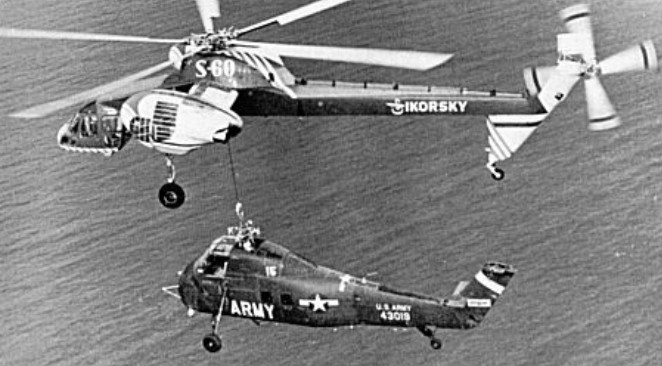
The last CH-37 was withdrawn from Army service in the late 1960s.

The S-56’s rotor and transmission systems were utilised in the development of the abortive Westland Westminster and Sikorsky’s own S-60 and S-64 crane helicopters, but hopes of selling the S-56 on the commercial market were not realised, due mainly to the high operating costs of a piston-engined machine of this size, and a proposal to fit Lycoming T55 gas turbines was not adopted.

A standard S-56 was ordered by Okanagan Helicopters Ltd. of Canada, for delivery in 1956-57.

In all, 150 S-56s were built; a prototype, 55 for the USMC and 94 for the Army.

HR2S-1

Gallery

Engines: Two P&W R-2800-C5 Double Wasp, 2100 hp
Rotor diameter: 21.95 m / 90 ft
Length: 19.76 m
Height: 6.71 m
Weight: Empty: 9386 kg
Max weight: 15000 kg
Speed: Max: 209 km/h
Range: Max 233 km
Service Ceiling: 2652 m

Engines: 2x 1,900 h.p. Pratt & Whitney R-2800-50
Rotors: 5-blade Main; 4-blade tail.
Rotor diameter: 90 ft.
Weight: 28,500 lb.
Max. speed: over 150 m.p.h.
Range: 200 miles at 120 m.p.h.
Seats: 2 crew and 26 passengers.

HR2S-1W
Engine: 2 x Pratt & WHitney R-2800-50, 1415kW
Main rotor diameter: 21.95m
Fuselage length: 20.27m
Height: 6.71m
Max take-off weight: 14060kg
Max speed: 196km/h
Service ceiling: 2438m
Range: 354km

Sikorsky S-43 / JRS / OA-8 / OA-11

S-43H

The S-43 was originally designed for a Pan American requirement for a twin-engined amphibian for secondary Latin American routes.

Essentially a scaled-down version of the S-42, the S-43 employed a single-step hull and a single tail group. The wing rested on a central pylon, supported on either side by N-struts. Wing flaps covering 48% of the span reduced the stall speed to 65 mph.

The S-42 had twin vertical tails. Many of the S-43s had the same arrangement, but some had a single tail. Biggest difference other than size and the S-43’s amphibious capabilities (although some S-43s were built as flying boats) were the powerplants, only two 750hp Pratt & Whitney Hornets on the S-43. The smaller airplane had a gross weight of 19,5001b (8,845kg) and could seat 16 to 24, depending on the legroom. Both transports were certificated in 1935.

After the first flight on 5 June 1935 (piloted by Boris Sergievsky), the first of fourteen S-43s delivered to Pan American (ATC 593) entered Latin American service in April 1936, though most were subsequently turned over to Panair do Brasil and other subsidiary operations.

Sikorsky Aircraft built 53 S-43 twin engined amphibians in the mid 1930s.

In 1938 Pan American used one of its S-43s on survey flights for planned route extensions to Alaska.

Additionally, four were sold Inter-Islan Airways Airways (later renamed Hawaiian, Airlines) in the Hawaiian Islands, four to Aeromaritime – an Air France affiliate, in West Africa, KLM’s Netherlands East Indies associate, and one to DNL-Norwegian Airlines.

Twenty-two amphibians were delivered as S-43s (NC15061-15068, NC16925, NC16928, NC16934, and NC20698), plus one S-43-A and three S-43-Bs (NC16926-16927, and NC16931-16933) with minor detail changes.

Sikorsky S-43-B NX16927

Three delivered in 1937-8 for inter-island operations in the Phillipines were registered as S-43-W’s (ATC 623) with a one-foot fuselage extension and Cyclone engines, plus one as the S-43-WB witthout amphibious landing gear (NC16929-16930, and PK-AFT, PK-AFU). Two S-43s were custom built in 1937 as personal transports, one to Howard Hughes and another to Harold Vanderbuilt.

Sikorsky S-43 Harold Vanderbilt 1938 flying yacht NC16925

One ‘Baby Clipper’ was ordered in 1937 by Howard Hughes especially equipped for a proposed 1938 around the world flight. Registered NR440, it was fitted with larger 900hp Wright GR-1820 Cyclone radials and additional fuel tanks in the cabin. However, it proved too slow and Hughes made his flight in a Lockheed 14.

Hughes had a mishap with his S-43H, modified with twin tails in 1941, flying NC440 into Lake Mead, Nevada, in May 1943 while practicing alightings in preparation for flying the HK4 Hercules flying boat. Raised by a US Navy diving team, the airplane was rebuilt as a S-43W with a single tail, fitted out as a ten-seat executive transport. Manufacturer’s serial number 4327 served only briefly in this capacity and spent most of its time in storage at Hughes Tool Co in Houston TX until 1977.

Ronald Van Kregten, an acquaintance of both Hughes and lgor Sikorsky, purchased the S-43 from the Hughes estate in 1977 and restored it essentially to its executive configuration, obtaining certification. The airplane was based at Houston. Van Kregten planned to flying it occasionally to air shows.

Between 1937 and 1939 the Navy acquired seventeen S-43s that entered service under the designation JSR-1 (0504-0506, 1054-1063, and 1191-1194), two being assigned to the Marine Corp.

Sikorsky JRS-1 0505

During the same time, five were delivered to the US Army Air Corp as the Y10A-8, 37-370 to -374, and in 1942, a commercial S-43, after being re-equipped with 875 hp R-1690-S2C engines, was impressed into the USAAF as OA-11 serial 42-01 VIP transport.

Sikorsky Y1OA-8

Military craft remained in service throught World War II. One S-43 was sold to the Soviet Union and several ex-Pan American examples were used in Brazil along the rubber river routes. Reeve Aleution Airways acquired an S-43 which it operated in Alaska and Catalina Island until the early 1960s.

One (a JRS) was in storage at the National Air & Space Museum’s facility at Silver Hill, Maryland.

Gallery

S-43
Engine: 2 x 750hp Pratt-Whitney R-1680-52 Hornet
Props: 3 blade variable pitch, metal
Wingspan: 26.21 m / 86 ft 0 in
Length: 15.60 m / 51 ft 2 in
Height: 5.38 m / 18 ft 8 in
Wing area: 781 sq.ft
Empty weight: 12,750 lb
Max take-off weight: 8662 kg / 19097 lb
Max. speed: 306 km/h / 190 mph
Cruise speed: 167 mph
Ceiling: 6310 m / 20700 ft
Range: 1247 km / 775 miles
Crew: 3-4
Passengers: 15

S-43
Engine: two 750hp P&W Hornet
Wingspan: 86’0″
Length: 51’2″
Useful load: 6750 lb
Max speed: 194 mph
Cruise: 167 mph
Stall: 65 mph
Range: 775 mi
Ceiling: 17,500′
Passengers: 16-25

S-43-A
Engine: two 750hp P&W Hornet
Wingspan: 86’0″
Length: 51’2″
Useful load: 6750 lb
Max speed: 194 mph
Cruise: 167 mph
Stall: 65 mph
Range: 775 mi
Ceiling: 17,500′
Passengers: 16-25

S-43-B
Engine: two 750hp P&W Hornet
Wingspan: 86’0″
Length: 51’2″
Useful load: 6750 lb
Max speed: 194 mph
Cruise: 167 mph
Stall: 65 mph
Range: 775 mi
Ceiling: 17,500′
Passengers: 16-25

S-43-H
Engine: two 750hp P&W Hornet
Wingspan: 86’0″
Length: 51’2″
Useful load: 6750 lb
Max speed: 194 mph
Cruise: 167 mph
Stall: 65 mph
Range: 775 mi
Ceiling: 17,500′
Passengers: 16-25

S-43-W
Engines: two 760hp Wright Cyclone
Wingspan: 86’0″
Length: 52’3″
Useful load: 6040 lb
Max speed: 186 mph
Cruise: 177 mph
Stall: 65 mph
Range: 775 mi
Passengers: 19-25

S-4-WB
Engines: two 760hp Wright Cyclone
Wingspan: 86’0″
Length: 52’3″
Useful load: 6040 lb
Max speed: 186 mph
Cruise: 177 mph
Stall: 65 mph
Range: 775 mi
Passengers: 19-25

JRS-1
Engines: 2 x P&W R-1690-23, 750 hp
Wingspan: 86’0″
Length: 52’1″
Max speed: 185 mph
Ceiling: 20,700′
Seats: 2-12

Sikorsky S-41 / RS-1

The Sikorsky S-41 was a fifteen-passenger development of the S-38 powered by two 428kW Pratt & Whitney Hornet engines.

Six 1931 S-41-A were built (ATC 418) priced at $62,500.

Two were converted to S-41-Bs (NC41V and NC60V) with modifications as 13 passengers under ATC2-286.

One, NC784Y, was converted to the S-41-C.

Also used in small numbers by the US Navy as RS-1. Three were purchased by USN in 1930 for evaluation as A8842 to 8844. Two 1930 XPS-2 (A8089 and 8090) were redesignated XRS-2.

Two S-41 were impressed from Pan American as RS-5 (37852 and 37853)

S-41-A, -B, -C
Engines: 2 x 575hp P&W Hornet B
Wingspan: 78’9″
Length: 45’2″
Useful load: 5700 lb
Max speed: 133 mph
Cruise: 115 mph
Stall: 66 mph
Range: 575-900 mi
Ceiling: 13,500′

RS-1
Wingspan: 78’9″
Length: 45’2″
Speed: 131 mph

Sikorsky S-38 / C-6 / RS-4

The S-38 was a nine-seat commercial amphibian powered by two 313kW Pratt & Whitney Wasp radial engines. A sesquiplane wing arrangement was employed and the tail unit was carried on two outriggers running aft from the main wing and braced to the heel of the hull by two struts. It was a successful design and many were built for airline use (including Pan American Airways, entering service in October 1938), private use and for the US Navy/USAAC. The type also set several world records for speed and altitude with specific loads. Over 100 were built from 1928 on.

By 1929 the company, having become a division of United Aircraft Corporation, occupied a large modern plant at Bridgeport, Connecticut, and was producing S-38 twin-engined amphibians. A ten-place prototype was built, NC5933, and eleven S-38A were built; NC8000, NC8005, NC8019 to NC8022, and NC8043 to NC8044, with ATC60.

Sikorsky S-38-A NC5933

One special luxury model was built as a personal transport for John H Whitney; NC8005.

The S-38-AH of 1928 (ATC 2-36) was powered by 525hp P&W Hornet A.

A single 12-place S-38A was procured by the USAAC in 1929 for evaluation as XC-6 29-406, also as Wright Field s/n XP-588. Eventually the aircraft, which had a length of 41’0″, was used as a VIP aircraft.

Sikorsky C-6

The XC-6 was followed by 10 C-6A production aircraft (30-397 – 30-406), used mainly for transport duties and target towing.

Sikorsky C-6A 30-400

Two S-38A were impressed from Pan American (37854 and 37855) as RS-4.

Two went to the USN as XPS-2.

First flying on 13 March 1928, the 2-10 place S-38-B (ATC 126, 2-74) was priced from $50,000+. Seventy-sic were built; NC1V to NC3V, NC5V, NC7V, NC11V, NC15V, NC18V to NC21V, NC23V, NC25V, NC40V, NC73K to NC75K, NC113M, NC141M to NC146M, NC158H to NC160H, NC196H to NC199H, NC300N to NC304N, NC306N to NC309N, NC943M to NC946M, NC9105 to NC9107, NC9137 to NC9140, NC9143 to NC9144, NC9151, NC9753, NC9775 to NC9776, of which NC9140 was another -38-B Special with two 450hp P&W Wasp C under (2-74), but crashed before its delivery to Colombia.

Sikorsky S-38-B NC9138

1929 S-38-B Special NC9143 and NC9144 (ATC 2-68, 2-69) were S-38-A approved for eleven-place with 450hp P&W Wasp C engines and four-place with Wasp SC, NC9137.

Two S-38-B, NC25V and NC40V (DoC records show as NC16V c/n 314-20 and NC17V c/n 414-8), were converted to S-38-BH in 1929 with ATC2-190 (superseded by ATC356). They sold for $53,000.

The 1932 S-38-BL NC24V c/n 414-15 was a modified S-38-B.

Sikorsky S-38-BL NC24V

The 1932 S-38-BS NC29V c/n 414-20 (ATC2-434) was a seven-place with two 450hp Wasp SC engines. It was built for a 1933 African wildlife survey, flown by pilot Osa and photographer Martin Johnson, with a “Zebra” paint job.

Sikorsky S-38-BS NC29V

The 1933 S-38-BT NC22V c/n 414-23 (ATC 2-446) was an 8-10 place with two 525hp P&W supercharged Wasp T engines.

Selling for around $50,000, ten 1929 S-38-C (ATC 158) were built; NC4V, NC6V, NC10V, NC26V, NC28V, NC111M and NC112M, NC160H, NC199H, and NC305N. By now, 111 S-38 had been built.

Sikorsky S-38-C NC10V

Two S-39-B (NC809W and NC1933/NC14326) were refitted with 400hp P&W Wasp S1 engines in 1931 as S-39-C in 1931. They received ATC 2-391 and 2-436,

The 1932 S-39-CS Special (ATC 2-436) was a four-place with 375hp P&W Wasp S2 engines. The one built, NC52V c/n 914, was for Osa and Martin Johnson.

Gallery

S-38-A, -B, -C (ATC 60)
Engines: 2 x Pratt & Whitney Wasp, 313kW / 400hp
Wingspan upper: 21.8 m / 72 ft 6 in
Wingspan lower: 11.0 m / 36 ft 1 in
Length: 12.3 m / 40 ft 4 in
Height: 4.4 m / 14 ft 5 in
Wing area: 66.9 sq.m / 720.10 sq ft
Max take-off weight: 4753 kg / 10479 lb
Empty weight: 2970 kg / 6548 lb
Max. speed: 200 km/h / 124 mph
Cruise speed: 175 km/h / 109 mph
Stall: 57 mph
Ceiling: 5480 m / 18000 ft
ROC: 1000 fpm
Range w/max.fuel: 965 km / 600 miles
Crew: 2
Passengers: 10

S-38-AH
Engines: 2 x 525hp P&W Hornet A.

S-38-B
Engines: 2 x P&W Wasp, 410hp
Wingspan: 71’8″
Length: 40’5″
Useful load: 3930 lb
Max speed: 125 mph
Cruise: 110 mph
Stall: 55 mph
Range: 750 mph
Ceiling: 18,000′
Seats: 2-10

S-38-B Special
Engines: 2 x P&W Wasp C, 450hp or Wasp SC
Seats: 11 or 4

S-38-BH
Engines: 2 x P&W Hornet B, 575hp
Useful load: 3580 lb
Max speed: 143 mph
Cruise: 120 mph
Stall: 55 mph
Range: 600 mi
Seats: 10

S-38-BS
Engines: 2 x P&W Wasp SC, 450hp
Seats: 7

S-38-BT
Engines: 2 x P&W supercharged Wasp T, 525hp
Seats: 8-10

S-38-C
Engines: 2 x P&W Wasp, 420hp
Wingspan: (upper) 71’8″
Wingspan: (lower) 36’0″
Length: 40’3″
Useful load: 3630 lb
Max speed: 125 mph
Cruise: 110 mph
Stall: 55 mph
Range: 600 mi
Ceiling: 18,200′
Seats: 8-12

S-39-B convert. S-39-C
Engines: 2 x 400hp P&W Wasp S1

C-6 / C-6A
Engines: 2 x P&W R-1340-7
Wingspan: 71’6″
Length: 40’3″
Max speed: 112 mph
Seats: 12

Sikorsky S-38

Sikorsky S-37

Despite the S-35 tragedy, Capt. Rene Fonck decided to try again, in a new Sikorsky aircraft, the S-37 NX1283 Ville de Paris. Powered by two 500hp Jupiters, it cruised at 190km/h and had a designed range of over 6400km, which would have taken it to Paris with fuel to spare.

Tests at progressively increased loads included the overload weight needed for the transatlantic flight, but the planned attempt was abandoned after the Orteig prize had been won by Charles Lindbergh.

The S-37 was sold by Fonck’s sponsors to American International Airways of Argentina as the Southern Star airliner for twenty passengers. During its delivery flight, begun on 30 June 1929, it became the first commercial transport to cross the 5700m Andes mountains, carrying eight people and a total useful load of 2300kg. Further flights over the Andes, between Buenos Aires and Santiago, became routine for several years.

Sikorsky S-37-1 AIA in Lima Perú R1283

First selling for $15,955, R1283 was modified as a sixteen passenger with 525hp P&W Hornet engines (the Jupiters went to S-37-B) for service in South America. It was scrapped by PAA in 1930.

The 1927 S-37-2 NX3698 (ATC 2-170) was built under a contract from Consolidated Co as their Model 12, for Army evaluation as five-place XP-496 bomber with two 525hp P&W R-1690 engines.

Sikorsky amended the suffix to “-B,” but while in the service it never did get an official Army designation.

Sikorsky S-37-2 NR942M

It did not meet Consolidated’s requirements, either, and was rebuilt in 1929 by Sikorsky from eight passenger to 21 passenger transport with two 675hp P&W Hornets, which were replaced by the Jupiters from the S-37-1.

Sikorsky S-37-B

Rebuilt again and re-registered in 1934 as NR942M, it crashed at sea in 1934.

Sikorsky S-37-2 NR942M

Gallery

S-37-1 Guardian
Engines: 2 x Gnôme-Rhône Jupiter, 520hp
Wingspan upper: 100’0″
Wingspan lower: 58’0″
Length: 44’0″
Useful load: 7000 lb
Max speed: 135 mph
Cruise: 115 mph
Stall: 57 mph
Capacity: 20 pax

S-37-2 / S-37-B / Model 12
Engines: 2 x P&W Wasp, 500hp
Wingspan upper: 100’0″
Wingspan lower: 58’0″
Length: 45’6″
Useful load: 7000 lb
Max speed: 140 mph
Cruise: 120 mph
Stall: 53 mph
Ceiling: 15,000′
Capacity: 8 pax

S-37-2 / S-37-B / XP-496
Engines: 2 x P&W R-1690 Wasp, 525hp
Useful load: 6315 lb
Max speed: 108 mph
Stall: 57 mph
Range: 575 mi

S-37-B
Engines: 2 x P&W Hornets, 675hp
Capacity: 21 pax

Sikorsky S-36 / XPS-1 / RS-3

Sikorsky developed the S-36, a larger version of the S-34, and six S-36 amphibians were built, usually with two 200hp Wright J-4 Whirlwind engines. Certified ATC 2-275, the 1927 S-36 had various seating arrangements and various wingspans, from 56’0″ to 72’0″. The latter span for the long-range version. Length was 34’0″.

Five built were NX1282, N3001 (temporary, cancelled), NX3699, and N4567, plus XPS-1 A8005 in 1928.

The US Navy used the PS-1, PS-2, PS-3, based on S-36 and -38, on patrol, transport and utility duties as the XPS-1. One was built as XPS-1 A8005 in 1928.

Sikorsky XPS-1 A-8005

Also in 1928, two PS-2 were built; A8089 and A8090.

Sikorsky PS-2

Four PS-3 were built in 1929 (A8284 to 8287), later being designated RS-3. One was produced for the USN (A9055) and two for the USMC (A8922 and 8923).

Other S-36s, carrying two crew and up to six passengers on two facing bench seats with a table between, were delivered to Andean National Corporation and, on 7 December 1927, to the newly formed Pan American Airways for survey flights in the Caribbean.

An S-36, named Dawn, was bought by Mrs Frances Grayson, a niece of President Wilson, who wanted to be the first woman to fly the Atlantic. After take-off on 23 December 1927, with Mrs Grayson and two pilots on board, it vanished over the ocean.

XPS-1
Engines: Two 220hp Wright R-790
Wingspan: 71’0″
Length: 36’8″
Ceiling: 9,000′
Seats: 3-4

PS-2
Engines: Two 450hp P&W R-1340B
Wingspan: 71’8″
Length: 40’3″
Ceiling: 19,400′
Seats: 3-4

PS-3
Engines: Two 450hp P&W R-1340C
Wingspan: 71’8″
Length: 40’3″
Ceiling: 14,800′
Seats: 3-4