A two-seat twin-engined military multipurpose type for Belgian Government.
2 Engines
Staib LB-4 Airey-Plane
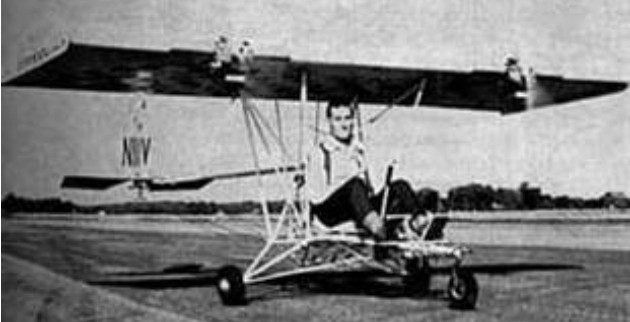
Wilbur Staib built this small airplane in limited spare time and working in limited hangar space in 1966. The “Airy-Plane” is a twin-engine aircraft registered N11V. Three months and about $500 were spent on the craft.
The LB-4 is a high-wing, uncovered welded steel tube fuselage, single seat twin-engine tricycle gear aircraft. It was registered by the FAA in 1966, and was considered at the time to be the world’s smallest twin engine aircraft. The wing ribs were a shortened pattern from a Piper Cub, assembled with staples. The tail is section is mounted on a wire braced removable boom for storage. Fuel tanks are made from 1 U.S. gallon (3.8 L; 0.83 imp gal) paint-thinner cans.
The engines are more or less inserted into the leading edge of the rather thick wing. Equipped with recoil starters they swing 24 in Troyer wood props.
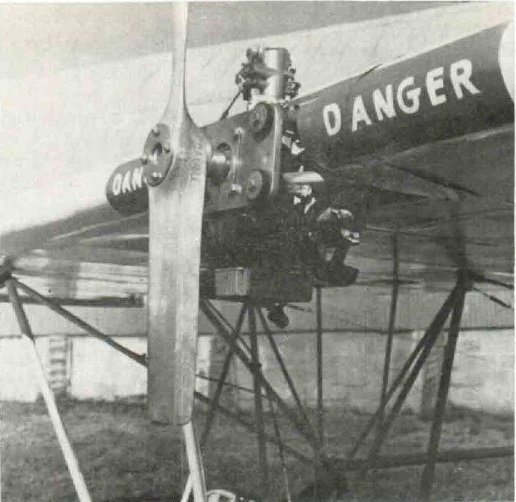
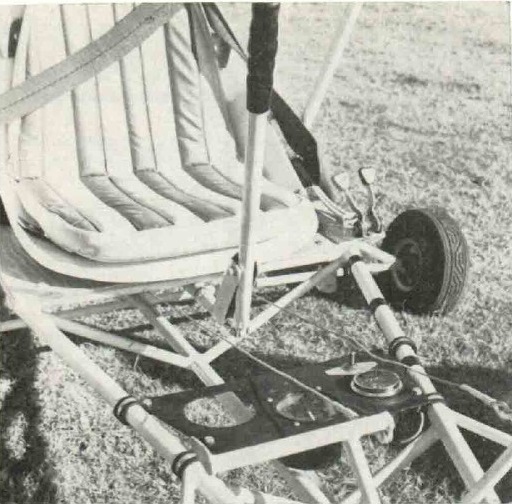
The fuel is carried in two 1 USG paint thinner cans. Instruments consist of an airspeed indicator and a tacho with a left-right toggle switch to pick up the reading from either engine.
Registration was N11V.
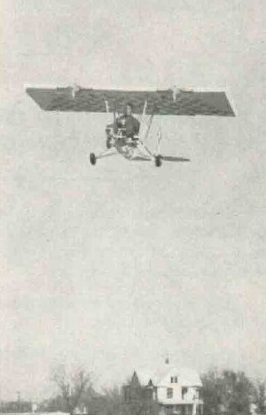
First flying in 1966, only the one was built. The LB-4 was test flown in 1966 at Carthage, Missouri. The aircraft cruises at 60 mph (97 km/h) and must be flown at full throttle. Later configurations included a third 10 hp (7 kW) engine mounted on top of the wing in pusher configuration.
Engines: 2 x 10 hp (7.5 kW) West Bend 820 chain-saw
Propellers: 2-bladed Troyer
Wing span: 14 ft (4.3 m)
Wing area: 70 sq ft (6.5 m2)
Airfoil: Modified Clark-Y
Length: 15 ft (4.6 m)
Empty weight: 175 lb (79 kg)
Gross weight: 340 lb (154 kg)
Useful load: 165 lb
Fuel capacity: 2 U.S. gallons (7.6 L; 1.7 imp gal)
Maximum speed: 52 kn (60 mph, 97 km/h)
Cruise speed: 52 kn (60 mph, 97 km/h)
Stall speed: 30 kn (35 mph, 56 km/h)
Seats: 1
Sperry Sportplane
The 1919 Sperry Sportplane was a two-place, open cockpit biplane, powered by two 38hp air-cooled, 2-cycle, 4-cyl Sperry WBB engines. The aircraft was fitted with folding wings.
Engines: 2 Sperry WBB, 38hp
Wingspan: 27’0″
Length: 21’0″
Useful load: 475 lb
Max speed: 88 mph
Stall: 36 mph
Seats: 2
Soviet Central Hydrofoil Design Bureau Strizh
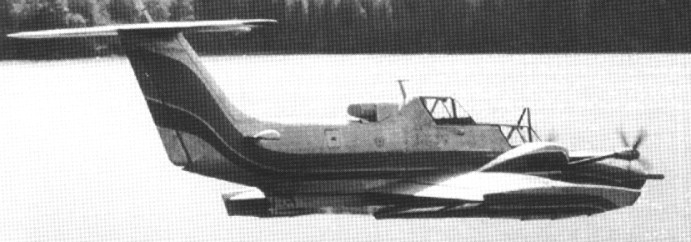
The Strizh was built in 1989 as a two-seat wing in surface effect trainer for Russian naval pilots.
Seats: 2
Southernaire BM-11
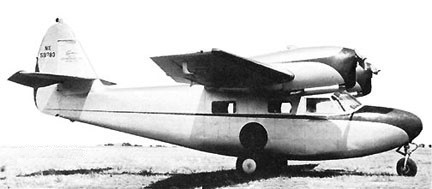
The 1940 Southernaire BM-11 was a six place, high wing, cabin monoplane. One was built, NX59783.
Engines: two 200hp Ranger 6-440
Wingspan: 42’0″
Length: 29’3″
Loaded weight: 1921 lb
Max speed: 175 mph
Cruise speed: 166 mph
Stall speed: 61 mph
Range: 760 miles
Songbo Zeppelin
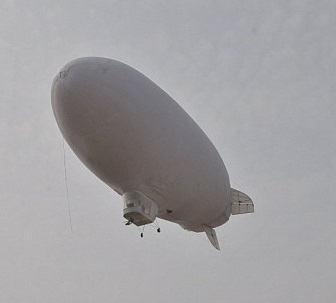
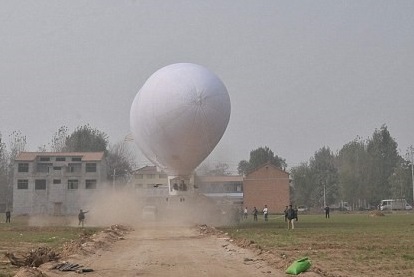
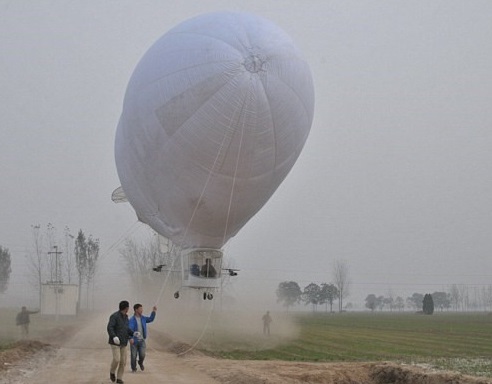
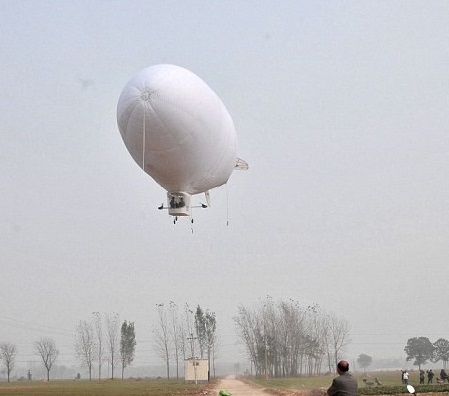
Shi Songbo from Ningling, central China, spent 300,000 Yuan (£30,000) on the Zeppelin, which successfully completed a two-hour test flight near his home in October 2015.
Although his family have been farmers for several generations, his brother attended the Aeronautical Engineering Institute in Xi’an, central China.
As a result of his studies, Shi’s brother always brought home aeronautical engineering magazines and reading material, which got Shi interested in the techniques involved in building an aircraft.
Eventually, Shi would go on to work for an aerial model company as a designer, which gave him greater understanding of the composition of a plane.
In June 2015, Shi was let go from his job, which prompted him to start building his ‘Songbo’ Zeppelin. Shi Songbo spent four months building a Zeppelin. The Zeppelin is about 33 feet tall and 75 feet long. The top portion is composed of a hydrogen-filled airbag while the bottom is made up of the seat and controls.

Shi spent around four months and 300,000 Yuan (£30,000) on the Zeppelin, with many of the components imported from Germany and the USA.
Shi Songbo conducted his first official flight on October 25 2015 in a field near his home under the direction of friend Shang Jianjun, who acted as a dispatcher.
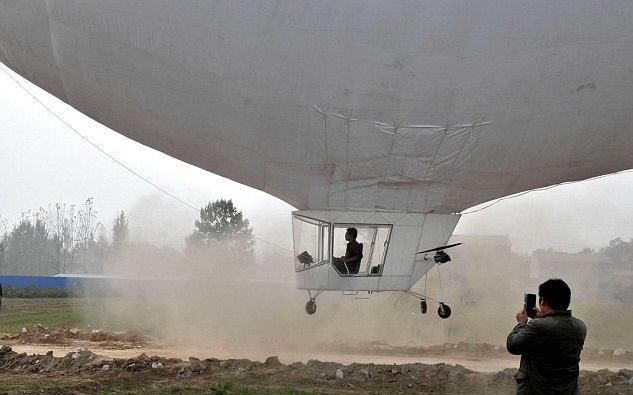
Along with his co-pilot Li Kai, the inventor made several different maneuvers and successfully took off and landed eight times over the space of two hours split between the morning and afternoon. Speaking of his first aerial experience, Shi said: ‘There were lots of low-hanging electricity cables.” ‘Because I was worried about bumping into the cables, everything had to be under the direction of the dispatcher.’ He added, ‘My co-pilot was my eyes and ears. He helped to monitor my surroundings.’
It is able to travel just over 30 miles per hour at 1,640 feet above the ground while carrying two people.
The Zeppelin prototype will need additional testing but Shi hoped that it could be used to distribute pesticide, aerial surveying or tourism in the future.
Soloy Pathfinder 21

The first flight of Soloy Corporation’s modified Cessna 208B Cara¬van, Pathfinder 21, was successfully made on 30 April at Olympia, United States. Flying the aircraft was Soloy’s chief test pilot Paul Haggland and on board for the milestone was crew chief Dan Wright and company president Joe Soloy. The Pathfinder 21 is equipped with two Pratt & Whitney Canada PT6D-114A engines powering a single propeller. The arrangement incorporates a Soloy Dual Pac gearbox assembly, which was certified by the FAA on 18 November 1997. The aircraft’s wings, struts and landing gear have been reinforced to enable its gross ramp weight to be increased to 5,675 kgs (12,500 lbs). The aircraft’s fuselage length has also been increased to almost 2 m more than Cessna’s design.
Engines: 2 x Pratt & Whitney Canada PT6D-114A
Max ramp wt: 5,675 kgs (12,500 lbs)
Soko / CNIAR J-22 Orao / IAR-93
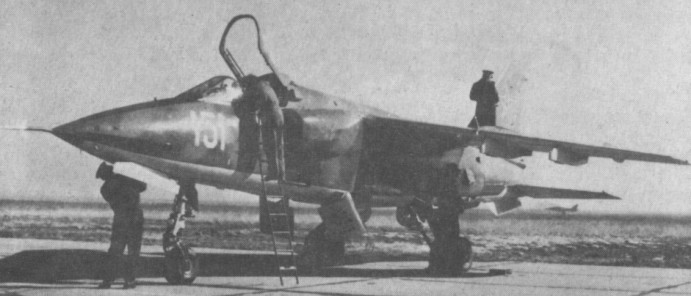
Built in Yugoslavia as the Soko Orao (eagle) and in Romania as the CNIAR (Centrul National al industriei Aeronautica Române) IAR-93, the aircraft was designed by a joint team and developed under a programme known as YuRom, the name indicating the partner countries. Prototypes assembled by Soko and CNIAR made their first flights within minutes of each other on 31 October 1974, and these were followed by a pair of two-seat variants, both of which flew on 29 January 1977. During 1978, deliveries began of a pre-production batch of 15 to each country, after which the initial series model, known in Romania as the IAR-93A, entered service. This was fitted with a pair of non-afterburning Viper Mk 632 engines, but after a short run of single and two-seat aircraft to this standard (20 of them for Romania) manufacture began of the definitive IAR-93B which features a licence-built afterburner and structural changes such as integral wing fuel tanks and a honeycomb rudder and tailplane.
Soko / CNIAR J-22 Orao / IAR-93 Article
The uprated Orao 2/IAR-93B flew in Jugoslavia in October 1983, and in Romania in 1985. The principal difference from the earlier Orao 1/IAR-93A is the introduction of a licence-built Viper 633 with reheat, giving improved performance and weapons carrying capability. The Orao 2 has a Thomson-CSF headup display, and four underwing and one underfuselage stores pylons. Optical and infrared reconnaissance pods are available for carriage on the centreline station.
Romania required 165 IAR-93Bs, including some two-seat models, with similar operational capability to the main version, for advanced training and weapons instruction. Yugoslav plans were believed to be similar. The Orao/lAR-93 is limited to the close support role by its lack of radar or inertial navigation, but low-level interception is a secondary duty.
The J-22 Orao/IAR-93 attack aircraft was out of production before all deliveries made, due to regional conflict.
Orao 2/IAR-93B
Engine: 2 x Rolls-Royce Viper Mk 633-47 afterburning turbojets
Installed thrust (dry / reheat): 37.7 / 44.8 kN, 2268-kg (5,000-1b)
Span: 9.62 m (31 ft 6.75 in)
Length excluding probe: 13.96 m (45 ft 9.5 in)
Height 4.45 m (14 ft 7.25 in)
Wing area: 26 sq.m (279.86 sq ft)
Empty equipped wt: 5900 kg (13,007 lb)
MTOW: 10,097 kg (22,260 lb)
Warload: 2800 kg
Max speed: 1160 kph (721 mph) at sea level
Initial ROC: 5.5 min to 13,000 m / 3960 m (12,990 ft) per min
Service ceiling 12500 m (41,010 ft)
T/O run: 690 m
Ldg run: 1050 m
Combat radius hi-lo-hi: 360 km
Fuel internal: 2600 lt
Air refuel: No
Armament: two 23-mm GSh-231, twin-barrel cannon (with 200 rpg) in front fuselage
four wing pylons and one centreline pylon carrying five x 250-kg (551-1b)
SOKO J 22 Orao 2
Engine: 2 x Rolls Royce Viper 633 41, 17462 N
Length: 45.932 ft / 14.0 m
Height: 14.764 ft / 4.5 m
Wingspan: 31.496 ft / 9.6 m
Wing area: 279.864 sq.ft / 26.0 sq.m
Max take off weight: 24806.3 lb / 11250.0 kg
Weight empty: 12678.8 lb / 5750.0 kg
Max. payload weight: 12127.5 lb / 5500.0 kg
Max. speed: 626 kts / 1160 km/h
Landing speed: 148 kts / 274 km/h
Cruising speed: 394 kts / 730 km/h
Initial climb rate: 13779.53 ft/min / 70.0 m/s
Service ceiling: 44291 ft / 13500 m
Wing loading: 88.77 lb/sq.ft / 433.0 kg/sq.m
Range: 572 nm / 1060 km
Crew: 1
Armament: 2800kg ext 5pods
SPCA T3-BN.4
Under Paulhan-Pillard license-built E.5 three-engined monoplane flying-boat and T3-BN.4 twin-engined twin float coast-defense floatplane.
Sud-Est SE 2410 Grognard
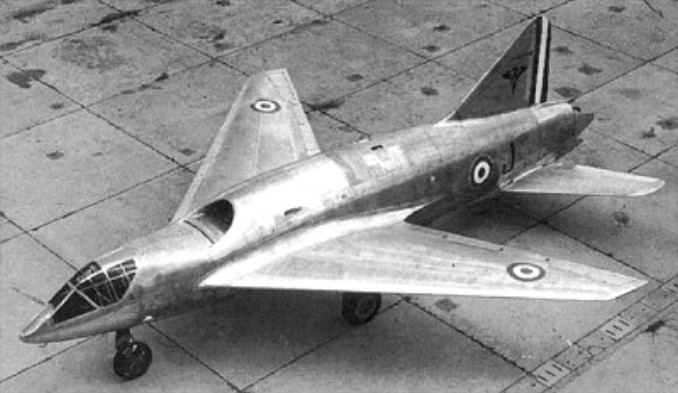
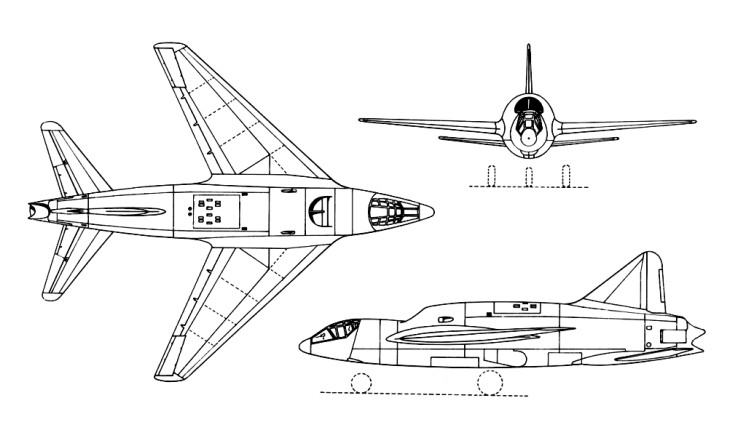
Designed as a single-seat ground-attack aircraft, the Sud-Est SE.2410 Grognard (Grumbler – a nickname for a soldier of Napoleon’s Old Guard) prototype flew for the first time on 30 April 1950. Powered by two 2197kg thrust Hispano-Suiza Nene 101 turbojets mounted one above the other in the fuselage and aspirated via a dorsal inlet, the Grognard I flew as a single¬-seater with wings swept at 47 degrees.
A second prototype, the SE.2415 Grognard II, flew in February 1945. Both designs suffered from flutter-induced problems. The definitive production version would have been the SE.2418, which was to have been powered by Rolls-Royce Tay turbojets, but the SO Vautour was selected to meet the Armee de l’Air’s ground-attack requirement instead.
SE.2410 Grognard
Engine: 2 x 2197kg Hispano-Suiza Nene 101 turbojets
Wingspan: 13.57 m / 44 ft 6 in
Wing area: 495 sq.ft
Length: 15.40 m / 50 ft 6 in
Height: 17 ft
Empty weight: 24,508 lb
Loaded weight: 31,967 lb
Max. speed: 1038 km/h / 645 mph at 4920 ft
Ceiling: 11590 m / 38050 ft
ROC: 5315 fpm
Range: 853 km / 530 miles
Armament: 2 x 30mm cannon, bombs and rockets
Crew: 1
 All Aero