LWD Mis

During 1947 LWD commenced development of a light transport for use as a feederliner. Named Mis, it is a high wing monoplane of composite wood and metal construction.

The wing is wood, and the fuselage a metal, basically rectangular structure, with a rounded decking on the upper and lower surfaces.

Other features are a single fin and rudder and a fixed tricycle undercarriage, the main wheels strutted to the fuselage and engine nacelles.

The Mis accommodates a crew of two and eight passengers.

Engines: 2 x Argus As 10, 240 hp
Wingspan: 16 m / 52 ft 6 in
Length: 12 m / 39 ft 4.5 in
Wing area: 40 sq.m / 430 sq.ft
Empty weight: 2000 kg / 4410 lb
Loaded weight: 3000 kg / 6615 lb
Cruise 60%: 220 kph / 137 mph
Crew: 2
Passengers: 8

Alcor C-6-1 Junior

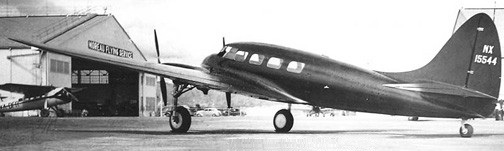
Alcor C-6-1 NX15544

The 1937 Alcor C-6-1 Junior eight-pace cabin monoplane, with retracting undercarriage, registered NX15544, crashed in final testing.

Only the one was built. Often incorrectly referred to as “Lockheed Alcor.”

Engines: 2 x 150hp Menasco C-6
Wingspan: 49’0″
Length: 31’8″
Useful load: 2059 lb
Max speed: 211 mph
Cruise: 190 mph
Seats: 8

SAI-Ambrosini P.512

In 1948, far a light freighter, SAI-Ambrosini modified the wartime Lombarda A.L.12P freight carrying glider to take two 225 hp Alfa 115 four-cylinder air-cooled engines. They also fitted a simple wide-track, fixed, tail wheel undercarriage and re-designated the aircraft P.512.
The lines of the AL.12P have been retained along with the swivelling forward fuselage section which hinges on a vertical axis for loading.
The P.512 is a high-wing monoplane. The wing is wooden monospar with plywood covering and fitted with aerodynamically balanced differentially-operated slotted ailerons. The fuselage is a woken semi-monocoque of elliptical section.
The tail unit is of wooden construction covered by fabric. Elevators and rudder contain trim tabs, the rudder adjustable in flight; the elevator on the ground.
The forward section of the fuselage, containing the pilot’s compartment, hinges to starboard, simplifying access to the pilots’ compartment and enabling bulky objects to be loaded easily. Two doors, 3 ft 6 in by 2 ft 3 in are placed either side of the fuselage forward of the wing leading edge.

Engines: two 225 hp Alfa 115
Wingspan: 70 ft
Length: 46 ft
Height: 11 ft
Wing area: 546 sq.ft
Empty weight: 4410 lb
Useful load: 3527 lb
Loaded weight: 7937 lb
Wing loading: 14.5 lb/sq.ft
Power loading: 17.6 lb/hp
Max speed SL: 155 mph
Cruise 70%: 143 mph
Min speed no flap: 60 mph
Min speed w/flap: 53 mph
ROC SL: 970 fpm
Climb to 3280 ft: 3 min 39 sec
Climb to 23,000 ft: 75 min 8 sec
Est ceiling: 24,000 ft
Service ceiling: 21,200 ft
SE ceiling: 6900 ft

Caproni AVS

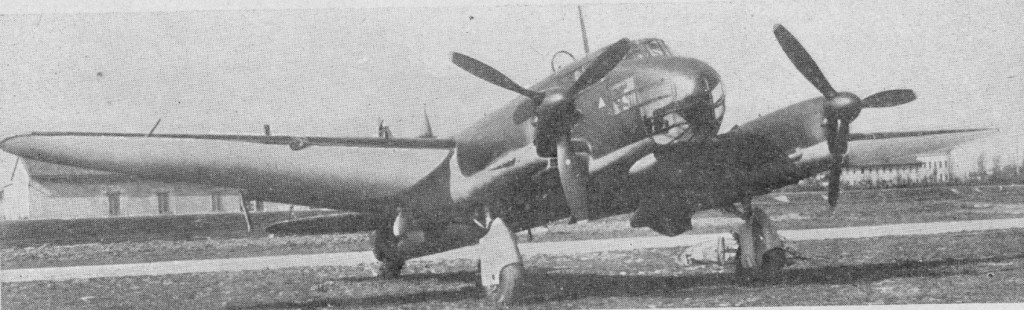
The Ca AVS (Addestramento al volo strumentale) is a twin-engined night flying and instrument trainer resembling the Ca 314 externally. A low-wing cantilever monoplane, it is powered by two 770 hp Isotta Fraschini Delta RC 40-III inverted V-12 engines, driving three blade constant speed props.
The cantilever monoplane wing comprises a centre-section and two outer sections. Construction is of wood with two box spars, former ribs and plywood covering.
The fuselage is a welded steel-tube framework, built in two sections and bolted together, with fabric covering over a light fairing structure. The tail unit is wood with plywood and fabric covering. The elevators and rudders are aerodynamically and statically balanced.
A crew of six can be carried for instruction of wireless operators, navigators and bomb aimers. Dual controls are fitted and one position can be screened off for blind flying.

Engines: two 770 hp Isotta Fraschini Delta RC 40-III
Wing span: 54 ft 6 in
Length: 38 ft 0.5 in
Height: 12 ft 11.5 in
Wing area: 422.4 sq.ft
Empty weight: 9180 lb
Useful load: 4078 lb
Loaded weight: 13,886 lb
Max speed SL: 214 mph
Max speed 14,928 ft: 255 mph
Cruise SL: 198 mph
Cruise 14,928 dt: 237 mph
Service ceiling: 26,574 ft
Ceiling est: 28,542 ft
Max range 211 mph: 745 miles

Vickers 618 Viking / Nene-Viking

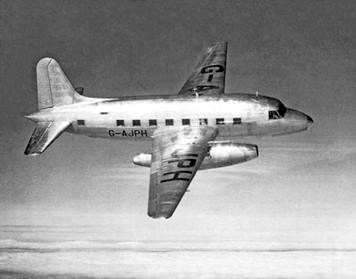
The Ministry of Aircraft Production Air Ministry Specification 17/44 from Vickers-Armstrongs Limited. The specification was for a peacetime requirement for an interim short-medium haul passenger aircraft. To speed development the aircraft used the wing and undercarriage design from the Wellington but the fuselage was new. Although the original contract referred to Wellington Transport Aircraft, on completion, the name Viking was chosen.

Vickers 618 Viking Article

The initial 19 production aircraft (later designated the Viking 1A) carried 21 passengers, they had metal fuselages and – except for the wing inboard of the nacelles – fabric-clad geodetic wings and tail units. Following feedback from customers, the next 14 examples, known as, featured stressed-metal wings and tail units. The next variant, the Viking 1B, was 28 in (71 cm) longer than the Viking 1, carrying 24 passengers with up-rated Bristol Hercules piston engines, achieved a production run of 115.

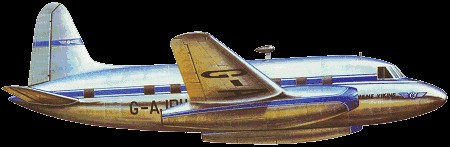
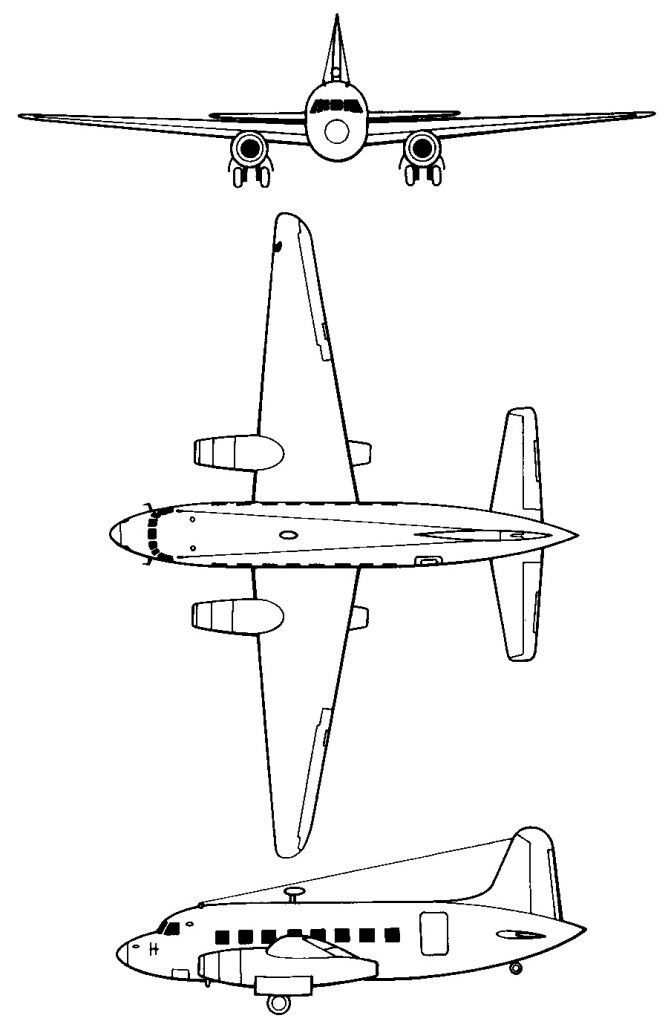
The 107th airframe on the Weybridge production line was set aside, and the existing nacelles were replaced by completely new jet pods each housing a Rolls-Royce Nene, with the trailing edge of the wing extended at the rear to fair smoothly into the top of the pod. The Vickers main landing gears were of a totally new type, designed only for this aircraft, with four separate short legs each carrying a wheel which retracted to lie on each side of the jet pipe inside the nacelle. Unlike other Vikings the elevators were skinned with metal, and the metal skin on the wings and tailplane was made thicker than normal. There were also changes to the cockpit, fuel system and other items.

Chief test pilot J ‘Mutt’ Summers flew the Type 618 Nene-Viking from Wisley on April 6, 1948. At different times it bore civil registration G-AJPH and Ministry serial VX856.

On 25 July 1948, on the 39th anniversary of Blériot’s crossing of the English Channel, the Type 618 Nene-Viking flew Heathrow–Paris (Villacoublay) in the morning carrying letters to Bleriot’s widow and son (secretary of the FAI), who met it at the airport. The flight of 222 miles (357 km) took only 34 minutes. It then flew back to London in the afternoon. It obtained a maximum speed of 415 mph (668 km/h) at 12,000 ft (3,700 m) and averaged 394 mph (634 km/h). In 1954 it was bought from the Ministry of Supply and underwent the substantial conversion to Hercules 634 piston engines by Eagle Aviation to join their fleet as Lord Dundonald on September 24, 1954.

Engines: 2 x 2268kg Rolls-Royce Nene I turbojets
Wingspan: 27.2 m / 89 ft 3 in
Wing area: 81.93 m2 / 881.89 sq ft
Length: 19.86 m / 65 ft 2 in
Height: 5.94 m / 20 ft 6 in
Empty weight: 9548 kg / 21050 lb
Take-off weight: 15196 kg / 33502 lb
Max. speed: 753 km/h / 468 mph
Cruise speed: 632 km/h / 393 mph
Range: 555 km / 345 miles
Crew: 4
Bombardier Global 6000/6500

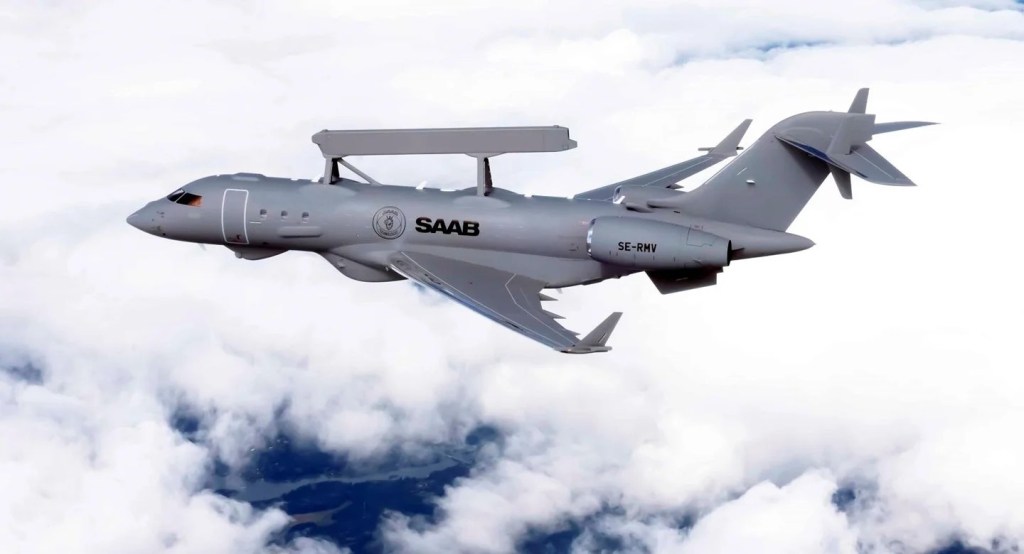
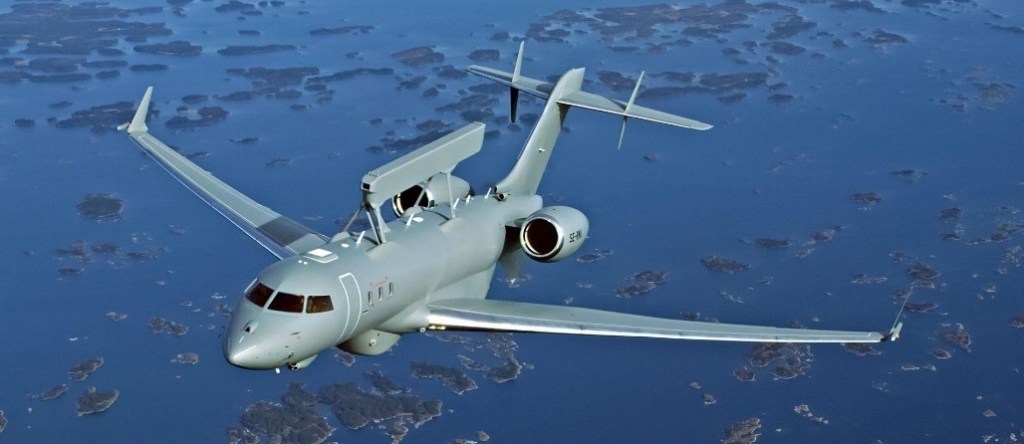
Saab GlobalEye Airborne Early Warning and Control (AEW&C)

The Saab GlobalEye Airborne Early Warning and Control (AEW&C) aircraft uses the Bombardier Global 6000/6500 platform.

Saab GlobalEye Airborne Early Warning and Control (AEW&C) aircraft

The Erieye radar system, installed on the GlobalEye aircraft, is capable of tracking airborne targets at a range of 650 km and ground targets at 425 km. Saab notes that the radar, thanks to its AESA (Active Electronically Scanned Array) technology, is sensitive enough to track drones at distances ranging from 100 km to 600 km.

GlobalEye Airborne Early Warning and Control (AEW&C) aircraft.

The Erieye radar system, developed by the Swedish company Saab Electronic Defence Systems, provides a 300-degree coverage, detecting airborne and maritime targets.
The system is used by the air forces of countries such as Sweden, Brazil, Pakistan, Thailand, Greece, Mexico, the United Arab Emirates, and Saudi Arabia. The installation platform varies depending on the customer’s needs.

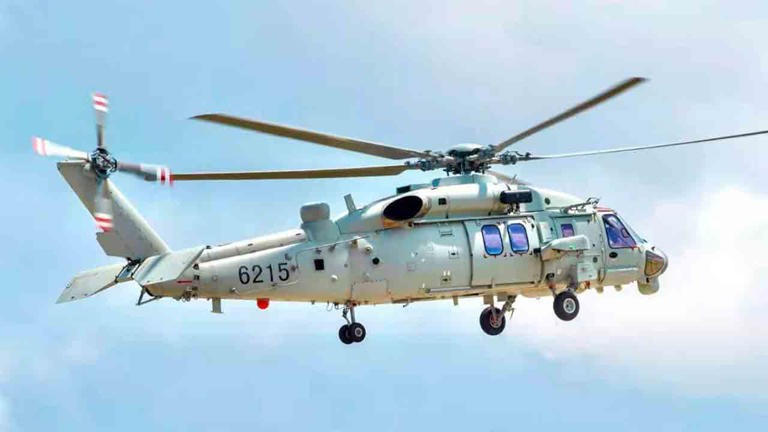
Changhe Zhi-20

Zhi-20F

As part of this modernization, the Zhi-9S and Ka-52 helicopters were being replaced in 2025 by the new Zhi-20F anti-submarine helicopters aboard the fourth production batch of Type 052D guided-missile destroyers.

Zhi-20F Specifications:
Engines: two WZ-10 turboshaft engines, 2,100 – 2,700 hp
Length: 20 meters
Height: 5.3 meters
Maximum speed: 360 km/h
Cruising speed: 290 km/h
Maximum takeoff weight: 10 tons
Service ceiling: 6,000 meters
Flight range: 560 km

Ikarus AD 214-D

Designed to meet a Yugoslav Air Force requirement for a twin-engined crew trainer / transport, the prototype Type 214-D flew in 1951, powered by two 480 hp Ranger SVG-770 engines. A change to 600 hp Pratt and Whitney R-1340-AN-1 radials was made for production aircraft, which entered service in 1957.

As a transport the 214-D can carry a crew of two and eight passengers. In its primary role as a crew trainer, it is able to provide simultaneous instruction for pilots, navigators, bomb-aimers and radio operators.

Construction is of all-wood, except for the tail control surfaces, which are metal with fabric covering. Provision is made for carrying practise bombs and rockets under the wings.

Engines: 2 x 600 hp Pratt and Whitney R-1340-AN-1
Wing span: 53 ft 1.5 in
Length: 35 ft 9 in
Gross weight: 11,080 lb
Max speed: 226 mph
Range: 670 miles