Supermarine 508 / 529

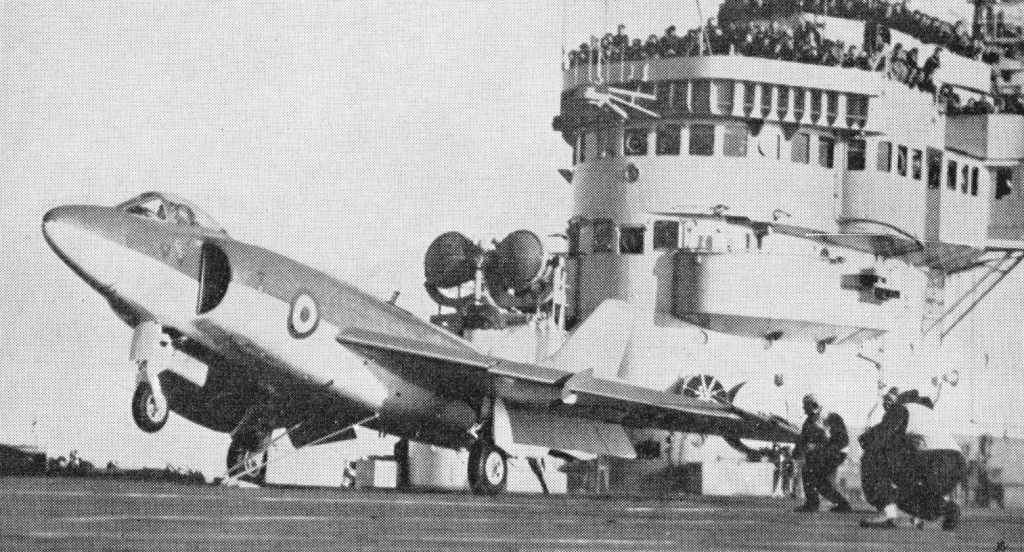
Responding to Admiralty interest in “undercarriage-less” aircraft suitable for operation from flexible decks on aircraft carriers, Supermarine designed the Type 505 single-seat fighter in 1945. Two Rolls-Royce AJ65 (later to be named Avon) turbojets were located side-by-side in a broad centre fuselage to provide a stable base for alighting on the “carpet” and a Vee configuration kept the tail surfaces clear of the jet efflux. An armament of twin 20mm cannon was planned and provision was made to provide for a fixed tricycle undercarriage for flight development and operation from shore bases. It was thus relatively simple to incorporate a retractable undercarriage in the design when Admiralty interest in the flexible deck concept waned in late 1947 and the fighter was modified as the more conventional Type 508.

Three aircraft were ordered to Specification N.9/47 for a naval fighter, and, configurationally similar to the Type 505 apart from the undercarriage, the first of these flew on 31 August 1951. The second (as the essentially similar Type 529) followed a year later, on 29 August 1952.

In February 1950, the contract covering the third prototype was amended to introduce sweptback wings, and this, as the Type 525, became, in effect, the prototype of the Scimitar. The Types 508 and 529 were each powered by a pair of 2948kg Avon RA3 engines and had provision for an armament of four 20mm cannon.
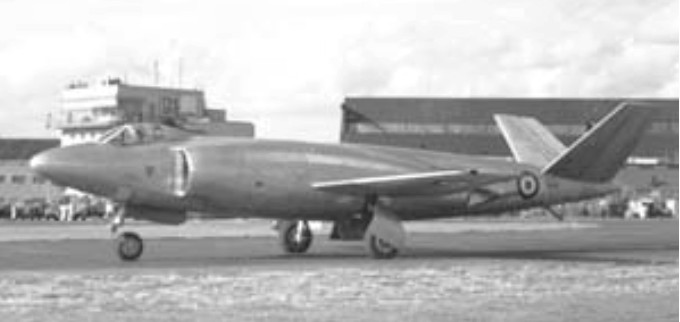
To be broken up February 1956

Type 529
Engines: 2 x 2948kg Avon RA3
Empty weight: 8373 kg / 18459 lb
Wingspan: 12.50 m / 41 ft 0 in
Length: 15.24 m / 50 ft 0 in
Height: 3.54 m / 12 ft 7 in
Wing area: 31.59 sq.m / 340.03 sq ft
Max. speed: 977 km/h / 607 mph

Supermarine 508 / 529

Supermarine N.113 / Scimitar

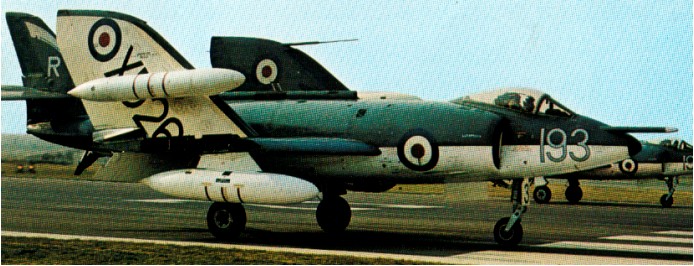
Known originally as the Supermarine N.113, the Scimitar F.1 was a large single-seat, twin-engined naval carrier-borne interceptor fighter and strike aircraft for the Royal Navy. The Royal Navy’s first single seat fighter capable of supersonic flight.

Supermarine Scimitar Article

The Scimitar has mid-set sweptback wings, with slight anhedral, and dog-tooth leading edges. Blown trailing edge flaps are fitted. There are swept back tail surfaces with 10 degrees of anhedral on the tailplane. Conventional ailerons, rudder and one-piece all-moving tailplane are fitted. Engine air intakes are on each side of the fuselage by the cockpit. A tricycle undercarriage has single wheels on each unit, the mains retracting into the fuselage and the nosewheel retracts rearward. Internal tanks can be supplemented by four underwing tanks of up to 800 Imp.Gal total capacity. A flight refuelling probe can be fitted on the starboard side of the nose. The original armament was four 30mm Aden guns.

1957

The prototype flew for the first time on 19 January 1956 and deck-landing trials were successfully completed on HMS Ark Royal in July 1957.

Scimitar F.1

The first of 76 production aircraft flew on 11 January 1957 and the first operational squadron (No 803) was formed in June 1958 and embarked on HMS Victorious in the following September.

Gallery

Scimitar F.Mk 1
Engine: 2 x Rolls-Royce Avon 202 turbojet, 50.04kN / 11,250 lb
Max take-off weight: 15513 kg / 34200 lb
Empty weight: 10869 kg / 23962 lb
Wingspan: 11.33 m / 37 ft 2 in
Length: 16.87 m / 55 ft 4 in
Height: 5.28 m / 17 ft 4 in
Wheel track: 14 ft 1 in
Wing area: 45.06 sq.m / 485.02 sq ft
Max. speed: 1143 km/h / 710 mph
Cruise speed: 14020 km/h / 8712 mph
Ceiling: 14020 m / 46000 ft
Range: 2288 km / 1422 miles
Armament: 4 x 30mm cannons, 4 x 454kg bombs or missiles
Crew: 1

Supermarine Scimitar

Supermarine Stranraer

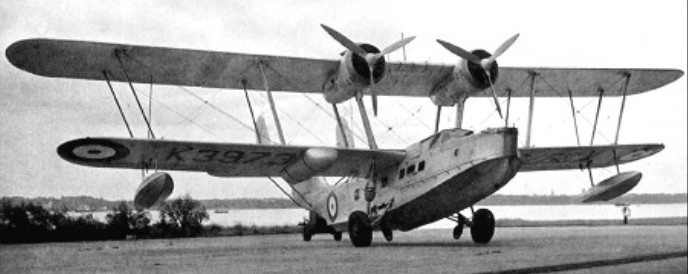
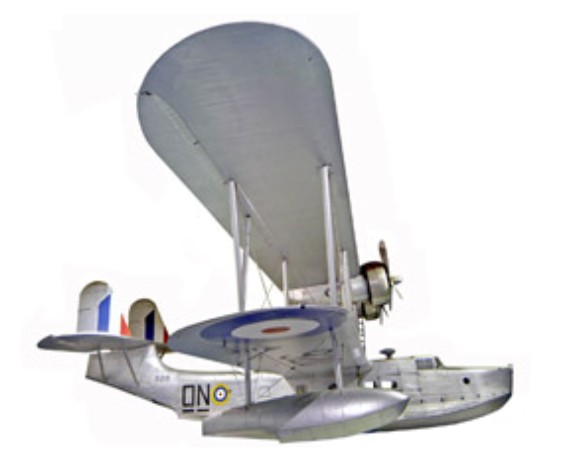
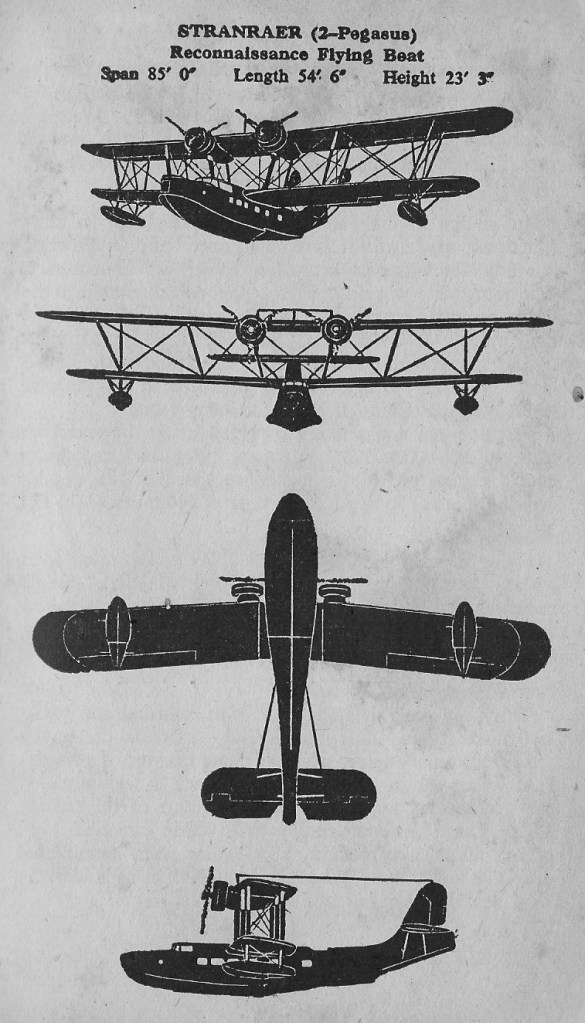
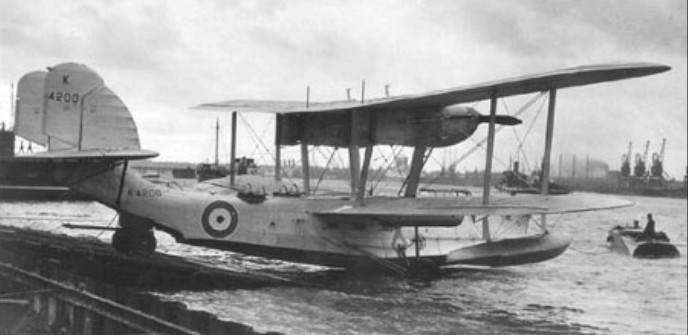
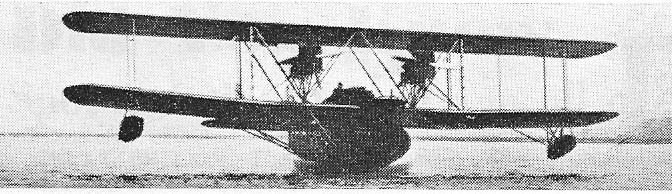
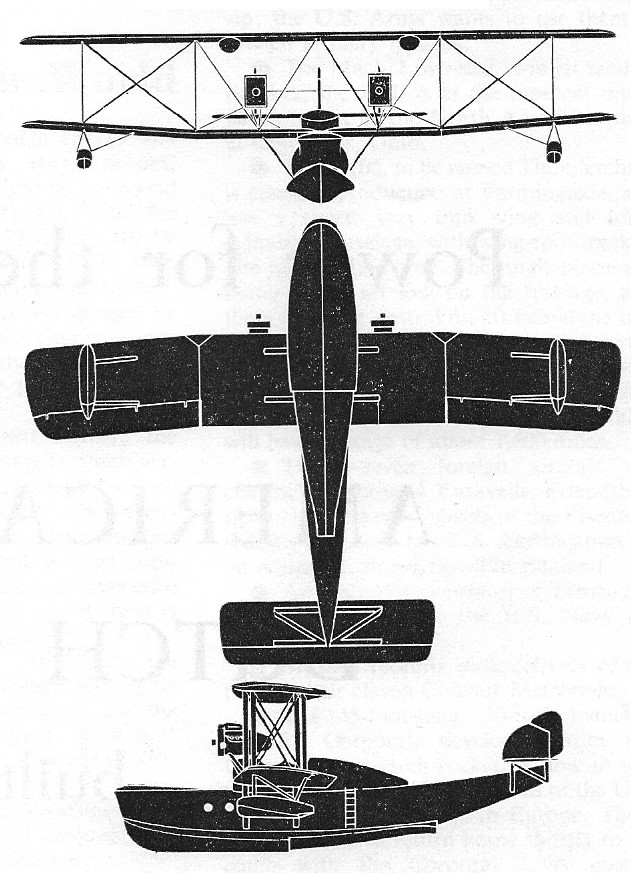
Designed to the same specification, R. 24/31, as the Saro London, the Supermarine Stranraer twin-engine biplane flying-boat prototype, originally known as the Singapore V, was powered by Bristol Pegasus HIM radials driving two-blade wooden propellers and first flew in mid-1935, but was immediately renamed Stranraer.

Supermarine Stranraer Article

A production contract was placed in August 1935 for seventeen aircraft. It also underwent comparative trials with the London on No. 210 Squadron in October and November 1935, during which it was found to be somewhat underpowered.

Production deliveries of aircraft powered by a pair of Pegasus X radials driving a three-blade Fairey Reed metal propeller started December 1936, and the type was declared operational in April 1937 with No. 228 Squadron at Pembroke Dock, remaining with this squadron until April 1939.

In December 1938 Stranraers joined No. 209 Squadron at Felixstowe, and later moving to Invergordon and Oban for patrols over the North Sea until supplanted by the Lerwick the following year.

No, 240 Squadron was the only other RAF Coastal Command squadron to fly the Stranraer, converting to the aircraft in June 1940 at Pembroke Dock for short-range patrol work over the Western Approaches. The Stranraers were eventually replaced by Catalina ‘boats in March 1941, continuing to serve in a training capacity until October 1942.

Although RAF Stranraers did not serve at overseas stations, a total of 40 aircraft was licence-built by Canadian-Vickers between 1939 and 1941, and served in the coastal reconnaissance/anti-submarine role with the RCAF until finally replaced by the Consolidated Canso (Catalina) from 1943.

Eight were in service with the Canadians at the outbreak of war. Hese aircraft were used for patrol duties both on the Atlantic and Pacific coasts. They were finally retired from service in February 1945.

After retirement from service use, several Stranraers were registered for civil use. Queen Charlotte Airlines continued to use Stranraers into the 1950s, operating from Vancouver and providing a service along the pacific coast of British Columbia.

Engine: 2 x Bristol Pegasus X, 652kW
Max take-off weight: 8600 kg / 18960 lb
Empty weight: 5100 kg / 11244 lb
Wingspan: 25.91 m / 85 ft 0 in
Length: 16.71 m / 55 ft 10 in
Height: 6.63 m / 22 ft 9 in
Wing area: 135.36 sq.m / 1457.00 sq ft
Max. speed: 266 km/h / 165 mph
Cruise speed: 169 km/h / 105 mph
Ceiling: 5640 m / 18500 ft
Range: 1600 km / 994 miles
Armament: 3 x 7.7mm machine-guns
Bombload: 450kg

Supermarine Southampton

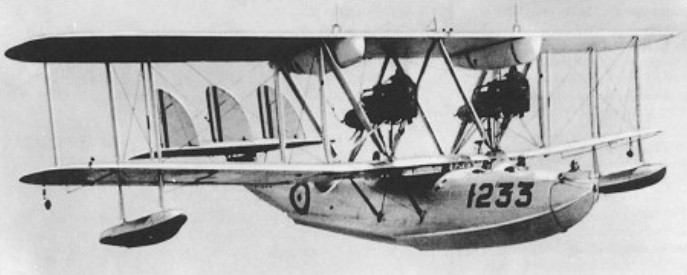
By the mid-twenties the RAF was desperate to replace their First World War vintage Felixstowe flying boats and had almost given up the search when R J Mitchell’s development of his civilian Swan design was offered. It proved an immediate success and established not only the name of the designer but that of the company in military circles.

The first eighteen Southamptons delivered were Mk Is with wooden hulls. However a lengthy marine research programme had convinced the Royal Air Force of the superior qualities of metal over wood and so the final forty-eight were delivered as Southampton MkIIs with metal hulls and powered by two 335kW Napier Lion V engines. In a programme begun in 1929 all surviving wooden-hulled Southamptons were re-built with metal hulls.

Southamptons first entered service in August 1925 and quickly became famous for long-distance formation flights, ‘showing the flag’ in many parts of the world. The most notable was a 43500km (27000 mile) cruise of the Far East Flight’s four Southamptons from Felixstowe to Singapore via the Mediterranean and India in 1927 and 1928.

The Southampton flying-boat was one of the most successful ever used by the Royal Air Force. With a reputation for reliability, its service life of eleven years was surpassed only by that of the Sunderland.

Gallery

Southampton Mk II
Engines: 2 x Napier Lion VA W-12, 373kW
Max take-off weight: 6895 kg / 15201 lb
Empty weight: 4082 kg / 8999 lb
Wingspan: 22.86 m / 75 ft 0 in
Length: 15.58 m / 51 ft 1 in
Height: 6.82 m / 22 ft 5 in
Wing area: 134.61 sq.m / 1448.93 sq ft
Max. speed: 174 km/h / 108 mph
Ceiling: 4265 m / 14000 ft
Range: 1500 km / 932 miles
Armament: 3 x 7.7mm machine-guns
Bombload: 500kg

Supermarine Swan

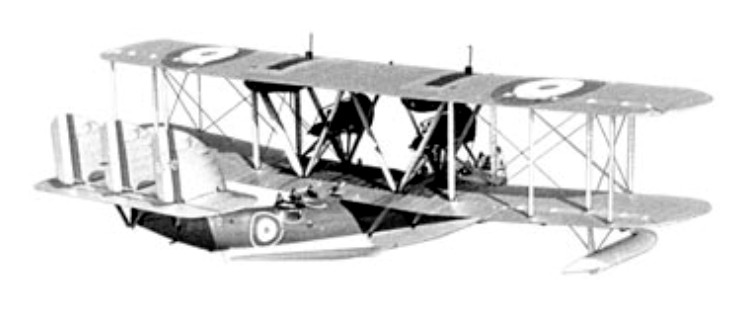
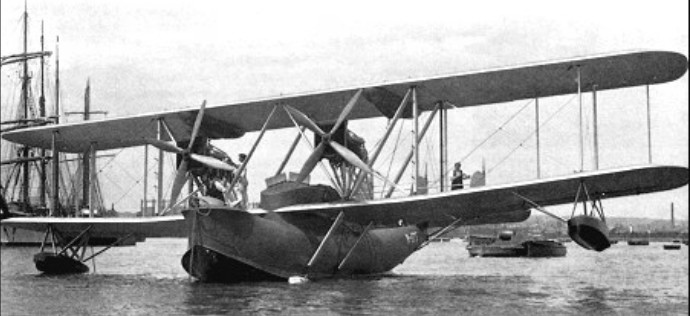
Shortly after World War I, Supermarine received two Air Ministry contracts to Specification 21/22, one in 1921 for a five-seat military seaplane and the other in 1922 for a commercial seaplane, the former named Scylla and the latter Swan.

The aircraft were equal-span, two-bay biplanes with monoplane tail units and triple fins and rudders. The raised cockpit seated the two-crew side-by-side.

The Scylla N174 emerged as a monoplane, but was apparently converted to triplane configuration in 1923, when it carried out taxi trials at Felixstowe. There is no evidence that it ever flew.

Swan

The Swan N175 was completed as planned in 1924, but as a maritime reconnaissance flying-boat biplane. After completing its flight trials, it was converted to civilian use. An Air Ministry Specification R18/24 was issued for a development, later built by Supermarine as the first Southampton.

Engine: 2 x 2 x 450hp Napier Lion IIB
Max take-off weight: 5820 kg / 12831 lb
Wingspan: 20.90 m / 69 ft 7 in
Length: 17.06 m / 56 ft 12 in
Height: 7.95 m / 26 ft 1 in
Max. speed: 175 km/h / 109 mph
Ceiling: 3089 m / 10150 ft
Range: 1400 km / 870 miles
Crew: 2
Passengers: 10

Supermarine P.B.31 NightHawk / Pemberton-Billing P.B.31E

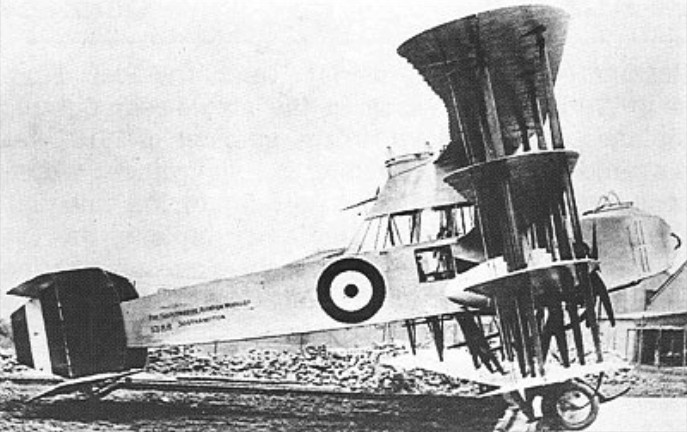
When Pemberton-Billing Ltd changed its name to Supermarine Aviation in December 1916, work on a further airship fighter, the P.B.31E, had reached an advanced stage and the first prototype of this quadruplane was to fly shortly afterwards, in February 1917.

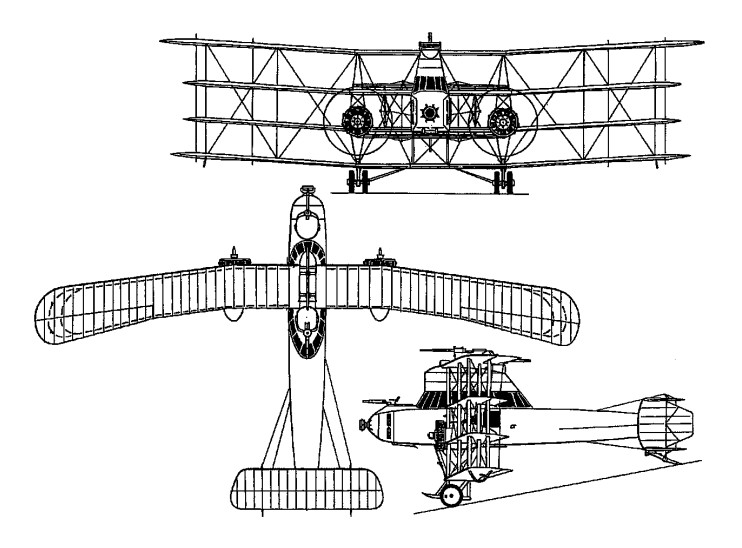
Fundamentally an extrapolation of the P.B.29E, and unofficially known as Night Hawk, the P.B.31E was designed to have a maximum endurance in excess of 18 hours to enable it to lie in wait for intruding airships.

A three-bay narrow chord quadruplane powered by two 100hp Anzani nine-cylinder radials, the P.B.31E carried a searchlight in the extreme nose. The four wings had considerable sweepback of their outer sections. The intended armament comprised a one-and-a-half pounder Davis gun on a traversing mounting in a forward position level with the top wing, a 7.7mm machine gun being located in a second position immediately aft and a similar weapon occupying a forward fuselage position.

Shortly after the start of flight trials, the shortcomings of the concept were finally appreciated, and, on 23 July 1917, the first prototype was scrapped and the second incomplete prototype abandoned.

Engines: two 100hp Anzani nine-cylinder radials
Max take-off weight: 2788 kg / 6147 lb
Empty weight: 1668 kg / 3677 lb
Wingspan: 18.29 m / 60 ft 0 in
Length: 11.24 m / 37 ft 11 in
Height: 5.40 m / 18 ft 9 in
Wing area: 89.37 sq.m / 961.97 sq ft
Max. speed: 121 km/h / 75 mph
Fuel capacity: 1016 kg / 2240 lb

Pemberton-Billing (Supermarine) P.B.31E

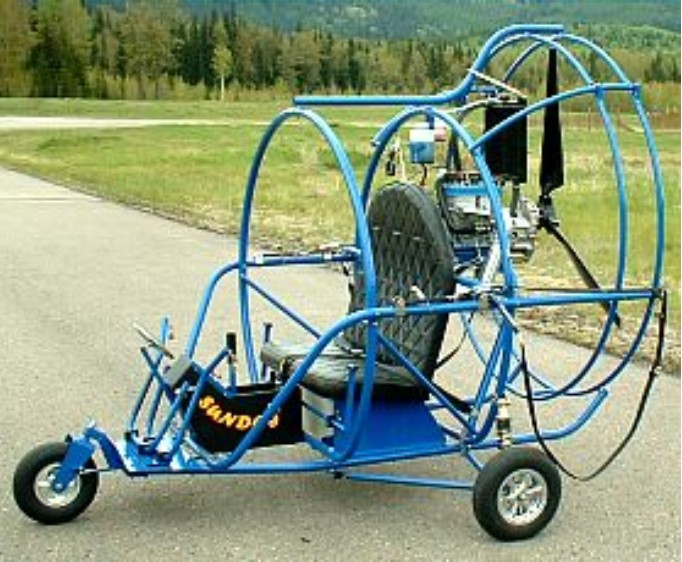
Sundog Powerchutes Two seater

A two-seater powered parachute, constructed with 6061T6 – Tubing + Plate, 304SS – Stainless Steel, and AN bolts. The risers are nylon webbing. The airframe/ cart, seat belts, and upholstery colour range is optional.

Dual Controls: Throttle + Steering

2009 Kit Price: 15,995 US$
2009 Price: $20,750.00 Canadian Dollars, assembled.

Engine: Rotax 582, 65 hp
E box, electric start
Fuel Tank: 10 USG
Parachute: Apco 500
Prop: Powerfin or GSC
Empty weight: 152 kg / 336 lbs.
MTOW Weight: 222 kg / 489 lbs
Length: 101 in
Width: 76 in
Height: 84 in
Air Speed: 28 to 33 mph
Takeoff Distance: 60 – 200 ft
Landing Distance: 30 – 100 ft
Glide Ratio: 4 – 5 to 1
Rate Of Climb: 400 – 800 ft/min.
Sink Rate: 500 – 700 ft/min.