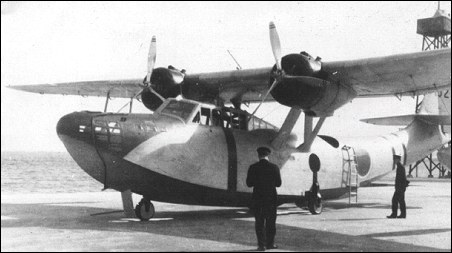
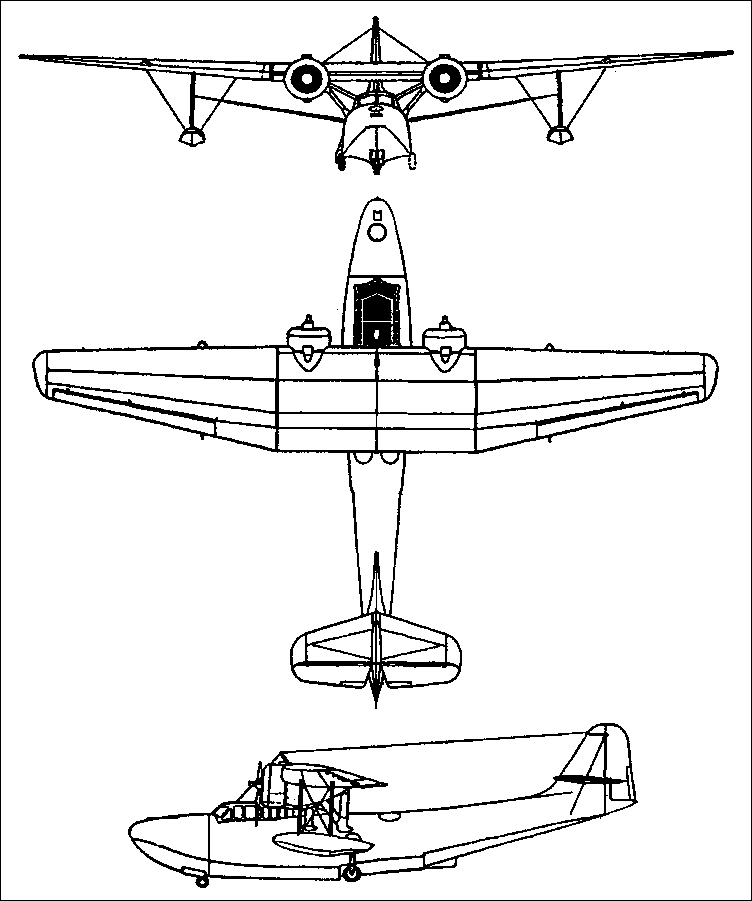
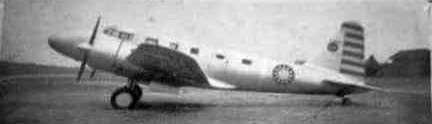
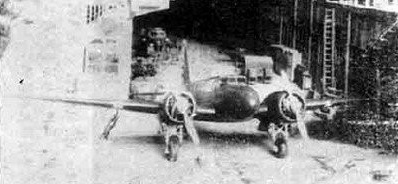
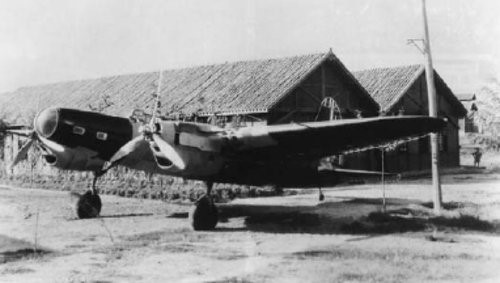
The first prototype flew in September 1940 and a total of 30 were built.
H9A1 Engine: 2 x Nakadjima Kotobuki-42, 530kW Wingspan: 24.0 m / 78 ft 9 in Length: 16.95 m / 55 ft 7 in Height: 5.25 m / 17 ft 3 in Wing area: 63.3 sq.m / 681.35 sq ft Take-off weight: 7500 kg / 16535 lb Empty weight: 4900 kg / 10803 lb Max. speed: 315 km/h / 196 mph Cruise speed: 220 km/h / 137 mph Ceiling: 6780 m / 22250 ft Crew: 5 Passengers: 3 Armament: 2 x 7.7mm machine-guns, 250kg of bombs
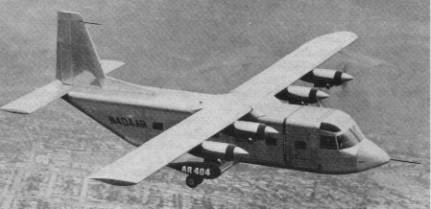
Ahrens developed AR 404 twin-turboprop 30 passenger or cargo transport, intended to be simple to maintain and having a constant square-section fuselage to provide maximum volume.
Designed by Peter Ahrens in Cali¬fornia for production in Puerto Rico
The prototype N404AR first flew on 1 December 1976, piloted by Herman “Fish” Salmon, followed by the first production-standard aircraft built in Puerto Rico in October 1979, but program halted through lack of funding.
The Ahrens 404 is designed for simple manufacture, harsh conditions, easy repair, the four turboprop utiliplane featured an aft loading ramp.
One other was built, N1028G.
AH 404 Engines: 4 x 420hp GMC-Allison 250-B17B Wingspan: 65’0″ Length: 48’4″ Useful load: 9400 lb Max speed: 210 mph Cruise: 160 mph Range: 1380 mi Seats: 31
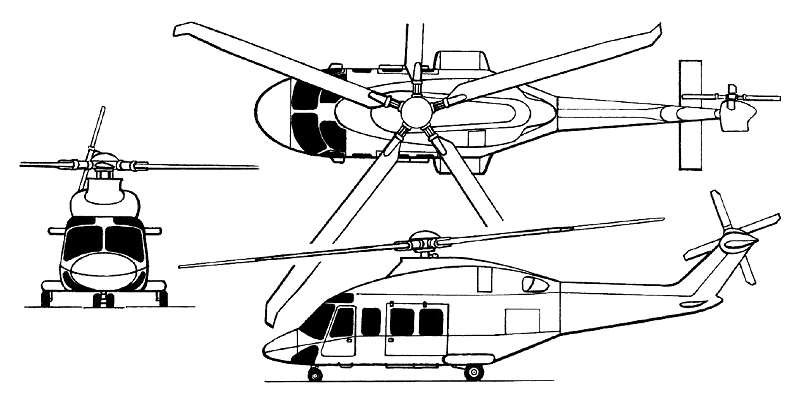
Bell and Agusta announced at Farnborough Air Show on 8 September 1998 that they had agreed to establish a joint venture to manage development of two new aircraft: the BA609 tiltrotor, previously a Bell and Boeing programme, and the AB139, a new helicopter announced on the same day. Following approval of both boards, a definitive agreement was signed on 6 November 1998. A full-scale mockup was unveiled at the Paris Air Show 12 June 1999. Agusta is responsible for the AB139’s development and certification to JAR/FAR 29 and transition to production, with participation by Bell on a 75:25% work-share basis; final assembly by Agusta at Vergiate, and by Bell (possibly at Mirabel, Canada). A military version was revealed in July 2000, and flight testing of the AB139 began in February 2001. Risk-sharing collaborators include GKN Westland (tail rotor drive train), Honeywell (avionics), Kawasaki (transmission input module), Liebherr Germany (landing gear and air conditioning system), Pratt & Whitney Canada (power plant) and PZL Swidnik (airframe components). PZL in Poland were making all the fuselages for the Agusta A109, AW119 and AW139, before shipping them to Brindisi, Italy, for customer fit-out. PZL also manufactured the A109 and A139 tail booms. With no designated prototype, the first preproduction aircraft (01, later I-ACOI) first flew on 3 February 2001 followed by second aircraft (02, later I-ATWO) on 4 June 2001 and third (03, later I-EPIC) on 22 October 2001. The first preproduction aircraft crashed on 22 April 2002. Assembly of first production aircraft began in late November 2001 and this aircraft, I-ANEW, was demonstrated at Farnborough in July 2002. Three preproduction aircraft and one tie-down helicopter (TDH) undertook the flight test programme and the AB139 achieved Italian IFR Type Certification on June 18, 2003 after 1,600hr of ground and flight testing. 750 hours was completed on the TDH.
Featuring a five-blade, fully articulated, ballistic tolerant main rotor and four-blade tail rotor, some of the transmission and rotor elements are based on Agusta A129 Mangusta. The AB139 has four-axis, digital AFCS flight controls and heavy-duty, retractable tricycle landing gear with twin wheels on the nose unit and single wheels on the main units, which retract into side sponsons. Powered by two Pratt & Whitney Canada PT6C-67C turboshafts, with FADEC, each rated is at 1,252kW for T-O and 1,142kW maximum continuous; OEI ratings 1,286kW for two minutes and 1,252kW maximum continuous. Fuel tanks are behind the main cabin. The main transmission can run for up to 30 minutes without oil. Up to 15 passengers are accomodated on crashworthy seats in three rows of five, two forward facing, one rearward facing, in an unobstructed cabin with a flat floor and a flight-accessible baggage compartment at the rear of cabin, or alternatively, six stretchers and four attendants in medevac configuration. Plug-type sliding door are on each side of cabin, with separate crew doors. The commercial version was priced at US$7 million in 2002. More than 80 had been ordered by 25 customers by June 2003. Launch customer Bristow Helicopters of UK announced order for two on 26 September 2000 for delivery in 2003. The AB 139 is operated by the US Coast Guard for recovery and surveillance.
Engine: 2 x Pratt & Whitney Canada PT6C-67C turboshafts Take-off power capacity: 1250kW Max continous power capacity: 1140kW Main rotor diameter: 13.80m Length with rotors turning: 16.65m Fuselage length: 13.53m Width: 3.2m Height: 4.95m Max take-off weight: 6000kg Internal payload: 2500kg External payload: 2700kg Max cruising speed: 290km/h Economic cruising speed: 278km/h Hovering ceiling, OGE: 3600m Endurance: 3.9h
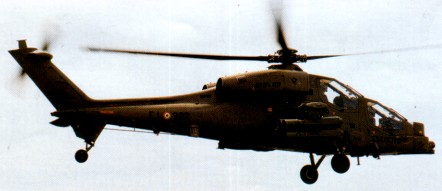
The A.129 Mangusta (Mongoose) is a day/ night military scout/antiarmour helicopter, which preliminary design began in 1978, and the first of four flying prototypes made its initial flight on 15 September 1983 powered by two 800 shp Avco Lycoming LTS101 850 turboshaft engines. The development programme was jointly funded by the Ital¬ian Army and Agusta.
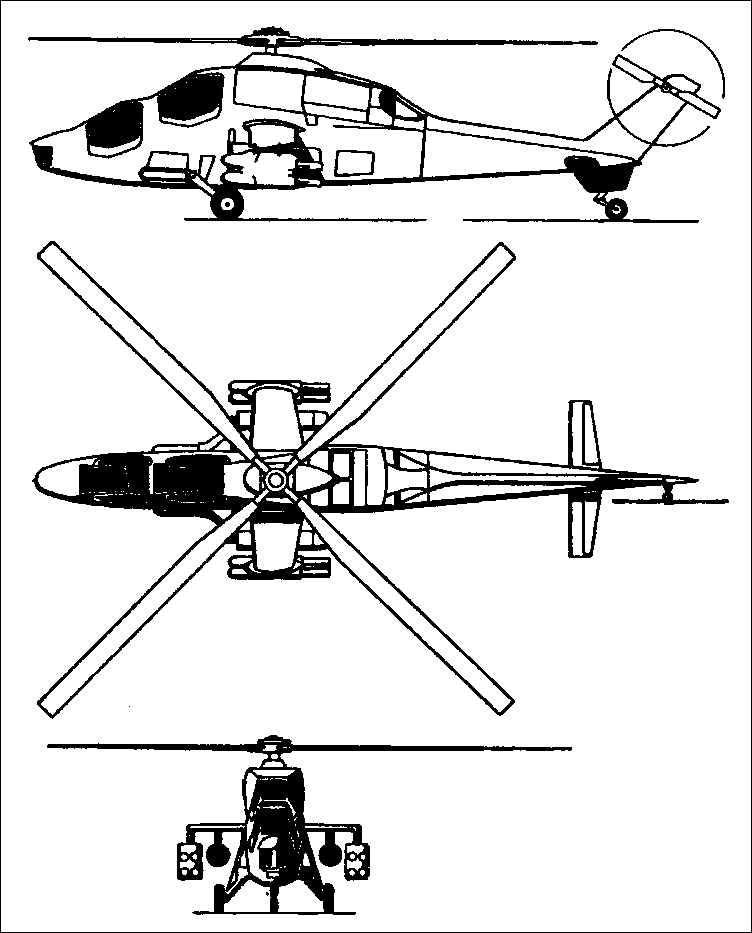
The A.129 uses a fully-articulated fiberglass four-blade main rotor system with elastomeric bearings and low-noise profile tips. The transmission has a run-dry capability. A Harris digital integrated multiplex system controls communication, navigation, engine, armament, power distribution and utility systems. The avionics include active and passive self-protection systems, and the 70 percent composite-built airframe is designed to provide protection against 12.7mm rounds and partial protection against 23mm rounds and meets crashworthiness standards. The main and tail rotors are also designed for 12.7mm ballistic tolerance. The two crew are seated in a tandem cockpit, fitted with a low-glint canopy and with a small frontal area to minimize visual and radar detection. They both use helmet-mounted displays which present targeting information and the imagery from infra-red sensors for operations at night. They also have fly-by-wire controls and multi-function displays showing all flight data.
The powerplant is two Rolls-Royce Gem 2 turbines, license-built in Italy by Piaggio.
Offensive armament can be carried by the A.129 on four stub-wing attachment points, the inner pair being stressed for loads up to 300kg. All four pylons can be elevated 3° and depressed 12°. The standard Mangusta (Mongoose) is armed with eight TOW anti¬tank missiles, with Flir-augmented nose sight and pilot’s night vision sensor linked to helmet display sights. Other equipment includes passive and active infrared and electronic counter measures. Provision is made for the later installation of a mast mounted target acquisition system.
A total of 66 A.129s were ordered by the Italian Army by early 1984 and the first entered service in 1989. Offered to Australia, the cost was around $9 million per aircraft.
In August 1990 Agusta delivered the first production A 129 Mangusta anti-armour helicopter to the Aviazione Leggera de;’Esercito at Viterbo, where the initioan batch of 15 were to be based.
Agusta has test flown an improved development of its Mangusta attack helicopter (the A.129 International) which features a number of improvements to enhance performance and payload, and improved avionics capabilities. The major change is the substitution of the Rolls-Royce Gem 1004 turboshafts with more modern and more powerful LHTEC T800s. The T800s output 30 to 40% more power over the operational range of the engines compared with the Gems, while the transmission rating has been increased to 1795shp (1340kW). Further performance improvements are courtesy of a five bladed, instead of four, main rotor system. The A 129 International’s armament has also been expanded to include a three barrelled M-197 20mm cannon mounted in a nose mounted Martin Marietta/GIAT turret, plus TOW and Hellfire anti tank missile capability, Stinger air-to-air missiles and 70mm and 81mm rockets. Improvements to the avionics include FLIR and CCD television.
The Turkish Aerospace Industries T129 ATAK Helicopter program started in 2007 for development and production of 91 helicopters, as a Joint Collaboration of TAI and AgustaWestland also known as the “ATAK Team”. Within the scope of program, the first T129 ATAK Helicopter was delivered to the Turkish Armed Forces on 22nd of April 2014.
Turkish Aerospace Industries T129 ATAK
Agusta A-129 Mangusta Engine: 2 x Rolls-Royce Gem 2 Mk. 1004D turboshaft, 750 shp / 615kW Main rotor diameter: 39.042 ft / 11.9m Wingspan: 3.20m Length rotors turning: 14.29m Fuselage length: 40.354 ft / 12.28m Height: 3.35m Weight empty: 5576.4 lb / 2529.0 kg MTOW: 9040.5 lb / 4100kg Loaded weight: 2529kg Fuel capacity: 246 gal / 930 lt Max speed: 140 kts / 259km/h Cruising speed: 130 kts / 240 km/h Rate of climb: 2145.67 ft/min / 10.9m/s HOGE: 3105m Service ceiling: 16076 ft / 4900 m Range: 378 nm / 700 km Endurance: 3hr Crew: 2 Armament: 8 Tows or 6 Hellfires
A.129 Mangusta Engine: 2 x R-R Gem 2 Mk 1004D turboshafts, 1,035 shp (772 kW) Installed pwr: 1230 kW Rotor dia: 11.9 m Fuselage length: 12.3 m No. Blades: 4 Empty wt: 2529 kg MTOW: 4100 kg Payload: 1750 kg Max speed: 135 kt ROC: 2000 fpm HIGE: 3290 m HOGE: 2390 m Range: 3 hr Crew: 2
A.129 International Engine: 2 x LHTEC T800-800 Instant pwr: 1044 shp Rotor dia: 11.9 m MTOW: 4113 kg Payload: 1200 kg Max speed: 159 kt Max cruise: 124 kt Max range: 527 km ROC: 2360 fpm HIGE: 10,300 ft HOGE: 6200 ft Crew: 2.
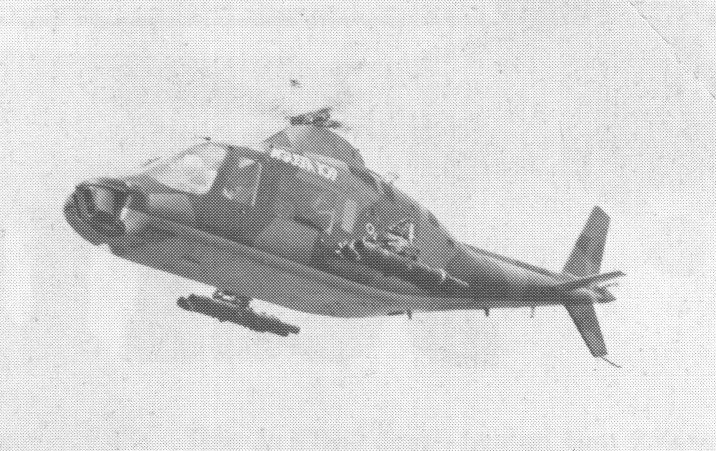
The first mass-produced helicopter designed by Agusta, the A 109 Hirundo (Swallow), was originally intended to be powered by a single 740hp Turbomeca Astazou XII turboshaft but was redesigned in 1967 for two Allison 250-C14 engines.
Feasibility studies for a medium-capacity helicopter – the A.109 – began in 1969. Wind tunnel tests, lasting almost a year, enabled the characteristics of the new helicopter to be greatly refined. Once the basic project had been drawn up, final design work of parts and equipment began in spring 1970, and in the summer, detailed construction work was started. The aircraft was assembled in spring 1971 and the prototype (NC7101) made its first flight on 4 August 1971 from the Cascina Costa plant. It was piloted by Ottorino Lancia, accompanied by Paolo Bellavita, who had developed the aircraft together with Bruno Lovera. Owing to a minor accident, testing was resumed some time later, in 1972, using the second prototype, as well as a special static test rig for the dynamic components. In 1973 a third prototype in military configuration was developed, together with a fourth model for civil use and an airframe for static tests. The A.109 has a four-blade articulated rotor, especially designed for fast flight. The rotor blades are honeycomb structure with a light alloy skin and extensive structural bonding. The fuselage is a metal honeycomb with light alloy panels. The cabin can have various internal layouts, with pilot and crew seated side-by-side, two bench seats for two-three people, and a baggage compartment. Behind the cabin is the rear fuselage section, which carries the landing gear units and fuel tanks. The fuel is distributed by electric pumps from two tanks with a total capacity of 550 litres. The two turbine engines are mounted side-by-side but are fully independent. The five prototypes of the A.109 were certified on 30 May 1975. American approval followed two days later on 1 June. Production had already begun with five aircraft for evaluation by the Italian Army. Atlantic Aviation, then the American distributors of the Agusta 109, took out an option on 100 aircraft for the civil market at the same time. The first A 109 pre-production aircraft was not completed until April 1975. Delivery of production machines, designated A 109A, started in 1976. The Agusta 109A has been certi¬ficated for single pilot IFR; 20 January 1977 (Italy); 22 December 1977 (USA). A specialised military utility model, the A 109B, was proposed, but in 1969 this was abandoned in favour of the eight-seat A 109C civil version certificated in early 1989. The A.109C (civil) version had the same four-blade rotor but a completely new fuselage, with cleaner lines and a retractable undercarriage. The hi-tech maritime A 109A ECM (electronic countermeasures) variant has a radar display, direction finder, electromagnetic emission analyser and jamming equipment. Agusta introduced the general purpose Model A.109A Mk.II derivative, which has been modified to improve engine-out performance at high altitudes, and in hot climates. This features an uprated transmission, two 400 shp (276 kW) Allison 250-C20B turboshafts and seating for seven passengers. First delivered in 1981, nearly 200 had been built by 1989, following on from the 150 or so of the original model. From 1985 the Mk II has been available in a ‘wide-body’ configuration with bulged fuselage sides for greater comfort.
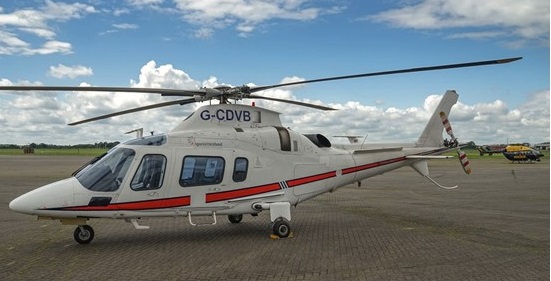
A.109 II ZK-HXI
Belgium has ordered 46 Mk II-Plus versions for Army use. Several military versions of the A.109A Mk.II are offered for armed scout, light-attack, command and control, utility, ESM/ECM, and naval roles. The A.109 MAX is a wide-body medevac variant of the A109 Mk II. The naval variant may be configured for ASW/ASV with a long-range search radar, as well as for SAR, utility, and medevac. It may also be employed, with suitable systems installed, for over-the-horizon guidance of ship-launched Otomat missiles. The Mirach version of the A.109A carries two Mirach 100 battlefield surveillance RPVs, while other reconnaissance/surveillance models can carry Flir equipment.
Developed for multirole hot-and-high missions, particularly in the Middle East and Africa, the A.109K is powered by two 539kW Turbomeca Arriel 1K turboshafts each rated at 575kW for 2.5 minutes, 550kW for take-off (30 minutes) and 471kW maximum continuous power, has a length¬ened nose for additional avionics, and a taller fixed tricycle landing gear. A new composite main rotor hub is resistant to abrasion by sand and dust. The A.109K flew in April 1983, and is primarily intended for two-crew combat missions armed with TOW anti-tank missiles and gun pods. The first flight of the production representative second aircraft took place in March 1984. Main transmission uprated to 671kW for take-off and maximum continuous twin-engined operation; single-engine rating is 477kW for 2.5 minutes and 418kW maximum continuous. Main rotor rpm 384, tail rotor 2,085. Standard usable fuel capacity 750 litres, with optional 150 litre auxiliary tank for EMS operations, or 200 litre auxiliary tank in the A109KM. Self-sealing fuel tanks optional. Independent fuel and oil system for each engine.
The Italian Army’s advanced observation helicopter, the A.109EOA, is similar in configuration to the A.109K but is powered by twin uprated Allison 250-C20R engines giving better performance than the standard -C20Bs of the A.109A.
Both the A 109 EOA and A 109K feature fixed undercarriage and a lengthened nose. PZL in Poland were making all the fuselages for the Agusta A109, AW119 and AW139, before shipping them to Brindisi, Italy, for customour fit-out. PZL also manufactured the A109 and A139 tail booms. Total of all versions delivered by 1 January 1999 was 621, of which 513 civil and 108 military. The Power has two Allison 250-C20R/1 turboshafts, each rated at 335kW for 5 minutes for T-O and 283kW maximum continuous; flat rated at 258kW for twin- engine operation; engines mounted side by side in upper rear fuselage and separated from passenger cabin and from each other by firewalls. Transmission ratings 589kW for take-off and 567kW for maximum continuous twin-engined operation, with maximum contingency rating of 607kW for 6 seconds. Rating for single-engined operation is 336kW for take-off (5 minutes limit). Two bladder fuel tanks in lower rear fuselage, combined capacity 560 litres, of which 550 litres are usable. Refuelling point in each side of fuselage, near top of each tank. Oil capacity 7.7 litres for each engine and 12 litres for transmission. Provision for internal auxiliary tank containing up to 150 litres of fuel.
Two of Argentina’s four A 109As were captured during the 1982 Falklands War and were used by the British.
Variants:
A.109 Hirundo Eight-seat executive helicopter with streamlined fuselage incorporating vertical fin and tailplane, 4-blade main rotor, retractable tricycle u/c, 2345kg TOGW and powered by two 420shp Allison 250-C20B turboshafts. Prot. NC7101 FF 4 Aug. 1971.
A.109A A.109 with additional ventral fin, structural strengthening and 2585kg TOGW. Initial production model, powered by twin 313kW Allison 250-C20B turboshaft engines. Replaced by A 109C Mk II from September 1981.
A.109A Mk.II Single-pilot IFR certificated version of A.109A with two 450shp Allison 250 C20R/1 engines, increase in transmission rating; new tail rotor driveshaft with two-point suspension; increased tail rotor blade life and reliability through use of Nomex core material and improved bonding techniques; new self- damping engine mounts; new integral-design oil coolers and blowers; redesigned tailboom; higher-pressure hydraulic system; improved avionics and instrument layout; additional access panels; and removable floor in baggage compartment. A utility version with less sophisticated interior and instrumentation was also available from 1983.
A 109A Mk II Plus Special law enforcement model.
A.109A TOW Military A.109A with externally mounted Hughes TOW missile tubes and nose-mounted ranging module.
A. 109BA Anti-tank version for Belgian Army.
A 109C Certificated in USA by Agusta Aerospace Corporation in early 1989; approved for single-pilot IFR operation; transmission uprated from 552kW to 589kW; ‘wide-body’ cabin; new composites main rotor blades; Wortmann aerofoil on tail rotor; strengthened landing gear; maximum T-O weight raised to 2,720kg, affording 109kg increase in payload. Other civil/public service roles include law enforcement and coastal patrol with 360° radar. Military version A.109CM.
A 109CM Military version of civil A 109C powered by two 335.6kW Allison 250-C20R/1; can have sliding doors and fixed landing gear; ventral fin removed; first customer Belgian Army (Agusta designation 109BA) with 18 scout versions and 28 anti-tank versions designated 109HO and 109HA respectively by customer; ordered 1988; first delivery, from offset supplier Sabca, February 1992; first 109BA with equipped weight reduced to originally specified 1,944kg delivered 25 November 1992; maximum T-O weight increased to 2,850kg; this was 11th of 46 109BAs; composites sliding doors, relocated batteries and custom Collins/Alcatel Bell avionics; scouts have roof-mounted Saab Helios stabilised observation sight; anti-tank system has roof-mounted Saab/ESCO HeliTOW 2 sight and TOW-2A missiles on lateral pylons; firing trials completed in Sardinia late 1992. Last Belgian aircraft delivered 4 February 1994.
A.109D Experimental A.109K-2 with retractable u/c, new rotor head with titanium hub and Allison 250-C22 turboshaft.
A.109 EOA Military A.109A for Italian Army with sliding doors, fixed u/c, external ordnance points and two 450shp Allison 250 C20R/1 turboshafts. 24 (16 EOA-1 and eight EOA-2) delivered in 1988 as Elicottero d’Osservazione Avanzata to Aviazione dell’Esercito; fitted with sliding doors, roof-mounted SFIM M334-25 daytime sight with CILAS laser ranger, variety of armament options, fixed landing gear, crashworthy fuel tanks and ECM. Maximum flight weight with slung load 2,850kg.
A.109E Power A.109D with fixed u/c, wider cabin, redesigned instrument panel and controls, modified tailfin and two 732shp Pratt & Whitney PW206C turboshafts. Prototype registered I-EPWR.
A 109 G di F Special version for coastal patrol, equipped with an integrated Mission Equipment Package (MEP) including various communication and navigation systems, 360° search radar RDR-1500, and searchlight, FLIR, and weapon systems such as pintle-mounted MG-3 machine gun.
A. 109K Military version of A.109A with revised nose profile, redesigned engine compartment and uprated transmission, external stores hardpoints, optional fixed u/c, composite main-rotor head with elastomeric bearings and composite blades with hard surface coating; new tail rotor of Wortman blade section; longer nose-to-house additional avionics and 722shp Turbomeca Arriel 1K turboshafts for enhanced hot & high operations. Also known as A.109KM and A.109KN (Naval version).
A.109K2 Civil hot and high rescue version with special avionics, fixed u/c, new fuel tanks. Tail skid replacing ventral fin, 771shp Arriel 1K1 engines, rescue hoist etc. Prototype registered HB-XWA.
A 109K2 Law Enforcement Dedicated police version; optional equipment includes 907kg cargo hook, 204kg capacity variable speed rescue hoist with 50m of cable, rappelling kit, wire-strike protection, SX-16 searchlight, MA3 retractable light, external loudspeakers, emergency floats, GPS, FM tactical communications, weather radar, LLTV and FLIR.
A.109KM Military version of A.109K2 with external braced hardpoints, fixed landing gear and sliding side doors.
A 109KN Shipboard version with equivalent roles to A 109KM, including anti-ship, over-the-horizon surveillance and targeting and vertical replenishment.
A 109 LUH Light utility version for the South African Air Force (SAAF) with Turbomeca Arrius 2K2 engines; production and final assembly by Denel. Orders placed for 30 aircraft, plus 10 options.
A.109 MAX Medevac version certificated in USA by Agusta Aerospace Corporation early 1989 with large upward-opening bulged doors and fairings give 3.96cu.m cabin volume and allow for two stretchers across main cabin and three sitting attendants/patients
Agusta 109 Engines: 2 x Allison 250 C20B, 420 shp TBO: 1,500 hrs Main rotor dia: 36 ft. 1 in Length: 36 ft. 7 in Height: 9 ft. 6 in Disc loading: 5.3 lb/sq.ft Empty wt: 3,224 lb Useful load: 2,176 lb Payload with full fuel: 1,233 lb Gross weight: 5,400 lb Power loading: 6.4 lb/hp Fuel cap: 146 USG/986 lb Baggage capacity: 330 lb Baggage area: 18.4 cu.ft ROC: 1,620 fpm SE ROC: 300fpm Service ceiling: 15,000 ft SE service ceiling: 2,625 ft VNE: 167 kt Max cruise: 150 kt Economy cruise: 129 kt Range @ max cruise (45 min res): 193 nm Range @ economy cruise (45 min res): 238 nm Duration @ max cruise (no res, std tanks): 2.2 hr HIGE: 9,800 ft HOGE: 6,700 ft Seats: 8
A.109A Engine: 2 x Allison 250-C14, 370shp
A.109B Engine: 2 x Allison 250-C14, 370shp
A.109A Mk.II Engine: 2 x Allison 250-C20B, 420 shp / 298kW TBO: 3500 hr Main rotor: 36.1 ft No. Blades: 4 Fuselage length: 10.7 m Crew: 2 Pax: 6 Seats: 8 Length: 45.2 ft Height: 11 ft Max ramp weight: 5730 lb Max takeoff weight: 5730 lb Standard empty weight: 3640 lb Max useful load: 2090 lb Max landing weight: 5730 lb Max sling load: 2000 lb Disc loading: 5.6 lb/sq.ft Power loading: 6.8 lb/hp Max usable fuel: 978 lb Max rate of climb: 1620 fpm Service ceiling: 15,000 ft Hover in ground effect: 9800 ft Hover out of ground effect: 6700 ft Max speed: 147 kt ROC: 515 m/min Normal cruise @ 3000 ft: 142 kt Fuel flow @ normal cruise: 355 pph Endurance @ normal cruise: 2.6 hr Fuel cap: 560 lt
A109-Mk.II Plus Engines: 2 x Allison 250-C20B Cruise: 150 kt Fuel cap: 191 USG Range incl res: 440 nm Max endurance: 4:35 hr Useful load 1 hr fuel: 1168 kg.
A.109C Hirondo Engines 2 x Allison 250-C20R/1 Rotor dia. 11.0 m Max T/O weight 2,720 kg Max payload 907 kg Max useful load 1,110 kg Max cruise 150 kt Max range 780 km HIGE 11,398 ft HOGE 8,000 ft Service ceiling 15,000 ft Seats: 8
A.109E Power Engines: 2 x P&W PW-206C / Turbomeca Arrius 2K1, 631 shp Weight empty: 1590 kg / 3,505 lb Internal load: 2850 kg External load: 3000 kg Max take off weight: 6284.3 lb / 2850.0 kg Rotor Diameter: 36.089 ft / 11 m Length: 13.04 m Height: 11.483 ft / 3.5 m Maximum Rate of Climb: 9.8 m/s Service ceiling: 13301 ft / 4054 m Cruising altitude: 4987 ft / 1520 m Max. speed: 168 kt / 311 km/h Cruising speed: 162 kt / 300 km/h Range: 948 km Endurance: 4 h
A.109 EOA Engine: 2 x Allison 250-C20R
A.109K/KM Engine: 2 x Turbomeca Arriel 1K1, 722 shp (538 kW) Rotor dia: 11.0 m Max T/O weight: 2,850 kg Max payload: 1,197 kg Max speed: 142 kt Max range: 580 km HIGE: 18,600 ft HOGE: 15,190 ft Crew: 1 Passengers: 7
A.109K2 Engine: 2 x Turbomeca Arriel 1K1, 550 kW Rotor dia: 11 m MTOW: 2720 kg Useful load: 1100 kg Max speed: 152 kt Max cruise: 145 k Max range (max payload): 543 km HIGE: 18,602 ft HOGE: 15,190 ft Service ceiling: 20,000 ft Crew: 1 Pax: 7
A.109KN Engine: 2 x Turbomeca Arriel 1K1, 575 kW MTOW: 2850 kg Max speed: 142 kt Max range: 543 km HIGE: 18,600 ft HOGE: 15,1900 ft Crew: 2
Ago Ao 192 B Der Kurier Engine: 2 x Argus As 10 E, 266 hp Fuel capacity: 108 gal / 410 lt Oil capacity: 10 gal / 38 lt Length: 36.024 ft / 10.98 m Height 11.942 ft / 3.64 m Cabin area: 30.785 sq.ft / 2.860 sq.m Cabin volume: 106 cu.ft / 3 cu.m Freight hold area: 15.823 sqft / 1.47 sq.m Undercarriage width: 10.105 ft / 3.08 m Wheel Diameter (Main): 2.264 ft / 0.69 m Wingspan: 44.423 ft / 13.54 m Wing chord: 7.054 ft / 2.15 m Wing chord root: 7.776 ft / 2.37 m Wing chord tip: 2.559 ft / 0.78 m Aspect ratio: 7.35 Wing trapezoid ratio: 3.04 V-Form Angle: 7.60 Wing Sweep Angle: 15.60 Wing area: 269.531 sqft / 25.04 sq.m Area of elevons: 24.111 sqft / 2.24 sq.m Flap area: 38.966 sqft / 3.62 sq.m Area of vertical fin: 25.726 sqft / 2.39 sq.m Rudder area: 10.549 sqft / 0.98 sq.m Area of horizontal stabilizer: 31.646 sqft / 2.94 sq.m Area of elevator: 55.758 sqft / 5.18 sq.m Propeller Diameter: 7.546 ft / 2.3 m Propeller blades: 2 Wood Max take off weight: 6306.3 lb / 2860.0 kg Weight empty: 4024.1 lb / 1825.0 kg Max. payload weight: 2282.2 lb / 1035.0 kg Max. weight carried: 2690.1 lb / 1220.0 kg Max. speed: 178 kts / 330 km/h Landing speed: 49 kts / 90 km/h Cruising speed: 154 kts / 285 km/h Take off distance: 902 ft / 275 m Landing distance: 771 ft / 235 m Initial climb rate: 1023.62 ft/min / 5.2 m/s Climb rate: 826.77 ft/min / 4.2 m/s Service ceiling: 17060 ft / 5200 m Range: 594 nm / 1100 km Endurance: 4 h Crew: 1 Pilot, 1 Radio/navigator Payload: 6 Passengers
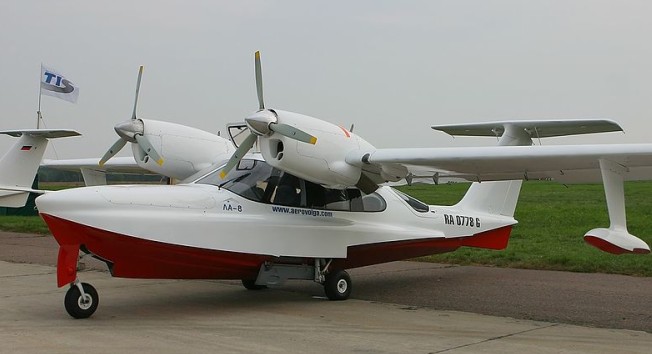
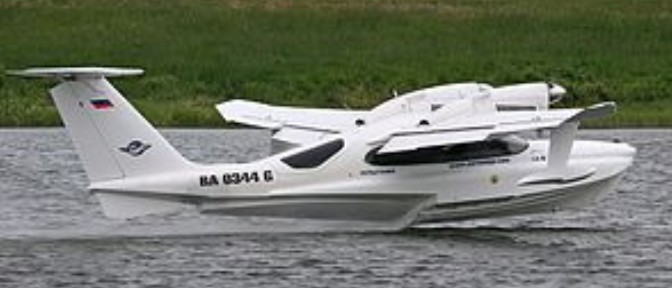
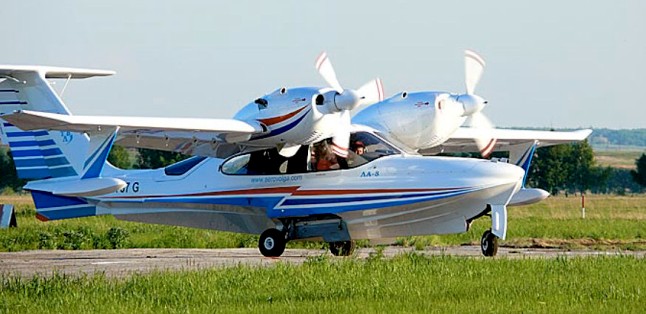
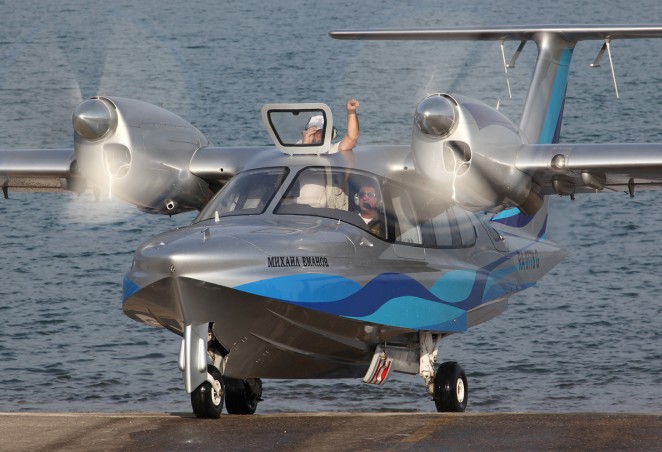
The AeroVolga LA-8 8 seat amphibious aircraft has its origin with the Chaika L-6, first flown in 2000, and its immediate successor the L-6M, promoted by AeroVolga and first flown in 2001. Both of these were twin engine, V-tailed amphibious aircraft, the latter differing in its hull design, undercarriage and maximum take-off weight. Chaika developed the L-6M into the L-4 and AeroVolga developed it into the LA-8. These are very different designs: the LA-8 has a T-tail and is some 25% longer than the L-4, with tricycle gear.
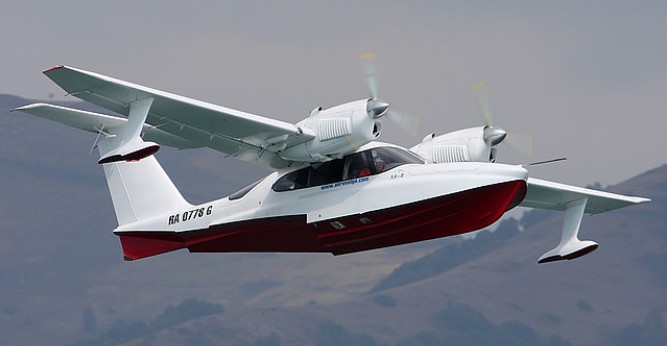
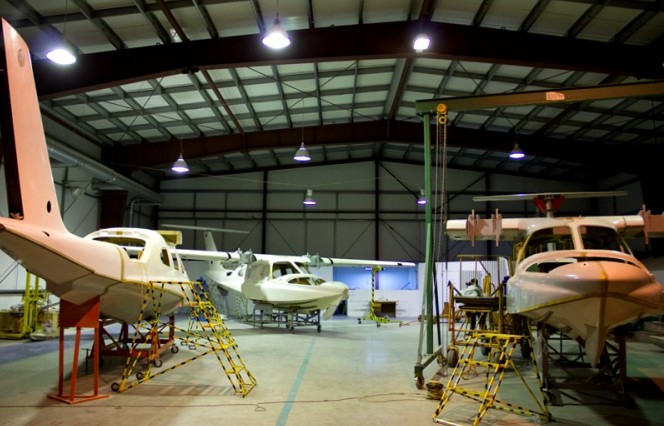
The LA-8 is largely built from plastic foam and PVC filled glass fibre sandwich. Its wing is divided into watertight compartments. The amphibian is a cantilever high wing monoplane with straight tapered wings; most of the sweep is on the trailing edge. First flown on 20 November 2004, the prototype originally had downturned wing tips but these were replaced with extended upturned tips by 2006 and by early 2011 a later aircraft had winglets which extended both above and below the tips. There is no dihedral. Its twin engines are placed above and ahead of the wing leading edge, as close to the centre-line as the clearance between propeller and fuselage allows. The prototype was powered by two LOM M337AK air-cooled six-cylinder supercharged inverted inline engines.
The basic version of the power plant (C-version) is two piston engines LOM PRAHA M337C-AV with take off power 235 HP. The engines are equipped with supercharge and timing fuel injection system. Time between scheduled maintenance of engines is 100 hours, motor oil replacing time is 200 hours.
The LA-8L variants have 175 kW (235 hp) Lycoming IO-540 air-cooled flat-sixes. Turboprop engines are TP-100 (250 HP) or АI-450 (300 HP).
First prototype in 2008, with upturned tips
The two step hull is also subdivided into watertight compartments. Two fixed underwing stepped floats at about 75% span stabilize the aircraft on water. The cabin is under the wing, with two long continuous transparencies, one on each side plus two shorter panels in the main entry hatch in the rear roof behind the trailing edge. There is seating for eight, including one or two pilots. The LA-8’s T-tail has a slightly tapered, straight edged, swept fin with a sub-fin extension; both the rudder and the single piece, externally mass balanced elevator have electrically actuated trim tabs.
The LA-8 has a tricycle undercarriage with mainwheels retracting into the fuselage sides and the nosewheel retracting rearwards. A ballistic parachute is an option.
The aircraft has a composite high wing, with T-shaped stabilizer. The main fuel tanks with a capacity of 455 liters (for RS-version – 1 400 liters) are located in the wing of the aircraft. For C-version and L-version it is possible to install the additional fuel tanks in winglets, with total capacity 100 liters.
Two mooring rings are located on the lower surface of the wing, one – in the nose part, one – on the aft. Two cleats are located near the hatch. The cleats can be either fixed or retractable into frame.
There are four knots on the top of the aircraft, for which the aircraft can be lifted by crane onto the deck of the ship and the dock with using a standard four-point brace. The aircraft can be equipped with lifting eye bolts and two sling-adapters.
Ground power unit (GPU) is plugged to the standard onboard socket and allows starting the engines and charging on-board batteries.
The landing/taxi LED lights cluster is installed in the left wing. The quad xenon land light is installed in the right wing. The navigation lights (left and right) are located in the winglets, in the tail part of the fuselage the tail light and anti-collision light are installed, on the fin tip is located the parking light switched on in the water.
Landing gear is tricycle type, with the nose strut. Wheel suspension is wishbone, with gas-fluid absorbers. For manufacture of landing gear it is used special high-quality stainless steel and special coverings with high resistance to seawater. The specially designed landing gear allows to land on unpaved ground. The landing gear retraction/extension is performed by hydraulic drive; emergency main struts extension is performed under its own weight, the nose strut extension is performed by backup pneumosystem.
The emergency extension of all struts is performed under their own weight in RS-version. The working of hydraulic system and emergency pneumosystem is controlled by two pressure gauges mounted on the pilot’s instrument panel.
Indication of the landing gear position is designed specifically for amphibian aircraft, when landing on the water surface is performed with retracted landing gear. So the position of retracted landing gear is displayed as bright-blue color, extended – as yellow color. The additional visual control of position of the landing gear can be made by using panoramic mirrors located on the floats.
For controlling the aircraft when moving on water the different engine thrust or reverse thrust is used, for controlling the aircraft movement on land – separate braking wheels. The brakes are hydraulic, on control pedals. Both main wheels can be stopped by parking brake.
Control of the aircraft is possible from the right or left pilot’s seats which are equipped with control columns and pedals. For locking the elevators and ailerons when standing the safety pin with red marker is inserted into the control column support.
Autopilot is controlled from the central instrument panel and the button of autopilot emergency cutoff is on the control wheel. Control of engines, propellers and trimmers are located on the centre console between pilots.
Engine control levers allow operate as straight thrust as reverse thrust. In order to prevent the propellers transition to reverse mode during flight engine, control console is equipped with computer controlled reverse lever lock disabling reverse activation at speed over 100 km/h and more than 1 400 RPM.
Flaps are controlled by electric drive. The flaps position is controlled by indicator or visually. RS-version of the aircraft normally (other versions – optional) is equipped with automatic follower-up control system of the flaps, where required flap angle from 0 to 40 degrees is set by flap position selector, after that automatic equipment set the flaps into appointed position.
Pilot’s seats have a system of longitudinal movement which provides comfortable seating and adjustment for pilots which are from 160 to 200 cm in height. For convenient seat adjustment the handrail is mounted in the cabin. The design of the seat pan allows using individual anatomic cushion.
The main access door is located in the top tail part of fuselage and designed to provide boarding the aircraft as well on land as in water. The hatch opens up. The dimensions of hatch allow to load long-measuring freight and as well a patient on special stretcher. Gas jacks provide easy hatch opening and closing and locking device – fixing the hatch opened. Hatch lock mechanism provides a two-level protection against accidental opening, allowing, at the same time, almost instantaneous opening hatch, both inside and outside. To access to the cabin is used embedded folding ladder, the design of which allows, if necessary, to climb back on board for swimmers.
There are two emergency exits on left and right sides. Sliding transparent vents are embedded in windshield of hatches. At the top of the cabin there is the access hatch. The windscreen of the cabin is made from acrylic (PMMA) plastics, with improved athermical properties. The windshield is able to stand standard bird strike. The left windscreen of pilot can be equipped with electrical defrost heating for deicing and besides the left windscreen can be equipped with washer which feed water to remove salt stains.
In the cabin up to eight seats can be installed with two pilot seats included. The rear seats have fold-back and lockers under the seat pan. Each seat is equipped with a mandatory safety belt system.
Above each seat individual lighting, adjustable air ball vent and intercom are installed.
For baggage there are two storage compartments – in the nose of the aircraft and in the rear part of the cabin. For small items there are special pockets and niches. The aircraft LA-8C-RS can be equipped with lockable luggage racks.
The aircraft is equipped with two bilge pumps. De-icing system includes electric system of heating the pitot tube, the stall warning indicator, the left pilot windshield, the propeller and the leading edges of wing and tail. Using the M337C-AV engines with compressors and dispersed fuel injection allows eliminating such a dangerous effect as icing the intake system of the engine.
The aircraft is equipped with a speed computer-analyzer which prevents the reverse activation at speed exceeding 100 km/h, as well as the landing gear retraction at speed below 100 km/h. If necessary to retract or extend the landing gear at slow speed (for example on the water or at maintenance works) the lock should be turned off by special switch.
Each propeller is equipped with a centrifugal lock, making it impossible to shift the propeller blades to reverse at 1,400 RPM. Thus to prevent accidental reverse activation in flight there is backup locking system.
Basic power plant is based on the two engines LOM PRAHA M337C-AV with take-off power 235 HP and continuous power of 210 HP each. Each engine has six cylinders in line (capacity of 6 liters, 366 cubic inches). The engines are invert. Such design of the engine provides the minimum aerodynamic resistance of power plant. The engines are equipped with mechanical superchargers and keep power to altitude of 1 200 m. Also the engines are equipped with timing fuel injection which provides record low fuel consumption up to 0,195 kg (kw/h) and have automatic altitude fuel-air mixture correction
The German propeller MTV-12-D-C-F-R(M)/CFR190-53 with constant speed, hydraulic control, reverse and feathering are installed.
The aircraft can be equipped with LYCOMING 540 of 235HP to 300HP, as well as turboprop TP-100 or AI-450 engines with propellers “AVIA” or MT.
In case of using LYCOMING engines it is possible to install HOFFMAN V-123 propellers with increased starting thrust.
The aircraft can be equipped with auxiliary power unit with generator of 1 500W to increase the independency of the aircraft.
The main electrical network of the aircraft is DC 27V. Energy supply is DC generators. Basic battery of 24V/16 Ah or also the battery of 24V/20 ah can be installed.
Power supply of power-consuming devices such as de-icing devices is performed by AC 42V from the additional generators mounted on the engines. To be able to connect devices with a voltage of 12V can be installed static converter with power up to 250 W.
The main flight instrument is GARMIN G500 avionics display system certified for multiengine piston aircrafts with take off weight up to 5 700 kg and flight altitude up to 6 000 m. The display consists of two monitors.
For better maneuverability of the aircraft on the water is provided the small boat engine installation.
The design of the aircraft allows its quick (within 15 minutes) transformation from a passenger (main) version into cargo version. On the rails of the floor are installed strapping shoes for mooring cargo or cargo mash. Re-equipment of the aircraft is performed from passenger modification into air ambulance less than 30 minutes.
The design of the wing (version RS) allows to mount two underwing containers weighing up to 150 kg each.
It is possible to deliver LA-8 as hydroplane with fast mounted undercarriage (mounting and dismantling take not more 10 minutes) and removable ski set for winter operation. The useful load of LA-8H is 1180 kg (1215 kg for RS-version).
SPU “AeroVolga” offers a unique modification of the fire-monitoring aircraft LA-8 FF (2 person crew) with the possibility of taking onboard 1000 liters of water in the planing mode, water drop (foam-water mixture) during 2 sec from the altitude up to 5 m at speed of 180 km/h and duration for fire monitoring up to 5 hours.
The patrol modification of the aircraft based on LA-8C-RS with radio and video monitoring set of surrounding area can stay in the air up to 14 hours with crew of 4 people. The crew is provided by dry closet, galley and a place for rest for one person as well as multi-channel communication protected system
The first-aid modification of the aircraft based on LA-8C-RS with medical equipment weighing up to 180 kg allows two doctors to resuscitate a patient (injured) during the flight up to 5 hours (1000 km).
In 2013 the aircraft are delivered with airworthiness certificate under FAP-118 Russian Federation at the moment.
The LA-8 first prototype flew for the first time on 20 November 2004 with test pilot M.M. Emanov. The first production aircraft flew in August 2006 and the first Lycoming powered machine was completed in mid-2010.
In 2006 the aircraft was modified with series 37 engines: М-337C with power increased by 25%, and specific fuel consumption reduced by 15%. In 2008 the Lycoming 540 (235 h.p.) engine was integrated.
The first flight tests of the LA-8 were carried out successfully. Takeoff from water showed good characteristics: exit to the glideslope is 45 km/h, take-off is 90 km/h, the length of takeoff of an empty plane is 200 meters. Prototyprs 1 and 2 conducted more than 200 hours of factory flight tests.
Certification works are carried out according to Russian aviation rules (АR-23,21) correspondent to international FAR; JAR.
By mid-2012 six LA-8s had been produced for customers as well as the three prototypes. Two were with Russian operators, one flying around Lake Baikal and the other on Lake Seliger. Two went to an operator in Montenegro. Another five have been sold to Rimos Ltd for work in the Persian Gulf; by July 2012 two of these had been delivered.
Seagoing ability allows operating with wave height up to 0,6 m. Minimum length of runway is 400 m. Runway absolute altitude up to 1 500 m for piston version and 2 500 m for turboprop version.
Variants:
LA-8C Baseline version powered by 2x 175 kW (235 hp) LOM Praha M-337C-AV01.
LA-8C-RS Long range version of LA-8C, powered by 2x 175 kW (235 hp) LOM Praha M-337C-AV01.
LA-8L-RS Long range version of LA-8L, 2x 175 kW (235 hp) Lycoming IO-540B4B5 engines.
LA-8HC Flying boat / Hydroplane / skis based on the LA-8C
LA-8HL Flying boat / Hydroplane / skis based on the LA-8L
LA-8LDM High specification variant.
LA-8FF Fire-fighting variant.
Specifications:
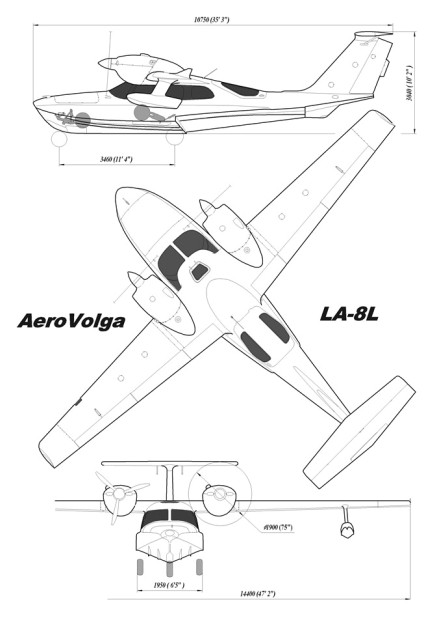
LA-8 Length: 36,42 ft Wing length: 46 ft Ramp height: 11,15 ft Maximum width of fuselage: 6,56 ft Track of landing gear: 6 ft Wheelbase of landing gear: 11,23 ft Wing area: 217,4 sq.ft Maximum takeoff weight: 5997 lb Maximum useful comercial load: 1764 lb Maximum fuel capacity (ferrying): 396,3 gal Maximum altitude: 14760 ft Maximum allowable speed: 189,5 ktas Maximum speed of horizontal flight: 170,9 ktas Cruise speed (economy): 146 ktas Range (payload 1764 lb): nm (max) Range max: 2160 nm Endurance (max tow): 5,6 hr Rate of climb: 787-1181 ft/min Runway length land (max t.o.w.): 1148 ft Runway length water level (max t.o.w.): 1476 ft Landing speed (at maximum weight): 53 ktas Maximum overload: +3,8 -1,9G Passenger Cabin length: 11,32 ft Passenger Cabin width: 5,381 ft Passenger Cabin height: 4,068 ft Cabin capacity: 130,7 cu.ft Maximum length of cargo: 14,53 ft Front upper access door: 1,47 х 1,90 ft Rear upper access door: 5,545 x 4,232 ft Emergency doors (left, right): 2,23 х 2,23 ft
LA-8C Empty weight: 1 685 kg Maximum take-off weight: 2 720 kg Maximum useful load: 1 035 kg Range 630 kg payload opt tip tanks: 1 400 km
LA-8C-RS Engines: 2x 175 kW (235 hp) LOM Praha M-337C-AV01. Empty weight: 1 650 kg Maximum take-off weight: 2 720 kg Maximum useful load: 1 070 kg Maximum range: 4 000 km
LA-8L-RS Engines: 2 × Lycoming IO-540B4B5 air-colled flat six, 175 kW (235 hp) each Propellers: 3-bladed Hoffman HO-V123K, 1.95 m (6 ft 5 in) diameter Length: 10.80 m (35 ft 5 in) Wingspan: 15.00 m (49 ft 3 in) Height: 3.14 m (10 ft 4 in) Wing area: 22.10 sq.m (237.9 sq ft) Airfoil: P-lll-15 Empty weight: 2,000 kg (4,409 lb) Gross weight: 2,720 kg (5,997 lb) Maximum speed: 259 km/h (161 mph; 140 kn) Cruising speed: 220 km/h (137 mph; 119 kn) normal Stall speed: 86 km/h (53 mph; 46 kn) power off, flaps down Service ceiling: 5,000 m (16,404 ft) g limits: +3.8/-1.9 Take-off run, land: 350 m (1,149 ft) Take-off run, water: 450 m (1,477 ft) Crew: One or two Capacity: max 7 passengers.