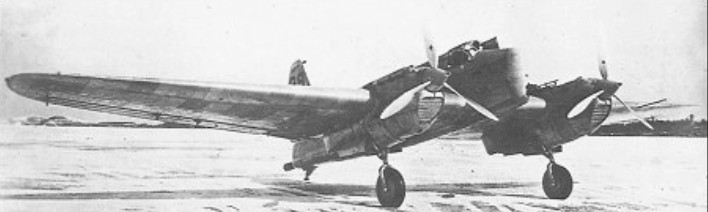
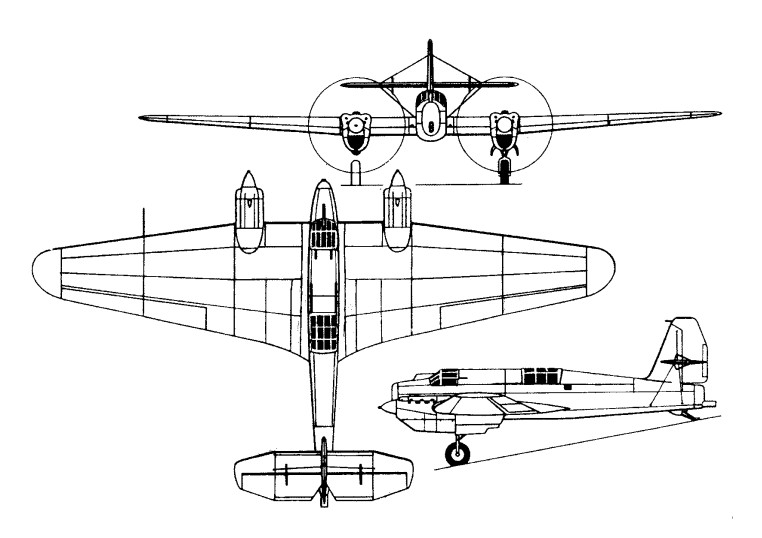
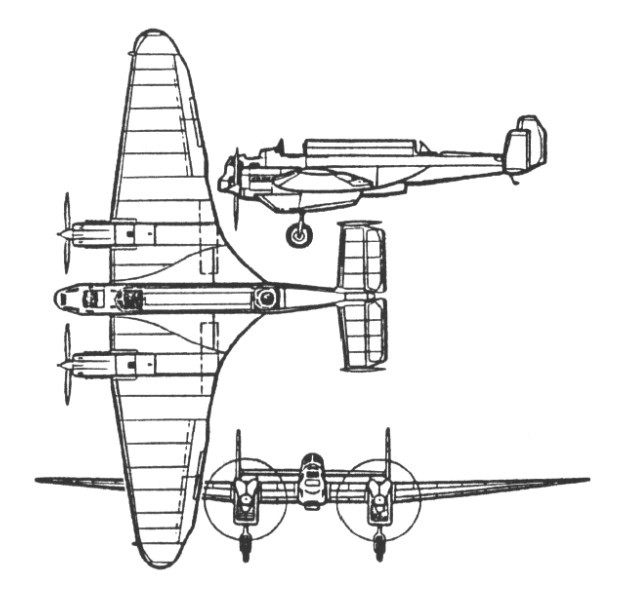
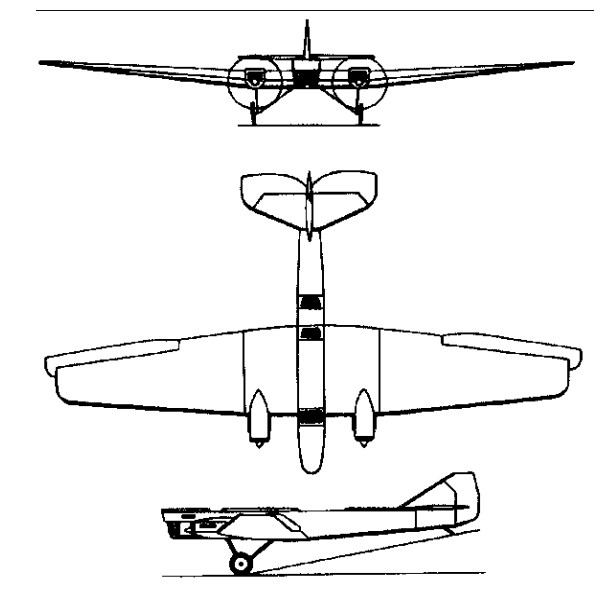
A progressive development of the basic ANT-21bis design, the ANT-29 was a DIP (Dvukhmotorny istrebitel pushechny, or twin-engined cannon fighter) designed by Aleksandr Arkhangelski’s brigade. Of flush-riveted all-metal construction and powered by two 760hp Hispano-Suiza 12Ybrs 12-cylinder liquid-cooled engines, the ANT-29 carried a 102mm Kurchevski DRP, a recoilless gun of 4.00m length, the exhaust gases of which were discharged through a steel tube projecting from the rear of the fuselage. This weapon was hand-loaded by the second crew member. In addition, one 20mm cannon was mounted in each wing root and provision was made for a dorsally-mounted 7.62mm machine gun. Priority assigned to other programmes delayed completion, and flight testing of the ANT-29 did not begin until the end of 1935, although the prototype had been rolled out in the previous February. State acceptance testing was scheduled for the first half of 1936, but, in the event, never took place as numerous problems were revealed by factory testing, including serious longitudinal instability. The project was abandoned after a loss of interest in Kurchevski’s recoilless guns for which the ANT-29 had been designed. These had suffered repeated failures leading to Kurchevski’s arrest and subsequent disappearance.
Engines: two 760hp Hispano-Suiza 12Ybrs 12-cylinder Max take-off weight: 5300 kg / 11685 lb Empty weight: 3900 kg / 8598 lb Wingspan: 19.19 m / 63 ft 0 in Length: 11.65 m / 38 ft 3 in Max. speed: 352 km/h / 219 mph
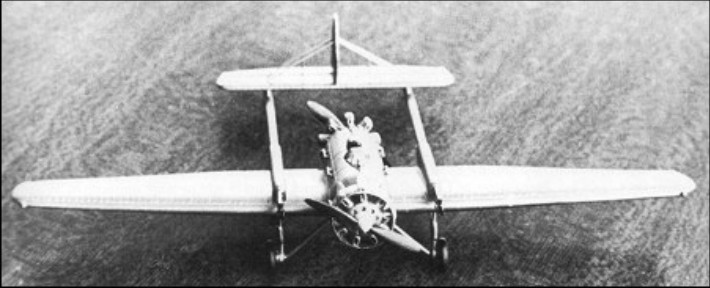
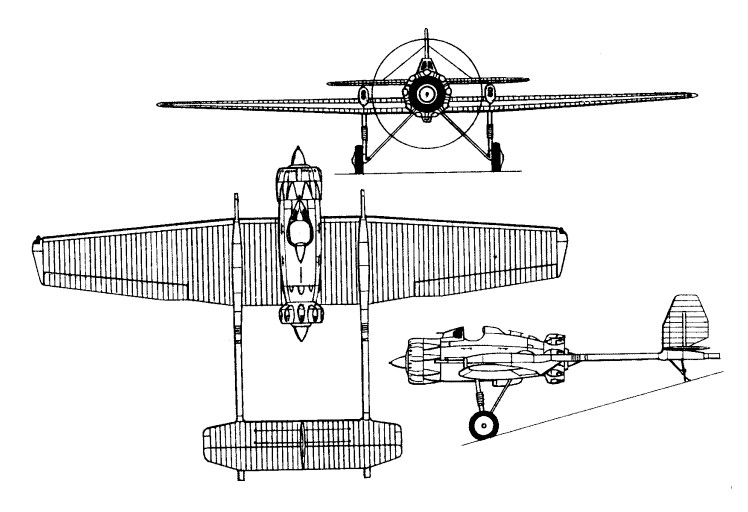
Of unconventional design in employing a tandem fore-and-aft engine arrangement and twin tailbooms embodying recoilless gun tubes as integral, but non-load-carrying, structural components, the ANT-23 single-seat fighter was conceived at the AGOS TsAGI by Viktor N Chernyshov, one of Tupolev’s brigade leaders. Of all-metal construction with smooth stressed skinning for the fuselage and wing – the latter and the tail surfaces being strengthened by externally-attached inverted “U” strips – and tail covering, the fighter was powered by two 525hp Gnome-Rhone 9AK nine-cylinder air-cooled radial engines.
Armament consisted of two 76mm Kurchevski APK-4 recoilless weapons which were embodied in the tailbooms, the gun gases being discharged from their tails. Known unofficially as the Baumanskii Komsomolyets – in memory of the pre-revolutionary Communist after whom the district in which the TsAGI was situated was named – and officially as the I-12, the ANT-23 was first flown in late December 1931. Flight testing continued through early 1932, but, on 19 May, the port gun exploded, the tail-boom collapsing on touchdown. The aircraft was overweight and suffered substantially higher drag than had been calculated. Chernyshov and his team were developing a means of jettisoning the aft propeller to afford safe escape for the pilot in an emergency, but, at the beginning of 1933, the ANT-23 was abandoned.
Engines: two 525hp Gnome-Rhone 9AK nine-cylinder air-cooled radial. Max take-off weight: 2400 kg / 5291 lb Wingspan: 15.60 m / 51 ft 2 in Length: 9.50 m / 31 ft 2 in Wing area: 30.00 sq.m / 322.92 sq ft Max. speed: 300 km/h / 186 mph Armament: two 76mm Kurchevski APK-4 recoilless
Designed at the KOSOS (Konstruktorski otdel opytnovo samolyetostroeniya, or Design Department for Experimental Aircraft Construction) within TsAGI by a brigade headed by Aleksandr A Arkhangel’sky, the ANT-21 MI (mnogomestnyi istrebitel – multi-seat fighter) was, by international standards of its day, very much state-of-the-art. Featuring all-metal stressed-skin semi-monocoque construction with partial flush-riveting and a retractable main undercarriage, the ANT-21, which was assigned the service designation MI-3, was powered by two M-17B (BMW VI) 12-cylinder water-cooled engines of 680hp. Proposed armament consisted of one 12.7mm machine gun or 20mm cannon on a pivoted nose mounting, two 7.62mm guns firing from a dorsal position and a single 7.62mm gun firing from a ventral tunnel. Three crew members were carried.
Work on the ANT-21 began on 18 January 1932, first flight taking place in August 1933. On 14 September, the starboard rudder suffered damage and separated as a result of violent flutter in a shallow dive. Arkhangel’sky elected to undertake major redesign as the ANT-21bis.
ANT-21bis
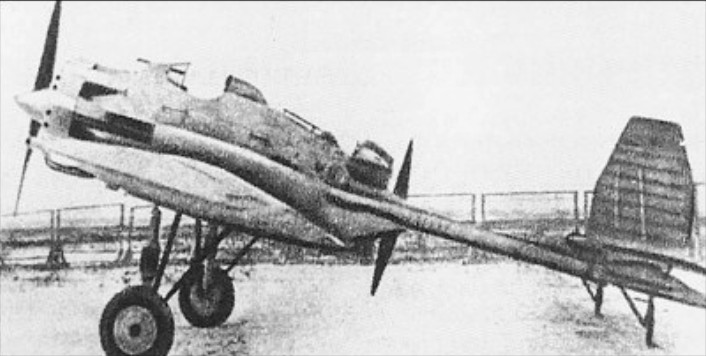
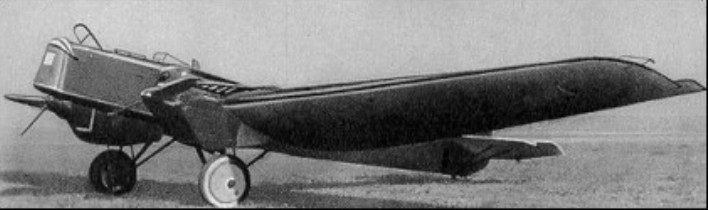
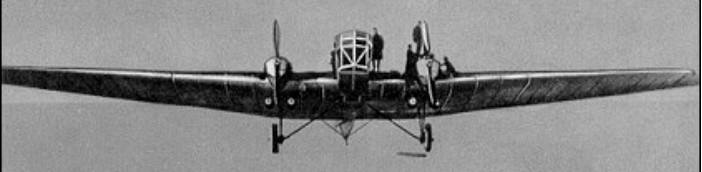
Retaining the wings, engines and undercarriage of the ANT-21, the ANT-21bis alias MI-3D (the suffix letter indicating dubler, or, literally, “understudy”) mated these elements with an entirely new fuselage, which provided enclosed cockpits for all crew members, and a single fin-and-rudder. Completed in April 1934, the ANT-21bis had provision for the same armament as that of the ANT-21, but the ventral tunnel was omitted, the gun being fired instead through a trap. During initial flight trials some tail oscillation at certain power settings led to the introduction of tailplane bracing struts. State acceptance trials were conducted between July and December 1934, but the results were somewhat academic as there was little official interest in an M-17B-powered aircraft which had, in any case, been largely overtaken by the ANT-29. Consequently, further work on the ANT-21bis was discontined.
ANT-21 / MI-3 Engines: two M-17B (BMW VI) 12-cylinder, 680hp Max take-off weight: 5500 kg / 12125 lb Empty weight: 3670 kg / 8091 lb Wingspan: 20.76 m / 68 ft 1 in Length: 11.70 m / 38 ft 5 in Wing area: 55.10 sq.m / 593.09 sq ft Max. speed: 359 km/h / 223 mph Range: 1120 km / 696 miles
ANT-21bis / MI-3D Engines: two M-17B (BMW VI) 12-cylinder, 680hp Max take-off weight: 5260 kg / 11596 lb Empty weight: 3800 kg / 8378 lb Wingspan: 20.76 m / 68 ft 1 in Length: 12.30 m / 40 ft 4 in Wing area: 55.10 sq.m / 593.09 sq ft Max. speed: 356 km/h / 221 mph
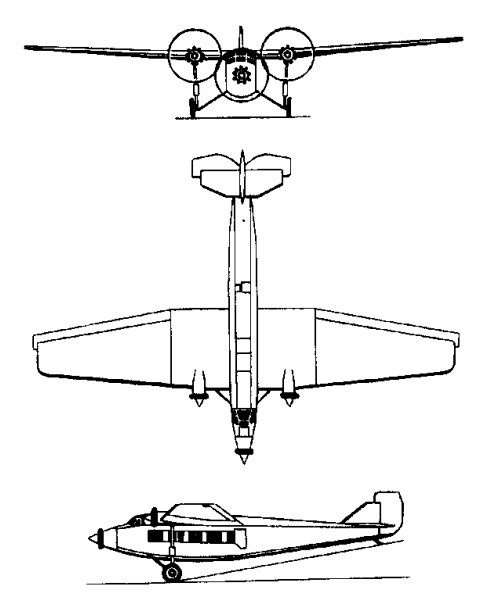
The ANT-9 was created in AGOS TsAGI (the first was called the Tupolev Design Bureau however, in reality, this machine was originally created at the initiative of the military. The very idea of designing a large (by the then standards) passenger aircraft originated in the mid-1927 within the walls of the Office of Air Forces RKKA (Red Army UWS).
The military was aware that the CAF – Air Force Reserve provided additional development of the aviation industry and related industries, the airfield network, and trained cadres of pilots and ground staff. In the event of war, civilian aircraft would join the military transport aviation. Moreover, in wartime, a passenger plane could turn into a battle plane. The question fot the Scientific and Technical Committee (STC) at UWS was whether it will be a bomber with the ability to transport passengers, or an airliner capable of carrying bombs and machine guns.
On October 27th, 1927 TsAGI specified the basic characteristics of the aircraft speed of at least 190-195 km / h, ceiling 4,500-5,000 meters, payload of 750 kg and a crew of three. The first task was to build a passenger ship used as a military transport plane, the second is the creation on its base bomber modification.
Tupolev found a compromise that allowed a fast and relatively cheap build. He proposed to build a passenger aircraft at the military base. On April 9 1928 at a meeting of the STC, Tupolev reported on the conceptual design of the new aircraft, named ANT-9. It was a three-engine all-metal monoplane with the wing overhead.
Tupolev prepared three options for the project with different engines. The first three engines would be the Gnome-Rhone “Titan”, the second and third – a combination of the two American “Wright” J4 and one French Gnome-Rhone “Jupiter.” The number of passenger seats variants differed in total payload, gross weight, as well as range and speed. The plane with the three Titans of 230 hp provided a small gain in speed and range. Tupolev emphasized the use in the project of components and assemblies of other aircraft that were created in the TsAGI – ANT-3 (R-3), ANT-7 (R-6) and ANT-8. Most borrowed from R-6. From it they took wing and tail.
Evaluation of the project considered the aircraft of modern western standard of the same weight carrying capacity. Tupolev was told that the fuselage was overly broad and could be narrowed to 10-15 cm, however, in general opinion was favorable.
A little later, the Commission on the organization of passenger aircraft, established by order of the UWS June 12, 1928 including representatives from the Air Force, TsAGI, Aviatresta, Osoaviahima and airlines’ Dobrolet. ” Chairman was appointed as deputy head of the UWS Ya.I.Alksnisa. Work on the ANT-9, and labor agreement were decided. Total allocated for the design was 100 thousand rubles. Half of this amount allocated Air Force, and others equally “Dobrolet” and Osoaviakhim. According to the agreement concluded with the TsAGI prototype ANT-9 was required to be presented on May 1, 1929
For the first machine of the three chosen engines were 230 hp Gnome-Rhône Titan. This five-cylinder radial air-cooled engine was developed in England by Bristol, while France produced them under license.
The lead engineer was A.A.Arhangelsky, who also designed the fuselage. Wing was engaged in VM Петляков, шасси – А.Н. Petlyakov, chassis – AN Путилов, оперением – Н.С.Некрасов, силовой установкой – братья Е.И. Putilov, feathers – N.S.Nekrasov, propulsion – the brothers E. и И.И.Погосские. and I.I.Pogosskie. September 24 completed the drawing of the general form.
In fact, re-done with the center fuselage, were landing gear and engines. The fuselage had a cross-section, close to rectangular, and made entirely of kolchugalyuminiya – the German equivalent of the Soviet duralumin. Corrugated sheathing was performed, and the closer to the tail, it took over some loads. Increased rigidity of the fuselage diagonal bands. In the nose housed the central engine. The cabin held two pilots and flight engineer. Inside, was a partition passenger compartment, two rows of the left and right of passage, with nine passenger seats. In the interior there were clothes, luggage room and two toilets (in the documents of that time wrote simply – “toilet”).
The center section was manufactured separately from the fuselage and was attached to its upper longitudinal members with four nodes. The fuselage was made entirely of imported special steel.
The engines frames had rubber bumpers to absorb vibration. Gasoline was placed in the wing tanks. The Titans had wooden fixed-pitch two blade props, specially designed to TsAGI. By November the building of the fuselage and wing of the prototype began. In March, proceeded to the strength tests.
Much of the new machine was bought abroad. From Germany, the entire lighting system, batteries, glass cockpit, fabric and artificial leather for the trim, even the mats. Tupolev liked the wicker chairs of “Merkur” from Dornier. Instruments were to be German and American.
Delays in imports is seriously hampered the assembly. The engines arrived late by three months, with no mufflers. The wheels were brought from France in time though, but smaller in diameter – in Paris trade mission members had mixed the size.
On March 27, the Commission agreed that delays should no longer be tolerated, wanting domestic materials and not waiting foreign arrivals. On April 30th, a day ahead of time, the prototype was ready. In appearance the aircraft had woven reed chairs made a small factory near Moscow. For ventilation all the passenger cabin windows opened, as for heating, there was none.
May 1, 1929 saw the ANT-9 in the middle of Red Square, demonstrating the new Soviet aircraft. A huge cart slowly moved the plane to toward Khodynka, Central Airport, at night.
When at the entrance to the airfield the procession began to cross the tram tracks but from the morning mist suddenly popped a tram. The driver did not have time to brake and the car crashed into a plane. Bending the console and completely blew the roof off the tram, the wing is almost not affected.
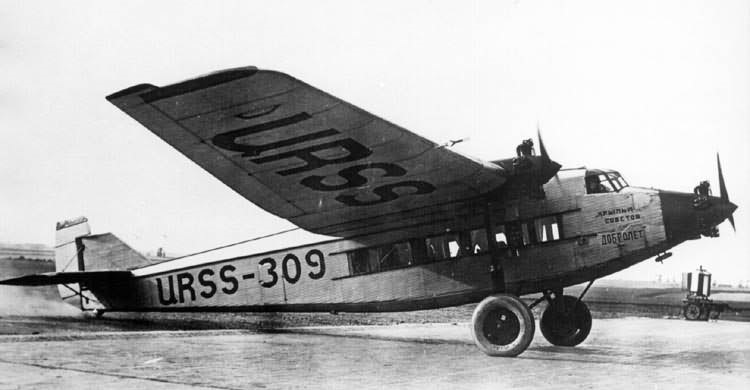
Tupolev ANT-9 (URSS-309) was first flown by M.M. Gromov on May 7 (some sources say 5th), 1929 at Khodynka. Originally it had no registration and was painted in natural metal colors. In May 1929, it was registered as URSS-309.
Just a few days was spent piloted by Gromov for factory testing . The plane was very successful. After the first flight Tupolev brought to the airfield his family, and literally forced the pilots to carry the unplanned passengers.
May 16, 1929 started the state tests in the Air Force Institute. The aircraft was piloted by the same Gromov and Stoman for an engineer. The tests were until 28 May and it was noted that the aircraft is stable, the control force small, with no tendency to stall or spontaneously reverse.
Although the ANT- 9 did not meet the requirements to climb above 1,500 m, the practical ceiling and takeoff distance , an overall assessment of the Research Institute of the report was: ” the ANT -9 is a very good passenger aircraft and some quality is undoubted advantage over the best foreign similar power planes.”
Observations made in the Institute concerned secondary issues and were easy to handle : seizing vent in the cockpit, a high level of noise in the cabin. An important point was insufficient deflection angle of the stabilizer. In addition, employees of the Research Institute clearly seized n the process of refueling with gasoline. From a barrel with bucket into the filler neck. To prepare the machine to fly in such a way it took half a day .
Tests were completed by a small flight Moscow- Serpukhov – Kashira -Moscow . Already on June 6 Gromov, co-pilot Mikheev , Spirin navigator and mechanics Rusakov and Monakhov flew the ANT- 9 to Odessa. It was a kind of rehearsal before the tour on the capitals of Europe, scheduled for July. The appearance of the ANT- 9 in Odessa included a courtesy visit to a group of Italian pilots who arrived in flying boats S.55. Chief of Staff of the Italian Air Force de Pinedo even a little fly on the Soviet machine.
On June 6, 1929 the aircraft left for Odessa. On July 10, 1929, with Tupolev on board taking a vacation in Odessa, with a group of his chief of staff and UWS PI Baranov, and Gromov, heading for Kiev. Approaching to the Dnieper, the plane entered rain. Suddenly the speed of the machine began to fall. When she approached the stall speed, they had to make an emergency landing. Swollen blisters on the props had reduced thrust. Remains of fabric were cut off with penknives. Since the area was too small to take off, a portion of gasoline was sent on foot to a nearby village with passengers. With Tupolev on the plane, Gromov took off safely.
On July 10 the aircraft went on an overseas tour. At this time the crew consisted only of Gromov and the mechanic Rusakov. ANT-9 was carrying a group of pilots and journalists. During the month of the “Wings of the Soviets’ they visited Warsaw, Berlin, Paris, Rome, Marseilles and London. The aircraft behaved perfectly. On the Moscow-Berlin Gromov flew 10:00 against a strong wind. Returning on August 8.
The only unpleasant incident occurred over southern France. ANT-9 suddenly went into a dive, and then began to tremble. The pilot immediately landed on a small meadow. After inspecting the aircraft, he said quietly: “Well, I thought – a coffin.” Buffeting arose from the opened hatch on the center from a burst of vibration of a broken engine mount tube. The tube is welded by a local garage mechanics, and ANT-9 flew on.
The fact that the ANT-9 launch into production, was determined in advance. The plane actually did not exist, and it had entered into a five-year plan for development of civil aviation. In the first option plan, prepared in July 1928, three airlines, then existing in our country – “Dobrolet”, “Ukrvozduhput” and “Derulyuft” gathered over five years to put a total of 148 vehicles of this type into service.
Few had the desire to acquire the new aircraft. The aircraft factories Aviatrest was so overwhelmed with orders and flatly refused to release the ANT-9. At the beginning of 1929 Alksnis even appealed to the President of “Dobrolet” V.N.Ksandrovu with a proposal to build the plant themselves in Voronezh. But even if “Dobrolet” would agree to this, the construction would take a long time, and the ANT-9 were needed now.
Aviatrestu began to “twist arms” at all levels. As a result, its leaders surrendered in April and ordered to start commercial production at the plant 22 in Fili – the only one who has had experience in producing all-metal machines. During the summer of 1929 TsAGI had sent drawings to the plant.
Initially it was assumed that the production ANT-9 would also receive ” Titans”. A large batch was ordered from France, but the fall of 1929 in the U.S. a representative went to a Soviet delegation headed by the Chief UWS PI Baranov. There she was negotiating with “Curtiss-Wright” the corporation on the three types of air-cooled engines; the 165, 225 and 320 hp. The last of them, “Wright” J5, was proposed for use of the ANT-9 instead of “Titans.”
December 28, 1929 meeting of the UWS approved the decision to abandon the French engine and put the U.S. engines in all production machines.
The calculations showed that the more powerful, 320 hp Wright J6 would increase the speed and capacity, albeit at the expense of a decrease in range – the same amount of tanks, more “hungry” engines. Firm “Gnome and Rhonw” was sent a formal notice of termination of the contract. Baranov, in January 1930 ordered a small batch of Wrights.
As a prototype decided to use the prototype ANT-9, replacing motors on it. This operation was enacted to implement by 20 February 1930, but actually did not carry out adaptations. Experienced ANT-9 passed the “Dobrolet” with “Titans.” September 15, 1930 returned to TsAGI. January 29, 1931 is registered as a Soviet-L101, transferred to Aeroflot.
But the entire series of 10 planes, planted at the beginning of 1930 the plant ╧ 22, has already had to get the Wright. Half of the machines designed for the Air Force, the other – for civilian pilots. The first six ANT-9 planned to deliver by July 1. Thus, the “unplanned” trehmotornik went into a series of one year earlier than the P-6, on the basis of which it did.
By the summer of several ANT-9 have already collected, but the motors from the United States do not have time. Since the plant was to carry out the plan, and the supply of engines lay on the responsibility of the customers had to start a “conditional” acceptance cars without engines. One such aircraft was in June and two more – in July. “”Wright” also began to mount in August.
Externally, the ANT-9, “Wright” differed from the prototype only in the absence cooks on the screws and partial nosing engines. The screws have others – U.S. Steel bought the firm, “Steel Propeller Corporation.” By eliminating the shortcomings of the prototype, the course of the stabilizer increased. Empty weight increased slightly, mainly due to motoustanovki.
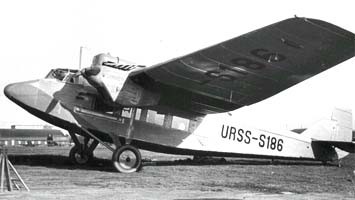
The three 172kW Gnome-Rhone Titan radials were replaced in series machines by domestic M-26s, which proved to be underpowered and were in turn replaced by imported Wright Whirlwinds of 224kW each. After the first batch of some 12 aircraft the design was revised to twin-engined configuration, with two 507kW M-17 engines raising maximum speed from 205km/h to 215km/h; this version was known usually as the PS-9, and about 70 were built.
PS-9
The three-engined ANT-9s served with the Soviet-German airline Deruluft on the Moscow-Berlin service. Some were also operated by the VVS as troop or VIP transports.
The PS-9 was flown widely on passenger services, the most famous being the propaganda aircraft Krokodil, with a suitably decorated plywood nose complete with a set of sharp teeth.
Engines: 3 x 172kW Gnome-Rhone Titan radial Max take-off weight: 6200 kg / 13669 lb Empty weight: 3353 kg / 7392 lb Wingspan: 23.7 m / 78 ft 9 in Length: 16.8 m / 55 ft 1 in Wing area: 84.0 sq.m / 904.17 sq ft Max. speed: 210 km/h / 130 mph Cruise speed: 195 km/h / 121 mph Ceiling: 3750 m / 12300 ft Range: 1800 km / 1118 miles Range w/max.payload: 1000 km / 621 miles Crew: 2 Passengers: 9
Engines: 3 x M-26
Engines: 3 x Wright Whirlwind, 224kW / 365 hp Maximum speed: 205 kph
PS-9 Engines: 2 x M-17, 507kW Maximum speed: 215km/h
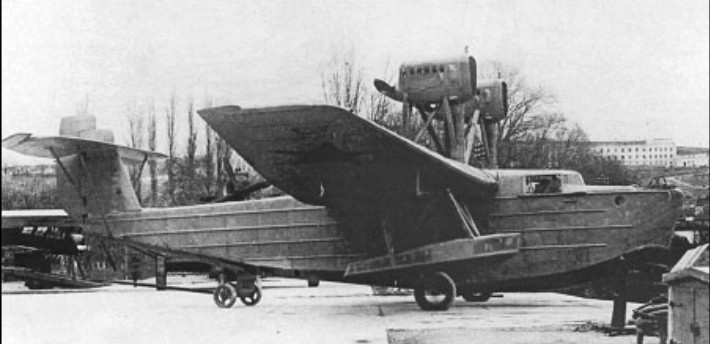
Although Tupolev and the TsAGI had been requested to construct a flying boat in 1925, higher priority had been given to his long-range bomber projects and little work was done. But in 1930, with Ivan Pogosski as head, work began in earnest on the ANT-8, which was given the military designation of MDR-2 (MDR = Morskoi Dalnii Razvedchik = Naval Long-Range Reconnaissance).
The designation ANT-8 indicated how long the TsAGI had held back this project, for shortly after its first flight, the ANT-14 flew. The flying boat’s wings and tailplane were derived from the ANT-9, and again an all-metal construction was chosen. The fuselage was given a lot of attention by the design team, and the opportunity was taken to make the floats part of the load bearing structure as well as surface balancing devices. Power was provided by two BMW-VI pusher engines mounted on struts over the wings. It was piloted by S. Riballschuk on its first flight which took place on 30 January 1931. Armament was two DA-2 machine-guns, and it could carry an underwing bomb load of 900kg.
Tupolev regarded the ANT-8 as a proof of concept machine for further development, particularly of hulls. In fact, it turned out to be a worthwhile design in its own right, although the Soviet Navy decided not to proceed with it as it considered the design already dated and unlikely to meet its developing needs.
Only the prototype ANT-8 was built; although several modifications were made to its hull, it remained essentially a one-off experimental aircraft.
Engine: 2 x BMW-VI, 500hp Max take-off weight: 8160 kg / 17990 lb Empty weight: 4560 kg / 10053 lb Wingspan: 23.7 m / 78 ft 9 in Length: 17.03 m / 56 ft 10 in Height: 5.67 m / 19 ft 7 in Wing area: 84.00 sq.m / 904.17 sq ft Max. speed: 166 km/h / 103 mph Ceiling: 3350 m / 11000 ft Range: 1062 km / 660 miles Crew: 5
The Tupolev ANT-7 prototype was a scaled-down version of the ANT-4. First flown on 11 September 1929, it was powered by two 544kW BMW VI engines. Production began in summer 1930 as the multi-purpose R-6 for the air force, with a total of 435 built by June 1934. The KR-6 version was a long-range reconnaissance aircraft with increased fuel capacity and no bombload, and the MR-6 was a naval floatplane variant. Many late production aircraft were delivered for civil use under the designation PS-7 or P-6; modifications were minimal, including a strengthened freight floor and elimination of gunners’ positions. The MP-6 was the civil floatplane version, and many P-/MP-6s and PS-7s had enclosed cockpits for Arctic use. The specially built R-6L was a one-off ‘limousine’ version incorporating a nine-passenger cabin.
R-6 Engine: 2 x M-17 Max take-off weight: 6470 kg / 14264 lb Empty weight: 3855 kg / 8499 lb Wingspan: 23.2 m / 76 ft 1 in Length: 15.1 m / 50 ft 6 in Height: 6.1 m / 20 ft 0 in Wing area: 80.0 sq.m / 861.11 sq ft Max. speed: 230 km/h / 143 mph Ceiling: 4900 m / 16100 ft Range: 800 km / 497 miles Armament: 3 x 7.62mm machine-guns, 500kg of bombs Crew: 3-5
Design work on Tupolev’s first large air¬craft, the twin engined ANT 4, began before the first flight of the ANT 3. It owed much to the three engined Junkers G 23 transport, and was built on the second floor of a former Moscow merchant’s house which formed part of the TsAGI premises. The walls had to be knocked down and the components taken to the Central Aerodrome for assembly before the seven minute first flight on 26 Novem¬ber 1925.
A cantilever low-wing monoplane powered by two 336kW Napier Lion engines, the prototype TB-1 or Tupolev ANT-4 made its maiden flight on ski landing gear on 26 November 1925. Intended mainly for the heavy bomber role, the ANT-4 was of all-metal construction with corrugated metal sheet covering and a glazed nose section.
The second aircraft was the true TB-1 bomber prototype; flown initially in July 1928 it had a redesigned nose section with ‘balcony’-type gunner’s cockpit and a crew of five including three gunners, and was powered by two 544kW BMW VI engines. A third prototype, designated ANT-4bis, had revised engine nacelles and increased armament.
The first series machine was completed as a propaganda aircraft; named Strana Sovietov (Land of the Soviets) it was equipped for a staged flight across Siberia and on to New York but was soon damaged severely in a forced landing. A second aircraft was prepared and completed the journey, using wheels or floats as appropriate, and this second Strana Sovietov (URSS 300) covered 21242km between leaving Moscow on 23 August 1929 and arriving in New York on 1 November.
In its production form, as the TB 1 heavy bomber, the ANT 4 was armed with three pairs of 7.62 mm DA machine guns, in the nose and two dorsal positions. Two hun¬dred and sixteen were produced at the former Junkers concessionary factory at Fili, Moscow, which had been taken over by the Soviet authorities in July 1926.
Production of the TB-1 continued until August 1932, a total of 152 being delivered plus 66 TB-1P twin-float bomber/torpedo seaplanes.
The TB 1 was used for a number of duties (torpedo bomber, freight plane) and was the first Tupolev component of the ‘Zveno’ series of composite aircraft, devised by V S Vakh¬mistrov to extend the radius of action of fighter aircraft. Two I 4 (ANT 5) single seat fighters were to be carried into action on the wings of a TB 1 mother plane. The Zveno 1, as it was known, was first and successfully tested on 3 December 1931.
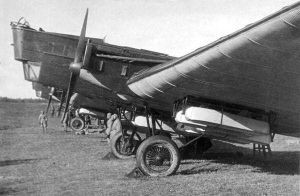
Pavel Grokhovsky proposed hanging special container under the wings of TB-1 aircraft, capable of transporting paratroopers. Officially these structures were called “Red Soldier Automatic Launchers” (“автоматическими выбрасывателями красноармейцев”). In each container there was a soldier with his parachute. In the landing area, the pilot released the containers, which, pivoting on their attachment to the wing, released their contents. The parachute was opened automatically by a rope attached to the structure. Members of the collective jokingly called the contenders “coffins.”
Parachute launchers under the wings of Túpolev TB-1 bombers.
In the first tests it was Grokhovsky, and later his wife, Lidia Alexseyevna, who were launched from a container under the wing of a TB-1 bomber on July 14, 1931.
In the USSR the first flight with solid fuel accelerators (TTU for the acronym of Tviordo-Toplivnie Uskaritieli) took place in May 1931 and was carried out in a U-1 suitably modified by the engineers of the GAZ No.3 VI Dudakov and VA Konstantinov. The results obtained suggested the possibility of using the method on Tupolev TB-1 heavy bombers. In 1933, 6 accelerators were installed in a TB-1, three on each side of the fuselage, at the junction with the centroplane. Two aircraft were modified. In the first one (No.614) the six accelerators were located above the wing, in the second (No.726) one accelerator was located above the wing and two below. The tests, which concluded in October 1933, showed that with the use of the gunpowder accelerators the takeoff run of the bomber was reduced by 4 times.
The ANT-4s were front-line equipment for a number of years before being relegated to the transport role with the revised designation G-1. Many were used as freighters by Aeroflot and by the Soviet Arctic Aviation Authority (Aviaarktika), final examples of the type being grounded in 1945. The TB-1 was also used in a number of experiments, including autopilot and drone trials, inflight refuelling of other aircraft, rocket-assisted take-offs, and cargo parachute drops. It was the first twin-engined all-metal cantilever monoplane to enter production in the world.
TB-1 Engine: 2 x M-17 Max take-off weight: 6712 kg / 14798 lb Empty weight: 4420 kg / 9744 lb Wingspan: 28.7 m / 94 ft 2 in Length: 18.0 m / 59 ft 1 in Wing area: 121.5 sq.m / 1307.81 sq ft Max. speed: 200 km/h / 124 mph Ceiling: 4800 m / 15750 ft Range: 1000 km / 621 miles Armament: 3 x 7.62mm machine-guns, 700 kg of bombs Crew: 5
Tugan Aircraft Ltd built in 1936 six examples of the Gannet twin-engined, high-wing monoplane for cartographic survey/ambulance duties for the RAAF, designed by Wg Cdr L. J. Wackett. Taken over 1936 by Commonwealth Aircraft Corporation.
The seven-seat utility flew in RAAF colours from November 1935.
After Japan’s entry to the war in December 1941 they were used as air ambulances.
Broadly similar to predecessors, incorporated new rotor proposed by I.P.Bratukhin with three large blades with articulated roots which provided lift, and three smaller blades with rigid attachment which provided control. Some accounts incorrectly state large and small rotors superimposed; all blades were in same plane, large and small alternating. This rotor worked, yet 5-EA appears not to have reached any considerable height or endurance (Western figures 13 miles and 1200 feet not confirmed in Soviet accounts). 5-EA flew from 1933 until late 1935 and was instrumental in providing research basis for machine with more powerful and more modern engine.
5-EA Engine: 2 x M-2 piston, 120hp Rotor diameter: 12.0m and 7.8m Max take-off weight: 1210kg Empty weight: 1047kg Max speed: 20km/h Ceiling: 40m Endurance: 0.7h Crew: 1
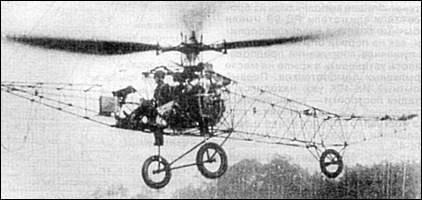
Ivan P. Bratukhin, one of the pioneer figures in Soviet rotorcraft development, was a senior member of the division formed under Boris N. Yuriev at the TsAGI (Central Aero and Hydrodynamic Institute) to carry out research into problems associated with rotary-winged flight. In 1925 Boris Nikolayevich Yur’yev organised a vertolyet (helicopter) group and in 1927 tested a 6m two-blade rotor driven by 120hp M-2. In 1928, from at least four project studies, design picked for 1-EA (Eksperimentalnii Apparat) and machine built at ZOK under G.Kh.Sabinin. Chief designer Aleksei Mikhailovich Cheryemukhin and Aleksandr Mikhailovich Izakson. The TsAGI’s first helicopter, begun in 1928, was the 1-EA, which made its first tethered flights in August 1930.
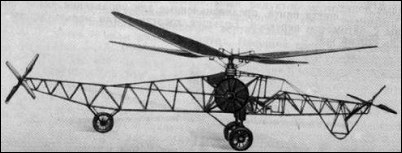
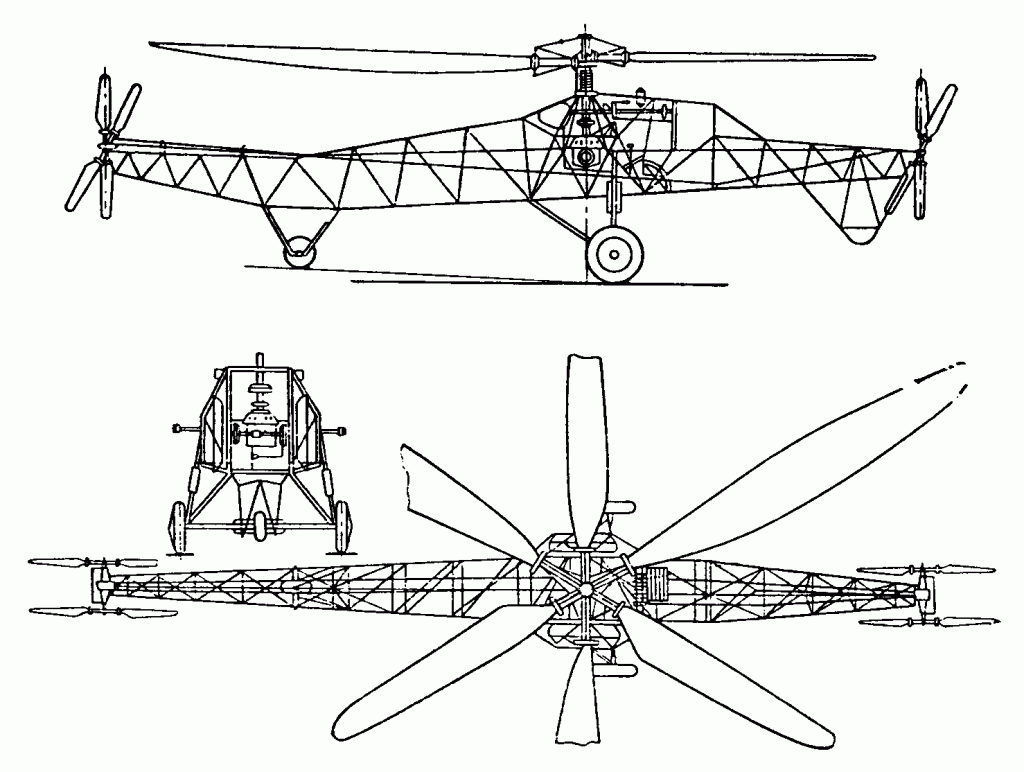
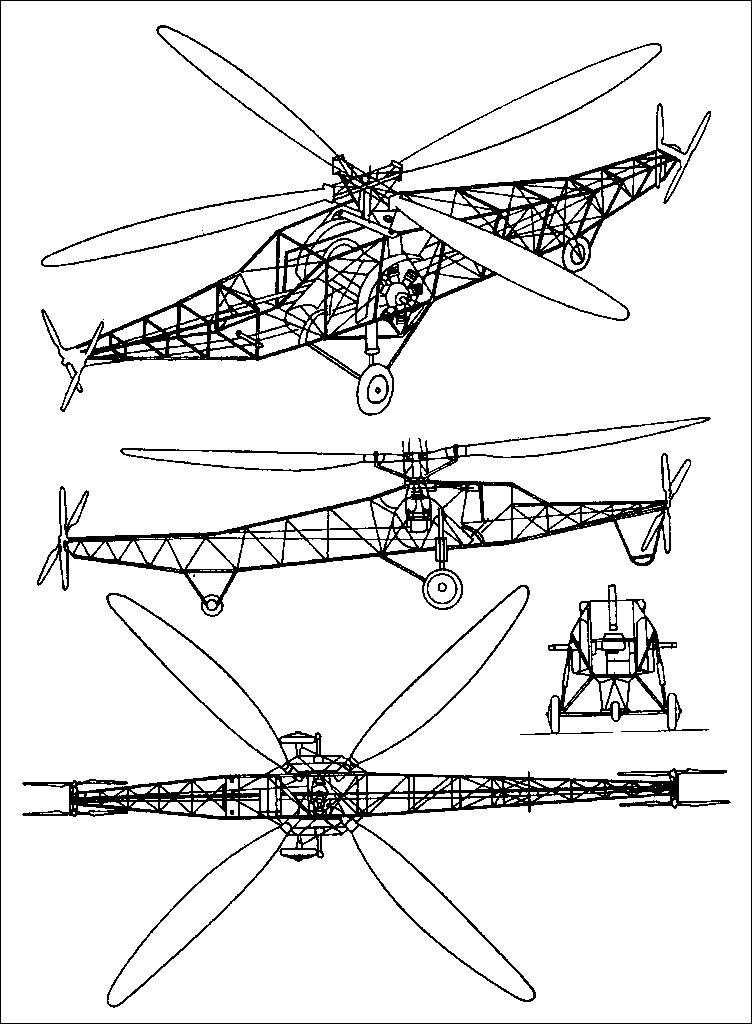
An open framework machine, the 1-EA was powered by two 120hp M-2 rotary engines, driving a single 4-blade lifting rotor and small 2-blade (with variable pitch) steering rotors at the nose and tail. The anti-torque rotors turned in the opposite direction from the other.
Fuselage welded from M1 mild-steel tube forming spaceframe resting on tailwheel landing gear with rubber springing. Twin engines at centre with reduction and bevel gears to vertical shaft to main rotor and side-by-side pairs of 1.8m anti-torque rotors at nose and tail. Chief development task was finding best structure for main rotor blades, an all-metal blade being rejected in favour of one with dural spar, wood ribs and stringers and ply/fabric skin. Four-blade main rotor with 5 degree coning angle driven at 153 rpm.
The single-seater helicopter had a four-bladed rotor with cyclic and collective pitch control operated by means of a hanging stick directly connected with the swash-plate, and pedal control of nose/tail rotors from pilot seat just ahead of engines. Flight testes began on June 26, 1932. In July-August 1-EA was demonstrated to M.N.Tukhachevskij and Ya.I.Alksnis.
M.N.Tukhachevskij suggested small series production, but A.M.Izakson (one of designers) insisted that more development is needed and resources should not be dispersed on production of ‘raw’ machine.
Fuselage was simple frame made of steel tubes, its construction was optimized during tests. Original rectangular structure with tension wires was replaced by more solid triangular without wires.
M-2 engines were selected because they did not require any special cooling in hovering regime. Because main rotor had solid blades, no special clutch was required and rotor started to spin once engines started (with compressed air).
Cheryemukhin elected to fly 1-EA himself, making first tethered run Aug 1930. No disasters and by 1932 reliable flights of up to 12 min. 1 Aug 1932 Cheremukhin reached 160m, 3 Aug 230m, 5 Aug 285m and on 1932 14 Aug 605m. The USSR at the time was not a member of an International Aviation Federation (plus secrecy), and this record could not be formally registered, the world record remaining 18m (d’Ascanio).
The 1-EA story was flown safely mostly due to well designed control system and pilot’s skills of A.M.Cheremukhin. Simple straight link of main rotor to the power plant does not provide enough stability. Smallest variations in engine regime caused aircraft to move up or down, and required full attention of a pilot.
One built, and the 1-EA continued to fly until at least 1934.
TsAGI 1-EA Engine: 2 x M-2 rotary, 120hp Main rotor diameter: 11.0m Max take-off weight: 1145kg Max speed: 20-30km/h Hovering ceiling: 605m








 All Aero