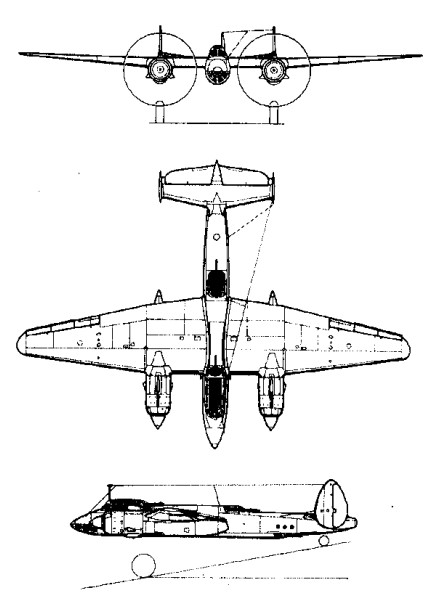
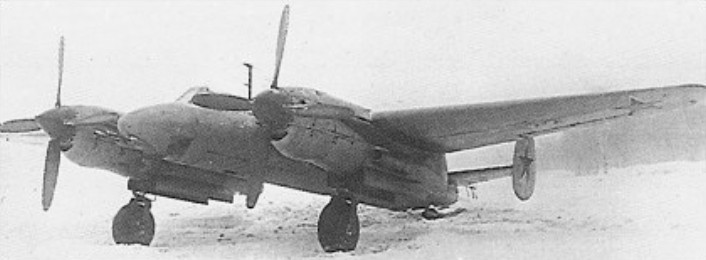
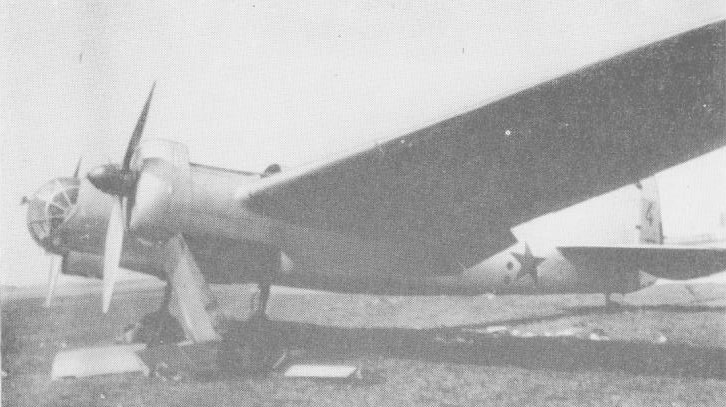
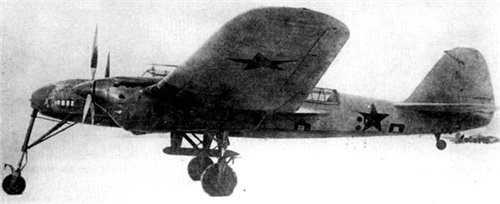
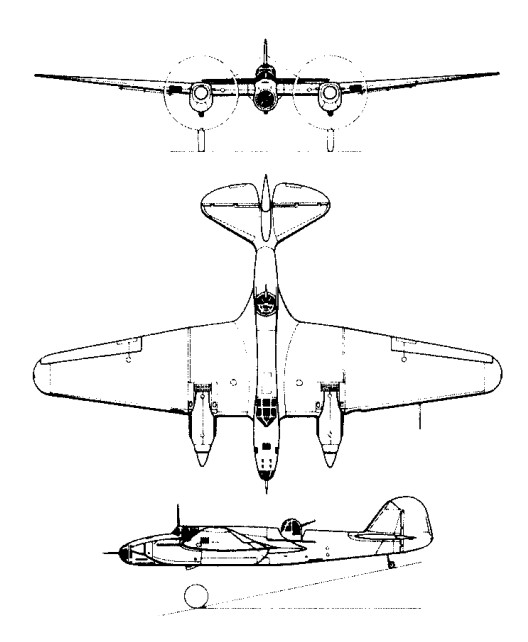
The Tu-12 was the last derivative of the Tu-2, better known as the Tu-77, really as a follow-on of the ANT numbering sequence. The VVS gave it the designation Tu-12. The Tu-12 was the Soviet Union’s first jet bomber. Tupolev intended it as an interim measure to develop later aircraft and to train crews in the handling of larger jet aircraft. Sergei Yeger, working under Tupolev’s supervision, led the programme. He took the basic Tu-2 fuselage, wings and tailplane, and adapted them only for the higher speeds of a jet. It was one of very few jets of the 1940s to feature a twin tail. The undercarriage was changed from a tailwheeler to a tricycle, and under the wings were fitted Rolls-Royce Derwent engines; for several years after the war, the British government allowed engines, and some other aviation components, to be sold to the USSR. Although Soviet designers were hurriedly developing jet engines, by the time of the Tu-12 in 1947 even MiG-15s were using either Rolls-Royce engines or licence-built copies of them. Only Lyulka’s jet engines were of Soviet design and manufacture, and these at that time had hardly half the power of the Nenes fitted on the Tu-12, which gave a static thrust of 2,270kp/5,0041b. The first Tu-12 was built at factory N156, the new title for the former KOSOS TsAGI works attached to the design offices. It was completed in May 1947, and after transfer to Zhukovski and reassembly, Aleksei Pereliot flew it on its first flight on 27 June. There were no major difficulties found in the test programme. For an interim aircraft its performance was reasonable: maximum speed was 783kph/487mph, range was 2,200km/l,367 miles, and its service ceiling was ll,300m/37,075feet. The VVS accepted the prototype Tu-12, and production began at factory N23 in Moscow with an order for five. However, only three were completed. These were completed by 1950, and were used by the Air Force in a training role for a short while. One was used as a flight test aircraft by the LII for experimental work with rocket engines, which were mounted on a pylon above the centre fuselage.
Engine: 2 x Rolls-Royce Nene I turbojets, 5000-lb (2272-kg) Max take-off weight: 15720 kg / 34657 lb Empty weight: 8993 kg / 19826 lb Wingspan: 18.86 m / 62 ft 11 in Length: 15.75 m / 52 ft 8 in Height: 4.19 m / 14 ft 9 in Wing area: 48.8 sq.m / 525.28 sq ft Max. speed: 783 km/h / 487 mph Ceiling: 11360 m / 37250 ft Range: 2200 km / 1367 miles Crew: 4
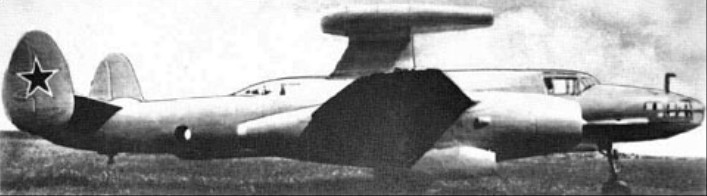
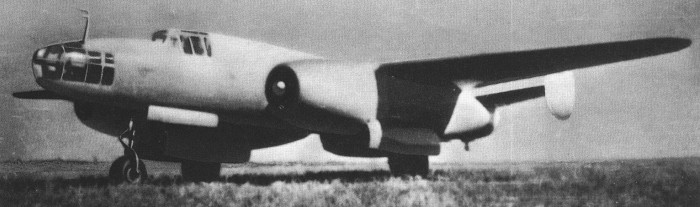
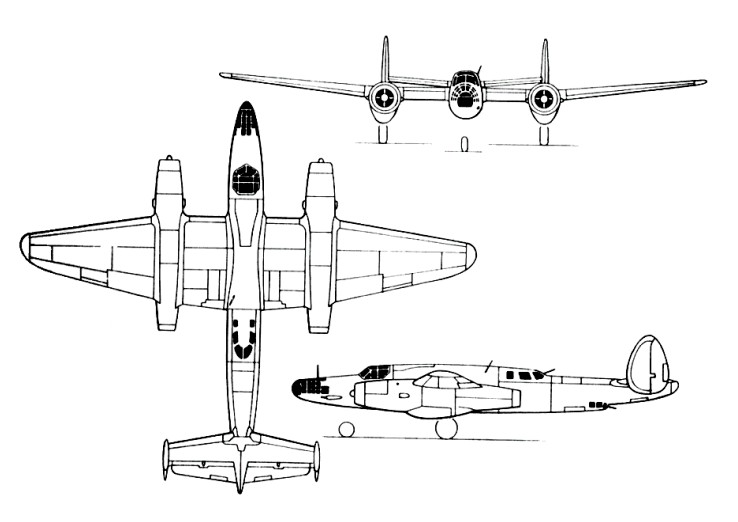
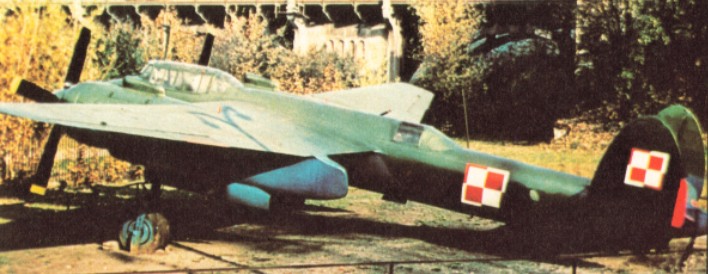
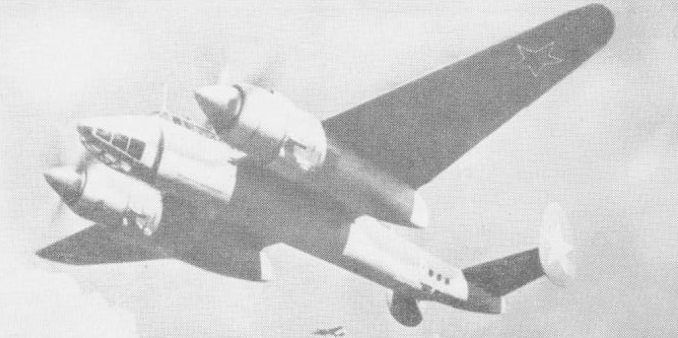
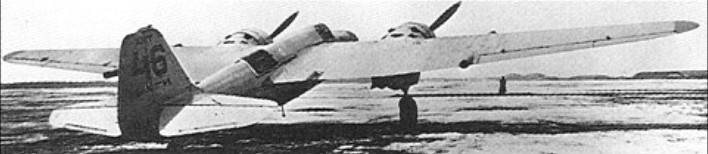
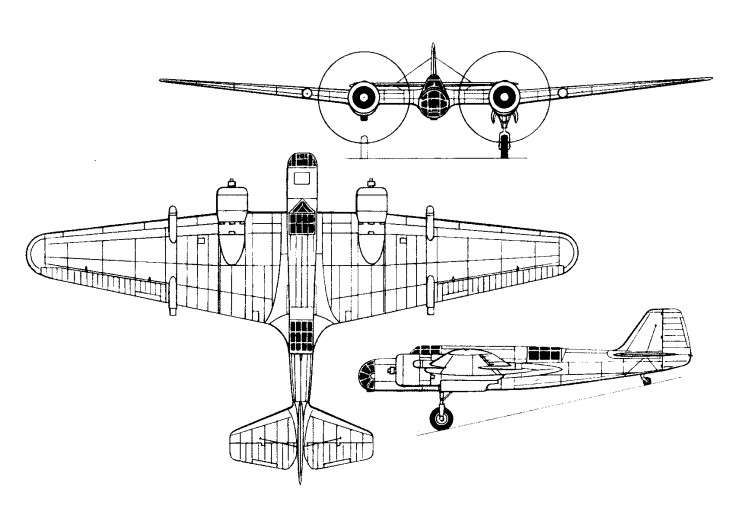
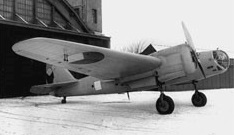
The bureau developed the Tu-72 as a contender for the Soviet air force’s main light bomber requirement, which was ultimately met by the cheaper Il-28. It was to be a mid-winged, twin-engined aircraft without sweep, and the engines were due to be hung under the wings. Rolls-Royce Nenes were the chosen powerplants, but Air Force worries over the adequacy of two engines to power an aircraft of this size and weight led Tupolev to design a similar, but slightly larger aircraft, the Tu-73, with a third engine, this time a 3500-lb / 1600kg Rolls-Royce Derwent, fitted in the tail but with an S-shaped duct air intake noticeable at the front of the fin. While design work of both aircraft continued in parallel, it was the three-engined Tu-73 that was actually built.
Its first flight was made on 29 December 1947. It went well. During state tests, its performance was measured as top speed 870km/h, range 2,800km, and service ceiling 11,500m.
The Tu-74 (or Tu-73R) was a proposed photo-reconnaissance version which was not developed.
The Tu-78 and Tu-79 were essentially the Tu-73 but with Soviet licence-built Rolls-Royce engines.
Tu-73 Engines: 2 x 2270kg Rolls Royce Nene I and 1 x 1589kg Derwent V turbojet Max take-off weight: 24200 kg / 53352 lb Empty weight: 14340 kg / 31614 lb Wingspan: 21.71 m / 71 ft 3 in Length: 20.32 m / 67 ft 8 in Wing area: 67.36 sq.m / 725.06 sq ft Max. speed: 872 km/h / 542 mph Range: 2810 km / 1746 miles Armament: 6 x 23mm cannon Bombload: 3000kg
Another Tu-2 variant was the Tu-10. This was a four-crew aircraft fitted with inline Mikulin AM-39FNVs of 1850hp. Its first flight took place on 19 May 1945, and it proved to have perhaps the best performance of any Tu-2. At 8600m it attained a speed of 641km/h. Ceiling was 10,450m but range fell to 1,740km. A small batch was produced in Omsk between 1945 and 1947.
The origin of the Tupolev Tu-2 lay in the ANT-58, ANT-59 and ANT-60 light bomber prototypes that came from the design bureau of Andrei N. Tupolev during 1938-40. Powered by two 1044kW Mikulin AM-37 V-12 engines, the ANT-58 made its first flight on 29 January 1941.
The ANT-60 was re-engined with the big and powerful 1104kW M-82 radials because of the relative unreliability of the AM-37s. The result was the definitive Tu-2 bomber that was to see service with the V-VS during the last year of World War II and well into the 1950s.
Soviet industry was still in a state of upheaval following the years of 1941-2, when the German army struck deep into Belorussia and the Ukraine. The Tu-2 was too complicated an aircraft for the conditions prevailing, and after many months in which the Tu-2 was modified and simplified for the mass production lines, the Tu-2S (Seriinyi, or series) appeared, flying for the first time on 26 August 1943. A small number of Tu-2s had previously been passed to front line regiments in September 1942, where their performance, armament and bombload had received general enthusiasm.
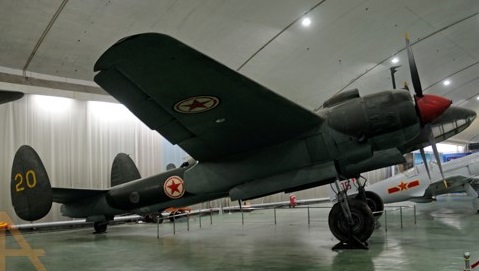
By January 1944 the first production Tu-2 and Tu-2S bombers had been passed to the regiments of the V-VS, but it was not until June of that year that Tu-2s saw action on a large scale. The sector was the Karelian (Finnish) front in the north where the V-VS forces, under the overall command of General A.A. Novikov, numbered 757 aircraft of the 13th VA (Air Army), the V-VS KBF (Red Banner Baltic Fleet) and the 2nd GVIAK (guards fighter corps). Of the 249 Tu-2 and Petlyakov Pe-2 light bombers in the Soviet order of battle, many came under Colonel I.P. Skok’s 334th Bomber Air Division which subsequently received a citation for its work. Reconnaissance work was now being carried out by Tu-2D and Tu-2R aircraft with modified mainplanes, nose glazing, and capacity for vertical and oblique cameras. Wartime production of the Tupolev Tu-2 and its sub-types amounted to 1,111. As a bomber it did not come into its own until the autumn of 1944. However, as German resistance stiffened on nearing the eastern borders of the Reich V-VS bombers, including Tupolev Tu-2s, were called up to attack strongpoints at Kustrin and other fortified ports and cities. September 1945 saw many Tu-2s in action against the Japanese Kwantung Army in Manchuria before the final surrender.
Tu-2
Tupolev was awarded a Stalin Prize for his Tu 2 medium bomber, the only wholly new Soviet wartime aircraft to go into production.
Tu-2S Engines: 2 x ASh-82FNV, 1380kW Max take-off weight: 11360 kg / 25045 lb Empty weight: 7474 kg / 16477 lb Wingspan: 18.86 m / 62 ft 11 in Length: 13.8 m / 45 ft 3 in Height: 4.55 m / 15 ft 11 in Wing area: 48.8 sq.m / 525.28 sq ft Max. speed: 550 km/h / 342 mph Ceiling: 9500 m / 31150 ft Range: 1400 km / 870 miles Crew: 4 Armament: 2 x 20mm cannons, 3 x 12.7mm machine-guns Bombload: 4000kg
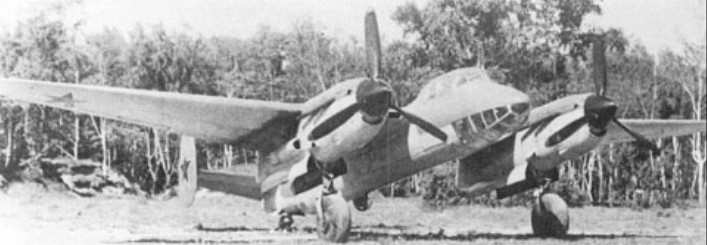
An attempt to produce a radar-equipped three-seat long-range night and all-weather fighter also suited for the escort mission, the ANT-63P, alias Tu-1, was one of a number of progressive developments of the ANT-61 (Tu-2S) bomber. Initially powered by two 1,900hp Mikulin AM-39F 12-cylinder liquid-cooled engines, the ANT-63P (the suffix letter indicating Perekhvatchik, or “Interceptor”) carried a fixed forward-firing armament of four 23mm cannon, two in the wing roots and two in the lower forward fuselage. The nose was intended to accommodate a PNB-1 Gneiss-1 airborne intercept radar based on the German FuG 220. First flown on 30 December 1946, the ANT-63P attained 680km/h and demonstrated a range of 2500km. Official interest in piston-engined fighters was waning by this time, and although the ANT-63P was re-engined with 1,950hp Mikulin AM-43V engines driving four-bladed propellers, being tested in this form in December 1947, no production was undertaken.
ANT-63P Engines: 2 x AM-43V Max take-off weight: 14460 kg / 31879 lb Wingspan: 18.86 m / 62 ft 11 in Length: 13.60 m / 45 ft 7 in Wing area: 48.80 sq.m / 525.28 sq ft Max. speed: 641 km/h / 398 mph Range: 2250 km / 1398 miles
Ordered in December 1934 as a single prototype under the designation DI-8, the ANT-46 was a two-seat fighter (Dvukhmestny istrebitel) derivative of Aleksandr Arkhangelsky’s SB high-speed bomber (ANT-40). Featuring a lightened structure and powered by two 800hp Gnome-Rhone 14Krsd 14-cylinder air-cooled radial engines, the ANT-46 was intended to carry two 100mm Kurchevski APK-100 recoilless guns as its primary armament, these weapons being buried in the outer wings between the ailerons and the flaps, and projecting fore and aft. In addition, it was intended to mount a battery of four 7.62mm guns in the extreme nose, but these were not carried by the prototype, which featured a glazed nose generally similar to that of the SB.
First flown on 9 August 1935, the ANT-46 was actually flown before the ANT-29, the factory flight test programme being completed successfully in June 1936, but state acceptance testing was not undertaken as official interest in the recoilless gun – for which the ANT-46 had been specifically developed – had terminated with the arrest, in February 1936, of Leonid Kurchevski.
Max take-off weight: 5553 kg / 12242 lb Empty weight: 3487 kg / 7688 lb Wingspan: 20.30 m / 67 ft 7 in Length: 12.24 m / 40 ft 2 in Wing area: 55.70 sq.m / 599.55 sq ft Max. speed: 388 km/h / 241 mph Range: 1780 km / 1106 miles
The two ANT-40 light bomber prototypes of Andrei N. Tupolev’s design bureau first flew in October 1934. The all-metal construction, enclosed cockpit and retractable landing gear were then comparatively novel features. The ANT-40’s maximum speed of 325km/h at operating height was faster than the biplane interceptor fighters that equipped most of the peacetime air forces.
Tupolev SB-2 Article
Entering production in 1936, the initial production version as selected for export and service with the V-VS was based on the second prototype, and was known as the Tupolev SB-2 (skorostnoi bombardirovshchik, or fast bomber). The engines were two 830 hp / 619kW licence-built Hispano-Suiza 12Ybr, termed M-34 by Soviet industry, and initially they were fitted with two-bladed fixed-pitch propellers.
An aircraft of this type secured an official FAI record in 1937 for carrying a 1000 kg / 2200 lb payload to an altitude of 40,177 ft.
The first SB-2s were passed to the V-VS’s bomber aviation regiments in February 1936, and in October of that year the first of 210 were transferred with Soviet crews to Spain to fight on the side of the Republican air force against the insurgent Nationalists.
The SB-2 was the first Soviet warplane delivered to the Republicans, arriving from October 1936 in an effort to provide an offensive type which could take the air war to the advancing Nationalists. The variant delivered was the initial SB-2 production model powered by M-100 or 641 kW (860-hp) M-100A inlines driving fixed or variable pitch propellers respectively. Estimates for the number of SB-2s delivered vary from 93 to 210, and these aircraft were amongst the best fielded by the Republicans: their performance and defensive firepower allowed most Nationalist fighters to be outrun or outfought. Some 19 operational SB-2 bombers fell into Nationalist hands at the end of the war, and claims on the type amounted to 14 by the Nationalists, a similar number by the Germans, and 48 by the Italians.
Over Spain the performance of the SB-2 caused considerable concern to the Nationalist fighter units which were equipped with Heinkel He-51 and Fiat CR.32 biplanes, and the urgent call went out for fighters of better speed and climb properties.
The production of the SB-2 bomber and the conversion of the units required the development of a training model that would facilitate the preparation of the crews. This need was solved in 1937 with the installation of a second flight control in the navigator’s position in an SB-2M-100A, but the results of the tests showed that this decision made the navigator’s work more complex and worsened the aerodynamics of the model.
At the time SB-2s were passed to the Chinese Nationalist air force to fight aganst the Japanese, and to Czechoslovakia, where the type went into licensed manufacture as the B.71 bomber.
1934 Avia development was helped engineer A. A. Archangelskij from the ANT 40.2 SB – 2 (Skorostnyj Bombardirovščik). The Czechoslovak Air Force had 60 of these aircraft and one at a research institute. Because all three Aeroplane Works within a range of German bombers were, a new plant was built at the village of Kunovice in South Moravia. Two batches of the B-71 bomber – 40 and 26 machines respectively. 30 SB-2s were purchased by the Czechoslovak Republic from the Soviet Union and in 1936 also their licence. Serial production started at Avia and by the German occupation not a single was finished, the unfinished aircraft were completed by the Germans. Avia Works built forty-five that were used by Luftwaffe or sent to Bulgaria. The B-71 Katyushkas were powered by Czech-made 680 Avia-Hispano Suiza engines and were able to accommodate the bombload of 600 kg under their wings.
The Avia-built B-71 were fitted with a new tubular radiators and gained 15 kph. The idea was copied by the Soviets and brought into use in the SB-3. After the German occupation the B-71s were converted to target towing configuration.
Avia B-71
In general the SB-2 performed well until faced with sterner fighter opposition, which occurred over Spain in 1938 and in particular over Finland during the Winter War of 1939-40, when many were shot down. Steps were taken to improve performance by installing the 641kW M-100A engine with variable-pitch propellers. Increased fuel capacity and two 716kW M-103 engines were installed in the Tupolev SB-2bis, the performance of which was improved by three-bladed VISh-22 propellers.
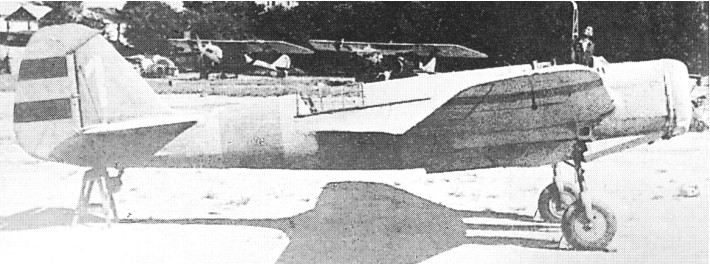
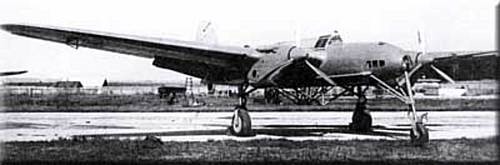
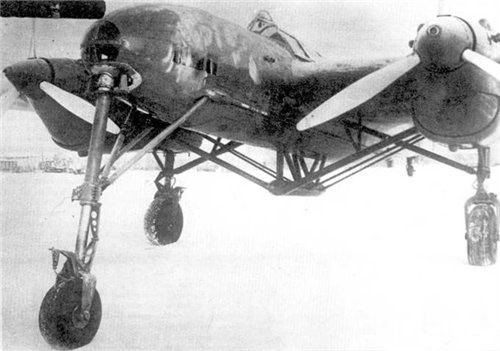
The study of the 3-wheeled undercarriage on a twin-engined aircraft, nicknamed “pterodactyl”, was carried out in 1940. Using a special frame under the center section the pilot, Mark Galley, repeatedly landed the aircraft with a vertical speed of up to 4.8 m / s. The landing gear was fully tested. For study of the “shimmy” phenomenon the ran over a log put across the runway. The original size of the front wheel was 470×210 mm, but changed to 600×250 mm.
SB “Pterodactyl”
The front wheel was 4.65 m from the center of gravity and the main struts moved back beyond the center of gravity 520 mm, the wheels remained the same – 900×300 mm.
SB “Pterodactyl”
A frame was used to rearrange the main undercarriage in order to determine their optimal location. The aircraft was tested with a flight weight of 6000 kg, the wing load was 106 kg/sq.m and flight speeds up to 220 – 230 km/hr. Landing speed with flaps was 140 – 150 km / h, without flaps 190 km/h.
SB “Pterodactyl”
Tests were summarized and published in February 1941, turned out to be very popular. It is believed that the research results were useful in developing a new generation of Soviet aircraft with a front support wheel.
The PS-41 was a transport variant with a ‘solid’ nose and gun positions eliminated.
In addition to the PS-40 and PS-41 transport versions the SB-RK (Arkhangelskii Ar-2) was a modified SB-2bis dive-bomber with reduced wing area and powered by two supercharged M-105R engines. The SB-2’s record as a day bomber came to an abrupt end during the fierce fighting following the German invasion of the USSR on 22 June 1941. Those that were not destroyed on the ground ventured into the air on numerous missions over the front line, and paid a heavy price to the Luftwaffe’s Messerschmitt Bf 109F fighters. Thereafter the SB-2 and SB-2bis bombers were relegated to night work with the V-VS and the Soviet naval air arm.
Production amounted to 6,967 of all marks.
Variant: Tupolev SB-RK / Arjanguelsky Ar-2 Arjanguelsky SB-B Arjanguelsky USB
SB-2 Three-seat light/medium bomber Span: 20.33m (66ft 8.5 in) Length: 12.57m (41ft 2.75in) Powerplant: 2 x Klimov M-100, 559kW (750 hp) Armament: 4×7.62-mm (0.3-in) mg Bombload: 1000 kg (2,205 lb) Max T/O weight: 5628 kg (12,407 lb) Max speed: 244 mph at 17,060 ft Operational range: 777 miles
SB-2bis Engine: 2 x M-100 Max take-off weight: 5732 kg / 12637 lb Empty weight: 4060 kg / 8951 lb Wingspan: 20.3 m / 67 ft 7 in Length: 12.7 m / 42 ft 8 in Wing area: 52.0 sq.m / 559.72 sq ft Max. speed: 420 km/h / 261 mph Cruise speed: 360 km/h / 224 mph Ceiling: 6600 m / 21650 ft Range: 1600 km / 994 miles Range w/max.payload: 1000 km / 621 miles Crew: 3 Armament: 4 x 12.7mm machine-guns Bombload: 1500kg
SB-2bis Engine: 2 x M-103, 990 hp Wingspan: 70 ft 6 in Length: 41 ft 6 in Max take-off weight: 14,330 lb Empty weight: 9436 lb Max. speed: 280 mph at 16,400 ft Cruise speed: 360 km/h / 224 mph Service ceiling: 27,890 ft Range: 1430 miles Crew: 3 Armament: 4 x 7.62mm machine-guns Bombload: 1320 lb
Developed from the uncompleted Tupolev ANT-36 (DB-1), a single-engined long-range bomber based on the ANT-25, the Tupolev ANT-37 (DB-2) long-range bomber was developed by Sukhoi’s design brigade under Tupolev’s overall control.
The Tupolev DB-2 (ANT-37) long-range bomber, designed in the autumn of 1934, could carry a 2,200 lb bomb load over a range of 3,100 miles at a speed of 155 m.p.h.
The prototype flew on 16 June 1935, powered by two 597kW Gnome-Rhone 14Kdrs engines, broke up in mid-air in August 1935 owing to buffeting of the tail unit. Test pilot K. Popov and the flight engineer managed to bale out, but a third crew member did not survive the crash.
The second prototype, powered by licence built Gnome-Rhone M-85s, was tested and refined throughout 1936. It was then transferred to the Nauchno Issledovatelsky Institut Voyenno-Vozdushnykh Sil (NII V-VS – Scientific Research Institute of the Air Force) for State tests, which continued until mid-1937. It was admitted that the DB-2 was inferior to Ilyushin’s DB-3 bomber in several respects, particularly maximum speed (200 m.p.h. and 248 m.p.h. respectively), so further development was abandoned.
When the second DB-2 prototype had completed its State tests it was proposed that it be handed over to the Tsentralniy Aero-Gidrodinarnicheskiy Institut (TsAGI, the Central AeroHydrodynamic institute) for further refinement and additional flight tests. Another DB-2 was completed and handed over to a Soviet Air Force (V-VS) unit for training personnel in endurance and long-range flying.
Having undergone modification, the second prototype was provided for the long-distance flight to be undertaken by Grizodubova, Raskova and Osipenko. it was completely stripped of armament, fitted with additional fuel tanks to ensure a maximum range of 4,350 miles and given new flight instruments and 950 h.p. licence-built Gnome-Rhone M-86 engines.
The DB-2D was followed in turn by the DB-2B or ANT-37bis, of which only three were built as record breakers/research aircraft after rejection of the design in favour of the llyushin DB-3.
Once the crew had been trained they started preparing for the non-stop flight. On August 18, 1938, they took off from the Central Airfield at Moscow for another training flight, but at a height of 165ft the aeroplane suddenly jerked down and almost went out of control. After a difficult landing, it became clear that the shortcomings of the first prototype had not been completely rectified. The tail unit had distorted disastrously during takeoff at maximum weight, and the aircraft was no longer airworthy. The technical team therefore began urgent preparation of the third prototype, the last of the three serviceable machines.
The aircraft’s replacement caused deferment of the flight, which in turn led to concern over a successful outcome. Autumn had already set in and weather conditions along the planned route across the Urals and Siberia were deteriorating with each passing day.
The first DB-2B, named Rodina (motherland) was flown to a long-distance women’s record by an all-female crew, covering 5908km on 24/25 September 1938 before making an emergency landing.
Examples survived well into the wartime period, flying for Aeroflot or on research projects.
DB-2bis Engine: 2 x M-86 Max take-off weight: 12500 kg / 27558 lb Empty weight: 5855 kg / 12908 lb Wingspan: 31.0 m / 102 ft 8 in Length: 15.0 m / 49 ft 3 in Wing area: 85.0 sq.m / 914.93 sq ft Max. speed: 300 km/h / 186 mph Ceiling: 8000 m / 26250 ft Range w/max.fuel: 7000 km / 4350 miles Crew: 3
The Tupolev ANT-35 all-metal light passenger transport prototype was based on the SB-2 bomber, and was flown initially on 20 August 1936. Of low-wing configuration with retractable main landing gear units, it was powered by two 597kW Gnome-Rhone 14K radials, later replaced by Soviet M-85s; its near circular-section fuselage accommodated a crew of two or three and 10 passengers. The improved ANT-35bis prototype was followed by nine series aircraft powered by 746kW M-62IR engines, and the type entered service with Aeroflot as the PS-35, delivered from 1937 to 1939. After June 1941 several were used for liaison and VIP transport, this 20.80m span aircraft having a maximum speed of 372km/h and a range of 1640km.
PS-35 Engines: 2 x M-85 Max take-off weight: 6620 kg / 14595 lb Wingspan: 20.8 m / 68 ft 3 in Length: 15.0 m / 49 ft 3 in Height: 5.9 m / 19 ft 4 in Wing area: 58.0 sq.m / 624.31 sq ft Max. speed: 376 km/h / 234 mph Cruise speed: 350 km/h / 217 mph Ceiling: 7200 m / 23600 ft Range: 1600 km / 994 miles Crew: 2 Passengers: 10






 All Aero