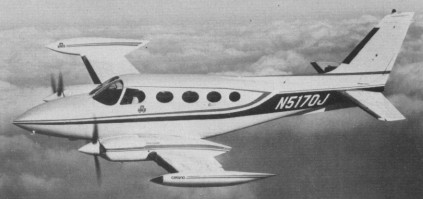
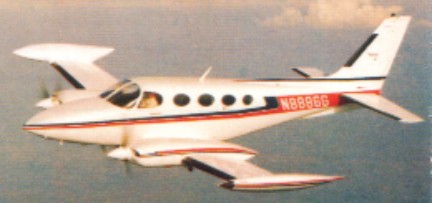
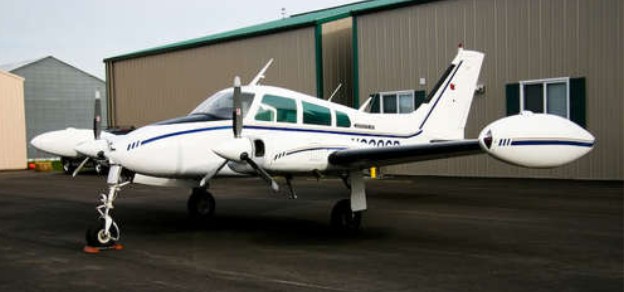
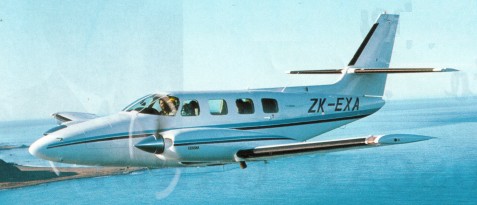
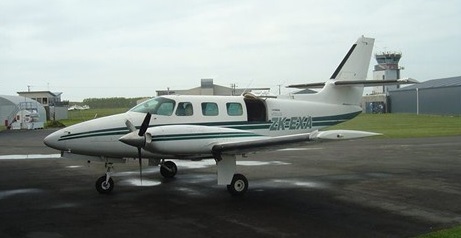
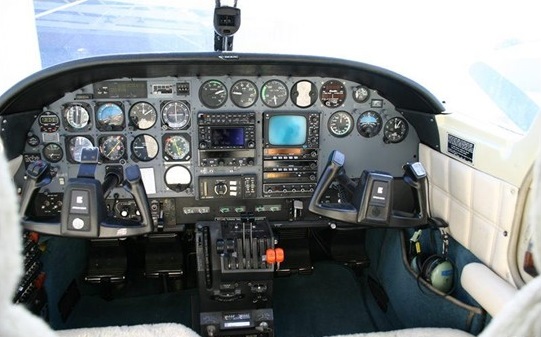
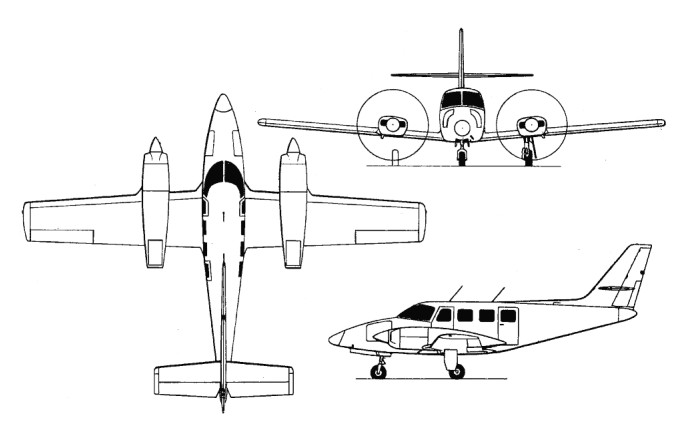
In December 1971 Cessna announced the introduction of the pressurised Model 340 developed from the Model 310. Powered by twin TSIO-520-NB engines each giving 213kW, the 340 incorporated the wing and tricycle landing gear developed for the Model 414, married to a new pressurised fuselage, but using the tail of the Model 310. Though aimed at the owner-pilot of light twins, the 340 has such features as center-aisle seating, an air-stair door and cruise performance of 241 mph at 20,000 feet. The 1972 model 340, grosses at 5,975 pounds and offers a top speed at 16,000 feet of 260 mph. Pressurized to a maximum differential of 4.2 psi, the fuselage is more than five feet longer than that of the 310, and the horizontal tail surfaces have much more leverage. The result is significantly improved pitch control at landing speeds. Normal fuel is 50 gallons in each tip: optional inboard aux tanks hold 20 each and another 20 will fit in a tank at the rear of each engine nacelle, for a possible total of 184 gallons and a range of more than 1,200 miles with four aboard. Standard useful load of the 340 is 2,278 pounds. Allowable baggage includes 350 pounds in a 15.5 cubic foot nose compartment, 340 pounds in an 18.5 cubic foot rear fuselage compartment and 120 pounds in each nacelle locker for a total of 930 pounds. The 340 at sea level and gross weight will climb at a heady 1,500 fpm. At gross on one engine the airplane will climb at 250 f`pm with the gear up. But keep in mind that this airplane is turbocharged, and will hold that r/c for a long time: it can climb on one all the way to 12,100 msl and still be going up at100 fpm. When it is loaded the 340 is not a power-off airplane – not with a wing loading of 32.5 lbs/sq. ft. – nor is it a short field airplane. Takeoff over the 50 ft obstacle requires 2,430 feet at gross, whereas you can land over the same obstacle in only 1,840. Without troubling passengers or crew with oxygen masks it can go to 20,000 ft with a cabin altitude of only 8,000 feet. This was followed in the mid-1970s by the Model 340A equipped with 231kW engines and later by the similarly powered Model 340A II fitted with comprehensive factory-installed avionics allowing IFR operation. In 1978 Cessna introduced the Model 340A III equipped with an improved avionics package including colour weather radar and this version remained available until 1985 when the type was taken out of production, by which time 1,287 had been delivered. A lightweight unpressurised version of the Model 340 was offered to the market in 1979 as the Model 335, later available as the improved Model 335 II version, but production ended in 1980 after only 45 had been built.
Variations: Riley Super 340
Cessna 340 Engines: 2 x Continental TSIO-520-K, 285 hp Wingspan: 38 ft 1.3 in / 11.62 m Length: 34 ft 4 in / 10.46 m Empty weight: 3723 lb / 1688 kg MTOW: 5975 lb / 2710 kg Max cruise 75% 20,000ft/610m: 209 kt / 241 mph / 388 kph ROC SL: 500 fpm / 457 m/min Service ceiling: 26,500 ft / 8075 m Range 75% 10,000ft/3050m 600lb/272kg fuel: 575nm / 663mi / 1067 km Max range econ 175kt/202mph/325kph 1218lb/552kg fuel: 1402nm / 1615nm / 2600km Seats: 6 Nose baggage: 350 lb / 159 kg Wing lockers: 2 x 120 lb / 54.5 kg Cabin length: 12 ft 8 in / 3.86 m Cabin max width: 3 ft 10.5 in / 1.18 m Cabin max height: 4 ft 1 in / 1.24 m Cabin volume: 162.4 cu.ft / 4.6 cu.m Rear cabin capacity: 340 lb / 154 kg
CE-340A Engines: Continental TSIO-520-NB, 310 hp to 20,000 ft TBO: 1400 hrs. Fuel Type:100/100LL Oil capacity (qts.): 12 Props: McCauley CS 3-blade, 76.5-in. Seats: 6. Landing Gear type: Tri./Retr. Wingspan: 38 ft. 1 in. Overall length: 34 ft. 4 in. Height: 12 ft. 7 in. Wing area: 184 sq.ft. Wing aspect ratio: 7.2. Maximum ramp weight: 6025 lbs. Maximum takeoff weight: 5990 lbs. Max landing weight (lbs.): 5990 Standard empty weight: 3948 lbs. Maximum useful load: 2077 lbs. Zero-fuel weight: 5630 lbs. Fuel capacity: (total): standard: 102 USgal. Fuel capacity with auxiliary tanks (40 gal. usable): 143 gal. Fuel capacity with auxiliary tanks (63 gal. usable): 166 gal. Fuel capacity with auxiliary tanks (63 gal.) and wing locker tanks, 207 gal. Maximum landing weight: 5,990 lbs. Wing loading: 32.5 lbs/sq.ft. Power loading: 9.7 lbs/hp. Best rate of climb: 1,650 fpm @ 108 kts. Climb gradient: 930 ft/nm. Rate of climb @ 8,000 ft: 1500 fpm. Service ceiling (ft.): 29,800 Certificated ceiling: 30,000 ft. 8000ft cabin alt @: 20,000 ft. Maximum single-engine rate of climb: 315 fpm @ 100 kts. Single-engine climb gradient: 189 ft/nm. Single-engine service ceiling: 15800 ft. Maximum speed: 244 kts. Cruise @ 65% pwr @ 8,000ft: 182 kts. Cruise @ 65% power @ 18,000ft: 196 kts. Fuel flow @ 65% pwr @ 18,000 ft: 180 pph. Endurance at 65 % pwr @ 18,000 ft: 6.5 hrs. Cruise speed (kts.) 75% power @ 25,000 ft.: 229 Cruise speed (kts.) 65% power @ 25,000 ft.: 219 Cruise speed (kts.) 55% power @ 25,000 ft.: 202 Max range (w/ reserve) (nm) 75% power @ 25,000 ft.: 1106 Max range (w/ reserve) (nm) 65% power @ 25,000 ft.:1248 Max range (w/ reserve) (nm) 55% power @ 25,000 ft.:1377 Stalling speed clean: 79 kts. Stalling speed gear/flaps down: 71 kts. Turbulent-air penetration speed: 155 kts. SL cabin at: 9,000 ft 8000 foot cabin at 20,000 feet. Takeoff ground roll (ft.): 1615 Takeoff over 50-ft. obstacle (ft.): 2175 Landing ground roll (ft.): 770 Landing over 50-ft. obstacle (ft.): 1850 Baggage allowable: 930 lbs. Cabin doors: 1 Cabin width (in.): 46.5 Cabin height (in.): 49 Wheel track: 12 ft. 11 in. Wheel base: 10 ft. 3 in. 1977 Price: $290,000
CE-340A Engines Continental TSIO 520 M, 310 hp to 20,000 feet. TBO 1,400 hrs. Propellers constant speed, full ¬feathering, three blade, 76.5 in, diameter. Length 34 ft. 4 in. Height 12 ft. 7 in. Wingspan 38 ft. 1 in. Wing area 184 sq. ft. Wing loading 32.5 lbs/sq.ft. Seats 6. Empty weight 4,527 lbs. Useful load 1,463 lbs. Gross weight 5,990 lbs. Payload with full fuel 365 lbs. Power loading 10.48 lbs./hp. Usable fuel 183 USG./1,098 lbs. Minimum runway requirement 2,175 ft. Rate of climb 1,650 fpm. Single engine rate of climb 315 fpm. Service ceiling 29,800 ft. Single engine service ceiling 15,800 ft. Maximum speed 242 knots. Maximum cruise (77.5% power @ 24,500 ft) 228 knots. Economy cruise (56.1 % power @ 25,000 feet) 190 knots. Range at maximum cruise (45 min res, 1,098 lbs. fuel) 996 nm. Range at economy cruise (45 min res, 1,098 lbs. fuel) 1,133 nm. Duration at maximum cruise, no res 5.23 hrs. Stall speed (clean) 83 knots. Stall speed (gear, flaps down) 71 knots.
CE-340A II Engines: 2 x Continental TSIO 520 N, 310 hp. Props: constant speed, full feathering, 3 blades, 76.5 inch dia. Wing span: 38 ft. 1 in. Wing area: 184 sq.ft. Length: 34 ft. 4 in. Height: 12 ft, 7 in. MTOW: 5990 lbs. Std empty wt: 4096 lbs. Max altitude: 20,000 ft. Max speed: 241 kt. Max recommended cruise: 77.5% power: altitude: 10,000 ft. speed: 198 knots Max recommended cruise: 77.5% power: altitude: 24,500 ft. speed: 220 knots. Range max cruise 77.5% power: altitude: 10,000 ft, endurance: 2.18 hrs. range: 425 nm Range max cruise 77.5% power: altitude: 24,500 ft. endurance: 3.99 hrs. range: 861 nm. ROC sea level: twin engine: 1650 fpm ROC single engine: 315 fpm. Service ceiling: twin engined: 29,800 ft. Ceiling single engine: 15,800 ft. Ground run: 1615 ft. / 50 ft. obstacle: 2230 ft. Ground roll: 760 ft. / 50 ft. obstacle: 1850 ft. Baggage allowable: 930 lbs. Wing loading: 32.55 lb/sq.ft. Power loading: 9,66 lb/hp. Fuel capacity: (total): standard: 102 gal. with auxiliary tanks (40 gal. usable): 143 gal. Fuel capacity: with auxiliary tanks (63 gal. usable): 166 gal. Fuel capacity: with auxiliary tanks (63 gal.) and wing locker tanks, 207 gal. Price 1977: US$210,450
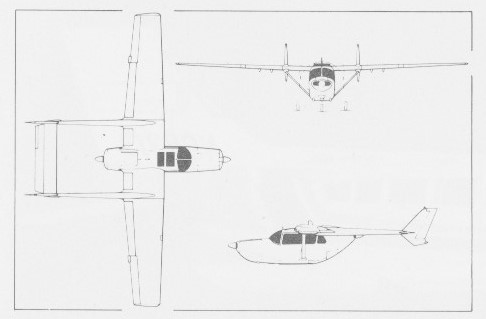
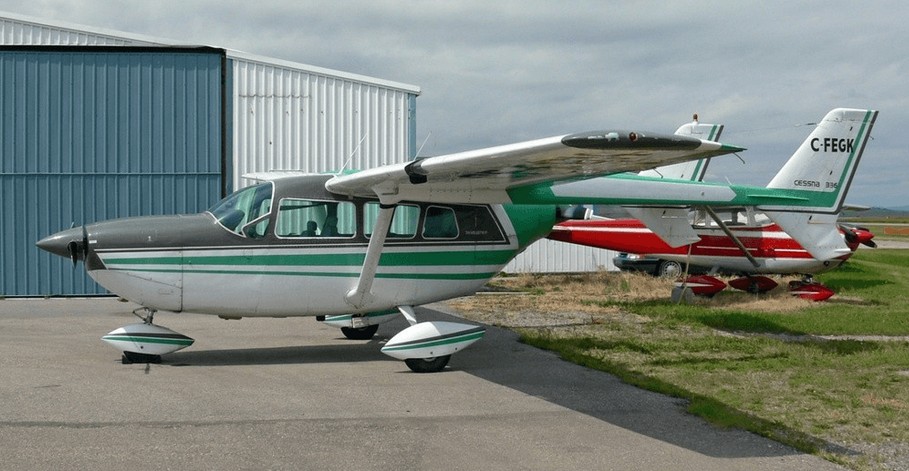
The model 337 Skymaster (originally Super Skymaster) was developed from the fixed gear model 336 and introduced in 1965. Successive refinements include increased gross weight (1968 337C), improved instrumentation (1969 337D), further increased gross weight and conical-cambered glassfibre wingtips (1970), seat belts and other safety features (1971), improved cabin layout (1972), and detail airframe improvements (1973).
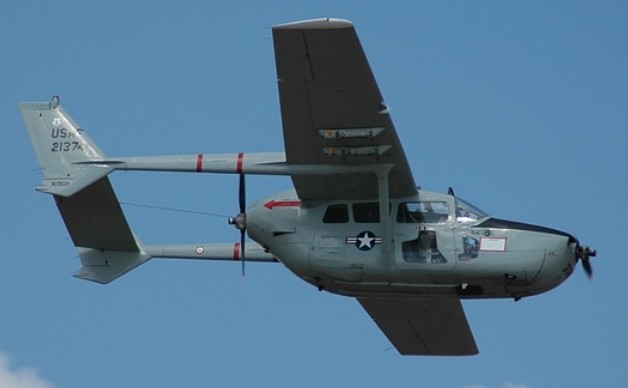
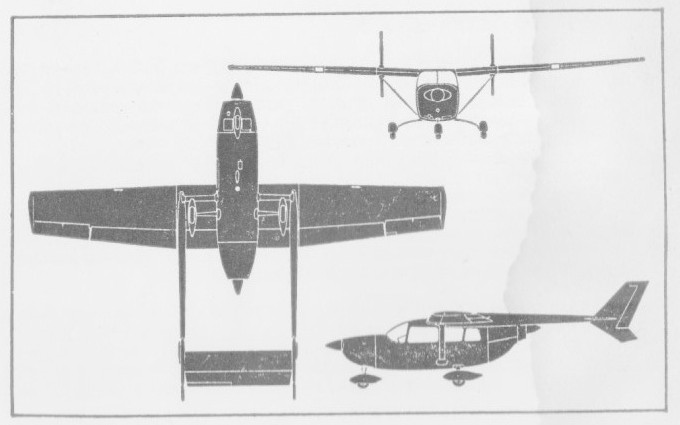
In 1966, the United States Air Force (USAF) realised it needed a replacement for its O-1 Bird Dogs in Vietnam. The Cessna 337 was selected and, with relatively minor modifications to incorporate four under wing weapons mounts and weapon release systems, was sent to war in Vietnam designated O-2A. The Cessna O-2A is an all metal, high wing, retractable gear aircraft incorporating twin tail booms and an engine mounted at the front and rear of its fuselage pod. The first Cessna 0-2A was delivered to the 20th Tactical Air Support Squadron at Da Nang on 2 July 1967. 501 were supplied to the USAF designated O-2A. In addition, a version equipped for psychological warfare missions entered USAF service under the designation O-2B This carried an air-to-ground broadcasting system using three 600-watt amplifiers and a battery of highly directional speakers. Total procurement of O-2B aircraft amounted to 31. Twelve O-2As were supplied to the Imperial Iranian air force in early 1970. A twin-turboprop O-2T/O-2TT did not proceed beyond USAF evaluation.
O-2A
Detail improvements continued each year, and a turbocharged version, the Model T337 Super Skymaster, was introduced in 1970, but the prototype of a pressurised T337G Skymaster, powered by 168kW Continental TSIO-360 engines, flew in July 1971 (the word Super had then been dropped), and deliveries began in 1973.
Only 356 were produced by 1980, when production ceased.
In 1969, Reims Aviation in France began licence assembly of the Model 337, with primary structures supplied by Cessna and Continental engines built in the UK under licence by Rolls-Royce. The US and French production lines continued in parallel, the French versions being classified Reims F337. The name Milirole was applied to the basic unpressurised F337 for a short time. Since 1974 Reims have developed a special unpressurised STOL version, designated FTB337, which can be provided with a wide range of equipment to make it suitable for such duties as maritime or overland patrol and rescue, and the military FTMA Milirole with wing strongpoints and enlarged flaps. Production of the Model 337 series by Cessna ended in mid-1980 by which time 1,821 Model 337s, 313 pressurised Model 337s and 544 military O-2s had been delivered. French production by Reims Aviation totalled 66 Model F337s, 27 F337Ps and 61 FTB337s. US Basler Flight Service modified a CE-337 with a P&W PT6 at the rear, replacing both piston engines, and stretched the fuselage 2.1m to accommodate 10 passengers or freight. The Summit Aviation Sentry O-2-337 Sentry is a military conversion of the Cessna T337 push-pull twin-piston-engined light aircraft with uprated 225 hp Continental TSI0-360 engines, similar in configuration and role to the O-2. Four underwing Nato-standard pylons can carry up to 160kg of stores including gun and rocket pods, and a combined search radar and speaker system pod. The Royal Thai Navy has taken delivery of ten O-2-337s.
337 Engines: 2 x Continental IO-360-C, 210 hp Wingspan: 38 ft 2 in / 11.63 m Length: 29 ft 9 in / 9.07 m Range max cruise no res: 677 nm / 780 mi / 1255 km Seats: 4-6 Cabin length: 9 ft 11 in / 3.02 m Cabin max width: 3 ft 8.25 in / 1.12 m Cabin mas height: 4 ft 3.25 in / 1.30 m Cabin volume: 138 cu.ft / 3.91 cu.m Cabin baggage – 4 seat: 365 lb / 165 kg Cargo pack under fuselage: 300 lb / 136 kg
Cessna 337 Engine: 2 x Continental IO-360-GB, 157kW, 210 hp Max Take-off weight: 2100 kg / 4630 lb Empty weight: 1264 kg / 2787 lb Wingspan: 11.63 m / 38 ft 2 in Length: 9.07 m / 29 ft 9 in Height: 2.79 m / 9 ft 2 in Wing area: 18.81 sq.m / 202.47 sq ft Max. speed: 332 km/h / 206 mph Cruise speed: 315 km/h / 196 mph Ceiling: 5485 m / 18000 ft Range: 1235 nm / 2288 km / 1422 miles Crew : 2 + 4
Cessna 337 Super Skymaster Engines: 2 x Continental IO 360 C, 310 hp Length: 29 ft 9 in. Wingspan: 38 ft 2 in. Speed: 199 mph. Ceiling: 18,000 ft. Range: 755 mls. Landing speed: 63 mph. Landing dist: 575 ft. Pax cap: 6. Payload: 1,610 lb.
1977 CE-337 Skymaster Engines: 2 x Continental IO-360-G, 210 hp. Seats: 4/6. Wing loading: 22.9 lb/sq.ft. Pwr loading: 11 lb/hp. Gross wt: 4630 lb. Empty wt: 2786 lb. Equipped useful load: 1730 lb. Payload max fuel: 842 lb. Range max fuel/75% pwr: 986 nm/5.8 hr. Range max fuel / 55% pwr: 1199 nm/ 8.1 hr. Service ceiling: 18,000 ft. 75% cruise: 169 kt. 55% cruise: 149 kt. Stall: 61-69 kt. 1.3 Vso: 79 kt. ROC: 1100 fpm. SE ROC: 320 fpm @ 88 kt. SE Service ceiling: 7100 ft. Min field length: 1675 ft. Fuel cap: 528/888 lb. Undercarriage: retractable.
1979 Skymaster Engine: 2 x Continental IO 360 G, 210 hp. Max speed: 171 kts. Max cruise speed: 169 kts. Max range: 1155 nm. Max usable fuel: 148 USG. ROC: 925 fpm. ROC SE: 300 fpm. Service Ceiling: 16,100ft. Service ceiling SE: 6900 ft. Takeoff dist 50 ft obstacle: 1,675 ft. Landing dist 50 ft obstacle: 1,650 ft. Max ramp wt: 4648 lb. Max useful load: 1848 lbs. Seats: 6.
CE-T337G Engine: 2 x 225 hp Continental TSIO-360-C, 210 hp. Vne: 197 kts. Max cruise: 205 kts. Econ cruise: 147 kts. ROC: 1100 fpm @ 110 kts. SE ROC (87kts): (Front eng.) 400 fpm, (rear eng) 500 fpm. Operational ceiling: 20,000 ft. Range, no res @ 16,000ft: 1308 nm. Empty wt: 3184 lbs. MTOW: 4700 lbs. Wing span: 38 ft 2 in. Length: 29 ft 9 in. Height: 9 ft 4 in. Wing area: 202.5 sq.ft. Seats: 6. Stall: clean: 57 kts, Flap, u/c dn: 50 kts.
CE-P337 Engines: 2 x Continental TSIO 360 C, 225 hp. TBO: 1,400 hrs. Propellers: constant speed, full feathering, two blade. Length: 29 ft. 10 in. Height: 9 ft. 2 in. Wingspan: 38 ft. 2 in. Wing area: 202.5 sq.ft. Wing loading: 23.2 lb/sq.ft. Power loading: 10.4 lb/hp. Gross weight: 4,700 lbs. Empty weight: 3,311 lbs. Useful load: 1,389 lbs. Max ramp wt: 4,724 lbs. Payload with full fuel: 511 lbs. Rate of climb: 1,250 fpm. Single engine rate of climb: 375 fpm. Single engine climb gradient at 89 knots (Vyse): 253 ft./nm. Service ceiling: 20,000 ft. Single engine service ceiling: 18,700 ft. Certificated ceiling: 20,000 ft. Max speed: 217 kts. Maximum cruise (75 % @ 20,000 ft.): 205 knots. Intermediate cruise (75% @ 10,000ft): 186 knots. Duration @ maximum cruise: 5.8 hrs. Maneuvering speed: 139 knots. Stall speed (clean): 70 knots. Stall speed (gear, flaps down): 62 knots. Pressurization differential: 3.35 psi. 10,000 foot cabin at 20,000 ft. Usable fuel capacity: 148 USG/888 lbs. Maximum takeoff weight: 4,700 lbs. Maximum landing weight: 4,465 lbs. Takeoff dist 50 ft obstacle: 1,500 ft. Landing dist 50 ft obstacle: 1,675 ft. Seats: 5. Max range: 1,155 nm.
Turbo-System Super Skymaster Engines: Continental TSIO-360-A/B, 210 hp
T337 Pressurised Skymaster Engines: Continental TSIO-360, 225 hp
Reims Cessna FT.337G Turbo Super Skymaster
Cessna 0-2A Engine: Two Continental IO-360-D, 210HP (158 kW) Propeller: Two McCauley Constant Speed, Full Feathering 2 blade Prop Diameter: 6 ft 6 in (1.95m) Fuel: Aviation Gasoline 100 Octane Wing Tank Capacity: 37 Imperial Gallons / 167 Litres / 44 U.S. Gallons Reserve Tank Capacity (2): 15 Imperial Gallons / 68 Litres / 18 U.S. Gallons Wingspan: 38 ft 0 in / 11.58 m Length: 29 ft 2 in / 8.90 m Wing Area: 201 sq. ft / 18.67 sq. m Height: 9 ft 5 in / 2.87 m Empty: 3,226 lb / 1,463 kg Maximum Takeoff weight: 4,850 lb / 2,200 kg Maximum Speed: 192 knots / 221 mph / 356 km/h Cruise Speed: 140 knots / 161 mph / 261 km/h
O2-337 Engines: 2 x 225 hp Continental TSI0-360 Hardpoints: Four underwing Hardpoint load: 160kg . Basler 337 Engine: 1 x P&W PT6. Pax cap: 10.
The push-pull concept, with engines driving one tractor and one pusher propeller, was adopted by Cessna in the late 1950s for a light, low cost, easy-to-fly twin, and one obvious advantage over a normal twin layout was that, in the event of an engine failure, there would be no asymmetric thrust problems. First flew on February 18, 1961, but significant improvements to the design were made before production aircraft were delivered. Changes included more powerful engines, a larger fuselage, and revised wing, tail and rear engine cowling. The first pre-production prototype was flown in August 1962 followed by the first production aircraft completed in November 1962. FAA certification took 15 months, with deliveries of the first production 336 beginning in May 1963. A total of 140 were sold that year. Powered by two 157kW Continental IO-360-A engines, the new aeroplane was a four-seater with fixed tricycle landing gear, although alternative seating arrangements for up to six were available. Additional baggage space was available in an optional glassfibre pack with a capacity of 136kg, which could be carried beneath the fuselage. However, fixed landing gear on light twins was becoming passe, and after 195 Model 336s had been built the type was replaced on the production line in early 1965 by the Model 337 Super Skymaster with retractable landing gear.
Engine: 2 x 195 hp Continental IO-360-A. Max speed: 160 kts. Max cruise: 150 kts. Econ cruise: 107 kts. ROC: 1340 fpm. Service ceiling: 19,000 ft. Range, no res, std fuel: 820 nm. Range optional fuel: 1143 nm. Empty wt: 2320 lbs. MTOW: 3900 lbs. Wing span: 38 ft. Length: 29 ft 7 in. Height: 9 ft 6 in. Wing area: 201 sq.ft. Seats: 6
336 Skymaster Engines: 2 x Teledyne Continental IO-360-G, 210 hp @ 2800 rpm. Props; 2x Constant Speed, Full Feathering Diameter; Front; 78 in, Rear; 76 Max Sea Level speed; 179 kts Cruise, 75% Power at 5500 ft; 169 kts. Range 75% power at 5500 ft: 545 nm Endurance; 3.3 hrs. Max range 10,000ft; 670 nm (528 lbs usable fuel), Rate of Climb at Sea Level; Twin Engine; 1100 fpm. Front Engine Only ROC; 270 fpm. Rear Engine Only; 320 fpm. Service Ceiling; Twin Engine; 18,000 ft. Ceiling Front Engine Only; 6,100 ft. Ceiling Rear Egine Only; 7,100 ft. Take-off; Ground Roll; 1000 ft. Total Distance Over 50 ft Obstacle; 1675 ft. Landing; Ground Roll; 700 ft. Over 50 ft Obstacle; 1650 ft. Stall Speed; Flaps up, Power off; 70 kts Flaps Down, Power off; 61 kts. Max Take-off; 4630 lbs. Max Landing; 4400 lbs. Standard Empty; 2786 lbs . Max Useful Load; 1844 lbs. Baggage Allowance; 365 lbs. Wing Loading; 22.9 lbs/sq.ft. Power Loading; 11.0 lbs/hp. Fuel Capacity; Standard; 90.6 US Gal. Opyion al Long Range; 150.6 US Gal.
336 Skymaster II Engines; 2 x Teledyne Continental IO-360-G, 210 hp @ 2800 rpm. Props; 2x Constant Speed, Full Feathering. Diameter; Front; 78 in, Rear; 76 in. Max Sea Level speed; 179 kts. Cruise, 75% Power at 5500 ft; 169 kts. Cruise; 75% power at 5500 ft – Range; 545 nm, Endurance; 3.3 hrs. Max range 10,000ft; 670 nm (528 lbs usable fuel) Rate of Climb at Sea Level; Twin Engine; 1100 fpm. ROC Front Engine Only; 270 fpm. ROC Rear Engine Only; 320 fpm. Service Ceiling; Twin Engine; 18,000 ft. Ceiling Front Engine Only; 6,100 ft. Ceiling Rear Egine Only; 7,100 ft. Take-off; Ground Roll; 1000 ft. Total Distance Over 50 ft Obstacle; 1675 ft. Landing; Ground Roll; 700 ft. Landing Over 50 ft Obstacle; 1650 ft. Stall Speed; Flaps up, Power off; 70 kts, Flaps Down, Power off; 61 kts. Max Take-off; 4630 lbs. Max Landing; 4400 lbs. Standard Empty; 2911 lbs. Max Useful Load; 1719 lbs. Baggage Allowance; 365 lbs. Wing Loading; 22.9 lbs/sq.ft. Power Loading; 11.0 lbs/hp. Fuel Capacity; Standard; 90.6 US Gal. Optional Long Range Fuel; 150.6 US Gal.
A lightweight unpressurised version of the Model 340 was offered to the market in 1979 as the Model 335, later available as the improved Model 335 II version, but production ended in 1980 after only 45 had been built.
1980 Cessna 335 Engine: Continental IO-520-EB, 300 hp@SL to 13,000 ft TBO (hrs.): 1400 Fuel type: 100/100LL Propeller type: 3-Blade/constant speed Landing gear type: Tri./Retr. Max ramp weight w/VGs (lbs): 6290 Gross weight w/VGs (lbs.): 6290 Landing weight (lbs.) 5990 Empty weight, std. (lbs.): 4240 Useful load, std. (lbs.): 2050 Useful fuel, std (USgals.): 183 Payload, full std. fuel (lbs.): 952 Wingspan: 38 ft. 1 in. Overall length: 34 ft. 4 in. Height: 12 ft. 7 in. Wing area (sq. ft.): 185 Wing loading (lbs./sq.ft.): 32.6 Power loading (lbs./hp): 9.98 Wheel size (in.): 6.00 x 6 Seating capacity: 6 Cabin doors: 1 Cabin width: 46.5 in. Cabin height: 49 in. Cruise speed (kts.) 75% power: 211 Fuel consumption (USgph.): 75% power: 34 Vso (kts.): 71 Vso w/VGs (kts.): 64 Best rate of climb, SL (fpm): 1400 S/E rate of climb, SL (fpm): 200 Service ceiling (ft.): 26,800 S/E service ceiling (ft.): 11,500 Takeoff ground roll (ft.): 1850 Takeoff over 50-ft. obstacle (ft.): 2365 Landing ground roll (ft.): 770 Landing over 50-ft. obstacle (ft.): 1850
In 1965 Cessna announced an improved twin-engined turbocharged Skynight. It has a larger cabin, more baggage area, easier access to aircraft systems for servicing and complete new interior styling. Top speed: 271 mph. It carries six persions, full fuel and 231 lb of baggage.
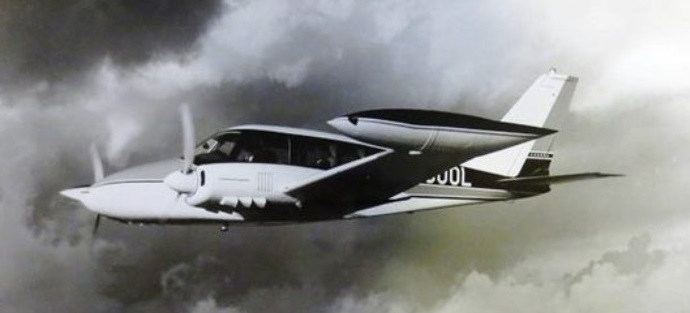
The 320 has essentially the same structure as the twin engine retractable Cessna 310, but with two 285-hp, six cylinder, turbocharged Continental IO-520s.
The 310, 320 and 402 all share virtually the same wing and the 320 and 402 the same engines, with the only real difference being is that the 6 seat 320 is “derated” such that full throttle produces 32 inches of boost (285 hp). The fuel selectors are found on the cabin floor directly between the two front seats and these control, by cable, the selectors in each wing. As there is some “give” in the cable system, selecting the fuel on requires the pilot to “feel” for the indent. Each engine has its own separate fuel system, but the two are interconnected with a crossfeed tube and each engine can be fed from either tan (necessary is you wish to balance the fuel in the two tanks, for example).
The tip tanks are, in fact, the main tanks, each holding 190 litres (50 gallons) usable fuel. The auxiliary tanks are slightly inboard and hold about 78 litres (20.5 gallons) each. There is space for additional fuel behind the engines.
Cessna 320E
Introduced as the premier model 310 version for the businessman, the turbo-charged 320 Skynight was never a big seller. Apart from the extra side windows the 320E is nearly identical to the non-turbo 310L. Only 575 model 320s were built.
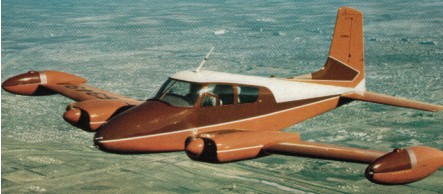
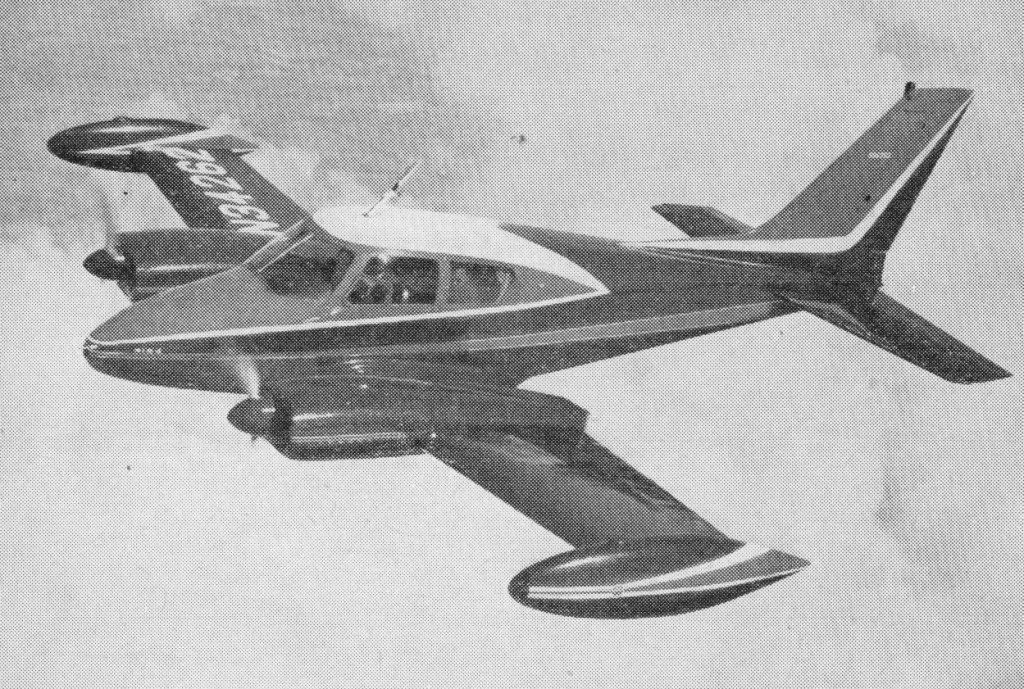
In 1952, Cessna initiated the design of a new five/six-seat twin-engined light monoplane designated Cessna Model 310. The prototype flew for the first time on 3 January 1953, proving in production form to be a popular twin. Of low-wing configuration and with tricycle landing gear, the prototype was powered by the 168kW Continental O-470, an engine developed originally for military use under the designation E225. Its use to power the Cessna Model 310 was one of its first civil applications, early production aircraft having the more powerful 194kW IO-470. An identification feature of the design at that time were the two wingtip fuel tanks, then representing the entire fuel tankage.
Production deliveries began in 1954, with steady product improvement continuing year by year. The swept tail came in 1960, the extra rear window in 1961, and now the slanted, sharpened tip tanks giving the 310G a totally updated appearance. The cabin was capable of seating five. It has a loaded weight of 4,830 lb., and cruises at 220 miles over a range of 825 miles.
1960 Cessna 310D
The 1964 310I Skynight had weather-proof compartments at the rear of both engine nacelles for an additional 120 lb of baggage, the same engines as the 310H, new light-weight props, redesigned control system, and an old price of $62,950.
A deluxe version with turbocharged engines, air-conditioning and an oxygen system as standard was introduced in 1966. This was then named the Turbo-System Executive Skyknight being known also for a short period as the Model 320, but later marketed as the Turbo T310.
Final versions were the basic Model 310 with 213kW Continental IO-520-MB engines, the structurally identical Model 310II which incorporated a factory installed avionics/equipment package, the Turbo T310 with TSIO-520-BB powerplants and the Turbo T310 II with the same additional equipment fit as the Model 310 II.
L-27A
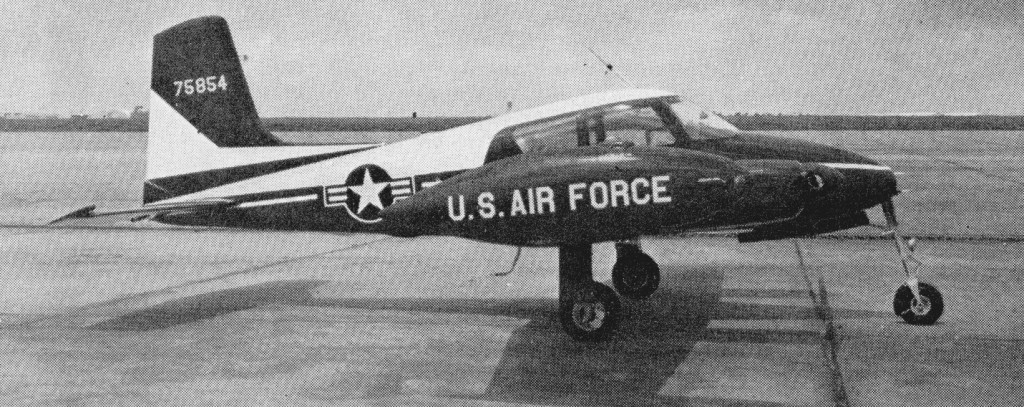
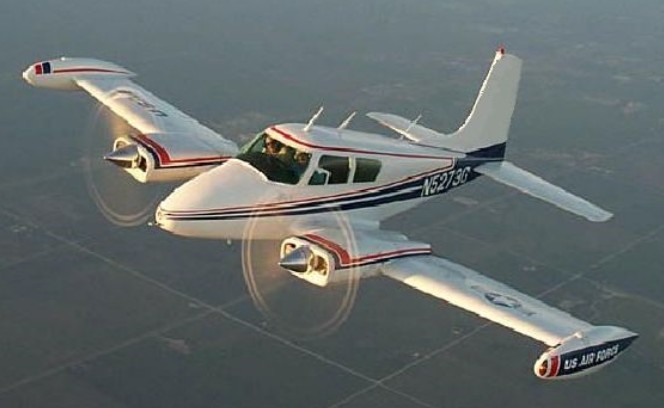
In the mid-1950s, following competitive selection, a slightly modified version of the Model 310 was ordered for light cargo-liaison duties with the US Air Force under the designation L-27A, subsequently redesignated U-3A A total of 160 were built followed by 36 U-3Bs equipped for all-weather operation, and all were nicknamed ‘Blue Canoes’.
Cessna L-27 (U-3A) Blue Canoe
The Turbo-System T310 was introduced in 1969 as Turbo-System 310P replaced the model 320 Skyknight in production.
The 1972 Cessna 310 had an Omni-Vision rear window installed in a slightly enlarged rear fuselage to provide more room for back seat passengers, together with a bigger front windshield, new easier-to read instruments, cleaner panels and detail refinements common to the entire line. On some 310s, with extra wing locker tanks, the aircraft can carry 203 USG. The Cessna 310 had well over 3,000 marketed by 1972. The B55 Barons and the Cessna 310s are powered by 260 hp Continental IO 470 series engines, which have 1,500 hour TBOs, provided their exhaust valves are either nickel coated or ni¬monic; otherwise a 1,200 hour TBO applies. With a wingspan of 36 ft 11 in (11.24 m), and two 260 hp engines, the Model 310 can fly safely on only one engine, and has a maximum range of about 1,700 miles (2,735 km). The final development of the 1953 design came in 1975 when a longer nose was fitted as well as an overhead window for the rear seat passengers.
In the late 1980s Neil Armstrong sold his Cessna 310.
When production finished in May 1981, 5,241 commercial examples of the Model 310 had been built, including a small number for the French air force, plus the 196 delivered to the USAF.
Variations: Riley Rocket Riley Turbostream / Super 310/320
310 1954 CE-310 Engines: 2 x Continental O-470-B, 240 hp Wingspan: 36 ft Length: 27 ft Height: 10 ft 6 in Empty weight: 2850 lb Max loaded weight: 4600 lb Fuel capacity: 2 x 41.6 ImpG tip tanks Max speed: 220 mph at SL Cruise: 205 mph at 8000 ft Range 60%: 875 mi at 10,000 ft ROC: 1700 fpm Service ceiling: 20,000 ft Seats: 5
1977 CE-310 Engines: 2 x Continental IO-520-M, 285 hp. Seats: 4/6. Wing loading: 30.73 lb/sq.ft. Pwr loading: 9.65 lb/hp. Gross wt: 5500 lb. Empty wt: 3337 lb. Equipped useful load: 2049 lb. Payload max fuel: 831 lb. Range max fuel/75% pwr: 1129 nm/5.8 hr. Range max fuel / 55% pwr: 1382 nm/ 7.9 hr. Service ceiling: 19,750 ft. 75% cruise: 194 kt. 55% cruise: 176 kt. Vmc: 81 kt. Stall: 72-79 kt. 1.3 Vso: 94 kt. ROC: 1662 fpm. SE ROC: 370 fpm @ 106 kt. SE Service ceiling: 7400 ft. Min field length: 1790 ft. Fuel cap: 600/1218 lb. Undercarriage: retractable.
1979 Cessna 310 Engines: 2 x Continental IO 520 MB, 285 hp, 213kW. Wingspan: 11.25 m / 36 ft 11 in Length: 9.74 m / 31 ft 11 in Height: 3.25 m / 10 ft 8 in Wing area: 16.63 sq.m / 179.00 sq ft Max speed: 207 kts. / 383 km/h / 238 mph Max cruise speed: 195 kts. Max range: 1,511 nm. Max usable fuel: 203 USG. ROC: 1,662 fpm. ROC SE: 370 fpm. Service ceiling: 6020 m / 19,750 ft. Service ceiling SE: 7,400 ft. Takeoff dist 50 ft obstacle: 1,700 ft. Landing dist 50 ft obstacle: 1,790 ft. Take-off weight: 2495 kg / 5501 lb Empty weight: 1523 kg / 3358 lb Max ramp wt: 5,535 lbs. Max zero fuel wt: 4,900 lbs. Max useful load: 2,182 lbs. Seats: 6.
1979 Turbo Cessna 310 Engines: 2 x Continental TS10 520 BB, 285 hp. Max speed: 237 kts. Max cruise speed: 223 kts. Max range: 1,440 nm. Max usable fuel: 203 USG. ROC: 1,700 fpm. ROC SE: 390 fpm. Service ceiling: 27,400 ft. Service ceiling SE: 17,200 ft. Takeoff dist 50 ft obstacle: 1,662 ft. Landing Dist 50 ft obstacle: 1,790 ft. Max ramp wt: 5,535 lbs. Max zero fuel wt: 5,015 lbs. Max useful load: 2,062 lbs. Seats: 6.
Turbo 310 Engines: 2 x Continental TSIO-520-B, 285 hp. Seats: 4/6. Wing loading: 30.73 lb/sq.ft. Pwr loading: 9.65 lb/hp. Gross wt: 5500 lb. Empty wt: 3453 lb. Equipped useful load: 1933 lb. Payload max fuel: 715 lb. Range max fuel/75% pwr: 1293 nm/5.7 hr. Range max fuel / 55% pwr: 1316 nm/ 7.4 hr. Service ceiling: 27,400 ft. 75% cruise: 223 kt. 55% cruise: 179 kt. Vmc: 81 kt. Stall: 72-79 kt. 1.3 Vso: 94 kt. ROC: 1700 fpm. SE ROC: 390 fpm @ 106 kt. SE Service ceiling: 17,200 ft. Min field length: 1790 ft. Take-off dist, 50ft: 1670 ft. Ldg dist 50 ft: 1795 ft. Fuel cap: 600/1218 lb. Undercarriage: retractable.
1979 Cessna Turbo 310-R Engine: 2 x Continental TSIO-520-MB, 285 hp@2700 rpm TBO hrs.: 1400 Fuel Type:100/100LL Propeller: McCauley three-blade, full feathering/78 in Landing Gear type: Tri./Retr. Max ramp weight (lbs.): 5535 Gross weight (lbs.): 5500 Landing weight (lbs.): 5400 Zero-fuel weight (lbs.): 5015 Empty weight, std. (lbs.): 3723 Useful load, std. (lbs.): 1777 Payload, full std. fuel (lbs.): 1165 Usable fuel (USgals.): 100 Optional fuel (USgals.): 143 / 166 / 207 Oil capacity (qts.): 13 per engine Wingspan: 36 ft. 11 in. Overall length: 31 ft. 11.5 in. Height: 10 ft. 8 in. Wing area (sq. ft.): 179 Wing loading (lbs./sq. ft.): 30.73 Power loading (lbs./hp.): 9.65 Wheel track (in.): 6.50 x 10 Wheel size (in.): 6.50 x 6 Seating capacity: 6 Cabin doors: 1 Cabin width (in.): 48.5 Cabin height (in.): 50 Baggage capacity (lbs.): 950 Cruise speed (kts.) 75% power @ 20,000/10,000 ft.: 223/201 Cruise speed (kts.) 65% power @ 20,000/10,000 ft.: 204/185 Cruise speed (kts.) 55% power @ 20,000/10,000 ft.: 195/177 Max range @ 20,000 ft. (w/ reserve) (nm) 75% power 100/203 gals. usable: 519/1242 Max range @ 20,000 ft. (w/ reserve) (nm) 65% power 100/203 gals. usable: 545/1290 Max range @ 20,000 ft. (w/ reserve) (nm) 55% power 100/203 gals. usable: 570/1360 Max range @ 10,000 ft. (w/ reserve) (nm): 75% power 100/203 gals. usable: 491/1140 Max range @ 10,000 ft. (w/ reserve) (nm): 65% power 100/203 gals. usable: 515/1200 Max range @ 10,000 ft. (w/ reserve) (nm): 55% power 100/203 gals. usable: 540/1270 Stall speed (gear, flaps up) (knots): 78 Stall speed (gear, flaps down) (knots): 70 Best rate of climb (2 engines) (fpm): 1700 Single-engine rate of climb, SL (fpm): 390 Service ceiling (ft.): 27,400 Service-engine sevice ceiling (ft.): 17,200 Takeoff ground roll (ft.): 1306 Takeoff over 50-ft. obstacle (ft.): 1662 Landing ground roll (ft.): 640 Landing over 50-ft. obstacle (ft.): 1790
Colemill Executive 600 / Cessna 310 Engines: 2 x Continental IO-520-E, 300 hp. Seats: 6. Wing loading: 29.1 lb/sq.ft. Pwr loading: 8.7 lb/hp. Max TO wt: 5200 lb. Empty wt: 3125 lb. Equipped useful load: 1952 lb. Payload max fuel: 1112 lb. Range max fuel/ 75% cruise: 990 nm/4.3 hr. Service ceiling: 19,500 ft. 75% cruise: 198 kt. Vmc: 64 kt. Stall: 64 kt. 1.3 Vso: 83 kt. ROC: 2500 fpm. SE ROC: 400 fpm @ 101 kt. SE ceiling: 11,500 ft. Min field length: 1795 ft. Fuel cap: 840 lb.
Cessna’s light twin, the Model 303 (N303PD), flew for the first time in February 1978. A top speed of 140 knots was reached on the Valentine’s Day flight, which lasted 54 minutes. It then designated Cessna Model 303 Clipper
In this prototype form it was a four-seat aircraft of low-wing monoplane configuration with the wing incorporating a super-critical aerofoil section. Other features included retractable tricycle landing gear, swept vertical tail surfaces with a long dorsal fin, extensive use of bonded construction and power-plant comprising two 119kW engines. Before the certification programme began it was superseded by a new Model T303 which reverted to conventional construction, had six-seat accommodation, was powered by two turbocharged engines of increased output, and had acquired the new name Crusader because the earlier title of Clipper infringed a US trademark.
Cessna’s Crusader had its keel laid in 1977, the airplane first flew in 1978 and was quickly laid to rest. The highly touted GAW 1 airfoil apparently was not talented enough in this application, and Cessna felt it would not be able to compete in a market that turned out to be small and overpopulated. That proved to be a good decision. So did the next one: to reinvent the light twin in a new form. The cabin class design was popular, so the target airplane became a basic size cabin class twin with good performance, excellent handling qualities and a big look. The result was an all new design called the Crusader (or T303, turbochargers having been added).
Cessna claimed the Crusader was the first lightweight twin of its class to have full IFR avionics and equipment as standard, and that handling of the aircraft benefited from the high set tailplane, coupled with unusually, counter rotating engines, which minimise engine torque effect. Production model Crusaders were certificated in August 1981, and first deliveries followed in October. When production ceased in 1986 297 had been delivered. Although it replaced the model 337, sales didn’t improve much and only a relatively small number were made.
T303 Crusader Engines: Continental TSIO-520-AE, 250 hp, 186kW and 1 x Continental LTSIO-520-AE. TBO: 2,000 hrs. Props: McCauley 3-blade, 74-in. Length: 30ft 5in. / 9.27 m Height: 13ft 2in. / 4.06 m Wingspan: 11.9 m / 39 ft 1 in Wing area: 189.2 sq.ft. / 17.58 sq.m Maximum ramp weight: 5,175 lbs. Maximum takeoff weight: 5,150 lbs / 2336 kg Standard empty weight: 3,305 lb / 1499 kg. Maximum useful load: 1,870 lbs. Zero-fuel weight: 4,850 lbs. Maximum landing weight: 5,000 lbs (5,150 lbs. with optional heavy-duty wheels and brakes). Wing loading: 27.2 lbs/sq.ft. Power loading: 10.3 lbs/hp. Maximum usable fuel 153 gals/918 lbs. Best rate of climb: 1,480 fpm @ 103 kts. Climb gradient: 871 ft/nm. Rate of climb @ 8,000 ft: 1375 fpm. Certificated ceiling: 25,000 ft / 7620 m. Maximum single-engine rate of climb: 220 fpm @ 97 kts. Single-engine climb gradient: 135 ft/nm. Single-engine service ceiling: 13,000 ft. Maximum speed: 2l6 kts. Cruise @ 65% pwr @ 8,000ft: 167 kts. Cruise @ 72% power @ 10,000ft 180 kts. Cruise @ 65% pwr @ 18,000 ft: 181 kts. Cruise @ 72% power @ 20,000 ft: 197 kts. Fuel flow @ 65% pwr @ 18,000 ft: 147 pph. Fuel flow @ 72% power @ 20,000 ft: 31.3 gph. Endurance at 72 % power, no reserve: 4.9 hrs: Stalling speed clean: 68 kts. Stalling speed gear/flaps down: 62 kts. Turbulent-air penetration speed: 148 kts. Range: 1889 km / 1174 miles
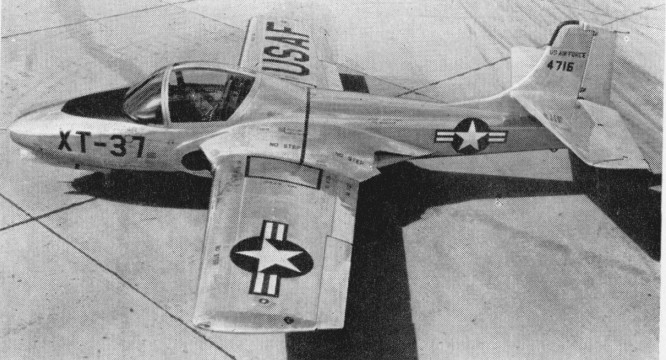
Late in 1952 the USAF formulated a requirement for a jet trainer which would economically permit student indoctrination at an early stage in the training curriculum. Specified design requirements included an empty weight of 4,000 lb (1814 kg) in order to limit both cost and complexity of the aircraft; the ability to undertake twenty take offs and landings within a two hour period; flight handling characteristics matching those of the most modern operational fighters; a 35,000 ft (10668 m) cruise ceiling with sufficient high altitude manoeuvrability to wholly orientate students, and a maximum traffic pattern speed of 113 knots (209 km/h) to assure good low speed handling characteristics. Side by side seating for the student and instructor was favoured. The Marbore II became the Continental J69 and the Cessna company designed their Model 318 around two J69s. This aircraft was a basic jet trainer. In the ensuing design contest, Cessna’s Model 318 was designated the victor early in 1953, and as XT 37s, three prototypes (54 716 to 54 718) were ordered.
The first of these flew on October 12, 1954, (piloted by Bob Hagen), powered by two Continental YJ69 T 9s (licence built Turbomeca Mabore IIs) with 920 lbf (4.1 kN) thrust each, by which time its manufacturers had been awarded a $5 million contract for eleven pre production T 37A trainers (54 2729 to 54 2739), the first of which flew on September 27, 1955. One of the XT-37 prototypes was lost in a flat spin; the pilot baled successfully. Some strengthening of the wing centre section was found to be necessary, the cockpit layout had to be revised, and field trials with the pre production machines were accompanied by minor teething troubles, among these being the fuel system of the Continental J69 turbojets licence built Turbomeca Marbore IIs, but these were soon overcome, and by the early spring of 1956, contracts had been placed for twenty (55 4302 to 55 4321) and 127 (56 3464 to 56 3590) production T 37A trainers, a contract for a further 123 machines (57 2230 to 57 2352) following shortly afterwards, and the 200th T 37A rolling off the assembly line on July 23, 1958. 534 were built under successive contracts, but were slow in entering service as a result of the need for a number of changes and modifications before they were considered acceptable for training purposes.
The first T-37A was completed in September 1955 and flew later that year. The T-37A was delivered to the U.S. Air Force beginning in June 1956. In the spring of 1957, the first training courses on the T 37A had begun at Waco, Texas, the first class of twenty students receiving 150 hours on the new jet trainer after forty hours on the piston engined Beech T 34A primary trainer. The second group of students at Waco had only twenty hours on the T 34A as the next stage in evolving an all jet curriculum.
In April 1961 all-through jet training was initiated, the pupil flying from the very beginning of his training on T-37 aircraft which had a speed range of 138-684km/h. No catastrophic accident rate resulted, as had been feared by many, but one point which had not been fully considered was the much higher training cost using jet aircraft. There is inevitably a varying pupil rejection rate at the end of primary training, and it was decided in 1964 to revert to light piston-engine trainers, which are much cheaper to operate, for this primary phase, so that T-37 pupils were those left after the first weeding-out.
The T 37A was powered by the 920 lb.s.t. (417 kgp) J69 T 9 turbojet, but during 1959, after the delivery of 416 aircraft of this type, production switched to the T 37B with 1,025 lb.s.t. (465 kgp) J69 T 25 turbojets, and new Onini and UHF equipment, the first of the improved trainers being accepted by the USAF on November 6, 1959. Subsequently, all T 37As passed through a modification programme to bring them up to ‘B’ standards.
For the training role, Cessna chose straight wings, twin wing root mounted engines and side by side seating. The original 417 kg (920 lb) thrust Continental J69 9 engines, built under licence from Turbomeca, were not calculated to make the American type a startling performer.
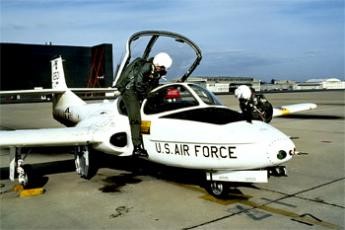
The T 37B is basically a low wing cantilever monoplane of all metal construction, and has its twin J69 T 25 turbojets mounted in the thickened wing roots, their inboard location creating a negligible change in directional control with one engine inoperative, and facilitating the demonstration of single engine procedures. A single stage, centrifugal compressor engine, the J69 T 25 has a fully automatic altitude compensating fuel control, and the two power plants draw their fuel from the main fuselage tank immediately aft of the cockpit, this being fed from six inter connecting rubber cell fuel tanks in each wing, the total usable capacity of these being 257 Imp. gal. (1 168 lt). Engine driven pumps and submerged booster pumps drive the automatic fuel transfer system, but in the event of a fuel proportioner or electrical system malfunction, fuel is automatically supplied to the engines by the gravity system.
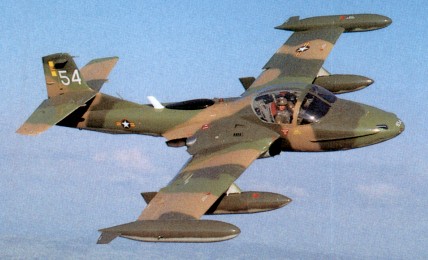
The low ‘sit’ of the T 37B on the ground eliminates the need for cockpit entrance ladders, flush steps in the fuselage 24 in (61 cm) above the ground providing easy entrance from either side of the aircraft. The cockpit itself is ideally situated, well forward of the wing, and, with the backward folding, jettisonable clam shell type canopy offers excellent visibility. The panel itself is a relatively simple and straightforward approach to current requirements. The primary instruments are duplicated for instructor and student, all instruments may be monitored, and all operating controls and switches are easily accessible from either seat. Positioned to port on the student’s side are the navigational and flight instruments, including directional and attitude indicators, altimeter, turn and bank, rate of climb and airspeed indicators, and course indicator. In front of the instructor on the starboard side but within reach of the student are the radio controls, circuit breaker, etc., and the engine instruments mounted over the central quadrant include tachometers, fuel flow and exhaust temperature indicators, fuel and oil pressure gauges, loadmeters and accelerometer. The stick grips and throttle quadrants are of fighter type. A 1,500 psi (105.5 kg/sq.cm) hydraulic system is installed. Two engine driven, constant displacement hydraulic pumps are used to drive the landing gear and doors, speed brake and thrust attenuators, nosewheel steering system, flaps and stall spoilers. The hydraulically operated brakes are independent of this system. The electrical system comprises two 200 amp. starter generators, one 24 volt, 36 amp hour battery and associated control equipment. No ancillary starting equipment is necessary, the battery being sufficient to provide engine starts for all normal training operations. Structurally, the T 37B comprises a semi monocoque fuselage, a two spar aluminium alloy wing of NACA 2418 section at the root and NACA 2412 section at the tip, and a normal cantilever monoplane type tail assembly of which the fin is integral with the fuselage, and the tailplane is mounted one third of the way up the fin. Hydraulically operated high lift slotted flaps with a total area of 15.1 sq ft (1.4 sq.m) are mounted inboard of the ailerons which have a total area of 11.3 sq. ft. (1.05 sq.m), and all movable tail surfaces have electrically operated trim tabs. Because of its low drag characteristics, an hydraulically actuated speed brake is located on the underside of the fuselage nose section, aft of the nosewheel well. This brake works in con¬junction with thrust attenuators which deflect the exhaust blast and permit higher rpm during landing approaches. When the attenuators are extended, the resultant effective thrust is reduced by more than forty per cent. Both attenuators and speed brake are controlled by the speed brake switch when the throttles are below seventy per cent rpm. The thrust attenuators automatically retract when the throttles are advanced above seventy per cent rpm. The undercarriage has two extension systems, the primary system being hydraulically actuated and the secondary system being pneumatically powered. The wheel brakes are, as previously mentioned, operated by a separate hydraulic system controlled by dual rudder and brake pedals, and the wide track of the main members (14 ft 0.5 in. 4.28 m) results in an unusually high degree of ground stability. The T 37B demonstrates good stability in all configurations and conditions of flight. Extremely effective control surfaces result in instant response, and light forces, well balanced between the three controls, make all manoeuvres easily co ordinated. Spins are mild and recovery by use of standard procedure is positive. The excellent stall characteristics are well defined with lateral control effective at all times, and good stall warning is provided for all flight configurations. Landings are accomplished equally well from either scat, and no abrupt pitch or directional trim change results when power is added for another circuit of the field. These characteristics are ideal for a training aircraft but they also result in an excellent weapons platform, and supplanting the T 37B trainer on the Wichita assembly line as the T 37C which has underwing attachment points for offensive stores or drop tanks and is intended primarily for supply to the smaller nations militarily aligned with the USA. With a gun sight mounted in the cockpit, underwing racks can carry bombs or rocket, gun or photographic pods for internal security duties, and the T 37C served with such coun¬tries as Portugal (30) and Vietnam. Mission range may be increased to more than 1,100 nautical miles (2 040 km) by the addition of wingtip tanks which, each containing 54 Imp gal. (246 lt), increase the total fuel capacity to 366 Imp gal. (1664 lt). Fuel is transferred from the tip tanks to the wing tanks by inline booster pumps, utilizing the existing internal fuel system, and provision is made for jettisoning. When production ended in 1977 a total of 1,268 T-37s had been built for the USAF and for export. During 1962 two Cessna T-37B trainers were evaluated by the USAF’s Special Air Warfare Center to consider their suitability for deployment in the counter-insurgency (COIN) role. These were first tested with their original powerplant of two 465kg thrust Continental J69-T-25 turbojets, at a take-off weight of 3946kg, almost 33% above the normal maximum take-off weight. Subsequently the airframes were modified to accept two 1089kg thrust General Electric J85-GE-5 turbojets. This increase in power made it possible for the aircraft, then designated YAT-37D, to be flown at steadily increasing take-off weights until a safe upper limit of 6350kg was reached. After successful trials Cessna were requested to convert 39 T-37B trainers from the production line to a light-strike configuration, a contract being awarded in 1966. Designated A 37A, they were delivered, only being withdrawn from service ten years later in 1974. The new model was based on the earlier experiments with the two YAT-37Ds, and equipped with eight underwing hard-points, provided with wingtip tanks to increase fuel capacity and powered by derated General Electric J85-GE-5 turbojets. Delivery to the USAF began on 2 May 1967, and during the latter half of that year a squadron numbering 25 of these aircraft underwent a four-month operational evaluation in South Vietnam. Following this investigation they were transferred for operational duty with the 604th Air Commando Squadron at Bien Hoa, and in 1970 they were assigned to the South Vietnamese air force. This led to the conversion of a number of T 37Bs to A 37A Dragonfly status for operational evaluation in Vietnam and followed with development of the much more dedicated A 37B. Production of 577 started in 1968, featuring the General Electric J85 turbojet, airframe stressed to 6g, much increased fuel capacity and eight underwing hardpoints. Various improvements to the avionics, upgrading of the turbines, the addition of wingtip fuel tanks, and provision for weapons saw the trainer develop into an attack version, and new aircraft were still being delivered for export in late 1977. Featuring side by side seating, the lightjet powered by two General Electric turbojets each rated in excess of 2800 lb static thrust had a range of some 1050 miles on a tankage of 1100 litres. Armed with a mini gun in the nose and with four pylons on each wing for ordinance and stores, the A 37 could feature a typical delivery of four 8701b bombs, two 600 lb bombs and two 500 lb bombs. A load could consist of an assortment of fire bombs, demolition bombs, canister clusters, flares or rockets. The aircraft could, it is claimed, carry their own weight in stores. During this period, Cessna had built the Model 318E prototype of a purpose-designated light-strike aircraft based on the T-37 and this flew for the first time in September 1967. The initial production batch of this A-37B was started quickly enough for the first deliveries to begin in May 1968. The A-37B differed in construction from the prototype YAT-37D, its airframe stressed for 6g loading, maximum internal fuel capacity increased to 1920 litres with the ability to carry four auxiliary tanks having a combined capacity of 1516 litres, and with provision for flight-refuelling. The engines were changed to two General Electric J85-GE-17A turbojets of 2585 kg (5700 lb) total installed thrust. The tip tanks became standard, a GAU-2B/A 7.62mm Minigun was installed, and eight underwing hardpoints. The two inner of these can each carry 395 kg (870 lb), the intermediate ones 272 kg (600 lb) and the outers up to 227 kg (500 lb) although the maximum weapon load is 2576 kg (5680 lb) with a maximum takeoff weight of 6350 kg (14000 lb). For the assessment of results both gun and strike cameras were carried, and some armour protection for the crew of two was provided by the inclusion of layered nylon flak-curtains installed around the cockpit. The avionics is limited to comprehensive but basic navigation/communications and a non computing gunsight. A Forward Air Control variant existed as the OA-37B. By the time production ended in 1977, 577 A-37Bs had been delivered. The Cessna Model 318E Dragonfly (A-37B) is equipped with two General Electric J85-17A turbojets, giving it almost double the takeoff power (each rated in excess of 2,800 lbs static thrust), and subsequently double the takeoff weight, over that of the T-37. Increasing the number of and strengthening the hard points, enables the A-37B to carry close to its own empty weight in armament (around 5000 lb).
The last T-37B was officially retired from active USAF service on 31 July 2009
The US Government supplied 254 Cessna A37B Dragonfly’s to the Vietnam Air Force (VNAF) during the Vietnam War. After the fall of South Vietnam in 1975, ninety-five VNAF A37B aircraft were captured and incorporated into the Vietnamese People’s Air Force. Many were transferred to the US Air National Guard. More than 600 were delivered at home and abroad, including sales to Brazil, Chile, Guatemala, Honduras, Peru, Thailand.
Military Users: (All models) Brazil, Cambodia, Chile, Columbia, Ecuador, Guatemala, Greece, Honduras, South Korea, Pakistan, Peru, Portugal, Thailand, Turkey, South Vietnam, Vietnam, USAF (and Luftwaffe via US training programme).
XT 37 CE Three prototypes of the Model 318, first flown October 12, 1954. Powered by two Continental YJ69 T 9s (licence built Turbomeca Mabore IIs) with 920 lbf (4.1 kN) thrust each.
T 37 CE Pre production batch of eleven airframes. All subsequently redesignated as T 37A CEs.
T 37A CE Cessna Model 318A, production standard. Two Continental T69 T¬9s. Production came to 444 units, survivors up graded to T 37W CE. Single example to JT 37A CE for special test. T 37 universally known as the Tweety Bird or Tweet in USAF service.
T 37B CE Further improved production standard, improved radio/navigation installation and J69 T 25s. Model 318B, 552 built.
T 37C CE Version of T 37B CE for Military Assistance Program countries. Provision for underwing pylons and tip tanks optional. 198 built.
YAT 37D CE Two T 37C CEs converted to counter insurgency aircraft with six underwing hardpoints and two General Electric J85 GE 5s. Both redesignated YA 37A CE. Cessna Model 318D.
A 37A CE Dragonfly ‘Production’ version of YA 37A CE with eight underwing hardpoints and 7.62mm Minigun in nose. 39 T 37B CE converted.
A 37B CE Dragonfly New build version, as A 37A CE but with J85 GE 17A, increased fuel, provision for in flight refuelling and strengthened airframe. 577 built of which one was termed YA 37B CE for development work.
OA 37B CE Dragonfly At least 122 A 37Bs redesignated for use by Air National Guard units in the Forward Air Controller role.
Specifications:
T 37A Engines: Two Continental T69 T¬9 Wing span: 33.78 ft ( 10.3 m). Overall length: 29.25 ft ( 8.9 m). Height: 9.17 ft ( 2.8 m). Wing area: 183.9 sq.ft ( 17.1 sq.m). Wing aspect ratio: 6.20. Empty wt: 4056 lb ( 1841 kg). Normal T/O wt: 6574 lb ( 2984 kg). MTOW: 6574 lb ( 2984 kg). Internal fuel cap: 257 Imp.Gal. (1168 lt). External fuel cap: 108 Imp.Gal. (490 lt). Wing loading: 35.7 lb/sq.ft ( 174 kg/sq.m). Pwr loading: 3.7 lb/lbst ( 3.7 kg/kgst). Max speed: 452 mph ( 727 kph). Initial ROC: 3000 fpm ( 15 m/sec). TO dist 50 ft: 2025 ft ( 617 m). Range: 935 sm ( 1500 km).
T-37A Engines: 2 x Continental J69-T-15, 920 lb Wingspan: 33 ft Length: 27 ft 1 in Height: 8 ft 9.25 in Wing area: 181.8 sq.ft Empty weight: 3116 lb Loaded weight: 5600 lb Max speed: 393 mph at 35,000 ft Cruise: 310 mph ROC: 3000 fpm Service ceiling: 39,800 ft Max range: 935 mi
T 37B Engine: 2 x Continental J69 T 25 turbojets, 1,025 lbs.t. (465 kgp). Span, 33 ft 9.5 in (10.3 m) Length, 29 ft 3 in (8.93 m) Height: 9.19ft (2.80m) Wing area, 183.9 sq.ft (17.09 sq.m). Gross weight: 6,574 lb 2 982 kg Empty wt: 4,056 lb (1840 kg). Take off dist to 50 ft. (15 m): 2,025 ft. (617 m). ROC S/L Military RPM: 3370 fpm (17 m/sec). Service Ceiling Military RPM: 38,700 ft (11 796 m). Single engine Service Ceiling ½ Fuel Military RPM: 25,000 ft (7 620 m). Cruise speed Normal rated power, ½ fuel at 35,000 ft (10 668 m): 320 kts (593 kph). Max speed ½ fuel Military RPM at 20,000 ft (6 096 m): 369 kts (684 kph) Range at 35,000 ft (10 668 m) at 289 kts (535 kph): 692 nm (1282 km). Max range 5% reserve at 35,000 ft (10 668 m) at 289 kts (535 kph): 809 nm (1 499 km). Range at normal RPM with 5% reserves at 35,000 ft (10 668 m) at 313 kts (580 kph): 755 nm (1390 km). Landing Distance from 50ft (15 m): 2,600 ft (792 m). Stalling speed gross weight, SL: 74 kts (137 kph).
T-38C – Engine: 2 x Continental J69 T 25 turbojets, 1,025 lbs.t. (465 kgp). Span, 33 ft 9.5 in (10.3 m) Length, 29 ft 3 in (8.93 m) Height: 9.19ft (2.80m) Wing area, 183.9 sq.ft (17.09 sq.m). Armament: 2 x 250lb Iron Bombs Rate-of-Climb: 3,370ft/min (1,027m/min) Service Ceiling: 39,199ft (11,948m; 7.4miles) Accommodation: 2 Hardpoints: 2
YAT 37D Engine: 2 x General Electric J85 GE 5 turbojet, 2,400 lb.s.t. (1 088.6 kgp). Gross weight: 10,500 lb. (4 763 kg). Take off dist: 1,000 1,700 ft (305 518 m). Ordnance: 3,000 lb. (1361 kg). Max speed: 475 mph (764 km/h) clean Max speed: 320 mph (515 km/h) max external ordnance and wingtip tanks.
A 37 Dragonfly Engine: 2 x Continental J69-T-25, 4562 N / 465 kp Length: 29.298 ft / 8.93 m Height: 9.35 ft / 2.85 m Wingspan: 33.793 ft / 10.3 m Max take off weight: 6401.1 lb / 2903.0 kg Max. speed: 370 kts / 686 km/h Service ceiling: 38714 ft / 11800 m Range: 1150 nm / 2130 km Crew: 2
Cessna A37B Dragonfly Engines: Two General Electric J85-17A Axial Flow turbojets, 2,850 lbs (1293kg) Wingspan: 10.93 m / 35 ft 10 in over tip tanks Wing Area: 193.5 sq. ft / 17.98 sq. m Length: 8.62 m / 28 ft 3 in Height: 2.71 m / 8 ft 11 in Empty weight: 6,254 lb / 2,843 kg Maximum Takeoff weight: 14,000 lb / 6,364 kg Maximum landing weight: 6350 kg (14 000 lb) Wing Tank Capacity: 2 x 83 Imperial Gallons / 376 Litres / 99 U.S. Gallons Fuselage Tank Capacity: 2 x 66 Imperial Gallons / 299 Litres / 79 U.S. Gallons Wingtip Tank Capacity: 2 x 75 Imperial Gallons / 341 Litres / 90 U.S. Gallons Pylon Tank Capacity: 4 x 81 Imperial Gallons / 367 Litres / 97 U.S. Gallons Maximum Speed: 420 knots / 483 mph / 778 km/h Cruise Speed: 265 knots / 305 mph / 491 km/h Cruise at 25,000 ft: 489 mph (787 km/h). Rate-of-Climb: 6,990ft/min (2,131m/min) Service Ceiling: 41,762ft / 12,729m Range w/max.fuel: 1629 km / 1012 miles Range w/max.payload: 740 km / 460 miles Take off run: 1740 ft. Landing dist: 1710 feet. Armament: One GAU-2B/A 7.62mm Minigun Hardpoints: 8
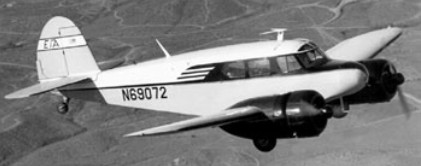
Dwane Wallace and his company perceived the untapped twin engine market as being for a relatively inexpensive and uncomplicated airplane. The prototype T 50 was a simple airplane. It had fixed ¬pitch props and small (225 hp) Jacobs en¬gines, but constant speed propellers and 20 more horsepower per side were later fitted. The props were not full feathering, and could only be pulled into full coarse pitch in the event of an engine failure. The design used al¬most no aluminum (only the nose cap, tail stinger, engine cowlings and nacelles) at a time when aluminum was far too valuable to waste on trainers. The T 50’s fuselage was welded steel tubing with fabric over wood longerons and formers, and the wing was all wood spruce, mahogany and birch under fabric. The flaps were wood also, and they and the gear were both driven through bicycle -chain loops by a pair of electric motors in the belly. The screw jack actuator for the gear was non-reversible, so no down locks or up¬latches were needed. The landing gear retracts upward into the nacelles and remains partly exposed so that belly landings can be made with little or no damage if the flaps are up. An unusual feature of the Jacobs engine is that it operates on only one magneto, plus battery ignition. It is started on the battery, then switched to the mag. Both engines turn generators, and they run smoothly on ignition if a mag fails. The T-50 prototype makes its first flight with Dwane Wallace at the controls on March 26, 1939. The plane was certified in December 1939. By 1940, it was in production and ready for buyers. Cessna only had time to make a few commercial T 50s before rumors of war reached American ears. The Army showed a polite interest in the T 50 as a trainer for bomber pilots, and ordered 33 specially equipped T-50’s – at the time, the largest order in Cessna’s history. The Army’s new planes are designated AT-8’s. The Army Air Corps’ first Bobcats were AT 8s, and they were, in fact, the service’s first multi-engine trainers of any sort. The AT¬8 had 290 hp nine cylinder Lycomings in place of the civilian airplane’s seven cylinder 220kW / 245 hp Jacobs R-680-9 engines, plus the eyebrow windows and transparent cockpit roof that henceforth all military T 50s would have. Service trials showed that these were unnecessarily powerful for use in a two-seat trainer, and when in 1941 the first real production contracts were placed, less powerful engines by the same manufacturer were specified. The British decided to ship their students to Canada for flight instruc¬tion, so it fell to Canada to come up with the necessary training planes. Prior to that, they’d sold four to the CAA [as airways fa¬cility check planes] and 33 to the Air Corps, but the big sale was the first 180 airplanes to the Canadians dubbing them “Cranes”. The Canadians called the T¬50s Cranes and eventually got 830 airplanes. One extra thing the Canadians wanted was a third fuel tank, installed in the fuselage be¬neath the rear seat; the two 60 gallon wing tanks were only good for about three hours, and 40 gallons in the fuselage gave the Crane an extra hour or so. The Crane wasn’t certified for civilian use with the third tank, and the filler cap opening was covered over in surplus Canadi¬an T 50s (and later U.S. versions that also got the mod) after the war. The Canadians soon reverted to wooden fixed pitch props, because of a lack of metal for blades and perhaps because they figured the airplane was going nowhere but down anyway if an engine stopped. For the Commonwealth Joint Air Training Plan, eventually 550 aircraft were supplied under Lend-Lease. The original use of Cessna’s T-50s had been in a light transport role, and in 1942 the USAAF decided that these aircraft would be valuable for liaison/communication purposes and as light personnel transports. The aircraft were named Bobcat and given the designation C-78, later changed to UC-78. In addition, a small number of commercial T-50s were impressed for service with the USAAF under the designation UC-78A.
The USAAF’s requirement for the two-seat conversion trainers had been difficult to predict, and when it was discovered in late 1942 that procurement contracts very considerably exceeded the training requirement, Cessna was requested to fulfil the outstanding balance of the AT-17B and AT-17D models as UC-78B and UC-78C Bobcats respectively. Both were virtually identical, but differed from the original UC-78s by having two-blade fixed-pitch wooden-propellers and some minor changes of installed equipment. Production of these two versions amounted to 1,806 UC-78Bs and 327 UC-78Cs. (3,370 UC-78 Bobcats for the USAAF in total)
The initial production version, designated AT-17, was equipped with Jacobs R-755-9 engines driving wooden propellers. A total of 450 was built, and these aircraft were followed into production by 223 of the generally similar AT-17A, which differed by having Hamilton-Standard constant-speed metal propellers and a lighter maximum weight. The later AT-17B (466 built) had some equipment changes, and the AT-17C (60 built) was provided with different radio for communications. Of these 1,199 aircraft, 550 were delivered to Canada with the name Crane Mk 1A. They came in two gross weights, de¬pending on the wing construction used¬ – 5,100 and 5,700 pounds and their crew capacity was either two or five, depending on whether they had the fuselage aux tank.
In the period 1942-3, the US Navy had a requirement for a lightweight transport aircraft to carry ferry pilots between delivery points and their home bases, as well as for the movement of US Navy flight crews. This led to the procurement of 67 aircraft, generally similar to the UC-78, which entered service under the designation JRC-1. Many examples of USAAF Bobcats remained in service for two or three years after the end of World War II. Originally built with 245 hp Jacobs radial engines, some Bobcats later got 295 hp Lycomings, and others were re-engined with 300 hp Jacobs powerplants. With the addition of an exit-hatch window to meet safety requirements, some also have been converted to six-seaters, though normal seating is two pilots and three passengers on a single bench-type rear seat.
Bobcats have a large rudder, but the vertical stabilizer is small and minimum single-engine control speed is 90 mph. At 10,000 feet, full throttle gives 20″ of manifold pressure, and 1,900 rpm on the Hamilton Standard constant-speed props will yield 143 mph indicated.
Cessna AT-17 / T-50 Bobcat
There are four different single engine ceilings listed for the heavier of the two versions of the airplane, based on gross weights of 5,400 and 5,700 pounds, each calculated with fixed pitch and constant speed props. The best is 1,500 feet above sea level; the worst is sea level, with a minimum rate of descent of 50 feet per minute. There were several little ¬known Bobcat variants and derivatives, though none of them ever progressed much beyond the prototype stage. The first was the Cessna P 7, a Bobcat with plywood covered wings and tail surfaces and 330 hp Jacobs engines. The second was the P 10, a Wichita mini-version of the de Havilland Mosquito, it was a two place P 7, with the big Jacobs en¬gines and a plywood covered fuselage, a little snub nose and a pair of side by side seats un¬der a bubble windscreen and roll back cano¬py. Finally, there was the P 260, which had the Bobcat’s wing planform, fabric covered fuselage arrangement and formation of boil¬ers nacelles; but it was a 14,000 pound car¬go hauler with R 1340 Pratt & Whitneys. It almost made it into production the Govern¬ment was about to buy 500 of them as C¬106As except the C-47 turned out to be more useful than any¬body had expected. In early 1944, Cessna suspends production of the Bobcat and begins manufacturing components for the Douglas A-26 and Boeing B-29 bomber. More than 5400 T-50s were constructed for the RCAF and the US military.
Cessna UC 78 Bobcat Engine: 2 x Jacobs R 755-9, 242 hp Length: 32 ft 9 in / 9.98 m Height: 9 ft 11 in / 3.02 m Wingspan: 41 ft 11 in / 12.78 m Wing area: 295.041 sqft / 27.410 sq.m Max take off weight: 5699.9 lb / 2585.0 kg Weight empty: 3501.5 lb / 1588.0 kg Max. speed: 170 kts / 314 km/h / 195 mph Cruising speed: 152 kts / 282 km/h Service ceiling: 22,000 ft / 6705 m Wing load: 19.27 lbs/sq.ft / 94.00 kg/sq.m Range: 652 nm / 1207 km / 750 miles Crew: 2 Passenger: 3
UC-78 Bobcat Engine: 2 x Lycoming R-680-9 radial, 220-kW (295-hp).
JRC-1 Engine: 2 x Lycoming R-680-9 radial, 220-kW (295-hp).
Crane Mk I Engine: 2 x Lycoming R-680-9 radial, 220-kW (295-hp).
Crane Mk 1A
AT-8 Engine: 2 x Lycoming R-680-9 radial, 220-kW (295-hp).
AT-17 Engines: 2 x Jacobs 8-775-9, 183kW (245 hp). Wingspan: 12.80m (41 ft 11 in). Length: 10m (32ft 9in). Max TO weight: 2258 kg (5,700 lb). Gross weight: 5,700 lb. Empty weight: 4,050 lb. Fuel capacity: 120-160 USG. Max speed: 195 mph at sea level. Cruise: 165 mph. Landing speed: 65 mph. Initial climb rate: 1,525 fpm. Ceiling: 15,000 ft. Operational range: 750 miles. Seats: 4-6.
The Centaur Ha (C.F.2A) was a twin-engined commercial transport biplane with Beardmore engines. Two were built, equipped with seats for six/seven passengers or to carry half a ton of mail or freight.









 All Aero