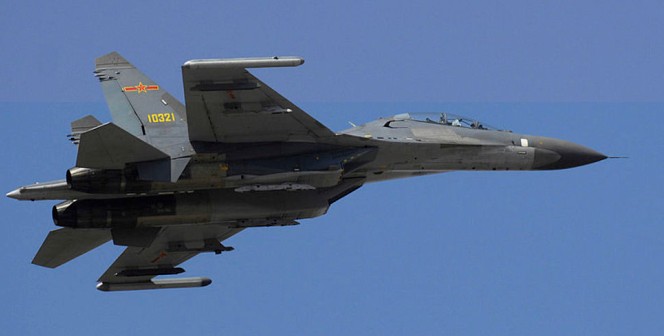
Chengdu J-11
The CAIC WZ-10 (Changhe Aircraft Industries Corporation / Wuzhuang Zhisheng) is an attack helicopter, with this particular model being produced for use by the People’s Republic of China.
The two crew members sit in tandem with the pilot in the rear and seated higher than his gunner at front. Wing stubs provide the ability for the system to wield munitions of various sorts and center around anti-tank missiles. Additionally the WZ-10 is believed to possess anti-aircraft abilities. Standard armament includes a chin-mounted 23mm cannon.
Power is derived from twin turboshafts centering on the Pratt & Whitney Canada PT6C-67C series. These two engines produce 1,531 horsepower each. The systems drive a five-blade main rotor and a four-blade tail unit. The transmission development is based on help from Agusta Westland. In all, the helicopter is believed to be in the same class as modern systems such as the Denel Rooivalk and Eurocopter Tiger and is slated for operational service beginning 2008.
CAIC WZ-10
Engines: 2 x Pratt & Whitney Canada PT6C-67C turboshaft, 1,531hp
Main rotor: five-blade
Tail rotor: four-blade
Length: 46.26ft (14.1m)
Height: 12.63ft (3.85m)
Maximum Speed: 168mph (270kmh; 146kts)
Maximum Range: 497miles (800km)
Service Ceiling: 19,685ft (6,000m; 3.7miles)
Armament: 1 x 23mm cannon in undernose position
Accommodation: 2
Hardpoints: 4
Empty Weight: 12,214lbs (5,540kg)
Maximum Take-Off Weight: 13,228lbs (6,000kg)
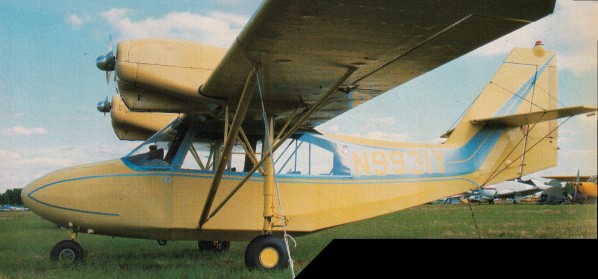
Manufactured by Champion Aircraft, the Lancer 402 was a multi-engine trainer from 1963.
With a fabric covered airframe and tandem seating, the Lancer had heel brakes and oleo-spring gear.
Powered by two Continential O-200A engines of 100 hp each, it sold for around US$12,500. The wing span was just over 34 feet, a wing area slightly over 170 sq.ft and an overall length of around 22 feet.
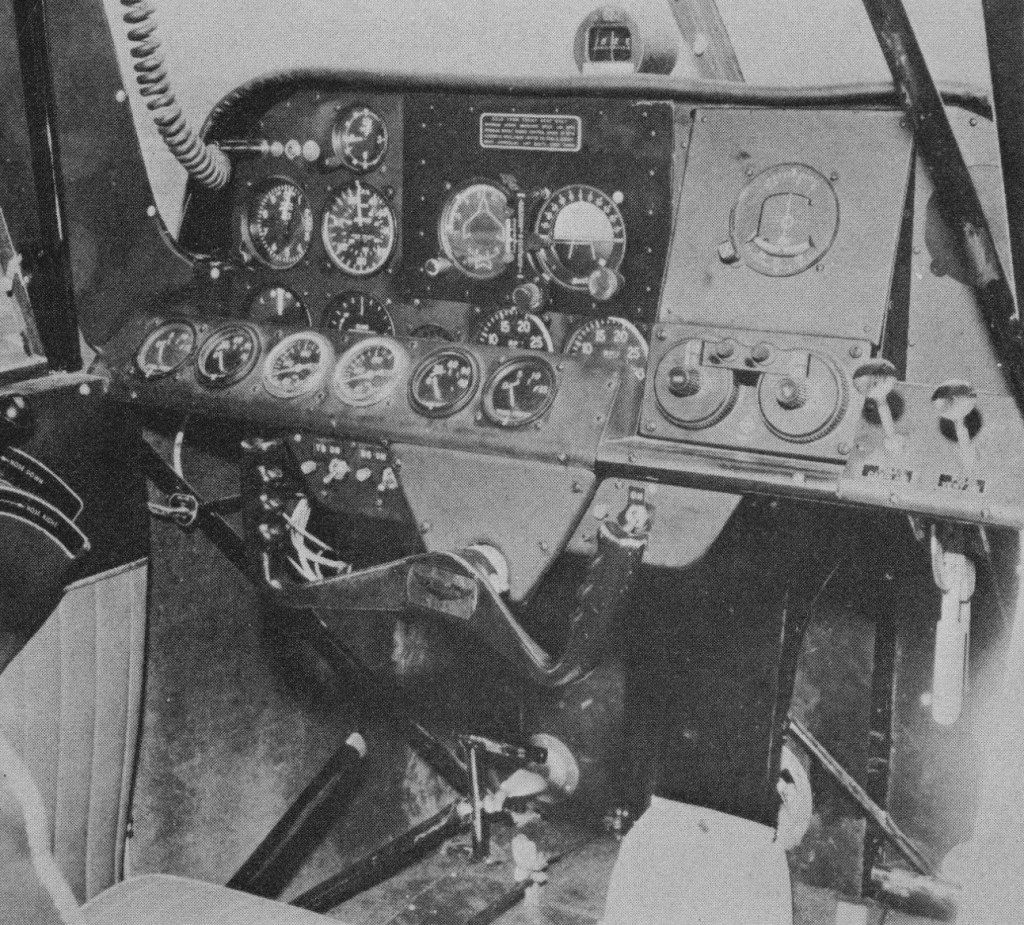
Landing gear tread is 9 ft 8 in. Steerable nose wheel is aluminium casting. Fuselage nose piece, top and cowl noses are fibreglass. Ground clearance of 44in at tail allows full stall landings. Cockpit with control wheel in front, stick in rear, is 28in wide. Rudder and stabiliser trim is via levers at the left of front and rear seats. Vertical trim tab on high, wire-braced tail provides for hands-off trim, even with the loss of one engine. Mixture and throttle controls are duplicated and located high on the cockpit left, with carb heat controls opposite back of front seat. Located at left wing root are fuel tank gauges selector switch for left tank, ignition switch, left engine starter and cockpit lights. Right wing root contains similar units for right engine plus two ammeters and electrical switches. Throttle mix controls hang from left side of cockpit.
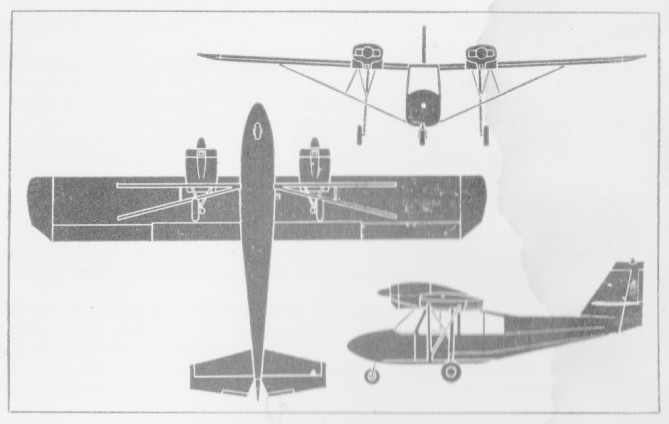
The Lancer first flew in October 1961 and a number of changes were made, including the raising of the engine nacalles above the wing, and the first production model flew on 10 March 1963.
FAA certification was obtained in the spring of 1963, and the first production deliveries were made during the following summer, 36 being delivered by years end.
American Champion Aircraft Corporation held the Type Certificate Number A3CE for the Model 402.
Useable fuel is held in two 26 US gallon tanks. Climb and approach speeds are both 80 mph.
Up to 100 lb of baggage can be carried in a compartment behind the rear seat.
With two seats in tandem, Champion only manufactured 24 Lancers, featuring a control yoke for the front seat and a floor mounted stick in the rear.
Engines: 2 x Continental O-200A, 100 hp
Propellers: 69 in fixed pitch
Wingspan: 34 ft 5.5 in
Length: 22 ft 3 in
Height: 8 ft 1.5 in
Wing area: 170.22 sq.ft
MAUW: 2450 lb
Empty weight: 1790 lb
Useful load: 660 lb
Baggage capacity: 100 lb
Max structural cruise: 130 mph at 7500 ft
Cruise 75%: 120 mph
Cruise 65%: 115 mph
Range: 710 miles
Service ceiling; 12,000 ft
SL ROC: 642 fpm
Landing speed: 48 mph
SE min control speed: 73 mph
Stall clean: 64 mph
Seats: 2
Airship, France, 1915
Length : 305.118 ft / 93.0 m
Width of hull : 45.276 ft / 13.8 m
Contained volume : 370860 cu.ft / 10500 cu.m
Max. speed : 38 kts / 70 km/h
Engine : 2 x Clément-Bayard, 197 hp
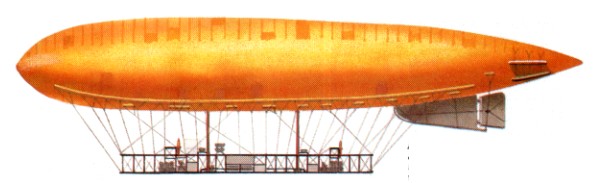
When war broke out in 1914, French airship equipment was entirely of the non-rigid pattern, and it was one of these that became the first Allied airship to carry out an air raid. This was the Fleurus, which had been built (like all French army craft of the lighter-than-air type) in the workshops at Chalais¬Meudon two years earlier, being re¬garded as a smaller sister ship to L’Ad¬jutant Vincenot (C.B.IV).
The Fleurus (or C.B.V. as it was officially known), had for the period a good aerodynamically efficient shape as it had been de¬signed as a result of wind tunnel tests conducted at the Eiffel laboratory. While these results were applied to the contours of the envelope, Clement¬Bayard was responsible for the design of the motor and the gondola, hence the initials of the alternative designa¬tion.
During the last year of peace, great use was made of the vessel, which par¬ticipated in the army manoeuvres of that summer. It also left its base at Pau on 23 September at the beginning of a flight to Saint-Cyr, a journey which it completed in 16 hours, averaging a speed of 54 km/h (33.7 mph), rather less than its maximum, for the distance of 680 km (423 miles) at an altitude nev¬er more than 1000 m (3,281 ft).
When making its historic raid from Verdun, the F]eurus was officially an army airship, there being no equiva¬lent naval air arm; but with effect from 1 January 1917 this was rectified and the army vessels were handed over to establish the new branch of the navy. Of the six non-rigids involved, four were at once deployed for sea patrol in much the same manner as the British ‘North Sea’ and similar types, but by now the C.B.V was five years old and obsolescent, so that with another airship it was relegated to training duties. The base for this work was far from the area where the newer airships operated — North Africa’s Mediterranean coast — being instead no further afield than Rochefort. It was here the Fleurus ended its days, destroyed in a fire as a result of an air raid in June 1918.
National insignia had not been adopted at the time of the first flight to be made by Fleurus, but when it was introduced this vessel was one of the earliest in France to be thus marked.
Chalais-Meudon Fleurus I
Engines: two 59. 7-kW (80-hp Clement-Bayard four-cylinder water-cooled piston
Diameter 12 40 m (40ft 8.2 in)
Length 77.0m (252 ft 7.5in)
Contained volume : 229580 cu.ft / 6500 cu.m
Max. speed : 32 kts / 59 km/h
Service ceiling 1005 m (3,281 ft)
Range 680 km (423 miles)
Useful lift 5200 kg (11.464 lb).
Airship, France, 1917
Length : 272.310 ft / 83.000 m
Width of hull : 45.276 ft / 13.800 m
Contained volume : 323178 cu.ft / 9150 cu.m
Max. speed : 46 kts / 86 km/h
Engine : 2 x Salmson, 237 hp
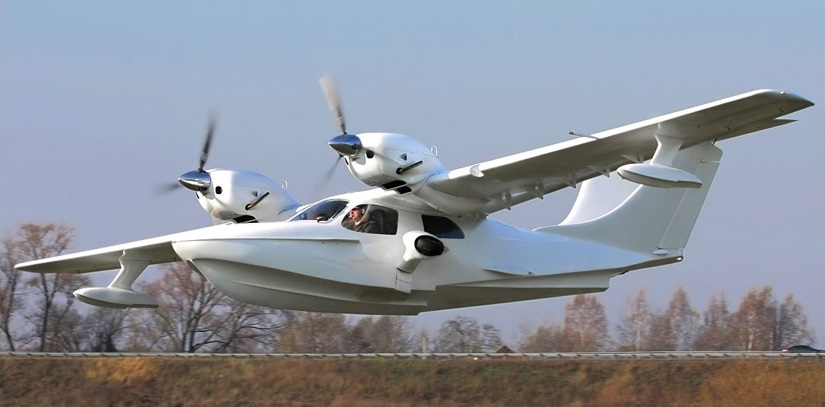
Several companies and groups have developed a series of designs which began at an offshoot of the Trod Kuznetsov aircraft engine plant in Samara. Beginning with the L-3, they differ in size and engine type but all are twin engine amphibians with a characteristic V tail. The L-4 is a direct development of the L-6M, promoted by AeroVolga. Its design began in August 2004.
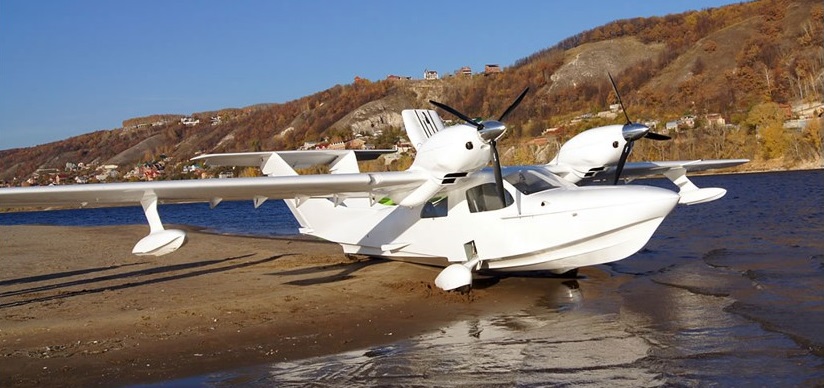
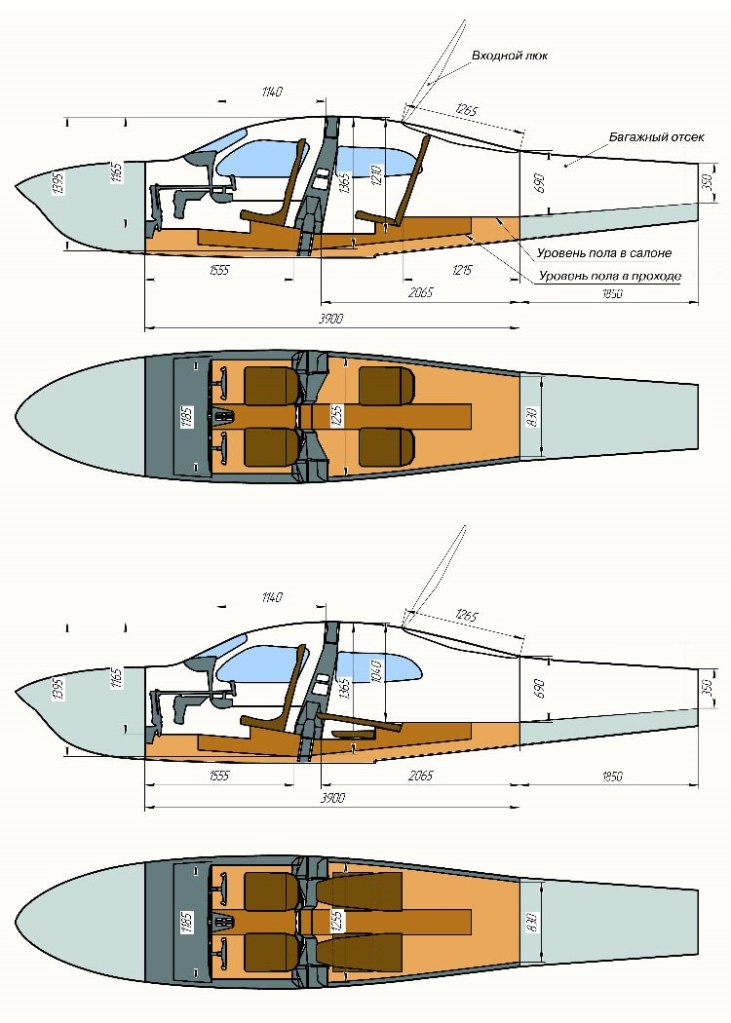
All L-4 variants have the same layout and all are largely built of composite materials. They are high-wing monoplanes with twin engines mounted close to the fuselage, on top of the wing. The wings have straight taper on both edges and almost square tips. The L-4 has a pair of flaps on each wing. Its hull has two steps and there are small winglets at waterlevel just aft of the trailing edge. The cabin extends from below the leading edge rearwards to the winglets. Fixed floats under the wings stabilize the L-4 on water; it is operable with waves to 400 mm (15 in) high.
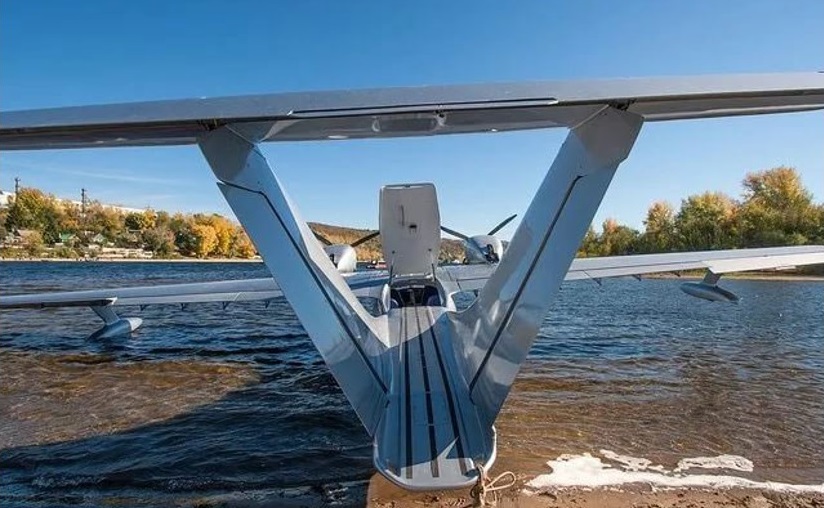
The most unusual feature of the L-4 is the empennage arrangement: it has twin fins, mounted on the fuselage and extended forward with long, curved dorsal fillets, separated at the base by the full fuselage width and leaning slightly outwards. The fins carry conventional rudders and the single tailplane is mounted upon the fin tips, extending well beyond them. Tailplane and single piece elevator together are trapezoidal; there is a trim tab at the centre of the elevator. The reason for the design is that the spine serves as a walkway to access the plane from behind, when moored at shore.
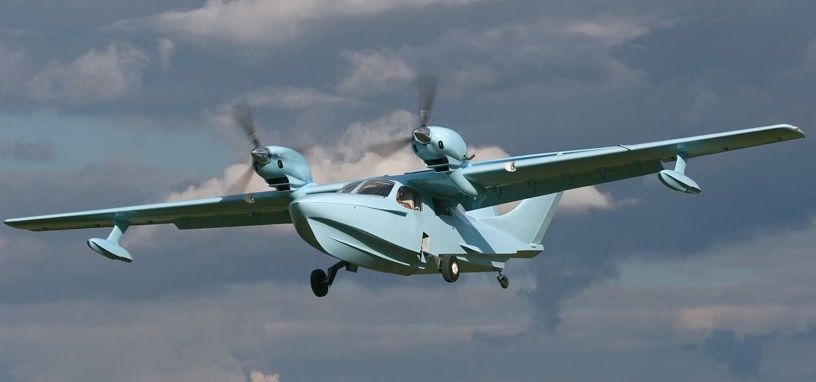
The L-4 has a conventional undercarriage for land use, all three wheels and the water rudder being retractable.
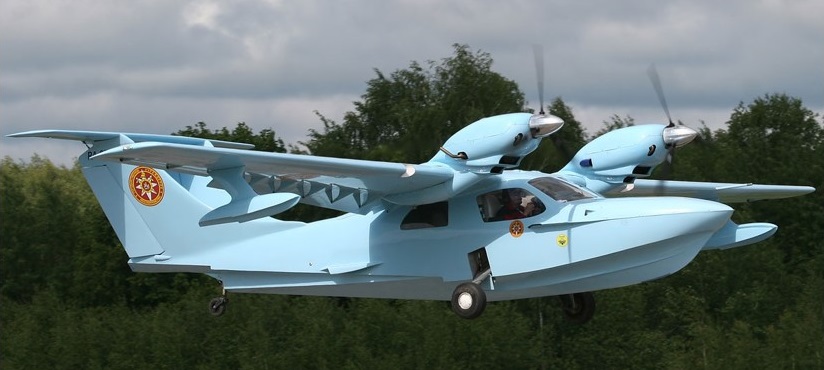
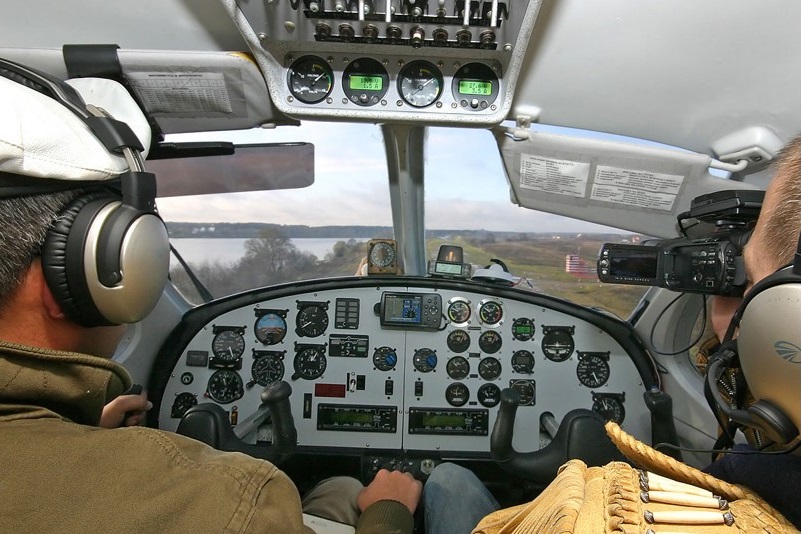
The first flight of the L-4 was in June 2005. The more powerful L-44 flew in 2009.
By mid-2008 sales, probably including L-6s from AeroVolga, had reached 14.
Chaika L-44 (English: Seagull).
Powerplant: 2 × Rotax 914, 84.5 kW (113.3 hp)
Propellers: 3-bladed Airmaster AR332
Wingspan: 13.50 m (44 ft 3 in)
Wing area: 22.45 m2 (241.6 sq ft)
Length: 8.50 m (27 ft 11 in)
Height: 2.52 m (8 ft 3 in) excluding propellers
Empty weight: 830 kg (1,830 lb)
Max takeoff weight: 1,460 kg (3,219 lb)
Fuel capacity: 230 kg (507 lb)
Maximum speed: 220 km/h (137 mph; 119 kn)
Cruise speed: 180 km/h (112 mph; 97 kn)
Never exceed speed: 250 km/h (155 mph; 135 kn)
Range: 1,598 km (993 mi; 863 nmi)
Service ceiling: 4,000 m (13,000 ft) service
Power/mass: 8.64 kg/kW (14.20 lb/hp)
Take-off run: 250 m (820 ft)
Crew: 1
Capacity: 3 passengers

On November 28, 2017, Textron Aviation unveiled a new large utility turboprop designated as Model 408. The aircraft’s configuration was built to fit FedEx Express requirements. FedEx Express has signed on as the launch customer for up to one hundred aircraft, with an initial fleet order of fifty cargo aircraft and options for an additional fifty.
The SkyCourier is a twin-engine, high-wing, large utility turboprop built for high utilization operations. It will be offered in a 19-passenger version incorporating large round cabin windows for greater views and separate crew and passenger doors for smooth boarding, or in a cargo version which features a large cargo door and a flat floor cabin sized for three LD3 shipping containers and 6,000 pounds of maximum payload, with a maximum cruise speed of 200 knots and a maximum range of 900 nautical miles. Both versions will provide single-point pressure refueling to allow faster turnarounds.
The clean-sheet design of the SkyCourier will feature improved cabin flexibility and payload capability, excellent performance, and reduced operating costs compared to its rivals. The airframe is constructed from conventional aluminum materials and will be powered by two Pratt and Whitney Canada PT6A-65 turboprop engines with 1,100 horsepower of thrust each. The aircraft is also designed with fixed landing gear and Garmin G1000 avionics.
The Skycourier was expected to enter into service in 2020. In March 2018, initial tests in the wind tunnel were performed and accomplished. The maiden flight was initially set for 2019 and the design will be certified to FAR Part 23 standards.
In December 2019, assembly of the wing and fuselage was completed. In March 2020, initial ground testing was performed, including inspection on the fuel system, engines, avionics interfaces, and electrical systems.
Cessna’s new twin utility turboprop, the SkyCourier made its maiden flight from the company’s east campus Beech Field Airport on 17 May 2020.
The aircraft, piloted by Corey Eckhart, senior test pilot, and Aaron Tobias, chief test pilot, flew for more than two hours on its first flight. The sortie included tests on the aircraft’s performance, stability and control, environmental impact as well as its propulsion and avionics systems.
The prototype aircraft, along with five additional flight and ground test articles, testing programme was focusing on flight controls and aerodynamics.
Powered by two Pratt & Whitney Canada PT6A-65SC engines, it was to be offered in various configurations including a 2,700kg payload freighter, a nineteen seat passenger version or a mixed passenger/freight combination, all based on the common platform.

It was to feature the popular Garmin G1000 NXi avionics suite and have a maximum cruise speed of 200kt (TAS), with a maximum range of 900nm.
Both freighter and passenger variants will include single-point pressure refuelling as standard to enable faster turnarounds.
Cessna 408 Skycourier
Engines: 2x Pratt & Whitney Canada PT6A-65SC, 1100 hp
Max Cruise Speed: 200 kt / 370 kph
Range: 900 nm / 1,667 km
Service Ceiling: 25,000 ft
Take Off Distance: 1006 m / 3,300 ft

Textron announced the Textron AirLand LLC and Cessna Scorpion ISR/Strike Jet aircraft in September 2013 during the Air Force Association conference.
The Scorpion is a twin-engine, low-cost jet designed for particularly areas of border and maritime security where long missions and sustained sortie rates can place a burden on dedicated tactical aircraft which were never designed for that role. The Scorpion benefits from many commercially off-the-shelf components better suited for sustained Intelligence, Surveillance and Reconnaissance (ISR) and Strike operations.
The two-seat jet is powered by twin-turbo fan engines and will be able to carry 3,000 pounds of internal payload. The all composite airframe will have an initial service life of 20,000 hours.
Textron AirLand LLC and Cessna Aircraft completed the first flight of their Scorpion jet prototype and demonstrator on December 12, 2013 from Wichita, Kansas. Textron CEO Scott Donnelly saying “When the design phase began less than two years ago, we were confident that we would deliver a uniquely affordable, versatile tactical aircraft by taking advantage of commercial aviation technologies and best practices.
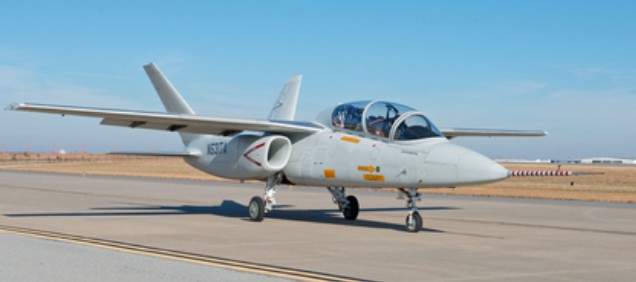
The Scorpion is powered by two turbofan engines that together produce approximately 8,000 pounds of thrust. The engines are directed by a Digital Electronic Engine Control and supply conditioned bleed air to the pneumatic system. Accessories mounted on the engine gearbox power electrical and hydraulic systems. The engines can operate on Jet-A, JP-5, and JP-8 jet fuels.
The first production conforming version of the Textron AirLand Scorpion light reconnaissance/strike/training aircraft has made a successful maiden flight at McConnell Air Force Base in Wichita, Kansas, in December 2016. Experimental test pilots Don Parker and Dave Sitz carried out a series of tests on the multi-mission, twin-seater, twin-engine jet during the one hour and 42 minute flight to verify the avionics and flight performance of the aircraft as well as other flight systems.
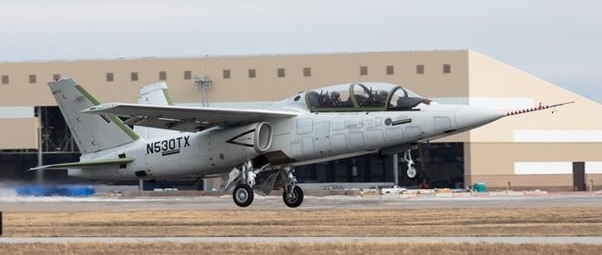
Textron says the new production version of the Scorpion has been improved based on customer feedback and 800 hours of flight testing, including military training exercises and operations in 10 countries. These upgrades include new avionics, a modified airframe, four degrees of sweep added to the wings, simplified landing gear, a next-generation Heads Up Display (HUD) and Hands-On Throttle And Stick (HOTAS) controls.
In addition, Garmin is now providing the Scorpion with the advanced G3000 integrated flight deck featuring a high-definition display and two high-definition touch-screen controllers, as well as improved navigation systems in the rear cockpit position.
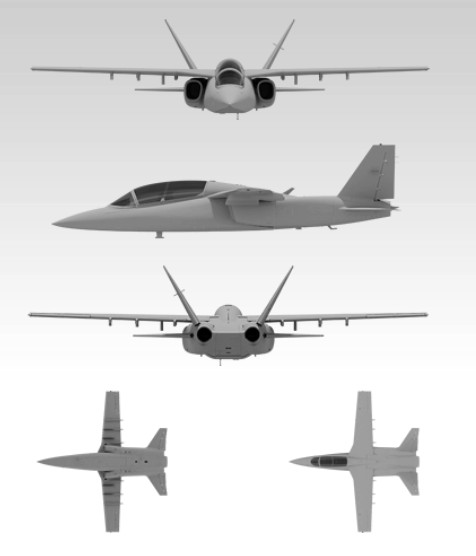
The tandem-seat, twin-engine aircraft was first conceived and developed in secret in 2011 in a project to create the “world’s most affordable tactical jet aircraft.” The modular wing design allows for the wings to be replaced by different designs.
The Scorpion relies on advanced sensors and the ability to operate about 15,000 ft (4,500 m) to avoid ground fire. To keep weight and costs down, the Scorpion has an all-composite fuselage with only the undercarriage, engine fittings and mounts made of metal. Inside, there’s a 3,000-lb (1,400-kg) payload section to carry various munitions and recon gear. To simplify the design, the airframe does not include fly-by-wire systems.
Engines: 2 x Honeywell TFE731 turbo fan, 8000 lb thrust
Length: 43 ft 6 in
Wingspan: 47 ft 4 in / 14.4 m
Height: 14 ft 0 in
Empty weight: 11,800 lb
MTOW: 21,250 lb
Max internal fuel: 6000 lb
Max internal payload bay: 3000 lb
Max speed: 450 kt / 518 mph / 833 km/h
Service ceiling: 45,000 ft / 13,700 m
Ferry range: 2400 nm
Endurance: 5 hr loiter 150 mi / 241 km from base
Hardpoints: 6
Hardpoint capacity: 6,200 lb / 2,800 kg
Seats: 2
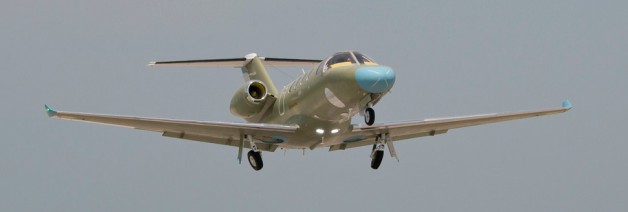
Cessna Aircraft Company successfully made the first maiden flight of their new Citation M2 light business jet in August 2013. The M2 departed on the two-hour flight from the company’s facility in Independence, KS.
“The aircraft performed exceptionally well today,” said Cessna production flight test pilot Terry Martindale. “We departed Independence and proceeded to an altitude of 17,500 feet. Through the almost two hour flight, we completed a large portion of the production test flight procedures. This is the first aircraft equipped with the Garmin G3000 avionics, and the system goes beyond what people might be expecting in terms of familiarity, versatility, situational awareness and ease of use. You can sense that pilots designed the cockpit. Everything is where you need it to be.”
The Citation M2 is the follow-on to the Citation Mustang jet. Offering increased speed, range, payload and avionics upgrades, the Citation M2 also features the new Garmin G3000 avionics suite, featuring high-resolution multi-function displays. Like it’s predecessor, the M2 will be powered by two Williams FJ44 turbo-fan engines.
 All Aero