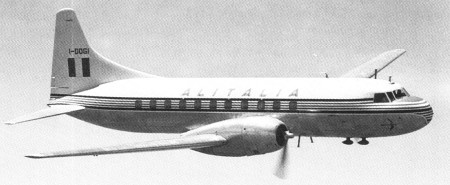
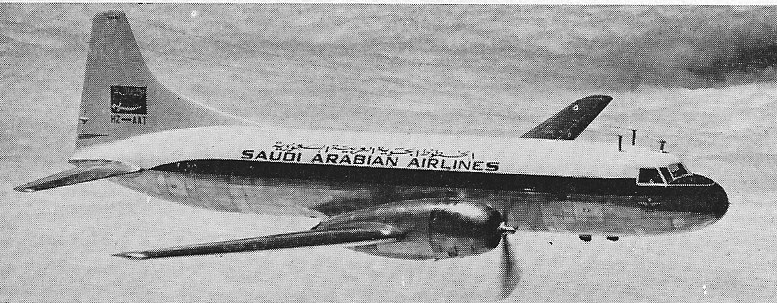
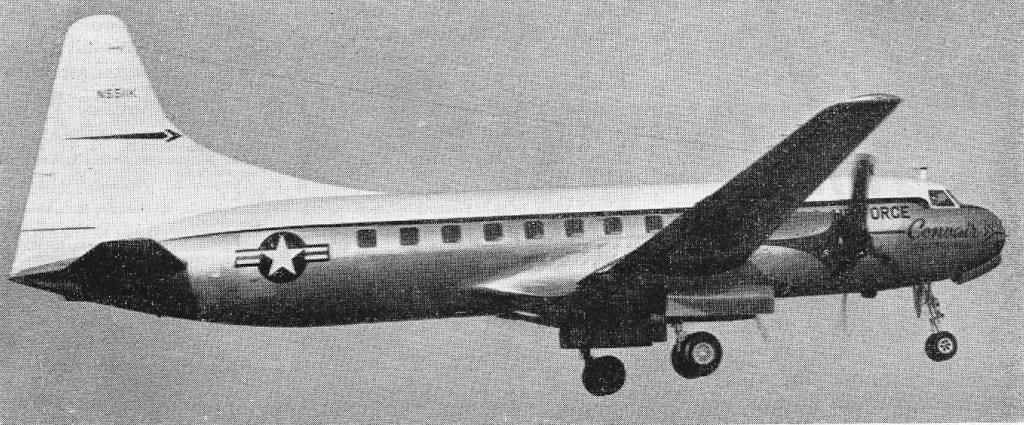
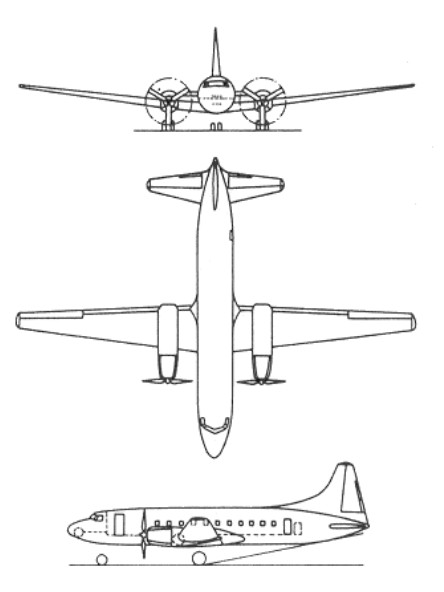
Although based on the Convair 240, the 340 was largely a new aircraft with greater wing span (32.11m) and area; a 54-in longer fuselage for 44 passengers; R-2800-CB16 or CB17 engines; greater all-up weight of 21,318kg; and many interior design improvements.
The first aircraft (N3401) flew on 5 October 1951 and the first delivery to an airline was N73103, to United Air Lines on 28 March 1952.
A total of 209 had been built by January 1955, when the last two production aircraft were delivered to REAL (Brazil).
CV-340-B
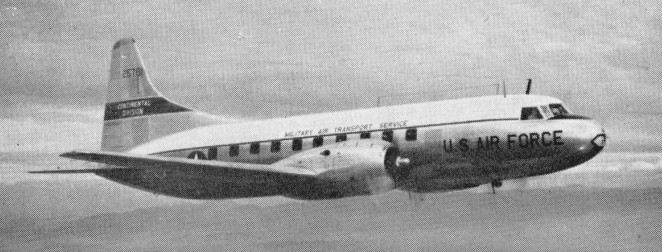
The C-131B, based on larger Convair-Liner 340, was being produced in 1955 as flying laboratory for electronics equipment.
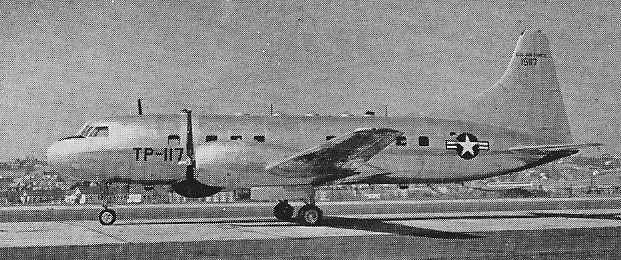
YC-131C was a ConvairLiner 340 fitted experimentally with two 3,750 h.p. Allison T56 turboprops.
Some standard ConvairLiner 340s were also ordered as C-131D.
The USAF operated the 340 as C-131 or VC-131 transports, flying and ECM trainers and for other duties; while the US Navy/Marine Corps received 37 transports as R4Y. The U.S. Navy equivalent of the C-131A is designated R4Y-1Z.
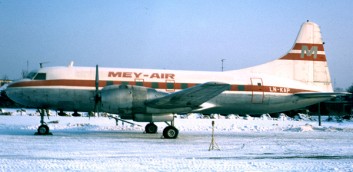
Many Convair 340s were converted to 440 and 580 standard.
A total of 209 CV-340s was built, followed by 186 CV-440s.
Convair C-131A Samaritan
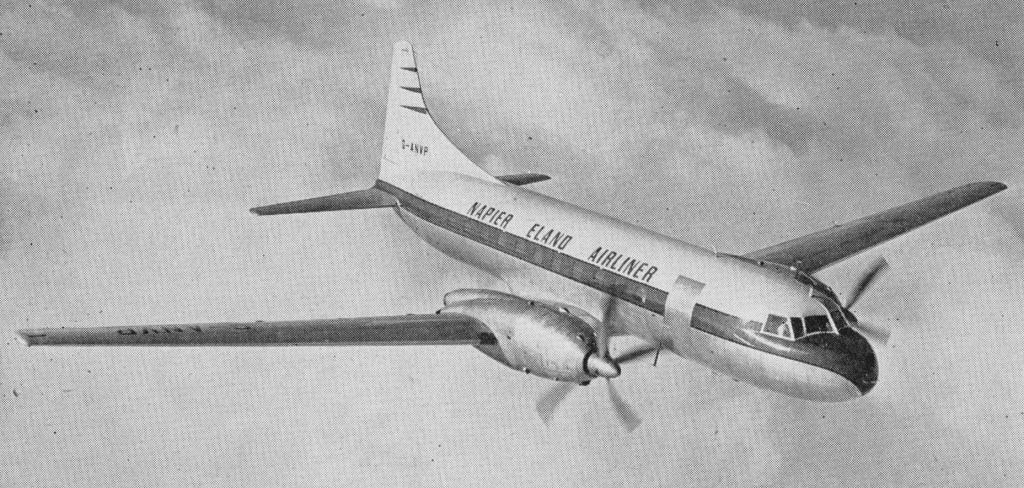
In November 1957 a Convair 340 with Napier Eland turboprop engines was flown to the USA to serve as a prototype. In 1958 the RCAF ordered a version of the Convair with Eland engines, to be built by Canadair as the CL-66.
Convair 340 Napier Eland conversion
In 1954 two Convair 340 were built as experimental YC-131C models to flight test Allison YT-56 turboprops. The first flew on 20 May 1954 with a gross weight of 53,200 lb compared to 47,000 lb for the standard 340.
YC-131C
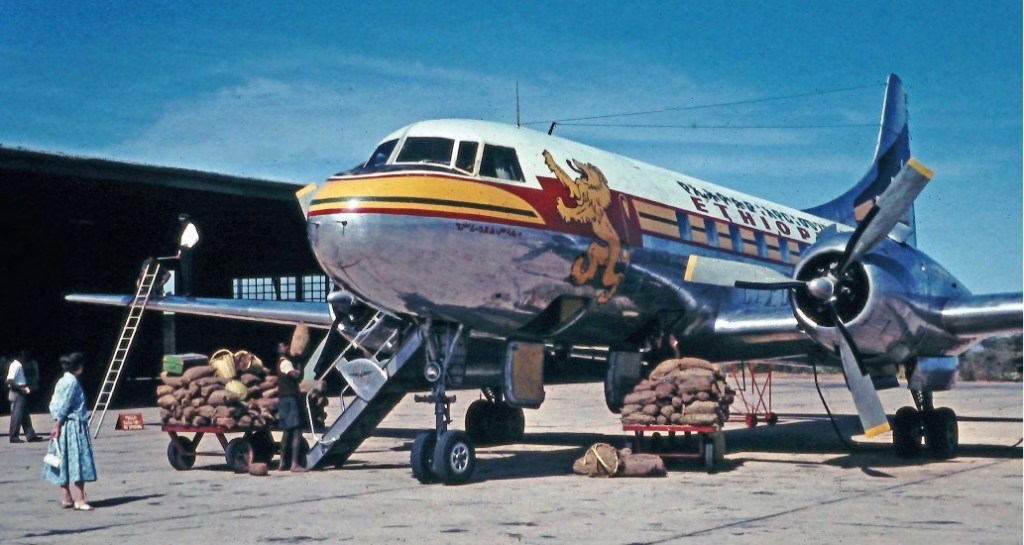
The Convair 440 Metropolitan is a 52-seat development of the Model 340, having increased all up weight.
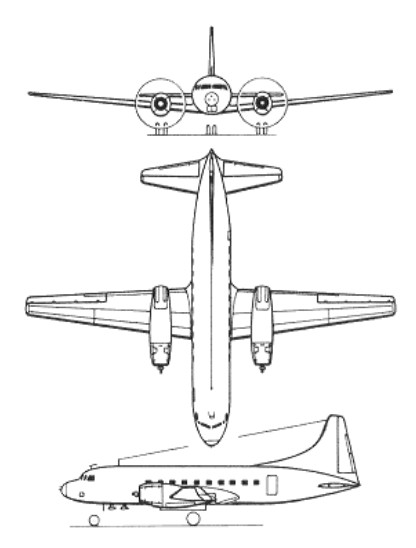
CV-340-B Engines: 2 x Pratt & Whitney R-2800-CB16, 2400 hp Wingspan: 105 ft 4 in Length: 79 ft 2 in Height: 28 ft 2 in Wing area: 920 sq.ft Empty weight: 32,399 lb Loaded weight: 47,000 lb Max speed: 314 mph at 16,000 ft Cruise speed: 292 mph Range: 1150 mi Seats: 44
Convair C 131 Samaritan Engine: 2 x Pratt & Whitney R-2800-103W, 2466 hp Length: 79.167 ft / 24.13 m Height: 28.15 ft / 8.58 m Wingspan: 105.348 ft / 32.11 m Wing area: 963.378 sq.ft / 89.5 sq.m Max take off weight: 47008.4 lb / 21319.0 kg Weight empty: 29004.6 lb / 13154.0 kg Max. speed: 265 kt / 491 km/h Cruising speed: 238 kt / 440 km/h Cruising altitude: 18635 ft / 5680 m Wing load: 48.79 lb/sq.ft / 238.0 kg/sq.m Maximum range: 1652 nm / 3060 km Range: 1652 nm / 3060 km Crew: 3 Payload: 48 Pax
Convair C-131A Samaritan Air evacuation and cargo transport. Engines: 2x 2,500 h.p. Pratt & Whitney R2800-99W Wingspan: 91 ft. 9 in Length: 74 ft. 8 in Empty weight: 29,000 lb Loaded weight: 43,575 lb. Max speed: 313 m.p.h. at 14,500 ft Cruise: 285 mph at 20,000 ft ROC: 1410 fpm Ceiling: 24,500 ft. Range: 875 miles Accommodation: 40 passengers or 27 stretchers. Armament: None
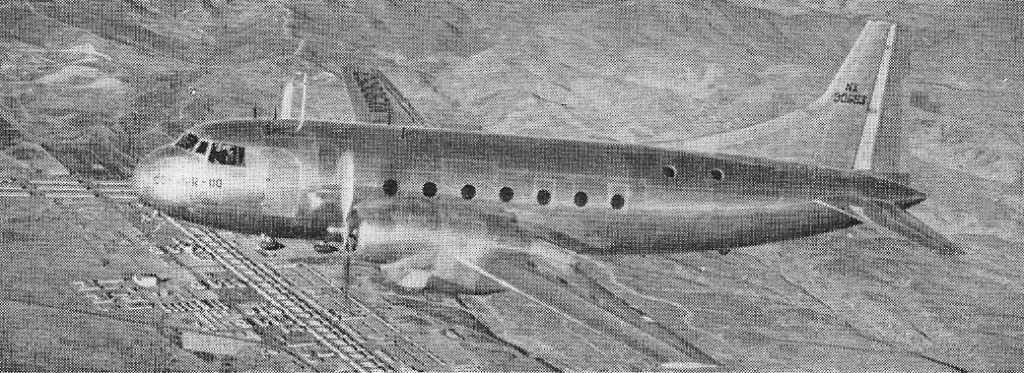
ConvairLiner project started with the Model 110, of which the prototype NX90653 was flown for the first time on 8 July 1946. American Airlines convinced Convair to alter the CV-110 into the larger CV-240. The first post-World War II commercial transport designed by Consolidated Vultee was evolved primarily as a DC-3 replacement.
Accommodation was provided for 2 crew and 40 passengers. The aircraft was powered by two 2400 hp / 1,788kW Pratt & Whitney R-2800-CA18 radial engines.
The prototype, NX90849, first flew at San Diego on 15/16 March 1947 and the first licensed aircraft was delivered to American Airlines on 28 February 1948, who put the type into scheduled service on 1 June 1948.
Military versions of the 240 were produced as the T-29A to E aircrew trainers for navigators and bombardiers.
Conversion of the commercial CV 240 for military training duties was commenced in 1948, the first version being the T-29A which first flew on 22 September 1952.
Development of the T-29A with pressurised cabin, increased fuel capacity, etc, resulted in the T-29B which first flew on 30 July 1952.
T-29B
The T-29C had higher powered engines, The T-29D for advanced navigational/bombardment training, and the VT-29E which was a personnel transport variant.
Altogether 176 were built, and the Convair 240 served VARIG for 26 years.
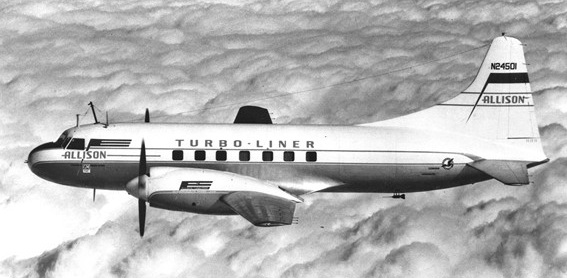
Convair CV-240-21 Turboliner, December 1952 (Courtesy Pat Ford)
The Allison T38 (company Model 501) engines fitted to the Convair CV-240-21 Turboliner were rated to 2,750shp.
The Convair 340 is a development of the Model 240, having a 4 ft 6 in increase in fuselage length, increased all up weight, and higher powered engines.
Engines: 2 x Pratt & Whitney R-2800-CA18, 2400 hp / 1,788kW Wingspan: 28.0 m / 91 ft 10 in Length: 22.7 m / 74 ft 6 in Height: 8.3 m / 27 ft 3 in Wing area: 75.9 sq.m / 816.98 sq ft Max take-off weight: 18972 kg / 41826 lb Empty weight: 12530 kg / 27624 lb Max. speed: 538 km/h / 334 mph Cruise speed: 480 km/h / 298 mph Ceiling: 9150 m / 30000 ft Range w/max.fuel: 2880 km / 1790 miles Crew: 3-4 Passenger capacity: 40
T-29B Engines: Pratt & Whitney R-2800-97, 2400 hp Wingspan: 91 ft 9 in Length: 74 ft 8 in Height: 27 ft 3 in Wing area: 817 sq.ft Loaded weight: 43,575 lb Max speed: 300 mph Cruise: 230 mph ROC: 1370 fpm Range: 1500 mi
The ConvairLiner project started with the Model 110, of which the prototype NX90653 was flown for the first time on 8 July 1946. American Airlines convinced Convair to alter the CV-110 into the larger CV-240.
A pressurized business and commuter rear-winged turbojet aircraft, as twin-jet Contender 202 for seven to 19 passengers, triple-engined 11 to 19 passenger Contender 303
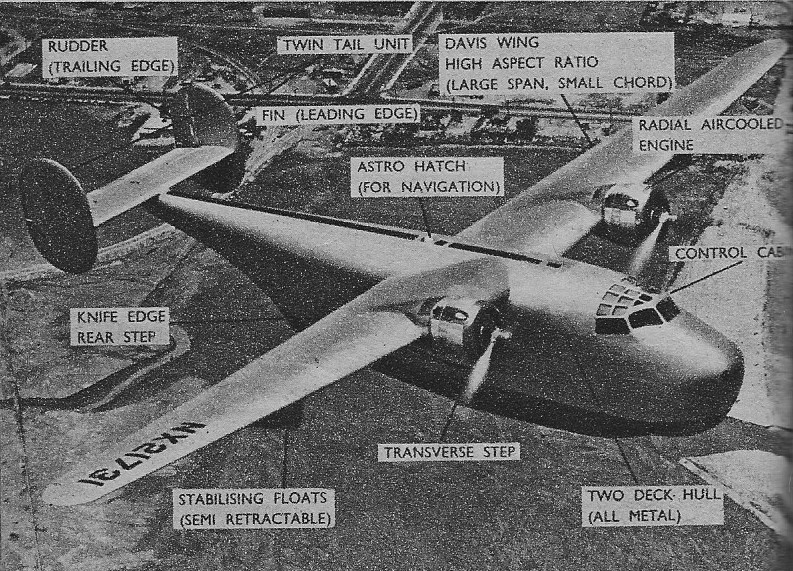
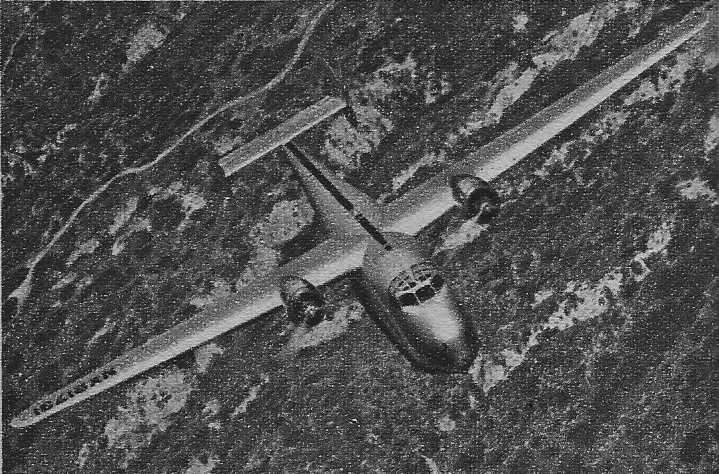
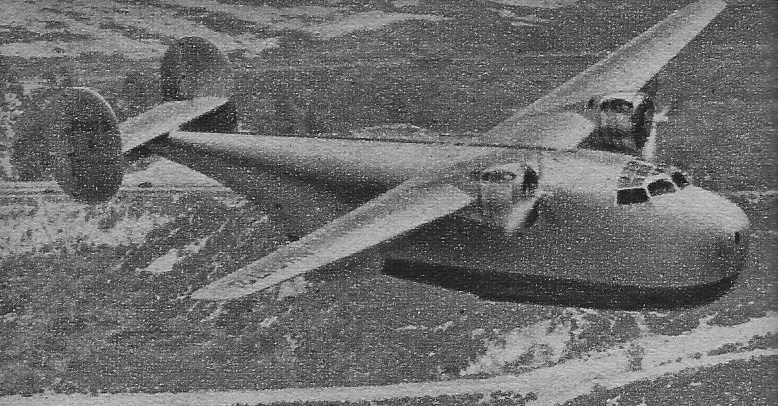
The Davis Wing emerged from the mind of David R. Davis, an aeronautical engineer working on a new wing planform, a planform utilizing a short chord and high aspect ratio along with thickness suitable to fit engines and fuel while maintaining efficiency. His meeting in the summer of 1937 with Consolidated President Reuben H. Fleet allowed the wing design to flourish as one of the most utilized wing planforms of World War 2. The new wing was intended for use on the company’s new flying boat design – the Model 31. Despite the Model 31’s cancellation (only one example emerged from development), the wing was seen as a good step forward in the design of the upcoming B-24 Liberator and became a major Consolidated design mainstay thereafter.
Engine: 2 x Wright Duplex Cyclone, 2000 hp Wingspan: 110 fy 0 in Length: 73 ft 0 in Top speed: 285 mph Range: 7000 mi at 220 mph
Long range sea surveillance flying boat, USA, 1939
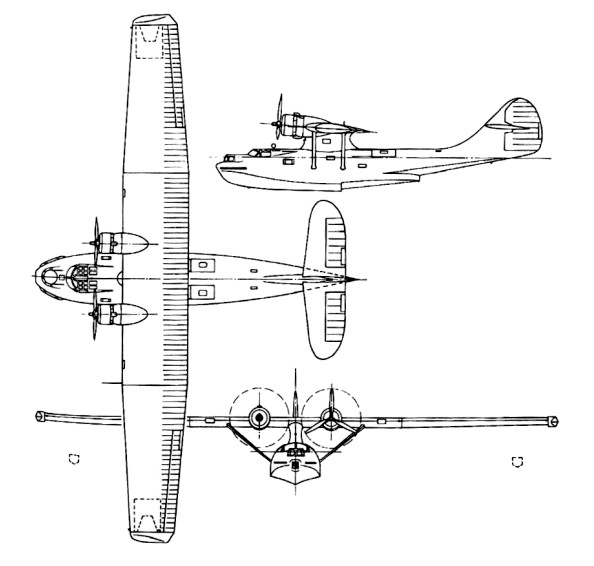
Engine: 2 x Wright R 3350-8 Cyclone, 2268 hp Length: 74.081 ft / 22.58 m Heigh : 25.164 ft / 7.67 m Wingspan: 110.007 ft / 33.53 m Wing area: 1047.983 sqft / 97.36 sq.m Max take off weight: 48007.3 lbs / 21772.0 kg Weight empty: 29339.7 lb / 13306.0 kg Max. speed: 215 kts / 398 km/h Cruising speed: 118 kts / 219 km/h Service ceiling: 21391 ft / 6520 m Wing load: 45.92 lb/sq.ft / 224.00 kg/sq.m Range: 2850 nm / 5279 km Armament: 1x 37mm Cannon, 4x cal.50 MG (12,7mm)
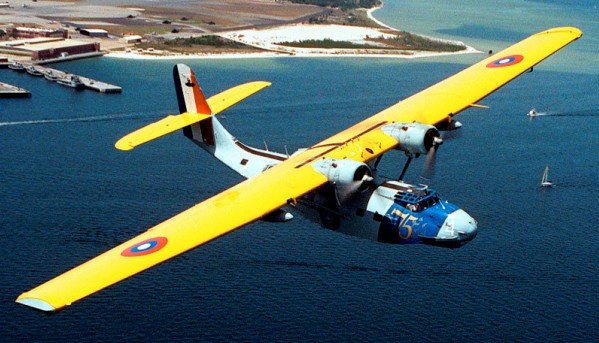
The Consolidated Model 28, designed by Isaac Laddon, originated from a US Navy requirement of late 1933.
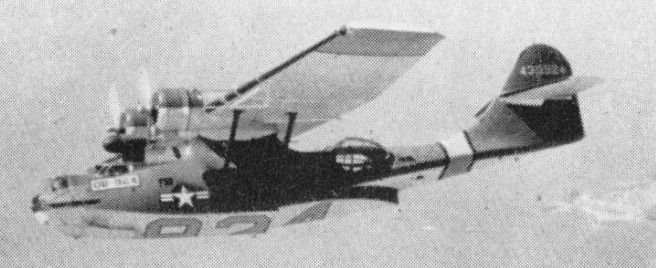
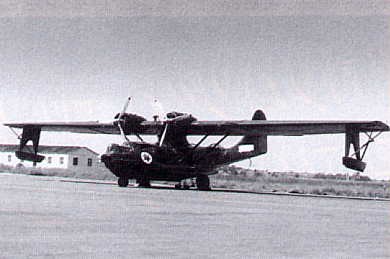
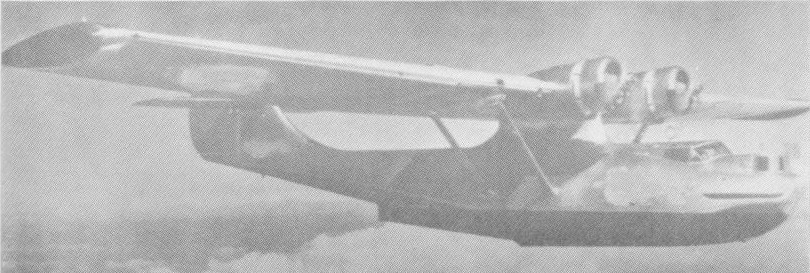
The prototype XP3Y-1, developed from the PY-1/P2Y and flown for the first time on 28 March 1935, introduced the parasol wing constructed on the basis of a cantilever wing requiring no supporting structures, although two small-section struts were mounted between wing and hull on each side. Another new feature was the introduction of stabilising floats which retracted in flight to form the wingtips. Power was from two 825 hp R-1830-54 engines.
Initial trials of the prototype left little doubt that the Navy was about to acquire a significant aircraft. Sixty PBY-1 ordered in 1933 and powered by 850 hp engines were ordered and began to enter squadron service in 1937. By mid-1938 14 squadrons were operational.
The first 22 aircraft built were PBYs and were built in the USA. Also built by Boeing Aircraft of Canada at their Vancouver plant, as the PB2B-1. Fifty-five Boeing Canada-built PBY-5 were eligible for conversion to 28-5ACF status which allows further conversion to air transport category.
Production as a pure flying-boat ended with the PBY-4, for the last of these was converted to an amphibian with retractable tricycle-type landing gear, under the designation XPBY-5A. Subsequent aircraft had this as standard. Production of the PBY series would be undertaken by Consolidated in the United States, Canadian Vickers and Boeing of Canada in Canada, the Naval Aircraft Factory in Britain and state factories in the Soviet Union under the Lend-Lease Act. Between 27 and forty Model 28 Catalinas were built in the Soviet Union as the MP-7.
On 7 May 1945, RAF Coastal Command flew its last raid against a German submarine when a Catalina of 210 Sqn, piloted by Lt. K. Murray, located a U-boat that had stopped dead between Shetland Islands and Norway, and recorded engine noises showing that the U-boat must be in distress. The Catalina dropped a series of depth charges. The boat was U-230 under 1st Lt. Emmerich, and it radioed later that it was badly damaged. On Wednesday 9 May 1945, the U-230 went down with all her crew off Bergen, Norway.
Initial export aircraft went to Russia, where the type was built subsequently in large numbers under the designation GST. The RAF acquired a single example for evaluation in 1939 and almost immediately ordered a batch of 50, the first of many to serve with Coastal Command. The name Catalina (adopted first by the RAF) was used later by the USN for the various versions which entered service. The type was also to serve with the RAAF, RCAF, RNZAF and the air arm of the Dutch East Indies.
The RNZAF operated 56 Catalinas, both PBY 5 and PB2B 1 models. They were used for maritime reconnaissance and air sea rescue between 1943 and 1956. The PBYs were withdrawn from service post war and sold for scrap in 1952; the PB2Bs soldiered on until replaced by Short Sunderlands in 1953 54.
The RCAF chose the PBY-5A as its replacement for the Supermarine Stranraer. During World War II, Boeing Aircraft of Canada, Canadian Vickers and Canadair Ltd. made almost 800 PBY’s. The RCAF called its version the ‘Canso A’ – A for amphibious. The PBY-5A first flew for the Royal Canadian Air Force on 20 March 1944.
Canadian Vickers built 130 for the RCAF, 9806-9844, and 11001-11100, and 230 to the USAF as OA-10A, 44-33868 to 44-34097.
139 were exports to the RAF, 36 as Catalina IIA, 12 PBY-5A as Catalina III, 11 PBY-5A as Catalina IV, and 70 PBY-5B as Catalina IVA.
A number were operated by the USAAF as OA-10As. Seventy-five went to the USAAF as OA-10B in 1945.
Israeli Air Force PBY-5A Catalina
The Amtorg KM-2 was an improved PBY Catalina, built under Consolidated license.
The GST (Russian State Aircraft Factory) was responsible for the production for a licence-built version. Russian-built engines were substituted and armament consisted of three 12.7mm or 7.62mm machine guns.
Russian State Aircraft Factory PBY
Altogether 2398 were built by Convair, 676 in Canada, and others in Russia.
Steward-Davis built about 13 Super Catalina civil conversion of PBY-5A/-6A wth two 1900hp Wright R-2600, larger squared tail, prop spinners, and faired-over nose turret. Many served in USFS fire duty, notably N6453C and N9505C.
In 1964 the province of Quebec, Canada, was using seven modified PBY to reduce forest fires. Field Aviation of Toronto modified the PBY to carry 800 USG of water that could be dumped in 0.8 sec and refilled in 14 sec during a touch and go on lakes or rivers.
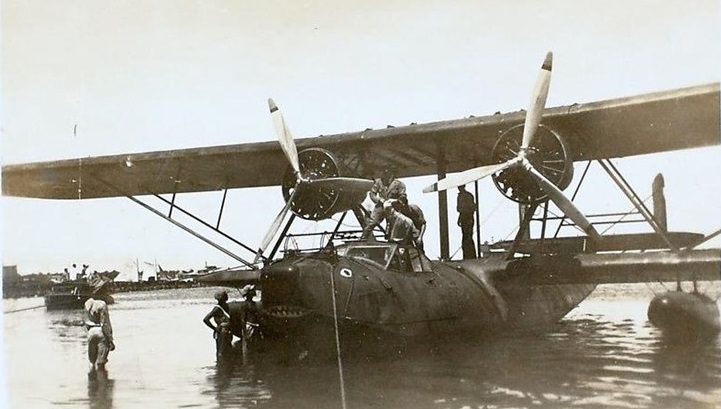
Foreign sales included a P2Y-1C for Colombia flown on December 23, 1932.
The sole P2Y-1C (ex NC2102) delivered to Cartagena, Colombia on Dec 31st 1932.
The Columbian P2Y remained in service until 1948.
P2Y-3 Engine: 2 x 750hp Wright R-1820-90 Take-off weight: 11471 kg / 25289 lb Empty weight: 5797 kg / 12780 lb Wingspan: 30.48 m / 100 ft 0 in Length: 18.82 m / 61 ft 9 in Height: 5.82 m / 19 ft 1 in Wing area: 140.66 sq.m / 1514.05 sq ft Max. Speed: 224 km/h / 139 mph Cruise speed: 188 km/h / 117 mph Ceiling: 4907 m / 16100 ft Range: 1900 km / 1181 miles Armament: One flexible 7.62mm Browning in bows; two dorsal gun hatches in wings
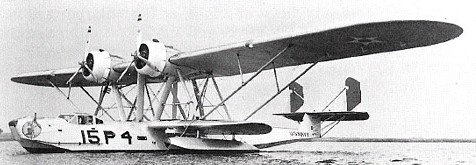
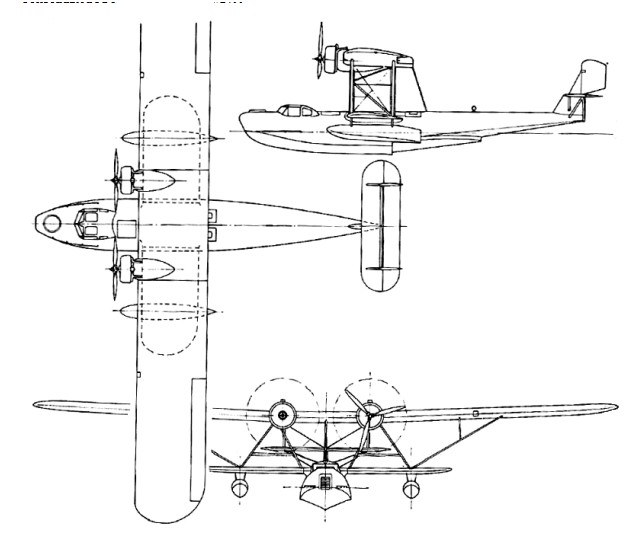
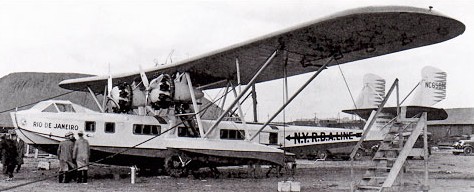
The Commodore twin-engined flying boat were ordered by a US-owned South American-based airline called NYRBA which challenged Pan American’s regional dominance and was later leveraged to sell its assets to Pan Am (circa 1930). Subsequently Pan Am went on to operate Commodores up to and through World War II, and some machines had short careers with successor operators. A total of 14 were ordered for commercial use. The Commodore failed to gain military orders in the form of XPY-1.
Model 16-1 Commodore Engine: 2 x 575hp Pratt & Whitney R-1860 Hornet radial Take-off weight: 7983 kg / 17600 lb Wingspan: 30.48 m / 100 ft 0 in Length: 18.80 m / 61 ft 8 in Height: 4.76 m / 15 ft 7 in Max. Speed: 206 km/h / 128 mph Ceiling: 3430 m / 11250 ft Range: 1609 km / 1000 miles Crew: 3 Passengers: 22
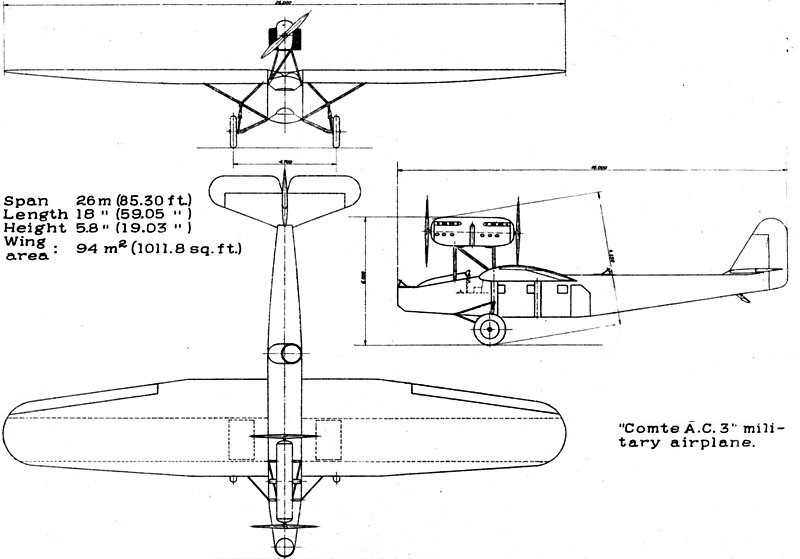
In November 1928, as a response to increasing tensions and clashes between troops in the Gran Chaco border region between Bolivia and Paraguay, Bolivia placed an order with Alfred Comte, the owner of a small Swiss aircraft manufacturer for three long-range bomber-transport aircraft, using funds collected by popular subscription.
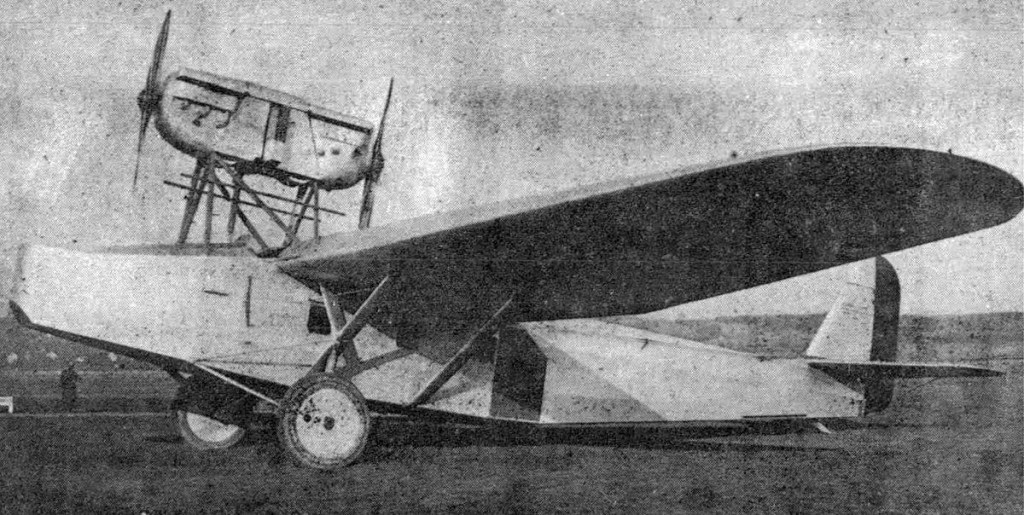
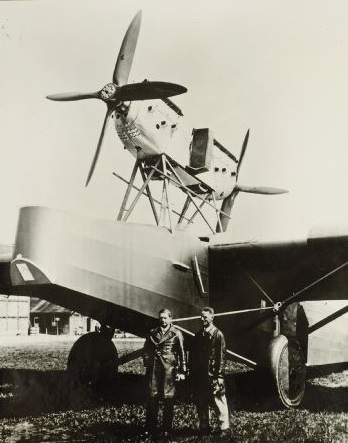
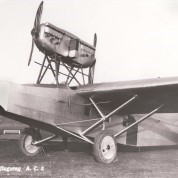
The AC-3 was a high-wing semi-cantilever monoplane of mixed construction. It was fabric covered with a conventional tail unit. It had three open cockpits, one in the nose for a gunner or observer, one forward of the wing for a pilot, and one on the upper rear fuselage for a rear gunner. An unconventional engine layout had two 447 kW (600 hp) Hispano-Suiza inline piston engines in tandem supported on eight struts above the fuselage. The installation had to be high enough to allow clearance for the two (one pusher, one tractor) propellers above the fuselage. A hatch in the port side allowed cargo or troops to be carried in the main cabin.
The new aircraft was too large to be built in Comte’s existing factory, (the AC-3 was the largest aircraft ever to be developed and built in Switzerland) and forced Comte to build a new hangar just for the AC-3. It made its maiden flight from Dübendorf airfield on 22 February 1930. The aircraft failed to meet its expected top speed, and as a result it was refitted with four-bladed propellers instead of the original two-bladed items. A collapse in the price of tin resulted in severe financial problems in Bolivia, and the military junta ruling Bolivia cancelled the order for the three Comte bombers, with only the first example being built, which was dismantled in 1935.
Engines: 2 × Hispano-Suiza, 447 kW (600 hp) each Wingspan: 26 m (85 ft 3 in) Wing area: 95 m2 (1,022 ft2) Length: 18 m (59 ft 0¾ in) Height: 6 m (19 ft 8¼ in) Empty weight: 4000 kg (8,818 lb) Gross weight: 6500 kg (14,330 lb) Maximum speed: 210 km/h (130 mph) Range: 1500 km (932 miles) Service ceiling: 5300 m (17,390 ft) Crew: 3
 All Aero