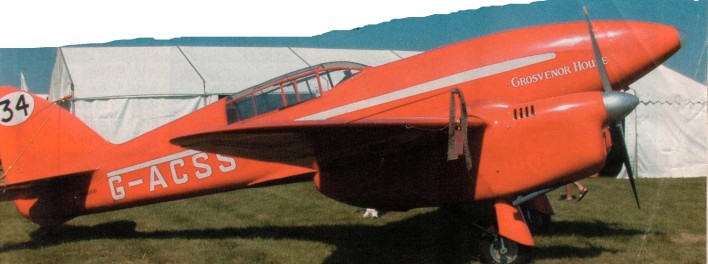
Aeronautica Umbra’s design office was responsible for a heavy fighter of advanced and unorthodox design, the M.B.902 designed by Ing. Bellomo. The M.B902 was actually built, although flight testing had not commenced when the prototype was destroyed.
The construction of the M.B.902 was begun in 1942, and this single-seat fighter was unusual in being powered by a pair or 1,250 h.p. Daimler-Benz DB 605 liquid-cooled engines buried in the fuselage and driving twin contra-props mounted outboard on the wings via extension shafts. Featuring a retractable nose wheel undercarriage and carrying an armament of four 20-mm. and two 12.7-mm. guns, the M.B.902 had an estimated maximum speed or 429 m.p.h., and a maximum range of 1,056 miles.
The UTAIS Ornithopter No.1, which “flew” in 2006 was designed by the University of Toronto. The light No.1 used a small motor to power its flapping wings. Realizing that a motor wasn’t enough to flap it off the ground, the designers also fitted the airplane with a jet engine booster to launch it into the air. The University claimed that most of the thrust was coming from the wings.
When the No.1 did its first test flight, it jumped off the runway for 14 seconds after the jet booster activated, traveled awkwardly for a third of a kilometer, nosed down, and crashed. The University claimed the test was a success.
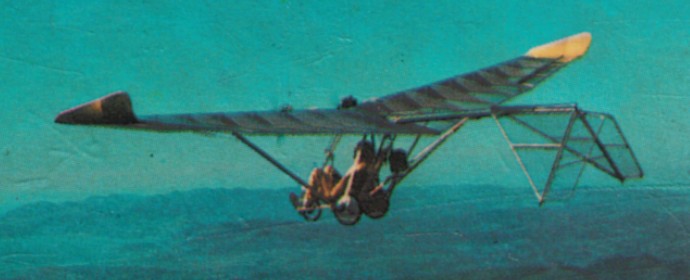
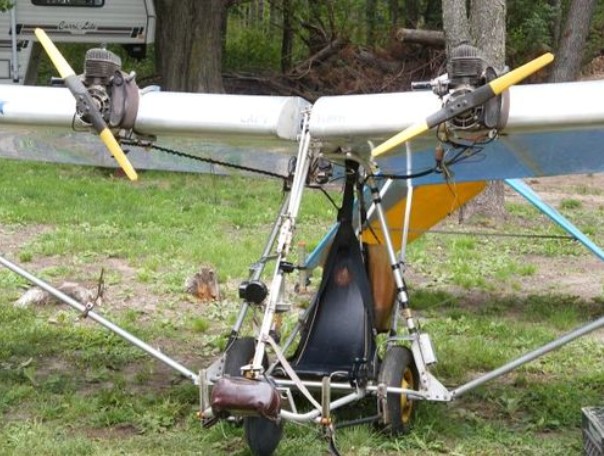
The Lazair is a single seat twin engined high wing monoplane with conventional three axis control (unconventional three axis optional). Wing has unswept leading edge, swept forward trailing edge and tapering chord; inverted V tail. Pitch/yaw control by elevon; roll control by 40% span ailerons; control inputs through stick for pitch/yaw and pedals for yaw (stick for pitch/yaw/roll optional). Wing braced from below by struts; wing profile double surface. Undercarriage has four wheels in double tail dragger formation; no suspension on any wheels. Push right go right ground steering by differential braking (also differential engine output). Brakes on main wheels. Aluminium tube framework, without pod. Engines mounted at wing height driving tractor propellers. Aluminium alloy grades: tubing 6061T6, sheet 2024T3, plate 7075T6. Ribs made from high density plastic foam. Wing covering 2 mm Tedlar.
By ultralight standards the Lazair could now be considered an old design, having been created by Dale Kramer in 1978, but continuous evolution since then has ensured that it is still a popular and highly competitive aircraft, especially with pilots who appreciate soaring ability rather than sheer power.
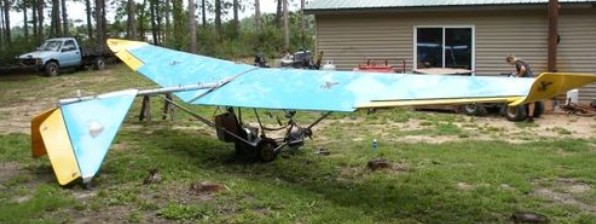
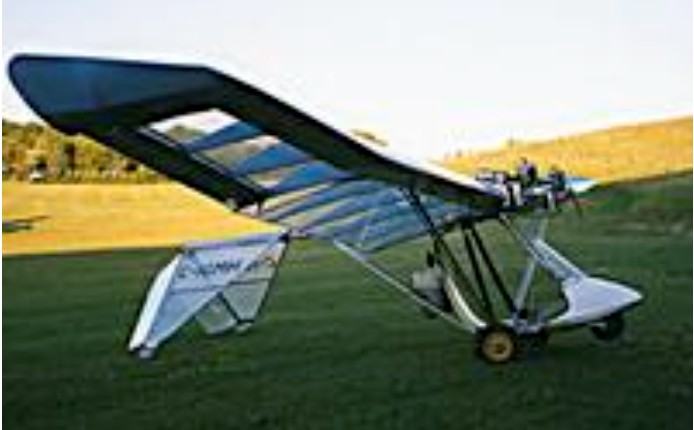
The concept, however, has never changed: an inverted V tail machine with high wing with foam ribs and aluminium alloy leading edge, plus of course the distinctive transparent covering which makes the Lazair look like no other aircraft. Though it still looks the same, that covering has been the subject one change, with Mylar being replaced by Tedlar in the interests of ultraviolet light resistance. The wings come off easily with just a few bolts making it ready to transport.
The more obvious alterations concern the control arrangements, the engines and the undercarriage. Originally the Lazair had a single top mounted stick with a mixer to apportion movement between the elevons and ailerons; separate rudder pedals were optional and, if ordered, could be easily disconnected in flight to bring the aircraft back to stick only control. Now the position is reversed: latest Lazairs have a conventional bottom mounted stick and rudder pedals as standard, with stick only control available to special order.
It has full three axis control. The control stick controls the ailerons and elevators, and separate rudder pedals control the rudders. The rudders and elevators are combined (ruddervators) in the turned down tail which makes the Lazair very controllable in slow flight and taxi because the air blast of the engines is directed into them.
One unique feature of this Lazair is the ability to lock the rudders and ailerons together to fly it using the stick only if you are not used to using rudders or you prefer to fly that way. You can unlock them with the flip of a knob to use rudders separately.
Units delivered by June 1981 300.
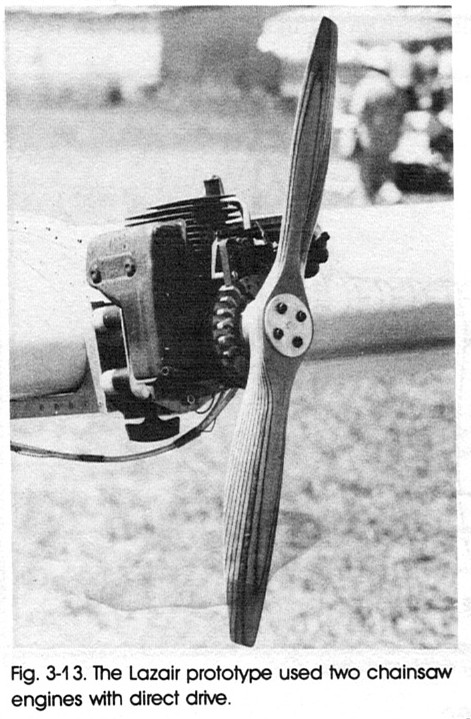
Pioneer engines of 100 cc and 5.5 hp each were normal fitment in 1981, but for 1981 these were replaced by the Rotax engines, each mated to an unusual ‘biplane’ propeller. This in turn was discarded for 1983 in favour of an injection moulded composite propeller with centre spinner and most important provision for the pitch to be adjusted on the ground.
The 1982 model came 6th in that year’s London Paris, with the non swivelling tailwheels, narrow track and additional nosewheel.
This progressive increase in thrust has made drag less critical than before, allowing Ultraflight Sales to fit a more stable, widetrack undercarriage without hurting the performance too much. En route, the additional nosewheel has been discarded and the aircraft turned into a true taildragger. Ground hand¬ling has been further improved by making the tailwheels castor and by fitting an independent disc brake on each main wheel; wheel spats are now standard equipment.
Options include floats and skis made from glass fibre reinforced polyester with a pigmented gelcoat.
The 1983 price: kit requiring 150h to complete C$6450; ready to fly C$8190.
In 1983 the Lazair II was still under development. In concept the aircraft is likely to be similar to the single seat model, again using two direct drive engines mounted on the leading edges of the wings. The engine type chosen was the WAM WAE 342, a horizontally opposed twin which is particularly powerful for its weight. The engine manufacturer’s design to certify the unit for motor glider operation had delayed deliveries and caused the postponement of the Lazair II launch from 1982.
The Lazair III is a high wing strut braced monoplane with twin engines, an inverted V tail and three axis controls. The wing has a constant tapper with upswept wing tips. Tedlar plastic covering gives the wing and tail surfaces its transparant Gossamer look which enables the operator to pre-flight nearly every nut and bolt. Engine off soaring is another feature. The latest model features a cockpit pod. Centre mounted joy stick, rudder pedals, tail wheel steerable through independent braking.
The Lazair Elite features a centre mounted joy stick, rudder pedals, tail wheel steerable through independent braking.
LAZAIR 4 Engine on Floats
Engines: 2 x AB Partner 185cc, 6 hp Static thrust, 40 lb Max pilot wt: 230 lbs Wingspan, 36 ft 4 in Wing area, 142 sq.ft Aspect ratio, 9.3 Overall length, 14 ft Empty weight, 183 lbs Usable payload (include fuel), 250 lbs Wing loading, 2.8 L/D power-off glide ratio, 13:1 Cruise speed, 35 mph Stall speed, 17 mph Approach speed, 25mph Flair speed, 20 mph Liftoff speed, 20 mph Takeoff roll distance, less than 100 ft Rate of climb, 400 Fuel capacity, 2.5 USG
Engines: 2 x Rotax 185, 9.5hp each at 5800rpm Propeller diameter 35 inch, 0.89 m No reduction. Max static thrust 140 lb, 64 kg Power per unit area 0.13 hp/sq.ft, 1.4 hp/sq.m Fuel capacity 5.0 US gal, 4.2 Imp gal, 18.9 litre Length overall 14. 0 ft, 4.27 m Height overall 6.3ft, 1.93m Wing span 36.3ft, 11.07m Chord at root 4.8 ft, 1.47 m Chord at tip 3.1ft, 0.94m Dihedral 2 deg Sweepback 0 deg Tailplane span 6.67 ft, 2.03 m Total wing area 142 sq.ft, 13.2 sq.m Total aileron area 4.8 sq.ft, 0.45 sq.m Total elevon area 8.6 sq.ft, 0.80 sq.m Wing aspect ratio 9.34 Wheel track 3.9 ft, 1.18 m Wheelbase 10.0 ft, 3.05 m Tailwheels diameter overall 4 inch, 10 cm Main wheels diameter overall 16 inch, 41 cm Optional floats: length 10.0 ft, 3.05 m; width 25 inch, 0.65 m; height 14 inch, 0.36 in Weight of pair including mounts 60 lb, 27 kg Optional skis: length 68 inch, 1.72 m; width 13.5 inch, 0.34 m Weight each 13 lb, 5.9 kg Empty weight 2101b, 95kg Max take off weight 530lb, 240kg Payload 3201b, 145kg Max wing loading 3.73lb/sq.ft, 18.2 kg/sq.m Max power loading 27.9lb/hp, 12.6kg/hp Load factors +4.0, 2.0 design Max level speed 50 mph, 80 kph Never exceed speed 55 mph, 88 kph Max cruising speed 45 mph, 72 kph Economic cruising speed 40 mph, 64 kph Stalling speed 20 mph, 32 kph Max climb rate at sea level 400 ft/min, 2.0 m/s Min sink rate 200 ft/min at 23mph, 1.0m/s at 37kph Best glide ratio with power off 12/1 Take off distance 100ft, 30m Landing distance 75 100ft, 23 30m Range at average cruising speed 165 mile, 265 km
Lazair III Empty wt: 220 lbs Wing span: 36’4” Wing area: 144 sq.ft Height: 6’4” Length: 14’ Fuel cap; 5 USG Construction: Aluminium, Tedlar Engine: 2 x Rotax 185 (370 cc) 38 hp Prop: 71 cm composite Max wt: 490 lbs Stall: 22 mph Max speed: 60 mph Vne: 65 mph Cruise speed: 26 kts, 50% power Climb rate: 400 fpm @ 30 mph Design limit: +4, -2g Glide ratio: 13-1 Wing loading: 3.4 lbs/sq.ft Power loading: 12.89 lbs/hp
The Kaan program, initiated in 2016 with an investment of $1.18 billion, was designed to replace Türkiye’s aging F-16 fleet. Developed with international collaboration from partners such as BAE Systems and Rolls-Royce, the program prioritizes local production and technology ownership. The aircraft incorporates advanced design features, including supercruise capability and reduced radar cross-section, alongside a suite of indigenous munitions such as the Gökdoğan and Bozdoğan air-to-air missiles. The program emphasizes network-enabled warfare capabilities and interoperability with UAVs and other air force assets.
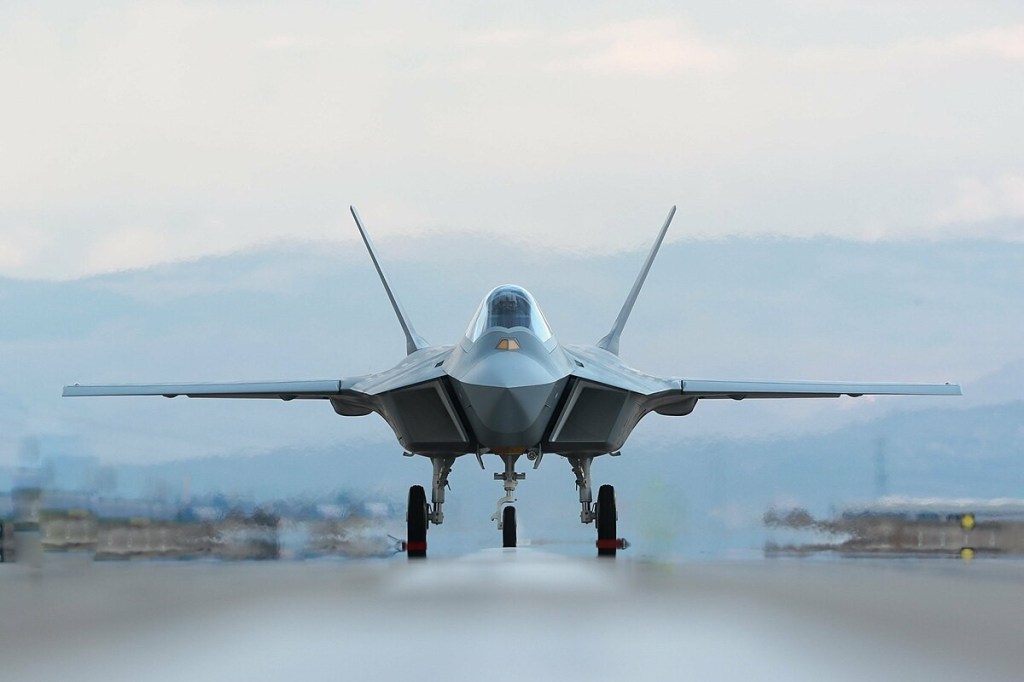
The Kaan, developed by Turkish Aerospace Industries (TAI), is a fifth-generation twin-engine stealth fighter designed for air superiority and multirole operations. It is equipped with advanced AESA radar capable of detecting targets over 100 kilometers away, internal weapon bays to reduce radar visibility, and a payload capacity of more than 6,000 kilograms. Initial models are powered by General Electric F110 engines, with plans to integrate domestically developed engines in later versions. The Kaan is designed to operate with other platforms in the Turkish Air Force, including the F-35A.
The TAI TF Kaan, a fifth-generation stealth fighter jet, achieved its maiden flight on February 21, 2024, with a second successful flight on May 6, 2024.
Engines: General Electric F110 Wingspan: 14 m Length: 21 m Height: 6 m Speed: Mach 1.8 Operating altitude: 55,000 ft Combat range: of approx 1,100 km
Turbay SA was formed in January 1961 to build the proposed T-3B production version and a lengthened fuselage development, the T-4, but no production was achieved.
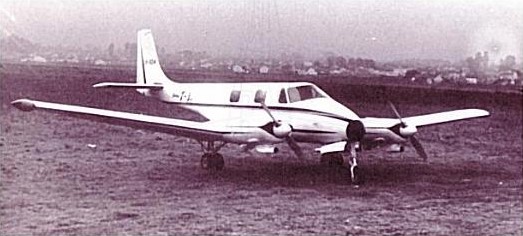
In 1957, the Argentine aircraft designer Alfredo Turbay began work on a twin-engined STOL light transport, the Turbay T-3A, with Turbay S.A. formed at Buenos Aires in January 1961 to build the new design. The T-3A was a low-wing cantilever monoplane of all metal construction. It was powered by two 130 kW (180 hp) Lycoming O-360-A1D engines driving two-bladed propellers, and was fitted with a retractable nosewheel undercarriage.
Alfredo Turbay piloted the T-3A on its first flight on 8 December 1964. Production was planned of the T-3B, which was to be fitted with 190–260 kW (250–350 hp) Lycoming or Continental engines, giving improved performance. These plans did not come to fruition, with the prototype T-3B never completed, and no production occurring.
Powerplants: 2 × Lycoming O-360-A1D, 130 kW (180 hp) each Propellers: 2-blade Hartzell HC-92 zk-2b/8447-12A metal Wingspan: 13.52 m (44 ft 4 in) Wing area: 24.08 m2 (259.2 sq ft) Aspect ratio: 7.5:1 Airfoil: NACA 23024 at root, NACA 4412 at tip Length: 9.40 m (30 ft 10 in) Height: 3.60 m (11 ft 10 in) Empty weight: 1,034 kg (2,280 lb) equipped Max. zero-fuel weight: 1,725 kg (3,803 lb) Max takeoff weight: 1,860 kg (4,101 lb) (MTOW and MLW) Fuel capacity: 360 L (95 US gal; 79 imp gal) in four wing tanks, with provision for 2x 80 L (21 US gal; 18 imp gal) external tanks; 24 L (6 US gal; 5 imp gal) oil Wing loading: 77 kg/m2 (16 lb/sq ft) Power/mass: 0.1442 kW/kg (0.0877 hp/lb) Maximum speed: 318 km/h (198 mph, 172 kn) Econ. Cruise: 230 km/h (140 mph, 120 kn) Max cruise: 255 km/h (158 mph; 138 kn) Stall speed: 85.4 km/h (53.1 mph, 46.1 kn) Never exceed speed: 342 km/h (213 mph, 185 kn) Range: 1,380 km (860 mi, 750 nmi) with maximum payload, zero wind Range: 1,840 km (1,143 mi; 994 nmi) with maximum fuel, zero wind Service ceiling: 7,600 m (24,900 ft) SE Service ceiling: 3,500 m (11,483 ft) Rate of climb: 6.6 m/s (1,300 ft/min) Take-off run: 118 m (387 ft) Take-off distance to 15.25 m (50 ft): 225 m (738 ft) Landing run: 100 m (328 ft) Landing distance from 15 m (49 ft): 180 m (591 ft) Crew: 1 Capacity: 6 passengers / 522 kg (1,151 lb) max. payload / tanks for 800 L (211 US gal; 176 imp gal) chemicals
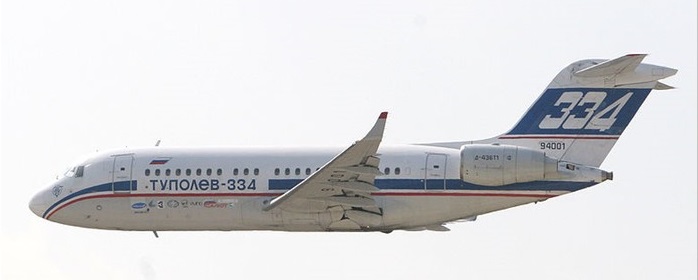
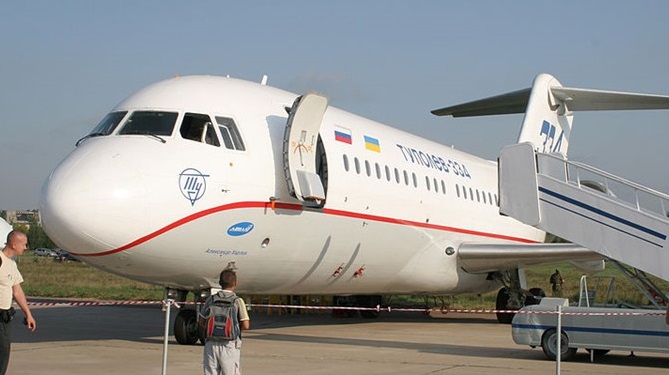
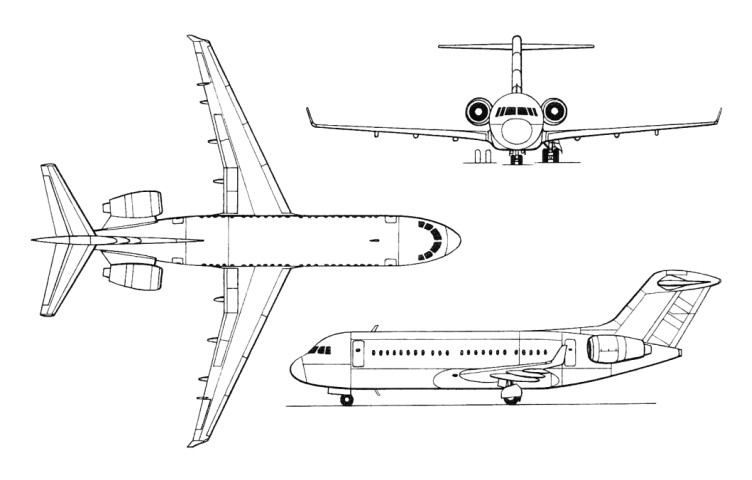
The Tupolev Tu-334 was a Russian short to medium range airliner project that was developed to replace the ageing Tu-134s and Yak-42s in service around the world. The airframe was based on a shortened Tu-204 fuselage and a scaled-down version of that aircraft’s wing. Unlike the Tu-204, however, the Tu-334 has a T-tail and engines mounted on the sides of the rear fuselage instead of under the wings.
Power is from two D-436T-1 turbofan engines with reversers (2×73.6 kN, 2×7500 kgf) produced by Zaporozhie Engine Manufacturing Design Bureau provided . The engine was certified in 2000. Engine is produced in co-operation with “Motor Sich” JSC (Ukrain), “Moscow Engineering Manufacturing Corporation”Salut” JSC (Russia), “Ufa Engine Manufacturing Corporation” JSC (Russia). TU-334 aircraft variants were supposed to be provided with turbofan D-436T-2 engines with thrust of 80.4-83.4 kN (8200 kgf) each.
Work commenced on the Tu-334 in the early 1990s, but proceeded slowly due to funding problems arising from the break-up of the Soviet Union. A prototype was displayed in 1995, but this was little more than a mock-up with few systems installed. A functional aircraft first flew on February 8, 1999, and later that year, agreements were put in place for MiG to undertake part of the production of the airliner. A Russian type certificate was obtained – after some delay – on December 30, 2003.
Since then, development remained slow due to protracted budget problems. In turn, the certification of the aircraft and its planned entry into serial production was delayed multiple times. As of December 2006 there were firm orders for the Tupolev Tu-334 from seven airlines, including Atlant-Soyuz Airlines and there were letters of intent from 24 airlines to obtain another 297 airplanes. Price per unit for the business version is estimated to be around $43–44 million.
Production lines were established for the 102- seat -100 in Aviant’s factory in Kiev, and for the 126-seat -200 in Aviacor’s Samara factory. A second -100 factory was also planned by Tavia at Taganrog. By 1996 series production of the Tu-334 at the Aviant factory in Kiev was 90% ready, but on 05 October 1996 the Russian government decided that Russia’s MIG MAPO was to take over from Kiev the manufacture of the new Tu-334 airliner. MIG MAPO had offered co-operation with Aviant: the Kiev plant would handover production tooling for half the aircraft parts to Moscow, the other half would be manufactured in Kiev and delivered to Moscow. Aviant had no choice since the rights for intellectual property of the aircraft belong to Russia. The assembly shop at the aircraft factory in Lukhovitsy was built especially for its production.
In February 2000 Vladimir Kravchuk, Deputy Director, Tu-334 program said the MiG Aircraft Concern was making production contracts and agreements on Tu-334 program with various aerospace enterprises in Russia and Ukraine. The Company had entered into an agreement with aircraft plants at Taganrog, which were expected to deliver a ready Tu-334 fuselage in March 2000. Ulyanovsk-based aircraft plant was to produce nose parts of Tu-334. These were made identical to nose parts of Tu-204 being mass-produced at Ulyanovsk. Russia’s Government had designated MiG the principle facility for producing Tu-334. The production was to cost 370 mln US dollars. The plan envisages the cost recovery after 7.5 years under production of at least 67 planes.
Serial production of TU-334-100 preparation has started at KAPO n.a.Gorbunov in accordance with Resolution of the Government of the Russian Federation of 15 April, 2005 No.217 “On organization of serial production of TU-334 a/c and its versions at FGUP “KAPO n.a.Gorbunov”. In January 2007 the oil-rich Russian republic of Tatarstan proposed to adopt the twinjet as the vehicle for the upgrade of its Gorbunov Aircraft Manufacturing Association (KAPO) manufacturing plant. The KAPO plant could take over production of dormant twinjet in exchange for $100 million to renovate factory.
In December 2007 it was reported that Iran was ready to make a purchase of up to 130 Tupolev Tu-214 and Tu-334 over ten years. The Iran Aviation Industries Organization (IAIO) was in negotiations to purchase licenses to assemble the aircraft in Iran by 2011 and manufacture them completely by 2015 alongside Tu-214. Nothing concrete became of these negotiations before the cancellation of the Tu-334 programme.
In June 2008 the Russian government bought 6 Tu-334. Four planes were Tu-334-100 with VIP-interiors and two planes were for the Federal Security Service. GTK Rossiya, the Russian government airline that provides flight services to the president and FSO federal security service, selected the Tupolev Tu-334 over Sukhoi’s Superjet 100 and Antonov’s An-148 in a tender for four aircraft, for delivery no later than 2010. Delivery under the state contract was planned as follows: 2010 – one plane, 2011 – two and in 2012 – three. KAPO resumed building Tu 334-100. This is the hull #03 of the experimental batch. While the second aircraft of this batch (#05 built by Aviant Kiev State Aviation Plant) was still flying to extend the certified conditions of operation, this one was likely to become the first Tu-334 sold as a product.
As late as 2008, Tupolev reported that a total of about 100 airlines had expressed an interest in placing orders for Tu-334s.
On 31 July 2008 Sergei Ilyushenkov, managing director of the Tupolev joint-stock company, said commercial production of a new Russian short-haul passenger airliner, the Tu-334, will start within the next six months. The Tu-334, including its business-class version, would be assembled at the KAPO Kazan aircraft plant. The project will be funded by a private investor. He said the Tu-334 business version would cost around $43-44 million, compared with over $60 million for a Bombardier business jet. Ilyushenkov also said the Tu-334’s range could subsequently be increased to 6,400 km by using additional fuel tanks. The aircraft had gone through certification, and can be launched into serial production at a minor expense once there were reliable orders from air carriers.
In 2009, with the project years behind the projected schedule and only two examples built and flying ten years after first flight, the Tu-334 came under review during the rationalisation of the Russian aircraft companies, which led to the formation of United Aircraft Corporation. In mid-2009, the decision was taken to not continue with the Tu-334 programme and instead focus efforts on the Sukhoi Superjet 100 and the Antonov An-148.
TU-334 A state-of-the-art short-haul aircraft designed on the basis of advanced developments in aerodynamics, structure, and avionics ensuring high-level comfort and safety, and high-quality standards traditional for “TUPOLEV” PSC. Various versions, universal layouts and up-to-date avionics allow operators to choose the TU-334 aircraft version that would be ideal for any flight mission.
TU-334-100 A basic version designated to carry 102 passengers in tourist class. The aircraft is powered by D436T1 engines. In 2003 it was certified against AP-25 Russian Airworthiness Rules.
Tu-334-100 Engines: 2 x Progress D-436T1 turbofans, 7500kg Wingspan: 29.77 m / 98 ft 8 in Length: 31.26 m / 103 ft 7 in Height: 9.38 m / 31 ft 9 in Wing area: 83.23 sq.m / 895.88 sq ft Empty weight: 30,050 kg (66,250 lb) Max. takeoff weight: 47,900 kg / 105,380 lb Payload: 11000kg / 24251 lb Maximum speed: 865 km/h (465 kt, 545 mph) Cruise speed: 820 km/h / 510 mph / 440 kt Service ceiling: 11,100 m / 36,400 ft Range: 2380 km / 1479 miles Passengers: 102 Crew: 2



 All Aero