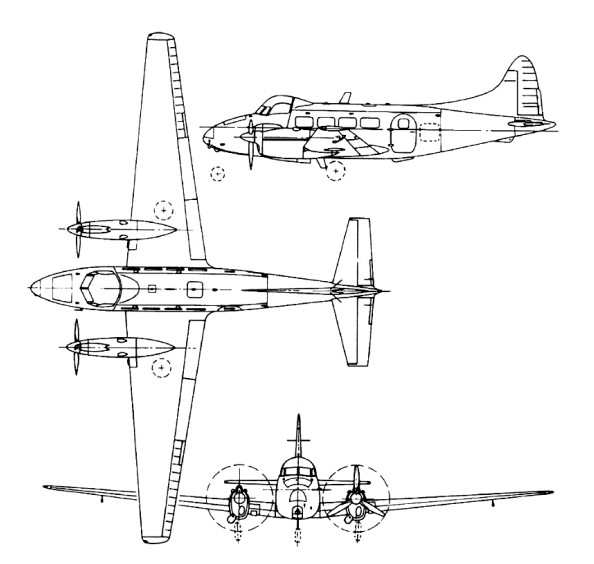
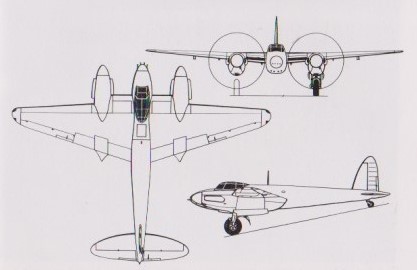
In 1944 R E Bishop and his team envisaged the DH104 as a successor to the Dtagon, Express and Rapide, and incorporated new construction techniques such as Redux bonding in the airframe and a tricycle undercarriage. A new low-wing monoplane which, with the exception of fabric-covered elevators and rudder, was of all-metal construction, and powered by two de Havilland Gipsy Queen engines, with constant-speed, fully-feathering, and reversible-pitch propellers. Standard accommodation as a transport was for 8 to 11 passengers.
The prototype flew on 25 September1945, initially with an angular dorsal fin before it was replaced by a new dorsal fin and, much later of a redesigned elevator, and of a domed roof to give a little more headroom on the flight deck. Production aircraft were generally similar to the original prototype.
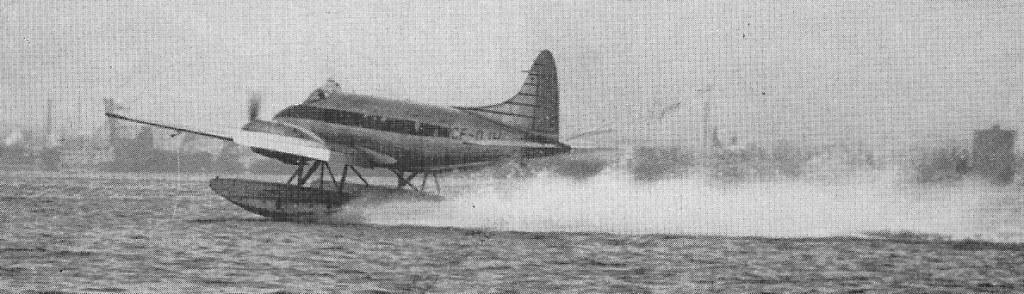
The 15th production DH.104 Dove, CF-DJH, was the only Dove to be flown with twin float undercarriage.
CF-DJH at Toronto, Canada, 1947
The Dove production variants resulted from differing Gipsy Queen powerplants, these including the 246kW Gipsy Queens 71 and 70-3 powering the prototype and the Dove 1/2 respectively; 254kW Gipsy Queen 70-4 in the Dove 1B/2B; 283kW Gipsy Queen 70-2 in the Dove 5/6, and 298kW Gipsy Queen 70-3 in the Dove 7/8.
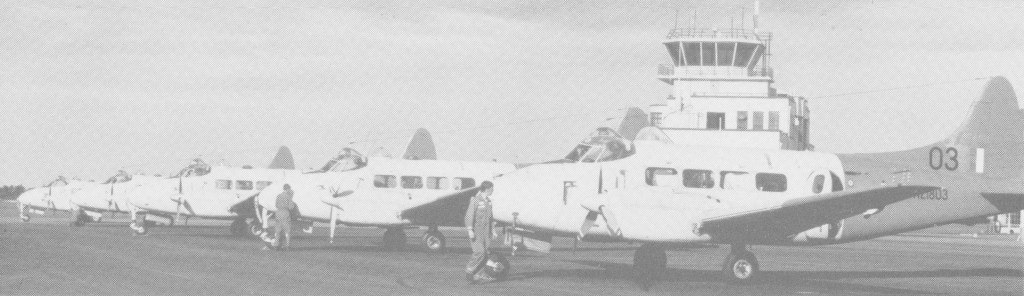
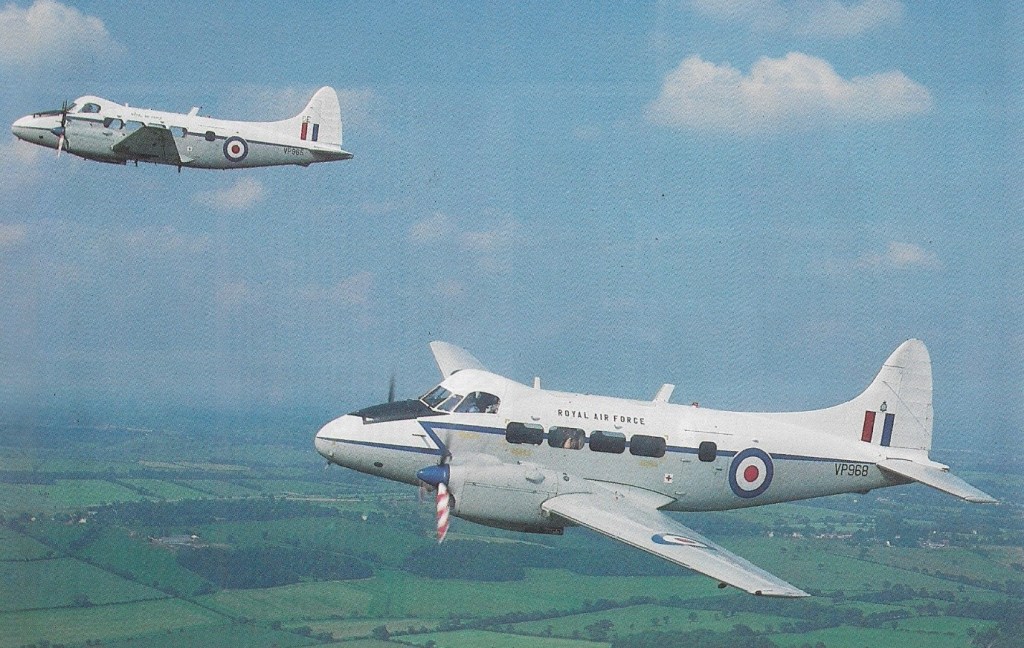
The Dove 1B powered by 305 hp DH Gipsy Queen 70 was the most prolific model, followed by 128 Dove 4/5, built as the Devon/Sea Devon. The Mk.4 was a military variant of the Dove, with two crew and 8 passengers.
Up to 30 were in Service with the RNZAF during 1946-80.
RNZAF DH 104
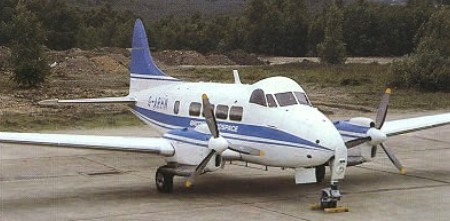
In the course of its long life, the type underwent significant improvements with the final production version, the Dove 7/8 having an enlarged cockpit, Heron-style canopy and 400HP Gipsy Queen Mk 3 engines.
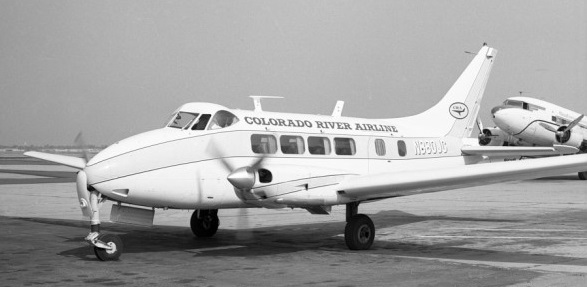
Doves in the United States were marketed as the Custom 800.
DH 104 production ran to 542 aircraft before production ended in 1968, mak¬ing it Britain’s best selling commercial air¬liner.
Just over 100 were supplied under the name Devon to many air forces, including the RAF, and a small number went to the Royal Navy with the name Sea Devon.
A number of Dove conversions carried out subsequently by Riley Aircraft in the USA as the Riley Turbo Executive 400 introduced 298kW Avco Lycoming IO-720-A1A flat-eight piston engines.
Riley Turbo-Exec 400 N880JG (04491)
Carstedt went even further with the Carstedt CJ-600A Jet Liner with a fuselage stretch by 7 ft 5 in (2.21 m) to seat up to 18 passengers and two 575 SHP / 451kW Garrett TPE-331 turboprops. The type was supplied primarily to Apache Airlines. Another version of the Dove was produced by Texas Airplane Manufacturing Co. that employed 705-eshp turboprops and a stretched fuselage.
DH104 Mk.1 Engines 2 x D.H. Gipsy Queen 70-2, 330 hp Length 39 ft 2 in (11.96 m.) Wing span 57 ft. (17.37 m.) Weight empty 6,325 lb. (2,870 kg). Max wt: 8800 lb (3992kg). Seats 2 crew and up to 11 passengers Maximum speed: 230 mph (370 kph) Cruise speed 200 mph (320 kph) Ceiling 21,700 ft. (6,600 m) full loaded Maximum range: 880 miles (1415 km)
Dove 7 Engine: 2 x Havilland Gipsy Queen 70-3 inline, 298kW, 400 hp Max take-off weight: 4060 kg / 8951 lb Empty weight: 2985 kg / 6581 lb Wingspan: 17.37 m / 56 ft 12 in Length: 11.99 m / 39 ft 4 in Height: 4.06 m / 13 ft 4 in Wing area: 31.12 sq.m / 334.97 sq ft Max. speed: 378 km/h / 235 mph Cruise speed: 261 km/h / 162 mph Service Ceiling: 6615 m / 21700 ft Range: 1891 km / 1175 miles Crew: 2 Payload: 11 pax
Dove 8 Engines: 2 x Gipsy Queen Mk 3, 400 hp.
Riley Dove Engines: 2 x Lycoming IO-720, 400 hp.
Carstedt CJ-600A Engines: two x Garrett TPE-33 1 turboprops, 575 shp
The de Havil¬land Hornet was a private-venture new design as a response to the need for a long-range single-seat escort fighter for service in the Pacific to Specification F.12/43. Development began in 1942, the prototype making its maiden flight on 28 July 1944, but the Hornet suffered heavily through post VJ-Day cancellations. It entered production at the end of 1944 and deliveries were made to the RAF from February 1945. Four versions were produced for the RAF as: the Hornet F.1 medium-range single-seat fighter with four 20mm cannon and provision for carrying two 450kg bombs or two 455 litre drop tanks; Hornet PR.2 long-range unarmed photographic reconnaissance aircraft; Hornet F.3 long-range single-seat fighter with the increased fuel tankage of the PR.2; and Hornet FR.4 with a vertically mounted camera. More than 200 were built. The Hornet entered service as a front line fighter in August 1946 until April 1951. The Hornet was the fastest twin piston-engined operational combat aircraft in the world while in service. Operated in Malaya in the early 1950s, the type was finally withdrawn from service in 1955.
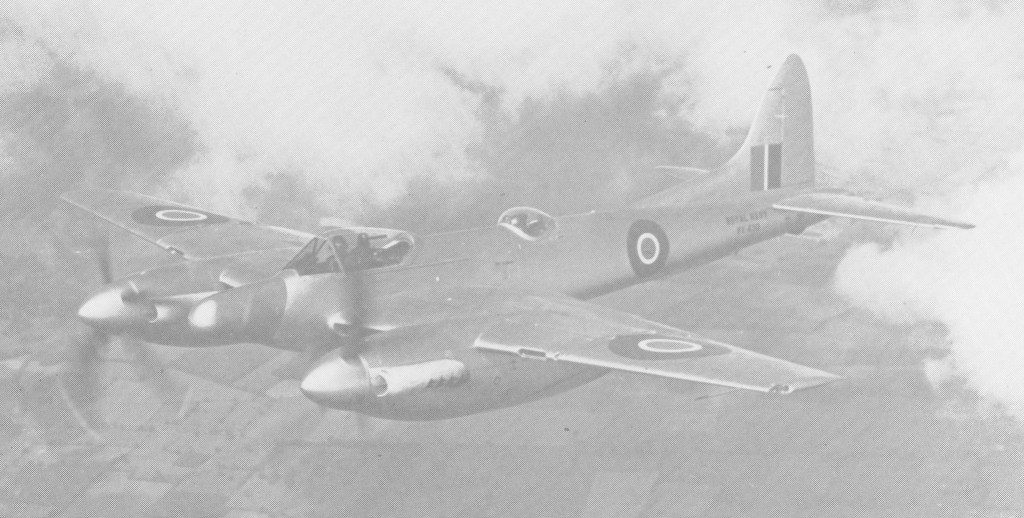
DH 103 Sea Hornet
Hornets equipped four UK Air Defence Squadrons, 19, 41, 64 and 65. Flying training was carried out by 226 Operational Conversion Unit (OCU) and by the Hornet Conversion Flight, the latter being based at Linton on Ouse.
Consideration of the possibility of acquiring a carrier-based variant resulted in the testing of three Hornet FMk 1 aircraft in 1944-5, the third of these being fully navalized. It was fitted with folding wings and had provision for deck arrester and RATO gear. Air-draulic shock-absorber legs replaced the rubber-in-compression legs to eliminate bounce in carrier landings. Such was the success of these trials that a production order for 79 Sea Hornet F.Mk 20 fighters soon followed, deliveries getting under way to No. 801 Squadron in June 1947 and joined HMS Implacable in 1949. A carrier-based medium-range single-seat fighter/reconnaissance/strike aircraft, capable of carrying eight 27kg rockets, bombs, mines and drop-tanks. Armament was basically similar to that of the RAF Hornet, and this model remained in service until 1951 in a front-line capacity. The next version was the Sea Hornet NF.Mk 21 night-fighter, whose development began in 1946 although it was not until January 1949 that this attained operational status with the Fleet Air Arm fitted with an A.I. radar scanner in a thimble radome in the nose, equipping No. 809 Squadron at Culdrose until 1954, when it finally gave way to jet-powered equipment in the shape of the de Havilland Sea Venom. Subsequently, the Sea Hornet NF. Mk 21 was reassigned to the training of night-fighter radar operators, a task it performed until 1956 when the handful of remaining aircraft were scrapped. Production of the Sea Hornet was completed with the Sea Hornet PR.Mk 22 for photographic reconnaissance, about two dozen examples being completed, all of which employed a pair of F52 cameras for use by day and a single K19B camera for night work. In order to undertake the reconnaissance mission, the cannon armament was deleted, its place being filled by cameras.
In all, a total of 391 aircraft were produced of which 180 were for the Royal Navy and the production run comprised: two prototypes, sixty F.Mk 1, five PRMk 2, 132 Mk 3, twelve FMk 4, 79 FMk 20 (RN), 78 NMk 21 (RN) and 23 PRMk 22 (RN).
Hornet F. Mk 3 Engines: 2 x Rolls-Royce Merlin 130/131, 1544kW Take-off weight: 9480 kg / 20900 lb Empty weight: 5840 kg / 12875 lb Wingspan: 13.72 m / 45 ft 0 in Length: 11.18 m / 36 ft 8 in Height: 4.32 m / 14 ft 2 in Wing area: 33.54 sq.m / 361.02 sq ft Max. speed: 760 km/h / 472 mph Ceiling: 10670 m / 35000 ft Range: 4820 km / 2995 miles Armament: 4 x 20mm cannons, 900kg of weapons Crew: 1
DH 103 Sea Hornet Engines: 2 x RR Merlin 133/134, 2030 hp Wingspan: 45 ft / 13.71 m Length: 37 ft / 11.28 m Max speed: 462 mph / 744 kph Crew: 1-2 Armament: 2 x 20 mm cannon
Sea Hornet F.Mk 20 Engines: two 2,030-hp (15 14-kW) Rolls-Royce Merlin 133/134 inline piston. Maximum speed 748 km/h (465 mph) at 6705 m (22,000 ft) Service ceiling 10,670 m (35,000 ft) Range 2414 km (1,500 miles) with auxiliary fuel. Empty weight 6033 kg (13,300 lb) Maximum take-off 8405 kg (18,530 lb) Wingspan 13.72 m (45 ft 0 in) Wing area: 361.025 sq.ft / 33.54 sq.m Length 11.18 m(36 ft 8 in) Height 4.32 m (14 ft 2 in) Wing area 33.54 sq.m (361 sq ft). Armament: four 20-mm cannon, eight 27-kg (60-lb) rockets or two 454-kg (1,000-lb) bombs.
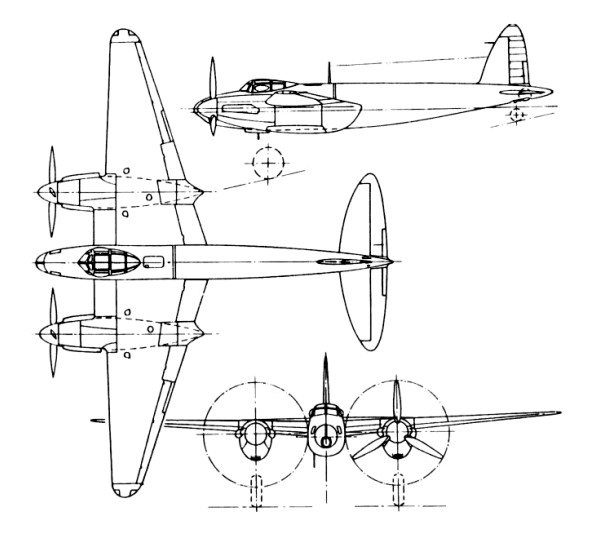
By 1937 Geoffrey de Havilland had become convinced that war with Hitler was inevitable. His idea had been a bomber fast enough to out fly enemy fighters, a two man crew, no rear armament, pure speed for defense. Two Rolls Royce Merlins for power, and the sleekest possible shape, entirely fashioned from wood, since in war there was likely to be a surplus of wood and woodworkers, DH thought, and a shortage of aluminum alloy.
When he showed up at the Air Ministry with his drawings of a 400 mph gunless carpentry bomber faster than a Spitfire, they told him: “Forget it. You haven’t built a war machine in years. Start on something simple, nothing this ambitious.” As they drove home, DH and a colleague discussed the Mosquito and what a good idea it had been. As they turned in the factory gate at Hatfield, DH said: “We’ll do it anyway.”
DH set up to de¬sign and build his prototype plywood bomber in an old moated mansion, Salisbury Hall, five miles away. In December 1939, a team under Geoffrey de Havilland, with R E Bishop and C C Walker, started detailed design. The radiators for the Merlins were in a two foot forward extension of the wing root between the engines and the fuselage, with intakes in the leading edge and cooling air exits beneath the wings that actually gave cooling thrust, not drag. From these inboard radiators, and with a minimum of plumbing, they were also able to contrive a cabin heat system that kept Mosquito crews warm at altitude. The fuselage was in cross section of tapered ovals. It was a balsa filling sandwiched be¬tween ply sheets, built in two vertical halves and glued together. The one piece wing and fixed tail surfaces were wooden, but the control surfaces were ply covered wooden flaps, metal covered al¬loy ailerons and elevators, fabric covered rudder. When all the wooden bits had been sanded smooth, screwed, glued and pinned, they were covered with fabric, the fabric stretched with dope and then painted.
The Rolls Royce Merlin engines were descendants of the R type racing engines developed for the Schneider Trophy floatplanes in the early 1930s. They were V 12s, cooled by a mixture of water and glycol, and (in later versions) aspirated by a two stage, two speed supercharger but the engines held power to rare altitudes. Takeoff power was 1,200 to 1,700 horsepower each, depending on the mark of Merlin. The wing, while more straightforward than the fuselage, requires a great deal of jigging and tooling. Made in one piece 51 feet long, it contains two spars built up of booms of laminated spruce with webs of birch ply. The rear spar is swept forward to give that distinctive wing shape. The spars are separated by 32 ribs, and then covered by an inner top skin of ply with an outer ply skin separated by spanwise douglas fir stringers. The bottom is single skin with stressed panels covering the fuel tank openings. All the skins are glued and screwed, with over 4000 screws in the top in alone.
The de Havilland team designed, drew up some 10,000 drawings, built a mockup, designed and built all the jigs and tooling, and rolled the aircraft out in 11 months.
On 1 March 1940 a contract was signed for 50 aircraft and the first flew on 25 November 1940, 11 months after design work began.
The prototype was taken to Hatfield Aerodrome and assembled in November 1940. The prototype’s first flight test pilot was DH’s eldest son, also named Geoffrey de Havilland.
Conceived as an unarmed fast light bomber, the Mosquito was also planned as a photo-reconnaissance aircraft and a night fighter. The second aircraft, flown on 15 May 1941, was the night fighter prototype. Also constructed at Salisbury Hall, and young Geoffrey decided he’d fly it out of the pasture beyond the manor’s cabbage patch, to save the time and labour of dismantling, trucking and reassembly at the airfield. Test flying of the Mosquito revealed airspeed readings so high that DH wasn’t sure he believed his pilots. So he one day “borrowed” (DH’s word) a Spitfire as a pace aircraft. Both pilots agreed the Mosquito was almost 20 knots faster, doing eventually 370 knots at 30,000 feet. DH arranged demonstrations for the Air Ministry at which young Geoffrey would fly such unbomber-like manoeuvres as vertical rolls with one engine feathered. In Boscombe Down trials the Mosquito proved some 20 mph faster than the then fastest mark of the Spitfire and was almost as manoeuvrable. It reached a maximum speed of 437 mph and a maximum altitude of 44,600 feet in the early 1940s. The third prototype was a fighter variant. Production wasn’t helped by the ex¬traordinary number of different models ordered 43 in all and by the Air Ministry oft changing its mind as to which variants were needed most urgently. Since they were possibly the fastest airplanes in the world for two and a half years, Mosquitos flew as fighters, both day and night, heavily armed with cannon and machine guns, as intruders fighter-bombers, pure bombers, marker bombers with the pathfinder squadrons of Bomber Command, photoreconnaissance aircraft, dual control trainers, airliners, and as antisubmarine aircraft, carrying a six pounder antitank gun or, later, rockets. The first Mossies into service, in the autumn of 1941, were photorecon variants. The first PR aircraft made their initial daylight sorties over Paris on 20 September 1941. PR Mosquitoes also had the distinction of being the last in RAF front-line service, being withdrawn in December 1955. In time, these PRU aircraft roamed all over Germany and Europe. They flew between 22,000 and 30,000 feet, just below contrail height, so that any German fighters above them might be revealed by their own trails. But they’d photograph from as little as 400 feet if that was the cloud base. The Mosquitos’ speed did give them substantial immunity from fighters though not from flak with the same FW 190s that the night-fighter Mosquitos were after being their principal adversary. When attacked by German jets, the Mosquitos could avoid their fire by tight turns; one held off two Me 262s for 15 minutes like this, till the Messerschmitts ran low on fuel. The Mosquitos’ cameras were good enough to reveal the markings on German aircraft on the ground from 24,000 feet. By 1943, they were getting good photographs at night, using American photoflashes of 600,000 candlepower.
Entering service at the end of July 1941, the first 50 Mosquitos were deployed as long-range reconnaissance aircraft (Mk.1), as night fighters (Mk.IIs) or as bombers (Mk.IVs).
No.105 Squadron introduced Mosquitos into service in May 1942 as daylight bombers. Mosquitos were also the first Allied aircraft to bomb Berlin in broad daylight. The British learned that on January 30, 1943, both Goering and Goebbels were to address a rally in the city, and the RAF timed nuisance raids by two trios of Mosquitos to coincide with the start of their speeches. Back in Britain, those in the know tuned their wireless sets to Berlin radio, and to their great joy heard muffled noises and shouts, then an hour of martial music when there should have been live broadcasts of grandiose Nazi pomposity. No great damage was done, and one Mossie was lost; but Nazi pride had been ruffled, and Goering’s boast that no Allied aircraft would ever bomb Berlin had been most obviously disproved. Unarmed Mosquitos flew in BOAC colours between Scotland and Stockholm. The British needed Swedish ball bearings, and they also transported POW mail and a few VIP passengers in a makeshift bunk inside the bomb bay. Passengers were loaned a flying suit, warm boots, Mae West and parachute for the trip; they had oxygen masks, heat and an intercom to the pilot but no means at all of seeing out. The Mosquito was an economical weapon. Four or five could be built for the man hours necessary for one heavy bomber; wood and women were resources not in short supply and women did much of the work in building Mosquitos. There were only two crewmen to train, against 10 for a heavy; two engines against four, and half the fuel consumption. By the war’s end, Mosquitos were carrying 4,000 pound bombs to Berlin: about the same load as a B 17, but the Mossies only took half the time and had a third of the loss rate. A total of 466 Mosquito Night Fighter Mk IIs were produced.
On the night of 18-19 August 1942, the British tried out their new pathfinder tactics for the first time in a riad on the ship docks in Flensburg (western Germany). British Mosquitos equipped with Gee navigational and blind-bombing equipment were supposed to mark the area bombing target with flares, but despite precise theoretical planning, the raids went awry: the Gee devices became non-operational several miles before reaching the city due to German jamming, and the marker flares were dropped in the wrong place.
On Sunday 20 December 1942, six British Mosquitos of 109 Squadron guided by the ‘Oboe’ radar-controlled blind-bombing and navigational aid that was here used for the first time, raided a power plant in Lutterade (eastern Holland). This target-finding radar used two ground transmitters – the ‘cat’ and ‘mouse’ stations – to lead an aircraft to its target by the shortest possible route.
The T.Mk.IIIs were a direct development of the F.Mk II fighter, possessing dual controls and no armament. The origin of the armed Mosquito T.Mk.IIIs was wartime Australia. The need for training in the ground attack role had led to some British built T.Mk.III trainers being armed with the machine gun packs removed from FB.Mk.40s previously converted to the photo reconnaissance role.
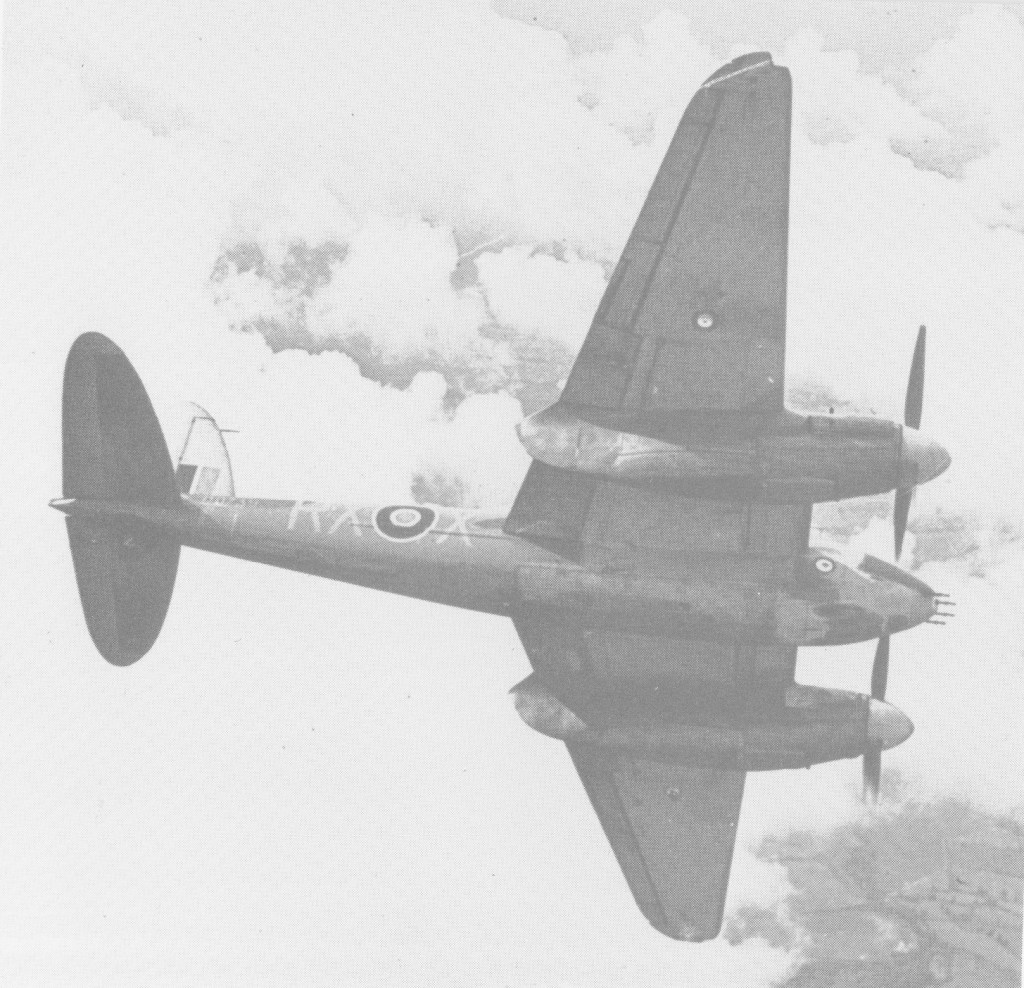
Mosquito B.IV
The prototype of the most widely used of the Mosquito fighters (HJ 662) made its first flight in February 1943, and more than 2,500 of this Mk VI version were built eventually. With two 1,710 hp Rolls Royce Merlin XXX engines, it had a maximum level speed of 407 mph (655 km/h) at 28,000 ft (8,535 m).
The B.IV Srs 2 bomber version first operation was on 20 November 1942.
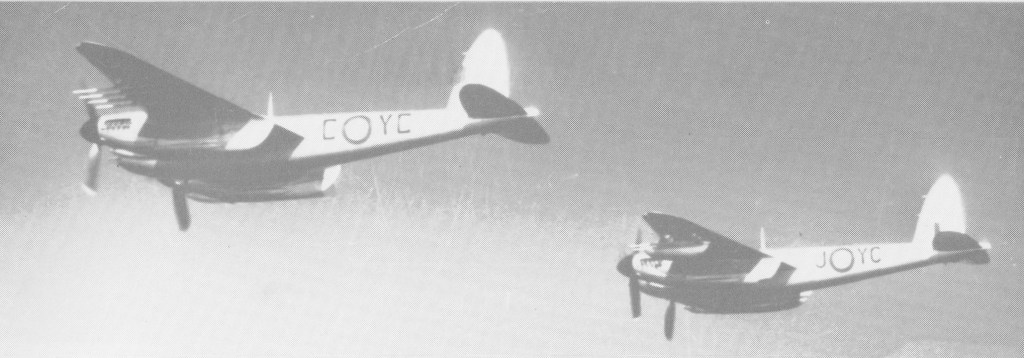
Little has been said of No.618 Sqn of Coastal Command, formed on 1 April 1943, before the dam buster raids, to operate Mosquito carrying a variant of the Wallis bomb. The primary function was to attack the German fleet in Norway using the weapon code-named Highball.
Smaller than the Lancaster weapons, Highball worked the same. Bouncing across water, rebounding, the spinning under the ship, where a hydrostatic fuse exploded the 600 lb / 272 kg explosive charge. The Mosquito accommodated two of these weapons in tandem in the bomb-bay, with the doors removed.
Highball Mosquito
Work on the Mosquito weapon, including dropping trials, was undertaken by Vickers during April 1943. Most of the test flying was done from Manston by ‘Shorty’ Longbottom, the Vickers test pilot who shared the Lancaster trials with Mutt Summers.
For the first two weeks 619 Sqn used standard Mosquito IVs. The first converted aircraft, DZ531/G, reached their Skitten base, from Vickers, on 18 April 1943. Another five had arrived by the end of the month. The Highball programme eventually had sixty of the 263 B.Mk.IV Series 2 Mosquitos built, but thirty were subsequently re-converted to take a 4000 lb bomb installation.
Highball Mosquito
618 Sqn began dropping trials with Highball on 13 April 1943, three days before the Dam Buster Lancaster. By the end of the month twenty-three drops were completed, using prototype weapons and flying the Mosquitos from Manston. Much of this practice was against the Bonaventura target ship in Loch Cairnbarn.
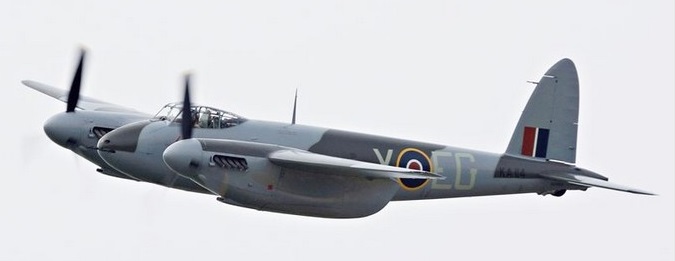
Mosquito FB.26 KA114
On 4 October 1944 the US 8th Air Force Headquarters announced that for several days the German Luftwaffe had been using allied Mosquito and Mustang aircraft furnished with German national emblems. On 3 October 1944 a Mosquito flown by Germans was shot down near Aachen. Aerial combats had taken place over Holland between allied and German Mustang fighters. These machines in German hands were aircraft which had been forced to land behind German lines.
The Royal Navy operated a number of Mosquito FB.Mk VI and T.Mk 3 land-based aircraft in the anti-ship attack and trainer roles, but its most important type was the Sea Mosquito TR.Mk 33 carrierbome torpedo and reconnaissance fighter. This model first flew in November 1945 and entered service in August 1946. The variant was based on the FB.Mk VI with larger propellers, American radar, and naval features such as fold¬ing wings and an arrester hook. With the Second World War over, deliveries of this model totalled just 50, though there were also six examples of the related Sea Mosquito TR.Mk 37.
On New Year’s Eve 1944, the RAF Mosquitos of 627 Squadron carried out another precision raid. This time the target was Gestapo Headquarters in Oslo. Forty-four Mosquitos badly damaged the buildings, destroying many German documents.
On the night of 14-15 June 1944 was the first time a V-1 flying bomb was shot down by an aircraft. An RAF Mosquito of 6-5 (County of Warwick) Squadron, flown by Lt. J.G. Musgrave and Sgt. F.W. Samwell, shot down a ‘doodlebug’ over the Channel.
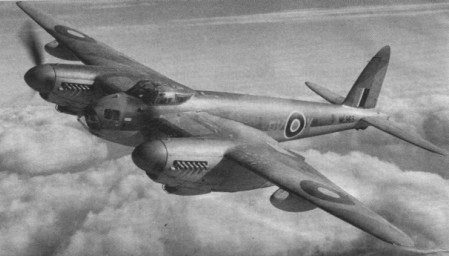
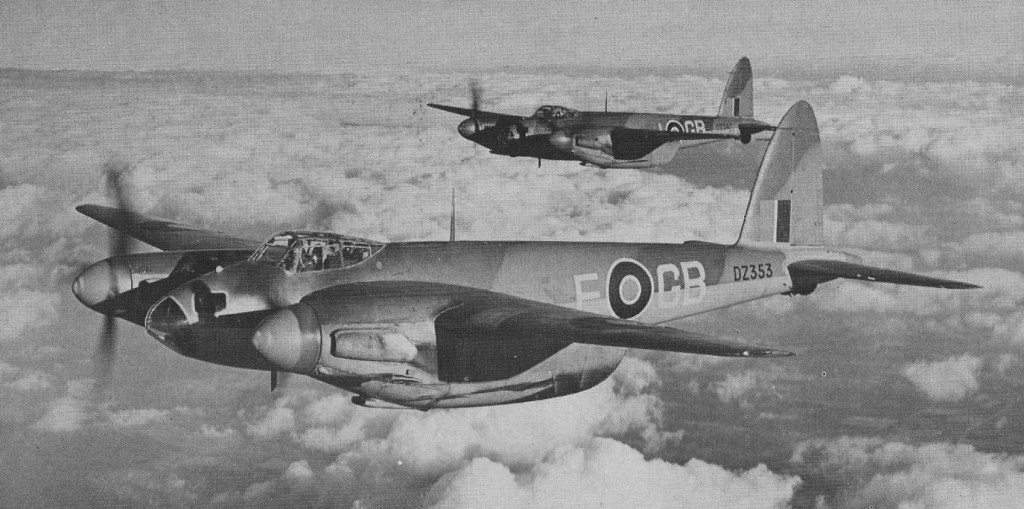
The availability of two-stage two-speed supercharged versions of the Merlin led to the introduction of numerous new Mosquito bomber and PR versions but, apart from their use in the high-altitude NF Mk XVs, these engines were not introduced in a fighter variant until the spring of 1944, when the Mosquito NF Mk 30 appeared. This night fighter had the same “universal” radome as the NF Mk X1X, together with 1,680 hp Merlin 72 engines (in the first 70 production examples) or 1,710 hp Merlin 76s (in the other 460 built). First Mk 30 flew in March 1944 and operational service began in June 1944 with No 219 Squadron for home defence, other squadrons using this type for long-range escort of Bomber Command formations attacking Germany in 1944/45.
Mosquito night fighters
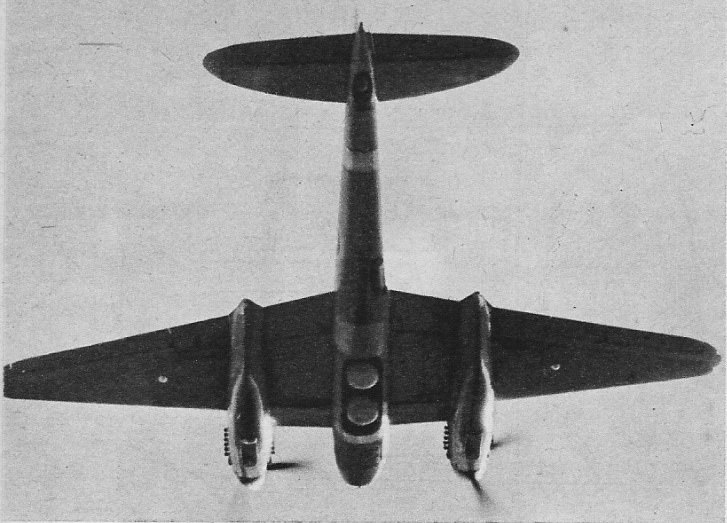
The PR.34 differences from earlier machines appear in an altered canopy, that has an astrodome in addition to the bulged side windows and vee-windscreen found on the bomber version. The engine cowlings feature an enlarged chin intake and the fuselage belly has a distinct bulge. The aircraft also features the paddle-bladed propellers that give the late series of this type such an air of purpose.
On the night of 2-3 May 1945, the RAF flew its last raid on Germany when 125 Mosquitos of 608 Sqn dropped 174 tonne of bombs on the harbour at Kiel. The crews met no opposition and all aircraft came back.
On 12 March 1945 the last bomber variant of the Mosquito, the B35, made its first test flight. The war had ended before it could be used operationally, but it entered service with the post-war Royal Air Force and served as a bomber until the beginning of 1954.
Some Mosquito B35s were converted for other duties including target-towing and in this role they continued in service until 1963.
The Mosquito NF Mk 36 was similar but had 1,690 hp Merlin 113s; the first example flew in May 1945 and 163 were delivered, up to March 1947. The Force Aérienne Beige acquired sufficient to equip two squadrons after RAF service, these remaining in service until the mid ‘fifties. The final fighter version of the Mosquito was the NF Mk 38, differing from the Mk 36 in having British Al Mk X1 radar in place of American Al Mk X and Merlin 113 / 114 engines, Of 101 built, 54 were supplied to the Yugoslav Air Force in 1950 and the others were scrapped.
The Mosquito T.43 is an Australian built dual control model similar to the T.3 but with Packard Merlin engines and retaining its armament of four .303 machine guns and four 20mm cannon.
Other versions were Sea Mosquito TR.Mk 33 (initial model with American ASH surface search radar), Sea Mosquito TR.Mk 37 (derived model with British ASV surface search radar), and Mosquito TT.Mk 39 (naval target-tug model based on the B.Mk XVI bomber).
Towards the end of the war Mosquito units were averaging one aircraft loss per 2,000 sorties – by far the lowest figure recorded by Bomber Command. Mosquito bombers, which had entered service carrying a 907kg bomb load, were later to carry a 1800kg block-buster in a bulged bomb bay. Mosquito fighters were to distinguish themselves in fighter-bomber, anti-shipping and night-fighter roles, and were to destroy some 600 V-1 flying-bombs in the defence of Britain. For reconnaissance duties the Mosquito was the RAF’s major long-range aircraft in this category, serving in Europe, Burma and the South Pacific. Including 1,342 Mosquitoes built in Australia and Canada, total construction was 7,785 aircraft when production ended in November 1950. 6,710 were built during WW2.
Eighty-nine were ordered by the RNZAF to re-equip 1946-55 but the bulk were never put into service.
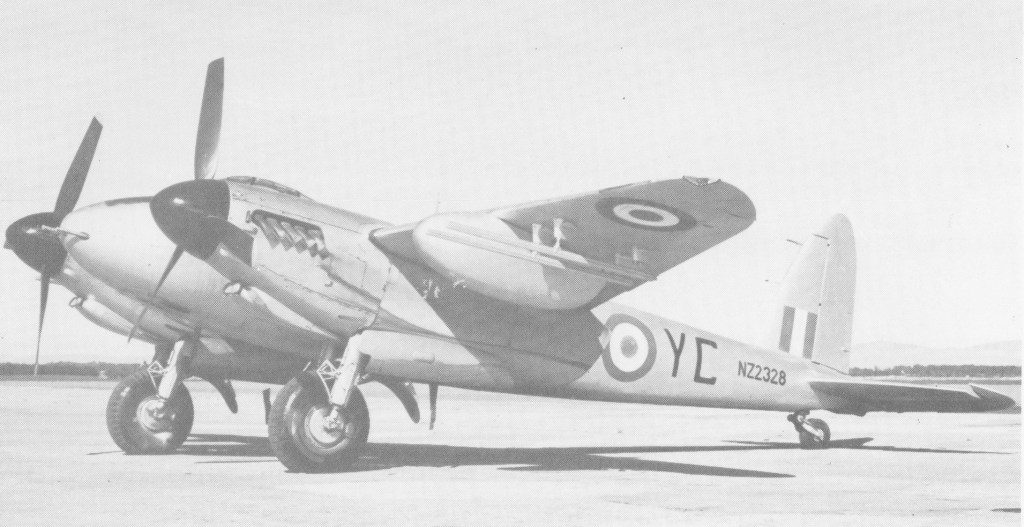
Specification F.18/40 was originally written for a fixed gun two-seat night fighter to replace the BP Defiant, dated 10/11/1940, but on 9 December a correction was made in that armament was changed to incorporate a ‘dorsal power-operated turret’.
de Havilland was asked to examine the spec, even though the firm was not invited to tender to it. The result was the two turret fighter Mosquitoes, the fourth prototype W4053 built at Salisbury Hall and flown from there to Hatfield with the turret fitted on 14 September 1941, and W4073, first flight 5 December from Hatfield.
turret equipped Mosquito
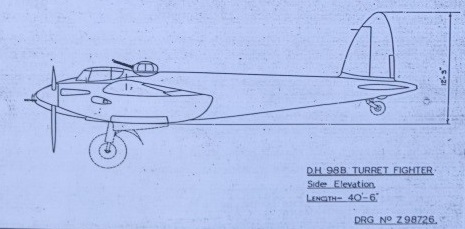
The turret was to be a Bristol B.11 four-gun turret, which was designed for the Bristol Beaumont bomber project, and was very light and compact.
DH also did much research into Mosquitos fitted with turrets as a result, to discover that a considerable amount of performance was lost as a result of the installation. The two turret fighter Mosquitos, after having their turrets removed, went on to become the prototype T.III trainers.
turret equipped Mosquito
W4050 July 1941
The prototype W4050 was fitted with a mock up turret for aerodynamics trials in July 1941. In September 1941 the fourth prototype Mosquito, W4053, which was the first prototype turret fighter (the third prototype, W4052 was the first night fighter NF.II, built to F.21/40), flew for the first time, but with a mock up turret only.
By then the decision had been made not to continue with the turret fighter, although a second prototype turret fighter was finished, W4073, in December 1941. This aircraft and W4053 became the prototypes of the T.III trainer variant once the turret fighter was cancelled.
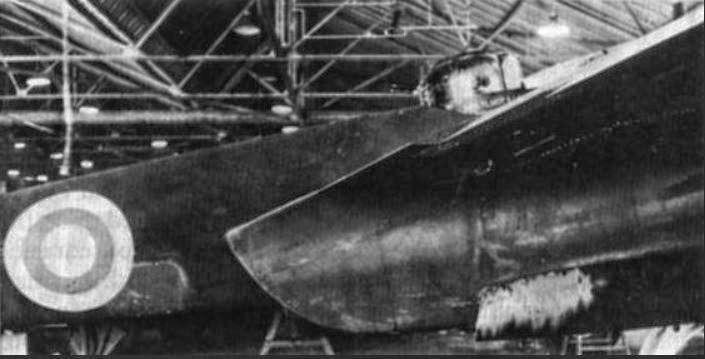
This faint vertical line on the canopy of the prototype shows where the fairing for the turret mock up rubbed against the canopy. Within the structure are four mounting bolts where the turret was fitted.
In 1949 Mosquitos of No.540 PR Squadron carrying a pilot and a navigator normally used the standard F.52 camera with two of these units arranged for split cover and a third rear unit for vertical photography. The F.52 can be fitted with lenses of various focal length, but normally 20in or 36in units; the picture size is 8.5in x 7in. and the magazine holds film for 500 exposures.
For aerial survey work, 6in K.17 cameras were used giving a 9in x 9in picture.
Engines: 2 x 1,680 hp Rolls Royce Merlin 72. Length 41.5 ft. (12.65 m.). Wing span 54.2 ft. (16.5 m.) Weight empty 15,510 lb. (7,035 kg.) Crew: 2. Max. bomb load: 4,000 lb. (1,800 kg.) Max speed 408 mph (656 kph) Ceiling 37,000 ft. (11,000 m) fully loaded Range 1,370 miles (2,200 km.) Stall flaps down and light: 90 knots, 119 knots flaps up and at gross weight Vmc: 185 knots at full power and 175 knots at climb power.
Prototype Wingspan: 52 ft 6 in
PR.I Unarmed reconnaissance Wingspan: 54 ft 2 in
F.II Night fighter Engines: 2 x Rolls-Royce Merlin 21, 1230 hp Seats: 2 side-by-side Armament: 4 x 20mm Hispano cannon 300 rds / 4 x 0.303 Browning 2000 rds each
T.III Dual control trainer First flown January 1942 Last delivery 1949 Engines: 2 x Rolls-Royce Merlin 21, 1230 hp
B.IV Unarmed bomber Engines: 2 x Rolls-Royce Merlin 21, 1230 hp Bombload: 4 x 500 lb / 227 kg Later bulged bomb-bay: 4000 lb / 1814 kg
Mosquito FB Mk VI Engine: 2 x Rolls-Royce Merlin 25, 1208kW / 1,635 hp Props: 12 ft 0 in (3.66 m) dia 3 blade. Max take-off weight: 10115 kg / 22300 lb Empty weight: 6486 kg / 14299 lb Wingspan: 16.51 m / 54 ft 2 in Length: 12.47 m / 40 ft 11 in Height: 4.65 m / 15 ft 3 in Wing area: 42.18 sq.m / 454.02 sq ft Wing loading: 47.15 lb/sq.ft / 230.0 kg/sq.m Max. speed: 583 km/h / 362 mph at 13,000 ft (3,960 m) Cruise speed: 523 km/h / 325 mph Service Ceiling: 10060 m / 33000 ft Initial climb rate: 2500.00 ft/min / 12.70 m/s Range: 2655 km / 1650 miles Endurance: 7 hr Armament: 4 x 20mm Hispano cannon, 4 x 7.7mm Browning machine guns Bomb load: 4 x 250 lb / 113 kg – later 2 x 250 lb / 113 kg & 2 x 500 lb (2,000 lb / 900kg) Crew: 2 No built: 2584
Mk VI Engine: 2 x Rolls Royce Merlin XXX, 1,710 hp. Max level speed of 407 mph (655 km/h) at 28,000 ft (8,535 m). Wing span: 54 ft 2 in (16.51 m). Length: 40 ft 6 in (12.34 m). Height: 15 ft 3 in (3.51 m). Max TO wt: 22,300 lb (10,115 kg)
B.VII Canadian-built – used in North America only
PR.VIII Reconnaissance Engines: 2 x Rolls-Royce Merlin 61
B.IX Bomber Engines: 2 x Rolls-Royce Merlin 72, 1680 hp Bombload: 4000 lb
PR.IX Reconnaissance – First flew July 1943 Engines: 2 x Rolls-Royce Merlin 72, 1680 hp
NF.XII Night fighter F.II with AI Mk.VIII radar Engines: 2 x Rolls-Royce Merlin 21, 1230 hp Seats: 2 side-by-side Armament: 4 x 20mm Hispano cannon 300 rds
NF.XIII As Mk.XII but new build Aug 1943 Mk.VI wing
NF.XV High altitude pressurised fighter Wing span: 59 ft Radar: AI Mk.VIII
Mk.XVI pressurised cockpit Engines: 2 x Rolls-Royce Merlin 72, 1680 hp or Merlin 74 or 77, 1710 hp Armament: 4 x 0.303 Browning mg Bombload: 4000 lb
NF.XVII Radar: AI Mk.X or SCR 720 Armament: 4 x 20mm, 500 rds each
Mk.XVIII Role: Fighter-bomber Wingspan: 54 ft 2 in Length: 40 ft 10.75 in Max speed: 380 mph at 13,000 ft Range: 1270 miles Armament: 1 x 57mm Molins gun, 4 x .303 in Bowning mg Bombload: 2 x 500 lb bomb
FB.XVIII Coastal Command fighter Armament: 1 x 57mm 6-pounder Molins, 24 rds / 4 x .303 Bowning mg Bombload: 8 x 60 lb rockets or bombs
NF.XIX Engines: 2 x Rolls-Royce Merlin 25, 1640 hp Radar: AI Mk.VIII or SCR 720
B.XX Canadian-built B.IV USAAF designation F-8
FB.21 Canadian-built Engines: 2 x Packard V-1640 Merlin
T.29 Canadian-built Engines: 2 x Packard V-1640 Merlin
Mk.XXX Engines: 2 x Rolls-Royce Merlin 76, 1710 hp
NF Mk 30 Based on Mk.XIX Max speed, 338 mph (544 km h) at sea level and 424 mph (682 kmh) at 26,500 ft (8077 m) Initial climb, 2,250 ft/min (11,4 m/sec) Range, 1,180 mls (1 900 km) Empty weight, 15,156 lb (6880 kg) Loaded weight. 21,600 lb (9806kg) Span, 54 ft 2 in (16,51 m) Length, 41 ft 6 in (12,64 m) Height, 15 ft 3 in (4,65 m) Wing area, 450 sq ft (41,81 sq.m).
Mk.32 Engines: 2 x Rolls-Royce Merlin 25, 1640 hp
PR.32 Extended-span reconnaissance Engines: 2 x Rolls-Royce Merlin 113/114, 1690 hp
Sea Mosquito TR.Mk 33 1st RN Sea Mosquito Folding wings Engines: two 1,640-hp (1,223-kW) Rolls-Royce Merlin Prop: 4 blade Maximum speed 385 mph (620 kph) at 13,500 ft (4,115 m) Initial climb rate 3,000 ft (914 m) per minute Service ceiling 30,000 ft (9,145 m) Range 1,260 miles (2,028 km) Empty weight: 17,165 lb (7,786 kg) Normal take¬off 22,500 lb (10,206 kg) Wing span 54 ft 2 in (16.51 m) Length 42 ft 3 in (12.88 m) Height 13 ft 6 in (4.11 m) Wing area 454.0 sq ft (42.18 sq.m) Armament: four 20-mm cannon, 2,000 lb (907 kg) bombs or one 18-in (457-mm) torpedo. Radar: ASH Equipment: arrestor hook, JATO boost
MK.34 Strategic reconnaissance Pressurised cabin Engines: 2 x Rolls-Royce Merlin 113/114, 1690 hp Fuel capacity: 1269 Gal (200 gal drop tanks)
MK. 35 Engines: 2 x Rolls-Royce Merlin 113/114, 1690 hp
Mk.36 Engines: 2 x Rolls-Royce Merlin 113/114, 1690 hp Wingspan: 54 ft 2 in / 16.52 m Length: 44 ft 6 in / 13.57 m Max speed: 404 mph / 646 kph Armament: 4 x .303 Browning MG, 4 x 20 mm Hispano cannon Crew: 2 Radar: AI Mk.X
TF.37 Torpedo fighter Engines: 2 x Rolls-Royce Merlin 113/114, 1690 hp Radar: AI/ASV Mk.XIII
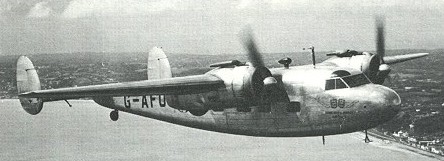
De Havilland’s first all-metal stressed-skin aircraft, the de Havilland D.H.95 Flamingo, was designed by R. E. Bishop as a medium range passenger transport to carry 12-17 passengers and a crew of three. It featured hydraulically retractable landing gear, split trailing-edge flaps and was powered initially by two 664 kW (890hp) Bristol Perseus XIIc radial engines.
The prototype was first flown by Geoffrey de Havilland Jr at Hatfield on 28 December 1938 and during subsequent flight testing a third, central fin was fitted temporarily. In May 1939 this aircraft was delivered to Guernsey & Jersey Airways Ltd for route-proving trials, linking Heston and Southampton’s Eastleigh Airport with the two principal Channel Islands.
The outbreak of war precluded commercial use on these services, but the Royal Air Force had ordered two Flamingoes for communications duties with No. 24 Squadron and one for The King’s Flight, the last being delivered to RAF Benson on 7 September 1940 as the Hertfordshire. It was transferred to No. 24 Squadron in February 1941, the unit having acquired also the prototype, two aircraft ordered by civilian customers and the fifth airframe which had been used by the manufacturer for development of the Bristol Perseus XVI radial. This engine was fitted to all subsequent examples, including one used by the Royal Navy’s No. 782 Squadron at Donibristle for communications flights to the Orkney and Shetland Islands and to Northern Ireland, and eight flown by BOAC on Middle East services, based at Cairo. The Royal Navy’s Flamingo was the only aircraft to return to civil use after the war, seeing limited service with British Air Transport at Redhill where it was scrapped in 1954. Flamingo production totalled 16 aircraft.
D.H.95 Engine: 2 x Bristol Perseus XVI radial, 694kW / 917 hp Take-off weight: 7983 kg / 17600 lb Empty weight: 5137 kg / 11325 lb Wingspan: 21.34 m / 70 ft 0 in Length: 15.72 m / 51 ft 7 in Height: 4.65 m / 15 ft 3 in Wing area: 59.36 sq.m / 638.95 sq ft Max. Speed: 385 km/h / 239 mph Cruise speed: 296 km/h / 184 mph Ceiling: 6370 m / 20900 ft Range: 1947 km / 1210 miles Service ceiling : 20899 ft / 6370 m Wing loading: 27.68 lb/sq.ft / 135.0 kg/sq.m Crew: 3 Payload: 17pax
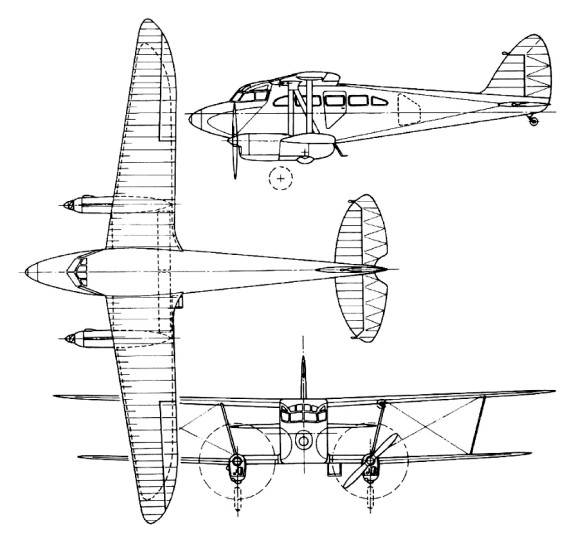
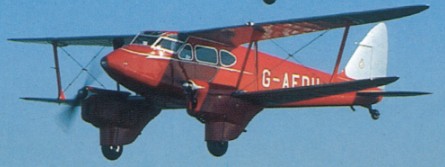
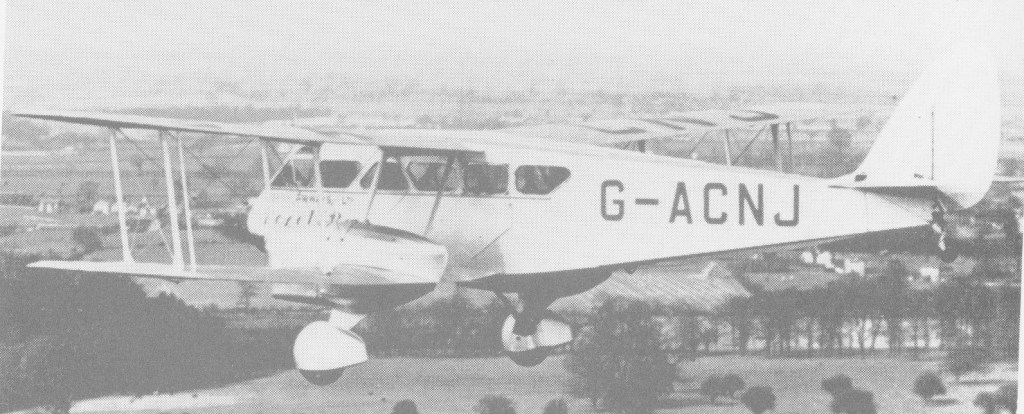
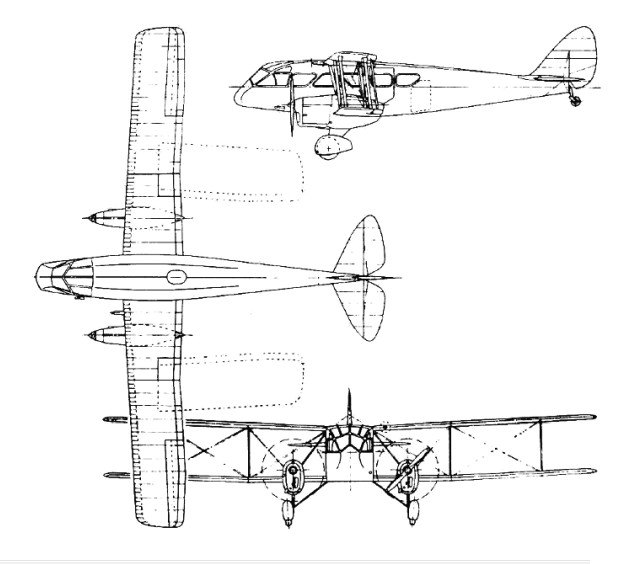
Similar to the D.H.89 Dragon Rapide, the de Havilland D.H.90 Dragonfly has a pre-formed plywood monocoque shell strengthened with spruce stringers. The lower wing centre section was strengthened, making possible deletion of the nacelle/wing root bracing struts and inner bay rigging wires, and so providing easy access to the cabin, with its accommodation for a pilot and four passengers. Powered by two de Havilland Gipsy Major engines, the prototype made its first flight at Hatfield on 12 August 1935 and the first D.H.90A production aircraft, with Gipsy Major II engines, flew in February 1936. Production totalled 66.
Military purchasers included Canada, Denmark and Sweden.
D.H.90 Dragonfly Engines: 2 x de Havilland Gipsy Major inline, 97kW, 130 hp Max take-off weight: 1814 kg / 3999 lb Empty weight: 1134 kg / 2500 lb Wingspan: 13.11 m / 43 ft 0 in Length: 9.65 m / 31 ft 8 in Height: 2.79 m / 9 ft 2 in Wing area: 23.78 sq.m / 255.97 sq ft Wing loading: 15.58 lb/sq.ft / 76.00 kg/sq.m Max. speed: 125 kts / 232 km/h / 144 mph Cruise speed: 109 kts / 201 km/h / 125 mph Service Ceiling: 5515 m / 18100 ft Range: 543 nm / 1006 km / 625 miles
In 1930, the owner of a London bus company, Edward Hillman, opened air services from London to the seaside. He used an aircraft especially designed for him, the de Havilland Dragon, carrying eight passengers.
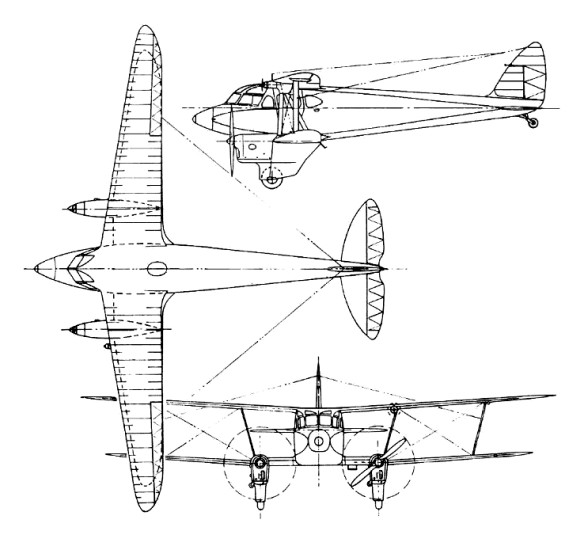
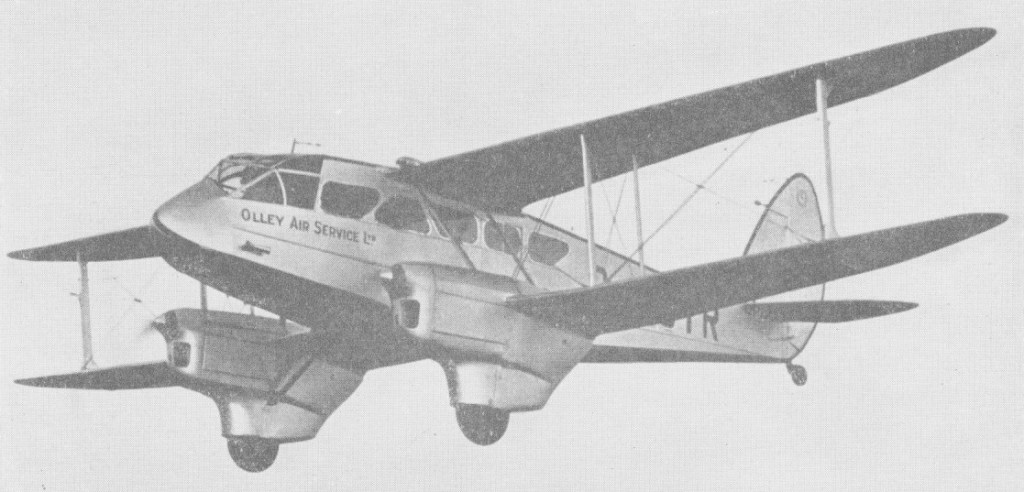
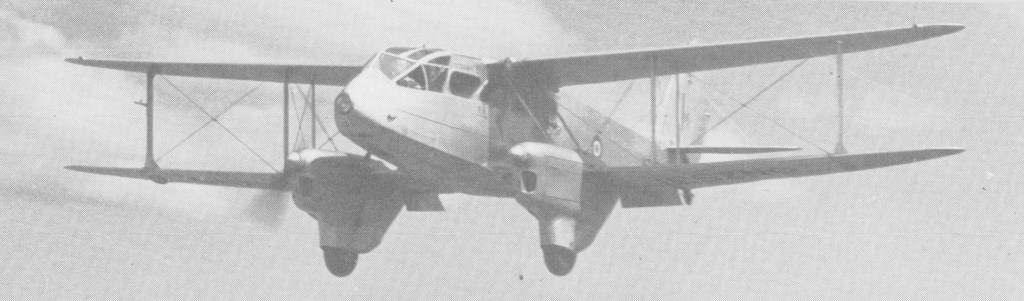
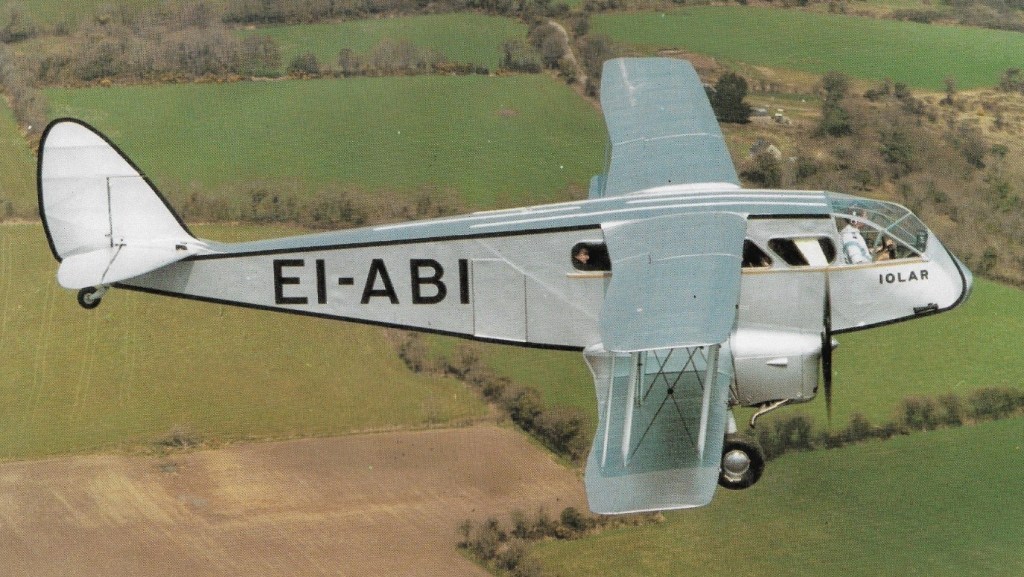
The Dragon Rapide was a direct development of the Dragon, employing the same structure but having tapered wings, 149kW Gipsy Six engines and a faired-in undercarriage. Known originally as the Dragon Six, it was first (E-4, later CH287) was flown on 17 April 1934 at Hatfield, put in production in 1934, and remained in production for more than ten years.
Construction consisted of a boxlike structured fuselage with plywood panelling on the inside and fabric covering on the outside. Wings had wooden spars and fabric covering.
In 1935, a military Dragon Rapide lost to the Anson as the RAF’s future Coastal Command reconnaissance machine. In 1938, the first RAF Dragon Rapide was delivered for communications duties, and eventually it became a mass production wireless (radio) trainer as well as a utility transport. It received the RAF name Dominie in 1941. Total production for the RAF and Fleet Air Arm was 521, the last being delivered in 1946.
The 48 ft spruce and fabric wings have ailerons on all four and split trailing-edge flaps are on the bottom wings between the engines and fuselage.
It remained in production until 1945 and a total of 738 were built. After the war the Rapide served for several years as interim equipment of BEA, Iraqi Airways, Jersey Airways, KLM and other airlines until more modern equipment became available.
Fine pitch props were often fitted to enable an extra 200 lb payload and better short field and climb performance. The DH Rapide were slightly slower than the original flapless DH.89s. The DH89A was produced in 1935 to Capt Fresson’s requirements (of Highland Airways, Inverness) and incorporated landing flaps, a landing light in the nose, and cabin heating.
In addition many military models were exported, some (for Iraq and Spain) being of the DH 89M armed variant. Typical armament was three machine guns (one fixed, and manually aimed dorsal and ventral) and a bombload of up to 127 kg (280 lb).
A number of Dragon Rapides were also operated on Fairchild-produced floats by Canadian airlines, produced in Canada by de Havilland’s Toronto-based company.
RNZAF Dominie
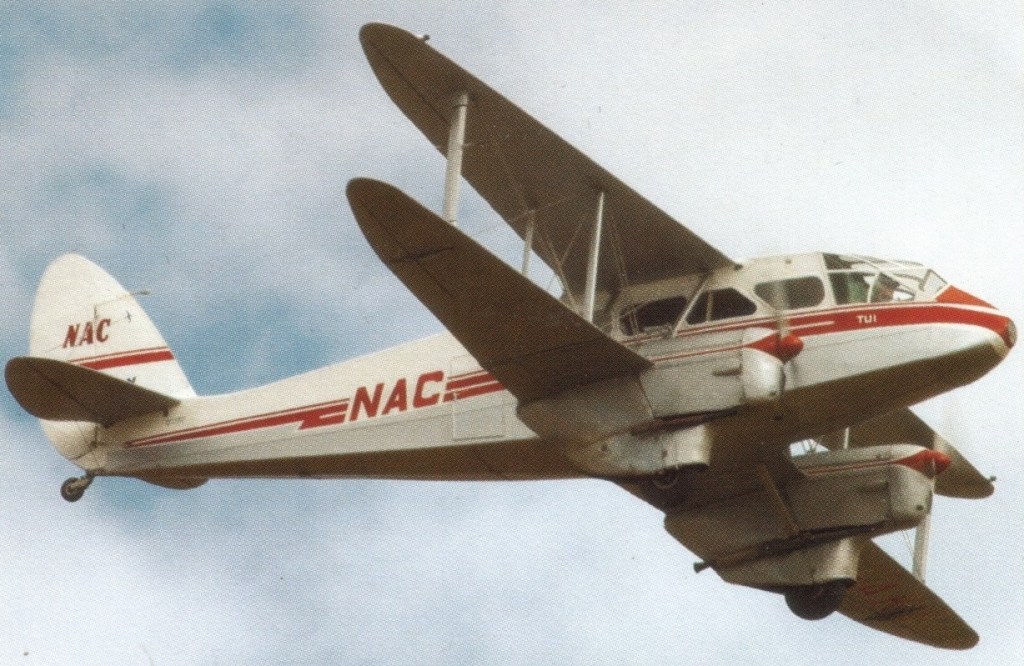
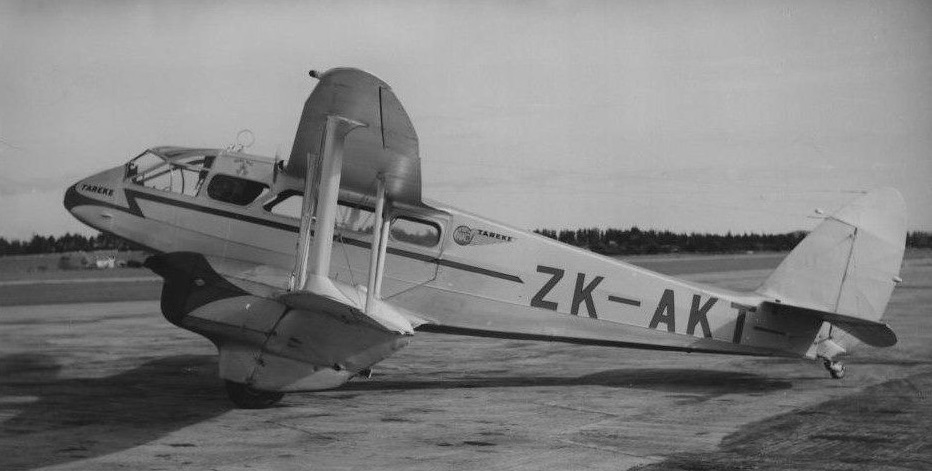
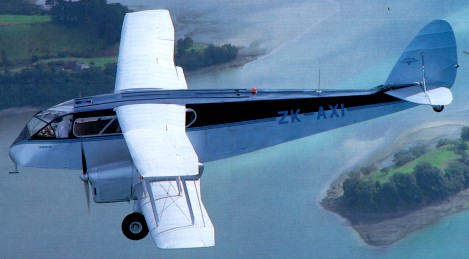
One example of the DH89A Dragon Rapide was owned by the NZ National Airways Corp (ZK-AHS Mokai) 1948-57 and five were impressed from civil airlines by the RNZAF 1939-45 and used as patrol and navigation aircraft. Fourteen DH89B Dominie served with the RNZAF for training and reconnaissance during 1943-53. The NZ National Airways Corp operated six DH89B 1947-64 (ZK-AKS Teoteo; ZK-ALB Tikaka; ZK-AKU Tawaka; ZK-AKT Tareke; ZK-ALC Tiora; ZK-AKY Tui).
DH.89B ZK-AKT
The Breda Ba.44 was a 1934 licence-built DH.89 Dragon Rapide. The prototype (MM.267) had 2 x 155 hp Colombo S.63 inline 6-cylinder engines mounted on lower, revised wing plan. Production Ba.44 were powered by 2 x 200 hp DH Gipsy Six in lowered position.
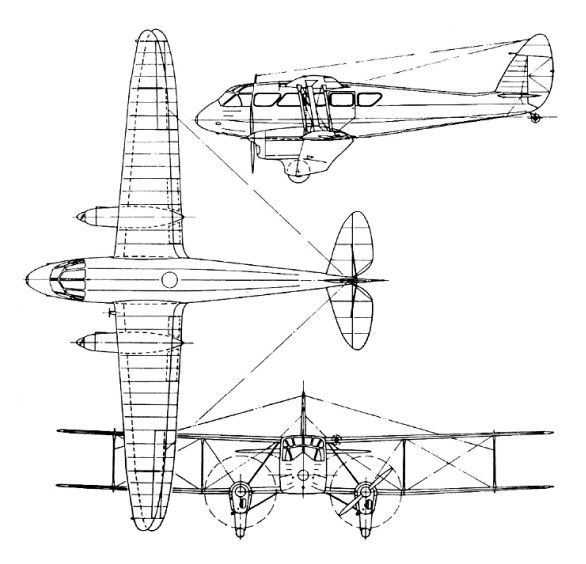
DH.89 Rapide Engines: 2 x de Havilland Gipsy Six, 205 hp. Prop: 2 blade metal. Wing span: 48 ft 0 in (14.63 m). Length: 34 ft 6 in (10.51 m). Height: 10 ft 6 in. Wing area: 336.0 sq.ft. (31.22 m). Gross weight: 5,550 lb (2:517 kg). Empty wt. 3,230 lb. Fuel capacity 76 ImpG. Maximum speed: 135 kts / 253 km/h (157 mph). Typical cruising speed: 132 mph (212 km/h) at 2.000 ft (610 m). Initial climb rate 867 fpm. Service ceiling: 19029 ft / 5800 m Takeoff run 870 ft. Landing roll 510 ft. Typical range: 578 miles (930 km). Seats: 8 Price new: £3500
DH89A Dragon Rapide Engines: 2 x DH Gipsy Six, 200 hp Wingspan: 48 ft / 14.63 m Length: 34 ft 6 in / 10.51m Max speed: 157 mph / 253 kph Crew: 1 Passengers: 5
D.H.89A Mk 4 Engines: 2 x de Havilland Gipsy Queen 2, 149kW/ 200 hp Max take-off weight: 2722 kg / 6001 lb Empty weight: 1465 kg / 3230 lb Wingspan: 14.63 m / 47 ft 12 in Length: 10.52 m / 34 ft 6 in Height: 3.12 m / 10 ft 3 in Wing area: 31.21 sq.m / 335.94 sq ft Max. speed: 241 km/h / 150 mph Cruise speed: 225 km/h / 140 mph Ceiling: 4875 m / 16000 ft Range: 837 km / 520 miles
DH.89B Dominie Engine: 2 x DH Gipsy Queen III, 200 hp. Wingspan: 48 ft / 14.63 m Length: 34 ft 6 in / 10.51m Max speed: 157 mph / 253 kph Crew: 1 Cruise: 132 mph. Pax cap: 8.
Sir Macpherson Robertson announced that he would put up the prizes for a race from Mildenhall, England, to Melbourne, Australia, to mark the Centenary of Victoria. de Havilland advertised that they were prepared to produce a 200 mph specially designed racer if anyone would put up the cash, and they received orders for three.
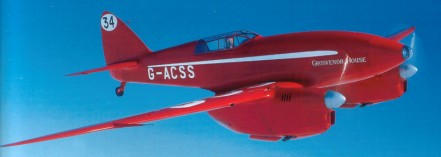
The de Havilland D.H.88 Comet attracted three orders before the February 1934 deadline which had been stipulated by the manufacturer for guaranteed delivery before the Race in October. Purchasers were Mr A. O. Edwards, managing director of the Grosvenor House Hotel, Bernard Rubin, and Jim and Amy Mollison. The Comet was of wooden construction throughout, the front section of the fuselage containing three large fuel tanks behind which were two tandem seats for the pilot and copilot. Two 230 hp high compression de Havilland Gipsy Six R engines were installed, driving Ratier two-position propellers which were set to fine pitch before each flight. These went into coarse pitch automatically at 241km/h, when a sealing disc in the spinner opened to release the unit’s internal pressure and thus activate the control mechanism. Other notable features included the provision of manually retractable landing gear and split trailing-edge flaps.
Designed and built in 7.5 months the first Comet was flown on September 8, 1934, only six weeks before the start of the race.
Hubert Broad flew the first Comet, intended for the Mollisons, at Hatfield on 8 September 1934. Its Certificate of Airworthiness was issued on 9 October and certificates for the other two aircraft on 12 October, just eight days before the Race.
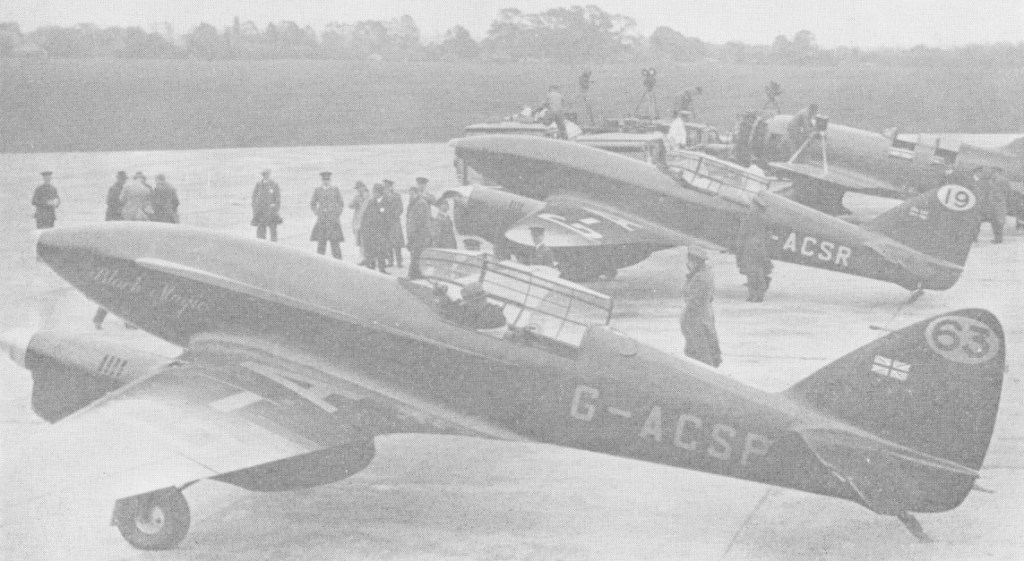
Dawn on 20 October saw the departure of the first contestants, including the Mollisons’ Black Magic G ACSP, Owen Cathcart-Jones and Ken Waller’s G-ACSR (owned by Rubin) and C. W. A. Scott and T. Campbell Black in G ACSS Grosvenor House. Black Magic accomplished successfully the non-stop London-Baghdad leg but was forced to retire with engine trouble at Allahabad. Cathcart-Jones and Waller, after getting lost and being forced to land in Persia, struggled through to Melbourne to finish fourth in the speed section. They flew straight back, with mail and film, to set an out-and-return record of 131/2 days. Scott and Black were the speed section winners, covering the course in 70 hours 54 minutes; Grosvenor House is now preserved by the Shuttleworth Trust at Old Warden, Bedfordshire.
The start of the England-Australia race
Two further Comets were built, one as a mailplane for the French government and the other for Mr Cyril Nicholson, who sponsored two unsuccessful attempts on the London-Cape record. During the second attempt the crew baled out over Sudan, on 22 September 1935.
Several more records were made, including a New Zealand and back record of 10 days 21.5 hrs.
D.H.88 Engines: 2 x de Havilland Gipsy Six R inline, 172kW / 230 hp Max take-off weight: 2413 kg / 5320 lb Empty weight: 1288 kg / 2840 lb Wingspan: 13.41 m / 44 ft 0 in Length: 8.84 m / 29 ft 0 in Height: 3.05 m / 10 ft 0 in Wing area: 19.69 sq.m / 211.94 sq ft Max. speed: 381 km/h / 237 mph Cruise speed: 354 km/h / 220 mph Ceiling: 5790 m / 19000 ft Range: 4707 km / 2925 miles at 220 mph Crew: 2
Edward Hillman, of Hillman Saloon Coaches and Airways Ltd, approached the de Havilland Aircraft Company in 1932 with a view to providing a twin-engine airliner to carry eight passengers. He had been using single-engine four-passenger Fox Moths with some success and wanted the equivalent of two of those combined into one, still with the economy of a single pilot for a proposed service from southern England to Paris.
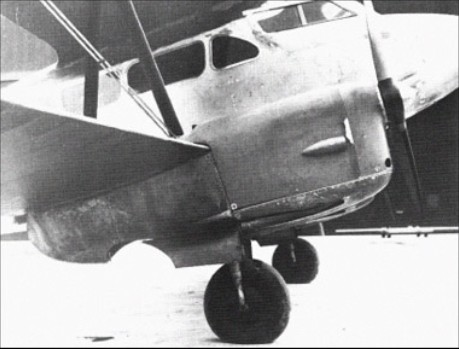
Chief designer Arthur Hagg had a light bomber being developed for the Iraqi Air Force able to carry four 200 lb bombs, a pilot, a navigator/bomb aimer and a wireless operator/air gunner, plus an assortment of Lewis guns for self defence. With its simple plywood box structure fuselage offering plenty of room inside, two Gipsy Major engines and typically de Havilland folding biplane wings and tail shape it would convert easily into a civil airliner, so Hillman ordered an immediate four DH84s off the drawing board. The slab-sided plywood box used successfully in the Fox Moth was adopted for the fuselage of the new design, a two-bay biplane with wings that could be folded outboard of the two de Havilland Gipsy Major engines. The pilot was provided with a separate compartment in the extreme nose and the main cabin could seat six passengers. The prototype made its maiden flight on 24 November 1932, at Stag Lane, Edgware. It was later delivered to Hillman’s Airways at Maylands, Essex, together with three examples of the production Dragon 1, which facilitated inauguration of the Paris route in April 1933.
British production totalled 115 aircraft built at Stag Lane and, from 1934, at Hatfield.
The 63rd aircraft was the first of an improved version, as the Dragon 2, with the glasshouse cabin windows replaced by individual framed transparencies, and with main landing gear fairings. The D.H.84M was a militarised version with a dorsal gun ring and a fin fillet; supplied to Denmark, Iraq and Portugal Dragon production stopped in 1937, but all the tooling and jigs, along with those for the DH94 Moth Minor, were shipped to Australia early in the war. So between September 1942 and May 1943, eighty-seven Australian Dragons came off the assembly line and flew. They were based on the English Mark 1 model, with its continuous cabin win¬dows, but had a steel diagonal brace tube behind the pilot instead of the normal bulkhead separating cockpit and cabin. Produced as navigation trainers for the Royal Australian Air Force, the first of these flying on 29 September 1942.
DH 84 Dragon II
Two Dragon II were impressed by the RNZAF 1939-45 for communications and radio training.
D.H.84 Dragon I Engines: 2 x de Havilland Gipsy Major I inline, 97kW, 130 hp Take-off weight: 2041 kg / 4500 lb Empty weight: 1060 kg / 2337 lb Wingspan: 14.43 m / 47 ft 4 in Length: 10.52 m / 34 ft 6 in Height: 3.3 m / 10 ft 10 in Wing area: 34.93 sq.m / 375.98 sq ft Wing loading: 11.89 lb/sq.ft / 58.0 kg/sq.m Max. speed: 117 kts / 216 km/h / 134 mph Cruise speed: 99 kts / 183 km/h / 114 mph Service Ceiling: 4420 m / 14500 ft Range: 474 nm / 877 km / 545 miles Best SE speed: 75 mph. Vmca: 57 mph. Crew: 1 Passenger cap; 8 Price 1932: £2500
DH 84 Dragon II Wingspan: 47 ft / 14.33 m Length: 34 ft 6 in / 10.52 m Max speed: 128 mph / 206 kph Crew: 1-2 Passengers: 4-10
On 10 July 1969 a project called Alpha Jet was started by the governments of Germany and France to cooperatively create a light aircraft for advanced jet training and for the tactical support role. The contenders were the following: Dassault-Brequet joined up with Dornier with the TA-501, Aérospatiale with MBB with the E-650 Eurotrainer and VFW with their own T-291 project. On 23 July 1970, the TA-501 project from Dassault-Dornier was selected, a tandem seat twin-engined jet trainer and light attack aircraft.
Dassault-Brequet was responsible for building the front fuselage and assembly of the trainer variant as well as the export orders. Dornier in Germany produced the rear fuselage, the tail, wings and assembled the attack variants. The Alpha Jet is power by two Larzac jet engines, which were designed by Turbomecca, SNECMA, MTU and KHD. On 30 November 1972 the first mock up was accepted by both governments and a contract for the production of four prototypes. On 26 October 1973 prototype 01 made the first flight, sixth months ahead of the contract scheduled date. The official presentation flight was flown on 23 November in 1973 at Isres, France. On 9 January 1974, the second prototype made its maiden flight, followed by prototype 03 on 4 May and prototype 04 on October 11th. Alpha Jet E entered production in 1977. The first production Alpha Jet E 1 was flown at Istres, France, on 4 November 1977. The aircraft features a DEFA 30mm cannon.
The German Alpha Jet A entered production a year later. Production aircraft were delivered starting in 1978, with French aircraft operating as pure trainer aircraft, while German aircraft were employed as light attack aircraft. The two types can be distinguished visually by the rounded nose of the French aircraft compared with the pointed nose of German aircraft. The aircraft feature a simple but sophisticated design, utilizing fixed leading edges and air intakes, and an area ruled fuselage to minimize transonic drag. The Alpha Jet was also designed to be turned between sorties quickly, and features single-point refueling, and no required ground-support equipment. Alpha Jet A was the light attack variant for the Luftwaffe designed to replace the Fiat G.91R/3s in the light attack and close air support role. The A is therefor equipped with a more advanced nav/attack system including HUD, Doppler navigation radar and twin-gyro INS. The German versions were equipped with a 27mm Mauser cannon, replacing the French DEFA. Alternatively a Super Cyclone recce pod could be carried on the centeline station.
Principal customers were the air arms of the partner countries, the French Air Force taking 176 between 1978 and 1985, and the Luftwaffe 175 between 1979 and 1983.
The Alpha Jet E was produced for the French Air Force and several export customers, including Egypt, where it is known as the MS1.
Alpha Jet E
The Arab Organisation for Industrialisation’s Helwan factory assembled 37 Alpha Jets from CKD kits between 1982 and 1985, and also produced some components under licence. The Egyptian Air Force also received eight aircraft assembled in France. The close-support version (Alpha Jet A) was built for the West German Air Force; while the alternative close support version, with a new navigation/attack system, was sold to the Cameroon and Egypt as the M52. The Alpha Jet Nouvelle Generation pur l’Ecole et l’Appui (NGEA), now known as the Alpha Jet 2, incorporates the navigation/attack system of the M52 together with uprated Larzac 04-C20 engines and Magic 2 AAMs. No NGEA sales have been achieved, but Egyptian M52s are to be upgraded to NGEA standard. The fifth version, announced in 1985, is the Alpha Jet Lancier. Derived from the NGEA, the Lancier is intended for day/night ground attack, anti-shipping strikes, and anti-helicopter duties. In addition to the NGEA systems it has a Flir, Thomson-CSF Agave multimode radar, active and passive ECM, anti-shipping missiles, and laser guided bombs. No orders for the Lancier have been achieved to date. The Alpha Jet 3 is an advanced training version for use with FLIR, laser and ECM systems.
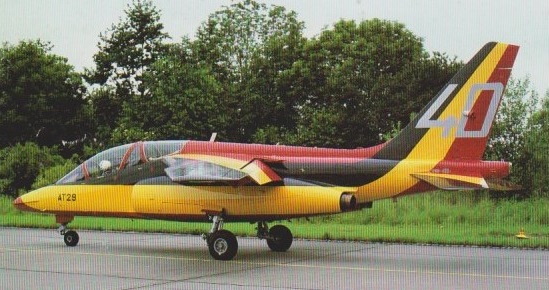
Alpha Jet AT-29, June 1987
Under an independent programme, the Luftwaffe is retrofitting more powerful Larzac 04-C20 engines to boost performance. A limited armament and avionics upgrade had been approved for the Luftwaffe’s Alpha jet fleet for service from 1992. By early 1986 more than 480 Alpha Jets had been delivered, against orders for 501 for ten customers. The German Luftwaffe was the sole operator of the Alpha Jet A light attack version until the 1990s. The first production aircraft flew in 1979 and three years later Dornier closed the production line. The 175 Luftwaffe Alpha Jets replaced the Fiat/Aeritalia G.91R, of which 300 were operated in the tactical support and light attack role. In the 1990s the Alpha Jet was slowly withdrawn from service, the last example being officially retired on 31 December 1998. A large number of aircraft was sold to other nations and about 40 aircraft were put into storage at Fürstenfeldbruck. Two examples have been bought and restored for flying with the Flying Bulls, a display team sponsored by Red Bull.
The Alpha Jet E trainer version for France entered service with the Armée de l’Air replacing the Fouga Magister, Lockheed T-33 and the Dassault Mystère IVA.
The Belgian Air Force needed an advanced trainer and was interested in the development of the Alpha Jet since the start of the project. Belgium operated 28 aircraft, which have been upgraded prolonging their service life until at least 2015. The upgrade was carrier out by SABCA (Société Anonyme Belge de Constructions Aéronautiques), the first upgraded example being delivered back to the air force on 21 April in 2000. The upgrade features a new flightstick, advanced HUD, GPS, ILS and a multi function display in the rear cockpit. In 1994 50 ex-Luftwaffe Alpha Jets were sold to the Portuguese Air Force. In service with Squadrons 103 Caracóis (Snails) for complementary flying training and operational conversion training and with Squadron 301 Jaguares (Jaguars) on the offensive air support role, both squadrons operated from Beja airbase.
In 2017 Alpha Jets were still in service with the militaries of France, Belgium, Egypt, Portugal, Thailand, and are operated by EPNER and Empire Test Pilot School.
Breguet Alpha Jet Engines: 2 x SNECMA / Turboméca Larzac 04-C5, 13244 N Length: 40.322 ft / 12.29 m Height: 13.747 ft / 4.19 m Wingspan: 29.888 ft / 9.11 m Wing area: 188.37 sqft / 17.5 sqm Max take off weight: 13230.0 lb / 6000.0 kg Weight empty: 6945.8 lb/ 3150.0 kg Max. speed: 535 kts / 991 km/h Initial climb rate: 11614.17 ft/min / 59.00 m/s Service ceiling: 44948 ft / 13700 m Wing load: 70.32 lb/sq.ft / 343.00 kg/sq.m Range: 680 nm / 1260 km Range (max. weight): 432 nm / 800 km Crew: 2 Armament: 1x MK 30mm, 2500kg ext.
Alpha Jet Engine: 2 x Snecma/Turbomeca Larzac 04-C6. Installed thrust: 26.5 kN. Span: 9.1 m. Length: 12.3 m. Wing area: 17.5 sq.m. Empty wt: 3855 kg. MTOW: 7940 kg. Warload: 2720 kg. Max speed: 1000 kph. Initial ROC: 3420 m / min. Ceiling: 14,600+ m. T/O run: 410 m. Ldg run: 610 m. Fuel internal: 1900 lt. Range/Endurance: 1230 km / 3.5 hr. Combat radius: 350-1075 km. Armament: 1 x 27/30 mm, 2 x AAM. Hardpoints: 4/5.
Alpha Jet Max Speed: 550 KIAS / .95 M Ceiling: 47,000 ft G-Limits: +8 / -5 Payload: 1,360 lb on each inner pylon, 635 lb on each outer pylon EW: Wired for ALQ-167 and ALQ-188 Endurance: 2.5+ hr with 2 drop tanks Empty Weight: 7,850 lb Useful load: 8,600 lb
Alpha Jet E Engines: two 13.24 kN (2,976 lb st) SNECMA/Turbomecca Larzac 04-C6 non-afterburning turbofan Wing span 9.11 m (29 ft 10¼ in) Wing area: 188,4 sq,ft / 17,50 sq m Length 11.75m (38 ft 6½ in) Height 4.19m (13 ft 9 in) Empty weight 3345 kg (7,374 lb) Max Take-Off Weight 8.000 kg (17,637 lb) Max level speed at sea level 1000 km/h (621 mph) Service ceiling 14,630m (48,000 ft) Climb to 30,000ft/9145m: 7 min 0 sec Radius: 764 mi / 1230 km Armament: one Mauser 27mm or DEFA 30mm ventral cannon pod with 125 rpg Ordnance: 2500 kg (5,511 lb) Hardpoints: 4















 All Aero