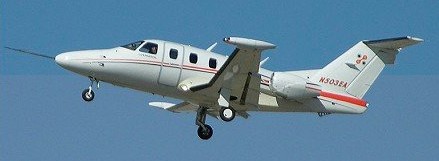
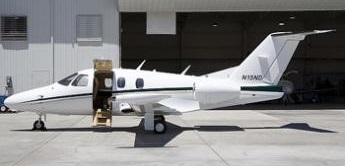
The Eclipse 500 was a project that was to build a lightweight, economical, fast jet, for both private and commercial use. The whole project was based primarily on the use of new EJ22 William jet engine.
The Eclipse 500’s price tag was promised at $837,500 and brought in deposits for more than 2,000 airplanes.
The Eclipse 500 business jet programme was temporarily suspended in 2002 because of problems with the starters and fuel-metering equipment on the aircraft’s compact Williams EJ22 engines. On August 26, 2002, at Albuquerque International Sunport, prototype N500EA first flew with test pilot Bill Bubb. The acceleration is lethargic, especially for an airplane loaded so lightly. In the hot, thin, mile-high air, the EJ22s can generate barely half their rated thrust. After a leisurely takeoff roll of more than 3,000 feet, the airplane lifts off and begins a gentle climb, paralleling the Sangre de Cristo mountains off its left wing. For about an hour, Bubb flies the planned test routine, checking out general handling qualities and systems operation. Overall, the flight is free of major glitches. The Eclipse 500 never again flew with EJ22s.
Three months later, Eclipse Aviation announced: “The EJ22 is not a viable solution for the Eclipse 500 aircraft, and Williams International has not met its contractual obligations.” Williams conceded that it had run into “a number of challenges” with the EJ22 but insisted it had satisfied the contract, implying that the airplane had simply grown too heavy.
Eclipse signed a deal with Pratt & Whitney to develop a smaller version of a more conventional engine. The PW610F would develop 900 pounds of thrust, but it would weigh 260 pounds—triple the weight of the EJ22. The extra power would give the Eclipse 500 a bit better speed and climb, but there was a big downside: an empty-weight gain of 700 pounds and a 20 percent increase in fuel consumption. The price and cost projections eventually ballooned to $1.3 million and 89 cents a mile.
First flight with Pratt & Whitney Canada PW610F turbofan engines was in December 2004. Three years later, flight tests of the P&W-powered Eclipse 500 were proceeding smoothly. The Eclipse 500 became the first of a new class of Very Light Jets (VLJ) when the first jet was delivered in late 2006. The engines are in aft fuselage-mounted nacelles.
Production of the Eclipse 500 was halted in mid-2008 due to lack of funding and the company entered bankruptcy.
Engines; 2 Pratt & Whitney Canada PW610F turbofans Takeoff Thrust at Sea Level ISA+15°C (86°F) 900 lb (each) 4.00 kn (each) Length 33.5 ft 10.2 m Wingspan 37.9 ft 11.6 m Height 11.0 ft 3.4 m Maximum Ramp weight 6,034 lb / 2,737 kg Maximum Takeoff weight 6,000 lb / 2,722 kg Maximum Landing weight 5,600 lb / 2,540 kg Empty weight 3,634 lb / 1,648 kg Fuel Capacity 1,698 lb/251 gal / 770 kg/950 l Useful Load 2,400 lb / 1,089 kg Sea Level Cabin to; 21,500 ft 6,533 m Cabin Altitude at 41,000 ft; 8,000 ft 2,438 m Takeoff Distance Sea Level, ISA to 50 ft (15 m) @ MGTOW 2,345 ft 715 m Landing Distance Sea Level, ISA @ 4,600-lb (2,087-kg) landing weight 2,250 ft 686 m Rate of Climb – 2 engines 3,424 ft / min 1,044 m / min Rate of Climb – 1 engine 989 ft / min 301 m / min Time to Climb – 35,000 ft (10,688 m) 22 min Takeoff at 5,000 ft (1,524 m) At ISA + 15°C; 3,881 ft 1,183 m Single Engine Takeoff Climb at 5,000 ft (1,524 m) At ISA + 15°C; 705 fpm / 215 m / min Max Cruise Speed; 370 kt / 685 km / hr Vso; 69 kt / 128 km / hr Vmo; 285 kt / 528 kph / 0.64 Mach Maximum Altitude; 41,000 ft / 12,497 m Single Engine Service Ceiling 25,000 ft / 7,620 m Range 100 nm alternate; 1,125 nm / 2,084 km Range – Max IFR 45-min res, 4 POB; 1,300 nm / 2,408 km Cabin length; 148 in /376 cm Cabin height (max); 50 in / 127 cm Cabin width (max); 56 in / 142 cm Seats 6
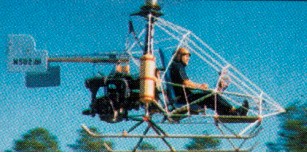
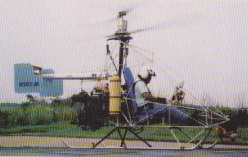
Eagle’s Perch single-seat kit-built helicopter was first flown 1994 as the Perch Nolan 51-HJ.
A single seat open frame coaxial pendulum helicopter. Steel tube frame, controlled with stick, throttle and rudder, no collective. Hydraulic controls, contra-rotating and two engines preclude autorotation. Engine: 2 x 65 hp Hirth 2706. Rotor blades: 4 blades, 14’ diameter, 4.75” chord, aluminium, asymmetric aerofoil. No tail rotor.
Gallery
Nolan 51-HJ Engine: 2 x Hirth 2706, 130 hp Rotor span: 4.11 m Blade area: 0.12 sq.m MAUW: 500 kg Empty weight: 258 kg Fuel capacity: 37.8 lt Max speed: 160 kph Cruise speed: 120 kph Minimum speed: 0 kph Climb rate: 15 m/s Seats: 1 Fuel consumption: 17 lt/hr Kit price (1998): $18,500
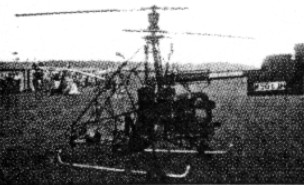
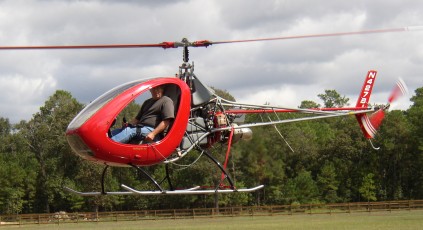
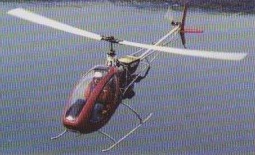
First flown in April 1985. After crashing his demonstrator Helicycle in 1999, Schramm did find investment. The result is a single seat partially enclosed helicopter which flies conventionally or as a compound with an additional pusher engine. An ultralight version uses Rotax 503. Elastomeric rotor head, long-life blades. Optional turbo version has full power to 10,000 ft. Engine options are: 74 hp Rotax 618 derated to 60 hp, Rotax 503. Compound engine: 45 hp Zenoah. Rotor blades: 21’ x 7” all aluminium by Eagle R&D. The HELICYCLE in it’s normal configuration is designed to cruise along side the industry standard R-22. Landings and take offs at above 9000 ft. are possible because of a 7.5/1 power to weight ratio. The same as the Hughes 500. The Helicycle features include a fully harmonized rotor, a modulated collective system, very low 2-per-rev vibration level due to elastomeric thrust bearings, generous flapping angle for low “G” and slope landing conditions, control friction devices, and electronic throttle control. The cyclic control in the HELICYCLE accurately models the feel of the R-22. With a high degree of control power, it provides a transition for the R-22 qualified student pilot. To aid in controlling costs, the Helicycle has 12 grease zerks and 2 sliders that do need a minute or two of attention now then, the rest of the bearings are sealed. The Helicycle certified level lifetimes for it’s drive train and rotor system components are 1500-2000 hrs.
Engines: 2 x McCulloch Top speed: 105 mph Cruise: 90 mph Range: 160 sm Rate of climb: 900 fpm Service ceiling: 9000 ft Fuel capacity: 12 USG Empty weight: 395 lb Gross weight; 672 lb Length: 21.7 ft Height: 7 ft Disk span; 20 ft Disk area: 314 sq.ft Seats: 1
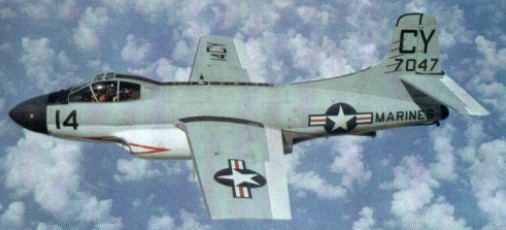
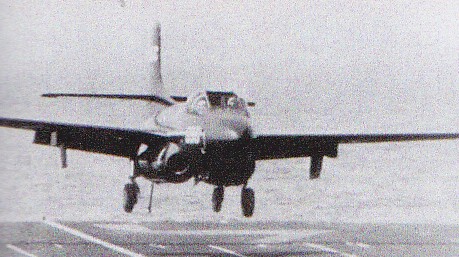
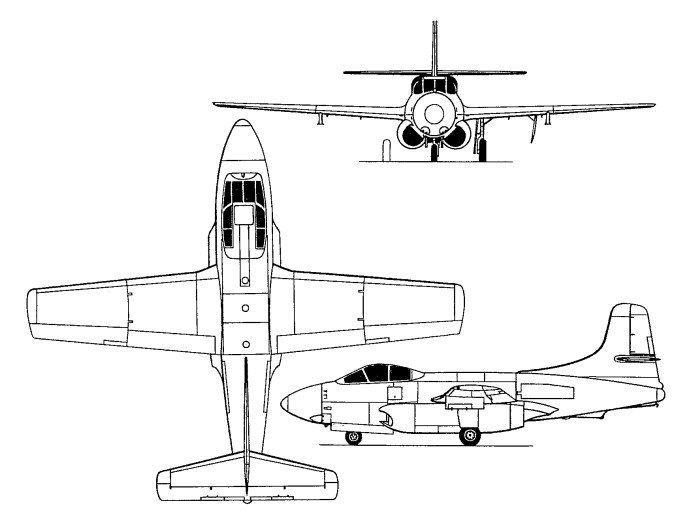
Unique in being the US Navy’s first jet-powered night-fighter, the Skyknight began development in 1945, Douglas being awarded a contract for three XF3D-1 prototypes in April 1946. The type emerged as a cantilever mid-wing monoplane of all-metal construction, the wings incorporating hydraulic folding for carrier stowage. The circular-section fuselage mounted hydraulically actuated speed-brakes, provided side-by-side pressurised accommodation for the pilot and radar operator, and carried at the rear a tail unit very similar to that of the D-558-1 Skystreak. An unusual feature was a crew escape tunnel, extending from the rear of the cabin to the underside of the fuselage. Landing gear was retractable tricycle-type, and the powerplant of the prototypes was two 1361kg thrust Westinghouse J34-WE-24 turbojets, mounted on the lower edges of the forward fuselage, beneath the wing roots. The first prototype made its maiden flight from Muroc (now Edwards AFB) on 23 March 1948, this event being followed in June by an order for 28 production F3D-1 (later redesignated F-10A) fighters while company testing was still in progress. The first of these was flown on 13 February 1950. Service acceptance trials were conducted by VC-3 at Moffett Field from December 1950, the type then being handed over to Marine Night Fighter Squadron VMF(N)-542. The F3D-1 differed from the prototypes by having improved avionics and equipment and, as delivered initially, had 1361kg thrust J34-WE-32 turbojets. These engines were uprated subsequently to 1474kg thrust, becoming redesignated J34-WE-34. In the event, the F3D-l did not see action.
Before delivery of the first F3D-1, Douglas had received a contract for production of an improved F3D-2 (F-l0B), which was to be the major and ultimate production version, with a total of 237 built in the early 1950s. It was intended that the F3D-2 should be powered by 2087kg thrust J46-WE-3 turbojets, but development of this engine was abandoned and, instead, they were all powered by J34-WE-36s. Improvements included the provision of an autopilot and updated systems and equipment. The first of these F3D-2s was flown on 14 February 1951 and all had been delivered just over a year later. It was this model which made the Skyknight’s combat debut with VMF(N)-513 in June 1952.
The Skynight saw extensive use in Korea, this all-weather fighter accounting for the majority of all victories scored by the US Navy and US Marine Corps. On the night of 2 November 1952, it succeeded in downing a North Korean Yakovlev Yak- 15, this marking the first recorded kill in a jet-versus-jet combat at night. Even more remarkable is the fact that the F3D ended the Korean War as the most successful naval fighter type in terms of aircraft destroyed in air combat.
In US Navy service, the F3D enjoyed only a brief front-line career, being quickly relegated to radar intercept training duties as the F3D-2T and F3D-2T2 (TF-10B), the last example being retired in the early 1960s. US Marine Corps composite squadrons continued to use the F3D-2Q (EF-10B) type in ECM duties, however, and the type again saw action in Vietnam with VMCJ-1 until 1969 when it was finally replaced by the Grumman EA-6A Intruder.
Two examples of the Skyknight were used by the US Army in support of air defence missile testing at White Sands, New Mexico. A proposed swept-wing version known as the F3D-3 was cancelled in 1952, but other service variants were the missile-armed F3D-1M and F3D-2M (MF-l0B).
F3D-1 Skyknight Engines: 2 x Westinghouse J34-WE-32 turbojets, 3000 lb thrust. Wingspan: 50 ft Length: 45 ft. 5 in. Loaded weight: 27,000 lb. Max speed: approx. 530 m.p.h. Range: about 1,200 miles. Armament: 4 20 mm cannon Crew: 2.
F3D-2 / F 10B Skyknight Powerplant: two 1542-kg (3,400-lb) thrust Westinghouse J34-WE-36/36A turbojets. Wing span 15.24 m (50 ft 0 in) Length 13.84 m (45 ft 5 in) Height 4.90 (16 ft 1 in) Wing area 37.16 sq.m (400 sq.ft). Maximum speed 909 km/h (565 mph) at 6095 m (20,000 ft) Cruise speed: 628 km/h / 390 mph Service ceiling 11645 m (38,200 ft) Range 2478 km (1,540 miles) Empty weight: 8237 kg (18,160 lb) Maximum take-off 12556 kg (27,681 lbs). Armament: four 20-mm cannon, plus two 907-kg (2,000-lb) bombs.
McDonnell Douglas’s only four engined civil jet airliner, the DC 8, preceded the company’s very successful DC 9 twin jet, which first flew at Long Beach, California, on February 25, 1965.
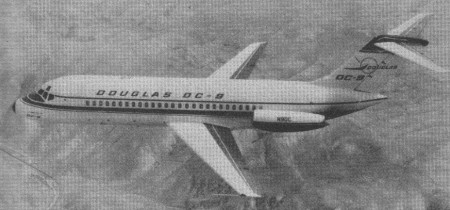
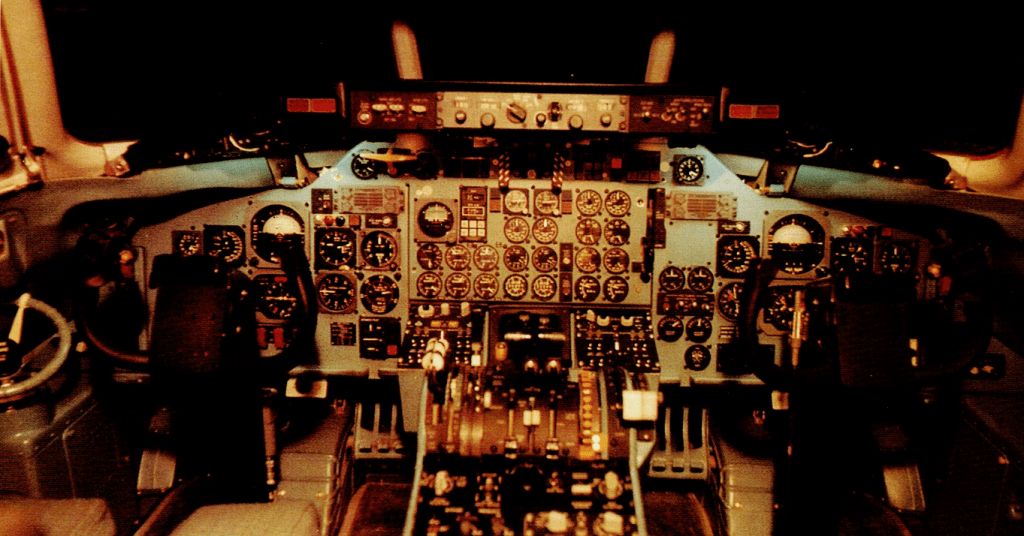
By 1962 Douglas’s Model 2086 had become a firm design, and the subject of negotiations with several opera¬tors. At last Delta agreed to buy a fleet and the Model 2086 became the DC-9 on 8 April 1963. In April 1963 the company announced that it would build the DC 9 and John Brizendine, who ten years later became President of Douglas Aircraft, was named programme manager. The programme was given top priority with more than 40,000 man hours a week expended on the project. The primary aims of the project were to produce a simple and reliable, easy to operate and maintain airliner. Construction of the prototype began in July 1963 and the first DC-9 flew from Long Beach on 25 February 1965. US airlines made no advance orders. Douglas’ own capital was tied up in modifications to the DC-8, so the company reduced the risk by utilizing the DC-8’s flight deck, and persuading major suppliers to design and manufacture different parts, receiving payment only as each aircraft was delivered to a customer. De Havilland Canada produced the complete wing, rear fuselage and tail. Later, the Douglas Aircraft Company bought part of their Toronto factory, and continued production there. By producing a series of stretched versions, to stay abreast of the demand for larger capacity aircraft, Douglas outsold all competitors in the same category. A big manufacturing programme was launched, with DH Canada making the wings, rear fuselage and tail. From the start Douglas planned to offer different versions, and the original DC-9 Series 10 could weigh anything from the basic 77,000lb with JT8D-5 engines of 12,000-lb thrust to 90,000 lb with extra fuel and 14,000-lb JT8D-1 or -7 engines. The first off the line flew a month early, on 25 February 1965, and services began with Delta on 8 December the same year. A total of 137 were built. Douglas offered a stretched ‘DC-9B’ and on 25 February 1965 and won an Eastern order. The designation was changed to DC-9 Series 30, with 14,500-lb engines and a considerable stretch both to the span and length. The weight was 98,000 lb, matched by full-span slats and double-slotted flaps. The first Srs 30 flew on 1 August 1966. Subsequently the Srs 30 (503 sold) grew to 108,000 lb with more-powerful engines, seating up to 115. Then came the Srs 20, for operation out of difficult airports by SAS. It combined the wings and engines of the Srs 30 with the original short fuselage. On 28 November 1967 Douglas, by now part of McDonnell Douglas, flew the DC-9 Srs 40, with engines of up to 16,000-lb thrust, enabling weight to rise to 122,000lb. The fuselage was stretched yet again, to seat up to 132. To meet airline demand for a DC 9 with larger capacity the 40 was developed with a longer fuselage enclosing a 132 seat configuration. Below floor cargo space was also increased. This version entered service in March 1968. Last of the original DC-9 variants was the Srs 50, first flown on 17 December 1974. This introduced many attractive new features, but the main difference was that, still keeping at 122,000-lb weight, the body was stretched yet again to seat 139. The 50 began airline operation in August 1975. Each DC 9 was, in practice, a stretched version of the Series 10. The 20 carried 115 passengers and featured a longer wingspan and a high lift wing system of leading edge slats for short field performance. The 30 was the most widely used. US Air Force versions were designated C 9A Nightingale and VC-9C and C 9B Skytrain for the US Navy.
Douglas also offered various cargo and convertible versions. A total of 649 DC-9s had been delivered by 1 February 1972. This includes the C-9A variant for the 375th Aeromedical Wing of the USAF MAC. Important orders were also placed by the US Air Force and Navy (Marines) for the C-9A Nightingale aeromedical aircraft, the C-9B Skytrain II (longest-ranged of all versions) and VC-9C for VIP missions. Each of the C-9A can carry 30-40 litter patients, two nurses and three aeromedical technicians, and have intensive care compartments. Ten were converted. The final aircraft off the assembly line, a DC¬9 30, was transferred to the US Navy as a C 9B in October 1982. Thrust for the 976 DC 9s completed over an 18 year production run was provided exclusively by the Pratt & Whitney JT8D family of engines. In mid 1998 there were in excess of 870 of the type being flown by over 70 operators worldwide. A new version was launched as the DC-9 Super 80, with an order from Swissair, closely fol¬lowed by Austrian and Southern, in October 1977. The first aircraft flew on 18 October 1979. Changes included a further (and very large) stretch to the fuselage, an extension to the span at both the wing roots and tips, a digital electronic flight guidance system, a further increase in fuel capacity and, not least, fitting the JT8D-200 series engine. The refanned engine, used initially in -209 form at 18,500-lb thrust, dramatically reduced noise and eliminated worries over impending noise legislation. Seating capacity was typically up to 172. In 1983 the company at last abandoned the famed ‘DC’ and adopted ‘MD’ for its designations, McDonnell Douglas launched the MD-80. Altogether Douglas sold 976 DC-9s, production being completed in September 1982.
DC 9 Srs 10 Engines: 2 x Pratt & Whitney JT8D 5 turbofans, 12,250 lb / 53.4kN thrust each. Length: 31.8 m / 104 ft 4.75 in. Wingspan: 89 ft 5 in. Height: 8.3 m / 27 ft 3 in Wing area: 85.9 sq.m / 924.62 sq ft Max take-off weight: 35245 kg / 77702 lb Max. speed: 895 km/h / 556 mph Ceiling: 25,000 ft. Range 1,311 mls. Pax cap: 90. Crew: 2 Passengers: 65-90
DC-9-10 Engines: 2 x Pratt & Whitney JT8D-1 or -7, 12,000-14,000 lb. Length: 104 ft 4 ¾in. Pax capacity: up to 90. MTOW: 77,000-90,000 lb.
Engines: 2 x 14,000 lb. (6,350 kg.) thrust Pratt & Whitney JT8D. Length 119.25 ft. (36.37 m.) Wing span 93.4 ft. (28.47 m.) Weight empty 52,935 lb. (24,010 kg.) Max cruise: 565 m.p.h. (909 kph) Range: 1,725 miles (2,775 km.) with 50 passengers.
DC-9-20 Engines: 2 x Pratt & Whitney JT8D. Length: 104 ft 4 ¾in. Pax cap: 90. Entered service: 1968.
DC-9-30 Engines: 2 x Pratt & Whitney JT8D, 14,000 lb. Pax capacity: up to 115. Max wt: 108,000 lb. Length: 119.3 ft. Entered service: 1967.
Wing span: 93 ft 5 in (28.47 m). Length: 119 ft 3.5 in (36.37 m). Height: 27 ft 6 in (8.38 m). Max level speed: 565 mph (909 kph).
DC-9-40 Engines: 2 x Pratt & Whitney JT8D, 15,500 lbs. Pax capacity: up to 132. Max wt: 122,000lb. Length: 125.6 ft. Entered service: 1968.
DC-9-50 Engines: 2 x Pratt & Whitney JT8D, 16,000 lbs. Pax capacity: up to 139. Length: 133.5 ft. Entered service: 1975.
DC-9-80 Engines: 2 x Pratt & Whitney JT8D-209, 18,500 lbs thrust. Length: 147 ft 10 in. Pax capacity: up to 172. MTOW: 108,000 lb. Entered service: 1980.
McDonnell Douglas C 9 A Nightingale Length : 117.126 ft / 35.7 m Height : 26.903 ft / 8.2 m Wingspan : 91.535 ft / 27.9 m Max take off weight : 107163.0 lb / 48600.0 kg Weight empty : 59224.1 lb / 26859.0 kg Cruising speed : 501 kts / 928 km/h Cruising altitude : 34797 ft / 10606 m Range : 1739 nm / 3220 km Engine : 2 x Pratt & Whitney JT8D-9, 64501 N / 6575 kp Crew : 8 Payload : 40 Pax
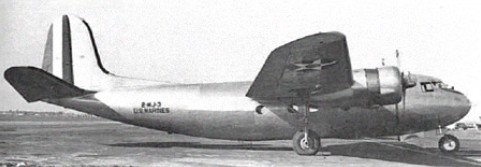
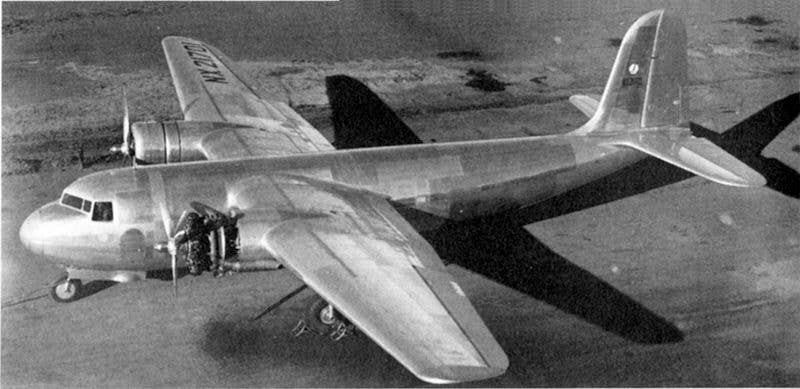
Designed at Douglas Aircraft Company’s El Segundo facility, the Douglas DC-5 was developed as a 16/22-passenger commercial transport for local service operations out of smaller airports. The DC-5 was a high-wing monoplane and featured the then relatively novel tricycle-type landing gear. With a design gross weight of 8391kg, the DC-5 was offered with either Pratt & Whitney R-1690 or Wright Cyclone radial engines. The prototype, powered by two 850hp Wright GR-1820-F62 Cyclones, flew for the first time on 20 February 1939, piloted by Carl Cover. Orders were placed by KLM (four aircraft), Pennsylvania Central Airways (six) and SCADTA of Columbia (two), but the programme was overtaken by the war and only the KLM aircraft were delivered. Although intended for service in Europe, two went first to the Netherlands West Indies to link Curacao and Surinam and the other two to Batavia in the Netherlands East Indies. All four were used to evacuate civilians from Java to Australia in 1942 and one, damaged at Kemajoran Airport, Batavia, on 9 February 1942, was captured by the Japanese and extensively test-flown at Tachikawa Air Force Base. The three surviving DC-5s were operated in Australia by the Allied Directorate of Air Transport and were given the USAAF designation C-110.
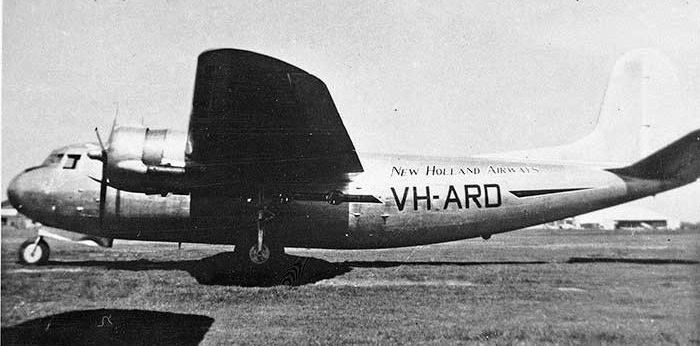
DC-5 VH-ARD at Essendon January 1948 just after purchase from Australian National Airways.
Still in one piece at Haifa (although engine-less) was Douglas DC-5, VH-ARD, carrying New Holland Airways (Sydney) insignia. On the nose was the name “Bali Clipper”.
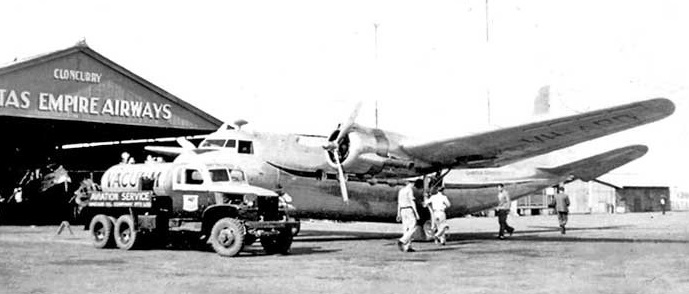
VH-ARD refuels at Cloncurry Qld during 1948 on the between Sydney and Darwin.
The earliest DC-5 military operations, however, were by the US Navy which had ordered seven examples in 1939. Three were R3D-1 16-seat personnel transports, the first of which crashed before delivery, and four were R3D-2 aircraft for the US Marine Corps with 1000hp R-1820-44 engines, a large sliding cargo door, and bucket seats for 22 paratroops. The prototype, after certification and development flying had been completed, was sold with a 16-seat executive interior to William E. Boeing, and was later impressed for US Navy use as the sole R3D-3.
Engine: 2 x 850hp Wright GR-1820-F62 radial Max take-off weight: 9072 kg / 20000 lb Empty weight: 6202 kg / 13673 lb Wingspan: 23.77 m / 77 ft 12 in Length: 19.05 m / 62 ft 6 in Height: 6.05 m / 19 ft 10 in Wing area: 76.55 sq.m / 823.98 sq ft Max. speed: 356 km/h / 221 mph Cruise speed: 325 km/h / 202 mph Ceiling: 7225 m / 23700 ft Range: 2575 km / 1600 miles
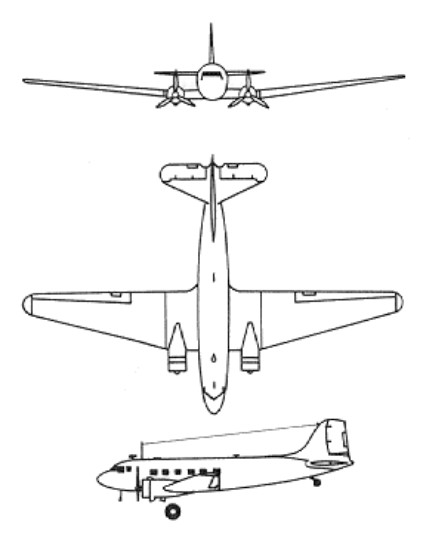
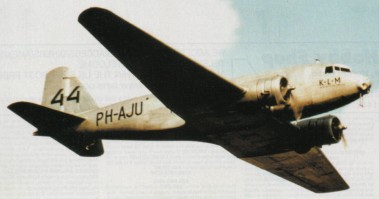
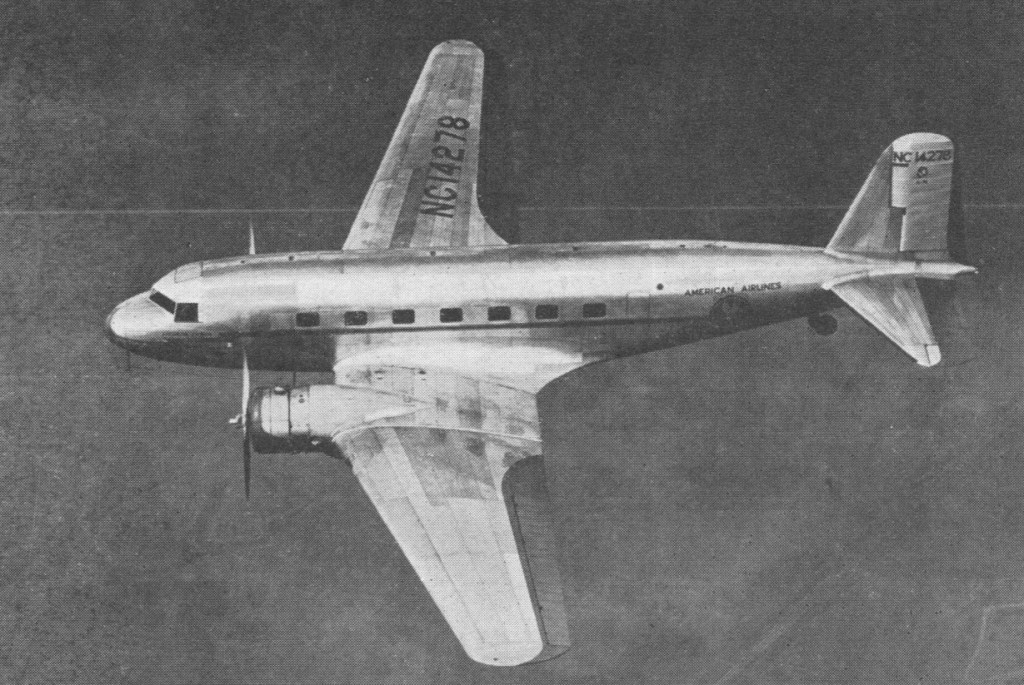
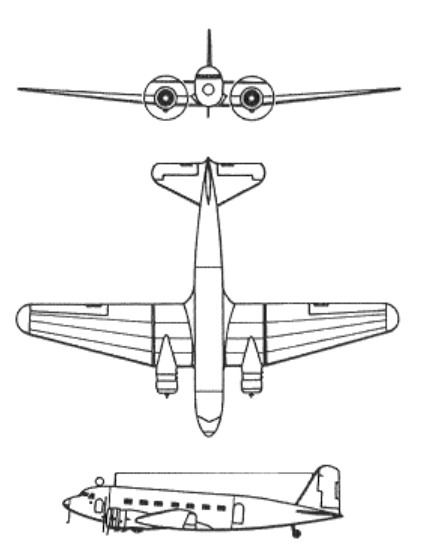
The DC-3 resulted from American Airlines’ requirement for a sleeper aircraft for its US transcontinental route. The DC-2 fuselage was too small for this, so, reluctantly, in the autumn of 1934 Douglas agreed to build the DST (Douglas Sleeper Transport) as an enlarged DC-2, with lengthened fuselage, increased span and, an increase of 66cm in fuselage width – allowing up to 28 seats or 14 sleeping berths. The prototype DST, with 633.4-745kW Wright Cyclone SGR-1820 engines, made its first flight on 17 December 1935. The type entered service with American Airlines on 25 June 1936 over the New York-Chicago route, with transcontinental sleeper services starting on 18 September. The DC-3/DST soon proved itself and orders grew rapidly, with KLM becoming the first operator outside the US.
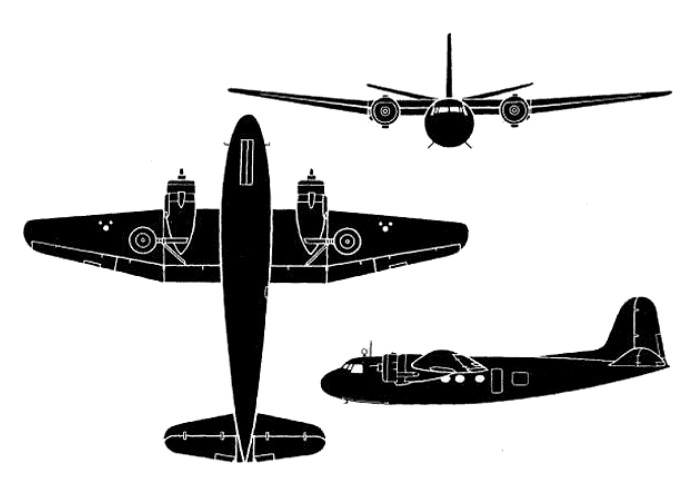
The first military version, the C 39, was an odd mixture of the new wing mated with the small DC 2 body. Similar aircraft procured in smaller numbers were the C 38 personnel trans¬port with Cyclones and the corresponding C-41 with Twin Wasps. Discounting about four civil DC 3s sold as VIP transports to overseas air forces, there was no true military DC 3 until October 1941, when deliveries began from Santa Monica of the C 53 Skytrooper. This simple conversion of the DC 3 had a wooden floor, fixed aluminium seats for 28 troops, and a glider towing cleat. Some were later supplied to the RAF as the Dakota II, and the US Navy and Marines as the R4D 3, and subsequent versions included the C 53B, C and D.
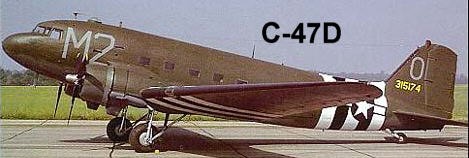
The main military type, put into large scale production in late 1941 at Santa Monica, Tulsa and Oklahoma City, was the C 47 Skytrain. This had been designed earlier in 1941 hence the earlier type number as an all purpose military transport with strong freight floor, large double doors, tie down fittings and folding wooden troop seats. The engine chosen was the 1200 hp R 1830 92 Twin Wasp. A first batch of 953 was followed in 1942 43 by 4991 C 47A with 24 volt electrics, and in 1943 by 3108 C 47B for high airfields (especially in India and China) with R 1830 90C engines with two stage blowers. Named Skytrain by all US forces, and designated R4D by the Navy, some 1200 C 47, 47A and 47B were supplied to the RAF under lend lease as the Dakota I, III and IV, respectively. Douglas also built 133 TC 47B trainers (R4D 7) with navigation classroom interiors, and one C 47C twin float amphibian version. The U.S. Navy version is designated R4D; but by 1955 most of these had been modified into R4D-8s, with more powerful engines, more swept wings with tips, taller squared-off fin and rudder with long dorsal fin, and room for up to 38 passengers.
C-47D
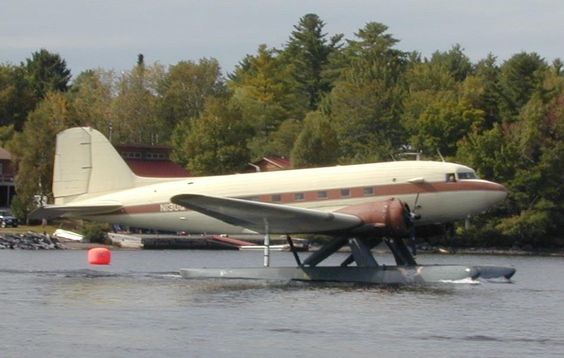
The single C 47C amphibious floatplane was a 1943 conversion of a C 47A Skytrain intended to increase the type’s versatility.
The sole 1943 XC-47C, 42-5671, had Edo amphibious floats with nose-wheels in addition to wheels under the steps, and each housed a 300 gal fuel tank.
Other oddballs included the XCG 17 glider converted from a production C 47A, and the unique DC 2½ flown out of China in an emergency with one DC 3 wing and one DC 2 wing, the original having been damaged beyond immediate repair. The glider was outstandingly successful, carrying 40 troops, towing at 464 kph (288 mph) behind a C 54 and landing at only 56 km/h (35 mph), but only one was built.
Wartime impressed civil DC 3s included the C 48 (R 1830) with civil furnishing (some were DST sleeper transports), C 49 (R 1820) usually with cargo floor and astrodome, C 50 (R 1820), C 51 (R 1820) for paratroops, C 52 (R 1830) taken over on the civil production line and completed as paratroop transports, C 68 (R 1830) previously the DC 3A late 1930s civil type, and C 84 (R 1820) previously the DC 3B. In 1945 17 purpose built VIP transports were delivered, designated C 117A. The DC-3/DST was operated as the C-38 transport.
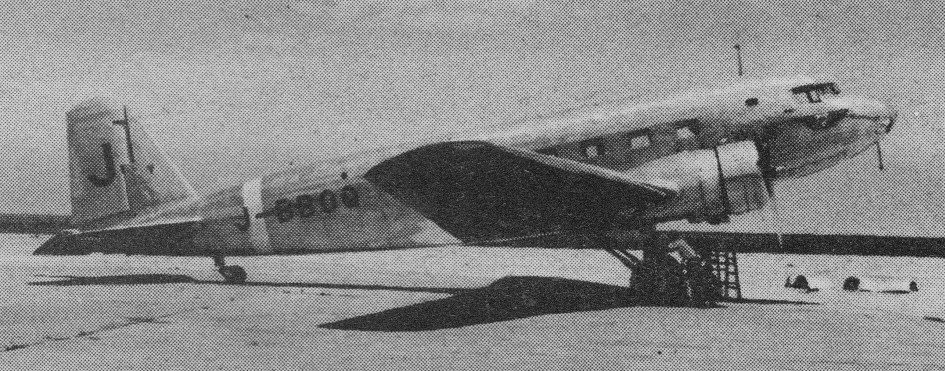
In 1940 the Japanese navy introduced the Type 0 transport, a Showa built version of the 21 passenger DC 3.
On 21 February 1942, some 25 Douglas DC-3 aircraft built under Japanese licence but bearing US national insignia, appeared over the city of Kupang on the Portuguese-owned Pacific island of Timor and dropped 250 troops from an altitude of only 300 ft. this was the first airborne operation carried out by the DC-3.
Operation Husky, the Allied invasion of Sicily beginning 10 July 1943, involved 400 Dakota C-47 transport aircraft and 170 Waco CG-4A cargo gliders. The operation verged on failure. Ninety-seven of the British and US gliders released from their towropes too early plunged into the sea, and another 24 were reported missing: only 12 of the gliders, all British, landed in the target zone. Then strong anti-aircraft fire confused the paratroops in the Dakotas, so they jumped too soon and were scattered over almost 60 miles. Six of the Dakotas were shot down, and only 73 British paratroops reached their target, the Ponte Grande bridge.
In mid-June 1943, for the first time, a Dakota FD900 of RAF Transport Command landed in Prestwick, Scotland, towing a glider. The two planes had taken off twenty-four hours earlier from Dorval (Montreal). Piloted by Sqn.Ldrs. Seys and Gobel, the Waco CG-4A had been built in a New York piano factory, and carried a full load of vaccine and radio and engine parts for the Soviet Union.
Accomplishments of the DC 3 in the Second World War include almost 1000 crossed the Channel on the night of D Day, June 6, 1944, many towing gliders, while in China a C 47 took off at a high altitude strip with 75 evacuees on board. Total wartime output by the US (almost all Douglas) was 10123.
In 1949 Douglas built two prototypes of a much improved Super DC 3, aimed chiefly at the airlines, with 1475 hp R 1820 C9HE engines and greatly altered airframe. Few, were sold, the main customers being the US Navy/Marines (R4D 8) and Air Force (C-117D).
Circa 1949-50, British European Airways Dakotas received cockpit and cabin upgrades and become known as the Pioneer in passenger service and Pioneer Leopard for cargo.
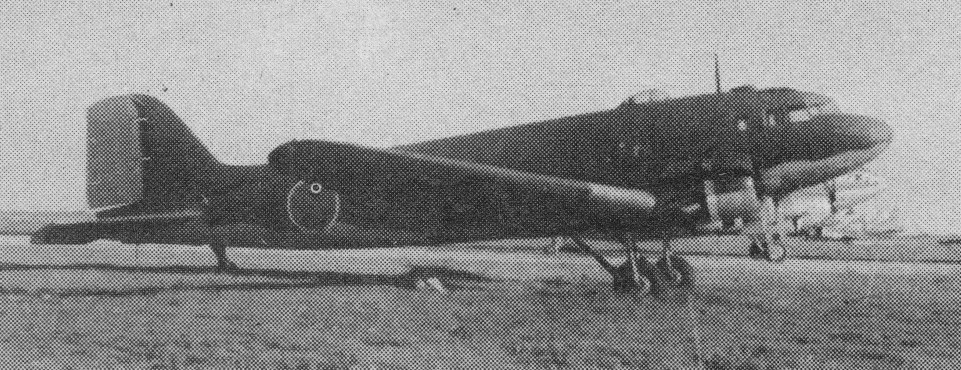
In February 1938 Mitsui in Japan acquired a licence to build the DC 3, on the secret orders of the Japanese navy. During 1939 45 the Japanese companies Showa and Nakajima respectively delivered 416 and 71 of the L2D 1 to L2D 4 versions, with 1300 hp Kinsei engines and cockpit windows extending much further aft than in the US aircraft. These machines received the Allied code name ‘Tabby’.
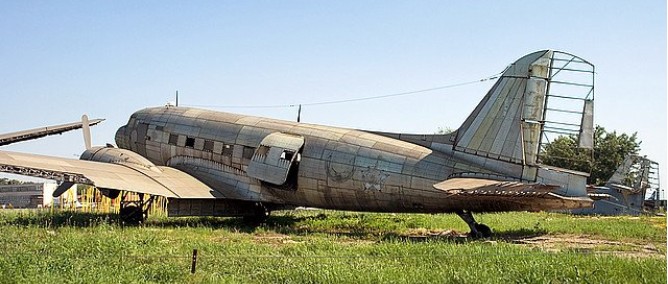
Lisunov Li-2
Much greater licence production was undertaken in the Soviet Union. Under Boris Lisunov, who had studied the DC 3 at Santa Monica, the Li 2 version considerably altered incorporating 1293 changes, and with entrance on the right and was in full production during 1939 43, about 3500 being built. The Li-2 used various engines, including the ASh-621R driving SISh-21 propellors, or AV-7N or AV-161 engines. Originally powered by 671kW Shvetsov M-62 radials in the PS-84 first version, but later fitted with uprated Shvetsov ASh-62 radials, most had the M 621R engine, and many had a gun turret behind the flight deck. Some were used as bombers with four 250kg bombs under the centre section and six light bombs on the outer wings.
Postwar Allied reporting name was ‘Cab’, this also covering the 707 lend lease C 47A and B which reached the Soviet Union in 1942 43. The Li-2 was designated PS-84 in Aeroflot service. Production comprised a number of variants, some of them armed with turreted armament; the Li-2G freighter, Li-2P personnel transport, Li-2PG convertible model and the Li-2V high-altitude model are best known of the variants.
The Yugoslav Air Force operated at least 11 Li-2s between 1945 and 1959. After the deterioratiom of relations between the Soviet Union and Yugoslavia in 1948, spare parts became difficult to obtain, and so ten aircraft were re-engined with Pratt & Whitney R-1830-900 engines and Hamilton Standard propellers from 1953 onwards. These aircraft were unofficially designated Li-3 by the Yugoslav Air Force. All Li-3s were on strengrh of the 111 ppa (transport regiment) at Zagreb. At least five of them seem to have been re-serialled from the four-digit 70xx series to the five-digit 711xx series, probably in late 1969. Shortly afterwards all Li-3s may have been withdrawn from use.
Lisunov Li-3
The most dramatic of all conversions has been the various series of AC 47 night interdiction gunships usually armed with three 7.62 mm (0.30 in) General Electric Miniguns with no fewer than 54 000 rounds of ammunition. While the basic air¬craft had become familiarly called the ‘Gooney Bird’ at least to US personnel the AC 47 was also known as ‘Puff the Magic Dragon’ or ‘Spooky’. The 25 initial conversions proved so useful in Vietnam that they spurred on the later AC 119 and AC 130 programmes.
404 C-53 variant were purchased or impressed. They were called Dakota Is and this version was powered by Pratt & Whitney R-1830-92 (1.200 hp) engines. It was primarily used as a troop transport and glider tug. A single XC-53A aircraft (42-6480), with full-span, slotted flaps and hot-air leading edge de-icing equipment.
In 1949 the Cyclone 9HE weighed less than 1400 lb and delivered nearly 1500 bhp. The first two were delivered to Douglas for installation in the new DC-3 Super. Apart from new engines, the DC-3 Super has a new tail unit and outer-wing panels, a strengthened undercarriage with complete wheel retraction, and re-arranged internal accommodation. The Cyclone 9HE engines would boost speed by 45 mph to 234 mph and maximum loaded weight increase from 25,200 lb to 27,300 lb.
In World War II the RCAF had three Dakota squadrons. In 1944, 437 was created in England and served in Northwest Europe; in that same year, 435 and 436 Squadrons were formed in India for service with the British XIV Army in Burma. Between 1943 and 1989 the RCAF and Canadian Forces (CF) Air Command employed 169 Dakotas.
The DC-3 was built in numerous versions and with a wide range of Wright Cyclone and Pratt & Whitney Twin Wasp engines ranging in power from 742 to 894kW. The aircraft were operated on wheels and skis – one even had floats (the XC-47G-DL) – and there was the XCG-17 experimental troop-carrying glider version. Original US military contracts covered 10,047 aircraft of which more than 9,500 were versions of the C-47 Skytrain with reinforced floor and double doors, and 380 C-53 Skytroopers. The US Navy ordered the DC-3 as the R4D. A wide range of military designations was given to civil aircraft impressed by the services before delivery including C-48, C-49, C-50, C-51, C-52, C-68 and C-84. Many military DC-3 were supplied to the US’s allies and the 1,900 plus supplied to the RAF were given the name Dakota – a name which has been widely used in place of the DC-3 designation.
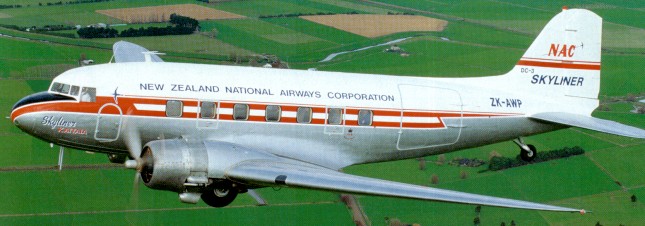
National Airways Corporation operated three models of DC-3 and applied its own model suffixes, unique to New Zealand versions. The DC-3C was the basic internal passenger version with double rear doors on the port side of the fuselage. The DC-3C freighter retained the dual rear doors on the port side, with the exception of ZK-BKE, which was the only genuine DC-3 to serve in the fleet, having been built in 1941 for United Airlines and had starboard side doors before being called up into military service. The DC-3D, with the smaller single door of prewar DC-3, an astrodome and a wireless operator’s station, was used initially on regional services. NAC ran its DC-3 with a maximum all-up weight of 26,900 lb for landing and take-off. The DC-3C Freighter could lift a payload of 4,244 lb, the DC-3C passenger 3,344 lb and the DC3D 3,244 lb. The DC-3C Freighter was the lightest, with a fleet operating weight of 17,400 lb compared with 18,200 lb for the DC-3C and 18,400 lb for the DC-3D.
Prior to Skyliner conversion in the 1960s, they could carry up to 4,824 lb of fuel in two 168 imperial gallon tanks between the front and centre spars in the centre section. The aircraft also had two auxiliary tanks each of 167 imperial gallons between the centre and rear spars on the centre line, but these were removed in the Skyliner conversion, although provision for one remained on all but the DC-3D, which retained provision for two.
The LC 47H was a winterised C 47H. Prior to 1962, before a change in the US Navy designation system, the aircraft would have been a R4D 5L. The R4D 8s were a Super DC 3 with modified outer wing panels, longer fuselage, enlarged tailplane, tall square topped fin, fully enclosable undercarriage and powered by 2 x 9 cylinder Wright Cyclone R1820 80s of 1,475hp. Principal versions – C-47, R4D-1 and Dakota Mk I (initial model), C-47A, R4D-5 and Dakota MkIII (revised electrical system), C-47B, R4D-6 and Dakota Mk IV (high ¬altitude blowers), Lisunov Li-2 (2,000+ Soviet-built aircraft), and Nakajima/ShowaL2D “Tabby” (485 Japanese aircraft).
In 1963 Libya started its own Air Force when the US turned over two T-33 and a C-47 at Wheelus AFB.
Nakajima L2D Type 0
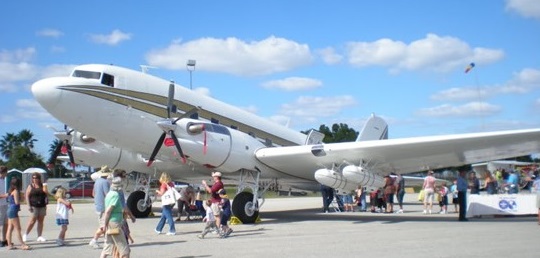
Basler Conversions of Wisconsin have FAA approval to fit Pratt and Whitney PT6A 67R turboprop engines driving Hartzell five-bladed propellers to DC 3s, enabling up to 42 passengers or a useful load of around 5900 kgs in the revitalised aircraft, being marketed as the Turbo 67R. The fuselage is stretched approximately 42 inches from its original length, with all-new electrics, and extended fuel storage with an additional 200 gallons of fuel carried in the engine nacelle-mounted fuel tanks.
Schafer Aircraft Modifications Inc was founded 1977, and from 1979 developed modifications for other aircraft. Included was developing a turboprop conversion and fuselage stretch for the DC-3 as DC-3-65TP Cargomaster.
The aircraft was ordered in very large numbers by the US armed forces and when production ceased in 1947, Douglas had built 10,654 examples of all civil and military variants. Nakajima and Showa in Japan built 485 (L2D) and about 2,000 had been built in the USSR as PS-84, but later redesignated Lisunov Li-2. As late as 1990 there were 3,500 Dakotas still flying world wide.
Prototype DST (Douglas Sleeper Transport) / C 38 Engines: 2 x Wright Cyclone SGR-1820, 633.4-745kW
Douglas DC-3 Engines: Two Pratt & Whitney R-1830-92, 1200 hp / 880kW Maximum speed: 237 mph (379 km/h) Maximum weight: 28,000 lb (12,600 kg) Range: 1110 miles (1776 km) Maximum passengers: 28 Span: 95 ft (28.5 m) Length: 64 ft 5 in (19.3 m) Height: 16 ft 11 in (5 m) Wing area: 987 sq ft (91.7 sq m) Crew: 2
DC 3 Engines: 2 x 900 h.p. Wright Cyclones. Length: 64.5 ft. (19.6 m.) Wing span: 95 ft. (29 m.) Weight empty: 16,290 lb. (7,390 kg.). Crew: 2. Pax cap: 21. Max cruise: 185 m.p.h. (298 km.p.h.). Ceiling: 23,000 ft. (7,000 m.). Range: 1,500 miles (2,400 km.).
NAC DC-3C Payload: 3,344 lb Operating weight: 18,200 lb Maximum all-up weight: 26,900 lb Fuel capacity: 4,824 lb / two x 168 imperial gallon tanks
NAC DC-3C Freighter Payload: 4,244 lb Operating weight: 17,400 lb Maximum all-up weight: 26,900 lb Fuel capacity: 4,824 lb / two x 168 imperial gallon tanks
NAC DC3D Payload: 3,244 lb. Operating weight: 18,400 lb Maximum all-up weight: 26,900 lb Fuel capacity: 4,824 lb / two x 168 imperial gallon tanks
C 39
C-¬41 Engines: 2 x Twin Wasps.
C 47 Skytrain / R4D / Dakota I Engines : 2 x Wright Cyclone R-1820-G202A, 1200 hp Wing Span : 95ft (28.96m) Length : 64ft 5.5in (19.65m) Height : 16ft 11in (5.16m) Range : 1,500 miles (2,414km) Speed : 229 mph (369 km/h) MTOW: 25,200 lb
C 47A Skytrain / R4D / Dakota III Engines: 2 x Pratt&Whitney R-1830-93, 1200 hp Length: 64.206 ft / 19.57 m Height: 16.929 ft / 5.16 m Wingspan: 95.013 ft / 28.96 m Wing area: 986.951 sqft / 91.69 sq.m Max take off weight: 26030.0 lb / 11805.0 kg Weight empty: 16974.1 lb / 7698.0 kg Max. speed: 199 kts / 369 km/h Cruising speed: 161 kts / 298 km/h Service ceiling: 23196 ft / 7070 m Cruising altitude: 10007 ft / 3050 m Wing load: 26.45 lb/sq.ft / 129.0 kg/sq.m Range: 1304 nm / 2415 km Crew: 3+28 Elec¬trics: 24 volt
C 47B Skytrain / R4D / Dakota IV Engines: two 1,200-hp (895-kW) Pratt & Whitney R-1830 90C Twin Wasp radial piston. Max speed: 230 mph.
C-47 Skytrain Engines: two 1,200-hp (895-kW) Pratt & Whitney R-1830-92 Twin Wasp radial Maximum speed 229 mph (368 kph) at 7,500 ft (2,290 m) Initial climb rate 1,130 ft (345 m) per minute Service ceiling 23,200 ft (7,075 m) Range 1,500 miles (2,401 km) Empty weight 16,970 lb (7,705 kg) Maximum take-off: 13290 kg (29 300 lb) (sometimes 14 080 kg, 31004 lb). Wing span 95 ft 0 in (28.90 m) Length 64 ft 5.5 in (19.63 m) Height 16 ft 11 in (5.20 m) Wing area 987.0 sq ft (91.70 sq.m) Payload: 28 troops, or 18 litters, or 10,000 lb (4,536 kg) of freight.
C-47B-35-DK Engines: two 1,000 hp Curtiss-Wright R-1820-G2 Cyclone 9 cylinder radials, or 1,200 hp Pratt & Whitney R-1830-92 twin Wasp two-row 14 cylinder radials. Wingspan: 28.96 m Length 19.66 m Height 5.17 m Cruising speed 266 km/h Ceiling 21,900 ft
TC 47B / R4D 7
C 47C Undercarriage: twin float amphibian Ex-C 47A
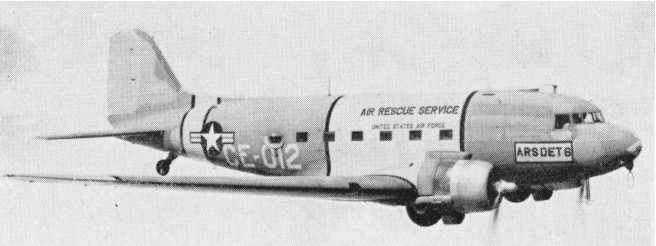
C-47D Engines: 2 x Pratt & Whitney R1830-90, 1,200 h.p. Wingspan: 95 ft Length: 63 ft. 9 in. Loaded weight: 30,000 lb. Max speed: 224 m.p.h. Ceiling: 24,100 ft. Typical range: 1,500 miles at 185 m.p.h. at 10,000 ft. with normal load Crew: 3 Capacity: 21 passengers
LC 47H / R4D 5L Skytrain
AC 47 Armament: 3 x 7.62 mm (0.30 in) General Electric Miniguns / 54 000 rounds
C 48 impressed civil DC 3 Engines: R 1830
C 49 impressed civil DC 3 Engines: R 1820
C 50 impressed civil DC 3 Engines: R 1820
C 51 impressed civil DC 3 Engines: R 1820
C 52 impressed civil DC 3 Engines: R 1830
XC-53A No built: 1 (42-6480)
C 53 Skytrooper / Dakota II / R4D 3 Engines: 2 x Pratt & Whitney R-1830-92, 1.200 hp
C 53B Engines: 2 x Pratt & Whitney R-1830-92, 1.200 hp
C 53C Engines: 2 x Pratt & Whitney R-1830-92, 1.200 hp
C 53D Engines: 2 x Pratt & Whitney R-1830-92, 1.200 hp
DC 3A / C 68 impressed civil DC 3 Engines: R 1830
DC 3B / C 84 impressed civil DC 3 Engines: R 1820
C 117A VIP transports 17 built
C-117A-11-KK
R4D 8 / C¬117D Engines: 2 x Wright Cyclone R 1820 C9HE, 1475 hp
XCG 17 glider – ex-C 47A Capacity: 40 troops Tow speed: 464 kph (288 mph) Landing speed: 56 km/h (35 mph) No built: 1
Basler Conversions Turbo 67R. Engines: 2 x Pratt and Whitney PT6A 67R turboprop Passengers: 42 Useful load: 5900 kgs
Lisunov Li 2 Engines: 2 x Shvetsov ASh-621R, 1000 hp Propellors: SISh-21 Wingspan: 95 ft 0 in Max speed: 225 mph
Lisunov Li 2 Engines: AV-7N
Lisunov Li 2 Engines: AV-161
Lisunov Li 2 / PS-84 Engines: 671kW Shvetsov M-62 radials
PS-84I Medevac version
Lisunov Li 2 Engines: Shvetsov ASh-62 radials
Lisunov Li 2 Engines: M 621R
Lisunov Li-2DB Long range fuel tanks.
Li-2F Aerial photography
Lisunov Li-2G Freighter
Li-2LL Flying labratory
Li-2 Metro Flying labratory
Lisunov Li-2P Passenger transport
Lisunov Li-2PG convertible
Li-2PR Glass nose
Lisunov Li-2R Survey aircraft with bulged windows.
Li-2RE Flying labratory
Li-2REO Flying labratory
Lisunov Li-2T Cargo and troop carrying Cargo door on left hand side
UChShLi-2 Navigator trainer
Li-2US Navigator trainer
Lisunov Li-2V high-altitude model Ski equipped, boosted engines.
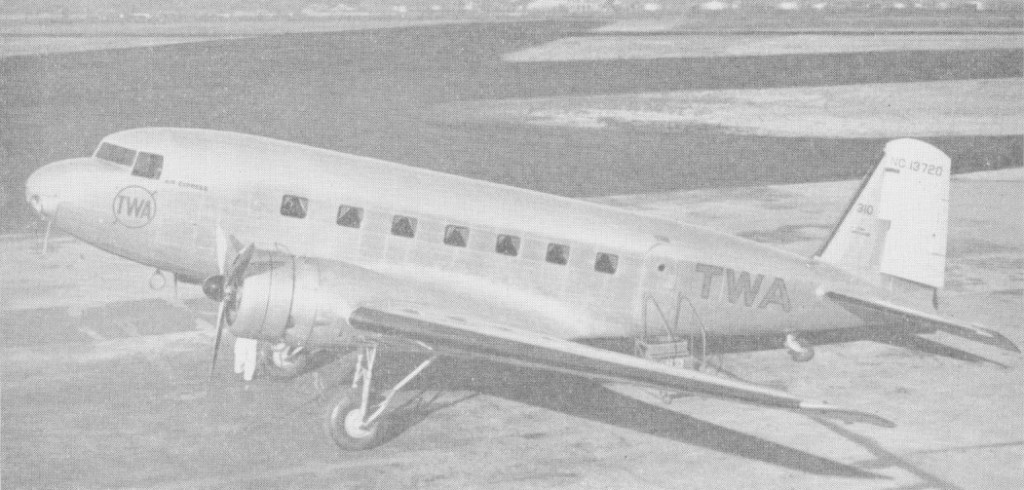
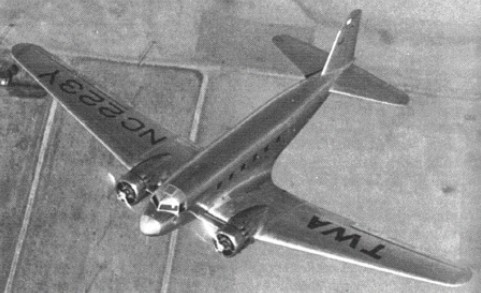
Design require¬ment to accommodate 14 passengers resulted in the DC-2, first flown on May 11 1934. Originally developed for TWA, it entered production in 1933 with 529kW Wright SGR-1820-F3 Cyclone engines.
The first of 20 ordered by TWA flew on 11 May 1934 and deliveries started soon after. The early DC-2 were so successful that by June 1934 orders for 75 aircraft had been received from airlines in both the US and abroad. Subsequent orders were received from American Air Lines, Eastern Airlines, Pan American Airways and from numerous foreign operators – the first exported DC-2 being flown by KLM in the autumn of 1934.
By September 1935 110 had been ordered and to meet the demand Douglas was producing one aircraft every three days. In 1934 Anthony Fokker acquired exclusive European rights to sell the Douglas Transport in Europe. In addition to commercial aircraft, DC-2 were purchased by the US Navy and USAAC and others were impressed into military service during World War II to serve with the Allied forces.
Usually powered by two 710 hp Wright R¬1820 Cyclone F series engines, the DC 2 seated 12 or 14 in airline service and 14 was a typical number of equipped troops for military versions. Deliveries of the latter began in 1935 with the US Army Air Corps C 32 and C 32A (24 delivered), followed by the R2D 1 of the Navy and Marine Corps. In 1942 civil DC 2s were impressed into Army Air Force service as the C 33. The eighteen C-33 had large cargo doors. A handful of aircraft formerly operated by European airlines served with the RAF, a few including the ex Polish LOT machines having Bristol Pegasus engines.
KLM DC-2 (PH-AKL) which crashed after take-off from Croydon Air Port near London, England on December 9th, 1936 taking the life of Juan de la Cierva y Codorníu, 1st Count of la Cierva,and 14 of 16 others aboard. The dead included Arvid Lindman, a former Prime Minister of Sweden, and the Austro-Hungarian fighter ace, Ludwig Hautzmayer, who was the aircraft’s pilot at the time.
In the mid-1930’s Japan obtained rights to produce the DC-2. It was built by Nakajima for civil airline use. Only a few reached military service, receiving the allied code name ‘Tess’.
Nakajima DC-2
35 were delivered to the USAF in 1939 with the DC-2 fuselage and DC-3 wing and tail assemblies, designated C-39.
DC-2 Engines: 2 x Wright Cyclone SGR-1820-F3, 710 hp Later Engines: 2 x Wright Cyclone SGR-1820-F52, 760 hp Wingspan: 85 ft Length: 61 ft / 11.75 in Empty weight: 12,408 lb Loaded weight: 18,560 lb Max speed: 210 mph Cruise: 190 mph ROC: 1000 fpm
Engines: 2 x Wright R-1820-25, 710 bhp / 550kW Max take-off weight: 8419 kg / 18561 lb Empty weight: 5448 kg / 12011 lb Wingspan: 25.9 m / 85 ft 0 in Length: 18.9 m / 62 ft 0 in Height: 4.9 m / 16 ft 1 in Wing area: 87.2 sq.m / 938.61 sq ft Max. speed: 320 km/h / 199 mph Cruise speed: 300 km/h / 186 mph Ceiling: 6100 m / 20000 ft Range w/max.fuel: 1400 km / 870 miles Crew: 2 Passengers: 14-16
In 1931 TWA Flight 599 crashed due to the failure of a wooden strut, which was caused by water which had dissolved the glue holding the layers together. The Civil Aeronautics Board ruled passenger aircraft could no longer contain wings or structural members (such as struts and spars) made of wood. Boeing 247 production capacity was limited and they could only supply their primary contract, United Airlines. TWA wanted a similar aircraft, and asked four manufacturers to bid for construction of a three-engine, 12-seat aircraft to meet the specifications stipulated by the CAB:
All metal wings and structural members Retractable landing gear Capable of remaining in flight, even if one engine failed.
Donald Douglas was initially reluctant to participate in the invitation from TWA. He doubted there would be a market for 100 aircraft, the number of sales necessary to cover development costs. Nevertheless, he submitted a design consisting of an all-metal, low-wing, twin-engine aircraft seating 12 passengers, a crew of two and a flight attendant. The aircraft exceeded the specifications of TWA even with two engines. It was insulated against noise, heated, and fully capable of both flying and performing a controlled takeoff or landing on one engine. Only one aircraft was produced in eight months, the prototype, X223Y. It made its maiden flight on July 1, 1933, flown by Carl Cover from Santa Monica in California, and was given the model name DC-1. During a half year of testing, it performed more than 200 test flights and demonstrated its superiority versus the most used airliners at that time, the Ford and Fokker Trimotors. It was flown across the United States, making the journey in a record time of 13 hours 5 minutes.
TWA accepted the model with a few modifications (mainly increasing seating to 14 passengers and adding more powerful engines) and ordered 20 aircraft. The production model was called the Douglas DC-2. The DC-1 flew with TWA (Transcontinental and Western Air) until 1936 when Howard Hughes purchased the aircraft with a view to a world flight. Instead he used a faster Lockheed 14 for his 91 hour world circling flight. The DC-1 was sold to Lord Forbes in the United Kingdom in May 1938, who operated it for a few months before selling it in France in October 1938. It was then sold to Líneas Aéreas Postales Españolas (L.A.P.E.) in Spain in November 1938. Later operated by Iberia Airlines from July 1939 with the name Negron it lost engine power on take-off and made a wheels-up landing at Malaga, Spain in December 1940 and was damaged beyond repair and later scrapped.
Powerplant: 2× Wright Cyclone SGR-1820F 9-cylinder radial, 710 hp (522 kW) Length: 60 ft (18,28 m) Wingspan: 56 ft (17,06 m) Height: 16 ft 10 in (4.88 m) Empty weight: 11,400 lb (5,171 kg) Max takeoff weight: 17,500 lb (7,938 kg) Maximum speed: 232 mph (373 km/h) Cruise speed: 186 mph (300 km/h) Range: 930 mi (810 nm, 1,500 km) Service ceiling: 23,000 ft (7,010 m) Crew: 2 pilots and flight attendant Capacity: 12 passengers
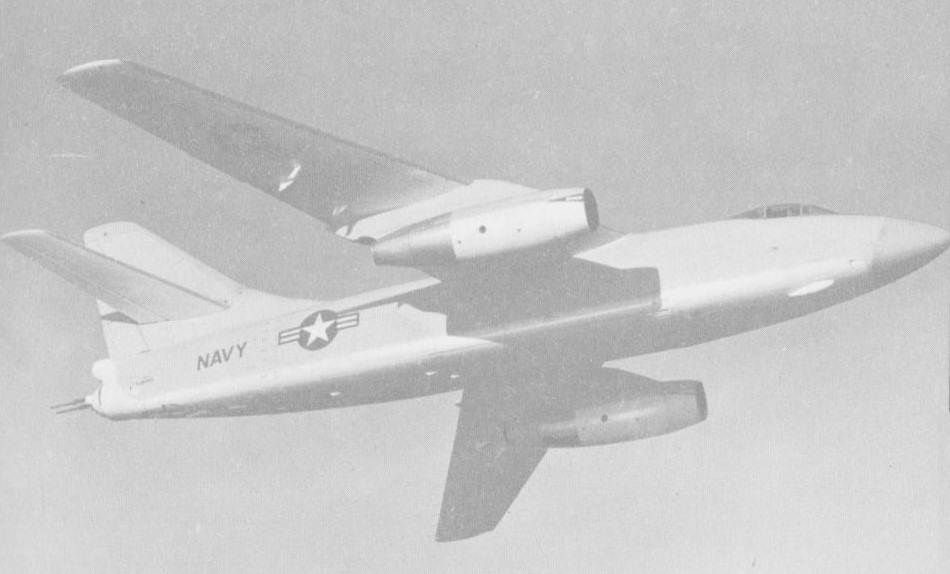
The Douglas A3D Skywarrior originated from a US Navy requirement of 1947. An attack bomber with strategic strike capability was envisaged for the new ‘Forrestal’ class aircraft-carriers.
The design was a high-wing monoplane, with retractable tricycle landing gear, two podded turbojets beneath the wing, and a large fifteen foot internal weapons bay to accommodate up to 5443kg of varied weapons. The wings were swept back 36° and had high-aspect ratio for long range, all tail surfaces were swept, and the outer wing panels and vertical tail folded.
Lateral control is by ailerons and spoilers on the outer wings. The wings are equipped with automatic leading-edge slats outboard of the engines, slotted trailing-edge flaps, and all-moving tailplane. Sideways opening airbrakes are on each side of the rear fuselage. Provision was made for twelve 4500 lb thrust jettisonable JATO rockets mounted on the side of the rear fuselage.
The first of two prototypes made its maiden flight on 28 October 1952, powered by 3175kg Westinghouse XJ40-WET3 engines, but the failure of this engine programme meant that the 4400kg thrust Pratt & Whitney J57-P-6 powered the production A3D-1. The first of these A3D-1s flew on 16 September 1953, and deliveries to the US Navy’s VAH-1 attack squadron began on 31 March 1956.
In 1962 the designation was changed to A-3, the initial three-seat production version becoming A-3A. Five of these were modified subsequently for ECM missions under the designation EA-3A. The A-3B (previously A3D-2) which entered service in 1957 had more powerful J57-P-10 engines and an inflight-refuelling probe. A reconnaissance variant with cameras in the weapons bay was designated RA-3B (A3D-2P), and EA-3B (A3D-2Q) identified ECM aircraft with a four-man crew in the weapons bay.
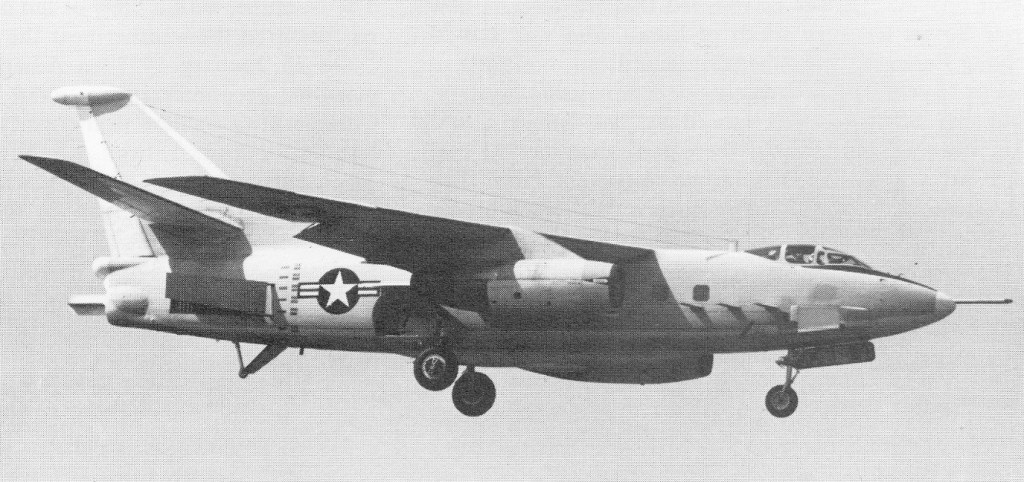
The EA-3B flew for the first time on 10 December 1958 as A3D-2Q and a year later the first batch of 24 production aircraft was delivered to the US Navy. Operated by VQ-1 and VQ-2 Squadrons, accidents reduced the number to about 12. The EA-3B, weighing around 33 tonne, operated regularly from aircraft carriers, fitted with hook for arrester cables and catapult. Behind the three cockpit crew members, a pressurised cabin holds four electronics specialists. The Skywarrior’s antennae are located in a wedge-shaped ventral pod under the fuselage and in the tail. Some VQ aircraft stationed at Guam had antennae on top of the fin and on either side of the cockpit.
EA-3B Seawing from VQ-2 at Rota
Apart from the American national insignia and the word NAVY, the registration number consists of one or two digits. Sometimes the identification letters PR from VQ-1 or JQ from VQ-2 were affixed, but sometimes nothing at all.
EA-3B from VQ-1
Other designations include 12 TA-3B (A3D-2T) trainers for radar operators, one VA-3B (A3D-2Z) executive transport, and the final variants in front-line US Navy service were KA-3B inflight-refuelling tankers and 30 EKA-3B tanker/counter-measures/strike aircraft. Skywarrior variants serving included TA-3B crew trainers, EKA-3B early-warning ‘aggressor’ trainers, and KA-3B tankers with Squadrons VAQ-33 at Key West and VAQ-34 at NAS Point Mugu, together with an NA-3B test aircraft operated by the Naval Weapons Test Center and NRA-3Bs with the Pacific Missile Test Center.
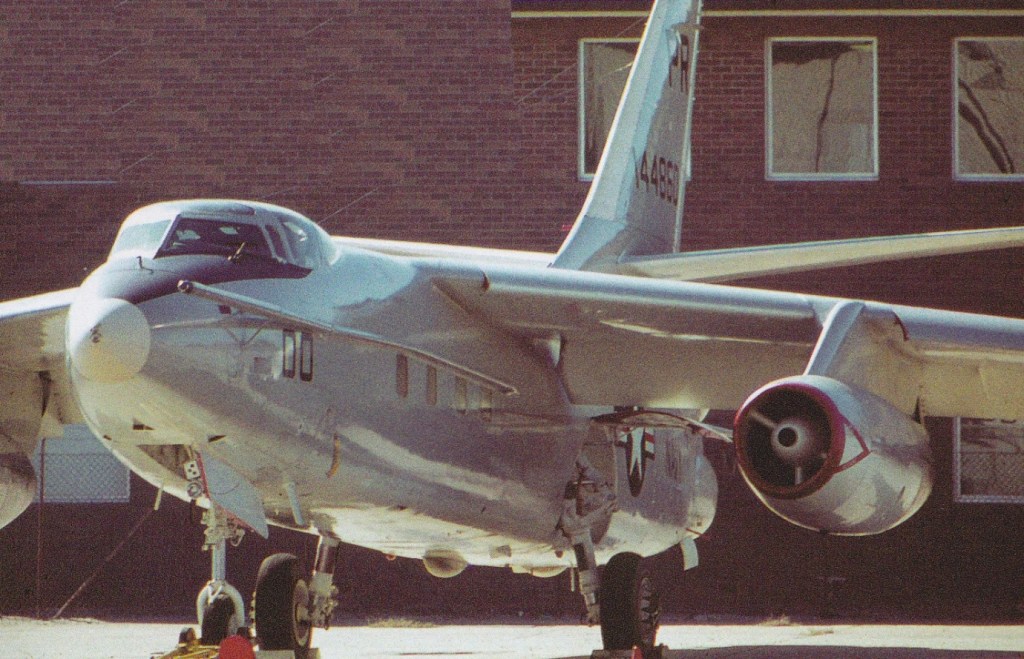
Of the 12 TA-3B Skywarrior built, three were converted to VIP transports with cabin windows in the forward fuselage.
TA-3B Skywarrior BuAer 144860 VIP transport
Douglas A3D-2 Skywarrior
An A3D-2 Skywarrior set a record takeoff weight from an aircraft carrier when it took off three times at 38,102 kg on 25 August 1959 from the USN’s newest aircraft carrier, the USS Independence, during suitability trials prior to the ship’s commissioning.
A3D-2 Skywarrior Naval attack bomber Engines: 2x Pratt & Whitney J57-P-2 turbojets, 10,000 lb. (approx.) thrust Wingspan: 72 ft. 6 in Length: 75 ft. 2 in Loaded weight: 67,000 lb Max. speed: nearly 700 m.p.h. Ceiling: 45,000 ft. Range: 1,500-2,000 miles. Crew: 3 Armament: 2 x 20 mm. tail guns.
A-3B Engine: 2 x Pratt & Whitney J57-P-10 turbojets, 4763kg / 10,500 lb each Max take-off weight: 37195 kg / 82001 lb Empty weight: 17876 kg / 39410 lb Wingspan: 22.10 m / 72 ft 6 in Length: 23.27 m / 76 ft 4 in Height: 6.95 m / 22 ft 10 in Wing area: 75.43 sq.m / 811.92 sq ft Max. speed: 982 km/h / 610 mph Cruise speed: 837 km/h / 520 mph Ceiling: 12495 m / 41,000 ft Range: 1690 km / 1050 miles Armament: 2 x 20mm rear-firing cannon, 5500kg / 12,000 lb of bombs









 All Aero