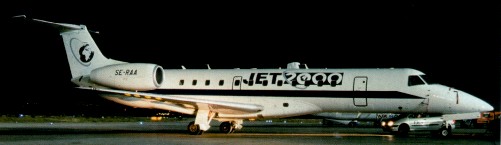
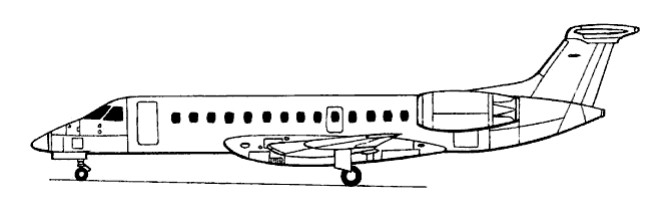
Embraer launched the ERJ-135 on 16 September 1997 as a 37-seat development of the ERJ-145 benefits from more than 95% of parts commonality with the ERJ 145: engines, main systems, cockpit, wing and tail. The fuselage cross section is the same, only 3,6 metres shorter. Rolled-out on 12 May 1998, the ERJ-135 made its first flight on 4 July 1998. A second prototype was flown on 24 September 1998, for systems testing before conversion to production standard in March 1999. Both prototypes were converted from ERJ-145 prototypes. The public debut was at Farnborough Air Show in September 1998. Brazilian CTA certification was achieved in June 1999 and FAA certification on 15 July 1999. The first customer delivery was on 23 July 1999 to Continental Express, followed by American Eagle.
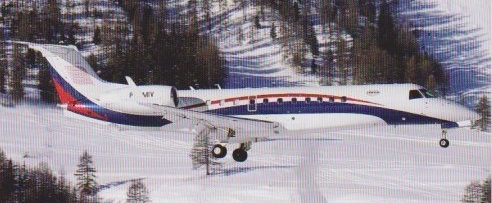
Embraer ERJ-135BJ Legacy P4-MIV
Two basic versions of the ERJ135 were available. The Extended Range (ER) and Long Range (LR). The ERJ135ER is powered by two Rolls Royce Allison AE3007A3 high-bypass ratio turbofans, while the ERJ135LR features an additional fuel tank and slightly more powerful AE 3007A4 turbofans. This ERJ135LR has a range of 3.241 km and a maximum cruise speed of Mach .78 (833 km/h).
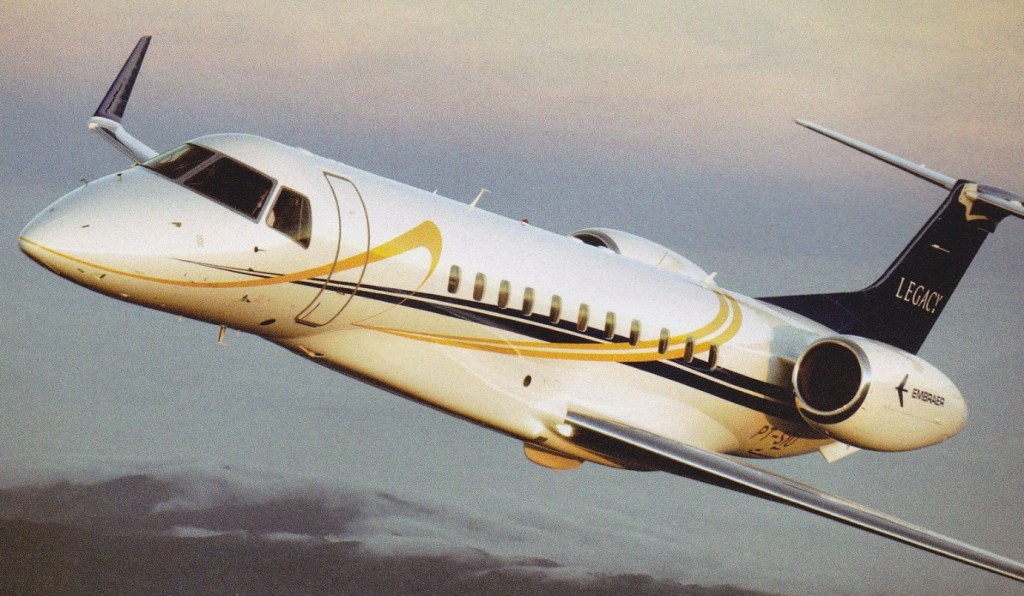
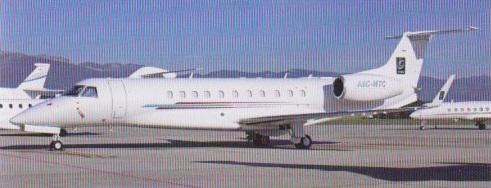
In 2000, Embraer started with the development of the Legacy. The Embraer EMB-135BJ Legacy 600 is a twin-engine corporate jet for up to 16 passengers. The Legacy first flew on 31 March 2001. Compared to the commercial versions, the Legacy has more thrust, a new fuel system, increased cabin headroom, new winglets, additional avionics, and a higher service ceiling. The Legacy features additional fuel giving a range with 10 passengers of 5930km (3200nm). The EMB135BJ Legacy is powered by two Rolls Royce Allison AE3007 A1E high-bypass ratio turbofans. The Legacy 600 has a range of 6.019 km and a maximum cruise speed of Mach 0.80. By 2008 over 70 aircraft of the Legacy has sold to operators around the world.
Legacy
The Legacy was available in 10-16 seat Executive, 16-25 seat Shuttle and 37-seat Shuttle HC versions. Additional fuel housed in extended under-fuselage fairings provided a range of up to 3200 nm / 5925 km. While building the Legacy 600, some 80 had been delivered.
The Embraer Legacy 650 first flew on 23 September 2009.
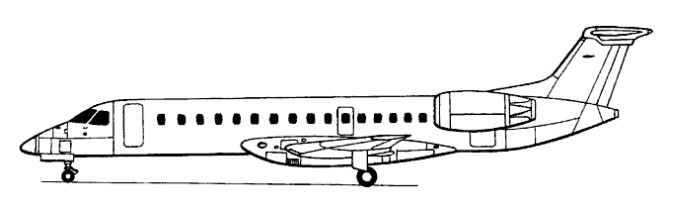
Embraer’s ERJ-140 were flying a year and a half after the ERJ-135. Upgraded versions of each model have followed. The ERJ-145LR came in 1998 and the XR came in 2002, both with larger and more efficient engines, an increased takeoff weight and more fuel capacity for extended range.
Total of 122 firm commercial orders and seven options by 1 January 2004. Additionally, one VIP-configured ERJ-135LR handed over to Greek Air Force on 7 January 2000 and two, also in VIP configuration, to the Belgian Air Force on 4 June and in August 2001, for operation by No. 21 Squadron at Melsbroek with two similarly configured ERJ-145s. Deliveries have been 16 in 1999, 45 in 2000, 27 in 2001, three in 2002 and 14 in 2003.
Embraer ERJ-135BJ Legacy A9C-MTC
The ERJ-140 was launched on 30 September 1999 at the European Regional Airline Association annual meeting in Paris, and the first flight of the prototype, modified from the prototype ERJ-135, was on 27 June 2000. The public debut was at Farnborough International Air Show July 2000. Brazilian CTA and FAA certification was achieved in June and 26 July 2001 respectively, with the first delivery to American Eagle late July 2001.
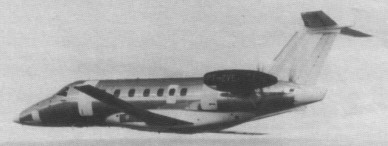
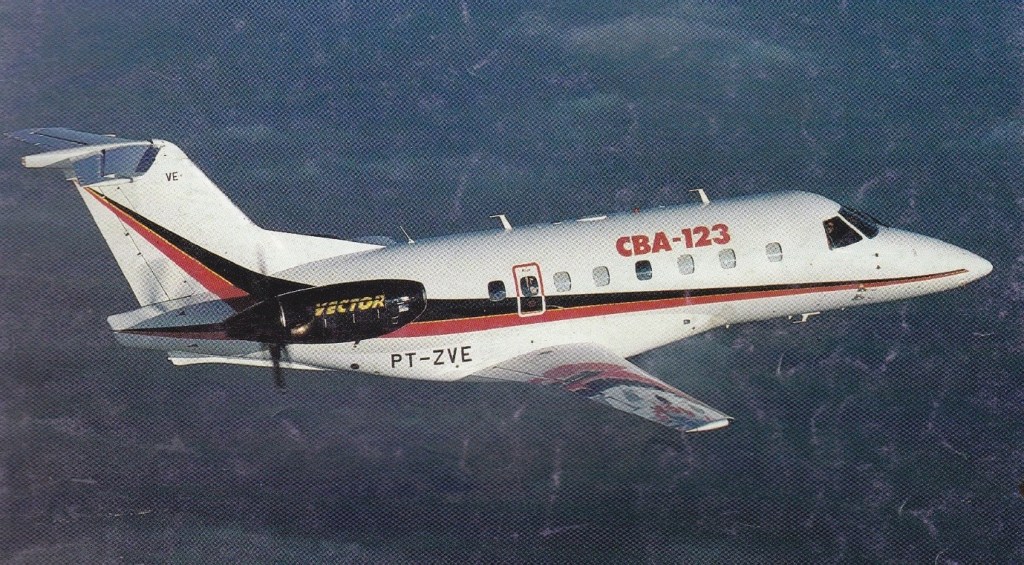
The 19-seat CBA-123 (Co-operation Brazil Argentina) Vector is the outcome of the 1986 collaboration agreement between Embraer and FMA. Support for the programme has been pledged by the Brazilian and Argentine governments, and paid options have been taken on 150 aircraft. The Vector carries two 2,081 shp (1 552 kW) Garrett TPF351-20 turboprops. Two flying prototypes will be built in Brazil and a third in Argentina, for certification in 1991.
The first prototype of the CB 123 made its first flight on 18 July 1990 from Embraer’s airfield in Sao Paulo, Brasil. The aircraft, prototype 801, registered PT ZVE, flew for one hour 20 minutes with a three-man crew in a flight devoted to evaluation of performance, handling and systems operation. Flaps and landing gears were cycled and the aircraft was assessed as to longitudinal stability. The un-painted prototype took off at a weight of 18,500 lb / 8300 kg and reached maximum and minimum speeds of 180 kt / 334 kph and 105 kt / 195 kph. The maximum altitude reached was 20,000 ft / 696 m.
The prototype weighed 18,300 lb on take off and attained maximum and minimum speeds during the flight of 180 knots IAS and 105 knots IAS respectively. Maximum altitude reached was 20,000 ft.
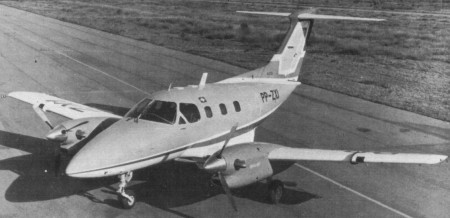
The pressurised EMBRAER EMB-121 Xingu featured a reduced-span version of the EMB-110P wing, a fuselage of circular cross-section similar to that of the Brasilia, and followed the same general configuration with twin turboprop engines and retractable tricycle landing gear, but differed by having a cantilever T-tail.
The first pressurized twin turboprop general purpose transport to be built in Brazil, it had accommodation for a crew of two and nine passengers. The prototype Xingu (PP ZXI) flew for the first time on 10 October 1976, followed by the first production aircraft just over six months later. The Xingu has PT6A 28 engines, six psi pressurisation, an anticipated cruise of 265 knots at 12,000 feet, a five to nine place cabin and max gross of 11,000 pounds. The original version, designated EMB-121A Xingu I, was powered by two Pratt & Whitney Canada PT6A-28 turboprop engines. From this was developed the EMB-121A1 Xingu II with 559kW PT6A-135 turboprops, these being available also as retrofits for the Xingu I. Thirty-two earlier machines were later reworked to this standard. A prototype of the EMB-121V Xingu III was flown. It was generally similar to its predecessors except that it had the fuselage lengthened by 0.89m, and was powered by two 634kW PT6A-42 engines. Seating the same number of passengers but in greater comfort, the Xingu III featured an optional ‘club’ layout for seven passengers, with folding tables and a galley. A total of 111 were built, including six for use by the special transport group of the Brazilian air force under the designation VU-9 as a VIP transport. Other users include the French navy and air force with 41 aircraft as multi-engined trainers and liaison aircraft, and five others serve with the SABENA pilot training school. Production of the Xingu 121 ended in 1986.
EMB-121A Xingu I Engines: 2 x Pratt & Whitney Aircraft of Canada PT6A-28 turboprops, 507kW Max take-off weight; 5670 kg / 12500 lb Loaded weight; 3620 kg / 7981 lb Wingspan; 14.45 m / 47 ft 5 in Length; 12.25 m / 40 ft 2 in Height; 4.74 m / 15 ft 7 in Wing area; 27.5 sq.m / 296.01 sq ft Max. speed; 450 km/h / 280 mph Cruise speed; 365 km/h / 227 mph Ceiling; 7925 m / 26000 ft Range; 2270 km / 1411 miles
EMB-121 Xingu II Engine: 2 x P&WAC PT6A. Installed pwr: 1120 kW. Span: 14.4 m. Length: 12.2 m. Wing area: 27.5 sq.m. Empty wt: 3710 kg. MTOW: 5670 kg. Payload: 780 kg. Cruise speed: 465 kph. Initial ROC: 550 m / min. Ceiling: 8540 m. T/O run: 580 m. Ldg run: 560 m. Fuel internal: 1720 lt. Range/payload: 1630 km with 780 kg. Capacity: 7 pax.
EMB-121V Xingu III Engine: 2 x 634kW PT6A-42 Length: 13.09 m. Span: 14.4 m. Wing area: 27.5 sq.m. Capacity: 7 pax.
Encouraged by the successful penetration of the commuter airline market by the EMB-110 Bandeirante, EMBRAER initiated design studies for a completely new and pressurised twin-turboprop regional airliner in September 1979.
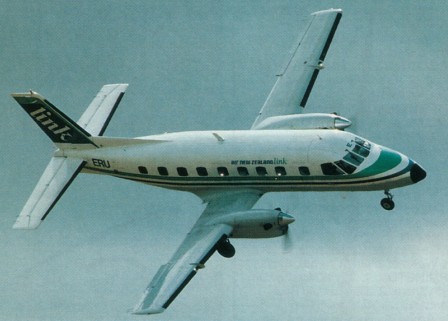
Designated the EMBRAER EMB-120 Brasilia, the prototype flew for the first time on 27 July 1983 and certification was achieved by May 1985. Primary design objective was to carry a full 30-passenger payload for up to three 185km sectors without refuelling. The fuselage has an interior diameter of 2.28m and a cabin height of 1.76m, the aisle being offset by the two-and-one seating arrangement. In cargo configuration the Brasilia has a maximum available cabin volume of 31.1cu.m and is fitted with a cargo door in the starboard side of the rear fuselage. Powered by advanced-technology Pratt & Whitney Canada PW118 turbo-props driving four-bladed Hamilton Standard 14RF-9 propellers, the engines can be ground-run without turning the propellers to facilitate speedier turn-rounds, thus obviating the need to shut down during loading or unloading. The starboard engine can act as an auxiliary power unit, to provide ground electrical power and cabin air-conditioning, but a conventional APU is optional. Composite materials equivalent to ten per cent of the aircraft’s basic empty weight have been used in the construction of the Brasilia. Deliveries began in June 1985 and by 1990 more than 500 orders and options had been recorded, for operators in three continents. In addition to airline use, the EMB-120 Brasilia is in service with the Forca Aerea Brasileira as the C-97 and VIP VC-97. By early 1991 more than 200 had been delivered and the production rate was six per month. The EMB 120ER model is the basis for Embraer’s regional jets.
Embraer EMB 120 Brasilia Engines: 2 x Pratt & Whitney Aircraft of Canada PW118 turboprops, 1342kW / 1,800 shp Props: 4 blade Length: 65 ft 7 in / 20.0 m Height: 20 ft 10 in / 6.4 m Wingspan: 64 ft 11 in / 19.8 m Wing area: 424.102 sqft / 39.4 sq.m Max take off weight: 25357.5 lb / 11500.0 kg Weight empty: 15589.4 lb / 7070.0 kg Max. weight carried: 9768.2 lb / 4430.0 kg Max. speed: 328 kts / 608 km/h Landing speed: 87 kts / 162 km/h Cruising speed: 260 kts / 482 km/h Initial climb rate: 2125.98 ft/min / 10.80 m/s Service ceiling: 29806 ft / 9085 m Wing loading: 59.86 lb/sq.ft / 292.00 kg/sq.m Range: 945 nm / 1750 km / 1087 miles Crew: 2 Payload: 30pax
In 1965 a government initiative to develop a light twin turbo-prop for the Brazilian Air Force led to the formation of Embraer four years later. Though initially this design requirement was for a military transport of only 7-9 seats, it was quickly realised that a substantial civil market also existed. Designed under the guidance of French designer Max Holste, the first of three prototypes, designated YC-95, flew for the first time on 26 October 1968. Though initially still only a 7-9 seater, the final design had the development potential to be stretched to meet the larger 15-seat and upward commuter market. The first EMB.110 flew on August 9, 1972, and deliveries to the Brazilian Air Force began in February 1972.
In early 1973 the first three production EMB-110 Bandeirantres were formally delivered to the Brazilian Air Force. At about this stage an airworthiness certificate was also granted for the 15-seat civil version, the EMB-110C and later that year a further three were delivered to the private domestic airline Trans Brazil. Powered by twin 680 shp Pratt and Whitney PT-6A-27 turboprops with reversible pitch and auto feathering capability, these first Bandeirantes had a range of around a thousand miles and speeds up to 220 knots. Seating was for 15 passengers and two crew. However it was not until 1975 that the Bandeirante achieved its first real breakthrough, when the Brazilian Government established a third-level network. Though in part this was to release the major carriers from the necessity to continue servicing uneconomical routes with large aircraft, the other result was to provide a vastly extended market for the Bandeirante. Over the next few years a number of third-level carriers re-equipped with Embraer’s commuter-liner until some 45 Bandeirantes were in service throughout Brazil on the regional network. Embraer produced the P1 and P2 variants, specifically designed for the export market. Both aircraft engined with the PT6A-34 of 750 shp, and carry up to 21 passengers in three-abreast seating. Each model is identical, except for their door arrangement. The P1 Bandeirante being designed as a quick change airliner with airstairs at the front and big top-hinged cargo door at the rear. The P2 version comes with dual airstairs front and rear, for fast whistlestop turnarounds. Both aircraft are designed for a 30,000 hour life cycle. France issued airworthiness certfication in late ‘77. U.S. and United Kingdom certification followed in August 1978. A cantilever low-wing monoplane, primarily of metal construction, the Bandeirante has a conventional fuselage and tail unit, retractable tricycle landing gear and power provided by two Pratt & Whitney Aircraft of Canada PT6A-34 free-turbine turboprops in wing-mounted nacelles. The two Pratt & Whitney PT6A turboprop engines are flat-rated at 750 shp maximum continuous power at 2,200 propeller rpm. The propellers are three-blade Hartzells with automatic synchronization and full beta-control reversing. Seating varies according to role, but the EMB-110P2 has accommodation for a maximum of 21 passengers. There’s a crew/passenger door at the front and passenger/baggage door at the rear, both on the port side. By the beginning of 1979, 219 Bandeirantes of various models had been sold to some 40 operators around the world. The Bandeirante was available in more than 14 versions, differing in their equipment for specialized missions. The EMB-110B1 Bandeirante was specially developed for aerophotogrammetric missions. Gyro-stabilised camera platform, electrically-operated ventral sliding camera hatch and dark-room cum toilet, all make for a specialised aircraft which can nevertheless still be easily reconverted back to a basic transporter. Other specialist use versions include the EMB-110S1 for geophysical survey. Equipped with the more powerful PT6’s from the P1 and P2 aircraft, and with increased fuel capacity, the S1 has up to nine hours endurance.
Military versions of the EMB.110 are the P1K utility transport and the P1K SAR. The P1K SAR is fully equipped for over-water and overland search and rescue missions, as well as for medevac duties. This has accommodation for observers and a variety of rescue equipment, plus space for up to six stretcher patients. Five are operated by the Brazilian air force under the designation SC-95B. Others are the EC-95B calibration and XC-95B rain research versions.
EMB-111
The EMB-111 was developed as a land based maritime reconnaissance aircraft to meet the needs of the Comando Costeiro (Coastal Command) of the FAéB (Brazilian Air Force) and the first example (2262) flew on 15 August 1977. Based on the EMB 110 Bandeirante, it differed primarily by the in¬troduction of a nose radome for search radar and the addition of wingtip fuel tanks and began to enter service in April 1978. In use with the Brazilian Air Force and the Chilean Navy. Powered by a pair of 750 shp (560 kW) Pratt & Whitney PT6A-34 turboprops, the EMB¬111 features a nose-mounted ALL AN/APS-128 (SPAR-1) search radar, a wing mounted searchlight, tip tanks, wing-tip fuel tanks and wing hard-points for the carriage of weapons. Ordered for the Brazilian air force, which designates them P 95, the first entered service in 11 April 1978 with ten hours endurance. Examples have been supplied also to the Chilean navy and the air force of Gabon.
When production ceased in 1990, 500 Bandeirantes had been ordered and built, variants including the EMB-110, EMB-110/C-95, EMB-110 A/EC 95, EMB-110B/R-95, EMB-110B1, EMB-110C, EMBHOE(J), EMB-110K1/C-95A, EMB-110P, EMB-110P1K and EMB-110S1. The final production versions, progressive developments of earlier aircraft, included the EMB-110P1/C-95B for quick-change passenger/cargo operations; EMB-110P2/C-95C third-level commuter transport; and two versions corresponding to the foregoing for operations at a higher gross weight which have the respective designations EMB-110P1/41 and EMB-110P2/41 A pressurised version designated EMB-110P3, did not proceed.
EMB-110 Engines: UACL, 600shp. TBO: 3500hr. Max cruise: 228mph. Econ cruise: 183mph. Fuel cap: 2920lb. Service ceiling: 25,500ft. SE service ceiling: 10,000ft. ROC: 1700fpm. SE ROC: 300fpm. Min field length: 1803ft. Payload with full fuel: 901lb. Max range: 1109sm. High speed range: 1020sm. Max payload: 1966lb. Range with max payload: 315sm. Seats: 8. Gross wt: 12,410lb. Equipped empty wt: 9380lb. Useful load: 3030lb.
EMB-110P2 Engines: 2 x P&W PT6A-34, 750 shp / 559kW Props: Hartzell 3-blade, 93-in. Seats: 21. Length: 49 ft 6 in / 15.08 m Height: 16 ft 2 in / 4.92 m Wingspan : 50.262 ft / 15.32 m Wing area : 312.156 sqft / 29.0 sq.m Wing aspect ratio: 8.1. Maximum ramp weight: 13,073 lbs. Maximum takeoff weight: 13,007 lbs. Standard empty weight: 7955 lbs. Maximum useful load: 5118 lbs. Zero-fuel weight: 12,015 lbs. Maximum landing weight: 12,566 lbs. Wing loading: 39.9 lbs/sq.ft. Power loading: 8.3 lbs/hp. Maximum usable fuel: 2948 lbs. Best rate of climb: 1660 fpm. Service ceiling: 22,500 ft. Maximum single-engine rate of climb: 428 fpm @ 115 kts. Single-engine climb gradient: 214 ft/nm. Single-engine ceiling: 11,000 ft. Maximum speed: 230 kts. Normal cruise @ 10,000ft: 225 kts. Fuel flow @ normal cruise: 638 pph. Endurance at normal cruise: 4.1 hrs: Stalling speed clean: 92 kts. Stalling speed gear/flaps down: 73 kts. Turbulent-air penetration speed: 169 kts. Takeoff distance (50 ft.): 2,215 ft Landing distance (50 ft.): 2,790 ft. Crew: 2 Passenger capacity: 21
EMB-111 Engines: two 750 shp Pratt & Whitney Aircraft of Canada PT6A 34 turboprop. Wing span: 52 ft 4.5 in (15.96m). Length: 48.655 ft / 14.83 m Height: 15.551 ft / 4.74 m Wing area: 312.156 sq.ft / 29.0 sq.m Max take off weight: 15435.0 lb / 7000.0 kg Cruising speed: 172 kts / 318 km/h Wing loading: 49.41 lbs/sq.ft / 241.0 kg/sq.m Range: 1458 nm / 2700 km Crew: 5
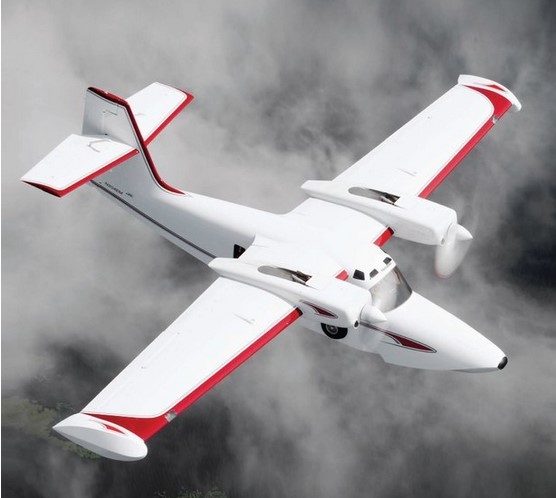
After Ben Ellison reviewed a Widgeon, Ben & Marty Ellison, & Ross Mahon designed the Gewduck around the Widgeon’s shortcomings and, one by one, eliminated them. They started designing the aircraft in 1990. The design involved a hired structural engineer and coaching from David Thurston, and the goal was an airplane that could carry 6 people and 300 lb of cargo.
Gweduck twin engine, six place, 600 hp amphibian. Construction is fibreglass, vinyl-ester resin and carbon fibre. All of the Gweduck’s akins are glass-foam-glass sandwiches of varying thicknesses. The fuselage sides and the wing skins are 3/8 in thick with the closed-cell, polyurethane Last-A-Foam (commonly used in the boating industry).
The landing gear borrows heavily on Grumman concepts with machined billet A-arms pulling the oleo struts up into the fuselage sides and the sealed landing gear wells.
The fuselage basically uses three moulded parts: the sides, the aft bottom, and the forward bottom ahead of the step, which is ¾ inch thick. The entire hull is totally sealed.
The windshield is 3/8 in thick to transfer some of the bow loads up to the top of the hull.
The fuselage is designed to be hosed out with salt water to wash. There is no metal from shoulder-level down, and everything drains into the bilge and is pumped overboard.
The wing has two molded-sandwich skins, top and bottom, and the molded ribs are bonded to the lower skin while it’s still in the mold. The spar is two C-sections back-to back with carbon fibre caps. They bolt the C-sections together and insert 3/8 in aluminium plates between the webs where the wings bolt into the fuselage. Once the top skin is bonded on, the bolts joining the spar halves are superfluous.
The main spar is at 39% and there is a front spar at 10% chord. The leading edge is non-structural for easy repair.
The airfoil is a 15% thick Ribblet, and the ailerons are linked to the flaps, so they go down 15 degrees as the externally hinged Fowler flaps come down 30 degrees.
All of the fuel is in the wings with none in the fuselage. The normal capacity is 200 USG but outboard auxiliary tanks increase the total capacity to 360 USG.
Engines: 2 x Lycoming IO-540, 300 hp Prop: MTV-9, reversible Wing span: 52 ft 6 in Span floats down: 48 ft Height: 10 ft 10 in Empty weight: 4200 lb MAUW: 6000 lb Fuel cap: 200 USG + 180 USG aux Cruise speed: 100 kt Fuel burn econ cruise: 19.5 USG/hr Seats: 6 Power loading: 10 lb / sq.ft Wing laoding: 20 lb/sq.ft
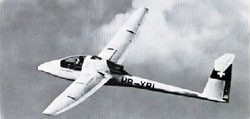
The Prometheus is a production of EFF / Entwicklungsgemeinschaft für Flugzeugbau / Association for the development project and airplane building. It is is a high performance side-by-side glider with two Microturbo 90 kp thrust engines. A self-launching glider, its engines can be stopped and reset running at will.
One was built, registered in 1978 as HB-YBI, and the name Prometheus PV.
With a wingspan of 19.4 m, it weighs 707 kg unladen and 900 at full load. Its radius of action powered flight exceeds 500 Km
In 1980, the manufacturer reported a radio navigation facility and a transponder allowing it to integrate seamlessly restriction in controlled airspace and major airport.
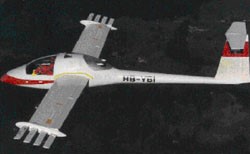
The Prometheus II is linked to an engineer in Switzerland, Ulrich La Roche , who sought to reproduce with WINGGRID, some aerodynamic effect on birds. This work began in the first wind tunnel at Emmen between 1993 and 1994. In 1996, an encounter with Prof . Dr. – Ing. Hans -Reinhard Meyer- Piening would offer the opportunity to validate the concept of a real WINGGRID demonstrator.
In 1997, the Prometheus was chosen for this experiment. To this end, the size was reduced to 12 m. They hoped a glide ratio of 15 to 17, but experience showed that it was 25. The Prometheus II is a high performance glider with a fineness approaching 40, but with a high wing loading.
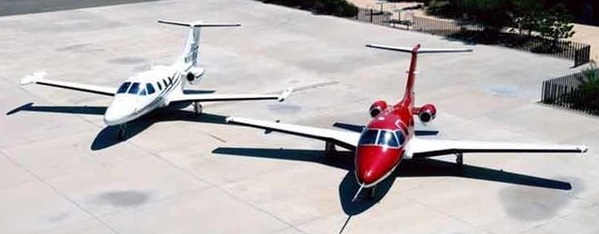
One Aviation successfully flew an aircraft carrying the proof of concept wing shape of the new EA700 Project Canada from the company’s Albuquerque headquarters.
The first flight lasted 1.3 hours and the aircraft, N990NE climbed as high as 15,000 feet to evaluate aircraft handling qualities with the landing gear up down, as well as retracted and also in all flap configurations. Jerry Chambers, Director, Flight Test/Chief Test Pilot was PIC for the flight.
The modified wing included the four-foot wing span extension with the original EA550’s tip tanks removed to match the shape of the wing to be used on the new EA700 still under development. The final shaping of the wing tips for the EA700 was not included on this test aircraft although the wing did include a reshaped inboard wing airfoil and planform.
The flight used a modified EA550 airframe that retained the original fuselage, engines and stabilizers. The production EA700 will feature a 14-inch cabin stretch making room for a fourth cabin window, a Garmin G3000 cockpit and additional fuel capacity. One Aviation is the parent company to Eclipse Aerospace.



 All Aero