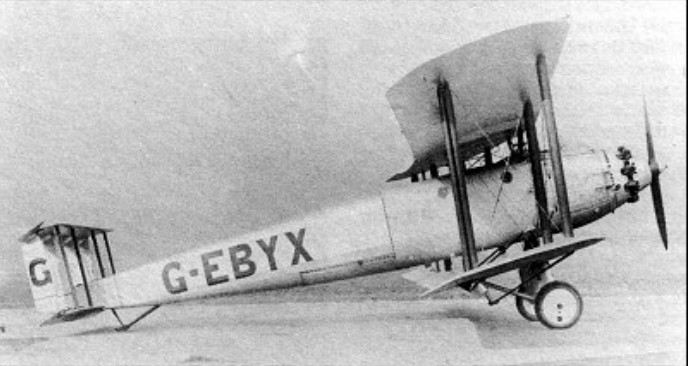
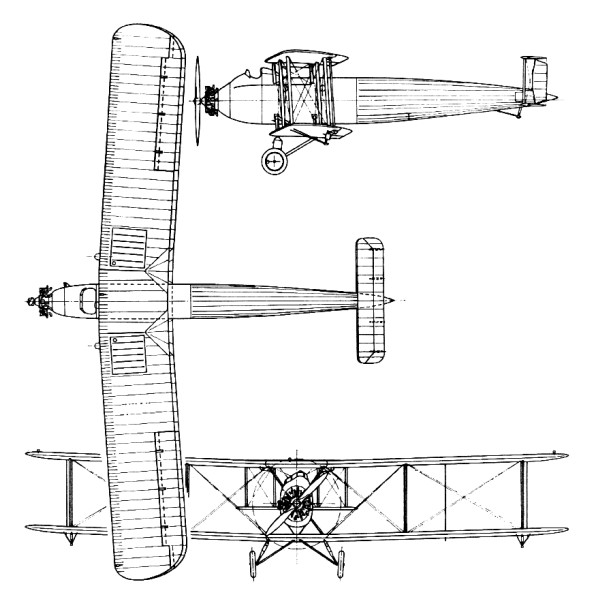
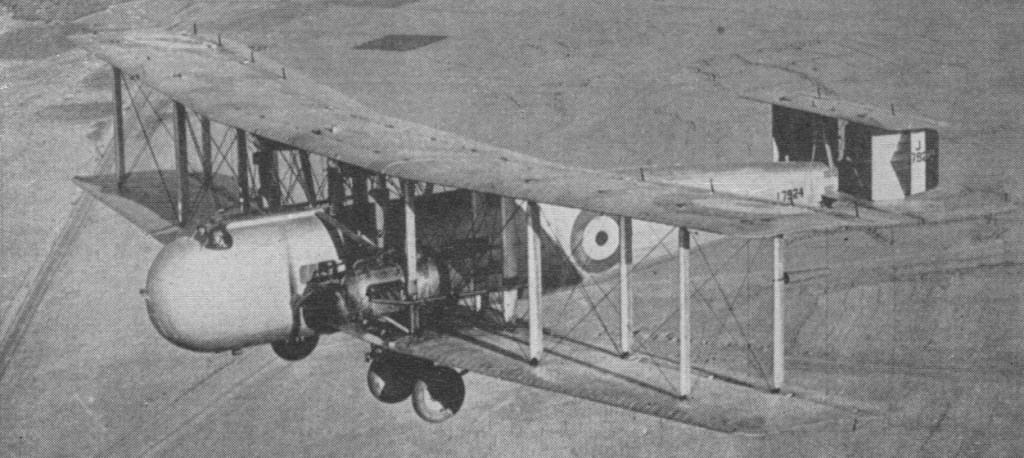
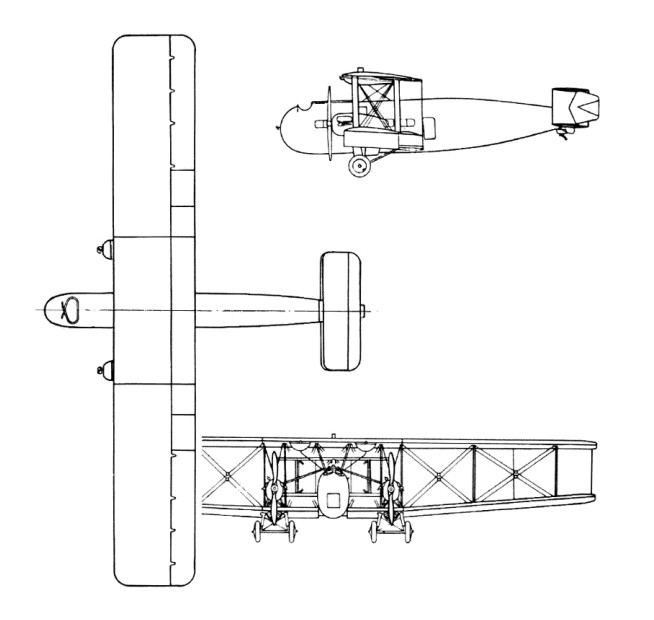
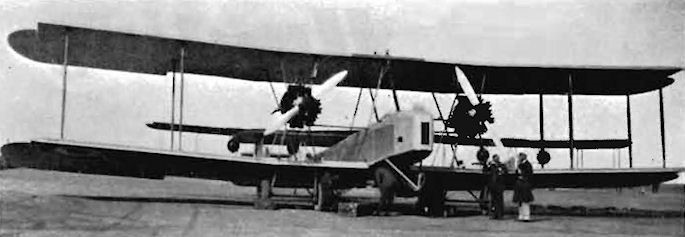
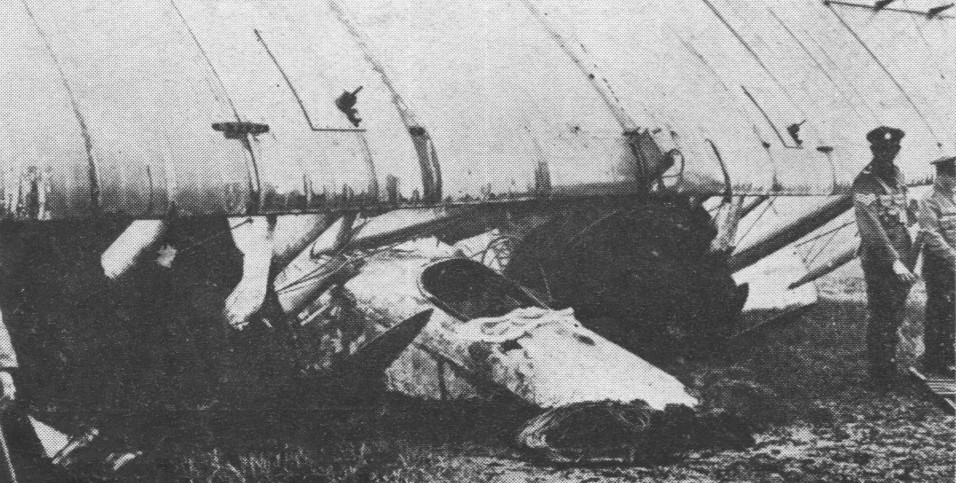
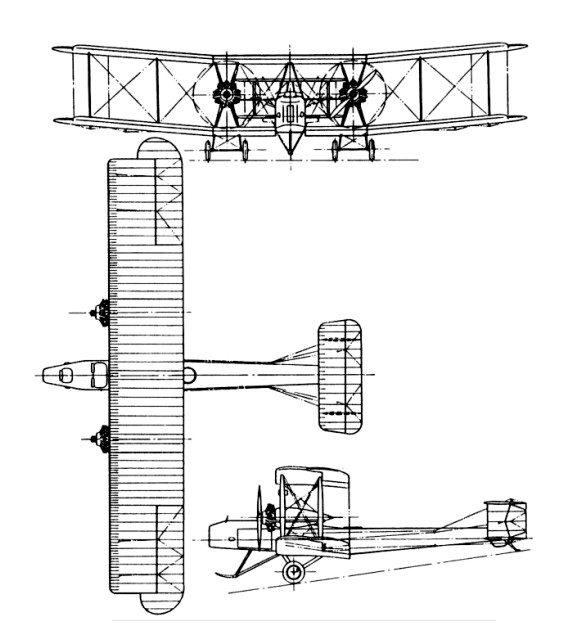
The Vickers Type 134 Vellore Mk I was a large equal-span biplane intended as a freight carrier. Powered by a 391kW Bristol Jupiter IX radial engine, it had an open cockpit forward of the wings seating two side-by-side, with behind and below them a large cargo hold. It was then re-engined with the Armstrong Siddeley Jaguar VI in an England-Australia flight in 1929 that terminated in the aircraft being written off in a crash landing. The designation Vellore Mk II was not used, but two twin-engined versions were built as the Type 172 Vellore Mk III and Type 173 Vellore Mk IV with 391kW Bristol Jupiter XIF radials. Final derivation of the design was the single Type 212 Vellox intended as a civil transport with cabin accommodation for a steward and 10 passengers. Powered by two 447kW Bristol Pegasus IM3 radial engines and first flown on 23 January 1934, it was acquired by Imperial Airways but used only as a freighter.
Vellore I Max take-off weight: 4309 kg / 9500 lb Wingspan: 23.16 m / 76 ft 0 in Max. speed: 183 km/h / 114 mph
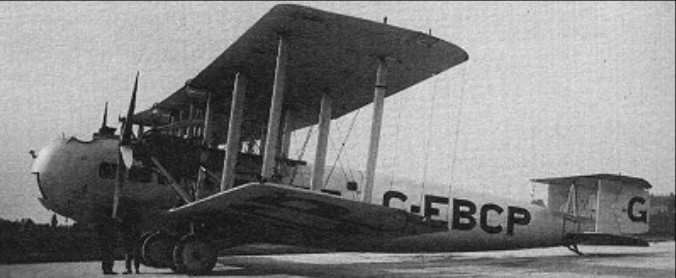
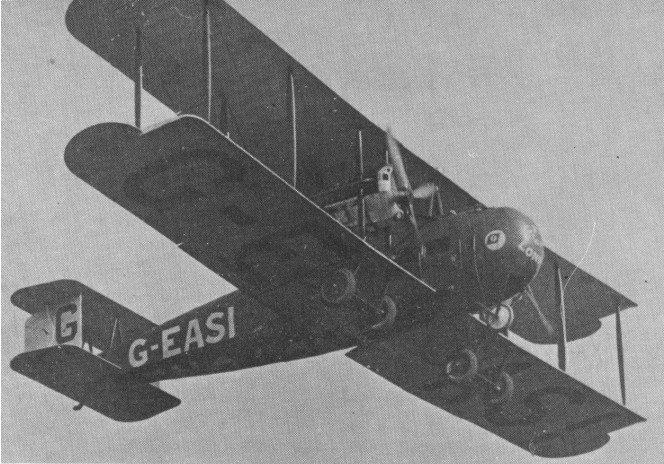
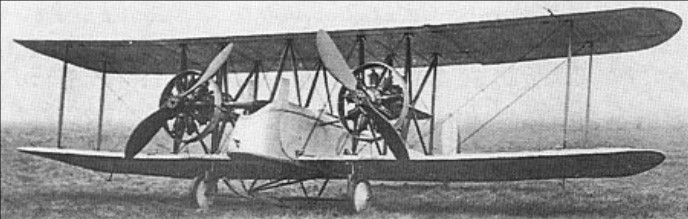
A one-off civil variant designated Type 72 Vanguard, accommodating 23 passengers and powered by two Napier Lion engines (later 485kW Rolls-Royce Condor III engines as the Type 103 Vanguard) entered service with Imperial Airways in May 1928. It was destroyed in an accident in late 1928 when being tested after modification of the tail unit as the Type 170 Vanguard.
Type 103 Vanguard Engines: 2 x Rolls-Royce Condor III, 485 kW Passengers: 23
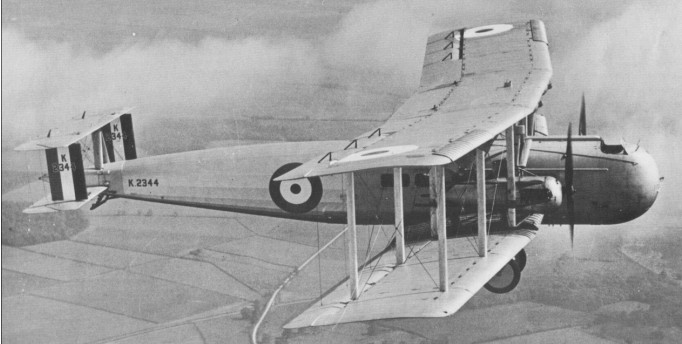
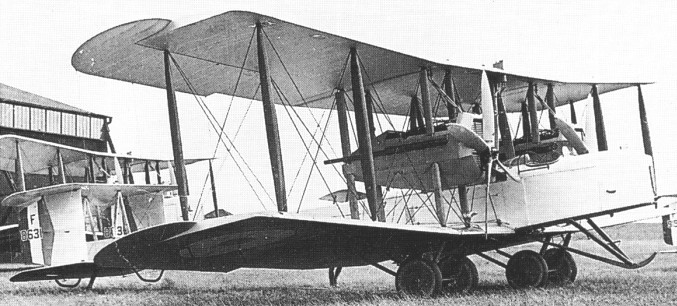
The Victoria 22-troop transport was built between the Vernon and Valentia. Production for the RAF totalled 94 aircraft. Entering service in 1926, it was powered by two 425kW Napier Lion engines. A commercial counterpart, the Vanguard, was less successful.
The Victoria is best remembered for its role during the Kabul airlift, when people and baggage were transported out of Kabul during tribal disturbances.
The Vernon was a development of the Vimy/ Vimy Commercial, having much the same wing plan, and being powered by the same type of engine the 375 h.p. Rolls Royee Eagle VIII. First flying in 1921, instead of a bomber style of fuselage, with gun rings fore and aft, the Vernon carried no defensive armament, and had a spacious hull designed to carry troops and stores. It was, however, fitted with bomb racks and could be used as a bomber. The Vernon served from 1922 26 with Nos 45 and 70 Squadrons of the RAF in India, Cyprus and Iraq. Apart from its role in the evacuation of sick British troops from Iraq in 1922, the Vernon was the chief transport aircraft used on the celebrated Cairo Baghdad air mail service in the mid 1920s. In 1923, when Squadron Leader A. T. Harris commanded the Squadron, he cut away a hole in the nose and fitted a high altitude drift bomb sight. This, with a bomb aimer using the prone position, made the Vernon a very fine bomber indeed, capable of far greater accuracy than any other contemporary aircraft. The maker’s figure for the maximum all up weight of the Vernon was 12,000 lb, but this had been increased by Middle East Headquarters to 12,500 lb. In order to give them sufficient range to make the desert crossing safely from Ziza to Ramadi, a cylindrical tank holding 150 gallons temporarily fitted inside the hull.
Vernon Mk I aircraft (20 built) differed little from the Vimy Commercial, but the Vernon Mk II (25) introduced 336kW Napier Lion II engines and the Vernon Mk III (10) had Lion III engines, increased fuel tankage and oleo-pneumatic landing gear. The Vernon was superseded by the Victoria from 1927.
Engines: 2 x 375 hp Rolls Royce Eagle VIII (later 450 hp Napier Lion II) Wing span: 68 ft 1 in (20.75 m) Length: 42 ft 8 in (13.00 m) Gross weight: 12544 lb (5,690 kg) Max speed: 118 mph (190 km/h) at S/ L with Lion engines Accommodation: Crew of 3 plus 11 passengers Typical range: 320 miles (515 km) at 80 mph (128 km/h)
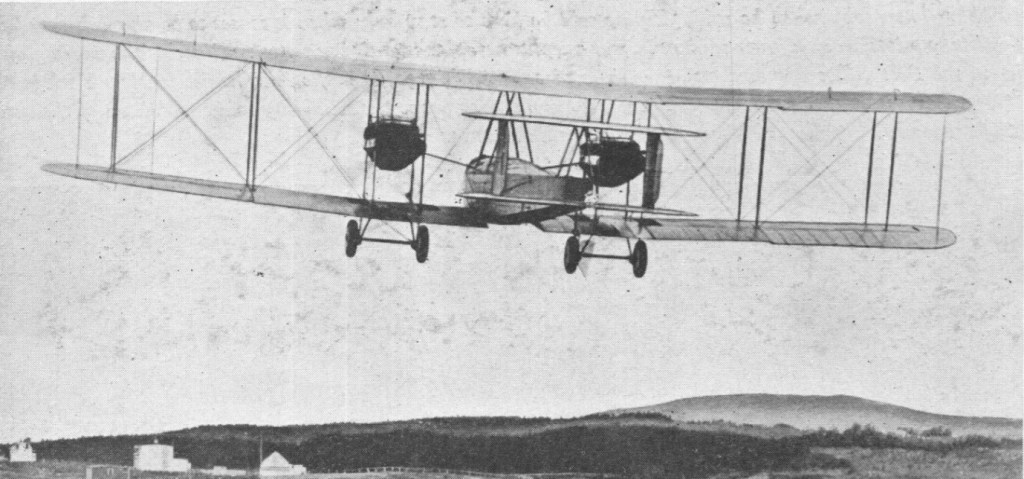
Design of the Vickers F.B.27 was initiated in 1917 to meet the requirement to provide bomber aircraft able to attack strategic targets in Germany from bases in Britain. The Vimy was one of three new-generation bombers with which the RAF planned to take the air war to Germany in 1919. Such aircraft as the de Havilland D.H.10 Amiens and Handley Page V/1500 were also built.
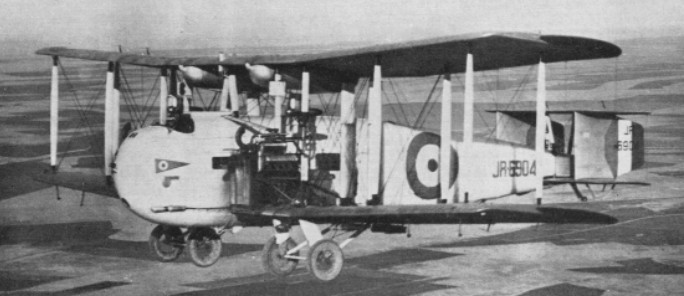
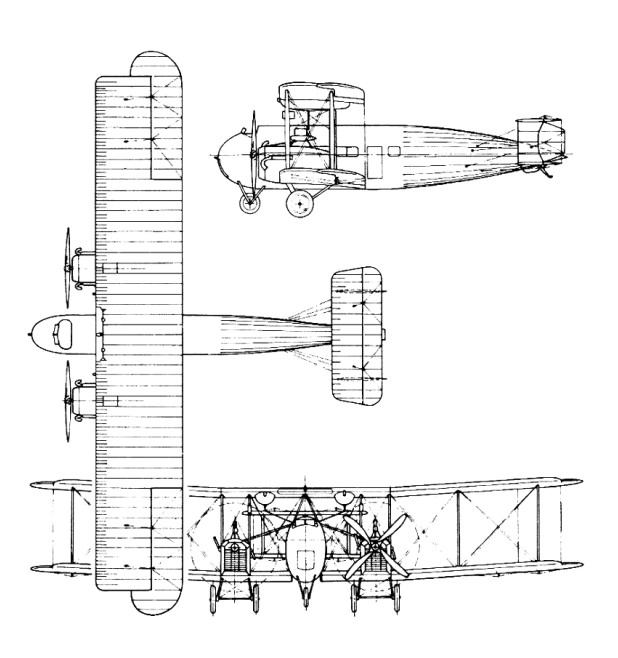
The F.B.27 was a three-bay biplane of conventional construction, with a biplane tail unit which had twin fins and rudders. The wing centre-section – almost one-third span – had the fuselage at its centre with large struts supporting the upper wing. At the outer ends of this centre-section the engines were mounted midway between the upper and lower wings. Two twin-wheel main landing-gear units were mounted beneath the lower wing, one directly below each engine. Outboard of this centre-section the wings had dihedral.
The largest aircraft then built by Vickers, it posed many construction problems; but despite this the first prototype, B9952, flew on 30 November 1917 – little more than four months after the design had been started. This aircraft was powered by two 149kW Hispano-Suiza engines (subsequently re-engined with 194kW Salmsons). Three further prototypes followed, powered respectively with 194kW Sunbeam Maoris, 223kW Fiat A-12s and 268kW Rolls-Royce Eagle VIIIs. It was the latter installation which was selected for production aircraft.
With the introduction of official aircraft names in 1918, the F.B.27 became the Vimy. But only a single example had been placed on an operational footing before the Armistice, which meant that none were used operationally in World War I.
The main production version was the Vimy Mk IV with Eagle VIII engines. Large contracts were cancelled at the end of the war but total Vimy Mk IV production amounted to 240, the last batch of 30 being ordered in 1925. The type entered service in July 1919 with No.58 Squadron in Egypt, home to another three squadrons; the type was retired from Middle Eastern service in August 1926 after operating the Cairo-Baghdad air mail service.
About 300 Vimy IVs of the standard production version were built, each with two 360 hp Rolls-¬Royce Eagle VIII engines. They carried a crew of three and 2476 lb of bombs, and were armed with twin Lewis machine guns in nose and midships positions.
Five home-based squadrons operated the Vimy, which was replaced as a first-line bomber by the Virginia during 1924 and 1925 but remained operational with No. 502 Squadron until January 1929.
Conversions carried 10 passengers. A small number of commercial and ambulance aircraft were built, known simply as Commercial Vimys. The Commercial was fundamentally the same as the Vimy bomber, with the same wings, engine and tail, but had a rounded fuselage, capable of taking up to ten passengers the two flying crew braving the elements in a high set open cockpit in the nose. G EAAV was the prototype Vimy Commercial, having first flown (as K107) on April 13, 1919.
A number of Vimys were used for flying and parachute training duties. Revived as an advanced instructional aircraft for training pilots in multi-engined flying. For this purpose Jupiter VI or Jaguar engines were fitted in about 80 aircraft.
No. 4 FTS Armstrong-Siddeley Jaguar powered Vimy at Abu Sueir, Egypt, in 1930
The Vimy is remembered especially in aviation history for the post-war long-distance flights which pointed the way to the air lanes that would link the world. First was the flight by Capt John Alcock and Lt Arthur Whitten-Brown across the North Atlantic, from St John’s, Newfoundland, to Clifden, Eire, during 14-15 June 1919 in a time of 16 hours 27 minutes.
Take-off from St.Johns, Newfoundland
Landing in a bog at Clifden, Ireland, and almost over-turned.
Next was the England-Australia flight of the brothers Capt Ross and Lt Keith Smith, together with Sgts Bennett and Shiers. Taking off from Hounslow (not far from today’s Heathrow Airport) on 12 November 1919, they landed safely at Darwin on 10 December 1919 in an elapsed flying time of 135 hours 55 minutes. Last of the trio of great Vimy flights was an attempt by Lt-Col Pierre van Ryneveld and Sqn Ldr Christopher J. Q. Brand of the South African Air Force to link London and Cape Town. On 4 February 1920 they took off from Brooklands, unfortunately making a crash landing between Cairo and Khartoum. Loaned a second Vimy by an RAF unit in Egypt, they continued to Bulawayo, Southern Rhodesia, where they failed to get airborne because of ‘hot and high’ conditions. They finally completed their flight to Cape Town in a third borrowed aircraft (a de Havilland D.H.9), arriving at their destination on 20 March 1920. They, like Alcock and Brown and the Ross brothers, were awarded knighthoods for their achievement.
In 1919, the Chinese government ordered perhaps 100 (or maybe 40) Vickers Vimy transports to be used to establish passenger service in China. Most remained in their shipping crates; only seven were put into use.
Replicas Vintage Aircraft & Flying Association Vimy
Engines: 2 x 360hp Rolls Royce VIII Length 43.5 ft (13.2 m) Wing span 67.1 ft (20.5 m) Height: 15 ft. 7.5 in Wing area 1318 sq. ft Weight loaded: 10885 lb Weight empty 7,100 lb (3,220 kg) Crew: 4 Armament: Two machine guns, one each in nose and aft cockpits Bomb load: 18 x 112 lb (50 kg) bombs 2 x 230 lb (104 kg) bombs Max speed: 89 kts / 103 mph (166 kph) Ceiling: 7,000 ft (2,100 m) Range: 1,000 miles (1,600 km) Range max. weight: 391 nm / 725 km Initial climb rate: 295.28 ft/min / 1.5 m/s
Vimy Mk II Engines: 2 x Rolls-Royce Eagle VIII, 268kW Max take-off weight: 4937 kg / 10884 lb Empty weight: 3222 kg / 7103 lb Wingspan: 20.75 m / 68 ft 1 in Length: 13.27 m / 44 ft 6 in Height: 4.76 m / 16 ft 7 in Wing area: 122.44 sq.m / 1317.93 sq ft Max. speed: 166 km/h / 103 mph Ceiling: 2135 m / 7000 ft Range w/max.fuel: 1448 km / 900 miles Armament: 2 x 7.7mm machine-guns, 1123kg of bombs Crew: 3
Vimy Mk IV Type: three-seat heavy night bomber Span: 20.75m (68 ft 1 in) Length: 13.27m (43ft 6.5 in) Powerplant: 2 x Rolls-Royce Eagle VIII, 268kW (360 hp) Armament: 2 x 7.7-mm (0.303-in) machine-guns Bombload: 1123 kg (2,476 lb) MTOW: 5647 kg (12,500 lb) Max speed: 103 mph at 6,500 ft Operational range: about 900 miles
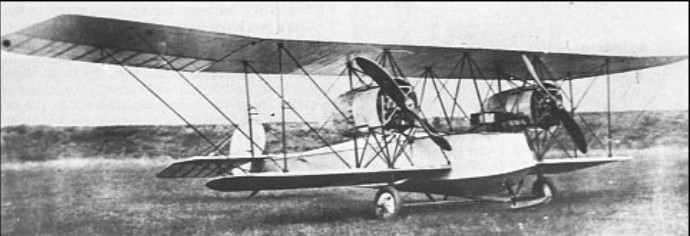
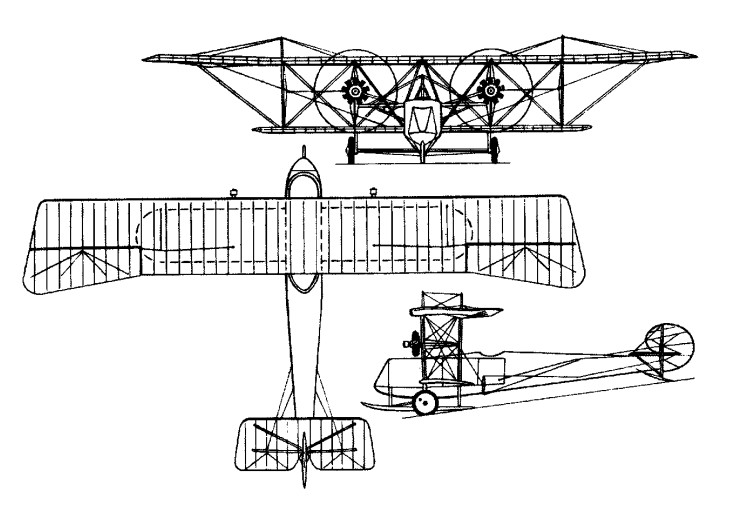
Although possessing a superficial resemblance to the F.B.7, the F.B.8, designed in the autumn of 1915 by Rex K Pierson, was a very much smaller, lightly-armed two-seat fighter carrying only a single 7.7mm Lewis gun as armament. Powered by two 100hp Gnome Monosoupape rotaries, the F.B.8 began flight testing in November 1915, and performance proved to be good. The gunner was accommodated in the extreme nose and the pilot was seated beneath the trailing edge of the upper wing. From the outset, it was obvious that the armament carried by the F.B.8 could equally well be accommodated by a smaller, single-engined aircraft, but it had been hoped that an appreciably higher performance could be obtained by doubling the power available. Insufficient attention had been paid to the drag of such an aircraft, however, and performance proved lower than had been anticipated. Furthermore, the aircraft was insufficiently manoeuvrable for fighting duties and was discontinued.
Max take-off weight: 1225 kg / 2701 lb Empty weight: 835 kg / 1841 lb Wingspan: 11.68 m / 38 ft 4 in Length: 8.58 m / 28 ft 2 in Height: 3.00 m / 10 ft 10 in Wing area: 43.48 sq.m / 468.01 sq ft Max. speed: 158 km/h / 98 mph Ceiling: 4270 m / 14000 ft
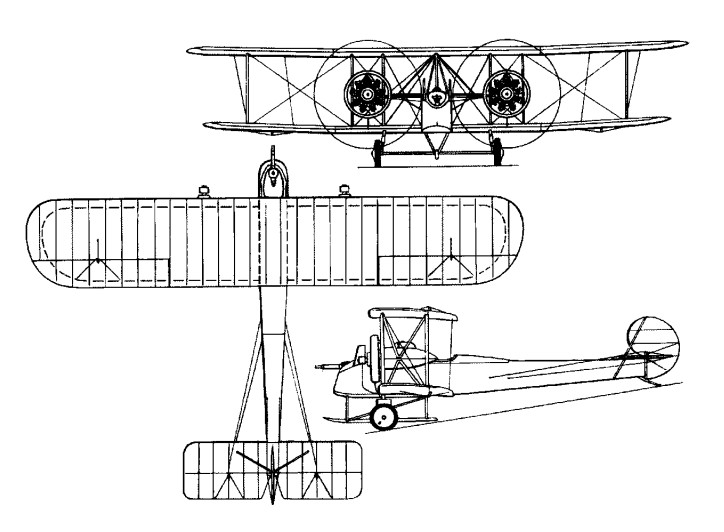
On the outbreak of World War I, Vickers engaged R L Howard-Flanders to design a twin-engined fighting aeroplane capable of carrying a Vickers one-pounder quick-firing gun with armour protection for the gunner. Powered by two 100hp Gnome Monosoupape nine-cylinder rotaries mounted overhung between the main-planes and suspended on simple steel-tube open framework, the prototype was designated E.F.B.7 and was flown for the first time in August 1915. An ungainly unequal-span biplane with two bays of struts, the E.F.B.7 accommodated the pilot aft of the mainplanes, several feet from the gunner in the extreme nose. The substantial gun mount was bolted to the centre of the forward cockpit floor, the gunner’s seat being attached to the mount with which it traversed – sufficient room was provided in the cockpit to permit gun and gunner to turn through a full 360 degrees.
The E.F.B.7 was one of the first twin-engined military aircraft to fly successfully, and an order for 12 production F.B.7s was placed on 20 August 1915, immediately after the initial flight tests of the E.F.B.7, but, in the event, the series model was to differ in a number of major respects. The distance separating the two-man crew was found unacceptable and the pilot was brought forward of the wings in sensible proximity to the gunner, the structure of the upper wing was completely redesigned and the fuselage was revised in cross section, becoming rectangular throughout rather than having an inverted triangular cross section aft. Owing to a shortage of Gnome rotaries, the first production aircraft was fitted with 80hp Renault eight-cylinder air-cooled engines as the F.B.7A, the engine change resulting in a major loss of performance. As the F.B.7A possessed no operational usefulness, Vickers persuaded the War Office to cancel the contract for the remaining aircraft (which were being built by A Darracq & Company at Fulham under subcontract).
Max take-off weight: 1450 kg / 3197 lb Empty weight: 969 kg / 2136 lb Wingspan: 18.17 m / 60 ft 7 in Length: 10.97 m / 36 ft 0 in Wing area: 59.46 sq.m / 640.02 sq ft Max. speed: 121 km/h / 75 mph Ceiling: 2745 m / 9000 ft
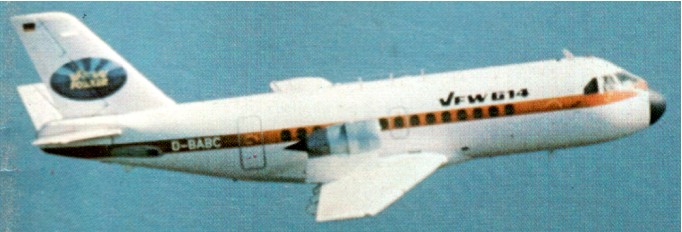
The VFW 614 twin-turbofan shorthaul transport was first flown in July 1971. German certification had been gained on 23 August 1974 and the first production aircraft had flown on 28 April 1975, but only 19 aircraft (including prototypes) were completed, and most ended up in storage at Bremen after very short working lives. Production was halted in 1978.
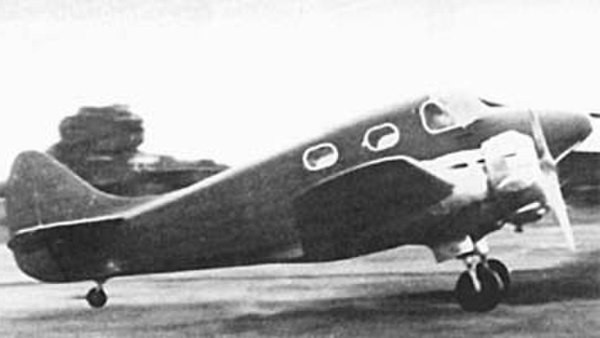
The VEF JDA-10M was a Latvian twin-engine, multi-purpose aircraft built in 1939 by VEF. It remains the only twin-engine aircraft ever built in Latvia. The builder of JDA-10M was American-Latvian engineer Jānis D. Akermanis (John.D.Akerman), a professor at the University of Minnesota.
Construction started in 1937, but the first flight of the JDA-10M was in September 1939. After the beginning of the Second World War it was planned to transform airplane into a light bomber for the military.
Since early 1960s Vecto Instrument Corp marketed Vecto Geronimo, an uprated-engine and refined airframe/equipment version of standard Piper Apache. About 31 conversions completed by spring 1965; after death of Vecto’s owner later that year, assets purchased by Geronimo.

 All Aero