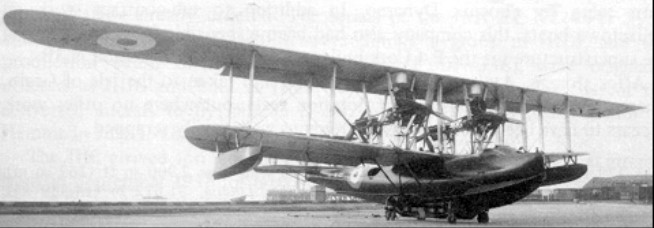
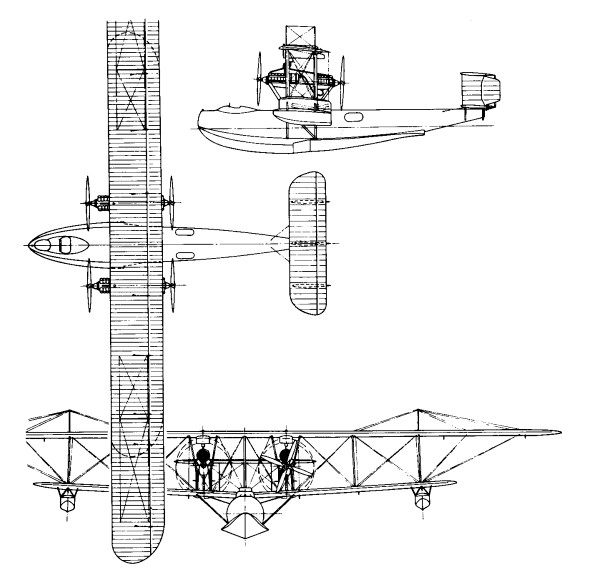
The Fairey N.4 was a 1920s British five-seat long range reconnaissance flying boat. Designed and built by the Fairey Aviation Company to meet an Admiralty requirement for a very large four-engined reconnaissance aircraft, it was the world’s biggest flying boat when it first flew in 1923. The first N.4 (named Atalanta) first flew in 1923 powered by four 650 hp (485 kW) Rolls-Royce Condor IA piston engines. The hull had been built in Southampton (by boat builders) and delivered to Lytham St. Annes for assembly and the complete aircraft was then dismantled and taken by road to the Isle of Grain for its first flight. The second N.4 Mk II (named Titania) included improvements and later variant Condor III engines. Titania was not flown straight away and was stored, not flying until 1925.
Engines: 4 × Rolls-Royce Condor III, 650 hp (485 kW) each Length: 60 ft 0 in (20.12 m) Wingspan: 139 ft 0 in (42.37 m) Wing area: 2900 ft2 (269.41 m2) Gross weight: 31612 lb (14339 kg) Maximum speed: 115 mph (185 km/h) Endurance: 9 hours 0 min Service ceiling: 14,100 ft (4300 m) Crew: 5 Armament 0.303in (7.7mm) Lewis machine-gun (in nose and beam positions) 1000lb (454kg) of bombs
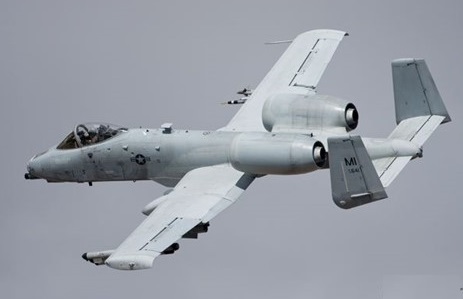
Produced in reply to a specification of 1967, which called for a hard-hitting close-support aircraft, the Fairchild A-10A Thunderbolt II (YA-10A) first flew on 10 May 1972 and was selected by the USAF in preference to the Northrop A-9 on 18 January 1973 after a competitive flyoff, and received a contract for six A-10A aircraft, the first of which flew 15 February 1975. The Thunderbolt’s appearance derives from the care taken to enhance its survival prospects over the battlefield and incorporate maximum fire-power. Absorbing much of the centre fuselage is a GAU-8/A Avenger seven-barrel 30-mm cannon, the muzzle protruding slightly beneath the nose, which can be fired at the rates of 2,100 or 4,200 rounds per minute. The engine location is considered optimum for minimizing hits by ground-fire, and has the additional advantage that the wing and tail mask the infra-red emissions of exhaust gases and therefore affords some protection against heat-seeking SAMs. All of the A-10’s glass is bulletproof and the cockpit itself is surrounded by a heavy tub of titanium. Titanium armor protects both the pilot and critical areas of the flight control system. This titanium “bathtub” can survive direct hits from armor-piercing and high explosive projectiles up to 37 mm in size. The front windscreen can withstand up to a 23 mm projectile. Fire retardant foam protects the fuel cells which are also self sealing in the event of puncture. The airframe has numerous constructional features resistant to battle-damage or conducive to swift repair, such as interchangeable (left or right) flaps, fuselage components, rudders, elevators and main landing gear legs. There are two primary hydraulic systems, each with manual back-up, and the landing gear can be extended under gravity if necessary. Well protected electronically by AN/ALQ-119 jamming pods, plus an AN/ALE-40 chaff and flare dispenser, the Thunderbolt carries a Pave Penny laser designation pod on a pylon to the right of the forward fuselage for accurate marking.
The first production A 10A Thunderbolt II flying on 21 October 1975. Entering service in early 1977, these single seat aircraft are powered by two 9,065 lb thrust General Electric TF34 GE 100 turbofan engines.
Armament comprises a seven barrel, 30 mm gun mounted in the nose, plus a maximum external load of 16,000 lb (7,257 kg) of weapons including air to surface missiles. The General Electric Aircraft Armament Subsystem (30 millimeter Gun System) is located in the forward nose section of the fuselage. The gun system consists of the 30 mm Gatling gun mechanism, double-ended link-less ammunition feed, storage assembly and hydraulic drive system. The General Electric GAU-8/A 30 mm seven barrel cannon, specifically designed for the A-10, provides unmatched tank killing capability. The gun fires armor-piercing projectiles capable of penetrating heavy armor. It also fires a high explosive incendiary round, which is extremely effective against soft skinned targets like trucks. The cannon fires at a rate of 4,200 rounds per minute.
Features of the design are very advanced avionics to enhance operational capability and provision of titanium 737 mph armour for the entire cockpit area.
Avionics equipment includes communications, inertial navigation systems, computer-aided fire control and weapons delivery systems, electronic countermeasures, target penetration aids and self-protection systems. The A-10 employs both electronic and infrared countermeasures against enemy weapons systems. The weapons delivery system incorporates a heads-up display that provides the pilot with references for flight control and weapons employment. The weapons delivery systems include head-up displays that indicate airspeed, altitude and dive angle on the windscreen, a low altitude safety and targeting enhancement system (LASTE) which provides constantly computing impact point freefall ordnance delivery; and Pave Penny laser-tracking pods under the fuselage.
Development of a night/adverse weather (N/AW) two seat version has been initiated, the prototype first flying in 1979. This is intended to allow the pilot to concentrate on control of the aircraft under night or adverse weather conditions, the second seat occupied by a weapons system officer to handle the electronics. The private-venture Thunderbolt N/AW (Night/Adverse Weather) was offered without success.
The A-10/OA-10 have excellent maneuverability at low air speeds and altitude, and are highly accurate weapons-delivery platforms. The A-10 has half the turning radius of the US Air Force’s other primary CAS aircraft, the F-16. After initially leaving a target, the A-10 can turn around and hit the same target again, all in around 7 seconds. Due to its large combat radius, the Thunderbolt II can loiter for extended periods of time, allowing for the coordination required to employ within yards of friendly forces. They can operate under 1,000-foot ceilings (300 meters) with 1.5-mile (2.4 kilometers) visibility. Using night vision goggles, A-10/ OA-10 pilots can conduct their missions during darkness.
The A-10 is capable of sustaining operations on unimproved airfields and the A-10’s rapid re-fueling and re-arming capability allows it to operate from forward bases close to the front lines. It is also capable of refueling in the air.
Altogether the USAF has received 713 aircraft, including A-10B dual control-trainers. Modelled on the A-10N/AW evaluator, the A-10B was in production featuring a second cockpit and taller fins.
The USAFs 33rd Tactical Fighter Training Squadron at Davis-Monthan AFB, Arizona, received its first Fairchild A 10A Thunderbolt IIs in February 1976.
The first combat-ready A-10A wing was the 345th Tactical Fighter Wing, based at Myrtle Beach, South Carolina, to which deliveries began on 20 March 1977. The last of 713 A-10s was handed over to the USAF on 20 March 1984. This was the end of aircraft manufacturing in Hagerstown and Washington County. A-10s were fitted with AIM-9L Sidewinder AAM dual rail adaptors, to allow four missiles to be carried in pairs.
The primary mission of the OA-10 is to act as forward air controller to coordinate and direct friendly air forces in support of land forces. Northrop Grumman acquired the A-10 programme from Fairchild in 1987. In 2000 preparations for the Precision Engagement Program (PEP) upgrade program began. PEP gives the A-10 the capability of deploying precision-guided weapons. The upgrade is carried out in two phases, called Spiral One and Spiral Two. The aircraft is designated A-10C. Between July and October 2004 the first A-10C underwent ground and instrumentation tests prior to the first flight in November 2004. In total 13 A-10C aircraft were for flight testing. The entire A-10A fleet is expected to receive the PEP upgrade. The last aircraft due to be modified before the summer of 2009.
Fairchild A-10A Thunderbolt II Engine: 2 x General Electric TF34-GE 100 turbofan, 9065 lb / 4112-kg Wingspan: 57 ft 6 in / 17.53 m Length: 53 ft 4 in / 16.25 m Height: 4.47m / 14 ft 8 in Wing area: 47 sq.m / 506.0 sq ft Empty equipped weight: 11,321 kg / 24,959 lb MTOW: 50,000 lb / 22,680 kg Wing load : 96.97 lb/sq.ft / 473.0 kg/sq.m Max speed: 439 mph / 706 kph Combat limit: 704 km/h (438 mph) at 1525 m (5,000 ft) Service ceiling 13,636m / 45,000 ft Initial ROC: 1830 m / min / 6,000 fpm Ferry range: 2454 sm / 3949 km Combat radius: 930+ km T/O run (to 15m): 780 m Ldg run (from 15m): 715 m Armament: 1 x 30 mm GAU-8/A Avenger seven-barrel cannon (1174 rds) Pylons: 11 up to 7,258 kg / 16,000 lb Fuel internal: 6225 lt. Air refuel: Yes. Seats: 1
The original Fokker F-27 Friendship was built in Holland. Fairchild has built the F-27 under license from Fokker since 1958. The first F-27 models had a maximum gross weight of 40,500 pounds and seated 44 passengers. Power was supplied by twin 1,720 shp Dart turboprops. When Fairchild merged with Hiller Aircraft, the designation of the airplane was changed to FH-227 and the fuselage was stretched by six feet, giving increased cabin space for passengers and freight. The stretched airliner will accommodate up to 52 passengers. In 1960, power was increased to 2,105 shp. The stretched version was fitted with 2,250 shp engines, and ultimately the FH-227 received a redesigned windshield, stronger landing gear, strengthened rear fuselage, heavier wing skin, propellers of increased diameter and a more powerful 2,300 shp Dart turboprop. Fairchild discontinued building the FH-227 under license from Fokker in 1975.
Engines; 2 x Rolls-Royce RDa-7 Dart Mk.532, 1655kW / 2,300 shp Wingspan; 29.0 m / 95 ft 2 in Length; 25.5 m / 83 ft 8 in Height; 8.4 m / 27 ft 7 in Wing area; 70.0 sq.m / 753.47 sq ft Take-off weight; 20640 kg / 45504 lb Empty weight; 12478 kg / 27509 lb Fuel capacity: 1,364 lb Max. Speed; 483 km/h / 300 mph Top cruise: 270 mph Stall speed: 87 mph Initial climb rate: 1,560 fpm Service ceiling: 28,000 ft Takeoff run: 3,950 ft Landing roll: 4,100 ft Range w/max.fuel; 2500 km / 1553 miles Range w/max.payload; 800 km / 497 miles Seats: 44-52 Crew; 2-3
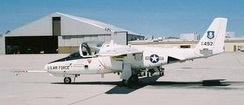
In 1977, the USAF began to reflect the launch of a program to find a successor to the Cessna T -37B trainer. At the end of 1981, a proposal for participation for a training aircraft of a next generation (NGT / Next Generation Trainer) was sent to Cessna, Fairchild Republic, General Dynamics, Rockwell International and Vought (associated with the German constructor Messerschmitt Bolkow Blohm). The specification was based on twin-turbofan, pressurised cockpit and to have a lower weight at T37. In terms of performance, the Air Force wanted an aircraft capable of a speed of 556 Km / h at 7620 m, and capable of taking off from a runway of 1524 m.
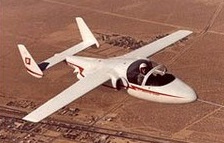
Designed as the Rutan 73, Fairchild Republic Company built a piloted 0.62 scale model of its New Generation Trainer design for the USAF, with the purpose of validating the handling qualities, control surface hinge moments, tail loads and spin characteristics of the full size aircraft.
Powered by a pair of 220 lb st (100 kgp) Microturbo TRS 18 turbojets, the scale aircraft was built by Rutan Aircraft under subcontract from Ames Industrial Corp on behalf of Fairchild and is largely of composite construction.
It was first flown at Mojave, California, on 10 September 1981 with Richard Rutan at the controls, and was expected to make about 35 flights by the end of November before being used for wind tunnel tests.
On July 2, 1982, Fairchild Republic was named the winner of the NGT program, which took the name of Thunder Piglet.
An initial contract was for two T- 46A (FSD) Nos. 84-0492 and 84-0493, 2 airframes for static tests, and an option for 54 of a planned total of 650. Deliveries were scheduled to begin in 1987 with a closure in March 1992.
The flight test program, and the development of pre-types took much longer than expected and led to the cancellation of the program March 13, 1987.
The prototype T-46 first flew in July 1986, but this was largely an academic move as the USAF had terminated the T 46 programme the previous March.
NGT Engines: 2 x Microturbo TRS18 Wingspan: 6.70 m Empty weight: 1,000 lb (454 kg) Gross weight: 1,600 lb (726 kg)
T 46 Engines: 2 x Garrett F109 GA 100 turbo fans, 1,330 lb thrust
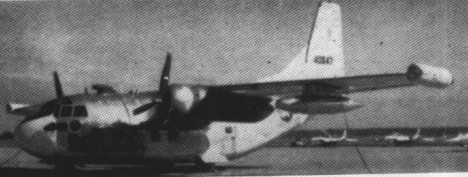
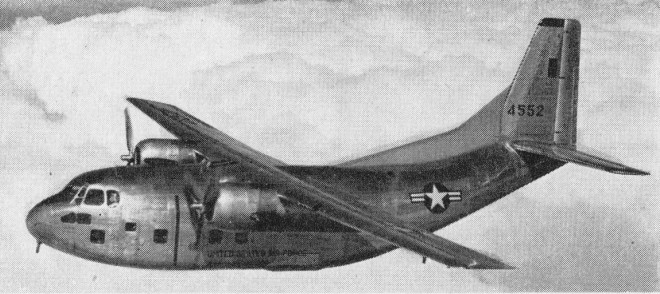
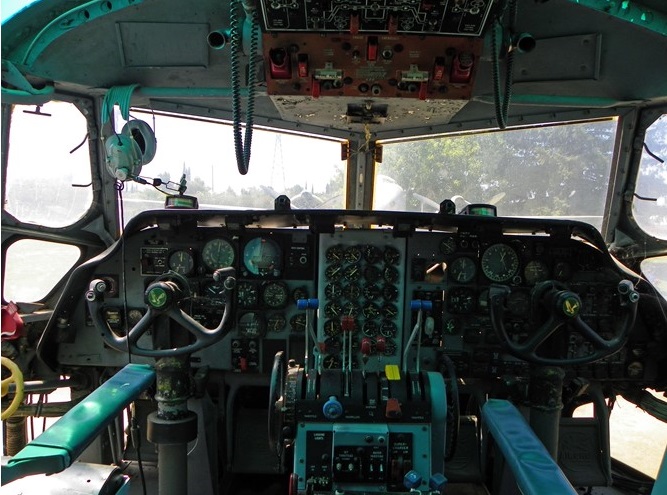
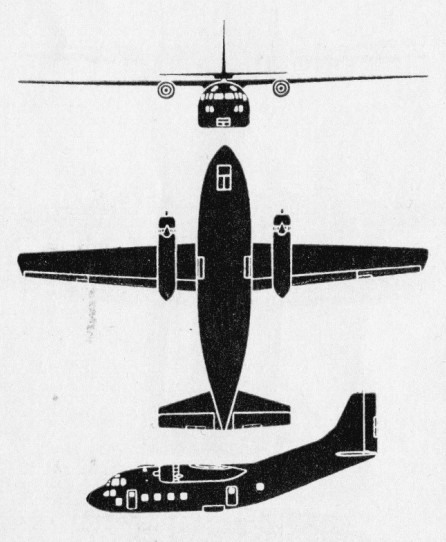
Chase Aircraft developed the larger C-123 Avitruc, first flown 14 October 1949, derived from XG-20 cargo glider. Chase Aircraft constructed the first five examples before Fairchild took over production. Taken over by Fairchild as C-123B and renamed Provider. An XC-123A prototype (four General Electric turbojets) flew on April 21,1951: first flight of a U.S. transport powered by jet engines. Chase became wholly owned subsidiary of Willys Motors Inc. of Toledo, Ohio, in 1953, itself owned by Kaiser- Fraser.
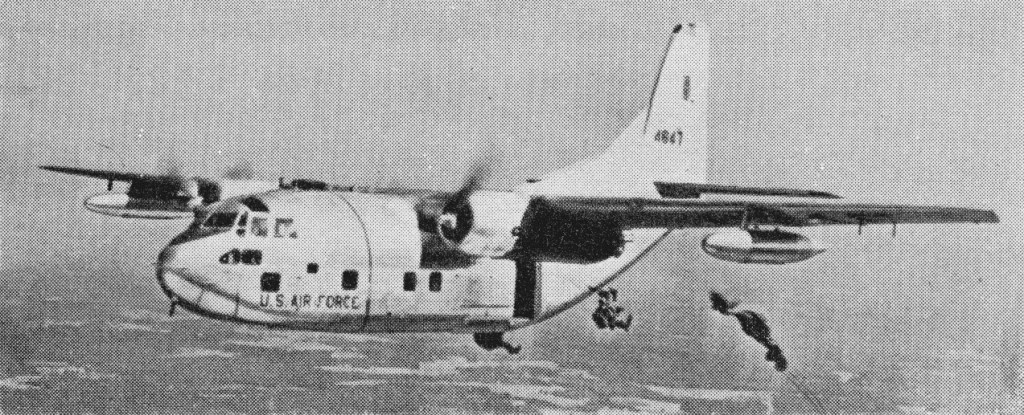
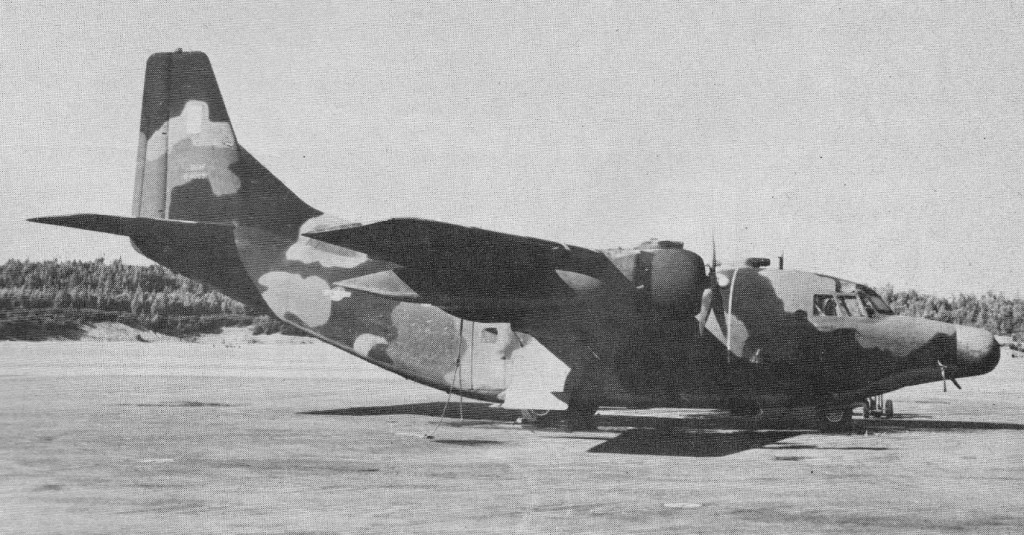
A production order for 300 C-123B, held by the Kaiser-Frazer Corporation (which had acquired a majority interest in the Chase company in 1953), was cancelled in June 1953. New bids were asked for, as a result of which production of the C-123B was assigned to Fairchild. The first Fairchild-built C-123B flew on 1 September 1954 and production aircraft entered service with the USAF’s 309th Troop Carrier Group in July 1955. Orders totalling more than 300 aircraft were completed by mid-1958, six going to Saudi Arabia and 18 to Venezuela.
The M.205 was designated C.123B, H and J.
In 1955 the prototype C-123B was fitted experimentally with two Fairchild J44-R-3 1000-lb static thrust turbojet engines mounted at the wingtips to provide auxiliary power for use in an emergency. As a result ten production aircraft were modified into C-123J with P&W 2,500 bhp R-2800-99W radials and turbojet engines fitted. Meanwhile a small number of C-123H had been produced with wide-track landing gears.
The prototype YC-123H was later experimentally fitted with CJ610 auxiliary turbojet engines and flown on 30 July 1962. After successful tests of a prototype C-123H Provider with jet pods in Viet Nam operations in 1963, the USAF wanted to modify 40 to 50 C-123’s to add a pair of General Electric CJ610 jet engines of 2859 lb thrust to go with the C-123’s standard Pratt & Whitney R-2800’s. Funding may not have been available because of heavy expense of B-52 modification. 183 more C-123B were given 12.68kN General Electric J85-GE-17 auxiliary turbojet engines in underwing pods and designated C-123K (M.473). Some were further converted to AC-123K Spectre gunships for service during the Vietnam conflict.
One of two NC-123X modified into BLU ‘bombers’ for blasting enemy on the trail
The C-123 grossed out at 60,000 lbs and cruised on piston power at 160 knots.
C-123B
When C-123 production ceased on 31 July 1958, Fairchild had built 303, 138 more than the original contract called for.
By 1956, Stroukoff Aircraft Corporation had already gained experience working on the C-123 Provider, having completed two contracts based on that airframe. During November 1954 the Air Force assigned Stroukoff Aviation one of the Providers to be equipped with the system of boundary layer control.
Its YC-123D had introduced a Boundary Layer Control (BLC) system to the C-123B. With the aid of the turbocompressor air was selected from under the inboard flaps between the fuselage and the pods and was blown out through the slots above the ailerons and the outboard flaps. The modernized aircraft XC-123D successfully underwent tests, after showing low stalling speed, small takeoff and path. This greatly improved landing and take-off performance, gross weight capability, and lowered the C-123’s stall speed.
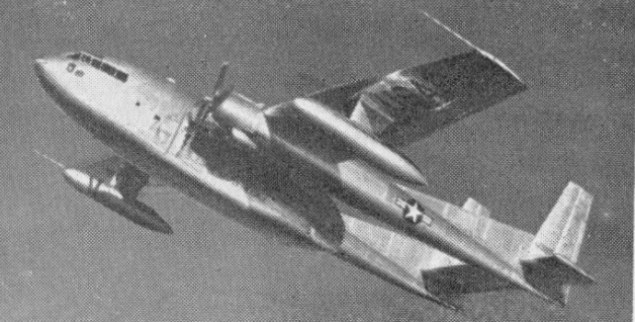
The Air Force hurried to give Stroukoff a contract to build a troop series of six XC-123D. However the head of the firm proposed a more attractive modification, finished in accordance with the advanced concept “Pantobase” (being rested everywhere). The aircraft had a pressurized fuselage, lower part of which were attached the form, which resembles the bottom of boat, usual chassis, two removed water skis even two underwing floats. It could be operated practically from any surface: the earth, water, ice, snow and sand.
The YC-123E had been another experiment in improving the C-123’s ability to operate wherever it might need to, introducing Stroukoff’s own Pantobase system: two high-stress skis fitted to the lower fuselage, wingtip mounted floats, along with sealing the fuselage itself. The first flight took place on 28 July, 1955 and this gave the YC-123E the ability to operate on water, as well as ice and snow, and with the BLC from the previous YC-123D, the new aircraft could effectively be operated from almost any runway surface available, and airstrips of shorter length.
Engines; 2 x P+W R-2800-99W, 1840kW Take-off weight; 27240 kg / 60054 lb Empty weight; 14100 kg / 31085 lb Wingspan; 33.6 m / 110 ft 3 in Length; 23.3 m / 76 ft 5 in Height; 10.4 m / 34 ft 1 in Wing area; 113.6 sq.m / 1222.78 sq ft Max. speed; 392 km/h / 244 mph Ceiling; 7000 m / 22950 ft Range w/max.fuel; 2350 km / 1460 miles Crew; 2
C-123B Assault transport. Engines: 2x Pratt & Whitney R2800-99W, 2500 h.p. Wingspan: 110 ft Length: 75 ft. 9 in Loaded weight: 71,000 lb Max. speed: 245 m.p.h. Ceiling: 29,000 ft. Typical range: 850 miles at 205 mph at 5,000 ft with full load. Crew: 2 Capacity: 61 troops or 16,000 lb cargo.
C-123J Engines: 2 x P&W R-2800-99W radials, 2,500 bhp & 2 x J44-R-3 turbojet, 1000-lb thrust.
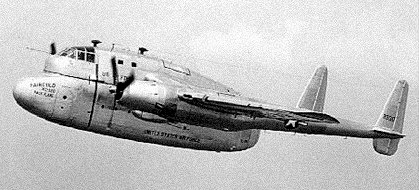
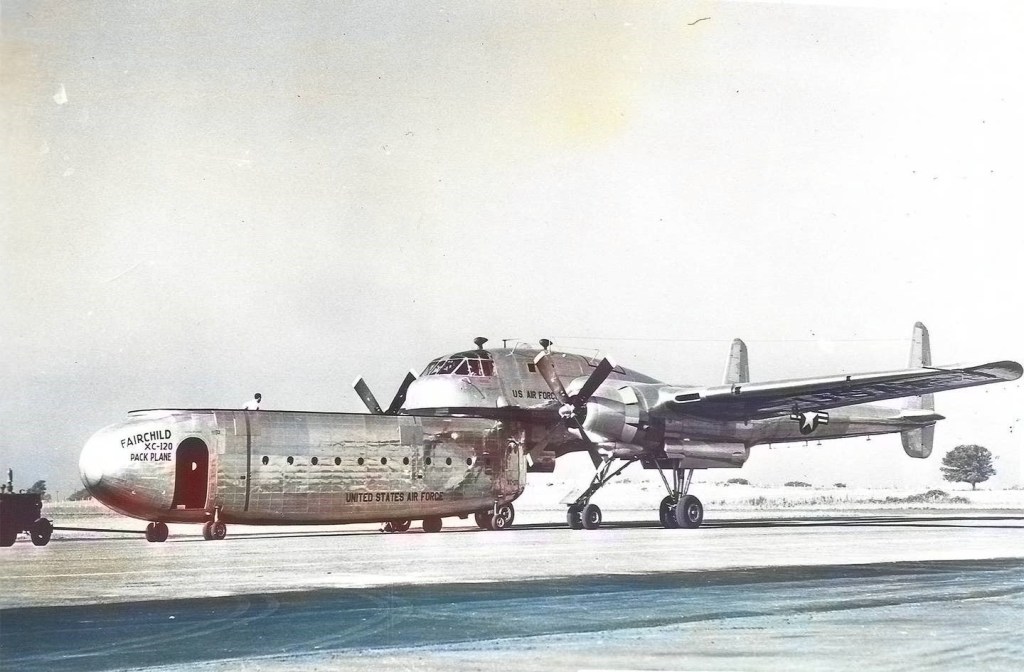
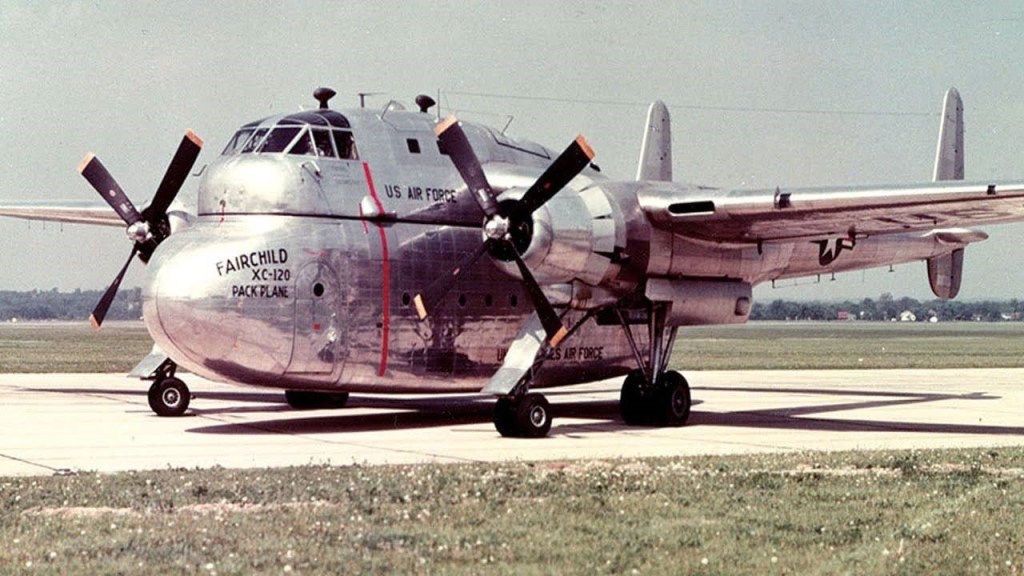
Recognizing that the loading and unloading process could become lengthy and keep aircraft on the ground for inordinately long periods of time, Fairchild engineers devised a modular cargo pod that, in theory, could be quickly and easily attached to and detached from the aircraft. The insect-like aircraft could fly with or without the cargo pod.
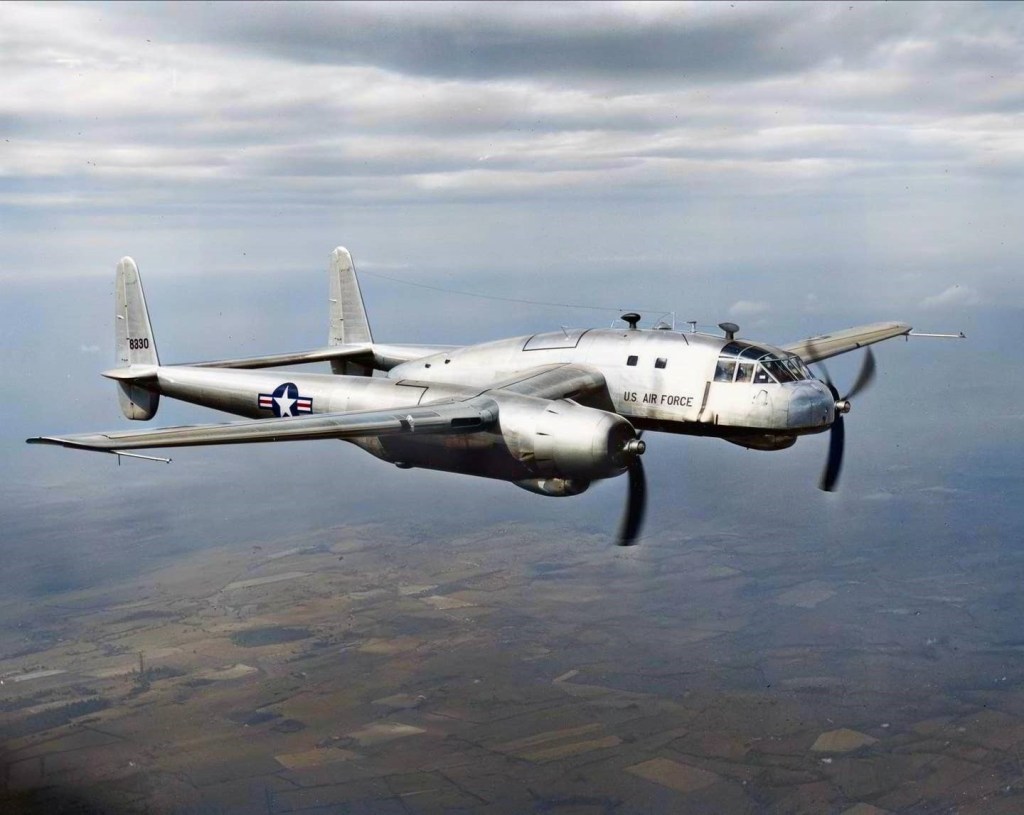
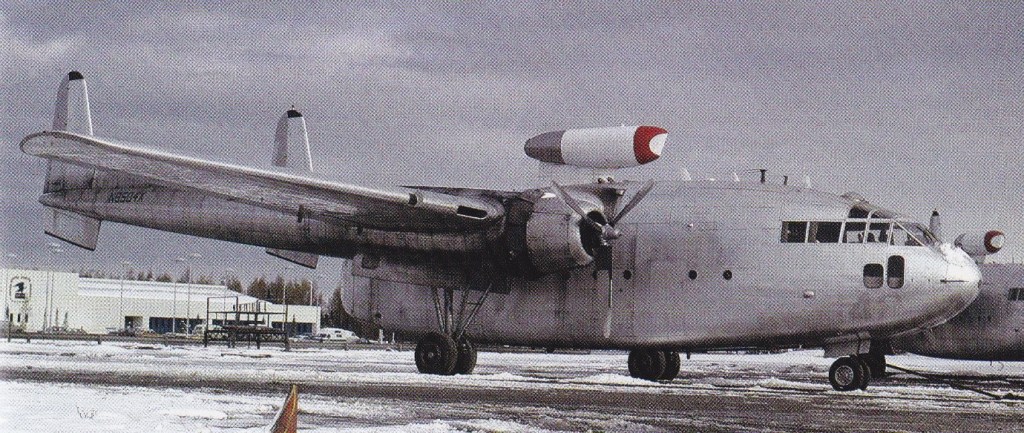
The conversion of one C-119B was to meet a USAF requirement for an experimental detachable-fuselage transport. C-119B wings and tail surfaces were combined with a new upper fuselage with a flat surface. A lower component with a flat upper surface, and incorporating a cargo compartment, could be mated with the Packplane.
The flight deck was in the upper component, and the type could be flown with or without pack and it was intended that various packs for different military operations would be provided.
When an aircraft arrived, crews could quickly disconnect the cargo pod it was carrying and reattach a preloaded pod in its place. This would minimize the amount of time the aircraft spent on the ground, theoretically moving more cargo over the course of a day.
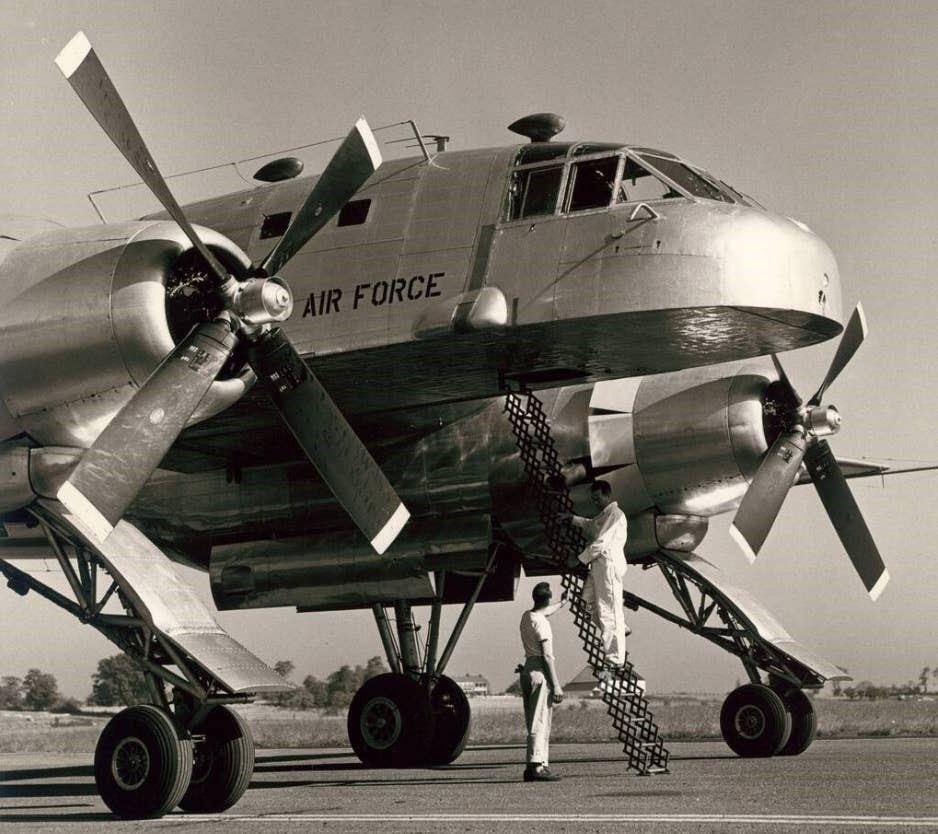
The quadricycle landing gear solved the problem of loading and unloading the cargo pod but presented new problems, particularly with ground towing. Special equipment was required to keep both front wheels tracking parallel to each other when backing up. This equipment could be carried in a pod but had to be left behind when flying without a pod attached. The unique landing gear also precluded “power backs,” or utilizing reverse thrust to back the aircraft up on the ground.
Aerodynamically, it also presented some challenges. Test crews discovered insufficient lateral and directional control at low speeds. Notably, during takeoff, the aircraft’s left-turning tendency could not be overcome by full right rudder. Their solution was to utilize asymmetric power until reaching 35 knots, at which point full power could be applied. The unique landing gear also had to be retracted immediately after liftoff, as it produced large amounts of drag during the retraction sequence.
First flown on 11 August 1950, flight test reports indicate that at a power setting of 2260 BHP, the XC-120 with a pod installed cruised at 218 knots—only 14 knots slower than flight without the pod. The pod weighed approximately 9,000-10,000 pounds. Test pilots also noted that the wheel-well doors were hanging approximately one and a quarter inches open in flight during the entire test program, but this would have been the case with or without a pod attached.
With the pod attached, the absolute ceiling with one engine inoperative at 63,000 pounds (1,000 pounds below maximum takeoff weight) was only 3,300 feet. Under the same conditions, the maximum rate of climb at 2,000 feet was between 10 and 50 feet per minute.
Note the bulges beneath the engines, necessary to contain the retracted forward wheels of the landing gear.
Evaluation crews discovered that attaching or removing the pod required an “unusual” amount of time due to the slow hoist mechanism, and doing so in high or gusty winds proved challenging, requiring even more time.
In 1952, only a couple of years after the XC-120’s first flight, the program was cancelled, and the sole XC-120 was ultimately scrapped.
XC-120 Engine; 2 x Pratt & Whitney R-4360-20, 2435kW Wingspan; 33.3 m / 109 ft 3 in Length; 25.3 m / 83 ft 0 in Height; 7.6 m / 24 ft 11 in Crew; 5 Passengers; 66
During 1947 Fairchild developed an improved version of the C-82, the XC-82B prototype being a conversion from a production C-82A. It differed primarily by having the flight deck resited into the nose of the aircraft and the installation of 1976kW Pratt & Whitney R-4360-4 Wasp Major 28-cylinder radial engines.
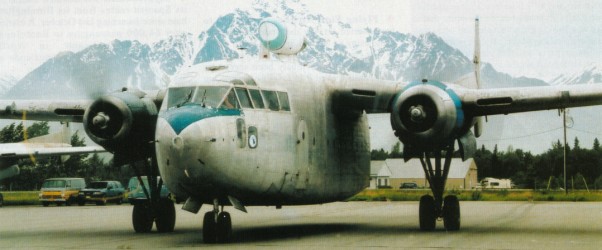
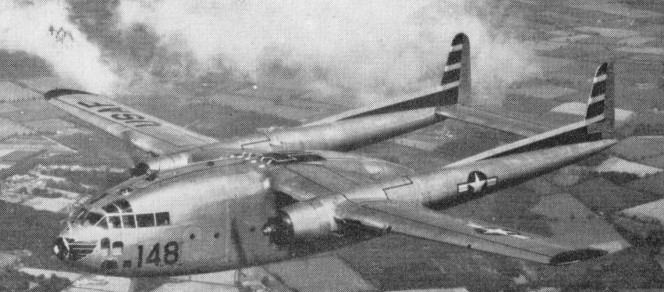
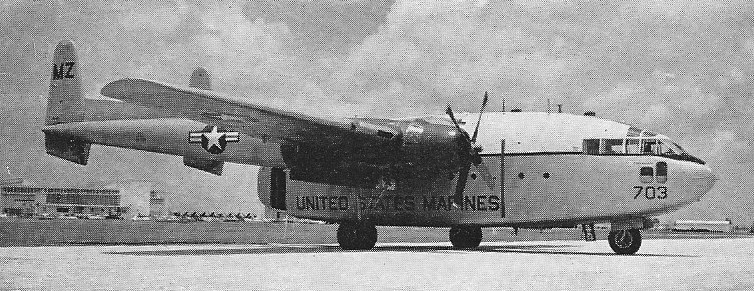
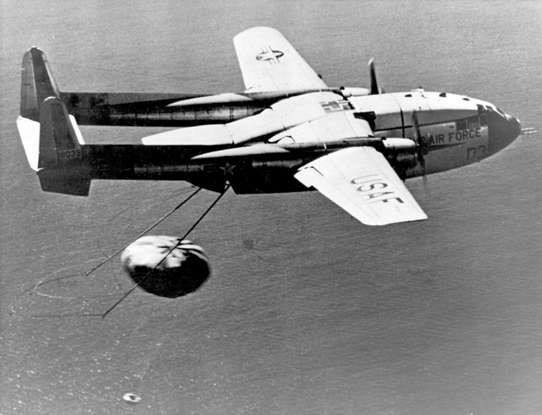
The M.105 was designated XC.119A Following service tests the M.110 was ordered into production as the C-119B Flying Boxcar (55 built), these having the fuselage widened by 0.36m, structural strengthening for operation at higher gross weights, and more powerful R-4360-20 engines, and M.110 / C.119C. Accommodating up to 62 paratroops, and with increased cargo capacity, the C-119s serviced during operations in Korea and Vietnam. C-119s also served with the air forces of Belgium, Brazil, Ethiopia, India, Italy, Nationalist China and South Vietnam, many supplied under the Military Assistance Program.
C-119F
In addition, some surplus military aircraft, both C-82s and C-119s, were acquired by civil operators.
The Fairchild AC-119G ‘Shadow’ and AC119K ‘Stinger’ gunships were a stop-gap replacement for the AC-47 as there were not enough spare C-130s around for conversion at the time, under the AC-130 Gunship 2 programme.
The C-119G is similar to the C-119F but has Aeroproducts airscrews. The C-119B and -G are designated R4Q-1 and -2 by the US Marines.
C-119G
The AC-119G was armed with four 7.62mm minigun pods and used for the support of troops in contact with the enemy and for airbase defence. It was about 25 per cent more effective than the AC-47. The AC119K, with its additional pair of underwing jet pods and improved armament in the shape of two 20mm cannon to supplement the four miniguns, was used exclusively in the truck-hunting role over the Ho Chi Minh Trail. The first AC-119G ‘Shadow’ squadron arrived in Vietnam in November 1968 and the first AC-119K ‘Stinger’ squadron a year later in November 1969.
The M.160 was designated C.119H. The C-119H was an extensively redesigned version of the C-119 Packet with 2 x 3500 h. p. Wright Turbo-Cyclones, increased wing and tailplane span, and all fuel carried in external underwing tanks. Payload increased to 27,200 lb. No production order.
C-119H Skyvan
In the early 1950s, the number of Fairchild employees reached approximately 10,000 who built 1112 C-119s between 1948 and 1952.
In 1961 Steward-Davis Inc. of Long Beach, California, developed a Jet-Pak conversion for C-119 aircraft. This involved the installation of a 1542kg thrust Westinghouse J34-WE-36 turbojet engine in a specially-developed nacelle mounted on the upper surface of the wing centre-section.
At least 26 Indian Air Force C-119s had a more powerful HAL-built Orpheus jet pod to enable them to operate with greater payloads under ‘hot and high’ conditions.
In 1967 Steward-Davis built the Stolmaster C-119 conversion with quick-attach J34 jet-paks, registered N383S.
C-119F Engines: 2xWright R3350-85WA, 3350 h.p. Wingspan: 109 ft. 3 in. Length: 86 ft. 6 in. Loaded weight: 72,800 lb Max. speed: 270 m.p.h. Ceiling: 22,000 ft. Typical range: 2,300 miles at 205 m.p.h. Crew: 4 Passenger capacity: 42-78.
C-119G Engines; 2 x Wright R-3350-85, 2610kW Max take-off weight; 33747 kg / 74400 lb Empty weight; 18136 kg / 39983 lb Wingspan; 33.3 m / 109 ft 3 in Length; 26.37 m / 86 ft 6 in Height; 8.0 m / 26 ft 3 in Wing area; 134.43 sq.m / 1446.99 sq ft Max. speed; 470 km/h / 292 mph Cruise speed; 322 km/h / 200 mph Ceiling; 7300 m / 23950 ft Range w/max.fuel; 3669 km / 2280 miles Crew; 5
C-119G Engines; 2 x Wright R-3350-32W, 3599 hp Empty weight; 38,751 lb Normal loaded weight: 64,000 lb Max take-off weight; 72,800 lb Max. speed; 296 mph at 17,000 ft / 258 mph at SL ROC; 800 fpm Range w/max.fuel; 3480 miles Wingspan; 33.3 m / 109 ft 3 in Length; 26.37 m / 86 ft 6 in Height; 8.0 m / 26 ft 3 in Wing area; 134.43 sq.m / 1446.99 sq ft
C-119H Skyvan Engines: 2 x 3500 h. p. Wright Turbo-Cyclone Span: 148 ft Weight: 85,900 lb Cruising Speed: 190 mph Payload: 27,200 lb
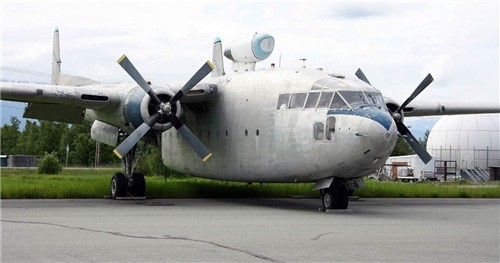
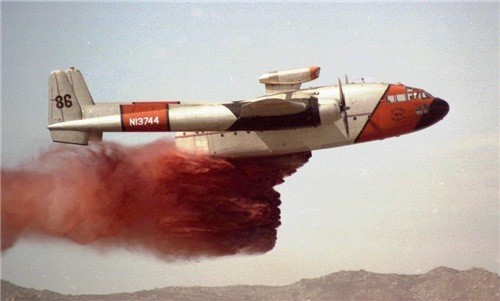
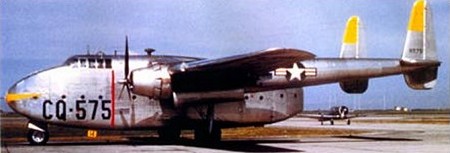
For a US Army requirement of 1941 for a specialised military freighter, Fairchild began work on the design of its Fairchiid F-78. Following approval of the design and a mock-up in 1942, a contract for a single prototype was awarded and the designation XC-82 allocated.
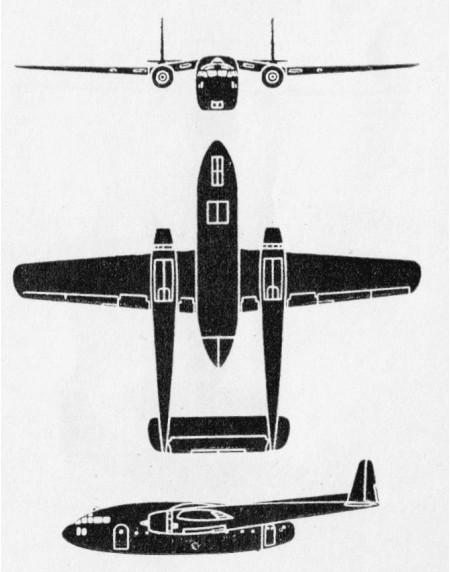
The XC-82 was a cantilever high-wing monoplane of all-metal construction, the fuselage incorporated a flight deck for a crew of five and a large-capacity cabin/cargo hold with clamshell doors at the rear to provide easy access for wheeled ortracked vehicles. The rear doors could be removed completely for the deployment of heavy loads by parachute extraction techniques, could accommodate 78 persons for emergency evacuation, 42 fully-equipped paratroopers or 34 stretches.
The undercarriage was a retractable tricycle and power was two 1566kW Pratt & Whitney R-2800-34 Double Wasp 18-cylinder radial engines in wing-mounted nacelles. Extending aft from these nacelles were tail-booms carrying twin fins and rudders and united at the rear by the tailplane mounting a single elevator.
First flown on 10 September 1944, the US Army Air Force placed an initial contract for 100 C-82A aircraft, named Packet. The first were delivered for evaluation in 1945 and a contract for 100 more followed.
Fifty-two were modified as AC-119G Shadow and AC-119K Stinger gunships.
Because of wartime demands a second production line was laid down by North American Aviation at Dallas, Texas, but from a contract for 792 C-82N only three were completed as North American NA-135 before the contract cancellations that followed VJ Day. Fairchild eventually built a total of 220 with deliveries ending in 1948.
The Packet serviced to the USAF’s Tactical Air Command and Military Air Transport Service until it was retired in 1954.
During 1947 Fairchiid developed an improved version of the C-82, the XC-82B prototype being a conversion from a production C-82A. It differed primarily by having the flight deck resited into the nose of the aircraft and the installation of 1976kW Pratt & Whitney R-4360-4 Wasp Major 28-cylinder radial engines. Following service tests it was further modified and ordered into production as the C-119B Flying Boxcar.
In 1964 Steward-Davis Inc converted C-82A N74127 to a Skytruck I with higher weights, performance, and hot-air de-icing system. The MTOW increased to 60,000 lb.
The 1965 Steward-Davis Inc Skypallet was a C-82A design with the fuselage floor separating from the aircraft from nose to tail for large cargoes, and fitted with an internal hoist. One was converted; N4828V.
C-82A Engines; 2 x Pratt & Whitney R-2800 Double Wasp, 1566kW Wingspan; 32.46 m / 106 ft 6 in Length; 23.5 m / 77 ft 1 in Height; 8.03 m / 26 ft 4 in Loaded weight; 24300 kg / 53573 lb Max. speed; 400 km/h / 249 mph Cruise speed; 260 km/h / 162 mph Ceiling; 8000 m / 26250 ft Range w/max.fuel; 3400 km / 2113 miles Crew; 5 Payload; 78 passangers or 42 paratroopers
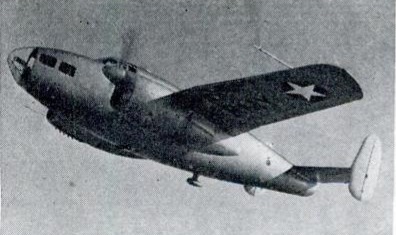
The increasing importance and complexity of multi-engined aircratt fitted with power-operated turrets compelled the development for the USAAF of a specialist trainer. The all-plywood XAT-13 medium bomber crew trainer with two 447-kW (600-hp) R-1340-AN-1 radials, a ball-mounted nose gun, a turret-mounted dorsal gun, a small bomb bay and, in addition to an instructor, stations for a pilot, bomb-¬aimer, navigator, gunner and radio operator, met that requirement.
The USAAC ordered two specialised gunnery trainer prototypes from Fairchild. The first (XAT-13) was intended to provide team training for a bomber aircraft’s entire crew, and this aircraft was powered by two Pratt & Whitney R-1340-AN1 Wasp 9-cylinder radial engines.
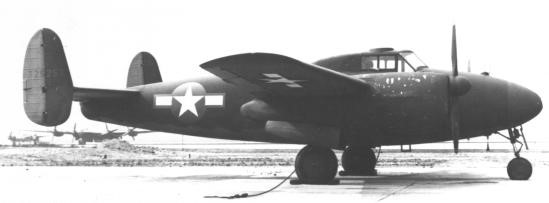
The second prototype (XAT-14) was of similar layout and powered by two 388kW (520-hp) Ranger V-770-6 inline engines. It was adapted subsequently as a specialised trainer for bomb-aimers, with its defensive guns removed, under the designation XAT-14A. Testing and evaluation of these aircraft resulted in the procurement of a specialised gunnery trainer under the designation AT-21 Gunner.
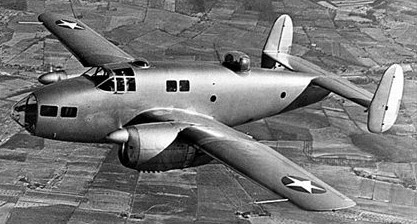
A cantilever mid-wing monoplane of mixed construction, the AT-21 had a deep oval-section fuselage, a tail unit incorporating twin fins and rudders and retractable tricycle landing gear. Accommodation was provided for a crew of five, including pilot, co-pilot/gunnery instructor and three pupils.
The AT-21 production type, was optimised for gunnery training with a two-gun turret but no bomb bay.
AT-21-BL
Of the 175 AT-21s constructed, 106 were built by Fairchild and, to speed deliveries to the USAAF, 39 were built by Bellanca Aircraft Corporation and 30 by the McDonnell Aircraft Corporation at St Louis. Entering service with newly-established air gunnery schools, the AT-21s remained in service until 1944, when they were displaced by training examples of the operational aircraft in which the air gunners would eventually serve. Many of these surplus aircraft were then converted for use as target tugs.
XAT-13 Engines: 2 x R-1340-AN-1 radials, 447-kW (600-hp).
XAT-14 Engines: 2 x Ranger V-770-6 inlines, 388-kW (520-hp).
AT-21 Engine; 2 x Ranger V-770-11/-15, 388kW / 513 hp Max take-off weight: 5129 kg / 11308 lb Empty weight: 3925 kg / 8653 lb Wingspan: 16.05 m / 52 ft 8 in Length: 11.58 m / 38 ft 0 in Height: 4.0 m / 13 ft 1 in Wing area: 35.12 sq.m / 378.03 sq ft Wing loading: 29.93 lb/sq.ft / 146.0 kg/sq.m Max. speed: 195 kts / 362 km/h / 225 mph Cruise speed: 170 kts / 315 km/h / 196 mph Service ceiling: 6750 m / 22150 ft Cruising altitude: 12008 ft / 3660 m Range: 791 nm / 1460 km / 907 miles Armament: 3x MG cal.30 (7.62mm) Seats: 5
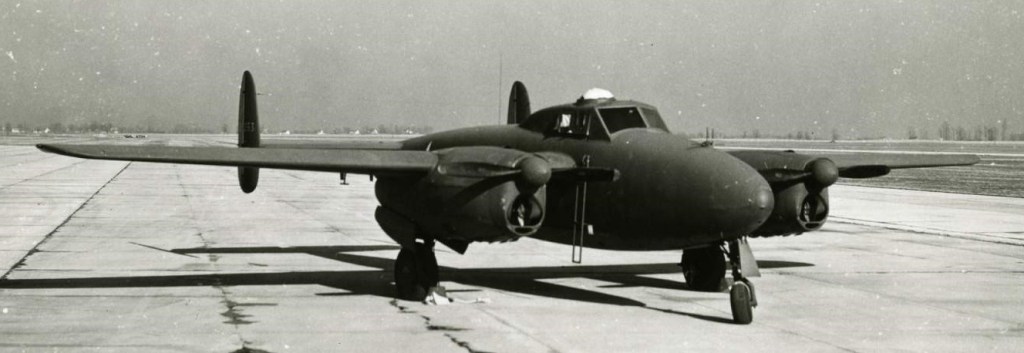
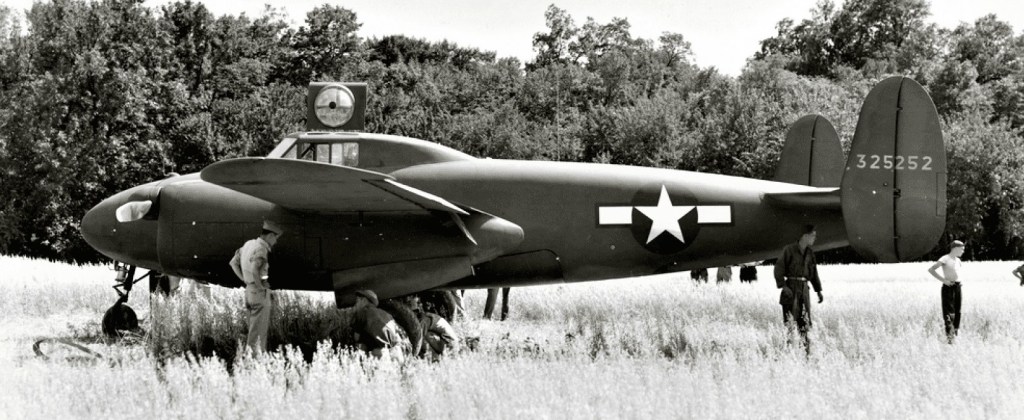
The Fairchild BQ-3, Model 79, was an early expendable unmanned aerial vehicle – referred to at the time as an “assault drone”. Development of the BQ-3 began in October, 1942, under a program for the development of “aerial torpedoes” that had been instigated in March of that year. Fairchild was awarded a contract for the construction of two XBQ-3 prototypes, based largely on the AT-21 Gunner advanced gunnery trainer already in United States Army Air Forces service.
XBQ-3 Serial # 43-25253
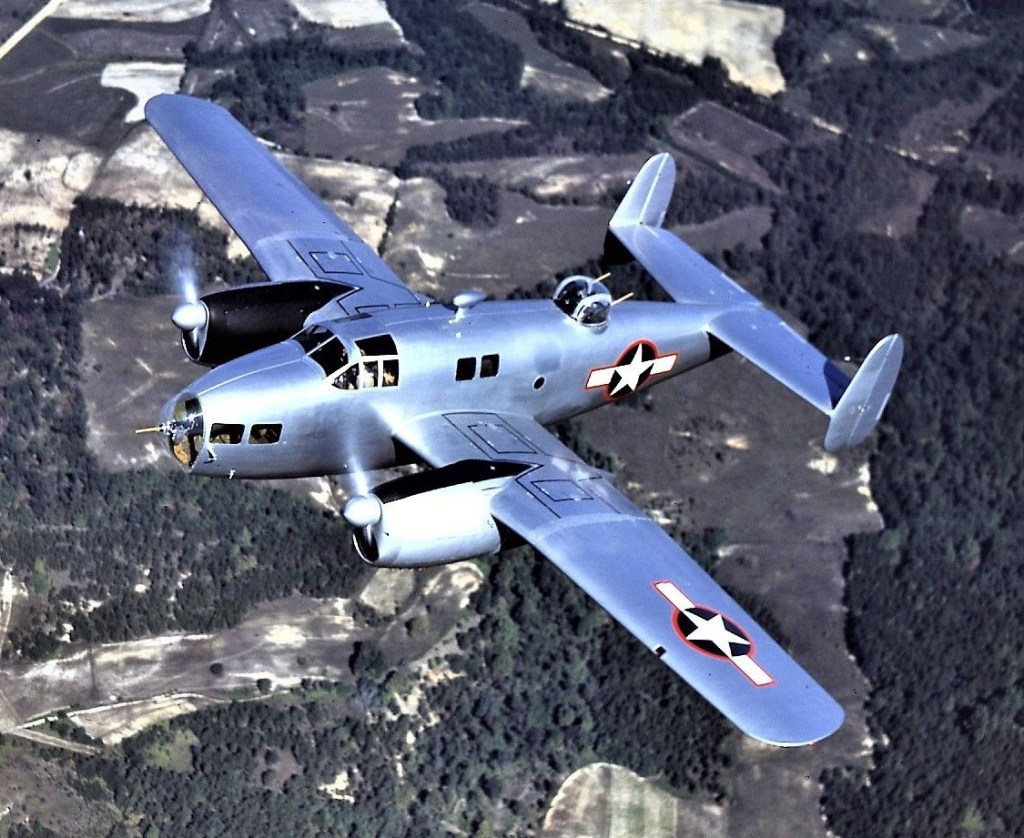
The XBQ-3 was a twin-engined, low-wing aircraft, fitted with retractable tricycle landing gear and a twin-finned empennage; although the aircraft was intended to be operated by radio control with television assist, a two-seat cockpit was included in the design for testing and ferry flights. Power was provided by two Ranger V-770 inline piston engines of 520 horsepower (390 kW) each; up to 4,000 pounds (1,800 kg) of explosives could be carried by the aircraft in unmanned configuration. The aircraft would be destroyed in the act of striking the target.
The first flight of the XBQ-3 took place in July 1944; later that month, one of the prototypes was severely damaged in a forced landing. Despite the accident, flight testing continued; however, the assault drone was determined to have no significant advantage over conventional bombers, and advances in the field of guided missiles were rapidly rendering the concept obsolete. As a result, the program was cancelled towards the end of 1944.
XBQ-3 Engines: 2 × Ranger V-770-15, 520 hp (390 kW) each Wingspan: 37 ft (11 m) Length: 52 ft 8 in (16.05 m) Height: 31 ft 1 in (9.47 m) Gross weight: 15,300 lb (6,940 kg) Maximum speed: 220 mph (350 km/h, 190 kn) Range: 1,500 mi (2,400 km, 1,300 nmi) 4,000 pounds (1,800 kg) warhead Crew: 1 (optional)





 All Aero